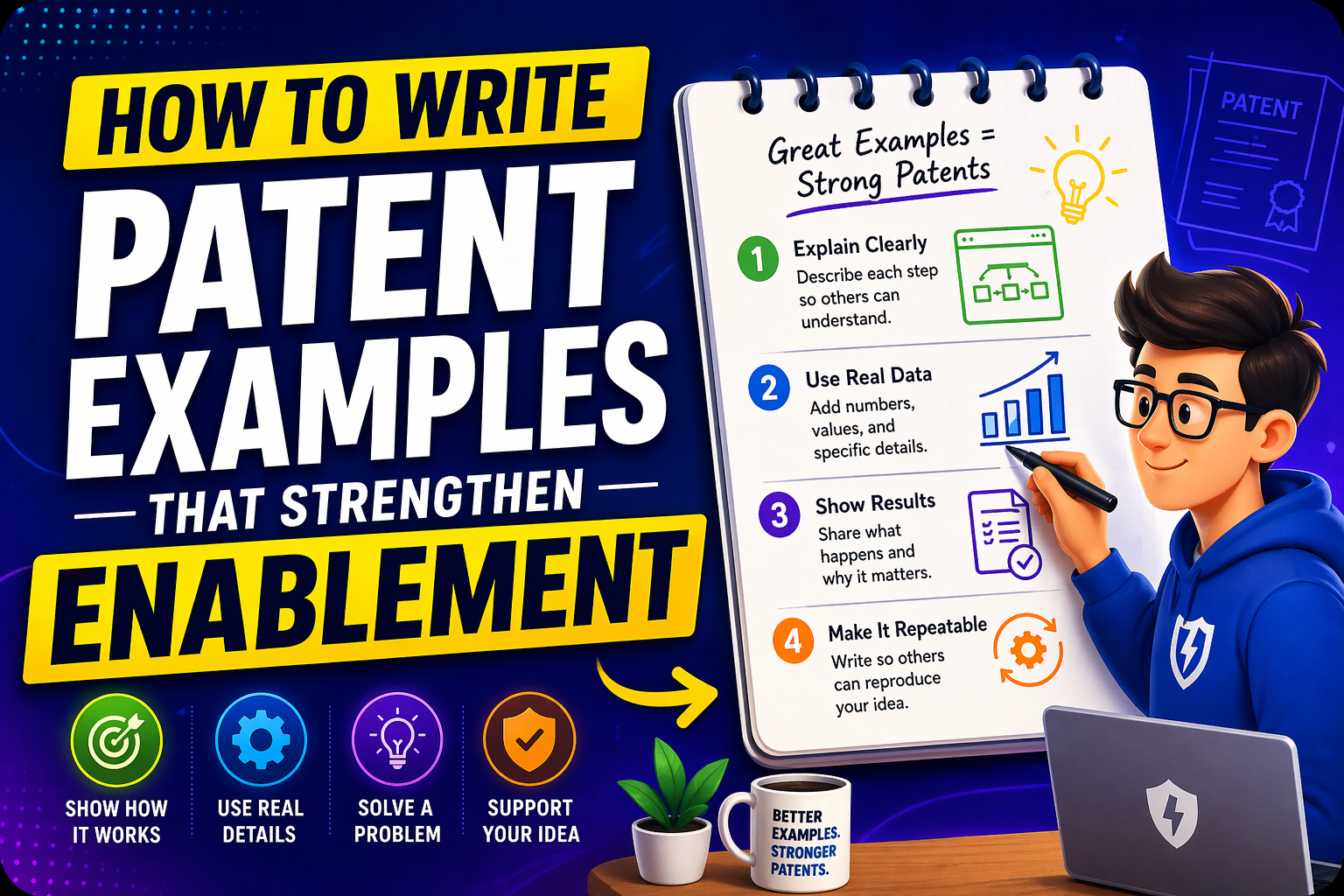
A patent is only strong if it teaches. That is the heart of enablement.
You cannot just say what your invention does. You need to show how a real person could make it and use it. That is where examples matter. Good examples make your patent clearer, safer, and harder to attack. They turn big claims into something concrete. They help the reader see the invention in action. They also help prove that you truly built something real.
For startup founders, engineers, and inventors, this is a big deal. Many smart people write patent drafts that sound impressive but stay too high-level. The result is a filing that looks polished on the surface but leaves too much open underneath. That gap can become a problem later.
This article will show you how to write patent examples that do real work. We will cover what enablement means, why examples help so much, how to write examples that are broad without being vague, and how to avoid the common mistakes that make a patent weaker instead of stronger. Along the way, you will see how to think like both a builder and a careful patent drafter.
And if you want help turning your product, system, model, or workflow into a real patent application that is reviewed by real attorneys, PowerPatent was built for that. You can see how it works here: https://powerpatent.com/how-it-works
Why examples matter more than most founders think
A lot of founders think the key to a good patent is the claims. Claims matter, of course. They define what you are trying to protect. But the claims do not stand alone. They sit on top of the description. If the description does not support them well enough, the claims can wobble.
That is why examples are so powerful. Examples help your patent do three jobs at once.
First, they make the invention understandable. A good example takes an idea out of the clouds and puts it on the ground. It shows what goes in, what happens in the middle, and what comes out. It gives shape to something that might otherwise feel abstract.
Second, examples help show that the invention can really be practiced. This is the core of enablement. The patent system is built on a trade: you get a limited monopoly, and in return you teach the public how your invention works. If your filing does not teach enough, the bargain breaks.
Third, examples help support broader claim language. This is a point many founders miss. They worry that examples will make their patent too narrow.
In fact, well-written examples often do the opposite. They give the reader enough detail to understand the invention deeply, which can make broader claim language more believable and better supported.
Think of it like this. If your patent says, “A system that improves machine performance using adaptive model updates,” that sounds broad, but it may also sound thin. If your patent then gives several examples showing how adaptive updates work in different settings, with different model types, data inputs, thresholds, and deployment paths, the invention starts to feel real and flexible. The broad concept now has roots.
This is one reason founders who rush their patent disclosure often regret it later. They write just enough to describe the general idea, then move on. But a patent is not a pitch deck. It is not supposed to tease. It is supposed to teach.
That does not mean you need to drown the reader in every possible implementation detail. It means you need to choose examples that reveal the working core of the invention.
If you are building something technical and want a faster way to capture that core before details get lost, PowerPatent can help you organize the invention clearly and turn it into a stronger filing with attorney oversight. That process is explained here: https://powerpatent.com/how-it-works
What enablement really means in plain English
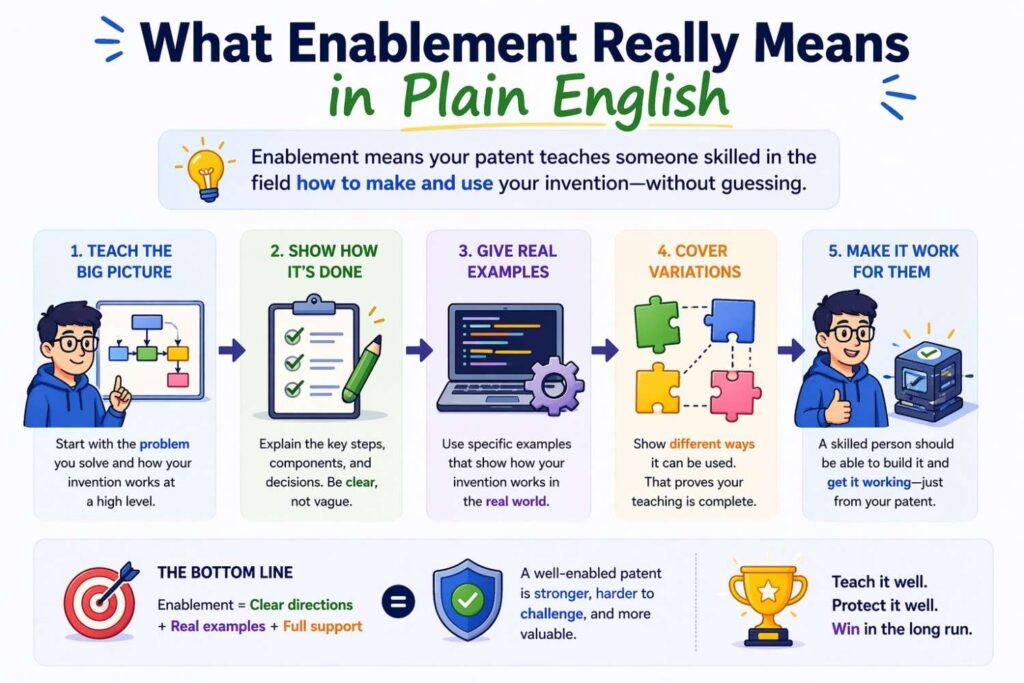
Enablement sounds like a legal word because it is one. But the idea is simple.
Your patent has to teach someone skilled in the field how to make and use the invention without making them do a giant research project first.
That is it.
The standard is not that any random person on the street could build it. The standard is closer to this: would a normal skilled person in that technical area understand enough from your patent, plus what people in that field already know, to practice the invention without too much trial and error?
This matters because many founders sit at one of two extremes.
At one extreme, they assume they must reveal every tiny thing. They panic and think the patent needs to read like a full internal handbook, full source code archive, and lab notebook all in one. That is not the standard.
At the other extreme, they write in a hand-wavy way and assume the reader will fill in the gaps. They think that because the invention makes sense to them, it must make sense to others. That is also not the standard.
Enablement lives in the middle. Your patent should reveal enough of the invention’s working structure, logic, and use so that a skilled person could carry it out.
The more unpredictable the field, the more detail you may need. The more cutting-edge the invention, the more careful you need to be. If the invention depends on a special training setup, a certain sequence of steps, a particular architecture, a new feedback rule, or a non-obvious hardware arrangement, then your examples should show that.
This is why examples are so important. They reduce guesswork.
A strong example answers silent questions the reader may have. What components are involved? In what order do they interact? What kind of inputs are used? What conditions trigger one branch versus another? What result is expected? Are there ranges, options, fallback modes, or alternate paths?
These are not just details for detail’s sake. They are clues that show the invention is not a slogan. It is a system.
Enablement is often easier to understand if you compare two short descriptions.
One weak version might say: the system detects suspicious network behavior and automatically adjusts security controls based on learned patterns.
That sounds useful, but it raises many questions. What data is used? What is a learned pattern here? How is suspicious behavior scored? What security controls are adjusted? Is the change automatic or recommended? What prevents overreaction? When does the system roll back the changes?
A stronger version might explain that the system collects traffic metadata from endpoint agents and gateway devices, extracts features such as request rate deviation, geographic variance, credential reuse signals, and unusual protocol shifts, applies a trained anomaly model to generate a confidence score, compares the score to a threshold selected based on asset sensitivity, and then triggers one of several actions such as rate limiting, session isolation, or credential challenge. It may further explain rollback conditions, retraining cadence, and example deployment settings.
Now the reader can see the moving parts. It is still broad enough to cover many forms of the invention, but it is no longer empty.
That is the work examples do. They teach the reader how the invention behaves in the real world.
The biggest myth: “Examples make my patent too narrow”
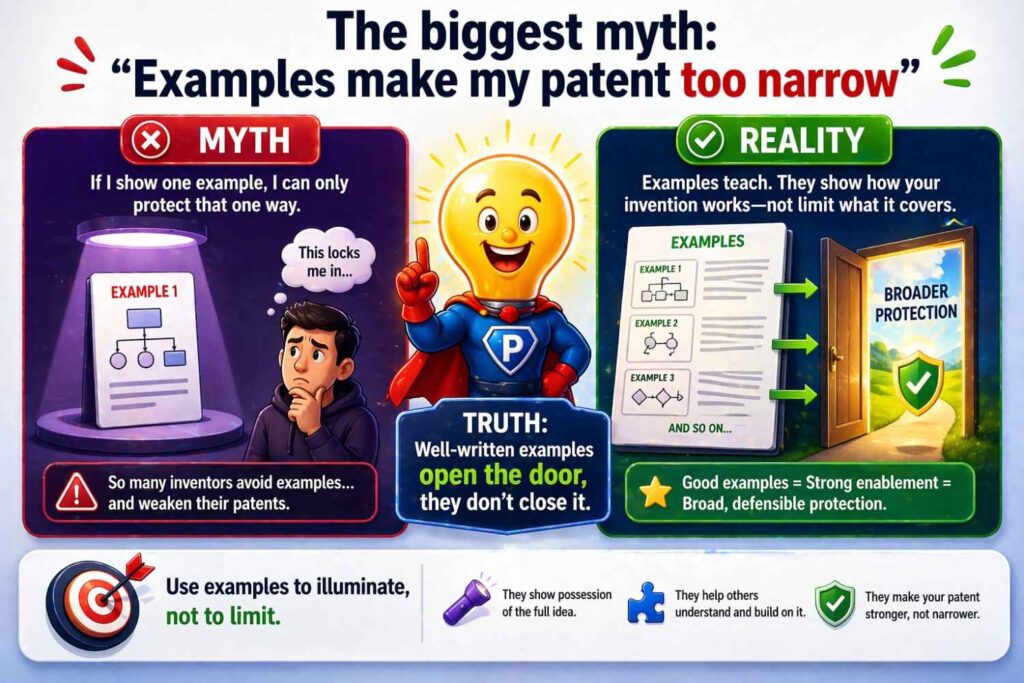
This fear stops many people from writing the kind of examples they need.
They think that if they describe one version in detail, a competitor can simply avoid that version and step around the patent. So they stay abstract on purpose. They speak in general terms and avoid specifics. They think they are staying broad.
Often, they are just staying unsupported.
A good patent usually includes both broad language and detailed examples. These are not enemies. They help each other.
The broad language defines the invention at a higher level. The examples show how that broad idea can actually be carried out. If you do this well, the examples make the broad language stronger. They do not trap you inside one exact build.
The key is how you write them.
If you write an example as though it is the only form of the invention, yes, that can create problems. If you use narrow language over and over, describe one embodiment as essential, or fail to mention alternatives, you may create a record that feels boxed in.
But that is not the same as writing examples. That is writing examples badly.
A better approach is to write examples as representative implementations. You can say that in some embodiments, a model receives time-series sensor data and outputs a control recommendation.
In other embodiments, the model may receive image data, event logs, user actions, or multi-modal input. In some implementations, the recommendation may be executed automatically. In others, it may be presented to an operator for approval. In certain cases, the threshold may be static. In others, it may be adjusted based on recent drift, risk level, or historical false positive rate.
Now you are giving detail without pretending that one path is the only path.
This is the art. Examples should be specific enough to teach, but framed in a way that keeps room around the invention.
Many strong patents use layered disclosure. They describe the broad concept, then the main system pieces, then one or more detailed flows, then variations on those flows, then optional enhancements. This gives the patent both spine and flexibility.
Founders often think broad means vague. In patents, vague can be weak. Broad is better thought of as well-supported room.
Examples create that room.
What a strong patent example actually does
A useful way to think about examples is that they are not there just to “illustrate.” They are there to carry weight.
A strong patent example usually does at least one of these things, and often several at once.
It shows a full working path from input to output.
It explains how parts of the invention interact.
It reveals conditions, thresholds, selections, or rules that help make the invention work.
It shows one problem and how the invention solves it.
It demonstrates variation without losing the core concept.
It helps support later claim language.
It makes the invention sound credible and complete.
Let us make that concrete.
Suppose you invented a system that helps a robotic arm sort mixed recyclable materials using visual data and dynamic grip control. A weak example might simply say that the system uses images to classify materials and adjust grip strength accordingly. That tells us almost nothing about how it really works.
A stronger example might explain that a conveyor-mounted camera captures image frames of incoming items, a classifier assigns each item to one of several categories such as clear plastic, colored plastic, aluminum, paper, or unknown composite, a depth sensor estimates object shape and position, a control module selects grip angle and force based on both category and shape confidence, and a feedback loop uses slippage detection during lift to update the grip setting for the next similar object in the batch.
The example may then describe how the system handles low-confidence classifications, overlapping items, or deformed containers.
That example does real work. It teaches the system. It also opens doors for claims about classification, sensor fusion, grip selection logic, slippage-based update loops, and more.
The stronger the example, the more your patent feels like it came from an actual builder.
That matters. Patent readers can often tell when a filing was written from real technical understanding versus abstract wishful thinking. Examiners can feel that difference. Litigators can feel it too. Judges and juries may feel it later if things go far enough.
Real examples show that the invention was truly possessed and understood.
Start with the invention’s beating heart
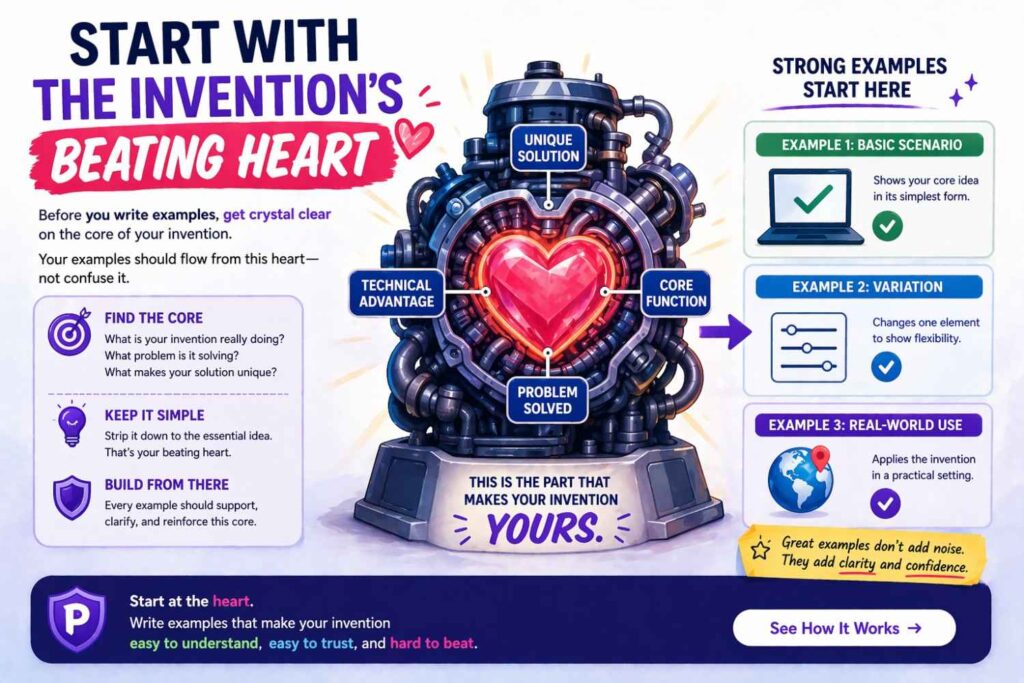
Before you write any example, you need to know the real center of your invention.
This is not always the product name. It is not always the user-facing feature. It is not the slogan.
The heart of the invention is the thing that makes it work in a new or better way.
Sometimes that is an architecture. Sometimes it is a sequence. Sometimes it is a feedback loop. Sometimes it is a data transformation. Sometimes it is a control rule. Sometimes it is a training method. Sometimes it is a hardware arrangement. Sometimes it is the way two known things are combined to create a new result.
If you do not know the heart, your examples will drift. They will include lots of detail but not the right detail. They may sound technical but still miss the invention.
A helpful question is this: what part of the system would a competitor need to copy, replace, or work around in order to get the same core benefit?
That is often close to the center.
Another helpful question is this: if you only had five minutes to explain why your solution is different from what came before, what would you point to first?
That is often close too.
Let us say you built a software platform that reduces cloud cost by moving jobs across compute types. The heart of the invention may not simply be “moving workloads.” That may be old.
The heart might be a prediction engine that estimates both completion risk and cost delta in real time, then applies a migration rule only within a bounded disruption window. Or it might be a staged checkpoint and resume mechanism that makes low-risk migration possible for jobs that used to be too brittle to move. Or it might be a combined scheduler that uses model confidence and infrastructure volatility together.
Once you find that heart, your examples should orbit around it. Every example should help the reader understand that center more clearly.
This keeps your writing from becoming random.
Many weak patent drafts fail not because they lack detail, but because they include detail that does not matter while skipping the mechanism that does.
That is why example writing is not just about adding more text. It is about choosing the right text.
The best examples follow a natural flow
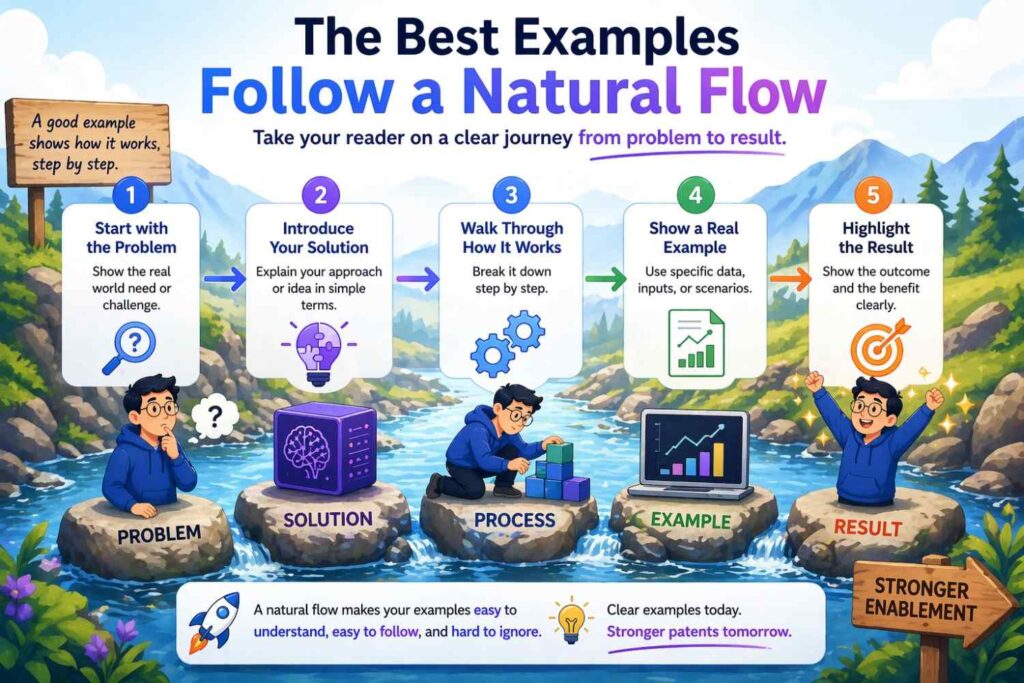
The easiest examples to read usually follow the same shape as real engineering work.
There is a setup. There is an input. There is a process. There is a decision or transformation. There is an output. There may be feedback, retry logic, or adaptation.
That flow feels natural because systems operate in time. Even if your invention is structural, like a hardware layout or data schema, readers still grasp it more easily when they can follow what happens.
So when you write examples, think in motion.
What exists at the start? What data, hardware, conditions, or actors are present? What happens first? What happens next? Where does the invention make a choice? What does that choice depend on? What comes out? What happens after that?
For a software invention, this might be a request flow.
For an AI invention, it might be an inference path and an update path.
For a medical device, it might be a sensing path and a treatment path.
For a manufacturing system, it might be a detection path and a control path.
For a cryptographic system, it might be a key generation path, an authentication path, and a fallback path.
When examples follow a real flow, enablement gets easier. The reader does not have to guess about sequence or interaction. The invention unfolds.
Let us say your invention is a fraud detection engine for real-time payments. A good example may begin with a payment request arriving at an authorization gateway. The engine extracts transaction features, user behavior signals, device data, recent account history, and network risk indicators.
A model generates a fraud score. A rules layer checks merchant class and transaction amount. A decision layer routes the payment into one of three paths: approve, deny, or step-up authentication. The example then describes how confirmed post-transaction outcomes are fed back to update thresholds or retrain a model. It may also explain how the system treats sparse-data users differently from established users.
This kind of example teaches much more than a paragraph that simply says the system uses machine learning to detect fraud.
Flow creates clarity. Clarity supports enablement.
How much detail is enough
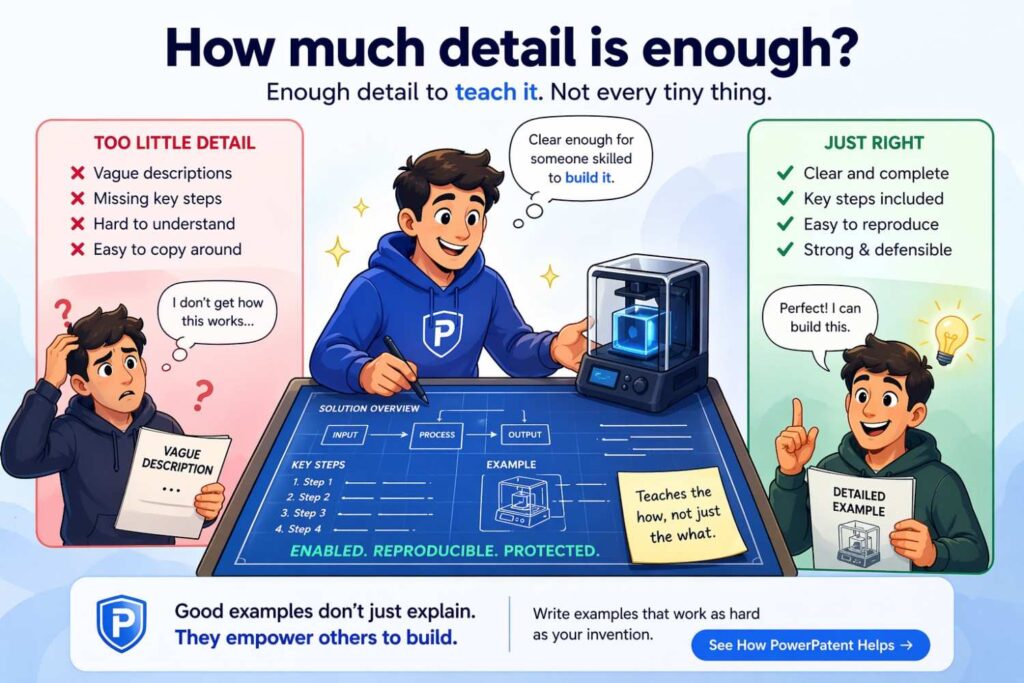
This is one of the hardest questions, and there is no magic number. But there are good ways to think about it.
You need enough detail to let a skilled person understand how to practice the invention without unreasonable guesswork.
That means the right amount of detail depends on the invention.
If the field is simple and predictable, less may be enough.
If the field is complex, unpredictable, or changing fast, you usually need more.
If your invention depends on a precise relationship between components, you should describe that relationship.
If your invention depends on specific parameter ranges, thresholds, training conditions, material choices, timing windows, or environmental limits, your examples should reveal those where useful.
If your invention works because of a non-obvious sequence, your example should show the sequence.
If your invention improves performance because of a feedback loop or dynamic adjustment, your example should explain when the adjustment happens and what drives it.
Founders sometimes ask whether they should include numbers. Often, yes. Not always as hard limits, but as examples, ranges, or sample conditions. Numbers can make an invention feel real. They can show that the process has been thought through. They can also help distinguish the invention from vague concepts.
For example, if your system rebalances battery loads across a fleet of storage modules, an example that mentions balancing every five seconds based on temperature spread greater than a threshold range may be much more useful than one that says the system adjusts based on operating conditions. The exact number may not need to be universal, but the reader learns what kind of system this is.
At the same time, detail should not become accidental narrowing. A useful habit is to pair detail with options. You can say that in one example, retraining occurs every 24 hours using labeled events from the prior interval.
In other examples, retraining may occur continuously, on demand, after drift detection, or after reaching a data volume threshold. In one implementation, a confidence threshold may be 0.82. In other implementations, the threshold may vary by asset class, user type, or false positive tolerance.
This gives the patent both grounding and range.
Another helpful test is to ask whether your example answers the hard parts. A weak example often spends a lot of time on things that any skilled person already knows and almost no time on the truly inventive part. A stronger example flips that. It may briefly mention standard components, then spend real attention on the new mechanism.
That is where the value is.
Examples should feel like they came from the build process
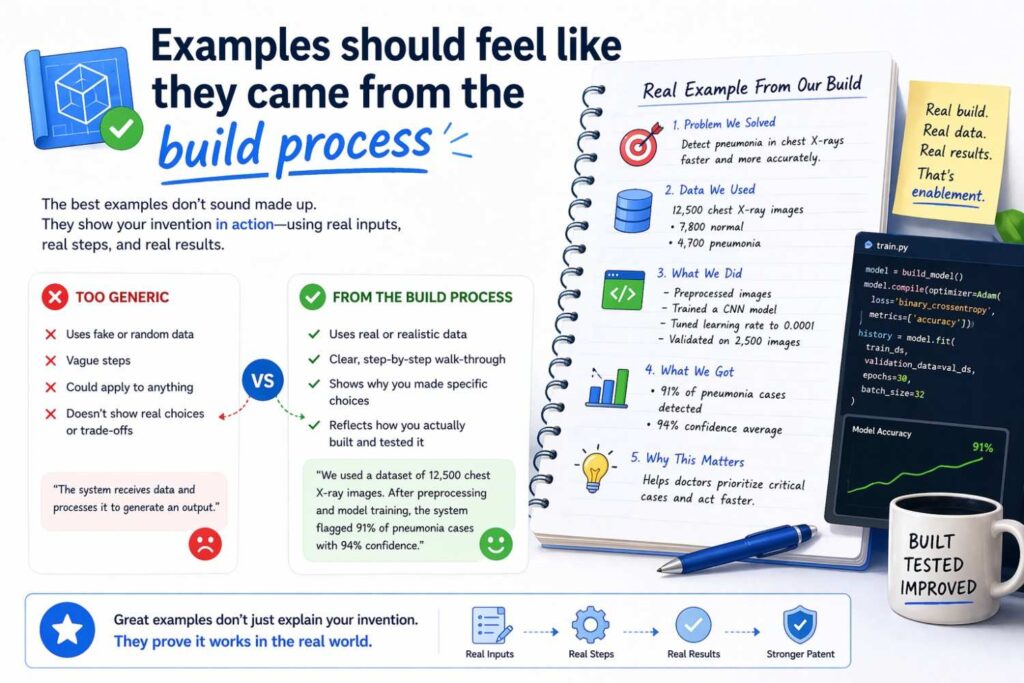
One of the best ways to write strong examples is to mine your real engineering work.
Do not start with a blank screen and ask, “What would sound patent-like?” Start with your actual system, tests, logs, diagrams, edge cases, and product choices.
What did you try first?
What broke?
What had to be tuned?
What sequence turned out to matter?
What input types had to be normalized?
What failure mode forced you to add a fallback?
What made the system stable enough to ship?
Those are gold.
Often, the best patent examples come from the moments when the invention became real. Maybe the model only became useful after you added a confidence decay rule. Maybe the device only became reliable after you changed where the sensor sat relative to the actuator.
Maybe the workflow only scaled after you split the pipeline into a fast pass and a deep pass. Maybe the user-specific adaptation only worked after you isolated one class of noisy signals.
These are not boring implementation details. They may be the invention, or part of it.
Many founders hide this richness because they think the patent should stay elegant and high-level. But real inventions are often won in the messy middle. Good examples bring that middle into view without drowning the reader.
A good exercise is to gather your build artifacts and ask which ones reveal the non-obvious truth of the system. Architecture diagrams, issue threads, experiment notes, performance comparisons, rollout plans, and internal docs can all surface example material.
Then translate that material into clean narrative form.
This is also where PowerPatent can be especially helpful for startups. Instead of forcing founders to become patent translators on their own, it helps turn the real technical story of what was built into something structured and filing-ready, with real attorney review to catch weak spots early. You can learn more here: https://powerpatent.com/how-it-works
Use more than one example when one is not enough
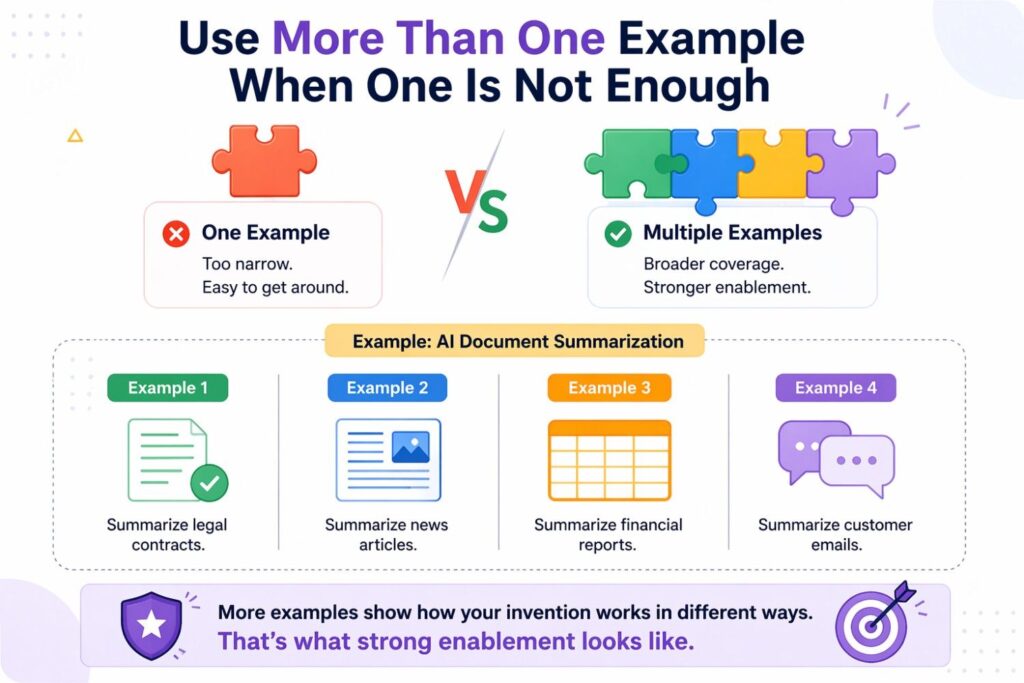
A common mistake is to write one polished example and stop.
That can be fine for a simple invention. But many modern inventions, especially in software, AI, robotics, networking, and systems engineering, do not reveal their full value through one scenario alone.
One example may show the basic operation. A second may show variation. A third may show edge handling. A fourth may show a different deployment context.
You do not need dozens. But you often need enough to show that the invention is not fragile.
Let us say your invention is a method for reducing latency in distributed inference. One example may cover the standard path where requests are routed across edge nodes based on current load and model fit.
A second example may show what happens when an edge node is unavailable and the system shifts to a compressed backup model. A third may show how the routing logic changes when privacy rules require local processing. A fourth may show how the system updates routing weights based on recent tail-latency spikes.
Each example teaches something different. Together they support a more complete understanding of the invention.
This is especially useful when your claims may later span several modes of operation. If the patent only teaches one mode in depth, broader claims may face support questions. But if the patent shows several representative modes, the disclosure becomes more resilient.
The trick is not to repeat yourself. Each example should earn its place. It should reveal a new angle, a new branch, a new setting, or a new advantage.
A good rule is this: if removing an example would not reduce the reader’s understanding, the example may not need to be there. But if an example shows the invention under a materially different condition, it may be doing important work.
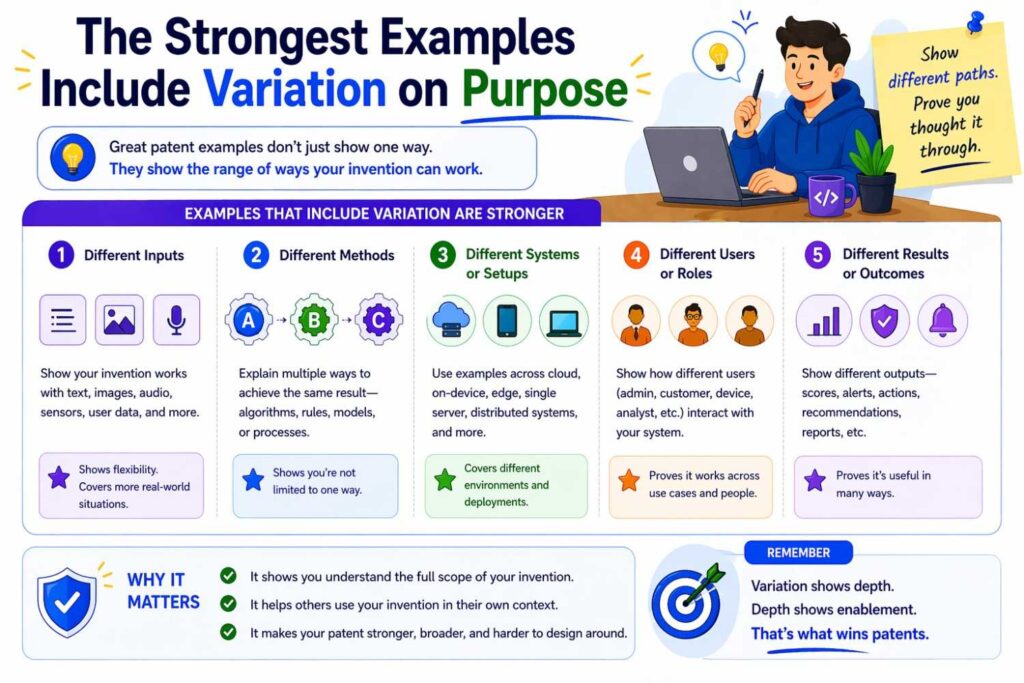
The strongest examples include variation on purpose
Variation is one of the secret weapons in patent writing.
A single example can teach one path. Variation teaches adaptability.
This matters because competitors often try to avoid patents by changing one detail and claiming they are outside the invention. Your specification cannot stop every design-around, but examples with thoughtful variation can help define the invention at the right level.
When you write examples, ask where the invention can vary without losing its core.
Can the input type vary?
Can the order vary?
Can the environment vary?
Can the scoring method vary?
Can the communication channel vary?
Can the hardware layout vary?
Can the feedback loop vary?
Can the output action vary?
Can the training source vary?
Can the control threshold vary?
If the answer is yes, say so, and where useful, show it through examples.
Suppose your invention is a system that predicts machine failure based on vibration and thermal data. Variation may include different sensor packages, different window sizes, different feature extraction methods, different prediction horizons, different intervention actions, and different deployment settings such as factory lines, field equipment, or vehicle fleets.
By writing examples that reflect some of these variations, you make clear that the invention is not limited to one narrow setup.
But variation should not be random. It should map to the core idea.
If your invention is really about a confidence-weighted maintenance trigger, then your variation should still revolve around how confidence is calculated, adjusted, and used. Do not wander into unrelated changes just to sound broad.
Useful variation is disciplined variation.
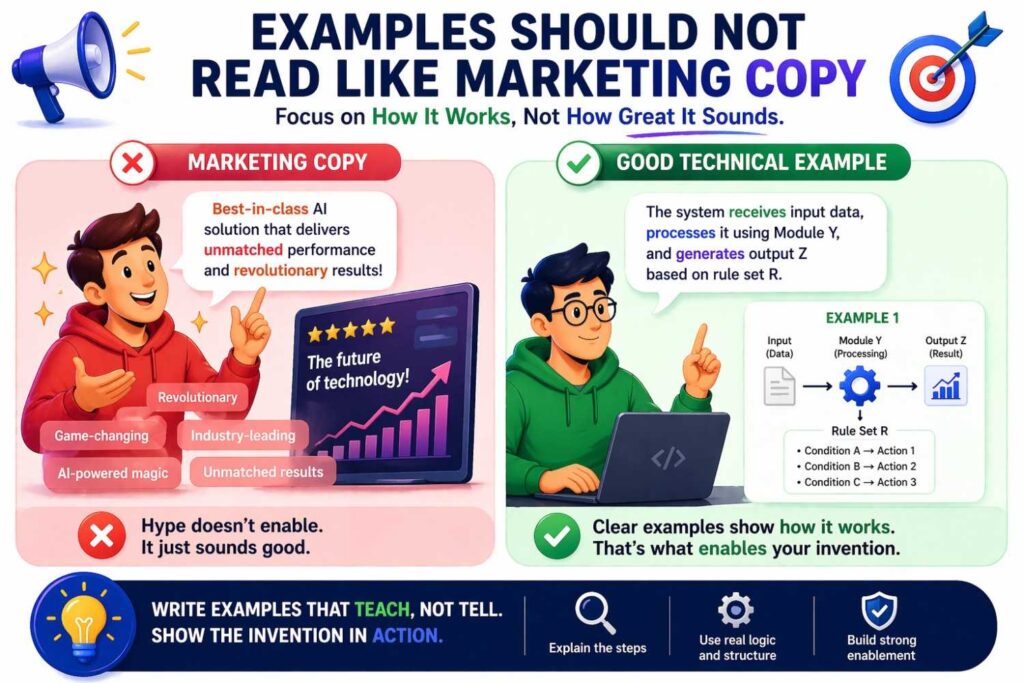
Examples should not read like marketing copy
This may sound obvious, but it is a real issue.
Founders are used to selling. They pitch investors, recruit talent, attract customers, and explain products every day. That instinct can leak into patent drafting. The result is writing full of praise words and benefit language but light on technical teaching.
A patent example is not a case study written for the homepage. It is not there to persuade with excitement. It is there to persuade with clarity.
So avoid overblown phrases like revolutionary, groundbreaking, seamless, state-of-the-art, next-generation, world-class, or highly efficient unless the text also explains why and how in plain technical terms.
Instead of saying the system intelligently optimizes resources in a highly scalable manner, say what the system actually does.
Maybe it predicts job duration, compares instance classes, checks checkpoint availability, and migrates workloads when expected savings exceed a threshold while estimated restart cost stays below another threshold.
That is much better. It sounds more serious because it is more real.
A patent that teaches well often sounds calm. It does not need hype. The substance does the convincing.
This is also why examples should avoid vague promises. Saying a process improves accuracy, lowers cost, increases speed, or enhances security is not enough. If those effects matter, show the mechanism that produces them and, where helpful, examples of conditions under which the benefit appears.
The best patent examples feel almost understated. They simply walk the reader through something that clearly works.
A simple structure you can use for almost any example
Most strong patent examples can be written using a repeatable pattern.
Begin by naming the setting. Explain what system, device, environment, or scenario the example is about.
Then explain the starting state. What components, data, actors, or conditions are present?
Then explain the process in sequence. What happens first, second, third, and so on?
Then explain the decision points. What choices are made? What rules, thresholds, model outputs, or conditions drive those choices?
Then explain the result. What happens at the end? What output, action, or state change occurs?
Then explain any variation, fallback, optional path, or feedback.
That is the basic frame.
You do not need to label these sections every time. In fact, the article you are writing inside the patent should usually feel smoother than that. But mentally, this frame helps keep examples complete.
Let us apply the pattern to an AI support tool used in enterprise workflows.
The setting might be a customer support platform that routes and drafts responses for incoming tickets.
The starting state might include a new ticket, a user account profile, prior conversation history, product usage logs, and a knowledge base.
The process might include classifying the ticket type, retrieving related help content, ranking candidate response actions, generating a draft response, and selecting an escalation path if confidence is low.
The decision points might include a threshold for direct reply versus human review, a rule for suppressing generated content in regulated contexts, and a confidence adjustment based on sparse user history.
The result might be that a draft response is sent to an agent queue with recommended next actions, or sent directly in low-risk settings.
The variation might include multilingual workflows, high-priority enterprise accounts, or failure handling when retrieval results conflict.
That is a useful example because it teaches operation, not just aspiration.
The role of concrete nouns and verbs
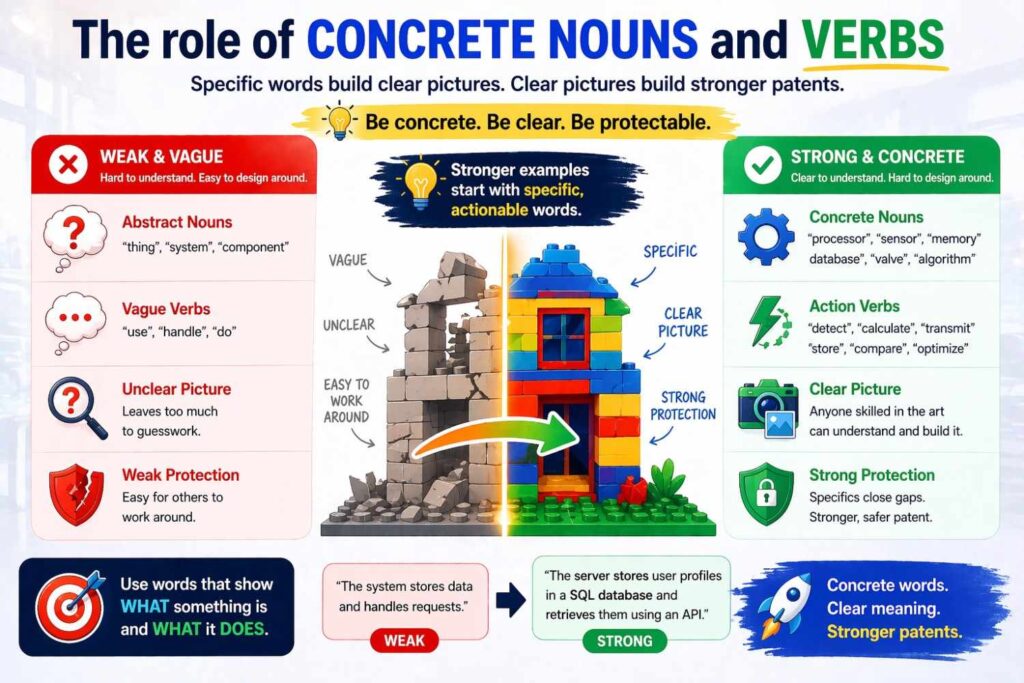
One easy way to improve examples is to use more concrete nouns and stronger verbs.
Weak patent writing is often full of vague actors doing vague things to vague objects. The system processes data. The module handles requests. The engine manages resources. The platform optimizes operations.
That language is not always wrong, but too much of it drains life and clarity from the example.
Concrete writing is stronger. A scheduler assigns batch jobs to GPU pools. A tokenizer converts support messages into token sequences.
A vehicle control unit compares lateral drift to a safe steering range. A cache service evicts low-priority entries after detecting memory pressure. A gateway signs a transaction payload with a session-bound key.
These sentences teach more because the nouns and verbs carry more information.
This matters for enablement because readers need to grasp what pieces of the invention are doing. Generic labels can hide the true mechanism. More specific language reveals it.
You do not need to become overly narrow. You can still use broad terms where appropriate. But in examples, especially where the inventive step appears, concrete language helps.
A useful editing trick is to circle every use of words like process, handle, perform, manage, optimize, facilitate, improve, or enable and ask whether a more exact verb would make the example clearer.
Often it will.
How to write examples for software inventions
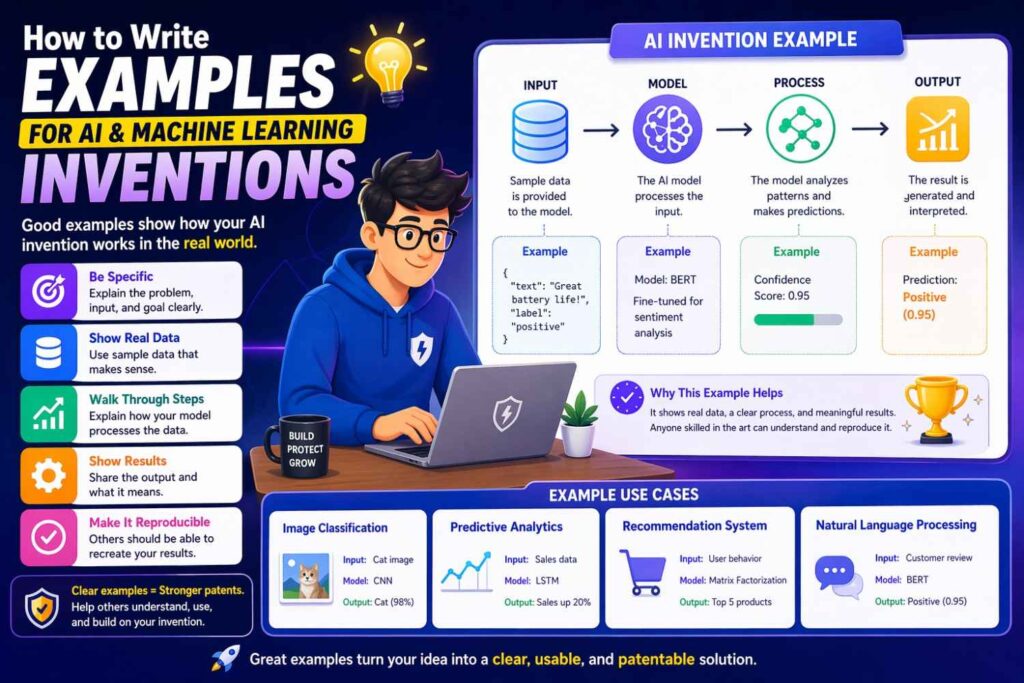
Software patents live or die on clarity.
Many software filings fail because they describe goals instead of mechanisms. They talk about what the software achieves but not how the software produces that result. Examples are the cure for this.
A good software example usually identifies the software components, the data they receive, the transformations they perform, the order of operations, and any decision logic that affects the path.
Suppose your invention is a collaborative editing platform that reduces merge conflicts in code or document changes. A weak example may say the platform predicts conflicts and coordinates edits.
A better example would explain that a session service tracks active users by document region, a change analyzer scores overlapping edits based on syntax tree impact and edit timing, a suggestion engine offers temporary region locks or structured merge previews when conflict risk exceeds a threshold, and a commit manager resolves compatible edits automatically while pushing incompatible edits into a guided review pane.
Now the invention sounds buildable.
For software examples, it often helps to include at least some of the following where relevant: data structures, message flow, event sequence, state changes, scoring logic, ranking rules, threshold logic, resource allocation, fallback paths, and update cadence.
You do not need source code. Often source code is not the best way to explain the invention anyway. Pseudocode can be useful in some cases, but plain language examples are often more versatile.
One important point for software founders: user interface details can support enablement, but they are rarely enough on their own. If the real invention is under the hood, your examples should spend most of their time there.
A screenshot might show what the user sees. But a strong patent example should show what the system does.
How to write examples for AI and machine learning inventions
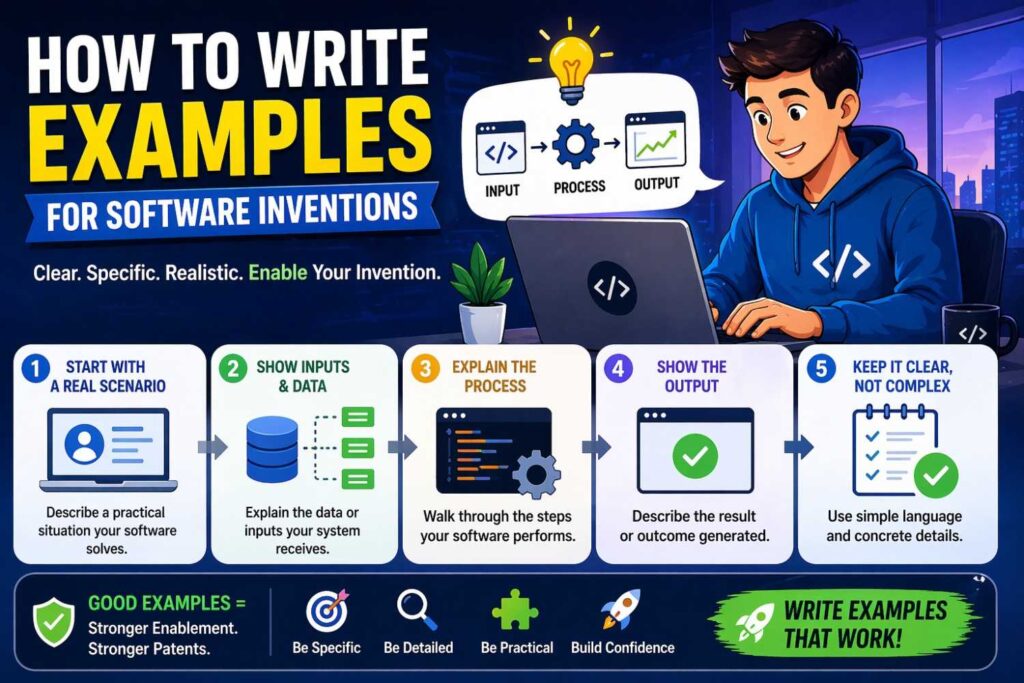
AI inventions need especially careful examples because it is easy to drift into abstraction.
Saying a model classifies, predicts, recommends, scores, generates, or optimizes is not enough by itself. The key questions are what goes in, what happens to it, what kind of model or logic is used, how outputs are used, and what makes the system new.
You do not always need to lock into one exact model family unless that matters to the invention. But your examples should say enough to teach the role of the model in the system.
A strong AI example often includes the input data types, preprocessing steps, feature or representation generation, model inference, confidence or scoring output, downstream use of the result, and any retraining or adaptation loop.
Suppose your invention helps detect patient deterioration in a hospital setting. A weak example may say that patient data is analyzed by a machine learning model to predict risk. That sounds modern, but it teaches very little.
A stronger example might explain that the system receives streams including heart rate, oxygen saturation, respiratory rate, nurse-entered observations, and medication timing; normalizes values by patient baseline; creates rolling time-window features; applies a trained risk model to generate a deterioration score; combines that score with a rules layer that suppresses alerts during known intervention windows; and triggers one of several escalation actions depending on score severity and trend direction. It may then explain how confirmed clinical outcomes are used to recalibrate thresholds for different care units.
That teaches a lot more.
Another area where examples help in AI patents is explainability. If your invention includes a method for selecting features, attributing outputs, filtering hallucinations, enforcing guardrails, or routing human review, your examples should show how those things happen in practice.
For generative AI, this is especially important. Many claims around prompting, retrieval, generation, verification, and policy enforcement can sound broad and thin if the examples are not concrete.
A good example should show the chain. What prompt context is formed? What documents are retrieved? How are they ranked? What output is generated? How is it checked? When is it blocked, revised, or escalated?
An AI patent example should not assume that saying “a model does X” is enough. The reader needs to understand the system around the model too.
How to write examples for hardware inventions
Hardware examples benefit from physical specificity.
That does not mean every dimension must be locked down. But the reader should be able to picture the arrangement, the relationships among parts, and how the structure produces the result.
If your invention is a sensor assembly, a thermal control device, a battery housing, a robotic end effector, a wearable, or any other physical system, your examples should answer basic physical questions. Where are the components located relative to one another? How are they connected? What materials or classes of materials are used? What conditions cause movement, transfer, activation, or measurement? What constraints matter? What optional forms exist?
Suppose you invented a cooling system for compact compute modules. A weak example may say the system improves thermal dissipation using a layered structure.
A stronger example may explain that a heat spreader sits between a processor package and an outer chassis wall, a phase-change interface layer fills surface gaps, a vapor chamber routes heat toward a finned sidewall, and a fan control circuit varies airflow based on both core temperature and predicted burst workload.
An example may then show how the system behaves during repeated short compute spikes versus sustained loads.
That teaches structure and function together.
Hardware examples often benefit from showing use over time. What happens during assembly? What happens during use? What happens under stress, failure, or maintenance conditions? Does a component lock, flex, release, expand, compress, seal, rotate, or isolate in response to something? The example should show that.
Where dimensions matter, ranges can be useful. Where materials matter, classes and substitutes can be useful. Where geometry matters, a few representative arrangements can be very helpful.
How to write examples for process inventions
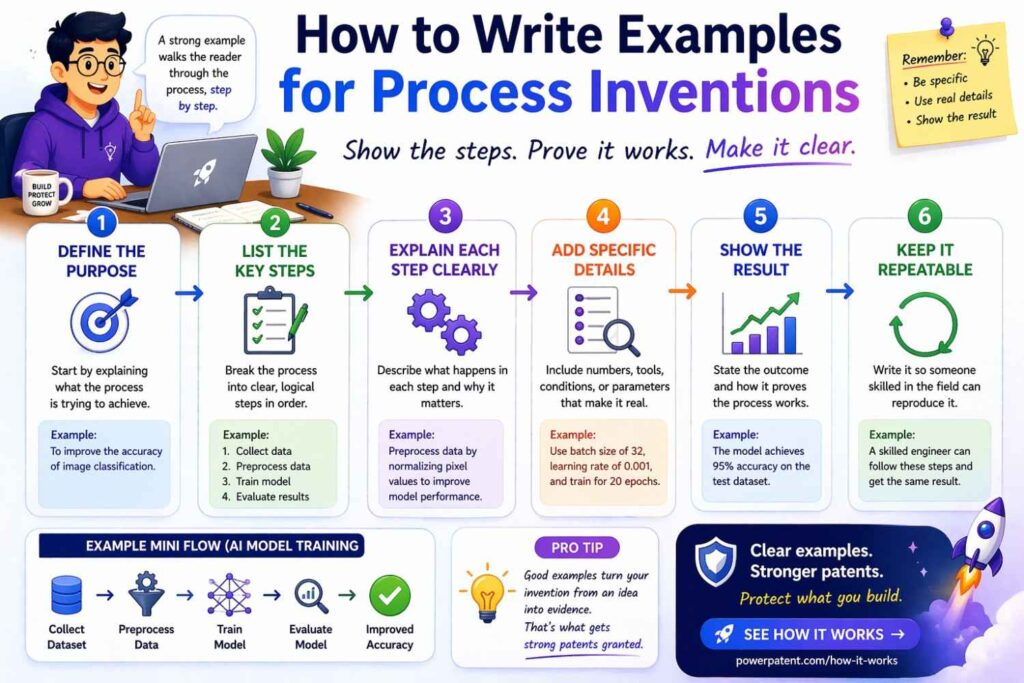
Process inventions often look simple at first and then turn slippery. That is because process claims often live or die on sequence, conditions, and decision rules.
A good process example should make the flow unmistakable.
What is the starting state? What step begins the process? What inputs are received? What order do the steps follow? Which steps are optional? Which steps depend on prior outputs? Are there thresholds, timing windows, or triggers? What output or state change marks completion?
Suppose your invention is a method for handling product returns in a way that reduces fraud while speeding honest refunds. The process may start when a return request is submitted. The system may compare the request to purchase history, item usage data, shipment confirmation, account risk, and image evidence. It may then assign a trust score.
Based on that score, the process may route the request to instant refund, item inspection, or manual review. A separate rule may apply for high-value items or repeat return behavior. A later feedback step may update the trust model based on confirmed return outcomes.
That is a teachable process.
For process inventions, one of the biggest mistakes is skipping the hard branch points. The inventor knows how the process chooses one route instead of another, but the draft just says the system determines an action. That is not enough. The example should show what drives the determination.
A process example often becomes much stronger as soon as the choice logic is visible.
The value of edge cases
Edge cases are not just for product quality. They can be very useful in patent examples too.
An edge case shows what happens when the normal path breaks or bends. That can reveal the true robustness of the invention.
If your system handles missing data, low confidence, conflicting inputs, sensor drift, degraded connectivity, user override, resource exhaustion, adversarial input, or timing failures, examples covering those situations can add real value.
Why? Because they show that the invention is not just a happy-path idea. It is an operational solution.
Suppose you built a distributed warehouse picking system. The normal example may show how tasks are assigned to mobile units based on location and load balancing.
An edge-case example may show what happens when one unit loses connectivity mid-task, when a shelf sensor reports conflicting stock counts, or when a priority order arrives after a route has started. The handling of those situations may itself be inventive.
Founders often leave these out because they seem secondary. But sometimes the edge handling is exactly what made the system commercially viable. If so, it may deserve patent attention.
An edge-case example can also support fallback claims or narrower claims that matter later. Even if the broad invention is challenged, the well-disclosed fallback may still hold important value.
Do not hide the “why”
Examples should show what happens, but they should also help the reader understand why the design is structured that way.
This does not mean every example needs a long lecture. It means that where the invention makes a non-obvious choice, the example should illuminate the reason.
Why does the model threshold change after a drift event?
Why does the controller wait for a second sensor confirmation?
Why does the system checkpoint before migrating a workload?
Why does the device place the antenna in that region of the housing?
Why does the process split into a fast pass and a deep pass?
These reasons often reveal the inventive insight.
A weak example says what the system does but leaves the rationale hidden. A stronger example exposes enough of the logic that the reader understands what problem the inventors solved.
This can be done elegantly in a sentence or two. For example, the system may delay control actuation until confirmation from an independent sensor stream to reduce false triggers caused by transient vibration artifacts. Or the pipeline may first apply a lightweight classifier to reduce inference load, routing only ambiguous inputs to a larger model.
Now the reader sees the design intelligence.
That kind of explanation can strengthen enablement because it helps a skilled person apply the teaching in practice. It can also make the invention feel more coherent, which supports the whole patent.
Show ranges, alternatives, and substitutes without losing focus
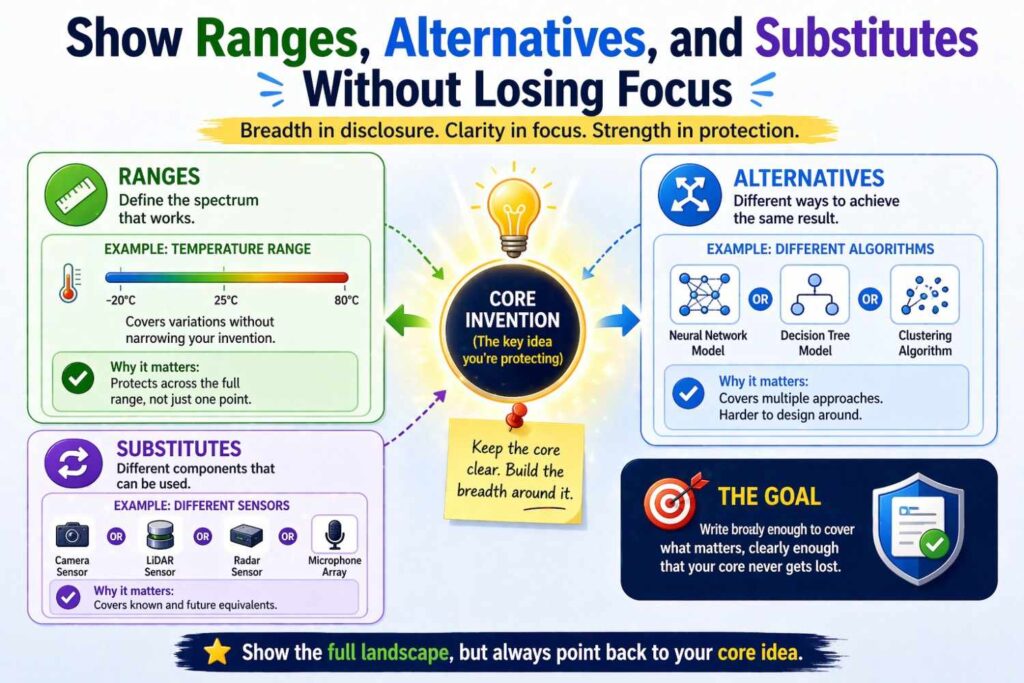
A helpful way to strengthen examples is to include options around the core.
If a threshold can vary, say that.
If a component can be replaced by another with similar function, say that.
If the sequence can change under certain conditions, say that.
If the deployment can be cloud-based, local, hybrid, embedded, or edge-based, say that where relevant.
If the material can come from a class of materials, say that.
If the algorithm can use one of several scoring approaches, say that.
These kinds of alternatives help avoid accidental narrowness while still teaching the invention.
But do not dump alternatives in a random pile. That turns examples into clutter.
The best alternatives are attached to the logic of the example. They appear where they matter.
For instance, you might say that in the example described above, the anomaly threshold is determined from a historical false positive target. In other implementations, the threshold may be selected based on device class, user role, asset sensitivity, or recent drift metrics. That variation belongs right there because it changes the decision.
Similarly, you might say that although the example uses a convolutional neural network for image classification, other implementations may use transformer-based vision models, hybrid models, or rule-assisted classifiers when compute limits or data volume differ. Again, that variation belongs because it relates to the same function.
Alternatives are most useful when they help the reader understand the true boundaries of the invention.
Avoid accidental admissions
When writing examples, be careful with language that sounds more limiting than you intend.
This is a common trap. Founders describe the one version they built and use words like must, required, essential, always, only, or critical when they really mean in one implementation, in some cases, or in one tested version.
Those stronger words can come back later in a bad way.
If a component truly is essential to the invention, then strong language may be correct. But if you are simply describing one embodiment, your wording should reflect that.
This is where many people get confused. They think safe drafting means being vague. It does not. It means being accurate about what is fixed and what is flexible.
So instead of saying the system must use a graph neural network, you might say that in some embodiments the system uses a graph neural network to propagate relationship signals across entities. In other embodiments, other relational models may be used.
Instead of saying the device requires a three-layer housing, you might say that in one example the housing includes three layers that together provide structural support, thermal isolation, and signal shielding. In other examples, similar functions may be achieved with a different number or arrangement of layers.
This kind of wording keeps the example detailed while preserving room.
Examples and claim strategy should support each other
Patent examples are not written in a vacuum. They should support the claim strategy you may want now and later.
That means examples should not just describe the flagship product. They should help support different claim shapes.
You may want system claims, method claims, computer-readable medium claims, device claims, control logic claims, training method claims, interface claims, or fallback claims around special features.
Good examples can support all of these by showing the invention from several angles.
For instance, a single example can reveal system components, their interactions, the steps of operation, the data flow, and the resulting output. That gives room for claims of different types.
If your examples are too shallow, later claims may lack support. If your examples are too tied to one product surface, you may miss other claim opportunities.
This does not mean you need to think like a litigator from day one. It just means that examples should expose the invention’s structure and behavior clearly enough that a range of claim forms can be built on top of them.
This is another reason many startups use PowerPatent. It helps founders capture the real invention in a way that supports broader and smarter patent drafting, with real patent attorney review built in. That can save a lot of pain later. Here is the overview: https://powerpatent.com/how-it-works
Use comparative examples with care
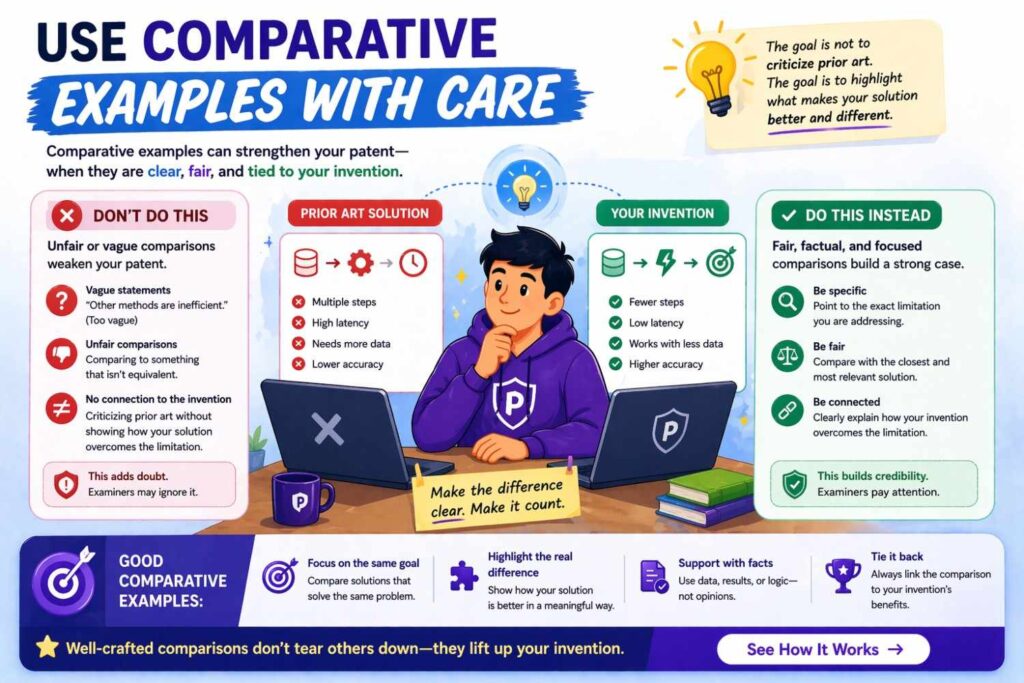
Sometimes it helps to include a comparison. A before-and-after example, or a conventional approach versus the new approach, can make the invention easier to understand.
This can be powerful when the difference is subtle.
For example, if your invention changes how a recommendation engine balances exploration and exploitation, a brief comparison to a static threshold method may help show what is new. Or if your hardware invention fixes a known thermal bottleneck, comparing the airflow path in a prior layout to the airflow path in the disclosed arrangement may clarify the advantage.
But do this carefully.
You do not want to make unnecessary admissions about what the prior art definitely is. You also do not want to accidentally frame your invention too narrowly around one comparison.
The safest approach is often to describe the problem with a conventional approach in general terms and then explain how the disclosed example addresses that problem. Keep the focus on your invention, not on trying to authoritatively define the whole prior art landscape inside the example section.
Comparative examples work best when they sharpen understanding, not when they try to become a prior art essay.
What to do when your invention is still evolving
Many startups file patents while the product is still changing. That is normal. It can also make example writing harder. You may worry that if you describe the current implementation in detail, the filing will age badly as the product shifts.
The answer is not to stay vague. The answer is to write examples at the right level and include variation.
Start with the version you understand best today. That gives the patent real substance.
Then ask what parts are likely to change and what parts define the invention.
Maybe the model family may change, but the confidence-weighted human review loop is likely to stay.
Maybe the user interface may change, but the data synchronization method is likely to stay.
Maybe the sensor vendor may change, but the sensor fusion arrangement is likely to stay.
Maybe the deployment stack may change, but the fault-tolerant migration sequence is likely to stay.
Your examples should reveal the stable invention while allowing space around the parts that may evolve.
This is one reason examples should be written from principles, not just product screenshots. A product surface can change fast. A core technical mechanism often changes more slowly.
The smartest filings often include present-tense examples grounded in the current build plus additional variations that reflect likely future versions. That way, the filing is useful both now and later.
A practical method for drafting examples from your notes
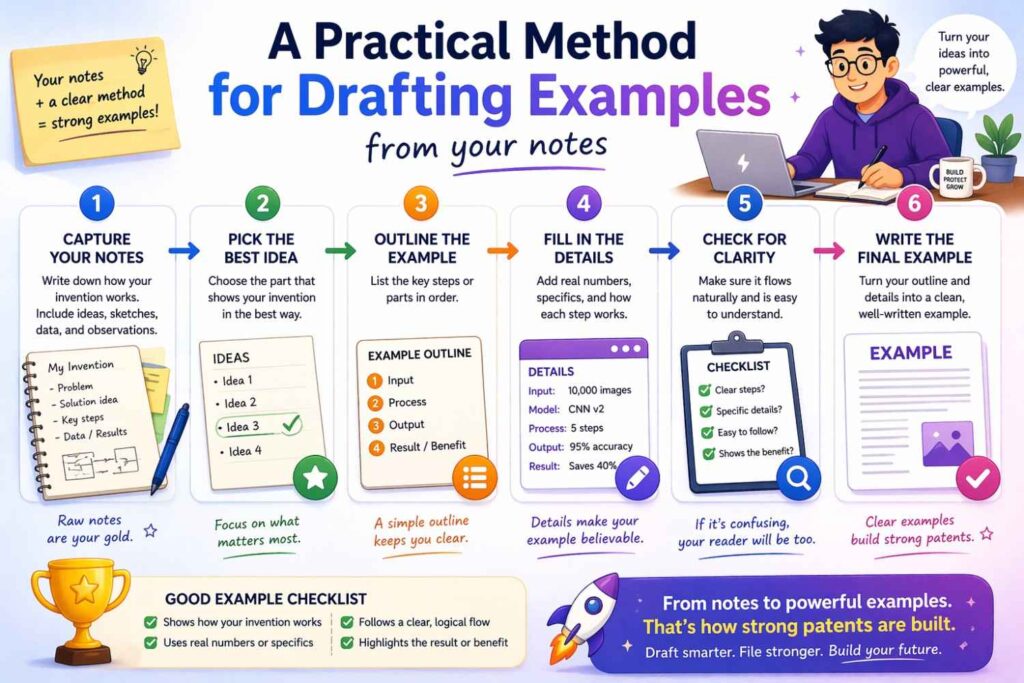
Here is a simple working method.
Take one important workflow from the invention. Write it in plain language first, without trying to sound legal or patent-like. Just explain how it works to a smart engineer from a nearby field.
Then underline the places where the invention makes a meaningful choice or does something non-obvious.
Then add the setup around those points. What data, components, or conditions are needed?
Then add the outputs and consequences. What does the system do next, and why?
Then add one or two variations that preserve the same core.
Then read it again and remove empty words.
What remains is often the start of a strong patent example.
This method works because it begins with truth. Many weak patent examples fail because the writer starts by imitating patent style instead of describing the invention honestly.
You can also use recorded design reviews, demo notes, and engineering memos. Speak the example out loud first. If it sounds like something your team would actually say in a design meeting, that is a good sign. If it sounds like bloated form language, it may need work.
How to make examples readable without making them casual
The user asked for a formal tone, and that matters. Formal does not mean stiff. It means clear, controlled, and serious.
Patent examples should be readable. Long walls of tangled sentences make it harder for the reader to understand the invention. Yet examples should still feel precise.
The easiest way to balance this is to use shorter sentences around the most important steps. Use plain words. Use strong verbs. Avoid unnecessary filler.
Instead of writing that the system may be configured to perform a determination regarding whether a threshold condition associated with operational behavior has potentially been satisfied, write that the system determines whether the operating threshold has been met.
That is cleaner and still formal.
Readable examples also benefit from paragraph breaks. One paragraph can cover setup. Another can cover the main operation. Another can cover variation or fallback. This helps the reader hold the sequence in mind.
A good patent example often reads like a calm technical walkthrough. It does not need fancy writing. It needs disciplined writing.
Signs your examples are too thin
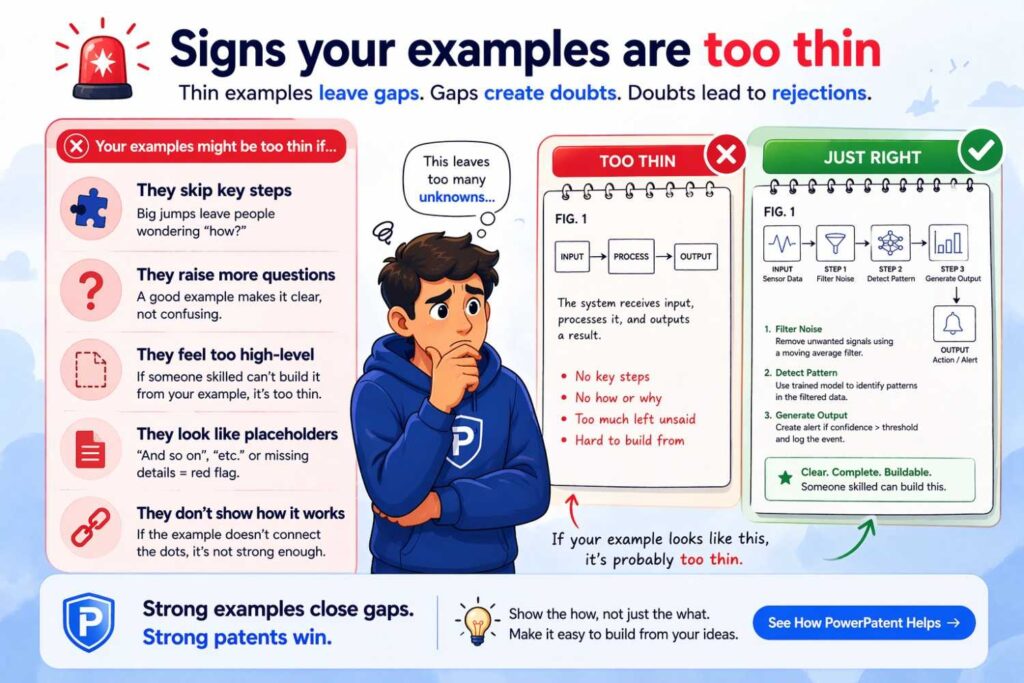
You can often spot weak examples by the feeling they leave.
If the example sounds like it could describe a hundred unrelated systems, it is probably too thin.
If the example mostly describes benefits and not mechanisms, it is probably too thin.
If the example never shows an input becoming an output through a concrete path, it is probably too thin.
If the example relies on words like analyze, optimize, manage, or improve without showing how, it is probably too thin.
If the example avoids the very part that made the invention hard to build, it is probably too thin.
If the example never shows thresholds, branching, interaction, timing, structure, or parameter logic where those things matter, it is probably too thin.
If the example could have been written by someone who never built the invention, it is probably too thin.
These are strong warning signs. When you see them, do not just add more length. Add more mechanism.
Signs your examples may be too narrow
There is a problem on the other side too.
If every example uses the same fixed values and never mentions alternatives, the disclosure may feel narrow.
If the writing repeatedly describes one embodiment as required or essential when it is not, the disclosure may feel narrow.
If the examples focus too much on a current product design and never abstract the core principle, the disclosure may feel narrow.
If the invention could work with several input types, architectures, or deployment modes but the examples mention only one, the disclosure may feel narrow.
If the examples bury the true inventive concept under product-specific surface details, the disclosure may feel narrow in the wrong way.
The fix is not to remove detail. The fix is to pair detail with thoughtful variation and better framing.
Real-world style example: software infrastructure
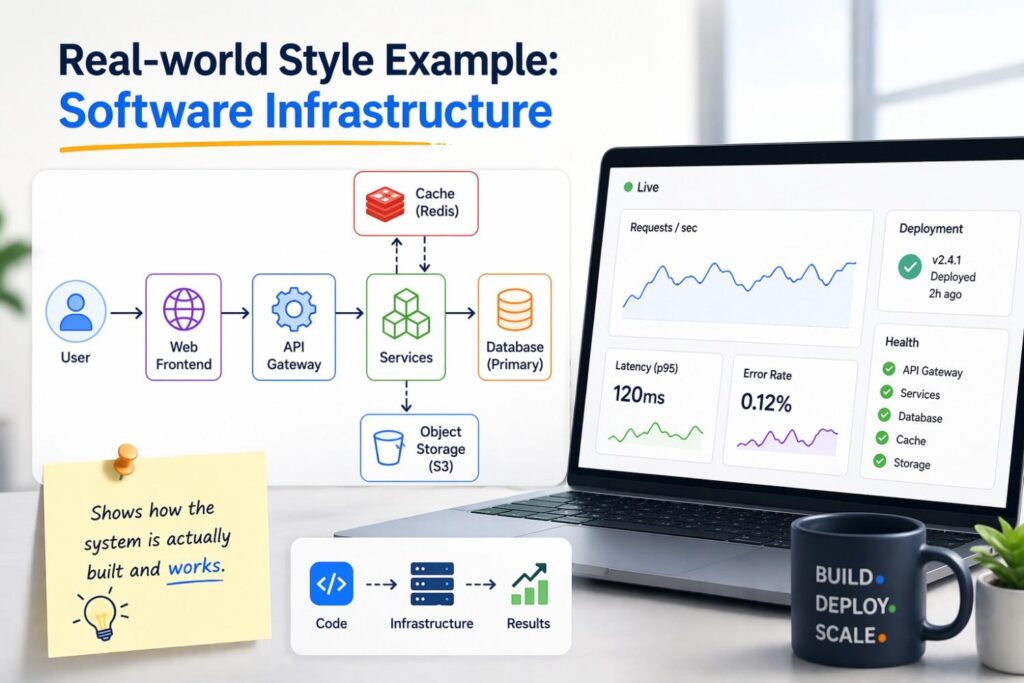
Let us walk through a fuller example in a software setting.
Imagine the invention is a system that reduces cloud cost and job failure risk by migrating long-running compute jobs across instance types based on predicted interruption risk and restart cost.
A stronger example might read like this in substance:
A job scheduler receives a request to execute a batch workload associated with a model training task. The scheduler places the workload on a first compute instance selected based on current price and resource availability.
During execution, a monitoring service collects metrics including elapsed run time, checkpoint freshness, instance interruption probability, current spot price deviation, and estimated completion time.
At periodic intervals, a migration engine computes an expected savings value for moving the workload to a second instance type and computes an expected disruption value based on checkpoint age, restore time, and model state size.
When the expected savings exceeds a savings threshold and the expected disruption remains below a disruption threshold, the migration engine triggers creation of an updated checkpoint, reserves the second instance, transfers checkpoint state, and resumes execution on the second instance.
If the checkpoint age exceeds a limit or no suitable target instance is available, the workload remains on the first instance. In some implementations, the savings threshold is adjusted based on workload priority or customer service level. In other implementations, the migration decision also considers region-level capacity volatility or historical resume failure rates.
Notice what this example does.
It teaches the setting, the inputs, the data being monitored, the decision logic, the action taken, and the conditions that block the action. It also shows variation.
That is the kind of example that strengthens enablement.
Real-world style example: AI workflow
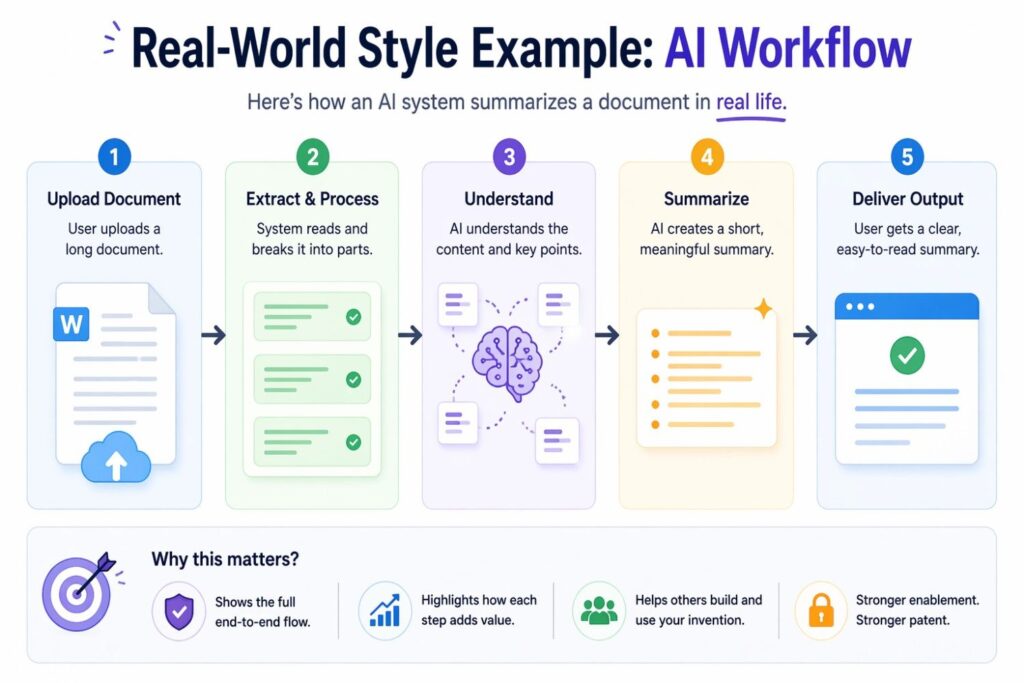
Now imagine the invention is a system that improves enterprise support by generating draft responses while reducing hallucinated answers.
A stronger example might say this in substance:
An intake service receives a customer support request and extracts customer account identifiers, message text, product context, and urgency indicators.
A retrieval module queries a knowledge store using both the message text and a product-state profile derived from the customer account. The retrieval module ranks candidate support documents based on semantic similarity, recency, and product-version match.
A generation module constructs a prompt that includes the customer request, selected document excerpts, and a response policy specifying that unsupported assertions are not permitted. A language model generates a draft response and associated citation pointers to the retrieved excerpts.
A verification module compares factual statements in the draft response against the cited excerpts and assigns a support score. When the support score exceeds a threshold and the request falls outside a restricted category, the draft response is presented to an agent with suggested edits.
When the support score falls below the threshold, the system suppresses the generated answer and instead presents the agent with the ranked support documents and a proposed escalation path. In some embodiments, the threshold is raised for regulated product lines or lowered for simple troubleshooting requests with high retrieval confidence.
Again, the example does real work. It does not just say “we use AI safely.” It teaches the mechanism.
Real-world style example: hardware control
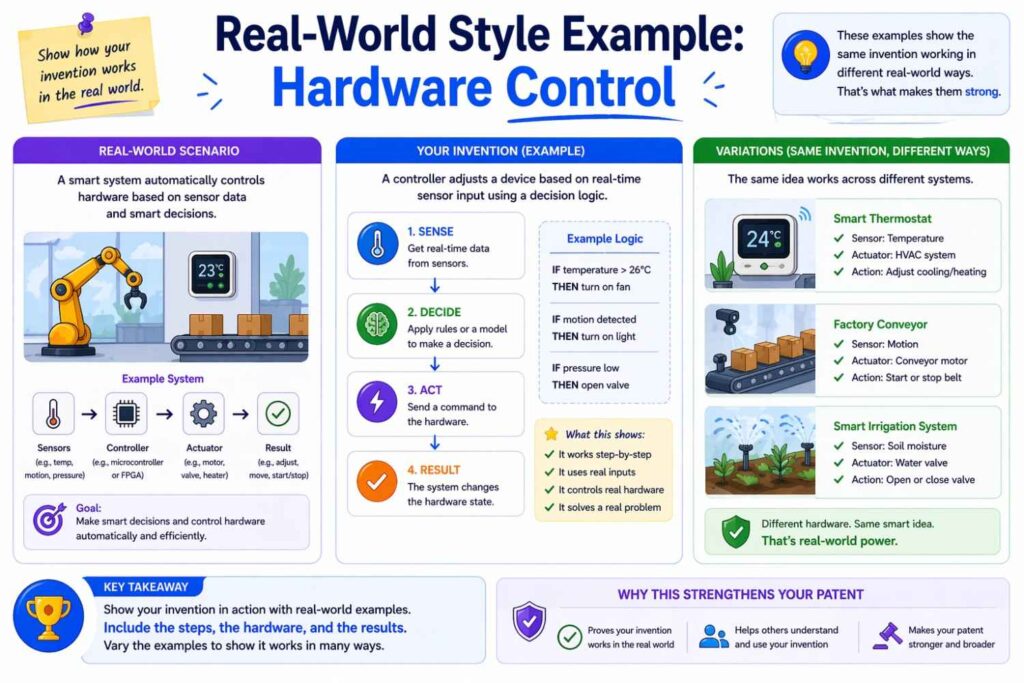
Imagine a robotics invention for adaptive gripping of irregular objects.
A stronger example might explain:
A conveyor system presents objects of varying shape and material to a robotic picking station. An imaging unit captures top-view and depth data for each object as it approaches a pickup zone.
A classifier estimates an object category and a confidence value, while a geometry module estimates contour features including width, height, local curvature, and visible deformation. A grip planner selects a contact region and an initial grip force based on both the estimated category and the contour features.
After contact, a slip sensor measures micro-movement during lift. When slip exceeds a threshold, a control module increases grip force within a category-specific safety range and stores the updated force setting in an object-handling profile associated with similar contour features.
When classifier confidence is below a threshold, the system selects a conservative grip plan with reduced lift speed and mandatory post-lift slip monitoring. In some embodiments, the object-handling profile is updated across shifts or across multiple robotic cells.
That example shows physical action, control logic, and adaptation. It is far stronger than saying “the robot adjusts grip using sensor data.”
Why examples help even before examination
Founders sometimes think enablement only matters if there is a fight later. That is too late.
Good examples help from the beginning.
They help your patent attorney understand the invention faster.
They help the drafter see what claims may be available.
They help surface hidden inventive points that may otherwise be missed.
They help avoid weak or overbroad claim language that will be hard to defend.
They help preserve fallback positions.
They help make office action responses easier because the specification contains usable support.
They help future team members understand what was invented when the filing was made.
In other words, examples are not a defensive extra. They are part of building the patent right the first time.
That is very much in line with how PowerPatent approaches the filing process. The goal is not to produce paperwork for its own sake. The goal is to help startups capture the real invention clearly, quickly, and in a way that stands up better later, with attorney review as part of the process. You can see the model here: https://powerpatent.com/how-it-works
How founders can contribute better examples to the patent process
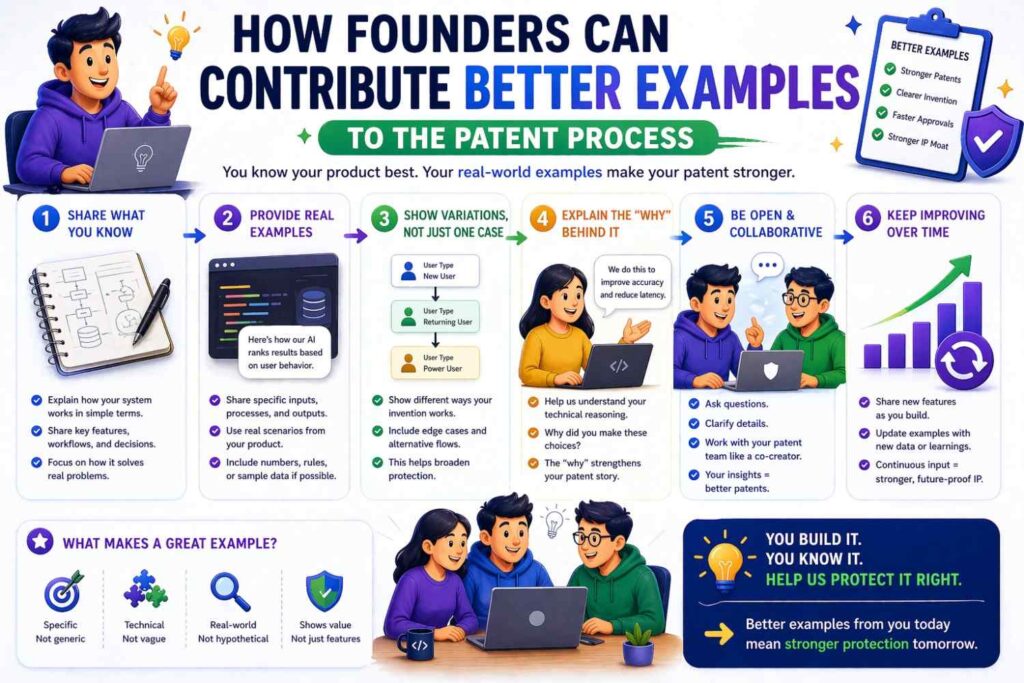
You do not need to become a patent expert to help produce strong examples. But you do need to stop assuming that your patent team can read your mind.
The fastest way to improve the result is to provide richer technical context up front.
When you explain the invention, do not just say what the product does. Explain the hard part. Explain what the team figured out. Explain what choices mattered. Explain what changed between version one and version two. Explain the failure mode that forced the new design. Explain the edge condition that made the solution valuable.
If you hand over only surface-level product language, your patent examples may end up shallow. If you hand over engineering reality, the examples can become much stronger.
This is another reason startups like working with tools that are built around the way founders and engineers actually think. When the capture process is designed to pull out the real technical story, better examples follow.
Editing your examples for strength
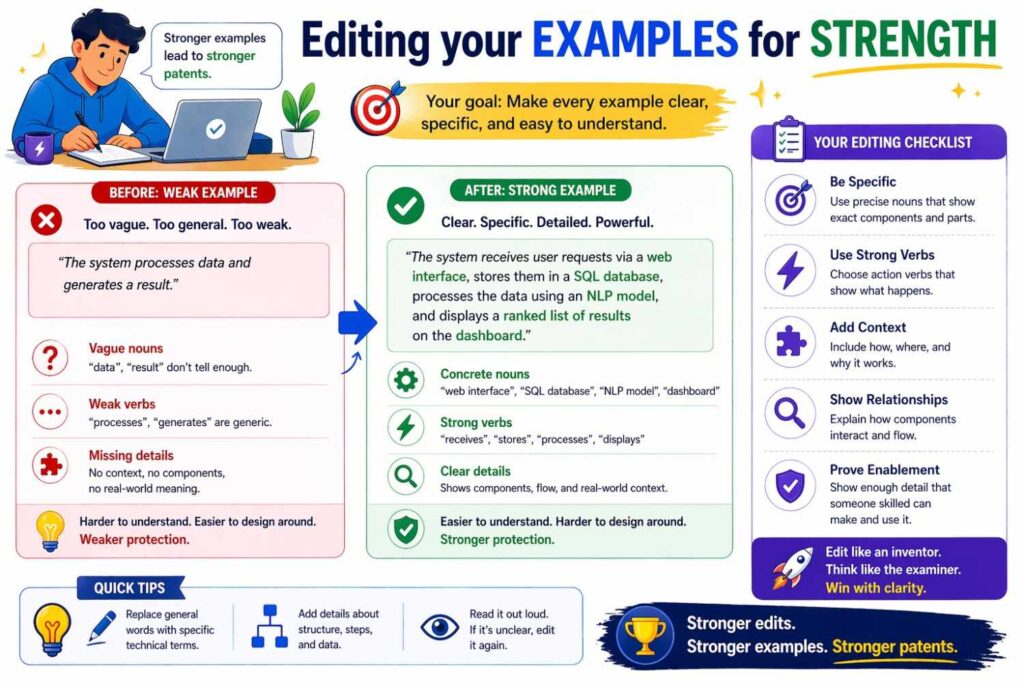
Once your examples are drafted, edit them with three questions.
First, does this example teach the invention, or does it just describe the result?
Second, does this example reveal the non-obvious part, or does it spend most of its time on ordinary setup?
Third, does this example include enough variation to avoid accidental boxing-in?
Then look again for language issues.
Replace empty verbs with stronger ones.
Remove hype.
Clarify sequences.
Expose branch logic.
Add concrete nouns.
Tighten long sentences.
Where helpful, add representative ranges, thresholds, or conditions.
Then read the example aloud. If you get lost halfway through, the reader may too. If the example sounds like a real system walkthrough, that is a good sign.
A founder-friendly checklist in paragraph form
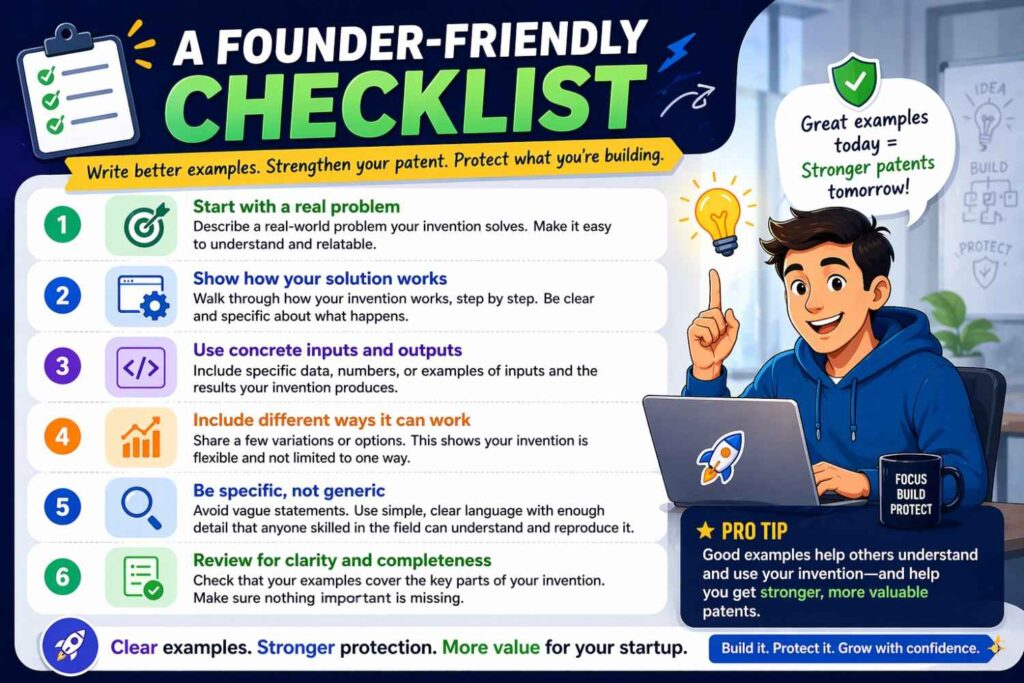
A strong patent example usually explains the setting, identifies the important parts, shows the flow from input to output, reveals decision points, includes the inventive mechanism, and leaves room for variation.
It should feel like it came from real engineering work. It should not hide behind marketing language. It should not act as though one embodiment is the only embodiment unless that is truly the case.
It should answer the reader’s likely questions before they are asked. It should help a skilled person understand how to make and use the invention without a large amount of guesswork.
If your example does those things, it is likely helping enablement.
The deeper reason examples make patents stronger
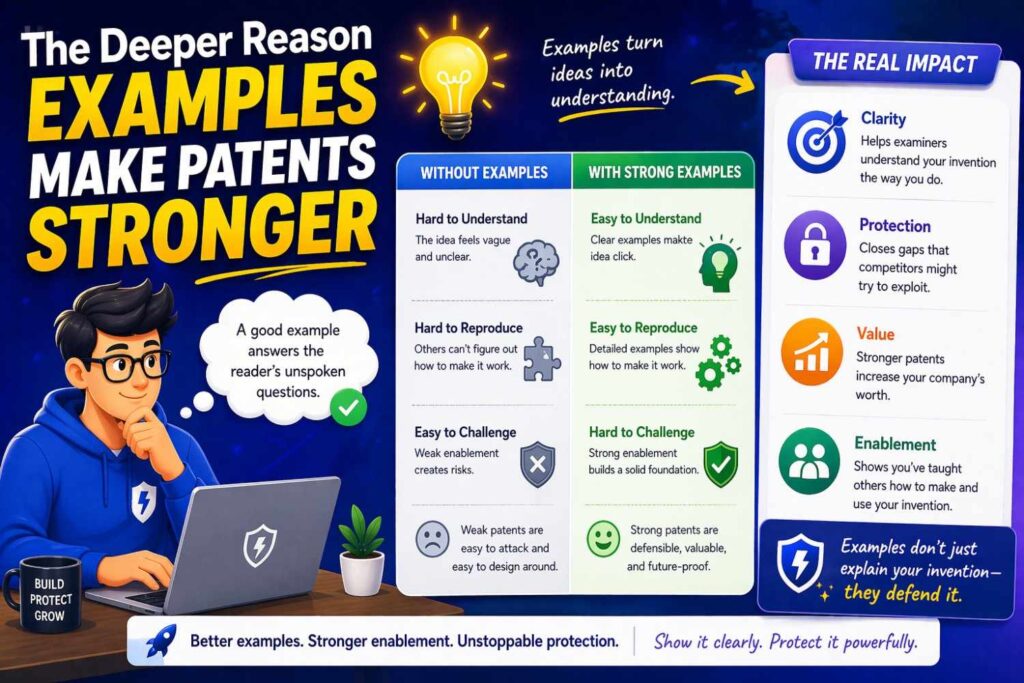
There is also a larger truth here.
Strong examples do more than satisfy a rule. They prove seriousness.
They show that the inventors actually built, understood, and thought through the invention. They show that the patent is not just an attempt to reserve territory around a broad idea. They show that there is substance under the claim language.
That substance matters. In patents, credibility has weight. The more your filing sounds like it came from real builders who know how the system works, the stronger the whole document feels.
This is especially important for startups. Young companies often compete against larger players with more resources, more distribution, and more leverage. A strong patent will not solve every business problem, but it can create real protection and real strategic value. To get that value, the patent must be more than a rough concept. It must be a clear technical teaching.
Examples are one of the best ways to make that happen.
Final thoughts
If you remember one thing, remember this: a patent should not merely announce an invention. It should teach it.
Examples are how that teaching becomes real. They are where the invention stops sounding abstract and starts sounding buildable. They are where the broad concept meets the practical path. They are where enablement becomes visible.
So when you write patent examples, do not write to impress. Write to teach. Show the real mechanism. Show the sequence. Show the decision points. Show the variations. Show the system under normal conditions and, where useful, under stress. Give the invention enough body that a skilled person could understand how to carry it out.
That is how examples strengthen enablement.
And that is how patents become more than paperwork.
If your team is building something new and you want help turning the real technical work into a stronger patent application without the usual drag, take a look at PowerPatent. It is built for founders and engineers who want speed, clarity, and real attorney oversight in the loop. Here is the link: https://powerpatent.com/how-it-works
The best patent examples begin with what your team already knows from building. The smart move is to capture that knowledge while it is still fresh, before key details vanish into shipping pressure and fast product cycles. PowerPatent helps make that process easier and more reliable, so you can protect what you are building without slowing down the work that matters most. See how it works here: https://powerpatent.com/how-it-works