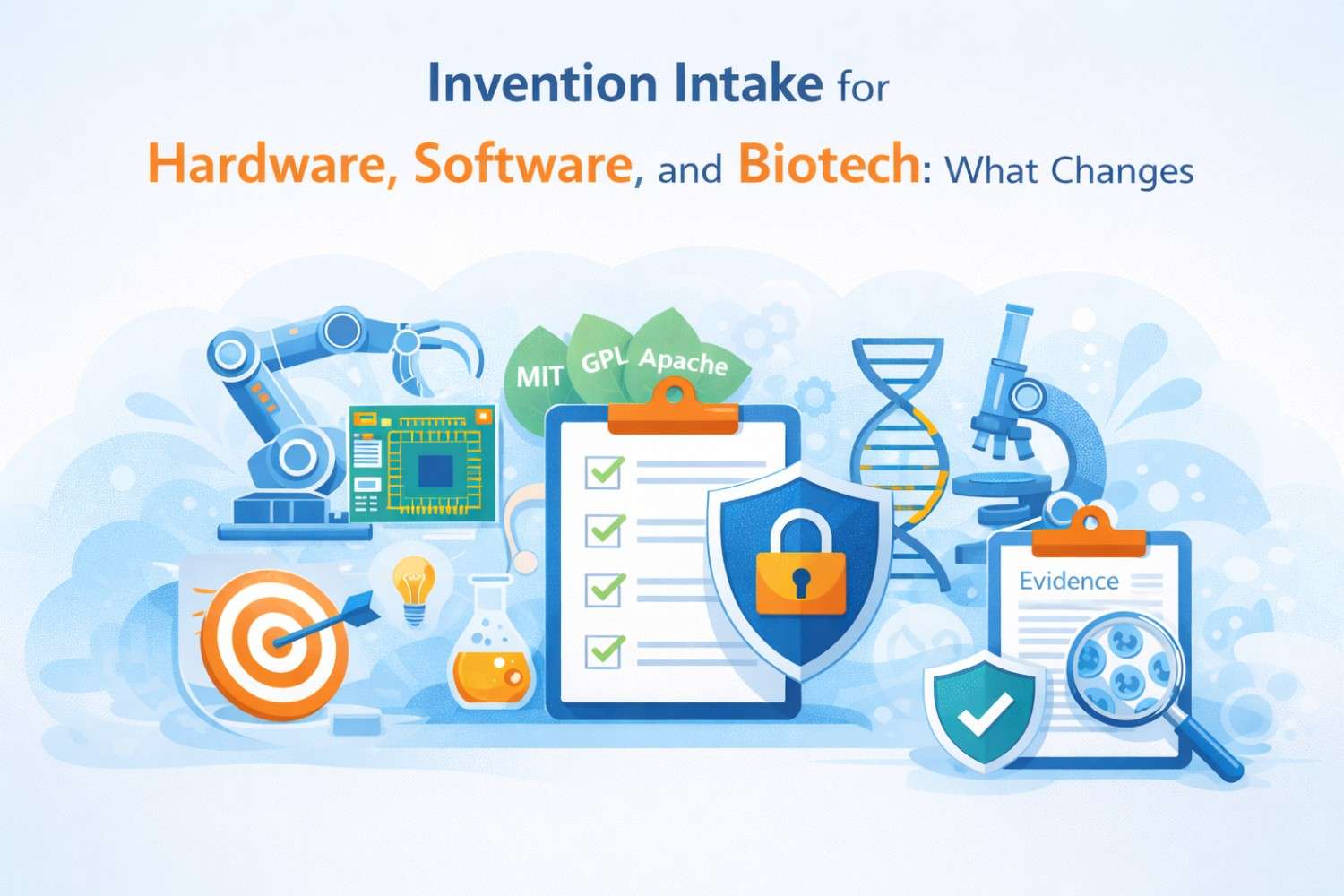
When you build something new, the first step in protecting it is simple: capture it the right way. That first capture is called invention intake. It is where you turn raw ideas, code, designs, lab results, and sketches into a clear story that can become a strong patent. But here is the truth most founders do not hear early enough: invention intake is not the same for hardware, software, and biotech. What you need to document, how you explain it, and where people often make mistakes all change depending on what you are building. If you get this wrong, you can lose protection without even knowing it. If you get it right, you build a wall around your startup. In this guide, we will break down exactly what changes between hardware, software, and biotech invention intake, and how to handle each one the smart way.
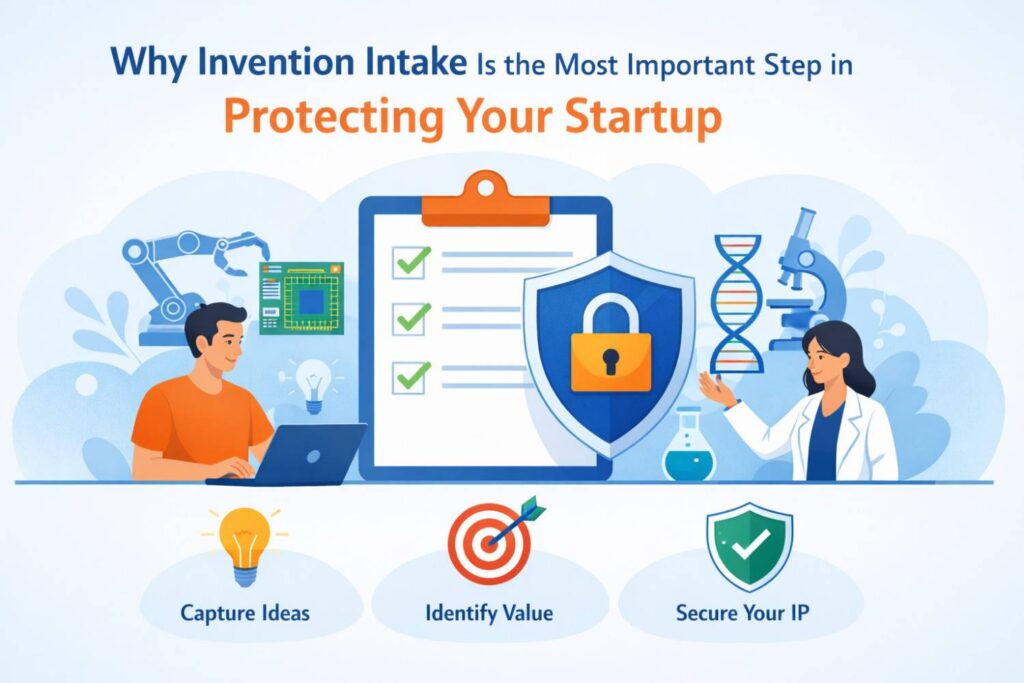
Why Invention Intake Is the Most Important Step in Protecting Your Startup
Every strong patent begins long before a lawyer writes a single sentence. It starts the moment you decide to capture your invention clearly and completely.
That moment is invention intake. This is not paperwork. This is not a form to rush through. This is where you decide whether your idea becomes a real asset or just a memory of what you once built.
If you are a founder, this step shapes your future leverage. Investors look at it. Acquirers care about it.
Competitors fear it when it is done right. When invention intake is weak, everything that follows is weak. When it is sharp and strategic, it becomes one of the strongest tools in your company.
Invention Intake Is Where Clarity Wins
Before you can protect anything, you must understand what you actually built.
Most founders describe their product at a high level. They talk about the outcome. They explain the user benefit. They pitch the vision. That is great for customers. It is terrible for patents.
Invention intake forces you to slow down and answer a harder question. What exactly makes this work? What is happening under the hood? What is new here compared to what existed before?
If you cannot explain your invention clearly in simple words, it will be almost impossible to protect it properly.
This is why a strong intake process should feel like a deep technical interview, not a surface conversation.
You should be pushed to explain how components interact, what problems existed before, what tradeoffs you solved, and why your approach is different. If no one is asking you those questions, you are not doing real intake.
At PowerPatent, this is where smart software combined with real attorney guidance changes everything. You are guided to think deeper about your own invention.
You uncover protection opportunities you did not even realize were there. That clarity becomes power.
If you want to see how this process works in action, you can explore it here: https://powerpatent.com/how-it-works
Small Gaps at Intake Become Big Holes Later
A missing detail at the beginning can cost you years of protection later.
Imagine you built a system with three core parts, but you only described two during intake. The third part may never make it into your patent. That means a competitor could copy that part and avoid your claims.
Founders often assume they can fix things later. In reality, once a patent is filed, adding new material becomes very hard. You cannot simply patch it like you patch code.
This is why invention intake should feel almost obsessive in detail. Not because you want to drown in paperwork, but because every detail is a potential shield.
During intake, ask yourself questions that go beyond the obvious. What variations could exist? What if someone swaps one part for another? What if the system runs on different hardware?
What if the data source changes? Thinking this way helps you protect not just what you built today, but what it could become tomorrow.
This forward thinking is what turns patents into long term strategic assets instead of narrow documents that age badly.
Intake Is Where You Define the Real Problem
Many patents fail because they focus on features instead of problems.
A feature can be copied or slightly changed. A well defined problem is harder to escape.
During invention intake, one of the most powerful moves you can make is to clearly define the pain point your invention solves. Not in marketing language, but in technical reality.
What was broken before? What was slow, unstable, expensive, inaccurate, or impossible? How did others try to fix it? Why did those attempts fall short?
When you describe the real problem in depth, you create room to protect your solution broadly. You also make it easier to show why your approach is new.
This step requires honesty. Sometimes founders skip it because they assume the problem is obvious. It rarely is.
Strong intake forces you to go back to first principles. It makes you think like an engineer again, not just a founder chasing growth. That mindset shift is often where the strongest protection is born.
Speed Without Structure Is Dangerous
Startups move fast. That is your edge. But speed without structure can quietly damage your intellectual property.
Many teams delay invention intake because they feel too busy. They say they will document things later. They assume the product will not change much. Then months pass.
The code evolves. The hardware design shifts. The research data grows. Now it is harder to untangle what was invented when.
A smart intake process captures inventions close to the moment they are created. Not years later when memories fade.
This does not mean slowing down. It means building a repeatable way to capture innovation while you build.
You can set internal triggers. For example, when a major feature ships, when a new experiment shows surprising results, or when a new system architecture is finalized. Each of those moments should prompt invention intake.
The key is making it part of your build cycle, not an afterthought.
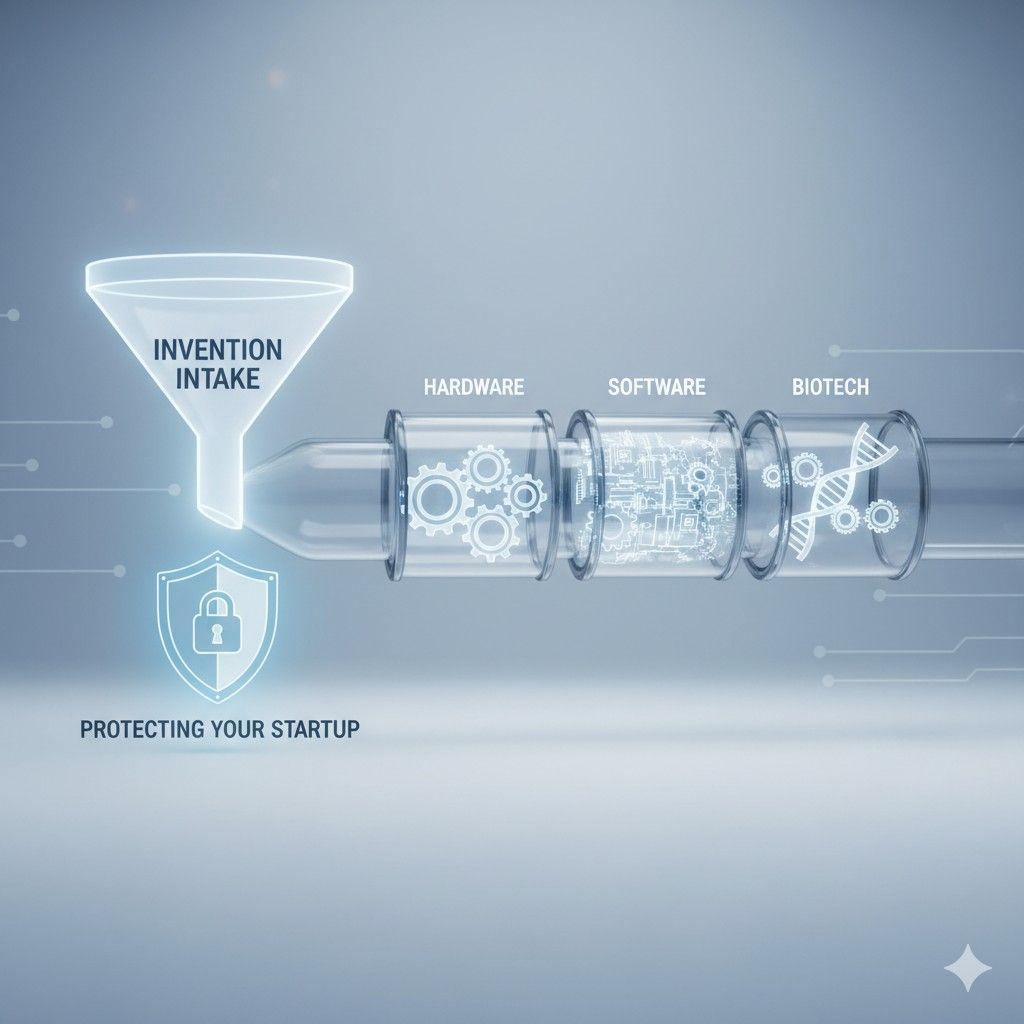
PowerPatent was designed around this reality. It fits into how founders actually work. You do not have to step out of your momentum. You capture innovation as it happens, with guidance that keeps you on track.
If you want to see how founders are doing this without slowing down their roadmap, take a look here: https://powerpatent.com/how-it-works
Intake Builds Investor Confidence
Investors rarely say this directly, but they look for signals of defensibility.
When you can explain your invention clearly and show that it has been thoughtfully documented and protected, it changes the tone of the conversation. You move from being just another startup to being a company with assets.
Invention intake is the foundation of that confidence. It shows that you understand what you built. It shows that you take protection seriously. It shows that you are thinking long term.
If you wait until due diligence to clean up your IP story, you will feel pressure. When intake is done early and done well, due diligence becomes smoother and faster.
Founders who treat intake strategically often notice something surprising. It sharpens their pitch. When you deeply understand your own technical edge, you explain it better to investors, partners, and even customers.
The act of documenting your invention makes you a clearer thinker about your own company.
Intake Is a Strategic Filter
Not every idea deserves a patent. That is a hard truth.
A strong intake process helps you decide which inventions are truly worth protecting. It forces you to ask whether the innovation is core to your business, whether it will still matter in three years, and whether it creates a real competitive edge.
Without intake discipline, founders either file too much and waste resources or file too little and miss critical protection.
Strategic intake helps you focus. It allows you to channel your time and money into the inventions that actually support your growth.
This is where having both smart software and real attorney oversight makes a difference.
Software helps capture and organize your ideas efficiently. Attorneys help evaluate them with experience. Together, that balance protects you from blind spots.
You are not guessing. You are making informed decisions.
If you are building something meaningful and want to protect it the right way from the start, you can learn how the full process works here: https://powerpatent.com/how-it-works
Intake Protects You From Yourself
Founders love to share. You talk to advisors. You pitch at demo days. You publish blog posts. You hire engineers and collaborate with partners.
Each conversation can expose parts of your invention.
If you have not completed proper intake and filed protection before public disclosure, you may limit your future rights. This risk is higher than most early stage teams realize.
Invention intake acts as a safety net. It ensures you have captured and protected what matters before you broadcast it to the world.
This does not mean you need to be secretive or paranoid. It means you need to be proactive.
Before major announcements, funding rounds, product launches, or conference talks, ask yourself a simple question. Have we completed intake on the core innovations we are about to reveal?
If the answer is unclear, that is a signal to act quickly.
With the right system in place, this does not become stressful. It becomes part of your launch checklist.
Intake Sets the Tone for Everything That Follows
Once your invention is captured clearly, every next step becomes easier. Drafting is smoother. Review is faster. Strategy is sharper.
When intake is messy, everything downstream is messy. You spend time correcting misunderstandings. You realize key elements were never explained. You rush to add detail under deadline pressure.
The strongest patent portfolios almost always start with disciplined intake.
Think of it like building a house. If the foundation is uneven, no amount of paint or decoration will fix it. Invention intake is that foundation.
If you are serious about building a company that lasts, this is not a step to rush or ignore. It is a moment to slow down just enough to capture your edge clearly.
When done right, it gives you control. It gives you leverage. It gives you peace of mind.
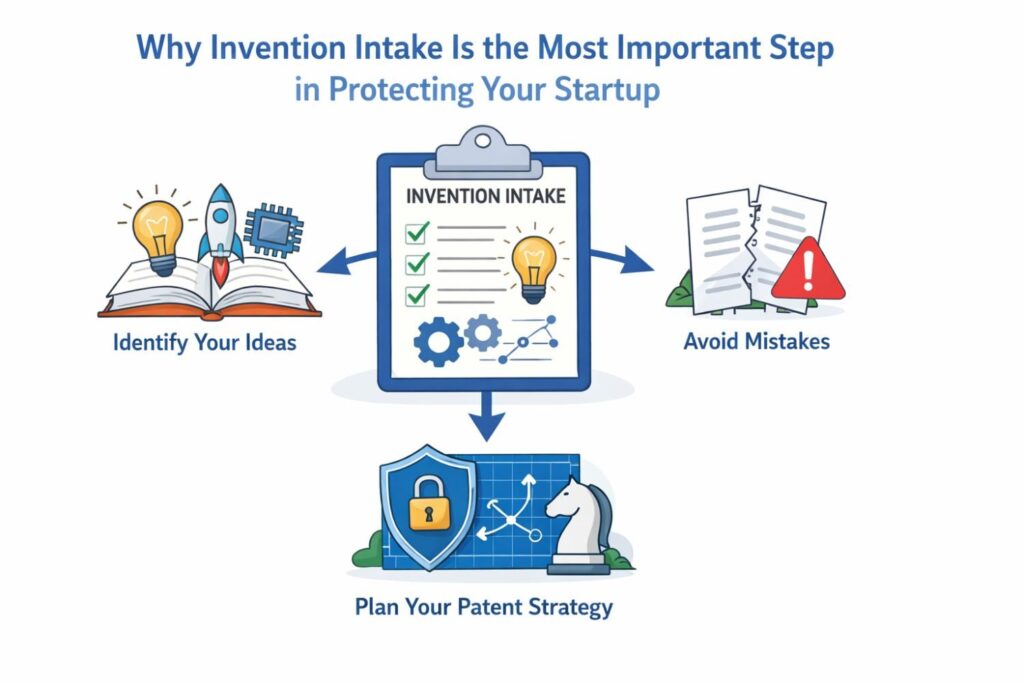
And if you want a system that helps you do this without drowning in legal complexity or wasting months in back and forth, you can see exactly how PowerPatent approaches invention intake here: https://powerpatent.com/how-it-works
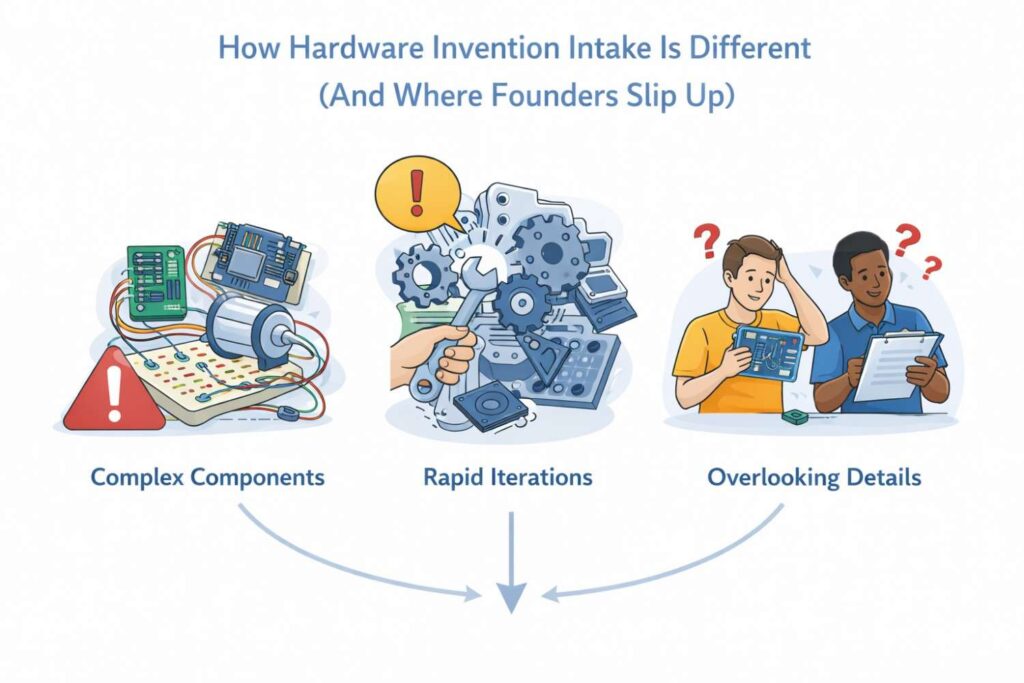
How Hardware Invention Intake Is Different (And Where Founders Slip Up)
Hardware feels solid. You can touch it. You can see it. You can hold a prototype in your hand. That physical nature makes many founders think hardware patents are simple. If it exists on a table, it must be easy to protect.
That assumption is where problems begin.
Hardware invention intake is different because physical systems have layers. There is structure, movement, material choice, manufacturing method, and how each part connects to the next.
If you only describe what the product looks like, you miss most of what actually makes it unique. Strong hardware intake goes deeper than the shell. It uncovers the hidden design logic inside.
Physical Structure Is Only the Starting Point
Most hardware founders begin intake by describing components. They say there is a frame, a sensor, a housing, a board, or a connector. That is useful, but it is not enough.
A patent is not about listing parts. It is about explaining how those parts work together in a new way.
During intake, you must clearly explain the relationships between components. How are they arranged? Why are they arranged that way? What would break if someone rearranged them? What performance gain comes from this specific layout?
Many founders forget to explain why the structure matters. They assume the uniqueness is obvious. It rarely is.
A stronger intake session forces you to go step by step. If someone else were building this from scratch, what would they need to know? What design decisions were intentional? What constraints shaped your final build?
When these answers are captured early, your protection becomes more than surface level.
Manufacturing Choices Often Contain Hidden Value
One of the biggest missed opportunities in hardware intake is ignoring how the product is made.
Founders focus on the final device. They overlook the process used to produce it. But sometimes the true innovation is in manufacturing.
Did you create a new assembly method? Did you reduce cost by changing material layering? Did you improve durability through a new bonding technique? Did you redesign internal geometry to simplify machining?
These details matter.
During intake, do not stop at the finished object. Walk through the production journey. Explain each major step. Ask yourself what was hard to figure out. Ask where you had to experiment.
That friction often points to protectable ideas.
If you want guidance that helps surface these details without slowing your engineering work, you can see how the PowerPatent process works here: https://powerpatent.com/how-it-works
Hardware Evolves Fast During Prototyping
Unlike software, hardware cannot always be changed with a quick update. Prototypes go through many physical revisions. Parts are swapped. Dimensions shift. Materials are tested and replaced.
Here is where founders slip up.
They wait too long to document the invention because they think the design is not final. They assume they should wait until everything is perfect.
In reality, early versions may contain broad concepts worth protecting. If you only capture the final refined model, you may miss earlier design principles that could support stronger claims.
Smart hardware intake does not chase perfection. It captures core concepts early and updates as the design evolves.
This requires discipline. When a major prototype milestone is reached, pause briefly. Document what changed. Explain why it changed. Clarify what problem the revision solved.
With the right system, this does not feel like a burden. It becomes part of your engineering rhythm.
Drawings Are Not Enough
Hardware founders often believe that CAD files and technical drawings are sufficient for intake. They are not.
Drawings show shape. They do not explain reasoning.
A patent requires written explanation that teaches how and why the system works. If you rely only on visual files without narrative context, you create gaps.
During intake, describe function in plain words. Explain movement. Explain force. Explain energy flow. Explain data flow if electronics are involved.
If a part rotates, explain what triggers that motion. If a component locks into place, explain the locking mechanism clearly. If pressure changes, explain how and why.
This kind of explanation transforms static drawings into a defensible story.
PowerPatent combines structured software prompts with attorney oversight to help you extract that story from your technical files. You are not left guessing what matters.
If you are building serious hardware and want to protect it properly, take a look at how it works: https://powerpatent.com/how-it-works
Integration With Software Changes the Strategy
Modern hardware rarely stands alone. Devices connect to apps, servers, or embedded firmware. This hybrid nature adds complexity to intake.
Many founders treat the physical device and the software layer as separate inventions. Sometimes that is correct. Often, the magic is in how they work together.
During intake, you must clearly describe the interaction between hardware and software. Does software control calibration? Does it adjust performance based on sensor data? Does it unlock new modes of operation?
If the combined system creates the real advantage, that integration must be documented carefully.
Failing to capture the interplay can weaken protection. A competitor might replicate your hardware and replace the software logic, or vice versa, if your claims are too narrow.
A thoughtful intake session explores both layers and how they influence each other.
Material Selection Is Often Undervalued
In hardware startups, material choice is rarely random. It is tied to performance, cost, weight, safety, or durability.
Yet during intake, founders sometimes gloss over this detail.
If you chose a specific composite, alloy, polymer, or coating for a reason, explain it. Was it about heat resistance? Flexibility? Electrical insulation? Corrosion resistance?
If the material interacts with other components in a unique way, that interaction could be protectable.
Even subtle improvements in material layering or thickness can matter.
The key is not to assume that small engineering decisions are unimportant. Often, competitors copy broad shapes easily but struggle to replicate nuanced design decisions. Those nuances are worth documenting.
Hardware Intake Requires Thinking About Alternatives
A common mistake in hardware invention intake is describing only one embodiment. Founders explain the exact version they built and stop there.
That approach creates narrow protection.
During intake, you should also explore reasonable variations. Could the device be scaled up or down? Could components be repositioned? Could different energy sources be used? Could mechanical parts be replaced with electronic equivalents?
You do not need to build every variation. But thinking through alternatives strengthens your patent strategy.
This is where guided intake makes a difference. Smart prompts push you to consider broader coverage. Experienced attorneys help shape that into defensible language.
Without that guidance, many hardware founders unknowingly limit themselves.
Timing Mistakes Can Be Costly
Hardware companies often attend trade shows, launch crowdfunding campaigns, or send early units to beta testers.
Public exposure can impact patent rights if protection is not in place.
Before major public events, make sure core innovations have gone through intake and filing steps. This is not about fear. It is about being strategic.
If you are weeks away from a big announcement, now is the time to review what has been captured and what has not.
Building this awareness early prevents last minute panic.
Where Founders Slip Up Most Often
The most common slip is underestimating complexity. Hardware feels straightforward because you can see it. But true innovation often lives in internal mechanics, tolerances, and system interaction.
Another common mistake is waiting too long because the design feels unfinished. In reality, early capture protects broad ideas while refinements continue.
Some founders also focus only on the flagship product and ignore supporting tools, fixtures, calibration systems, or internal test rigs. Those support systems can contain protectable ideas as well.
Finally, many teams treat invention intake as a one time event instead of an ongoing process. Hardware development is iterative. Your IP strategy should be as well.
Turning Hardware Into a Strategic Asset
When hardware intake is done right, your physical product becomes more than a device. It becomes leverage.
You gain confidence when talking to investors. You gain protection when competitors analyze your design. You gain optionality if licensing becomes part of your future.
But this only happens if the foundation is solid.
If you are building hardware and want a structured way to capture your inventions without slowing down your roadmap, explore how PowerPatent blends smart software with real attorney oversight here: https://powerpatent.com/how-it-works
What Makes Software Invention Intake So Tricky Today
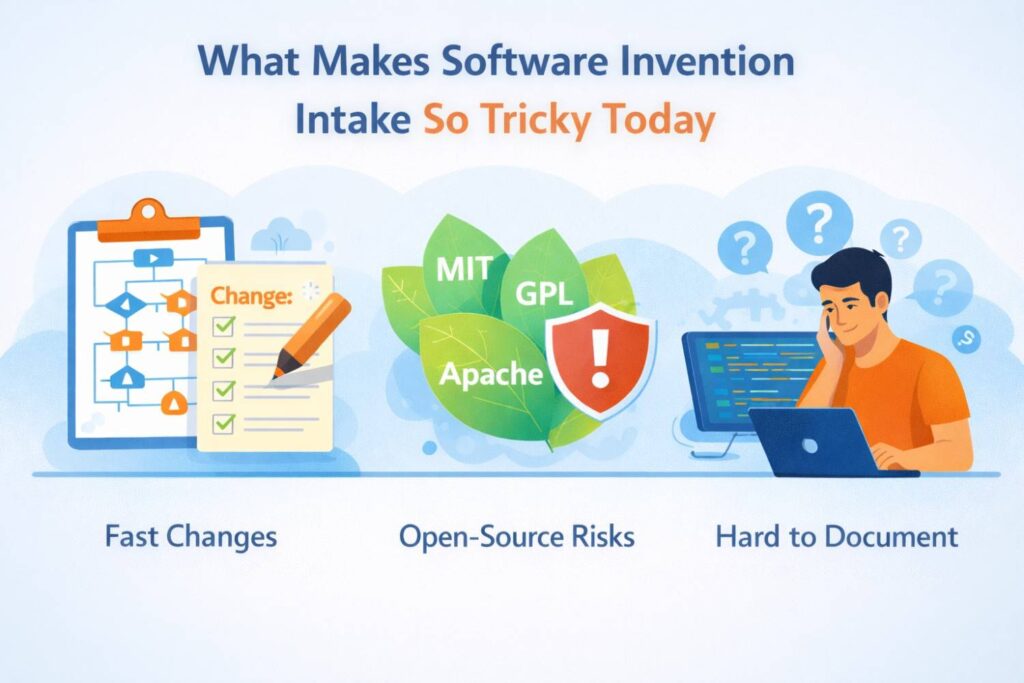
Software moves fast. Code changes daily. Features ship weekly. Entire systems get refactored in a single sprint. That speed is powerful for growth, but it makes invention intake much harder than most founders expect.
Unlike hardware, you cannot point to a physical object and say, “This is the invention.” Software is logic. It is flow. It is invisible architecture running across machines. If you do not capture it clearly, it becomes almost impossible to protect later.
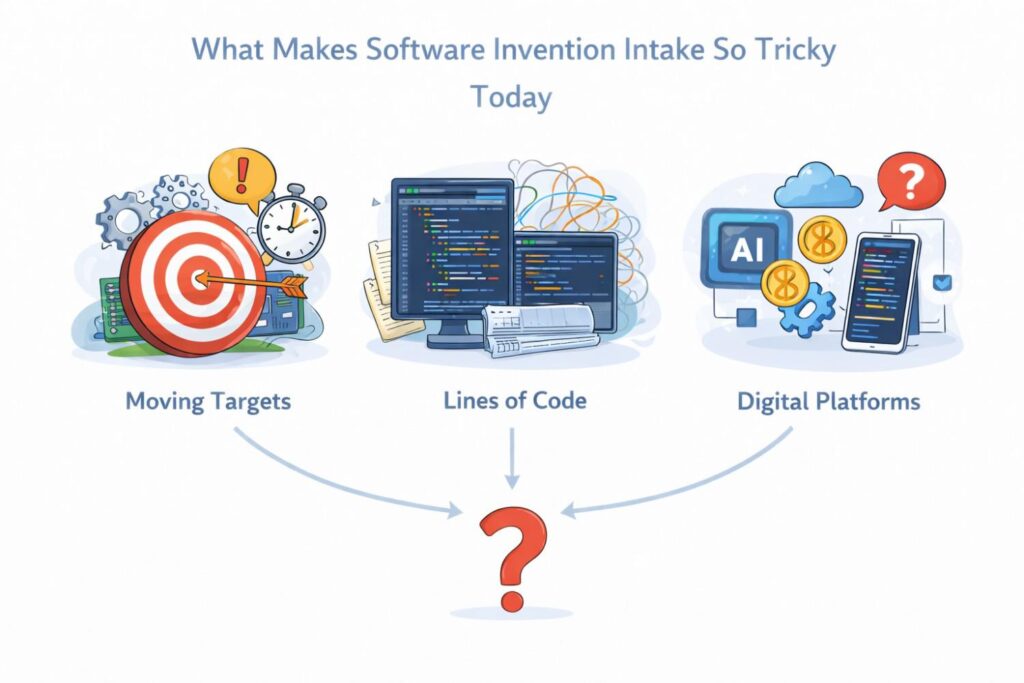
Software invention intake today is tricky because the rules are tighter, the landscape is crowded, and small wording mistakes can limit protection in a serious way.
Software Is Abstract, and Patents Do Not Like Abstract Ideas
One of the biggest challenges in software intake is avoiding vagueness.
Founders often describe their invention in outcome terms. They say their system “improves performance” or “optimizes workflows” or “connects users intelligently.” That language may work in marketing. It does not work in patent protection.
Patents require you to explain how the system achieves those results in technical detail.
During intake, you must translate your codebase into a clear explanation of processes, data structures, system components, and interactions. You need to describe inputs, transformations, outputs, and constraints.
If you stay too high level, the invention can be viewed as an abstract idea. That weakens protection.
The tricky part is that many engineers are used to thinking in code, not in structured explanations. They know how the system works, but they do not always articulate it step by step in plain words.
A strong intake process helps bridge that gap. It guides you to unpack your logic clearly without turning it into legal jargon. That balance is critical.
If you want to see how software founders are guided through this without slowing down their development, you can explore the process here: https://powerpatent.com/how-it-works
The Line Between “Business Logic” and “Technical Innovation” Is Thin
Today, many software startups build tools around workflows, automation, data analysis, or AI models. The risk is that the invention can be framed as a business method instead of a technical improvement.
That distinction matters.
If your intake only describes what the software does for users, you may miss the deeper technical advancement. You must explain how the system changes the functioning of a computer, a network, or data processing itself.
Did you design a new way to handle distributed data? Did you reduce memory usage? Did you improve latency through a new scheduling method? Did you create a training pipeline that adapts in a new way?
These technical angles need to be surfaced during intake.
Founders often slip up by focusing only on the user-facing layer. They forget that the backend architecture, model structure, or processing flow may contain the strongest protectable elements.
A guided intake session pushes you to explore both layers.
AI and Machine Learning Add New Complexity
Modern software frequently includes machine learning models. That introduces new challenges.
Simply stating that your system uses AI is not enough. You need to explain how data is prepared, how models are trained, how parameters are adjusted, how outputs are validated, and how the model integrates into a larger system.
Many founders assume their model is unique because of performance metrics. But performance alone is not always protectable. The method that achieves that performance often is.
During intake, it is important to describe training data pipelines, preprocessing steps, feedback loops, and deployment mechanisms.
If your system adapts over time, explain that adaptation clearly. If it uses reinforcement signals, describe the mechanism. If it blends multiple models, clarify how they interact.
AI based inventions require careful framing to show concrete technical improvement. That framing starts at intake.
With the right structure, this does not become overwhelming. It becomes a focused technical conversation that surfaces real innovation.
Code Changes Faster Than Patents Move
Here is another reason software intake is tricky. Software evolves constantly, but patents move slowly.
By the time a patent application is examined, your codebase may look very different from the version you initially documented.
This reality means intake must focus on core principles, not just current implementation details.
Instead of describing only specific variable names or narrow code snippets, you should explain the broader architecture and logic patterns.
What is the underlying method? What is the structural idea that will likely persist even as the code is cleaned up or optimized?
If intake is too narrow, it may protect only a small snapshot of your system. If it is done thoughtfully, it protects the foundational concept.
This is where experienced oversight makes a difference. Software founders need help distinguishing between temporary implementation details and lasting innovation.
PowerPatent blends smart capture tools with attorney review to help you draw that line correctly. You can see how it works here: https://powerpatent.com/how-it-works
Open Source and Third Party Dependencies Create Risk
Modern software rarely stands alone. It often relies on open source libraries, APIs, or cloud services.
During intake, it is important to clearly separate what you built from what you integrated.
If your innovation lies in how you orchestrate existing tools in a new way, that orchestration needs to be described clearly.
At the same time, you must avoid overclaiming elements that are not truly yours.
Founders sometimes rush through intake and blur these lines. That can create confusion later.
A careful intake session asks precise questions. What parts are original? What parts are modified? What parts are external dependencies? How does your system coordinate them uniquely?
Clarity here protects you from disputes and strengthens your application.
Security and Infrastructure Innovations Are Often Overlooked
Many software startups focus on core product features during intake. They ignore internal innovations around security, scaling, or deployment.
But sometimes the real technical edge lies in how the system handles load, protects data, or ensures uptime.
If you designed a new encryption flow, a new container orchestration method, or a new fault tolerance mechanism, that may be protectable.
These elements are often invisible to users, so founders forget to mention them.
A strategic intake process digs into infrastructure. It asks how the system behaves under stress. It asks what happens during failure. It explores how data integrity is maintained.
These deeper layers can create powerful protection.
Timing and Public Disclosure in Software Are Dangerous
Software companies often launch publicly before thinking about patents. They push updates live. They publish technical blogs. They speak at conferences. They share GitHub repositories.
Once disclosed, certain rights may be limited depending on timing and jurisdiction.
That is why invention intake should happen before major public exposure of new core innovations.
If you are about to release a breakthrough feature, pause briefly and ask whether it has been captured and reviewed.
Building this checkpoint into your release cycle is a smart habit.
With a streamlined intake system, this does not create delay. It creates protection.
Where Software Founders Slip Up Most
One common mistake is being too broad and conceptual. Another is being too narrow and tied to one code snapshot.
Some founders also assume that because software is intangible, it is harder to protect, so they avoid the process entirely. That leaves major value on the table.
Others think filing a quick provisional with minimal detail is enough. Weak detail at intake leads to weak protection later.
The strongest software companies treat invention intake as a technical deep dive. They document architecture, data flow, model logic, infrastructure, and variations early.
They do not treat it as a legal chore. They treat it as part of building defensibility.
Turning Software Into Real Leverage
Software may be invisible, but the protection around it does not have to be.
When intake is done right, your codebase becomes more than a product. It becomes a protected system with defined boundaries.
That gives you confidence when talking to investors. It strengthens your position against competitors. It creates long term optionality if licensing or acquisition becomes part of your path.
If you are building serious software and want a process that captures your innovation clearly without pulling you out of build mode, you can learn how PowerPatent approaches software invention intake here: https://powerpatent.com/how-it-works
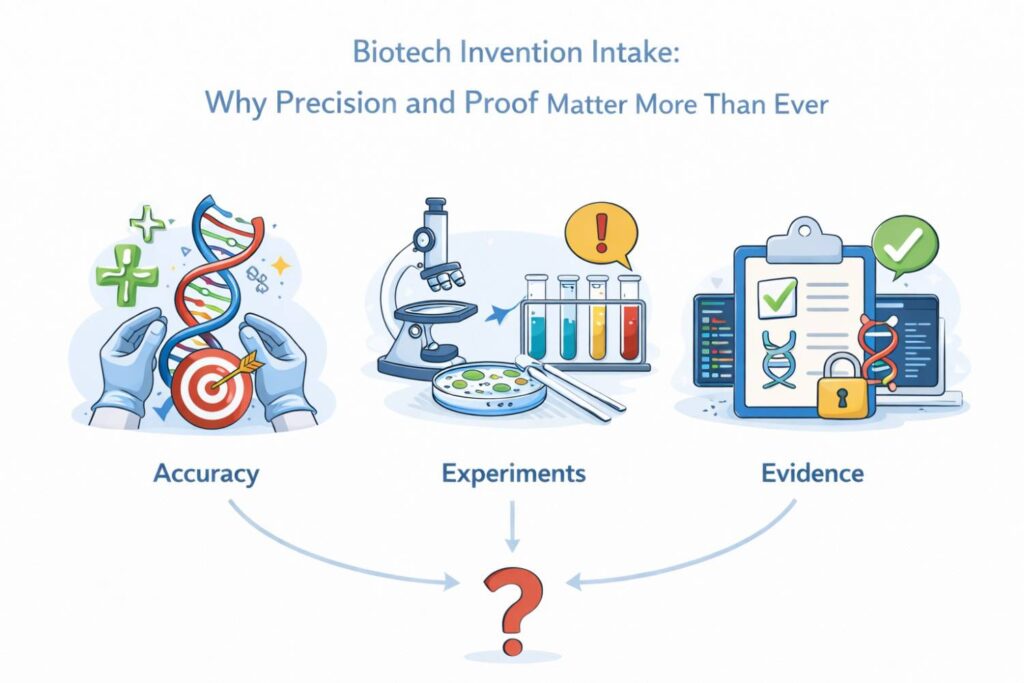
Biotech Invention Intake: Why Precision and Proof Matter More Than Ever
Biotech is different from hardware and software in one major way. In biotech, small details can change everything.
A slight change in a sequence, a minor shift in concentration, or a subtle variation in a protocol can lead to very different results.
That level of sensitivity means invention intake in biotech must be handled with extreme care.
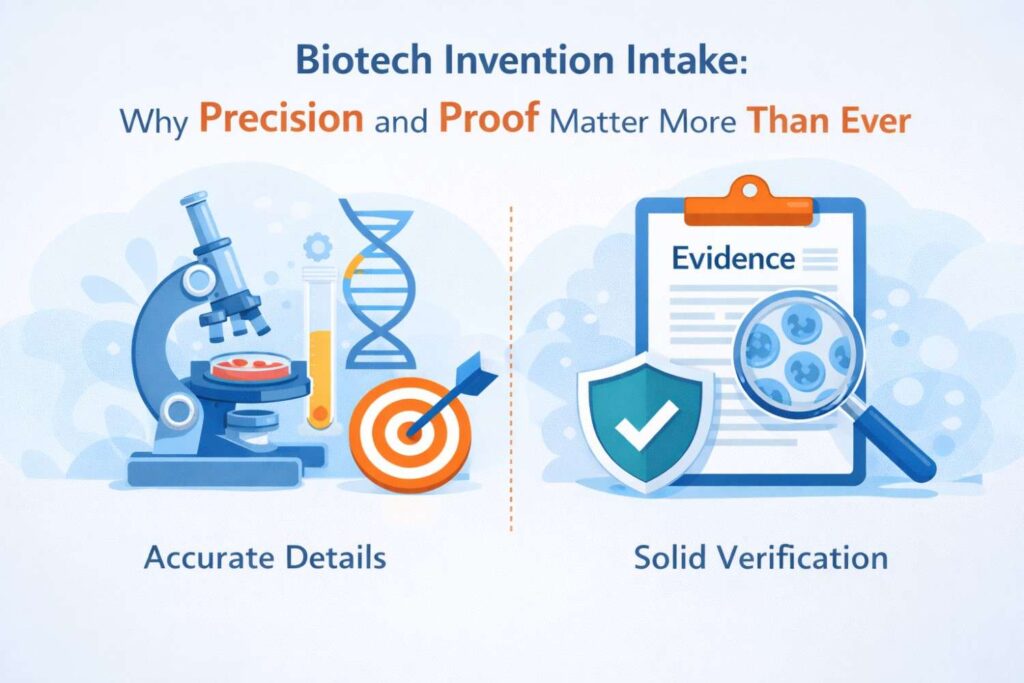
In biotech, you are not just protecting an idea. You are protecting data, biological materials, lab methods, and measurable outcomes. If your intake is vague, you risk losing the core of your innovation. Precision is not optional here. It is the foundation.
Biology Is Complex and Demands Exact Language
Biological systems are not predictable machines. They react, adapt, and behave in ways that can surprise even experienced researchers. That complexity means your invention intake must describe your work with exact detail.
If you developed a new compound, you must clearly explain its structure, composition, and functional properties. If you engineered a sequence, you must define the sequence and describe its variants.
If you created a diagnostic method, you must explain each step of the protocol, including reagents, conditions, and detection techniques.
General descriptions do not work in biotech. Saying a treatment “improves cell health” is not enough.
You must explain how improvement is measured. Is it growth rate, protein expression, survival percentage, or something else? What baseline are you comparing against?
During intake, precision builds credibility. It also builds strength. The more clearly you define your invention, the harder it is for others to work around it.
If you want a system that guides you through capturing this level of detail without overwhelming your team, you can see how PowerPatent approaches invention intake here: https://powerpatent.com/how-it-works
Experimental Data Is Not Optional
In biotech, proof matters more than promise.
Unlike many early stage software tools, biotech inventions often require data to support claims. Lab results, trial outcomes, and validation studies become part of the protection strategy.
During intake, you should gather all relevant data tied to the invention. This includes raw data, summary results, graphs, lab notebooks, and protocol records.
You should clearly explain what experiments were conducted, how they were designed, and what conclusions were drawn.
Founders sometimes assume they need fully complete studies before starting the patent process. That is not always true. Early data can still support strong filings. The key is transparency and clear explanation.
Intake should capture not only successful results but also failed experiments that shaped your final approach. Those failed paths can demonstrate the difficulty of the problem and highlight why your solution is meaningful.
Documenting this journey strengthens your story.
Variants and Alternatives Must Be Thought Through Carefully
Biological inventions often involve sequences, compounds, or formulations that can vary slightly while maintaining function.
If you only document a single narrow version, competitors may adjust a sequence or concentration and move outside your protection.
During intake, you should think carefully about reasonable variants. If you developed a protein, are there similar sequences that preserve function? If you created a formulation, are there alternative carriers or buffers that could be used?
You do not need to test every variation in the lab, but you should consider them conceptually.
This step is where many biotech founders slip up. They focus only on the exact molecule or method that worked in the lab. They forget to explore functional equivalents.
A structured intake process helps surface these broader protection angles while staying grounded in real data.
Timing Is Critical in Research Environments
Biotech startups often collaborate with universities, research institutions, and external labs. Papers are published. Conference abstracts are submitted. Posters are presented.
Public disclosure can affect patent rights.
Before submitting research for publication or presenting findings publicly, it is essential to complete invention intake and coordinate filing strategy.
This does not mean delaying scientific communication. It means planning strategically.
Build internal checkpoints into your research workflow. Before major submissions or presentations, review whether new inventions have emerged and whether they have been documented.
This habit prevents rushed filings and protects long term value.
If your team is moving quickly in the lab and needs a way to capture inventions without slowing research, explore how PowerPatent blends smart tools with real attorney review here: https://powerpatent.com/how-it-works
Regulatory Pathways Influence Patent Strategy
Biotech products often face regulatory review. Whether you are developing therapeutics, diagnostics, medical devices, or agricultural biotech, regulatory approval is a long process.
That timeline makes patent timing even more important.
During intake, consider how long development and approval may take. Strong early filings can secure priority dates that protect you through long clinical timelines.
Intake should also capture details relevant to regulatory positioning. For example, if your method reduces side effects, improves stability, or enhances delivery efficiency, those points may support both patent strategy and regulatory narrative.
When invention intake aligns with long term development plans, you create a coherent path from lab bench to market.
Ownership and Inventorship Must Be Clear
Biotech innovation often involves multiple researchers, institutions, and funding sources.
During intake, it is important to identify who contributed to the inventive concepts. Clear inventorship reduces disputes later.
If research was funded through grants or conducted in partnership with a university, those agreements may affect ownership.
Founders sometimes overlook these details in early stages. Later, they discover complications that delay deals or fundraising.
A disciplined intake process includes documenting contributors and understanding contractual obligations tied to the invention.
Clarity here protects your company’s future.
Where Biotech Founders Slip Up Most
One common mistake is assuming that scientific publication alone provides protection. It does not. Publication without filing can limit patent rights.
Another frequent error is underestimating the importance of detail. In biotech, broad claims without strong support can face serious challenges.
Some teams also delay intake because experiments are ongoing. They wait for perfect data. In reality, early filings can capture foundational discoveries while research continues.
Finally, biotech founders sometimes treat patent intake as separate from scientific thinking. It should not be. The same rigor applied to experiments should apply to documentation.
Turning Scientific Discovery Into Defensible Assets
Biotech innovation requires years of effort, funding, and expertise. Without strong protection, that investment is exposed.
When invention intake is handled with precision, supported by data, and aligned with long term strategy, your discoveries become defensible assets.
That protection increases investor confidence. It strengthens partnerships. It supports licensing discussions. It adds stability during long development cycles.
Biotech is not forgiving when it comes to vague documentation. Precision and proof are your strongest allies.
If you are building in biotech and want a structured way to capture your scientific breakthroughs clearly and strategically, you can learn how PowerPatent supports biotech founders here: https://powerpatent.com/how-it-works
Wrapping It Up
Invention intake is not a side task. It is not paperwork you rush through at the end of a sprint. It is the moment where your hard work turns into something defensible. Hardware demands that you explain structure, interaction, materials, and manufacturing logic with care. The value often hides in mechanical detail and system integration. If you only describe the outer shell, you leave the real innovation exposed.