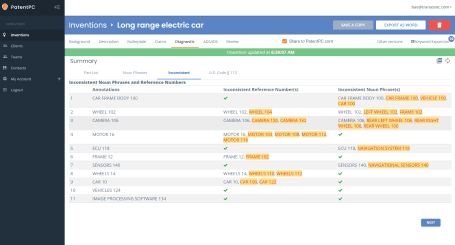
The background section can make or break a patent application.
It looks simple at first. Just a short part near the beginning. Easy to rush. Easy to treat like filler.
That is a mistake.
In AI patent drafting, the background section does real work. It sets the stage. It explains the problem. It helps show why the invention matters.
It can make the rest of the application feel clear and grounded. Or it can quietly weaken the whole thing.
A strong background section is not long for the sake of being long. It is sharp. It is useful. It is careful. It gives context without boxing the invention in.
It explains the world your invention lives in without saying things that can hurt you later.
That balance is where the skill is.
This article will show you how to generate a strong background section for an AI patent application. We will keep it simple.
We will walk through what the section is for, what should go into it, what should stay out, and how founders and builders can write one that actually helps. We will also look at how AI tools can speed up the process without turning your patent into generic, weak, machine-made text.
If you are building something new and want a faster, better way to turn your technical work into real patent protection, PowerPatent is built for this. It combines smart software with real attorney oversight, so you can move fast without giving up quality. You can see how it works here: https://powerpatent.com/how-it-works
Why the background section matters more than most founders think
Many founders care most about the claims.
That makes sense. Claims get a lot of attention because they define the legal edge of the patent.
But claims do not live on their own.
Every part of the application supports the whole. The background section is one of the first places where that support starts.
It tells the reader what kind of technical area the invention belongs to. It explains the problem setting.
It frames the limits of what already exists. It prepares the reader to understand the invention that follows.
When that framing is done well, everything that comes after feels more solid.
When it is done badly, problems start early.
A weak background section can make the invention sound less important than it is. It can make the technical problem feel vague.
It can include broad statements that are easy to challenge. It can even create admissions or narrow framing that later become painful.
That is why this part of the draft deserves real care.
This is especially true in AI patents.
AI inventions often sit in fast-moving, crowded areas. Many teams are working on models, workflows, ranking systems, recommendation systems, prediction systems, automation tools, and decision engines.
If your application starts with fuzzy background language, it may sound like just another generic AI story. That is not where you want to begin.
A strong background section helps show that your work solves a real technical problem in a real way.
That is valuable.
What the background section is really supposed to do
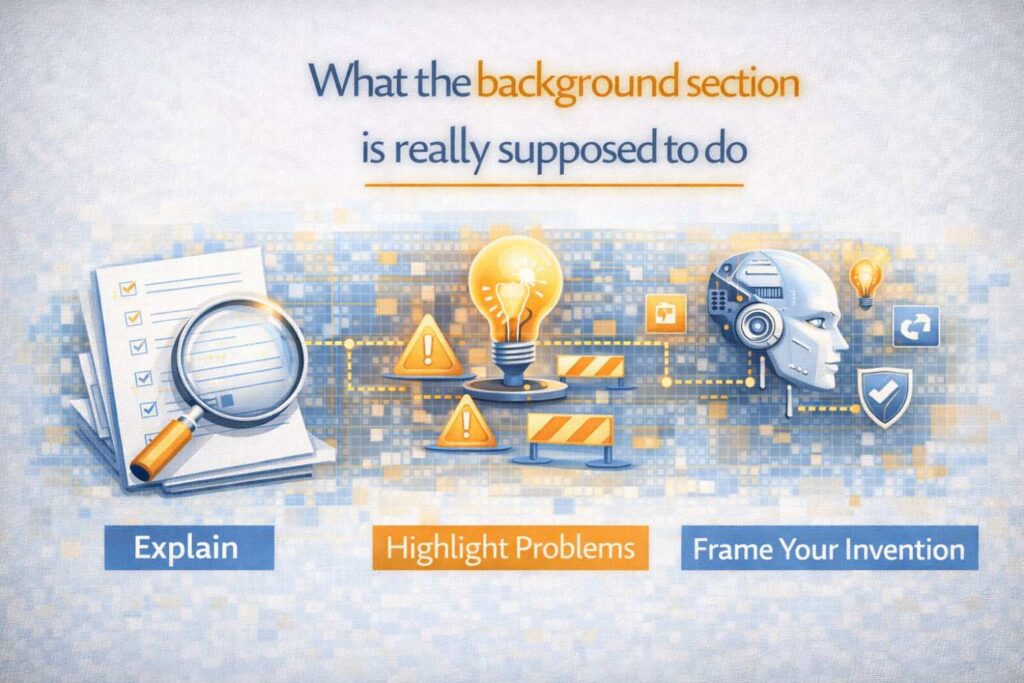
Let us make this simple.
The background section is there to explain the technical setting and the problem context.
That is its core job.
It is not there to brag.
It is not there to sell.
It is not there to throw around buzzwords.
It is not there to write a long history of artificial intelligence.
It is not there to attack every existing system in dramatic terms.
It is there to answer a few quiet but important questions.
What kind of technical area are we in?
What kinds of systems or methods are commonly used here?
What limits or pain points can show up in those approaches?
Why is there room for improvement?
That is enough.
The best background sections feel calm, clear, and useful. They do not try too hard. They do not overstate. They make the reader feel oriented.
Think of the background section like the opening of a good case presentation. Before you explain the answer, you explain the setting and the problem. You help the reader see the need.
That is what works.
Why AI patent backgrounds are often weak
A lot of AI patent applications have weak background sections.
Some are too broad. They say things like AI is changing the world, data is growing rapidly, and businesses need better insights. None of that is wrong, but none of it says much either.
Some are too narrow. They describe a tiny version of the problem that fits only the current product release, which can limit how the invention is understood later.
Some are too marketing-heavy. They sound like startup website copy instead of technical writing.
Some are too absolute. They say current systems cannot do something, when in truth some systems can, at least in some settings.
Some are too vague. They claim there are “inefficiencies” or “drawbacks” without saying what those are.
These mistakes happen for a few reasons.
First, founders and engineers often know the invention deeply, but they have not spent much time thinking about how to frame the problem carefully in patent language.
Second, AI tools make it easy to generate text quickly, but quick text is not the same as strong text. A generic prompt can produce generic drafting.
Third, many teams rush this section because they assume it is not where the real patent value lives.
That is a bad habit.
The background section is not where the legal boundary sits, but it absolutely affects how the invention is read, understood, and positioned.
The hidden risk of writing the background like a pitch deck
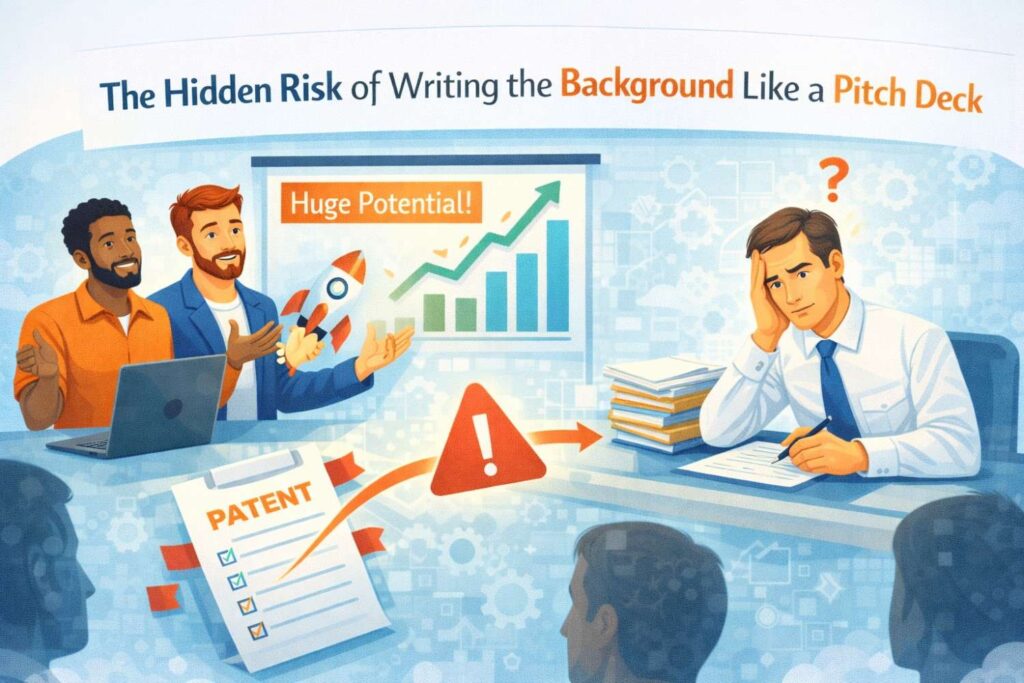
This is one of the biggest traps for startup teams.
They know their company story well. They know their market story well. So when they start drafting the background, they fall into pitch mode.
That sounds like this:
Companies today face massive data overload.
Businesses need better AI-driven decision making.
Existing tools fail to deliver intelligent, real-time, end-to-end outcomes.
That sounds polished. It also sounds empty.
The problem is not just that this language is weak. The deeper problem is that it avoids the real technical issue.
Patent drafting is strongest when it stays close to the actual technical pain.
For example, suppose your invention is an AI system that reduces false positives in fraud detection by combining behavioral signals over time with transaction context and adaptive thresholds.
A pitch-style background might say:
Financial institutions need better fraud detection tools that use AI to improve security and customer trust.
That is not helpful enough.
A stronger background might say:
In some transaction monitoring systems, fraud decisions may be triggered based on isolated events or fixed rule sets. Such approaches may generate false positives where transaction behavior appears unusual in one narrow view but is consistent with a broader pattern of account activity, device history, or user behavior. Excess false positives may increase review burden, delay legitimate transactions, or reduce system efficiency.
That is much better.
It names the setting. It names the kind of old approach. It names the problem in technical and practical terms. It stays grounded.
That is the kind of framing you want.
Start with the real technical problem, not the shiny product promise
If you want a strong background section, begin with the real technical problem.
Not the brand story.
Not the company mission.
Not the future of AI.
The real technical problem.
This sounds obvious, but it changes everything.
A real technical problem is usually visible in one or more of these forms.
A system produces too many false alerts.
A model takes too long to update.
An inference pipeline uses too much compute.
A ranking process ignores important context.
A sensor fusion system breaks when signals arrive out of order.
A personalization engine fails when user data is sparse.
A workflow depends too heavily on manual review.
A classifier loses accuracy when deployed on low-power devices.
A data processing step requires repeated full scans and slows response time.
These are real problem shapes.
They are much better than saying something broad like “organizations need better AI.”
The more specifically you understand the technical problem, the easier the background becomes.
This is also one reason strong patent workflows start with invention capture instead of just blank-page drafting.
When you map how the system works, where the friction sits, and what exactly your approach improves, the background section starts to write itself in clearer form.
That is one area where PowerPatent helps founders a lot. Instead of forcing you into old-school drafting pain, it helps capture the real technical substance behind your invention and turn it into a stronger patent application with real attorney oversight.
You can explore that here: https://powerpatent.com/how-it-works
The ideal shape of an AI background section
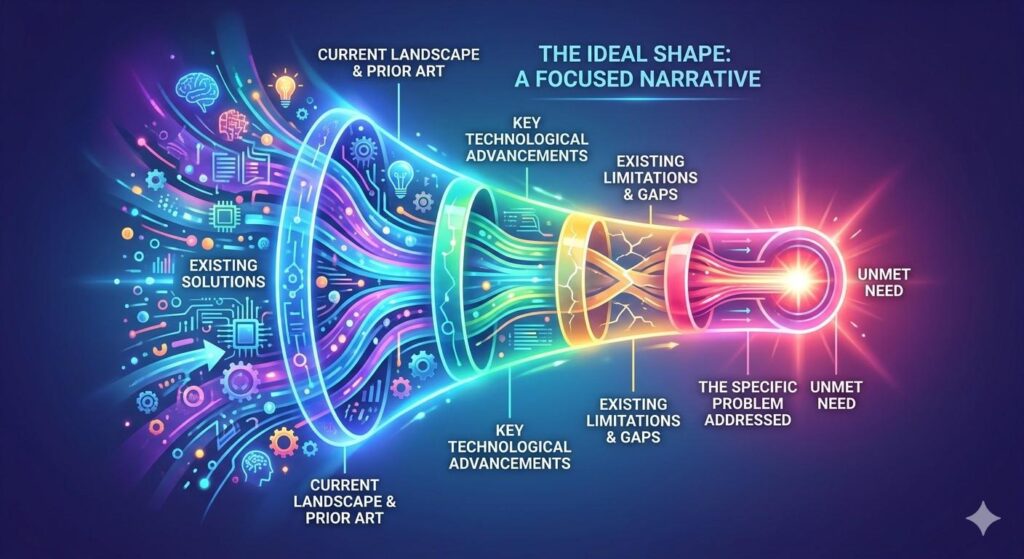
A strong AI background section usually has a simple shape.
It starts by identifying the general technical area.
Then it describes a common type of existing approach used in that area.
Then it explains where those approaches may fall short in certain cases.
Then it leaves room for the invention that follows.
That is all.
It does not need to be long. It does need to be thoughtful.
Here is the rough pattern in plain language.
First, tell the reader what kind of systems are involved.
Second, explain how those systems are often used.
Third, explain a technical limitation that can arise.
Fourth, point to the need for improvement.
That shape works across many kinds of AI inventions.
If your invention is about model training, focus on the training limitation.
If it is about inference on edge devices, focus on the deployment limitation.
If it is about ranking, scoring, personalization, generation, automation, monitoring, or control, frame the specific technical issue in that domain.
The background section is not supposed to explain your full solution. It is supposed to make the need for your solution easy to see.
How to identify the right problem framing for AI inventions
This is where many founders need the most help.
Their system does many things. The product has many features. The model has many moving parts. So which problem should the background section focus on?
The answer is simple in theory and hard in practice.
Focus on the problem that is most closely tied to the inventive contribution.
Not the biggest market problem.
Not the broadest industry trend.
The problem most tied to what is actually inventive.
For example, say your startup built an AI assistant for support teams.
The company story might be about reducing support costs and improving customer happiness.
But the patent-worthy invention might be a method for selecting a response action using context windows, historical resolution paths, and confidence-based escalation logic.
If that is the invention, then the background should not mostly talk about rising customer service demand.
It should talk about the technical limits of response selection systems, such as weak context handling, poor escalation timing, or inaccurate action ranking.
That is the right level.
Another example.
Suppose your team built a computer vision system for warehouse safety.
The company story may be about reducing injuries and improving operations.
But the invention may involve fusing video frames with movement history and zone state data to reduce false alerts in crowded spaces.
If so, the background should focus on technical limits in event detection and context-aware alert validation. Not just on workplace safety in general.
This distinction matters.
Patent value often lives in the deeper mechanism, not the broad business outcome.
A useful rule: describe pain in technical terms, not emotional terms
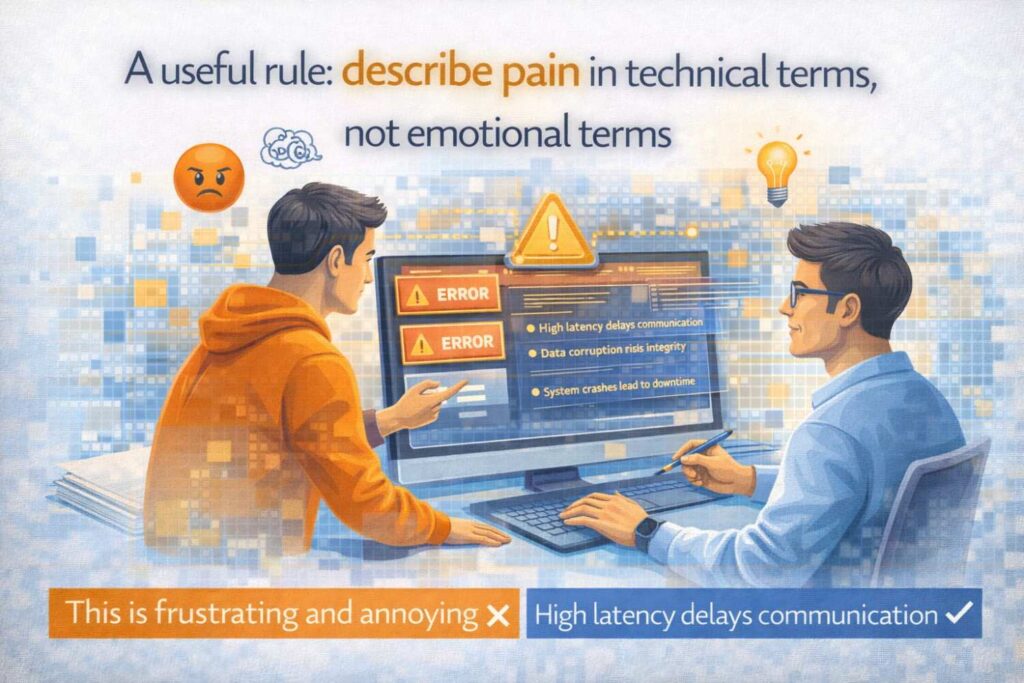
It is tempting to write the background in emotional business language.
Current systems frustrate users.
Companies suffer from inefficient workflows.
Customers need trust.
These are not terrible ideas, but they are weak foundations for a patent background.
A better approach is to describe pain in technical terms.
Current systems may require repeated manual labeling to maintain accuracy.
Existing classifiers may rely on static thresholds that do not adapt to changing signal patterns.
Some recommendation systems may underperform where interaction history is sparse.
Certain model update workflows may introduce latency due to centralized retraining requirements.
These are better because they tell the reader something real.
They also make the invention feel more specific and more credible.
Patent drafting becomes stronger the moment you move from “this is bad for business” to “this is the technical limitation that arises in the system.”
That shift is simple, but powerful.
What a strong AI background section sounds like
A strong background section usually sounds measured.
It avoids hype.
It avoids making giant claims about all prior systems.
It avoids saying the invention is the answer before the answer section arrives.
It sounds like someone who understands the space and is explaining the problem clearly.
Here is the tone you want:
In some environments, existing systems may rely on fixed models trained on historical data that do not update effectively in response to shifting input patterns.
As a result, classification performance may degrade over time, especially where user behavior or device conditions change rapidly.
Notice what this does well.
It says “in some environments,” which avoids overclaiming.
It refers to a type of existing approach.
It names a clear problem.
It explains when the problem may show up.
That is good drafting.
Now compare that to this:
Conventional AI systems fail to adapt to real-time behavior and cannot provide reliable classification in dynamic settings.
That is too absolute. It invites pushback. It sounds careless.
You do not need the background section to sound dramatic. You need it to sound correct.
The line between useful context and harmful admissions
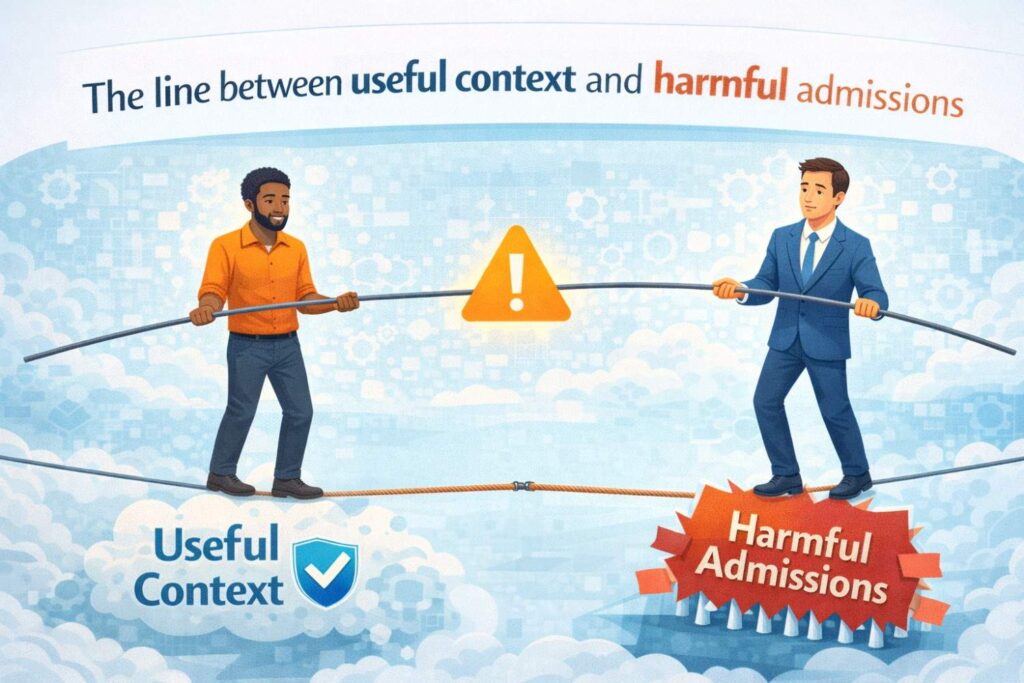
This is one of the most important skills in drafting a background section.
You want to explain what exists and where it may fall short. But you do not want to accidentally make statements that become harmful later.
This can happen in a few ways.
One way is by describing prior approaches too specifically, as if only one type exists, when the field is broader.
Another is by stating that certain steps or features are always required, which can later narrow how the invention is understood.
Another is by saying current systems cannot do something at all, when in reality some can.
The safest path is careful, measured language.
Use phrases like “in some cases,” “may,” “can,” “in certain environments,” and “for example” where they fit naturally.
These words are not weak. They are often wise.
They let you describe the problem space without boxing yourself in.
At the same time, do not become so soft that the problem disappears. The background still needs to feel meaningful.
So the goal is balance.
Clear enough to matter. Careful enough to hold up.
Why AI-generated patent backgrounds often feel empty
Let us talk directly about AI drafting for a moment.
AI can help a lot in patent work.
It can speed up invention capture. It can help organize technical material. It can produce first-pass language. It can turn messy notes into structured prose.
But when it comes to background sections, AI often produces weak output unless guided very well.
Why?
Because generic prompts tend to produce generic writing.
If you ask an AI system to “write a patent background for an AI invention,” it will usually give you broad lines about data growth, business challenges, conventional systems, and the need for improvement.
That is safe text. It is also bland and easy to replace.
A strong background section needs more than broad pattern matching.
It needs to understand the actual technical setting, the actual prior approaches, and the actual limitation most relevant to the invention.
That means the prompt matters a lot.
So does the source material.
AI works far better when it is drafting from a real invention map instead of inventing context from thin air.
That is why the best use of AI in patent drafting is not blind generation. It is guided generation grounded in invention-specific facts.
How to prompt AI to generate a better background section
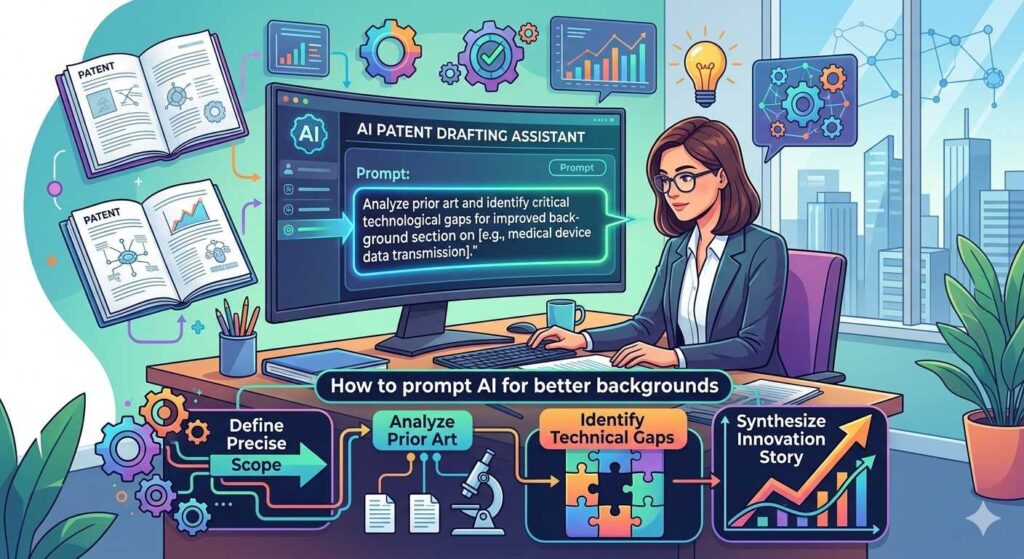
If you are using AI to help draft a background section, do not start with “write a background section.”
Start with structured inputs.
Give the model the invention area.
Give it the old approach.
Give it the limitation.
Give it the context where that limitation matters.
Give it any wording constraints you care about, such as avoiding absolute language or avoiding marketing tone.
For example, a better drafting prompt might look like this in substance:
The invention relates to AI-based ranking of service tickets. Existing systems often rank tickets using static priority rules or models that do not consider updated context from recent customer interactions, agent capacity, or issue history.
This can cause poor routing and delayed handling. Draft a patent-style background section in formal but clear language.
Explain the technical setting and the limitation without mentioning the invention itself. Avoid absolute language.
That is much better than “write a background section for an AI support invention.”
The more grounded the prompt, the better the output.
But even then, review matters.
Generated text should be checked for overstatement, vagueness, accidental narrowness, and repeated generic phrases.
This is where human judgment still matters a lot.
And this is exactly why PowerPatent’s model is so useful. It does not just throw raw AI at the problem.
It combines smart software with real patent attorney oversight, which helps founders move faster while still producing stronger work. Here is the link if you want to see the workflow: https://powerpatent.com/how-it-works
The simplest drafting formula that works
Here is a practical formula you can use when generating an AI patent background section.
Begin with the domain.
Then name the common type of existing system.
Then explain the technical limitation.
Then explain the effect of that limitation.
Then point to the need for improvement.
In paragraph form, it might feel like this:
The present disclosure relates generally to automated decision systems used in digital transaction environments.
In some implementations, such systems may use rule-based or model-based approaches to classify transaction events based on observed input features.
However, where classification is performed using limited event context or static thresholds, the systems may generate false alerts or fail to adapt to changing behavior patterns.
This may increase review burden, delay event handling, or reduce classification efficiency. Accordingly, improved techniques remain desirable.
That is a good shape.
It is simple. It does not say too much. It does not say too little.
It makes room for the rest of the application.
How long should the background section be?
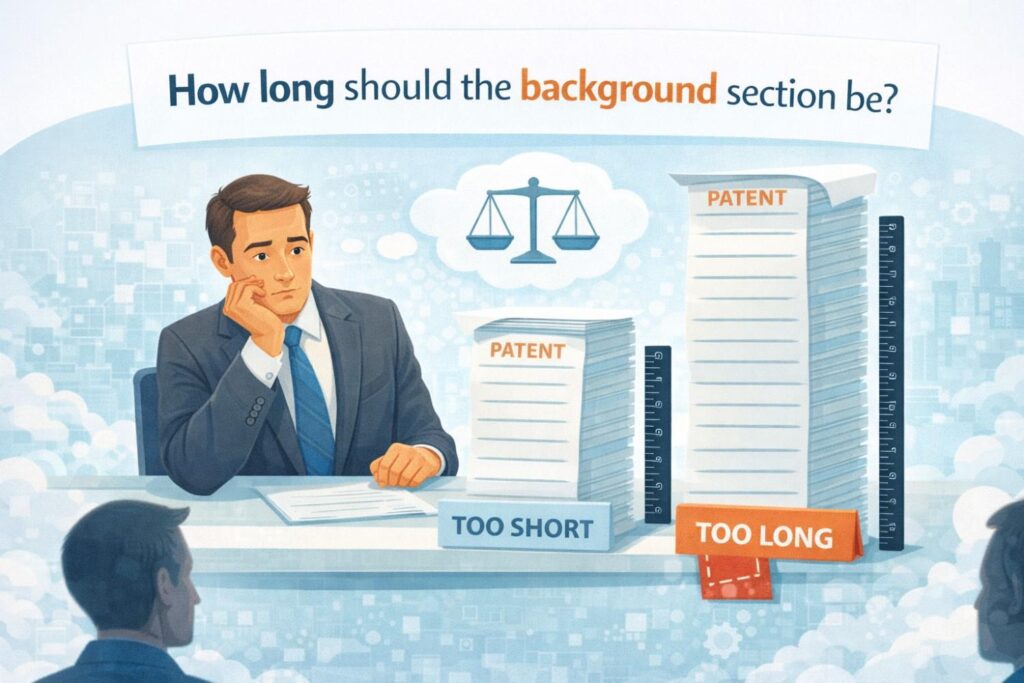
There is no magic length.
Some strong background sections are short.
Some need more room because the technical setting is complex.
The real test is not word count. The real test is whether the section does its job.
Does it explain the technical context clearly?
Does it identify the right kind of problem?
Does it avoid harmful overstatement?
Does it make the need for improvement easy to understand?
If yes, the length is probably fine.
Many founders assume longer means safer. That is not true.
A long background full of broad industry commentary, repeated points, and generic AI language is not stronger. It is just longer.
On the other hand, a one-sentence background that says almost nothing is not enough either.
Aim for enough detail to orient the reader and frame the problem well. No more, no less.
Why the best background sections feel obvious after you read them
A good background section often creates a simple reaction in the reader:
Of course. I see the setting. I see the issue. I see why an improvement could matter.
That is what you want.
You do not want the reader confused about what the problem is.
You do not want the reader stuck in broad business language.
You do not want the reader feeling like the draft skipped from “AI exists” to “here is our invention.”
The background section is the bridge.
When that bridge is built well, the rest of the patent becomes easier to absorb.
Common patterns for AI inventions and the right background focus

AI inventions come in many forms, but certain patterns show up again and again.
If the invention is about model training, the background may focus on training inefficiency, stale models, costly labeling, weak adaptation, or poor data quality handling.
If the invention is about inference, the background may focus on latency, compute limits, memory limits, device constraints, or poor confidence handling.
If the invention is about personalization, the background may focus on sparse data, weak context use, slow feedback loops, or cold-start problems.
If the invention is about recommendations, the background may focus on poor ranking under changing conditions, narrow signal use, or weak cross-session context.
If the invention is about computer vision, the background may focus on noisy scenes, occlusion, false positives, low-light settings, or costly frame-by-frame processing.
If the invention is about natural language processing, the background may focus on limited context windows, poor intent selection, weak domain adaptation, or uncertain response generation.
If the invention is about anomaly detection, the background may focus on static thresholds, imbalance between normal and rare events, drift over time, or alert overload.
If the invention is about edge AI, the background may focus on model size, limited bandwidth, battery constraints, or delayed cloud response.
The point is not to copy these lines directly.
The point is to think in the right pattern.
Your background should match the actual technical shape of your invention.
How to avoid sounding like every other AI patent
This matters a lot.
There is a flood of AI language now. Everyone says smarter, adaptive, intelligent, automated, data-driven, and real-time.
If your background section leans too heavily on those words, it will blur into the crowd.
To stand out, get concrete.
Instead of saying “intelligent decision making,” describe the specific decision context.
Instead of saying “data-driven optimization,” describe the input and the process pain.
Instead of saying “real-time adaptation,” describe what changes and why static approaches struggle.
Specificity is what makes the background sound real.
That does not mean stuffing it with jargon. Simple, concrete words are better than fancy ones.
For example, “fixed thresholds may trigger alerts when signal patterns shift during peak demand periods” is stronger than “legacy approaches lack intelligent dynamic responsiveness.”
The first one says something.
The second one sounds like filler.
The background section should not explain the invention itself
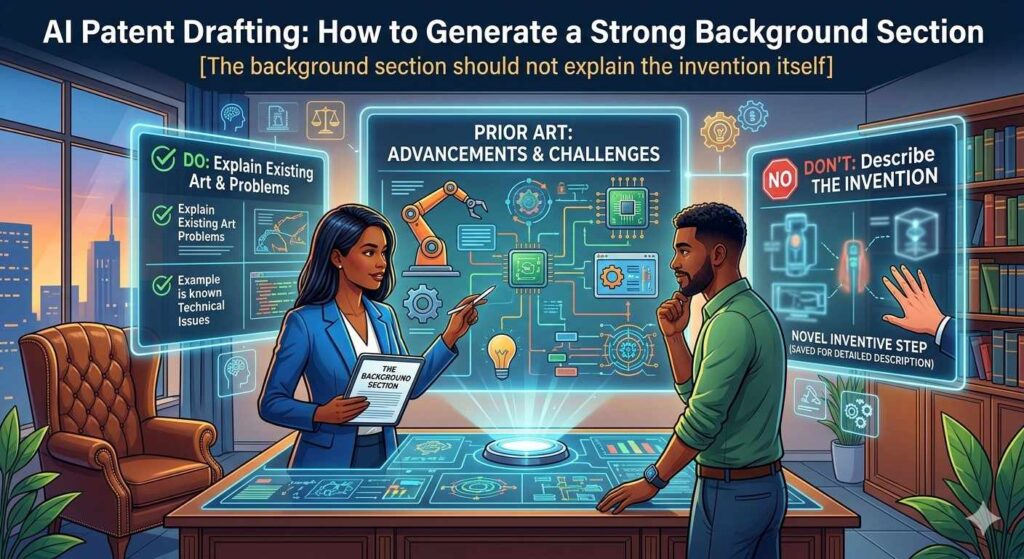
This may seem strange at first.
If the background is supposed to set up the invention, why not explain the invention there?
Because each section has its role.
The background sets the scene and the problem.
The summary introduces the invention.
The detailed description explains it fully.
When founders mix those jobs together, the draft gets messy.
A background section that starts previewing the full answer can feel awkward. It can also weaken the clean structure of the application.
So keep the background focused on the setting and the limitation.
You can point toward the need for improvement. You do not need to solve the problem yet.
Let the invention arrive in the next section with force.
A practical way to generate a strong background from internal product knowledge
Most founders do not start with clean patent-ready language.
They start with product notes, architecture diagrams, tickets, whiteboard photos, or a head full of system knowledge.
That is fine.
Here is a practical way to turn that into a background section.
First, ask what the system does now that older systems do not do well.
Second, ask what old approaches usually rely on.
Third, ask where those old approaches break.
Fourth, ask what bad result comes from that break.
Then write the background around those answers.
Suppose your system helps detect faults in industrial equipment using streaming sensor data and context-aware scoring.
You might ask:
What did older systems rely on?
Maybe static thresholds or isolated sensor readings.
Where did those systems break?
Maybe in changing operating conditions where normal behavior shifts by time, load, or environment.
What bad result followed?
Maybe too many false alerts or missed detections.
Now you have the background frame.
That is much easier than staring at a blank page.
A plain-language template you can adapt
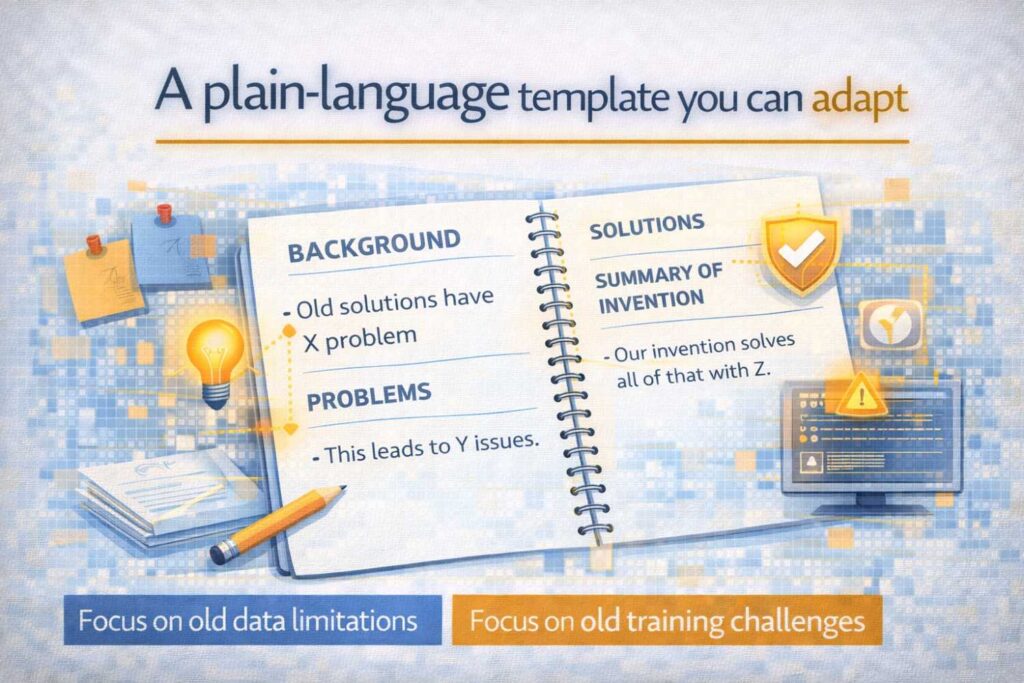
Here is a simple background template in plain language. Do not copy it word for word. Use it as a shape.
In some environments, systems are used to perform [general task] based on [common input or approach]. These systems may rely on [old method type], which can be effective in some settings.
However, where [specific condition], such approaches may [technical limitation]. This may lead to [technical or operational effect]. Accordingly, improved techniques remain desirable.
This works because it is neutral, clear, and flexible.
You can adapt it to many AI inventions without forcing weird language.
For example:
In some environments, systems are used to classify network events based on observed traffic features.
These systems may rely on fixed rule sets or models trained on historical activity patterns, which can be effective in some settings.
However, where traffic behavior shifts over time or varies across deployment environments, such approaches may generate false alerts or fail to identify relevant anomalies.
This may increase review load, delay response actions, or reduce monitoring efficiency. Accordingly, improved techniques remain desirable.
That is a solid starting point.
How to write a better first sentence
The first sentence matters more than people think.
A weak first sentence sounds broad and empty.
Artificial intelligence is increasingly used across many industries to improve outcomes.
That is true and useless.
A stronger first sentence enters the real technical setting sooner.
Automated systems are often used to classify input events in transaction processing environments.
That is better.
Or:
Machine learning systems are increasingly deployed to generate predictions from sensor data in industrial monitoring environments.
Also better.
The best first sentence gives the reader a place to stand. It says, this is the type of system we are talking about.
That helps everything that follows.
Good and bad examples side by side
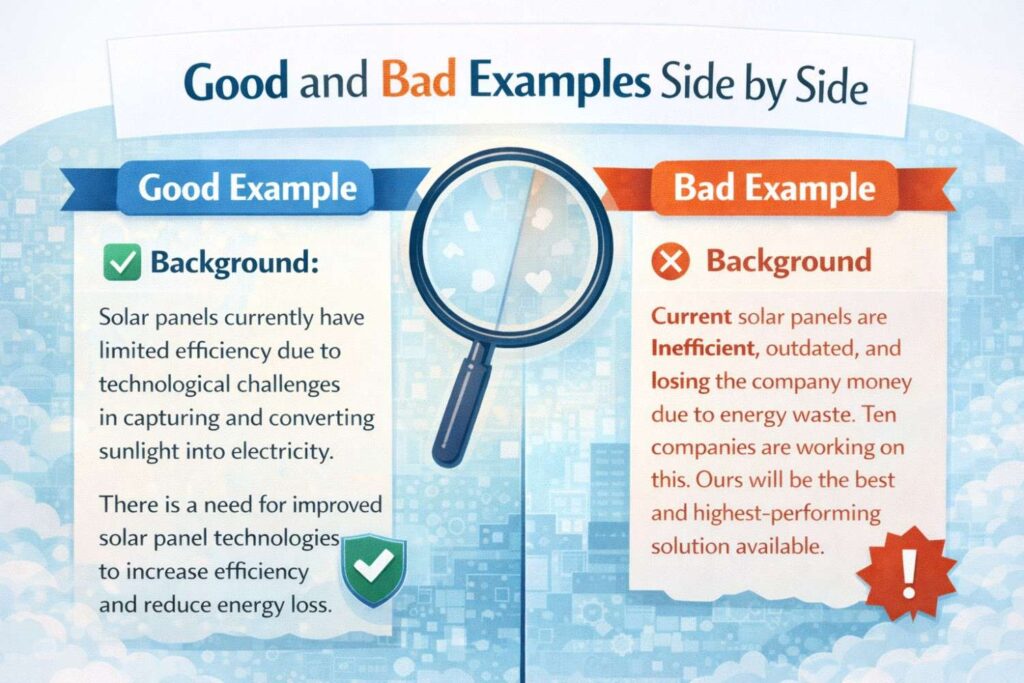
Let us make this more concrete.
Bad version:
Businesses today generate large volumes of data and need AI-powered systems to make better decisions in real time. Conventional tools are not enough to keep up with growing demand, and improved solutions are needed.
What is wrong with it?
It is broad.
It is generic.
It sounds like a keynote speech.
It tells us almost nothing about the real technical setting.
Better version:
In digital workflow management environments, automated systems may be used to assign tasks based on input data associated with incoming work items. Some systems rely on fixed routing rules or trained models using limited task attributes.
However, where task context changes over time or depends on related workflow history, such approaches may assign tasks inefficiently or produce inconsistent routing outcomes.
This may increase processing delay, review burden, or system overhead.
This version is stronger because it gives shape to the world and the problem.
That is the standard you want.
How much prior art detail belongs in the background section?
Usually, not too much.
The background section can describe general types of existing approaches and their possible limits. But it does not usually need a deep prior art survey in the body of the application.
You are not writing a literature review.
You are setting context.
So do not feel pressure to name every paper, every product, or every model class in the background section itself.
What matters more is that the framing is technically accurate and tied to the invention area.
If specific prior art analysis is needed, that can happen elsewhere in the patent process.
Why founders should review the background personally

Even if you have outside help, founders and technical leads should review the background section closely.
Why?
Because this is where tone and framing get set.
A background written by someone who only partly understands the product may sound formal but miss the actual technical pain.
It may focus on a broad industry issue instead of the real inventive problem. It may use language that feels polished but empty.
The founder or lead engineer can usually spot this very quickly.
They know where the system struggled before the breakthrough. They know what design choice made the difference.
They know which pain point was real and which one is just general market noise.
That insight is exactly what helps turn a weak background into a strong one.
So do not treat this section like boilerplate. Read it. Push on it. Tighten it.
How to use product history to improve the background
One of the best ways to draft a stronger background is to remember how your own team got to the invention.
Before the current system worked, what was hard?
What failed?
What created noise, delay, cost, drift, low accuracy, or too much manual work?
Those real pain points are often better than abstract market framing.
For example, maybe your team tried a simple ranking model first and it kept surfacing bad results because it ignored session-level context.
That is a useful clue.
Maybe your edge deployment kept failing because full models were too large for the device.
Also useful.
Maybe rule-based alerting broke the moment customer behavior shifted across geographies.
That is background gold.
The road your team walked often contains the clearest version of the real problem.
How AI can help without replacing judgment
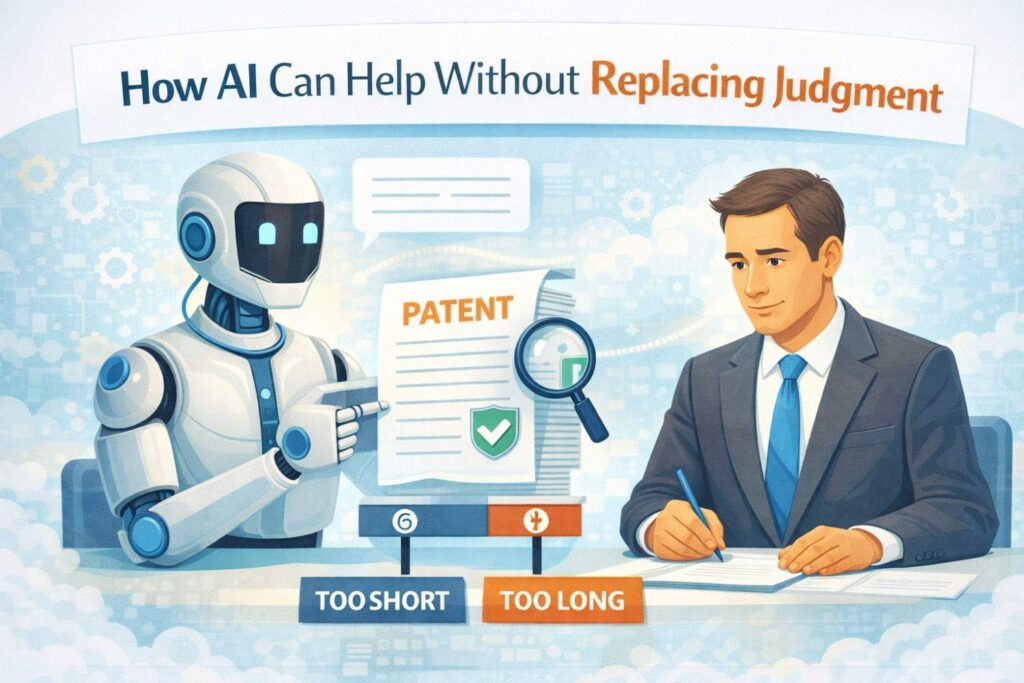
Used well, AI can make this process much easier.
It can help summarize problem notes.
It can turn engineering explanations into cleaner draft language.
It can produce alternate versions of the same paragraph so you can compare tone and clarity.
It can help you test whether the problem framing is too broad or too narrow.
It can even suggest safer language where a sentence feels overly absolute.
All of that is helpful.
But AI should not be the final judge of whether the background is truly good.
That judgment still needs people who understand the invention, the patent strategy, and the risks of careless language.
In practice, the best workflow is not AI alone or human alone.
It is structured invention capture, smart generation, and informed review.
That is the sweet spot.
Drafting backgrounds for different kinds of AI inventions
Let us go deeper and look at how the background section can shift depending on the invention type.
AI systems for ranking and recommendation
If your invention ranks things, the background should usually focus on how ranking is often done and where existing approaches miss relevant context.
For example, maybe old systems rely on static scoring rules, narrow feature sets, or one-shot predictions that ignore recent behavior.
The limitation might be poor ordering, stale relevance, or weak adaptation under changing conditions.
That is much better than saying users want better recommendations.
The technical issue is what matters.
AI systems for classification and detection

If your invention classifies events, content, behavior, or signals, the background may focus on false positives, false negatives, drift, weak calibration, or poor context handling.
A good background might explain that some systems classify events using isolated inputs or fixed thresholds, which can break when behavior varies over time or across environments.
That sets up many kinds of classification inventions well.
AI systems for generation
If your invention involves generated content, the background should not just say content generation is hard.
Instead, focus on the real technical issue.
Maybe prompt handling lacks domain control.
Maybe output selection ignores system state.
Maybe generated actions are not tied to execution logic.
Maybe context windows are managed poorly.
The background should set up that specific problem.
AI systems for automation and control
If your invention automates actions, routing, scheduling, or device control, the background may focus on weak decision timing, poor adaptation to changing inputs, or heavy reliance on manual review.
Again, stay close to the technical pain.
AI systems for edge deployment
If your invention is about getting AI to work on small or remote devices, the background should likely discuss model size, bandwidth, latency, battery use, or delayed cloud response.
This is especially important because edge AI backgrounds often get too broad and start sounding like general IoT commentary. Keep it specific.
The role of the background in making the invention feel non-obvious
The background section is not where you argue patent law directly.
But it does help create the setup for why the invention matters.
If the background frames the old approaches well, then the invention that follows can feel more grounded, more necessary, and more technically meaningful.
That is useful.
A vague background makes the invention harder to appreciate.
A sharp background helps the reader see that there was a real problem and that the invention is operating in the right space.
This is another reason to take it seriously.
How to revise a weak background section
A weak background section is not the end of the world.
It is usually a signal.
It tells you the invention may not have been framed clearly enough yet. It tells you the draft may be leaning on broad language instead of real technical context.
It tells you the team may know the solution well, but has not fully explained the real problem in a way that supports the patent.
That is fixable.
In fact, revising a weak background section can become one of the most useful parts of the drafting process.
It forces the business to get sharper about what problem it actually solved, what old approach it replaced, and why that difference matters in a technical way.
That is not just good for the patent.
It is good for the company.
Start by Diagnosing the Type of Weakness

Not every weak background section fails in the same way.
Some are too broad. They sound like they could belong to almost any AI startup.
Some are too thin. They mention a problem, but not enough context to make the problem feel real.
Some are too aggressive. They overstate what existing systems can or cannot do.
Some are too close to the invention and start revealing the answer before the application is ready for it.
Some are technically correct but strategically weak because they frame the wrong problem.
That is why the first step is diagnosis, not editing.
Before changing words, identify the real flaw.
Ask simple questions.
Is this section too generic?
Does it describe the right technical setting?
Does it explain the actual limitation that led to the invention?
Does it sound like a product pitch instead of patent drafting?
Does it leave room for the invention that follows?
Once you know what is wrong, revision becomes much easier.
Remove Anything That Could Fit Ten Other Startups
This is one of the fastest ways to improve a weak background section.
If a sentence could appear in almost any AI patent draft, it is probably not helping enough.
Lines about growing data volumes, rising demand for automation, real-time decision making, improved efficiency, and the need for better outcomes often fall into this category. They are not always false. They are just too broad to carry real drafting weight.
The test is simple.
If you removed your company name, product name, and invention title, would the paragraph still sound like it could belong to many different businesses?
If yes, it needs work.
A stronger background section should feel tied to a real technical setting. It should describe a real kind of system and a real kind of weakness. That is what makes it useful.
Rebuild the Section Around One Clear Technical Friction Point
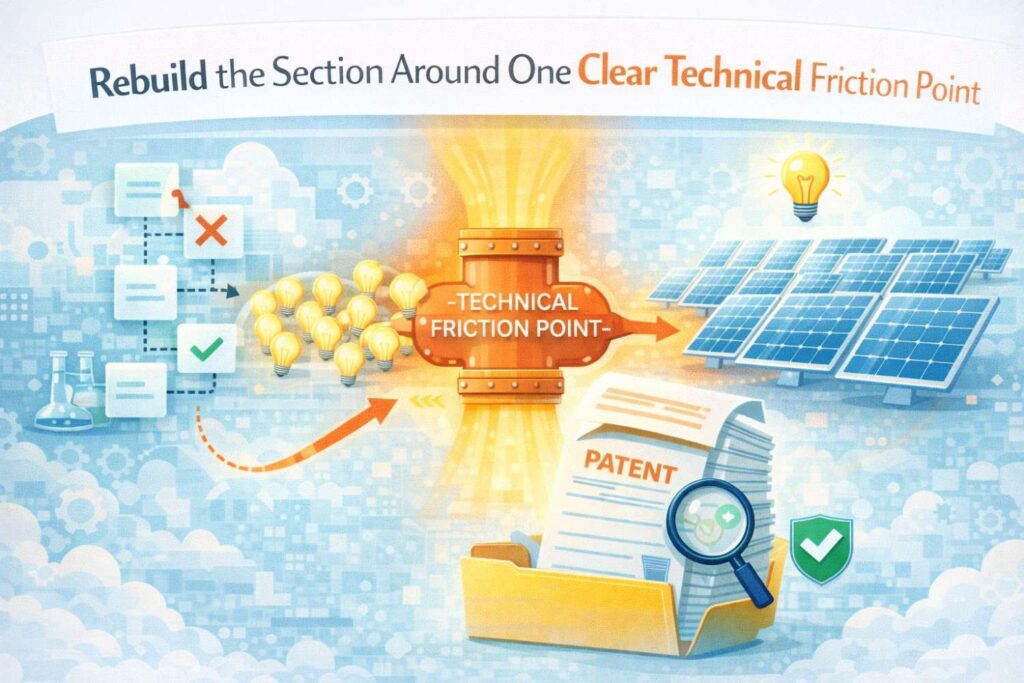
A weak background often tries to cover too much ground.
It talks about the whole market, the whole field, and every possible limitation at once. That usually leads to soft, blurry writing.
A better move is to center the revision around one main technical friction point.
What was the actual pain?
Was the system too slow when inputs became large?
Did the model perform badly when context changed?
Did rule-based logic create too many false alerts?
Did a ranking process fail when user history was sparse?
Did a workflow break because updates happened too late?
Choose the friction point most closely tied to the invention and rebuild the section around that.
This makes the writing more focused and much more believable.
Businesses benefit from this because it creates stronger alignment between the patent story and the real product advantage. Instead of sounding broad and abstract, the draft starts to reflect what the company actually solved.
Revise With the Business Goal in Mind
Patent drafting should be technically grounded, but businesses should still think strategically when revising a weak background section.
Ask what role the patent is supposed to play.
Is this filing meant to protect a core platform advantage?
Is it tied to an upcoming raise?
Is it meant to strengthen a moat story in a crowded category?
Is it meant to support a new product line or enterprise motion?
These questions matter because they help you decide which problem framing is most valuable.
For example, if the invention is part of a core platform, the background should frame the pain at the platform level, not just at the feature level.
If the filing supports a broader market story, the background should still stay technical, but it should point toward the problem space that makes the invention commercially meaningful.
That does not mean writing marketing copy.
It means being deliberate about which technical pain gets centered in the draft.
Replace Broad Claims With Operational Detail
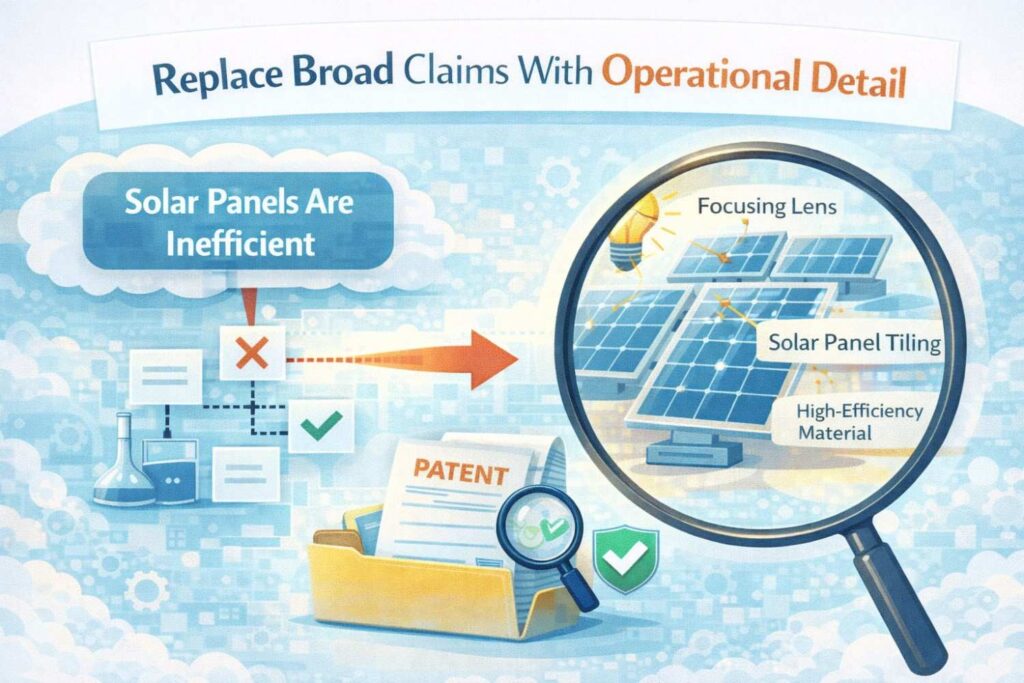
One of the best ways to strengthen a weak background section is to replace broad claims with operational detail.
Weak version:
Existing systems are inefficient and inaccurate.
Stronger version:
Some systems rely on fixed scoring rules applied to isolated event records, which may reduce accuracy where event significance depends on prior activity, related context, or shifting input patterns.
The second version works better because it tells the reader how the older system works and where the weakness appears.
This kind of revision is powerful because it turns vague criticism into grounded explanation.
When businesses do this well, they create drafts that are easier to defend, easier to understand, and more clearly tied to the invention.
Check Whether the Background Is Framing the Wrong Enemy
This is a very strategic revision step.
Sometimes a background section is weak not because the writing is poor, but because it frames the wrong problem.
For example, a company may think it is solving “slow customer support,” but the patent invention may actually relate to context-aware response ranking.
Or a startup may think it is solving “better automation,” while the inventive step is really about reducing failure in low-data situations.
If the background frames the wrong enemy, the whole application can feel slightly off.
The answer is to ask one hard question:
What exact technical weakness would a competitor still struggle with, even if they copied the visible product outcome?
That is often the better problem to frame.
This is where revision becomes strategic. You are not just editing language. You are aligning the patent story with the deepest layer of defensibility.
Make the Problem More Concrete by Adding Conditions
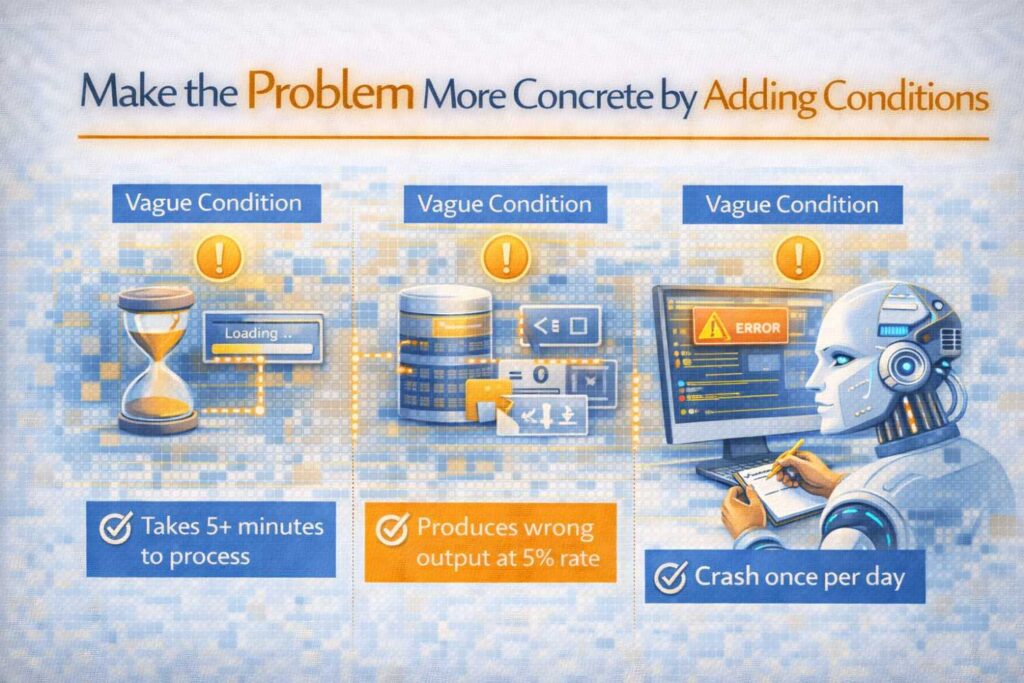
Many weak background sections identify a limitation, but they do not explain when or where that limitation shows up.
That missing condition is often the difference between generic writing and useful writing.
For example, saying that a classifier can produce poor results is too general.
Saying that classification accuracy may fall when signal patterns shift across users, devices, or time windows is much stronger.
The condition makes the problem real.
This is highly actionable for businesses. During revision, ask the team:
Under what operating condition did the old approach break?
Was it during scale?
During sparse data?
During changing user behavior?
During real-time deployment?
During low-bandwidth operation?
During noisy sensor input?
Once those conditions are identified, the background becomes sharper and more credible.
Use Revision to Tighten Claim Support Indirectly
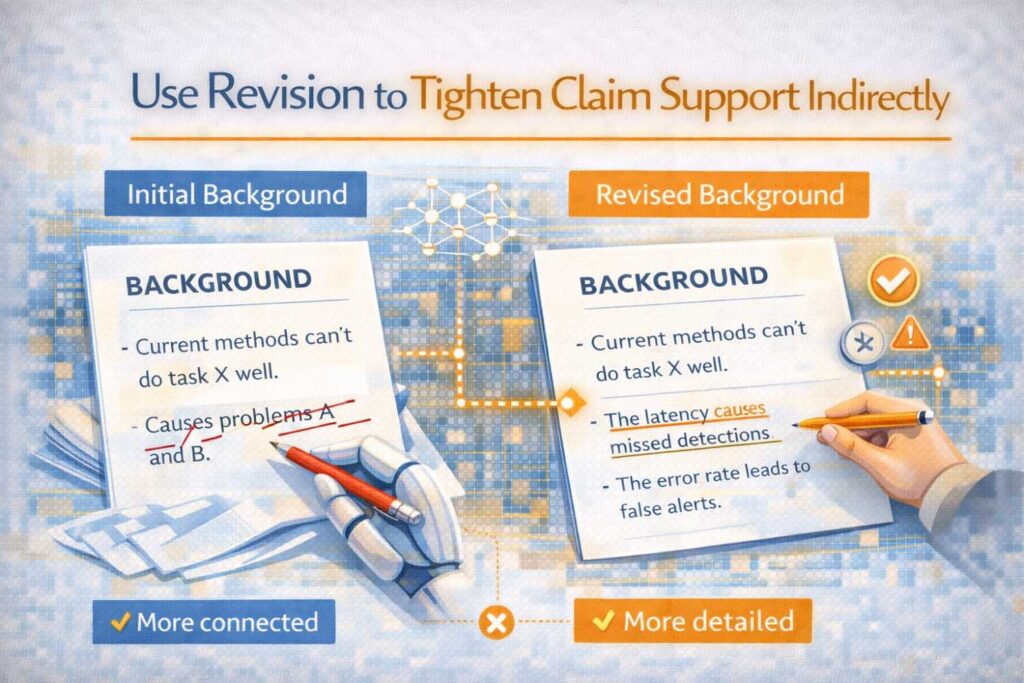
The background section is not where claims are written, but it still affects how the application feels as a whole.
A revised background that clearly frames the right problem can improve the logic of the whole draft.
It makes the summary feel more natural. It makes the invention feel better positioned. It can even help the team see whether the detailed description is telling the same story.
That is why businesses should not treat background revision as cosmetic.
It can expose bigger alignment issues.
If the background is hard to fix, that may mean the invention itself has not been described clearly enough elsewhere in the application.
That is useful to know early.
Turn Revision Into a Cross-Functional Review
One smart business practice is to revise the background with input from more than one angle.
A founder may understand the business importance.
An engineer may understand the technical failure mode.
A product lead may understand where the old workflow actually broke in real use.
A patent professional may understand what wording creates risk.
When those perspectives are combined, the revision tends to get much stronger.
This does not need to be a long meeting.
Even a short review can be enough.
Have each person answer one question:
Does this section describe the real technical pain that made the invention necessary?
If the answer is uncertain, keep revising.
Use a “Before the Breakthrough” Lens
A very effective revision method is to mentally go back to the period before the invention worked.
What was happening then?
What kept failing?
What created repeated friction?
What workaround felt unsatisfying?
What design choice finally changed the outcome?
This “before the breakthrough” lens helps businesses revise weak backgrounds in a much more truthful way.
Instead of writing from the comfort of the final product, you write from the reality of the earlier problem.
That usually leads to stronger framing.
It also helps avoid hindsight bias, where the old problem gets described too loosely because the team already knows the answer.
Test the Section Against a Competitor Lens
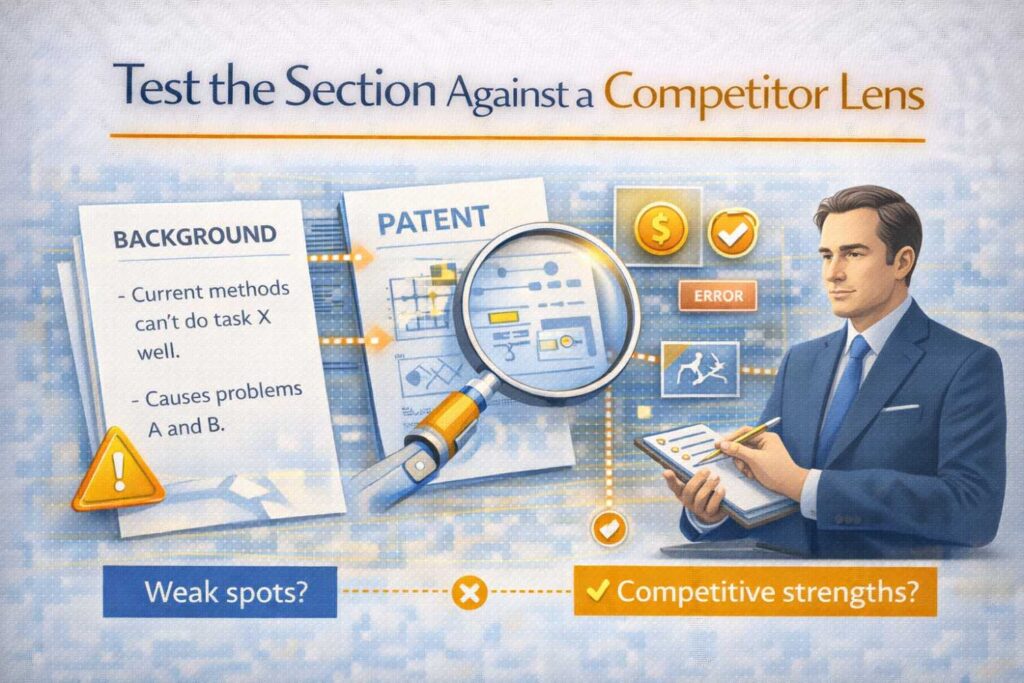
Here is a practical strategic test.
Imagine a smart competitor reads the background section.
Would they understand the category of technical problem being described?
Would they recognize it as a real engineering issue?
Would they see that the patent is likely aimed at a meaningful part of the system, not just surface-level language?
If the answer is no, the background may still be too soft.
A strong background section does not need to reveal the invention, but it should make clear that the company is operating in a serious technical problem area.
That alone can strengthen the perceived value of the filing.
Revise for Internal Reuse Value
A strong background section can help the business beyond the patent itself.
It can sharpen the company’s own understanding of its technical moat.
It can help founders answer diligence questions more clearly.
It can improve internal alignment on what was actually inventive.
That means one smart revision goal is internal reuse.
Ask whether the revised background captures the problem in a way the company could later use in fundraising prep, strategy discussions, or technical storytelling.
Again, this does not mean turning it into marketing copy.
It means making sure the section reflects a real and useful framing of the company’s technical edge.
A Practical Revision Workflow That Works
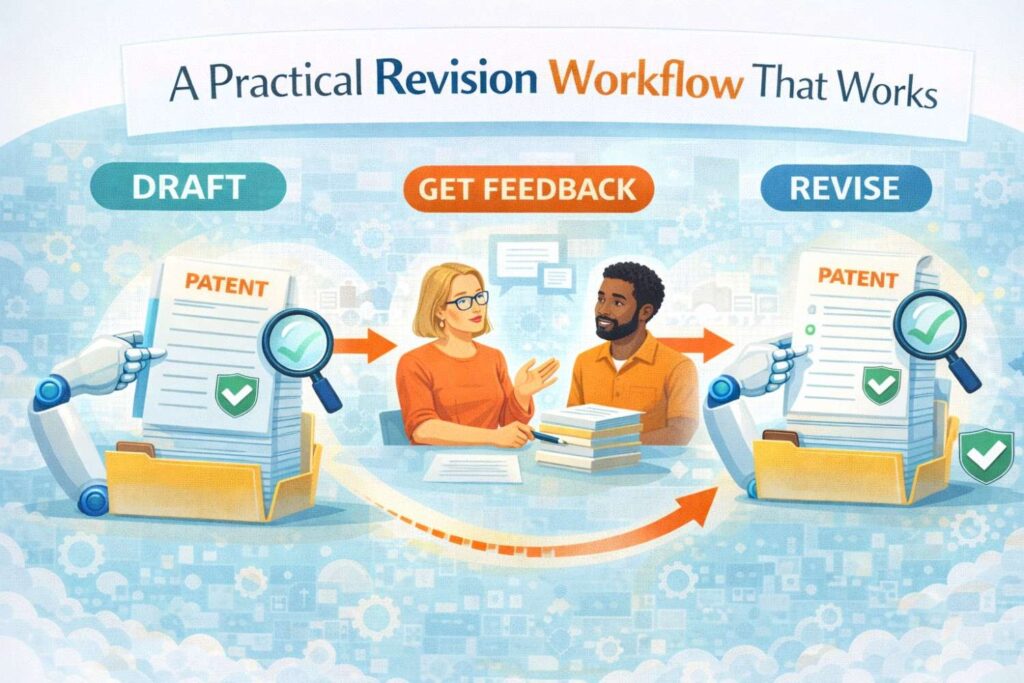
If a business wants a cleaner process, here is a simple way to handle revision.
First, mark every sentence that is broad, vague, or overstated.
Second, identify the single most important technical limitation.
Third, ask under what conditions that limitation appears.
Fourth, rewrite the section so the limitation is tied to a real system setting.
Fifth, remove anything that previews the invention too early.
Sixth, review the language for words like “always,” “never,” “cannot,” and other terms that may be too absolute.
Seventh, have one technical person and one business person read it and react to the same question: does this feel like the real problem?
That workflow is simple, but very effective.
Actionable Advice for Businesses Revising Weak Backgrounds
One useful move is to keep a “bad sentence log” during review. Every time someone flags a sentence as generic, vague, or too broad, save it.
Over time, patterns appear. This helps the team learn what weak patent language looks like and avoid it in future drafts.
Another strong habit is to ask engineering leads for one concrete example of when the old system struggled.
Even if that example never appears directly in the final text, it often helps produce sharper problem framing.
It is also smart to compare the background section against the actual product roadmap. If the background focuses on a narrow issue that no longer reflects where the business is going, revision may need to happen at a more strategic level.
Finally, businesses should treat revision as a moat exercise, not just a writing exercise. The goal is not merely to polish sentences. The goal is to describe the kind of technical problem that matters enough to protect.
Revision Is Often Where the Real Strategic Clarity Appears
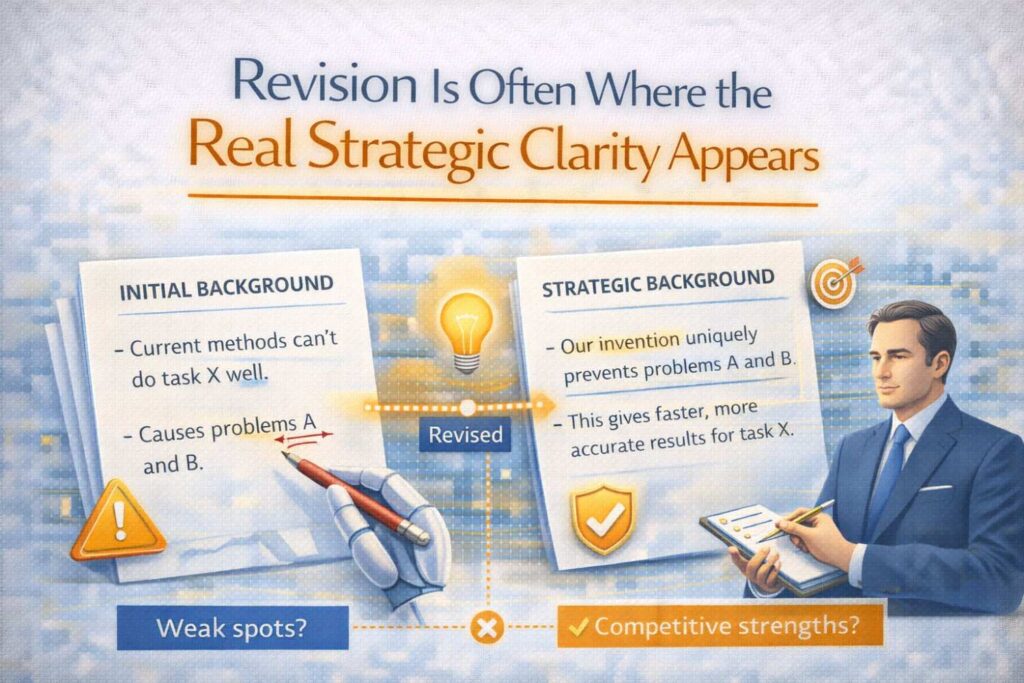
A weak first draft is common.
What matters is what the business does next.
When companies revise the background section carefully, they often discover something bigger than better wording. They discover a better articulation of their own technical advantage.
That is valuable.
It helps the patent.
It helps the product story.
It helps the company explain why its approach is different in a way that sounds grounded, not inflated.
That is why revising a weak background section should never be treated like cleanup work.
Done well, it becomes a strategic step in turning invention into a stronger business asset.
I can also turn this into a version with subheadings that exactly match the article’s tone and paragraph rhythm.
Actionable drafting exercise for founders and engineers
Here is a practical exercise you can do with your team.
Take ten minutes and answer these questions in plain language.
What kind of AI system area are we in?
What did people usually do before our approach?
Where did that approach break?
What bad result did that create?
What setting made that problem matter most?
Now turn those answers into one paragraph.
Do not worry about perfect patent style at first.
Just get the truth down clearly.
Once you have that paragraph, you can clean the language and shape it into a formal background section.
This is often faster and better than asking AI for a full draft with no real inputs.
Why simple words are better in the background section
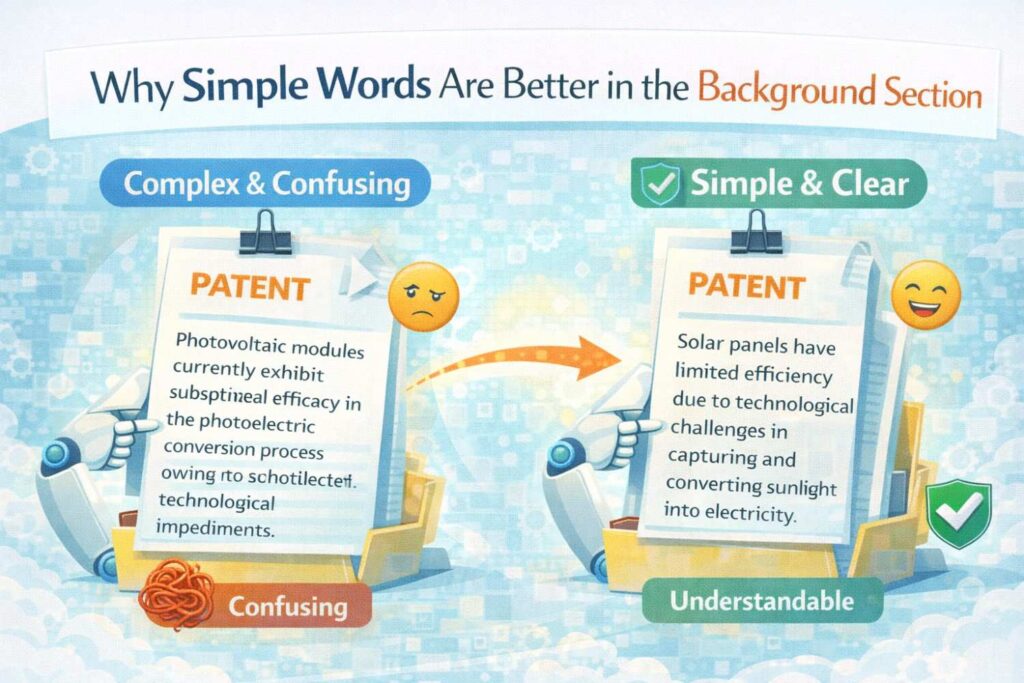
The best patent writing is often simpler than people expect.
You do not need to sound academic.
You do not need to impress anyone with dense language.
You do need to be clear.
Simple words help you stay clear.
For example, say “fixed thresholds” instead of “static parameterized decision boundaries” unless there is a real reason to be more technical.
Say “false alerts” instead of “spurious event classifications” if the simpler phrase is accurate.
Say “changing input patterns” instead of “non-stationary multidimensional data distributions” unless the deeper term is truly needed.
Simple language reduces confusion. It also makes weak reasoning easier to catch.
That is a good thing.
How to keep the background broad without becoming vague
This is a subtle but important skill.
If the background is too tied to your exact product version, it may feel narrow.
If it is too generic, it may feel empty.
The answer is to describe the problem at the right level.
For example, suppose your product today uses smartphone GPS and accelerometer data to detect unsafe driving.
A too-narrow background might focus only on phone sensors.
A broader but still grounded background might refer to systems that classify vehicle or driver behavior based on motion-related input signals, and explain that some approaches rely on isolated signal features or fixed thresholds that may not adapt well to different conditions.
That gives you room.
You are still describing a real technical setting. You are just not locking the framing to one exact hardware choice.
That is the balance.
The difference between “problem statement” and “background section”
Some teams confuse the two.
A problem statement is the core issue in one simple line.
The background section is the fuller explanation around that issue.
For example, the problem statement may be:
Existing fraud systems may trigger too many false alerts because they evaluate transactions in isolation.
The background section would take that idea and place it in the broader technical setting, explain the kinds of systems involved, and describe the practical effect of that limitation.
The problem statement is the seed.
The background section is the paragraph that grows from it.
How to know when the background is ready
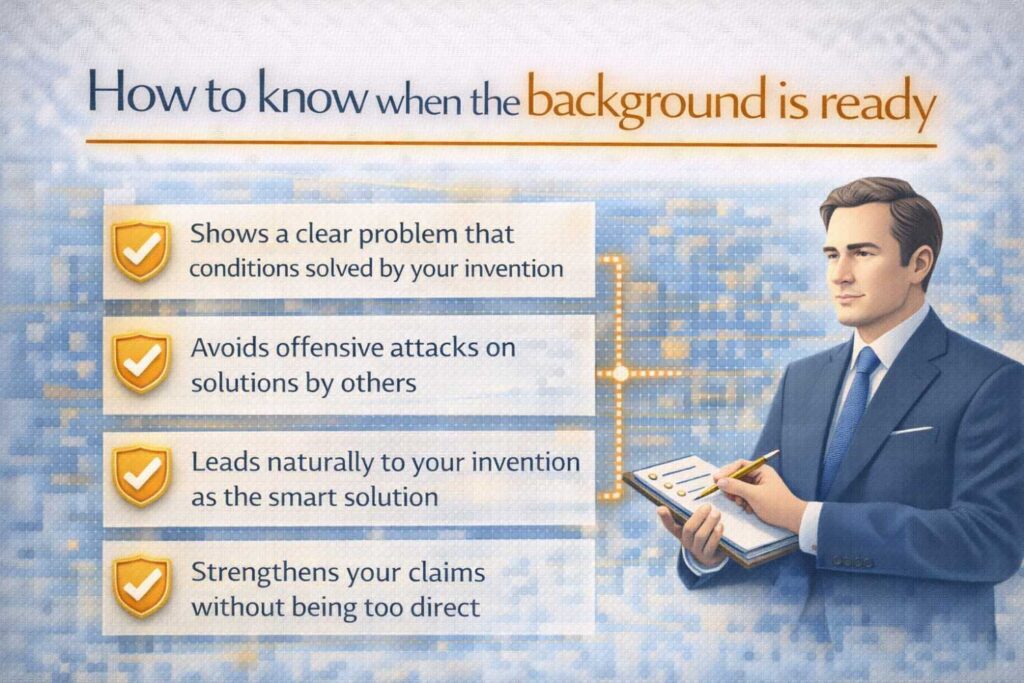
A strong background section usually feels ready when these things are true.
It clearly identifies the technical setting.
It describes a common type of existing approach.
It explains a real limitation in measured language.
It shows the effect of that limitation.
It points toward the need for improvement without jumping into the invention.
It does not sound like a pitch deck.
It does not sound like empty AI filler.
It sounds calm, specific, and useful.
That is the standard.
Why this matters even more for startups moving fast
Fast startups often file patents under pressure.
There is a launch coming.
A fundraise is in motion.
A competitor appears.
A customer demo reveals something important.
Under that pressure, teams tend to rush the draft and focus only on the parts they think matter most.
That often means the background section gets very little attention.
But a rushed background can quietly lower the quality of the whole application.
It can make the invention feel less anchored. It can make the problem look broad or vague. It can create language you later wish had been tighter.
The answer is not to slow everything down.
The answer is to use a better process.
Capture the invention well. Frame the technical problem clearly. Use AI where it helps. Review with care. Keep the drafting grounded in the actual system.
That is how you move fast without producing weak work.
The real goal of AI patent drafting
The goal is not to generate words.
The goal is to generate strong patent applications.
That sounds obvious, but it changes how you use AI.
If your goal is just speed, you will often get generic language.
If your goal is strong drafting, you will use AI as part of a smarter process. You will guide it with good inputs. You will review for strategy and risk. You will make sure the output reflects the real invention.
That is a very different mindset.
And it leads to much better results.
A model background section, built the right way
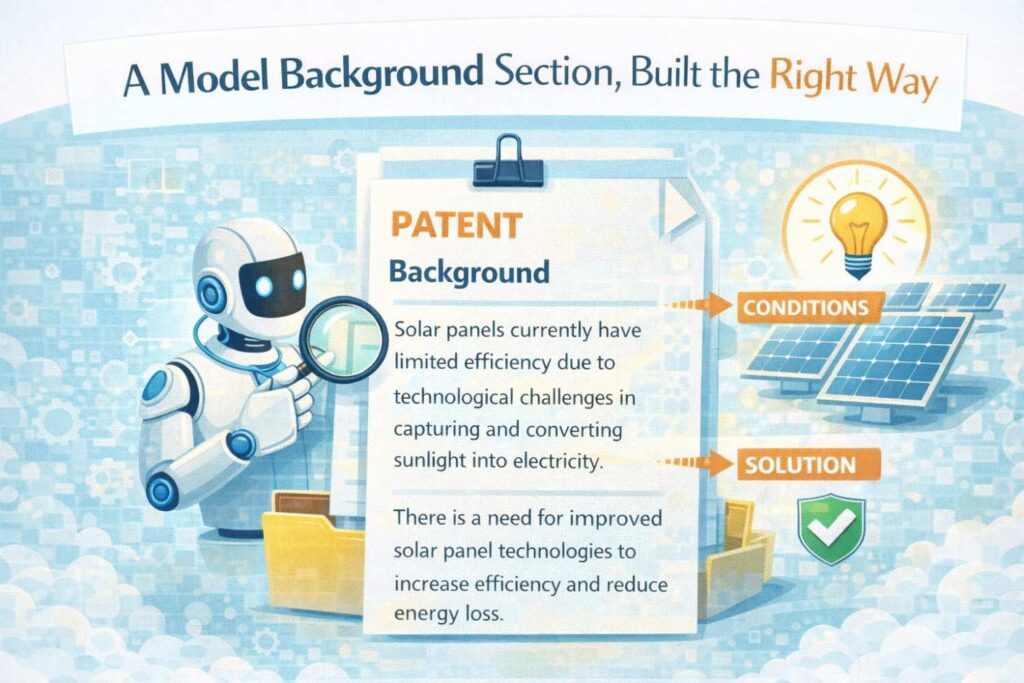
Let us end the practical part with a fuller example.
Suppose the invention is an AI system that routes incoming medical imaging cases for review based on urgency prediction using image metadata, patient context, and workflow state.
A weak version might say:
Healthcare systems need intelligent AI tools to improve imaging review speed and patient outcomes. Existing methods are slow and inefficient, and improved systems are needed.
That is not enough.
A stronger version might say:
In medical imaging workflow environments, incoming cases may be assigned for review based on available case information and workflow rules.
Some systems rely on fixed priority categories, manual triage, or predictive models using limited input features.
However, where case urgency depends on a combination of imaging-related information, patient context, and current workflow state, such approaches may assign review priority inefficiently or inconsistently.
This may delay handling of time-sensitive cases, increase manual triage burden, or reduce workflow efficiency. Accordingly, improved techniques for routing and prioritizing imaging cases remain desirable.
That is much better.
It gives the reader a real setting and a real limitation.
It does not oversell.
It does not solve the problem too early.
It sets the stage.
Why great patent backgrounds often come from great invention capture
A strong background section rarely starts as a writing win.
It usually starts as a thinking win.
When teams capture the invention well, the background becomes easier to write, easier to trust, and much more useful. When teams skip that step, the background often turns into vague language, broad claims, and filler that sounds polished but does not say much.
This matters because the background section is not supposed to guess what the invention is trying to solve. It should reflect the real technical pain that gave birth to the invention in the first place.
That truth usually does not come from a blank page.
It comes from good invention capture.
Invention Capture Reveals the Real Problem Behind the Product
Many businesses describe their product one way in sales conversations and a very different way in engineering conversations.
That gap is normal.
Sales language talks about outcomes. Engineering language talks about mechanisms.
Patent drafting needs the mechanism.
A great background section comes from understanding what was actually broken before the invention existed. That is not always the same as the headline promise on the company website.
For example, a startup may say its product helps teams respond faster. But the true technical problem may be that existing systems process events one by one, without using shared context across sessions, devices, or time windows. That deeper issue is what belongs in the background section.
This is why invention capture matters so much. It helps pull the team away from broad company messaging and closer to the actual technical obstacle that was solved.
Once that obstacle is clear, the background becomes far stronger.
Good Capture Stops the Team From Writing Generic Patent Language
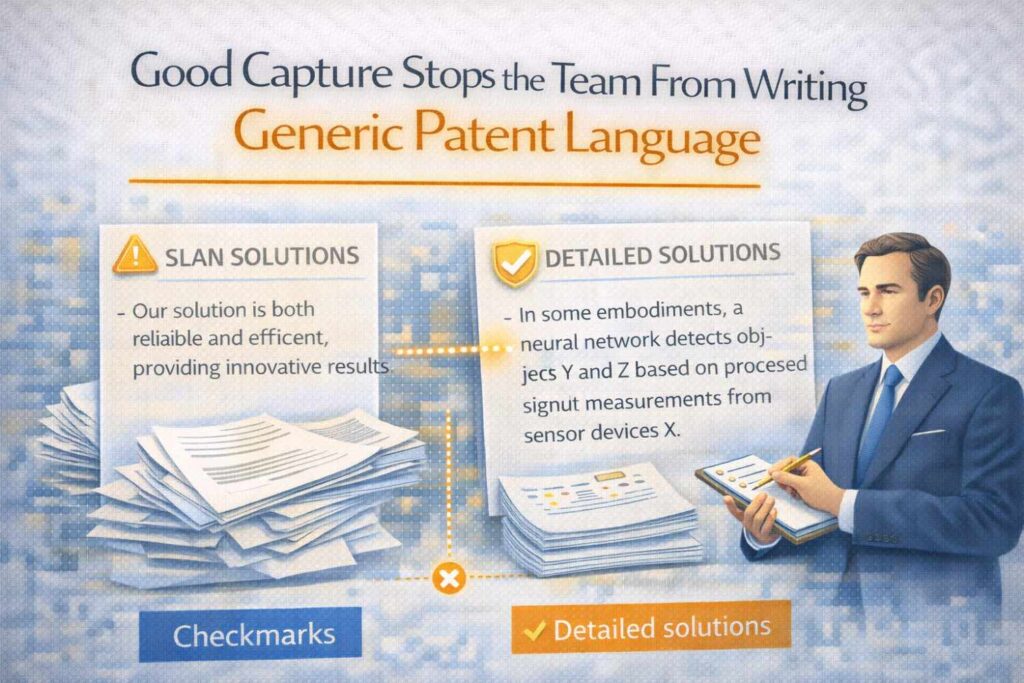
A weak background often sounds like it was written for any company in the same market.
That is a sign the invention was not captured deeply enough.
When the team has only a loose description of the system, the draft tends to fall back on safe, broad wording. It talks about growing data volumes, rising demand, slow workflows, or the need for better automation. That kind of language may sound fine at first, but it does not make the patent feel grounded.
Good invention capture fixes that.
It gives the draft real material.
It shows what kind of inputs the old systems relied on.
It shows where they failed.
It shows what conditions made those failures worse.
It shows what technical burden the team removed.
That is what allows the background section to feel specific without becoming narrow.
It Helps the Business Protect the Right Layer of Value
This is where invention capture becomes strategic, not just descriptive.
A lot of businesses think their value sits in the visible feature. But when they go through a careful capture process, they often find that the real protectable value sits deeper in the system.
Maybe the visible product is a dashboard.
Maybe the feature users see is a recommendation.
Maybe the customer experiences faster review, better matching, or smarter automation.
But the true technical value may live in the way data is filtered before scoring, the way context is carried across states, the way signal quality is checked before classification, or the way the model decides when not to act.
That deeper layer matters because it is often the layer competitors would struggle most to copy cleanly.
A strong background section should set up that layer of value, not just the surface feature.
You only get there when invention capture goes beyond “what does the product do” and into “what changed technically that made this work better.”
Great Capture Improves Internal Strategy, Not Just the Patent Draft
There is a hidden business benefit here.
When a company captures inventions well, it often learns something important about itself.
It learns where the real edge sits.
That clarity is useful far beyond patent drafting.
It can sharpen roadmap decisions. It can improve fundraising language. It can help leadership decide what deserves long-term investment. It can even shape how the company thinks about product moat.
This is because invention capture forces sharper questions.
What exact technical pain did we remove?
What old approach were we replacing?
What part of the system creates the biggest lift?
What would a smart competitor try to copy first?
What would they have trouble recreating?
Those are patent questions, but they are also strategy questions.
A background section built from strong invention capture tends to sound better because the business itself understands its technical advantage more clearly.
Why Businesses Miss Important Background Material
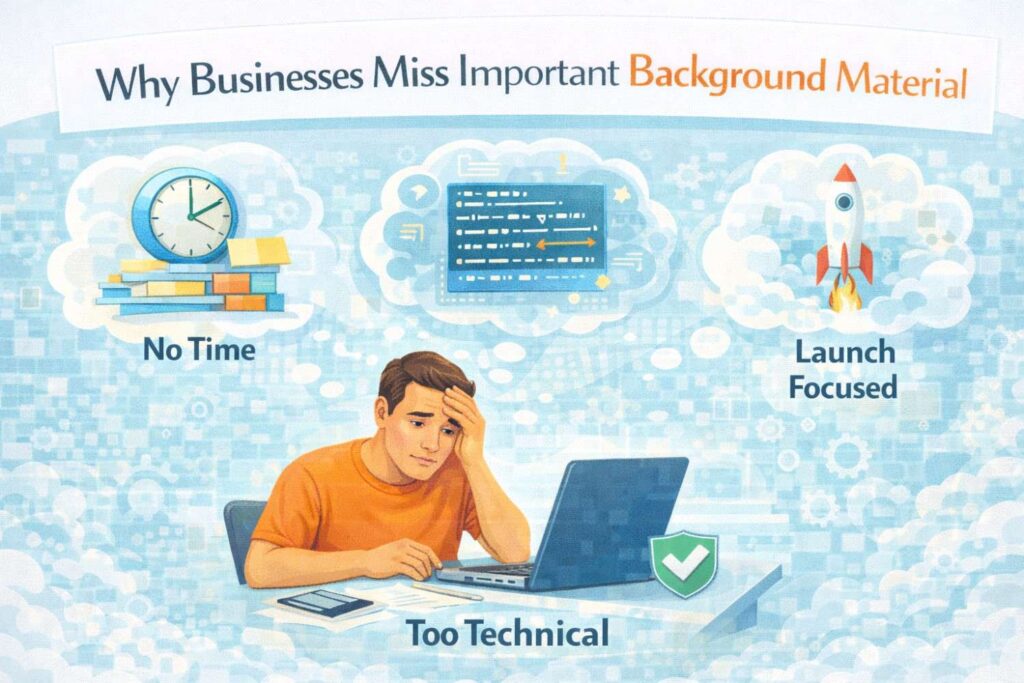
Most companies do not miss the background section because they lack intelligence.
They miss it because the useful detail is spread across too many places.
Some of it lives in the founder’s head.
Some of it sits in engineering tickets.
Some of it is buried in product decisions no one wrote down.
Some of it came from a failed version of the system months ago.
That scattered knowledge is a real problem.
If nobody pulls it together, the patent draft gets built from partial memory. That is when the background becomes generic or distorted.
The Most Valuable Problem Framing Is Often Hidden in Old Decisions
One of the best sources for a strong background is not the current system.
It is the path the team took before the current system worked.
What did the team try first?
Why did that approach fail?
What did it handle badly?
What signal did it miss?
What cost or delay did it create?
Those answers often contain the cleanest version of the old technical problem.
That is gold for a background section.
Founders often forget this because once a system works, the earlier pain fades into the background of company memory. But the earlier pain is exactly what helps explain why the invention matters.
Engineers Often Hold the Best Background Insights Without Realizing It
When businesses prepare a patent filing, they often ask for a clean summary of the invention.
That is useful, but it is not enough.
The strongest background material often comes from casual engineering comments like these:
“The old model broke when traffic patterns shifted.”
“We kept getting false alerts when sensor timing drifted.”
“The ranking logic looked fine in testing but failed when new users had no history.”
“We had to rebuild the pipeline because the original flow was too slow at inference time.”
Those lines may sound informal, but they hold the real technical pain.
A smart invention capture process knows how to pull those details out and turn them into patent-quality framing.
That is one reason businesses should not rely only on one polished summary from leadership. The deeper story usually lives across the team.
How to Capture Better Raw Material for the Background Section
If businesses want stronger backgrounds, they need better inputs.
This does not require a huge legal process. It just requires a more deliberate capture habit.
Ask “What Was Failing Before?” Before You Ask “What Did We Build?”
This is a very useful order.
Many teams start with the new solution because it is exciting.
But for the background section, the better starting point is the old pain.
Ask the team what the earlier approach did badly.
Ask what broke under real conditions.
Ask what became too slow, too noisy, too expensive, too manual, or too brittle.
Once you have those answers, you can frame the background more cleanly.
This also reduces the risk of writing a background that sounds detached from the actual invention.
Capture the Conditions, Not Just the Outcome
Businesses often say things like “the old system was inaccurate” or “the workflow was slow.”
That is a start, but it is not enough.
You also want the conditions that caused the failure.
Was the system inaccurate when inputs changed over time?
Was it slow when datasets became large?
Did it break when devices had low power?
Did false positives increase when signals arrived out of order?
Those conditions matter because they make the problem real and technically credible.
A background section becomes much stronger when it explains not only the weakness, but also the setting where the weakness showed up.
Pull Examples From Real Product Friction
One smart move is to ask product and engineering leaders for moments when the system almost failed or had to be redesigned.
Those moments often reveal the exact background problem in a way broad summaries do not.
Maybe an alerting engine created too much review work during demand spikes.
Maybe a recommendation model failed badly for first-time users.
Maybe a vision system lost quality when lighting changed.
Maybe an automation pipeline needed manual overrides because confidence was not handled well.
These are not just product stories. They are invention-capture assets.
When used carefully, they can help businesses build stronger, more truthful background sections.
Strategic Ways Businesses Can Use Invention Capture
A great invention capture process should do more than feed one draft.
It should strengthen how the company thinks about protection across time.
Build a Repeatable Capture Habit, Not a One-Time Scramble
Too many businesses treat patent drafting like a fire drill.
A launch is coming. A raise is coming. A competitor appears. Then the team rushes to document what matters.
That creates weak inputs.
A better approach is to build a light invention-capture habit into normal product development.
When a team solves a meaningful technical problem, someone should capture the core challenge, the old approach, the failure mode, and the new method that improved things.
That can be simple.
It can be a short internal note, a product architecture memo, or a structured review at the end of a project.
The point is not paperwork for its own sake.
The point is to preserve invention memory while it is still fresh.
That makes later patent drafting much stronger.
Use Invention Capture to Spot Protectable Themes Early
A company may think it has one invention, but a good capture process often reveals several related themes.
One may relate to model behavior.
Another may relate to workflow control.
Another may relate to data preparation or edge deployment.
This matters because the background section for one filing may later help reveal the opening for another.
Businesses that capture inventions well are better at seeing patterns in their own technical work. They do not just protect isolated features. They start to see families of innovation.
That is a stronger strategic position.
Keep the Capture Process Close to Roadmap Decisions
One of the smartest things a business can do is connect invention capture to roadmap reviews.
When the team discusses what has become technically important, it should also ask what was newly solved, what old limitation was removed, and whether that work changed the company’s defensibility.
This makes the background section easier to draft later because the key problem framing has already been discussed while the work was fresh.
It also helps leadership decide what to protect first.
Actionable Advice for Businesses
Here are practical ways to improve invention capture so your patent backgrounds get stronger.
Run Short Technical Debriefs After Important Builds
After a major feature, model improvement, infrastructure shift, or system redesign, spend fifteen minutes asking four questions.
What was not working before?
Why did that old approach fail?
What did we change?
Under what conditions does the change matter most?
Write down the answers in simple language.
Those notes are often enough to support a much stronger background section later.
Save the “Rejected Path” Story
Do not only document what worked.
Also document the path the team rejected.
Why?
Because the rejected path often explains the background problem more honestly than the final polished solution story.
It captures the real struggle.
That is exactly the material that can make the background section feel grounded and persuasive.
Appoint One Person to Gather Technical Friction Notes
In fast-moving teams, useful invention details vanish because nobody owns the capture step.
Assign one product, engineering, or IP lead to gather short notes on technical friction points as they appear.
This does not need to be formal.
The goal is to build a small record of real problems, failed attempts, and important breakthroughs.
That record becomes extremely valuable when the company decides to file.
Review Background Language Against Team Memory
Before finalizing a draft, ask one engineer and one product lead a simple question:
“Does this background describe the real problem we solved, or does it sound generic?”
That check can catch a lot.
If the team says the section sounds like boilerplate, it probably is.
If the team immediately says, “Yes, that is exactly the pain we had,” you are much closer.
Great Invention Capture Creates Better Business Assets
This is the bigger point.
When a business captures inventions well, it does not just get a stronger patent background.
It creates a stronger internal record of how the company wins.
That record can help in fundraising because it sharpens the technical moat story.
It can help in hiring because it clarifies the problems the company solves uniquely well.
It can help in product planning because it shows which technical layers are worth deepening.
It can help in future filings because it reveals what is adjacent and still unprotected.
In that sense, invention capture is not administrative work.
It is strategy work.
And the background section is one of the first places where the quality of that strategy becomes visible in writing.
The Best Backgrounds Usually Come From Teams That Remember Why the Work Mattered
In the end, great patent backgrounds are rarely born from clever phrasing.
They come from teams that still remember the real technical pain, the failed paths, the constraint that made the old way break, and the design insight that changed the outcome.
That memory is what invention capture preserves.
When that memory is captured well, the background section becomes clearer, more credible, and more useful to the business.
It stops sounding like generic AI patent language.
It starts sounding like a company that knows exactly what it solved and why that solution matters.
That is where strong patent drafting begins.
Final thoughts
A strong background section does not try to do everything.
It does one job very well.
It explains the technical setting and the real problem in a way that is clear, careful, and useful.
That is enough.
For AI patent drafting, this matters more than ever. The field is crowded. The language is noisy. Generic drafting is everywhere. If you want your application to feel grounded and strong, the background section is one of the first places to prove it.
Start with the real technical pain.
Describe the common kind of old approach.
Explain where it can fall short.
State the effect of that limitation.
Leave room for the invention to arrive next.
Keep the language simple. Keep the framing measured. Keep the writing tied to the actual system.
That is how you generate a strong background section.
And when you do that well, the rest of the patent has a much stronger foundation.
If your team is building something worth protecting, do not settle for generic AI patent drafting. Use a process that helps you capture the invention clearly, move quickly, and still end up with a filing that is strong where it counts. PowerPatent was built for exactly that. See how it works here: https://powerpatent.com/how-it-works