Every strong patent starts much earlier than most teams think. It starts the moment a new idea, feature, system, model, or technical breakthrough first gets noticed inside the company. If that moment is messy, slow, unclear, or easy to ignore, good inventions get lost, teams miss filing windows, and valuable work never turns into real protection. That is why invention intake matters so much. It is the front door to your patent process. In this article, we will walk through how to audit that front door, find the slowdowns that are quietly hurting your team, and fix them with simple steps that make it easier to capture better inventions faster. If your team is building valuable technology and you want a cleaner, faster way to protect it without dragging engineers into a painful legal process, PowerPatent shows how to do that with smart software and real attorney guidance working together: https://powerpatent.com/how-it-works
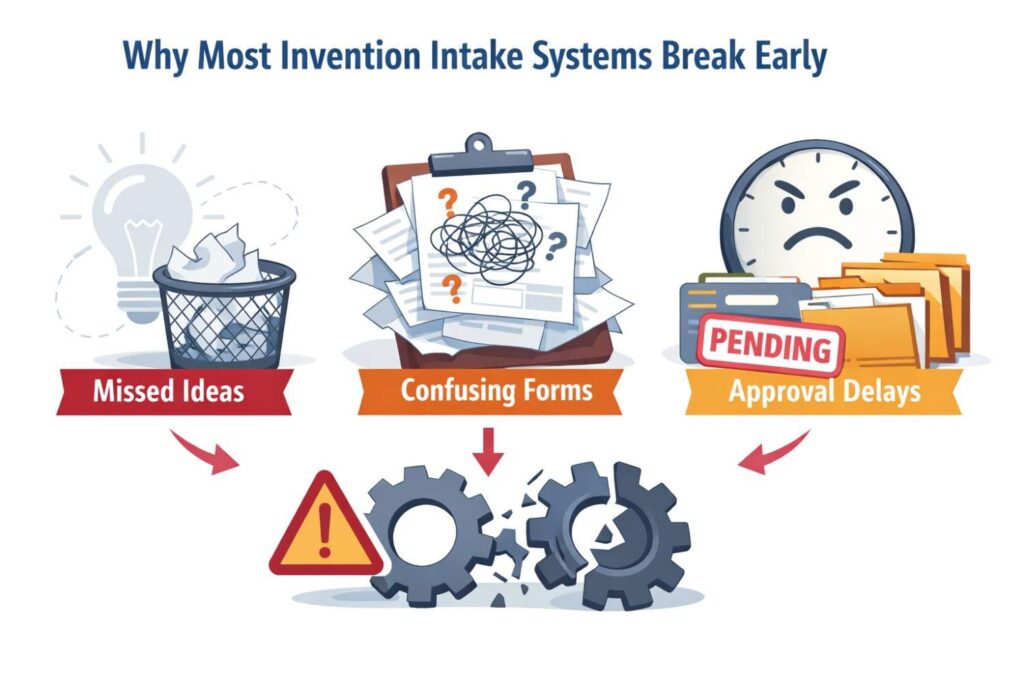
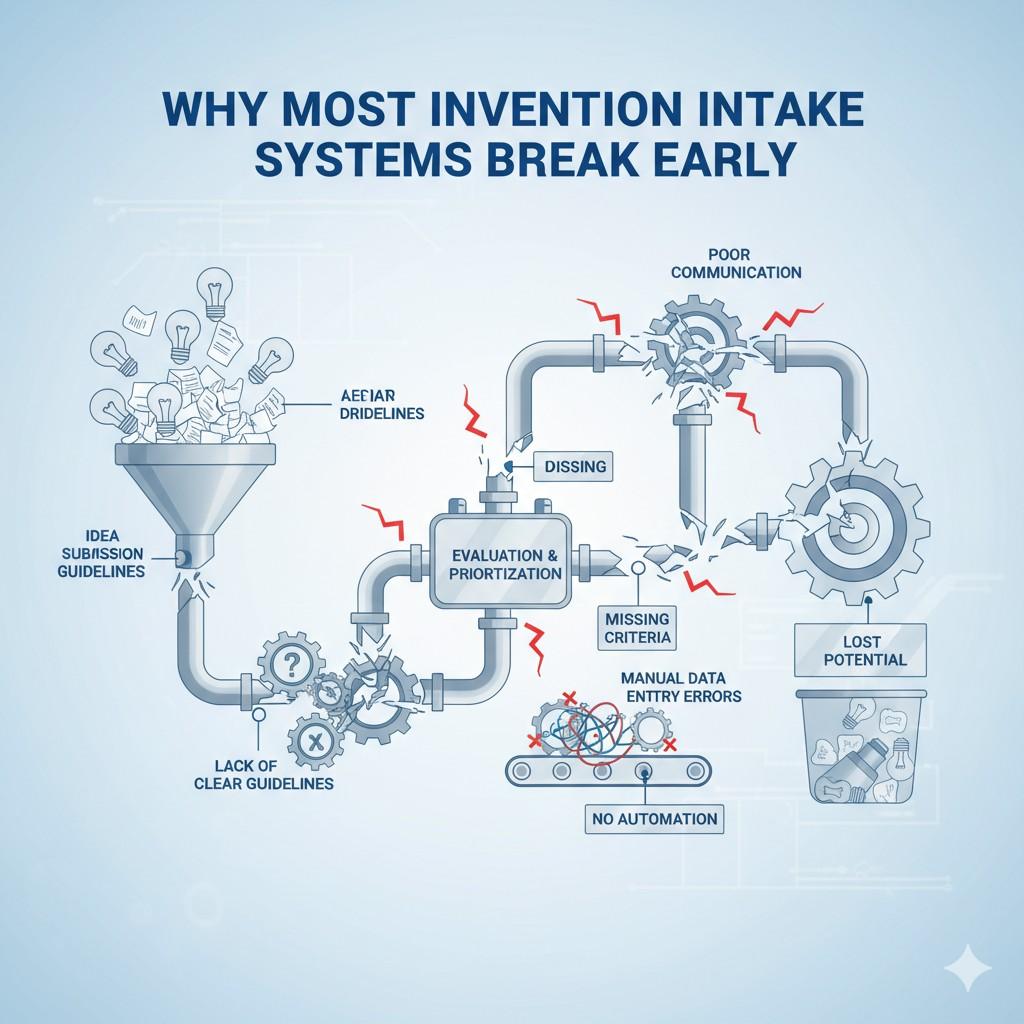
Why Most Invention Intake Systems Break Early
Most invention intake systems do not fail because teams lack smart people or strong technology. They fail because the process around those ideas was never built for speed, clarity, or real day-to-day behavior inside a company.
On paper, many businesses believe they have a working intake process. In real life, that process often depends on busy engineers remembering to speak up, managers knowing what counts as patent-worthy work, and legal teams getting enough detail before the moment passes.
That gap is where strong inventions disappear. If a business wants a better patent pipeline, it has to understand why the process breaks so early and why these breakdowns are often hidden until the damage is already done.
The process usually starts too late
One of the biggest reasons invention intake breaks early is simple. Most companies wait too long to start the conversation. They treat invention capture as something that happens near launch, near fundraising, or after a product has already shown traction.
By then, a lot of value has already slipped through the cracks. The best patent opportunities often show up while teams are solving hard technical problems, not after the final version is packaged and shipped.
When a company only starts asking about inventions at the end, it forces people to look backward instead of capturing insight while it is still fresh. Engineers forget why they made certain design choices.
Researchers lose track of the real technical leap that made the system work. Product teams focus on customer outcomes and skip the hidden technical work that created the edge.
The result is a weak record of innovation and a narrow view of what could have been protected.
A more strategic approach is to move invention intake closer to the moment of creation. That does not mean every idea needs a formal review right away. It means the business needs a lightweight way for technical teams to flag important work when it happens.
A short internal prompt after a major build, model change, infrastructure fix, hardware iteration, or performance jump can make a major difference. The goal is not to slow teams down. The goal is to catch the signal before memory fades.
Teams are asked the wrong questions
Many invention intake systems break because they ask technical people questions that are too vague, too legal, or too hard to answer in the flow of work.
When someone gets a form that says, “Describe your invention,” they often freeze or write something too broad to be useful. They may not know where to start.
They may assume their work is too small to matter. They may write a sentence that sounds nice but says very little about what actually makes the work special.
This is not a people problem. It is a design problem. If the intake method does not match how inventors think, the system will keep producing shallow input.
Technical teams usually explain their work best when they are asked grounded questions tied to real decisions.
What problem were you stuck on? What did you try before this worked? What changed in performance, speed, cost, accuracy, or reliability? Why would another skilled team not get to the same answer right away? Those questions create better raw material.
Better intake starts with better prompts
A company that wants stronger invention capture should stop asking people to sound like patent writers. It should ask them to explain the work the way they explain it to another builder.
The more natural the intake feels, the better the substance will be. That makes it easier for the business to identify which ideas deserve deeper review and which ones should simply be stored for later.
A practical fix is to rewrite every intake form, meeting script, and submission workflow around the actual moments of technical change.
Ask what was difficult, what was new, what was improved, and what made the solution work. These kinds of questions pull out details that matter. They also reduce the fear that someone must be “good at patents” to contribute.
Ownership is often unclear from the start
Another reason invention intake systems break early is that no one truly owns the process. A company may assume legal owns it, but legal is often too far from daily product and engineering work.
A company may assume engineering managers own it, but they are usually focused on shipping and hiring. A founder may care deeply about patents but still have no repeatable system that runs without constant personal involvement.
When ownership is fuzzy, invention intake becomes optional. Optional processes do not survive in fast-moving businesses. They get pushed aside by release timelines, customer pressure, and the next urgent sprint.
This creates a dangerous pattern where important inventions are only captured when a highly motivated person happens to drive the effort.
A better model is to assign one clear operational owner for intake health, even if that person is not the final patent decision-maker. That owner should not be buried in theory. Their job is practical.
They make sure prompts go out, submissions get reviewed, follow-up happens fast, and blocked cases do not sit in limbo. Without that operational rhythm, the system decays.
Technical teams do not see what counts as valuable
Many businesses lose invention opportunities early because engineers and researchers often assume patent-worthy work has to look dramatic. They think only a brand-new product, a huge algorithmic breakthrough, or a once-in-a-generation hardware design is worth flagging.
In reality, valuable inventions often hide inside systems, workflows, internal tools, optimization methods, data handling, deployment paths, controls, or design tradeoffs that outsiders never see.
This misunderstanding creates a silent filter inside the company.
Teams decide for themselves that a piece of work is “just implementation” and never mention it. But implementation can carry major value when it solves a hard technical problem in a new way.

A faster training method, a more stable architecture, a novel sensor arrangement, a better fault-handling process, or a cleaner way to reduce compute load can all matter.
The hidden cost of self-screening
When technical teams self-screen too aggressively, the company gets a distorted picture of its own innovation. Leadership may believe the pipeline is thin when the real problem is that the intake process only captures obvious inventions.
That is why businesses should teach teams one simple idea: they are not being asked to decide whether something deserves a patent. They are being asked to surface meaningful technical work for review.
That small mindset shift changes behavior. It lowers the bar for sharing and raises the quality of what enters the pipeline.
It also helps companies see innovation in parts of the business that are usually ignored, such as platform work, internal infrastructure, and reliability improvements.
Intake gets treated like admin work
Invention intake often fails because it feels like paperwork. The moment a process feels like extra admin, busy teams avoid it.
That is especially true in startups and high-growth companies where every hour is already spoken for. If sharing an invention means long forms, repeated explanations, or slow follow-up, people will put it off until later. Later often turns into never.
This is not just a convenience issue. It is a strategic issue. Every extra bit of friction reduces the odds that strong technical work gets captured while it is still clear and useful.
If the business wants more invention disclosure, it should stop thinking only about policy and start thinking about user experience. Engineers will not engage with a broken system just because the company says patents matter.
A strong intake flow should feel less like a legal event and more like a smart product workflow. It should be easy to start, quick to complete, and worth the effort.
One useful move is to cut every non-essential field from the first-touch submission. Get the core signal first. More detail can come later during review.
Review cycles are too slow
Even when a team does submit an invention, the process often stalls right away. The legal team may take too long to respond. Decision-makers may not know enough about the subject to judge it.
Follow-up meetings may be delayed until key details are forgotten. This slow response sends a message across the company that invention intake is not urgent, even if leaders claim it is important.
Speed matters because invention quality depends on freshness. The longer a business waits, the weaker the context becomes. Technical details get blurry. Design alternatives are forgotten.
The reasons behind the solution become harder to explain. In some cases, public disclosure, shipping activity, conference talks, demos, or investor conversations may even create timing pressure that the company did not manage well.
A fast first response changes behavior
One of the most effective ways to strengthen invention intake is to commit to a fast first response window. That does not mean every submission needs a full legal review within days.
It means every submission should get acknowledged, triaged, and routed quickly. When people see that the system responds fast, they trust it more. When they trust it more, they use it more.
A business can create this discipline by setting a simple internal rule. Every new invention entry gets reviewed within a fixed short window, and every submitter gets a next-step update.
This prevents ideas from vanishing into silence. It also creates accountability across teams and helps leadership see where bottlenecks are building.
The process depends too much on meetings
Some invention intake systems rely on meetings as the main path for capture. Ideas only surface during quarterly reviews, special patent sessions, or founder-led check-ins. While these meetings can help, they are rarely enough on their own. Innovation does not happen on a calendar.
It happens in the middle of experiments, technical debates, code changes, hardware tests, and customer-driven problem solving.
When meetings are the main intake channel, only the most visible or best-presented ideas get airtime. Quiet contributors get missed. Smaller but valuable technical advances get overlooked.
Teams begin to think invention capture is an event instead of a continuous operating habit.
A stronger system allows intake to happen both inside and outside meetings. It gives teams a standing way to submit work whenever it matters. Then meetings can be used for deeper review, prioritization, and pattern spotting rather than as the only source of invention discovery.
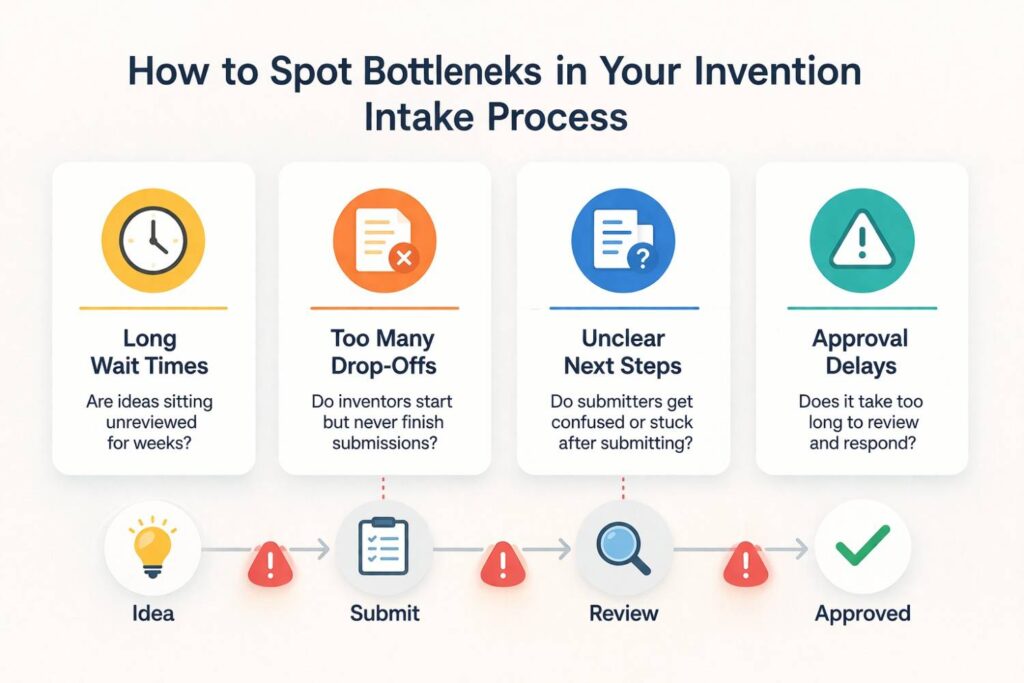
How to Spot Bottlenecks in Your Invention Intake Process
Most invention intake problems stay hidden because teams get used to them. A delay starts to feel normal. Missing details become expected. Follow-up happens late so often that no one questions it anymore. That is what makes bottlenecks dangerous.
They do not always look like major failures. Many times, they look like small slowdowns, repeated back-and-forth, or ideas that quietly disappear before anyone makes a clear decision.
If a business wants a stronger patent pipeline, it needs to learn how to see these weak points early and fix them before they cost the company valuable protection.
Start by looking at what really happens
The fastest way to spot a bottleneck is to stop looking at the policy and start looking at the real path an invention takes inside the company. Many businesses think they understand their process because they have a document that explains it.
But the written process and the lived process are often very different. A team may have an intake form, but inventors may avoid it. Legal may be the official reviewer, but managers may be the real gatekeepers.
A founder may believe strong ideas are getting surfaced, while engineers assume no one wants to hear about small technical wins.
To find bottlenecks, you need to follow actual behavior. Pick a recent product change, model update, platform improvement, hardware design step, or system breakthrough and trace how it moved through the business.
Ask when the inventive part first appeared, who noticed it, how it was shared, how long review took, and where momentum slowed down. Once you do that a few times, the same weak points usually appear again and again.
Watch where ideas first lose speed
Many bottlenecks show up in the first handoff. Someone has a meaningful technical idea, but there is no smooth way to move that idea from the builder’s mind into a usable company record.
That early handoff matters more than most teams realize. If it is hard, vague, or slow, the entire system becomes weak downstream.
A business should study this early moment closely. Is the inventor sure where to send the idea? Do they know what kind of work should be flagged? Do they have to stop their normal work to explain it?
Are they asked to write too much too soon? Every bit of friction at this stage reduces participation.
The result is not just fewer submissions. It is a distorted view of the company’s innovation because only the loudest or easiest ideas make it through.
Check whether inventors hesitate before they submit
One useful signal is hesitation. If inventors wait days or weeks before sharing something important, that usually points to friction at the top of the process. They may be unsure whether the work matters.
They may not want to deal with paperwork. They may believe they need manager approval first. They may worry that explaining the idea will take too long.
That hesitation is not random. It is data. It tells the business that the system is not easy enough to use at the exact moment it should be used. When you see hesitation often, the fix is usually not more reminders. The fix is a cleaner intake path that feels natural to technical teams.
Look for missing first-step clarity
A strong intake process gives inventors a clear first move. A weak one leaves them guessing.
If employees are asking basic questions like where to submit, what counts, who reviews it, or what happens next, the process has an early bottleneck. People rarely chase clarity when they are busy. They move on.
The business should test whether the first step is obvious without explanation. If not, it should simplify that step until it becomes almost automatic.

Good systems reduce thinking at the start. They make it easy to act before the moment fades.
Measure delay between creation and capture
Time is one of the clearest signals of an intake bottleneck. The longer the gap between invention creation and invention capture, the more likely it is that the process is leaking value.
Memory weakens fast. Context gets lost. Important design choices become harder to explain. Timing pressure around demos, launches, sales calls, or public sharing may rise without anyone fully seeing the risk.
That is why businesses should pay close attention to the delay between when a technical step happens and when the company records it as something worth review.
This gap says a lot about process health. A short gap usually means the company has a system that fits how teams work. A long gap often means the system depends too much on memory, spare time, or manual follow-up.
Notice where context disappears
A serious bottleneck is present when ideas do reach review, but they arrive stripped of the detail needed to evaluate them. This often happens when the intake process captures only a thin summary instead of the real technical story.
The reviewer sees a general statement, not the specific problem, the failed attempts, the key tradeoff, or the unique approach that made the solution work.
When context disappears, the business pays twice. First, reviewers need more follow-up, which slows the process.
Second, the value of the invention may be underestimated because the most important details were never surfaced well. That means strong ideas can get labeled weak for the wrong reason.
Compare what the inventor knows with what the reviewer receives
A practical way to spot this bottleneck is to compare two versions of the same invention. Ask the inventor to explain it live in plain words. Then compare that explanation to what the intake process produced on paper.
If the live version is much richer, clearer, and more specific, the system is losing value during capture.
This kind of gap is common. It shows that the business does not have a talent problem. It has a translation problem. The process is failing to preserve the technical insight that already exists in the team.
Study repeated follow-up requests
Another strong signal is repeated follow-up. If reviewers keep going back to inventors for the same kinds of missing details, that is not just normal process. It is evidence that the intake method is not gathering the right information up front.
Maybe the prompts are too vague. Maybe the first submission step is too thin. Maybe the people reviewing the ideas do not have a clear triage structure.
Businesses should not treat repeated follow-up as a personal issue between the reviewer and inventor. It is a system symptom. If the same missing pieces keep showing up, the process itself needs to change.
Pay attention to silent drop-off
One of the most costly bottlenecks is silent drop-off. This happens when an invention is noticed, maybe even discussed briefly, but then nothing else happens. No formal intake.
No review. No next step. The idea simply fades out of the process. These lost moments can be hard to see because there is often no record that the invention ever surfaced in the first place.
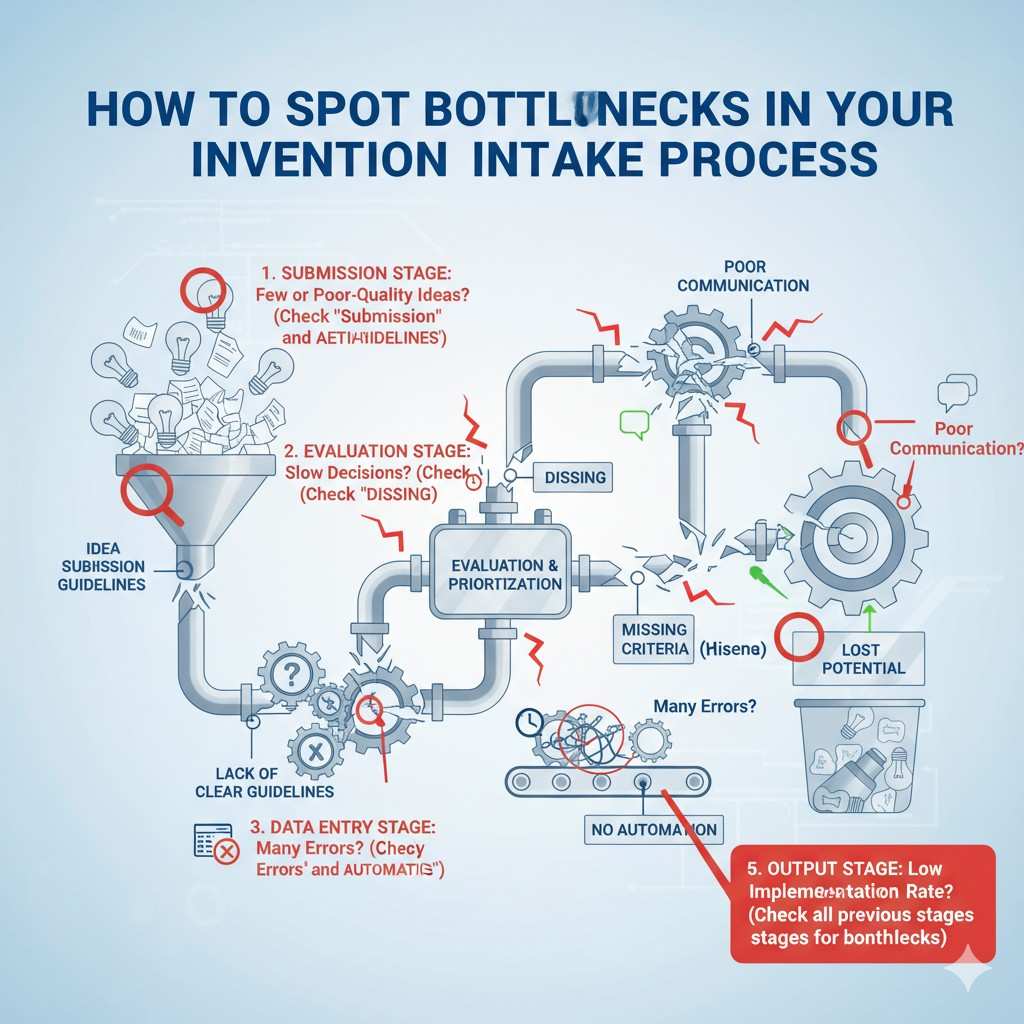
Silent drop-off usually means the system lacks strong handoff discipline. It may rely too much on people remembering to circle back. It may depend on meetings that get postponed. It may require one person to drive everything manually. In fast-moving businesses, those setups fail often.
Simple Fixes That Help Your Team Capture Better Inventions Faster
Most companies do not need a giant overhaul to improve invention capture. They need smarter defaults. In many cases, the biggest delays come from small points of friction that have gone unnoticed for too long. A form asks for too much. A review takes too long.
A team does not know when to raise its hand. A good idea gets buried because nobody followed up at the right time. The good news is that these problems can be fixed.
The best fixes are usually simple, practical, and easy to put into the flow of work. When that happens, teams share better invention signals earlier, and the business gets more chances to protect what it is building.
Make invention capture part of the work, not extra work
If invention intake feels like something separate from normal work, teams will keep putting it off. That is why one of the most useful fixes is to place invention capture inside the places where technical work already happens.
When teams do not have to switch tools, change mental gears, or stop what they are doing for too long, the odds of capturing real innovation go up fast.
A company should not think of invention intake as a special event that only happens in legal review or during occasional strategy sessions.
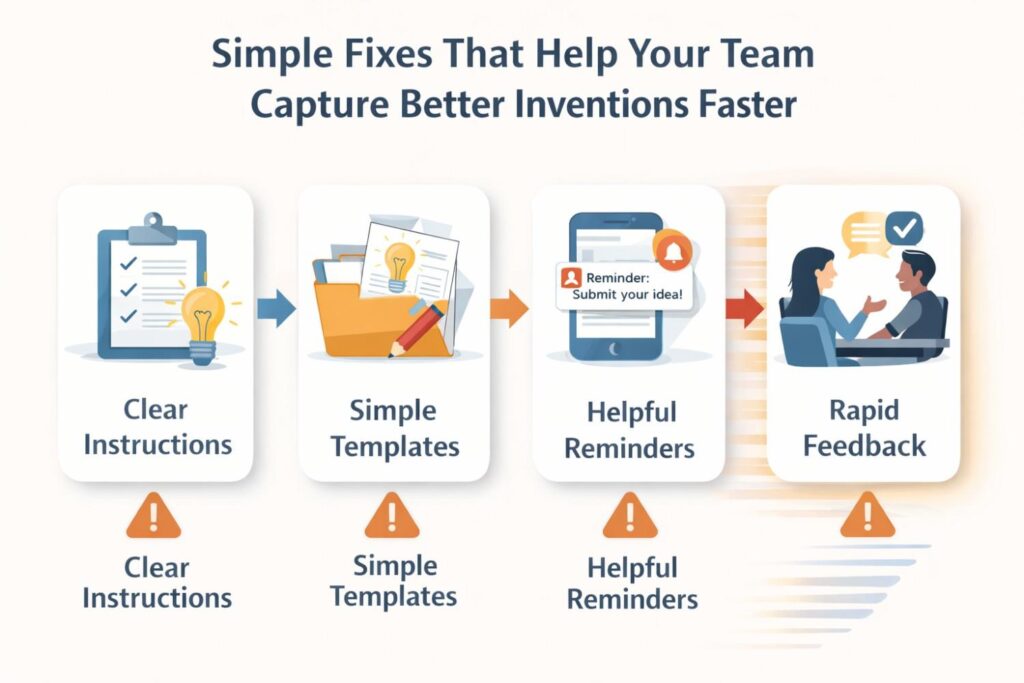
It should live closer to product development, research, code reviews, technical retros, design reviews, and milestone check-ins. The more natural the timing, the more complete and honest the input tends to be.
Use moments of technical change as intake triggers
The easiest way to make invention capture feel natural is to tie it to events that already matter.
A major increase in model performance, a new system design, a successful workaround for a hard hardware problem, a new way to cut compute cost, or a change that improves speed or reliability can all act as triggers.
Instead of asking teams to remember patent intake on their own, the business can create a light prompt at the moment those changes happen.
This works because it removes guesswork. The team does not have to wonder when to submit something. The process tells them. That one shift reduces delay and keeps invention details close to the actual work.
Ask for signal first, details second
A common mistake is asking inventors for too much at the start. That slows everything down. It also makes people feel like they need to produce a polished technical memo before they can submit anything. In most cases, that is the wrong approach.
The better path is to capture the signal first. What changed? Why did it matter? What problem did it solve? What was hard about getting there? That is enough to begin.
Once the business sees that the idea may be worth review, it can ask for deeper detail in a follow-up. This keeps the front door open and reduces drop-off.
Rewrite the intake questions so people can answer them quickly
A weak intake form can quietly damage the whole process. It may look fine on paper, but if the questions are too broad, too abstract, or too formal, the answers will be thin.
Strong invention intake starts with strong prompts, and strong prompts sound like real questions a builder can answer without stopping to translate their work into legal language.
The goal is not to make people write like patent professionals. The goal is to help them explain what they built and why it mattered. When the questions are simple and direct, the output becomes much more useful.
Replace broad prompts with grounded ones
Instead of asking someone to “describe the invention,” ask what problem they were stuck on before this solution. Ask what they tried that did not work. Ask what changed after the new method was used.
Ask why another team would not arrive at the same answer right away. These questions do not just feel easier. They reveal the parts of the work that matter most.
This approach also helps uncover technical value that teams may overlook. Many inventors do not realize that the hard part of their work is exactly the part the business should pay attention to. Better prompts help surface that.
Keep the first submission short by design
When businesses say they want more invention capture, they often add more fields to the form because they think more data will lead to better review. In practice, the opposite often happens.
The longer the form, the fewer the submissions. The fewer the submissions, the less visibility the company has into what its teams are actually inventing.
A strong fix is to set a time limit in the design itself. The first submission should be something a technical person can complete quickly, without needing a special meeting or extra prep.

That makes it far more likely that the process gets used in real life rather than admired in theory.
Create one clear owner for intake flow
One of the fastest ways to improve invention capture is to make sure one person clearly owns the movement of ideas through the system. This does not mean one person decides which inventions matter.
It means one person is responsible for making sure nothing gets stuck, forgotten, or left hanging.
Without clear ownership, invention intake often becomes a shared responsibility that nobody actually manages. A founder assumes legal is watching it.
Legal assumes engineering will send strong signals. Managers assume someone else is tracking follow-up. That kind of gap is where bottlenecks grow.
Give the owner an operating role, not a symbolic one
The right owner does practical work. They watch new submissions, make sure each one gets seen, route it to the right reviewer, request missing detail, and keep response times from slipping.
They also look for repeating friction in the system itself. If teams are confused by a question, if a review stage is slow, or if one group never submits anything, the owner should catch that pattern early.
This role matters because good systems do not run on intent alone. They run on rhythm. Clear ownership creates that rhythm and turns invention intake into a repeatable process instead of a series of random efforts.
Make response timing part of the owner’s job
A process that responds slowly trains people to stop using it. That is why the intake owner should not just watch volume.
They should also watch speed. How long does it take for a new submission to be seen? How long until the inventor hears back? How long until the next step is clear?
When timing is tracked on purpose, delays become visible. Once delays are visible, they can be fixed. That alone can improve participation because teams begin to trust that sharing an idea will lead to action rather than silence.
Build a simple triage layer before full review
Not every invention needs the same level of attention at the same moment. Some signals deserve fast action.
Some need more context. Some should be saved and watched as the technology matures. A common mistake is treating all submissions the same from day one. That creates review pileups and wastes valuable time.
A light triage step solves this problem. It helps the business quickly sort what came in without forcing every idea into a full deep review right away. This keeps the process moving and protects the time of both inventors and reviewers.
Sort by urgency, not just by interest
The smartest triage question is often not “is this good?” but “does this need attention now?” A team may be about to launch a feature, speak at a conference, share technical details with partners, or publish research.
Those timing factors matter. A submission tied to a near-term public event may deserve faster movement even if it still needs refinement.
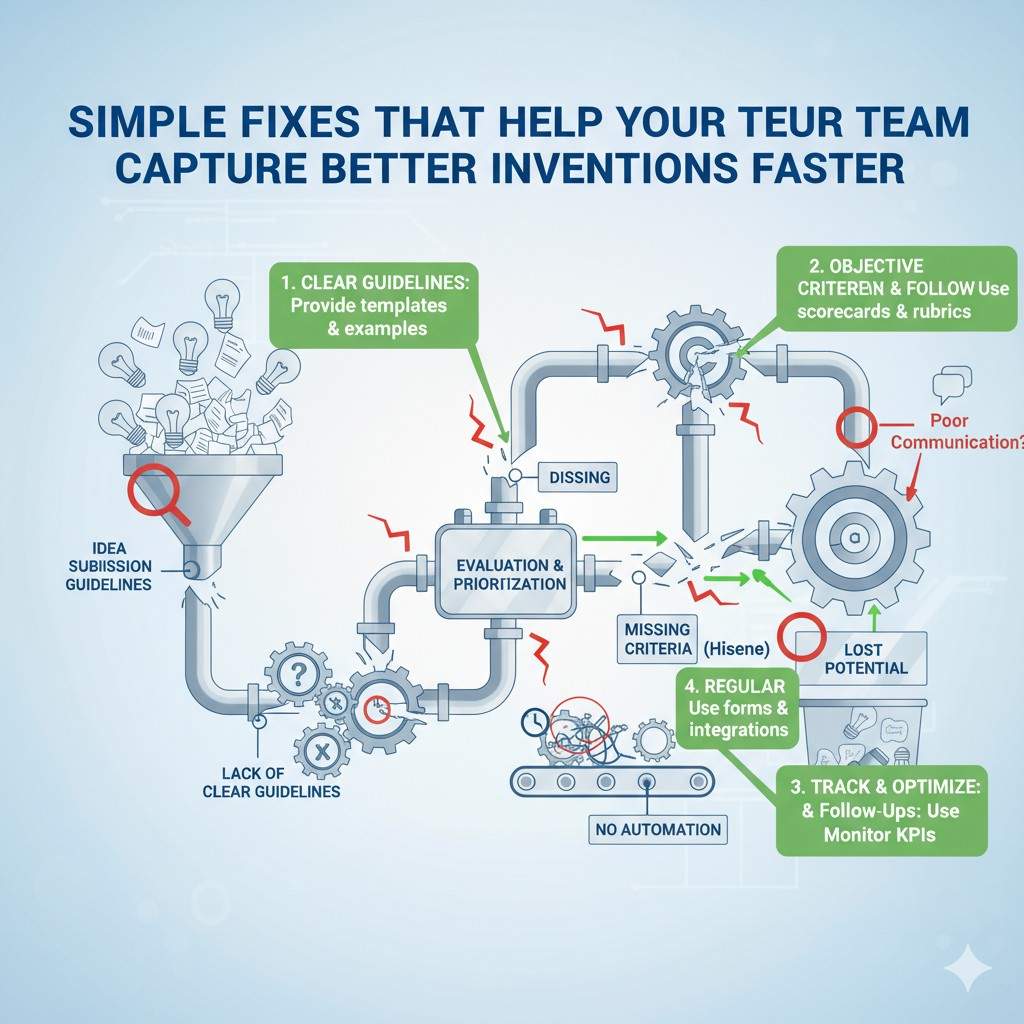
This view helps businesses protect themselves better because it connects invention intake to real business timelines rather than treating it like a disconnected back-office process.
How to Build an Invention Intake System That Keeps Up With Innovation
A fast-moving company cannot rely on a slow-moving invention process. That mismatch creates problems very quickly. Product teams ship faster, research teams test more ideas, engineers solve harder problems, and the business keeps creating technical value.
But if the intake system is still built like a once-in-a-while legal task, it will fall behind. That is when good inventions start piling up in people’s heads instead of moving into a real pipeline.
To keep up with innovation, a company needs an intake system that feels light, clear, responsive, and built for the way modern technical teams actually work.
Start with the pace of your company, not the pace of legal work
A strong invention intake system begins with one simple truth. It has to match the speed of the business. If the company ships weekly, tests constantly, and changes core systems every month, the intake process cannot depend on slow check-ins, long forms, or delayed review.
The system has to be designed around the real rhythm of technical work, not around an ideal process that only works when everyone has spare time.
Many companies make the mistake of building intake as a side process. They treat it like something that happens outside the real work of building. That is why it breaks.
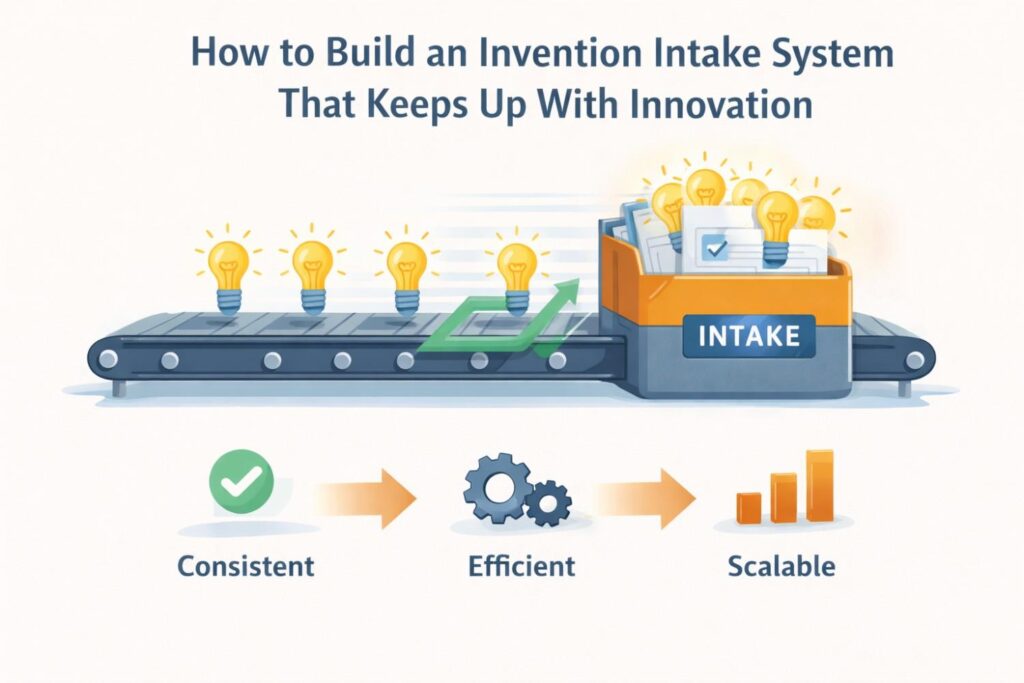
Anything that feels separate from daily execution is easier to ignore. A better system fits inside the company’s operating flow. It moves with the work instead of asking the work to stop.
Design the system around how innovation actually shows up
Innovation does not always arrive in a neat package. It often appears in pieces. A team finds a way around a hard scaling problem. A model starts performing better because of a new training step.
A hardware team changes an arrangement that improves reliability. A backend team builds a method that cuts latency in a way nobody expected. These moments do not always look dramatic at first, but they can carry real patent value.
An intake system that keeps up with innovation is built to catch these moments while they are happening. It does not wait for a polished presentation.
It does not require the inventor to already know how important the work is. It simply makes it easy to raise a hand when something meaningful changes.
Build for rough signals, not only polished submissions
A common mistake is expecting inventors to submit fully formed invention write-ups too early. That slows the process and causes valuable ideas to disappear before they even enter the system.
In reality, many of the best invention signals begin rough. Someone knows they solved something hard, but they have not yet turned that into a clean summary.
A better system accepts rough signals on purpose. It allows the first step to be simple and incomplete as long as it captures the core idea.
Once that signal is in the system, the company can decide whether to collect more detail. This keeps the intake door open and allows the system to scale with faster innovation.
Make room for partial technical stories
Not every inventor will explain an idea in the same way. Some will focus on the problem. Some will focus on the architecture. Some will focus on the result.
A system that keeps up with innovation should allow for that variation. It should not force every technical story into the exact same shape too early.
This matters because early-stage invention capture is often about preserving value before it fades.
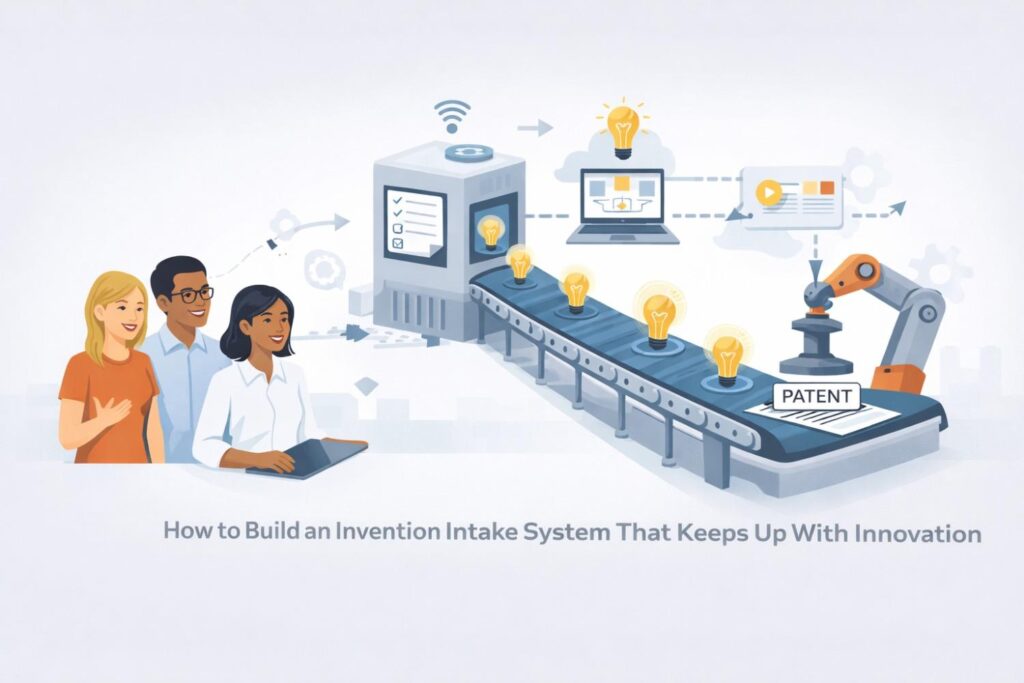
If the system is too rigid, it loses detail. If it is flexible enough to hold different kinds of technical insight, it becomes much better at keeping pace with a real product and engineering organization.
Put invention capture inside existing workflows
The strongest intake systems do not rely on memory. They rely on placement. They put invention capture inside the normal flow of work so teams encounter it at the right moments without needing to remember it from scratch.
This is one of the most important design choices a business can make.
If teams must leave their normal tools, schedule separate meetings, or go find the right person every time they want to flag an invention, the system will always lag behind the pace of innovation.
But when invention capture appears naturally around product milestones, research updates, technical reviews, or build retros, the process starts to feel normal instead of extra.
Use technical milestones as natural intake points
An invention intake system should attach itself to moments that already matter to the business. A successful experiment, a major architecture shift, a system performance gain, a new deployment method, or a solved reliability issue can all act as intake triggers.
This is much stronger than asking people to submit ideas whenever they happen to think about patents.
By linking intake to real milestones, the company reduces the risk of delay and improves the quality of information captured. The invention is still fresh. The team still remembers the challenge.
The design choices are still clear. That timing advantage is one of the biggest reasons this approach works.
Use project transitions to prompt reflection
Many inventions become easiest to spot at moments of transition. A team finishes a hard phase, moves from prototype to production, or closes out an important technical sprint.
These are excellent points for a light invention prompt because the team is already reflecting on what changed and what worked.
A short check at these moments can produce much better signals than a generic request sent at random times.
It helps the company capture meaningful work without adding heavy process. It also makes invention intake feel like part of good technical hygiene rather than outside paperwork.
Capture before public exposure increases
A system that keeps up with innovation must also pay attention to timing risk. In many companies, technical details are shared in demos, sales discussions, conference talks, investor meetings, or product launches before anyone has properly reviewed invention potential.
This is not always caused by carelessness. Often it happens because the intake system moves too slowly to keep up with business activity.
That is why a modern intake system should connect invention prompts to moments before public exposure rises.
The closer the process gets to launch and disclosure planning, the better the company can protect important work without slowing down the business.
Keep the first step very small
A system can only keep up with innovation if the first move is easy. This is where many businesses go wrong. They build intake with too much weight at the front.
The first submission asks for long explanations, technical diagrams, prior art comparisons, or detailed legal framing. That may sound thorough, but it does not match how busy technical teams work.
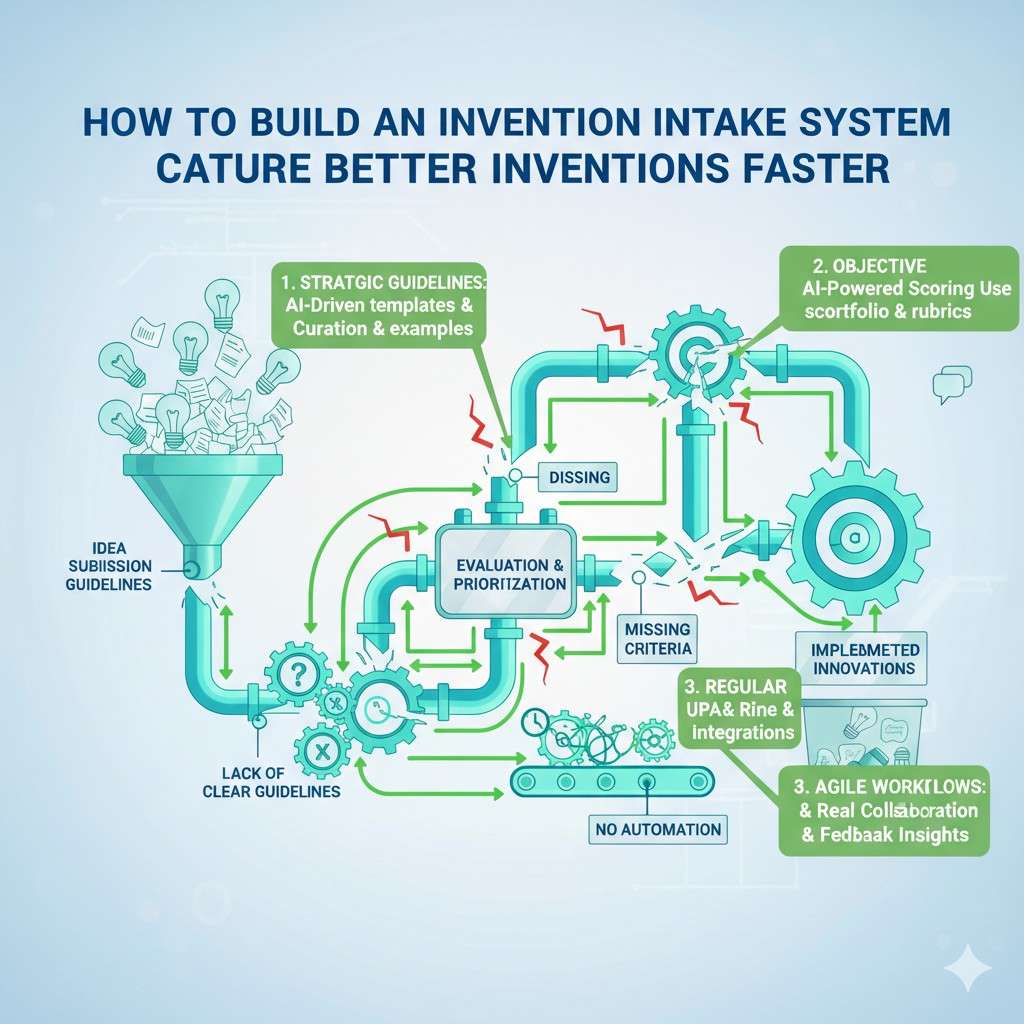
A better system respects attention. It makes the first step small enough that a strong inventor can complete it without friction. The goal is to get the signal in quickly. Once the system has that signal, deeper follow-up can happen in a more focused way.
Wrapping It Up
An invention intake process does not fail all at once. It breaks in small ways first. A team waits too long to share a breakthrough. A useful detail gets lost. A manager becomes a gatekeeper without meaning to. A review sits too long. Over time, those small misses turn into bigger losses. Strong technical work never makes it into the pipeline, and the business ends up with less protection than it should have.