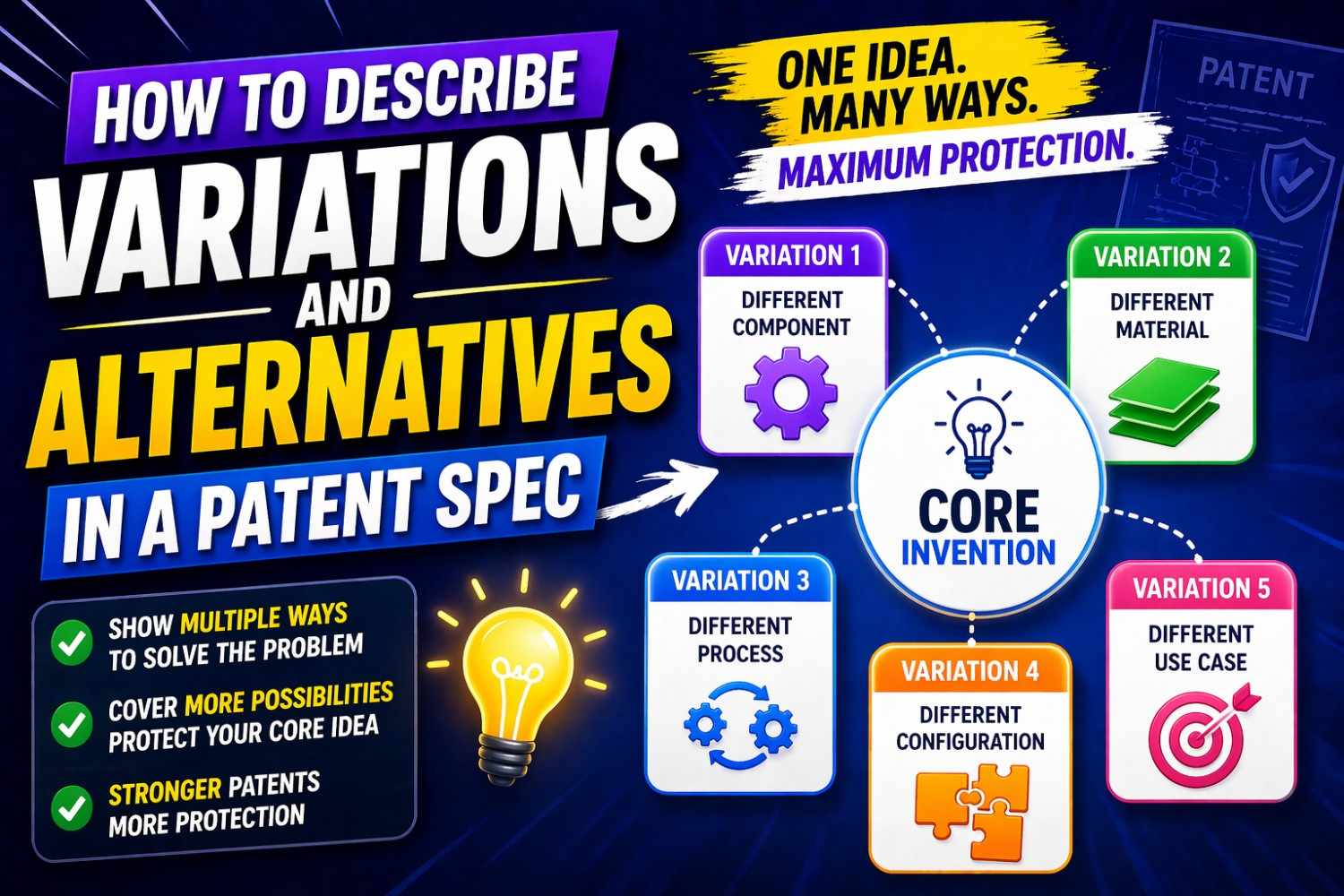
A patent is not just about showing one version of your invention. It is about protecting the real idea underneath it.
That is why variations and alternatives matter so much.
If your patent spec only describes one exact setup, one exact workflow, or one exact design, you may end up with protection that is far smaller than you hoped. But if your spec explains the different ways the invention can be built, used, adjusted, swapped, or extended, you give the patent much more strength. You show that the invention is not a fragile one-off. You show that it has range.
This is where many founders, engineers, and inventors get stuck. They know their product well. They know what they built. But they are not always sure how to describe other versions without becoming vague, messy, or too broad. They worry about saying too much. They worry about saying the wrong thing. They worry that alternatives will weaken the story or make the patent less clear.
The truth is the opposite when it is done well.
A strong patent spec usually does two things at the same time. It explains the invention clearly, and it leaves smart room around the invention. Variations and alternatives are how you create that room.
If you are building something real and want help turning your technical work into a strong patent application with real attorney oversight, PowerPatent was built for that. You can see how it works here: https://powerpatent.com/how-it-works
Why this matters more than most founders think
A lot of people assume the main job of a patent spec is to describe what exists today. That is part of the job, but it is not the whole job.
A patent spec should also help protect what a competitor might build tomorrow if they try to copy your core idea in a slightly different way.
That is why describing variations and alternatives matters so much.
If someone can change one component, switch the order of two steps, replace one model with another, move logic from the server to the device, swap one sensor for another, or use a different threshold method and get the same core result, your patent should be prepared for that.
Not because you can magically cover everything, but because you want the patent to reflect the true shape of the invention, not just the narrow form you happened to build first.
This is especially important for startups.
Startups move fast. Products change. Systems evolve. Models improve. Hardware gets smaller. Workflows get cleaner. What you launch in version one is often not what you ship in version three. If the patent spec only covers version one in a rigid way, your own invention may outgrow your filing.
That is painful. It also happens a lot.
Good variation writing helps prevent that problem. It keeps the patent tied to the heart of the invention while still showing that the invention can appear in many forms.
That is the real goal. You are not trying to make the patent vague. You are trying to make it durable.
What “variations and alternatives” really means
This phrase sounds larger than it is.
In plain words, it means this: what else could be used, changed, swapped, adjusted, reordered, resized, retrained, relocated, or reformatted without changing the core invention?
That is what you want to describe.
Sometimes the variation is physical. A component may sit in a different place. A housing may use a different material. A device may include two sensors instead of one.
Sometimes the variation is digital. A model may use a different architecture. A workflow may run locally instead of in the cloud. A scoring system may use a different threshold rule.
Sometimes the variation is operational. A step may happen before another step. A process may trigger on a schedule, on an event, or on a confidence score. A system may run in one mode during setup and another mode during production.
Sometimes the variation is contextual. The invention may work in healthcare, logistics, industrial monitoring, security systems, robotics, or finance. The core mechanism is the same, but the setting changes.
All of those can matter.
The main point is that your patent spec should not act like the current product build is the only possible expression of the invention unless that is truly the case.
Most of the time, it is not.
The hidden risk of writing too narrowly
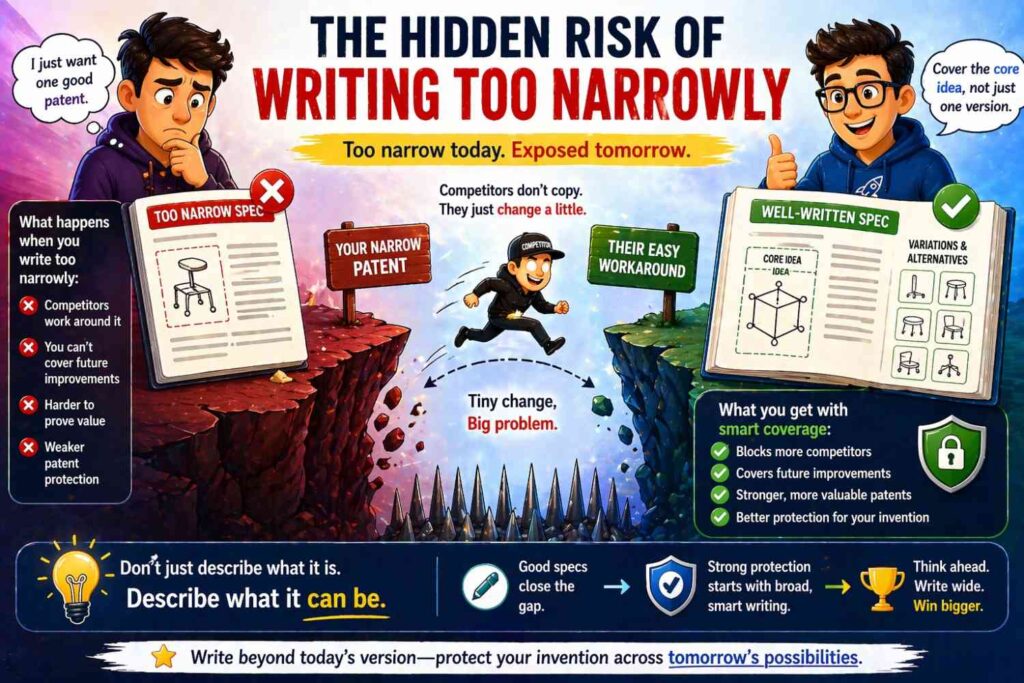
Founders often think that being specific is always good. Specificity is good when it teaches. But specificity without flexibility can box you in.
Suppose you invented a system that routes support tickets using a machine learning score plus business rules. If the spec only says the system uses a gradient boosting classifier, a fixed score threshold of 0.82, and a three-step routing flow that always goes from intake to classification to assignment, you may be telling a clear story. But you may also be leaving out other forms of the same invention.
What if later your own team replaces the classifier with a transformer-based model? What if the threshold becomes dynamic by account tier? What if routing happens after retrieval instead of before? What if the logic runs on the client device for privacy reasons? What if the ticket is triaged into one of five paths instead of three?
If those possibilities are not reflected in the spec, the written disclosure may feel tighter than the real invention deserves.
This is one reason great patent drafting is not just about documenting what exists. It is about understanding what matters and what can move.
A patent spec should have a spine, not a cage.
Variations and alternatives are how you avoid building the cage by accident.
The other risk: writing too loosely
There is danger on the other side too.
Some people hear that a patent should cover alternatives, so they start adding broad language everywhere. They say any model, any material, any step order, any network, any data type, any output. They throw in every possible substitute they can think of.
That does not always help.
If the writing becomes too loose, the invention can start to feel unsupported or fuzzy. The reader may stop understanding what the actual contribution is. The document may sound like it is trying to reserve territory around a concept instead of teaching a real solution.
That is not what you want either.
Strong variation writing is not random expansion. It is disciplined expansion.
You describe alternatives that still connect to the same core inventive idea. You show what can vary while keeping the invention recognizable. You do not just spray the page with generic “may” language and hope for the best.
Think of it like this. A good spec says, “Here is the invention, here is how it works, and here are the meaningful ways it can be implemented without changing its core.” A weak spec says, “This invention could be anything that sounds somewhat similar.”
One builds support. The other creates fog.
Start with the core before you describe alternatives
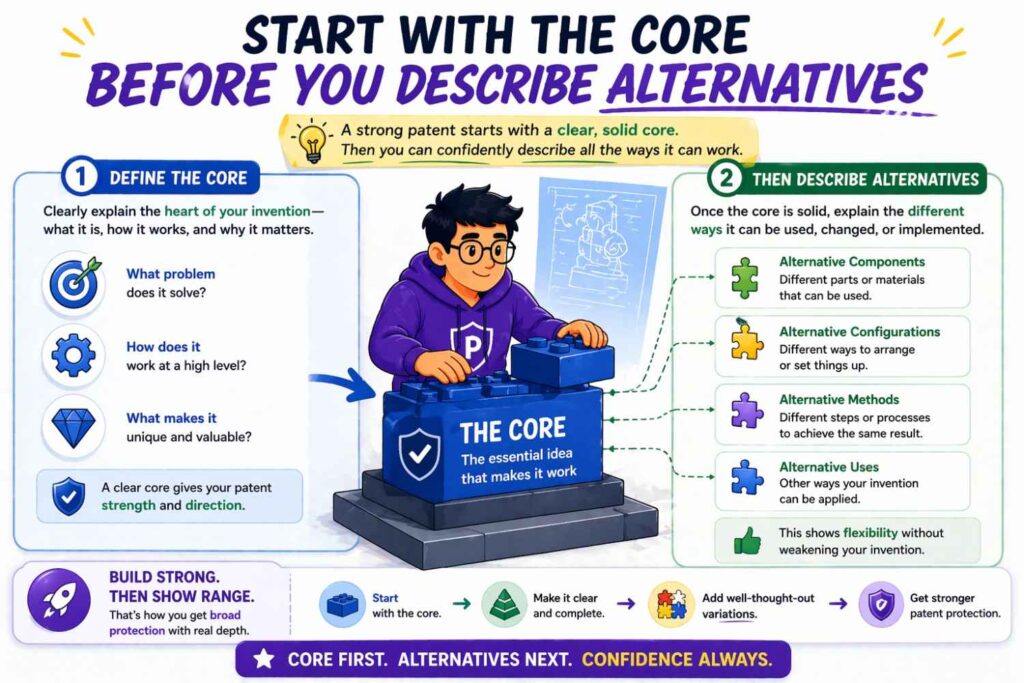
Before you can describe what may vary, you need to know what should stay the same.
That sounds obvious, but many people skip it.
If you do not know the core of the invention, your alternatives will either be too narrow or too chaotic. You will not know which details are just current implementation choices and which details are part of the real idea.
So start here: what is the invention actually about?
Not the market category. Not the feature name. Not the investor pitch.
What is the technical thing that makes it new or better?
Maybe it is a feedback loop that updates control settings based on real-time slippage.
Maybe it is a retrieval and verification flow that reduces hallucinated AI responses.
Maybe it is a workload migration method that balances cost savings against restart risk.
Maybe it is a secure handoff architecture between devices using session-bound keys.
Maybe it is a multi-stage ranking system that uses both behavior data and business rules.
Once you can say that clearly, the rest gets easier.
Now you can ask better questions.
What parts of this can change while the core still stays the same?
Can the input type change?
Can the model type change?
Can the location of the logic change?
Can the timing of the update change?
Can the materials change?
Can the output action change?
Can the order change?
Can the deployment environment change?
Can the interface change?
Can the threshold logic change?
Those are the right questions because they orbit around the real invention.
A useful way to think about alternatives
One of the simplest mental models is this: every invention has fixed points and flexible points.
The fixed points are the parts that make the invention what it is.
The flexible points are the parts that can shift without losing the inventive concept.
Your job in the spec is to teach both.
You want the reader to understand the fixed points so clearly that the invention feels real and distinct. You also want the reader to understand the flexible points so clearly that the invention does not feel trapped inside one exact build.
For example, imagine you invented a battery management system that predicts cell imbalance and redistributes load before thermal stress rises above a risk level. The fixed point may be the predictive imbalance detection tied to preemptive redistribution logic. The flexible points may include the sensor types, balancing intervals, threshold calculation method, pack geometry, communication path, and whether the balancing logic runs centrally or at the module level.
If the spec teaches those flexible points well, the invention stays grounded while gaining range.
That is what good drafting looks like.
Why founders often miss good alternatives
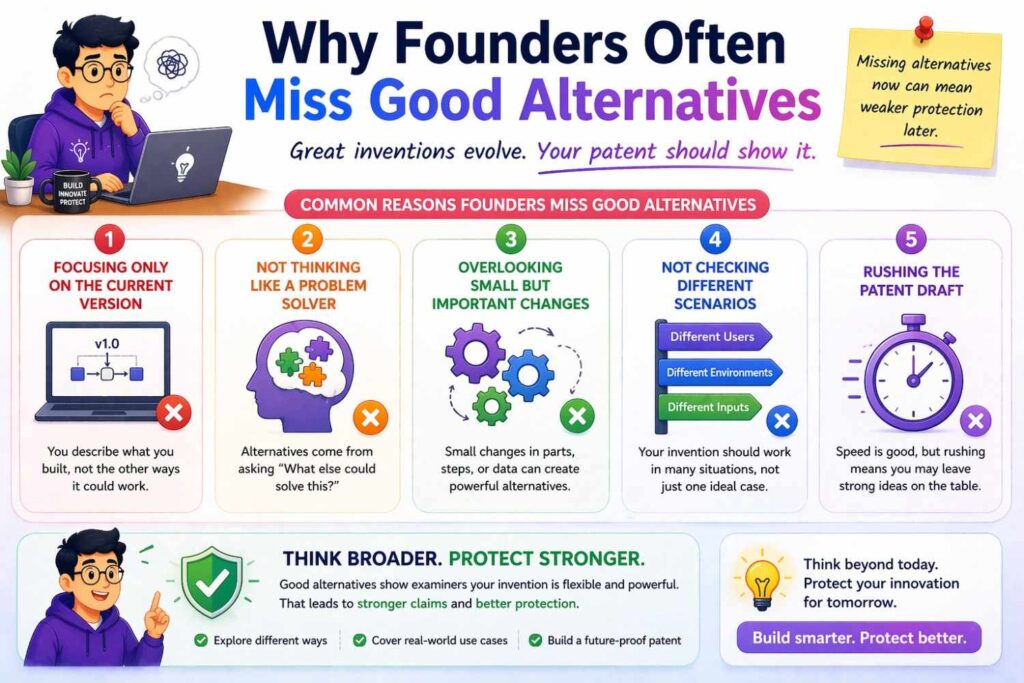
The strange thing is that inventors usually know more alternatives than they realize.
They considered other approaches during design.
They rejected one model before choosing another.
They tested two sensor placements.
They debated whether to run the pipeline on-device or in the cloud.
They changed the order of certain steps after early results.
They added a fallback when the first design failed under load.
All of that is rich material.
But when it is time to prepare the patent disclosure, many founders only describe the final build. They tell the story as though the product arrived fully formed. The side roads vanish from the written record.
That is a missed chance.
Some of those side roads may still be valuable alternatives. Some may show the invention more broadly. Some may reveal where the real novelty lives. Some may become future versions of the product. Some may become fallback claim support later.
The path not taken is often useful patent material.
That does not mean every abandoned idea belongs in the spec. But you should at least look at your design history with fresh eyes and ask what it reveals about the core invention and its possible forms.
This is one reason founders often benefit from a structured patent capture process. When the right questions are asked, the hidden alternatives come out. PowerPatent helps make that easier by turning real technical work into stronger patent drafts with real attorney review built in. You can see the process here: https://powerpatent.com/how-it-works
Variations are not filler
Some people treat alternative embodiments like boilerplate. They tack them on at the end with generic language and move on.
That is a mistake.
Variations and alternatives are not filler. They are part of the substance.
They help support broader claims.
They help show that the inventors understood the invention deeply.
They help avoid accidental admissions that one form is required when it is not.
They help preserve room for later product changes.
They help make design-arounds harder.
They help examiners and later readers see that the invention has depth.
That is real value.
The best specs do not hide alternatives in one lifeless paragraph near the end. They build flexibility into the whole document. The alternatives appear where they matter. They sit next to the main description. They show up in the system section, in the method section, in the examples, in the drawings discussion, and in the optional implementation language.
That kind of drafting feels thoughtful because it is.
The simplest places to look for variations
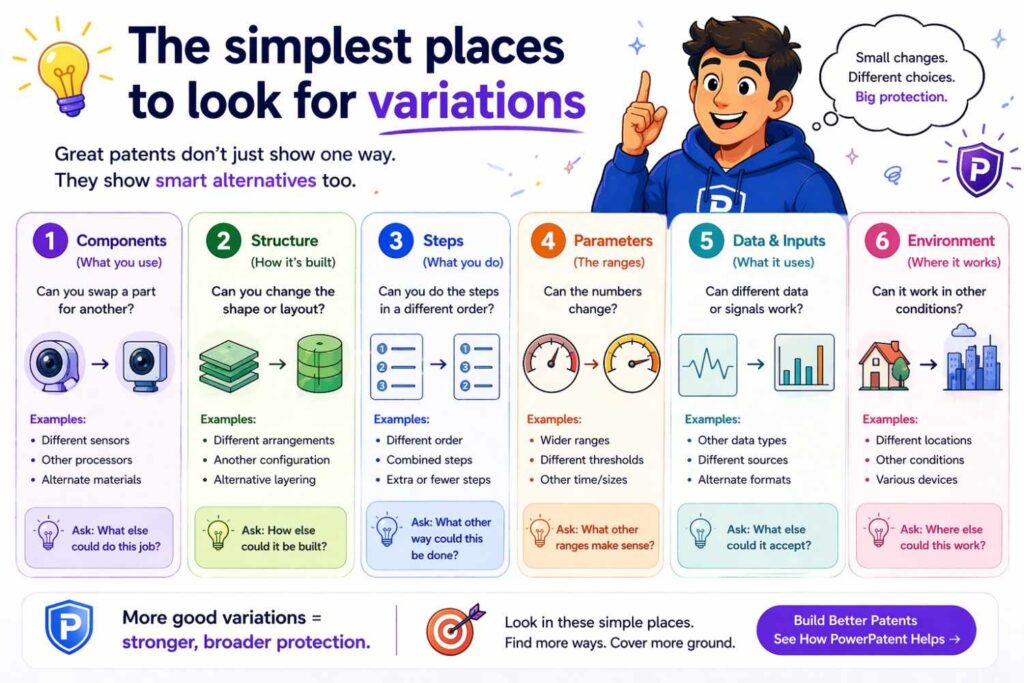
If you want a practical way to gather alternatives, start by looking at a few common categories.
Look at components. Could one part be replaced by another part that serves a similar role?
Look at data. Could the system use different input sources or output formats?
Look at logic. Could the decision be made using a rule, a model, a score, a threshold, or a hybrid?
Look at sequence. Could steps happen in a different order or under different triggers?
Look at location. Could processing happen on a device, on a server, at the edge, or across a hybrid setup?
Look at structure. Could the same function be spread across modules or combined into one module?
Look at scale. Could the system work for one user, a group, a fleet, a site, or a distributed network?
Look at timing. Could an action happen continuously, periodically, on request, or after a detected event?
Look at context. Could the same invention work in more than one use case or technical environment?
These are not just brainstorming prompts. They are a practical way to pull flexibility out of the invention without drifting away from it.
Describe alternatives in plain words first
One of the biggest mistakes in patent drafting is trying to sound patent-like too early.
When people do that, their writing fills with stiff phrases and vague legal-sounding language. The alternatives become harder to understand. They lose the engineering truth.
A better approach is to describe the alternatives in plain words first.
Talk through them the way you would explain the system to another engineer. Start with the actual choices your team made and the other choices that could still work.
For example, instead of starting with a sentence like “In various embodiments, any suitable classification engine may be employed,” start with the real thought. Maybe the system currently uses a gradient boosting model because the data is tabular and the team needed speed. But the same routing logic could also use a neural network, a rules engine, or a hybrid score if the input features or latency targets changed.
That is much more useful.
Once the plain idea is clear, it can be shaped into patent-ready language without losing its meaning.
This matters because variations only strengthen a spec if they are understandable. Foggy generality does not help much.
One strong method: explain the main version, then branch outward
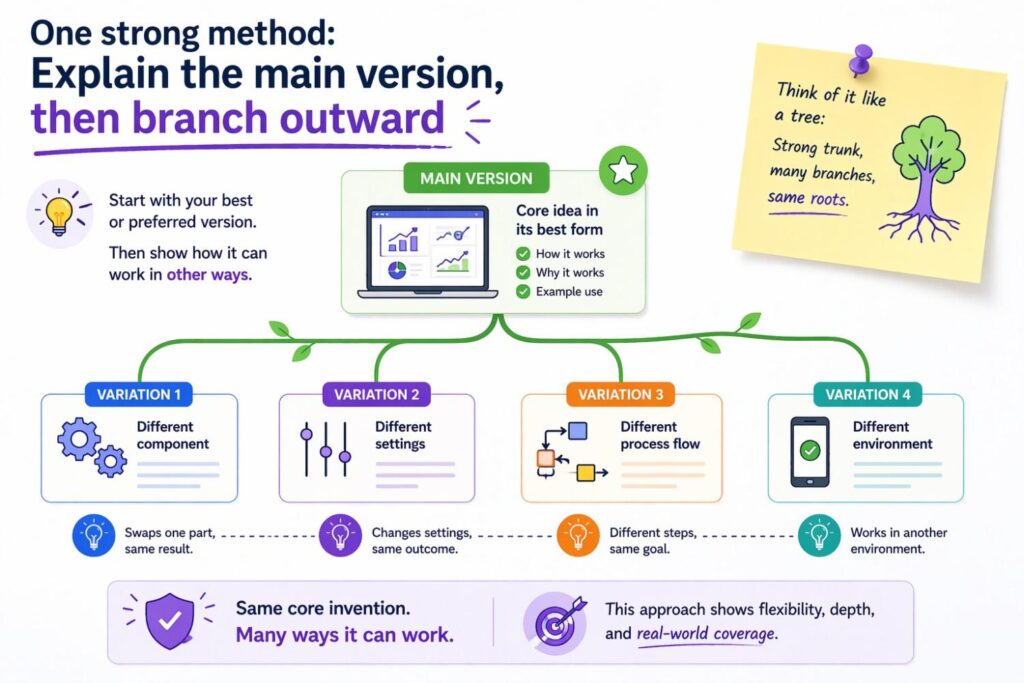
A reliable drafting pattern is to explain one representative embodiment clearly and then branch outward from it.
That gives the reader a solid anchor.
Once the main embodiment is clear, you can point out the ways it might differ in other implementations. This feels natural because the reader already understands the baseline.
For example, suppose you are describing a system that detects machine faults from vibration data. You may first explain a representative flow in which vibration signals are collected from mounted sensors, segmented into time windows, transformed into frequency-domain features, evaluated by a trained model, and used to trigger maintenance alerts above a confidence threshold.
Once that path is clear, you can introduce alternatives. The sensors may also include acoustic or thermal sensors. The feature generation may use wavelet transforms instead of frequency bins. The model may be trained per machine type or across a fleet. The confidence threshold may be fixed, adaptive, or risk-weighted. Alerts may trigger service tickets, operator notifications, or automated load reduction.
That branch-out method works because it keeps the core visible.
It also helps prevent the common problem of leading with too many options before the invention itself is understandable.
Do not let one embodiment sound mandatory unless it is
This point deserves special attention because it causes real damage in patent specs.
Inventors often write about their main implementation with words like “must,” “requires,” “only,” “essential,” or “critical” when they really mean “in our current design” or “in one useful embodiment.”
That language can make the spec feel narrower than intended.
If a component truly is required for the invention, then say so. But if it is just one way of implementing the invention, the wording should reflect that.
For example, saying “the system requires a transformer model” is very different from saying “in one embodiment, the system uses a transformer model to generate ranked outputs.” The second sentence still teaches the implementation, but it leaves room for other model types.
The same is true for hardware. “The device includes a copper heat spreader” may be fine in a specific embodiment. But if the real idea is a thermal transfer structure between two regions, you may also want to explain that other conductive materials, composite layers, or equivalent transfer structures can be used.
This is not about being slippery. It is about being accurate.
A good patent spec is careful about what is truly fixed and what is only representative.
Alternatives should match the invention’s level
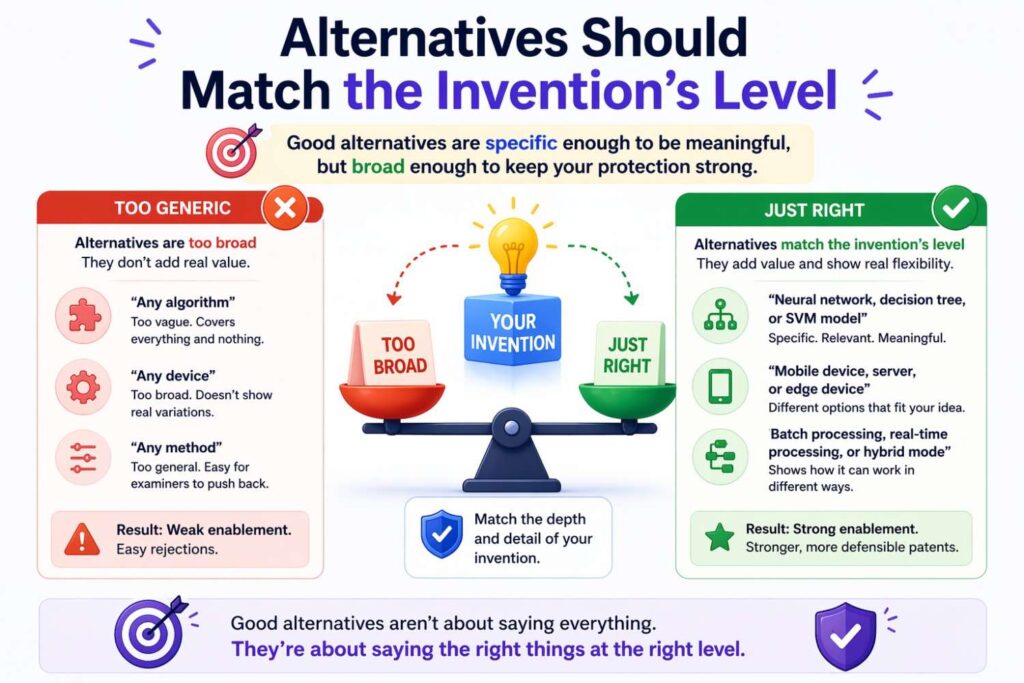
Another common mistake is describing alternatives at the wrong level.
Sometimes the writing gets too high-level. It says almost anything can be swapped for anything else, but without showing how those substitutes still fit the invention.
Other times the writing gets too low-level. It lists tiny interchangeable parts that do not really matter while ignoring bigger architectural changes that do matter.
The right level is the level where the invention lives.
If the invention is about a control strategy, then the alternatives should focus on how the strategy may be implemented across different sensors, thresholds, or control actions.
If the invention is about a hardware arrangement, then the alternatives should focus on structural variations, material choices, component placement, and physical relationships.
If the invention is about an AI workflow, then the alternatives should focus on input sources, preprocessing paths, retrieval methods, model types, confidence logic, and output handling.
This is why you cannot really write good alternatives without understanding the invention deeply. You need to know where the real action is.
How to describe substitute components
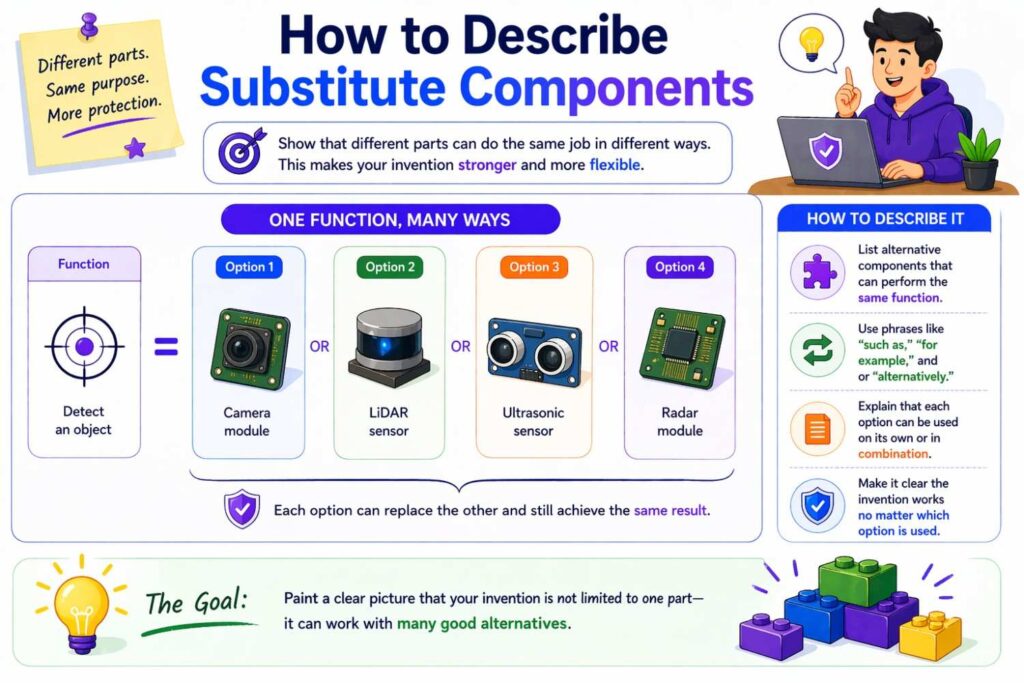
One of the easiest kinds of alternative to describe is the substitute component.
This is where one part can be replaced by another part that serves a similar function.
For example, a temperature sensor may be replaced with an infrared sensor in some implementations. A centralized controller may be replaced with distributed control logic. A vision model may be replaced with a rules-based classifier in low-resource settings. A wired communication bus may be replaced with a wireless link. A metal enclosure may be replaced with a polymer composite that still provides the needed structural function.
The key is not just naming substitutes. The key is explaining why they still fit.
A weak sentence says that any suitable sensor can be used. A stronger sentence explains that the example uses a contact temperature sensor mounted at the battery module, but other embodiments may use infrared sensing, distributed thermal probes, or indirect thermal estimates derived from voltage and current behavior where direct sensor placement is limited.
That sentence teaches function, not just substitution.
It also shows that the inventors thought through the role of the component rather than treating it as a plug-in label.
How to describe alternative step order
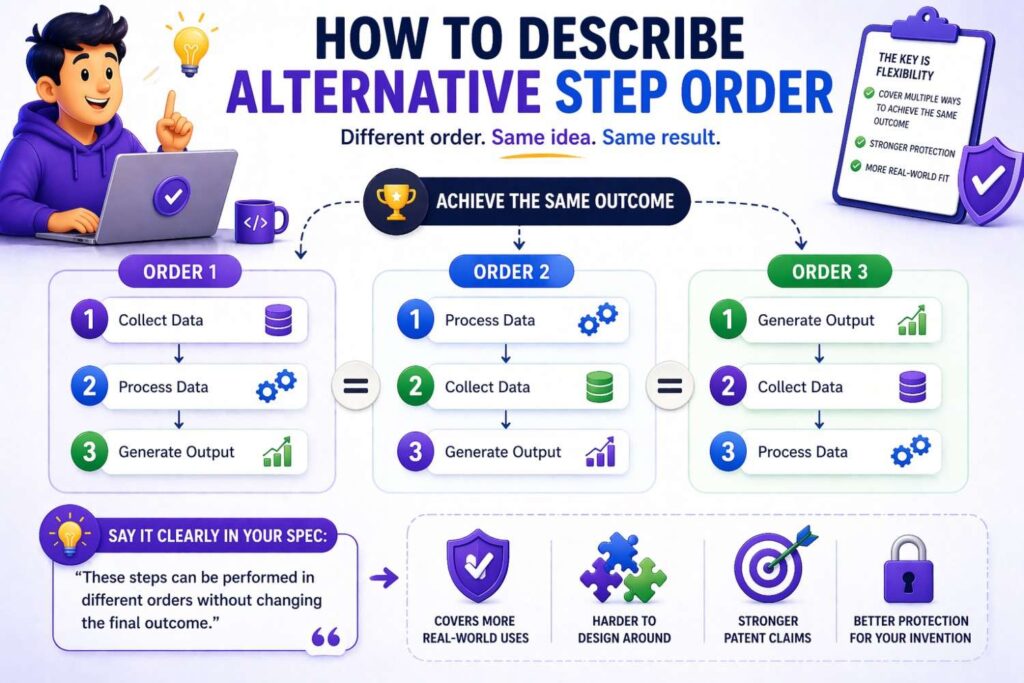
Many inventions, especially in software and process workflows, can still work even when certain steps happen in a different order.
This should be described carefully.
Suppose your invention involves receiving an input, retrieving context, scoring relevance, and generating an output. In one version, retrieval may happen before scoring. In another, a quick score may first decide whether retrieval is worth doing at all. In another, generation may happen first, followed by verification against retrieved material.
If those are all valid forms of the invention, the spec should say so.
This is important because process order can become a point of attack or avoidance later. If the spec always presents one order as the only order, that can create unwanted limits.
A good way to handle this is to explain the primary sequence clearly, then note that in other embodiments some operations may be reordered, combined, omitted, or performed conditionally while still achieving the disclosed function.
But do not stop there if the order matters in interesting ways. Give examples of the variations. Explain when one order may be preferred over another. That makes the disclosure much stronger.
For example, you might say that in one implementation the system retrieves candidate support documents before classifying ticket complexity, while in other implementations a lightweight complexity score is generated first so that retrieval can be skipped for low-information messages or routed to a simplified path for routine requests.
Now the variation has real content.
How to describe alternative data sources
Modern inventions often depend heavily on data. That makes data-source alternatives very important.
A system may work with sensor data, user actions, account history, transaction logs, image data, audio signals, geolocation data, text input, device metrics, or third-party feeds. Often the invention is not tied to only one source.
If your invention can work with multiple input types, say so in a useful way.
For example, if a fraud system currently uses transaction amount, merchant class, device ID, and account history, but could also use behavioral biometrics, velocity patterns, geolocation consistency, or network intelligence, the spec should reflect that broader range.
Again, avoid empty generalities. Do not just say “other data may be used.” Show the kinds of data that can be swapped in and how they fit the logic of the invention.
This helps the invention feel adaptable without becoming vague.
It also helps support claims later if you want to avoid being pinned to one narrow input set.
How to describe alternative model types in AI inventions

This is a big one for modern startups.
A lot of AI-related specs accidentally tie themselves too tightly to a current model choice. That can happen because the team is focused on what they built right now, or because the AI space changes so fast that the current model family feels central when it may not be.
Sometimes the model type really is central. If the invention depends on a very specific model structure, then that should be clear.
But often the real invention is not the exact model family. It may be the way the model is used, the way data is prepared, the way outputs are verified, the way confidence is handled, or the way the system adapts over time.
In those cases, the spec should describe model alternatives thoughtfully.
For example, if the system uses an anomaly model to flag network behavior, the disclosure might explain that the example uses a gradient boosting model trained on feature vectors derived from traffic metadata, while other embodiments may use neural networks, graph-based models, probabilistic models, one-class classifiers, or hybrid rule-and-model systems depending on feature structure, compute limits, data sparsity, or interpretability needs.
That is strong because it still explains function and context.
It does not pretend that all models are equal in all settings. It shows how alternatives fit different conditions.
This kind of writing is especially valuable because your own product may evolve from one model family to another over time. If the patent spec only describes the model of the month, that can become a problem later.
How to describe optional features without weakening the core
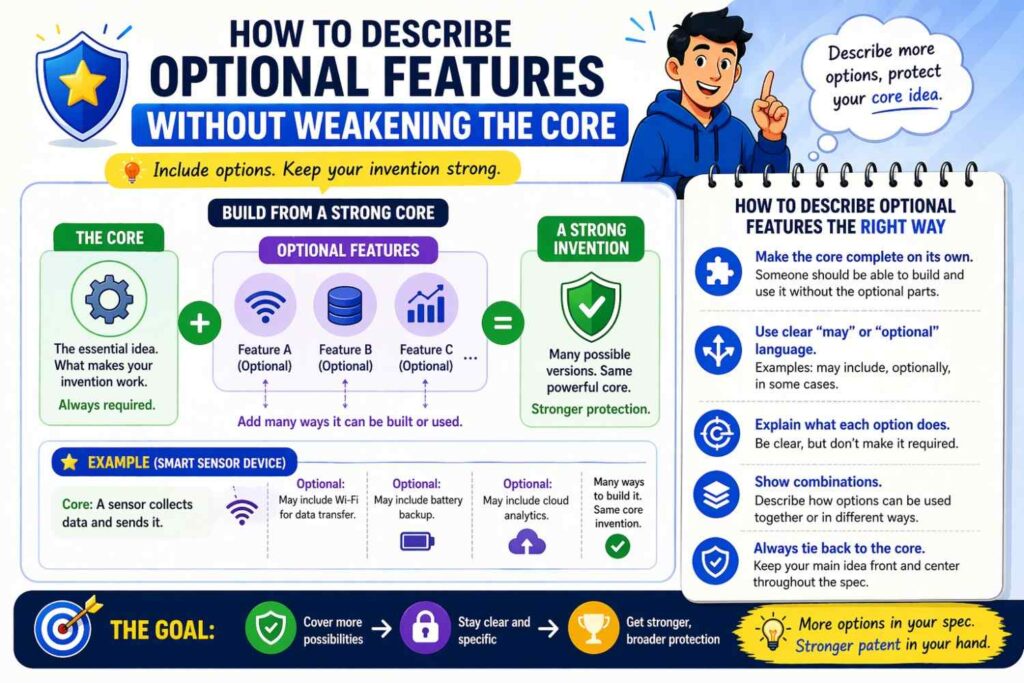
Many inventions have add-ons, enhancements, safety checks, fallback logic, dashboards, user approvals, monitoring tools, or secondary modules that improve the system but may not be essential to the main inventive idea.
These should often be described as optional features.
That does not make them unimportant. In fact, some optional features may be worth their own dependent claims or even their own filings later. But in the main spec, it can help to frame them correctly.
For example, suppose your core invention is an automated compliance screening pipeline. A dashboard that visualizes flagged results may be useful, but the dashboard may not be central to the core screening logic. The same may be true for an audit export feature or a human override panel.
If those are presented as optional, the patent keeps focus while still preserving support for the added features.
A good spec often shows this by distinguishing between primary operations and optional enhancements. It teaches the core system first, then explains that some embodiments may further include logging, user review, rollback controls, visualization layers, or cross-system synchronization.
This helps the reader see what is central and what is supplemental.
The power of “in some embodiments” when used well
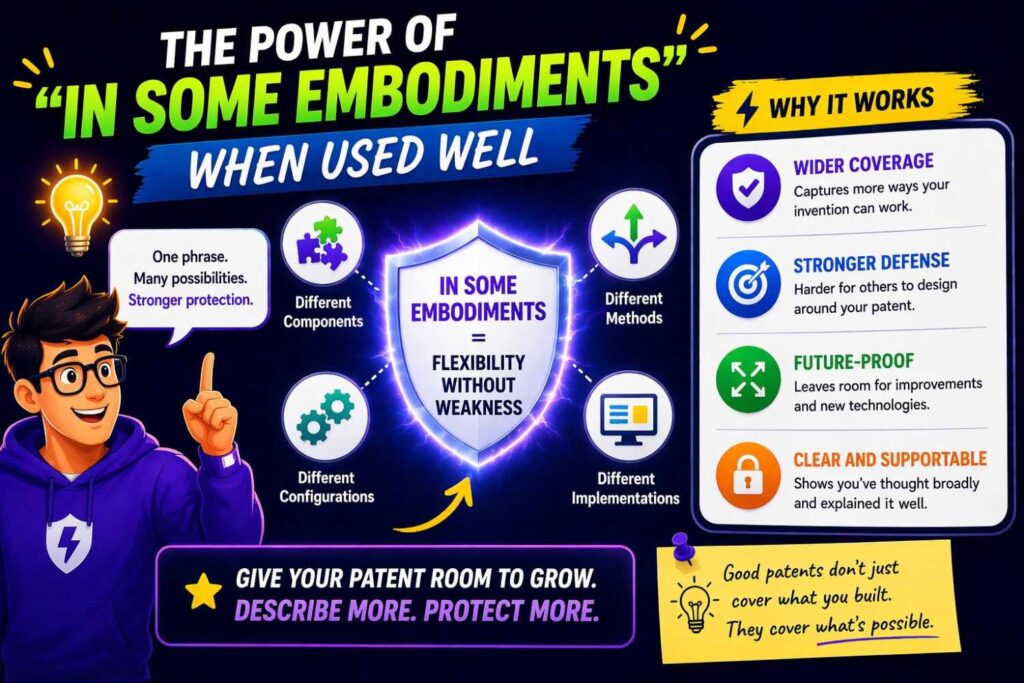
This phrase exists for a reason.
“In some embodiments” is one of the simplest ways to introduce flexibility without losing clarity. But it only helps when the sentence that follows has substance.
Weak use looks like this: in some embodiments, different things may happen.
Strong use looks like this: in some embodiments, the threshold for triggering a maintenance alert is adjusted based on machine age, recent load profile, or a historical false positive target.
The difference is obvious. The second version teaches something real.
So yes, phrases like “in some embodiments,” “in one implementation,” “in other examples,” or “in certain cases” are very useful. But they should not become empty padding. They should be gateways to actual technical alternatives.
Think of those phrases as structural tools, not content.
Examples make variations stronger
One of the best ways to describe alternatives is not through abstract statements at all. It is through examples.
Examples let the reader see how the invention operates in different forms. That makes the alternatives feel real.
For instance, if your invention is a system for adaptive routing of compute jobs, one example might show routing based on current price and checkpoint status. Another might show routing based on privacy rules that require local execution. Another might show routing based on thermal limits in edge hardware. These examples all reveal the same core concept in different settings.
That is much stronger than a single sentence saying the system may use different routing criteria.
The same is true for physical inventions. A robotic gripper may use one contact geometry for rigid objects and another for deformable items. A cooling system may use one airflow path in a compact housing and another in a rack-mounted assembly. A medical sensor may operate continuously in one embodiment and periodically in another.
Examples help alternatives breathe.
They also help avoid a common problem where the patent tries to sound broad but never shows a second form actually working.
Use families of alternatives, not random piles
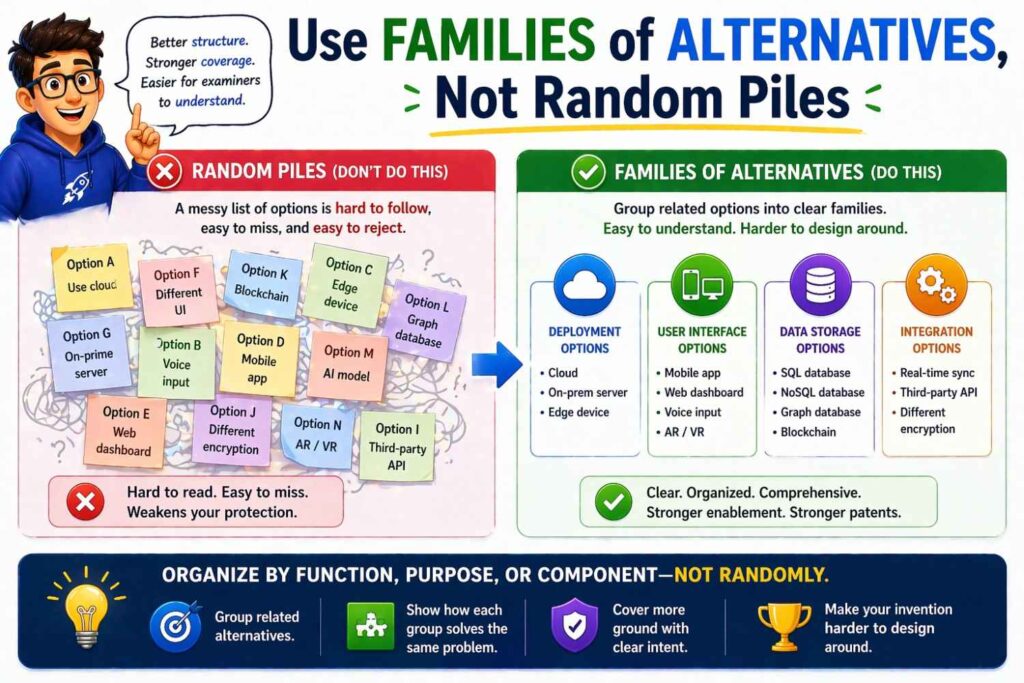
A patent spec gets stronger when alternatives are organized around meaningful families.
For example, if your invention includes a scoring step, the alternatives around that step might form one family: static thresholds, adaptive thresholds, per-user thresholds, risk-weighted thresholds, model-generated thresholds.
If your invention includes a communication path, the alternatives may form another family: direct device-to-server, relay-based communication, peer-to-peer exchange, local gateway buffering, asynchronous upload.
If your invention includes sensing, the alternatives may form another family: optical sensing, acoustic sensing, thermal sensing, inertial sensing, combined sensor fusion.
This kind of family-based drafting is useful because it shows structure. It tells the reader that the inventors understood the design space around the invention.
Random piles do not have the same effect. They can make the spec feel bloated or careless.
So when you draft alternatives, group them around the functions they serve. That keeps the disclosure cleaner and stronger.
Do not confuse alternatives with unrelated wish lists
A spec should not become a dumping ground for every cool idea near the invention.
This is another trap.
Sometimes teams brainstorm possible future versions, integrations, and adjacent features, then try to push all of it into the same filing. That can blur the invention.
The question is not whether an idea is interesting. The question is whether it belongs to the same inventive concept or is at least meaningfully connected to the same disclosed system.
If your invention is about a secure transaction confirmation method, adding a paragraph about a future loyalty rewards feature may not help unless it directly ties into the inventive mechanism. If your invention is about sensor fusion for machine control, tossing in speculative analytics dashboards may not add much unless they relate to the core operation.
Good alternatives are close cousins of the core invention. Bad alternatives are unrelated guests at the same table.
This is one reason patent drafting benefits from discipline. The goal is not maximum word count. The goal is strong support around a coherent invention.
How to write alternatives for hardware inventions
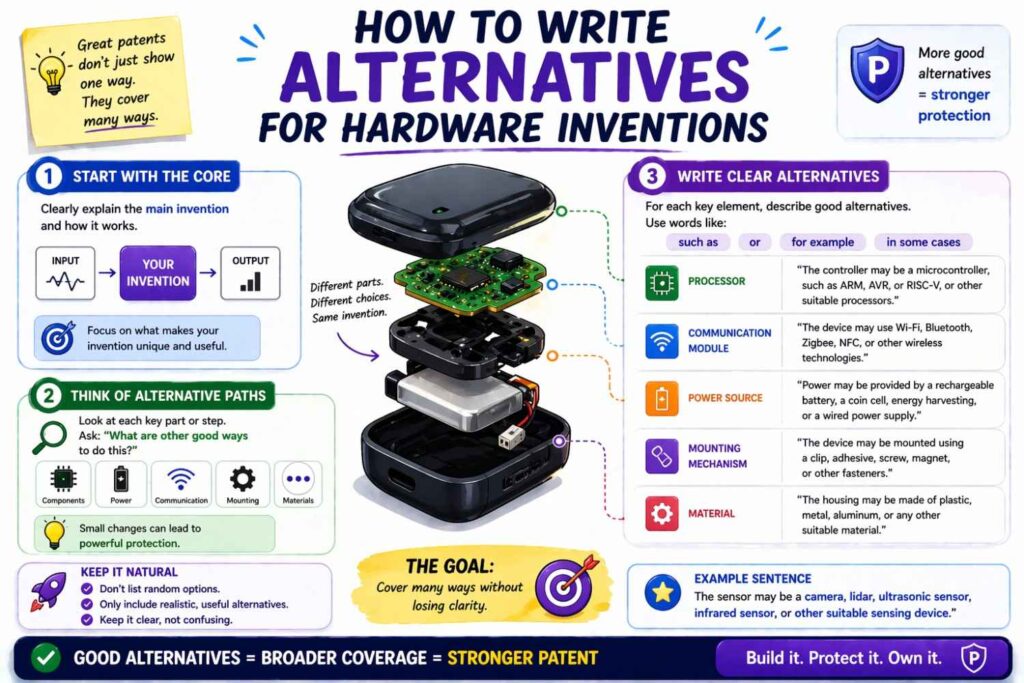
Hardware inventions often need careful handling because structure matters.
When writing alternatives in hardware specs, focus on physical relationships and functional roles.
If a component can be positioned differently, say where and why.
If a material can change, explain what property matters. Is it conductivity, flexibility, durability, weight, thermal resistance, signal shielding, or biocompatibility?
If a component can be integrated, split, layered, rotated, compressed, or mounted differently, describe those changes in functional terms.
Suppose you invented a compact cooling assembly for an edge compute device. The primary embodiment may use a heat spreader coupled to a processor, a vapor chamber extending toward an external fin region, and a fan that moves air through side vents.
Alternatives may include passive convection in low-power settings, heat pipes instead of vapor chambers, composite spreaders instead of copper, top-vent or rear-vent layouts, or dual-stage airflow control tied to predicted workload rather than current temperature alone.
Those are meaningful hardware alternatives because they stay close to the thermal management concept.
Hardware specs get much stronger when they describe not only what parts are present, but also what other arrangements can preserve the same inventive effect.
How to write alternatives for software inventions
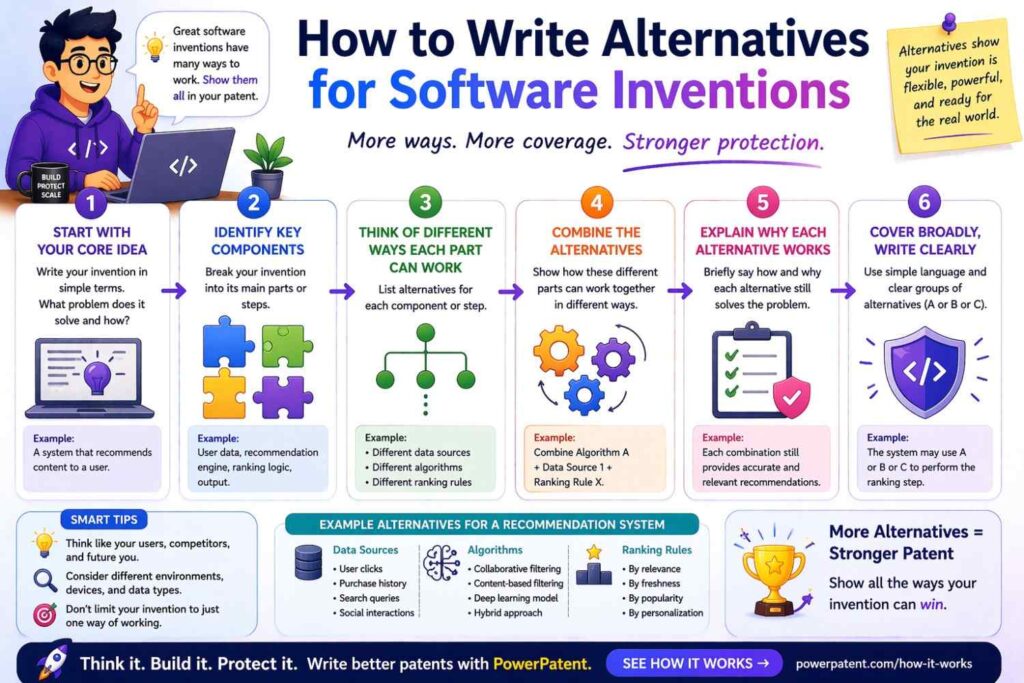
Software inventions are especially vulnerable to narrow drafting because teams often describe the code path they shipped and forget that the same logic could be implemented in several different ways.
When writing software alternatives, think about modules, timing, infrastructure, data structures, communication patterns, control logic, and deployment choices.
A main embodiment may describe a server-side workflow. Alternatives may place some logic at the client, at the edge, or in a background service. A batch process may become event-driven.
A ranking function may become a rules-plus-model pipeline. A single service may be broken into microservices. A synchronous request flow may become asynchronous with queue-based retry.
These are not just architecture details. They may matter a lot for the practical form of the invention.
Suppose your invention is a system that detects duplicate support tickets and merges them before human review. One embodiment may use a central service that compares text embeddings and account metadata.
Other embodiments may use hash-based fast filtering before deeper semantic matching, local duplicate detection within enterprise workspaces, or periodic background clustering instead of inline request-time matching.
That is the kind of alternative writing that creates real range.
How to write alternatives for process inventions
Process inventions often turn on sequence, conditions, and branch logic. So their alternatives should usually focus on those same things.
Can a step happen earlier, later, or only after a trigger?
Can two steps be merged?
Can a step be skipped under certain conditions?
Can one input source replace another?
Can one approval path be automatic in some settings and manual in others?
Can the process run continuously in one environment and only on request in another?
These are very useful process alternatives.
Suppose your invention is a return-handling workflow that reduces fraud while speeding refunds. One embodiment may score the request based on purchase history, account age, and image evidence before choosing instant refund or inspection. Alternatives may use merchant-specific rules, product-specific thresholds, deferred review after refund issuance, or post-return model updates based on warehouse inspection results.
Again, the key is not simply saying the process may vary. The key is showing where and how it may vary while keeping the central logic intact.
Use drawings to support alternatives
When people think about patent drawings, they often think only about the main embodiment. That is too narrow.
Drawings can also help support variations and alternatives.
You do not need a separate figure for every possible substitute, but where a variation is important, a drawing can make it much easier to understand. This is especially true for hardware arrangements, system architectures, network topologies, and control flows.
For example, one figure might show a baseline system layout. Another might show an alternate sensor placement. Another might show centralized control versus distributed control. Another might show a cloud deployment versus on-device execution. Another might show a fallback workflow when confidence is low.
These alternative views do real work. They make the spec feel more complete. They also force clarity. If an alternative cannot be explained visually or structurally, that may be a sign it is not well thought through yet.
Strong patent drafting often uses drawings and text together to show both the main embodiment and meaningful branches around it.
Variations can protect your own future roadmap

This is one of the most practical reasons to do this well.
Your own product may change.
The version you have today is rarely the final version. Your team may refine the UI, change the architecture, improve the model, replace vendors, move compute closer to the user, combine steps, split modules, or add fallback controls.
If those changes still rely on the same inventive core, you want the original patent spec to be broad enough to support that evolution.
Otherwise, you may find yourself in an awkward position where your own later product feels only partly covered by your earlier filing.
That is not a theoretical concern. It happens often in startups because product evolution is normal.
Good variation drafting helps your patent age better.
This is one reason filing with a process built for modern technical teams matters. A platform like PowerPatent helps founders capture not only what exists right now, but also the surrounding implementation space that may matter as the product grows, all with real attorney review to shape the final result. You can learn more here: https://powerpatent.com/how-it-works
A practical way to pull alternatives out of your team
If you are working with engineers, product leads, researchers, or founders, one of the best ways to gather alternatives is to ask a small set of direct questions.
Ask what they almost built but did not.
Ask what they may switch to later.
Ask what could be changed without breaking the core result.
Ask which parts are fixed because of the invention and which parts are fixed only because of current constraints.
Ask what would happen if the system had to run with less compute, more latency pressure, fewer sensors, stricter privacy rules, or different customer needs.
Ask what a competitor might change first if they wanted to copy the idea while pretending not to.
The answers to those questions are often extremely useful.
They reveal alternatives that are grounded in reality, not just drafted from thin air.
Watch for accidental narrowing through repeated language
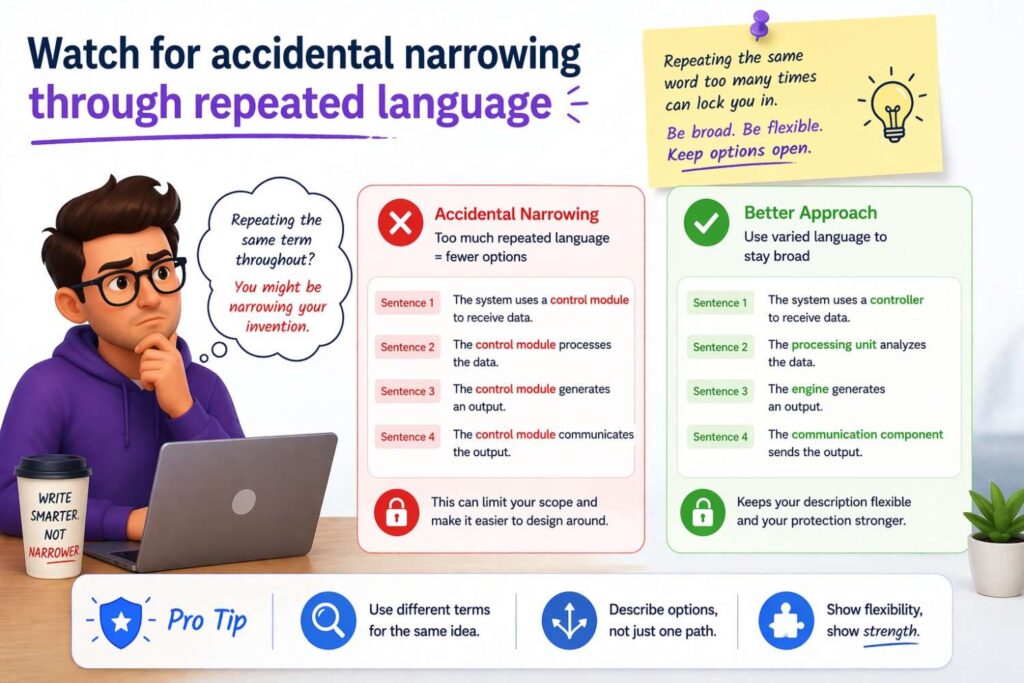
Even if you include alternatives, the spec can still become narrow by repetition.
If the whole document repeats the same exact component labels, the same sequence, the same values, and the same architecture over and over without much variation in wording, a reader may come away with the sense that this is the only form of the invention.
That is why variation should not live in one isolated section. It should appear throughout the disclosure where relevant.
If the system section always says “server” but the invention could also run on-device or at the edge, say that where it first matters. If the process section always says “classification occurs before retrieval” but there are other valid sequences, say that near the process description.
If the hardware section always says “metal housing” but thermal polymer composites can also work, say that when discussing the structure.
This kind of distributed flexibility makes the whole document stronger.
Use fallback positions wisely
Alternatives are not only about broadening. They can also help with fallback.
Sometimes a broader version of the invention is challenged. In that case, narrower disclosed alternatives may become very valuable. They can support dependent claims, amended claims, continuation strategies, or targeted enforcement positions later.
This is why a strong patent spec often includes both broad alternatives and narrower refinements.
For example, a general routing invention may have narrower disclosed forms that use confidence-based escalation, cost-sensitive thresholding, or cross-session state reuse. A hardware invention may have narrower forms involving specific sensor placement or multi-layer isolation. A model-based invention may have narrower forms involving verification rules, training cadence, or data filtering.
These are not signs of weakness. They are part of building a layered disclosure.
The broad invention matters. But the narrower versions can matter too.
How to avoid sounding repetitive when writing alternatives
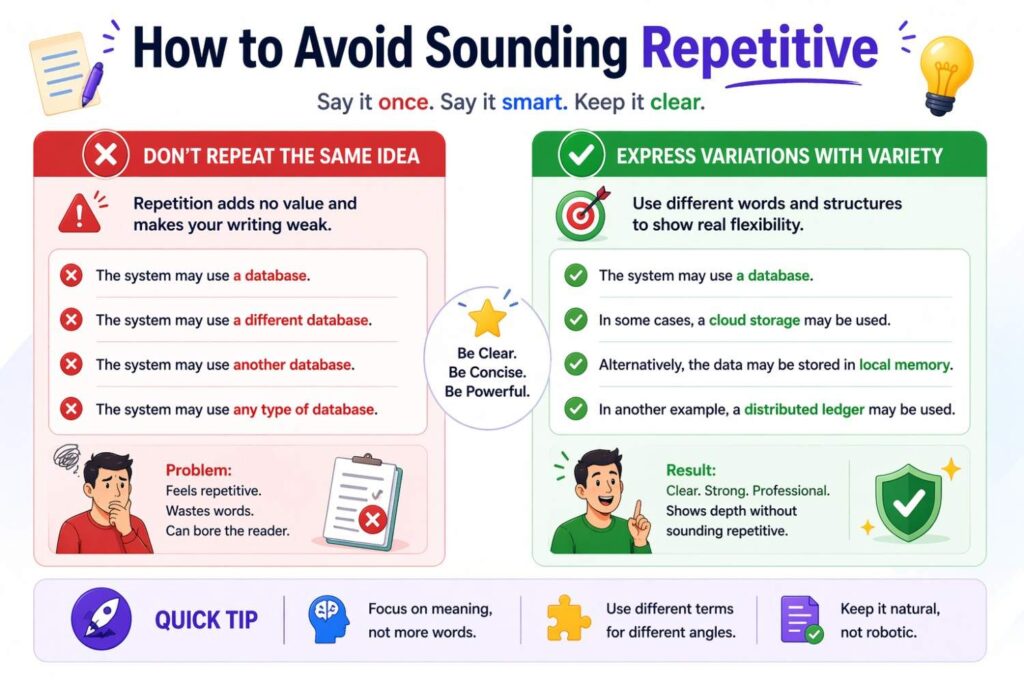
One challenge in long patent descriptions is that alternatives can start sounding repetitive. Every paragraph begins to feel like “in some embodiments” followed by a slightly different noun swap.
That gets dull fast.
The fix is to vary the way alternatives are introduced and to make each one earn its place.
Sometimes you can introduce an alternative by function. For example, the confidence logic may be adjusted differently in high-risk environments.
Sometimes you can introduce it by context. In mobile deployments, some processing may be shifted to the device to reduce network dependence.
Sometimes by condition. When sensor coverage is incomplete, indirect estimates may be used.
Sometimes by structure. The control module may be centralized in one system or distributed across devices in another.
The more each variation is tied to a real purpose, the less repetitive the writing feels.
This matters because readable specs are easier to understand, and that helps everyone involved.
A concrete example: AI support system
Let us make this more practical.
Imagine the invention is an AI support system that drafts responses using retrieved internal knowledge while checking whether generated statements are actually supported.
The core idea may be the retrieval-plus-verification loop before presenting an answer.
Now think about the alternatives.
The retrieval module may use keyword search, vector search, graph-based retrieval, or a hybrid approach.
The knowledge base may include help articles, release notes, prior tickets, product documentation, or account-specific configuration data.
The generation module may use different model families depending on latency and quality targets.
The verification module may compare generated statements to cited passages, to structured knowledge records, or to extracted factual tuples.
The threshold for human review may depend on account type, support tier, risk category, or confidence trend.
The system may run fully server-side, partly on-device, or in a customer-specific isolated environment.
The output may be sent directly to an agent, used to suggest a reply, or blocked entirely in low-support cases.
All of those are meaningful variations. They all stay close to the same core invention.
A strong spec would not just name them in one paragraph. It would weave them into the description at the places where they matter.
A concrete example: industrial control system
Now imagine an industrial system that predicts equipment drift and adjusts control settings before failure occurs.
The core may be predictive control based on detected deviation patterns.
Alternatives may include different sensor sets, such as vibration, acoustic, thermal, pressure, or current draw.
The drift estimate may be produced by a rules engine, a learned model, or a hybrid system.
The control action may be a speed reduction, a shutdown, a recalibration, a maintenance alert, or a shift to a backup unit.
The update cadence may be continuous, periodic, or event-triggered.
The system may operate at a single machine, across a production line, or across multiple sites.
The threshold may be global, per machine type, or adjusted based on operating history.
Again, this is not random expansion. These alternatives all describe the same invention family.
That is what your spec should do.
The role of language like “can,” “may,” and “in one example”
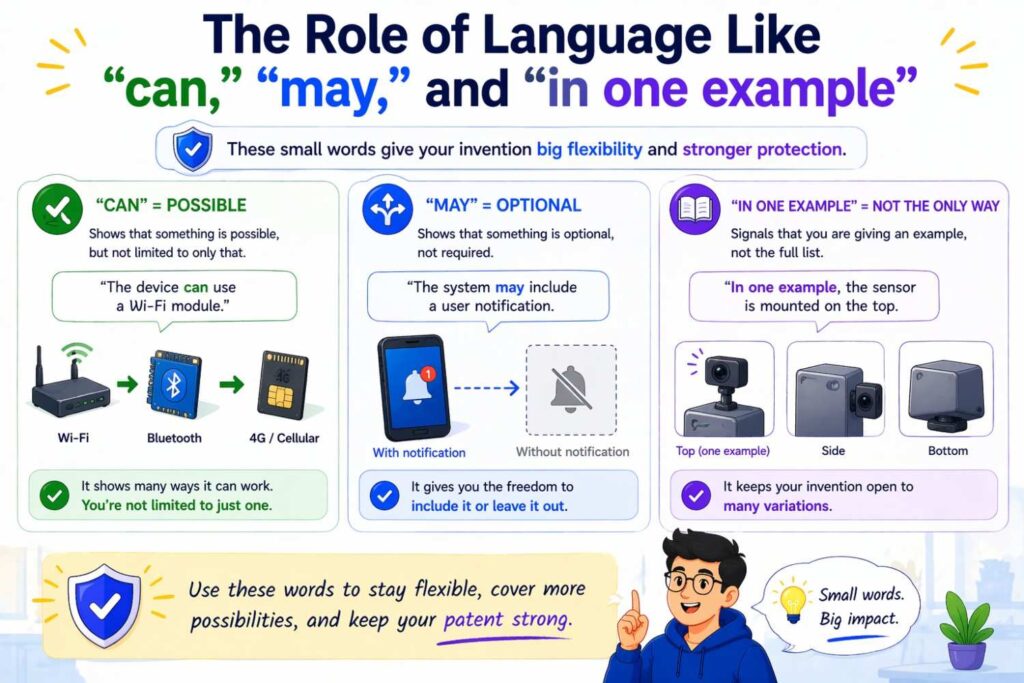
These words are small, but they matter.
They help you describe possibility without making every feature sound mandatory. They let you disclose one implementation while preserving room for others.
But like all drafting tools, they need discipline.
If every sentence uses “may” but never gives substance, the spec starts to feel weak. If every sentence uses hard language, the spec starts to feel boxed in.
The answer is balance.
Use flexible language where the invention truly allows flexibility. Use direct language where the invention truly requires something or where the representative embodiment is being clearly described.
A sentence like “the control module may increase grip force when slip exceeds a threshold” is useful if the control action is one valid form among several. A sentence like “the system includes a sensor interface that receives vibration data” may be perfectly fine if the embodiment being described definitely includes that interface.
Good drafting is not about making every sentence soft. It is about matching the language to the reality of the invention.
Do not forget deployment alternatives
Many software and AI inventions can run in different technical environments. That should often be reflected in the spec.
For example, logic may run in a centralized cloud system, in an enterprise private environment, on a local gateway, on a device, or across a hybrid architecture.
These deployment choices can matter a lot, especially for latency, privacy, cost, regulation, or reliability.
If the invention is not tied to one deployment model, say so.
A support tool may run in a multi-tenant cloud in some embodiments and in a customer-isolated environment in others. A predictive maintenance pipeline may process data locally on edge hardware in bandwidth-limited sites and centrally in higher-connectivity sites. A secure communication protocol may operate across phones, embedded devices, kiosks, or industrial controllers.
Deployment alternatives can make a spec much more future-proof.
The best alternatives often come from real constraints
One of the best sources of useful variation is the real-world constraint.
Why did your team choose one architecture over another? Why did you use one model family? Why did you move one function to the edge? Why did you add a fallback? Why did you keep a manual review step? Why did you choose one material over another?
These choices are usually responses to constraints like compute, speed, power, cost, regulation, reliability, sensor quality, user trust, or data availability.
If a different constraint would lead to a different but still valid implementation, that is often a good alternative to describe.
This makes the spec feel grounded because the alternatives are not made up for drafting purposes. They are tied to real engineering tradeoffs.
That is usually where the best patent writing comes from anyway: not from inflated language, but from honest understanding of what the system needs to work.
How to review your draft for missing alternatives
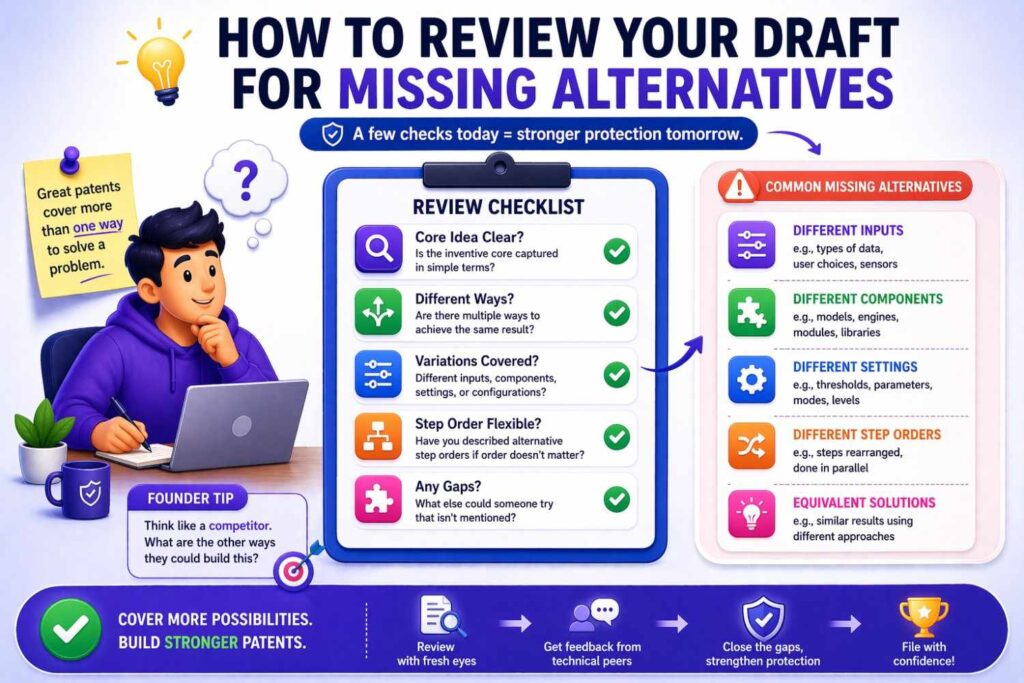
Once the draft is done, review it with fresh eyes.
Look at every major component and ask whether the spec wrongly implies that this exact component is required.
Look at every major step and ask whether the order is presented as fixed when it may not be.
Look at every data input and ask whether the invention could work with other sources.
Look at every threshold, score, or model and ask whether the logic could be expressed in a different form.
Look at every system diagram and ask whether another architecture could still carry out the invention.
Look at every paragraph that uses strong words like essential or required and make sure that is truly accurate.
Then ask one final question: if a smart competitor wanted to copy the real idea while changing surface details, would this spec help me argue that those surface changes are still within the invention’s disclosed range?
That is a very good test.
Why this is not just a legal drafting issue
It is easy to think of all this as just patent writing technique. It is more than that.
Describing variations and alternatives well is really about understanding your invention deeply.
It forces you to separate the core idea from the current implementation.
It forces you to see what is essential and what is incidental.
It forces you to think about the invention as a platform of possibilities, not just a single shipped object.
That is useful even outside patent work. It sharpens product thinking. It sharpens technical storytelling. It sharpens strategy.
Founders who do this well often understand their own moat more clearly.
A lot of founders think this part of patent writing belongs only to lawyers. On the surface, that makes sense. The patent spec is a legal document. It has filing rules. It has formal language. It has to support claims.
But the real work here is bigger than legal drafting.
When you describe variations and alternatives well, you are not just helping a patent read better. You are helping the business protect the real shape of its advantage.
That is a strategy issue.
That is a product issue.
That is a market defense issue.
That is often a fundraising issue too.
The reason is simple. A business rarely wins because of one frozen version of a product. It wins because of a core technical edge that can survive change. Markets shift. customers ask for new things. systems get rebuilt. models improve. suppliers change. teams find faster ways to do the same job. If the patent only follows one snapshot, but the business moves far beyond that snapshot, the protection may no longer match the company’s path.
That is why this work matters at the company level, not just at the drafting level.
It helps you define what the business really owns
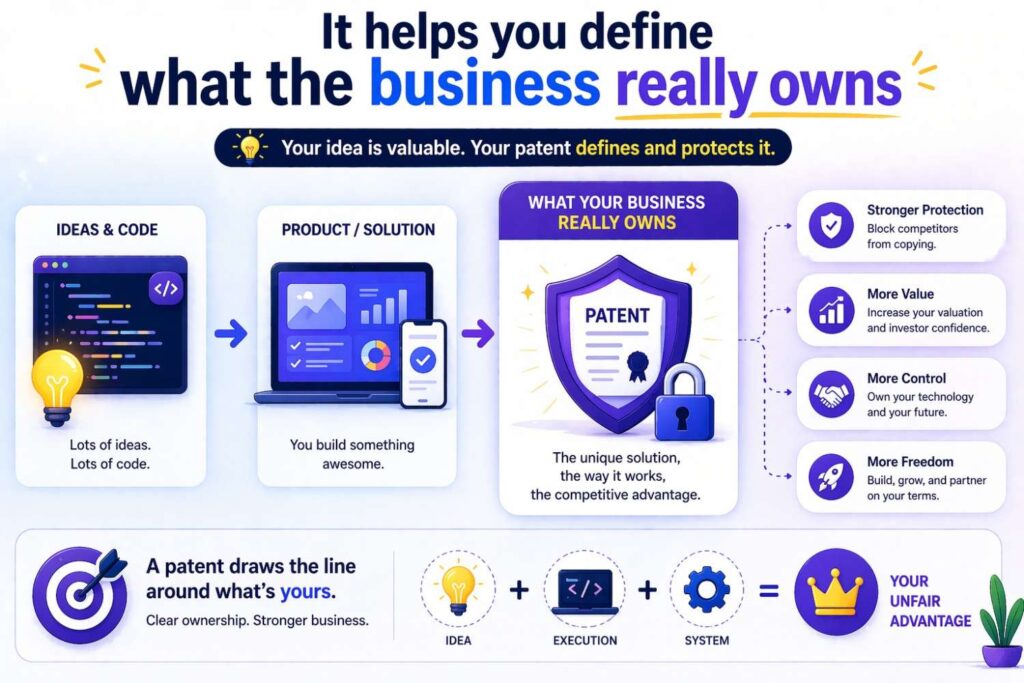
Every startup says it has something special. But not every startup can clearly say what that special thing is once surface details change.
That is where this exercise becomes valuable.
When you force yourself to describe variations and alternatives, you are really asking a deeper question: what is the business trying to own?
Not the screen layout.
Not the current stack.
Not the current vendor.
Not the exact model you are using this quarter.
What is the repeatable technical advantage that still matters even when implementation details move around?
That is the part worth protecting.
This is very useful for leadership teams because it helps separate the core from the temporary. Many product decisions are temporary. They are based on speed, budget, staffing, customer timing, or technical debt. Those things matter, but they should not be confused with the invention itself.
A smart business uses the patent process to identify the technical center of gravity. Once that center is clear, the company can build around it with more confidence.
A very practical move here is to ask your team one question during invention capture: if we had to rebuild this product from scratch next year, what would we absolutely keep because it gives us the edge? The answers are often more valuable than the current architecture diagram.
It strengthens product strategy, not just patent coverage
Describing alternatives is also a product strategy exercise because it forces the team to see the invention as a system of options rather than a single shipped configuration.
That mindset is powerful.
It helps product leaders understand which parts of the offering are flexible and which parts create the moat. It helps engineering teams see where they can move fast without weakening the core. It helps founders decide what future versions still belong inside the company’s long-term IP story.
In practice, this can shape roadmap decisions.
For example, suppose your team has built a workflow that uses a server-side ranking engine. During the patent process, you realize the real invention is not where the ranking runs, but the way behavior signals and confidence logic are combined. That insight means future on-device or edge-based versions may still sit inside the same patent strategy. Suddenly the roadmap has more room.
That is not a small drafting benefit. That is a business planning benefit.
One useful habit is to review patent disclosures alongside roadmap planning at least once each quarter. Ask whether the roadmap is drifting into new variants that should already be reflected in your disclosures. If not, you may need to file again or expand future filings with more intention.
It makes design-arounds easier to spot before competitors spot them

Most companies think about competitors after a patent is filed. That is late.
A better move is to use the process of describing alternatives to ask how someone else would try to imitate the invention while avoiding the exact version you built.
That exercise is incredibly valuable for business strategy.
It reveals weak spots in your protection early. It also reveals how visible your true moat is.
Imagine a competitor looking at your product and asking, “Can we swap the model? Can we move the logic? Can we change the order? Can we use a different signal source? Can we wrap the same idea in a different product flow?” If your team has already thought through those moves, you are in a stronger position.
This is not just about legal claims. It can also shape commercial positioning. Sometimes a design-around risk reveals that the market sees only your surface features, not your deeper technical edge. That may suggest a need for clearer messaging, better internal documentation, or a more complete IP plan.
A highly practical exercise is to run a short “copycat workshop” with product, engineering, and leadership in the room. Spend thirty minutes asking: if a well-funded competitor wanted to mimic our result in six months without copying our exact implementation, what would they change first? Write down every answer. Those answers are often perfect raw material for stronger alternative descriptions in the patent spec.
It improves diligence readiness for investors and buyers
Investors and acquirers do not just want to hear that you filed patents. They want to understand whether the patents actually map to the company’s value.
That is why this section matters in a business sense.
A patent that only tracks one narrow product version can look less impressive during diligence if the company has already evolved beyond it. On the other hand, a filing that clearly supports multiple implementations, deployment paths, and technical forms may look much more aligned with the company’s real asset base.
This matters because diligence is often about confidence. Buyers and investors want confidence that the company understands what it has built and has protected the durable part of it.
A thoughtful discussion of alternatives signals maturity. It shows that the team did not just document a demo. It shows they understood the broader technical design space around the invention.
A simple but very smart step is to keep a short internal memo for each major filing that explains three things: the core inventive concept, the known implementation variants, and how those variants tie to the product roadmap. This memo is not a patent filing itself. It is a business asset. It helps leadership speak clearly during diligence and makes later filing decisions faster.
It creates better alignment between founders, engineers, and counsel
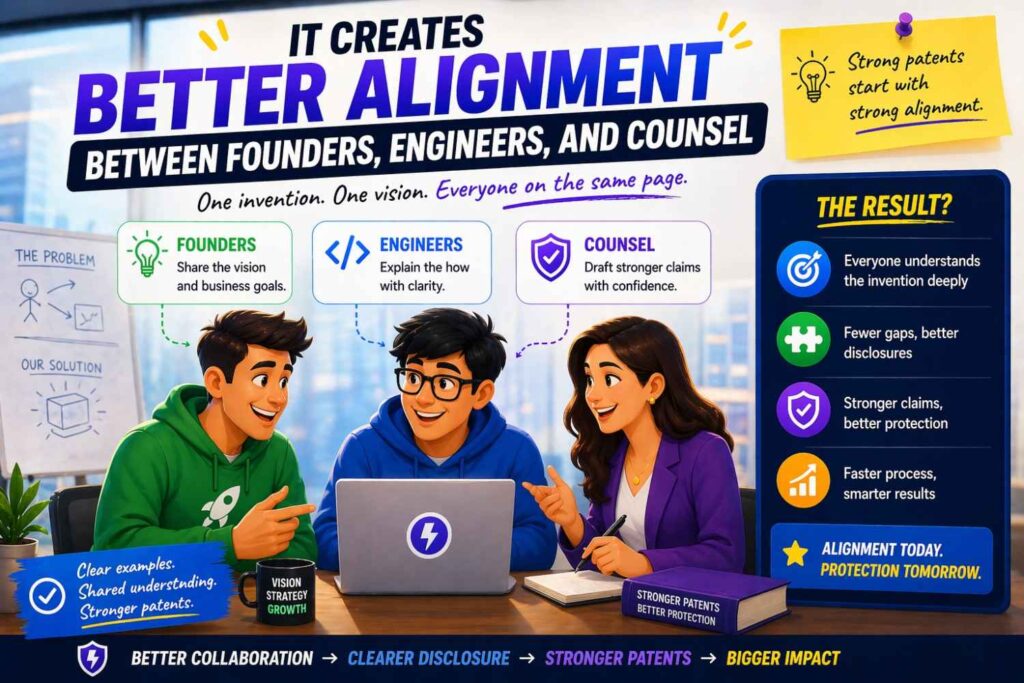
One hidden business benefit of this work is alignment.
Many patent problems are really communication problems. Founders describe the market need. Engineers describe the current build. Patent counsel tries to translate both into legal structure. Important details get lost in the gaps between those viewpoints.
Talking seriously about variations and alternatives helps close those gaps.
It gives everyone a shared language for what is essential and what is optional. It helps legal teams understand where the company may go next. It helps engineers explain design choices more clearly. It helps founders avoid anchoring the whole filing to a product story that may change in six months.
This kind of alignment saves time and money. It reduces redrafting later. It reduces the risk of under-disclosure. It also leads to stronger decision-making across the board.
A very useful operating move is to assign one person on the product or engineering side to act as the “invention owner” for each filing cycle. That person should not merely describe the current system. They should also gather likely variants from the team and flag what may change over the next year. That makes the patent process much more strategic.
It helps you decide where to file next
Once you get good at identifying meaningful alternatives, you also get better at spotting when one filing is not enough.
That is important.
Some alternatives belong inside the same spec because they are clearly part of the same invention family. But other alternatives may reveal a second invention, a narrower improvement, or a future continuation opportunity.
This is where real business value can be created.
For example, while discussing alternatives for a machine-learning workflow, your team may realize that one fallback path is not just an optional variation. It is a separate and valuable control system in its own right. Or while describing different sensor placements, you may discover that one arrangement solves a very different problem and deserves its own filing track.
That kind of insight is strategic. It helps build a stronger portfolio instead of a single isolated patent.
A practical way to handle this is to mark alternatives in three buckets during review: core variants that belong in the same spec, narrower versions that may support dependent claims, and separate concepts that may deserve their own future filing. This keeps the drafting clean while helping the business grow its IP portfolio with purpose.
It protects the business from its own speed
Fast-moving companies often become victims of their own momentum.
The team ships quickly. The product changes. The infrastructure gets upgraded. A temporary workaround becomes a core feature. A pilot use case becomes the main revenue stream. And suddenly the original patent story no longer reflects the business very well.
This is common in startups because survival requires speed. But speed can also create IP gaps if the company is not careful.
Describing alternatives and variations well helps protect against that. It allows the patent to stay closer to the business even as implementation details move. It gives the company more breathing room between product change and legal coverage.
This is especially important in fields like software, AI, robotics, fintech, and digital health, where system design can evolve very fast.
One concrete practice that helps is to treat major product architecture changes as an IP review trigger. If your team changes where core logic runs, changes the main input source, changes a scoring engine, changes the decision sequence, or changes the control loop, that should prompt a quick review of whether the current filings still tell the right story.
It gives leadership a clearer moat narrative
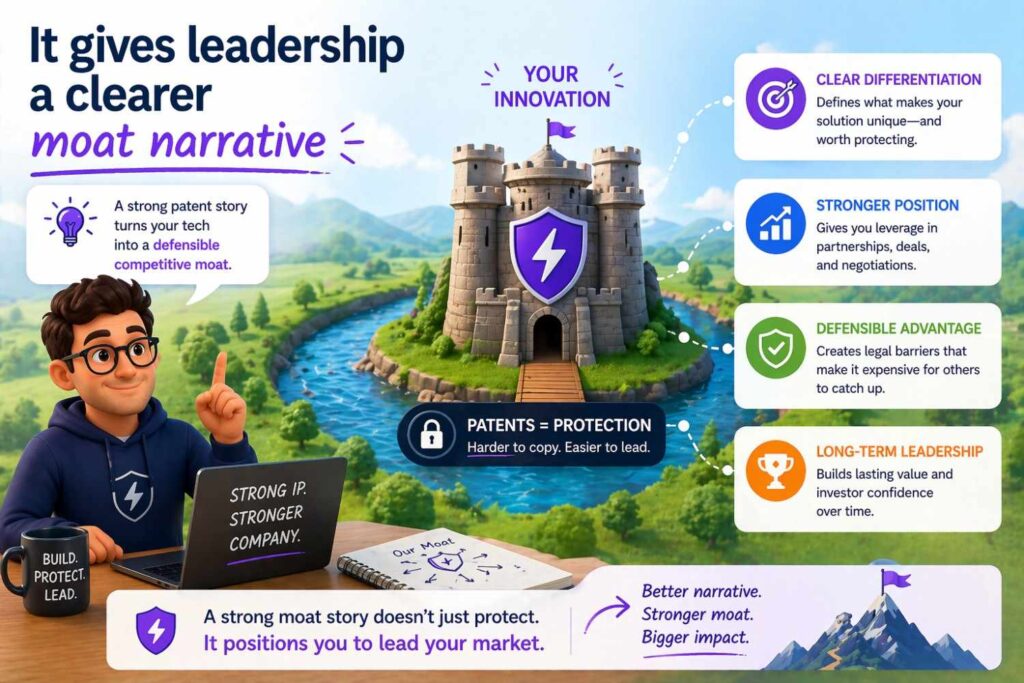
A good patent story is also a good moat story.
Not in a vague branding sense. In a very concrete strategic sense.
When leadership understands the variations and alternatives around an invention, they can speak more clearly about what makes the company hard to copy. They can explain why the advantage is not tied to one user interface or one release version. They can show that the company owns a deeper technical pattern.
That helps in investor meetings, partnerships, board discussions, recruiting, and even internal planning. Strong companies know how to describe the technical principle that gives them leverage.
The patent process can sharpen that if it is handled well.
A useful leadership exercise is to write a one-paragraph moat summary after each major invention disclosure. It should answer this: what is the technical advantage we are protecting, and what are the main ways it can appear in products over time? That short exercise often reveals whether the patent strategy and the business strategy are actually aligned.
It helps businesses choose smarter trade secret boundaries
There is another strategic angle here that gets overlooked.
When you study alternatives carefully, you often get a better sense of what should be patented and what should remain internal know-how.
Some implementation details are worth disclosing because they help create broader protection around the invention. Other details may be too operational, too changeable, or too sensitive to put in the patent if they are not needed for strong support.
The act of mapping the variation space can help make those calls more intelligently.
For instance, if the company’s real advantage lies in a broad technical workflow, that may belong in the patent. But a specific tuning process, dataset refinement technique, pricing rule, or deployment playbook may be better preserved as internal know-how if it is not necessary to support the claims.
This is not about hiding the invention. It is about being deliberate.
A practical step here is to ask, for each major variation the team identifies: does this strengthen the patent if disclosed, or is it better treated as internal operating knowledge? That question can improve both patent quality and information discipline across the business.
Action steps businesses can use right away
The biggest mistake is treating this as abstract theory. It should become part of how the company captures invention value.
A useful first step is to add one short section to every invention intake process called “likely variants over the next 12 months.” Keep it simple. Ask what may change, what may be swapped, and what can move without changing the core result.
A second strong move is to hold invention reviews with more than just legal input. Product and engineering should be in the room. This is where many of the best alternatives surface.
A third step is to review your patent filings against the roadmap twice a year. Not every week. Not every month. But enough to catch drift before it becomes expensive.
A fourth move is to document competitor design-around guesses before filing, not after. Those guesses often lead to the strongest alternative language.
A fifth step is to treat patent drafting as part of strategic asset building, not just compliance. That mindset changes the quality of what gets captured.
The bigger takeaway

Describing variations and alternatives well is not merely about satisfying patent formality.
It is about helping a business protect the full commercial life of its technical advantage.
It is about making sure the company owns the idea beneath the current build, not just the version that happened to exist on filing day.
That is why this work matters so much.
And that is why the best businesses do not leave it as a last-minute legal detail. They treat it as part of understanding, protecting, and extending the moat they are working so hard to build.
A strong spec feels both clear and roomy

That is the balance you want.
A reader should come away thinking two things at once.
First, they should think, “I understand this invention. I can see how it works.”
Second, they should think, “I can also see that this invention is not limited to one brittle setup.”
That combination is powerful.
It is why the best patent specs feel both precise and expansive. They do not wander, but they also do not corner themselves.
Variations and alternatives are a huge part of creating that effect.
Final thoughts
If you want a patent that holds up better over time, do not just describe the one thing you built. Describe the invention in a way that reflects its true range.
Show the main embodiment clearly. Then show what can change without changing the core. Explain substitute components, alternate sequences, different data sources, model options, deployment choices, structural changes, optional features, and context shifts where they matter. Keep those alternatives tied to the actual inventive idea. Do not use them as filler. Use them as support.
That is how a patent spec becomes stronger.
It becomes more useful for examination. More useful for future claims. More useful for your own roadmap. More useful against design-arounds. More useful as a business asset.
Most of all, it becomes more honest about what the invention really is.
If your startup is building something new and you want help capturing the core invention plus the right range around it, PowerPatent can help you do that without the old slow, painful process. It is built for modern founders and engineers, and every filing includes real attorney oversight. Learn more here: https://powerpatent.com/how-it-works
The best time to capture variations and alternatives is while the technical thinking is still fresh, while the tradeoffs are still visible, and while the team still remembers what almost got built. That knowledge fades faster than most people expect. A strong patent process pulls it out early and turns it into protection. PowerPatent helps teams do exactly that. See how it works here: https://powerpatent.com/how-it-works