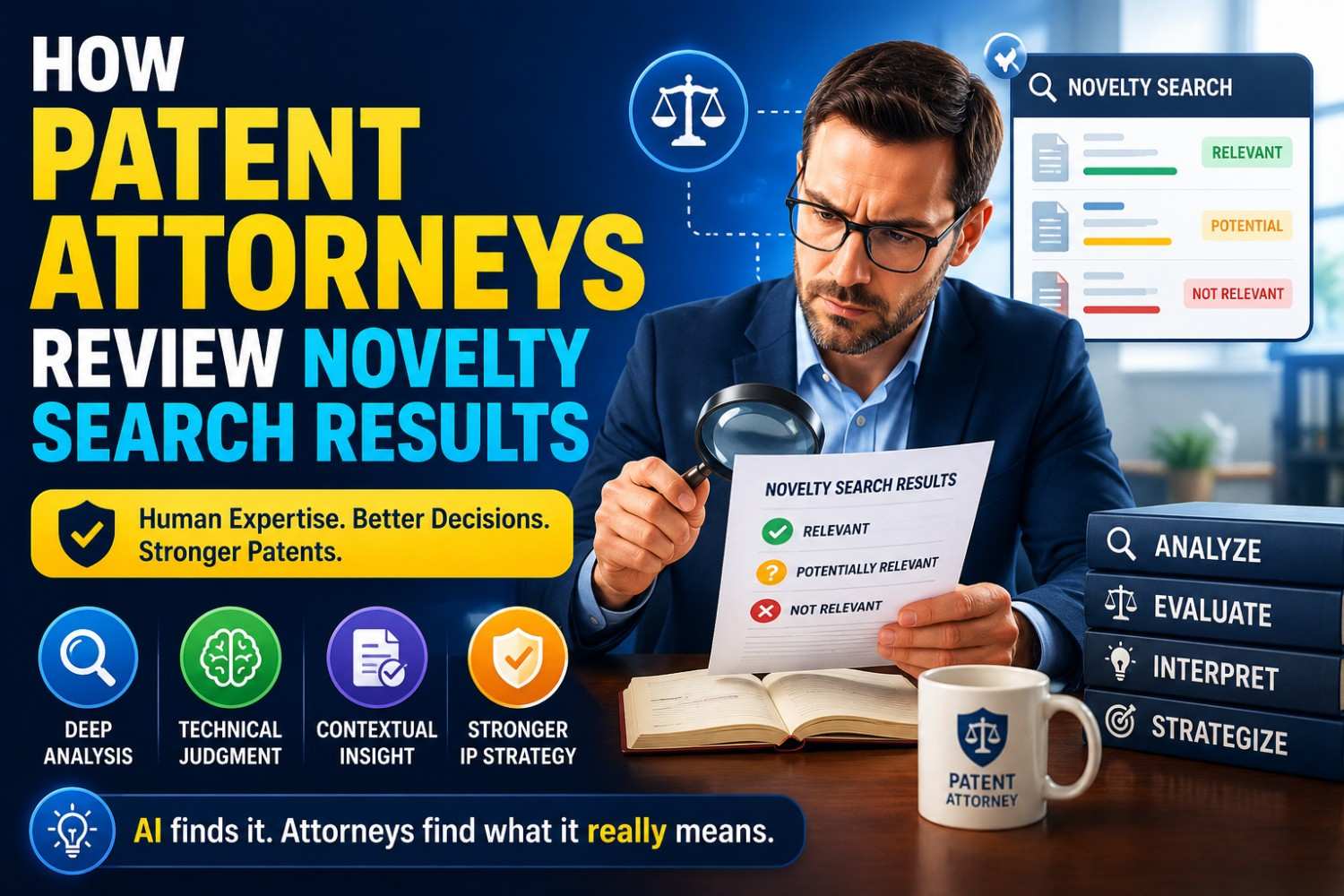
A novelty search gives you a stack of references.
A patent attorney turns that stack into a filing decision.
That decision may be to file, narrow, pivot, search more, keep something secret, or walk away. For a startup, this is where patent work becomes strategy.
PowerPatent helps founders, engineers, scientists, and inventors turn invention notes and novelty search results into stronger patent filings with smart software and real patent attorney oversight. See how PowerPatent works here.
Why Attorney Review Matters After a Novelty Search
A novelty search can feel simple from the outside.
You search. You find similar things. You decide if your idea is new.
But in real patent work, it is rarely that clean.
A search result may look scary because the title sounds close, but the details may be different. Another result may look harmless because the title is broad, but one figure or example may show the exact feature your team wants to claim.
This is why patent attorney review matters.
A patent attorney does not just skim search results. They compare each reference to the invention. They look at what is shown, what is missing, what can be claimed, what may need to be avoided, and whether the remaining patent space is worth the cost.
For founders, this review can save money and protect better ideas.
It can stop a weak filing before it starts.
It can also uncover a stronger invention hiding inside the product.
A search result is not the end of the process. It is the start of a more careful decision.
Attorneys First Ask: What Is the Real Invention?
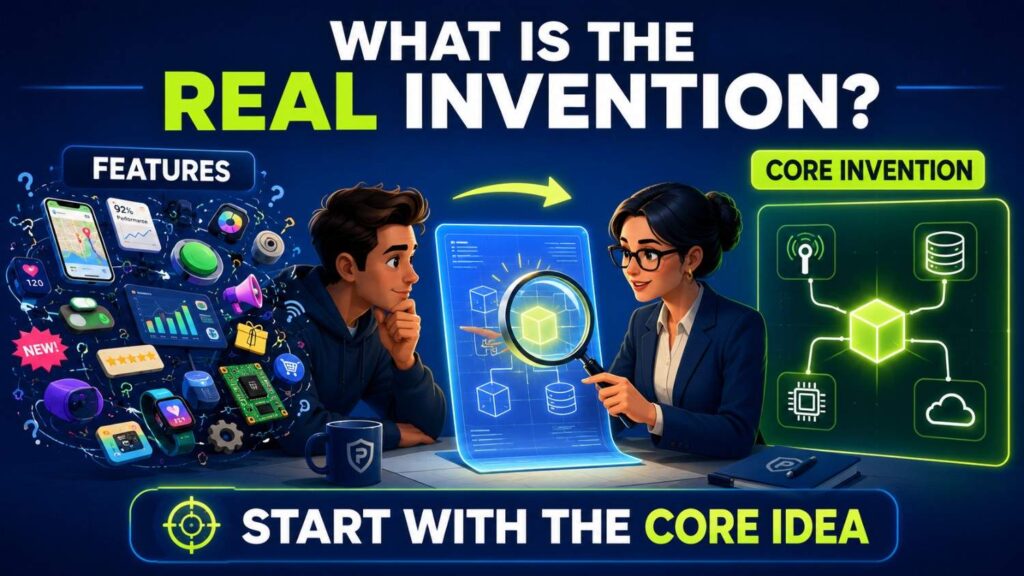
Before a patent attorney can review novelty search results, they need to understand the invention.
This sounds obvious, but it is where many patent filings begin to go wrong.
A founder may describe the business:
“We built an AI compliance tool.”
“We created a better battery safety system.”
“We made a robot that avoids crashes.”
“We developed a new cancer test.”
“We built a SaaS workflow platform.”
Those descriptions are useful for sales, but they are too broad for patent review.
The attorney needs the technical invention.
For example:
“Our AI compliance system checks generated workflow actions against customer policy, user permission, and source-data support before allowing execution.”
That is much more useful.
Or:
“Our battery system compares pressure drift during matched charging windows and adjusts a swelling score based on charge rate and temperature.”
That gives the attorney something specific.
Or:
“Our robot predicts blind-corner crossing risk before visual detection using sound direction, map geometry, and recent traffic history.”
Now the search results can be reviewed properly.
Attorney review starts by moving from product language to invention language.
The product may be broad. The invention is the technical method, structure, workflow, or control step that creates value.
PowerPatent helps teams capture this difference early, so attorney review starts with the real invention and not a vague product summary. See how PowerPatent helps founders file better patents faster.
Attorneys Separate the Product From the Claim
Founders think in terms of products.
Patent attorneys think in terms of claims.
A product can have many features. A claim is the legal boundary around one invention.
Your product may include a dashboard, AI assistant, data sync engine, user roles, alerts, reports, APIs, cloud processing, customer settings, and analytics.
But the claim may focus on one key technical part.
For example, the claim may not be about the dashboard. It may be about how alerts are grouped by shared root cause before display.
The claim may not be about the AI assistant. It may be about how the system checks source support before letting an AI-generated action run.
The claim may not be about the wearable device as a whole. It may be about how the wearable adjusts alert confidence based on skin-contact pressure and motion state.
The claim may not be about the diagnostic product as a whole. It may be about an inflammation-normalized marker ratio for a specific patient group.
This separation matters because novelty is reviewed against the claim, not against the whole company story.
A patent attorney will often ask:
What are we trying to protect?
Is it a system?
A method?
A device structure?
A workflow?
A scoring method?
A sensor placement?
A formulation?
A marker combination?
A feedback loop?
A control rule?
Once that claim focus is clear, the attorney can review the search results in a useful way.
Attorneys Break the Invention Into Elements
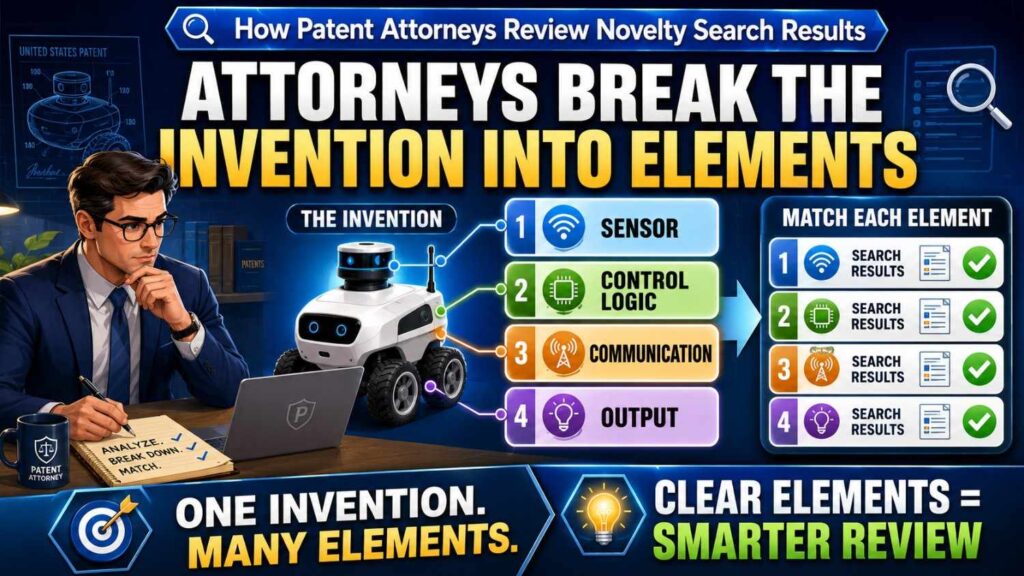
After the claim focus is clear, the attorney breaks the invention into elements.
An element is one required part of the invention.
This is one of the most important steps in novelty review.
Without elements, the team ends up saying things like:
“This looks close.”
“That seems different.”
“This is kind of similar.”
Those comments do not help much.
With elements, the review becomes concrete.
For a SaaS invention, the elements may be:
The system receives a workflow event.
The system generates a proposed AI action.
The system checks user permission.
The system checks customer policy.
The system checks source-data support.
The system allows, blocks, or routes the action.
The system records the decision in an audit log.
For a robotics invention, the elements may be:
The robot stores map data showing blind corners.
The robot receives sound direction data.
The robot uses recent traffic history.
The robot predicts crossing risk before visual detection.
The robot changes speed before reaching the crossing point.
For a biotech diagnostic, the elements may be:
The method uses a low-volume plasma sample.
The method measures Marker A and Marker B.
The method calculates a marker ratio.
The method normalizes the ratio based on inflammation.
The method produces an early-stage disease risk result.
This breakdown creates a clean comparison.
Now the attorney can ask whether each prior art reference shows each element.
Attorneys Compare One Reference at a Time
A patent attorney usually starts by comparing one reference at a time.
This is important because founders often mix references too early.
They find one patent with a sensor, one paper with a score, one product page with an alert, and one technical blog with a feedback loop. Then they assume everything is already known.
That may raise a concern, but it does not answer the first novelty question.
The first question is usually:
Does one prior art reference show every required element of the claim?
If yes, the claim may not be new.
If no, the claim may still be novel, though there may still be other risks.
This one-reference review keeps the process clean.
For example, suppose your invention validates AI-generated workflow actions before execution.
Reference A shows AI-generated task suggestions and permission checks.
Reference B shows policy-based workflow approval.
Reference C shows audit logging.
Reference D shows source-data support checking.
No single reference shows the whole workflow.
That may mean the invention still has novelty. But the attorney will then ask a second question: would it have been obvious to combine those teachings?
That second question matters, but it comes after the one-reference novelty review.
This step prevents both panic and false confidence.
Attorneys Read the Whole Reference, Not Just the Title
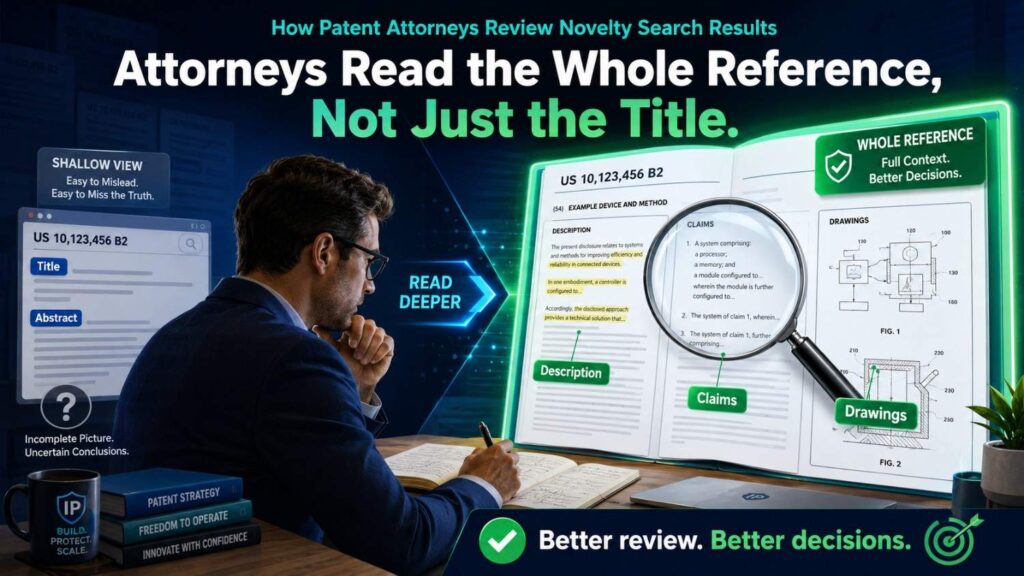
Patent titles can be misleading.
A patent titled “System and Method for Data Processing” may contain a very specific cloud workflow.
A patent titled “Medical Device” may disclose the sensor placement your device uses.
A paper titled “Machine Learning for Review” may include a detailed method for routing uncertain outputs.
A product manual may show a feature that never appears on a marketing page.
Patent attorneys know this.
They look past the title and abstract.
For patents, they often review the claims, drawings, flowcharts, examples, and detailed description.
For papers, they look at the method section, figures, tables, examples, and supplementary material.
For software products, they may look at API docs, admin guides, help center pages, release notes, and data schemas.
For hardware, they study drawings, part numbers, sensor placements, material layers, force paths, and control loops.
For biotech and MedTech, they may review assay conditions, sample types, dose ranges, patient groups, clinical workflows, and protocols.
The question is not, “Does this reference sound close?”
The question is:
What does this reference actually teach?
That difference matters.
A scary title may become less scary after careful reading.
A dull title may turn into the closest prior art.
Attorneys Mark Yes, No, Partial, and Unclear
A good novelty review is not only yes or no.
Each element may be shown, missing, partly shown, or unclear.
That level of detail matters because many references are close but not complete.
For example, imagine your invention sends AI answers to review when source trust is low, even if model confidence is high.
A prior art reference may send low-confidence model outputs to review.
That is not a full match.
It shows review.
It shows confidence.
But it does not show source trust overriding high model confidence.
An attorney may mark that as partial.
Another example:
Your invention compares battery pressure drift during matched charging windows.
A prior art reference may measure pressure during charging.
That is also partial.
It shows pressure measurement, but not matched windows or drift comparison in the claimed way.
This matters because a partial match may still leave room for a claim.
It also helps the attorney decide whether the claim should be narrowed around the missing part.
A founder may see the word “pressure” and think the invention is blocked.
An attorney asks how pressure is used.
That is where the real analysis happens.
Attorneys Look for the Closest Prior Art
Not every search result matters equally.
Patent attorneys look for the closest prior art.
The closest prior art is the reference that shares the most important elements with the invention.
It may not be from a direct competitor.
It may not be the newest result.
It may not be in the same market.
It may not use the same words.
It is the reference that creates the hardest patentability question.
For a SaaS invention, the closest art may be an old enterprise workflow patent, not a modern cloud product.
For an AI invention, the closest art may be a research paper, not a patent.
For a hardware invention, the closest art may be a product manual or old mechanical patent.
For a robotics invention, the closest art may come from industrial automation.
For a biotech invention, the closest art may be a paper, clinical trial record, or patent family from a related disease area.
Once the attorney identifies the closest reference, they use it to test the claim.
If the claim is too broad, the closest reference will expose that.
If the claim still has a meaningful gap, the closest reference helps define the filing angle.
Attorneys Ask Whether the Gap Matters
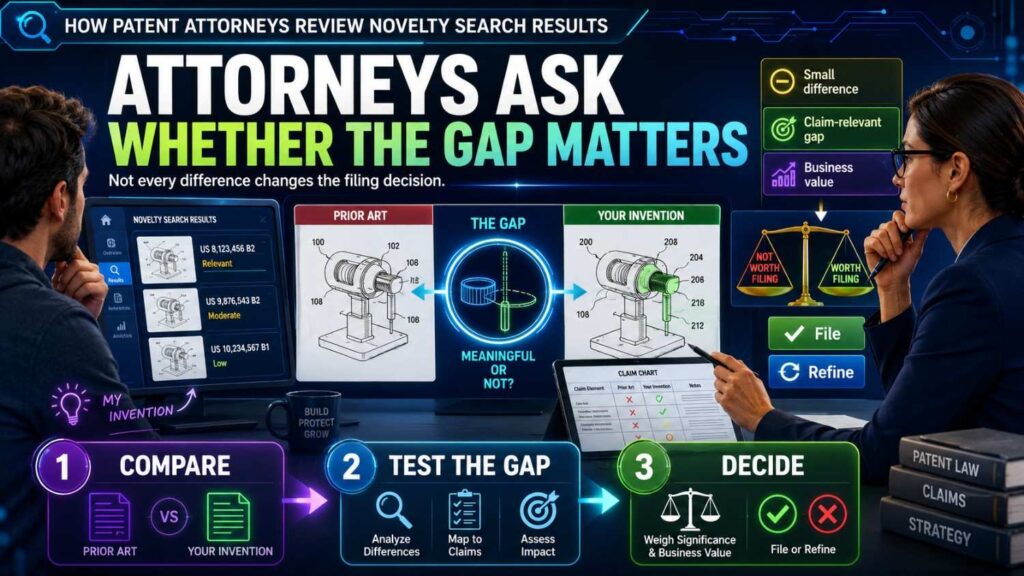
A missing element is not automatically enough.
The attorney will ask whether the gap matters.
A missing button color does not usually matter.
A missing notification channel may not matter.
A missing file format may not matter unless it changes how the system works.
But a missing control rule, signal processing step, source-validation step, timing window, marker normalization, sensor placement, dosing schedule, or feedback loop may matter a lot.
The attorney asks:
Does this missing part create a technical result?
Does it solve the problem?
Does it drive customer value?
Would a competitor need it?
Does it make the system safer, faster, cheaper, more accurate, more reliable, or more scalable?
For example, if the prior art shows AI review but not source-trust conflict review, that gap may matter because it catches high-confidence unsupported outputs.
If the prior art shows pressure sensing but not matched-window drift comparison, that gap may matter because it reduces false swelling alerts during fast charging.
If the prior art shows wearable alerts but not alert confidence based on contact pressure and motion state, that gap may matter because it reduces false alerts during movement.
A strong gap is not just different.
It is useful.
Attorneys Check Whether the Claim Is Too Broad
Founders often want the broadest possible claim.
That is natural.
But broad claims run into more prior art.
A patent attorney reviewing search results will ask whether the current claim is too broad.
For example:
“A system that uses AI to automate compliance” is likely too broad.
“A system that validates AI-generated workflow actions against permission scope, customer policy, and source-data support before execution” is more specific.
“A wearable that monitors heart data” is broad.
“A wearable that adjusts arrhythmia alert confidence based on skin-contact pressure and motion state” is more focused.
“A robot that avoids collisions” is broad.
“A robot that predicts blind-corner crossing risk before visual detection using sound direction, map geometry, and recent traffic history” is more specific.
The attorney may recommend dropping the broad claim angle and focusing on the technical step that appears different.
This is not a loss.
It is how strong claims are built.
Attorneys Check Whether the Claim Is Too Narrow
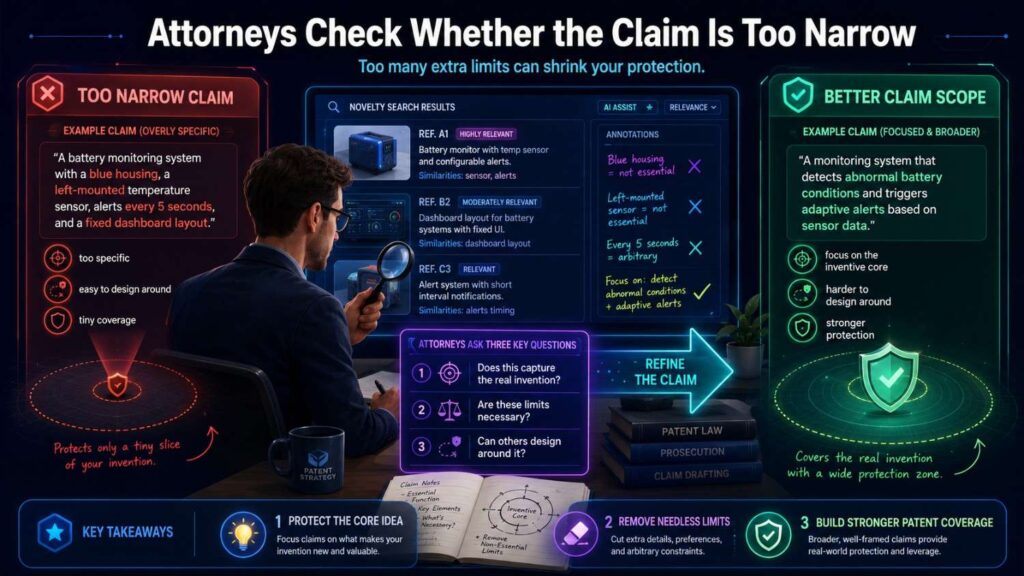
The opposite problem also matters.
A claim can be so narrow that competitors can avoid it easily.
A patent attorney will look for details that should not be required in the main claim.
For example:
If the claim requires sending an email, competitors may use Slack or in-app alerts.
If the claim requires one exact threshold number, competitors may use a nearby number.
If the claim requires one exact model type, competitors may use another model.
If the claim requires one sensor brand, competitors may swap it.
If the claim requires one specific dashboard layout, competitors may redesign the screen.
The attorney asks:
Is this detail essential?
Does it create the technical result?
Is it needed to avoid prior art?
Can it be described more generally?
Should it be a backup claim instead?
The goal is balance.
The claim must be narrow enough to avoid prior art but broad enough to protect the business.
That balance is one of the main reasons attorney review matters.
Attorneys Think About Obviousness
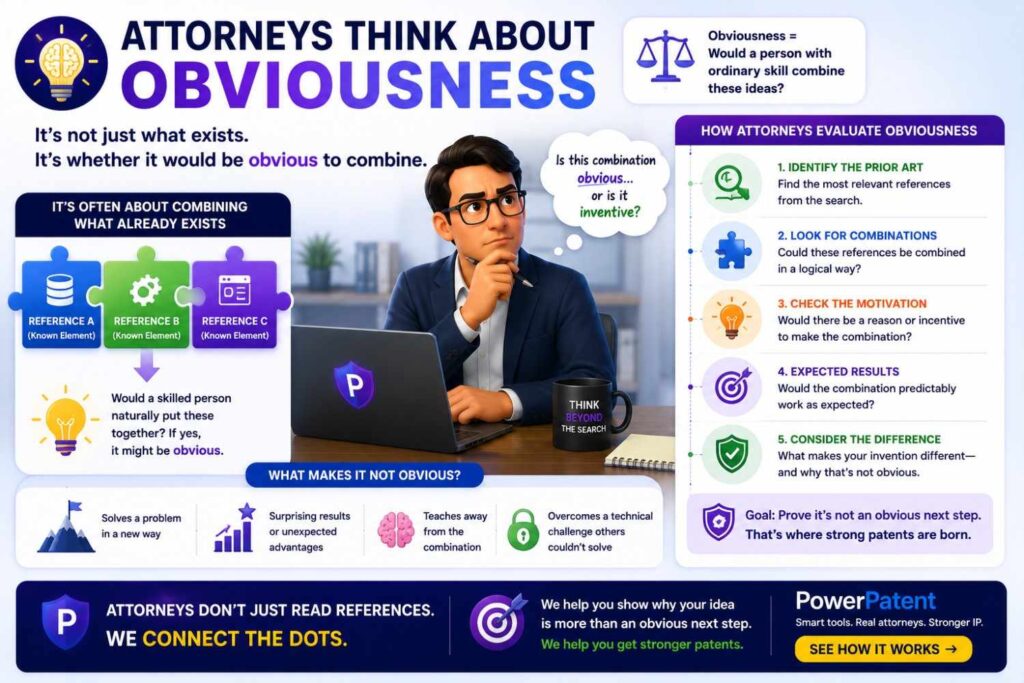
Novelty is only one part of patentability.
Even if no single reference shows every element, the attorney will ask whether the invention may be considered an obvious combination of known ideas.
For example, one reference shows model confidence. Another shows source reliability. Another shows human review.
Your invention combines these ideas into a source-trust conflict review workflow.
The attorney will ask:
Would someone in the field have had a reason to combine these references?
Do the references solve the same problem?
Would the combination work in a predictable way?
Does one reference suggest adding the missing feature?
Does any reference point away from your approach?
Does the invention solve a problem the old systems did not solve?
Does it produce a surprising result?
This is often where the real patent strategy forms.
A claim may be novel but still risky if the combination looks easy.
A claim may be stronger if the prior art did not recognize the problem or taught away from the solution.
Attorneys Look for Teaching Away
Sometimes prior art helps your case because it points away from your invention.
For example, old battery references may say pressure signals during fast charging are unreliable.
Your invention may make those signals useful by comparing pressure drift during matched charging windows.
Old AI review systems may trust model confidence.
Your invention may show that high-confidence outputs can still be unsafe when source trust is low.
Old robot systems may slow at every blind corner.
Your invention may predict actual hidden crossing risk, allowing safer and more efficient movement.
Old diagnostic methods may avoid low-volume samples because the signal is weak.
Your invention may normalize the marker signal so low-volume samples become useful.
This kind of point can matter.
It helps explain why the invention was not just a simple next step.
Patent attorneys look for these storylines because they can support a stronger filing and later response if the patent office raises a rejection.
Attorneys Ask About Technical Results
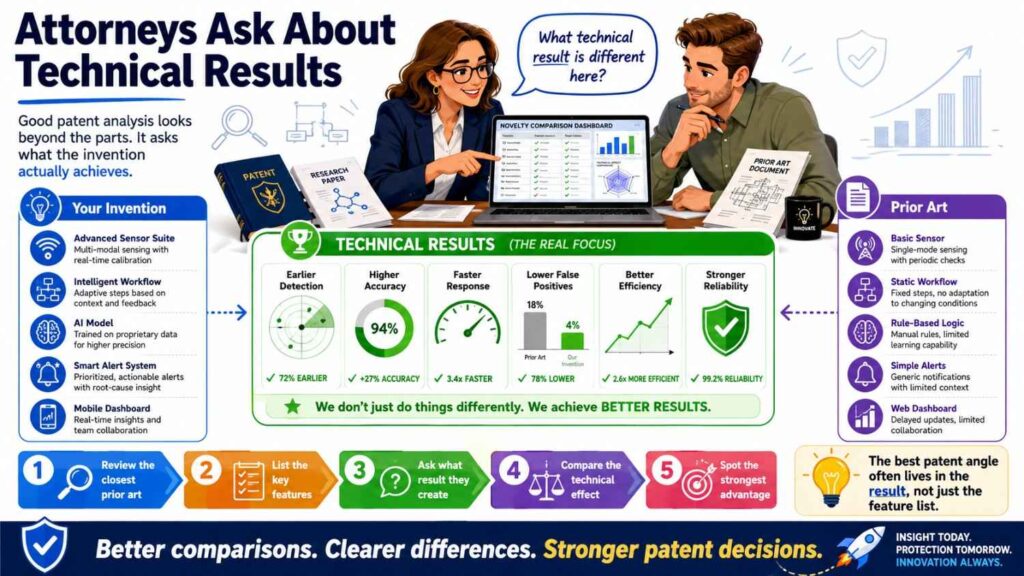
A patent attorney will often ask what improved.
This is not just for marketing.
It helps explain why the invention matters.
For software, did the invention reduce errors, latency, cloud cost, review time, unsafe actions, data leakage, or duplicate alerts?
For AI, did it catch hallucinations, improve grounding, reduce compute, improve routing, or reduce bad outputs?
For hardware, did it improve signal quality, reduce false alarms, reduce heat, improve durability, or make assembly easier?
For robotics, did it improve safety, reduce unnecessary stops, avoid collisions earlier, or improve fleet movement?
For biotech, did it improve accuracy, stability, delivery, response, or safety?
For MedTech, did it reduce false alerts, improve clinician workflow, improve placement, reduce procedure time, or improve patient safety?
A claim tied to a technical result is easier to understand and often easier to defend.
The attorney may ask for test data, examples, engineering notes, benchmarks, or lab results to support that story.
Attorneys Look at the Quality of the Search
Patent attorneys also evaluate the search itself.
They may ask whether the search was deep enough.
Did it search only patents?
Did it search papers?
Did it search non-patent sources?
Did it use synonyms?
Did it search old terms?
Did it search related fields?
Did it search competitors, inventors, and assignees?
Did it follow citations?
Did it review foreign patents?
Did it consider product manuals, API docs, clinical records, standards, GitHub, or technical blogs?
The answer depends on the field.
For AI and software, papers and open-source repositories may be important.
For SaaS, API docs and help centers may matter.
For hardware and robotics, manuals, videos, drawings, and supplier catalogs may matter.
For biotech and MedTech, papers, protocols, clinical trial records, labels, and sequence databases may matter.
If the search was too shallow, the attorney may recommend more searching before filing.
If the search is good enough for the decision, the attorney may proceed.
No search is perfect.
But the attorney wants enough confidence to make a responsible recommendation.
Attorneys May Reframe the Invention
Attorney review often changes how the invention is described.
This is a good thing.
A founder may begin with:
“We have an AI compliance assistant.”
After review, the attorney may reframe it as:
“A source-supported action validation system for enterprise workflows.”
A founder may begin with:
“We have a battery safety sensor.”
After review, the attorney may reframe it as:
“A matched-window pressure drift scoring system for swelling risk.”
A founder may begin with:
“We have a cancer detection test.”
After review, the attorney may reframe it as:
“An inflammation-normalized marker ratio method for early-stage risk scoring in low-volume plasma samples.”
This reframing is not just wordsmithing.
It helps align the patent claim with the technical gap.
It also helps avoid prior art.
Good patent language should be broad enough to cover meaningful variations but specific enough to point to the actual invention.
Attorneys Decide Whether to File, Narrow, Pivot, Search More, or Pause
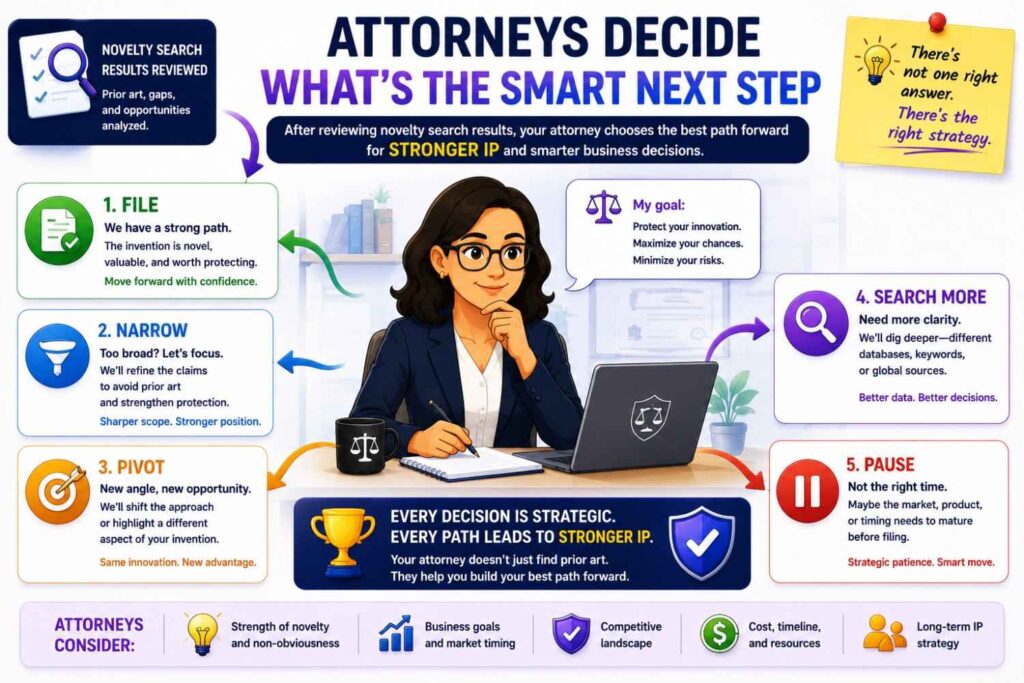
At the end of the review, the attorney should help the team make a decision.
The decision may be to file.
That happens when the invention appears to have a meaningful gap, enough technical support, and business value.
The decision may be to narrow.
That happens when the broad idea is crowded, but a specific version still looks promising.
The decision may be to pivot.
That happens when the first idea is blocked, but another feature in the product looks stronger.
The decision may be to search more.
That happens when the closest art is unclear or the new claim angle needs more checking.
The decision may be to pause or drop.
That happens when the remaining claim is weak, easy to design around, not tied to business value, or not ready.
A strong attorney review does not always end with “file now.”
It ends with a clear recommendation.
That is what founders need.
Attorneys Consider Business Value
Patent attorneys are not only reviewing documents.
They are helping protect business value.
A claim may be technically possible but not worth filing.
The attorney may ask:
Is this feature core to the product?
Would competitors copy it?
Does it support revenue?
Does it support fundraising?
Does it matter to enterprise buyers?
Does it help with partnerships?
Does it support acquisition value?
Does it cover the roadmap?
Can copying be detected?
If the answer is no, the filing may not be worth the budget.
If the answer is yes, even a narrower claim may be valuable.
This business lens is critical for startups.
The goal is not to file patents for show.
The goal is to protect the technical edge that makes the company hard to copy.
PowerPatent is built for this kind of startup patent strategy, combining smart software with real patent attorney oversight so founders can file with more confidence. See how PowerPatent works.
Attorneys Consider Detectability
A patent can be harder to use if you cannot tell whether someone is using the invention.
This matters a lot for backend software, AI models, cloud systems, manufacturing methods, biotech processes, and hidden device logic.
The attorney may ask:
Can we observe the feature from the product?
Would it show in API outputs?
Would it appear in logs, reports, alerts, or behavior?
Would testing reveal it?
Would product docs disclose it?
Would it require discovery in litigation?
A hidden backend formula may still be valuable. But if it is very hard to detect, the team should understand that.
Sometimes the attorney may suggest claiming a visible system behavior instead of a hidden internal detail.
For example, instead of claiming exact scoring weights, the claim may focus on the action triggered by the score.
Instead of claiming a hidden model-tuning step, the claim may focus on the output validation workflow.
Instead of claiming a manufacturing parameter, the team may consider trade secret treatment.
Detectability is not the only factor, but it is part of a smart filing decision.
Attorneys Consider Design-Around Risk
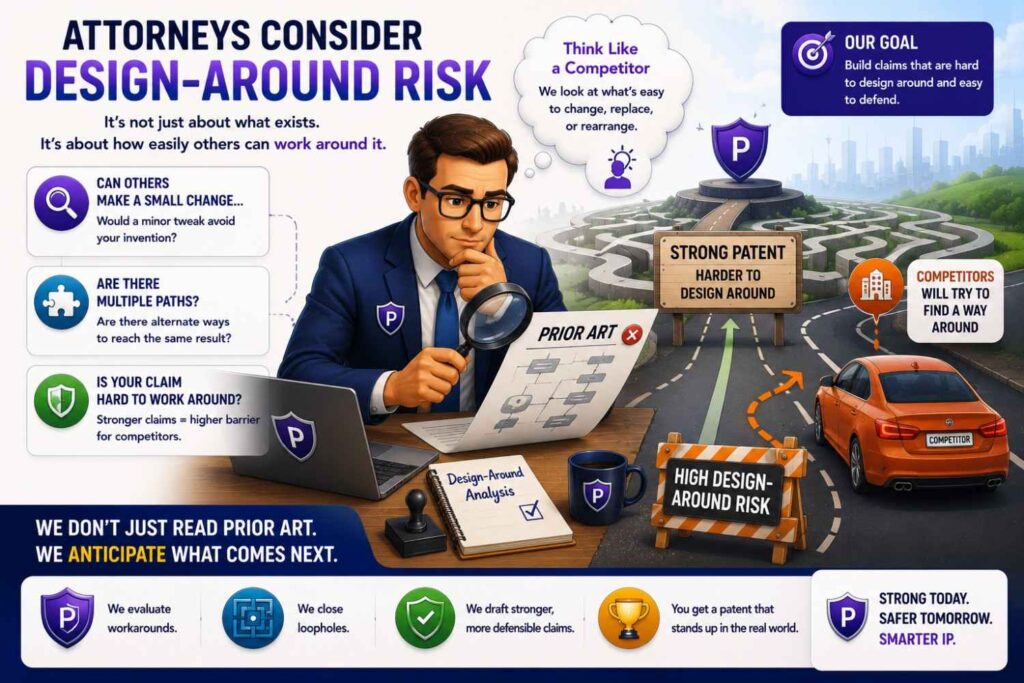
A patent is less useful if competitors can easily avoid it.
Attorney review often includes design-around thinking.
The attorney may ask:
How would a competitor copy the business value without meeting the claim?
Could they change one input?
Could they change one output?
Could they move a step earlier or later?
Could they use a different sensor?
Could they use a different model?
Could they use a different threshold?
Could they replace human review with automated review?
Could they change the data source?
If yes, the claim may need broader wording or more alternative versions.
This is why attorneys ask about variations.
They are not trying to make the invention vague. They are trying to avoid a claim that only covers one exact implementation.
A good patent filing should make obvious workarounds harder.
Attorneys Look for Backup Claim Support
Prior art can appear later during examination.
That is why backup positions matter.
An attorney reviewing novelty search results will think about what happens if the first claim is rejected.
What narrower version still matters?
For SaaS, backups may include specific policy sources, audit logs, review triggers, tenant rules, or data validation steps.
For AI, backups may include source trust inputs, model confidence conflicts, feedback updates, or human review paths.
For hardware, backups may include sensor placements, timing windows, materials, calibration methods, and control actions.
For robotics, backups may include different sensors, map inputs, speed controls, rerouting actions, or fleet messages.
For biotech, backups may include sample types, marker ranges, assay conditions, patient groups, dose ranges, and formulations.
A good application describes these options before filing.
If the application does not support backup claims, options may be limited later.
This is one reason attorney review should happen before filing, not after.
Attorneys Review Public Disclosure Timing
Timing can change everything.
An attorney will ask whether the invention has already been made public or will be made public soon.
Public disclosure may include:
A launch page.
A demo video.
A conference talk.
A GitHub repo.
API docs.
A white paper.
A product manual.
A journal article.
A clinical trial record.
A grant publication.
A pitch deck shared without confidentiality.
A webinar.
A standards submission.
If disclosure is coming soon, the attorney may recommend filing quickly on the best supported angle.
If the invention has already been disclosed, the attorney needs to know exactly when, where, and what was shared.
Founders should be honest here.
Do not hide disclosures because they feel inconvenient.
A good attorney can only guide the right filing plan if they know the full timeline.
Attorneys Consider Patent Versus Trade Secret
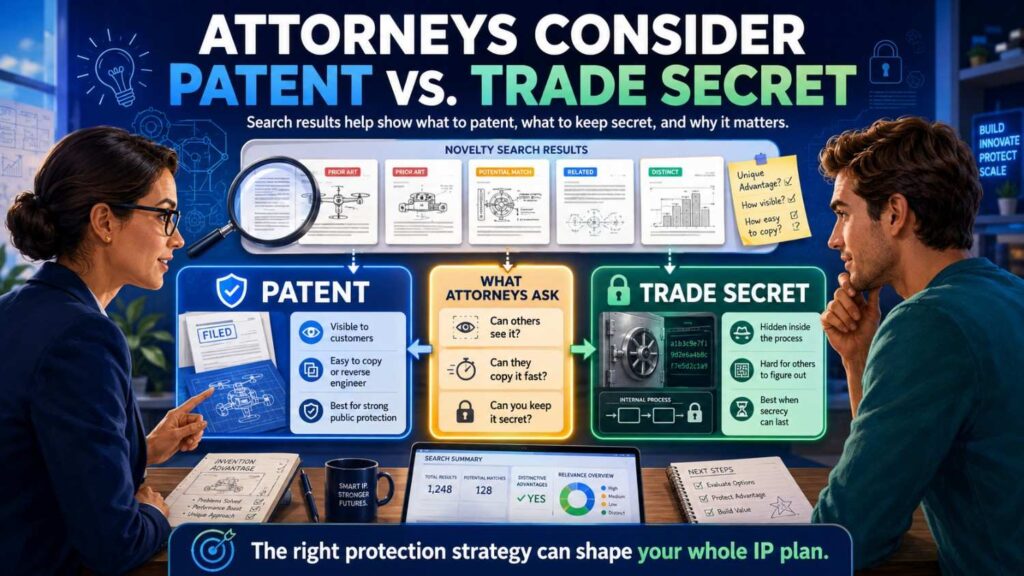
Not every technical advantage should be patented.
Sometimes a search shows that broad claims are blocked, but a hidden method is still valuable.
That may raise a trade secret question.
Examples include:
A backend ranking formula.
A model tuning method.
A manufacturing parameter.
A cell culture condition.
A private data cleaning process.
A quality control step.
A fraud weighting method.
A patent requires public disclosure. A trade secret requires secrecy.
The attorney may ask:
Can competitors see the method?
Can they reverse engineer it?
Will it appear in docs, product behavior, regulatory filings, publications, or customer outputs?
How valuable is it?
How likely is independent discovery?
Can the company actually keep it secret?
If the method is visible or likely to be discovered, patent filing may be better.
If it is hidden and hard to reverse engineer, trade secret treatment may be worth considering.
Attorney review helps weigh these choices.
Attorneys May Recommend Splitting the Invention
A product can contain more than one invention.
A novelty search may show that one angle is crowded, while another is strong.
A patent attorney may recommend splitting the strategy.
For example, a SaaS product may include separate inventions in AI action validation, tenant-safe audit packet generation, and field-level sync repair.
A robotics product may include separate inventions in blind-corner prediction, fleet routing, and docking alignment.
A MedTech product may include separate inventions in sensor placement, signal filtering, and clinician review workflow.
A biotech product may include separate inventions in sample prep, marker scoring, and assay conditions.
Trying to force all of this into one claim can make the filing messy.
Separate filings or separate claim groups may be better.
This is how a startup begins to build a portfolio instead of one broad patent.
Attorneys Think About the Roadmap
A good patent attorney does not only ask what the product does today.
They also ask where the product is going.
This matters because a patent filing can support future versions if those versions are described well.
For example:
Today, an AI system routes risky outputs to human review. The roadmap adds second-model review.
Today, a wearable uses motion data. The roadmap adds skin-contact pressure.
Today, a SaaS platform blocks risky actions. The roadmap adds isolated execution.
Today, a diagnostic uses plasma. The roadmap tests saliva and urine.
Today, a robot slows at blind corners. The roadmap adds fleet warnings.
If these variants are real and technically understood, the attorney may want them included.
This helps the filing stay useful as the company grows.
The goal is not to claim fantasy. It is to protect the technical path the company is actually building.
Attorneys Check Whether the Application Can Tell a Strong Story
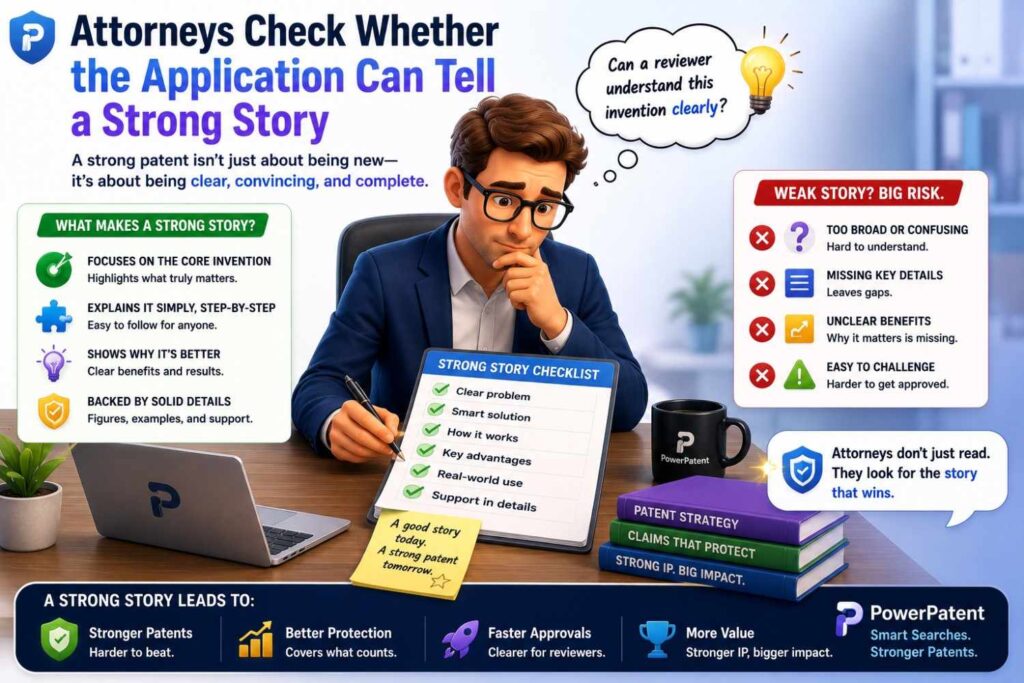
A patent application is technical, but it still needs a clear story.
The story is simple:
Old systems had a problem.
The invention solves the problem in a specific way.
The specific way creates a technical result.
Novelty search results help shape that story.
For example:
Old AI review systems routed low-confidence outputs to review. But high-confidence outputs can still be unsupported. The invention checks source trust and routes outputs to review when source trust is low, even if model confidence is high.
That is a strong story.
Old battery systems used fixed pressure thresholds. But fast charging can create pressure spikes that cause false alerts. The invention compares pressure drift during matched charging windows and adjusts the score based on charge rate and temperature.
That is a strong story.
Old wearable systems filtered motion artifacts. But alert quality may also depend on skin-contact pressure. The invention adjusts alert confidence based on both motion state and contact quality.
That is a strong story.
A patent attorney uses the search results to write this story more clearly.
Attorneys Turn Search Results Into Claim Strategy
A novelty search is not useful just because it finds prior art.
It becomes useful when the attorney turns those findings into a claim plan.
This is where legal review becomes business strategy. The attorney is not only asking, “Can we say this is new?” They are asking, “What claim would protect the valuable part of the invention while avoiding the closest prior art?”
That is a very different question.
A good claim strategy does not come from wishful thinking. It comes from careful comparison. The prior art shows where the open space may be. The invention details show what the company actually built. The business strategy shows which parts are worth protecting.
The claim strategy sits where those three things meet.
The Search Shows Where Not to Claim
One of the first things search results do is mark danger zones.
If the prior art already shows a broad feature, the attorney will usually avoid making that broad feature the center of the claim.
For example, if the search shows many systems that route AI outputs to human review, the claim should not stop at “routing AI outputs to review.”
The better claim angle may be:
Routing high-confidence AI outputs to review when source trust is low.
Or:
Routing AI-generated actions to review when source support conflicts with permission scope.
Or:
Updating the review trigger after later reviewer outcomes.
The prior art helps show what is too broad.
This is valuable for businesses because it prevents wasted patent spend. Filing on a broad idea that is already covered can lead to long office actions, weak amendments, and claims that no longer protect the product well.
A smart attorney uses the search to avoid that trap early.
The Search Helps Find the Claim Anchor
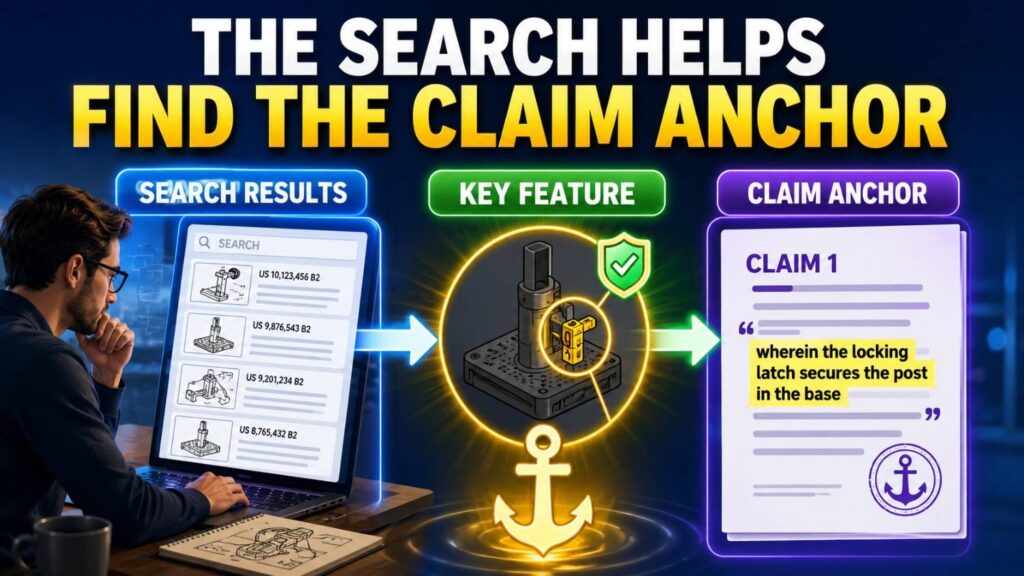
A claim anchor is the technical feature that carries the invention.
It is the part the attorney keeps coming back to because it appears different, useful, and tied to the business value.
For a SaaS product, the anchor may be a pre-execution validation step.
For an AI product, it may be a source-trust conflict rule.
For a hardware product, it may be a sensor placement or timing window.
For a robotics product, it may be a pre-visual risk prediction step.
For a biotech product, it may be a normalized marker ratio or dosing window.
For a MedTech product, it may be a quality-gated workflow or signal-confidence rule.
The attorney looks at the closest prior art and asks:
What feature is not shown?
What feature creates the result?
What feature would competitors need to copy?
What feature is supported by the invention notes?
That feature becomes the anchor.
Without an anchor, the claim may feel like a loose collection of parts. With an anchor, the claim has a clear center.
The Claim Anchor Should Match the Business Moat
A technical gap is not always a business moat.
An attorney may find a difference that is legally useful but commercially weak. That is not enough.
A strong claim anchor should protect the reason the company wins.
For example, if your AI SaaS product wins because enterprises trust its automation, the claim anchor should be the trust-building control step, not a minor dashboard output.
If your battery product wins because it reduces false swelling alerts, the claim anchor should be the false-alert reduction method, not a generic pressure sensor.
If your diagnostic wins because it works in noisy patient samples, the claim anchor should be the normalization method or marker pattern, not just the fact that a known marker is measured.
This is where founders should be active in the claim strategy discussion.
Ask:
Does this claim anchor protect what customers care about?
Would a competitor need this to match us?
Does this feature support our pitch, sales story, or roadmap?
If the answer is no, the claim may be technically interesting but not strategically strong.
Attorneys Use Prior Art to Shape Claim Layers
A strong patent filing usually has layers.
The broadest claim tries to protect the main concept.
Middle claims protect important commercial versions.
Narrower claims protect specific product examples and fallback positions.
Search results help decide those layers.
For example, if the prior art shows general AI review, the broadest claim may need to focus on source-trust conflict review. Middle claims may cover different ways to compute source trust. Narrow claims may cover specific review actions, audit logs, reviewer feedback, or source types.
For a hardware invention, the broad claim may cover matched-window pressure drift scoring. Middle claims may cover windows based on charge rate or temperature. Narrow claims may cover specific sensor placements, alert types, or charge-control actions.
For a diagnostic, the broad claim may cover a normalized marker ratio. Middle claims may cover sample types or patient groups. Narrow claims may cover threshold ranges, assay conditions, or marker subgroups.
This layered approach is practical.
If the patent office challenges the broad claim, the application has meaningful fallback paths. The company does not have to start from scratch.
Attorneys Avoid Adding Random Details
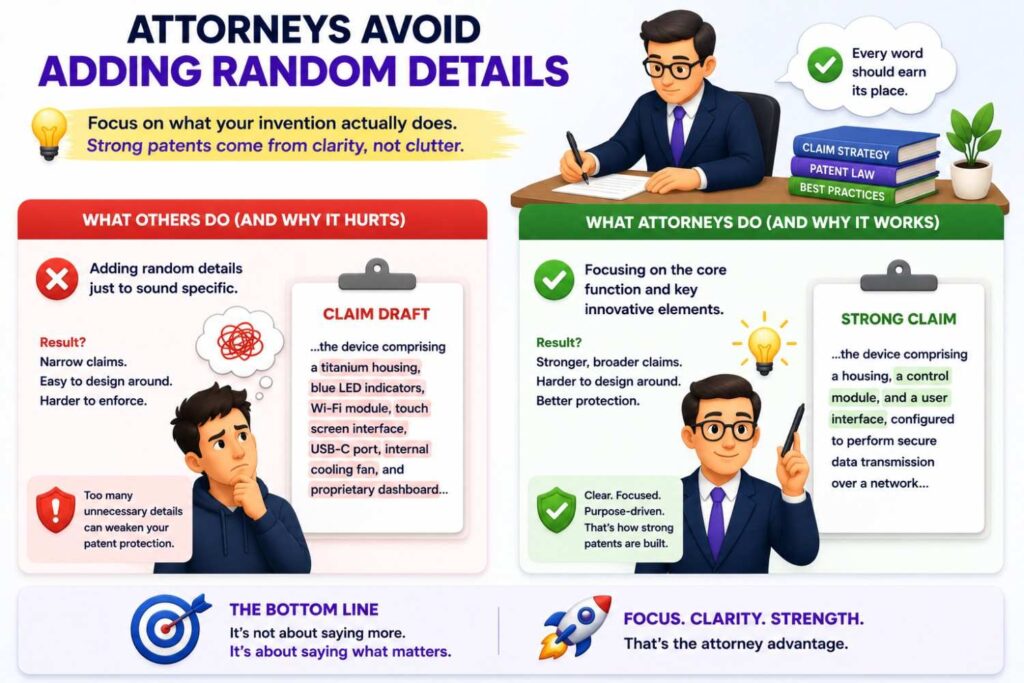
When prior art is close, it can be tempting to add any detail that makes the claim different.
That is dangerous.
A claim should not be narrowed with random product details unless those details matter.
For example, adding “the alert is sent by email” may avoid one reference, but it may also make the claim easy to avoid.
Adding “the model is a transformer model” may be unnecessary if the real invention is the output validation workflow.
Adding “the sensor is mounted with a specific screw pattern” may be too narrow if the invention is signal correction based on sensor position.
The attorney’s job is to avoid prior art with meaningful technical features, not cosmetic details.
A good founder question is:
Are we adding this because it creates the result, or only because it makes the claim look different?
If it does not create the result, it may belong in an example or backup claim, not the main claim.
Search Results Help Decide What to Leave Out
Claim strategy is not only about what to include.
It is also about what to leave out.
Every required claim element can become a design-around opportunity.
If a detail is not needed for the invention, the attorney may leave it out of the broad claim.
For example, a SaaS claim may not need to name the exact database used.
An AI claim may not need to require a specific LLM vendor.
A hardware claim may not need to require one exact material if several materials work.
A MedTech claim may not need one exact user interface step if the clinical workflow can be performed in other ways.
A biotech claim may not need one narrow threshold if the data supports a range.
This is strategic.
The fewer unnecessary requirements in the broad claim, the harder it may be for competitors to avoid.
But the claim still needs enough structure to be patentable over the prior art.
That balance is where attorney skill matters.
Attorneys Use the Search to Build Fallback Claims
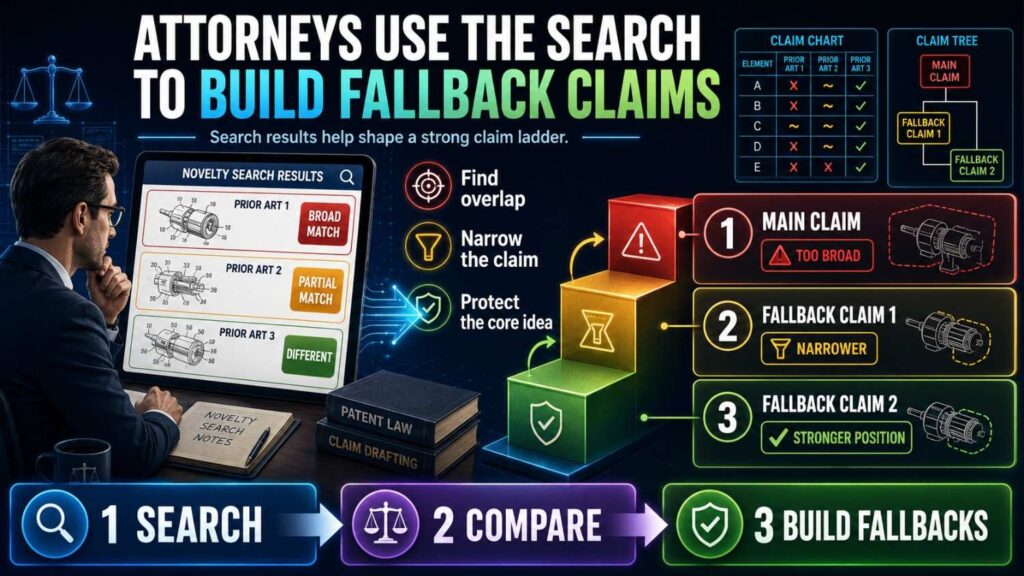
Prior art can appear later, even after a strong search.
That is why fallback claims matter.
A fallback claim is a narrower claim that still protects useful value if the broad claim is rejected.
The attorney uses the search to decide which fallback positions are worth including.
For example, if the broad claim is source-data validation, fallback claims may cover:
Source confidence based on age of source data.
Source confidence based on source type.
Human review when source trust and model confidence conflict.
Audit record generation after blocking an action.
Tenant-specific policy rules used in validation.
For a robotics invention, fallback claims may cover sound direction, map geometry, traffic history, speed reduction, rerouting, or fleet warnings.
For a diagnostic, fallback claims may cover marker ranges, sample types, patient subgroups, assay conditions, or specific thresholds.
The key is that fallback claims should still matter commercially.
Do not build fallback claims around details no competitor would care about.
Attorneys Look for Claim Sets, Not Just One Claim
A good claim strategy may include different claim types.
For software, there may be system claims, method claims, and computer-readable medium claims.
For hardware, there may be device claims, method-of-use claims, and manufacturing claims.
For biotech, there may be composition claims, method claims, formulation claims, treatment claims, and diagnostic method claims, depending on the invention.
For MedTech, there may be device claims, system claims, method claims, and software workflow claims.
The novelty search helps decide which claim types are worth pursuing.
For example, if the device structure is crowded but the operating method is different, the attorney may focus on method claims.
If the method is visible but the backend scoring is hidden, the attorney may claim the visible control action and consider keeping the hidden scoring weights secret.
If the product includes a new manufacturing process, that process may deserve its own claim set.
This is important for businesses because one product can contain several protectable layers.
The strongest portfolio may not come from one broad claim. It may come from several claim sets that protect different parts of the moat.
Attorneys Use Search Results to Avoid “Patent Theater”
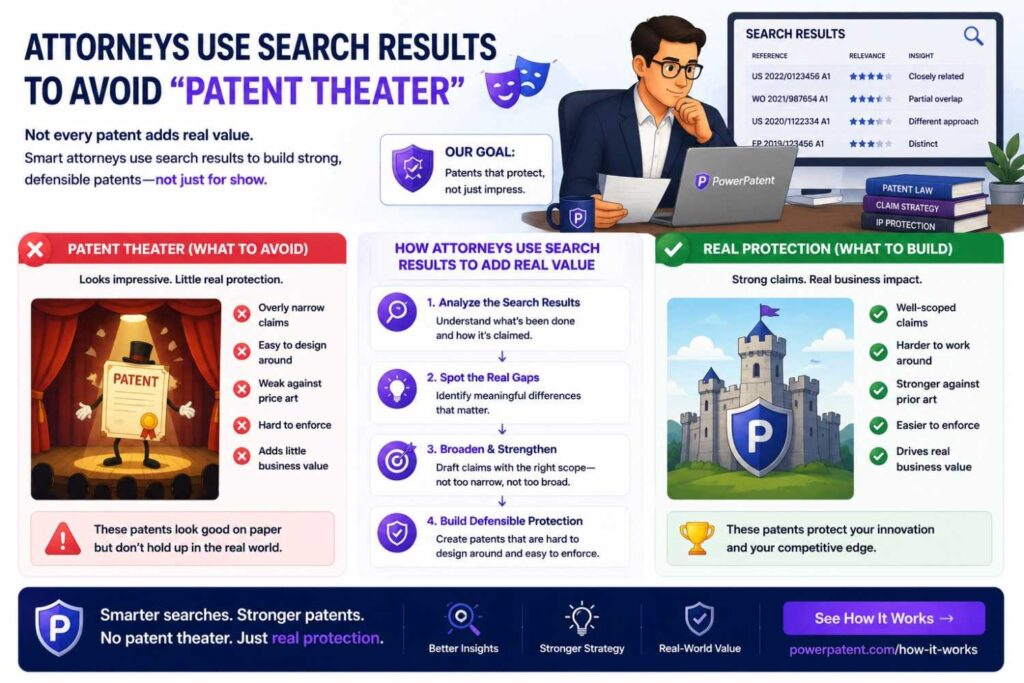
Patent theater means filing something mainly so the company can say “patent pending.”
That can feel good in the short term, but it may not create real value.
A search-driven claim strategy helps avoid this.
If the closest prior art forces the claim into a tiny corner that competitors can easily avoid, the attorney may recommend not filing or shifting to another feature.
If the claim protects a detail that customers do not care about, the attorney may recommend dropping that angle.
If the invention is hidden and better kept confidential, the attorney may suggest trade secret review.
This is not negative. It is disciplined.
For startups, the goal is not to collect patent filings. The goal is to protect technical leverage.
Claim Strategy Should Consider Enforcement Reality
A claim may look good on paper but be hard to use if infringement is hard to detect.
Attorney review should consider this.
For SaaS and AI, a claim that depends on hidden backend weights may be hard to observe.
For cloud platforms, internal scheduling logic may not be visible unless product behavior or API output reveals it.
For biotech manufacturing, process conditions may be hidden inside a lab or factory.
For hardware, a hidden internal structure may still be visible through teardown.
For MedTech software, workflow steps may appear in outputs, logs, or clinician screens.
The attorney may shape the claim toward observable behavior when possible.
For example, instead of focusing only on hidden scoring weights, the claim may focus on the control action triggered by the score.
Instead of claiming only an internal model update, the claim may also cover the system behavior after the update.
Instead of claiming only a manufacturing parameter, the attorney may consider whether the final product has a detectable structure or property.
This helps make the patent more useful in the real world.
Search Results Help Draft Around Competitor Workarounds
A strong claim strategy asks how competitors might avoid the patent.
Search results often show possible workarounds.
If prior art uses one sensor, competitors may use another.
If prior art uses one kind of score, competitors may use a different one.
If prior art uses human review, competitors may use automated review.
If prior art uses fixed thresholds, competitors may use dynamic thresholds.
The attorney uses this information to draft broader concepts and fallback versions.
For example, if the invention can use source trust from several sources, the application should describe those sources.
If a robot can use sound, vibration, or wireless signals for hidden-risk prediction, the application should describe real alternatives.
If a diagnostic can use plasma, saliva, or urine and the science supports it, those options may be included.
If a cloud workflow can block, delay, route, or sandbox an action, the application may describe those actions.
This makes design-arounds harder.
Attorneys Align Claim Strategy With Public Disclosure
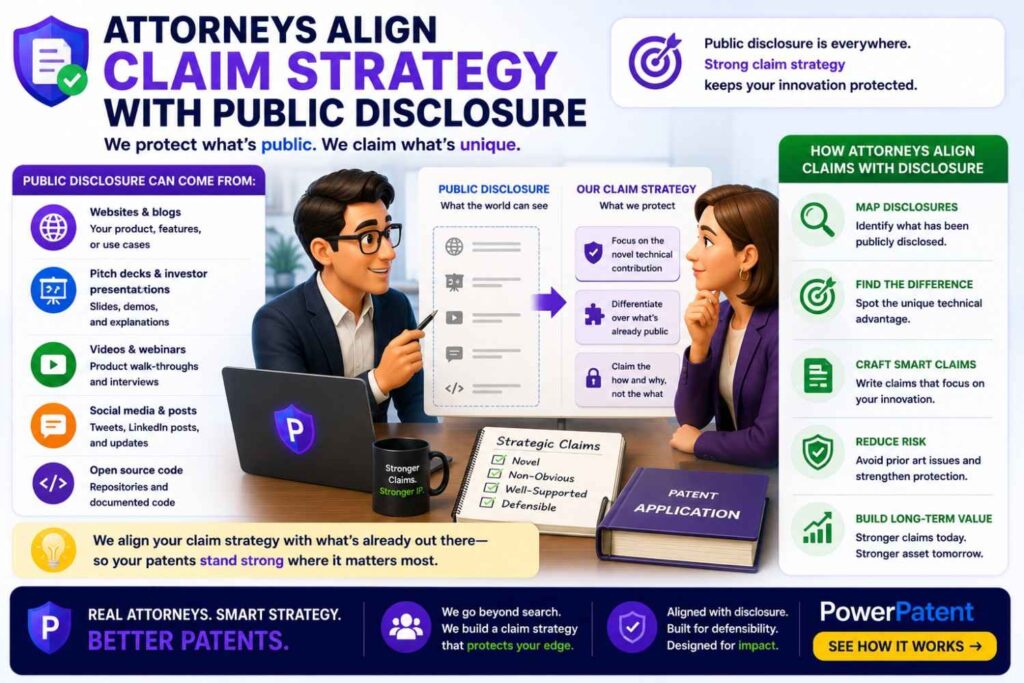
Search results also affect timing.
If the claim strategy depends on a feature that will soon appear in API docs, product demos, a conference talk, a clinical trial record, or a white paper, the attorney may recommend filing before disclosure.
If the best claim angle is not yet ready and no disclosure is planned, the team may gather more support first.
A strong claim strategy includes a disclosure plan.
Founders should tell counsel:
What is going public?
When?
What details will be shown?
Will the claim anchor be exposed?
Will docs reveal fields, workflows, sequences, or thresholds?
Will a demo show the control behavior?
This can decide whether to file now or wait.
PowerPatent helps teams track invention details and filing decisions before public disclosures create risk. See how PowerPatent works.
Attorneys Use Search Results to Decide What Evidence to Include
Claim strategy is stronger when the application explains why the invention works.
Search results help identify what evidence matters.
If prior art shows fixed thresholds, include evidence or examples showing why adaptive thresholds help.
If prior art shows model-confidence review, include examples showing why source-trust review catches a different problem.
If prior art shows pressure measurement, include test examples showing why matched-window pressure drift improves detection.
If prior art shows a known marker, include data showing why the marker ratio or normalization improves results.
The evidence does not always need to be perfect or final. But practical examples can make the application stronger.
They help show the technical result.
They also help future claim arguments.
Attorneys Turn Negative Results Into Positive Drafting
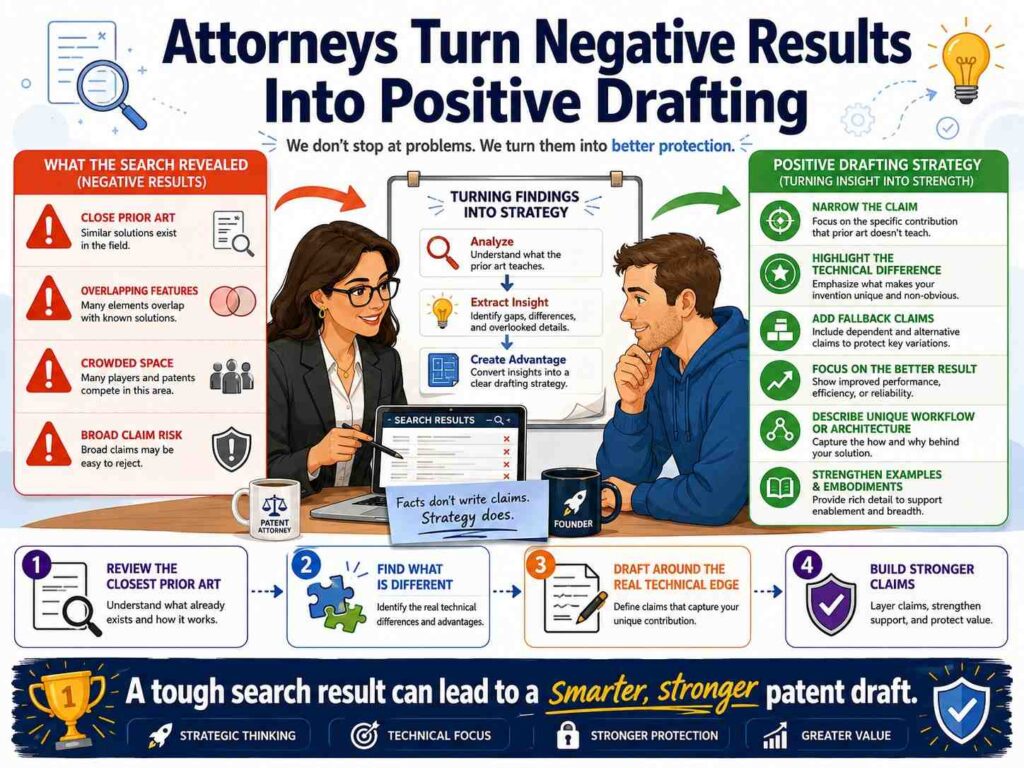
A close reference is not always bad.
It can sharpen the application.
The attorney may use the prior art to frame the problem more clearly.
For example:
Old systems verified AI output only when model confidence was low. The invention handles a different risk: high-confidence output with weak source support.
Old systems detected pressure changes, but did not account for fast-charging noise. The invention compares drift during matched charging windows.
Old systems collected audit evidence, but risked exporting unrelated tenant data. The invention creates scoped packets with field-level redaction.
This drafting approach makes the patent story clearer.
It also helps the claims feel tied to a real technical improvement.
Claim Strategy Should Support Future Continuations
For startups, the first filing may not be the last.
A strong application can support future continuation filings if the original disclosure includes enough detail.
Search results help decide what to include now so the company has options later.
For example, if the current claim focuses on AI action validation, the application may also describe audit packets, review feedback, policy updates, sandboxing, and model routing if those are real technical variants.
If the current claim focuses on battery pressure drift, the application may describe temperature, charge rate, load, cycle phase, and charging-control outputs.
If the current claim focuses on a diagnostic score, the application may describe marker ranges, patient groups, sample types, assay conditions, and longitudinal changes.
This is not about stuffing the application with random ideas.
It is about capturing real variants that may matter as the product grows.
Founders Should Ask for the Claim Strategy in Plain English
Founders should not leave claim strategy as a mystery.
After attorney review, ask for a plain-English version.
A good answer should sound like this:
“We are not claiming generic AI workflow automation. We are claiming the validation layer that checks an AI-generated action against permission, policy, and source support before execution.”
Or:
“We are not claiming any battery pressure sensor. We are claiming pressure drift comparison during matched charging windows and using that score to control charging or alerts.”
Or:
“We are not claiming the biomarker alone. We are claiming the normalized marker pattern in a specific sample and patient context.”
This plain-English version helps everyone align.
It helps engineering understand what details matter.
It helps product avoid premature disclosure.
It helps executives explain the IP story.
It helps the company avoid filing something nobody understands.
The Best Claim Strategy Ends With Action
A strong claim strategy should lead to clear next steps.
For example:
File now on the claim anchor before disclosure.
Run one more search on a narrower angle.
Collect test data to support the technical result.
Add backup examples to the invention disclosure.
Split the invention into two filings.
Keep one hidden method as a trade secret.
Drop the weak broad claim.
Update the draft to avoid prior art language.
This is what turns novelty search review into business value.
PowerPatent helps founders and technical teams turn search findings into claim strategy faster, with structured invention capture and real patent attorney oversight. See how PowerPatent works.
What Founders Should Send to Patent Counsel
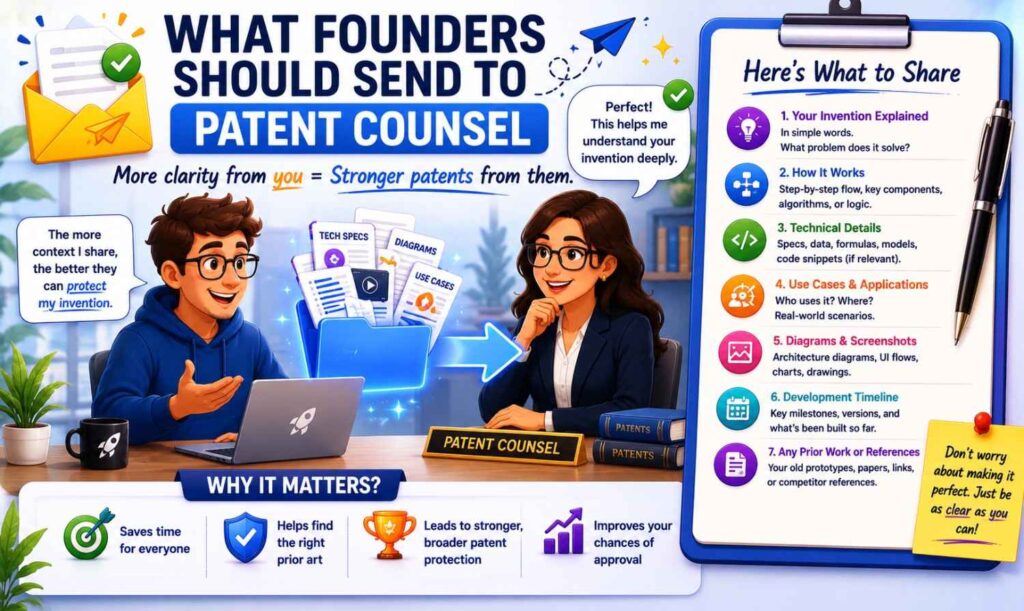
Founders can make attorney review much better by sending the right materials.
Do not send only links.
Send context.
A useful packet includes:
The invention in one plain sentence.
The technical problem.
The key elements.
The closest search results.
What each result seems to show.
What each result seems to miss.
Why the missing part matters.
Any test data, examples, or diagrams.
Any public disclosure dates.
Any roadmap variants.
The business goal.
The decision question.
For example:
“Our invention is an AI action validation layer for enterprise workflows. The key step is checking source-data support before an AI-generated action can run. Reference A shows AI task suggestions and permission checks, but we do not see source-data support validation before execution. API docs may publish in four weeks. Should we file on this validation layer now, search more, or pivot to audit packet generation?”
That is attorney-friendly.
It helps counsel give useful advice quickly.
What Founders Should Avoid Sending
Avoid vague summaries.
Do not say:
“We are like X but better.”
“We use AI.”
“Our product is unique.”
“This reference looks close.”
“We did not find exact matches.”
Those statements are not enough.
Also avoid hiding bad facts.
If a reference is close, say so.
If a disclosure happened, say so.
If the feature is still not built, say so.
If the result is not proven, say so.
If the roadmap is uncertain, say so.
A good attorney can work with hard facts.
They cannot protect the company well if the facts are missing or softened.
How Engineers Help Attorney Review
Engineers are often the best source of patentable detail.
They know what was hard.
They know what failed.
They know what changed.
They know which part improved the result.
They know what competitors would need to copy.
They know real alternatives.
They know what the prior art does not solve.
For example, an engineer may say:
“The reference uses confidence review, but our system checks source trust when confidence is high. That catches a different failure mode.”
Or:
“The old system uses pressure thresholds, but our matched-window comparison removes fast-charge noise.”
Or:
“The prior art uses the same sensor, but our placement avoids heat drift from the motor.”
Those comments can become claim strategy.
Founders should involve engineers before and during attorney review.
How Business Leaders Help Attorney Review
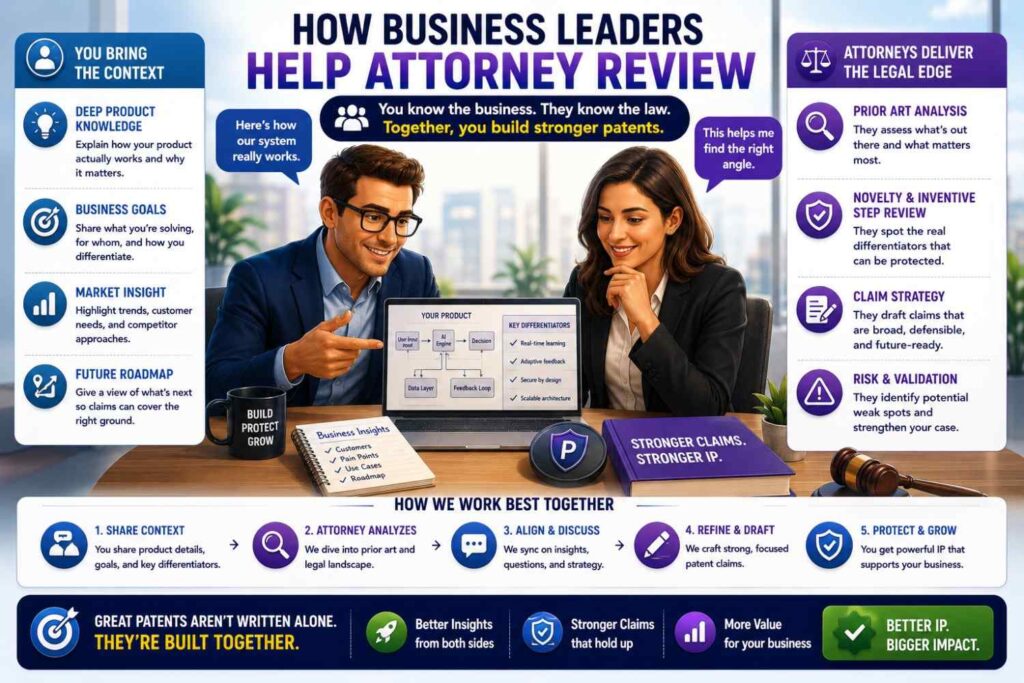
Business leaders help by explaining value.
A patent attorney may find a technical difference. The business leader can explain whether it matters.
Does it drive sales?
Does it lower cost?
Does it reduce risk?
Does it help pass security review?
Does it improve clinical adoption?
Does it matter to investors?
Does it block a competitor path?
Does it support the roadmap?
For example:
“This validation layer is why enterprise customers trust our AI automation.”
“This matched-window method is what reduced false battery alerts in pilots.”
“This normalized marker ratio is what makes the test work in high-inflammation patients.”
That business context helps the attorney decide whether the claim is worth pursuing.
What a Strong Attorney Review Outcome Looks Like
A strong attorney review outcome does not leave the team guessing.
It does not end with “this looks okay” or “there may be issues.” It gives the business a clear path. It tells the founder what to file, what not to file, what needs more support, and what decision must happen before launch, fundraising, publication, or partnership talks.
The best outcome is not always “file now.”
The best outcome is a smart, specific decision.
It Names the Filing Path
A strong outcome tells the team exactly where the patent filing should focus.
For example:
“File on the source-data validation layer. Do not claim broad AI workflow automation. Include backup claims for policy sources, audit logging, review routing, and source confidence.”
That is useful because it gives direction. The team knows the broad idea is too crowded. It also knows the stronger filing angle.
A weaker outcome would say:
“The invention may still be patentable.”
That may be true, but it does not help the business act.
A strong attorney review should answer:
What is the best claim focus?
What part should be avoided?
What technical feature should carry the filing?
What backup positions should be included?
What should the team gather before drafting?
This makes the review useful to founders, engineers, product leaders, and investors.
It Separates the Strong Claim From the Weak Claim
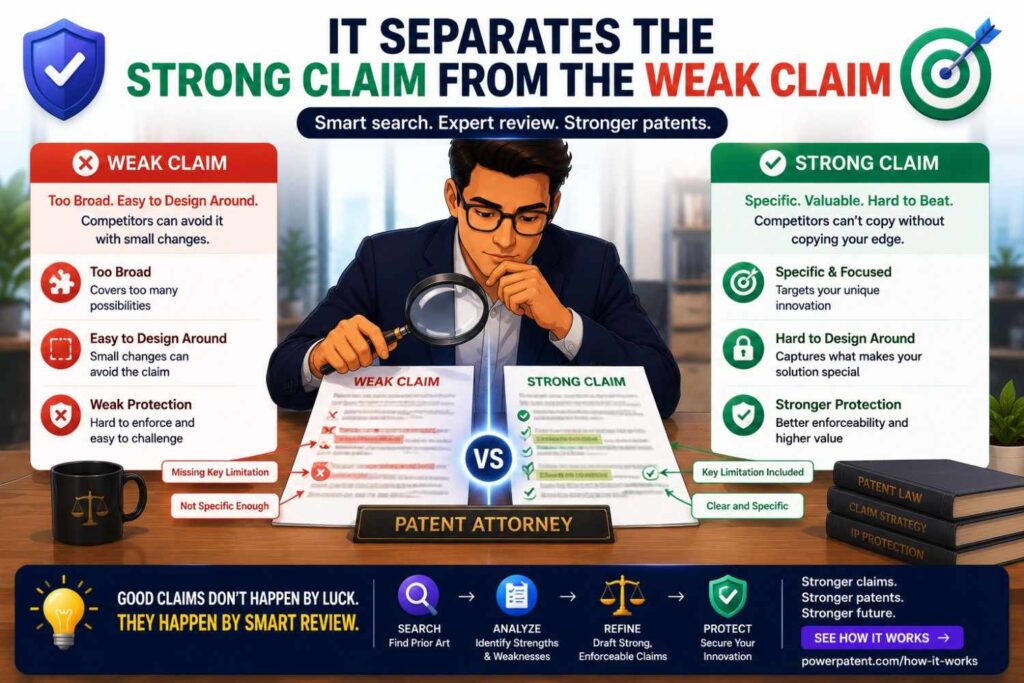
A good attorney review does not treat all claim ideas the same.
It separates the broad, risky idea from the narrower, stronger idea.
For example, the attorney may say:
“The broad claim to AI-based support routing is weak because the closest references show ticket classification and confidence-based routing. The stronger claim is the middle-confidence clarifying question tied to error logs, software version, and recent configuration changes.”
That is a strategic outcome.
It does not just say the broad idea is crowded. It shows the team where value may remain.
This is important because founders often love the broad claim. But the broad claim may be the least likely to survive.
The stronger claim is often the one that protects the real technical edge.
It Gives a Clear “Why”
A strong review outcome explains the reason behind the recommendation.
Not in dense legal language.
In plain business terms.
For example:
“Generic wearable alerts are crowded. The signal-confidence method is stronger because it ties the alert to both contact quality and motion state. That difference maps to the product’s false-alert reduction claim.”
That tells the team why the claim matters.
Or:
“The broad biomarker claim is risky because Marker A appears in several papers. The inflammation-normalized ratio is more promising because it targets the false-positive problem in high-inflammation patients.”
That explanation helps the business understand the IP story.
A strong review outcome should make the decision feel grounded, not mysterious.
It Links the Patent Strategy to Product Value
A patent filing should protect something the business cares about.
A strong attorney review outcome makes that link clear.
For example:
“This claim angle supports the enterprise trust story because it protects the control step that blocks unsafe AI actions before execution.”
Or:
“This filing angle supports the hardware value story because it protects the matched-window pressure method that reduces false alerts during fast charging.”
Or:
“This claim path supports clinical adoption because it protects the quality-gated workflow that asks for a missing scan view before model review.”
This is the level of clarity business teams need.
It helps the company avoid filing patents that sound technical but do not protect the product’s real advantage.
It Identifies What Must Be Added to the Draft
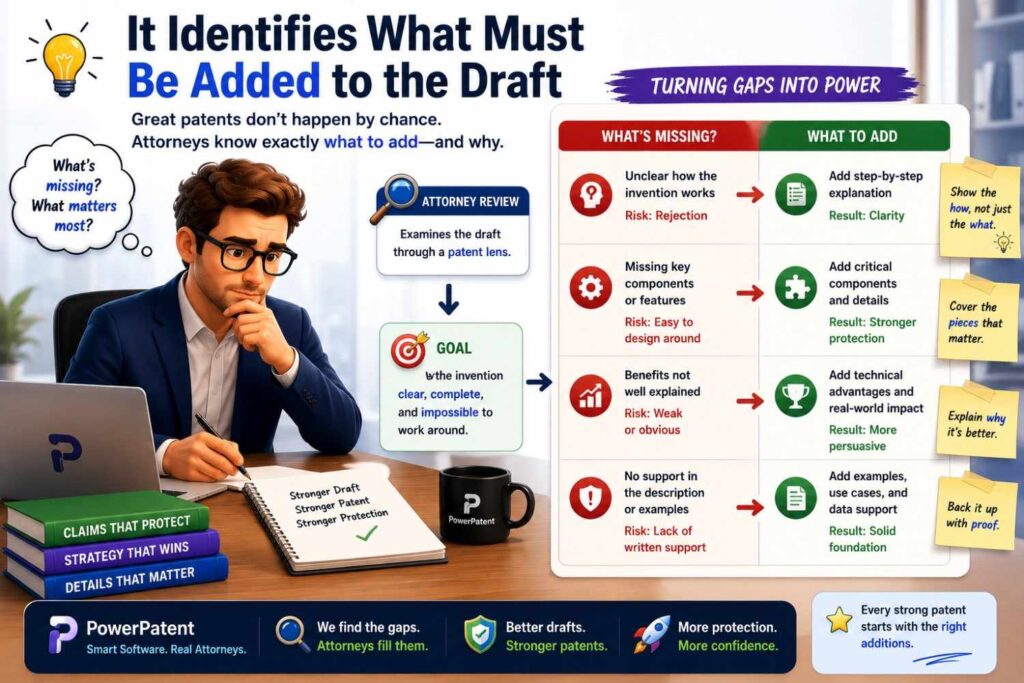
A strong review outcome should not only say what to claim. It should also say what the patent application needs to describe.
For example:
“To support this filing, include examples of different policy sources, source-confidence inputs, audit log structures, human review paths, and automated blocking actions.”
Or:
“Include examples of pressure windows based on charge rate, temperature, load, and cycle phase.”
Or:
“Include marker ratio ranges, alternate sample types, assay conditions, and patient subgroup examples.”
This matters because claims may need to change later.
If the application does not describe backup versions, the team may have fewer options during examination.
A strong attorney review outcome turns novelty search results into drafting instructions.
It Flags Missing Evidence
Sometimes the filing angle is promising, but the support is thin.
A strong outcome should say that.
For example:
“The claim angle is promising, but the current record does not yet show the false-alert reduction. Add prototype data or internal test examples before filing if timing allows.”
Or:
“The normalized marker ratio may be the strongest angle, but the application should include data showing why inflammation adjustment improves accuracy.”
Or:
“The cloud cost-saving claim should include before-and-after compute examples or architecture details showing why the batching method reduces cost.”
This does not mean every filing needs perfect data.
But the team should know what evidence would make the application stronger.
It Sets a Timing Decision
Attorney review should include timing.
A strong outcome may say:
“File before API docs publish because the docs will disclose the source-validation workflow.”
Or:
“File before the conference poster because the poster includes the marker ratio and patient subgroup.”
Or:
“There is no public disclosure pressure this month, so search more before filing.”
Timing changes strategy.
A filing that can wait may benefit from more data or better claim mapping.
A filing before public disclosure may need to move faster.
A strong review outcome tells the business what clock is running.
It States What Not to File
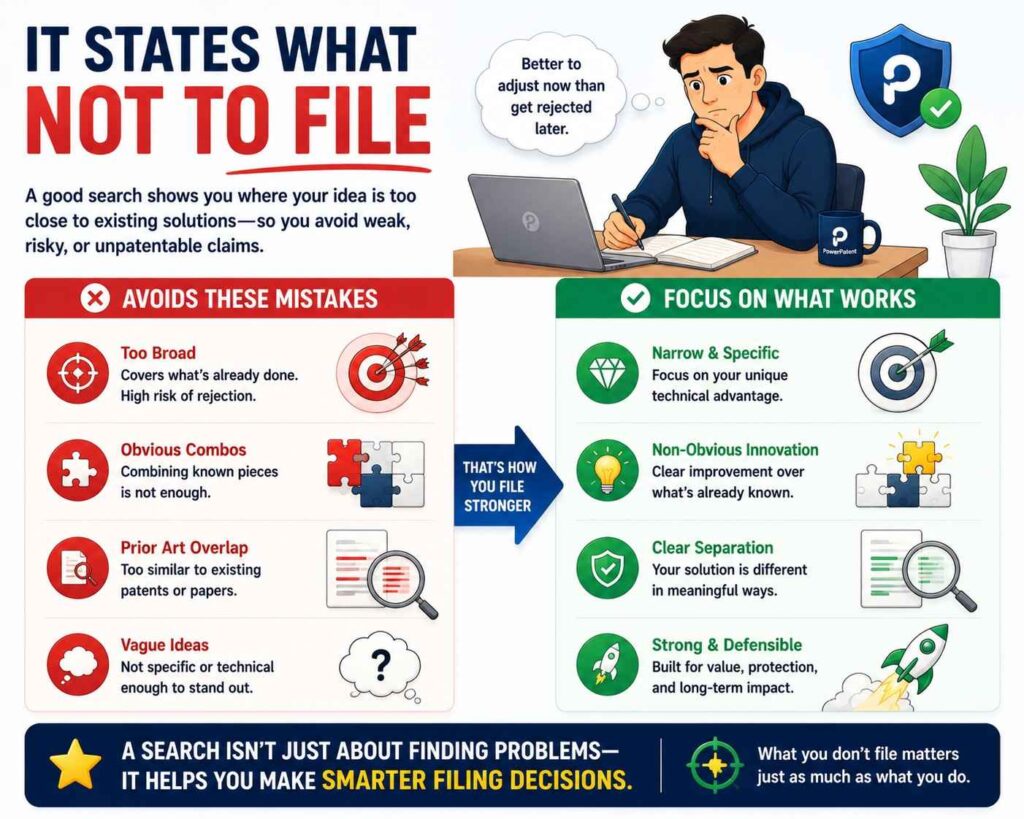
This is just as important as saying what to file.
A strong attorney review may say:
“Do not file on generic AI answer generation. That space is crowded and the filing would likely be weak. Focus instead on source-trust conflict review.”
Or:
“Do not file on the device housing shape alone. The stronger invention is the sensor placement and calibration method.”
Or:
“Do not pursue the broad diagnostic marker claim. The marker itself appears known.”
This saves money.
It also prevents weak filings that create false confidence.
For startups, knowing what not to file is a major advantage.
It Suggests Whether to Split the Filing
Sometimes one product contains several inventions.
A strong review outcome may recommend splitting them.
For example:
“The AI validation layer and tenant-safe audit packet generation should likely be treated as separate invention families. They solve different technical problems and may support different claim sets.”
Or:
“The sensor placement and manufacturing calibration fixture may deserve separate filings because one protects product operation and the other protects scale-up.”
This helps the business build a portfolio instead of forcing everything into one messy application.
Separate filings can also make future continuation strategy cleaner.
It Includes a Trade Secret Call
A strong attorney review should flag when patenting may not be the best option.
For example:
“The backend scoring weights are not visible to customers and may be hard to reverse engineer. Consider keeping those as trade secrets while filing on the visible action-control workflow.”
Or:
“The manufacturing temperature parameter appears valuable but hidden. Trade secret treatment may be stronger than a narrow patent claim.”
This is strategic.
A patent requires disclosure. A trade secret requires control.
A strong outcome helps the company choose the right tool for each part of the invention.
It Gives a Next-Step Checklist
A strong review should end with action.
For example:
“Next steps: update the invention disclosure to focus on source-data validation, add examples of policy sources and review outcomes, collect two customer workflow examples, confirm API publication timing, and prepare a provisional filing before docs go live.”
That is far more useful than a general opinion.
Another example:
“Next steps: pause the broad wearable alert filing, gather motion-plus-contact false-alert data, search one more pass on signal-confidence scoring, then revisit filing before clinical pilot materials are shared.”
This kind of checklist helps the team move.
It also reduces confusion between legal, product, and engineering teams.
It Creates an Investor-Ready IP Story
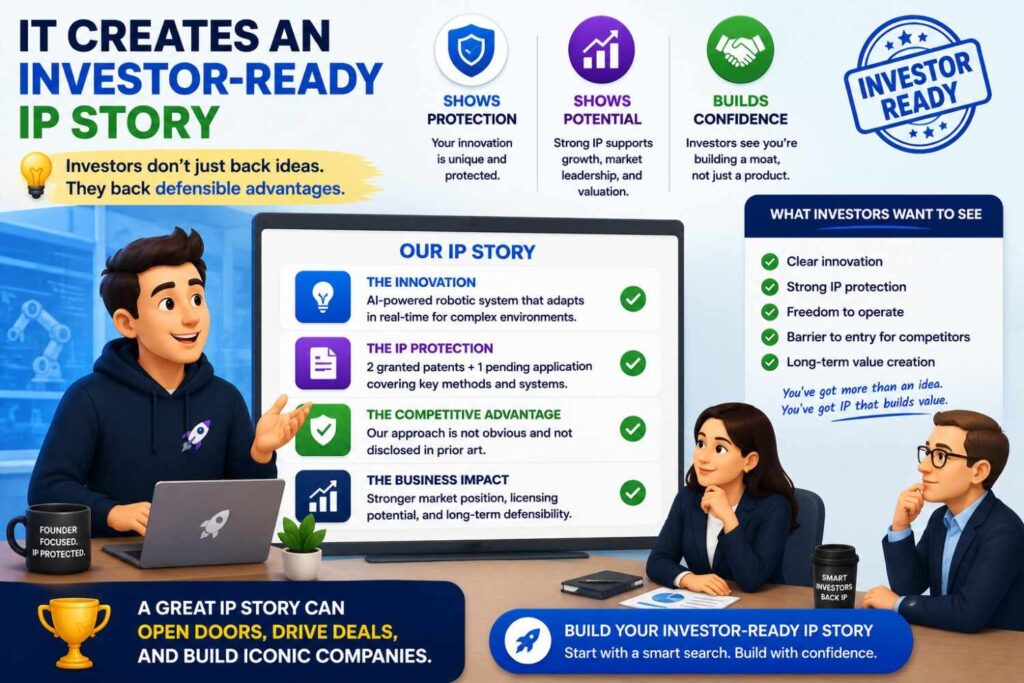
A strong attorney review outcome can help founders explain the patent strategy in a credible way.
Not with hype.
With precision.
For example:
“The broad AI automation space is crowded, so our filing focuses on the control layer that validates AI-generated actions against policy, permission, and source support before execution. That is the layer enterprise customers need to trust automation.”
That is an investor-ready story.
It shows the company knows the field.
It avoids claiming too much.
It ties IP to customer value.
That is much stronger than saying:
“We filed a patent on AI automation.”
It Leaves a Written Decision Record
A strong review outcome should be written down.
The decision record should capture:
What was reviewed.
What the closest prior art showed.
What filing angle was selected.
What was rejected.
What evidence is needed.
What disclosure timing matters.
What backup claims should be included.
What trade secret issues remain.
This record helps later during drafting, prosecution, fundraising, diligence, and portfolio planning.
It also prevents the same debate from coming back every few months.
Strong Outcome Examples
For an AI SaaS product:
“File on pre-execution validation of AI-generated workflow actions. The broad AI automation space is crowded. The closest references show AI task suggestions, permission checks, and audit logs, but do not appear to show validation against source-data support before execution. Include backup claims for customer policy types, source-confidence scores, human review routing, and audit decision records. File before API docs disclose the validation field.”
For a hardware product:
“Do not file broadly on pressure-based battery swelling detection. The closest art shows pressure sensing and fixed thresholds. Focus the filing on matched-window pressure drift scoring tied to charge rate and temperature. Include examples for other operating context signals and charge-control outputs. Add prototype data showing reduced false alerts during fast charging.”
For a biotech diagnostic:
“Do not pursue broad Marker A claims. Marker A appears known for the disease. The stronger angle is the Marker A to Marker B ratio normalized by inflammation score in low-volume plasma samples. Include threshold ranges, sample alternatives, patient subgroup examples, and any false-positive reduction data before filing.”
For a robotics product:
“Generic blind-corner slowing is crowded. Focus on pre-visual risk prediction using sound direction, map geometry, and recent traffic history. Include backup claims for rerouting, fleet warnings, and speed-control variations. Gather test examples showing earlier slowing compared with map-only corner rules.”
The Best Outcome Creates Confidence Without Overpromising
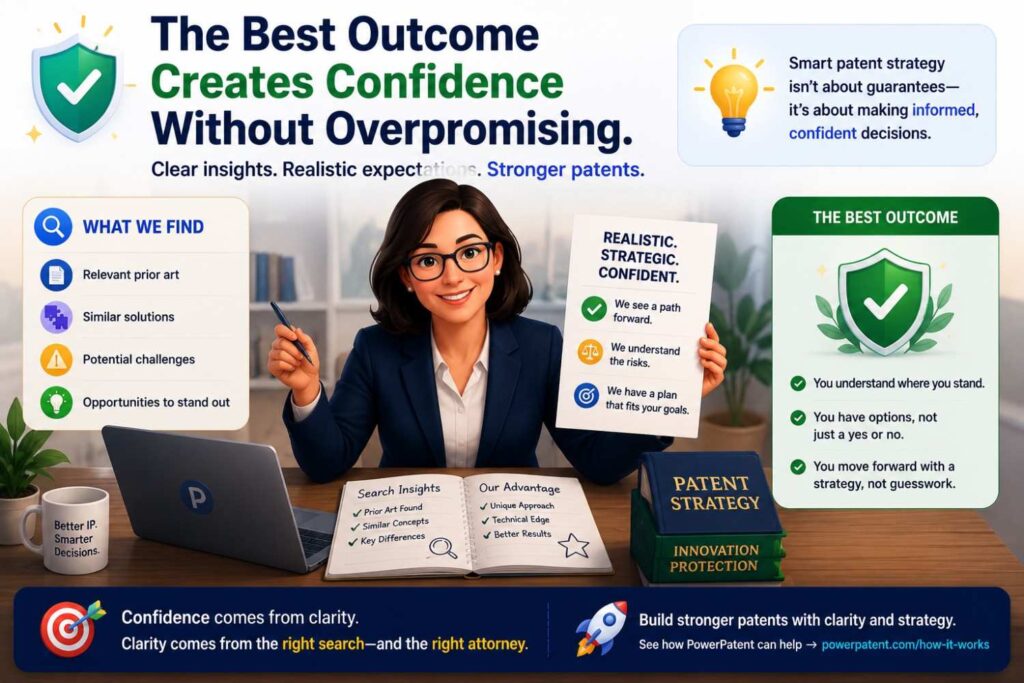
A strong attorney review outcome should not say, “This patent is guaranteed.”
No one can promise that.
It should say:
“Based on the reviewed search results, this is the strongest filing path, these are the risks, these are the backup positions, and these are the next steps.”
That gives founders confidence without false comfort.
That is the value of attorney review.
PowerPatent helps teams get to this kind of clear outcome faster by organizing invention details, prior art notes, technical gaps, and attorney guidance into a stronger filing workflow. See how PowerPatent works.
How PowerPatent Helps With Attorney Review
Patent attorneys do better work when they have strong inputs.
PowerPatent helps teams create those inputs.
It helps founders and engineers capture the real invention, organize novelty search results, record technical gaps, collect examples, and prepare better materials for attorney review.
Then real patent attorney oversight helps turn that material into filing decisions.
This helps startups avoid rushed filings based on vague summaries or scary search results.
It also helps protect the technical features that actually matter.
PowerPatent is built for founders who need speed, control, and confidence without sacrificing quality.
A Practical Founder Checklist Before Attorney Review
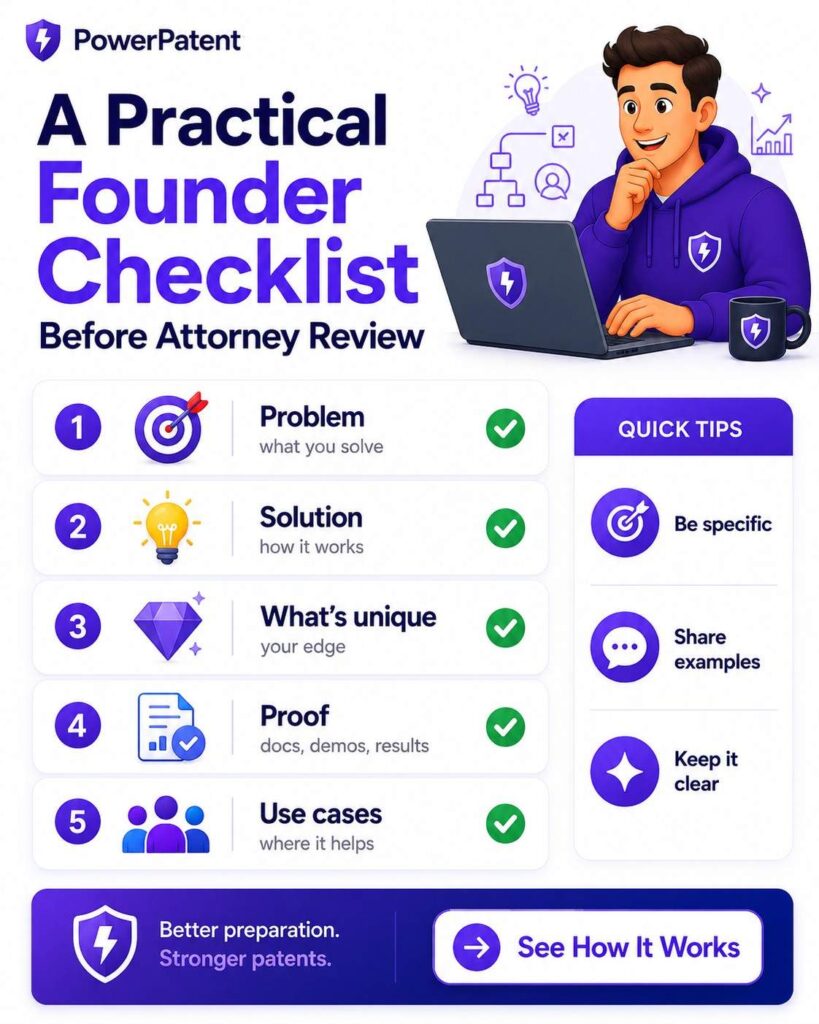
Before meeting with patent counsel, prepare a short packet.
Write the invention in one plain sentence.
Name the technical problem.
List the key elements.
Attach or link the closest references.
Write what each reference appears to teach.
Write what each reference appears to miss.
Explain why the missing part matters.
Add diagrams, flows, or test data if you have them.
Share public disclosure dates.
Share roadmap variants.
Explain the business value.
Ask a clear decision question.
The question might be:
“Should we file on this narrowed angle before launch, pivot to another feature, or search more?”
That one packet can make the attorney review much more useful.
Final Takeaway
Patent attorneys review novelty search results by turning search findings into filing strategy.
They start with the real invention. They break it into elements. They compare one reference at a time. They look for matches, partial matches, and gaps. They ask whether the gaps matter. They consider obviousness, claim scope, backup positions, public disclosure timing, trade secret options, design-around risk, detectability, roadmap fit, and business value.
The best review does not only answer, “Is this new?”
It answers:
“What should we file, how should we claim it, and is it worth the business spend?”
That is the real value.
And when you want help turning invention notes, search results, engineering details, and attorney review into stronger patent filings, PowerPatent can help you move faster with smart software and real patent attorney oversight.