Big mistakes in patents do not happen at the end. They happen at the beginning. The first call. The first form. The first set of notes from the inventor. If your intake process is weak, everything that follows will be weak. You will draft around missing facts. You will file with gaps. You will fix things later that should have been clear on day one. For IP teams working with engineers, founders, and product leaders, inventor intake is not just admin work. It is the foundation of the entire patent.
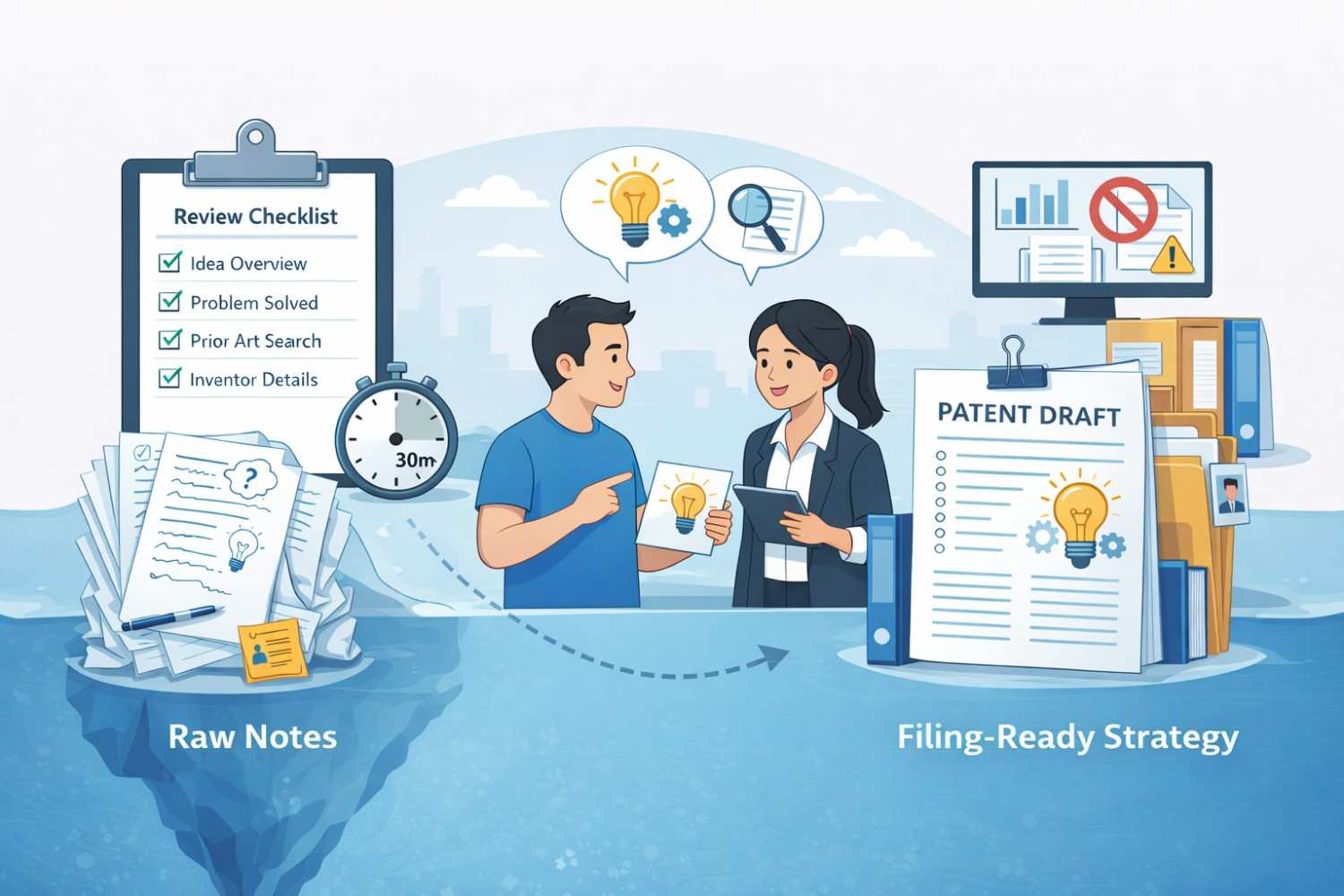
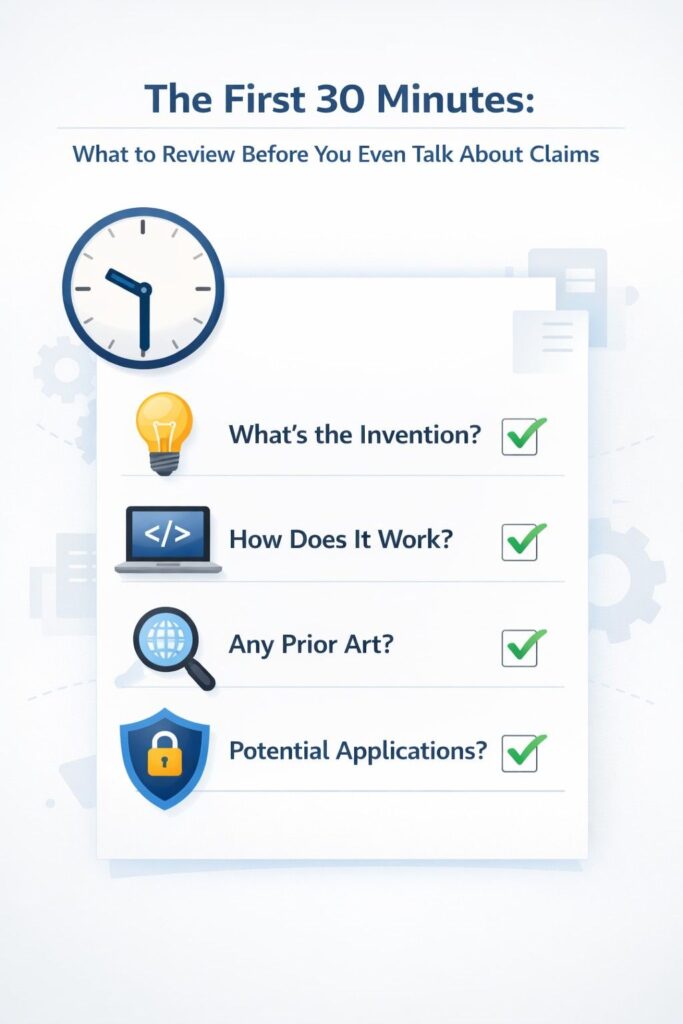
The First 30 Minutes: What to Review Before You Even Talk About Claims
The first 30 minutes after an invention hits your desk will shape everything that follows. This is not the time to draft claims. This is not the time to polish language. This is the time to slow down and see clearly.
Most IP teams rush here. They skim the intake form. They jump into technical details. They start thinking about scope.
That is backwards.
The first half hour should be about clarity, risk, and direction. If you get this right, drafting becomes easier, faster, and stronger. If you get it wrong, you will spend weeks fixing what should have been obvious on day one.
Let’s walk through what smart IP teams review before they ever think about claim language.
Start With the Business Goal, Not the Technology
Before you look at diagrams or code snippets, step back. Why does this invention matter to the company?
You cannot protect something well if you do not understand its role in the business.
What Problem Does This Solve for the Company?
Begin by asking a simple question: what business problem does this invention solve?
Is it tied to a key product launch? Is it a core platform piece? Is it a defensive move to block a competitor? Is it part of a fundraising story?
If intake documents do not clearly explain the business reason behind the invention, pause and request that context. Do not assume you can guess it from technical notes.
When IP teams understand business goals early, they make smarter choices. They know where to push for broad coverage and where narrow protection may be fine. They know what must be filed quickly and what can wait.

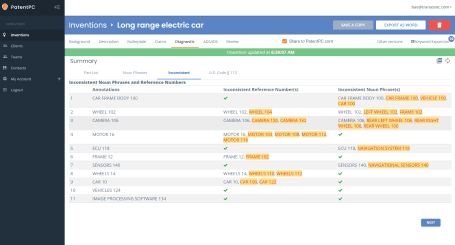
PowerPatent makes this easier by capturing both technical and business context in one structured flow, so nothing important gets lost between engineering and legal review → https://powerpatent.com/how-it-works
Is This Core or Peripheral?
Not every invention deserves the same level of investment.
In the first 30 minutes, try to place the invention on a simple internal scale. Is this core to revenue? Is it part of a flagship feature? Or is it an internal improvement that may never be visible to users?
This does not mean you ignore smaller inventions. It means you align effort with impact.
A core platform algorithm should trigger deeper review and faster action. A small interface tweak may require a lighter process.
Without this early filter, IP teams waste time polishing filings that do not move the business forward.
Confirm the Real Invention Is Clear
Intake forms often describe features, not inventions.
Your job in the first 30 minutes is to find the actual idea hiding inside the feature.
Separate the Outcome From the Mechanism
Engineers often describe what the system does. For example, they may say the tool reduces latency or improves model accuracy.
That is an outcome.
You need to know how it achieves that outcome.
If the intake form says, “This improves training speed by 40%,” you should immediately ask, “What changed in the architecture or method to make that happen?”
Do not move forward until the mechanism is clear.
Patents protect how something works, not just what result it delivers. If the intake description is vague, push for specifics right away. Waiting will only make drafting harder later.
Look for Hidden Assumptions
In many cases, inventors skip steps because they feel obvious to them.
They may assume that everyone understands how data flows through the system. They may not mention dependencies or constraints because those are routine in their world.
In the first review, read the intake like an outsider. If any step in the explanation feels like a jump, flag it.
You want to surface gaps early. A missing step in intake can become a weak point in the patent if it is never fully explained.
One practical move is to rewrite the invention in your own words after reading the intake. If you struggle to explain it clearly in a few sentences, the intake is not ready. Send it back with targeted questions.
Review Timing and Public Exposure Immediately
Timing errors can destroy patent rights. That is why this review must happen before you draft anything.
The first 30 minutes should include a focused check on disclosure and deadlines.
Has This Been Shown to Anyone Outside the Company?
Ask whether the invention has been shared with customers, investors, partners, or at conferences.
If the intake form does not address this directly, it is incomplete.
Public exposure can start the clock in many places. If something was disclosed months ago, you may have limited time left to file.
You need clarity now, not after weeks of drafting.
IP teams should build a habit of scanning intake forms specifically for any sign of public use, demos, beta testing, blog posts, or open-source commits.
If there is even a hint of exposure, escalate the review.
Was Any Code Pushed to a Public Repository?
In deep tech companies, this question is critical.
Developers often push code to public repositories without thinking about patent timing. Even partial implementations can raise issues.
During your first review, check whether the invention relates to code that has been shared publicly.
If so, confirm dates. Confirm scope. Confirm whether it fully reflects the invention or just part of it.
This is not about blame. It is about protecting rights before it is too late.
With structured intake systems like PowerPatent, these questions are built directly into the workflow, so teams do not forget to check exposure risks → https://powerpatent.com/how-it-works
Verify Ownership and Inventorship Early
Ownership problems are much easier to fix before filing.
They are much harder after.
The first 30 minutes should include a careful look at who contributed and under what agreements.
Who Actually Contributed to the Idea?
Many intake forms list a single name, even when multiple engineers were involved.
Do not assume the listed inventor is complete.
Read the description carefully. If it sounds like a team effort, confirm who contributed to the core idea. Not who implemented it. Not who tested it. Who helped create the concept.
If you miss a true inventor, you create risk. If you list someone who did not contribute to the core concept, that also creates issues.
Clarify this before drafting starts.
Were All Contributors Under Proper Agreements?
If contractors, advisors, or interns were involved, check their agreements.
Are invention assignments in place? Are there any joint development arrangements with partners?
This is not a deep legal audit in the first 30 minutes. It is a red flag scan.
If you spot any sign of shared ownership or unclear assignments, escalate it immediately. Do not proceed as if everything is clean.
Strong intake review protects the company from future disputes.
Align the Invention With Existing Filings
A strong IP portfolio is connected. It is not a pile of random applications.
During your early review, check whether this invention overlaps with prior filings.
Is This an Extension of an Earlier Patent?
Sometimes inventors build on their own prior work.
If the invention appears related to an earlier filing, pull that earlier document and skim it.
You are looking for overlap. You are looking for opportunities to tie this filing into a larger strategy.
If it is an improvement, you may need to reference earlier work. If it is closely related, you may need to think about continuation strategies.
Doing this at the start avoids duplication and missed strategy moves.
Are You About to Claim the Same Thing Twice?
In fast-moving startups, teams may submit multiple invention disclosures around the same feature set.
If intake review shows heavy similarity to another pending idea, do not ignore it.
Coordinate.
You may decide to combine disclosures into one stronger filing. Or you may split them cleanly with different focuses.
The key is to see this before drafting begins.
Modern IP tools help surface these overlaps early by organizing disclosures in one place and linking related concepts clearly.
That is one reason many startups move away from scattered email-based intake and toward structured platforms with real attorney oversight → https://powerpatent.com/how-it-works
Check for Strategic Filing Windows
Not every invention should be filed the same way or at the same time.
The first 30 minutes should include a quick strategic lens.
Is There an Upcoming Fundraise or Product Launch?
If a company is about to raise capital or announce a major release, filing timing matters.
A filed application can strengthen a pitch. A missed deadline can weaken it.
If intake review shows that the invention is tied to a public milestone, coordinate with leadership early.
You may need to fast-track drafting.
Is This Part of a Larger Platform Shift?
Sometimes an invention is not a standalone feature. It is part of a broader technical shift inside the company.
If so, it may be smarter to group related innovations into a coherent filing plan rather than file one-off applications.
The intake stage is where you detect this pattern.
Ask yourself whether this invention feels isolated or part of a wave. That answer shapes filing strategy.
Set the Tone for the Entire Process
The first 30 minutes are not just about checking boxes. They are about setting standards.
If inventors learn that intake is taken seriously, they will submit better information next time.
If they see that vague descriptions pass through without questions, quality will drop.
When you respond to an intake with clear, thoughtful follow-up questions, you signal that this process matters.
That culture shift improves your entire IP pipeline over time.
Platforms like PowerPatent support this by guiding inventors through structured prompts that encourage depth, while real attorneys review and refine the content before filing.
This blend of smart software and human oversight helps teams move fast without cutting corners → https://powerpatent.com/how-it-works
The first 30 minutes are not about perfection. They are about direction.
Get direction right, and everything downstream becomes smoother, faster, and stronger.
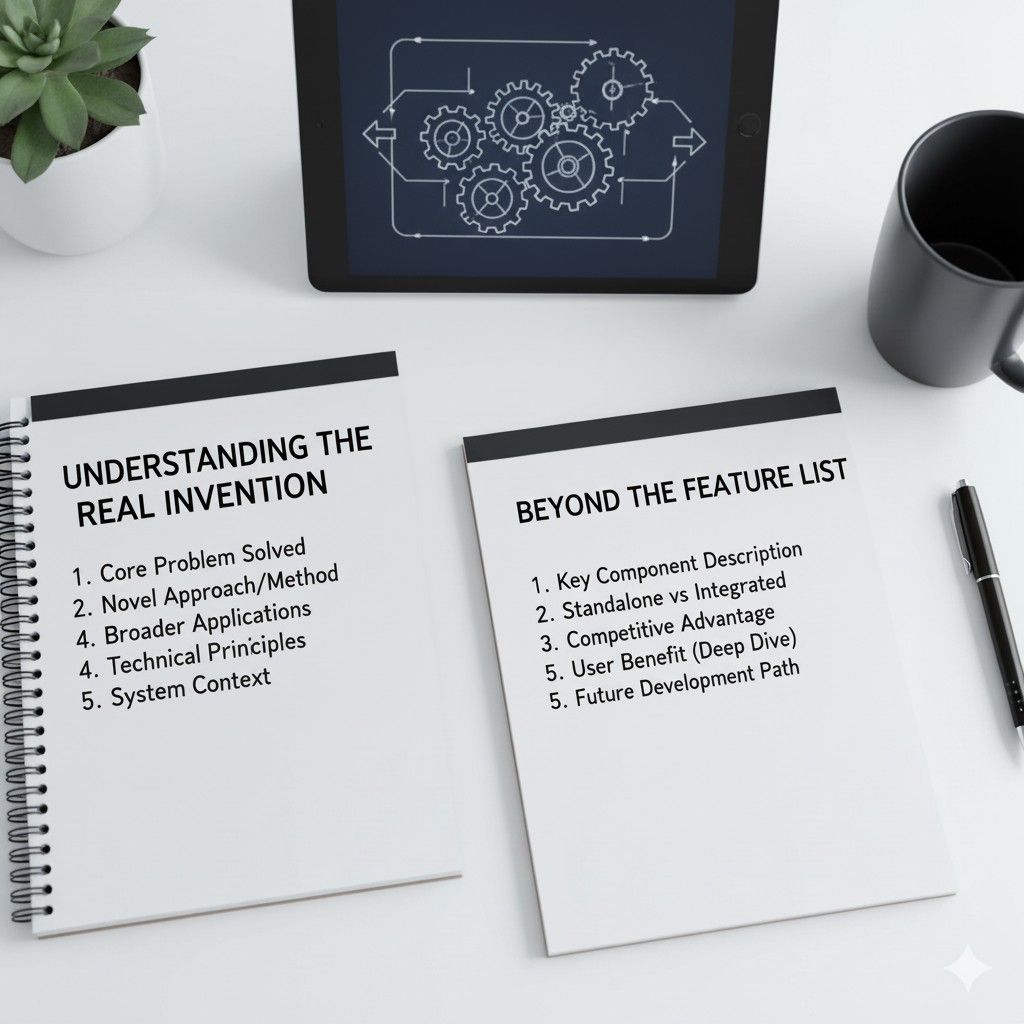
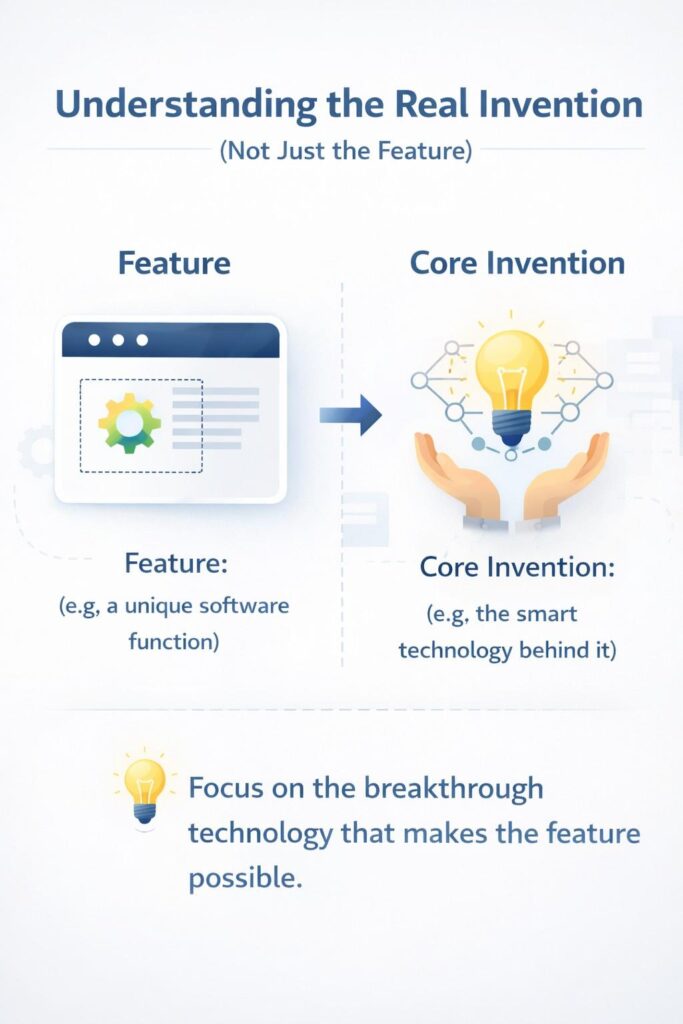
Understanding the Real Invention (Not Just the Feature)
Most invention disclosures describe features.
Very few describe inventions.
That gap is where weak patents are born.
A feature is what users see. It is what shows up in a product demo. It is what goes on a slide deck. An invention is the technical solution that makes that feature possible.
If your IP team cannot clearly separate the two, you will protect the surface and miss the engine underneath.
This section is about slowing down long enough to uncover the real idea. Not the marketing version. Not the product label. The actual technical breakthrough that deserves protection.
The Difference Between a Feature and an Invention
Before you draft anything, you must reframe the disclosure.
A feature is the visible result. An invention is the hidden method.
When an inventor says, “We built real-time fraud detection,” that is a feature. It tells you nothing about the technical approach. Ten companies can claim real-time fraud detection. Only one can claim a specific new method for doing it.
Your job in intake review is to strip away the feature language and expose the mechanics.

If you do not do this early, you will draft claims around a business outcome. That is a weak position.
Dig Beneath Product Language
Engineers and founders often describe inventions using product terms. They talk about dashboards, workflows, optimization, automation, orchestration.
These are labels.
In your review, rewrite every product term into a technical explanation.
If the intake says, “We automated model retraining,” you should ask, “What changed in the data pipeline? What triggers the retraining? What logic decides when and how updates occur?”
Keep asking “how” until you hit something concrete.
That concrete layer is where patent value lives.
Modern intake systems like PowerPatent guide inventors to explain the mechanics directly, not just the feature summary.
That saves hours of back-and-forth and leads to stronger filings from the start → https://powerpatent.com/how-it-works
Identify the True Technical Leap
Not every improvement is an invention.
Some are small optimizations. Some are obvious next steps. Others represent real technical shifts.
Your role is to spot the leap.
What Was Hard Before This?
Ask yourself what was difficult before this invention existed.
Did systems crash under load? Did models fail under certain data types? Did latency spike at scale?
If you cannot identify the prior pain clearly, you do not yet understand the invention.
Strong patents are built around solving real technical limits. Weak patents describe surface-level changes without context.
When reviewing intake, look for clear statements about past limitations. If they are missing, request them.
You want to understand the technical wall that existed before the team broke through it.
What Did the Team Change That Others Were Not Doing?
Now focus on the change itself.
Did they redesign system architecture? Did they introduce a new data structure? Did they alter how signals are processed or filtered?
Pinpoint the exact change that made the difference.
Many teams describe performance gains without identifying the structural shift behind them. Your review should force clarity.
If performance improved, what changed internally? If accuracy increased, what logic or process was added or removed?
The invention is almost always the internal shift, not the final metric.
Look for Multiple Inventions in One Disclosure
A common intake mistake is packing several ideas into one form.
At first glance, it looks like one invention. On closer review, it may contain several independent technical concepts.
If you do not separate them early, you may file a single application that blends everything together. That can limit flexibility later.
Separate Core From Supporting Ideas
As you read the disclosure, ask whether there is one central technical concept or several layered improvements.
For example, a new machine learning system may include a novel training method, a new data labeling approach, and a unique deployment pipeline.
Each of those may stand on its own.
If you identify separate technical concepts, flag them. You may choose to file them together for now, but you should make that decision intentionally.
Strategic separation at intake gives you options later for follow-on filings or continuation strategies.
Avoid Overcrowding a Single Patent
When too many ideas are crammed into one filing, the core message becomes diluted.
Examiners may focus on secondary elements and miss the true breakthrough. Competitors may design around one part while avoiding another.
By identifying distinct inventions early, you can craft a cleaner strategy.
This is where having structured review workflows helps. PowerPatent organizes invention data in a way that makes it easier to see overlapping and distinct concepts before drafting begins → https://powerpatent.com/how-it-works
Understand the System Boundaries
An invention does not live in isolation. It exists within a system.
To draft strong protection, you must understand where the invention starts and ends.
What Parts Are New Versus Standard?
Intake documents often mix standard components with new ones.
An engineer might describe servers, databases, APIs, user interfaces, and then briefly mention the new algorithm.
You need to isolate the novel portion clearly.
Ask which elements are standard in the industry and which were built uniquely by the team.
If you do not draw this boundary early, you risk claiming too broadly without support or too narrowly around the wrong element.
A simple technique during review is to mark each described component as either conventional or new. This mental filter sharpens your focus on the actual invention.
Could the Invention Exist in Another Context?
Another powerful test is portability.
If the invention only makes sense inside one specific product, you may be thinking too narrowly.
Ask whether the technical solution could apply to other systems, industries, or data types.
For example, if the intake describes a solution in a fintech app, ask whether the same method could apply in healthcare or logistics.
This question helps you see the invention at a higher level without losing technical detail.
The earlier you expand your lens, the more strategic your filing will be.
Translate Engineer Thinking Into Legal Strategy
Engineers think in terms of solving problems. Patent strategy requires thinking in terms of protecting concepts.
Your review process is the bridge between those two worlds.
Turn Implementation Details Into General Principles
An inventor may describe a specific implementation in one programming language, on one cloud provider, using one set of tools.
That is useful, but it is not the whole story.
As you review, extract the principle behind the implementation.
If they used a specific database structure to speed up queries, what is the broader idea? Is it about partitioning data differently? Is it about precomputing certain values? Is it about caching in a new way?
By identifying the principle, you prepare the ground for broader protection.
This does not mean ignoring details. It means understanding which details are examples and which reflect the core idea.
Avoid Locking the Patent to One Version of the Product
Products evolve. Code changes. Architectures shift.
If your intake review locks onto the current version only, your patent may become outdated quickly.
Ask whether the invention would still work if the company switched frameworks, languages, or infrastructure providers.
If yes, the core idea is likely deeper than the current setup.
Capture that depth now.
PowerPatent supports this translation process by combining structured technical capture with real attorney insight, ensuring that the invention is framed broadly but grounded in actual engineering detail → https://powerpatent.com/how-it-works
Pressure Test the Novelty Early
While formal prior art searches may come later, you can still do a basic sanity check during intake review.
You do not need to run full searches yet. But you should challenge the assumption that the idea is new.
Ask What Others Are Doing Today
If the inventor claims this is unique, ask what competitors currently do.
Is the current industry approach manual? Rule-based? Batch-processed? Centralized?
Understanding the current state of the art helps you gauge how far the invention moves the needle.
If the team cannot clearly articulate how others solve the problem, push for that clarity.
That contrast is critical in later drafting.
Separate Truly New Concepts From Expected Optimizations
Some improvements are natural next steps.
For example, moving from hourly updates to near real-time updates may be expected as hardware improves.
But introducing a new event-driven architecture that enables real-time updates in a novel way may be inventive.
During intake, challenge vague claims of novelty. Look for structural changes, not just performance gains.
This early pressure test sharpens your strategy and reduces wasted effort later.
Capture the Story While It Is Fresh
Finally, remember that memory fades.
Engineers move on to the next sprint. Details blur. Decisions that felt obvious at the time become hard to recall.
The intake stage is your best chance to capture the full story.
Encourage inventors to explain why they made specific choices. Why they rejected other approaches. Why certain designs failed before landing on the final solution.
These insights can become powerful support during prosecution.
By building a disciplined intake review focused on the real invention, not just the visible feature, your IP team lays the groundwork for stronger, broader, and more durable patents.
And when this process is supported by structured software and experienced attorney oversight, the quality and speed both improve.
That is exactly what PowerPatent is built to do for modern tech teams → https://powerpatent.com/how-it-works
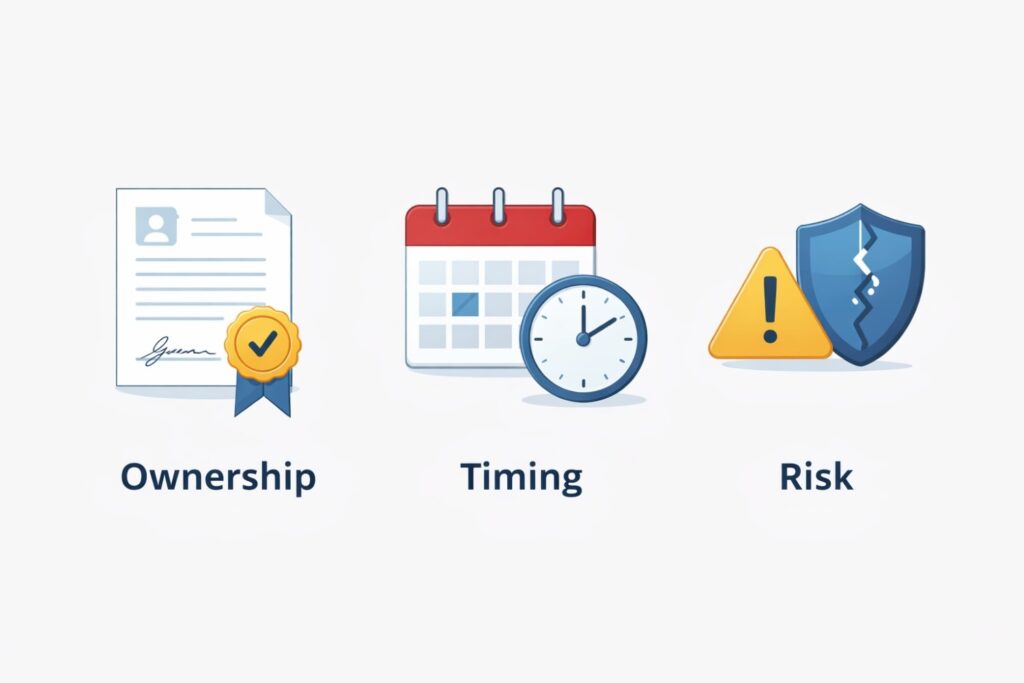
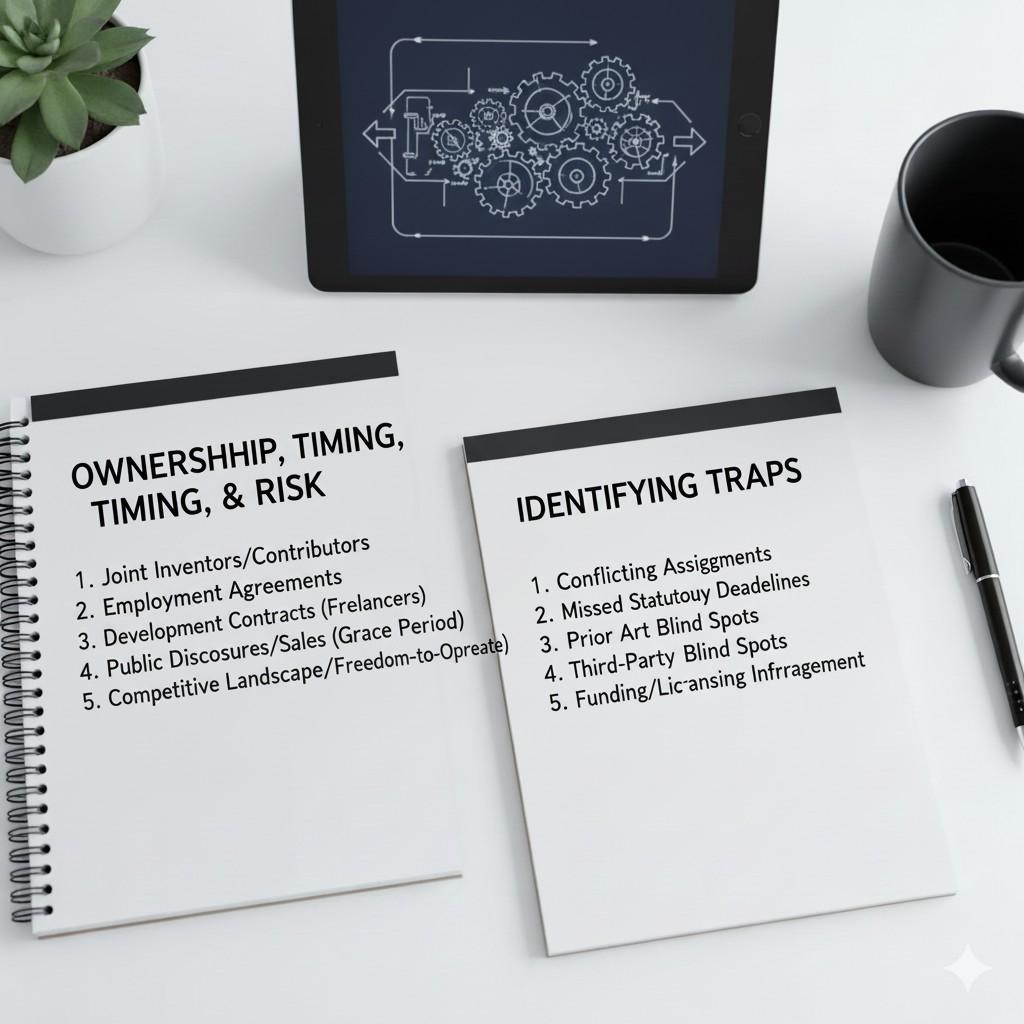
Ownership, Timing, and Risk: The Hidden Traps in Early Intake
Many patents do not fail because the invention is weak.
They fail because of ownership mistakes, timing errors, or silent risks that no one spotted at intake.
These issues rarely show up in the technical description. They hide in the background. In hiring decisions. In product launches. In Git commits. In investor updates.
By the time they surface, damage is often done.
That is why early intake is not just about understanding the invention. It is about scanning for risk before the company locks itself into a filing path that cannot be undone.
This section focuses on what smart IP teams review immediately to avoid costly surprises later.
Ownership Is Not Always Obvious
It is easy to assume that if someone works at the company, the company owns what they create.
That assumption is dangerous.
Ownership must be verified, not assumed.
Confirm Employment Status at the Time of Invention
When reviewing an intake submission, pause and confirm something basic. Was each inventor a full-time employee when the invention was conceived?
If someone joined recently, check whether the key idea was formed before their official start date. If so, assignment may not be automatic.
If someone left the company after contributing, confirm that proper agreements were signed and documented.
These details matter more than teams realize. If ownership is unclear, investors will find it during diligence. Acquirers will flag it. Competitors may exploit it.
You want to discover these issues at intake, not during a deal.
Contractors and Advisors Create Hidden Exposure
Startups often rely on contractors, consultants, or part-time experts.
If any contributor was not a direct employee, you must confirm that an invention assignment agreement exists and covers the work in question.
Do not assume that a general services agreement covers IP rights. Check whether invention ownership is clearly addressed.
If intake notes mention outside contributors, escalate that immediately. Before drafting. Before filing.
Cleaning up assignment gaps after filing can be expensive and stressful.
A structured intake process that prompts teams to identify contributor status upfront reduces this risk. PowerPatent builds these ownership checks directly into the workflow, helping companies catch issues early while attorneys review the details → https://powerpatent.com/how-it-works
Joint Development Can Complicate Everything
Partnerships move fast in startups.
Two companies collaborate. Code is shared. Data flows back and forth. Everyone is focused on shipping.
Few people pause to ask who owns what.
Was the Invention Created During a Collaboration?
If the intake disclosure mentions a partner, customer, or research institution, stop and investigate.
Was there a joint development agreement in place? What does it say about IP ownership?
Some agreements assign ownership based on inventorship. Others assign based on field of use. Some create joint ownership automatically.
Joint ownership can limit enforcement rights. It can also complicate licensing.
You need clarity before filing.
If the invention was created during a collaboration, review the agreement before moving forward. Do not treat it like an internal-only invention until you confirm that status.
Shared Data Can Raise Rights Questions
Even if the invention itself was built internally, if it relies heavily on partner data or co-developed models, ownership questions may arise.
For example, if a model was trained using proprietary datasets provided under a restricted agreement, that may affect how the invention can be used or licensed.
Intake review should include a brief scan for external data dependencies.
If the invention depends on third-party inputs in a meaningful way, loop in the right stakeholders early.
Ignoring this can create downstream conflict.
Timing Errors Can Destroy Rights
Timing is one of the most unforgiving aspects of patent protection.
You cannot negotiate with the calendar after a deadline passes.
Public Disclosure Often Happens Quietly
Founders love to share progress.
They speak at conferences. They publish blog posts. They pitch investors. They post on social media. They open beta programs.
Any of these can qualify as public disclosure depending on the details.
During intake review, look for any sign that the invention has been shown or described publicly.
Do not rely only on formal publications. Ask whether slides were shared. Whether demos were recorded. Whether screenshots were posted.
Even informal exposure can trigger filing deadlines in certain regions.
You want exact dates. Not estimates.
If exposure has already occurred, your filing strategy may need to shift quickly.
Product Releases Can Start the Clock
If the invention is already embedded in a released product, confirm the launch date.
Public product availability can impact patent rights in many jurisdictions.
Even a soft launch to a limited group may count depending on the circumstances.
The intake stage is your best chance to capture these facts accurately while memories are fresh.
IP teams that delay this check risk discovering timing problems after drafting is complete.
That is wasted time and unnecessary stress.
PowerPatent’s guided intake prompts teams to document public use and release timelines upfront, helping companies avoid accidental forfeiture of rights → https://powerpatent.com/how-it-works
Open Source and Licensing Risks
Modern tech companies build on open source tools.
That is normal. It is also a source of risk if not reviewed carefully.
Was Any Open Source Code Modified?
If the invention involves modifications to open source software, confirm the license terms.
Some licenses require sharing derivative works under specific conditions. Others are more flexible.
While patents and open source are separate legal areas, the interaction between them can create strategic concerns.
During intake review, flag any open source components that were altered as part of the invention.
You do not need to solve the issue immediately. But you do need awareness.
Ignoring this can create friction later if the company seeks to enforce the patent.
Are There License Restrictions on Key Components?
If the invention depends on licensed third-party software, check whether the license includes restrictions related to ownership or derivative works.
Most standard licenses do not create patent ownership issues. But unusual terms do exist.
A quick review at intake can prevent major headaches later.
Competitive and Regulatory Risk Signals
Early intake is also a moment to scan for external pressure points.
These may not block filing, but they shape strategy.
Does This Invention Target a Dominant Competitor?
If the invention directly challenges a large incumbent’s core technology, that matters.
It may increase the value of strong protection. It may also raise the risk of scrutiny.
Understanding competitive context helps IP teams decide how aggressively to draft and where to file.
During intake, ask whether the team views this as a differentiator against a specific competitor.
That insight informs strategy.
Are There Regulatory Constraints?
In sectors like healthcare, finance, and AI, regulatory rules can affect how inventions are deployed.
If the invention interacts with regulated data or processes, note that early.
While this may not affect patentability directly, it can influence enforcement strategy and product rollout.
Capturing these signals at intake creates a more complete picture.
Build a Culture of Early Risk Awareness
Ownership, timing, and risk checks should not feel like legal roadblocks.
They should feel like protective shields.
When IP teams treat intake as a serious review step, founders learn to surface sensitive details early.
That cultural shift reduces friction over time.
It also builds trust with leadership. When investors or board members ask about IP hygiene, you can answer with confidence.
PowerPatent supports this disciplined approach by combining structured data capture with experienced attorney review. Founders move quickly, but with safeguards built into the process → https://powerpatent.com/how-it-works
Early intake is where hidden traps are either caught or missed.
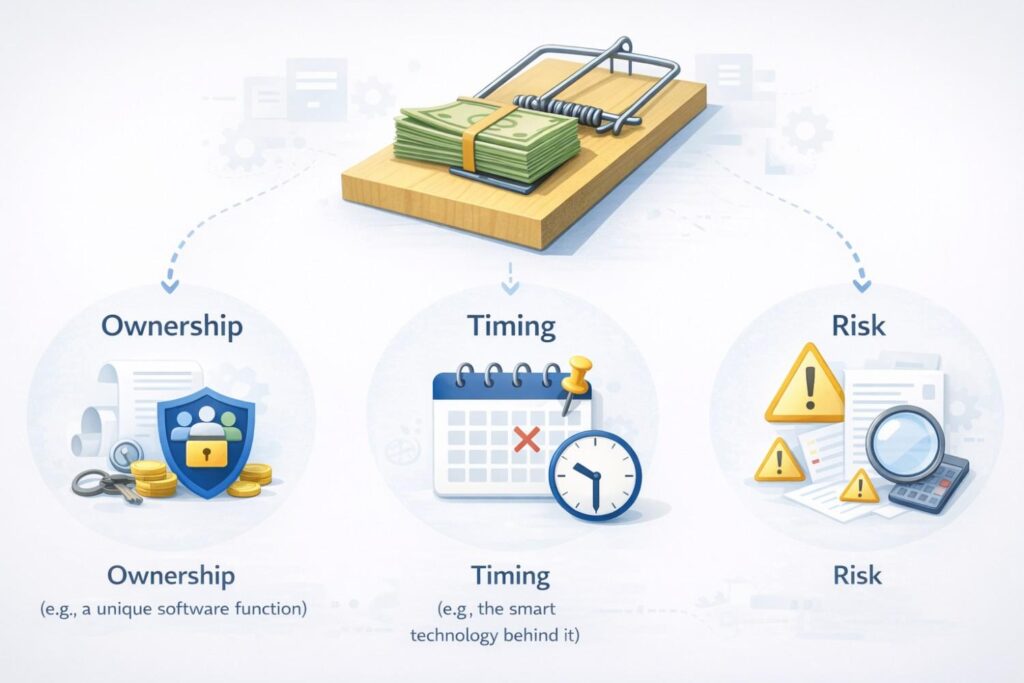
If you slow down just enough to review ownership, timing, and risk carefully, you protect not only the patent, but the company itself.
Turning Raw Notes Into a Filing-Ready Strategy
An invention disclosure is rarely clean.
It comes in as rough notes. A slide deck. A Slack thread copied into a form. A mix of code comments and half-finished diagrams.
That is normal.
Your job is not to judge the format. Your job is to turn that raw material into a clear, focused, filing-ready strategy.
This is where many IP teams either create real value or become paper processors.
Strategy does not start at drafting. It starts the moment you decide what this patent is really going to protect.
Move From Information to Positioning
Raw notes contain facts. A filing-ready strategy requires positioning.
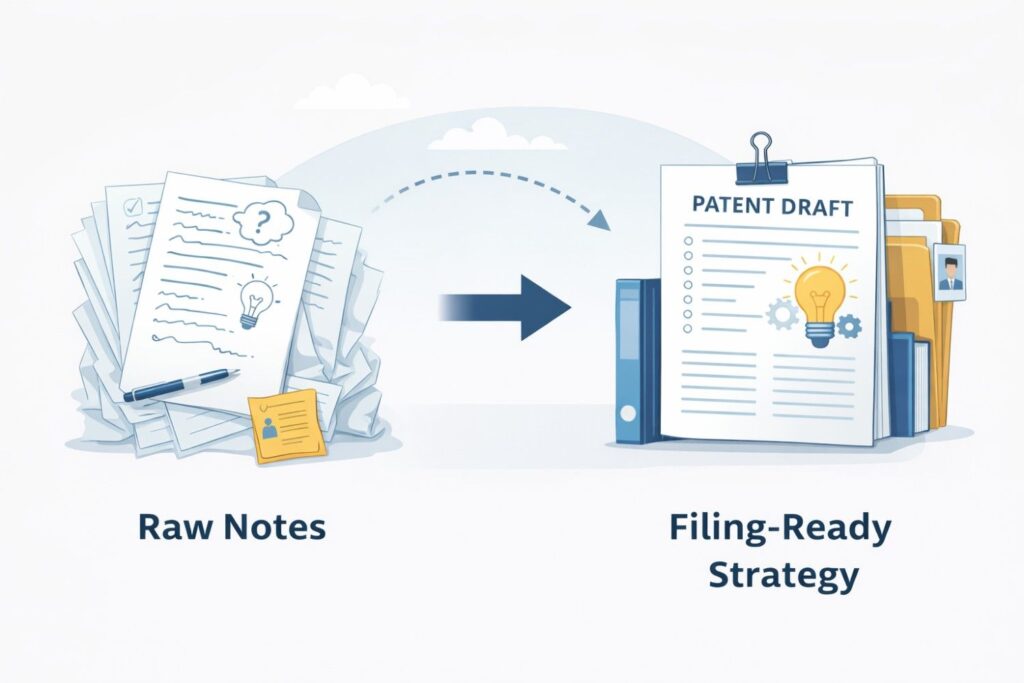
That means deciding what angle you will take, what story you will tell, and what ground you want to claim.
Define the Core Thesis of the Patent
Before drafting begins, reduce the invention to a single core idea.
Not a feature description. Not a product name.
A technical thesis.
For example, instead of saying, “This system improves real-time analytics,” your internal thesis might be, “A distributed event-trigger model retraining system that dynamically reallocates compute resources based on anomaly thresholds.”
That internal framing shapes everything that follows.
It guides what you emphasize in the specification. It influences how broad you can go. It helps avoid drifting into secondary details.
If you cannot clearly articulate the thesis in one or two tight sentences, the strategy is not ready.
Platforms like PowerPatent help teams refine this thesis early by structuring technical inputs and layering in attorney review before drafting begins → https://powerpatent.com/how-it-works
Decide What You Are Really Trying to Protect
Not every detail in the disclosure deserves equal attention.
Some parts are implementation choices. Others are the heart of the invention.
You must decide which is which.
Protect the Engine, Not the Paint
Founders often feel attached to specific product flows or UI layers. Engineers may focus on specific code structures.
But ask yourself: if a competitor rebuilt this system differently but achieved the same technical breakthrough, would you still want protection?
If the answer is yes, then your strategy must focus on the engine behind the result, not the cosmetic elements.
During this stage, strip away anything that feels like branding, interface design, or temporary implementation detail.
Keep the structural changes. Keep the technical mechanisms.
This discipline leads to stronger, more durable patents.
Identify What Competitors Would Try to Copy
A practical strategy test is simple.
If this product succeeds, what will competitors try to replicate?
They will not copy your exact code. They will copy the underlying concept that gives you an edge.
That concept is what your filing should center around.
When reviewing raw notes, think like a competitor. What would you reverse engineer? What architectural change would you attempt to imitate?
Anchor your strategy around that core advantage.
Build Layers of Protection Early
A filing-ready strategy is rarely one-dimensional.
Strong patents often include layered protection that covers different angles of the same invention.
Consider Multiple Technical Entry Points
The same invention can often be described from different perspectives.
It may be framed as a method. As a system. As a process running on distributed nodes. As a computer-readable medium storing instructions.
Even before formal claim drafting, your strategy should account for these angles.
When converting raw notes into strategy, map the invention across its natural technical forms.
How does it operate step-by-step? How does it function as a system? What components interact?
Thinking this through early ensures that the drafting phase is focused and efficient.
Capture Variations Before They Are Forgotten
Raw disclosures often describe one main embodiment.
But inventors frequently mention variations casually during follow-up conversations.
Different thresholds. Alternate data sources. Optional processing steps.
Do not treat these as afterthoughts.
During strategy development, actively ask for variations.
What happens if input data changes format? What if processing occurs at the edge instead of in the cloud? What if the algorithm uses a different optimization method?
Capturing these alternatives early strengthens your position and gives room to maneuver during prosecution.
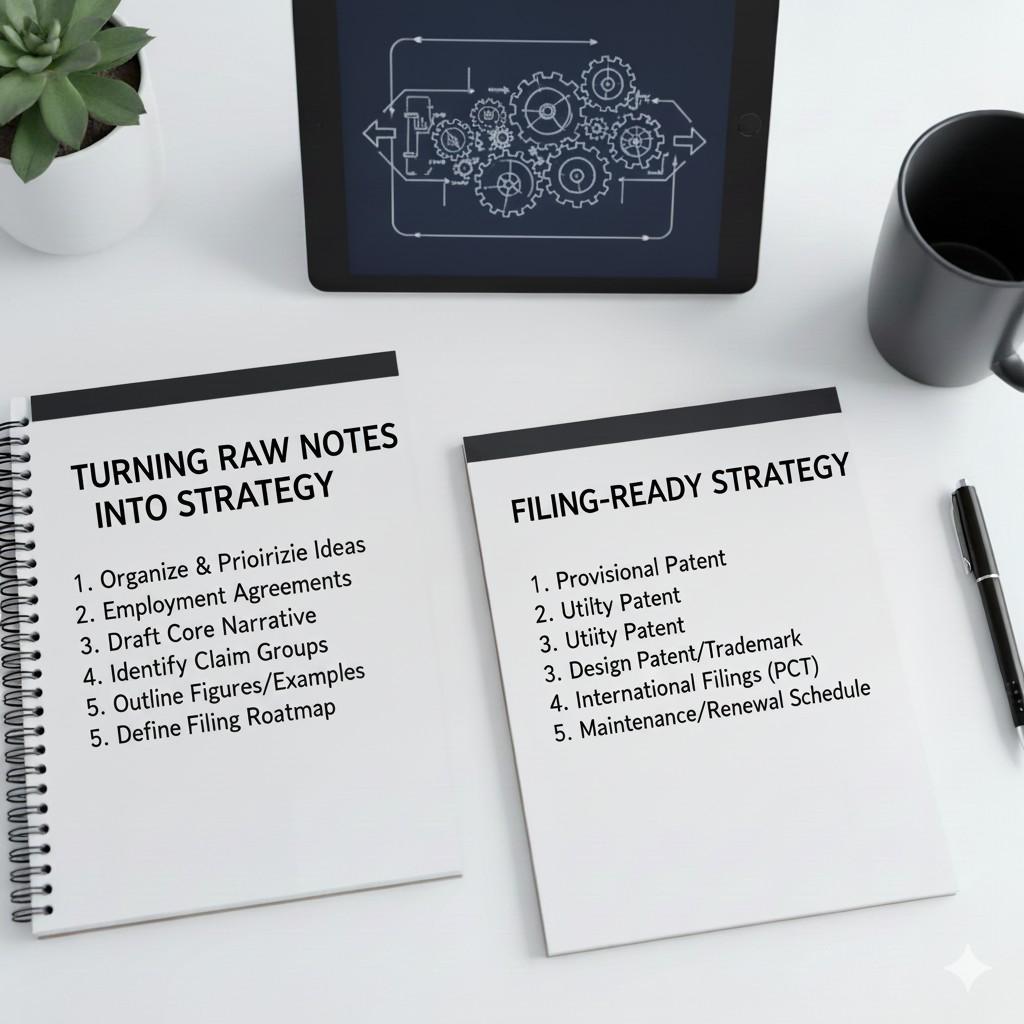
PowerPatent’s structured intake approach encourages inventors to think through variations upfront, reducing the risk of narrow filings that miss obvious extensions → https://powerpatent.com/how-it-works
Align With Portfolio Goals
A single patent does not exist alone.
It lives inside a portfolio.
Your strategy must consider how this filing fits into the broader IP picture.
Fill Gaps, Do Not Duplicate
Review existing filings and pending applications.
Is this invention filling a gap in coverage? Or does it overlap heavily with something already filed?
If overlap exists, decide whether this is an improvement that deserves its own protection or whether it should be positioned as a continuation or follow-on.
Making this decision early avoids confusion later.
It also ensures your portfolio grows intentionally rather than randomly.
Think About Future Roadmaps
Talk to product leadership if needed.
Is this invention part of a larger technical direction? Will future versions expand on this concept?
If yes, structure this filing to serve as a foundation.
That may mean drafting with enough depth and breadth to support future continuation filings.
Turning raw notes into strategy is not just about the present invention. It is about enabling future protection.
Prepare for Examination From Day One
A filing-ready strategy anticipates questions before they are asked.
Examiners will look for novelty. They will look for clarity. They will test boundaries.
You can prepare for that now.
Clarify Technical Advantages Clearly
Do not assume the advantage is obvious.
In your internal strategy notes, define exactly what technical improvement this invention provides.
Does it reduce memory usage? Increase processing speed? Improve prediction accuracy? Enhance fault tolerance?
Be specific.
Quantified improvements are powerful when available. If the team has metrics, capture them now.
Even if exact numbers are not included in the final filing, understanding them sharpens the narrative.
Define the Problem-Solution Link
Every strong patent tells a clear story.
There was a technical problem. The prior approaches failed in specific ways. This invention introduced a new structure or method that solved it.
During strategy development, make sure that story is tight.
If the problem is vague, refine it. If the solution is loosely described, sharpen it.
A clear internal story leads to a stronger external filing.
Create a Clean Drafting Brief
By the time you finish converting raw notes into strategy, you should have something powerful.
Not a draft application.
A clean, structured brief that makes drafting almost mechanical.
This brief should clearly state the core thesis, identify the key mechanisms, outline major variations, highlight business importance, and flag any ownership or timing risks.
When you reach this stage, drafting becomes execution, not discovery.
This is where modern IP teams gain speed.
Instead of endless back-and-forth emails and unclear direction, the attorney works from a structured foundation.
PowerPatent is designed exactly for this moment. Smart software captures invention details in a structured way, and real patent attorneys refine them into filing-ready applications without the delays of traditional firms → https://powerpatent.com/how-it-works
Speed Without Chaos
Founders want speed.
IP teams want accuracy.
Turning raw notes into a filing-ready strategy is how you achieve both.
When strategy is clear, drafting is faster. When risks are flagged early, surprises are rare. When the invention is framed properly from the start, prosecution becomes smoother.
This is not about adding bureaucracy.
It is about building a repeatable system that transforms messy inputs into strong, defensible protection.
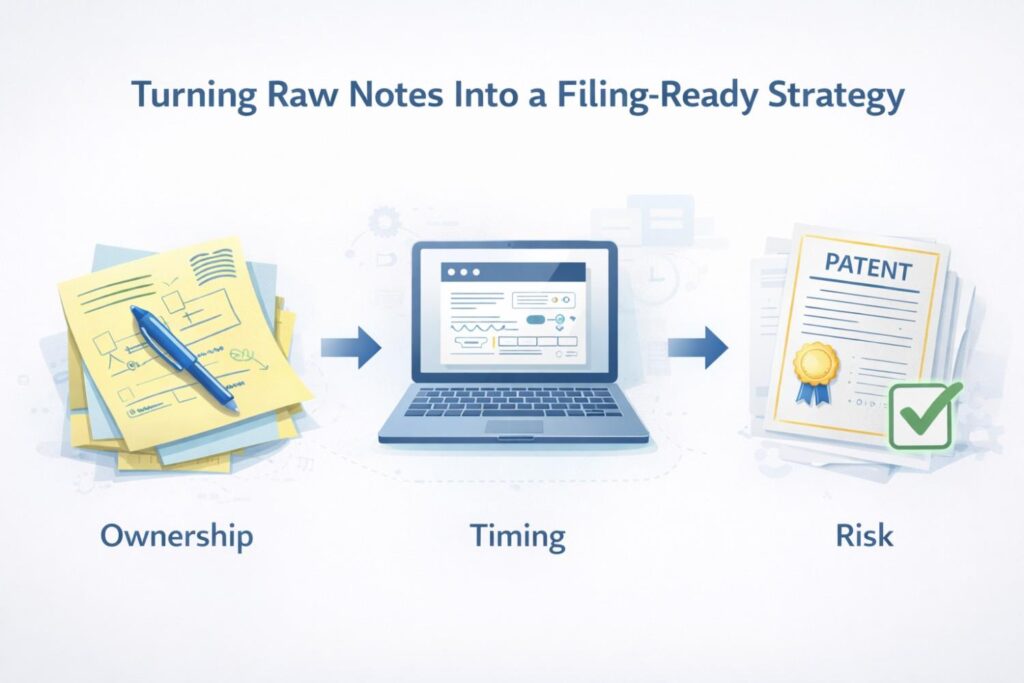
And when that system is powered by modern tools and experienced legal oversight, the process feels less like a burden and more like a strategic advantage.
Wrapping It Up
Strong patents do not start with claims. They start with discipline. They start with careful intake. With clear ownership. With verified timing. With a deep understanding of the real invention, not just the product feature. With a deliberate strategy that turns messy notes into focused protection.