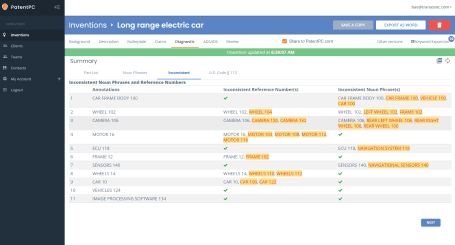
Most founders do not struggle because they lack good ideas. They struggle because they are moving fast, building real things, and trying to protect what they build before someone else catches up.
That is where patent writing often breaks down.
A founder may have one strong version of an invention in mind. The team knows how the product works today. They know what the code does. They know the model, the system flow, the data path, the hardware setup, or the user action sequence. But a strong patent usually needs more than one version. It needs to show the invention in different forms, different setups, and different ways it can be used.
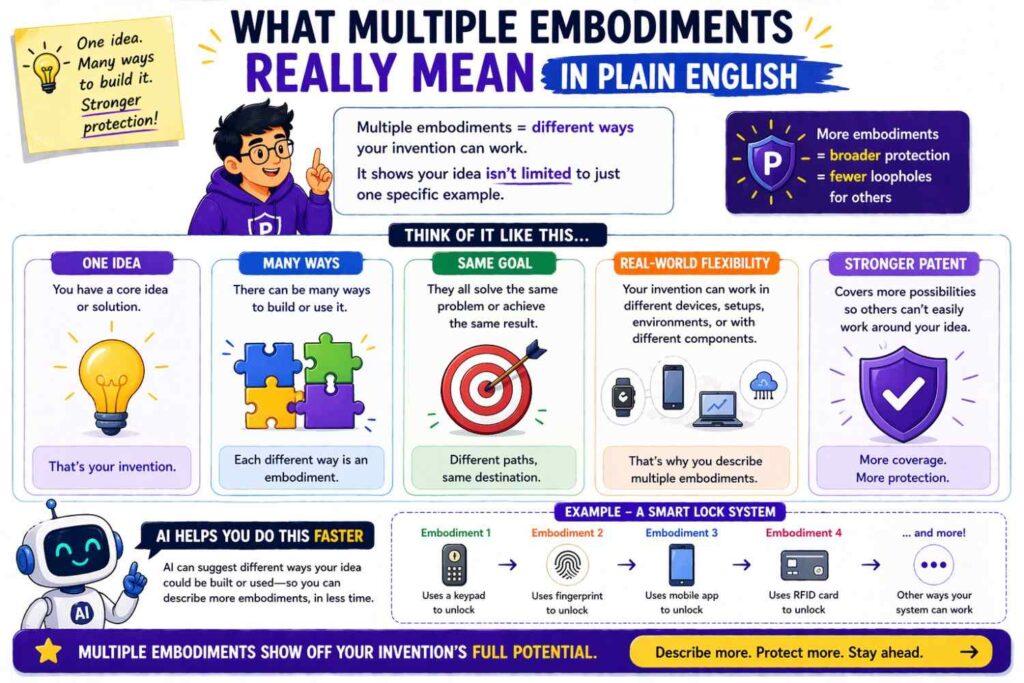
That is what people mean by multiple embodiments.
And that is exactly where AI can help.
When used the right way, AI can help founders and engineers describe more versions of an invention, more clearly, in less time, without losing the real technical value. It does not replace legal judgment. It does not replace careful review. But it can take a painful, slow writing job and turn it into a much faster, more usable workflow.
That matters a lot when you are building a startup and every week counts.
If you want to see how founders use software and real attorney support together to file better patents faster, take a look at how PowerPatent works here: https://powerpatent.com/how-it-works
The real problem is not writing one version
A lot of people think patent drafting is about describing the product. That is only part of it.
The bigger job is showing the invention with enough range.
A startup founder often explains the invention like this: “Our system takes this input, runs this model, ranks these results, and then sends the best answer to the user.” That may be true. It may even be a very good description of the current build. But it is usually too narrow.
What happens if the input is collected a different way? What happens if the ranking step uses different logic? What happens if the model is local in one case and remote in another? What happens if the user does not ask directly, but the system predicts intent from signals? What happens if the same core idea is used in healthcare, fintech, logistics, robotics, security, or developer tools?
Those are not random side notes. Those are often the very details that help expand and strengthen protection.
This is why multiple embodiments matter. They help show that the invention is not just one tiny implementation frozen in time. They help show the broader concept and the different ways it can exist in the real world.
The problem is that writing these versions takes work. A lot of work.
It takes time to think through the alternatives. It takes energy to turn those alternatives into clean language. It takes patience to avoid saying the same thing again and again in a useless way. It takes technical care to make sure each version still matches the actual invention. And it takes discipline to do all of this while your team is also trying to ship product, raise money, hire people, and stay alive.
That is why many patent drafts end up thin. The founder gives one explanation. The patent process turns that into one main story. The result may cover the product as built, but not the wider shape of the invention.
AI can help fix that bottleneck.
What multiple embodiments really mean in plain English
Let us keep this simple.
An embodiment is a version of how an invention can work.
It is not magic language. It just means one possible way the invention may be carried out.
If your invention is a system that detects fraud, one embodiment may use a machine learning model trained on user behavior data. Another embodiment may use rules. Another may combine both. Another may run in real time during checkout. Another may run after the transaction as part of a review process. Another may work for banks. Another may work for crypto wallets. Another may work for marketplaces.
If your invention is a robotics control system, one embodiment may use sensor fusion from cameras and lidar. Another may use cameras and depth sensors. Another may use a remote planner. Another may do edge inference on the device. Another may adjust motion based on safety rules set by the operator. Another may learn from prior task runs.
The core idea may still be the same. But the expression of that idea can change.
That range matters because competitors do not copy your invention in the exact way you first wrote it down. They often change one part, shift a sequence, move a function to another layer, swap one model for another, or use the same idea in a different market. If your patent only speaks to one narrow version, it may be easier for others to work around it.
Multiple embodiments help reduce that risk.
They also help tell a fuller technical story. Founders often know far more than they first say. In conversation, they can explain ten different ways their system might operate. But in the actual draft, only two of those ways may appear. AI can help close that gap by pulling more of the founder’s own knowledge into the written description.
That is one of the biggest gains.
Why this is hard for even very smart founders
Technical founders are usually very good at building. They are often very good at explaining the product to users, investors, and engineers too. But patent writing asks for a different kind of thinking.
It asks you to move between the specific and the general at the same time.
You need enough detail to show the invention is real. But you also need enough breadth to avoid trapping yourself inside one tiny corner of your own idea.
That tension is hard.
A founder may say, “We use a transformer model that scores event streams from API calls and user sessions.” That is useful detail. But if the core invention is actually about detecting risky sequences from time-based system behavior, then the draft may need to talk about other model types, other data sources, other scoring methods, and other deployment patterns too.
The founder knows this in the abstract. But during a busy week, they may not sit down and write five clean alternatives. They may not ask themselves what happens when the same logic runs in a different architecture. They may not map which parts are optional, which parts are preferred, and which parts are essential.
This does not happen because they are careless. It happens because they are busy and because writing broad technical language from scratch is mentally expensive.
The more complex the invention, the more expensive the writing becomes.
Now think about a startup with a stack that includes model training, inference, user personalization, data ingestion, API orchestration, security controls, device-side processing, and analytics feedback loops. There may be dozens of possible embodiments hidden inside the system. Each one could matter. Each one could become important later as the product changes or the market shifts.
Without help, many of those paths never get written down.
AI helps by making expansion easier.
It can take a founder’s first explanation and help surface adjacent versions, likely alternatives, optional modules, deployment changes, sequence changes, data changes, and use-case changes. Instead of staring at a blank page, the founder can react to a structured expansion and refine it.
That is much faster than drafting every version by hand.
AI is not valuable because it writes more words
This is important.
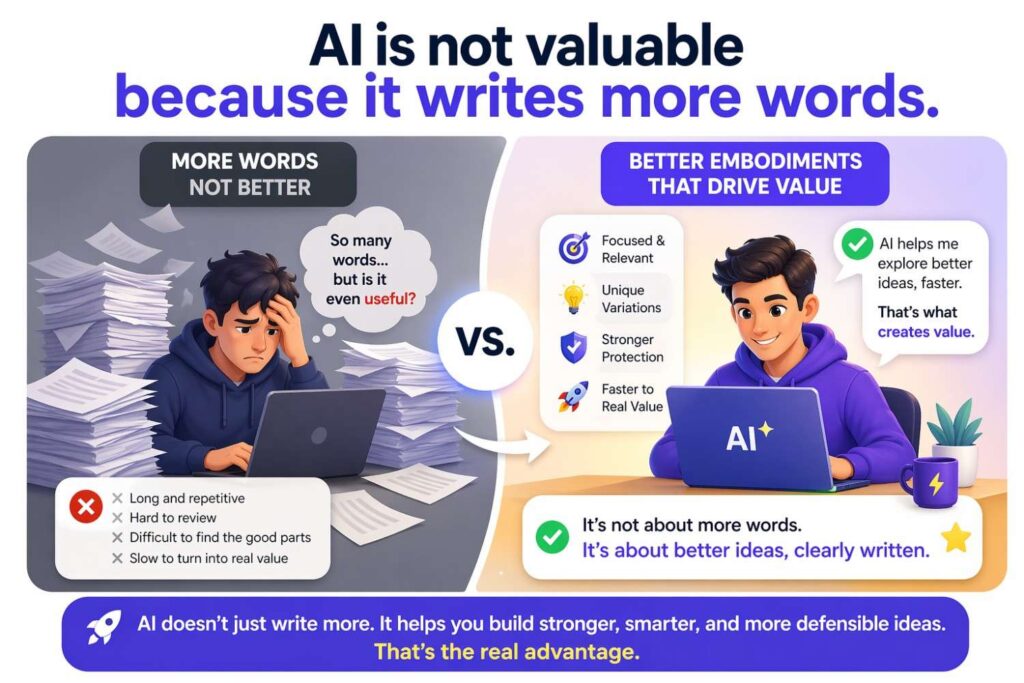
The value of AI is not that it can flood a page with text.
Anyone can generate more words. That is not the hard part.
The real value is that AI can help produce more useful variation from a technical core.
That means turning one invention explanation into a richer map of possible implementations.
A weak use of AI sounds like this: take the same sentence, swap a few terms, and repeat it ten times. That does not help much. In fact, it can make a draft worse because it creates clutter without adding real support.
A strong use of AI sounds like this: identify the main inventive concept, break it into functional pieces, ask how each piece can vary, ask where each piece can sit in the system, ask what can happen before or after each step, ask what data can be used, ask which parts are optional, ask where the same concept works in a different environment, and then turn those answers into readable draft language.
That is a different game.
When used well, AI is not just a text machine. It is a structured thinking aid.
It helps the inventor move from “here is what we built” to “here are the many technically valid ways this invention can exist.”
That shift is where speed and quality can meet.
The old way is slow because it depends on memory and stamina
In many traditional workflows, the process looks something like this.
The inventor explains the invention in a meeting. Notes are taken. Some questions are asked. A draft begins. Later, the drafter tries to think of alternatives and broader versions. Another round of questions may happen. Then revisions go back and forth.
This can work. Good attorneys have done it for years. But it often depends on two fragile things: what people remember and how much time they have.
Memory is imperfect. Stamina is limited.
A founder may forget to mention an alternative architecture that seemed obvious at the whiteboard. A drafter may not know which optional system paths matter most. A team may skip a deeper brainstorm because they are racing toward a filing date. An engineer may say, “We could also run this at the edge,” but that thought never makes it into the final text.
Over time, those missed details add up.
AI helps by reducing the cost of exploration.
It lets the team explore more possibilities early, while the technical picture is still fresh. It can respond to prompts like, “Show alternative ways this module could collect data,” or “Generate embodiments where the ranking engine is local, remote, or hybrid,” or “Describe optional security checks before model execution,” or “Rewrite this invention for different deployment environments while keeping the core concept the same.”
That does not mean every output should go straight into a filing. It should not. But it means the thinking process becomes faster and more complete.
Instead of relying only on what one person thinks of in one meeting, the team can use AI to widen the search space and then review that output with real judgment.
That is a smarter way to work.
Why speed matters more than people admit
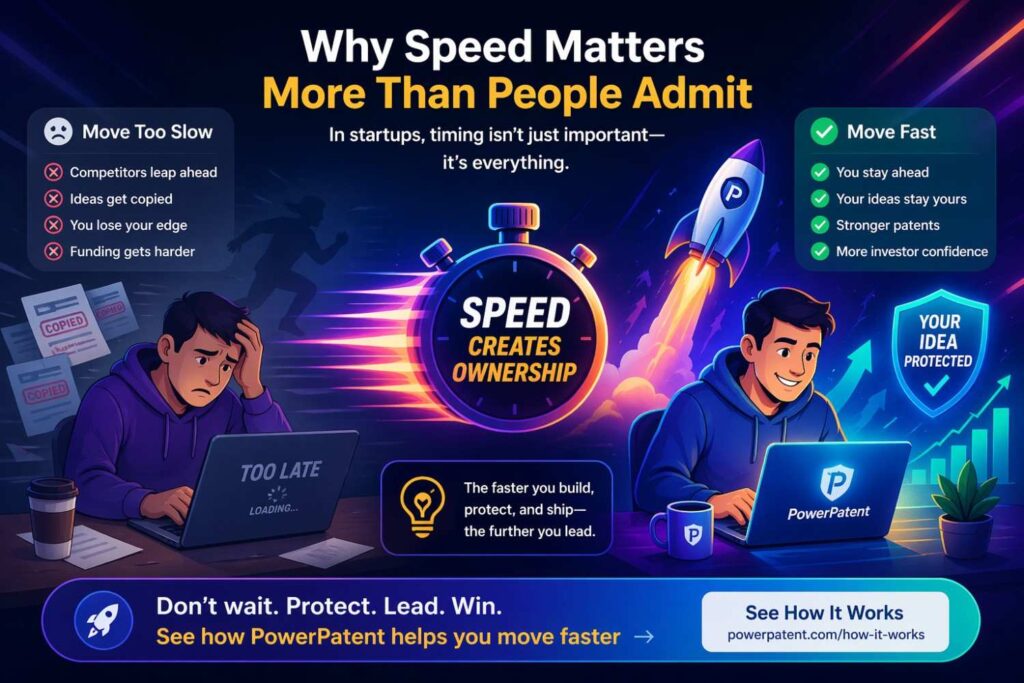
Founders often hear that patent quality matters, and that is true. But speed matters too.
Speed matters because startups change fast.
A feature that feels central today may become one part of a larger platform in three months. A model pipeline may change. A hardware setup may evolve. A deployment choice may flip after a customer request. A product built for one vertical may suddenly fit three.
If the patent process is too slow, the written story may lag behind the actual invention. The team may file too late. Or they may file a narrow version because it was the only version they had time to write down.
That is where AI creates leverage.
By speeding up the early drafting and expansion work, it helps teams capture more of the invention while the ideas are still fresh and before the product shifts again.
This is especially useful for startups that are still discovering their best product shape. A founder may know the core technical advantage but may not yet know which market path will win. Multiple embodiments help keep options open. AI helps create those embodiments faster.
That does not just save time. It helps preserve future room.
PowerPatent is built around this reality. Startups do not need more delay. They need a better way to move from technical invention to strong patent work without falling into the old slow process. That is why a mix of smart software and real attorney oversight matters so much. You can see how that works here: https://powerpatent.com/how-it-works
How AI actually helps at the start
The first big help comes right after the inventor explains the invention.
Most inventors start with a rough explanation. It may be a product demo, a whiteboard walk-through, an architecture doc, a code sample, a research note, or a voice memo. This first explanation is often rich with meaning but rough in form. It may jump between details. It may assume context that is not written down. It may mix core invention points with implementation choices that are not essential.
AI can help turn that rough material into a structured draft base.
It can pull out the system components. It can identify the sequence of steps. It can suggest where one step may be optional. It can separate input handling from processing, model logic from output generation, storage from communication, orchestration from control. It can reflect the invention back in a clearer shape.
This alone saves time.
But the bigger gain comes next.
Once the first structure exists, AI can help ask the next question again and again: what else?
What other ways can this be done while keeping the inventive concept intact?
What other data may be used?
What other modules may perform this function?
What other environments may host this system?
What other user actions or system triggers may start the flow?
What other decision logic may be applied?
What parts may be parallel instead of sequential?
What parts may be removed in a simpler version?
What parts may be added in a more advanced version?
Those questions are the engine of multiple embodiment drafting.
AI is very good at helping drive that engine quickly.
The most useful AI pattern is controlled expansion

The best results usually do not come from asking AI to “write more embodiments” in one vague command.
The best results come from controlled expansion.
Controlled expansion means you start with the actual invention as grounded input. Then you expand it one dimension at a time.
You may begin with the core problem solved by the invention. Then the core mechanism. Then the system pieces. Then the data used. Then the deployment choices. Then the sequence of operations. Then the possible user types. Then the target environments. Then the model options. Then the fail-safe or fallback paths. Then the integration paths.
By expanding one layer at a time, you avoid nonsense. You avoid generic filler. And you stay closer to the real invention.
For example, imagine the invention is a system that uses machine learning to route customer support tickets based on urgency, topic, and account context.
A loose AI prompt may return a blob of generic alternatives. Some may be useful. Many may be shallow.
A controlled workflow would do something smarter.
First, define the core inventive concept. Maybe it is not “ticket routing with AI” in the broadest sense. Maybe it is specifically “using account-sensitive context features and dynamic urgency weighting to route support interactions in a way that improves outcome speed.”
Now you have a center.
Next, ask how inputs may vary. Ticket text, call transcript, email body, app events, account metadata, usage logs, prior support history.
Then ask how urgency may be determined. Rules, model scores, thresholds, hybrid logic, administrator-set weights, dynamic weights based on service level agreement status.
Then ask how routing may happen. To an agent, to a queue, to a bot, to a team, to an escalation process, to a resolution workflow.
Then ask where the system runs. Single tenant, multi-tenant, on-device, cloud, edge gateway, enterprise private deployment.
Then ask how feedback improves the system. Manual corrections, outcome tracking, reinforcement signals, retraining, online updates, ranking calibration.
Each of those areas can produce multiple embodiments. And because the expansion is grounded in the real invention, the result is more likely to be helpful.
This is how AI helps teams write faster without drifting into meaningless text.
AI helps founders see the shape of their own invention
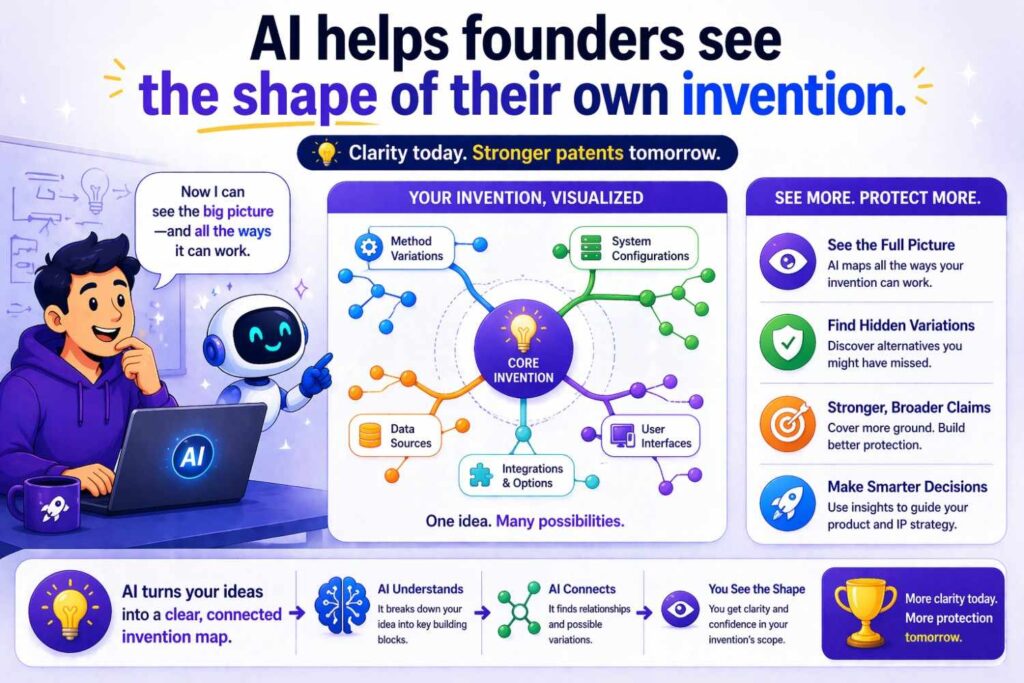
One of the most interesting things about this process is that many inventors do not fully see the range of their own invention until they watch it get expanded.
That is not a flaw. It is normal.
When you are deep in building, you focus on getting the product to work. You make choices that fit the current system, the current users, the current budget, the current stack, and the current timeline. You choose one model, one hardware profile, one data path, one UI flow.
But your actual inventive idea may be broader than those choices.
AI can reflect that back to you.
It can show that the core concept still makes sense even if one subsystem changes. It can reveal that your ranking logic can be applied before or after another step. It can show that the same control method can work with different sensors. It can reveal that a personalization engine can be triggered by user input, background monitoring, or scheduled evaluation. It can show that your security mechanism can live in the client, the gateway, the server, or a trusted enclave.
Suddenly the invention feels larger and more durable.
That is powerful because it helps founders stop thinking only in terms of today’s implementation.
Strong patent work often starts when the founder can say, “Wait, yes, that is still our idea even if we swap that component.”
AI helps surface those moments faster.
The difference between helpful breadth and dangerous overreach
Now for the part that matters just as much as speed.
Not every expanded embodiment is good.
One of the risks of AI is that it can suggest versions that sound plausible but are not really supported by the invention. Or it can push too far and create language that is so broad it disconnects from what the inventors actually built or understood.
That is why review matters.
Helpful breadth stays tied to the real inventive concept.
Dangerous overreach drifts into generic territory or invents unsupported details.
This is why founders should not treat raw AI output as final patent content. It is a working layer. It is a draft expansion layer. It is a thought partner. But it still needs technical and legal review.
A good process asks questions like these.
Does this embodiment still rely on the same core inventive insight?
Would the inventors understand and stand behind this version?
Is this a true variation, or is it a different invention?
Does this language add support, or is it just inflated text?
Does this broaden usefully, or does it become vague?
These questions are exactly why software alone is not enough for something this important.
For startups, the sweet spot is not old-school slowness and it is not blind AI generation either. The sweet spot is smart software plus real patent attorney oversight. That is the kind of system that can help a founder move faster without making avoidable mistakes. That is also why PowerPatent’s model makes sense for technical teams that want speed and confidence together: https://powerpatent.com/how-it-works
AI helps find variations across the whole stack

When founders hear “multiple embodiments,” they sometimes think only about one part of the system. They may think it means describing a few alternative algorithms or changing one hardware component.
But embodiments can vary across the full stack.
AI is useful because it can help examine the invention from many angles.
The input layer can vary. Data can come from sensors, user actions, logs, APIs, cameras, documents, message streams, wearable devices, industrial systems, financial records, system telemetry, or external feeds.
The processing layer can vary. A system can use rules, learned models, ranking functions, optimization logic, thresholding, signal fusion, graph analysis, vector search, simulation, or statistical scoring.
The architecture can vary. Modules can be centralized or distributed. Some functions can run on device, in the cloud, at the edge, or through a hybrid flow. Components can be decoupled or tightly linked.
The sequence can vary. One step may happen before another in one version, but after it in another. A validation step may be optional. A confidence score may trigger a fallback path. A user confirmation may happen before execution or after preliminary output.
The output can vary. The system may return a ranked answer, a binary flag, a user-facing recommendation, a control signal, a route decision, a generated draft, a changed parameter, a risk score, or a dashboard update.
The environment can vary. The same invention may be used in logistics, healthcare, manufacturing, cloud security, education, biotech, fintech, retail, or enterprise software.
The actor can vary too. One embodiment may involve a user, another an admin, another an automated system, another a downstream application.
AI helps because it can move through these layers fast and generate draft language for each one without losing track of the core logic.
That makes the exploration of embodiments far more complete than a rushed manual pass.
A simple example from a startup product
Let us make this concrete.
Imagine a startup has built an AI code review system. It scans pull requests, detects risky changes, and gives recommendations before code merge. The system uses code diffs, dependency data, commit history, test coverage, and model predictions to flag issues and assign a risk score.
The founder may first explain the invention like this:
“Our system looks at a pull request, computes a risk score using a trained model, and then decides whether to request more review, block merge, or suggest test steps.”
That is a solid start. But there are many possible embodiments inside it.
The system may use static analysis in one embodiment and not in another. It may use developer history in one version and repository-level patterns in another. It may compute the score on the server in one case and within a private enterprise environment in another. It may give direct recommendations to the author in one embodiment and route the pull request to a specific reviewer in another. It may use thresholds set by policy in one version and learned thresholds in another. It may run when a pull request opens, when a new commit is pushed, on a schedule, or just before merge.
A human can find these alternatives. But AI can help find them much faster and draft them in usable form.
Now imagine the startup later expands into infrastructure policy review, security scanning, and deployment gating. If the early patent draft already captured broad embodiments around change-risk analysis, policy scoring, workflow routing, and action triggering, the startup is in a better place than if the draft only described one narrow merge-blocking flow.
That is why this matters in practice.
It is not abstract. It affects how well the patent fits the company as it grows.
AI is especially strong at pattern-based variation
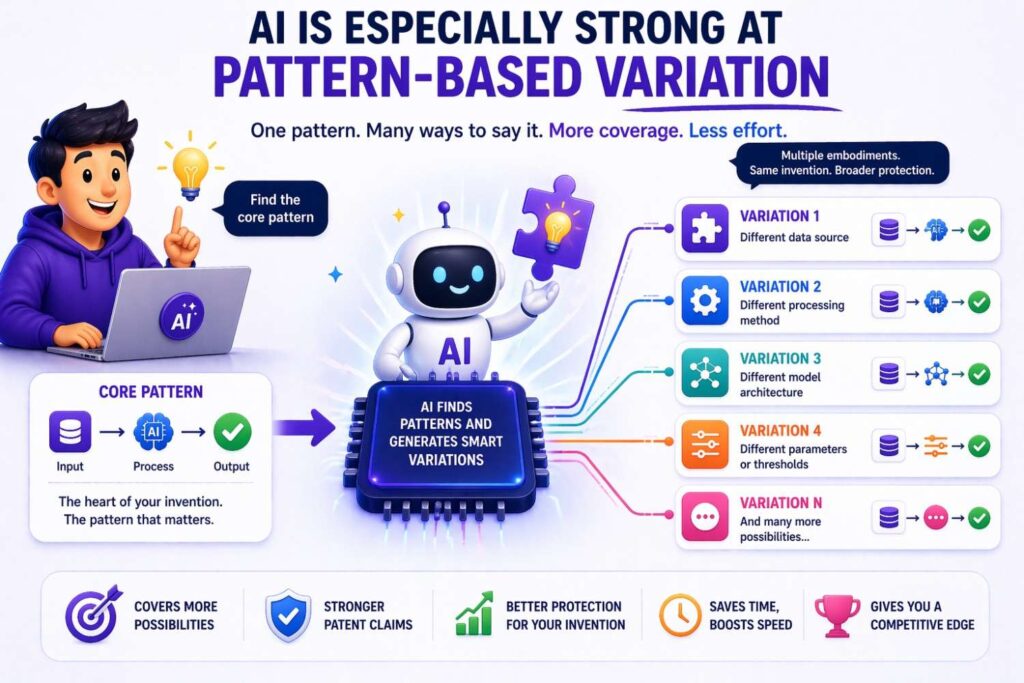
One reason AI works well here is that patents often involve patterns.
Not canned phrases. Real technical patterns.
Systems receive inputs, transform data, compute values, compare thresholds, select actions, store results, update models, trigger outputs, and repeat.
Embodiments often vary by changing one part of that pattern while preserving the inventive core.
AI is good at seeing that structure and generating variations around it.
For instance, if a system performs three steps in sequence, AI can help suggest whether some steps might occur in parallel, whether a step could be omitted under certain conditions, whether a different component could perform the step, or whether a different data type could feed the same logic.
If an invention uses a prediction score, AI can help articulate variations where the score is binary, continuous, relative, weighted, updated over time, adjusted by policy, aggregated across signals, or combined with rule-based checks.
If an invention relies on user context, AI can help expand which kinds of context may be used and how they may influence downstream actions.
This pattern sensitivity is one of the reasons AI can help write embodiments faster than manual drafting alone. It can recognize where technical variation is natural and then turn that into text.
Again, the output still needs review. But the first-pass work becomes much lighter.
Founders often underwrite optional features
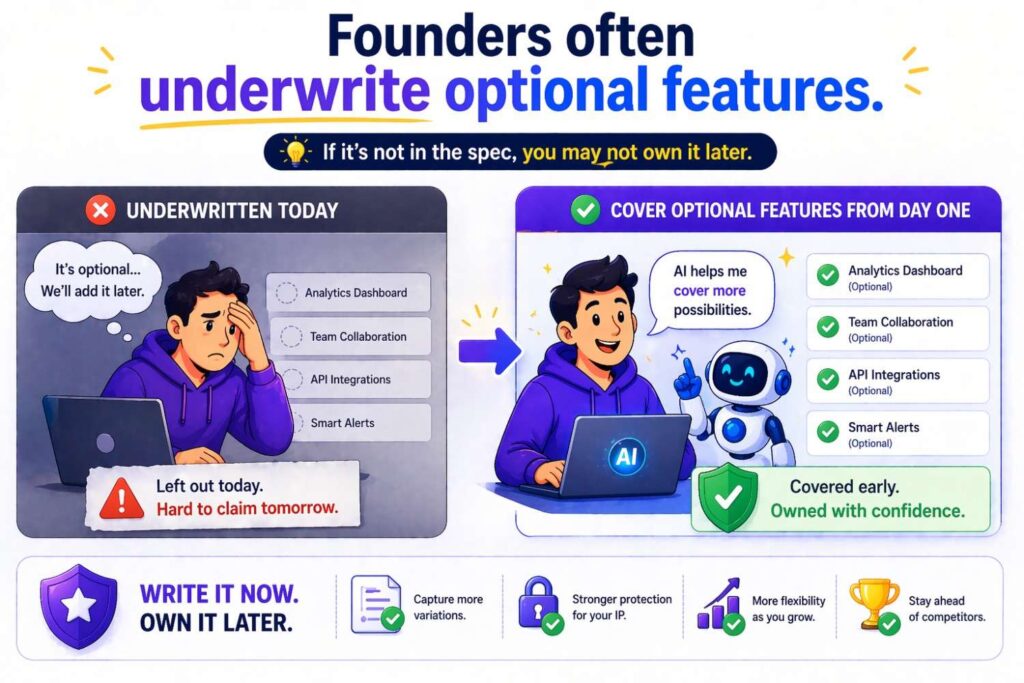
Another very common issue is that founders do not write enough about optional features.
They focus on the main path because that is what the product demo shows.
But optional features matter.
A fallback mode matters. A confidence threshold matters. A manual review path matters. A retry process matters. A personalization layer matters. A local cache matters. A privacy filter matters. A post-processing step matters. A user override matters. A monitoring loop matters.
These optional features may not define the whole invention. But they often make the invention more robust, more practical, and more adaptable. They also become important when competitors try to copy the system in a slightly different form.
AI helps by making it easy to ask, “What optional features fit naturally with this invention?”
That question alone can unlock a lot of useful embodiment language.
For example, if the invention involves automated document classification, optional features may include confidence-based escalation, human correction capture, category-specific thresholds, document-source weighting, layout parsing, language detection, privacy masking, feedback-based retraining, multi-label routing, or task-specific output generation.
A founder may know many of these features exist in the system or roadmap. But without a structured drafting aid, they may not make it into the draft.
AI makes that expansion faster and less mentally draining.
AI helps turn roadmap thinking into stronger support

Startups live in the future.
They are always building toward the next version. The current product is only one snapshot. Engineers often know what they will add next, what they may swap out, what they may simplify for one customer, and what they may scale for another.
That roadmap thinking is valuable in patent drafting.
Not because every idea should be claimed right away in the broadest form possible, but because the written description should often reflect more than the exact current release.
If the team knows the invention can be implemented in several ways, or used in several environments, or improved through specific add-on paths, that knowledge can help support stronger drafting.
AI is useful here because it can help convert roadmap thoughts into draft embodiments while they are still top of mind.
A founder can say, “Today we use a central model, but later we may run lightweight scoring on device.” AI can help draft both versions.
A team can say, “Right now we use direct user prompts, but later we will infer intent from passive signals.” AI can help draft both flows.
An engineer can say, “Today this is for one vertical, but the same control logic works in industrial robotics too.” AI can help reflect that.
This does not mean the patent should become a fantasy document. It means the real knowledge already inside the team can be translated into broader support more efficiently.
That is a major gain for startups that are still evolving.
What a founder should feed into the AI
The quality of outputs depends a lot on the quality of inputs.
If the founder gives AI a vague sentence, the output will often be vague too. If the founder gives richer technical material, the output becomes much more useful.
The best source material is usually not polished legal text. It is real technical content.
That may be a product requirements doc. It may be a system architecture note. It may be a design review deck. It may be code comments. It may be a whiteboard transcript. It may be a technical memo. It may be a founder explanation recorded after a build session. It may be issue tracker notes about how the system works and where it is going.
These materials contain the real invention story.
AI can help transform them into a better drafting base because it can identify patterns and hidden alternatives within the actual technical material.
For example, design docs often contain words like “in one version,” “optionally,” “future work,” “fallback,” “could also,” “for enterprise,” “for mobile,” “if offline,” or “depending on policy.” Those phrases are gold for embodiment drafting. They reveal real technical branches.
A founder does not need to write a perfect statement on day one. They need to provide enough grounded substance for AI to work with.
This is another reason why a tool built for real inventors matters. The workflow should help them start from what they already have instead of forcing them to become patent writing experts before they begin.
The hidden benefit: better inventor interviews
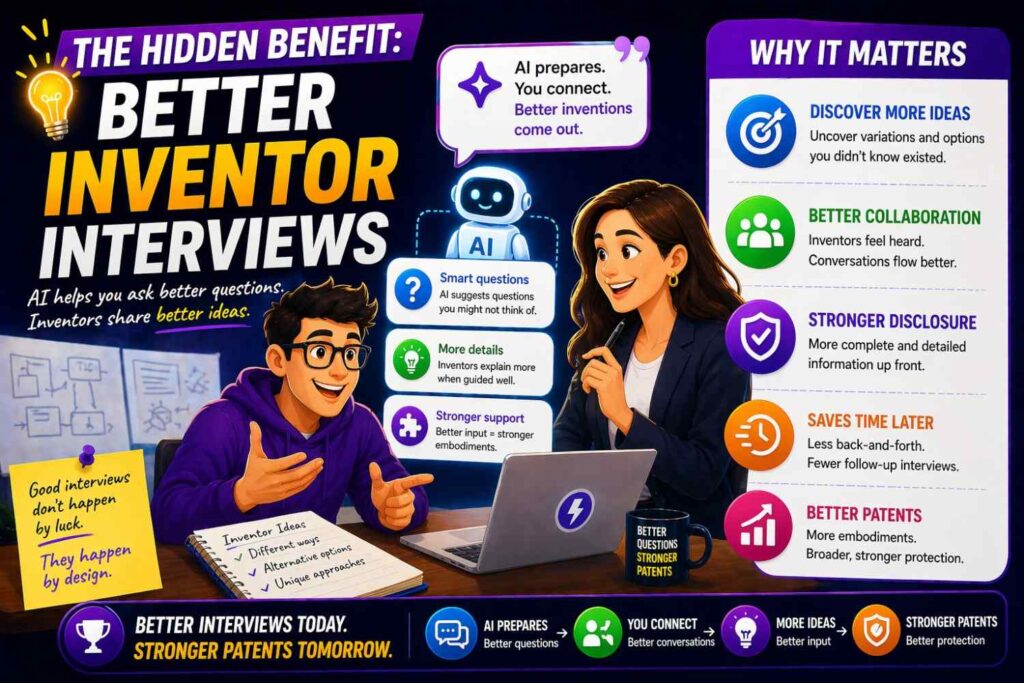
AI does not only help with text generation. It can improve the questions asked in the first place.
That matters more than people think.
A strong patent process depends on strong inventor input. But many inventor interviews are too broad or too shallow. People talk around the invention instead of drilling into the parts that matter most.
AI can help generate sharper follow-up questions based on the first explanation.
If a founder describes a model-driven personalization engine, AI can help ask whether personalization happens before retrieval, after ranking, or during content generation. It can ask whether the profile is static or updated over time. It can ask whether the system uses explicit preferences, observed behavior, or both. It can ask whether the profile is user-specific, account-specific, session-specific, or device-specific. It can ask what happens when confidence is low. It can ask what happens when privacy settings limit access to some data.
Each of those questions can uncover multiple embodiments.
This means AI helps not only by writing faster, but by helping the inventor think more fully.
That is often where the best patent content comes from. Not from fancy wording, but from better questioning.
Why engineers usually like this more than the old process
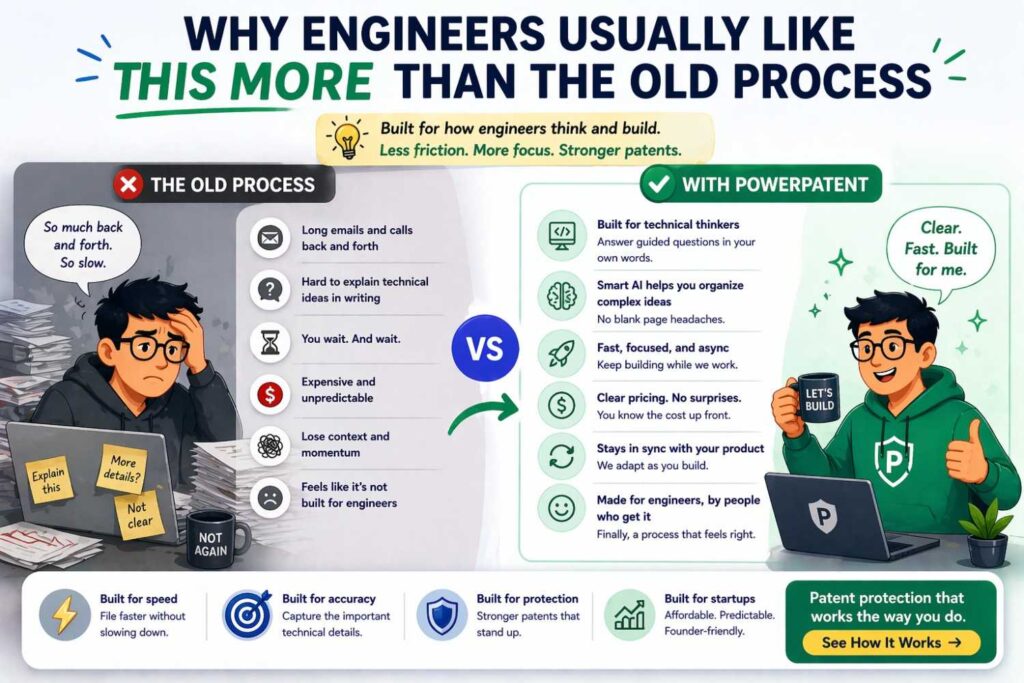
Engineers often dislike vague, slow, overly formal workflows. They prefer systems that feel clear, responsive, and grounded in the actual technical work.
That is why AI-assisted embodiment drafting often feels better to technical teams.
It feels more like engineering and less like ceremony.
An engineer can describe a system, inspect the expansion, correct what is wrong, add what is missing, and quickly iterate. The process feels interactive. It feels testable. It feels like refining a model or reviewing code. The inventor does not have to wait through a long black-box sequence before seeing useful output.
That is a major behavior win.
When the process feels more natural, founders and engineers are more likely to contribute richer information. They are more likely to notice missing cases. They are more likely to push for accuracy. They are more likely to engage deeply instead of treating the patent as a side task.
That engagement improves quality.
A good workflow does not just speed drafting. It helps the right people stay involved long enough to make the patent better.
One of the biggest wins is reducing blank-page friction
Blank pages kill momentum.
A founder sits down to “write embodiments” and suddenly the task feels huge. Where should they start? How broad should they go? How much detail is enough? How do they avoid sounding repetitive? How do they know if a variation is worth including?
This friction delays action.
AI helps because it removes the need to invent the whole structure from scratch. It gives the founder something to react to.
Reaction is easier than creation.
It is easier to say, “This version is correct, but add the edge deployment case,” than to write the entire paragraph from zero.
It is easier to say, “This embodiment is too broad; narrow it to enterprise security workflows,” than to design the whole architecture description on a blank document.
It is easier to say, “Add a version where the confidence score triggers a human review path,” than to remember every optional branch alone.
That reduction in friction is not trivial. It changes whether the work gets done.
For busy startup teams, that matters more than almost anything else.
Better embodiment drafting can change claim strategy later
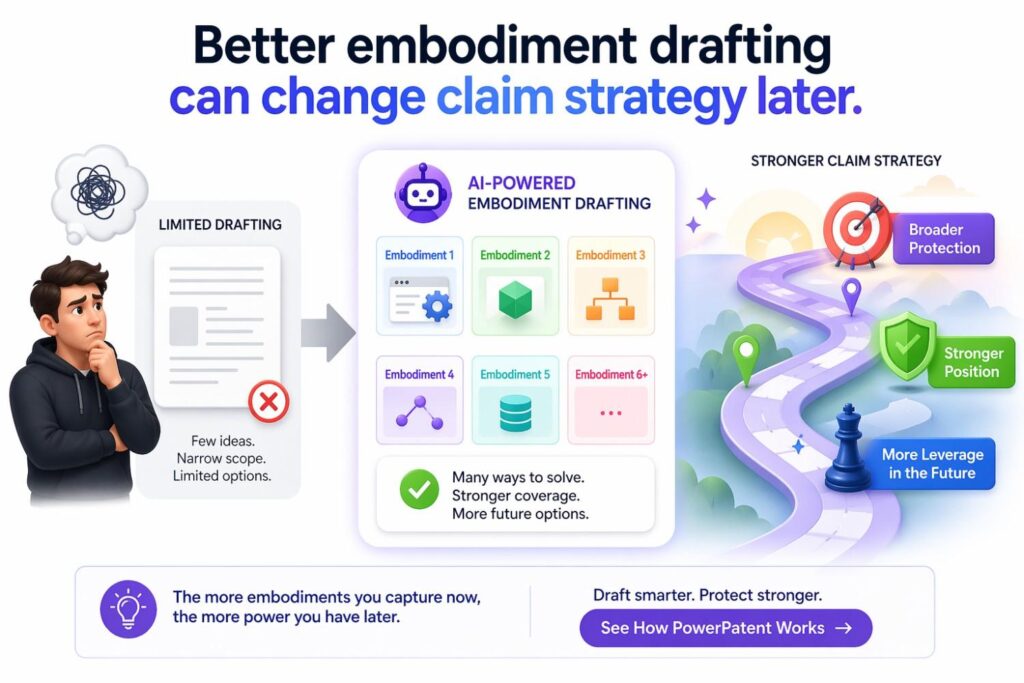
Even though this article is about writing embodiments faster, it is worth noting a deeper effect.
A richer written description can support stronger options later.
The claims in a patent application do not appear from nowhere. They depend on the support in the specification. If the written description includes multiple implementations, more system positions, more sequence options, more data types, more environment cases, and more optional features, there may be more room to shape claims thoughtfully.
That does not guarantee any result. Patent outcomes always depend on many factors. But stronger support gives more room to work with.
This is one reason multiple embodiments are not just extra drafting. They are part of building a better foundation.
AI helps because it makes it more realistic for founders to create that stronger foundation early instead of hoping they can reconstruct it later from memory.
That is a major strategic advantage for teams that want to move fast without boxing themselves in.
How AI helps separate core features from replaceable parts
Many founders struggle to see which parts of the current implementation are essential and which parts are just one choice among many.
This matters because a patent draft should usually not lock the invention too tightly to a replaceable part if the real value lies elsewhere.
AI can help by asking a simple but powerful question across the invention: what is the function here, and what are the possible ways to perform it?
That question helps separate role from implementation.
Maybe the system uses a vector database today, but the real inventive point is not the vector database. It is how context signals are fused to improve retrieval and action timing. In that case, embodiments may describe other storage or retrieval mechanisms too.
Maybe the system uses a drone-mounted camera today, but the inventive point is the adaptive inspection path based on detected anomalies. In that case, embodiments may cover other sensing setups.
Maybe the system uses one specific model family today, but the inventive point is the timing and use of confidence-aware intervention. In that case, other model forms may matter.
This is where AI can be very helpful. It can identify the functional role of a system part and suggest alternative ways that role may be fulfilled.
That helps founders avoid overfitting the written description to one implementation detail.
The best outputs often come from back-and-forth iteration
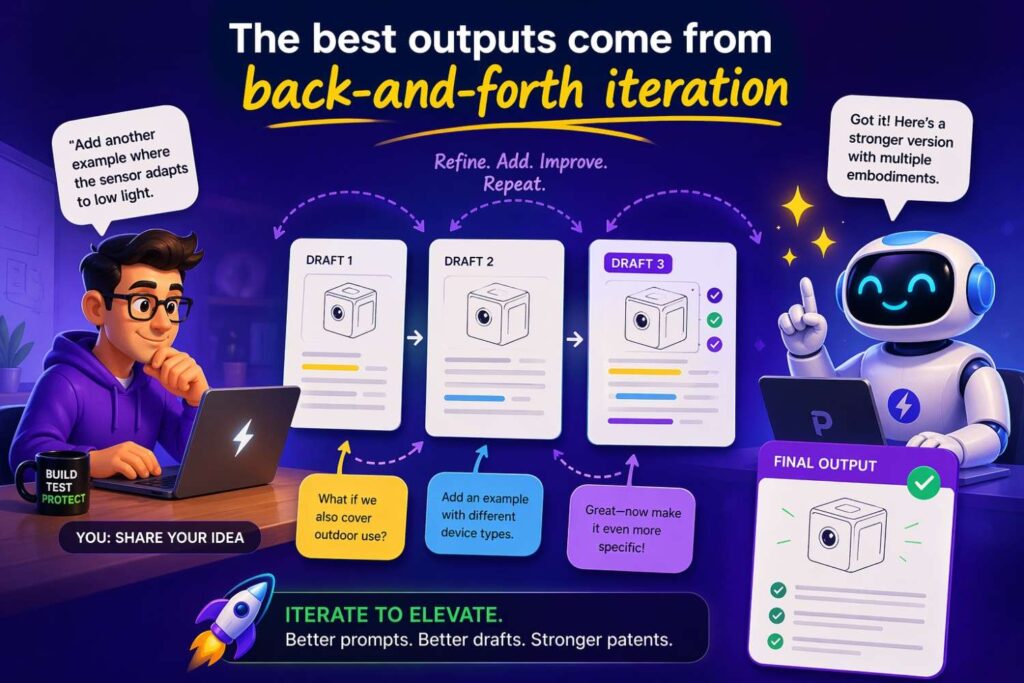
It is tempting to think of AI as a one-shot tool. Put in a prompt, get the final answer.
That is usually not the best approach here.
The strongest embodiment drafting often comes from short rounds of iteration.
The founder gives an initial explanation. AI expands it. The founder corrects it. AI refines it. The founder says which variations are real, which are less relevant, and which missing options matter. AI reorganizes and deepens. Then a reviewer helps shape the result into a stronger draft.
This loop is fast, and that speed changes the game.
Instead of needing multiple slow meetings, a startup team can work through a large amount of invention detail in a shorter time window while the technical context is still fresh.
Iteration also helps prevent the classic AI failure mode of sounding polished but missing the point. Each round tightens the output around the actual invention.
This is where the combination of software and attorney review matters most. The software helps the team move fast and explore broadly. The attorney helps make sure the final result is grounded, useful, and aligned with sound patent practice.
That mix is a lot more powerful than either side alone.
A practical workflow that actually works
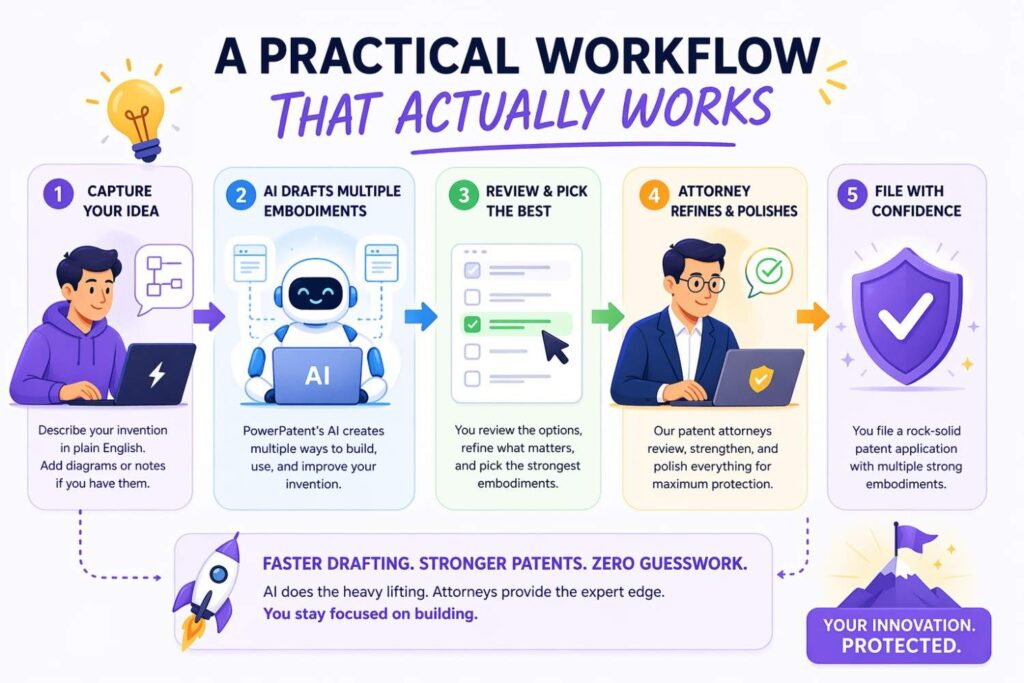
Let us walk through a practical workflow in plain terms.
A founder starts by explaining the invention as clearly as they can. Not in legal language. Just in technical truth. What problem does it solve? How does it solve it? What pieces are involved? What inputs come in? What outputs go out? What are the main steps? What makes it different?
Then AI helps clean up that explanation into a first structured description.
After that, AI helps expand along specific lines. It can explore component alternatives, input alternatives, processing alternatives, environment alternatives, deployment alternatives, sequencing alternatives, user role alternatives, optional features, fallback cases, learning loops, and cross-domain uses.
Next, the founder or engineer reviews the expansion and marks what is accurate, what is too far, and what should be added.
Then the draft is reshaped around the strongest, real embodiments.
Then real patent review helps make sure the language is doing useful work and not creating avoidable issues.
This kind of workflow feels much more manageable than the old model of asking founders to somehow produce polished breadth from scratch.
It is also a much better fit for deep tech teams, because it starts with the invention as built and then expands intelligently.
That is the practical promise of AI here. Not magic. Not push-button patents. A better workflow.
Common mistakes when people use AI for embodiments
There are a few common mistakes worth avoiding.
One mistake is using AI too early without enough technical substance. If the input is too thin, the output often turns into generic noise.
Another mistake is asking for broadening without defining the true inventive core. That leads to output that sounds wide but is not connected to what makes the invention special.
Another mistake is accepting every generated embodiment as helpful. Some will be weak. Some may be unsupported. Selection matters.
Another mistake is focusing only on algorithm changes and ignoring deployment, system position, data source, control flow, and user interaction changes. Embodiments can vary in many ways.
Another mistake is treating repetition as breadth. Saying the same thing five ways is not the same as describing five real implementations.
And another mistake is skipping review. AI can move fast, but fast without review can create risk.
The founders who get the most value are the ones who treat AI as a speed and thinking tool, not as an unquestioned source of truth.
Why this matters even more in AI and software patents
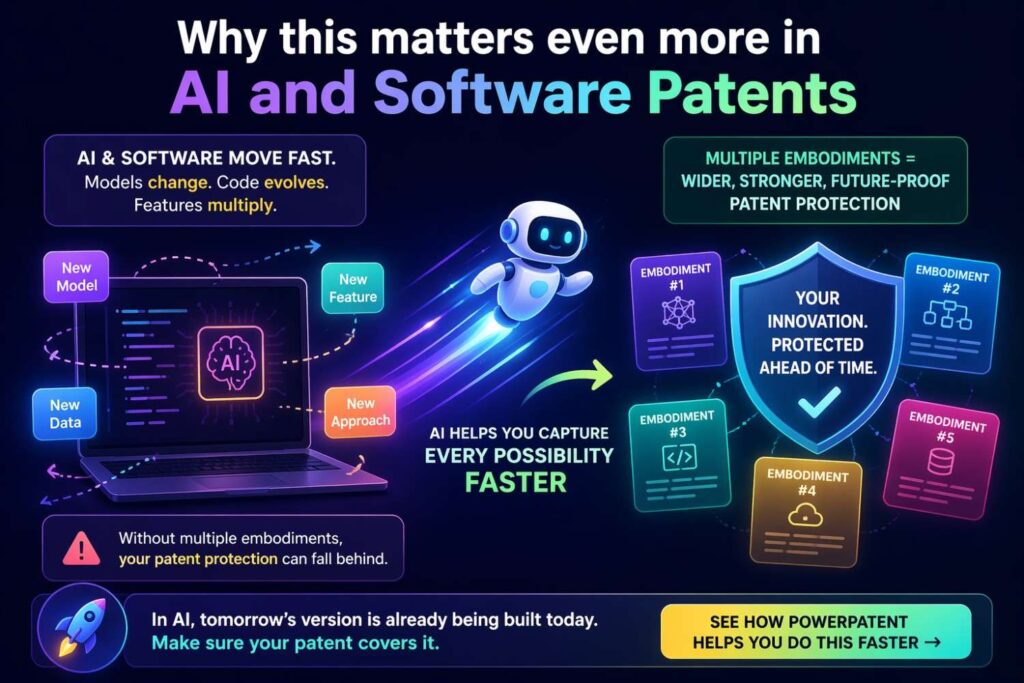
The need for multiple embodiments is especially clear in software and AI inventions because these systems are highly flexible.
A software invention can run on many architectures. An AI system can use many model types, data sources, training flows, update methods, deployment shapes, and output mechanisms. A platform can serve different user roles and operate at different layers of an enterprise stack.
This flexibility is good for the business. But it also means a narrow draft can miss a lot of the true invention range.
Founders in AI especially often face this challenge because their products evolve very quickly. Today’s model may not be next quarter’s model. Today’s fine-tuned stack may become tomorrow’s retrieval-plus-tool system. Today’s server-side orchestration may become tomorrow’s private deployment. Today’s prompt path may become tomorrow’s autonomous workflow.
If the patent draft only mirrors one moment in that moving system, it may age badly.
Multiple embodiments help reduce that problem.
AI helps create them faster, which is exactly what fast-moving software teams need.
AI can help preserve the founder’s own words
This may sound small, but it matters.
One of the best ways to keep a patent grounded is to preserve the inventor’s technical meaning. Not every exact phrase needs to stay the same, but the thinking should remain recognizable to the people who built the invention.
AI can help with this when used carefully.
It can expand around the founder’s own description instead of replacing it with stiff language. It can keep the system logic understandable. It can help maintain a voice that still reflects the technical reality.
That makes review easier too. Founders are more likely to catch issues when the draft still sounds like their invention rather than a translation into strange formal wording.
This is one reason modern patent workflows can feel so much better. The process does not need to turn the invention into something unrecognizable. It can keep the founder close to the draft while still building the detail and range needed for stronger support.
The faster you capture embodiments, the less you lose

There is another practical truth here.
Ideas fade.
Teams forget why a design choice was made. Engineers leave. Roadmaps change. Old experiments vanish from memory. Side branches that once seemed obvious stop getting discussed. A founder who could once explain six possible implementations may only remember the current production version a year later.
That loss is real.
Capturing multiple embodiments earlier helps preserve valuable invention knowledge while it is still alive inside the team.
AI helps because it lowers the effort required to do that capture.
A team can document more breadth sooner, with less pain, before those alternatives disappear into the fog of startup life.
That is not just useful for the patent itself. It can also be useful as a historical record of the invention’s design space.
Why this should feel empowering, not intimidating
Many founders feel nervous about patents because the process seems slow, formal, expensive, and outside their comfort zone. They assume they need to become experts in a different world just to protect what they are building.
That feeling keeps good teams from acting.
AI-assisted drafting changes the emotional side of the process too.
It makes the work feel more approachable. More interactive. More like a technical collaboration and less like a mysterious handoff.
You start from what you know. The system helps you expand it. You review it. You refine it. You keep control. And you get expert oversight where it counts.
That is a very different experience from sending notes into a black hole and waiting.
For founders who care deeply about speed and quality, this shift is a big deal.
A founder’s time is too valuable to waste on inefficient drafting
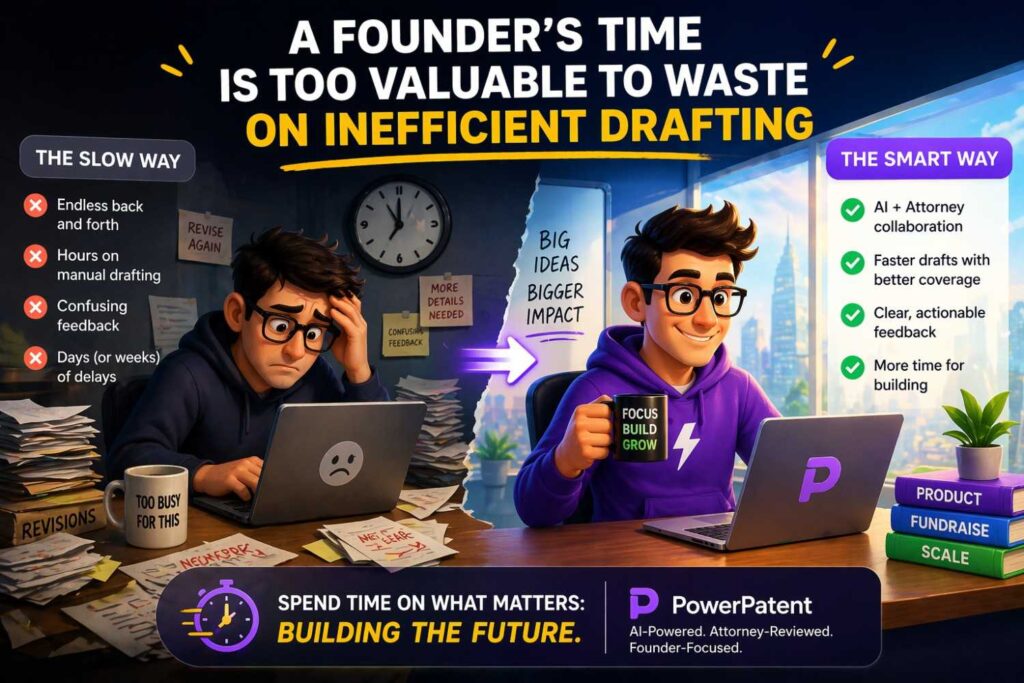
This is worth saying plainly.
A startup founder’s time is one of the most expensive things in the company.
Every hour spent wrestling with slow, unclear patent drafting is an hour not spent building product, meeting users, hiring talent, or closing deals.
That does not mean patents are not worth doing. It means the process has to respect the founder’s time.
AI helps because it compresses the time needed to get from raw invention detail to a fuller, more useful draft. It removes much of the repetitive burden. It helps uncover alternatives faster. It reduces the cost of iteration.
When this is paired with real legal review, the founder gets a better process without having to become a full-time patent drafter.
That is exactly the kind of leverage startups need.
If you want a patent workflow built for teams that move fast, where smart software helps capture the invention and real attorneys help protect it properly, this is the place to start: https://powerpatent.com/how-it-works
A deeper look at how embodiment expansion works in practice
Suppose your startup has built a system that monitors industrial equipment and predicts failures before they happen. The current product uses vibration data, temperature readings, usage logs, and a trained model to estimate failure risk and trigger maintenance actions.
The first explanation may focus on the current deployment in factories using sensor hubs and cloud analysis.
But the invention may have many possible embodiments.
One embodiment may use direct sensor streams from the machine. Another may use data uploaded in batches. Another may combine machine data with operator notes. Another may perform inference at the edge for low-latency alerts. Another may run in the cloud for fleet-wide analysis. Another may prioritize alerts based on asset criticality. Another may trigger maintenance scheduling automatically. Another may only recommend inspection steps. Another may adapt thresholds based on historical false positives. Another may include a confidence score that determines whether to escalate to a human technician.
If the system is truly inventive in how it combines multi-source operating signals with action logic, then these embodiments help show the real range of the idea.
AI can help identify and draft each of these branches very quickly.
More importantly, it can help the founder remember them.
That is what makes the tool useful. It is not only writing. It is also retrieval of technical possibility from the inventor’s own understanding.
The role of human review does not shrink, it gets smarter
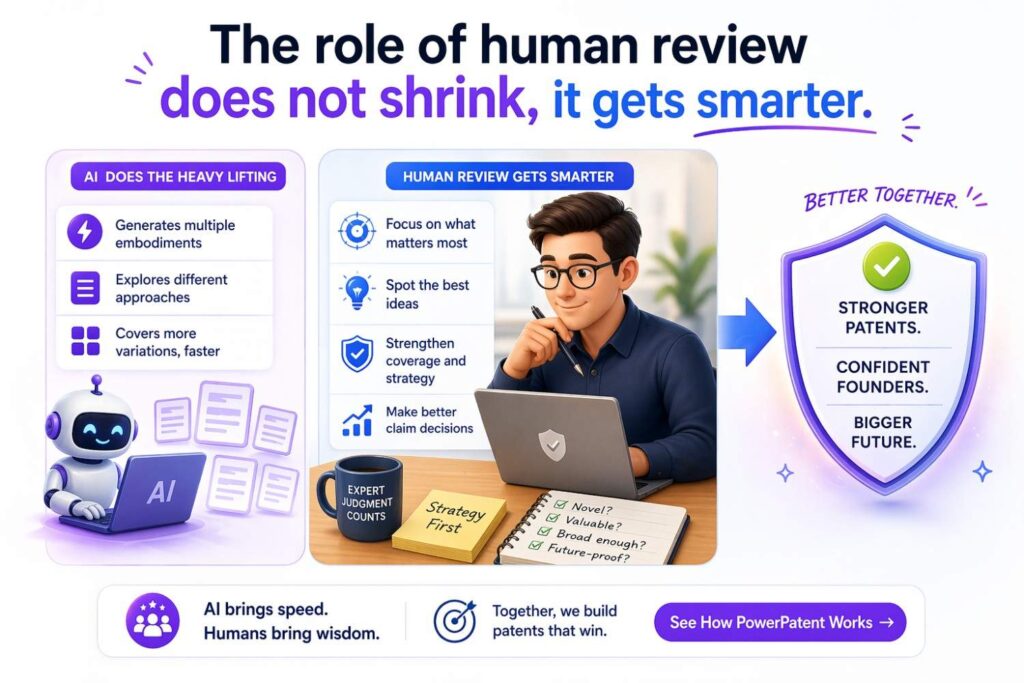
Sometimes people hear “AI helps write embodiments” and assume humans become less important.
In good workflows, the opposite happens.
Human effort becomes more focused on the parts that really matter.
Instead of spending hours generating first-pass wording and chasing obvious variations manually, the inventor and the attorney can spend more time on judgment. They can decide what the real inventive center is. They can evaluate which embodiments add true support. They can spot weak areas. They can improve accuracy. They can shape strategy.
That is higher-value work.
AI handles more of the heavy lifting around expansion and drafting. Humans handle more of the thinking that demands context, responsibility, and care.
This is exactly how useful technology should work. It should not remove people where judgment matters most. It should remove drag where human time is being wasted.
Why startups should care about this now, not later
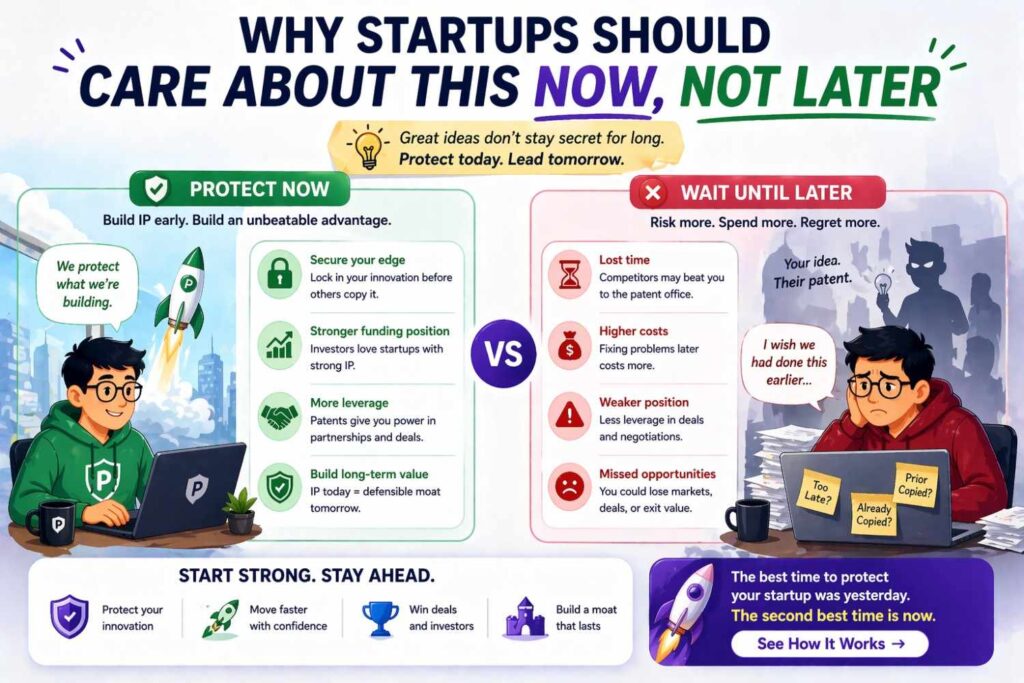
Many teams delay patent work because they assume they will handle it when the product is more mature.
But waiting can be costly.
The invention is usually easiest to capture when the builders are closest to the original insight. The alternative implementations are fresh. The design space is still visible. The team remembers why the system is different.
As time passes, those details can blur. The company may also move into new product areas, making it harder to reconstruct the original breadth.
AI-assisted drafting lowers the cost of acting earlier.
Instead of seeing patent work as a giant painful task, founders can see it as a faster structured process that starts from the technical materials they already have.
That mindset shift is huge. It turns protection from “later, maybe” into something realistic now.
The best patent workflows fit the way startups already work
This may be the biggest point of all.
Startups do not need patent processes built for another era.
They need workflows that fit how modern technical teams work today.
They work from product docs, code, demos, architecture notes, experiments, issue trackers, and rapid iteration. They need speed. They need clarity. They need strong outcomes without weeks of drag. They need to stay close to the technical truth. And they need real experts involved so they do not make expensive mistakes.
AI-assisted multiple embodiment drafting fits that world much better than the old model.
It starts from existing technical work. It supports iteration. It helps teams think in systems. It speeds up expansion. It improves participation from engineers. It reduces blank-page pain. And when paired with real attorney oversight, it can lead to much stronger, more efficient patent preparation.
That is why this is not just a writing trick. It is a workflow upgrade.
Start with the work your team already creates
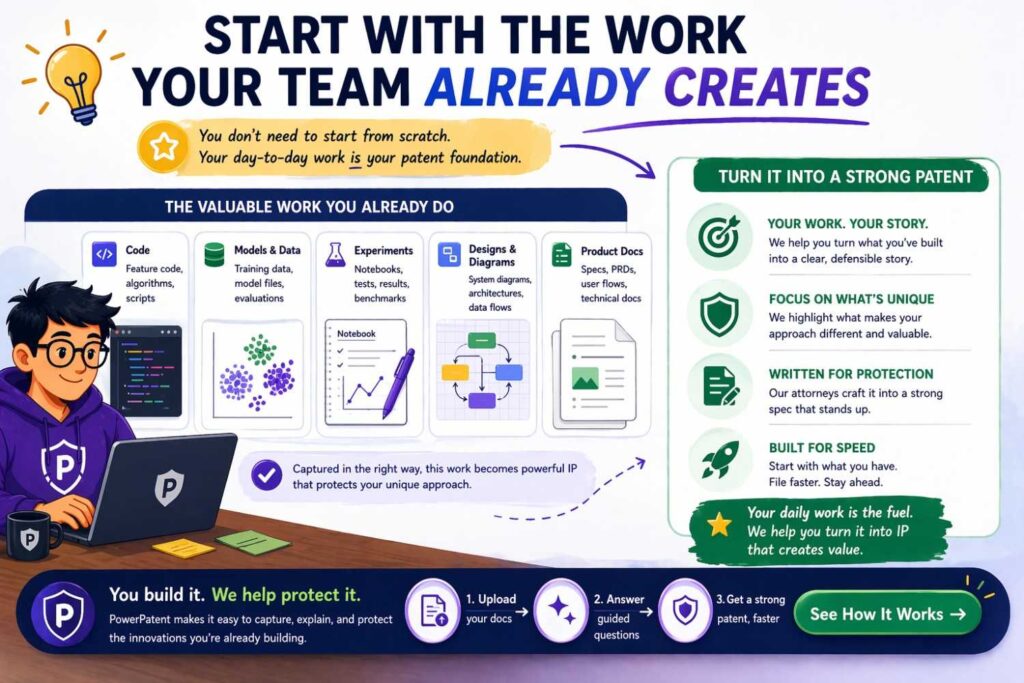
The strongest patent workflow does not begin with a long form, a confusing checklist, or a slow chain of meetings. It begins with the materials your team already makes while building the company.
That means product specs, system diagrams, sprint notes, research memos, model testing docs, demo scripts, code comments, architecture reviews, and customer-driven feature plans. These are often the clearest record of what your invention really is. They show what problem the team is solving, how the system is designed, what choices were made, and what could change next.
This is important for businesses because speed is not only about filing fast. Speed is about reducing the amount of extra work your team must do just to get protection started. If your patent process asks engineers to stop building and rewrite everything from scratch, that process is going to lose momentum very quickly. But if your workflow starts from real internal materials, it becomes much easier to capture invention details while they are still fresh and accurate.
A smart business move is to create a simple internal rule: when a team ships a major technical feature, launches a new model behavior, changes a system flow, or solves a hard engineering problem in a new way, someone should save the key materials in one place. That one habit can make future patent drafting much easier. It also gives leadership a better view of where real defensible value is being created inside the company.
Build patent capture into product rhythm, not outside of it
Many companies treat patent work like a separate legal event. That is often the wrong approach for startups. A better approach is to connect patent capture to the normal rhythm of product and engineering work.
When teams already have design reviews, roadmap reviews, launch reviews, or technical retrospectives, those moments can double as invention capture points. Not every meeting needs a patent agenda. But the company should have a clear way to ask one simple question at the right time: did we solve something here in a way that is new and important?
That single question can do a lot.
It helps teams notice invention opportunities before they fade into routine. It also helps the business avoid a common mistake, which is waiting until much later when the details are harder to recover.
For a startup, this is highly practical. You do not need a complex process. You need a repeatable trigger. For example, after each meaningful release, the product lead or engineering lead can spend ten minutes flagging whether the update involved a new technical method, a system improvement, a new automation flow, a model behavior change, or a different way of solving a known problem. If the answer is yes, that work should go into a patent review lane.
This makes patent work part of company operating rhythm, which is exactly where it belongs.
Give engineers a low-friction way to flag invention value
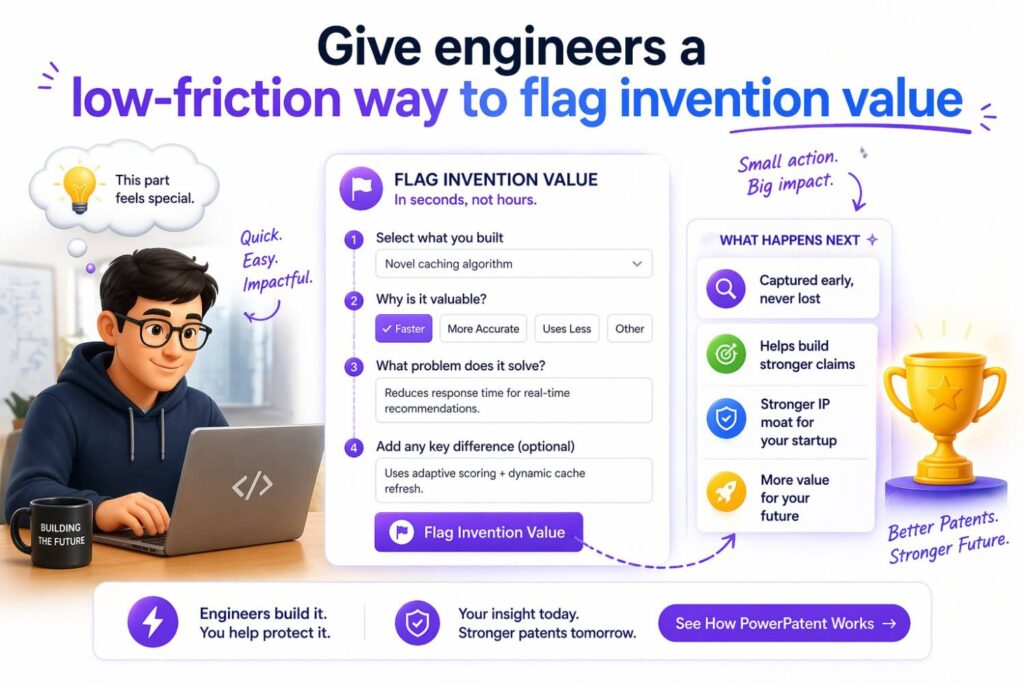
A lot of invention goes unprotected because the people closest to it do not have an easy way to raise their hand.
Engineers are usually not going to stop mid-build and draft a formal invention summary. But many will absolutely drop a short note if the system makes that easy. That is why good patent workflows are low friction.
For businesses, this matters because your invention pipeline is only as strong as your intake process. If the intake process is painful, weak, or unclear, good ideas get buried inside normal product work.
A better approach is to give technical teams a very simple template they can fill out in a few minutes. Not a legal document. Just a clear internal note. What problem did you solve? What is the new approach? Why is it better than the normal way? What parts can vary? Where else could this method be used?
Those answers are often enough to start a high-quality review.
A very actionable move is to put this into the tools your team already uses. That may be your issue tracker, your internal wiki, your release review process, or your product planning system. The easier it is to flag invention value where work is already happening, the more likely your company is to catch important ideas before they disappear.
Treat patents like product assets, not paperwork
The companies that get the most value from patents do not treat them like forms to file. They treat them like strategic assets tied to the business.
That shift changes everything.
When patents are seen as paperwork, teams rush through them, delegate them too far away from the builders, or put them off until it feels urgent. When patents are seen as business assets, the company starts asking better questions. Does this invention protect a core system advantage? Does it support future product expansion? Does it create a stronger story for fundraising, partnerships, or market position? Does it help defend key technical ground as the company scales?
These are business questions, not just legal ones.
This is where founders and leadership teams can be much more intentional. Every startup has limited time and budget. That means not every feature deserves the same level of patent attention. The smart move is to focus on inventions that sit close to revenue, product defensibility, unique technical workflows, cost-saving infrastructure, or future platform expansion.
A useful operating habit is to review invention candidates using business impact first. Ask whether the idea supports a major product line, a critical technical moat, or an important future market. If it does, it deserves faster attention. This helps the company spend time on the inventions that actually matter most.
Connect patent thinking to roadmap planning
One of the best places to improve patent workflow is inside roadmap planning.
Roadmaps show where the company is going. They reveal upcoming product changes, platform bets, deployment shifts, model improvements, automation layers, and customer-driven technical moves. All of these can help shape stronger patent work if the company pays attention early enough.
This is especially helpful for businesses because roadmap planning often reveals the broader shape of an invention long before it is fully shipped. That helps teams write broader, more useful support around the idea, instead of describing only the narrow version that happens to exist today.
A practical move here is to add one light patent check during roadmap reviews. The goal is not to slow down planning. The goal is to spot when a coming feature may involve a real technical leap, a new system method, or a reusable platform mechanism.
This is highly strategic because the best patent support often comes from understanding not just today’s product, but also tomorrow’s variations. If your roadmap already shows that a feature will move from one environment to three, or from one workflow to many, or from a single use case to a broad platform, that insight should shape the drafting process early.
Make invention review cross-functional
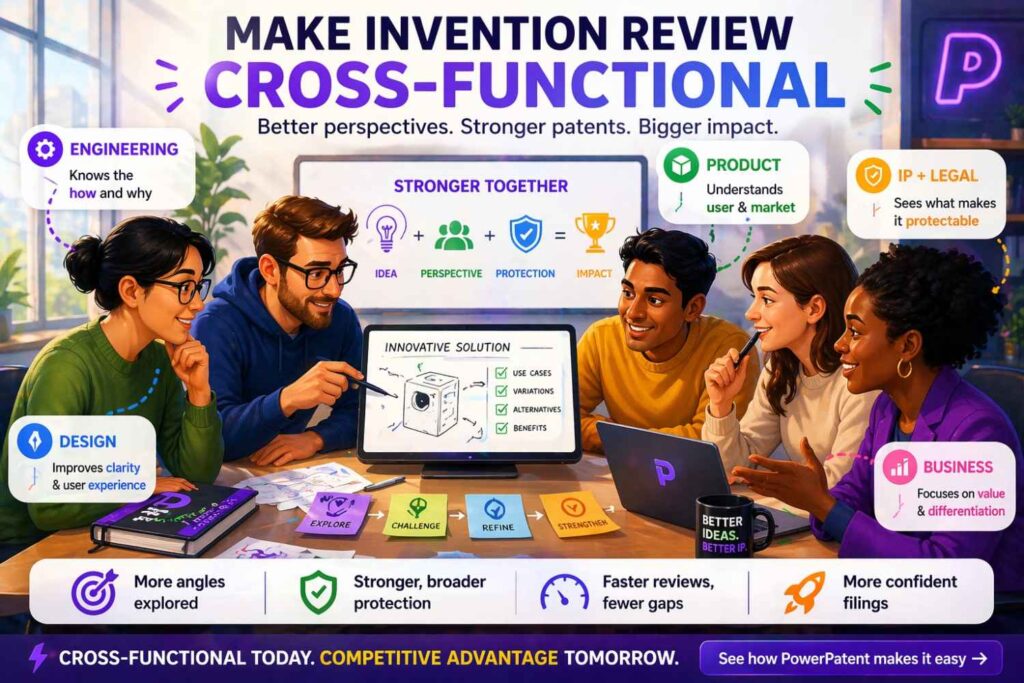
The best startup patent workflows are not trapped in one department.
Good invention review often needs input from product, engineering, leadership, and legal support. Each group sees something different. Engineers understand how the system really works. Product leaders understand what matters to users and where the platform is headed. Founders understand company strategy and market position. Patent experts understand how to turn that into a strong filing path.
When these views come together early, the result is usually much stronger.
This is useful for businesses because important invention value is often hidden in the overlap between technical work and company strategy. A system improvement may look small inside engineering, but become highly valuable when seen through the lens of customer expansion, cost reduction, platform leverage, or long-term defensibility.
A practical step is to create a short invention review session for important candidates. It does not need to be a major meeting. Even twenty minutes can be enough if the right people are present. The goal is to answer three things clearly: what is actually new, why it matters to the business, and how broadly this idea may matter across products or markets.
That small step can prevent the company from filing too narrowly or missing stronger invention opportunities.
Reduce delay between invention and documentation
Delay is one of the biggest enemies of good patent workflow.
The longer a team waits, the more context gets lost. People forget alternatives. The reason behind key design choices fades. Early system paths stop being discussed. What once felt like a major technical leap starts to look ordinary because the team has already moved on.
For businesses, this means delayed capture often leads to weaker protection.
A better workflow is built around quick documentation close to the moment of invention. The goal is not perfect drafting on day one. The goal is to preserve the core insight while it is still clear.
One highly actionable approach is to create a “capture first, refine later” habit. As soon as a team solves an important technical problem in a new way, someone records the core details in plain language. That note should include the problem, the new method, the system parts involved, and the likely variations. This can be rough. It just needs to be accurate enough to preserve the thinking.
Later, that rough material can be expanded into stronger patent content. But if the first capture never happens, the company may lose a lot of value.
Use AI where it removes drag, not where it adds risk
For startups, the best workflow uses AI in a very practical way.
AI is most useful when it helps reduce repetitive work, uncover technical variations, organize rough invention notes, and generate cleaner first-pass descriptions. That is where it saves time and helps the team move faster.
But businesses should be careful not to use AI blindly. The goal is not to let a tool guess at invention scope with no review. The goal is to let AI help the team surface more of what is real and worth protecting.
This means the company should use AI to support thinking, not replace judgment.
An effective internal rule is simple. Use AI to expand, compare, organize, and draft. Then require technical review before anything moves forward. This gives the company the speed benefit without losing control over accuracy.
This is especially important for startups that build in fast-changing areas like AI, software infrastructure, robotics, biotech systems, or security. These inventions often have many possible embodiments, but not every generated version will be useful. The review layer is what turns speed into real business value.
Create a simple decision path for what gets prioritized
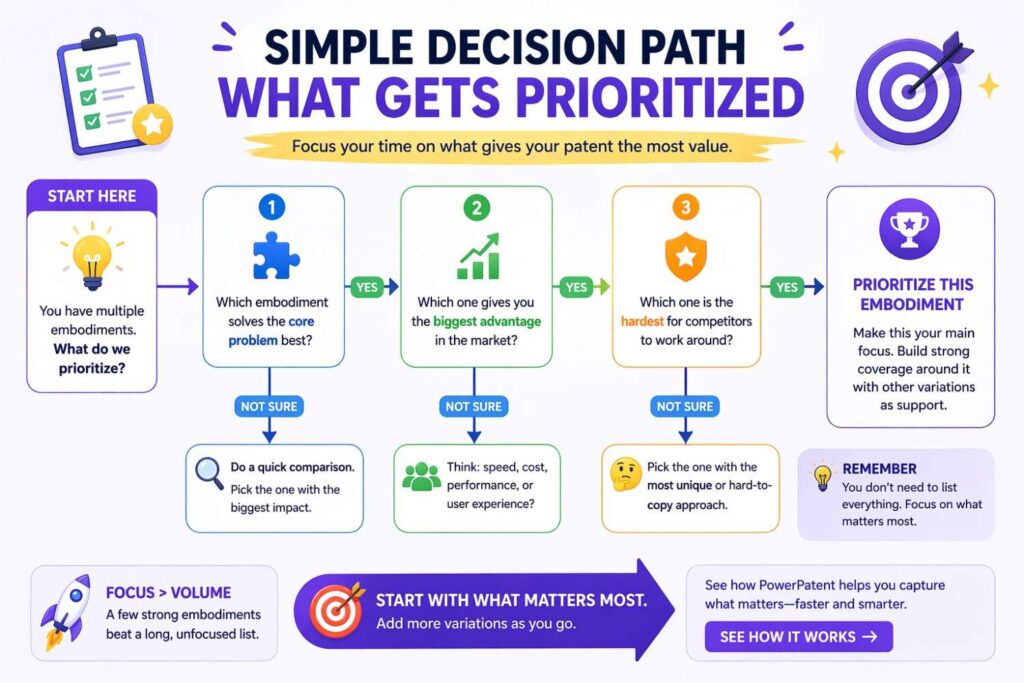
One reason patent workflows feel messy inside startups is that teams do not always know what deserves attention first.
That leads to confusion, delay, or uneven action.
A stronger approach is to create a very simple decision path. Not every invention needs the same response. Some are urgent because they protect core technical advantage. Some matter because they support a major launch. Some are useful but less central. Some should be documented now and reviewed later.
Businesses do better when this is clear.
A practical way to handle this is to classify invention opportunities into a few action levels. One group includes core moat inventions tied to revenue, platform uniqueness, or major future product lines. These should move quickly. Another group includes useful supporting inventions that strengthen the broader portfolio. These can move on a normal track. A third group includes ideas worth preserving but not yet ready for filing. These should still be documented well.
This kind of prioritization helps founders use time and budget wisely. It also keeps the company from wasting energy on low-value work while missing high-value inventions that deserve fast action.
Make patent readiness part of technical leadership
Patent workflow improves a lot when technical leadership takes ownership of invention visibility.
This does not mean engineering leaders need to become patent experts. It means they should know how to spot work that is likely valuable and know where to send it next.
This is a very strategic move for businesses because leaders shape what gets noticed. If engineering managers, staff engineers, and product leaders are trained to recognize invention value, the company gets a much stronger view of what it is actually creating.
A highly actionable step is to train technical leads on a few simple signals. Did the team solve a known problem in a different way? Did they create a repeatable technical method that can scale across customers or products? Did they reduce cost, improve speed, improve accuracy, improve control, or unlock a new user experience through a system-level change? If yes, that work may deserve invention review.
This is not about turning managers into lawyers. It is about giving them enough pattern recognition to help the business capture real value early.
Keep the process clear enough that teams will actually use it
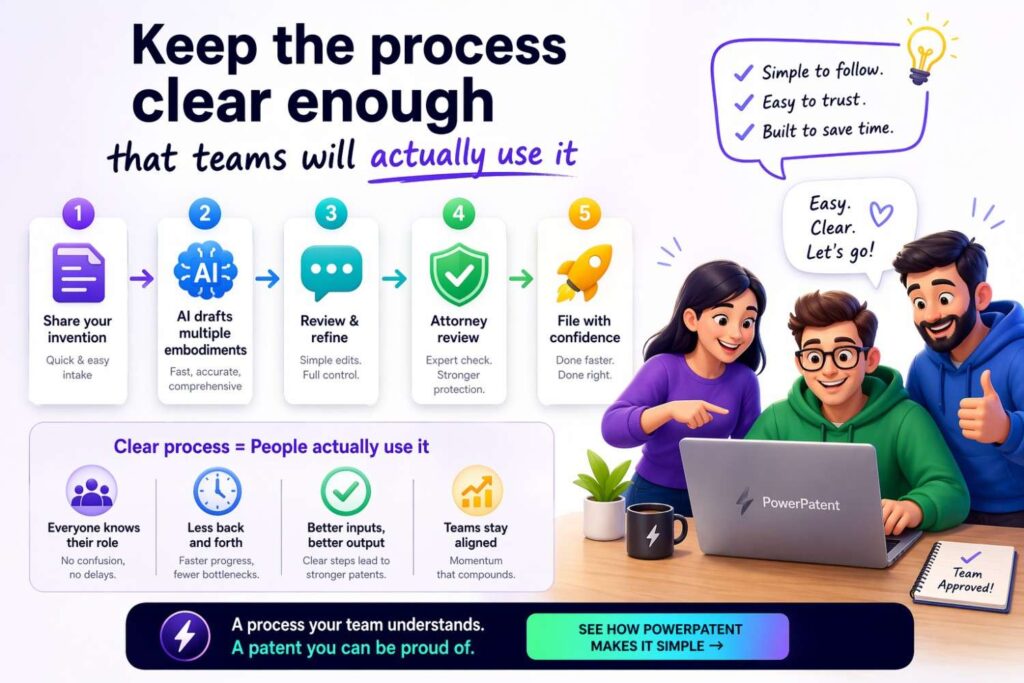
The best patent workflow is not the one that looks perfect on paper. It is the one your team will actually follow.
That means it needs to be clear, lightweight, and easy to trust.
If the process is confusing, people will avoid it. If the process is too slow, they will postpone it. If the process feels disconnected from real technical work, they will stop taking it seriously.
For startups, simplicity wins.
A good workflow answers a few core questions fast. What kinds of work should be flagged? Where should they be flagged? Who reviews them? What happens next? How quickly should people expect a response?
When those answers are clear, the workflow becomes real. Teams know what to do. Leaders know how to prioritize. The business starts building a repeatable habit instead of relying on random moments of memory.
That is what makes a workflow strategic. It is not just well designed. It is usable.
Build a system that scales with company growth
What works for a five-person startup may not work for a fifty-person team. What works for one product line may fail once the company expands into a platform. That is why patent workflow should not only fit how the startup works today. It should also be able to grow with the company.
This is a major business point because invention capture tends to break when companies scale. More teams are building. More systems are changing. More customer requests are shaping the roadmap. More product lines create more technical overlap. Without a clear workflow, valuable inventions get lost in that growth.
A practical move is to set up a process that can scale in layers. Early on, simple capture and founder review may be enough. Later, the company may need a small invention committee, a more formal tracking system, or quarterly portfolio reviews tied to business priorities.
The key is not to overbuild too soon. The key is to create a process that can expand without being rebuilt from scratch every year.
Strong workflows protect speed and quality at the same time
The biggest mistake businesses make is assuming they must choose between moving fast and protecting their inventions well.
They do not need to make that trade if the workflow is built correctly.
A modern patent process should help startups protect real technical value without dragging down product momentum. It should fit into the way teams build, review, plan, and ship. It should make it easy to capture invention insight early, expand it intelligently, and review it with care.
That is the real goal.
When the workflow fits the company, patent work stops feeling like outside friction. It becomes part of how the business protects what it is already doing best.
And that is where the real strategic value shows up.
What founders should do next
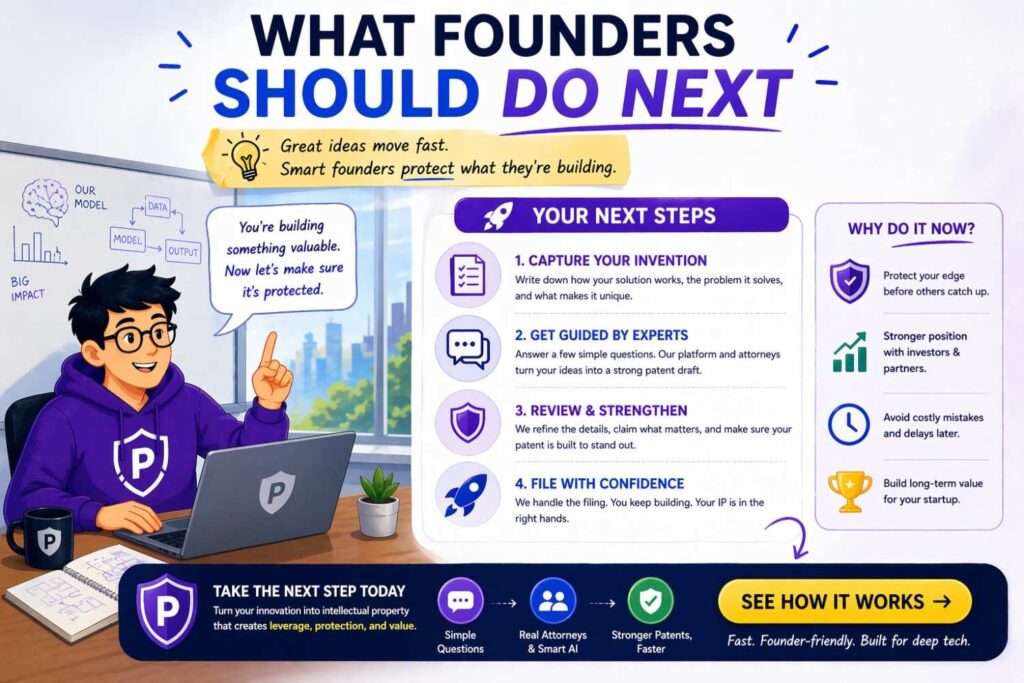
If you are a founder, engineer, or inventor, the practical lesson is simple.
Do not assume your invention only has one patent-worthy version because you only built one version first.
Look at the real technical idea underneath the current implementation.
Ask how inputs can vary. Ask how processing can vary. Ask how outputs can vary. Ask where the system can run. Ask what happens when confidence is low. Ask which parts are optional. Ask how the same concept works in a different setting. Ask what your roadmap already implies.
Then use AI to help turn those answers into clean, fast draft language.
But do not stop there. Review the result carefully. Keep what is real. Cut what is fluff. Strengthen what reflects the true invention. And make sure real patent expertise is part of the process so your speed turns into actual protection, not just more text.
That is the path.
The bottom line
Multiple embodiments are not extra decoration in a patent. They are often one of the clearest ways to show the full shape of an invention.
The problem is that writing them well takes time, and startup teams do not have much of that.
AI helps because it reduces the hardest parts of the job. It helps organize rough invention input. It helps surface alternative implementations. It helps expand along useful technical dimensions. It helps ask better questions. It helps reduce blank-page friction. It helps founders capture more of what they already know before that knowledge fades.
Used well, it does not replace judgment. It improves the speed and quality of the drafting process so that inventors and attorneys can focus on the decisions that matter most.
That is why AI is such a strong fit for writing multiple embodiments faster.
And that is why modern startups should not be stuck with slow, painful patent workflows that were never designed for the way builders work today.
PowerPatent is built for exactly this kind of founder. The platform helps technical teams move from invention to patent faster with smart software and real attorney support, so you can protect what you are building without slowing down the company. See how it works here: https://powerpatent.com/how-it-works
When you are building something valuable, speed matters. Clarity matters. Range matters. And protecting the full shape of your invention matters too.
AI can help you get there faster. The right patent workflow makes sure you get there the right way.