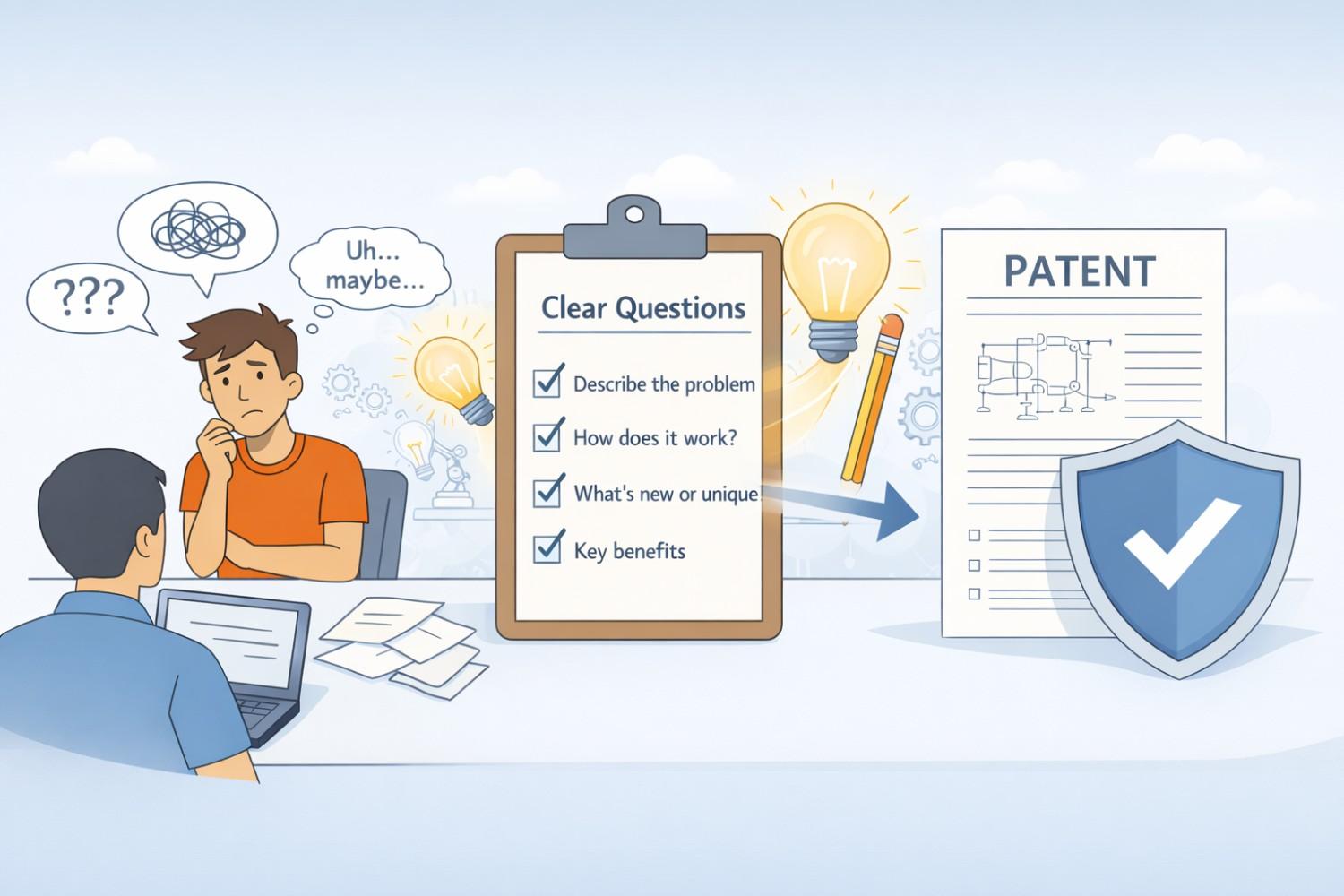
If you want strong patents, you need strong answers. And strong answers only come from clear inventor questions. This is where most startups go wrong. They jump into filing before they slow down and ask the right things. The result? Gaps. Confusion. Missed protection. In this guide, I’ll show you how to write inventor questions that unlock deep, clear, technical answers—so you can protect what you’re building with confidence instead of guesswork.
Why Most Inventor Interviews Fail Before They Even Start
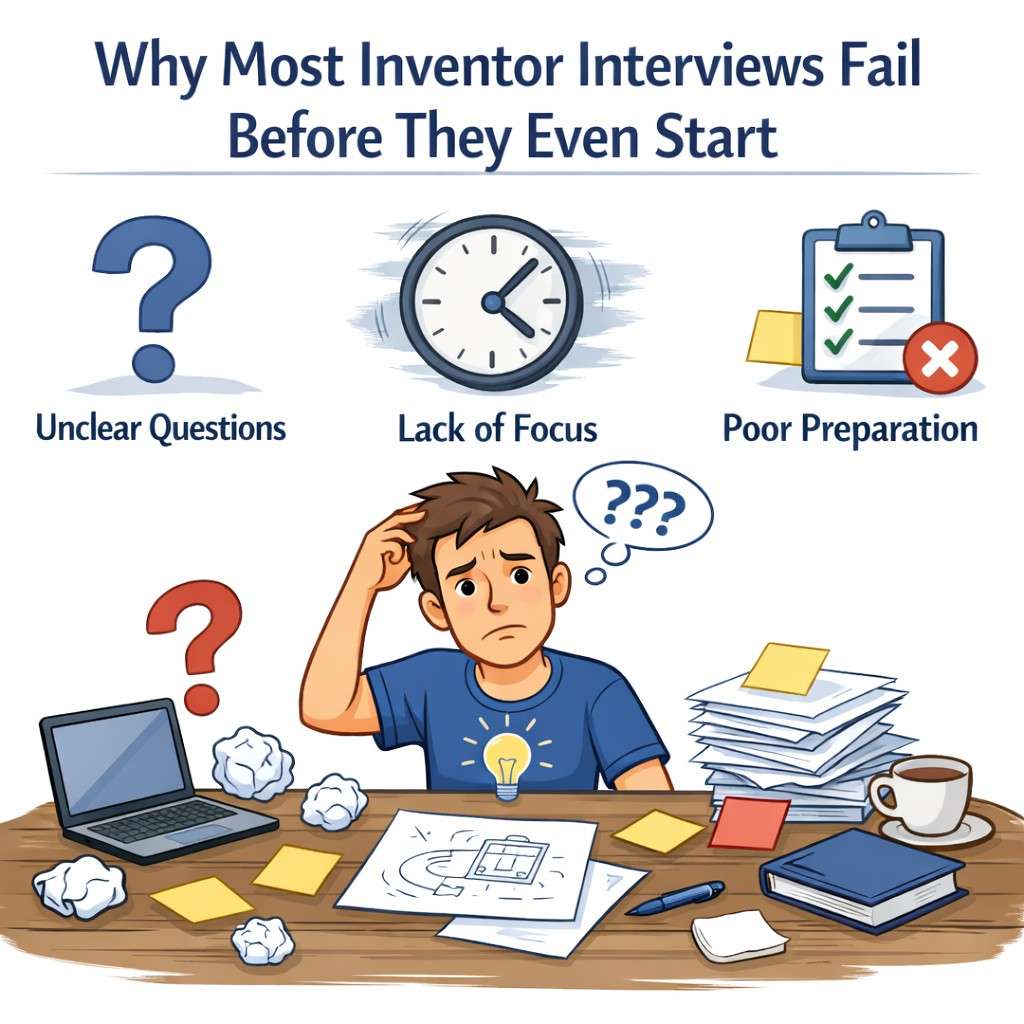
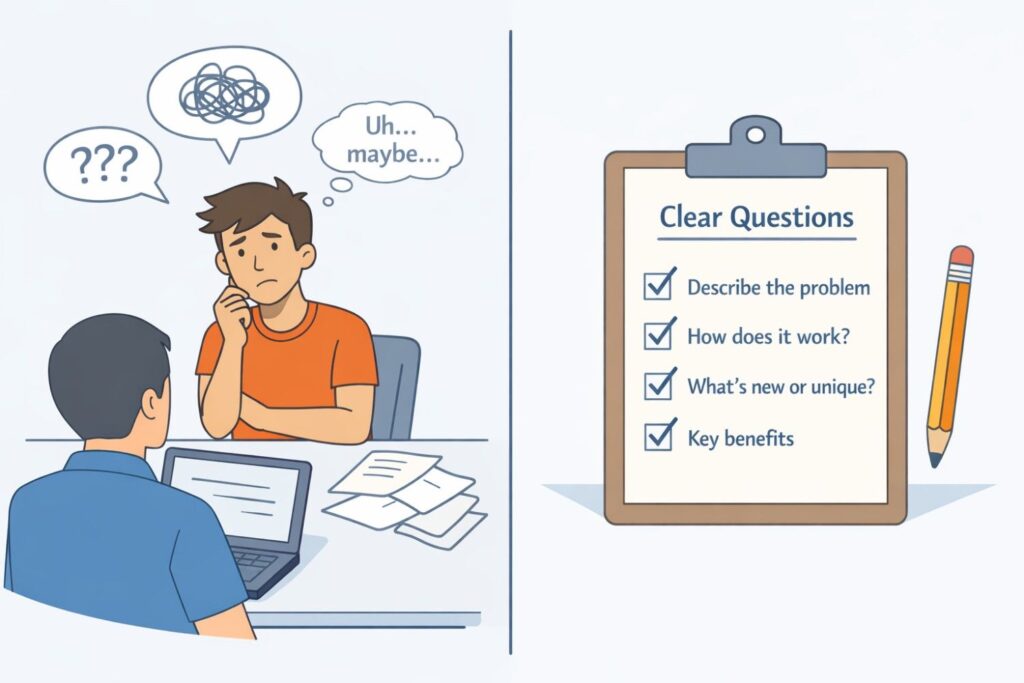
Most inventor interviews do not fail because the idea is weak. They fail because the questions are weak. The meeting starts with good intent, but it quickly turns into a vague conversation.
The inventor explains the product at a high level. The interviewer nods. Notes are taken. Everyone feels productive.
But later, when it is time to write the patent, the gaps show up. Key details are missing. Important decisions were never discussed. Critical technical differences were never explored.
This section is about fixing that problem before it happens.
The Real Problem Starts Before the Meeting
The biggest mistake happens long before anyone sits down to talk. It starts with a lack of preparation. Many teams treat the inventor interview as a casual conversation.
They believe the invention will naturally reveal itself if they just talk long enough. That almost never works.
An invention lives in the small decisions. It lives in the tradeoffs, the edge cases, and the design choices that were made for a reason.
If you walk into the meeting without knowing what you are trying to uncover, you will leave with surface-level answers.
A strategic approach begins with clarity. Before the interview, define the goal. Are you trying to understand the core engine of the system? Are you trying to protect a specific feature?
Are you trying to block competitors from copying your method? Without that focus, your questions will drift.
If you are building deep tech, this matters even more. Your product likely has layers.
There is the visible feature. Then there is the system behind it. Then there is the algorithm or process that powers that system. If you do not plan your questions around those layers, you will only scratch the surface.
At PowerPatent, this is why we combine software tools with real attorney oversight. Preparation is not guesswork. It is structured. You can see how this works in practice here: https://powerpatent.com/how-it-works
Founders Assume the Technology Is Obvious
There is a silent assumption in many interviews. The inventor believes the interviewer understands the system. The interviewer believes the inventor has explained enough. Neither is true.
Founders live inside their product every day. They forget what is not obvious. They skip steps in their explanation because it feels basic to them. They jump from problem to solution without explaining the path in between.
When questions are not precise, inventors will give high-level answers. They will describe what the system does, not how it does it. For patent protection, that is a serious issue. Patents protect how something works, not just what it does.
To avoid this, questions must slow the inventor down. Instead of asking, “How does your platform work?” ask in a way that forces detail.
For example, focus on the first technical step the system performs. Then the second. Then the third. Move through the system in sequence.
If you do not break it down step by step, you will miss the core logic. And that core logic is often the most valuable part of the invention.
Conversations Drift Into Product Demos
Another reason interviews fail is because they turn into product demos. The inventor starts showing screens. They click through features. They explain benefits.
The discussion becomes about user experience and market positioning.
That is useful for marketing. It is not enough for patent drafting.
A demo shows what the user sees. A patent needs to capture what the system is doing behind the scenes. If your questions stay focused on what appears on the screen, you will miss the technical engine running underneath.
A better approach is to pause the demo and shift the focus. Ask what happens on the server when the user clicks a button. Ask how data moves from one module to another.
Ask how the model processes inputs before returning outputs.
You are not trying to understand the product from a customer view. You are trying to understand it from a system view.
When you shift your questions this way, the inventor will begin revealing the true architecture. That is where strong patent protection begins.
Fear of Sounding “Too Basic” Kills Clarity
Many people hesitate to ask simple questions. They do not want to appear uninformed. This is a huge mistake.
Simple questions often unlock the most important answers. When you ask, “Why did you choose this method instead of another?” you are inviting the inventor to explain their reasoning. That reasoning is often where novelty lives.
Patents are built around differences. What did you do that others did not? What problem were you solving that others ignored? What technical constraint forced you to design it this way?
If you avoid basic follow-up questions, you will never uncover those distinctions.
In fact, the best inventor interviews feel almost repetitive. The interviewer keeps digging. Keeps clarifying. Keeps asking for examples. Not in an aggressive way, but in a focused way.
When an inventor says, “We optimized the model for speed,” that should trigger a deeper question. How exactly was it optimized? What changed in the architecture? What was the measurable difference? What tradeoffs were made?
Those follow-ups are not optional. They are the difference between a weak filing and a strong one.
No Clear Definition of the “Core” Invention
Another common issue is that no one defines what the real invention is before the interview begins. Teams often assume they know. But assumptions are risky.
Is the invention the algorithm? The training method? The data pipeline? The hardware configuration? The integration between systems?
Without clarity, the interview becomes scattered. Questions bounce from one feature to another. Important technical threads are started and never finished.
Before the conversation, align on what you believe is the core technical advance. This does not need to be perfect. It just needs to provide direction. Once you have that anchor, your questions can orbit around it.
For example, if the core invention is a new way to reduce latency in distributed systems, your questions should keep circling back to that improvement.
How is latency measured? What specific bottlenecks were removed? What architectural changes were required?
This focus keeps the interview tight. It prevents drift. It ensures the most valuable technical details are captured clearly.
At PowerPatent, our process guides founders through identifying and articulating that core innovation early. That clarity saves time and prevents expensive revisions later. You can explore the process here: https://powerpatent.com/how-it-works
Rushing the Process to “Get It Filed”
Speed is important for startups. But rushing the interview phase is dangerous. When teams treat the conversation as a box to check, they miss depth.
The irony is this: a rushed interview often leads to more delays later. When key details are missing, attorneys have to circle back. Clarifications are needed.
New technical descriptions must be added. That back-and-forth slows everything down.
It is far more efficient to ask thorough questions at the start.
A strategic interview balances speed with depth. You do not need endless meetings. You need focused sessions that dig into the right areas. The goal is not volume of conversation. It is quality of detail.
Think of it this way. The interview is your chance to transfer knowledge from the inventor’s brain into a structured record. Once that moment passes, memories fade. Context gets lost. Team members move on.
Treat that time with care.
Misalignment Between Business Goals and Patent Strategy
Another reason inventor interviews fail is because they are disconnected from business goals. The questions focus only on technical features, not on strategic protection.
A startup might be building toward a future product line. Or planning to license technology. Or preparing for fundraising. If the interviewer does not understand that roadmap, they will not ask the right questions.
For example, if you plan to expand into adjacent markets, your questions should explore how flexible the system is. Can it handle different data types? Different environments? Different hardware?
If you plan to block competitors, your questions should explore variations. What alternative methods could achieve similar results? Could someone swap out one component and still copy the idea?
When interviews ignore business strategy, the resulting patent may protect the current product but fail to support long-term growth.
This is why structure matters. Strong inventor questions are not random. They are guided by both technical insight and business vision.
The Cost of Getting It Wrong
When inventor interviews fail, the damage is not always obvious right away. The patent may still get filed. It may even get granted. But later, when you need it most, the weaknesses show.
A competitor designs around it. An investor asks hard questions. An acquirer spots gaps in protection.
At that point, it is too late to go back and ask better questions.
Writing strong inventor questions is not just a drafting skill. It is a business skill. It shapes how well your innovation is protected. It influences valuation. It affects leverage in negotiations.
If you want to avoid costly mistakes and delays, the work starts here.

And if you want a structured way to guide these conversations, backed by smart software and real patent attorneys who know how to dig for depth, you can see how PowerPatent makes that process simple and founder-friendly here: https://powerpatent.com/how-it-works
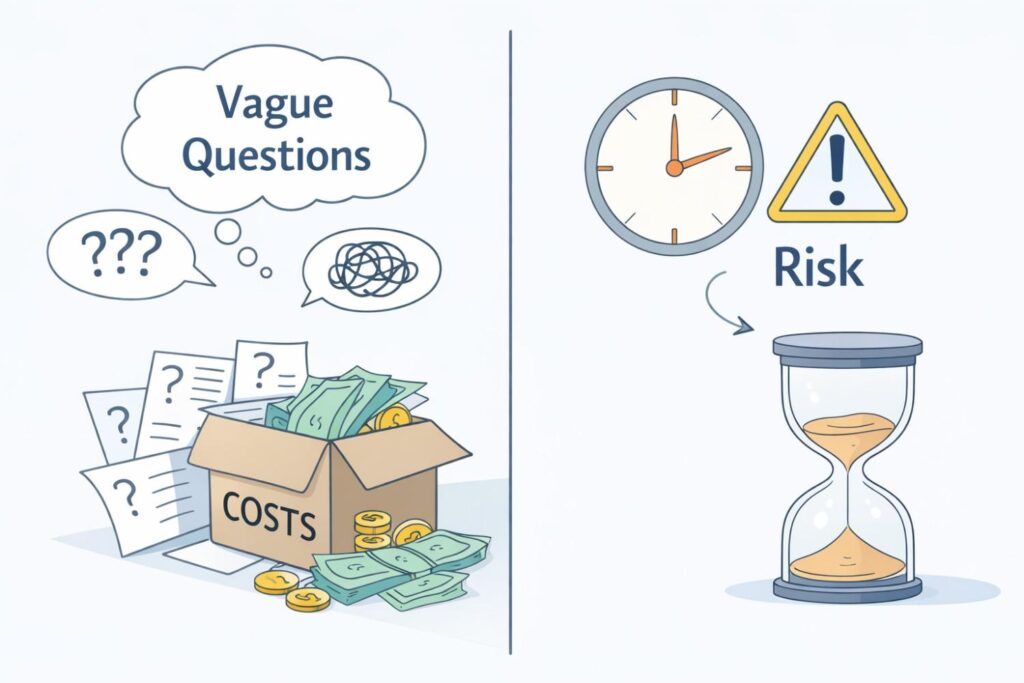
The Hidden Cost of Vague Technical Questions
Vague questions feel harmless in the moment. The meeting flows. The inventor talks. Notes get filled. But vague questions quietly damage your patent before it is even drafted.
They blur the edges of your invention. They hide the real technical lift. They make your innovation sound common when it is not.
If you want strong protection, you cannot afford unclear questions. The cost is higher than most founders realize.
Vague Questions Produce Polished but Useless Answers
When you ask a broad question, you get a broad answer. It sounds smart. It may even sound impressive. But it often lacks the detail needed for real protection.
For example, if you ask, “What makes your system unique?” the inventor will usually respond with a summary. They will explain the outcome. They will explain the benefit.
They might mention performance gains or accuracy improvements. But they will rarely break down the mechanics unless pushed.
That polished summary might work in a pitch deck. It does not work in a patent.
A patent is not about marketing language. It is about mechanics. It is about how components interact. It is about the sequence of operations. It is about constraints and decisions.
When your questions are vague, you accidentally encourage high-level storytelling instead of technical explanation. That storytelling hides the real invention.
A better approach is to narrow the frame. Instead of asking what makes the system unique, ask what specific step in the workflow changed compared to prior approaches.

Ask what internal process was redesigned. Ask what technical limitation forced the new design.
These narrower questions pull the inventor out of summary mode and into explanation mode.
Weak Questions Lead to Weak Claims
Most founders do not see the link between the interview and the final patent claims. But the link is direct. Every claim is built on the raw material gathered during inventor questioning.
If the answers lack depth, the claims will lack strength.
When questions fail to explore variations, the resulting patent may cover only one narrow implementation. A competitor can then make a small adjustment and avoid infringement. That design-around risk often begins with incomplete questioning.
If you do not ask how the invention could be implemented in different ways, you will not capture those variations. If you do not ask what parts are optional versus required, you will not understand the boundaries of the invention.
Strategic questioning should always explore flexibility. Can the method run on different hardware? Can the algorithm use different inputs? Can steps be reordered? Can modules be separated or combined?
Without that exploration, your protection becomes fragile.
This is where structure matters. At PowerPatent, the process is designed to guide founders through these deeper layers so nothing critical is missed. It is not just about capturing what exists today.
It is about protecting the full technical footprint. You can see how the system supports this here: https://powerpatent.com/how-it-works
Missing the “Why” Behind Technical Choices
One of the most expensive mistakes in inventor interviews is failing to ask why a decision was made.
Inventors often describe what they built. They explain the architecture. They show the flow of data. But they may not explain why that design was chosen over other options.
That reasoning is often where novelty lives.
If an engineer chose a specific compression method because standard methods created latency spikes, that context matters.
If a data structure was redesigned to reduce memory usage in edge devices, that constraint matters. If a model was trained in a certain way because labeled data was limited, that tradeoff matters.
Without asking why, you lose the story of technical improvement.
And patents are built on improvement.
When you write inventor questions, always aim to uncover the decision-making path. What alternatives were considered? What failed? What tradeoffs were evaluated? What measurable problem was being solved?
Those answers create a stronger foundation for drafting. They also prepare you for future challenges, where you may need to explain how your invention differs from what came before.
Vague Questions Hide System Boundaries
Another hidden cost of unclear questioning is confusion around system boundaries.
Where does your invention start? Where does it end? What parts are part of the innovation, and what parts are standard tools?
If this is not clearly explored during the interview, the patent may either claim too little or attempt to claim too much in an unsupported way.
For example, if your product integrates with third-party APIs, are you protecting the integration method? The data transformation layer? The orchestration logic? Or just the user-facing feature?
If you do not ask focused questions about boundaries, the answers will blur these distinctions.
Clear inventor questions should define the edges. Ask what parts of the system are conventional and what parts were newly designed.
Ask which components could be swapped out and which are essential. Ask where the unique logic resides.
This boundary clarity prevents overgeneralization. It also ensures the invention is described with enough detail to withstand scrutiny.
Surface-Level Answers Create Future Rework
When inventor interviews rely on vague questions, the first draft of the patent often triggers follow-up confusion.
Attorneys may return with questions. Engineers may struggle to recall specific details months later. Time gets lost. Momentum slows.
For a startup, this delay has real cost. Filing timelines may matter for fundraising or competitive positioning. Every extra round of clarification drains attention from product development.
Clear, targeted questions at the start reduce this friction later.
Instead of revisiting conversations, you capture technical depth in the first pass. Instead of guessing at missing pieces, you document them properly from the beginning.
That efficiency is not accidental. It comes from disciplined questioning.
PowerPatent was built with this reality in mind. By combining structured software workflows with real attorney guidance, founders can surface detailed technical insights early, without endless back-and-forth.
The goal is clarity upfront, not cleanup later. If you want to understand how that works in practice, you can explore it here: https://powerpatent.com/how-it-works
Vague Questions Undermine Investor Confidence
There is another cost that many teams overlook. Weak inventor interviews can ripple outward into investor conversations.
During diligence, investors may ask about your patent scope. They may want to understand what is truly protected. If your internal documentation lacks depth, answering those questions becomes harder.
Strong patents begin with strong technical articulation. If you cannot clearly explain your own system architecture and decision logic, that uncertainty can create doubt.
The process of writing sharp inventor questions forces internal clarity. It aligns your team on what was built and why. That clarity strengthens not just your patent, but your narrative.
In many cases, the discipline required for good inventor questioning improves product thinking itself. Engineers reflect more deeply on their design decisions. Founders gain sharper insight into their differentiation.
This is not just about paperwork. It is about understanding your own innovation at a deeper level.
The Compounding Effect of Small Omissions
The most dangerous aspect of vague questioning is that each omission feels small. A skipped follow-up here. An unexplored variation there. A missed clarification about a technical constraint.
Individually, these gaps may seem minor. Together, they weaken the structure.
Patent strength is cumulative. It grows from layers of detail. Remove enough of those layers, and the protection becomes thin.
Writing strong inventor questions is not about making the interview longer. It is about making it sharper. Every question should have intent. Every follow-up should aim to reveal mechanics, reasoning, or variation.
When you approach inventor interviews this way, you move from casual conversation to strategic extraction of technical insight.

And that shift can change the entire quality of your intellectual property.
How to Ask Questions That Unlock Real Innovation
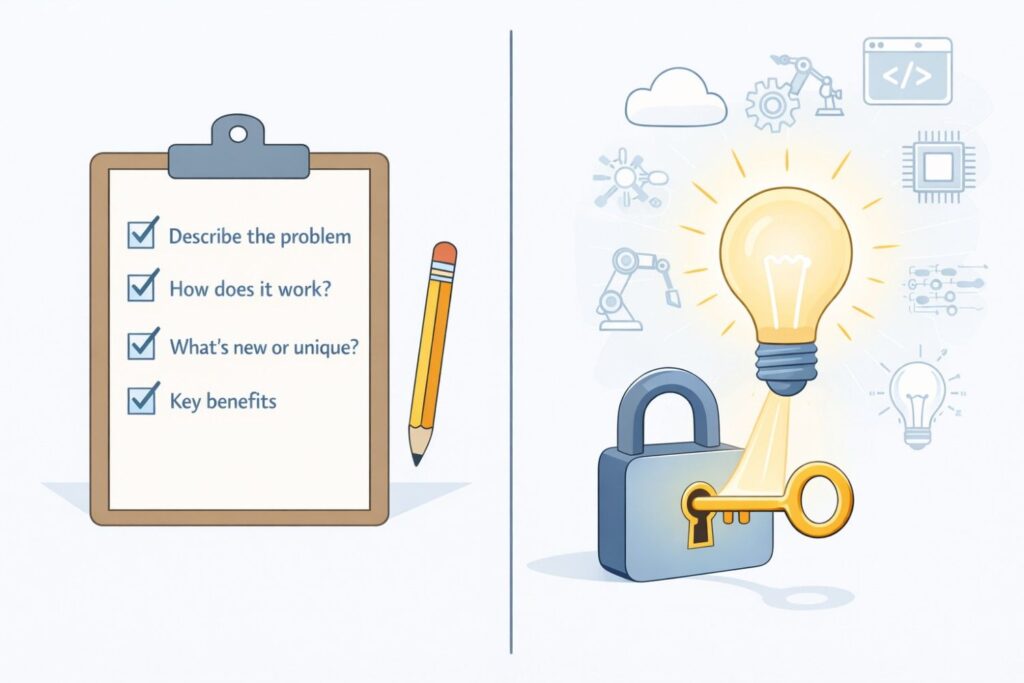
If weak questions create weak patents, then strong questions create powerful protection. But strong questions are not random. They are deliberate. They are structured. They are designed to pull out the hidden layers of an invention that even the inventor may not realize are important.
This is where strategy meets skill.
Asking better questions is not about sounding technical. It is about guiding the inventor to reveal the core mechanics, the design logic, and the variations that make the invention truly valuable.
Start With the Technical Problem, Not the Product
Most interviews begin with the product. That feels natural. The inventor explains what was built. They describe features. They walk through the system.
But innovation starts with a problem, not a feature.
When you frame your first questions around the technical problem that existed before the invention, you change the tone of the conversation. You anchor the discussion in context. You surface the pain that led to the solution.
Instead of asking what the system does, ask what technical limitation existed before this solution was created. Ask what was failing. Ask what could not be achieved with standard tools. Ask what constraint forced a new approach.
This forces the inventor to reflect on the environment in which the invention was born. That context often reveals the real breakthrough.

A patent built around a clearly defined technical problem is stronger than one built around a generic feature set. It shows improvement. It shows necessity. It shows advancement.
That clarity begins with the right opening question.
Slow Down the Workflow and Move Step by Step
Innovation hides in sequences. It hides in the order of operations. It hides in how data moves, transforms, and returns.
When you ask an inventor to explain how the system works, they may compress the explanation into a short summary. That summary is not enough.
A better approach is to slow the conversation down. Guide the inventor through the workflow one step at a time. Ask what happens first. Then ask what happens next. Then ask what triggers the next event.
Do not rush the transitions.
If the invention involves an algorithm, ask about input preparation before asking about model output. If it involves hardware, ask about signal capture before asking about processing. If it involves distributed systems, ask about communication between nodes before discussing overall performance.
This step-by-step questioning forces detail. It reduces the chance of skipping key transitions. It also reveals hidden dependencies that might otherwise go unnoticed.
The goal is not to interrogate. The goal is to map the system clearly.
When this is done well, the inventor often realizes new aspects of their own work. The clarity benefits both the patent and the product thinking itself.
At PowerPatent, structured workflows help guide founders through this layered breakdown so nothing critical is left vague. It turns what could be a messy conversation into a focused technical exploration.
You can see how that process works here: https://powerpatent.com/how-it-works
Explore Variations Before They Are Obvious
One of the most powerful ways to unlock real innovation is to explore alternatives.
After the inventor explains the main implementation, shift the conversation toward flexibility.
Ask whether the same result could be achieved with a different architecture. Ask whether certain steps could be reordered. Ask whether different inputs could be supported.
This does not mean you are redesigning the system. You are testing its boundaries.
Often, the inventor will say something like, “Yes, we could also implement this using a different data store,” or “The model could be trained with synthetic data instead of real data.” Those variations matter.
If you never ask, they may never mention them.
Strong patent protection captures not just the primary version of the invention, but also reasonable variations. This reduces the risk that someone can copy the idea with minor tweaks.
Strategic questioning makes these variations visible early.
Focus on Decisions, Not Just Descriptions
Descriptions explain what exists. Decisions explain why it exists.
To unlock deeper insight, shift your questions toward decision points. Ask what design paths were considered and rejected. Ask what tradeoffs were evaluated. Ask what technical barrier forced a specific choice.
For example, if a system uses a particular synchronization method, ask why that method was chosen over others. Was it due to speed? Resource limits? Compatibility? Stability under load?
These decision insights often define the novelty of the invention.
They also prepare you for future challenges. If someone questions whether the invention is truly different, the documented reasoning behind design choices becomes powerful support.
Asking about decisions also helps uncover hidden innovation. Sometimes the inventor sees a design choice as minor. But when examined closely, that choice may represent a meaningful technical shift.
Strong inventor questions highlight these hidden breakthroughs.
Separate Core Logic From Supporting Tools
Modern systems often rely on standard frameworks, libraries, and platforms. During interviews, inventors may describe their work in terms of these tools.
That is natural. But your questions must separate the invention from the tools.
Ask what part of the system was newly designed. Ask what logic sits on top of existing frameworks. Ask what would remain if the underlying tools were swapped out.
This separation clarifies where the true innovation resides.
Without this distinction, the conversation may overemphasize common components while underemphasizing custom logic.
A patent should not rely on the existence of a specific third-party library. It should protect the unique method or system built by the inventor.
Your questions must guide the inventor to articulate that distinction clearly.
Use Hypotheticals to Test the Boundaries
Hypothetical scenarios can unlock powerful detail.
After understanding the core workflow, ask what would happen under extreme conditions. What if the data volume doubled? What if the network failed mid-process? What if the input quality degraded?
These questions are not meant to challenge the invention. They are meant to expose how robust the system is.
Often, the inventor will explain fallback mechanisms, error handling, or adaptive behaviors that were not mentioned earlier. These features may represent additional inventive concepts.

Hypotheticals also reveal how tightly coupled certain components are. If the system can adapt to changes easily, that flexibility may be worth protecting.
This style of questioning turns the interview into a stress test for understanding.
Translate Technical Depth Into Clear Language
Asking strong questions is only half the task. The answers must be captured in clear language.
During the interview, you should restate complex explanations in simpler terms and confirm accuracy. This ensures shared understanding. It also ensures the eventual patent draft will be readable and precise.
When inventors speak in dense technical language, ask clarifying follow-ups. Not because the detail is unwanted, but because clarity is essential.
This back-and-forth creates alignment. It prevents misinterpretation later.
At PowerPatent, smart software tools help organize these insights in a structured way while real attorneys ensure technical accuracy is preserved. The combination allows founders to move fast without sacrificing depth.
If you want to see how that balance is achieved, you can explore it here: https://powerpatent.com/how-it-works
Keep the Energy Focused but Calm
The tone of the interview matters. If the inventor feels rushed, they will compress answers. If they feel judged, they may become defensive. If the conversation feels chaotic, important threads will be lost.
Strong questioning requires calm focus.
Give space for thought. Allow pauses. Encourage reflection. Some of the best insights come after a short silence.
At the same time, maintain direction. If the discussion drifts into marketing language or future roadmaps unrelated to the invention, gently bring it back to the technical core.
This balance of patience and focus creates an environment where real innovation surfaces.
Treat the Interview as Strategic Asset Creation
When you approach inventor questioning as a routine step in filing, you limit its impact. When you treat it as strategic asset creation, your mindset shifts.
Every question becomes intentional. Every follow-up becomes an opportunity to strengthen protection. Every clarified detail becomes a building block for long-term value.
You are not just gathering information. You are shaping the defensive wall around your technology.
Founders who understand this treat inventor interviews with care. They prepare thoughtfully. They dig deeply. They ensure clarity.
And they build stronger intellectual property as a result.
Turning Raw Answers Into Strong, Defensible Patent Protection
You asked the right questions. You slowed the workflow down. You explored variations. You uncovered design decisions. Now comes the part most founders underestimate.
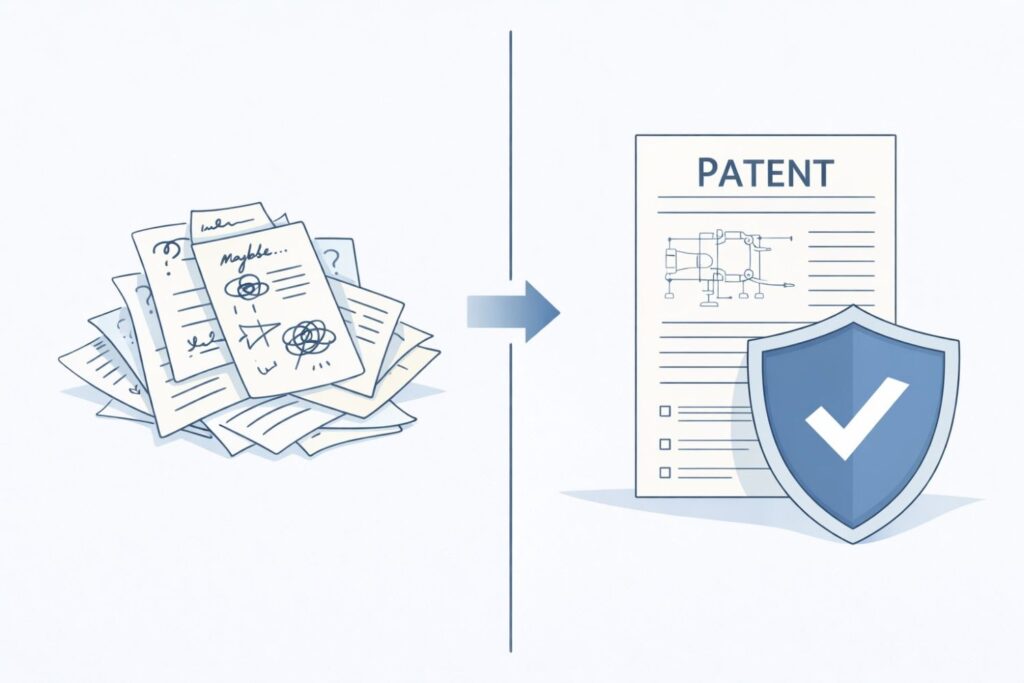
Raw answers are not protection.
They are fuel. They are ingredients. But unless they are shaped correctly, they do not turn into a strong patent.
This final stage is where many startups lose strength. Not because they lack innovation, but because they fail to transform technical insight into strategic protection.
Clarity Must Replace Conversation
An inventor interview is messy by nature. Ideas come out in fragments. Explanations circle back. Technical terms mix with shorthand. Assumptions hide inside sentences.
That is normal.
But a patent cannot be messy.
The first step in turning answers into protection is organizing the technical story into a clear structure. What is the core problem? What is the key technical solution? What are the required components? What are optional extensions?
If this structure is not defined, the patent will read like a transcript instead of a carefully designed asset.
You are not copying what the inventor said. You are refining it.
This is where experience matters. Knowing which details are central and which are supporting is a skill. Knowing how to describe a system broadly enough to protect variations, but precisely enough to avoid confusion, is a balance.
At PowerPatent, this is exactly why smart software is paired with real patent attorneys.
The software captures structured technical input. The attorneys shape it into defensible language. You get speed without sacrificing quality. You can see how that balance works here: https://powerpatent.com/how-it-works
Define the Core Before Expanding Outward
One of the biggest drafting mistakes is trying to protect everything equally.
Not all parts of a system carry the same weight. Some elements are central to the invention. Others simply support it.
When converting interview answers into protection, you must identify the true core. What is the smallest combination of elements that still achieves the technical improvement?
That core becomes the anchor.
Once defined, you expand outward. You describe additional features. You describe enhancements. You describe variations. But you never lose sight of the core mechanism that creates the improvement.
If you skip this discipline, you risk building protection around surface-level features instead of the true engine.
Strong patents protect the engine.
Broaden Without Becoming Vague
There is tension in patent drafting. You want protection to be broad. But you cannot be vague.
Broad protection means covering variations and alternative implementations. Vague language means failing to explain how something actually works.
The difference is subtle but critical.
Broad drafting relies on understanding the underlying principle behind the invention. If you know the core technical insight, you can describe it in ways that cover multiple implementations.
For example, instead of tying the invention to one specific data format, you describe how the system processes structured input regardless of format. Instead of limiting protection to one type of hardware, you explain how the method operates across computing environments.
But you only earn that flexibility if the original inventor questions uncovered the principle behind the design.
If the interview stayed shallow, broad drafting becomes risky because it may lack support.
This is why strong questioning and strong drafting are directly connected.
Anticipate How Competitors Will Try to Copy
Defensible protection requires forward thinking.
Once the technical answers are organized, ask a new question: how would someone try to replicate this without directly copying it?
Would they change one module? Replace one algorithm? Split one step into two smaller steps?
Your drafting must account for these likely design-arounds.
This is not about paranoia. It is about realism. In competitive markets, if your idea creates value, others will look for ways to achieve similar results.
When shaping raw answers into a patent, imagine those alternative paths. If your invention relies on a sequence of steps, consider whether the order could be adjusted.
If it relies on specific thresholds, consider whether ranges should be described instead of fixed numbers.
This forward-looking mindset strengthens the final document.
It transforms a description of what exists into a shield against what might come next.
Connect Technical Detail to Business Strategy
Protection is not abstract. It serves a business purpose.
As you turn inventor answers into patent language, align the scope of protection with the company’s growth plans.
If the startup plans to expand into new markets, ensure the patent is not tied to a single narrow use case. If licensing is part of the roadmap, ensure the invention is described in a way that supports flexible application.
This requires collaboration between technical and business leadership.
A patent should not be written in isolation from company strategy. It should reinforce it.
At PowerPatent, this alignment is built into the process. Founders are not left alone to translate business goals into technical claims.

The platform and legal guidance work together to ensure the protection matches the company vision. If you want to understand how that structured approach works, explore it here: https://powerpatent.com/how-it-works
Remove Ambiguity Before It Becomes a Problem
Ambiguity is dangerous in patent language.
If a term can be interpreted in multiple ways, it may create confusion later. If a process step is unclear, it may weaken enforcement.
When shaping raw answers, review each technical concept and ask whether it is clearly defined. Are key components explained? Are relationships between modules described? Is the flow of data unambiguous?
This refinement stage requires careful attention.
It also requires asking follow-up questions when needed. Sometimes, even after a strong interview, small clarifications are necessary.
The goal is not to create complexity. The goal is precision.
Clear language strengthens enforceability. It reduces risk. It improves confidence.
Preserve Flexibility for Future Innovation
Startups evolve. Products change. New features are added.
When turning interview answers into patent protection, think beyond the current version of the product.
If your invention is likely to expand, ensure the patent language does not lock you into one narrow embodiment. Describe the invention at a level that supports growth.
This is where capturing variations during the questioning phase becomes powerful. Those variations allow you to draft with flexibility.
A strong patent should feel like it grows with the company.
It should not become outdated the moment the product roadmap shifts.
Speed Without Sacrificing Strength
Founders often feel pressure to file quickly. And in many cases, speed matters.
But speed should not mean cutting corners.
The right system allows you to move fast while maintaining depth. Structured inventor questions feed directly into organized drafting. Smart tools reduce administrative friction. Experienced attorneys ensure strategic strength.
This combination prevents the common tradeoff between quality and momentum.
PowerPatent was built for this exact challenge. Deep tech founders need protection that matches their innovation. They also need a process that respects their time.
By blending AI-powered workflows with real attorney oversight, the platform helps startups file faster without weakening their position.
If you are building something worth protecting, do not leave it to vague conversations or rushed drafts. Build your patent on clear questions, structured insight, and strategic shaping.

You can see how to turn your invention into strong, defensible protection here: https://powerpatent.com/how-it-works
Wrapping It Up
Everything starts with a question. Not the kind you ask casually. Not the kind you throw out in a rushed meeting. But the kind that forces clarity. The kind that slows thinking down. The kind that uncovers the real mechanics behind what you built. Strong patents are not written. They are uncovered. They come from asking what problem truly existed. They come from walking step by step through the system. They come from exploring alternatives, tradeoffs, and edge cases. They come from understanding why each technical decision was made.