AI can help you write faster.
That is the good news.
The bad news is that fast writing often sounds like fast writing.
It may look clean. It may sound polished. It may even feel smart on first read. But many AI drafts have the same problem: they sound broad, flat, safe, and oddly forgettable. They say the right kind of things, but they do not sound like a real person with a real point of view explaining something real.
That is a problem for any business.
It is an even bigger problem when you are building something important and need your writing to sound clear, sharp, and trustworthy.
Generic writing does not sell well. It does not teach well. It does not persuade well. It does not build trust well. And it definitely does not help a startup stand out.
The good part is this: generic AI writing can be fixed.
You do not need to throw AI away. You just need to learn how to shape its output so it sounds more human, more specific, more useful, and more like your company.
That is what this article is about.
And if you are building something worth protecting, this same idea matters even more in patent work. PowerPatent helps founders turn complex inventions into strong patent filings using smart software and real attorney oversight, so the output is not just fast, but actually useful. You can see how it works here: https://powerpatent.com/how-it-works
Why AI drafts sound generic in the first place
Most people try to fix generic writing too late.
They edit a few lines. They swap a few words. They tell the AI to “sound more human.” Then they wonder why the draft still feels bland.
The real reason is simple.
Generic writing is not only a word problem. It is a thinking problem.
AI sounds generic when the input is generic, when the goal is fuzzy, when the writer has no clear point of view, when the draft is trying to please everyone, or when the text avoids the kind of details that make writing feel real.
AI is trained to predict likely language. That means it often defaults to the middle. The middle is safe. The middle is smooth. The middle is familiar. But the middle is rarely memorable.
That is why so many AI drafts end up sounding like they came from nowhere.
They use stock openings. They make broad claims. They repeat common phrases. They explain things in the same order. They avoid friction. They rarely take a clear stand. They do not sound wrong. They just do not sound alive.
This matters more than many people think.
In business writing, readers make fast judgments. They can feel when a piece is saying something real and when it is simply moving words around. They may not call it generic. They may not know exactly what is off. But they feel it. They stop trusting it. They skim it. They leave it.
That is why the goal is not only to make AI writing cleaner.
The goal is to make it feel grounded.
Grounded writing has a source. It feels connected to a person, a product, a customer problem, a real belief, or a real lesson. Generic writing feels disconnected from all of that.
Once you understand this, the fix becomes much easier.
You stop asking only, “How do I make the AI sound better?”
You start asking, “How do I give this draft something real to say?”
That shift changes everything.
The real cost of generic writing for startups and tech companies
A generic draft is not just a style issue.
It is a growth issue.
Startups live and die by clarity. You have to explain what you do, why it matters, why now, why you, why your product is different, and why someone should trust you. If your writing sounds like every other company in your space, you lose one of the cheapest and strongest ways to stand out.
This shows up everywhere.
It shows up on your homepage when the copy sounds like ten other AI startups.
It shows up in blog posts when the article feels like a summary of things everyone already knows.
It shows up in emails when the message sounds polite but empty.
It shows up in investor materials when your story feels flat.
It shows up in technical writing when the explanation seems clean but thin.
And it shows up in patent-related writing when a draft sounds polished but fails to capture what is actually special about the invention.
Generic writing also creates extra work.
A founder or marketer reads the AI draft and feels that something is missing. So they spend time rewriting line by line. Or worse, they publish it anyway because they are busy, and the content does nothing. It gets little traction. It does not convert. It does not build trust. Then the team says content does not work, when really the problem was not content itself. The problem was that the writing had no edge.
If you want content to perform, it has to feel like it came from somewhere real.
That is why strong AI writing is not about hiding that AI helped. It is about adding enough specificity, structure, and point of view that the final result feels authored instead of assembled.
That is a very different standard.
It is also a much more useful one.
The easiest way to spot a generic AI draft

Before you can fix generic writing, you need to know what it looks like.
Most generic drafts share a few traits, even when the topic changes.
They open with broad statements that could fit almost any article.
They say things that are technically true but not especially helpful.
They explain without really teaching.
They sound smooth but not insightful.
They use familiar transitions and overused phrases.
They avoid naming real tension.
They do not sound like anyone in particular.
One of the simplest tests is this: could you swap the company name, topic, or audience and keep most of the article the same?
If the answer is yes, the draft is probably too generic.
Another good test is to ask what the piece is really trying to say.
Not the topic.
Not the headline.
The actual message.
If you cannot state that clearly in one line, the draft likely lacks a spine.
Strong writing has a spine.
It has a central idea that shapes the rest of the piece. It does not wander through safe observations. It makes a case.
Generic AI drafts often lack that case. They are built from topic patterns, not from belief. They cover the territory without planting a flag.
That is why one of the biggest improvements you can make is to decide what the draft should believe before you ask AI to help write it.
A blog post should not just be “about” a subject.
It should say something about that subject.
That difference is where better writing begins.
Start with a stronger raw material, not a better polishing prompt
A lot of people try to solve the wrong problem.
They think the answer is a magic prompt.
So they say things like “Write this in a human tone,” or “Make this more engaging,” or “Avoid sounding robotic,” or “Use a conversational style.” Those prompts are not useless, but they are rarely enough.
Why?
Because style instructions alone do not create substance.
If the source material is vague, the output will still feel vague. If the thinking is thin, the writing will still feel thin. If the only goal is to produce a clean article fast, the article will probably sound like it was produced cleanly and fast.
The better move is to improve the raw material.
That means giving the draft something specific to work from.
A real customer pain.
A real founder belief.
A real product tension.
A real contrast between old and new.
A real mistake people keep making.
A real process that actually works.
A real example from your own experience.
These are the things that make writing feel less generic.
AI is much better at shaping specific input than inventing specific depth.
That is important.
You do not want AI guessing what makes your company different. You want it helping express what already is different.
This is one reason PowerPatent works so well for founders. The goal is not to spit out generic legal-sounding text. The goal is to turn the real substance of an invention into something clear and useful, with real attorney review making sure it stays grounded. That is how better output happens. See how it works here: https://powerpatent.com/how-it-works
Specificity is the fastest cure for generic writing
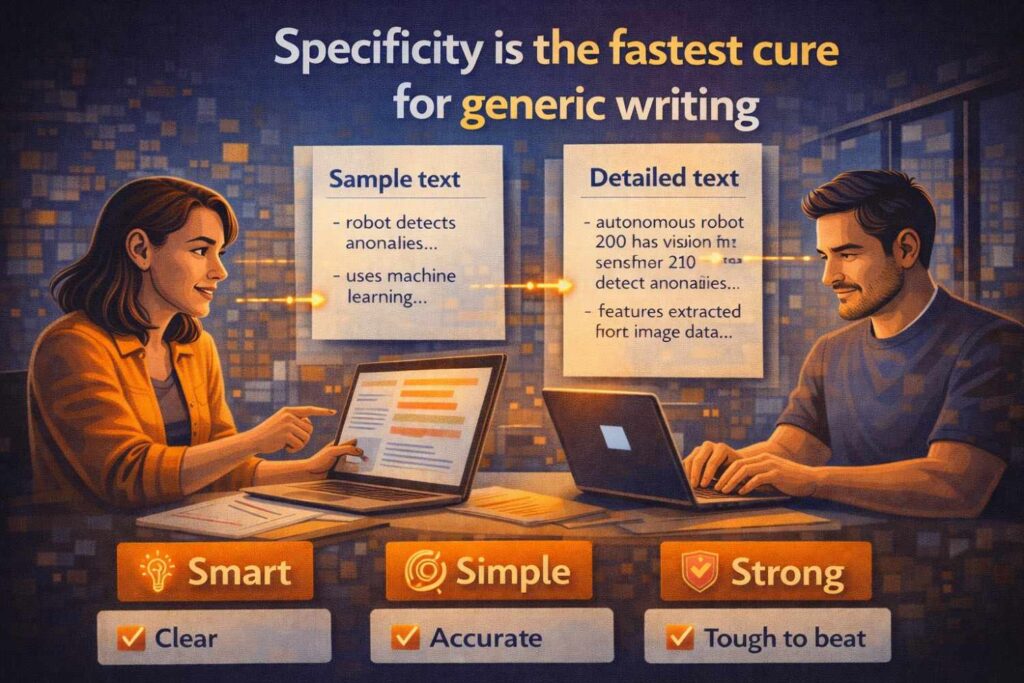
If there is one rule that improves AI drafts more than anything else, it is this:
Be more specific.
Specific writing feels real because reality is specific.
Generic writing says a company improves efficiency.
Specific writing says a company cuts the time it takes to move from rough technical notes to a patent-ready draft.
Generic writing says founders face many challenges.
Specific writing says founders are juggling product work, customer calls, hiring, and fundraising while trying to protect what they are building before someone else catches up.
Generic writing says AI can help businesses scale content.
Specific writing says AI can turn a blank page into a useful first draft in minutes, but that draft still needs a human to add judgment, examples, and a real point of view.
Readers trust specific writing more because it sounds observed, not manufactured.
Specificity also makes writing more persuasive. It helps the reader picture the situation. It makes the problem clearer. It makes the solution feel more believable.
This is true in thought leadership, marketing, product content, technical education, and patents.
The mistake many teams make is thinking they need to sound broad to sound smart. In reality, broad writing often feels empty. Specific writing, when done well, makes the larger point stronger.
So when an AI draft feels generic, ask yourself a blunt question:
Where is this too broad to feel real?
Usually the answer will appear fast.
The problem may be in the examples. Or the claims. Or the verbs. Or the way the draft talks about the audience. Or the benefits. Or the process. But almost always, the draft needs more detail that could only come from someone who actually knows the topic.
That is what makes writing feel authored.
Add a point of view or the draft will drift toward sameness
A lot of AI writing sounds generic because it has no opinion.
It wants to be balanced. It wants to be safe. It wants to present the topic in a way that no one could object to. That sounds good in theory, but in practice it makes the draft weak.
Strong writing does not need to be loud or extreme.
But it does need a point of view.
A point of view gives the piece direction. It tells the reader why this article exists instead of a thousand others on the same topic. It tells them what the writer believes is true, false, overrated, misunderstood, risky, useful, or changing.
Without that, the draft becomes a tour guide. It walks through the subject politely and leaves.
With a point of view, the draft becomes a case. It shows the reader what matters.
That is when writing starts to feel like it came from a real person.
For example, an article about AI writing could simply explain what AI writing is, how it works, and some best practices. That is fine, but it is forgettable. A stronger version might argue that most teams focus too much on prompting and not enough on source material. Or that generic writing is usually a thinking problem, not a tone problem. Or that AI is best used as a drafting partner, not a replacement for point of view.
Now the article has a shape.
This does not mean every piece needs to be provocative. It just needs to stand for something.
That one change can make a draft feel far less generic.
Use real tension, not fake smoothness
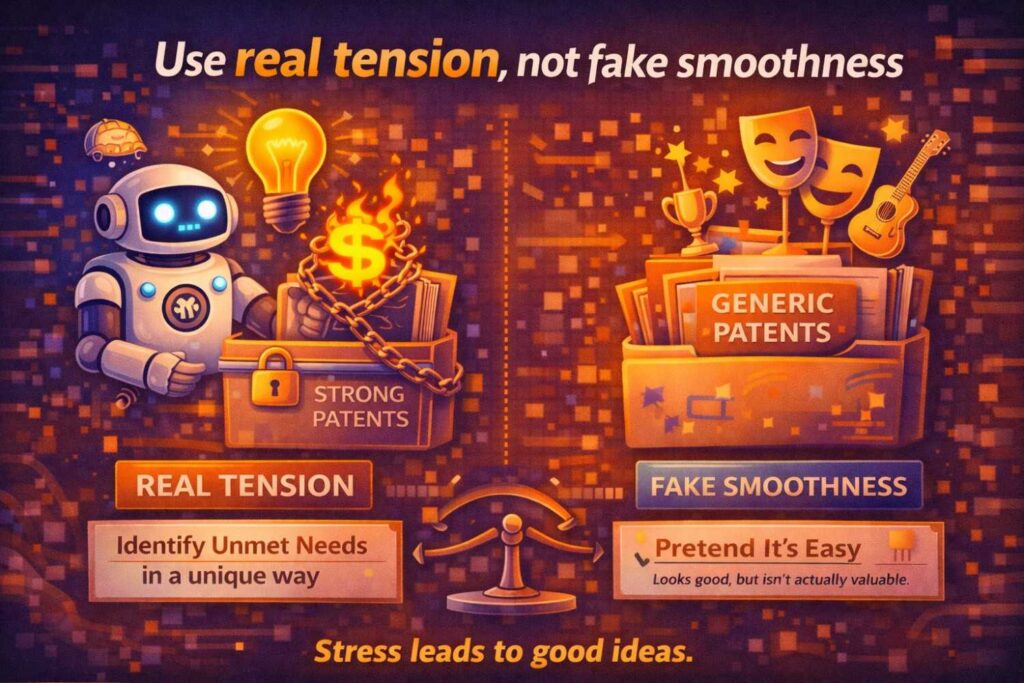
Generic AI drafts often try to make everything feel easy.
They explain topics in a neat, frictionless way. They move from one point to the next with clean transitions. They avoid the messy parts. They rarely admit tradeoffs. They almost never show where people get confused, frustrated, stuck, or misled.
That is a big reason they feel synthetic.
Real writing has tension.
It shows what people struggle with.
It names the thing that sounds true but is not.
It points out what looks easy and turns out to be hard.
It makes distinctions.
It shows where the real problem is.
This is one of the easiest ways to make AI drafts sound more human. Add tension.
If you are writing about AI content, do not say only that AI can help businesses create content faster. Say that speed is easy, but real quality is harder. Say that many companies publish AI content that sounds polished but says very little. Say that most people try to fix this at the prompt level when the real issue starts earlier.
That creates movement in the piece.
It also makes readers more likely to trust you because you are not pretending the topic is simpler than it is.
Good writing does not flatten reality.
It gives shape to it.
That is especially important when the audience is founders, engineers, or technical teams. These readers are usually allergic to fluff. They want to see that you understand the real problem, not just the marketable version of it.
When you add real tension, you make the writing feel less like content and more like insight.
Replace empty praise with clear cause and effect
AI drafts often love empty praise.
They say things are powerful, transformative, innovative, seamless, robust, efficient, scalable, game-changing, next-generation, or cutting-edge. These words sound impressive, but they usually do not carry much weight on their own.
The problem is not only that these words are overused.
The problem is that they skip the real work of explanation.
If you want a draft to sound less generic, stop leaning on praise and start showing cause and effect.
Do not say a platform is powerful.
Say what it lets people do that they could not do easily before.
Do not say a product is efficient.
Say what friction it removes, what steps it shortens, or what mistakes it helps avoid.
Do not say a patent workflow is modern.
Say that it helps founders move from invention details to a strong draft without months of back and forth and without losing attorney oversight.
That is stronger because it is concrete.
It also sounds more trustworthy because the reader can follow the logic. They do not have to take your word for it. They can see why the thing matters.
A lot of generic AI writing relies on adjectives because adjectives are easy. Real writing relies more on explanation because explanation is where trust gets built.
Whenever you see a broad positive word in a draft, ask what exactly makes that word true.
Then write that instead.
Write like someone is actually trying to decide

One quiet reason AI drafts feel generic is that they often sound like they are written for no one making any real decision.
They explain a topic in a general way, but they do not speak to the moment the reader is in.
That is a missed opportunity.
The best business writing usually meets the reader at a decision point.
Should we use AI for this?
Should we publish this?
Should we trust this process?
Should we change how we do this?
Should we keep doing it the old way?
Should we spend time or money here?
When writing recognizes that moment, it feels more useful and more human.
This is a major fix for generic drafts. Instead of writing to “the audience” in a broad sense, write to the reader at the point where they are trying to choose.
For example, a founder reading about AI-generated patent drafts is often not just curious. They are deciding whether they can trust AI in a high-stakes workflow. A content lead reading about AI writing is deciding whether they can publish more efficiently without sounding low quality. A startup marketer reading an article about copy may be deciding whether to rewrite the homepage again.
That context changes the writing.
Now the piece can speak to the real concern, not just the topic.
It can address risk, tradeoffs, timing, and action.
It can sound like guidance instead of summary.
That is a big shift.
And it is one of the simplest ways to make AI-assisted writing feel more useful.
The more you know your audience, the less generic the draft will be
Many drafts sound generic because the audience is generic.
The prompt says something like “Write a blog post for startup founders,” or “Create an article for SaaS companies,” or “Write for business leaders.” That is better than nothing, but it is still broad enough to produce flat writing.
A real audience is more exact.
It has context.
It has pressures.
It has familiar problems.
It has vocabulary it uses and vocabulary it ignores.
It has objections.
It has habits.
It has blind spots.
When you define the reader more clearly, the writing gets sharper almost automatically.
Take founders as an example. That word alone can mean many things. A biotech founder raising a Series A is not the same as a solo SaaS founder. A deep tech founder with strong engineering talent is not the same as a consumer app founder hiring their first marketer. The more your draft knows who it is talking to, the less likely it is to drift into bland advice.
This matters a lot for PowerPatent-style content.
The best audience framing is not “anyone interested in patents.” It is founders, inventors, and technical teams who are building real products, want to move fast, and do not want a painful old-school patent process. That clarity changes the writing. It changes the examples. It changes the tone. It changes the calls to action.
If your AI draft feels generic, tighten the reader.
Not just by role, but by situation.
Who are they really?
What are they dealing with right now?
What are they afraid of?
What are they trying to avoid?
What would make them lean in and keep reading?
Answer that well, and the draft gets stronger very quickly.
Strong openings do not warm up slowly

Many AI drafts open in a dull, safe way.
They start with broad context. They give history. They define the topic. They take too long to become interesting. This is one of the fastest ways to sound generic.
A strong opening gets to the point.
It creates interest quickly.
It names the problem.
It highlights the tension.
It makes the reader feel seen.
It suggests the article will actually help.
That does not mean every opening needs to be dramatic. It just means it should do something besides ease into the topic.
A weak opening says that AI has transformed the world of content creation and many businesses are using it to improve efficiency.
A stronger opening says AI can help you write fast, but fast writing often sounds generic, and that becomes a serious problem when your company needs to sound sharp, clear, and trustworthy.
The second opening creates direction.
It makes the reader feel the issue right away.
A lot of AI-generated introductions feel generic because they try to sound complete instead of compelling. They want to cover the topic rather than pull the reader into it.
That is the wrong priority.
You do not need to explain everything in the first paragraph.
You need to make the reader want the next one.
Your examples should sound lived, not borrowed
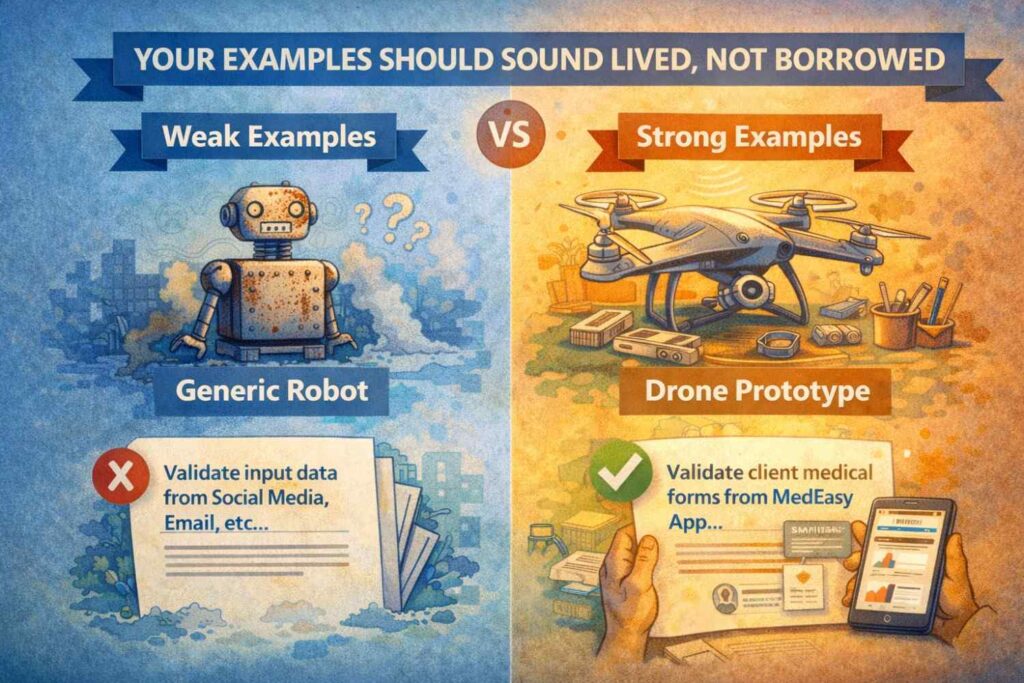
Examples are one of the easiest ways to make writing feel less generic.
They are also one of the easiest ways to make it feel fake if they are weak.
A generic example feels invented for the article. It sounds like it exists only to prove the point. It has no texture. No pressure. No detail. No consequence.
A strong example feels lived.
It may come from your product, your customers, your process, your team, or your own experience. It does not have to reveal confidential details. It just needs enough reality to make the point feel earned.
For instance, do not say only that founders struggle with patents. Say that many founders wait too long because they assume patenting will mean slow law firm meetings, messy intake, and months of delay while the product is still moving. That feels closer to life.
Do not say only that AI drafts need editing. Say that many AI drafts sound polished until you ask what they are really saying, and then you realize the article could fit ten other companies with only a few nouns changed.
The example does not need to be long.
It needs to feel connected to real observation.
When you add that kind of detail, the article becomes more trustworthy, more readable, and far less generic.
Stop over-explaining the obvious
Another reason AI drafts feel generic is that they spend too much time explaining things the reader already knows.
This often happens because AI is trying to be complete. It wants to cover the topic cleanly from the ground up. But that creates drag.
A smart reader can feel when the article is taking them through background they do not need. It makes the writing feel padded. It lowers the energy of the piece. It also makes the author seem less confident, because instead of moving toward the real point, the article keeps clearing its throat.
Better writing respects the reader.
It does not skip necessary setup, but it does not over-teach the obvious.
This is especially important in content for founders, operators, and technical readers. These audiences are usually short on time and quick to leave if the writing spends too long saying things they already understand.
One good editing question is this:
What in this section would my ideal reader already know or assume?
Cut or compress that.
Then use the space to say something more useful.
Generic drafts often become long because they are filled with low-value explanation. Strong drafts feel richer because more of the words are pulling weight.
Make the draft sound like your company, not the internet
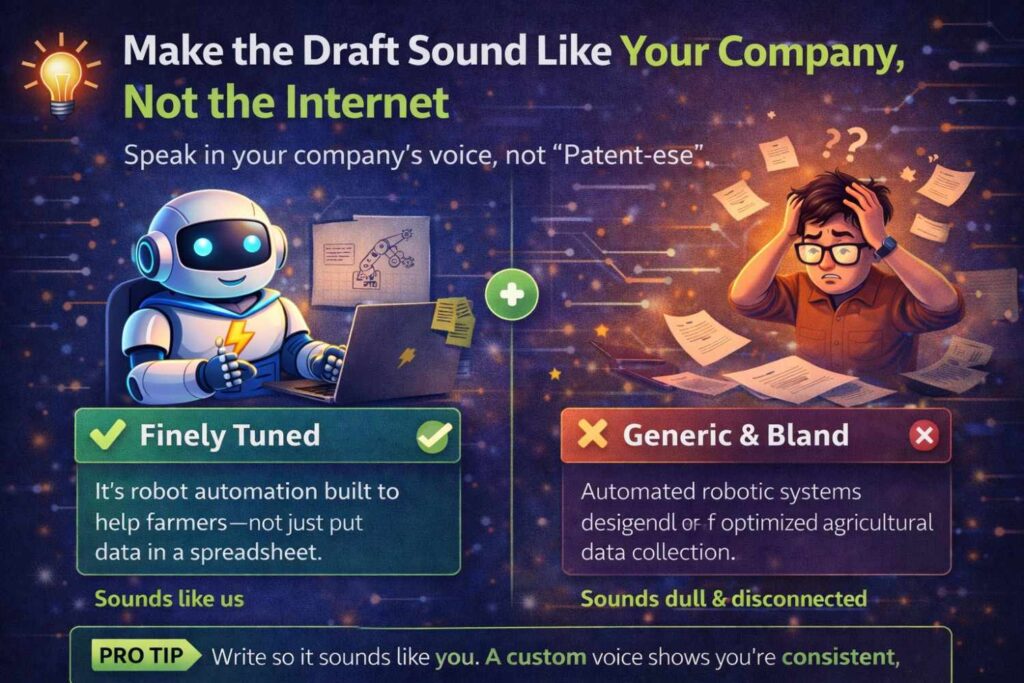
A lot of AI writing sounds generic because it sounds like public internet language.
It reflects the most common ways a topic is usually discussed. That is a problem if your company is supposed to sound distinct.
Your company should have a voice, even if it is subtle.
Not a fake brand voice with catchy internal labels and tone guides nobody follows. A real voice. A repeatable way of explaining what matters. A level of directness. A kind of confidence. A way of talking to customers. A way of describing the problem. A way of naming what is broken about the old way.
That voice should shape the draft.
Otherwise the content may sound fine but still not sound like you.
For PowerPatent, for example, the voice should feel clear, grounded, simple, and founder-friendly. It should make patents feel less intimidating and more like a smart business move. It should explain complex ideas in plain words. It should emphasize speed, control, confidence, and real attorney support without slipping into jargon or empty hype.
That kind of voice is what turns good information into good company content.
If you want AI writing to sound less generic, do not ask only for tone. Feed it examples of how your company actually speaks. Feed it real phrases you use. Feed it product truths you say often. Feed it the kinds of distinctions you care about.
The draft gets better when it is anchored to a voice that already exists.
Do not hide the hard part
Generic content loves easy conclusions.
It makes everything feel manageable. It wraps up neatly. It gives advice that sounds right but does not acknowledge what is hard.
That makes the draft less credible.
Readers trust writing more when it admits the hard part.
Not in a gloomy way. In an honest way.
If the topic is AI writing, say that anyone can create a decent-looking first draft now, but making that draft sound original still takes judgment. If the topic is patents, say that speed matters but weak filings can create problems later. If the topic is startup growth, say that there is usually no simple playbook that works unchanged in every context.
This matters because real expertise does not flatten difficulty.
It clarifies it.
When you write honestly about what is hard, you make the solution feel more useful. You also make the reader more likely to trust your recommendations because they can see you are not selling simplicity where it does not exist.
Many AI drafts avoid this because they are trying to sound smooth. But smooth is not always persuasive.
Sometimes the most persuasive sentence in an article is the one that says, “This is where most teams get it wrong,” or “This is the part that looks easy but usually is not.”
That kind of honesty gives the piece force.
Use stronger verbs and fewer soft phrases
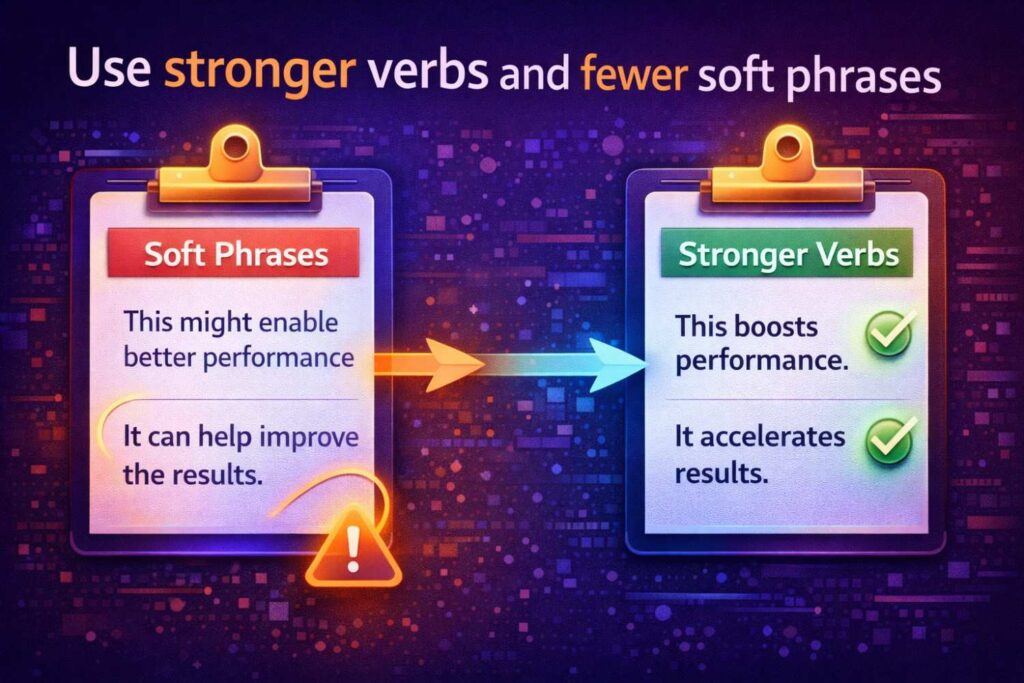
Sometimes generic writing is not about the idea. It is about the language.
AI drafts often rely on soft verbs and padded phrases.
Things are designed to enable. Systems are intended to facilitate. Strategies can help organizations improve outcomes. Businesses may benefit from solutions that are able to optimize processes.
This kind of language sounds distant.
It creates a fog around the point.
You can often improve a draft quickly by using stronger verbs and cutting soft framing.
Instead of saying a tool helps enable faster drafting, say it speeds up drafting.
Instead of saying a process is designed to reduce errors, say it reduces mistakes.
Instead of saying companies can leverage AI to improve productivity, say AI can help teams write faster.
This sounds more direct because it is more direct.
Clear language makes writing feel more human because people rarely speak in padded abstractions unless they are trying to hide something or sound formal.
That does not mean the tone should become casual or sloppy. It means it should be crisp.
Formal writing can still be plain.
In fact, plain formal writing often sounds stronger because the reader can feel the confidence in it.
Repetition is one of the biggest signs the draft needs work
Many AI drafts repeat themselves without meaning to.
They introduce the same point in slightly different forms. They use the same phrase more than once. They restate benefits. They circle back to ideas already made. This repetition can make the article feel generic because it creates the impression of motion without adding depth.
Readers notice this, even if only subconsciously.
They start to feel that the piece is stretching. They lose trust in its usefulness. The article starts sounding machine-made because it is filling space instead of moving forward.
One of the best ways to fix this is to edit for progression.
Every paragraph should add something.
A sharper distinction.
A more useful example.
A new implication.
A business angle.
A mistake to avoid.
A practical takeaway.
A stronger explanation.
If the paragraph only restates what the reader already got, it probably needs to be cut or merged.
This is especially important in long-form content, where AI can produce a lot of words that feel smooth but do not deepen the piece.
Length is not value.
Progress is value.
A long article that keeps developing the idea feels rich.
A long article that keeps restating the idea feels generic.
Use transitions that sound natural, not polished for their own sake
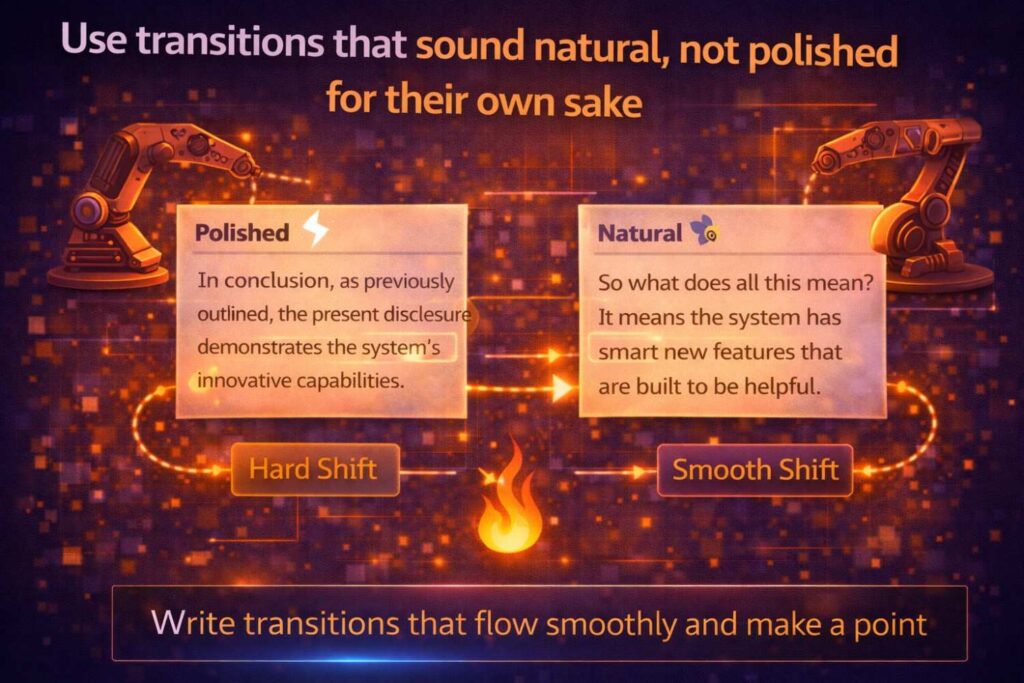
AI loves neat transitions.
It uses phrases like “In today’s fast-paced digital landscape,” “Additionally,” “Furthermore,” “Moreover,” “It is important to note,” and “By doing so.” These transitions are not always wrong, but they often signal a draft that is trying to sound formal rather than sound real.
Natural transitions are usually simpler.
They follow the logic of the thought.
They sound like someone moving from one point to the next because the next point actually follows.
Good transitions can be as simple as “That is the problem,” “This matters because,” “Here is where things go wrong,” “The better move is,” “That sounds fine, but,” or “This is where most teams get stuck.”
These transitions feel less generic because they carry meaning, not just structure.
They also create better rhythm.
The piece starts to sound like it is being argued, not assembled.
If you want AI drafts to sound less generic, pay close attention to transitions. They reveal a lot about whether the piece is flowing from real thought or from default writing patterns.
A transition should do more than connect two paragraphs.
It should carry the reader’s attention forward.
That is the standard businesses should care about.
A lot of AI drafts fail here because they treat transitions like decoration. The writing uses smooth connector phrases that make the article look finished, but those phrases do not actually deepen the argument or improve clarity. They simply signal that one paragraph has ended and another is beginning.
That may sound harmless, but it creates a real business problem.
When transitions feel artificial, the whole piece starts to feel artificial. The reader may not stop and say, “This transition is weak,” but they will feel a small drop in trust. The article starts sounding like it was assembled from polished parts rather than written with a clear line of thought.
For businesses, that matters.
If your content is meant to persuade, educate, convert, or build authority, the movement between ideas has to feel earned. It has to sound like each point naturally leads to the next because the logic is strong, not because the copy was filled with formal linking words.
The best transitions carry meaning, not just motion
A weak transition moves the reader.
A strong transition moves the argument.
That is the real difference.
For example, many generic drafts use soft bridge phrases that could fit almost anywhere. They say things like “In addition,” “Furthermore,” or “It is important to note.” These phrases are not always wrong, but they often do very little. They tell the reader that more information is coming, but not why that information matters.
A more useful transition tells the reader what kind of turn is happening.
Maybe the next paragraph explains why the previous point matters in practice.
Maybe it introduces a risk that businesses often miss.
Maybe it shifts from theory to execution.
Maybe it shows where the common advice breaks down.
Maybe it challenges an easy assumption.
Those are meaningful transitions.
They do not just smooth the surface. They guide the reader through the real logic of the piece.
For business writing, that is much more valuable than polished filler. It helps the reader stay oriented. It makes the article easier to follow. It also makes the writer sound more in control.
Bad transitions often hide weak thinking
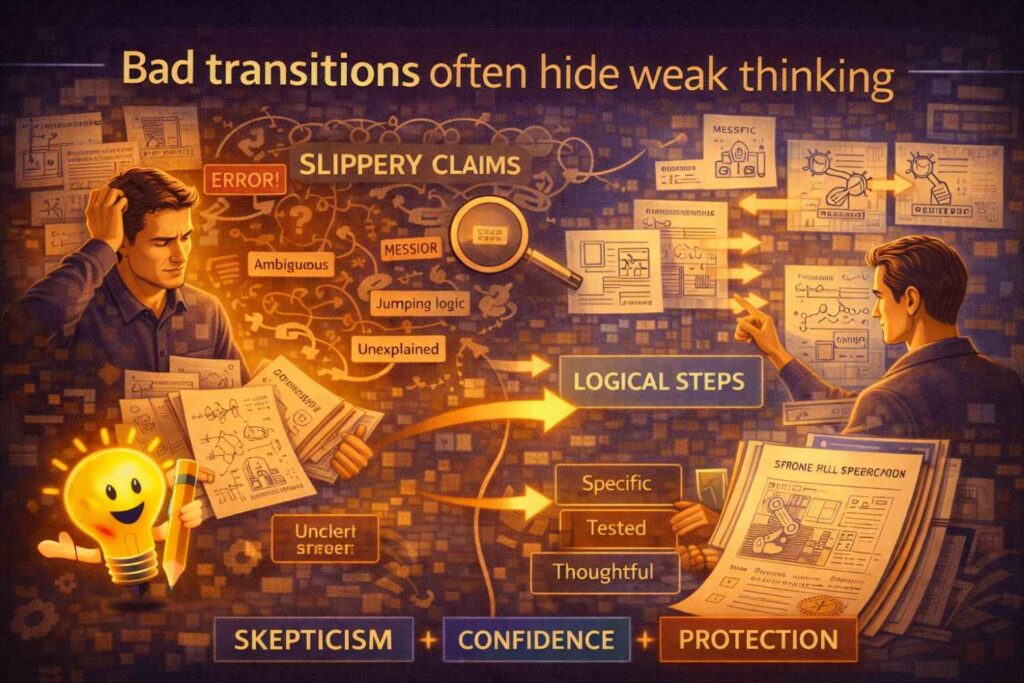
This is the part many teams miss.
A transition problem is often not a transition problem.
It is a structure problem.
When a draft uses too many formal bridge phrases, it is often because the ideas are not actually connected in a strong way. The writing needs a bridge because the argument itself is loose. So the draft adds polished language to hide the gap.
That is why simply swapping out transition words is not enough.
You have to ask whether the second paragraph really grows out of the first one. If it does not, no stylistic tweak will fix the deeper issue.
This is very useful during revision.
If a paragraph begins with a polished phrase and still feels awkward, stop editing the phrase and inspect the connection. Ask what the new paragraph is doing. Is it extending the previous point, narrowing it, contrasting with it, proving it, or applying it? If the answer is unclear, the writing likely needs stronger logic before it needs stronger wording.
Businesses that publish a lot of AI-assisted content should pay close attention to this. Weak transitions are often early warning signs that the article sounds complete without actually being coherent. That can hurt trust, lower engagement, and make the brand seem less thoughtful than it really is.
Natural transitions help readers trust the brand voice
Readers rarely separate writing style from brand credibility.
They experience both at once.
If your transitions sound stiff, over-managed, or overly formal, the brand itself can start to feel distant. The reader may not consciously blame the company’s voice, but they may leave with the sense that the content is polished in a generic way rather than grounded in real understanding.
This is especially important for companies that sell trust.
If you are asking readers to believe your product is better, your process is smarter, or your team understands a hard problem deeply, the writing should feel direct and well-led. Natural transitions help create that feeling. They make the content sound like it came from people who know exactly what they are saying and why they are saying it.
That matters for startups, legal tech, AI companies, and any business operating in a crowded market.
A natural flow makes the content easier to trust because the reader does not feel pushed through a pre-built content machine. They feel guided by a real mind.
That is a subtle advantage, but a meaningful one.
Different transition types serve different business goals
Not all transitions should do the same job.
This is where strategic writing gets better.
Some transitions should increase urgency. Some should slow the reader down and deepen understanding. Some should create contrast. Some should move from problem to solution. Some should shift from explanation to action.
When businesses understand this, their content gets much sharper.
A transition that introduces a hidden risk can increase attention.
A transition that shifts from theory to execution can make the article more practical.
A transition that names a common mistake can make the piece more persuasive.
A transition that signals a business implication can help the reader connect the idea to real decisions.
That is much stronger than relying on the same few polished phrases throughout the draft.
One smart editing move is to label the role of each section break in a draft. Do not focus first on the wording. Focus on the move. Is the next section explaining, challenging, narrowing, proving, applying, or warning? Once that is clear, the transition becomes easier to write in a natural way.
This gives the article more control.
It also helps business content do what it is supposed to do: guide the reader toward clearer understanding and better decisions.
The transition should match the temperature of the piece
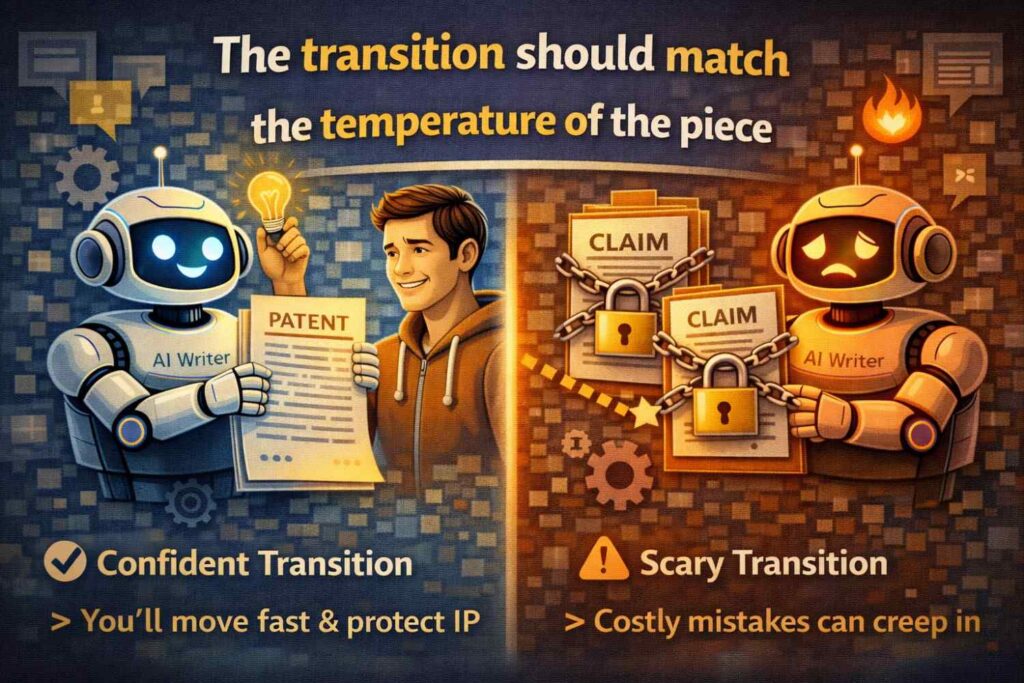
This is a detail that makes a big difference.
Transitions have tone.
Some sound formal and distant. Some sound sharp and direct. Some sound calm and thoughtful. Some sound urgent. If the transition tone does not match the rest of the article, the writing starts to feel uneven.
That is one reason AI drafts often feel generic. They may contain useful ideas, but the transitions sound like they came from a different kind of writing altogether. The body feels direct, but the connectors feel like a school essay. Or the piece aims to feel conversational, but every turn sounds like it was copied from corporate white paper language.
Businesses should be careful here because tone consistency affects trust.
If your content is supposed to feel founder-friendly, the transitions should not suddenly become stiff and ceremonial. If your brand is clear and practical, the transitions should help the piece move cleanly instead of weighing it down with formal phrasing.
One useful editing question is simple: would a smart person at our company actually say this line out loud?
If not, the transition may be too polished for its own good.
Strategic transitions can improve conversion, not just readability
This is where transitions become more than a writing issue.
They become a conversion issue.
In business content, the reader is often moving toward a decision. Maybe they are deciding whether they trust your view. Maybe they are deciding whether the problem matters. Maybe they are deciding whether to explore your product. If the transitions are weak, the path to that decision becomes weaker too.
Strong transitions help shape momentum.
They show the reader why the next point matters. They increase clarity at the right moment. They help the article feel like it is building toward something useful. That makes the piece more persuasive.
For example, a transition that shifts from a common problem to a costly business outcome can make the article more compelling. A transition that moves from general advice to a sharper, practical solution can make the content more actionable. A transition that leads naturally into a product mention can make the call to action feel earned instead of inserted.
That is important.
Readers do not like feeling steered. But they do appreciate being guided when the logic is strong. Good transitions create that experience. They make the journey feel coherent rather than sales-driven.
For businesses, this means transition quality can affect not only readability but also trust, time on page, and eventual action.
How to audit transitions in a business draft
A lot of teams do not review transitions directly.
They should.
Transitions are one of the fastest ways to spot whether a piece is actually flowing or only appearing to flow.
A useful review method is to read only the first line of each paragraph in sequence. This reveals the skeleton of the article. If those opening lines feel repetitive, stiff, or oddly formal, the transitions likely need work. If they feel like a real progression of thought, the piece is in much better shape.
Another strong method is to highlight every standard linking phrase in the draft. If you see too many of the same patterns, the article may be leaning on formula instead of logic.
You can also test transitions by removing them. In some cases, the writing gets stronger right away. That is a sign the transition was adding polish but not adding value. In other cases, removing the line exposes a real gap, which tells you the connection needs to be built more honestly.
This kind of review is highly practical for teams using AI at scale. It helps them catch one of the biggest sources of generic feel without needing a full rewrite every time.
Actionable ways businesses can improve transitions fast

Improving transitions does not need to be slow.
A few habits go a long way.
Replace formal bridge phrases with logic-first openings
Instead of starting a new paragraph with a polished connector, start by showing why the next point follows. This usually makes the writing sound more natural and more authoritative.
Write the transition after the paragraph is finished
Many weak transitions happen because the writer tries to connect ideas before the second idea is fully clear. Draft the paragraph first, then write the opening line based on what that paragraph actually does.
Use the next paragraph’s job as the guide
Before writing the transition, ask what the paragraph is meant to do. Is it warning, explaining, proving, narrowing, or applying? That answer will usually produce a better opening than a stock phrase.
Read the paragraph jump out loud
If the movement feels stiff when read aloud, it will feel stiff on the page too. This is one of the fastest tests for transition quality.
Cut transitions that exist only to sound smooth
Some transitions are just verbal padding. If a line does not sharpen the logic or improve the reader’s orientation, remove it.
Match transition style to brand voice
A company with a clear, simple voice should use transitions that are equally clear and simple. This helps the article sound consistent and more human.
Why this matters more in expert-led content
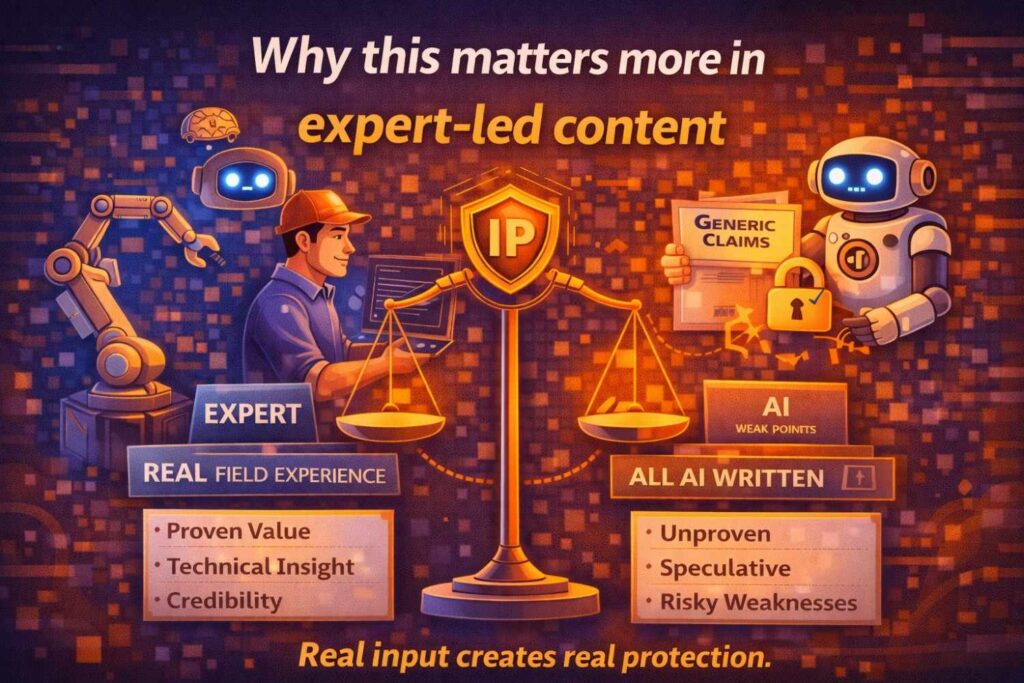
Some content can survive weak transitions.
Expert-led content usually cannot.
When a company is trying to teach, advise, or lead in a category, the writing needs to show control. Readers expect more than surface polish. They want to feel that the article was built by someone who understands the topic deeply enough to move through it with purpose.
That is why transitions matter so much in founder content, technical writing, legal tech content, and category education pieces. These articles are not only sharing information. They are building authority.
Authority is not built by sounding formal.
It is built by sounding clear, deliberate, and deeply aware of what the reader needs next.
That is exactly the kind of content businesses should aim for.
And it is especially important when the writing supports high-trust decisions. In those settings, the flow of thought can influence whether the company sounds thoughtful or generic, credible or polished-but-thin.
Better transitions make the whole article feel smarter
This may sound small, but it is true.
When transitions improve, the whole article often feels smarter.
The ideas seem clearer.
The structure feels tighter.
The writer sounds more confident.
The brand feels more deliberate.
That happens because strong transitions reveal strong control. They show that the article is not just a collection of paragraphs. It is a guided argument with shape and purpose.
For businesses, that is a real edge.
A smarter-feeling article is more likely to hold attention, earn trust, and move the reader closer to action. And in a world full of AI-assisted content, that kind of edge matters more than ever.
Build the article around one useful promise
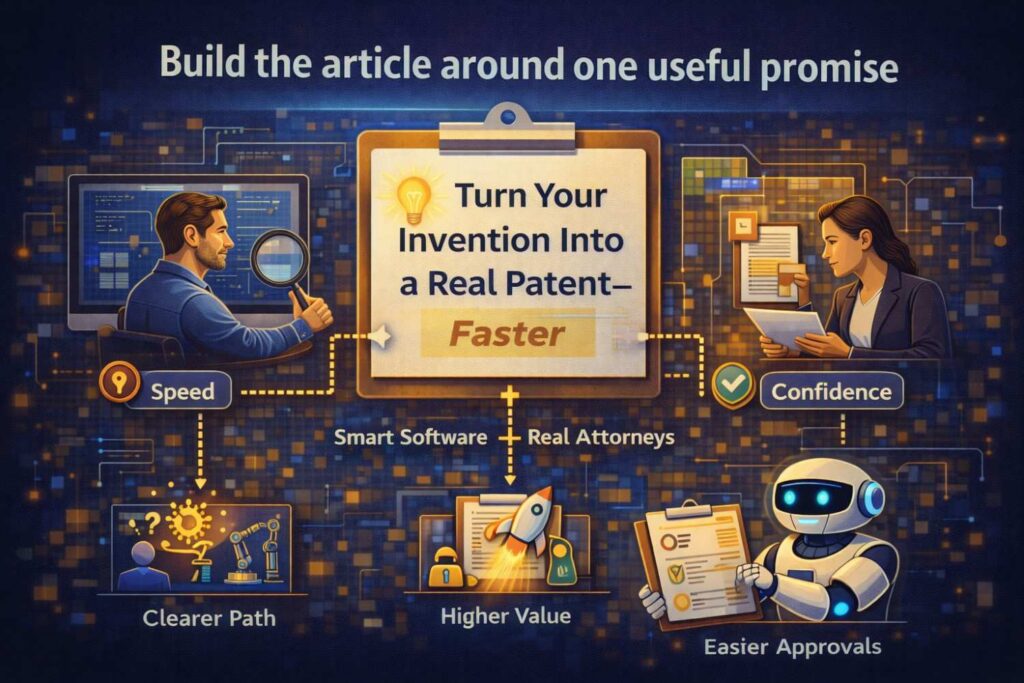
Strong articles feel focused.
Generic articles feel like they are trying to cover a topic.
One reason this happens is that many AI drafts are not built around a real promise to the reader. They are built around a topic area and a word count.
That is not enough.
A better article usually has a central promise.
Not a hypey promise. A useful one.
It tells the reader what they will understand, avoid, improve, or do better by the end.
That promise shapes what belongs in the piece and what does not.
For example, an article titled “How to Make AI Drafts Sound Less Generic” should promise more than vague advice about tone. It should help the reader understand why generic drafts happen, how to spot them, how to fix them, and how to build stronger source material from the start. That promise keeps the piece from drifting.
Without a promise, the article becomes loose. It collects related points. It covers the area. It sounds complete but not especially helpful.
This is one reason content teams publish so much forgettable writing. The article may be accurate, but it is not built around an outcome.
Readers respond much better when the piece feels like it is taking them somewhere.
Better drafts usually come from better interviews
If you want less generic AI writing, one of the best places to improve is before the writing begins.
Interview better.
This is especially true for founder-led content, technical content, and product-driven articles.
A shallow interview produces shallow material. The draft then has to rely on general knowledge, broad prompts, and common phrasing. That is when content starts sounding like everyone else.
A good interview does something different. It pulls out sharp distinctions.
What do you believe that others in your market get wrong?
What frustrates your customers before they find you?
Why do people wait too long?
Where does the old process break down?
What mistake do smart teams keep making?
What looks like the right move but is not?
What happens in the real world that most articles leave out?
Those questions create material with life in it.
They create tension, perspective, examples, and practical insight. They give the draft something worth saying.
This is incredibly useful for PowerPatent-style content because the best articles are not generic explanations of patents. They are founder-friendly guides rooted in real startup pressure, real invention capture problems, and real ways to avoid costly mistakes. That is where the writing becomes valuable. Learn more about the approach here: https://powerpatent.com/how-it-works
Make it easier to picture
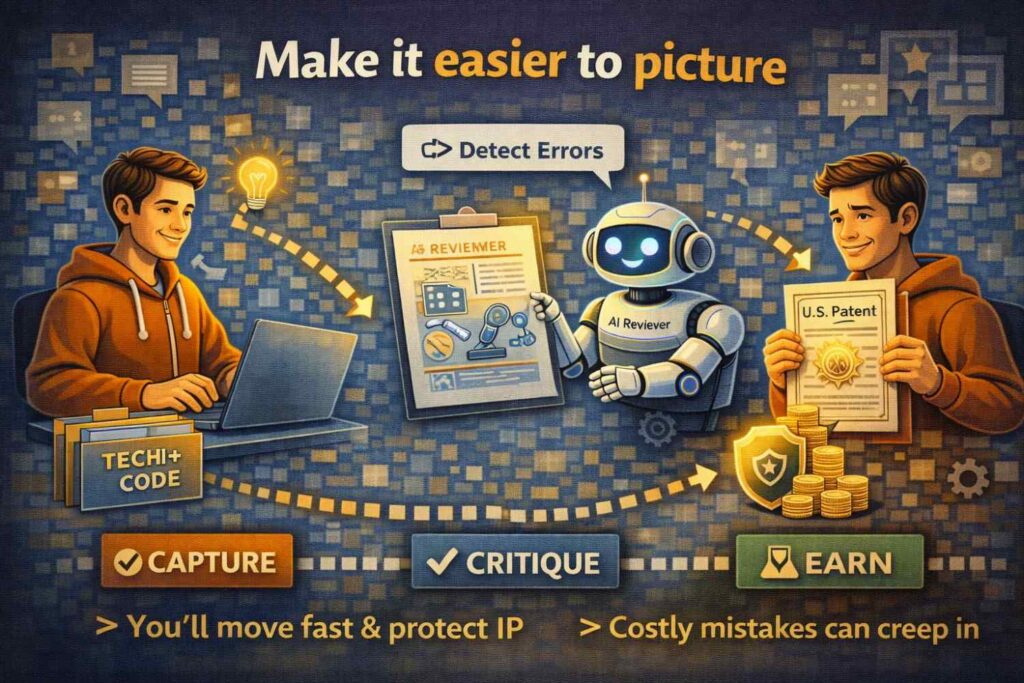
A lot of generic writing stays abstract for too long.
It talks about systems, teams, businesses, workflows, users, or organizations in a general way. That makes the writing feel distant.
Good writing helps the reader picture what is happening.
Not with big dramatic scenes. Just with enough detail that the mind can hold onto something.
A founder is not just a founder. They may be closing customer calls, reviewing product decisions, and trying to protect an invention before a launch.
A content team is not just a content team. It may be under pressure to publish more while still keeping quality high.
An AI draft is not just a draft. It may be a clean-looking article that sounds right until someone reads it aloud and realizes it could have been written for any company in the category.
These small touches matter.
They make the article easier to feel, not just understand.
That is a big part of what people mean when they say they want writing to feel human. Human writing often helps you picture reality more clearly. Generic writing remains at the concept level.
When revising a draft, look for places where the writing could become easier to picture.
Usually that means replacing abstract nouns with grounded moments, actions, or examples.
Ask better questions during revision
A lot of weak editing focuses on grammar, clarity, and sentence flow.
Those things matter, but they are not enough to fix generic writing.
You need sharper revision questions.
What in this draft could only have come from us?
Where does this sound like the internet instead of our company?
What claim sounds true but still feels empty?
What section says something real?
Where does the article avoid tension?
Where is the point of view weak or missing?
What would make a smart reader stop and think, “Yes, that is exactly right”?
What would make them trust this piece more?
These are much better revision tools than simply asking whether the draft sounds human.
They force the article toward usefulness and away from bland fluency.
One of the best tests is to read the draft and mark any paragraph that could be copied into another company’s blog with almost no change. Those are the paragraphs most likely to feel generic. They either need sharper detail, stronger perspective, or to be cut.
Another good test is to ask what the draft would lose if one full section disappeared. If the answer is “not much,” the section probably is not doing enough.
Strong editing is not only about cleanup.
It is about raising the density of meaning.
The best AI writing still sounds like someone is in charge

This is the heart of it.
People do not mind that software helped create a draft.
What they mind is when the final piece feels unmanaged.
They can feel when no one was really in charge of the meaning.
The article becomes smooth but hollow. It explains without choosing. It moves without building. It sounds correct without sounding committed.
Strong AI-assisted writing still feels directed.
It feels like someone decided what matters, what does not, what the reader needs most, what examples belong, what tension should lead the piece, and what the final takeaway should be.
That sense of authorship is what keeps the writing from feeling generic.
You do not need to hide that AI helped.
You need to make sure the piece reflects a mind, not only a model.
That is the real standard.
A practical way to make any AI draft better
If you want a simple working method, here is one that helps a lot.
Start by getting the fast draft. That is fine.
Then stop treating it like the final article.
Ask what the article is really trying to say.
Write that in one plain sentence.
Then go back through the draft and sharpen everything that does not support that message.
Add one clear point of view.
Add one or two real tensions.
Add real examples.
Remove low-value background.
Replace broad praise with explanation.
Make the audience more exact.
Cut repeated ideas.
Tighten the opening.
Strengthen the close.
Read it out loud.
Then ask whether it sounds like your company or like a decent internet summary.
That last question matters a lot.
The goal is not perfection.
The goal is authorship.
Why this matters even more in high-stakes writing
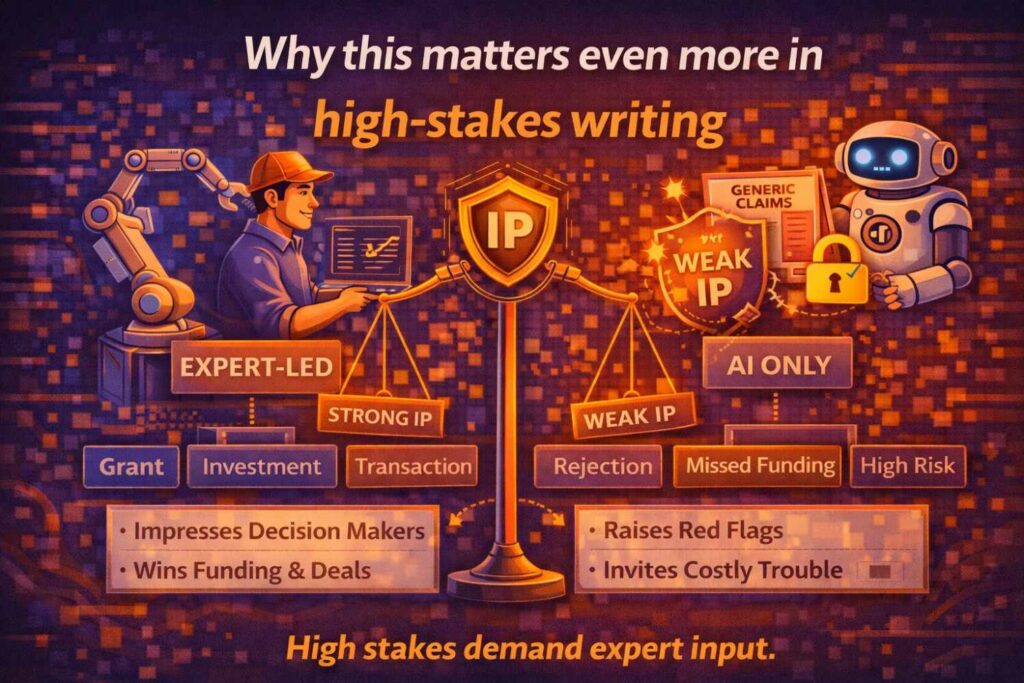
Generic writing is bad for marketing.
It is worse for high-stakes writing.
When the writing affects trust, money, product clarity, investor belief, legal positioning, or technical understanding, generic language becomes more than a style problem. It becomes a risk.
This is why founders should care deeply about how AI is used in serious workflows.
If AI helps generate blog content, that is one thing. If it helps shape how your invention is described, how your product is explained, how your company is understood, or how your expertise is presented, then the quality bar needs to be higher.
That does not mean avoiding AI.
It means controlling it.
It means making sure the output reflects real knowledge, real decisions, and real review.
That is exactly why PowerPatent combines smart software with real patent attorney oversight. Speed matters. But when the writing is tied to the protection of real innovation, generic output is not good enough. The process has to stay grounded in the actual invention and the actual business value behind it. See how PowerPatent works here: https://powerpatent.com/how-it-works
The hidden reason some AI writing performs well
It is easy to assume that any content that performs well must be deeply original.
That is not always true.
Sometimes good-performing AI-assisted content works because the team behind it did the hard part before the writing began. They knew the audience. They knew the promise. They had strong examples. They had a point of view. They had useful distinctions. They revised hard.
In other words, the draft did not perform because AI magically sounded human.
It performed because humans gave it enough real material and enough real judgment to shape it into something useful.
This is an important mindset shift.
Do not ask how to make AI behave like a perfect writer.
Ask how to create a process where AI helps strong writing happen.
That is a better question. It leads to better systems, not just better prompts.
Make the close feel earned

A generic article often ends the same way it begins.
Broadly.
It wraps up by saying the topic matters and businesses should consider using these strategies moving forward. That kind of ending sounds finished, but it does not feel earned.
A strong ending should leave the reader with a clear takeaway.
It should reinforce the central point in a sharper way.
It should make the advice feel practical.
It should create motion.
For example, the ending of an article like this should not simply say that AI drafts can be improved. It should remind the reader that generic writing is usually a sign of missing specificity, weak point of view, and low-tension thinking. It should encourage them to stop chasing magic prompts and start giving AI better raw material. It should make them feel that the fix is real and worth doing.
That is a much stronger finish.
Good endings do not just close the article.
They sharpen what the reader should do or remember next.
How founders can use this in practice right away
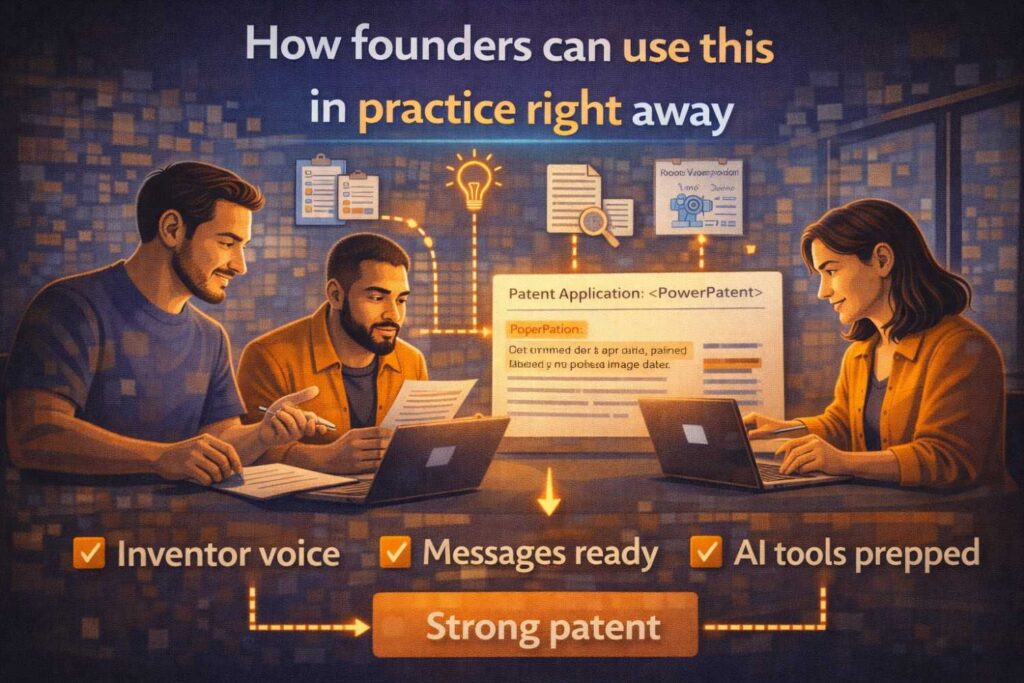
This does not need to stay theoretical.
If you are a founder, operator, marketer, or technical writer using AI right now, you can apply this quickly.
The next time you generate a draft, do not ask first whether it sounds polished.
Ask whether it sounds specific.
Ask whether it has a point of view.
Ask whether it names real tension.
Ask whether it could have been written for ten other companies.
Ask whether the examples feel observed.
Ask whether the opening gets to the point.
Ask whether the writing sounds like your company.
That small review shift will improve output fast.
Then build a better workflow around it.
Use AI for speed.
Use humans for substance, direction, and judgment.
That combination is where the best work happens.
Founders do not need a perfect content system to make AI drafts better.
They need a usable one.
That is the key.
Most teams do not fail because they lack access to AI. They fail because they do not have a repeatable way to turn fast drafts into sharp company writing. The draft gets generated, someone glances at it, a few lines get cleaned up, and then it goes live without enough pressure on whether it actually sounds like the company, helps the reader, or supports a business goal.
That is where founders can make a real change quickly.
The best move is not to write everything from scratch again. It is to build a simple operating habit around AI so every draft starts with speed but ends with judgment.
Treat every draft as raw material, not finished work
This shift alone can save a business from publishing weak content.
A lot of teams get fooled by fluency. The draft looks clean, so it feels close to done. But polished wording is not the same as strong communication. A founder should treat the first AI draft the way a product team treats a first prototype. Useful, fast, and worth reviewing, but not something to ship just because it exists.
This is a strategic habit because it changes the standard.
The question is no longer, “Did AI give us a decent article?”
The better question is, “Does this draft carry our real thinking well enough to represent the business?”
That standard improves everything. It improves blog writing, product pages, founder memos, investor notes, customer education, and even internal documents. Once the team sees AI output as raw material instead of finished work, quality gets much easier to manage.
Build a company “voice bank” before you need it
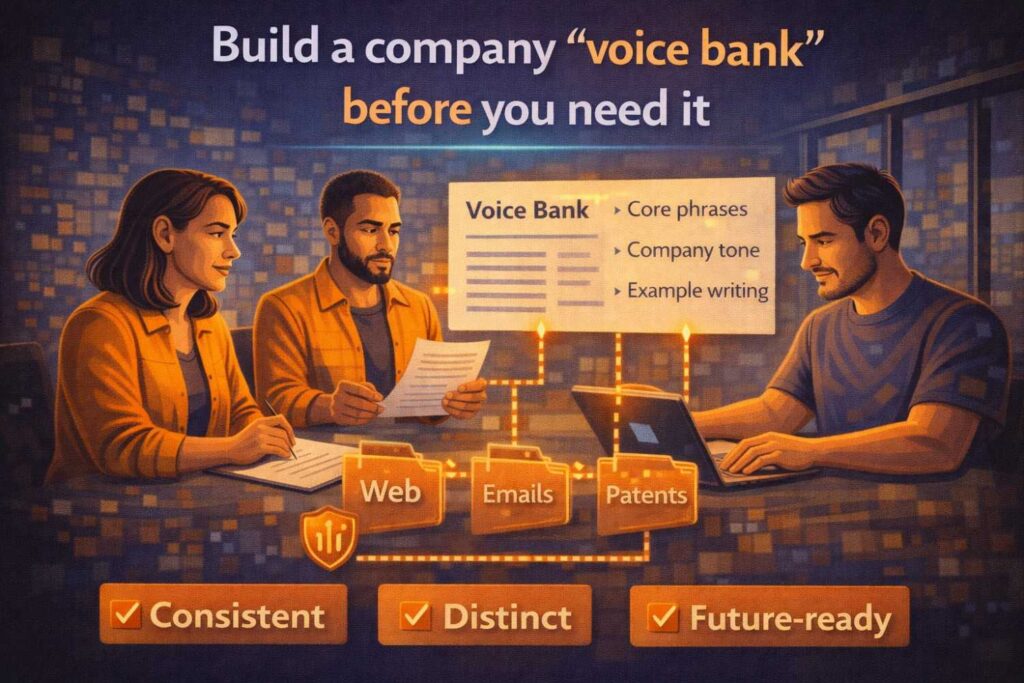
Many founders wait until a draft sounds generic before trying to fix the tone.
That is too late.
A smarter move is to build a small internal voice bank. This does not need to be fancy. It can be a living document with a few simple things: phrases your company uses often, phrases it avoids, examples of writing that feel most like your brand, common ways you explain the problem, and the way you describe your product when you are at your clearest.
This helps because AI output often becomes generic when it has nothing specific to imitate except public internet writing.
A strong voice bank gives the draft better gravity.
For a founder, this is highly practical. Pull from real sources. Use founder emails, strong sales notes, product explanations, customer call language, onboarding copy, and great past blog posts. The goal is not to sound clever. The goal is to sound consistent and real.
Over time, this becomes one of the easiest ways to keep company content from drifting into bland sameness.
Write the “why now” note before every important piece
A lot of AI content sounds generic because it has no urgency behind it.
It covers a topic, but it does not answer why the company is talking about this topic right now.
Founders can fix that with one short move before drafting starts. Write a brief “why now” note for the piece.
Why does this article matter at this moment?
What business goal does it support?
What confusion is it trying to clear up?
What wrong idea is it trying to correct?
What decision is the reader likely making right now?
This gives the draft direction.
It also keeps content tied to business timing instead of turning into general thought leadership that sounds fine but does not move anything. That is a strategic gain because it turns content into a tool, not just an output.
A founder can do this in five minutes before the team prompts AI. Those five minutes often make the final article much stronger.
Assign one real owner for meaning, not just editing
In many companies, nobody truly owns the thinking once AI creates the first draft.
A marketer may clean it up. A founder may skim it. Someone may check grammar. But meaning gets passed around without clear ownership.
That is a major reason generic content slips through.
A better practice is to assign one person to own meaning. Not only line edits. Not only approval. Meaning.
That person is responsible for asking whether the article says something clear, useful, and true to the company. They are the one who pushes the draft past surface polish. They make sure the message is real, the examples feel grounded, and the advice actually helps.
For an early-stage company, this may be the founder for a while. Later it may be a content lead, product marketer, or someone close to customer insight. The important point is that one person owns the final point of view.
That removes one of the biggest causes of generic writing, which is shared responsibility with no clear standards.
Use customer friction as your best draft filter
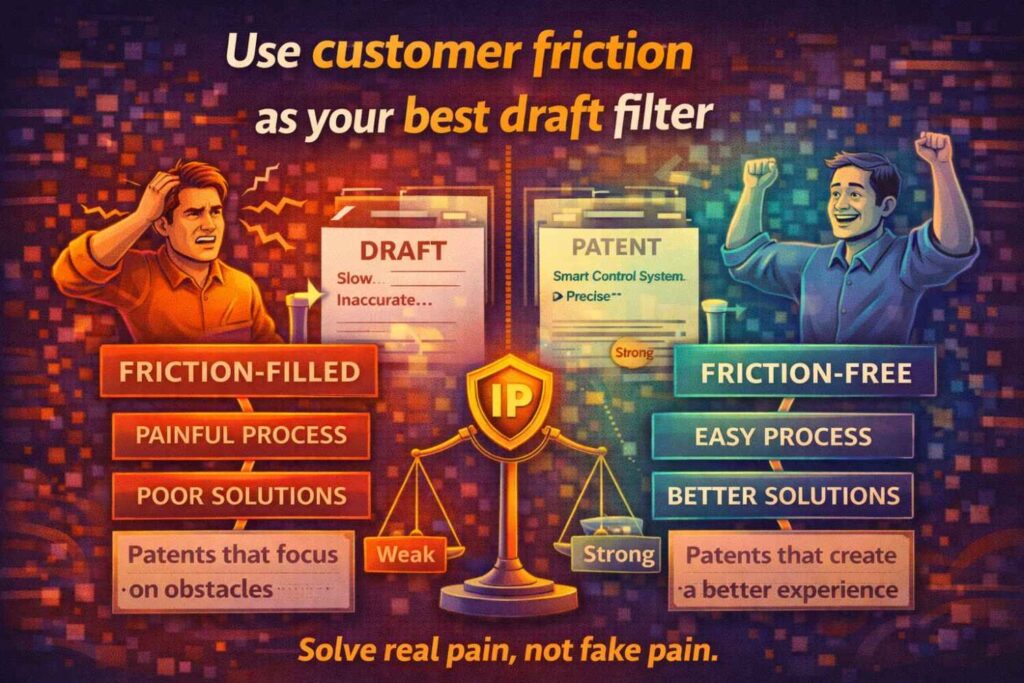
One of the most useful ways to make AI content better is to run it through real customer friction.
By that, think about the points where prospects hesitate, customers get confused, buyers delay, or users ask the same questions again and again. Those friction points are often much more valuable than broad topic ideas.
Why?
Because they force the writing toward reality.
A founder should ask, what part of our process do people misunderstand most? Where do they get nervous? What false assumption slows them down? What question shows up in sales calls every week? What part of our product do customers notice only after they start using it?
Then use those answers to shape the content.
This is strategic because content built around live friction is much more likely to drive action. It sounds less generic because it speaks from actual business pain, not from category-level summaries. It also tends to convert better because the article meets the reader at a point of real hesitation.
Turn founder voice notes into source material
Founders are often much better at speaking naturally than writing polished content from scratch.
That is a huge advantage.
Instead of trying to make AI invent a founder-like tone, let the founder create rough spoken source material. A quick voice note about what the team believes, what customers keep getting wrong, what the old way misses, or what the company has learned can become far better raw material than a formal content brief.
This works because voice notes usually contain the things generic drafts lack. They carry pressure, emphasis, belief, frustration, and natural phrasing. They often include the lines that sound the most human because they were spoken without overthinking.
For businesses, this is also efficient. A founder may not have time to draft a full article, but they often do have time to speak for five or ten minutes. That spoken material can then guide the AI draft and give the content team something much richer to shape.
This is one of the easiest practical moves for startups that want more authentic content without creating a heavy process.
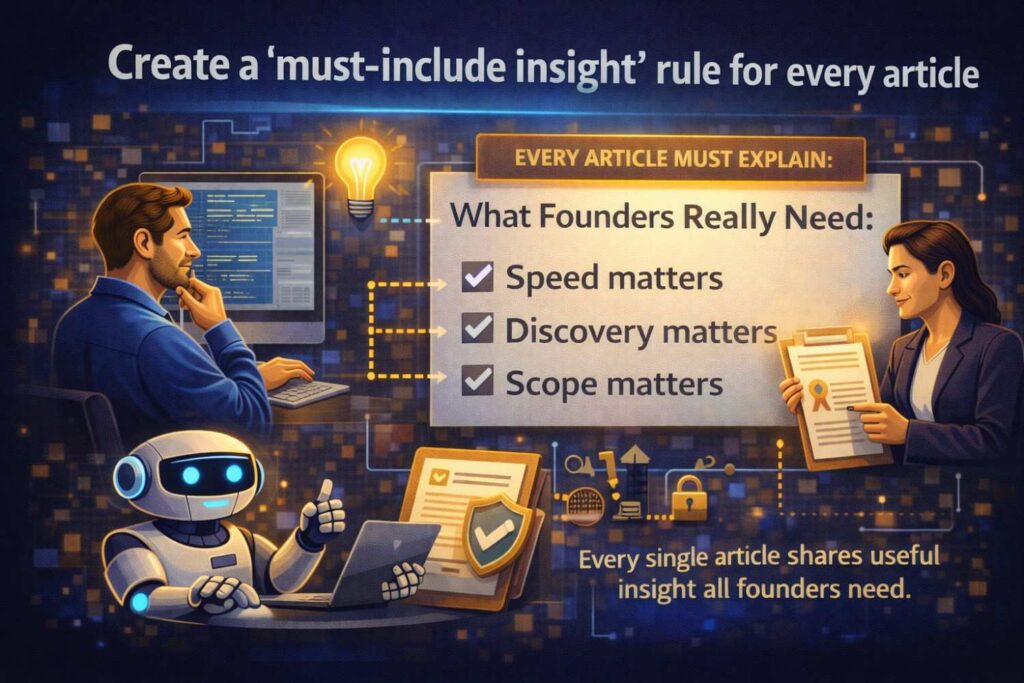
Create a “must-include insight” rule for every article
A lot of business content becomes generic because it is accurate but not distinctive.
It explains the topic well enough, but it does not include anything a smart reader would remember.
A good fix is to create a simple rule: every article must include at least one insight that could only come from your company.
That insight might come from product experience, founder perspective, customer patterns, technical lessons, or repeated mistakes you see in the market. It does not have to be dramatic. It just has to feel owned.
This is highly actionable because it gives the team a clear threshold. Before publishing, ask: what is the one part of this article that belongs to us?
If the answer is weak, the draft probably still sounds too generic.
This rule is especially useful for startups in crowded markets, where many competitors publish safe content that blends together. The company that consistently includes a real, earned insight sounds sharper very quickly.
Build revision around business goals, not only writing quality
Many teams revise AI drafts only for readability.
That matters, but it is not enough.
Founders should also revise for business function. In other words, what is this piece supposed to do for the company?
Should it build trust with technical buyers?
Should it make a complex process feel simpler?
Should it lower fear around a next step?
Should it help sales by answering a hard objection?
Should it support a product launch?
Should it strengthen authority in a crowded category?
When content gets reviewed against its business job, generic writing becomes easier to catch. That is because generic writing often fails not only as writing, but as business communication. It may sound polished while doing very little to move the reader toward trust, action, or clarity.
A smart founder will ask the team to define the job of the piece before revision starts. Once that is clear, the edits get sharper.
Keep a swipe file of lines that actually worked
Most companies save articles.
Fewer save the exact lines that made those articles strong.
That is a missed chance.
A founder can help the team build a small swipe file of company lines that worked unusually well. These might be opening hooks, clear product explanations, sharp customer pain lines, phrases that made sales conversations easier, or closing lines that drove more responses.
This is valuable because strong company language is an asset. When AI drafts start sounding generic, the team can pull from language that already reflects how the company sounds at its best.
This is not about copying old content into new content. It is about preserving the patterns of clarity that already proved effective. Over time, this gives the business a stronger writing memory, which makes new drafts better and faster.
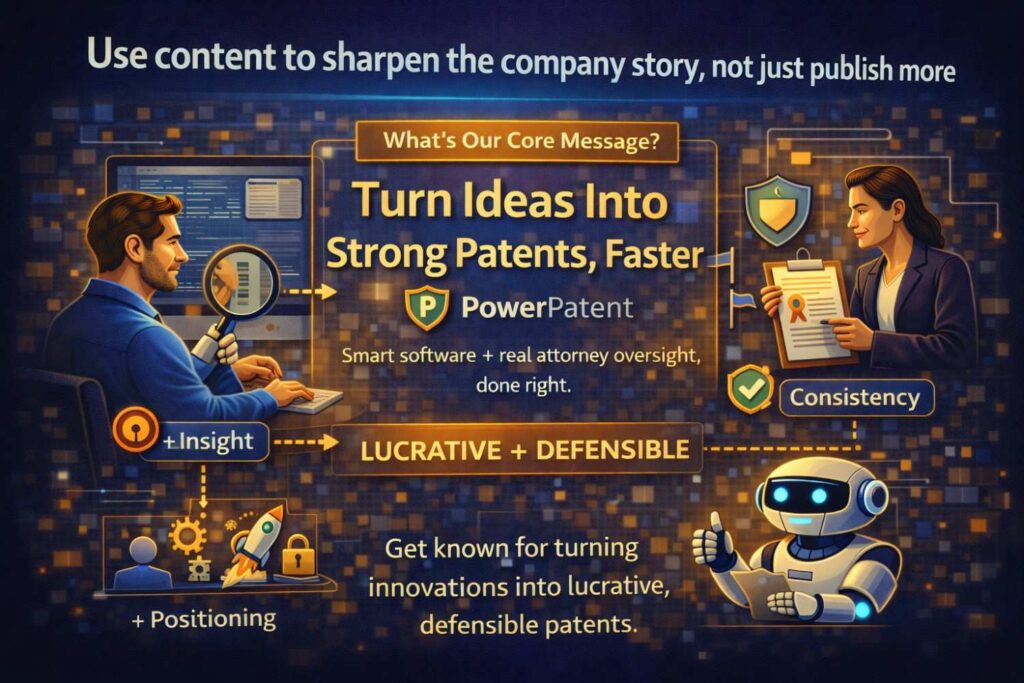
Use content to sharpen the company story, not just publish more
This is an important strategic point.
Many founders think of AI writing as a way to scale content production. That is useful, but it is not the highest-value use.
A better use is to treat content as a place where the company story gets refined.
Every article is a chance to test how you explain the problem, how you frame the old way, how you describe the new way, what language clicks with readers, and which ideas actually create trust. If the team treats every piece as part of that learning loop, the writing gets stronger and the company message gets sharper.
This matters because one of the biggest hidden benefits of good content is message clarity. The business learns how to explain itself better. That improves more than blog posts. It improves sales calls, onboarding, product marketing, investor communication, recruiting, and founder storytelling.
So the founder should not only ask, “Did this article get published?”
They should also ask, “What did this article teach us about how our market thinks and how we should explain ourselves?”
That mindset makes AI-assisted writing far more strategic.
Create a final review question that stops weak content from shipping
Every company needs a last filter.
For content quality, one of the best filters is a single final question before publish:
Would we be proud to have this article be the first thing a smart customer reads from us?
That question is stronger than asking whether the article is good enough.
It raises the bar.
It pushes the team to think about first impressions, trust, clarity, and brand quality in one move. It also helps catch drafts that are technically fine but still too generic to represent the business well.
A founder can make this part of the publishing rule. If the answer is not clearly yes, the article needs more work.
That one habit can protect a company from putting out content that looks polished but quietly weakens its brand.
Make your best people easier to use, not harder
A lot of companies have strong thinkers inside the business, but their knowledge rarely makes it cleanly into content.
The founder knows things the market misunderstands.
The head of product sees patterns customers miss.
The technical lead knows where the real complexity sits.
The sales team hears the same hesitation every day.
But if tapping those people requires long meetings, blank-page writing, or messy review cycles, the knowledge never gets used well. Then AI fills the gap with generic material.
The solution is to make expert input easier to capture. Short voice notes. Quick prompts. Brief annotated comments. Five-minute insight dumps. Small review requests focused on one question.
This is strategic because it lowers the cost of authenticity. It makes the company’s real intelligence easier to feed into the draft process. And once that happens, the content starts sounding much more specific and useful.
Use AI speed to create depth, not just volume

This is one of the most important mindset shifts for founders.
AI makes it easy to produce more.
That does not mean the best use of AI is more output.
Often the better use is more depth.
Instead of using AI to create five average articles, use it to build one strong draft faster and spend the saved time making that piece sharper, more distinct, and more useful. Go deeper into the business angle. Add the real examples. Strengthen the opening. Clarify the action step. Make the company point of view more obvious.
That is usually a much better trade.
For businesses, quality compounds. A few sharp pieces can build more trust than a stream of forgettable ones. They are also easier for sales to use, easier for founders to share, and more likely to shape how the market sees the company.
So the founder should be careful not to confuse efficiency with volume alone. The best content systems use AI speed to free up time for better thinking.
Founders do not need to become full-time editors to make AI drafts sound less generic.
But they do need to shape the system around the draft.
That means better source material, clearer ownership, stronger review questions, closer ties to customer friction, and a higher standard for what counts as publish-ready. When those pieces are in place, AI becomes much more useful because it is no longer asked to create meaning on its own. It is helping the company express what it already knows.
That is the real advantage.
And for companies building something complex, that same principle matters even more in patent work. PowerPatent helps founders turn real technical insight into strong patent filings with smart software and real attorney oversight, so the final output reflects the real invention instead of drifting into generic language. See how it works here: https://powerpatent.com/how-it-works
Final thoughts
AI drafts sound generic when they are built from generic thinking.
That is the truth most people skip.
The fix is not only a better tone prompt. It is a better message, a sharper audience, stronger raw material, more specificity, more tension, a clearer point of view, and harder revision.
When those things are present, AI can be incredibly useful.
It can speed up the slow part.
It can help organize ideas.
It can turn rough notes into working structure.
It can help good writing happen faster.
But it still needs a person to decide what the piece should really say.
That is what makes the final result feel real.
And that is what separates content that gets ignored from content that earns trust.
If you are building something important, that difference matters.
Your writing should not sound like it came from the middle of the internet.
It should sound like it came from a company that knows what it is doing.
And if that company is building real technical innovation, the same standard matters even more in patent work. PowerPatent helps founders move quickly without settling for generic output, combining smart software with real attorney oversight to turn real inventions into strong filings. Learn more here: https://powerpatent.com/how-it-works