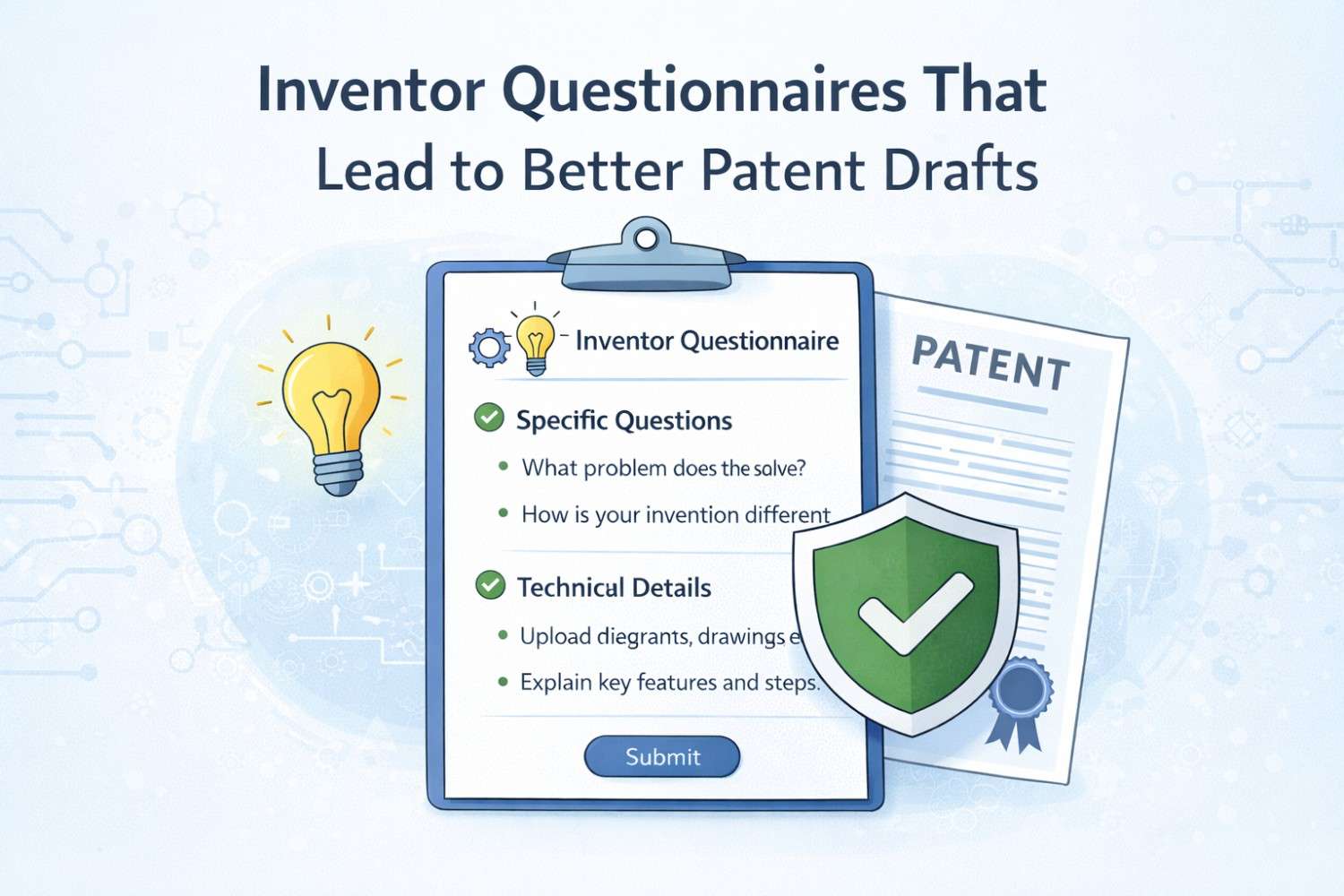
Most patents fail before they are even written. Not because the idea is weak. Not because the market is small. They fail because the wrong questions were asked at the start. If you want a strong patent, you do not start with legal words. You start with the right inventor questionnaire. And if you are building deep tech, writing code, training models, designing hardware, or shipping a new system, the quality of your answers will shape the strength of your protection. This is where most founders go wrong. They rush. They send a quick summary. They assume the attorney will “figure it out.” That is how weak patents are born.
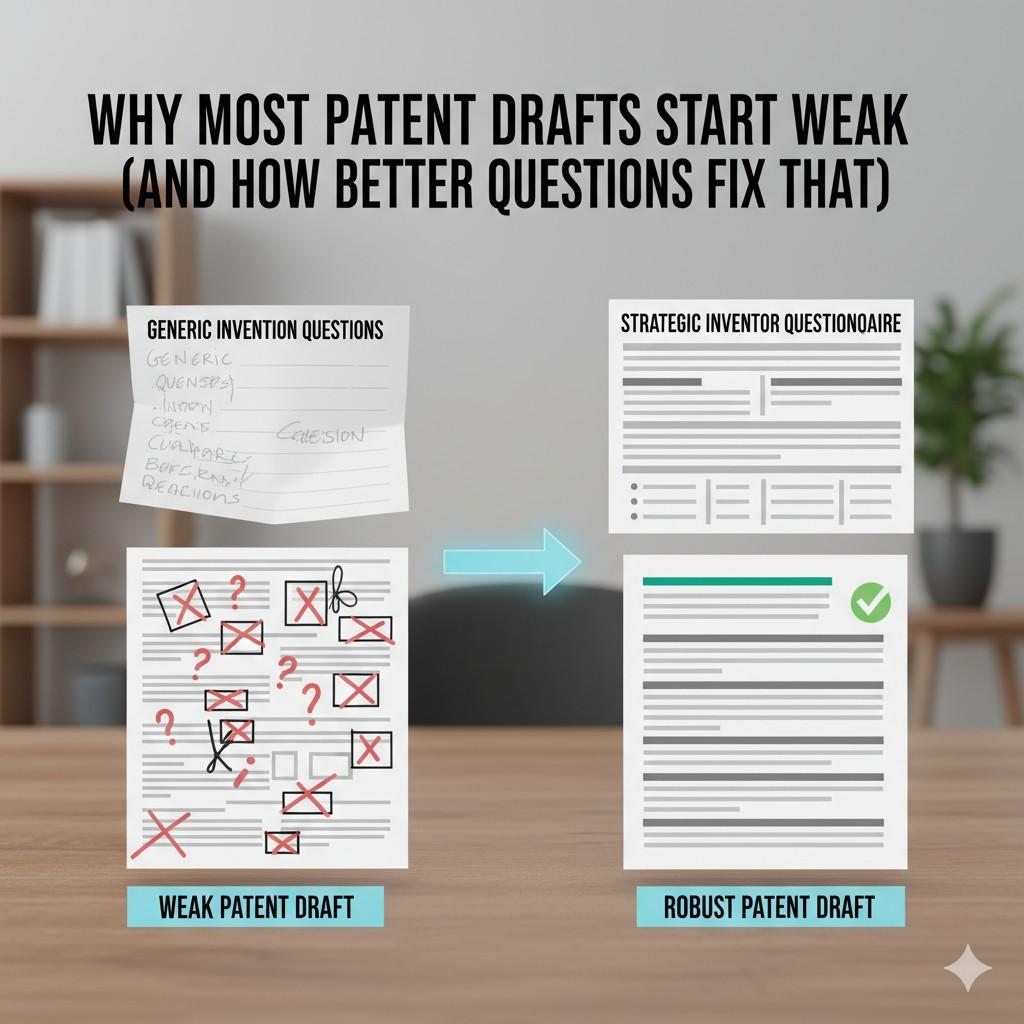
Why Most Patent Drafts Start Weak (And How Better Questions Fix That)
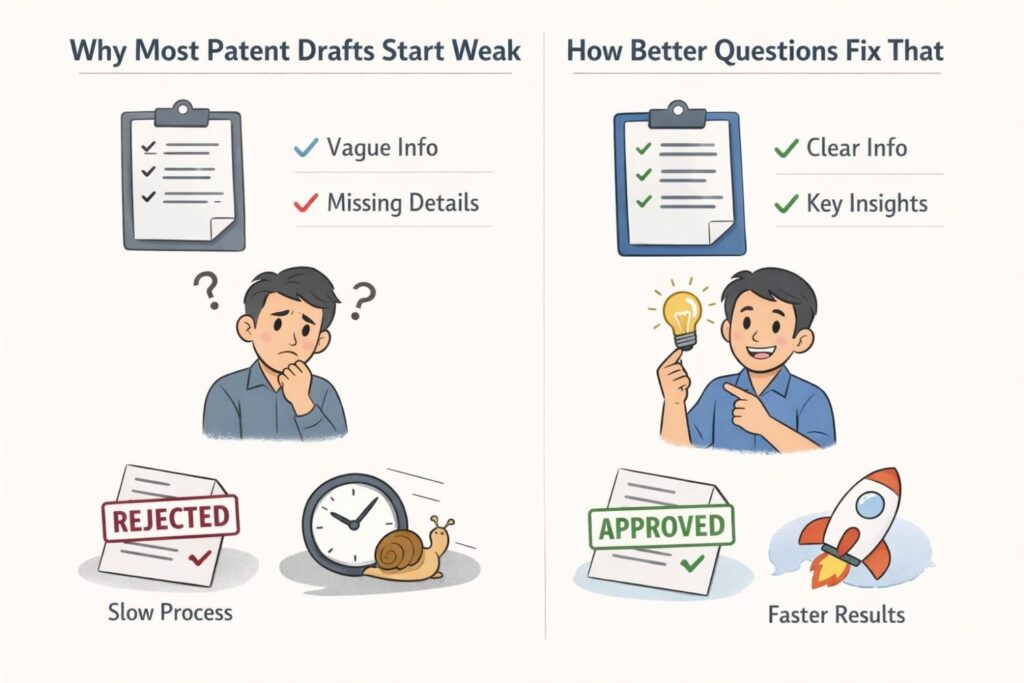
Most weak patents do not fail because the idea was small. They fail because the first conversation was shallow. The draft ends up describing a feature instead of the full system.
It focuses on what the product does today instead of what it could become tomorrow. And it misses the deeper logic that makes the invention special.
If you are building serious technology, your patent needs to reflect the full depth of your work. That only happens when the questions asked at the start force you to slow down and think clearly.
A strong questionnaire is not paperwork. It is strategy. It pulls hidden insight out of your head and turns it into protection.
Let’s look at why most drafts start weak and how better questions change everything.
The Founder Is Too Close to the Build
When you live inside your product every day, it feels obvious. You know why you made each choice. You know what failed before you found what works.
But when someone asks, “What did you invent?” you often describe the surface layer.
This is one of the biggest problems in early patent drafts.
A founder might say, “We built a system that uses AI to match users with experts.” That sounds fine. But it hides the real value. What is unique about the matching logic?
How does your model train? What signals matter most? What constraints are solved? What trade-offs did you handle differently?
If a questionnaire only asks for a “summary of the invention,” you will give a short answer. And the patent will be shallow.
A better questionnaire asks you to explain the problem before your solution existed. It asks what did not work before. It asks what made your first versions fail. It asks what breakthrough allowed the system to finally perform well.
Those questions force depth. They uncover the story behind the invention. And that story is where strong protection lives.
If you are serious about protecting your company, you need a system that pulls that depth out of you. That is exactly how PowerPatent approaches inventor questionnaires.
It guides you step by step so you do not accidentally under-explain your own genius. You can see how it works here: https://powerpatent.com/how-it-works
The Questionnaire Is Treated Like Admin Work
Most old-school patent forms feel like paperwork. They ask for dates, names, basic summaries, and maybe a rough diagram. Founders rush through them because they feel like a chore.
That mindset kills quality.
The questionnaire is not admin work. It is a strategic design session. It is where you decide what future competitors will and will not be allowed to copy.
If the questions are basic, your answers will be basic. If the questions are sharp, your thinking becomes sharper.
A strong questionnaire should make you think about edge cases. It should ask how your system behaves under stress. It should explore alternate implementations.
It should push you to describe variations, not just the version in production.
When those variations are captured early, your patent can cover more ground. That is how you block copycats before they even appear.
If your current process feels like filling out a form and hoping for the best, you are leaving protection on the table.
The Real Technical Insight Never Gets Written Down
Many founders assume the attorney will “extract” the right details during a call. Sometimes that happens. Often it does not.
Why? Because the best technical insight lives in your head in messy form. It lives in Slack threads. It lives in code comments. It lives in failed experiments.
If the questionnaire does not explicitly ask for design decisions, trade-offs, and system logic, those insights never surface.
And once the draft is written without them, it is hard to retrofit depth later.
A better approach is to treat the questionnaire as a structured deep dive. It should ask you to walk through your architecture. It should prompt you to describe data flows. It should make you explain how components talk to each other.
When those details are captured early, the patent draft becomes clear and layered. It reflects not just what the system does, but how and why it works.
This is one of the reasons PowerPatent blends software guidance with real attorney oversight. The software helps you capture the technical truth in a structured way.
The attorney ensures it turns into strong legal coverage. You move fast, but you do not lose depth. If you want to see the process in action, explore it here: https://powerpatent.com/how-it-works
The Focus Is Too Narrow
Another reason drafts start weak is simple. The invention is described too narrowly.
Founders often describe the exact implementation they built. They describe their current stack. Their current architecture. Their current user flow.
But a patent is not a product manual.
It should capture the broader concept behind your system. It should cover multiple technical paths to achieve the same outcome. It should anticipate future versions.
A good questionnaire helps expand your thinking. It might ask, “Could this work without this specific component?” or “What if this module were replaced with another method?” or “Is the benefit tied to this exact algorithm, or to a higher-level concept?”
These questions feel subtle. But they change everything.
They help you protect the core idea, not just the first release.
That is strategic IP. And strategic IP increases valuation, blocks competitors, and gives investors confidence.
The Problem Is Not Framed Clearly
Weak patents often describe the solution but fail to clearly define the problem. That makes the invention look incremental instead of transformative.
If the questionnaire does not push you to describe the real pain point, the draft will lack force.
You need to explain what was broken before. What limits existed. What technical barrier stood in the way.
When the problem is framed sharply, your solution looks powerful. And when the solution looks powerful, the claims can be written with strength.
A strong questionnaire asks you to compare prior approaches. It asks how they fall short. It asks what technical gap you closed.
That context is gold. Without it, your patent becomes just another feature description.
Speed Without Structure Leads to Risk
Startups move fast. That is good. But speed without structure leads to thin patents.
Founders often say, “Let’s just file something quickly.” But filing something weak is not the same as filing something smart.
The right questionnaire allows speed and quality at the same time. It creates structure so you do not miss key pieces. It captures insight in a clean format so attorneys can draft efficiently.
This reduces back-and-forth. It cuts revision time. It lowers the chance of mistakes.
And it helps you file faster without sacrificing strength.
If your goal is to protect your tech while staying focused on building, you need a system that respects your time but still pushes for depth. That is exactly the balance PowerPatent is built for.
You stay in control. You move quickly. And you avoid the common traps that weaken early drafts. You can learn more about the process here: https://powerpatent.com/how-it-works
Better Questions Create Strategic Thinking
The biggest shift happens when the questionnaire changes from descriptive to strategic.
Instead of asking only “What did you build?” it asks “What are you trying to prevent others from doing?” That one shift forces you to think defensively.
You begin to imagine competitors. You picture how they might design around you. You consider which parts of your system are hard to copy and which parts are easy.
When you answer those questions honestly, the patent draft becomes stronger by design.
This is not about adding fluff. It is about capturing the real moat inside your technology.
Strong patents do not happen by accident. They start with sharp questions that pull out deep answers.
If you want better patent drafts, do not start by looking at legal templates. Start by upgrading the questions you are asked.
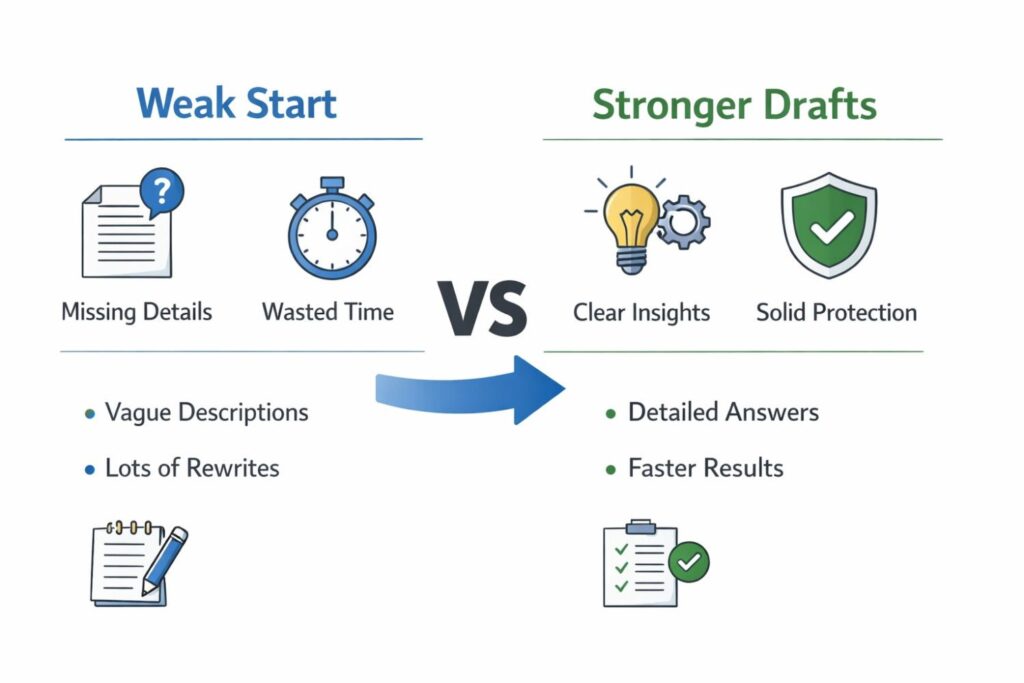
That single change can turn a basic filing into a strategic asset that protects your company for years.
What a High-Quality Inventor Questionnaire Really Looks Like
A strong patent does not begin with legal language. It begins with clarity. And clarity does not come from a blank page. It comes from a well-designed inventor questionnaire that pulls the right information out of your head in the right order.
Most founders think a questionnaire is just a form. In reality, it is the foundation of your entire patent strategy. If it is shallow, the draft will be shallow. If it is thoughtful, the draft will be powerful.
A high-quality inventor questionnaire is built to think the way a great patent attorney thinks. It guides you through your invention step by step. It forces you to slow down where it matters. It reveals the depth behind your system so that nothing critical gets missed.
Let’s break down what that actually looks like in practice.
It Starts With the Real Problem, Not the Feature
A great questionnaire does not begin with “Describe your invention.” That question is too open and too easy to answer poorly.
Instead, it starts by digging into the real-world problem your invention solves. It asks what was broken before. It asks what limits existed in the old way of doing things. It asks what pain users or systems faced.
This matters because patents are not just about what you built. They are about how you overcame a barrier.
When you clearly explain the technical problem, your solution gains weight. It shows that your work was not random. It was necessary.
For example, if you built a new machine learning pipeline, the questionnaire should not just ask how it works. It should ask what performance issues existed before.
Was there latency? Was training unstable? Did data quality create bias? Were existing systems too slow or too rigid?
Was there latency? Was training unstable? Did data quality create bias? Were existing systems too slow or too rigid?
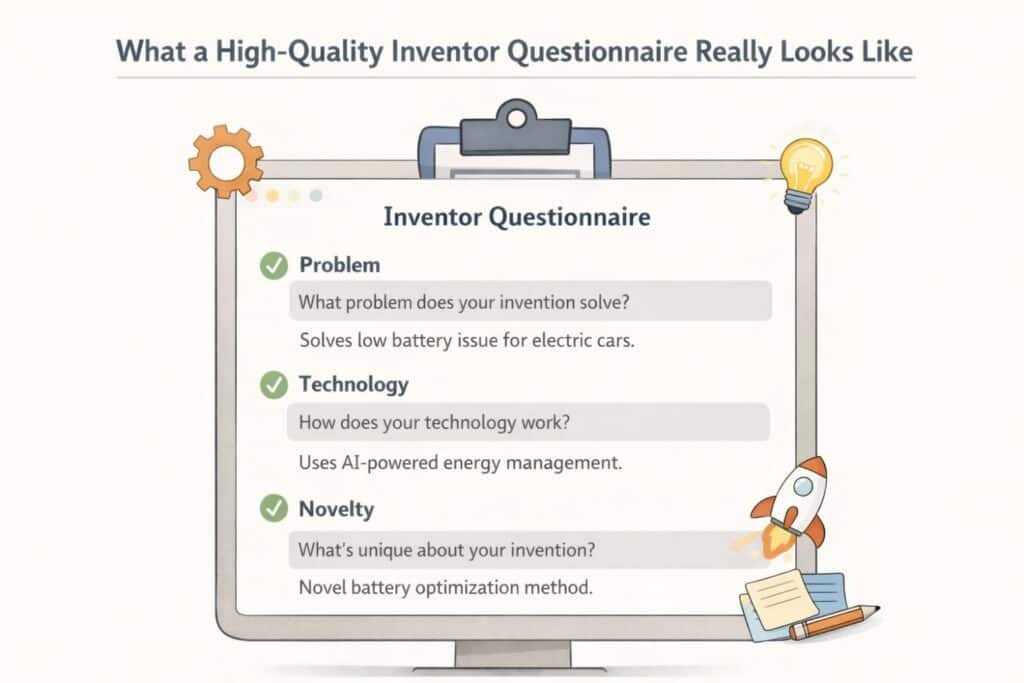
When those details are captured early, the draft becomes more than a description. It becomes a story of technical progress.
That is how you create protection that stands up later.
It Forces You to Explain the “Why” Behind Every Design Choice
Founders often describe what their system does but skip why it was designed that way.
A high-quality questionnaire does not let that slide.
It asks why you chose one method over another. It asks why you structured components in a certain way. It asks what trade-offs you faced and how you resolved them.
These “why” questions are powerful. They expose the logic that competitors cannot easily see from the outside.
Imagine a hardware startup that designs a new sensor layout. The layout itself is visible.
But the reasoning behind it is not. If the questionnaire pushes the inventor to explain why certain placements reduce noise or improve signal strength, that reasoning can shape stronger claims.
The same applies to software. Why did you choose that data structure? Why that training approach? Why that control flow?
Those answers create depth.
At PowerPatent, the questionnaire is designed to surface this reasoning clearly. The platform walks you through structured prompts so you do not forget the logic behind your system.
Then real patent attorneys refine that insight into strong protection. You can see how this works here: https://powerpatent.com/how-it-works
It Maps the Full System, Not Just One Piece
Weak questionnaires focus on one feature. Strong ones capture the whole system.
Your invention likely has multiple components. Inputs. Processing layers. Outputs. Feedback loops. Integrations. Hardware elements. User interactions.
A high-quality questionnaire guides you through the full architecture. It encourages you to describe how each part connects to the others.
This system-level view is critical.
When the full flow is documented, the patent can cover more ground. It can protect the method, the system, and even variations of the system.
For deep tech startups, this is especially important. Your competitive edge often lies in how pieces work together, not just in one isolated step.
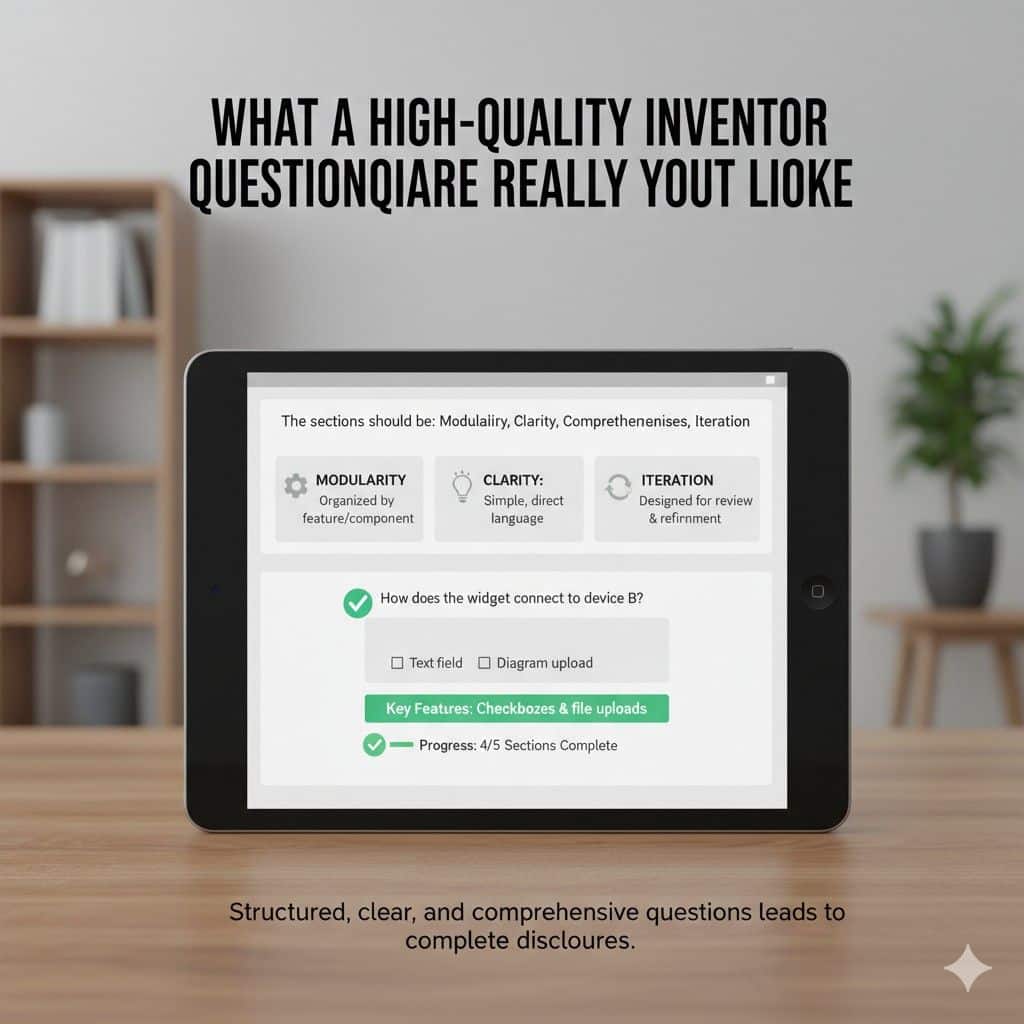
A strong questionnaire might prompt you to walk through the entire process from start to finish. It may ask you to describe what happens at each stage. It may ask how data moves through the system.
By the time you finish answering, you have effectively mapped your invention in a way that can be turned into strong diagrams and detailed descriptions.
It Explores Variations and Future Versions
Your current product is version one. But your patent should not be stuck in version one.
A strong questionnaire pushes you to think ahead.
It may ask how the invention could work with different inputs. It may ask whether certain components could be replaced with alternatives. It may ask if the same concept applies in a different environment.
This is not about guessing the future. It is about recognizing the flexibility already built into your idea.
When variations are captured early, your patent can cover multiple implementations. That makes it harder for others to design around you.
Many founders do not think about this on their own. They focus on what they have built today. A well-crafted questionnaire expands that view without overwhelming you.
This is where smart software makes a difference. Instead of dumping vague questions on you, a structured platform can guide you step by step, helping you explore reasonable alternatives without turning the process into a burden.
That balance between guidance and speed is what modern patent workflows should look like.
It Asks About Edge Cases and Failure Modes
Here is something most inventors never think to include: what happens when things go wrong.
Yet edge cases and failure modes often contain valuable insight.
A strong questionnaire may ask how your system handles unusual inputs. It may ask what happens when data is missing or corrupted. It may ask how errors are detected and resolved.
These answers reveal robustness.
They also help shape claims that are not overly narrow. If your invention includes safeguards or fallback mechanisms, those can become part of your protection.
For example, if your AI model includes a unique confidence scoring method that triggers a specific fallback path, that detail could matter. If it is never mentioned, it cannot be protected.
A thoughtful questionnaire creates space for these details to surface.
It Connects the Invention to Business Strategy
A patent is not just a technical document. It is a business asset.
A high-quality questionnaire recognizes this.
It may ask what markets the invention serves. It may ask how competitors currently solve the problem. It may ask where you believe your main competitive advantage lies.
These are not marketing questions. They are strategic questions.
When the drafting team understands your business goals, they can align the patent with those goals.
If you plan to license the technology, the coverage may need to be broad. If you plan to use it as a barrier in a specific niche, the focus may shift.
Without this context, the draft may miss the mark.
PowerPatent’s approach combines structured inventor input with attorney oversight so that your technical details and business goals align from day one.
That means fewer surprises later and stronger confidence when you talk to investors. You can explore the process here: https://powerpatent.com/how-it-works
It Reduces Back-and-Forth and Speeds Up Drafting
Ironically, a deeper questionnaire often leads to a faster overall process.
When key details are captured early, the attorney does not have to chase you for missing pieces. There are fewer vague descriptions. There is less guesswork.
This reduces revision cycles.
For busy founders, that matters. You do not want endless email threads asking for clarification. You want to provide structured input once and move forward.
A well-designed questionnaire respects your time. It gathers what is needed in a focused way. It helps you think clearly without turning the process into a long legal interview.
That is the sweet spot.
Strong patents do not require endless meetings. They require the right information at the right time.
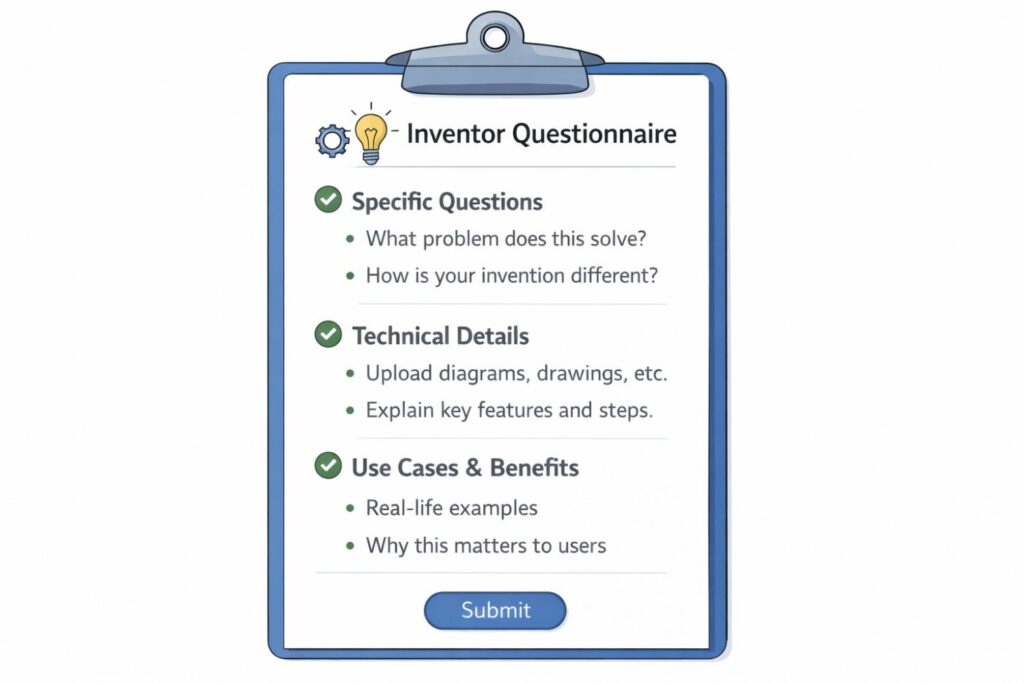
A high-quality inventor questionnaire is how you deliver that information.
It is not just a form. It is the bridge between your technical brain and a defensible patent.
How Founders Should Answer to Get a Strong, Defensible Patent
A great questionnaire is only half the equation. The other half is how you answer it.
Two founders can receive the exact same questions and produce very different patents. One gives short, surface-level answers. The other uses the prompts to unpack the full depth of the invention. The outcome is not even close.
If you want a patent that actually protects your company, you cannot treat your responses like quick homework. This is where you shape the boundaries of your future moat.
Let’s talk about how to answer in a way that leads to real protection, not just a document you can frame on a wall.
Slow Down and Reconstruct the Origin Story
Most inventions are born from frustration. Something did not work. Something broke. Something was too slow, too costly, or too limited.
When answering a questionnaire, go back to that moment.
Do not just describe the final system. Walk through the early attempts. What failed? What surprised you? What bottleneck forced you to rethink your design?
This process often reveals the true inventive step.
For example, maybe your first model had great accuracy but unacceptable latency. Maybe your first hardware prototype overheated under real load. Maybe your first architecture could not scale past a certain user threshold.
The breakthrough that solved that issue is often the heart of your patent.
When you explain that progression clearly, the drafting team can frame your invention as a solution to a specific technical barrier. That framing makes the patent stronger and more defensible.
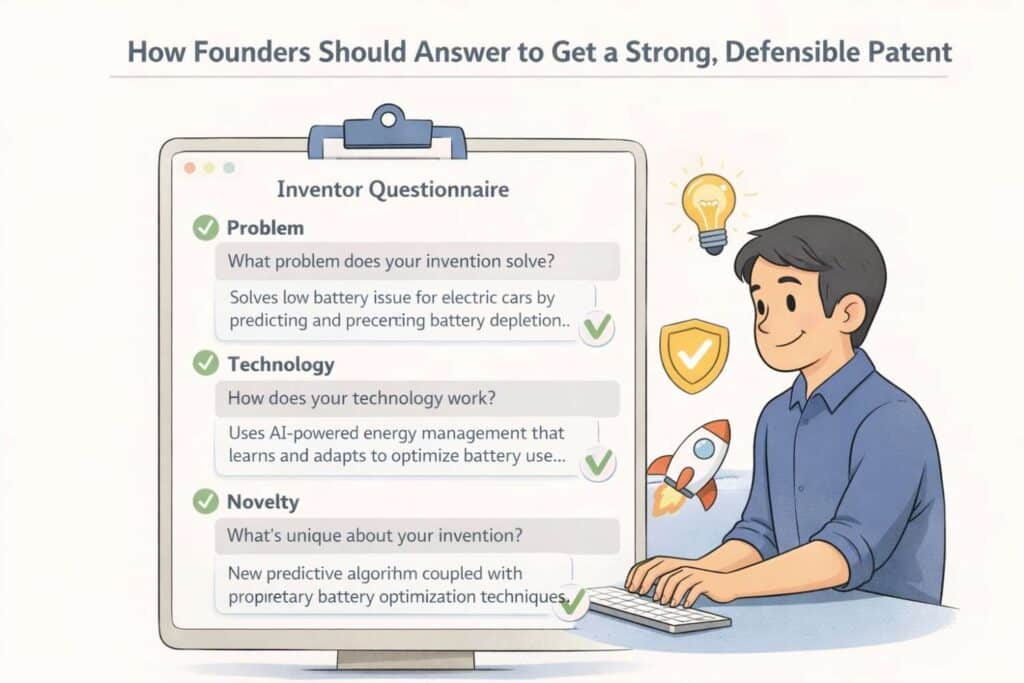
At PowerPatent, founders are guided to unpack this journey in a structured way so nothing critical gets lost.
The goal is not to add fluff. The goal is to capture the insight that competitors will struggle to replicate. You can see how this process works here: https://powerpatent.com/how-it-works
Write Like You Are Teaching a Smart Engineer
Do not assume the reader knows your system. But also do not oversimplify it.
The best mindset is this: explain your invention to a smart engineer who is not on your team.
That means you should describe the flow of data. The interaction between components. The inputs and outputs. The conditions that trigger certain behavior.
Instead of saying, “The system processes user data,” explain what type of data. How it is formatted. Where it is stored. How it is transformed. What happens next.
Instead of saying, “The model ranks results,” explain what signals influence ranking. How those signals are weighted. Whether ranking changes over time.
Specific detail creates room for strong claims.
Vague language shrinks protection.
You do not need legal terms. In fact, avoid them. Just describe the system clearly and honestly, as if you were onboarding a new technical hire.
That clarity gives the drafting team raw material to work with.
Do Not Hide the Secret Sauce
Some founders hesitate to fully describe their system because they fear revealing too much.
This instinct is understandable, but it can backfire.
If you hold back critical details during drafting, your patent may end up protecting only a thin slice of your technology. Later, if a competitor copies the core logic you failed to describe, your protection may not cover it.
Remember, a patent application is not instantly public in full detail in a way that destroys your business. There is a process, and there are strategic ways to disclose what matters while still protecting your competitive edge.
The key is this: you cannot protect what you do not describe.
If your invention includes a unique training method, a custom hardware configuration, or a special optimization layer, explain it. If there is math behind it, describe the structure of that math in plain words.
If there is a novel workflow, walk through it step by step.
When you provide depth, the drafting team can shape that depth into strong coverage.
PowerPatent’s combination of structured software prompts and real attorney review helps ensure you strike the right balance between disclosure and protection.
You stay informed and in control throughout the process. Learn more here: https://powerpatent.com/how-it-works
Think Beyond the Current Release
When answering questions, it is easy to focus only on what is live in production.
But your patent should not be locked to today’s version.
As you respond, ask yourself how this invention could evolve.
Could the same method apply to a different type of input? Could the system run on a different infrastructure? Could certain modules be swapped out while preserving the core idea?
Even if you have not built those variations yet, describing them can expand your protection.
For example, if your invention processes text data today, but the same logic could apply to image or audio data, mention that. If your hardware device currently uses one sensor type but could support others, say so.
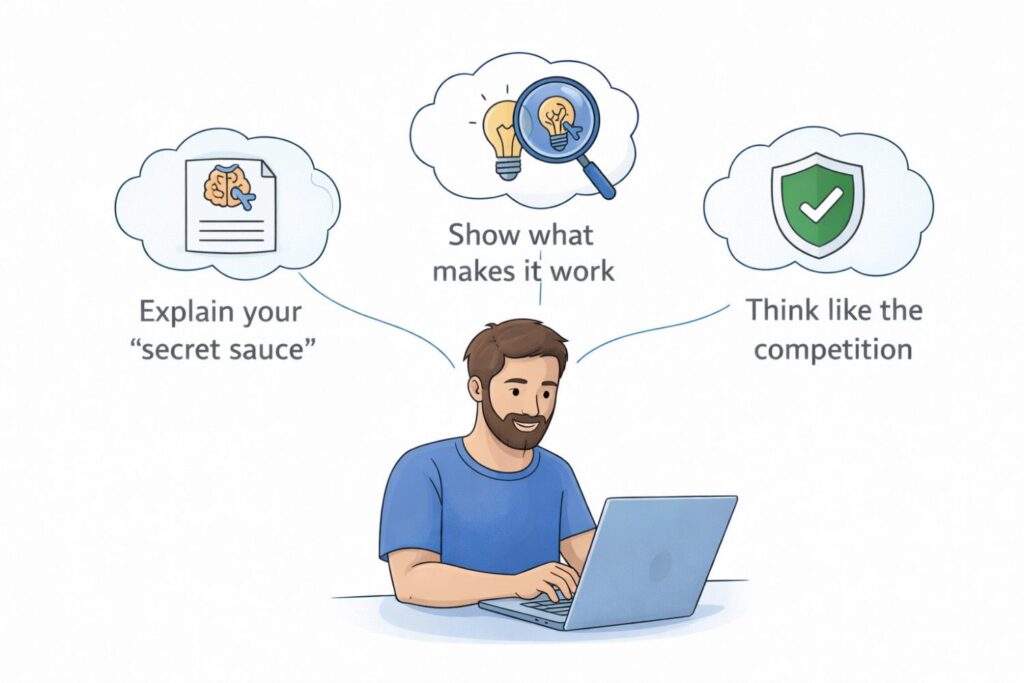
This forward-thinking approach makes it harder for competitors to design around you.
It also signals to investors that you are thinking long term about your IP strategy.
Be Honest About What Is Truly New
Not every part of your system is novel. And that is fine.
A strong patent does not require that every component be new. It requires that the overall combination or specific improvement be meaningful.
When answering a questionnaire, clearly separate standard components from your unique contribution.
If you use known libraries, say so. If you rely on common hardware, acknowledge it. Then focus attention on what you changed, improved, or connected in a new way.
This honesty builds credibility.
It also helps the drafting team highlight the real inventive step without overreaching.
Trying to present everything as groundbreaking can weaken your position. Clear contrast between what existed before and what you added strengthens the narrative.
Provide Real Examples and Use Cases
Abstract descriptions are useful, but concrete examples are powerful.
When answering questions, include scenarios.
Describe how the system behaves in a specific situation. Walk through a sample input and output. Explain how performance improves in measurable terms.
For instance, if your invention reduces processing time, explain by how much and under what conditions. If it improves accuracy, describe the baseline and the improvement.
Even if exact numbers may change later, examples give shape to the invention.
They also make it easier for attorneys to draft clear, robust descriptions and supporting diagrams.
The more tangible your answers, the stronger the resulting draft.
Treat This as a Strategic Asset, Not a Task
The way you answer the questionnaire reflects how you view your IP.
If you see it as a box to check, you will invest minimal effort. If you see it as a long-term shield for your company, you will give it proper attention.
A strong patent can increase valuation. It can block competitors. It can create leverage in partnerships. It can support fundraising conversations.
That value begins with your answers.
At PowerPatent, the process is designed to respect your time while helping you think strategically. You are not left alone with a confusing form.
You are guided through structured prompts and supported by real attorneys who refine your input into a strong draft.
The goal is speed without sacrificing strength. You can explore how it works here: https://powerpatent.com/how-it-works
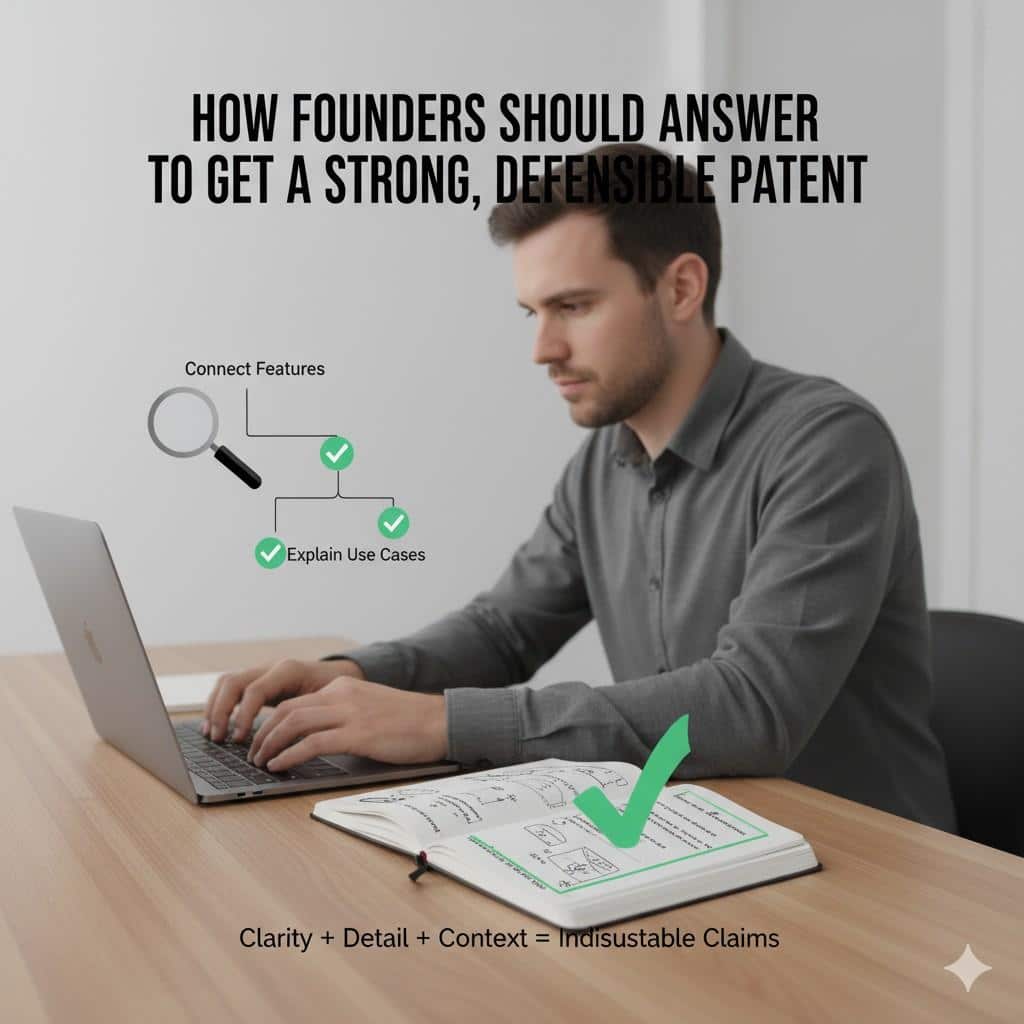
When founders answer with clarity, depth, and forward thinking, the result is not just a patent application. It is a defensible position in the market.
Your words shape that position.
Turning Technical Details Into Real Protection Without Slowing Down
Speed matters. If you are building a startup, you cannot pause product development for months just to file a patent. You cannot sit in endless meetings. You cannot afford confusion, delay, or bloated legal bills.
At the same time, rushing through the process can leave you with a weak filing that does little to protect what you built.
The real challenge is this: how do you turn complex technical detail into strong protection without slowing down your momentum?
The answer lies in structure, focus, and the right system around you.
Capture Once, Use Fully
One of the biggest time drains in traditional patent drafting is repetition. Founders explain their invention in an email. Then again on a call. Then again in response to draft comments. Each time, small details get lost or misremembered.
A well-designed inventor questionnaire solves this by capturing the full picture early.
When you provide detailed answers in a structured format, those answers become the foundation of the draft. Diagrams, descriptions, and claims are built from that base.
This reduces rework. It lowers the risk of misinterpretation. It keeps the process clean.
Instead of scattering your technical insight across different channels, you centralize it.
PowerPatent is built around this idea. You input your invention details in a guided way. The platform organizes them. Real patent attorneys then transform that structured input into a strong draft.

This means fewer redundant conversations and faster turnaround. You stay focused on building while your protection takes shape. Learn more here: https://powerpatent.com/how-it-works
Translate Engineering Logic Into Clear Language
Technical founders often worry that their system is “too complex” to describe clearly.
In reality, complexity is not the problem. Lack of structure is.
Every system, no matter how advanced, follows logic. Inputs move through steps. Decisions are made. Outputs are generated.
When you describe that flow clearly in your questionnaire, the drafting team can translate it into formal patent language without losing substance.
The key is to focus on cause and effect.
If a specific input triggers a specific action, explain that relationship. If one module improves performance because of a defined mechanism, describe that mechanism in simple terms.
You do not need to use legal phrasing. You need to be precise in your technical explanation.
Once that clarity exists, turning it into protection becomes far easier.
Balance Depth With Direction
More detail is good. Random detail is not.
When answering a questionnaire, focus on what drives the inventive step. What makes your system different? What makes it better? What would a competitor struggle to copy?
If a technical detail does not relate to those questions, it may not need emphasis.
A strong process helps you prioritize.
Instead of dumping raw documentation, you are guided to highlight the parts that matter most. This ensures the patent draft is deep where it counts and efficient where it can be.
That balance keeps the process moving without sacrificing strength.
Align Protection With Product Roadmap
Your patent strategy should not lag behind your roadmap. It should support it.
When technical details from your questionnaire are translated into claims, those claims should align with where your product is headed.
If you plan to expand into new markets, the draft should anticipate that direction. If you expect to add new system layers, the patent should not box you into a narrow implementation.
This alignment prevents costly refiling later.
It also ensures your protection grows with your company.
By thinking strategically during the questionnaire stage, you reduce the need for reactive filings down the road.
PowerPatent’s mix of guided software and real attorney review helps connect your current invention with your broader business goals. You are not just filing for today.

You are building a long-term IP position. See how it works here: https://powerpatent.com/how-it-works
Reduce Friction Between Founders and Attorneys
Traditional patent workflows often create friction.
Engineers feel misunderstood. Attorneys feel they are not getting enough detail. The result is delay and frustration.
A structured inventor questionnaire acts as a shared reference point.
Instead of vague back-and-forth, both sides look at the same detailed input. Questions become more precise. Revisions become more focused.
This reduces friction and builds confidence.
Founders feel heard because their technical depth is captured accurately. Attorneys can draft with clarity because they have structured insight.
The process becomes collaborative instead of chaotic.
Protect the Core, Not Just the Surface
Many patents end up protecting visible features rather than underlying mechanisms.
This happens when the questionnaire focuses only on what the user sees.
To create real protection, you must capture the core logic. The system architecture. The internal processes. The performance improvements that are not obvious from the outside.
When those elements are documented clearly, the patent can reach deeper.
This is what makes it harder for competitors to design around your work. They may copy the look and feel, but they cannot easily replicate the protected engine beneath it.
Strong protection comes from depth, and depth comes from detailed answers at the start.
Keep Momentum While Building a Moat
The fear many founders have is that patents slow them down.
In old systems, that fear is justified. Endless forms. Long email threads. Delayed drafts.
But with the right structure, the process can move in parallel with product development.
You answer targeted questions once. You review a focused draft. You provide comments. The process moves forward without draining your time.
Meanwhile, you are quietly building a moat around your technology.
That combination of speed and strength is what modern startups need.
PowerPatent was created specifically for founders who do not want the headache of old-school firms but still want serious protection. Smart software guides you.
Real patent attorneys ensure quality. You stay in control, move quickly, and avoid costly mistakes. If you are building something that matters, this is worth exploring: https://powerpatent.com/how-it-works
In the end, better patent drafts do not start with legal brilliance. They start with better questions and better answers.
A thoughtful inventor questionnaire captures your true innovation. Clear responses turn that innovation into structured insight. And the right system transforms that insight into strong, defensible protection.
If you are investing years of your life into building technology, make sure the first step of your patent process is not weak.
It is not about filling out a form.
It is about defining the future boundaries of your company.
Wrapping It Up
If there is one idea to take away from this entire discussion, it is simple. The strength of your patent is decided long before the draft is written. It is decided the moment you are asked the right questions. Most weak patents are not the result of bad lawyering. They are the result of shallow input. A rushed summary. A vague explanation. A missed insight that never made it onto the page.