AI can help you write faster. That part is true.
But when it comes to patent specification writing, speed alone is not the win.
The real win is getting a better draft, with clearer detail, stronger support, and fewer blind spots from the start.
That only happens when you use the right prompts.
A weak prompt gives you a weak draft. A vague prompt gives you vague output. A generic prompt gives you generic patent writing that sounds polished but misses the real invention.
That is the trap.
The good news is that there is a much better way to use AI for patent specification writing. And if you are a founder, engineer, or startup team trying to protect what you are building, knowing how to prompt well can save a huge amount of time while helping you create a much stronger starting point.
That is exactly where PowerPatent helps. It gives startups a faster way to turn technical work into patent-ready drafts with smart software and real attorney oversight, so you are not left guessing whether your application is actually strong. You can see how it works here: https://powerpatent.com/how-it-works
Why prompts matter more than most founders think
A lot of people treat prompting like a side detail.
They think the hard part is finding the right AI tool. Then they assume the tool will do the rest.
That is not how this works.
AI does not know your invention unless you teach it. It does not know which technical details matter most unless you direct it. It does not know the difference between your core inventive concept and the random noise around it unless your prompt makes that clear.
This matters even more in patent specification writing than in normal business writing.
A patent specification is not just a summary. It is not a blog post. It is not a pitch deck. It is not a product page.
It has to explain the invention with real depth. It has to support future claims. It has to capture different versions of the invention. It has to describe how the invention works, not just what the product does. It has to leave room for future changes. It has to avoid accidental narrowing. It has to be useful later, not just sound good today.
That is why lazy prompts are expensive.
When founders say AI gave them a shallow patent draft, the tool is not always the main problem. The prompt is often the real issue.
If your prompt says something like, “Write a patent for my AI system,” you should not be surprised when the result sounds broad, thin, and generic.
AI usually mirrors the quality of the thinking you put into it.
So the real question is not whether AI can help with patent specification writing.
The real question is whether you know how to ask it the right way.
The goal is not to get one perfect prompt

This is where many people go wrong.
They search for the single magic prompt that will create a complete patent specification in one shot.
That is almost never the best path.
Patent drafting works better when you treat prompting as a sequence, not a single command.
You use one prompt to pull out the core invention.
Another prompt to identify the problem being solved.
Another prompt to turn technical notes into architecture.
Another prompt to expand one embodiment.
Another prompt to surface variations.
Another prompt to test for gaps.
Another prompt to rewrite weak sections with more support.
In other words, good prompting works like good drafting. It happens in layers.
That is why the best prompts for AI patent specification writing are not just “write the patent.” They are the prompts that help you think better, extract more detail, and shape the draft step by step.
When used that way, AI becomes much more valuable.
What makes a prompt good for patent specification writing
A good prompt for this kind of work usually does four things at once.
It gives context.
It gives a clear task.
It gives boundaries.
It gives a useful output goal.
Context tells the AI what the invention is about and what material it should use.
The task tells it what to do with that material.
Boundaries tell it what to avoid, what tone to use, how broad or narrow to be, and what kind of detail matters.
The output goal tells it what shape you want back.
Without context, the output becomes generic.
Without a clear task, the output becomes scattered.
Without boundaries, the output may overreach or undershoot.
Without a target output, the result may not be useful.
This matters because patent specification writing is not about pretty wording. It is about building real technical support.
So the best prompts are the ones that guide AI toward substance.
Start with the invention, not the writing
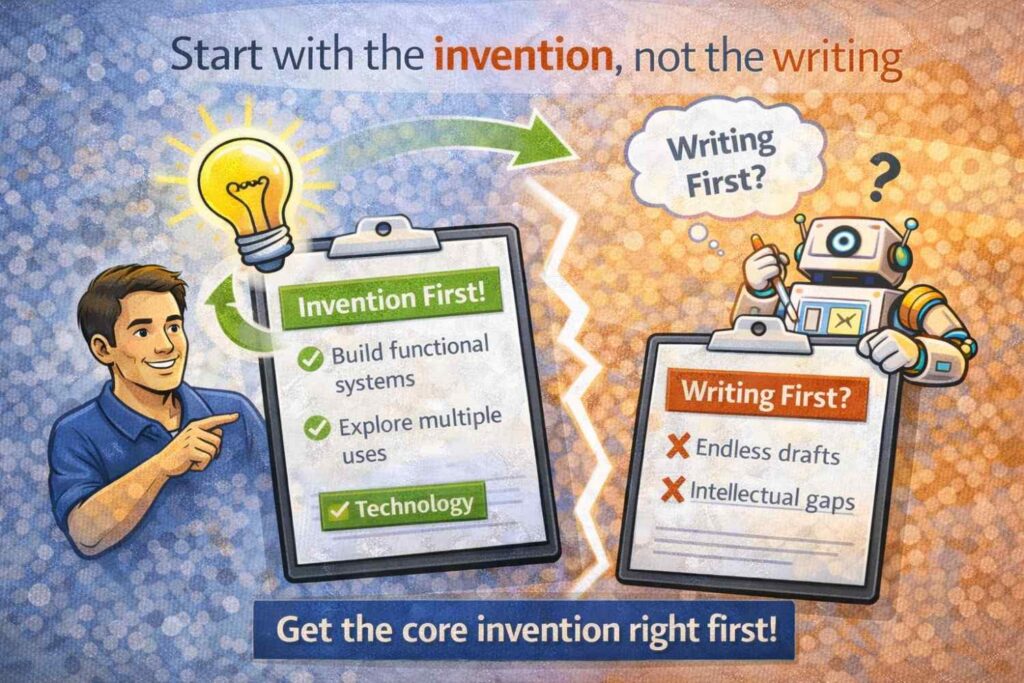
Before you ever prompt AI to write a specification, you should prompt it to understand the invention.
That is a much smarter first move.
Most weak AI drafting happens because people ask for writing before they ask for understanding.
You do not want the AI to start drafting while the inventive concept is still fuzzy.
You want it to help clarify the invention first.
One of the best prompts for this early stage is a prompt that forces AI to identify the heart of the technical idea in plain words.
You can say:
Prompt:
“Read the invention details below and explain the core inventive concept in plain English. Focus on the technical idea, not the product marketing story.
Tell me what problem the invention solves, what the old approach likely was, what the new approach is, and which parts seem most central to making it work.”
This is a strong opening prompt because it clears away noise.
It helps you see whether the invention is actually being framed at the right level.
It also helps expose a common founder mistake, which is confusing the product with the invention.
That difference matters a lot.
A startup may have built a product that does ten things. But the invention worth protecting may be a specific method, system arrangement, control logic, data flow, or processing approach inside that product.
This prompt helps separate those layers.
Use prompts that force technical clarity
A patent specification gets stronger when the invention is described in technical terms that are still simple and readable.
That is why one of the most useful moves is asking AI to restate the invention in a way that strips away fluff and keeps only the real mechanism.
A very strong prompt for that is:
Prompt:
“Based on the invention details below, explain how the invention works step by step. Do not use marketing language. Do not talk about user benefits first. Focus on technical flow, system behavior, inputs, outputs, decisions, and interactions between parts.”
This prompt is powerful because it forces AI away from startup pitch language.
Founders often describe inventions in business language. That makes sense in fundraising and sales. But patent specifications need a different center of gravity.
You need the mechanism.
You need the flow.
You need the structure.
You need the logic.
This kind of prompt pushes the draft in the right direction from the start.
The best prompts pull out missing detail
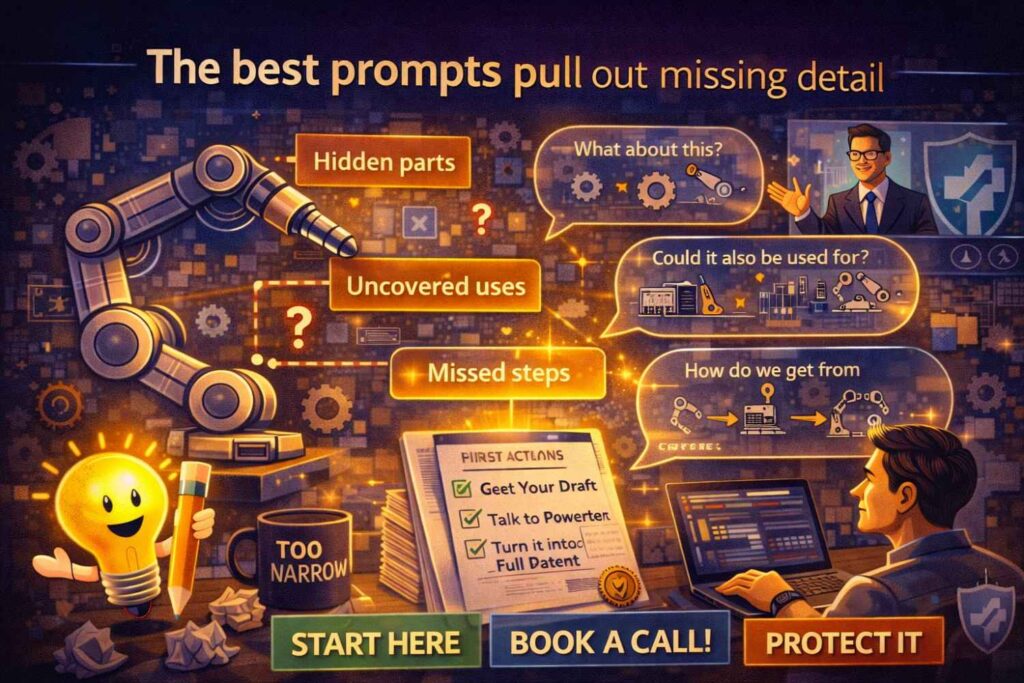
One reason AI is so useful in patent drafting is that it can act like a smart interviewer.
It can help you notice what is missing.
That is huge.
Invention disclosures are often too short. Engineering notes are often too scattered. Founders often skip the detail they think is obvious. This leads to shallow drafts.
The right prompt helps surface what the team forgot to mention.
A very effective prompt for this is:
Prompt:
“Review the invention details below as if you are preparing to draft a full patent specification. Identify what important technical information appears to be missing. Ask targeted follow-up questions that would help create a stronger and more complete specification, including questions about system components, method steps, data flow, alternate embodiments, implementation choices, failure handling, optional features, and deployment environments.”
This is one of the best prompts in the entire workflow.
Not because it gives you writing right away, but because it improves the source material.
And better source material leads to better patent writing every time.
Use AI to build the backbone before the full draft
Instead of asking for a full specification too early, a smarter move is to use prompts that build the backbone of the document first.
That means the AI helps you shape the structure of the invention.
For example, this prompt is extremely useful:
Prompt:
“Create a structured outline for a patent specification based on the invention details below. Include a technical field, background framing, summary of the invention, figure concepts, system description, method description, detailed embodiments, variations, and optional implementation details. For each section, explain what content should go there based on this invention.”
This gives you something better than a full draft too early.
It gives you a map.
That matters because once the structure is good, the writing becomes easier to improve.
Without a structure, even a long AI draft can feel hollow.
With a strong structure, you can build a far more useful specification step by step.
Prompt AI to think like a patent strategist, not just a writer
This is an important distinction.
A writer focuses on clarity and flow.
A patent strategist also thinks about support, scope, fallback positions, different angles of protection, and how the invention may need to be described for future use.
You want prompts that push AI toward that second mode.
One of the best prompts for doing this is:
Prompt:
“Analyze the invention below and identify the different ways it might later be described in a patent specification to support broad and narrow claim strategies. Distinguish between core features, optional features, useful technical variations, and implementation-specific details. Explain which parts should be described broadly and which parts may be supported with more concrete examples.”
This is a strong prompt because it helps avoid one of the biggest patent drafting mistakes: writing everything at only one level.
A good specification usually has multiple layers.
It has broad framing.
It has specific examples.
It has alternative embodiments.
It has optional features.
It has detail where detail helps, and flexibility where flexibility matters.
This prompt helps the AI organize the invention that way.
Use prompts to separate essential features from temporary product choices
Many startups are drafting while the product is still changing.
That creates risk.
You do not want the patent specification tied too tightly to whatever the team shipped last month if the underlying invention is broader than that.
This is why one of the best prompts you can use is a prompt that forces AI to distinguish between the durable inventive idea and the temporary implementation details.
A useful prompt is:
Prompt:
“Review the invention details below and separate the likely core inventive concept from features that appear to be product-specific, interface-specific, stack-specific, or temporary implementation choices. Explain which details seem essential to the invention and which may be examples rather than requirements.”
This can save founders from a lot of accidental narrowing.
It helps you see whether your invention is really about a specific interface, model, sensor, workflow, or deployment setup—or whether those are just one way the invention happens to show up today.
That insight can make the final specification much stronger.
Prompt for figures before you prompt for polished prose
This is a very smart move that many teams miss.
A lot of clarity problems get solved when you first ask AI what the figures should be.
That is because figures force structure.
They reveal what the main system pieces are. They reveal what steps belong in the method flow. They reveal what alternative embodiments deserve their own visual treatment.
Try this:
Prompt:
“Based on the invention details below, suggest the most useful patent figure concepts for a full specification. Focus on system diagrams, method flowcharts, component relationships, data flow, user interaction where relevant, and alternate embodiments. For each figure, explain what it should show and why it would strengthen the written description.”
This prompt is very practical.
It helps you think like someone building a full patent application, not just a block of text.
Once you know the figures, you often know what the specification needs to explain.
Ask AI to draft in layers, not all at once
One of the best prompting habits is to draft one section at a time.
That sounds slower, but it usually produces a better result.
Instead of one giant instruction, break the drafting into parts.
Ask for the background.
Then the summary.
Then the system overview.
Then the method description.
Then one detailed embodiment.
Then alternative embodiments.
Then optional features.
Then edge cases.
Then implementation examples.
This improves quality because each prompt can carry more focus.
A strong prompt for one section might look like this:
Prompt:
“Draft a detailed system description section for a patent specification based on the invention details below. Describe the main system components, what each one does, how they interact, what information flows between them, and where optional variations may exist. Keep the writing technically clear and formal, but readable.”
That prompt is much better than asking for a full application in one shot.
It gives the AI a clear target.
It also makes your review process easier.
The most useful prompt for method steps

Method claims are common. Method support in the specification is critical.
That means one of the most useful prompts is the one that turns scattered invention details into a coherent process flow.
A strong example is:
Prompt:
“Convert the invention details below into a patent-style method description. Explain the process as a sequence of steps, including what is received, what is determined, what is generated, what conditions affect later steps, and what outputs are produced. Where appropriate, note variations in step order, optional steps, and alternate processing paths.”
This prompt does several good things at once.
It creates procedural clarity.
It encourages logical flow.
It allows room for optional steps.
It helps the AI move beyond a static description into something more operational.
That makes it far more useful for specification drafting.
Prompt for alternative embodiments early, not late
Many weak drafts leave variations to the very end, as an afterthought.
That is a mistake.
Alternative embodiments are not filler. They are part of what makes a specification useful later.
So you should prompt for them earlier than most people do.
One of the best prompts here is:
Prompt:
“Identify realistic alternative embodiments of the invention described below. Focus on changes that preserve the same core inventive concept while varying system structure, method flow, processing logic, data source, hardware or software division, deployment model, communication path, or user interaction. Explain how each embodiment relates back to the same underlying invention.”
This is a strategic prompt.
It does not ask for random variations. It asks for realistic ones tied to the same core idea.
That is what you want.
This kind of prompting helps the final specification stay more useful as the product and market evolve.
Prompt for optional features without locking them in
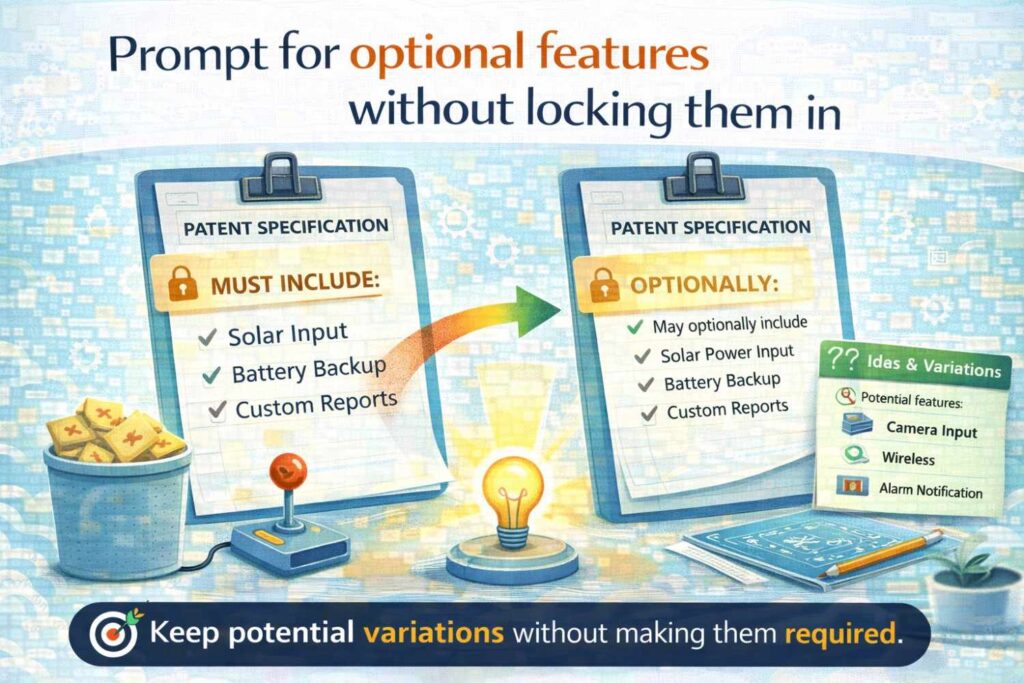
Another important skill in patent specification writing is describing useful features without making them sound mandatory when they are not.
AI can help with this if you ask the right way.
For example:
Prompt:
“Review the invention details and draft language that describes additional or optional features in a way that preserves flexibility. Distinguish between core features and features that may be present in some embodiments. Keep the wording clear and avoid making nonessential implementation choices sound required.”
This prompt is valuable because AI can otherwise slip into overly rigid phrasing.
That can make the specification narrower than it should be.
You want prompts that teach the AI to preserve room where room is appropriate.
Use prompts to uncover business-critical coverage
The best patent drafting is not only technically sound. It is also tied to business reality.
You want the specification to describe what matters strategically, not just what is easiest to explain.
That means one of the smartest prompts you can use is a prompt that asks AI to think about what part of the invention creates real leverage for the company.
Try this:
Prompt:
“Based on the invention details below, identify which technical aspects of the invention are most likely to matter strategically for the business. Focus on what a competitor would likely try to copy, what drives product differentiation, and what would still matter even if the interface, branding, or stack changed. Then explain how those aspects should be emphasized in the patent specification.”
This is one of the highest-value prompts a startup can use.
It helps connect patent drafting to business value.
That is exactly the kind of thinking that separates a filing from a real IP asset.
And that is one reason many fast-moving startups turn to PowerPatent. The platform helps founders create stronger filings that reflect both the technology and the business, with real attorney support built into the process. You can learn more here: https://powerpatent.com/how-it-works
Prompt AI to write like a technical explainer, not a hype machine
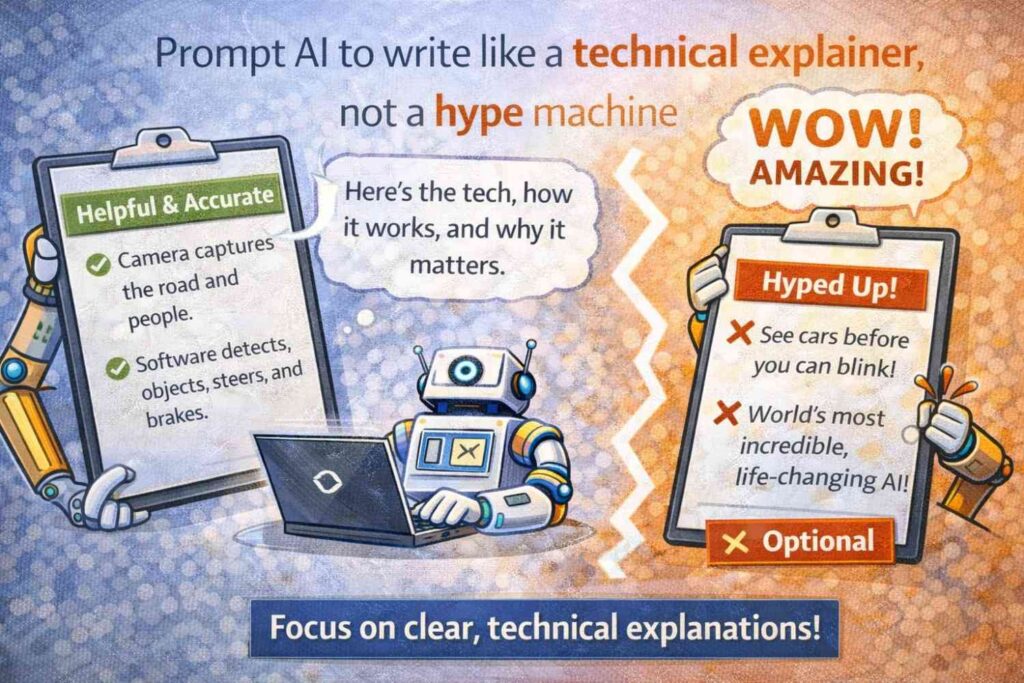
A lot of AI output sounds polished on the surface but weak underneath.
It uses big words. It repeats the same promise in different ways. It sounds impressive without saying much.
That is dangerous in patent drafting.
So one of the best things you can do is explicitly tell AI what not to do.
A useful prompt is:
Prompt:
“Draft the section below in a formal and technically clear style. Avoid hype, avoid marketing language, avoid vague statements, and avoid repeating benefits without explaining mechanism. Write as though teaching a technically trained reader how the invention works.”
This kind of prompt improves output quality right away.
It reduces fluff.
It raises the signal.
It makes the result feel more like a useful drafting tool and less like generic AI content.
Use prompts that ask for examples but keep them as examples
Examples make specifications stronger. But examples can also narrow the document if they are framed poorly.
So you want prompts that ask AI to include examples while clearly preserving flexibility.
A strong example prompt is:
Prompt:
“Draft one detailed embodiment of the invention below using a concrete example that helps explain how the invention works in practice. Make clear that the example is illustrative and that other embodiments may vary while still using the same core inventive concept.”
This is a subtle but important prompt.
It helps the AI use examples well without turning them into limits.
That is especially useful when the invention can apply across multiple settings but one example is easier to explain than the rest.
The best prompts test the draft, not just create it
This is a major point.
AI should not only draft. It should also critique.
Some of the best prompts come after you already have a draft.
These review prompts can dramatically improve the final result.
For example:
Prompt:
“Review the patent specification draft below and identify places where the invention may be described too narrowly, too vaguely, or with missing technical support. Flag any sections where optional features sound mandatory, where core inventive concepts are not clearly explained, or where useful alternative embodiments appear missing.”
This kind of prompt is incredibly practical.
It helps turn AI into a second-pass reviewer.
That is often where the real value shows up.
Prompt to find unsupported generalizations
One problem in AI drafting is that the output can sound broad without actually being supported by the details you gave it.
That creates weak spots.
So you want a prompt that checks for this directly.
Try:
Prompt:
“Review the draft below and identify any broad statements, generalizations, or abstract descriptions that are not well supported by the invention details provided. Suggest where the draft needs more concrete explanation, examples, technical detail, or implementation support.”
This prompt improves honesty in the draft.
It helps keep the writing grounded.
And it reduces the risk of a specification that feels impressive but lacks substance.
Prompt AI to compare invention framing options
Sometimes the real challenge is not writing. It is choosing the right way to frame the invention.
Is it mainly a system invention?
A method invention?
A device invention?
A workflow invention?
A data-processing invention?
A control invention?
A hybrid?
AI can help think through that.
One of the best prompts for this is:
Prompt:
“Analyze the invention below and suggest different ways it could be framed in a patent specification. Compare treating the invention as a system, a method, a device, a networked arrangement, a computer-implemented process, or another useful framing based on the invention details. Explain what each framing highlights and what support should be included for each.”
This does not replace legal strategy, but it helps improve the draft structure and content.
It also helps teams think more clearly about what they actually invented.
Prompt for edge cases and real-world conditions

A specification gets stronger when it does not only describe the happy path.
Real inventions often show value when inputs are messy, signals are uncertain, or system conditions change.
So one of the most useful prompt types is the edge-case prompt.
For example:
Prompt:
“Based on the invention details below, identify practical edge cases, exception paths, uncertain conditions, failure modes, or alternate operating conditions that may be relevant to a full patent specification. Explain how the invention may handle or adapt to these situations, and draft language that could describe them clearly.”
This prompt often pulls out material founders forget to mention.
And that material can make the specification far more robust.
Prompt for future-proofing
One of the smartest uses of AI in patent specification writing is asking it to help future-proof the document.
You do not want the application locked to one product release if the core invention is meant to support a growing company.
So use prompts like this:
Prompt:
“Review the invention below and identify how the specification can be written to stay useful as the product evolves. Distinguish between the enduring technical concept and short-term product choices. Suggest broader implementation paths, deployment variations, and future-ready descriptions that remain faithful to the invention.”
This prompt is strategic.
It helps preserve value for later.
It also lines up with how strong startups think about IP.
A patent application should not be written only for filing day. It should be written for future fundraising, future product expansion, future competition, and future portfolio growth.
Prompt AI to write from raw engineering inputs
A lot of founders do not start with clean invention disclosures. They start with messy materials.
That is normal.
The good news is that AI can still help if you guide it well.
A great prompt for this situation is:
Prompt:
“Using the engineering notes below, extract the invention-relevant material needed for a patent specification. Ignore project-management noise, marketing language, and nonessential implementation clutter. Organize the result into problem solved, core inventive concept, system components, process flow, implementation details, optional features, and possible alternative embodiments.”
This is a very tactical prompt.
It turns engineering material into drafting material.
That is exactly the kind of bridge most startups need.
Prompt AI to turn code logic into specification language
For software inventions, this is one of the highest-value prompt categories.
You do not want the AI to simply describe the code as code. You want it to translate the logic into patent-style explanation while preserving the technical truth.
A strong prompt is:
Prompt:
“Based on the code logic or pseudocode below, explain the underlying technical process in patent-specification style. Focus on what inputs are received, what operations are performed, what decisions or conditions affect flow, what outputs are generated, and how the process may be implemented in different software or hardware arrangements.”
This prompt helps extract real value from technical work.
It is especially helpful for startups whose inventions live deep in backend logic, model orchestration, optimization layers, or data flows.
Best prompts for AI inventions

AI-related inventions need careful prompting because weak drafting in this area becomes vague very quickly.
You want prompts that force specificity without boxing the invention into one narrow model or implementation choice unless that narrowness is real.
Here is one of the best prompts for an AI invention:
Prompt:
“Draft a technically detailed description of the AI-related invention below. Explain the full workflow, including data intake, preprocessing, feature handling, model or decision logic, inference or evaluation flow, confidence or scoring where relevant, output generation, and any feedback, validation, or adaptation steps. Avoid generic phrases like ‘using AI’ unless supported by actual technical explanation.”
This prompt is good because it resists buzzword drafting.
It pushes toward real pipeline detail.
That is where useful patent support often lives in AI systems.
Best prompts for hardware inventions
Hardware inventions need clarity about structure, relationships, and operation.
A useful prompt here is:
Prompt:
“Draft a detailed patent-style description of the hardware invention below. Explain the structural components, how they are arranged, how they connect or interact, what signals or forces are involved, how operation occurs over time, and what alternative physical configurations may exist.”
This helps the AI move beyond a flat parts list.
It encourages system behavior and structural relationship detail, which are both important.
Best prompts for mixed hardware-software inventions
Many modern inventions are not purely software or purely hardware. They live in both.
That means the prompt should ask for both dimensions clearly.
Try this:
Prompt:
“Draft a specification section for the invention below that clearly explains both the physical system components and the software or control logic that operates with them. Describe how sensing, processing, decision-making, communication, and actuation or output work together, including possible distribution across different devices or modules.”
This type of prompt is very helpful for robotics, IoT, edge computing, diagnostics, industrial systems, and other modern startup categories.
Best prompts for rewriting weak invention disclosures
Sometimes the source material is just not good.
The disclosure is too short. The logic is buried. The technical mechanism is barely explained.
AI can help rebuild it if you ask well.
Use something like:
Prompt:
“Rewrite the invention disclosure below into a stronger and more complete technical foundation for a patent specification. Keep the true content intact, but expand the explanation of the problem solved, the core mechanism, the main system parts, the method flow, and possible embodiments. Where important details are missing, identify them clearly rather than guessing.”
This is useful because it balances rewriting with honesty.
You do not want AI making up invention details.
You want it to improve structure and clarity while showing you where more input is needed.
Best prompts for drafting the background section
The background section should provide context, not act like a sales page.
A good prompt for this is:
Prompt:
“Draft a patent-specification background section for the invention below. Explain the relevant technical field and the practical limitations of prior approaches in a fair, general, and technically grounded way. Avoid hype, avoid naming unnecessary specific competitors, and avoid overstating what the invention solves.”
This prompt protects tone.
It also helps prevent exaggerated language that can weaken the overall draft.
Best prompts for drafting the summary section

The summary should explain the invention clearly while keeping room for multiple embodiments.
Try:
Prompt:
“Draft a summary of the invention for a patent specification based on the details below. Describe the invention at a level broad enough to cover multiple embodiments but concrete enough to communicate the central technical concept. Focus on what the invention does technically and how it differs in approach from conventional systems.”
This is a strong balance prompt.
It helps AI avoid the two big errors in summary drafting: being too vague or being too narrow.
Best prompts for drafting detailed embodiments
Detailed embodiments are where a lot of support comes from.
One of the strongest prompts you can use is:
Prompt:
“Draft a detailed embodiment section for the invention below. Explain one representative implementation in enough depth that a technically trained reader can understand how the invention operates in practice. Include component interactions, data or signal flow, key decisions, optional refinements, and where applicable, implementation choices that may vary across embodiments.”
This helps create substance.
It is one of the most important drafting prompts in the whole process.
Best prompts for variation language
Variation language can easily become empty filler if you are not careful.
So prompt for meaningful variations.
For example:
Prompt:
“Draft a section describing meaningful variations of the invention below. Focus on realistic alternative implementations that preserve the same core inventive concept. Do not provide random substitutions. Instead, describe variations in architecture, processing order, communication mode, deployment environment, data source, or control logic that would still fall within the spirit of the invention.”
This prompt improves quality by filtering out lazy filler.
Best prompts for deployment flexibility
Many inventions can run in different places or different technical environments.
That deserves support in the specification.
A useful prompt is:
Prompt:
“Based on the invention below, draft language that explains how the invention may be implemented across different deployment environments, including centralized, distributed, local, cloud-based, edge-based, device-level, or hybrid arrangements where relevant. Preserve the core inventive concept while showing flexibility in implementation.”
This prompt helps future-proof the draft.
It is especially useful for startups that know the product stack may change over time.
Best prompts for terminology consistency
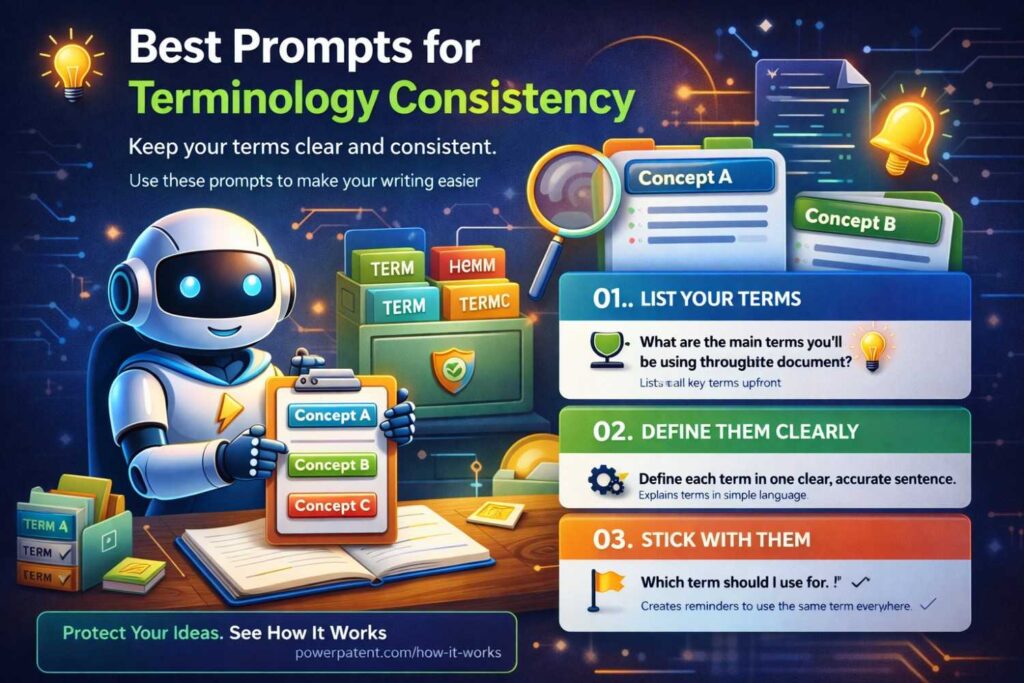
One simple but powerful use of AI is checking whether the draft uses terms consistently.
This matters more than many people think.
A good prompt is:
Prompt:
“Review the draft below and identify inconsistent terminology, shifting labels for the same component, unclear naming, or terms that may confuse whether the same feature is being described in different ways. Suggest a cleaner and more consistent terminology structure for the specification.”
This is one of those small prompts that can create a big improvement.
Consistency makes the specification clearer, stronger, and easier to work with later.
Best prompts for narrowing-risk review
This is a very strategic category.
A lot of weak patent drafts become smaller than they should be because of unintentional wording choices.
Use prompts that look directly for that problem.
For example:
Prompt:
“Review the draft below for accidental narrowing. Identify places where examples sound mandatory, where one implementation is described as though it defines the invention, where optional features are treated as required, or where broad concepts are tied too tightly to a specific product version, interface, model, or architecture.”
This prompt is worth using on almost every draft.
It helps preserve room where room belongs.
Best prompts for gap review before attorney review

If you are using AI before legal review, one of the smartest moves is to use AI to clean up the draft and expose obvious gaps first.
A great prompt is:
Prompt:
“Act as a rigorous pre-review editor for the patent specification draft below. Identify weak spots that should be strengthened before attorney review, including unclear invention framing, missing technical support, missing alternatives, vague summaries, unsupported generalizations, poor flow between sections, or lack of connection between figures and text.”
This makes attorney review more productive.
Instead of paying for cleanup on basic issues, you can use AI to improve the draft first.
That is exactly the kind of leverage smart startups want.
And it is one reason PowerPatent’s approach is so compelling. It combines the speed of AI-assisted drafting with real attorney oversight, helping teams move faster without sacrificing the legal judgment needed for strong patent work. You can explore it here: https://powerpatent.com/how-it-works
The biggest mistakes people make with prompts
It is worth slowing down here, because the mistakes matter.
The first big mistake is asking AI to write a full patent specification before giving it enough invention detail.
That almost always leads to generic content.
The second mistake is using prompts that focus on sounding formal instead of being technically clear.
A patent specification does need to sound professional. But that is not the same thing as stuffing it with stiff language.
The third mistake is failing to ask follow-up questions.
Many teams accept the first AI output too quickly. That is a miss. Good prompting is iterative. The second and third passes often create the strongest improvements.
The fourth mistake is not prompting for alternatives.
If you only ask for one embodiment, you may only get one.
The fifth mistake is treating AI like a replacement for judgment.
AI can help a lot. But it still needs smart input, review, and legal oversight.
The sixth mistake is using prompts that are too broad to guide anything useful.
The seventh mistake is allowing the AI to drift into marketing language, especially in startup contexts.
The eighth mistake is failing to prompt for business-relevant coverage.
The ninth mistake is not testing the draft for weak spots after it is generated.
The tenth mistake is assuming a long output is a strong output.
Length is not the goal.
Support is the goal.
Clarity is the goal.
Strategic usefulness is the goal.
How founders should actually use these prompts in real life
Knowing good prompts is helpful.
Using them the right way inside a real company is what creates results.
That is the part many founders miss.
They read about AI prompting, save a few templates, and assume that is enough. Then real life gets in the way. The invention details are scattered across Slack, product docs, and engineers’ heads. The team is moving fast. Nobody wants to stop work to “do patents.” The founder tries one or two prompts, gets a rough output, and then either files something too thin or gives up.
That is not a prompt problem.
That is a workflow problem.
The companies that get real value from AI-assisted patent drafting do not use prompts as random one-off commands. They build a simple operating rhythm around them. They use prompts at the right moment, with the right source material, and with the right people involved.
That is when prompting starts to help the business, not just the document.
Use Prompts While the Thinking Is Still Fresh
One of the biggest mistakes founders make is waiting too long.
They wait until the product is live. Then until the launch is over. Then until the next sprint ends. Then until the team has more time. By then, key details are already fading. The inventors remember the big idea, but not always the small technical choices that made the invention work.
This is where prompts become much more useful than people expect.
You do not need to wait until you are “ready to draft a patent.” You can use prompts earlier, while the invention is still alive inside the team’s current work.
Right after an architecture change, model improvement, control logic breakthrough, or system redesign, use AI to help capture the real inventive content while the memory is still sharp.
That means founders should not think of prompting as something that begins at the filing stage. It should begin at the invention-capture stage.
A smart internal habit is to run a short AI-assisted invention session within days of a meaningful technical breakthrough. Feed in rough notes, architecture text, or a design summary, and use prompts to pull out the core invention, likely missing detail, and possible variants.
This early capture step can dramatically improve the quality of what gets written later.
Do Not Ask the Whole Team to “Help With the Patent”
That usually goes nowhere.
It is too vague. It sounds like extra work. And people do not know what kind of input is actually useful.
A much better approach is to break the work into small, targeted contributions and use prompts to guide each one.
For example, instead of asking the engineering lead to “review the patent draft,” use AI prompts first to generate focused questions around system flow, alternate implementations, or deployment options. Then ask the engineer to react to those specific points.
Instead of asking a product lead whether the draft “looks right,” use prompts to isolate what parts of the current product are temporary and what parts reflect the deeper invention. Then ask the product lead to confirm where the roadmap is heading.
This is far easier for busy teams.
It lowers friction.
It also leads to better input because people respond better to narrow questions than to open-ended legal tasks.
Create One Internal Source of Truth Before Prompting Hard
A lot of weak AI output comes from messy inputs.
That does not mean your materials need to be polished. But it does mean you should avoid throwing disconnected scraps into the process and hoping AI will produce a strong patent-ready result on its own.
Before you start serious prompting, pull together one working source document that contains the core invention notes, the problem solved, known system components, method flow, and any available diagrams or engineering explanation.
It does not need to be pretty.
It does need to be coherent enough that the AI is not constantly guessing how the pieces relate.
For businesses, this is a very useful discipline. It creates a single place where the invention can be understood across product, engineering, and legal review.
That alone saves time later.
It also improves consistency if the company wants to file related patents in the future.
Treat Prompting Like Product Discovery, Not Like Form Filling
This is a mindset shift that helps a lot.
The best founders do not use prompts as if they are completing a form. They use prompts the way strong product teams use discovery questions.
They probe.
They test.
They look for gaps.
They refine the framing.
They pressure-test the logic.
That is exactly how prompting should work in patent preparation.
The first answer from AI should not be treated as the final truth. It should be treated as a draft thought partner output that helps the team see where the invention is clear and where it still needs sharper definition.
This is especially valuable for businesses with complex products. In many startups, the most important invention is buried under layers of implementation detail. Good prompting helps peel those layers back.
Founders should expect to use prompts in rounds.
The first round is usually about invention clarity.
The second round is about technical completeness.
The third round is about strategic framing.
The fourth round is about draft improvement and review.
Thinking this way creates a much more reliable process.
Match the Prompt Stage to the Business Stage
Not every company should use prompts the same way.
A very early startup with one core product and a tiny team may use prompts mainly to identify and clarify inventions before anything formal is drafted.
A growth-stage startup with more mature systems may use prompts to build stronger draft sections, expand embodiments, and support a broader portfolio strategy.
A company preparing for fundraising, diligence, or acquisition review may use prompts to tighten specifications so they better reflect what gives the business real technical leverage.
The key point is that prompting should match the company’s real business moment.
If the business is early, use prompts to capture and define.
If the business is scaling, use prompts to deepen and broaden.
If the business is being evaluated by outsiders, use prompts to sharpen strategic coverage and close obvious holes.
This helps founders avoid a common mistake, which is treating all patent work as though it serves the same purpose. It does not.
The right prompt workflow depends on what the business needs right now.
Build Prompting Into Existing Team Habits

The easiest process is the one your team will actually use.
That is why the smartest businesses do not create a giant new invention workflow from scratch. They attach prompting to habits the team already has.
If your team already writes technical design docs, use prompts right after those docs are created.
If your team already runs product review meetings, use prompts to turn major technical decisions from those meetings into invention-capture questions.
If your team already creates sprint summaries, use prompts to scan those summaries for patent-worthy changes.
If your founders already meet with engineering leads weekly, use prompts to structure a short invention review once a month.
This matters because the biggest threat to good patent capture is not lack of intelligence. It is lack of consistency.
Teams forget. Priorities shift. Shipping takes over.
Prompting works best when it fits the natural motion of the business.
Assign an Internal Owner, Even If They Are Not the Inventor
This is one of the most practical changes a startup can make.
If nobody owns the patent prompting workflow, it usually breaks.
The inventors are too busy building. The founder is juggling everything. The legal work feels distant until a deadline appears.
A much better approach is to assign one internal owner who drives the process.
This person does not need to be the most technical person in the company. They do need to be organized, trusted, and able to gather input from the right people.
Their job is to make sure invention details do not stay trapped in scattered notes. They run the initial prompts, gather follow-up answers, organize the source material, and help move the draft toward review.
For businesses, this is a very high-return role. Even if it is only part of someone’s job, it creates continuity.
Without an owner, even good prompts often get wasted.
Use Prompts to Reduce Attorney Friction, Not Replace Attorneys
This is where smart companies get leverage.
A common mistake is treating prompting as a way to avoid legal review entirely. That usually creates risk.
The better move is to use prompts to make legal review more focused, more informed, and more productive.
If AI helps your team clarify the invention, surface variations, organize the technical flow, and identify weak spots before the draft reaches counsel, the legal review becomes much stronger.
The attorney spends less time trying to decode scattered source material and more time improving strategy, scope, wording, and protection quality.
That is exactly the right use of AI in this setting.
Businesses should think of prompting as a way to raise the quality of the starting point. That is where the real efficiency comes from.
This is also why PowerPatent’s model makes so much sense for startups. It gives founders a way to move faster with software while still getting real attorney oversight where legal judgment matters most. You can see how it works here: https://powerpatent.com/how-it-works
Use Prompts to Spot Portfolio Opportunities, Not Just Single Filings
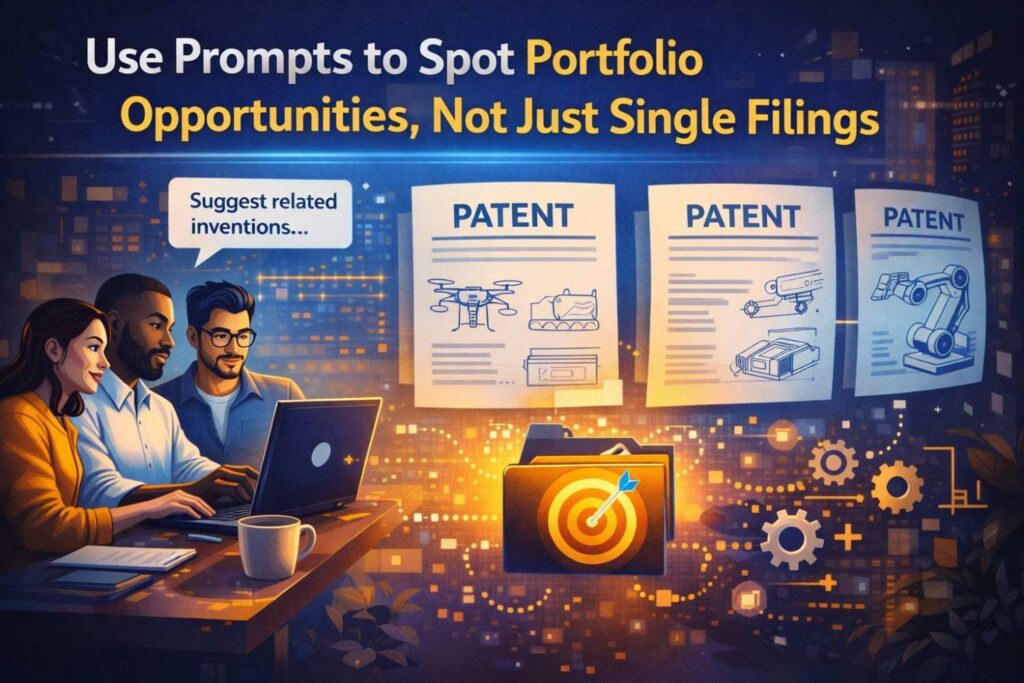
This is a more strategic use case that growing businesses should pay close attention to.
A good prompt process can reveal that what looks like one invention may actually contain multiple protectable ideas.
For example, the core system architecture may support one filing. The training or optimization flow may support another. The user-specific adaptation logic may support another. The safety, verification, or fallback layer may support yet another.
That does not mean every idea should become a separate filing. But businesses should absolutely use prompts to uncover where the real invention boundaries may sit.
This is important because a single invention disclosure often blends together multiple technical contributions. If you do not separate them early, you may miss chances to build a more thoughtful portfolio.
A smart internal review question is this: does the draft describe one invention, or are there two or three invention centers hiding inside it?
Prompts can help answer that.
Keep a Record of What the AI Helped Surface
This sounds simple, but it matters more than most teams expect.
As prompts generate follow-up questions, embodiment ideas, variation paths, and review comments, save those outputs in an organized way.
Do not let them vanish into chat history.
Those outputs often contain strategic thinking that becomes useful later, even if it does not all make it into the first filing.
A question the AI raised today may become the center of a continuation later.
A variation mentioned during prompt review may become important once the product evolves.
A business-critical angle surfaced during a prompting session may shape how the company talks about technical defensibility during fundraising.
In other words, prompting creates more than text. It creates insight.
Businesses should store that insight.
Use a “Competitor Copy” Prompt Pass Before Finalizing
Here is one highly actionable move that founders can start using right away.
Before a draft is treated as ready, run one prompt pass focused only on competitive copying.
Ask the AI to look at the invention and identify what a competitor would most likely imitate if they wanted the same advantage without using the exact same interface, branding, or internal stack.
Then compare that answer to the draft.
If the specification does not really describe that competitive pressure point, the business may be protecting the wrong layer.
This is one of the most practical ways to connect patent drafting to business defense.
It helps founders move beyond the question of whether the draft is “accurate” and into the more important question of whether it protects what actually matters.
Review Prompt Output Through a Business Lens, Not Just a Technical Lens
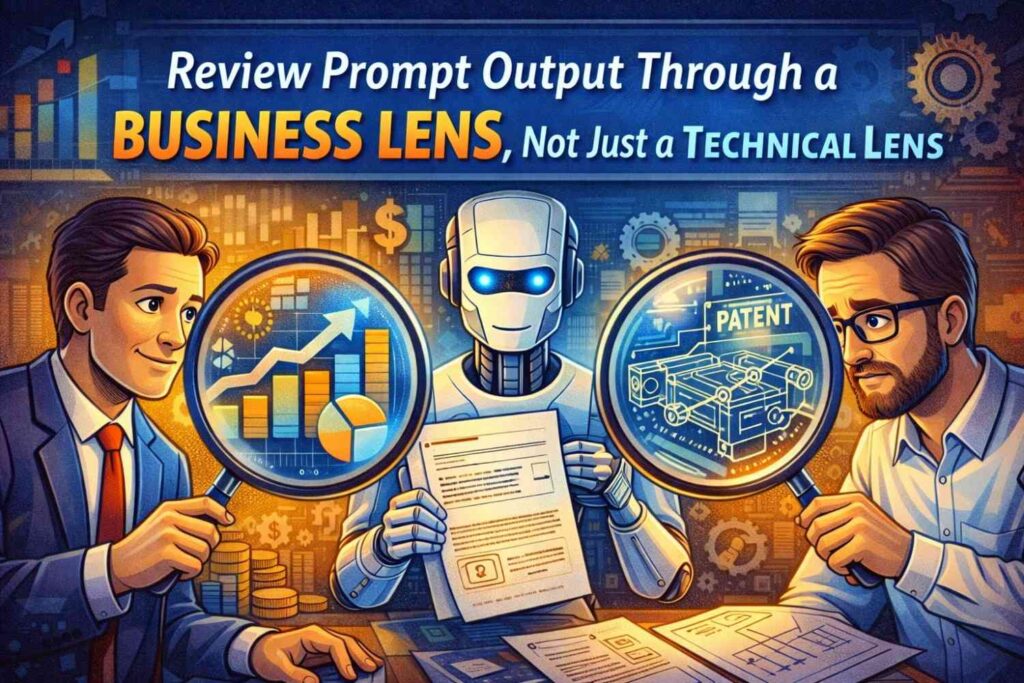
Founders often review AI output by asking whether the explanation is technically right.
That is necessary, but it is not enough.
They should also ask whether the output supports the company’s long-term business position.
Does it reflect what makes the product different in a way that matters commercially?
Does it support future versions of the product?
Does it leave room for adjacent use cases?
Does it capture the architecture or process that creates switching costs, margin advantage, speed, reliability, trust, or scalability?
These questions matter.
A technically correct draft can still be strategically weak if it focuses on the wrong parts of the invention.
That is why businesses should review prompt output with both engineering and business judgment in mind.
Use Prompting to Create Repeatable Quality, Not One-Time Speed
Founders often get excited about how quickly AI can generate text.
That is fine. Speed is useful.
But the deeper business value is not speed alone. It is repeatable quality.
A startup that uses prompts well can create a better invention-capture habit, a better draft-building habit, and a better review habit across the whole company.
That means the second filing gets easier.
The third gets more strategic.
The fourth benefits from stronger internal language and cleaner technical records.
This is where prompting starts to compound.
It stops being a tool for one draft and becomes part of the company’s IP operating system.
That is a very valuable shift.
A Simple Operating Rhythm That Works
For businesses that want something practical, here is a simple rhythm that works well.
When a meaningful technical milestone happens, capture it fast with a short internal invention summary.
Use prompts to extract the core inventive idea and identify what details are missing.
Get focused follow-up input from the relevant engineer, founder, or product lead.
Use prompts to build the draft structure and develop the key technical sections.
Run a review pass for alternative embodiments, accidental narrowing, and strategic business coverage.
Then send a much stronger starting point into real legal review.
That process is simple enough for a startup to maintain and strong enough to create real improvement.
The Best Founders Use Prompts to Make Better Decisions, Not Just Better Text
This may be the most important point in the whole section.
The true value of prompting is not only that it helps write a specification.
It also helps founders think more clearly about what they invented, what matters most, where the business value sits, what competitors may copy, what future versions deserve support, and where the company should invest in protection.
That is not just drafting help.
That is strategic help.
When used well, prompts do not merely produce words. They help businesses make better IP decisions.
And that is where the real edge begins.
The right prompt often sounds simple
This is important to understand.
A good prompt does not need to be bloated.
In fact, the strongest prompts are often simple, direct, and clear.
What matters is that they contain the right instructions.
They should say what material to use.
They should say what job to do.
They should say what to avoid.
They should say what kind of result you want back.
That is enough.
People sometimes overcomplicate prompting because they think complexity signals quality.
It does not.
The quality comes from the thinking behind the prompt.
Why startups need better prompting, not just more patent budget
Many startups assume the path to better patent work is simply spending more money.
Sometimes more budget helps. But often the bigger problem is poor process.
If the invention intake is weak, if the drafting source material is thin, if the prompts are generic, and if the team is not surfacing the right technical detail, a bigger budget will not automatically fix that.
Better prompting improves the process.
It helps teams pull more value from what they already know.
It helps them turn scattered technical work into stronger patent support.
It helps them collaborate with counsel more effectively.
It helps them draft faster without turning quality into an afterthought.
That matters a lot for startups trying to move quickly and protect what they are building.
What the best prompt systems really do
At the highest level, the best prompt systems do not just generate text.
They create thinking structure.
They help the team define the invention.
They help separate essential features from incidental ones.
They help reveal missing material.
They help expand one example into a broader set of embodiments.
They help test whether the specification is too thin, too vague, or too narrow.
They help connect the draft to business value.
That is what good prompting should do.
Once you see it that way, everything changes.
You stop asking, “What is the best prompt to write my patent?”
And you start asking, “What prompts will help me produce the strongest specification possible?”
That is the better question.
A strong prompt library becomes a real advantage

This is something most companies overlook.
If your team develops a good set of prompts for invention extraction, technical clarification, embodiment building, variation drafting, and draft review, that prompt library becomes an internal advantage.
It helps you move faster the next time.
It improves consistency.
It lowers drafting friction.
It helps technical founders work better with legal teams.
It makes invention capture more repeatable.
It helps the company build a better IP process overall.
This is especially powerful for startups with fast product cycles and frequent invention output.
Instead of reinventing the wheel each time, you refine a repeatable workflow.
That is a very smart way to use AI.
Why attorney oversight still matters even with great prompts
It is worth being very clear here.
Great prompts can improve drafting a lot.
They can save time.
They can increase completeness.
They can produce much better first drafts.
But they do not remove the need for legal judgment.
Patent specifications are not just technical documents. They are legal assets too.
That means choices about scope, wording, support, framing, and strategy matter in ways that go beyond writing quality.
That is why the best setup is not AI alone.
It is AI plus real patent attorney oversight.
That is the model PowerPatent is built around. Founders get the speed and clarity of modern software, but they also get real attorney review so the work is not left at the level of “good-looking AI output.” That combination helps startups file better patents, faster, with more confidence. You can see the full workflow here: https://powerpatent.com/how-it-works
Final prompt examples founders can start using today
Knowing a few strong prompts is useful.
Building a repeatable prompt flow is much better.
That is where real leverage starts.
Most founders do not need fifty prompts on day one. They need a small set of prompts that helps them move from rough invention notes to a stronger, more complete specification draft without wasting time. The goal is not to collect clever prompt wording. The goal is to create a practical system your company can use again and again.
When that happens, prompting stops feeling like guesswork.
It becomes part of your invention process.
Start With a Prompt Chain, Not a Single Prompt
A lot of teams still use AI in one-shot mode. They drop in a few invention notes and ask for a full patent draft all at once.
That usually leads to weak results.
A better way is to create a prompt chain. That simply means using a short sequence of prompts where each one does a specific job and improves the next step.
For example, the first prompt should pull out the core inventive idea. The second should test for missing detail. The third should build a structure. The fourth should draft one major section. The fifth should add alternatives. The sixth should stress-test the draft.
This is a much stronger business workflow because it reduces waste. It also gives founders more control over quality. Instead of hoping the AI gets everything right in one pass, you guide it through the same kind of staged thinking a strong drafting process would use anyway.
That makes the output more useful and easier to review.
Use a “Business Value” Prompt Before the Draft Gets Too Far
One of the smartest moves a founder can make is to ask AI early in the process which parts of the invention appear most tied to business value.
This is not the same as asking what sounds impressive.
It means asking what part of the invention would actually matter if the company grows, raises money, or faces copycats.
A very useful prompt for this stage would be:
Prompt:
“Review the invention details below and identify which technical aspects appear most important to the company’s long-term advantage. Focus on what would still matter if the product design changed, what a competitor would most likely imitate, and what parts of the invention seem most tied to differentiation or defensibility. Then explain how those parts should be emphasized in the specification.”
This helps founders avoid a common problem. Many early drafts spend too much time on surface-level features and not enough time on the deeper mechanism that creates leverage.
For a business, that is a costly miss.
A patent specification should not just mirror the product. It should help protect the technical edge that makes the product hard to copy.
Build a Prompt for “What Are We Forgetting?”
Teams are often closest to their own blind spots.
They know the product so well that they skip steps in explanation. They leave out logic that feels obvious internally. They forget to mention alternate flows because the main version is already clear in their own minds.
That is why every founder should use a specific gap-finding prompt before moving into full drafting.
A strong example is:
Prompt:
“Assume this invention will be used as the basis for a full patent specification. What key technical details, variations, fallback positions, or practical examples appear missing from the current description? Focus especially on what would matter later if the company wanted broader support, future continuation filings, or better protection against design-arounds.”
This prompt is useful because it asks the AI to think like a future-minded reviewer, not just a writer.
That shift matters.
It helps businesses draft for value, not just completion.
Create a Prompt That Looks for Competitor Workarounds
One of the most strategic uses of AI is to ask where a competitor could slip around a narrow draft.
That question does not get asked enough early in the process.
A founder may think the draft looks solid because it explains the current product clearly. But a competitor will not care about clarity. A competitor will care about how easily they can copy the real value while changing one or two visible details.
So a very strong review prompt is:
Prompt:
“Review the invention description below and identify likely ways a competitor could try to design around a narrow patent specification. Focus on technical substitutions, workflow changes, architecture changes, deployment changes, or alternate data flows that might preserve the same commercial value. Then suggest what kinds of description should be added to the specification to reduce that risk.”
This is a highly practical prompt for businesses.
It turns drafting into defensive strategy.
That is exactly how stronger patent work starts.
Use a Prompt That Connects the Patent to the Product Roadmap
A patent becomes much more useful when it is not locked to the current release.
That is why founders should use prompts that pull in near-term roadmap thinking without drifting into fantasy.
The point is not to invent future features that do not exist. The point is to ask whether the current invention has real and known extensions the company already expects to pursue.
A good prompt here would be:
Prompt:
“Based on the invention below, identify realistic product or technical extensions that appear likely within the next one to two years and that still use the same core inventive concept. Explain how the specification could describe the invention in a way that supports those likely future directions without becoming vague or speculative.”
This is very useful for companies that know their architecture, deployment model, automation logic, or customer workflow will evolve soon.
A founder who uses this prompt is not just thinking about filing.
They are thinking about future-proofing.
That is a much smarter business posture.
Build an Internal Prompt Pack for Your Team
This is where companies can create real process advantage.
Instead of prompting from scratch every time, build a short internal prompt pack that your team reuses for every invention.
It does not need to be big. In fact, smaller is often better. What matters is consistency.
A good internal prompt pack might cover invention summary, missing details, system description, method flow, key embodiments, meaningful alternatives, business-value emphasis, and narrowing-risk review.
Once the team has that, invention capture becomes easier. Engineering leaders know what kind of detail to provide. Product leaders know how to connect the invention to roadmap reality. Legal reviewers get stronger source material. The whole process becomes faster and more repeatable.
That kind of system is valuable because it lowers friction without lowering quality.
For a growing business, that is exactly what you want.
Use a Prompt for “Continuation Readiness”
This is a very strategic move that many startups miss.
A strong specification does not only support the first filing. It should also help support later filings built around related concepts, improvements, or narrower angles.
That is why founders should test drafts for continuation readiness.
A very useful prompt is:
Prompt:
“Review the invention description below and identify whether it appears rich enough to support future continuation-style patent strategy. Point out where the specification should include broader framing, narrower technical examples, alternate embodiments, or additional system and method detail to create more downstream filing flexibility.”
This is not about gaming the process.
It is about drafting with foresight.
Businesses that think this way usually build stronger portfolios over time because the early filings are not treated as isolated events. They are treated as part of a longer IP path.
Add a Prompt for Diligence-Readiness

Founders often think about patents mainly in terms of filing and protection.
But patents are also read during fundraising, partnerships, acquisitions, and diligence.
That means the specification should do more than exist. It should reflect technical maturity and strategic thinking.
A useful prompt for this business lens is:
Prompt:
“Review the invention draft below as if it may later be read by investors, acquirers, or diligence counsel. Identify whether it clearly reflects the company’s real technical edge, whether the invention appears commercially meaningful, and whether the write-up feels aligned with a scalable business rather than a one-off feature.”
This is a very practical check.
It pushes the team to think beyond the immediate legal task.
A specification that reflects real depth can support trust in the company’s defensibility. That matters far more than many founders realize.
Use Prompts to Improve Cross-Team Alignment
One hidden benefit of better prompting is better internal communication.
A lot of patent work slows down because engineering, product, and leadership are not using the same language for the invention. One team talks about features. Another talks about infrastructure. Another talks about market value. The result is a scattered draft.
Prompts can help fix that.
For example, founders can use a prompt like:
Prompt:
“Based on the invention details below, explain the invention in three aligned ways: first for engineering clarity, second for product clarity, and third for strategic business clarity. Keep all three versions centered on the same core inventive concept and point out where these views should stay consistent in the specification.”
This is very helpful because it gives the company a shared way to talk about the invention.
That kind of alignment often improves not just patent drafting, but invention spotting and future filing decisions too.
Create a “Before Attorney Review” Prompt Bundle
Many businesses can save time and improve quality by running a small prompt bundle before sending material for attorney review.
This is not about replacing legal judgment. It is about sending cleaner, stronger input into the review process.
A smart pre-review bundle might include a prompt to identify vague sections, a prompt to flag narrowing language, a prompt to test for missing embodiments, and a prompt to check whether the technical mechanism is actually clear.
That kind of prep creates better use of attorney time. It helps legal review focus on strategic and legal improvements instead of basic cleanup.
For startups watching both speed and budget, that is a very practical advantage.
This is one reason PowerPatent’s model fits modern companies so well. It helps teams use smart software to build stronger drafts on the front end, then layers in real attorney oversight where judgment matters most. You can see how that works here: https://powerpatent.com/how-it-works
Turn Good Prompts Into Operating Discipline
The biggest long-term value does not come from one strong prompt.
It comes from turning good prompts into operating discipline.
That means your company develops a habit. Every invention goes through the same kind of structured intake. Every rough draft gets pressure-tested the same way. Every important filing gets reviewed not only for accuracy, but also for business value, flexibility, and future usefulness.
Once that happens, prompting becomes part of how your company protects innovation.
That is a real operational edge.
It means fewer ideas get lost.
It means better inputs for legal review.
It means stronger first drafts.
It means the company gets faster at translating technical work into defensible IP.
For a startup building fast, those gains add up.
Action Steps Founders Can Use Right Now

A founder who wants to improve results immediately does not need to overhaul the whole company in one day.
Start small.
Pick one real invention disclosure or one real technical document from your current product work. Run it through a short sequence of prompts that covers invention summary, missing detail, business-value emphasis, realistic variations, and narrowing-risk review. Save the best versions of those prompts. Refine them after each use.
Then use the same sequence again on the next invention.
Very quickly, you will start to see patterns.
You will notice which prompts surface the best technical detail. You will see which questions help engineers explain things more clearly. You will learn where drafts tend to become too narrow or too product-specific. And over time, you will build an internal system that makes patent drafting faster and more strategic.
That is the real opportunity.
The Best Prompt Is the One Your Company Will Actually Reuse
There is one final point worth making.
The best prompt is not always the most clever one.
It is the one your company will actually use, understand, improve, and repeat.
That is what makes it valuable.
A reusable prompt system turns one-time effort into long-term process strength.
And for businesses that care about speed, quality, and protecting what makes them different, that kind of repeatable advantage matters a lot.
Final thought
AI can be incredibly useful for patent specification writing.
But only when it is guided well.
The best prompts do not just ask for words. They ask for clarity. They ask for structure. They ask for technical truth. They ask for variation. They ask for strategy. They ask for stronger support.
That is what makes them valuable.
If you are a founder, engineer, or startup leader, this is the real opportunity in front of you. Not simply using AI, but using it in a way that helps you build better patent applications from the start.
And if you want a faster, smarter way to do that with software designed for startups and real attorney oversight built in, PowerPatent is worth a close look. See how it works here: https://powerpatent.com/how-it-works
Protecting your invention should not feel slow, confusing, or outdated.
With the right prompts and the right system, it does not have to.