A patent draft can look polished and still be weak.
That is the danger.
A clean format does not mean the invention is explained well. Formal words do not mean the draft is ready to file. And a document that sounds smart can still miss the exact details that matter most when your company is trying to protect what it built.
That is why review matters so much.
Before filing, every patent draft needs a real check for gaps, mistakes, weak spots, and missed chances. And today, AI can help with that in a big way.
Used well, AI can help founders, engineers, and patent teams catch problems earlier, sharpen the draft faster, and go into filing with much more confidence. Used poorly, it can create a false sense of safety.
This article explains how to use AI patent draft review the right way, what errors to look for, where founders often get stuck, and how to build a review process that actually makes the filing stronger.
If you are building real technology and want a faster path to better patent work, PowerPatent was built for this exact problem. It helps startups move from invention to stronger patent drafts with smart software and real attorney oversight. You can see how it works here: https://powerpatent.com/how-it-works
Why patent draft review matters more than most founders think
Many startup teams treat patent review like a final skim.
They read the first few pages. They check whether the product name is correct. They glance at the drawings. They look for obvious mistakes. If nothing jumps out, they assume the filing is probably fine.
That is not enough.
A patent draft is not like a normal business document. It is not enough for it to sound right on the surface. It has to support future claims. It has to describe the invention clearly. It has to leave room for different versions.
It has to avoid shrinking the invention by mistake. It has to match the real technical work. It has to be written in a way that will still help the business later, not just on filing day.
A weak review process can miss all of that.
This is where founders get surprised. They think the hard part was getting the draft done. In reality, some of the most important value is created in review.
A good review can turn a thin draft into a useful one.
A poor review can let a weak draft slide into filing, where its limits may not show up until much later.
By then, fixing the problem may be hard, costly, or impossible.
That is why pre-filing review is such a big deal. It is the last strong chance to improve the foundation before the application is locked in.
What AI can actually do in patent draft review
There is a lot of noise around AI right now. Some people act like it can replace all legal review. Others act like it is just a toy that writes bad summaries.
Neither view is very helpful.
AI can be extremely useful in patent draft review, but only if you use it for the right jobs.
It is very good at finding missing detail, spotting repeated weak language, checking whether terms are used consistently, surfacing places where the explanation is too vague, testing whether optional features sound required, and comparing the draft against source material to see whether important technical content has been lost.
It is also useful for asking smart follow-up questions.
That alone creates real value.
A lot of patent drafts are weak not because the invention is weak, but because the draft leaves too much unsaid.
AI is good at pressing on that problem. It can point to a paragraph and ask, in effect, “What exactly happens here?” or “Is this always required?” or “What are the alternative ways this part could be implemented?”
Those questions matter.
AI is not the final judge of legal quality. It is not a substitute for experienced patent counsel. But it can be a very strong review layer before filing, especially for startups that want to move quickly without letting avoidable mistakes slip through.
That is one reason PowerPatent is so useful for modern companies. It combines AI tools that help improve draft quality with real attorney oversight, so startups get both speed and real legal judgment. You can learn more here: https://powerpatent.com/how-it-works
The biggest mistake founders make with draft review
The biggest mistake is simple.
They review for correctness, but not for strength.
Those are not the same thing.
A draft can be correct in the basic sense that it describes the product and does not contain obvious factual errors.
But it can still be weak because it is too narrow, too shallow, too tied to the current version, too light on alternatives, too fuzzy about the actual technical mechanism, or too thin in the places where claim support will matter later.
Founders often ask, “Is this accurate?”
That is a good question, but it is only the start.
They also need to ask, “Is this enough?” “Is this broad in the right places?” “Does this really explain how the invention works?” “Would this still help us if our product changes?” “Does this protect what a competitor would likely copy?”
That is the deeper review.
AI is especially useful here because it can read the draft in a more demanding way than busy founders often do. It can push past “looks fine” and help surface where the draft may still be leaving value on the table.
Why polished drafts still fail
A patent draft can fail quietly.
It may have all the right sections.
It may have drawings.
It may have a formal tone.
It may sound like a patent.
But those surface signs can be misleading.
Some drafts fail because they describe only one version of the invention. Some fail because they are full of abstract statements that never explain the real technical logic.
Some fail because they mirror the current product too closely and miss the larger inventive concept. Some fail because they bury the actual innovation under long background text and generic filler.
Some fail because the key terms shift from page to page. Some fail because they never really explain what changed technically.
The worst part is that these problems are easy to miss if the review is too casual.
That is why AI review is valuable. It can be trained through prompts and workflow to look for exactly these kinds of hidden weaknesses.
It can ask whether the draft is saying something real or just sounding polished.
That is a very important difference.
A strong review starts with the right standard
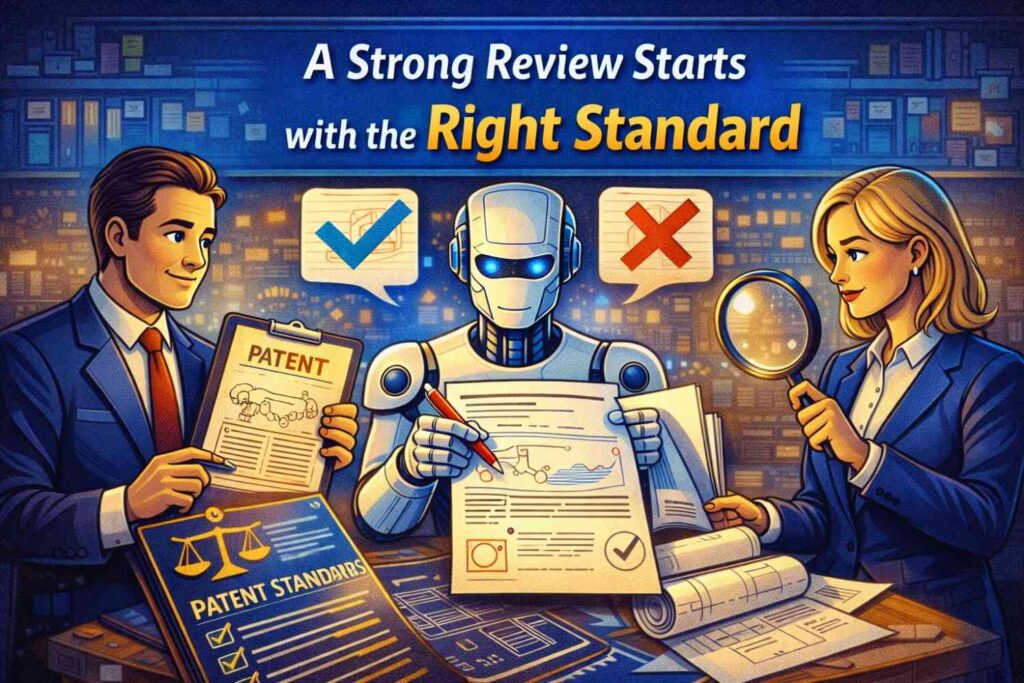
Before reviewing a patent draft, you need to know what “good” looks like.
This is where many teams get lost. They do not have a clear review standard, so they fall back on surface checks.
A stronger standard is this: a good patent draft should clearly describe the technical idea, explain how it works, support the invention from multiple angles, leave room for practical variation, use consistent language, match the source invention, and align with the business value the company actually wants to protect.
That is a much higher bar than “looks okay.”
AI becomes far more useful once that bar is clear. Now the review is not random. It has a purpose.
You are not just asking AI to proofread.
You are asking it to help test whether the draft is truly doing its job.
The first review question: what is the invention here, really?
This sounds basic, but it is one of the most important checks in the whole process.
A surprising number of patent drafts go several pages before the real invention becomes clear.
The draft may describe a product area, a user workflow, or a broad technical setting, but the specific inventive concept remains fuzzy.
That is a problem.
A good review should test whether a technically smart outsider could read the draft and understand what was actually invented.
Not the business pitch.
Not the market category.
Not the high-level product story.
The real technical contribution.
AI is useful here because it can be asked to answer that exact question.
After reading the draft, can it identify the core inventive concept in plain words? Can it explain what problem is being solved and what the technical solution really is? Can it point to the parts of the draft that support that explanation?
If it struggles, that is often a sign the draft needs work.
Because if the invention is not clear in review, it may not be clear when it matters later either.
The danger of drafts that describe the product, not the invention
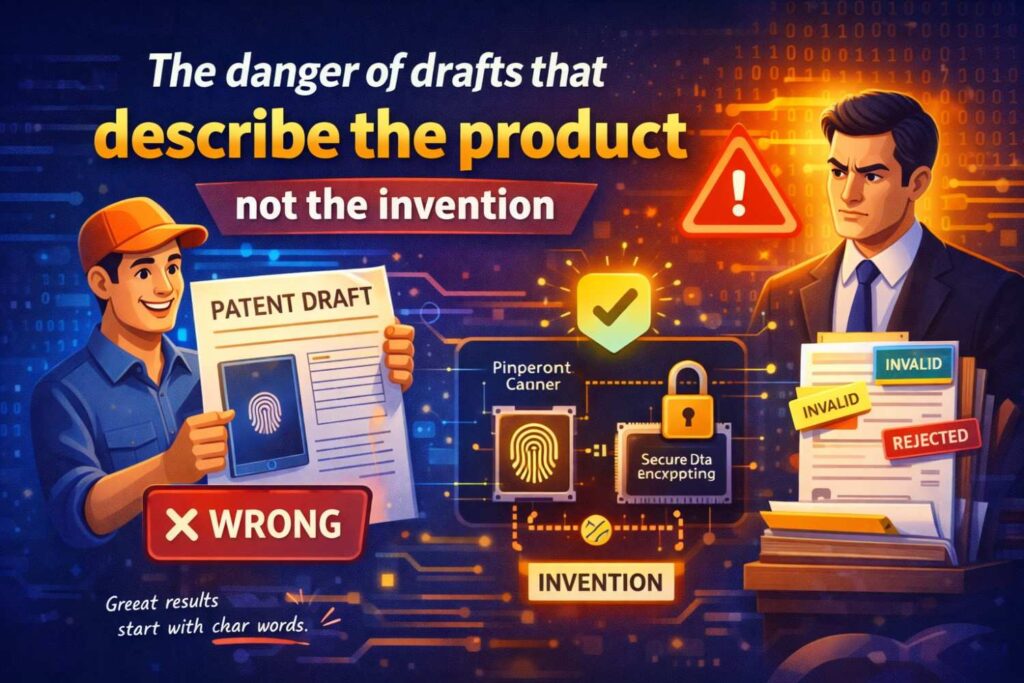
This is one of the most common patent draft problems in startups.
The draft ends up describing the product as it exists today instead of the invention that matters underneath it.
That may sound close enough, but it is not.
A product includes branding, interface choices, current workflows, market-specific framing, and many implementation details that may change fast.
The invention may be broader. It may live in the backend logic, the decision flow, the data handling method, the control system, the interaction between modules, or the way the system adapts under certain conditions.
If review does not catch that difference, the filing may become much smaller than it should be.
AI can help by asking whether the draft is tied too tightly to one interface, one deployment path, one customer use case, one stack, one model, or one current feature set.
It can help separate temporary product choices from the durable inventive idea.
That is a very valuable step.
Because in many companies, the product will change long before the patent matters most.
Review the draft against the source material, not just against itself
A patent draft can be internally consistent and still miss important content from the underlying invention.
That is why one of the smartest review moves is to compare the draft against the raw source material.
This may include invention disclosures, design docs, architecture notes, technical memos, engineering write-ups, code explanations, or inventor interviews.
The question is simple.
What was in the source material that never made it into the draft?
This is where AI can help a lot.
It can compare the draft against the source content and flag where the draft may have dropped an important technical step, ignored an alternate implementation, skipped a useful edge case, lost the real system flow, or oversimplified a mechanism that matters.
This kind of comparison is powerful because information often gets lost during translation. The engineers know it. The founder understands it. The first notes may mention it. But the actual draft may smooth it away in the name of clarity or speed.
That loss can weaken the application.
A good AI review process helps catch it before filing.
The best review does not only look for mistakes. It looks for missing value
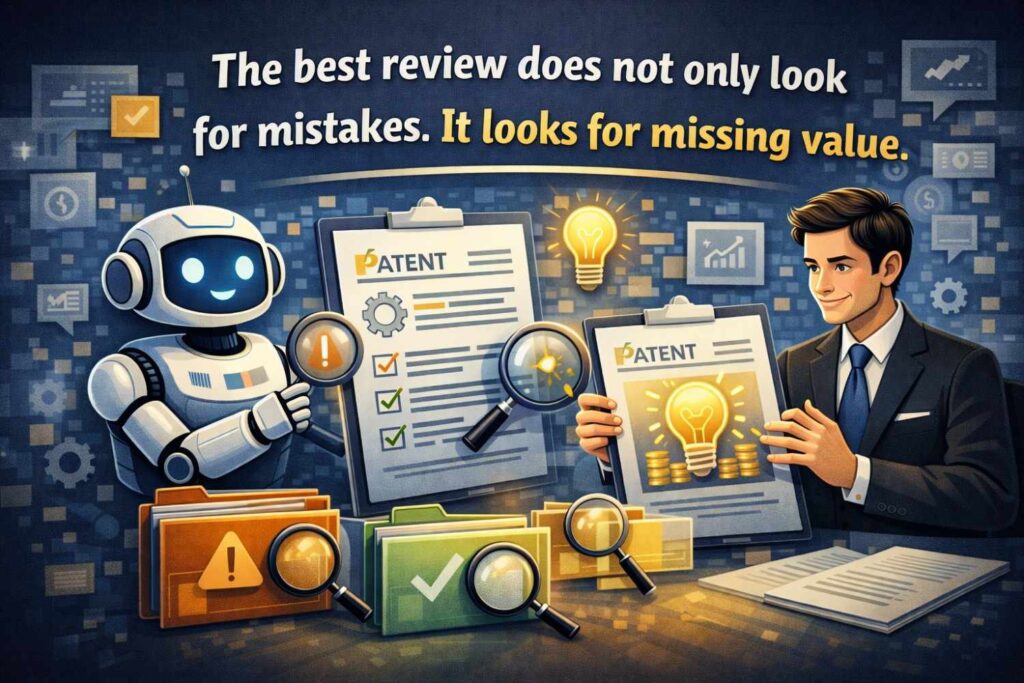
This is a key mindset shift.
Most people review documents by searching for errors.
That matters, but in patent drafting the bigger issue is often missing value.
Maybe the draft is correct but does not include enough alternatives.
Maybe it explains the basic system but not the fallback logic.
Maybe it mentions the model but not the preprocessing or post-processing that make the invention work.
Maybe it covers the current deployment path but not the distributed version coming next year.
Maybe it explains the main embodiment but not the smaller business-critical feature a competitor would actually copy.
These are not always “errors” in the narrow sense.
But they are lost value.
AI is good at pointing to this kind of gap if the review is structured well. It can ask where the draft could be stronger, broader, or more complete based on the real invention and business goals.
That is the kind of review startups should want.
Common errors AI can help catch before filing
Let us make this more practical.
There are several error types that show up again and again in patent drafts, especially in fast-moving startup work.
One common problem is vague language. The draft says the system “processes,” “analyzes,” “optimizes,” or “determines” something, but never really explains how. Those words are not useless, but they need support. If the mechanism stays thin, the draft may be weaker than it looks.
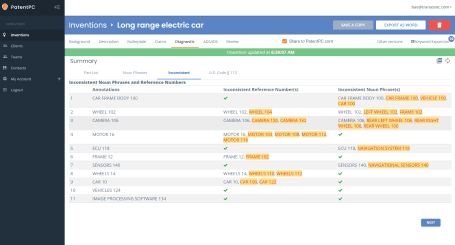
Another common problem is inconsistent terminology. A module is called one thing in one section and something else later. A score becomes a ranking. A controller becomes an engine. A data source becomes an input stream. These shifts may seem small, but they can make the draft harder to follow and less precise.
Another issue is accidental narrowing. A feature that should be optional gets described as essential. An example sounds like the only version.
A current product setup gets written as though it defines the invention. This is one of the most damaging quiet errors in patent drafting.
Another problem is missing alternatives. The draft explains one embodiment but not realistic variations. That can make the filing less flexible later.
Then there is missing edge-case handling. The draft describes the happy path but never discusses uncertainty, low-confidence outputs, failed signals, alternate processing paths, or fallback behavior where those things matter.
There is also missing business focus. The draft may explain a lot of technical detail but fail to describe the part of the invention competitors would actually want to copy.
And sometimes the biggest issue is simple omission. A critical step, component, or interaction from the source material never makes it into the draft at all.
AI can be very effective at identifying these issues, especially when it is prompted to review with them in mind.
Why vague language is so dangerous
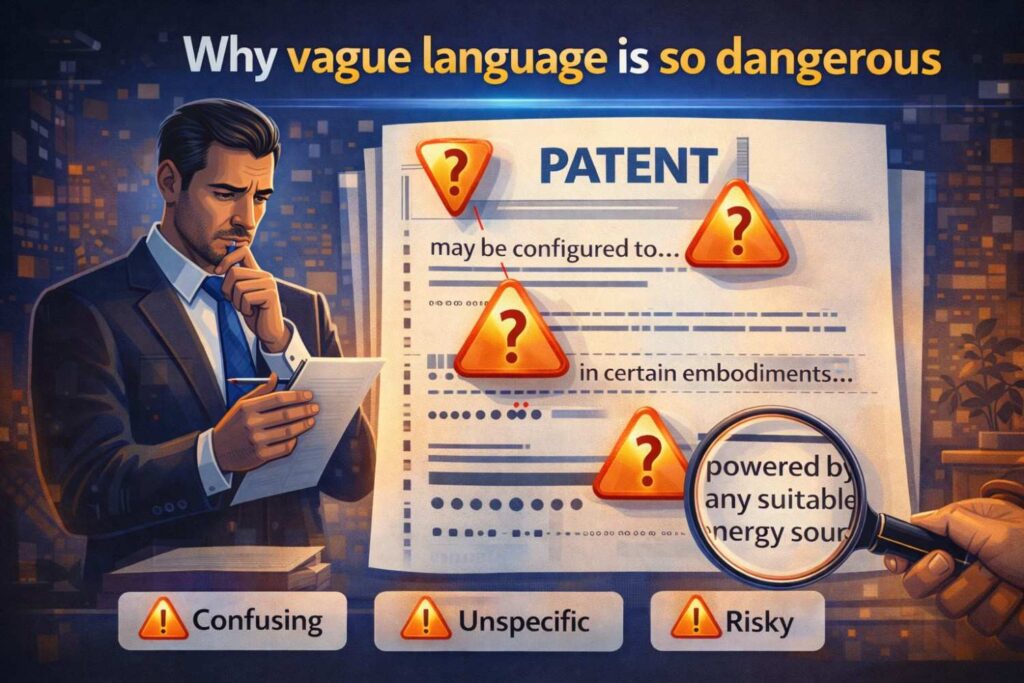
Vague language can be hard to spot because it sounds formal.
Words like “analyze,” “classify,” “manage,” “improve,” “optimize,” and “adapt” can make a draft sound sophisticated. But if those words are not backed by concrete explanation, they do not carry much weight on their own.
A strong patent draft usually needs more than outcome words.
It needs process.
It needs structure.
It needs flow.
It needs explanation.
For example, saying “the system optimizes resource allocation” is not nearly as useful as explaining that the system receives workload signals, applies a set of policy constraints, generates a score for each available resource, and selects an assignment based on the score and current availability.
The second version gives something real.
AI review can flag where the draft relies too heavily on result words without enough supporting mechanism. That alone can make a huge difference in draft quality before filing.
Why inconsistent terms weaken the draft
Patent drafts benefit from consistency in a way normal writing often does not.
In ordinary content, changing words can make the writing feel less repetitive. In patent writing, too much variation can create confusion.
If the same concept is called three different things, readers may wonder whether those are actually three distinct parts. That can muddy the technical story and reduce clarity.
AI is good at finding this because it can scan the full draft for naming drift. It can flag where labels shift, where related elements are not defined clearly, and where the document would benefit from a cleaner terminology structure.
This is not just a style issue.
Consistent language helps the draft support claims better later. It also makes it easier for inventors, counsel, and business leaders to understand what the application actually covers.
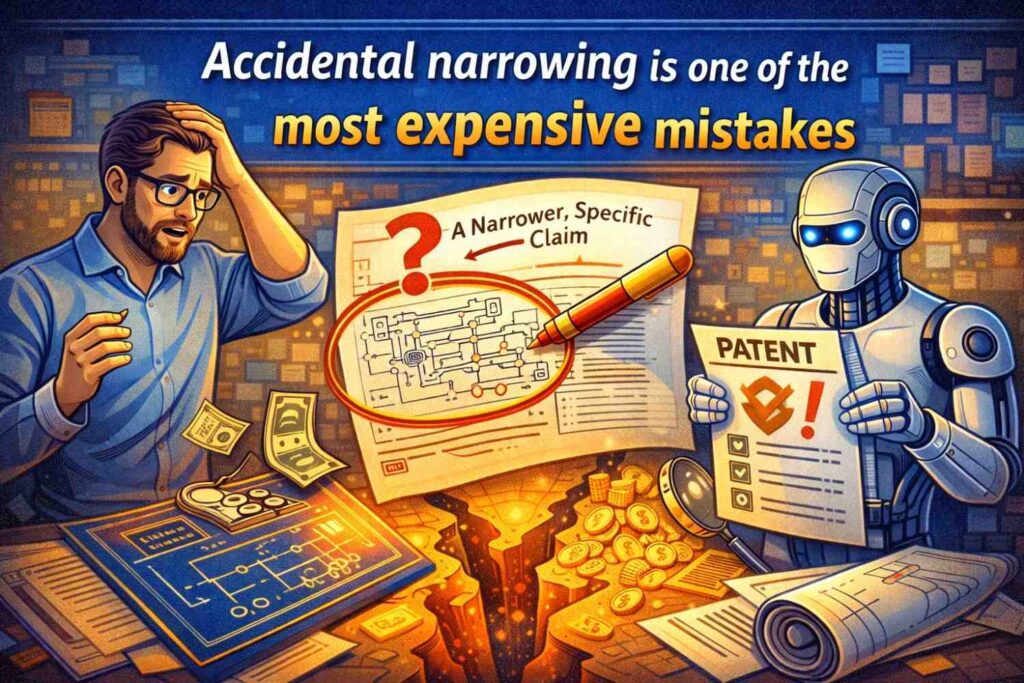
Accidental narrowing is one of the most expensive mistakes
This is worth slowing down for.
Accidental narrowing happens when the draft quietly makes the invention smaller than it should be.
Sometimes this happens because the writer stays too close to the current product version. Sometimes it happens because one example is described so strongly that it sounds required. Sometimes it happens because a useful implementation detail is written as though it is essential to every version of the invention.
This kind of narrowing can be very hard to spot in a casual review.
The draft may still feel accurate.
But accurate is not enough if the business wants broader protection and the invention truly supports it.
AI can help by looking for rigid wording, overuse of “must” or “requires,” overly specific environmental assumptions, or descriptions that tie the invention to one model, one interface, one platform, one sensor type, one communication path, or one deployment arrangement when the core idea is actually broader.
That kind of review is extremely valuable.
Because once the application is filed, the opportunity to broaden the written support may be gone.
Missing alternatives reduce future flexibility
A single embodiment is rarely enough.
Even when the current product has one main implementation, the full patent draft usually benefits from describing realistic alternatives. These alternatives can involve different system structures, changes in step order, different data sources, different deployment environments, different control logic, or different ways of dividing work between software and hardware.
Why does this matter?
Because products evolve.
Competitors design around narrow language.
Claim strategy changes.
Future filings build on earlier support.
If the draft only tells one narrow story, the company may lose room later.
AI review can surface this by asking what alternative embodiments are missing and whether the draft describes the invention in multiple useful forms.
This is one of the biggest ways AI helps turn a decent draft into a stronger one.
Edge cases often hold hidden value

Founders and inventors tend to explain inventions through the normal flow.
That makes sense. It is easier to describe how the system works when everything goes right.
But some of the most valuable technical detail shows up when conditions are messy.
What happens when inputs are missing?
What if confidence is low?
What if two outputs conflict?
What if a signal is delayed?
What if a sensor fails?
What if the model result is uncertain?
What if a user does not respond?
What if a network path goes down?
These situations matter because they often reveal where the real technical contribution lives.
A draft that only describes the happy path may miss the exact logic that makes the system robust.
AI review is good at pushing on this. It can identify where the invention may involve fallback behavior, thresholds, exception handling, alternate modes, or adaptive responses that deserve to be described before filing.
Review for what a competitor would copy
This is one of the most strategic review questions in the whole process.
A patent draft should not just describe what the team built. It should help protect what creates leverage for the business.
So before filing, someone needs to ask: if a strong competitor saw our traction and wanted to copy the most valuable technical part, what would they borrow first?
Would they copy the user interface? Maybe not.
Would they copy the brand? No.
Would they copy the hidden decision engine, ranking flow, control loop, verification layer, data fusion logic, deployment method, or optimization process that creates the real edge? Very possibly.
That is what the draft needs to cover well.
AI can help test this by reviewing the draft through a competitive lens. It can ask whether the most defensible technical layer is actually described with enough depth and flexibility.
This is a very smart use of review.
Because a patent that ignores the real copy point may be technically accurate and still strategically weak.
Good review asks whether the draft will still help next year
A startup filing is not just for today.
The product will move. The stack may change. The market may expand. The team may discover new variants. The part of the invention that matters most may shift as the company grows.
That is why a good review asks whether the draft is future-friendly.
Does it describe the durable technical concept, or just the current release?
Does it leave room for likely product evolution?
Does it describe the invention in a way that still makes sense if the interface changes, the processing moves from cloud to edge, or one model is replaced by another?
AI can be very useful here because it can identify where the draft is overly tied to temporary product choices.
That matters a lot for businesses that expect fast change.
A strong application should not age badly six months after filing because the description was trapped inside version one of the product.
AI review is especially useful for software and AI inventions
Software-heavy drafts often look clean on the page while hiding serious weaknesses.
That is because software inventions are easy to describe in vague outcome language. It is tempting to say the system “predicts,” “recommends,” “routes,” “secures,” or “optimizes” without fully describing the technical flow underneath those results.
AI review is very useful in this area because it can push for detail.
It can ask what inputs are received, what transformations occur, what decisions are made, what modules interact, what thresholds or rules apply, how confidence is handled, what outputs are produced, and what alternate implementations may exist.
For AI-related inventions, this is even more important.
A draft that says “the model determines an output” is usually not enough by itself. Review should ask about preprocessing, feature handling, scoring, validation, feedback, policy overlays, fallback behavior, deployment structure, and where the invention actually lives in the full pipeline.
That level of review can dramatically improve the application before it is filed.
Hardware drafts need a different kind of pressure test
Hardware inventions have their own review issues.
A common problem is that the draft lists parts without fully explaining their relationship, arrangement, operation, or why the structure matters.
Another problem is that a narrow physical example gets treated as the full invention when variations in size, placement, material, shape, or control logic should also be supported.
AI review can help by pushing on structure and operation.
Does the draft explain how the components interact?
Does it explain how signals, forces, or control instructions move through the system?
Does it describe different physical configurations where appropriate?
Does it explain what is optional and what is central?
This kind of review makes hardware applications stronger and more useful later.
Mixed systems need review across both worlds
Many modern inventions are not purely software or purely hardware. They sit in both.
A sensor system with adaptive logic.
A robotics platform with physical control and model-based decision making.
An edge device with onboard processing and cloud coordination.
An industrial system with hardware monitoring and software response rules.
Drafts for these inventions often become lopsided. They may describe the physical system well but skim the software logic, or the reverse.
AI review can help balance the two.
It can ask whether the draft explains both the structural pieces and the operational logic that ties them together.
That is important because the value in mixed systems often lies in the interaction between the physical layer and the intelligence layer.
If review misses that, the application may miss the best part of the invention.
AI can help inventors review without making review painful
One reason draft review often fails is that inventors are busy.
They do not want to spend hours reading dense legal text. They may not know what kind of feedback is most useful. They may skim the draft and say it “looks good” because they are focused on building.
AI can make inventor review much more productive by turning the review into targeted questions instead of a vague request to read the whole thing carefully.
Instead of asking an inventor to review every page from scratch, AI can highlight areas where the draft may be missing detail, ask whether certain features are actually optional, flag where the terminology may be off, and point out where the draft seems more narrow than the source invention.
This makes inventor input more useful and easier to give.
That is a big win for startups.
The best AI review happens in passes, not one shot
A single review prompt is rarely enough.
The strongest process uses multiple passes, each with a different purpose.
One pass checks whether the core invention is actually clear.
Another checks whether key technical detail is missing.
Another checks for accidental narrowing.
Another checks terminology consistency.
Another looks for missing alternatives and future-friendly support.
Another compares the draft against the source invention material.
Another reviews the document through a business lens and asks whether the company’s real leverage is protected.
This layered review is much better than one generic instruction to “find issues.”
That is because patent quality is not one thing. It is a bundle of clarity, completeness, flexibility, accuracy, structure, and strategic fit.
AI works best when the review is organized that way.
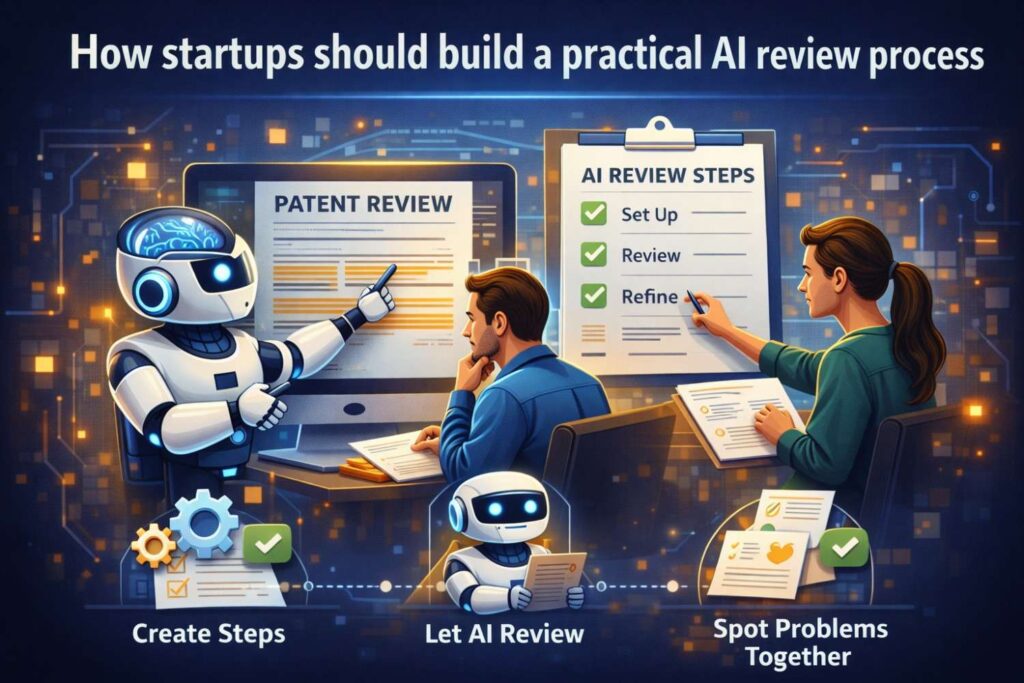
How startups should build a practical AI review process
The best review process is the one your company will actually use.
That means it needs to be simple enough to fit into a busy startup workflow, but serious enough to catch real problems before filing.
A practical process often starts with the current patent draft and the main source materials. Then AI is used to summarize the invention, identify missing details, review for narrowing, check consistency, and suggest questions for inventors or founders.
After that, the team answers the follow-up questions and updates the draft.
Then the revised draft gets another AI review pass focused on strategic coverage and likely product evolution.
Then real legal review happens with a stronger starting point.
This approach is much better than sending a rushed draft straight to filing or waiting until late-stage counsel review to uncover obvious issues.
It helps teams save time, reduce friction, and improve quality before the most important legal decisions are made.
Review should happen before the draft feels “done”
This is a subtle but important point.
If review starts only after everyone is emotionally attached to the draft, improvement gets harder. People resist change. They want closure. They skim instead of rethink.
A better move is to treat AI review as part of drafting, not as a final afterthought.
Review while the draft is still open to revision.
Review before the language hardens.
Review before everyone starts acting like the main job is finished.
This mindset creates stronger filings.
Because the goal is not to prove the draft is done. The goal is to make the draft better.
AI review helps startups move faster without getting sloppy

Startups want speed. That is normal.
But speed creates risk if it leads to shallow review.
The old legal workflow often felt slow because every improvement had to move through long back-and-forth loops. AI changes that. Now teams can pressure-test a draft quickly, surface weak spots earlier, and tighten the document before it reaches final legal review.
That is a huge advantage.
But only if the team uses AI to raise the quality bar, not to skip judgment.
This is where PowerPatent stands out. It gives startups a way to move faster with AI-powered patent workflows while still getting the benefit of real attorney oversight. That means you can catch more issues before filing without turning your patent process into guesswork. You can see the workflow here: https://powerpatent.com/how-it-works
The most useful review questions to ask before filing
A good pre-filing review often comes down to a handful of hard questions.
Can someone reading this draft tell what the invention actually is?
Does the draft explain how it works, not just what it achieves?
Does it describe the invention at both a broad level and a detailed level?
Does it include realistic alternatives?
Does it avoid making examples sound mandatory?
Does it match the source invention material?
Does it describe the technical layer a competitor would most likely copy?
Would this still help us if the product evolves?
Are the key terms used clearly and consistently?
Is the draft missing the exact detail that makes the invention valuable?
AI is very good at helping teams answer these questions.
And if the answers are weak, it can help point to where the draft needs work.
What AI should not be trusted to do alone
It is also important to be clear about limits.
AI can help review language, structure, completeness, and internal logic. It can compare drafts to source material. It can raise smart questions. It can improve the quality of inventor review. It can help expose weak spots before filing.
But it should not be trusted as the only layer of legal judgment.
Patent strategy still matters.
Claim direction matters.
Scope decisions matter.
How the application fits into a broader portfolio matters.
What gets filed now versus later matters.
How risks are weighed matters.
These things benefit from experienced patent counsel.
So the right model is not AI instead of lawyers. It is AI plus lawyers, used in the right order and for the right reasons.
That is what smart startup teams should want.
Why founders should care even if outside counsel is handling the draft
Some founders assume they do not need to think much about draft review because their patent attorney will take care of it.
That is understandable, but it misses something important.
No outside counsel knows the product, roadmap, technical tradeoffs, and business priorities as deeply as the company does.
That means the company still has a big role in making sure the draft reflects what really matters.
AI review can help founders contribute without needing to become patent experts themselves.
It can surface where the draft may not match the actual system, where it misses likely future versions, where business-critical features are underdeveloped, and where more inventor input is needed.
That creates a better conversation with counsel.
Instead of vague comments like “this seems fine” or “can we make it broader,” the team can raise concrete issues.
That is a much stronger position.
Hiring outside counsel does not remove the founder from the patent process.
It changes the founder’s role, but it does not erase it.
That distinction matters.
A lot of founders assume that once a patent lawyer is involved, the work becomes mainly legal. They think their main job is to answer a few questions, review a draft for obvious mistakes, and approve the filing. That sounds efficient, but it often leads to missed value.
The truth is simple. Outside counsel can bring legal skill, filing experience, and claim strategy. But they are still working from the information the company gives them.
They do not live inside the product. They do not sit in architecture meetings every week. They do not always know which design choice created the real advantage. And they do not always see the hidden gap between what the company built and what the draft actually protects.
That is why founder involvement still matters so much.
Not because founders need to become patent lawyers.
But because founders are often the only people who can connect the invention, the roadmap, and the business risk in one view.
Outside Counsel Sees the Draft. Founders See the Stakes
A lawyer may see whether the application is well structured.
A founder sees what happens if the protection is too small.
That is a major difference.
The founder knows what part of the system took the hardest thinking to build. The founder knows what competitors are starting to notice. The founder knows which technical layer supports pricing power, customer trust, speed, accuracy, scale, or margin. The founder also knows which parts of the current product are likely to change and which underlying ideas will stay valuable.
That broader view is not always visible from the draft alone.
So even when outside counsel is doing strong work, the founder adds a layer no one else can fully replace. The founder brings context around commercial importance.
That matters because patent quality is not only about technical accuracy. It is also about whether the filing protects what matters most to the business.
A Good Patent Process Still Needs Business Judgment
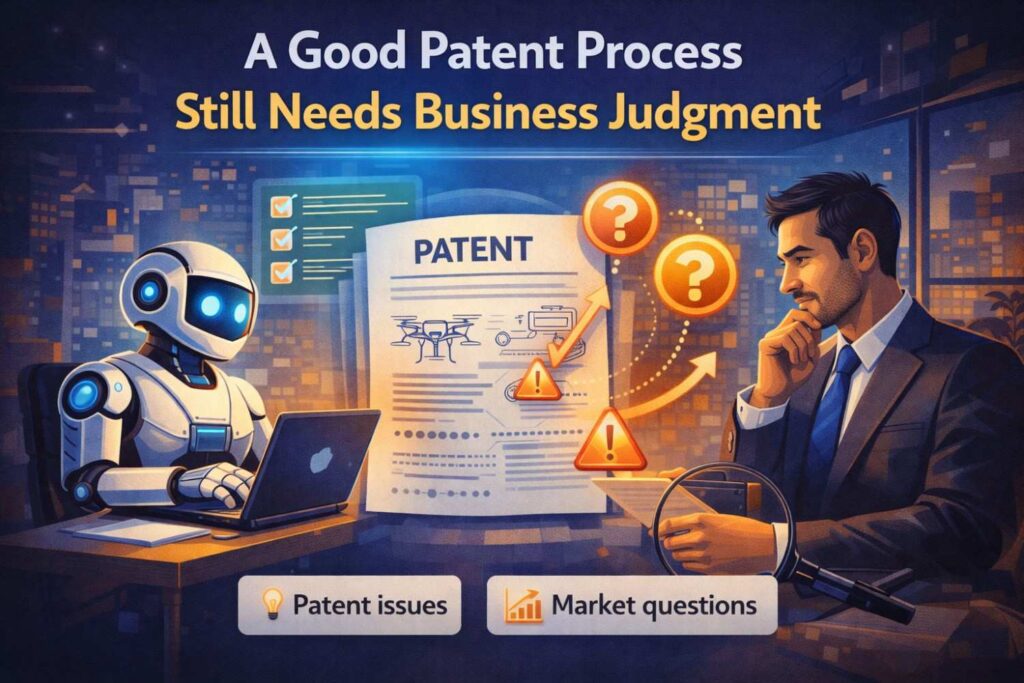
Patent drafting often gets framed like a legal exercise.
In reality, it is also a business exercise.
Choices about what gets emphasized, what gets described broadly, what alternatives get included, and what details get extra support are not just legal choices. They are strategic business choices too.
That is why founder involvement matters.
The founder is usually in the best position to answer questions like these:
What part of this invention would hurt most to lose to a copycat?
What part is core to future revenue, not just current features?
What part of the system is likely to become even more important as the company grows?
What technical move gives the company leverage that outsiders may not fully see yet?
Those questions shape what deserves attention in the draft.
Outside counsel can help express and protect those answers. But the founder often has to supply them first.
Your Attorney Does Not Automatically Know What You Left Out
This is one of the biggest blind spots in startup patent work.
Founders often assume that if a draft looks detailed, then it must include the right substance. But if key information never made it into the intake conversation, source materials, or follow-up discussions, even a skilled attorney may not know it was missing.
This is not a criticism of counsel.
It is just reality.
Patent attorneys work with what they are given. They can ask strong questions, and good ones do. But they cannot always detect the detail that stayed trapped in an engineer’s head, got buried in an internal tool, or seemed too obvious for the team to mention.
That is why founders should care deeply about review.
A founder is often the bridge between the written draft and the fuller truth of the invention.
That bridge matters most when the missing detail is not just technical, but strategic.
Founders Protect Against “Looks Fine” Risk
One of the most dangerous phrases in startup patent work is “looks fine.”
That phrase usually means the draft is readable, the product is recognizable, and nothing feels obviously wrong on a quick skim.
But “looks fine” is not the same as “creates leverage.”
A founder who reads the draft only at the surface level may miss the deeper issue that the filing is accurate but weak.
Maybe it describes what the product does but not why it works better.
Maybe it focuses on visible features and leaves out the hidden logic.
Maybe it captures a current workflow but not the deeper technical engine.
Maybe it explains one implementation but not the broader system choices that make the invention commercially meaningful.
Outside counsel may not always know which of those gaps are most serious from a business standpoint.
A founder often can.
That is why founder review should not be passive. It should be strategic.
The Founder’s Job Is Not to Edit Legal Language
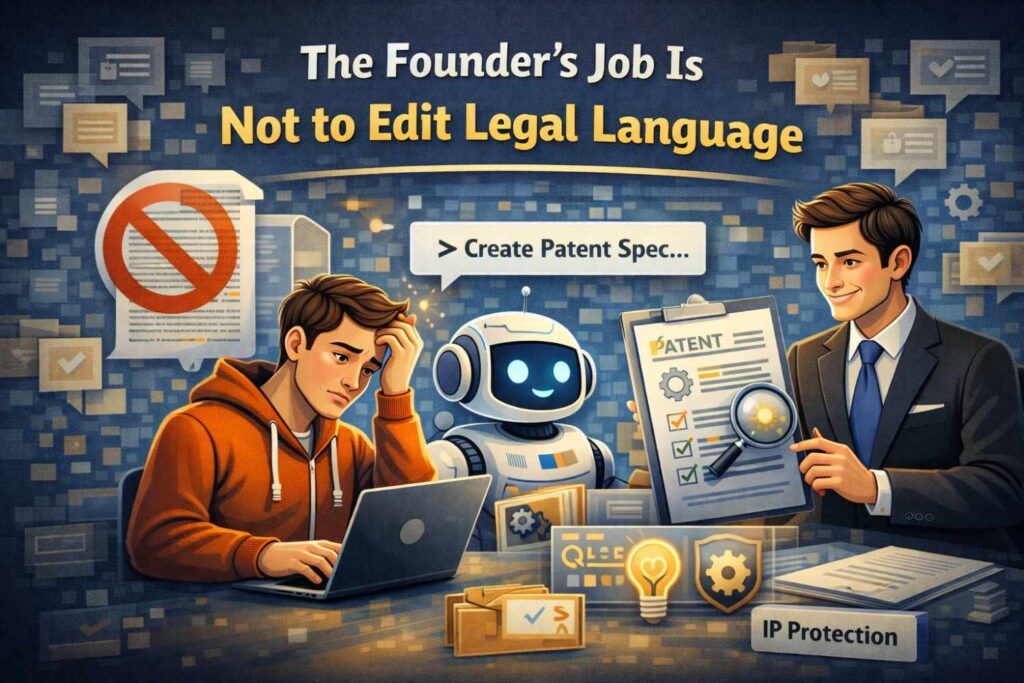
This is a very helpful shift in mindset.
Many founders hesitate to engage deeply because they assume they are not qualified to review patent wording. They worry they will comment on the wrong things or slow the process down.
But founder review is not mainly about editing legal language.
It is about testing whether the document reflects the company’s real advantage.
That means a founder should spend less time asking whether a sentence sounds legal and more time asking questions like these:
Does this draft capture the part of the system that actually makes us hard to copy?
Does it over-focus on what customers see instead of what the system does under the hood?
Does it leave out the design choice that made the product finally work?
Does it describe only today’s version, or does it still map to the business six or twelve months from now?
Those are founder-level questions.
And they are extremely valuable.
Founders Often Know the Roadmap Better Than Anyone in the Room
This gives founders a major advantage during draft review.
Outside counsel can draft based on the invention as described. But founders usually know what is coming next.
They know which product changes are already planned.
They know whether a central system may move to the edge.
They know whether manual review is about to become automated.
They know whether one customer workflow is temporary.
They know whether the same core engine will soon expand into another use case or vertical.
That roadmap view can make the difference between a draft that ages well and a draft that becomes narrow very quickly.
This does not mean inventing future material that does not exist. It means recognizing where the current invention naturally supports future paths that are already visible inside the company.
That is a business judgment call.
And it is one of the strongest reasons founders should stay involved.
Founders Help Keep the Patent Aligned With the Company’s Real Moat

Every startup talks about moat.
Very few connect moat thinking clearly to patent draft review.
That is a mistake.
A patent becomes more valuable when it maps to the company’s real defensibility. That could be in the architecture, the process flow, the optimization layer, the trust logic, the feedback loop, the control method, or the deployment structure.
But those points do not always stand out clearly in a first draft.
Sometimes the most protectable feature is not the most visible one.
Sometimes the company’s real edge is buried deep in a workflow that outsiders would barely notice but would absolutely copy if they understood its value.
Founders are often the people who know where that moat really lives.
That means they are in the best position to ask whether the draft is protecting the right layer.
That is not legal overreach. That is smart business involvement.
Review Should Be Tied to Competitive Risk
A very practical founder move is to review the draft through a competitor lens.
Not a legal lens first. A market lens.
Imagine a serious competitor gets a close look at your traction and decides to build a rival version of your product. What would they borrow to close the gap fast?
Would they copy the branding? No.
Would they copy the sales motion? Probably not first.
Would they copy the workflow logic, the ranking method, the adaptive control system, the signal handling method, the data path, the safety checks, or the system structure that gives you performance or trust advantages?
Very likely.
That is why founders should ask whether the draft truly covers that copy point.
This is one of the most actionable review habits a business can adopt. It turns founder review into a strategic exercise instead of a passive approval step.
Founders Can Improve Counsel’s Work by Giving Better Inputs
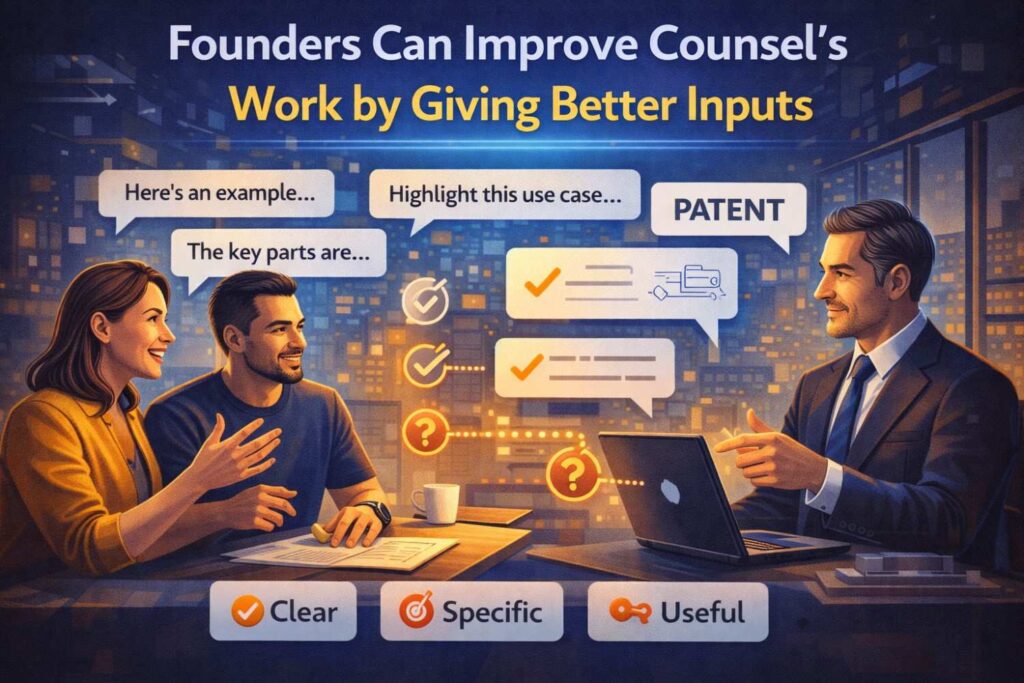
There is a simple truth here.
Better input leads to better drafts.
If founders only provide a short summary and a quick review, even excellent counsel is working with limits. If founders provide clearer invention framing, better source material, sharper follow-up answers, and stronger business context, the draft quality often rises fast.
This is not about doing the lawyer’s job.
It is about making the lawyer more effective.
That is a high-return move for any company.
A founder does not need to write the application. But the founder can absolutely improve the outcome by making sure counsel has the real technical and strategic picture.
That includes surfacing hidden variations, explaining roadmap relevance, pointing out commercial pressure points, and clarifying what the company most needs to protect.
A Founder Should Name the “If We Lose This, It Hurts” Layer
Here is one very actionable idea.
Before final review, the founder should write down one short answer to this question:
If a competitor copied one technical part of our system and got away with it, what would hurt us most?
That answer is powerful.
It forces clarity.
It helps identify the layer of the invention that carries the most business risk.
And once that answer exists, the founder can compare it to the draft and ask a direct question: does this filing really describe and support that layer?
If not, something important may still be missing.
This is one of the simplest and most effective founder review exercises there is.
Founders Should Bring One Product Lead and One Technical Lead Into the Review
A founder does not need to carry the whole burden alone.
A smart way to strengthen review is to involve one product lead and one technical lead for focused input.
The product lead helps test whether the draft reflects where the product is going, not just where it is today.
The technical lead helps test whether the mechanism is described clearly enough and whether important implementation paths are missing.
The founder then ties those insights back to the business.
That three-way review is often far stronger than founder-only review or outside-counsel-only review.
It also keeps the process efficient because each person is contributing from their real area of strength.
Use AI to Help Founders Ask Better Questions
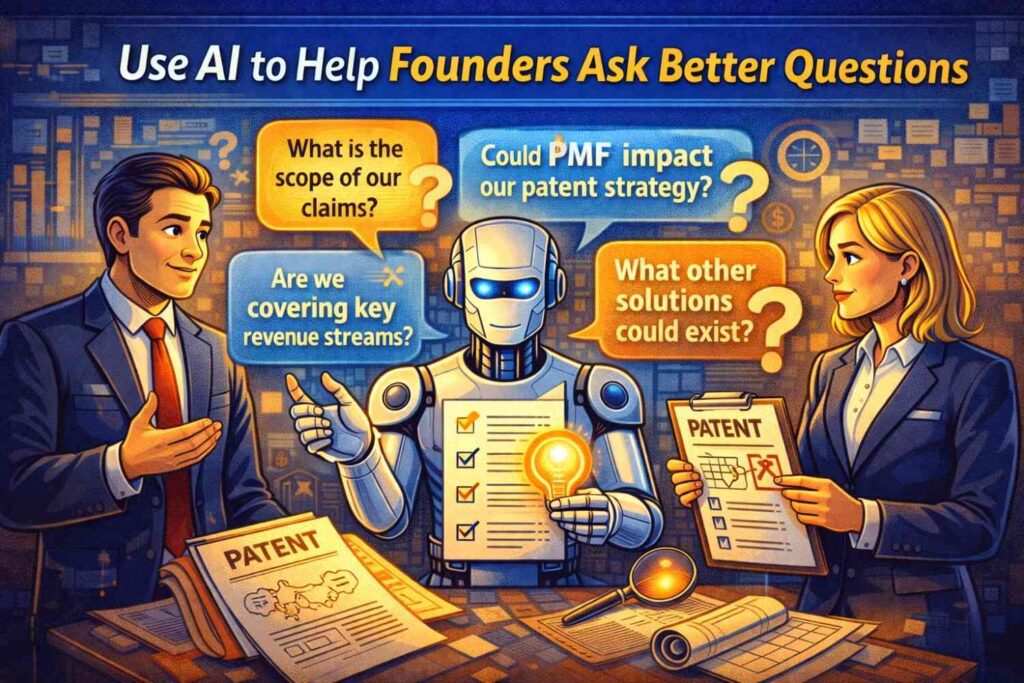
Founders do not always know what to look for in a patent draft.
That is where AI becomes especially useful.
AI can help turn founder review into a sharper process by surfacing the kinds of questions founders should be asking in the first place.
It can flag where the draft may be too tied to the current product version. It can point out where the invention is described vaguely. It can identify where optional features sound required. It can ask what realistic alternatives are missing. It can help compare the draft to product direction and source materials.
That means the founder does not have to start from a blank page.
They can use AI to make their review more focused, more strategic, and more useful for counsel.
This is a big part of why modern startups benefit from a better workflow. PowerPatent helps founders do exactly this by combining AI-assisted review and drafting support with real attorney oversight, so the process is not left to guesswork or last-minute skim review. You can explore that here: https://powerpatent.com/how-it-works
Founders Help Prevent Portfolio Drift
This is a bigger-picture reason to stay involved.
Patent filings do not live alone. Over time, they become a portfolio.
If founders are passive in early drafting and review, the portfolio can start to drift. One application may describe the company’s technology one way. Another may use different language. A third may focus on less important features because no one tied the work back to core business value.
That fragmentation weakens the overall story.
Founder involvement helps prevent that.
By staying close to what the company is really protecting, founders can help create more consistency across filings, more alignment with roadmap direction, and a clearer connection between the patent portfolio and the company’s real technical identity.
That has real value in diligence, fundraising, licensing, and long-term IP strategy.
The Best Founder Review Is Short, Sharp, and Focused
Founder review does not need to be bloated to be effective.
In fact, it works better when it is focused.
A founder should not try to become a line-by-line patent editor. That is usually not the highest-value use of their time.
A better approach is to focus on a few sharp questions.
What is the most important technical thing we need this filing to protect?
Where is the draft still too tied to the current version of the product?
What would a competitor actually copy?
What likely future version of the product should this still cover?
What key business advantage is missing or underdeveloped?
Those questions can do far more for draft quality than hours of surface-level reading.
Founders Who Stay Involved Usually Get More Strategic Patent Assets
This is the bottom line.
When founders stay engaged in the right way, the company is more likely to end up with patent filings that reflect real business value instead of just formal documentation.
The applications tend to be more aligned with the product roadmap.
The technical core is usually clearer.
The competitive pressure points are more likely to be covered.
The draft is less likely to be trapped inside temporary implementation choices.
And the resulting portfolio is more likely to support the company in the moments that matter later.
That is why founders should care even when outside counsel is handling the draft.
Not because counsel is unnecessary.
But because founder judgment is still essential.
The strongest patent work happens when legal skill and business insight are working together, not apart.
The hidden cost of filing without real review
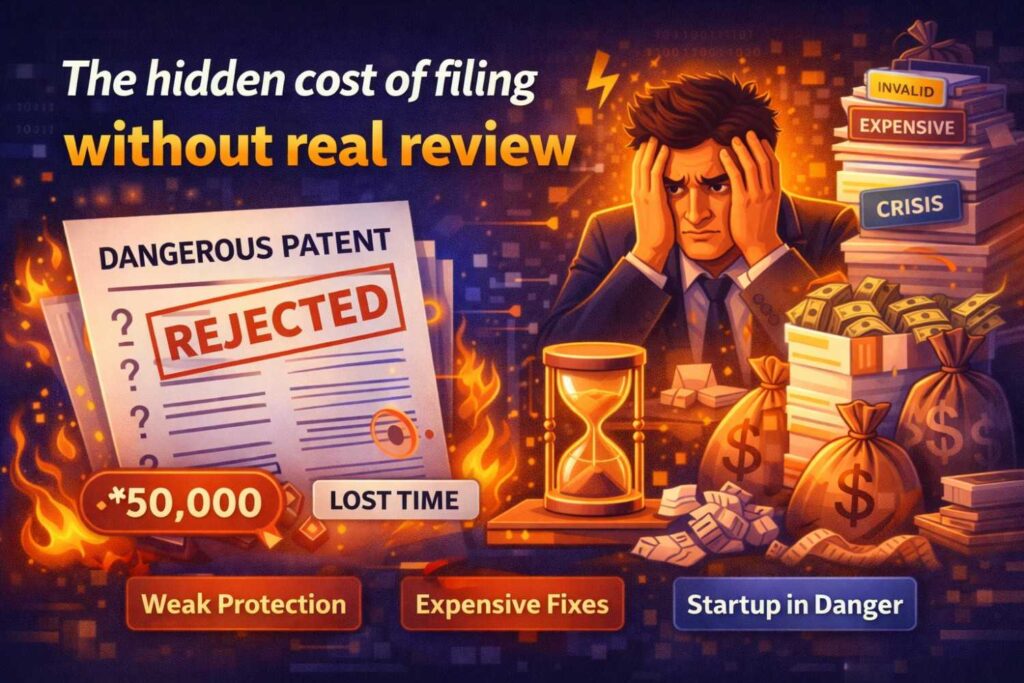
Filing a weak draft can create costs that do not show up right away.
Maybe the application is harder to adapt later.
Maybe an important continuation idea lacks support.
Maybe the claims end up narrower because the written description was thinner than it should have been.
Maybe a competitor copies the real value layer and the draft does not clearly cover it.
Maybe diligence later reveals that the patent assets look formal but do not reflect the company’s true edge very well.
These are serious business costs.
They are also hard to fix after filing.
That is why good review is not just about avoiding embarrassment or catching typos. It is about protecting strategic value while there is still time to improve the draft.
Strong review creates better patent portfolios, not just better single filings
A lot of companies think about patent review one application at a time.
That is understandable. A draft is in front of them. A filing deadline is coming. The team wants to get that one document cleaned up and out the door.
But the smartest businesses do not stop there.
They understand that every patent draft becomes part of a larger story.
It shapes how future inventions get described.
It influences how later filings are framed.
It affects whether the company ends up with a portfolio that feels connected and strategic, or scattered and uneven.
This is why strong review matters far beyond the single application.
A careful review process does not just improve the filing in front of you. It helps build a stronger patent base for the whole company.
One Weak Filing Can Create Long-Term Drag
Patent portfolios do not grow in isolation.
Each new filing often connects to what came before. Terms get reused. system descriptions get carried forward. Related inventions are framed against earlier disclosures. Future applications may depend on the same technical language, the same architecture story, or the same core invention family.
That means a weak early draft can quietly create problems later.
If the first application uses unclear terms, later drafts may inherit that confusion.
If the first filing frames the invention too narrowly, future related filings may feel boxed in.
If the first review misses useful alternatives, the company may lose a chance to build around those variations in later work.
This is why businesses should review each draft with a bigger question in mind:
Will this filing make the next filing easier and stronger, or harder and weaker?
That is a portfolio question, not just a document question.
A Good Review Process Creates Better Internal Language
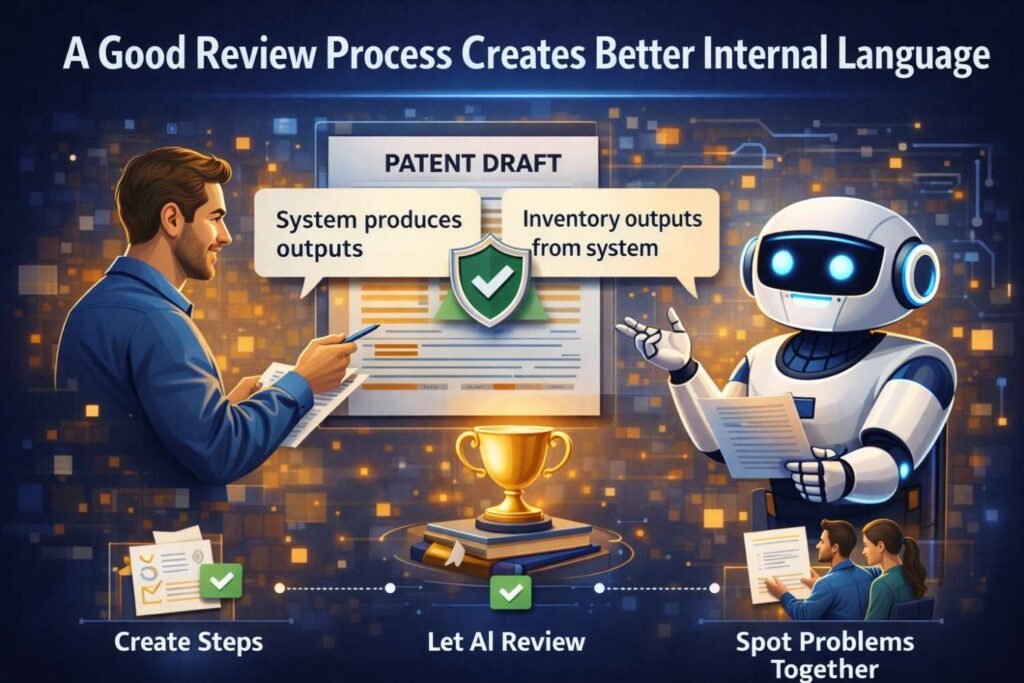
One hidden benefit of strong review is that it helps the company develop better internal language around its inventions.
That matters more than most founders realize.
When teams review patent drafts carefully, they are forced to agree on what the invention really is called, what the main components are, what the core technical advantage is, and how different parts of the system relate to each other.
That clarity becomes useful later.
It helps future invention disclosures sound sharper.
It helps product, engineering, and legal teams speak more consistently.
It helps new patent drafts start from a stronger place.
Over time, this creates a better internal vocabulary for the company’s technical moat.
That is a real advantage.
A scattered portfolio often reflects scattered internal thinking. A stronger review process helps fix that before the weakness spreads.
Portfolio Strength Comes From Pattern Quality
A patent portfolio is not only judged by how many filings a company has.
It is judged by what kind of pattern those filings create.
Do they clearly protect a core technical area?
Do they show thoughtful expansion around a platform?
Do they reflect how the company’s real advantage is growing over time?
Or do they look random, narrow, disconnected, and reactive?
Strong review improves pattern quality.
It helps each filing do its own job while also fitting into a larger structure.
For example, a careful review may reveal that one application should focus on the core system architecture, while a later one can focus on optimization logic, and another can cover the way the system adapts under real-world conditions.
That is far stronger than filing overlapping drafts with fuzzy boundaries.
A business with a clear portfolio pattern tells a better story to investors, acquirers, and even internal leadership.
Review Helps You Spot What Should Become a Patent Family
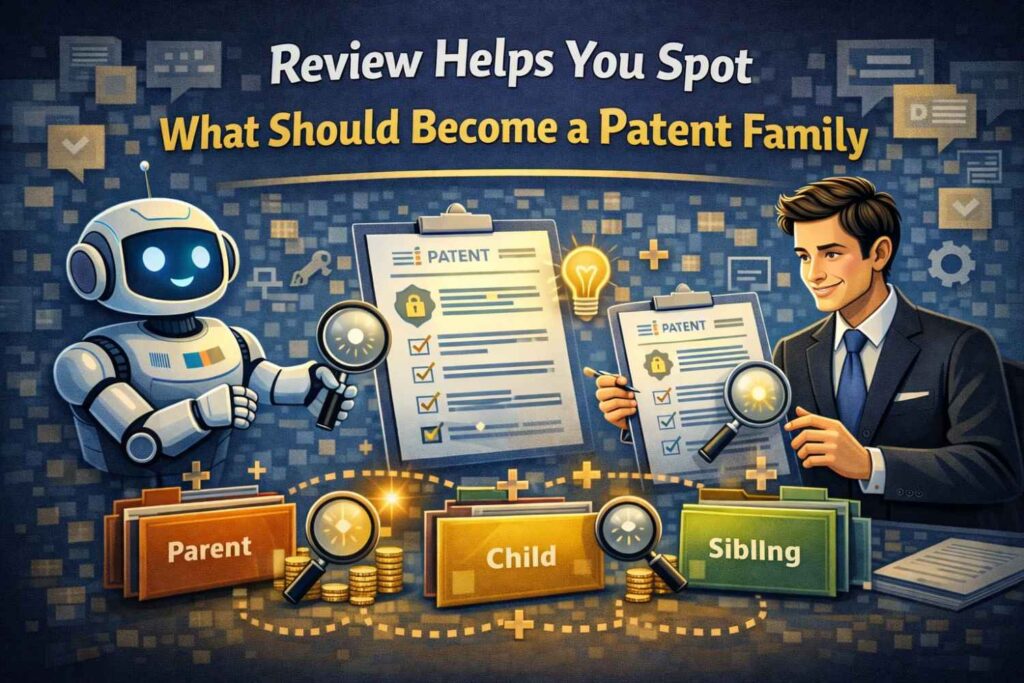
Not every invention should stand alone.
Some ideas are better treated as part of a broader family, especially when they share the same technical foundation but apply in different modes, environments, or use cases.
A strong review process helps spot that earlier.
During review, the team may notice that the draft contains a broader invention center than first expected. Or it may reveal that one “single invention” actually contains one core concept plus several strong follow-on versions.
That insight can shape the portfolio in a much smarter way.
Instead of filing one narrow application and moving on, the business may choose to build a more deliberate patent family around the technology.
That is a strategic decision.
And it becomes easier to make when review is not rushed and shallow.
Use Review to Separate Core Platform Protection From Feature Protection
This is one of the most useful ways businesses can strengthen a portfolio.
Not all patent filings should do the same job.
Some should protect the deep platform layer.
Others should protect important workflows, reliability improvements, deployment methods, safety mechanisms, or user-specific adaptations that create business leverage.
A weak review process often fails to separate those layers. Everything gets blended into one draft. The result may be broad in a messy way, narrow in the wrong way, or unclear about what the company is really trying to protect.
A stronger review process asks a more strategic question:
Is this draft protecting the core engine, or is it protecting one valuable expression of that engine?
That distinction matters.
When businesses understand it, they can shape a portfolio that protects both the center of the moat and the practical ways that moat shows up in the product.
Strong Review Makes Continuation Strategy Smarter
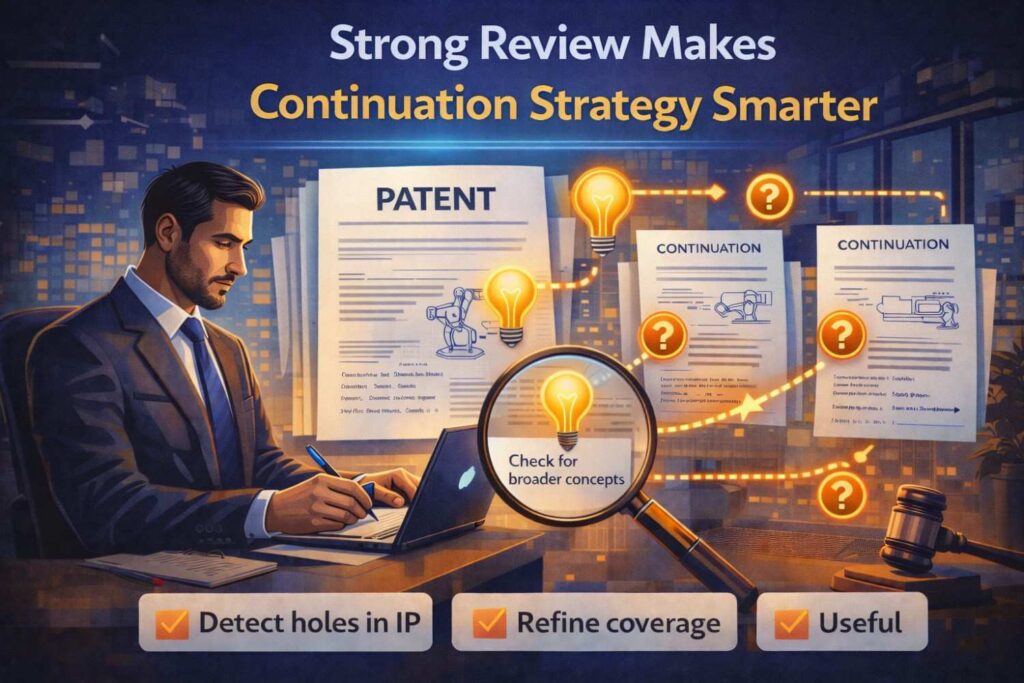
Many businesses do not think about continuation value early enough.
They focus on the immediate filing and leave later strategy for later.
But the quality of review on the first filing often shapes how much room the company has to work with in the future.
If the original application is reviewed carefully and includes broader support, stronger variations, cleaner terminology, and better technical depth, it can become a much stronger base for continuation strategy later.
That flexibility has real business value.
It gives the company more options as the market shifts.
It gives more room to pursue claims that become important once competitors reveal how they are designing around the technology.
It helps the business adapt its patent path as commercial priorities change.
This is one reason strong review should be treated as a growth investment, not just a cleanup step.
Better Review Helps Avoid Portfolio Cannibalization
This is a problem many startups do not notice until later.
Portfolio cannibalization happens when filings overlap in messy ways, repeat the same technical story without clear strategic separation, or accidentally narrow each other through inconsistent language and weak review.
The business may feel like it is building a portfolio, but in reality it is just creating clutter.
A strong review process helps prevent that.
It forces the team to ask what this filing adds to the portfolio.
Does it create a new protection layer?
Does it deepen protection around a core invention?
Does it open a new business-relevant angle?
Does it cover a technical variant that matters?
Or is it just repeating material that has already been covered poorly?
These are the right questions.
They help companies build portfolios with more shape and less waste.
Use Review to Build a Better Invention Map
Here is one highly practical step businesses can use.
After reviewing a draft, do not only revise the document. Also update a simple internal invention map.
That map should show the company’s main technical areas, which patent filings connect to each one, what invention families are emerging, and where obvious gaps still exist.
This does not need to be a complex legal chart.
It can be a working business tool.
The reason this matters is simple. Good review often reveals more than document flaws. It reveals where the company’s protection is strong, where it is thin, and where future filings may matter most.
If you capture that insight after each review, your portfolio strategy gets smarter over time.
Without that step, valuable pattern knowledge often gets lost.
Review Can Surface White Space Around the Core Technology
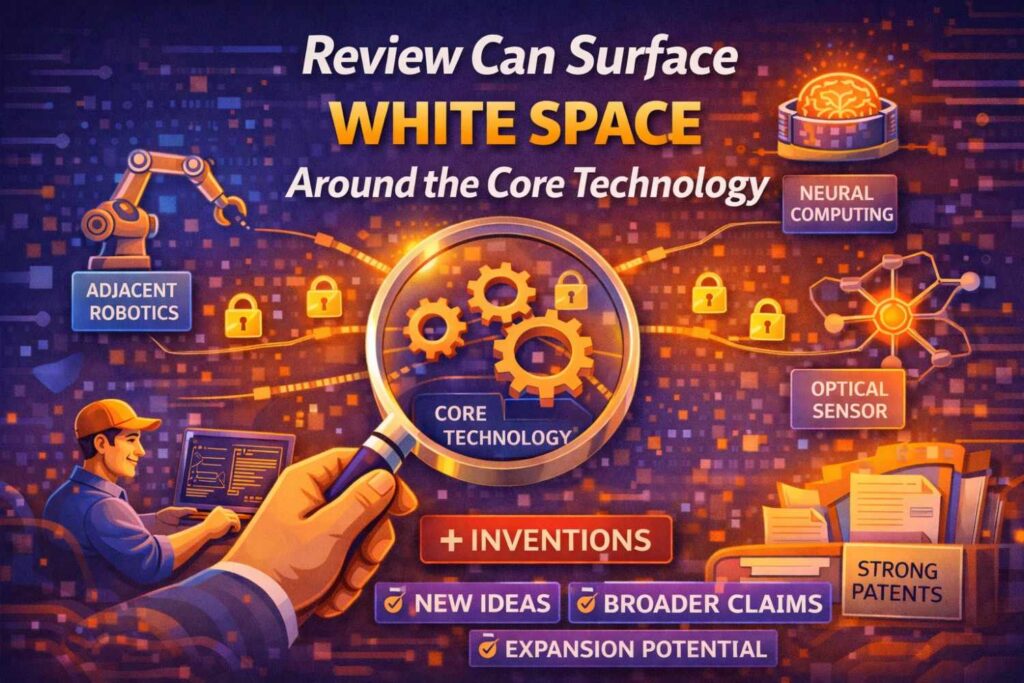
One of the best outcomes of strong patent review is that it can reveal nearby invention space the company has not protected yet.
This is especially useful for platform businesses.
A careful review of one draft may show that the company has focused on the core processing logic but not the control layer around it. Or it may reveal that the product’s reliability mechanism, data validation path, deployment strategy, or safety fallback system could support strong future filings too.
That is not mission drift.
That is strategic white space discovery.
Businesses that capture those insights early can build a more complete and defensible portfolio around the technology they are already developing.
That is often much more valuable than chasing random new filing ideas.
Strong Review Improves Diligence Readiness
A strong patent portfolio is not just about future enforcement. It also matters in diligence.
When investors, acquirers, or partners look at a company’s patent assets, they are not only counting filings. They are reading for quality, coherence, and strategic relevance.
A portfolio built through strong review tends to look more mature.
The applications use clearer language.
The invention families make more sense.
The filings support the business story better.
The technical protection feels tied to real product value.
That kind of portfolio creates more confidence.
For businesses, this is a major reason to take review seriously. Strong review today can improve how the whole patent position is perceived later.
Action Step: Run a Portfolio Impact Check During Draft Review
Here is a very actionable move.
Before finalizing any major patent draft, run one short internal review focused only on portfolio impact.
Ask four questions.
First, how does this draft fit into the company’s broader technical protection story?
Second, what does this filing add that existing filings do not already cover well?
Third, what future filings might naturally grow from this application?
Fourth, does this draft use terms and framing that support the rest of the portfolio cleanly?
This check does not take long.
But it can dramatically improve how intentional the company becomes about its patent position.
Action Step: Keep a “Next Filing Notes” Section After Every Review
Here is another simple habit with big payoff.
After each serious draft review, create a short internal section called “next filing notes.”
This is not part of the patent application itself. It is an internal business record.
In that note, capture what the review surfaced that may matter for future portfolio development. That might include uncovered embodiments, alternate deployment models, reliability layers, adjacent workflows, or narrower invention centers that deserve later attention.
This is one of the easiest ways to turn review into portfolio growth.
It keeps good ideas from disappearing once the current filing is done.
Action Step: Review for Family Consistency, Not Just Draft Quality
If the company already has patent filings on related technology, review the new draft against that family, not just on its own.
Look for consistency in how the system is described.
Look for alignment in how core components are named.
Look for whether the new filing expands the family thoughtfully or creates confusion.
Look for whether the new application adds genuine support instead of repeating the same story with slightly different wording.
This is an easy discipline to miss when teams are moving fast.
But it can make the difference between a portfolio that feels connected and one that feels patched together.
The Best Portfolios Are Built on Review Discipline
In the end, strong patent portfolios are rarely the product of luck.
They come from discipline.
Not only invention discipline.
Not only filing discipline.
Review discipline.
The companies with the best portfolios tend to ask harder questions before filing. They look for what is missing. They think about future families. They protect the core and the edges. They build cleaner language over time. They learn from each draft instead of treating every filing like a one-off event.
That is what creates compounding value.
And that is why strong review creates better patent portfolios, not just better single filings.
A better way to think about AI review
Do not think of AI review as a machine checking boxes.
Think of it as an extra layer of pressure-testing.
It asks the draft to prove itself.
It asks whether the invention is really clear.
It asks whether the explanation is deep enough.
It asks whether the business value is actually protected.
It asks whether the document is trapped inside today’s product.
It asks what is missing.
That kind of pressure is healthy.
It helps teams file stronger applications with fewer regrets later.
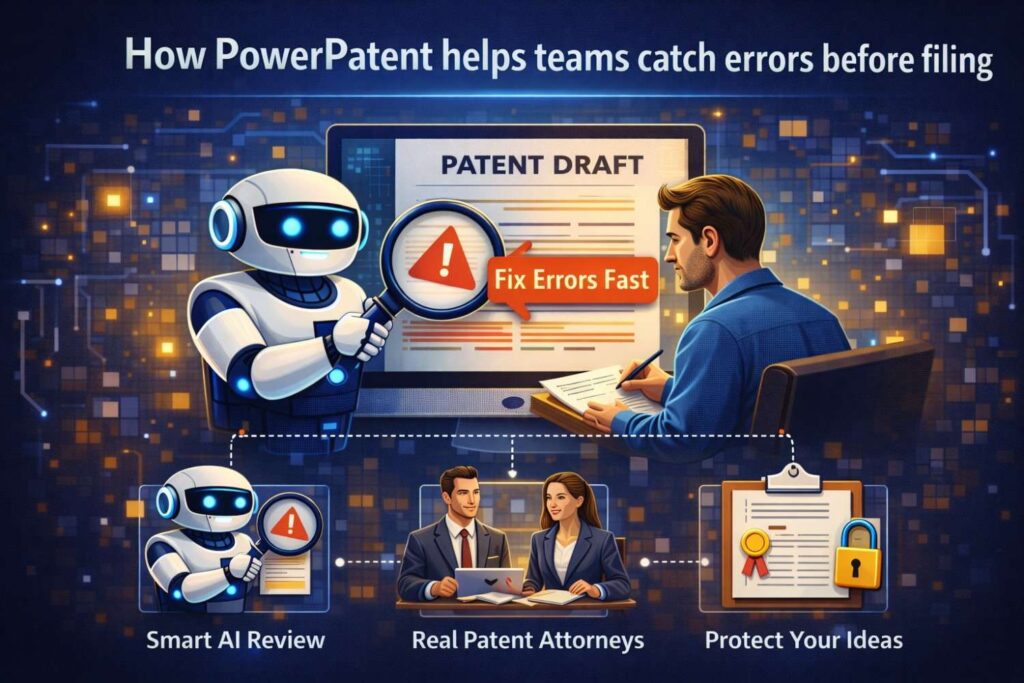
How PowerPatent helps teams catch errors before filing
Most companies do not lose patent strength because they lack smart ideas.
They lose strength because the review process breaks down before filing.
Important details stay stuck in the heads of inventors. Drafts move too fast from rough notes to legal language. Busy founders assume the hard part is done once the draft exists. Engineers skim instead of digging in. Outside counsel may only see part of the technical picture. Small gaps survive because nobody had a clean system for finding them early.
That is the real problem.
PowerPatent helps solve that problem by giving teams a better way to move from invention to filing with more visibility, more structure, and far fewer blind spots.
It is not just about making patent work faster.
It is about making pre-filing review smarter.
It Helps Teams Catch Problems Before They Turn Into Filing Risk
One of the biggest business advantages in a better patent process is timing.
A missed detail after filing is much harder to fix than a missed detail before filing.
That sounds obvious, but many companies still operate in a way where important issues only surface late. A founder notices that the draft left out a key variation. An engineer realizes the described workflow is not how the system really behaves. A product lead spots that the application is locked too tightly to the current release. By that point, the team is rushing, the filing date feels close, and the review becomes reactive instead of strategic.
PowerPatent helps move those discoveries earlier.
That changes everything.
When issues are surfaced sooner, teams can improve the specification while they still have room to think clearly, ask better follow-up questions, and shape the draft around what actually matters.
For businesses, this reduces avoidable risk.
It also improves the quality of every hour spent by the team, because the review is happening when it can still change the outcome.
It Creates a Better Bridge Between Technical Teams and Patent Review
A common reason patent drafts go weak is that the people who know the invention best are not always the people best positioned to turn that knowledge into a complete filing.
Engineers know the mechanism.
Founders know the business value.
Product leads know what is changing and what is likely to stay.
Patent counsel knows how to shape legal protection.
But in many companies, those views never come together in a clean way before the application is filed.
PowerPatent helps close that gap.
It gives teams a more workable bridge between the raw technical truth of the invention and the polished filing that eventually gets submitted.
That matters because many filing errors are not simple mistakes. They are translation problems.
The technical team may understand the real system behavior, but the draft may flatten it.
The founder may understand what a competitor would copy, but that layer may not be emphasized in the write-up.
The product team may know which implementation details are temporary, but the draft may still treat them like permanent features.
A stronger review workflow helps those disconnects surface early.
For businesses, this means the final application is more likely to reflect the real invention and the real strategic value of the company.
It Helps Founders Review Drafts Without Needing To Think Like Patent Lawyers
This is a major practical benefit.
Many founders want to review their patent drafts seriously, but they do not always know what to look for. They can tell if a description feels generally right or wrong, but they may not know how to spot weak support, hidden narrowing, missing embodiments, or thin technical explanation.
That creates a review bottleneck.
Either the founder gives only surface-level feedback, or the founder delays review because the task feels dense and hard to engage with.
PowerPatent helps make that review more usable.
Instead of forcing founders into a vague legal review task, it helps turn the process into something more structured and more connected to how founders already think.
Founders can focus on sharper questions.
Does this reflect what makes the company different?
Does this capture the part of the system that will still matter a year from now?
Does this leave room for the roadmap?
Does this protect the part a competitor would actually copy?
Does this explain the invention in a way that matches how the team built it?
Those are business-smart questions.
When the workflow makes it easier to ask them before filing, the resulting application gets stronger.
It Helps Engineering Teams Give Better Input With Less Friction
Engineers are often the source of the most valuable invention detail.
They also tend to be the hardest people to pull into patent review in a useful way, not because they do not care, but because the process often feels inefficient.
A generic request to “review the patent draft” is usually a poor use of engineering time. It is too broad. It is not clear what kind of feedback matters most. The engineer ends up scanning dense text instead of contributing the exact technical insight the filing needs.
PowerPatent helps make that easier.
It supports a process where engineers can react to specific questions, specific gaps, or specific technical sections instead of being asked to perform an open-ended legal read.
That small shift has a big business effect.
It increases the odds that the right people will actually participate.
It also improves the quality of their contribution.
Instead of general comments, the team can gather concrete input about system flow, alternate implementations, edge-case behavior, deployment changes, or optional features that should not be written as required.
That is a far better use of technical talent.
It Helps Businesses Protect What Matters Commercially, Not Just Technically
A patent can be technically correct and still be strategically weak.
This happens more often than founders think.
A draft may accurately describe the system, but spend too much time on details that are easy to change and not enough time on the technical layer that creates commercial leverage.
For a business, that is a serious problem.
What matters is not only whether the invention is described. What matters is whether the filing supports protection around the part of the product that drives advantage.
That may be the ranking logic.
It may be the control loop.
It may be the safety layer.
It may be the system arrangement that reduces cost or latency.
It may be the hidden workflow that creates better performance or trust.
PowerPatent helps teams review the draft with that commercial lens in view.
That makes the process more strategic.
It helps the company move beyond the basic question of “is the draft accurate?” and into the more useful question of “is the draft protecting the right thing?”
That shift is where stronger IP strategy starts.
It Gives Businesses a Better Way To Support Future Filings
Strong companies rarely stop at one patent filing.
As the product grows, new inventions appear. Improvements get made. Follow-on protection becomes more valuable. Continuations, related filings, and deeper portfolio planning all become more realistic.
That means a patent draft should not only be reviewed as a one-time document.
It should also be reviewed as part of a larger foundation.
PowerPatent helps businesses think that way earlier.
By helping teams catch thin spots, missing alternatives, weak terminology, and underdeveloped invention framing before filing, it improves the odds that the first application will become a stronger base for future work.
That matters a lot.
A weak first filing can create drag on the rest of the portfolio.
A stronger first filing can make future protection easier, cleaner, and more connected to the business.
From a business perspective, that is not a small benefit. It is compounding value.
It Helps Reduce Expensive Cleanup Later
A weak process often looks cheaper at first.
The team gets a draft, glances at it, sends back minor edits, and files quickly.
But the hidden cost comes later.
Later, the company may realize the application missed a useful embodiment. Later, a follow-on filing may be harder because the first draft lacked support. Later, diligence may reveal the patents do not line up well with the company’s real moat. Later, legal work becomes more expensive because the team is trying to work around issues that could have been fixed much earlier.
PowerPatent helps reduce that kind of cleanup.
That is not just a legal benefit. It is an operating benefit.
It means the company spends less time fixing preventable problems and more time building useful, connected patent assets.
For startups with limited resources, this matters a lot.
Saving one filing from preventable weakness can be worth far more than the small amount of effort needed to review it properly before submission.
It Encourages Better Internal Habits Around Invention Capture
The best patent review does not begin with the final draft.
It begins much earlier, with how the company captures invention details in the first place.
If the source material is thin, scattered, or unclear, the review process is always playing catch-up.
PowerPatent helps businesses build better habits upstream.
That is an underrated advantage.
When teams know they have a stronger system for turning invention details into reviewable patent material, they tend to capture more useful information earlier. They document breakthrough decisions better. They preserve technical context that might otherwise fade. They think more clearly about what changed in the system and why it matters.
That makes each later review stronger.
It also turns patent preparation from a reactive scramble into a more repeatable business process.
That is exactly what growing companies need.
A Smart Way To Use PowerPatent Inside a Business
The best results usually come when companies treat PowerPatent as part of their operating rhythm, not as a one-off emergency tool.
A practical approach is simple.
When a real technical breakthrough happens, capture the core idea early.
Then use the workflow to sharpen the invention description before memories fade.
Bring in the right founder or engineer to answer targeted follow-up questions.
Review the resulting draft not only for factual accuracy, but also for breadth, business relevance, and likely future versions of the product.
Then let attorney oversight focus on the highest-value legal judgment, not basic cleanup that could have been handled earlier.
This creates a much stronger system.
It also helps the company get more value from both its internal team and its outside legal spend.
A Stronger Review Process Creates Better Business Leverage
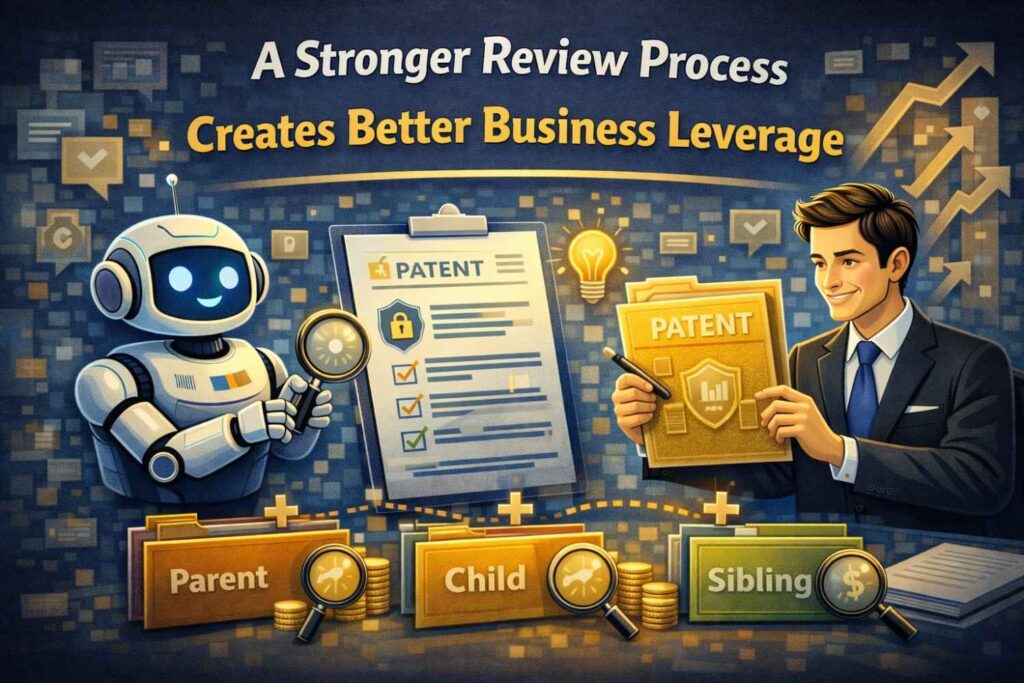
At the end of the day, businesses do not file patents just to have documents on paper.
They file to create leverage.
Leverage in fundraising.
Leverage in diligence.
Leverage against competitors.
Leverage in partnerships.
Leverage in long-term company value.
That leverage depends on the quality of what gets filed.
PowerPatent helps improve that quality before the point of no return.
By helping teams catch missing details, surface weak spots, improve review participation, and align the draft more closely with both the invention and the business, it helps companies file with more confidence and better strategic footing.
That is what makes the process valuable.
And that is why better pre-filing review is not a side task.
It is one of the smartest ways a business can protect what it is building.
Final thought
A patent draft should never be filed just because it looks finished.
It should be filed because it has been tested.
Because the weak spots were pushed on.
Because the missing pieces were added.
Because the wording was tightened.
Because the invention is clear.
Because the company knows what it is trying to protect and the draft actually supports that goal.
AI can help with all of that.
Not as a replacement for judgment, but as a serious review tool that helps founders and patent teams catch problems before they harden into filing mistakes.
That is the real value.
And for startups moving fast, that value can be enormous.
A better patent filing does not begin with more pages.
It begins with a better review.