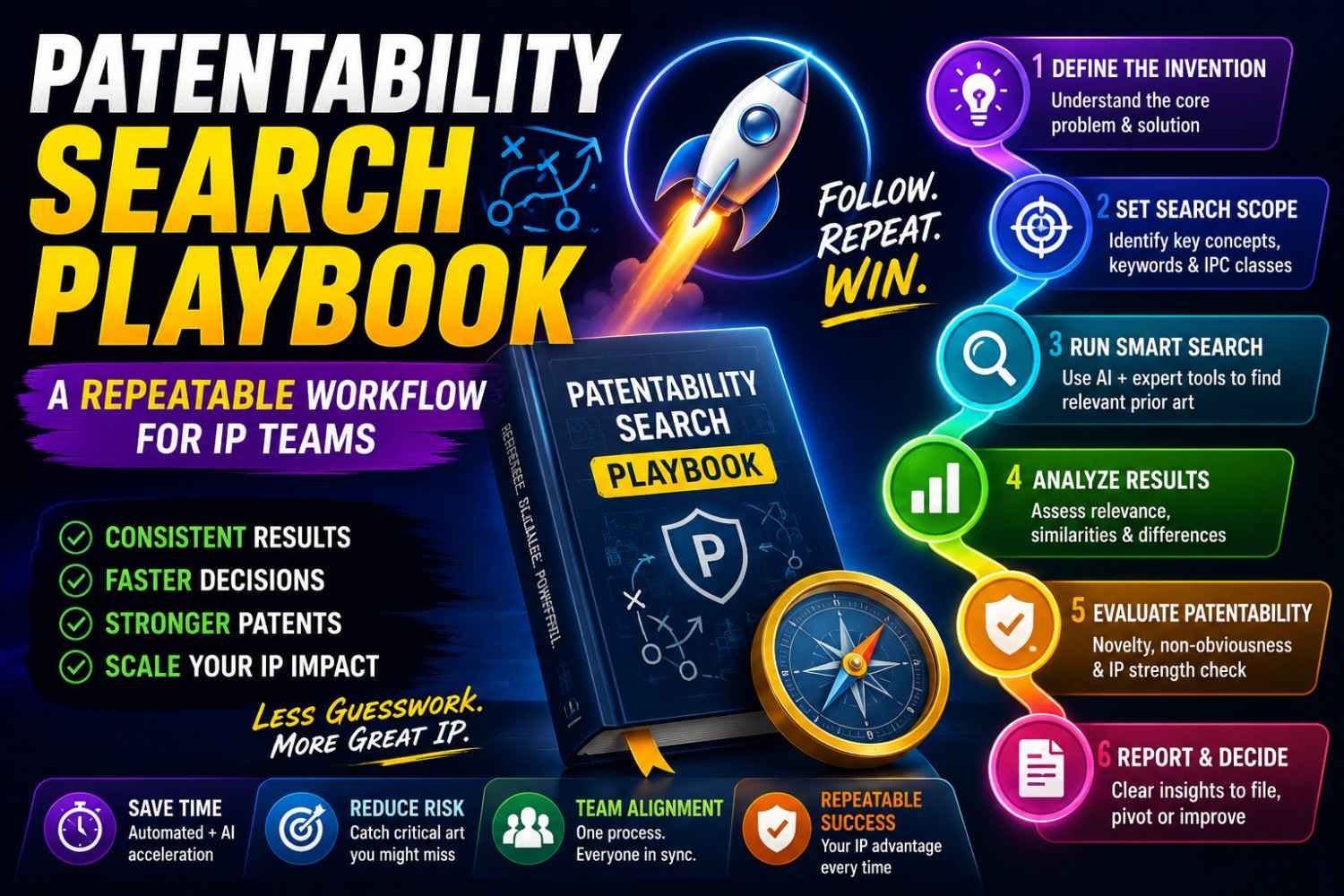
Patentability search should not feel random.
For busy IP teams, the goal is not to search harder every time. The goal is to build a repeatable workflow that helps the team find prior art, understand risk, and make better filing decisions without slowing the business down.
This playbook gives you a clear process you can use again and again.
PowerPatent helps founders, engineers, inventors, and IP teams turn invention notes, search results, product details, and attorney review into stronger patent filings with smart software and real patent attorney oversight. See how PowerPatent works here.
Why IP Teams Need a Patentability Search Playbook
Most IP teams are under pressure.
The product team is shipping. Engineers are building. Scientists are testing. Founders are fundraising. Sales teams are closing deals. Marketing wants to publish. Partners want demos. Investors want to hear about the moat.
In the middle of all this, the IP team has to answer a hard question:
Should we file a patent on this invention?
That question can rarely be answered well with a quick keyword search.
A patentability search needs structure. It needs a clear invention statement. It needs the right search scope. It needs prior art comparison. It needs business context. It needs attorney review. Most of all, it needs a decision.
Without a repeatable workflow, patent search becomes messy.
One invention gets over-searched. Another gets rushed. One team searches only patents. Another only searches Google. Some results sit in spreadsheets. Some live in Slack. Some are never reviewed by counsel. Some filings go forward because someone senior liked the idea, not because the search supported it.
That is how weak filings happen.
A playbook solves this.
It gives the team a shared way to move from idea to decision. It does not remove judgment. It makes judgment easier.
What a Patentability Search Playbook Should Do
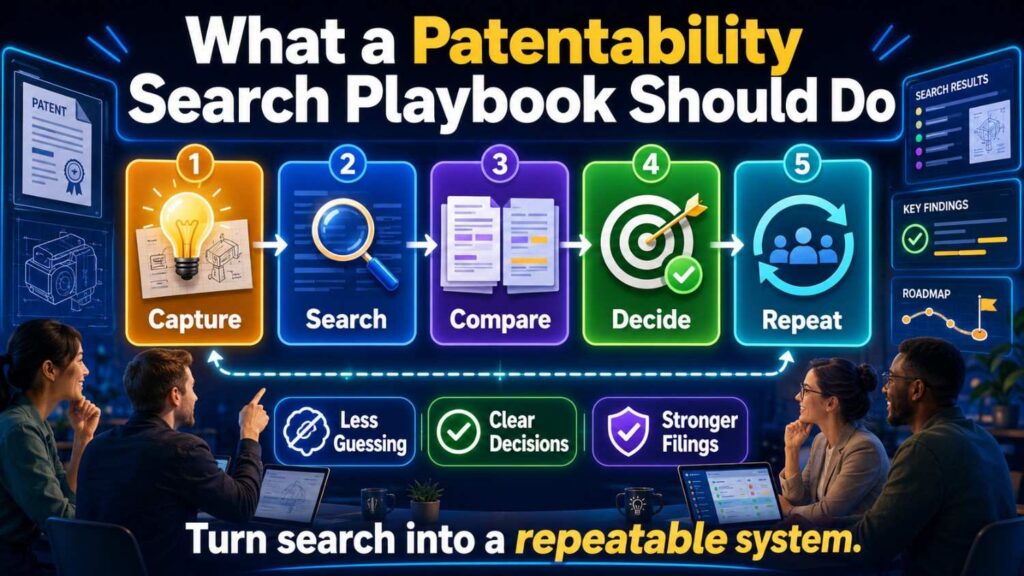
A good playbook should help IP teams answer five simple questions.
What is the real invention?
What came before?
What is still different?
Does that difference matter to the business?
What should we do next?
That is it.
Everything in the workflow should support those questions.
The playbook should not become a heavy legal process that slows inventors down. It should not ask engineers to write legal memos. It should not turn every product idea into a full search project.
Instead, it should create a clear path.
Capture the invention. Filter for business value. Search with discipline. Compare the closest references. Identify the strongest gap. Decide whether to file, narrow, pivot, search more, keep secret, or drop.
When this workflow is used across the company, the IP team gets cleaner inputs, better search records, faster attorney review, and stronger filing decisions.
Start With an Invention Intake Trigger
A repeatable patentability search workflow begins before the search.
It begins with intake.
The IP team needs to know when an invention may exist.
In many companies, invention intake is too passive. The IP team waits for someone to say, “We should patent this.” But engineers and product teams often do not know what might be patentable. They may think only big breakthroughs count. They may miss small but valuable improvements.
A good playbook creates triggers.
An invention review should happen when the team solves a hard technical problem, creates a new system workflow, improves accuracy, reduces false alerts, lowers compute cost, improves safety, makes manufacturing easier, improves signal quality, creates a new diagnostic method, changes model behavior, automates a risky task, or builds something competitors would likely copy.
The trigger does not mean “file a patent.” It means “capture the invention and decide whether search is needed.”
This is important because the best inventions are often hidden in normal work.
A SaaS team may create a new way to repair broken sync events.
An AI team may create a source-checking workflow that catches high-confidence errors.
A robotics team may solve blind-corner movement with a new prediction method.
A biotech team may discover that a marker ratio works only when adjusted for inflammation.
A hardware team may create a pressure-drift method that avoids false battery alerts.
If the IP team waits until launch, the invention may already be public. If the IP team waits for a polished invention disclosure, the detail may be lost.
The playbook should catch invention signals early.
Build a Lightweight Invention Capture Form
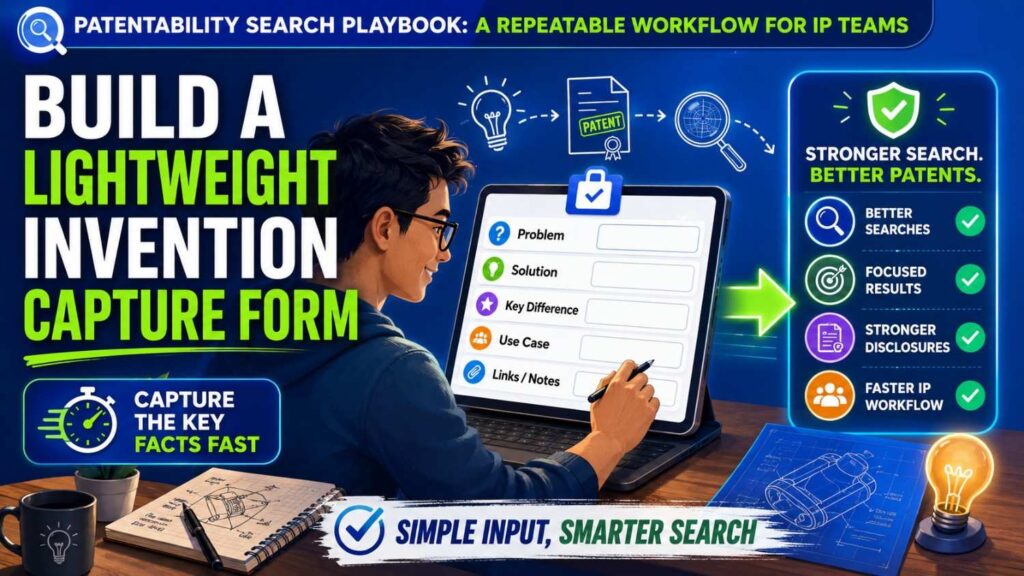
The first tool in the playbook should be a simple invention capture form.
It should be short enough that engineers and founders will actually use it.
Do not ask for legal language. Do not ask for claims. Do not ask for patent terms.
Ask plain questions.
What problem did we solve?
What old approach failed or was not good enough?
What did we build?
What are the key inputs?
What are the key steps?
What does the system, device, method, model, or process do next?
What result improved?
Why does this matter to customers or the business?
What would a competitor likely copy?
Will this be shown publicly soon?
Who are the inventors or technical contributors?
These questions are enough to begin.
A good intake form should create an invention snapshot. It should not be perfect. It should be useful.
For example:
“Our system validates AI-generated workflow actions before they run. It checks user permission, customer policy, and source-data support. If any check fails, the action is blocked or sent to review. This matters because enterprise customers need safe automation.”
That is enough to start a search.
PowerPatent helps teams capture this kind of invention detail early, before it gets buried in product docs, code comments, lab notes, or meeting memory. See how PowerPatent works.
Sort Inventions Before Searching Deeply
Not every invention needs the same search effort.
A repeatable workflow should include a triage step.
This prevents the IP team from spending too much time on low-value ideas and too little time on core inventions.
During triage, ask three questions.
Is the invention technically clear?
Is it important to the business?
Is public disclosure near?
If the invention is vague, it may need more technical detail before search.
If the invention is low-value, it may not deserve a full search.
If public disclosure is near, the search and filing decision may need to move faster.
A simple triage result can be:
Search now.
Capture and revisit.
Need more technical detail.
Consider trade secret review.
Do not pursue.
This triage step keeps the workflow practical.
For example, a minor UI tweak may not need a full search. A backend method that prevents unsafe AI actions before API docs are published probably does.
A manufacturing process that lowers cost and is hidden may need a patent-versus-trade-secret review. A broad product concept that is still just an idea may need more engineering detail before search.
The playbook should help teams choose the right level of effort.
Define the Search Question
Before opening a database, define the search question.
This is one of the most important steps.
A weak search question is:
“Is our product patentable?”
A stronger search question is:
“Do prior art references show validating AI-generated workflow actions against permission, customer policy, and source-data support before execution?”
Another strong question is:
“Do prior art references show comparing battery pressure drift during matched charging windows and adjusting a swelling score based on charge rate and temperature?”
Another:
“Do prior art references show using an inflammation-normalized marker ratio in low-volume plasma samples for early-stage disease risk?”
The search question should match the invention, not the market.
If the question is too broad, the search will drown in noise. If the question is too narrow, the team may miss close art.
A useful search question has four parts.
The technical action.
The key input or structure.
The decision or transformation.
The result or purpose.
For example:
“Find prior art for cloud systems that generate tenant-scoped audit packets by mapping evidence to controls and removing unrelated tenant data.”
That is a good search question.
It tells the searcher what to look for.
It also helps the IP team judge whether the results matter.
Write the Invention in One Plain Sentence
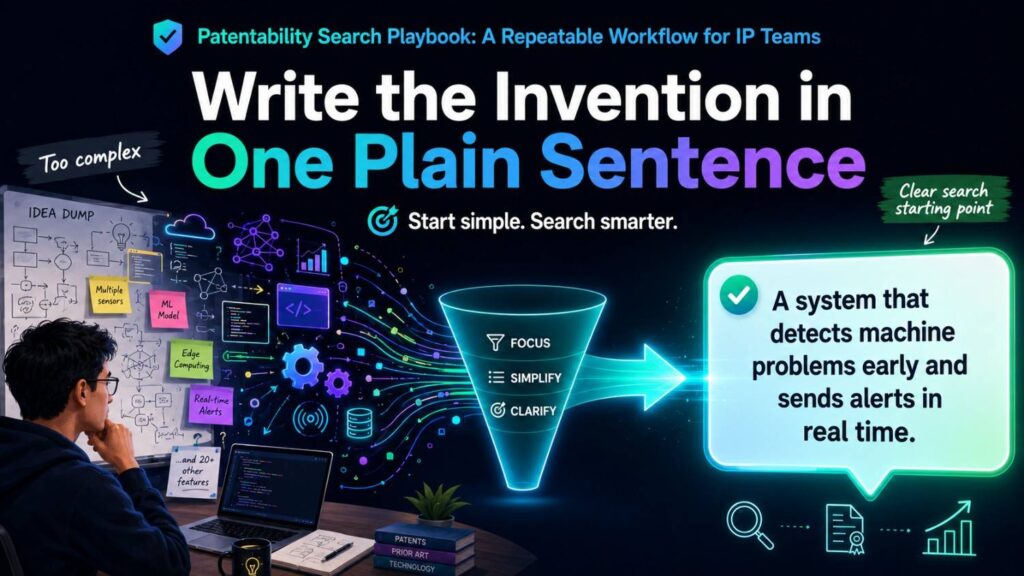
Every search should have a one-sentence invention statement.
This sentence becomes the anchor for the whole report.
Use a simple form:
“Our invention does [main action] by using [technical method] so that [technical result] improves.”
For example:
“Our invention prevents unsafe AI workflow actions by checking permission, customer policy, and source-data support before allowing the action to run.”
Or:
“Our invention reduces false battery swelling alerts by comparing pressure drift during matched charging windows and adjusting the score using charge rate and temperature.”
Or:
“Our invention improves robot safety by predicting hidden crossing risk before visual detection using sound direction, map shape, and recent traffic history.”
Or:
“Our invention reduces diagnostic false positives by normalizing a marker ratio based on inflammation score in low-volume plasma samples.”
This sentence helps everyone stay aligned.
If the sentence is not clear, the invention may not be ready for search.
The IP team should not move forward until the technical team can explain the invention simply.
Separate Product Language From Patent Language
The playbook should force a translation step.
Product language is useful for selling.
Patent search language is useful for finding prior art.
Product language may say:
“AI compliance copilot.”
Search language may say:
“AI-generated workflow action validation using permission scope, policy rules, and source-data support.”
Product language may say:
“Smart battery safety.”
Search language may say:
“Pressure drift comparison during matched charging windows for swelling risk scoring.”
Product language may say:
“Robot safety layer.”
Search language may say:
“Pre-visual blind-corner crossing risk prediction using non-visual signal direction and map geometry.”
This translation matters.
If the team searches product language, the results may be shallow.
If the team searches technical language, the results become useful.
IP teams should build a habit of asking:
What does the product call this?
What does the system actually do?
What words would older patents use?
What words would papers use?
What words would competitors use?
What words would standards use?
That vocabulary work is part of the search.
Build a Search Term Map
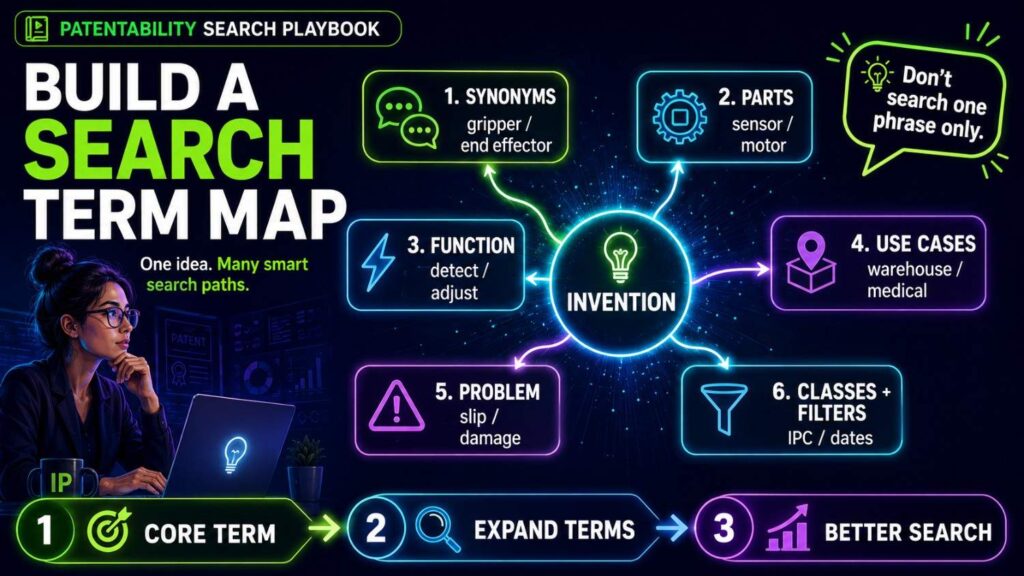
A repeatable workflow should include a search term map.
This map should cover the invention from several angles.
Start with the technical problem.
Then list the solution words.
Then list the key inputs.
Then list the key actions.
Then list the outputs.
Then list the technical results.
Then list synonyms and older terms.
For a SaaS invention about AI action validation, the map may include:
Problem words: unsafe automation, unauthorized action, unsupported action, policy violation.
Solution words: validation, approval, blocking, review routing, source verification.
Input words: permission scope, customer policy, source data, evidence, audit log.
Action words: execute, allow, block, route, approve, reject.
Result words: safer automation, auditability, reduced risk, compliance trust.
Older or alternate words: task authorization, workflow approval, evidentiary support, access control, rule engine.
This map makes searching more complete.
It also helps avoid the common mistake of searching only one phrase.
For hardware, the map may include structure, signal, force, timing, material, sensor, and control action.
For biotech, it may include marker names, sample types, assay terms, patient groups, pathways, and older disease terms.
For robotics, it may include sensors, motion, control, environment, safety, and prediction terms.
A search term map gives the team range without chaos.
Search in Layers
The playbook should use layered searching.
Do not jump straight into a narrow search and stop. Do not stay broad forever.
Search in layers.
The first layer is the broad field. This helps the team understand the landscape and vocabulary.
The second layer is the specific technical method. This tests the claim angle.
The third layer is adjacent fields. This finds prior art outside the product category.
The fourth layer is competitor and assignee search. This checks known players.
The fifth layer is citation search. This follows close references backward and forward.
The sixth layer is non-patent search. This checks papers, docs, manuals, code, standards, protocols, and public materials depending on the field.
For example, a search for a cloud compliance invention may start with compliance automation, then move to evidence mapping, then tenant-scoped audit packets, then field-level redaction, then competitor docs, then API guides, then cloud security standards.
A search for a robotics invention may start with robot obstacle avoidance, then blind-corner prediction, then sound direction and map geometry, then industrial AGV prior art, then warehouse robot patents, then videos and manuals.
A search for a biotech invention may start with the disease, then markers, then marker ratios, then sample type, then normalization methods, then clinical trial records and papers.
Layered searching prevents both overbroad noise and narrow blindness.
Search the Right Sources for the Field
A patentability search playbook should not use the same source list for every invention.
Different fields publish differently.
For SaaS and cloud platforms, search patents, API docs, product help centers, technical blogs, release notes, GitHub, security standards, and cloud architecture materials.
For AI and software, search patents, papers, preprints, GitHub repos, model cards, developer docs, benchmark papers, technical blogs, and product docs.
For hardware and robotics, search patents, drawings, product manuals, datasheets, supplier catalogs, demo videos, teardown articles, research papers, and standards.
For biotech and MedTech, search patents, papers, clinical trial records, protocols, product labels, instructions for use, regulatory summaries, sequence databases, reagent catalogs, and conference abstracts.
For semiconductors, search patents, conference papers, standards, architecture papers, manufacturing process literature, and product datasheets.
The playbook should include source templates by technology area.
This helps the team avoid a common problem: searching patents only when the closest prior art may be in a paper, manual, code repo, or product doc.
Capture Search Results as You Go
Search records should not live in browser tabs.
A repeatable workflow needs a clean search log.
For each search, record:
The date.
The searcher.
The database or source.
The query or terms used.
The filters used.
The relevant results found.
Why each result matters.
Notes on what the result appears to show.
This may feel simple, but it saves time later.
If the team needs attorney review, the search log gives context.
If the invention returns six months later, the team does not repeat work.
If an investor or acquirer asks about the patent strategy, the team can show discipline.
A search log is not just admin work. It is institutional memory.
PowerPatent helps teams keep invention details and search findings organized so the patent workflow does not depend on scattered spreadsheets and Slack threads. See how PowerPatent works.
Identify the Closest References
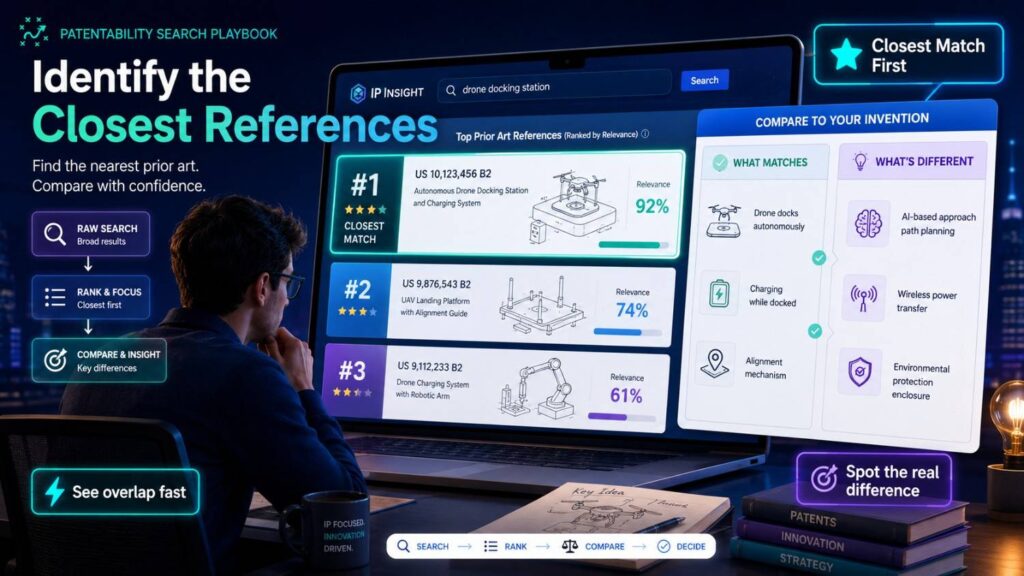
After search, the team should not treat every result equally.
The playbook should require the searcher to identify the closest references.
The closest reference is not always the first result. It is not always the same market. It is not always a competitor.
It is the reference that shares the most important technical elements with the invention.
A patent with the same title may be less relevant than a product manual with the same workflow.
A competitor blog may be less relevant than an old patent from another industry that teaches the exact control method.
A recent AI paper may be less relevant than an older expert system reference that shows the same decision flow.
The closest references should be moved into a short list.
That list is what the IP team and attorney should review.
A good search may find many references. A good report focuses on the few that drive the decision.
Summarize Each Close Reference in Plain Words
For each close reference, write a short summary.
Do not copy the abstract.
Do not paste long text.
Explain what the reference teaches in relation to the invention.
For example:
“Reference A describes AI-generated task suggestions and permission checks before task execution. It does not clearly show source-data support validation before execution.”
Or:
“Reference B describes pressure-based battery swelling detection using fixed pressure thresholds. It does not appear to compare pressure drift during matched charging windows.”
Or:
“Reference C describes Marker A for Disease X, but does not appear to use a Marker A to Marker B ratio normalized by inflammation score.”
These summaries make attorney review faster.
They also help business leaders understand the risk without reading every full reference.
Build an Element Map
An element map is the core of the playbook.
Break the invention into parts.
Then compare each close reference against each part.
Use simple labels:
Yes.
No.
Partial.
Unclear.
For example, for an AI workflow invention:
Element: System generates an AI workflow action.
Reference A: Yes.
Reference B: No.
Reference C: Partial.
Element: System checks permission.
Reference A: Yes.
Reference B: Yes.
Reference C: No.
Element: System checks source-data support.
Reference A: No.
Reference B: Partial.
Reference C: No.
Element: System blocks or routes the action before execution.
Reference A: Partial.
Reference B: Yes.
Reference C: No.
This map gives the team a clear view.
Does one reference show everything?
Do multiple references show pieces?
What element seems to be missing?
What should the claim focus on?
Without an element map, teams argue by vibe. With a map, they discuss facts.
Review One Reference at a Time
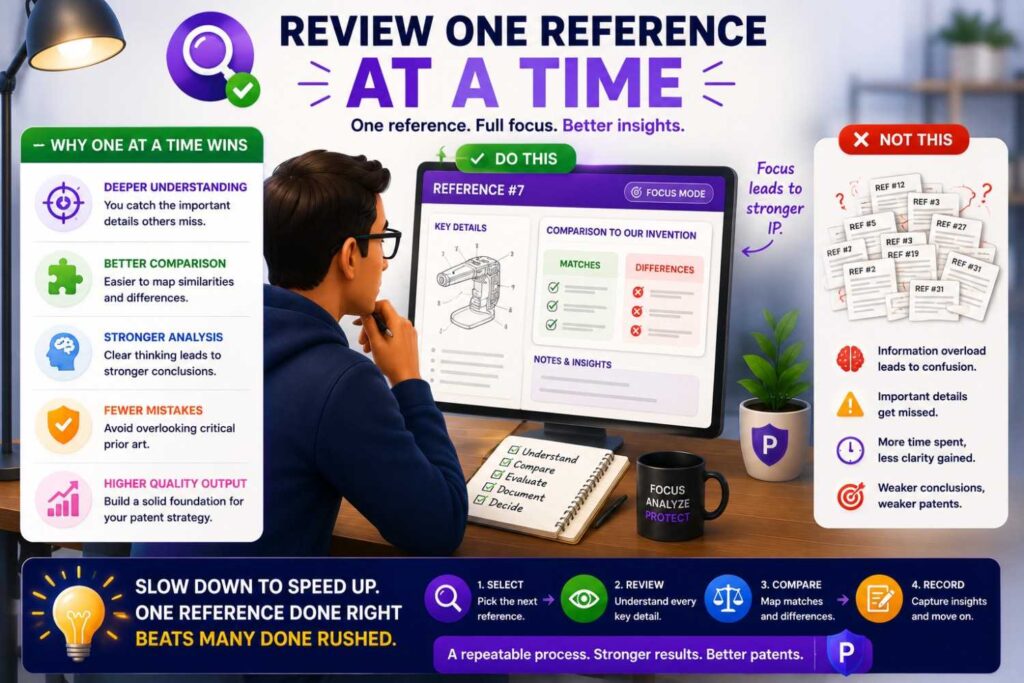
The playbook should include a one-reference review step.
For novelty, ask:
Does one reference show every key element of the invention?
Do not mix references too early.
This avoids panic.
A search may find all the pieces across ten references. That does not mean one reference shows the whole invention.
After the one-reference review, the team can consider whether combining references creates risk.
But the first pass should stay clean.
This is especially important for software, AI, SaaS, hardware, and biotech, where many inventions combine known parts in a specific way.
A one-reference review helps the team decide whether the broad claim is blocked, whether a narrowed claim has room, or whether more search is needed.
Then Review Combination Risk
After novelty, review obviousness risk.
This is where the team asks whether multiple references together may make the invention look like an easy next step.
For example:
One reference shows AI task generation.
Another shows policy approval.
Another shows source reliability.
Another shows audit logs.
Would combining them into source-supported AI action validation be natural?
Maybe. Maybe not.
The team should ask:
Do the references solve the same problem?
Would someone have a reason to combine them?
Would the combination work predictably?
Did prior art point away from the invention?
Does the invention solve a problem old systems missed?
Does the invention create a technical result?
This step should be reviewed with patent counsel when the invention is important.
The playbook should not require non-lawyers to make final legal judgments. It should prepare the facts so counsel can give better advice.
Identify the Strongest Technical Gap
After the element map, the playbook should require one clear sentence:
“The strongest technical gap appears to be…”
This sentence is critical.
It may be:
“The strongest technical gap appears to be validating AI-generated actions against source-data support before execution.”
Or:
“The strongest technical gap appears to be comparing pressure drift during matched charging windows rather than using fixed pressure thresholds.”
Or:
“The strongest technical gap appears to be normalizing a marker ratio by inflammation score in low-volume plasma samples.”
Or:
“The strongest technical gap appears to be predicting hidden crossing risk before visual detection using sound direction and map geometry.”
This gap becomes the center of claim strategy.
If the team cannot state the gap clearly, the search is not done.
Tie the Gap to Business Value
A technical gap is not enough.
The playbook should require a business value statement.
Why does this gap matter?
Does it reduce false alerts?
Make automation safer?
Lower cloud cost?
Improve diagnostic accuracy?
Reduce review time?
Improve robot safety?
Improve manufacturing yield?
Protect customer data?
Support a product claim?
For example:
“This gap matters because enterprise customers need AI actions to be validated before execution.”
Or:
“This gap matters because false swelling alerts during fast charging can reduce customer trust in the battery system.”
Or:
“This gap matters because inflammation causes false positives, and normalization may improve test performance in the target patient group.”
This business connection helps the IP team decide whether the invention is worth filing.
A patent filing should protect value, not just novelty.
Assign a Risk Level
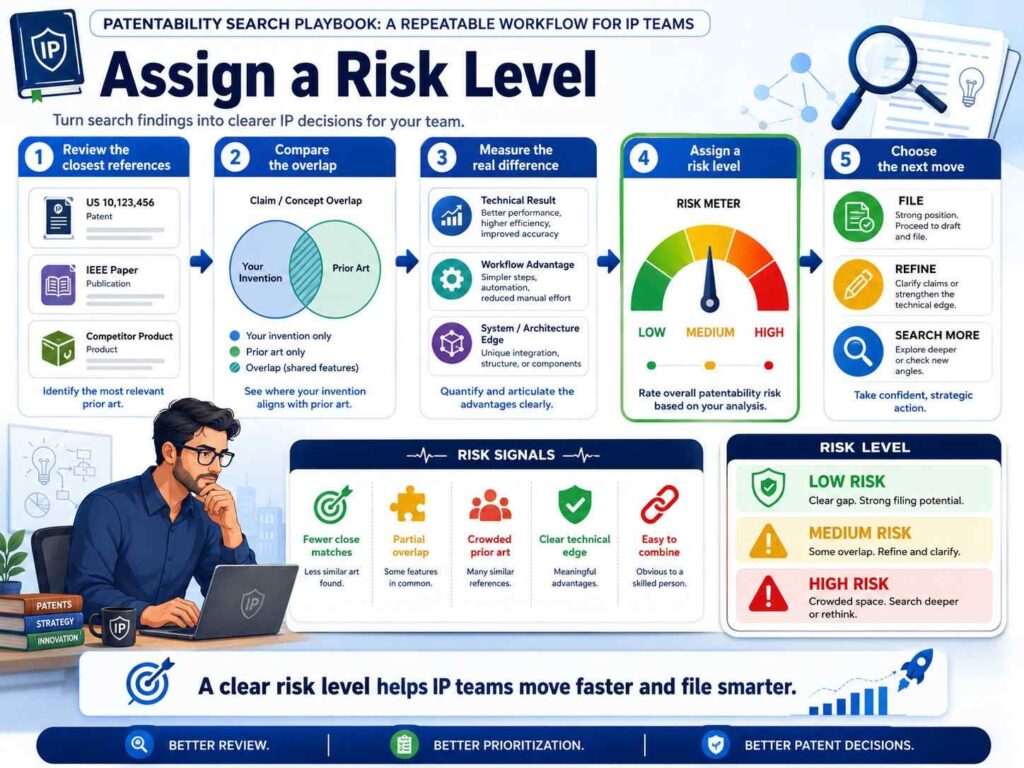
The playbook should include a simple risk rating.
This does not need to be complex.
Use low, medium, or high for novelty risk and obviousness risk.
But always explain the rating.
For example:
“Novelty risk appears medium. No single reviewed reference clearly shows source-data support validation before execution, but Reference A is close on AI task generation and permission checks.”
“Obviousness risk appears medium to high. Related references show source reliability and workflow approval separately, so attorney review is recommended.”
“Novelty risk appears high for broad pressure-based swelling detection, but lower for matched-window pressure drift scoring.”
This helps the business make decisions without pretending there is certainty.
The rating should be tied to the claim version reviewed.
The broad claim and narrowed claim may have very different risk levels.
Decide the Recommended Path
A repeatable workflow must end in a decision.
Not a pile of references.
Not “more analysis needed” without direction.
Use clear paths:
File.
File with narrower claim focus.
Search more.
Gather more technical detail.
Pivot to another invention.
Split into multiple filings.
Keep as trade secret candidate.
Pause.
Drop.
The recommendation should be direct.
For example:
“Recommend filing on the source-data validation layer before API docs publish. Do not file on broad AI workflow automation.”
Or:
“Recommend more search on field-level replay before filing because close references use different language and may be relevant.”
Or:
“Recommend pausing the broad marker filing and gathering data on the normalized ratio.”
Or:
“Recommend trade secret review for backend scoring weights and patent filing on the visible workflow control step.”
A search playbook that does not force a recommendation will not change behavior.
Create a Founder and Executive Summary
Every search report should include a short executive summary.
This is the part busy leaders read first.
It should state:
What was searched.
What was found.
What the closest art shows.
What gap appears strongest.
What risk remains.
What action is recommended.
For example:
“The broad field of AI workflow automation is crowded. The closest references show AI task suggestions, permission checks, and policy approval. No single reviewed reference clearly shows source-data support validation before execution. The strongest filing angle appears to be the validation layer. Recommend filing before API docs publish, with backup claims for source confidence, review routing, and audit logs.”
This summary should be short, honest, and actionable.
It should not sound like marketing. It should sound like a decision memo.
Prepare an Attorney Review Packet
Once the internal search is complete, prepare a clean packet for patent counsel.
Do not send only links.
Send:
The invention statement.
The technical problem.
The key elements.
The closest references.
The element map.
The strongest gap.
The business value.
Public disclosure timing.
Open questions.
Recommended path.
This makes attorney review much faster and better.
A strong packet lets counsel focus on legal judgment and claim strategy rather than reconstructing the invention from scattered notes.
For important inventions, attorney review should not be optional.
Patentability judgments can be nuanced. The internal playbook should prepare the facts, not replace counsel.
PowerPatent helps teams turn invention capture and search work into attorney-ready materials so filing decisions can move faster and with more confidence. See how PowerPatent works.
Use Attorney Review to Refine Claim Strategy
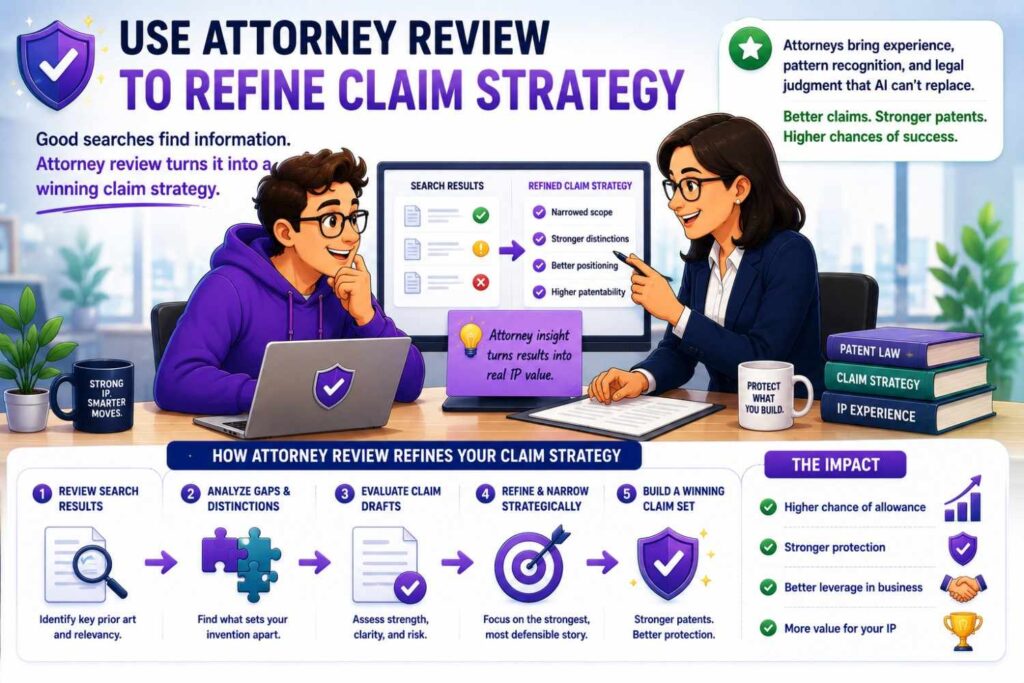
Attorney review should not only answer “yes” or “no.”
It should refine claim strategy.
Counsel may say:
The broad claim is too risky.
The narrowed gap is promising.
A different element is a better anchor.
A second search is needed.
The invention should be split.
Some details should be kept secret.
More data is needed before filing.
A public disclosure creates urgency.
The playbook should capture the attorney’s recommendation and update the decision record.
Do not let attorney advice disappear into an email chain.
Record it in the search report or IP tracker.
This helps the company remember why a filing went forward, changed direction, or was dropped.
Build Backup Claim Positions Early
A good search workflow should identify backup positions before drafting begins.
If the broad claim is challenged, what narrower versions still matter?
For SaaS, backups may include policy types, review actions, source confidence measures, audit logs, tenant rules, or validation timing.
For AI, backups may include model confidence, source trust, human review, second-model review, feedback updates, or prompt risk.
For hardware, backups may include sensor placements, timing windows, calibration steps, materials, and control actions.
For robotics, backups may include alternate sensors, map inputs, speed controls, fleet warnings, and near-miss feedback.
For biotech, backups may include sample types, marker ranges, patient groups, assay conditions, dose ranges, and formulation variants.
Backup positions should be real and valuable.
They should not be random details.
The playbook should ask:
If the main claim is blocked, what narrower claim would still protect business value?
That question improves drafting.
Decide Patent Versus Trade Secret
The playbook should include a protection-path decision.
Not every invention should be patented.
Some inventions may be better kept secret.
Ask:
Will this method be visible?
Can competitors reverse engineer it?
Will it be disclosed in product docs, API outputs, regulatory filings, publications, demos, or customer behavior?
Is the patent space strong?
Can the company keep it secret?
Does the method create long-term value?
For example, a hidden backend scoring formula may be a trade secret candidate. A visible workflow validation step may be better suited for patent filing.
A manufacturing parameter may be kept secret if it cannot be detected from the product. A device structure visible in teardown may be better filed.
The playbook should force this conversation before filing.
A bad filing can reveal secrets without gaining useful protection.
Check Public Disclosure Timing
Every search workflow should include a disclosure check.
Ask:
Has the invention already been disclosed?
Will it be disclosed soon?
Where?
To whom?
Was it confidential?
What details were shown?
Upcoming disclosures may include launches, API docs, GitHub repos, demos, conference talks, posters, investor decks, white papers, clinical trial records, product manuals, grant publications, sales materials, and webinars.
If disclosure is near, the IP team may need to move quickly.
If disclosure has already happened, counsel needs the details.
The playbook should create a simple disclosure log.
This protects the company from accidental loss of rights and helps counsel make better timing decisions.
Include Roadmap Review
The invention being searched may not be the final version.
Startups change quickly.
The playbook should ask whether the roadmap includes real technical variants.
For example:
Today’s AI workflow uses human review. The roadmap adds second-model review.
Today’s battery system uses pressure and temperature. The roadmap adds strain history.
Today’s diagnostic uses plasma. The roadmap includes saliva.
Today’s robot slows at blind corners. The roadmap adds fleet warnings.
Today’s SaaS product exports audit packets. The roadmap adds automated remediation.
If these variants are real and technically understood, they may belong in the patent disclosure.
This helps the filing support where the product is going.
Do not include fantasy. Include real technical alternatives.
Add a Design-Around Review
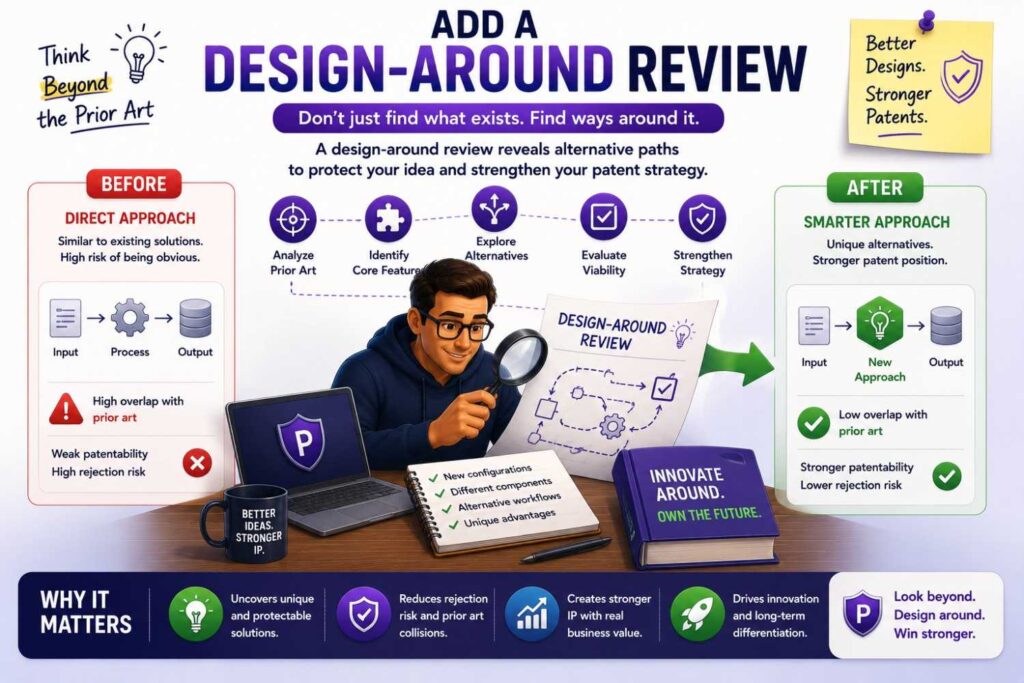
Before filing, the playbook should ask:
How would a competitor avoid this claim while keeping the same business benefit?
This is a powerful exercise.
If a competitor can avoid the claim by changing one minor detail, the claim may be too narrow.
For example:
Changing email to in-app notification.
Changing one threshold number.
Using a different sensor type.
Moving a step earlier or later.
Replacing human review with second-model review.
Using a different sample type.
Using a different data source.
The team should identify these workarounds before drafting.
Then the attorney can decide whether to broaden language, add alternatives, or include backup claims.
Design-around review turns the search into a stronger filing.
Add a Detectability Review
A patent may be hard to use if no one can tell whether competitors practice it.
The playbook should ask:
Can we detect use of the invention?
Would it appear in product behavior?
API fields?
Outputs?
Reports?
Logs?
Teardown?
Regulatory filings?
Clinical workflow?
Testing?
Customer documentation?
If the answer is no, consider whether claims should focus on observable behavior or whether trade secret protection is better.
This is especially important for backend software, AI model tuning, cloud scheduling, manufacturing methods, cell culture conditions, and internal scoring weights.
Detectability does not decide everything, but it matters for business strategy.
Score the Filing Opportunity
IP teams often need to prioritize.
A simple scoring model can help.
Score each invention on:
Business value.
Technical clarity.
Prior art risk.
Disclosure urgency.
Detectability.
Design-around difficulty.
Roadmap importance.
Support in data or examples.
Patent-versus-trade-secret fit.
Use simple high, medium, low rankings.
This is not meant to be perfect math.
It is meant to support better conversations.
An invention with high business value, medium prior art risk, strong support, and urgent disclosure may be a file-now candidate.
An invention with low business value and easy design-around risk may be dropped.
An invention with high value but hidden implementation may need trade secret review.
Scoring helps the IP team allocate budget.
Build a Decision Record
Every search should end with a written decision record.
This record should say:
What invention was reviewed.
What sources were searched.
What prior art was closest.
What gap was identified.
What risk level was assigned.
What decision was made.
Who approved the decision.
What next steps remain.
This decision record is valuable.
It helps during drafting. It helps during prosecution. It helps during fundraising. It helps during acquisition diligence. It helps when team members change.
It also prevents repeated debates.
If the team decided not to file on a feature, record why.
If the team decided to file narrowly, record why.
If the team chose trade secret treatment, record why.
IP strategy should not live only in memory.
Use Search Reports as Portfolio Inputs
A patentability search report should not disappear after one filing decision.
It should feed the portfolio strategy.
Over time, search reports show patterns.
Which areas are crowded?
Which product layers have white space?
Which competitors are filing heavily?
Which inventions support the roadmap?
Which features are better kept secret?
Which filings should be continued?
Which areas need more R&D?
This helps IP teams build a stronger portfolio.
The goal is not one good patent.
The goal is a set of filings that protect the company’s technical advantage.
A repeatable playbook makes that possible.
Set Search Depth by Decision Type
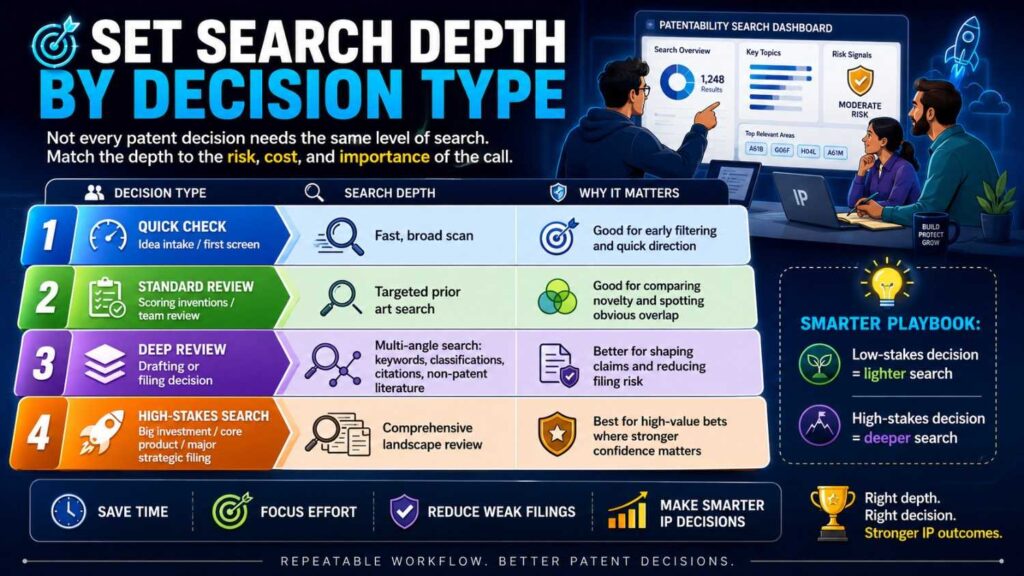
Not every decision needs the same depth.
The playbook should define search levels.
A light search may be enough for early triage.
A focused search may be enough to decide whether to draft a provisional.
A deeper search may be needed before a non-provisional, major funding round, product launch, clinical disclosure, or high-value platform filing.
A full freedom-to-operate review is a different project and should not be confused with patentability search.
This prevents overwork.
It also prevents under-searching when stakes are high.
For example:
A minor roadmap feature may need only initial triage.
A core platform invention near public launch needs deeper search and attorney review.
A high-value MedTech feature before clinical publication may need broad patent and non-patent searching.
The playbook should match depth to risk.
Define Roles Clearly
A repeatable workflow needs clear roles.
The inventor explains the technical problem and solution.
The product lead explains business value and roadmap fit.
The IP manager owns the workflow and decision record.
The searcher performs and documents the search.
The engineer or scientist reviews technical accuracy.
The patent attorney reviews legal risk and claim strategy.
The executive sponsor approves budget and priority.
Not every company has all these roles as separate people. In a startup, one person may wear several hats.
Still, the responsibilities should be clear.
Confusion about roles causes delays and weak filings.
Create a Cadence for IP Review
A playbook works best when it has rhythm.
Do not wait for emergencies.
Hold regular invention review sessions.
For fast-moving startups, this may happen monthly or around product milestones.
For deep tech teams, it may happen after major experiments, design reviews, prototype tests, or model releases.
For biotech and MedTech teams, it may happen before conference submissions, trial registrations, publications, regulatory steps, and partner meetings.
For SaaS teams, it may happen before launches, API docs, major releases, open-source drops, and enterprise sales pushes.
The cadence does not need to be heavy.
It just needs to exist.
Regular review catches inventions early.
Train Teams to Spot Patentable Signals
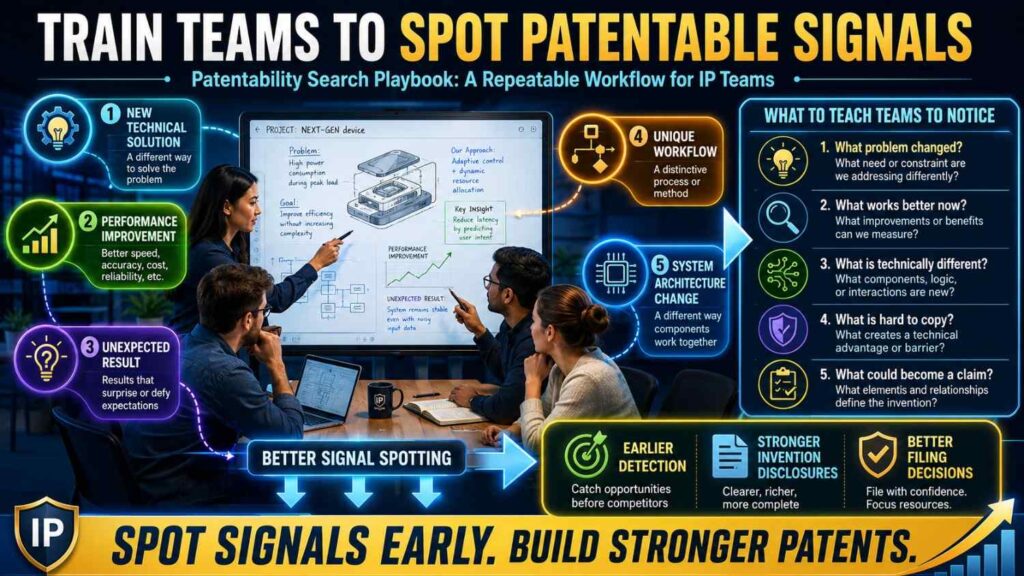
IP teams should not carry the whole burden alone.
Engineers, scientists, product managers, and founders should know what to flag.
Train them to watch for signals:
We solved a problem others struggle with.
We changed system behavior in a new way.
We reduced false positives.
We reduced compute cost.
We improved safety.
We created a new workflow trigger.
We improved signal quality.
We made manufacturing easier.
We found a new marker pattern.
We created a control loop.
We handled an edge case.
We built something competitors would want.
Training does not need to be legal.
It should be practical.
The goal is to help teams recognize inventions early enough for search and filing.
Keep Lists Short but Decisions Clear
Patent workflows can become too complicated.
The playbook should be detailed enough to guide work, but simple enough to use.
Do not make inventors fill out twenty-page forms.
Do not make every idea go through a full search.
Do not ask business leaders to read dense legal memos.
Keep the process focused.
Capture the invention.
Triage value and timing.
Search the right sources.
Map the closest art.
Identify the gap.
Get attorney review.
Make the decision.
Record the decision.
That is the core.
Everything else supports it.
Use PowerPatent to Make the Workflow Easier
A repeatable patentability search workflow needs structure.
It needs invention capture, search organization, technical context, attorney review, and decision tracking.
PowerPatent is built to help startups and IP teams do this faster and more clearly.
Instead of scattered notes and last-minute patent scrambles, teams can organize the real invention story, connect it to search findings, and move toward better attorney-reviewed filing decisions.
This helps founders protect what they are building without slowing down product work.
A Practical Patentability Search Playbook Template
A good playbook should be simple enough to use every week and strong enough to support real filing decisions.
The goal is not to create a long checklist that no one follows. The goal is to give the IP team a repeatable path from “we may have invented something” to “we know what to do next.”
This template works best when it is treated like a living workflow. Use it for new ideas, product updates, lab results, engineering fixes, AI workflows, hardware improvements, SaaS features, and manufacturing wins.
Step 1: Open an Invention Record
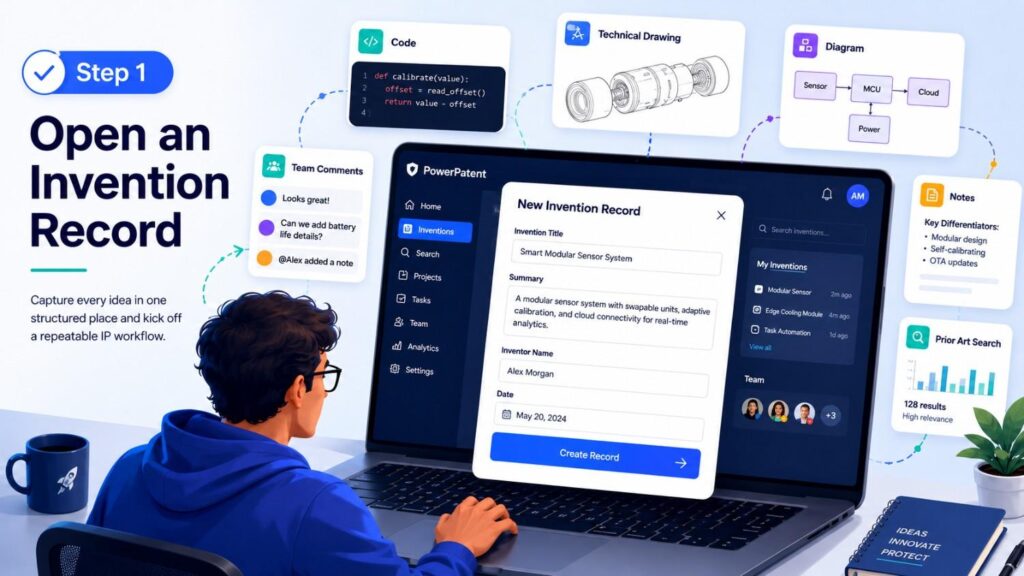
Start by creating one clean record for the invention.
This record should have one owner, one title, one date, and one place where all notes live. That may sound basic, but it prevents a lot of confusion later.
The record should capture the invention name, inventors, product area, business owner, technical owner, filing urgency, and public disclosure risk.
A useful invention title should be specific.
Weak title:
“AI compliance feature.”
Strong title:
“Source-data validation before AI workflow action execution.”
Weak title:
“Battery safety.”
Strong title:
“Matched-window pressure drift scoring for battery swelling risk.”
This title helps everyone remember what is really being reviewed.
Step 2: Write the Business Reason for Reviewing It
Before searching, write why this invention matters.
This keeps the process tied to business value.
The reason may be that the feature supports a launch, protects a core product claim, reduces cloud cost, improves safety, strengthens fundraising, blocks competitor copying, supports a partner deal, or may be disclosed soon.
For example:
“This workflow is part of our enterprise AI trust story and will be described in API docs next month.”
Or:
“This manufacturing method reduced assembly failures in pilot production and may lower cost at scale.”
Or:
“This diagnostic scoring method is central to our clinical differentiation and will be included in an upcoming poster.”
If there is no clear business reason, the idea may still be worth capturing, but it may not deserve a deep search yet.
Step 3: Define the Technical Problem in One Sentence
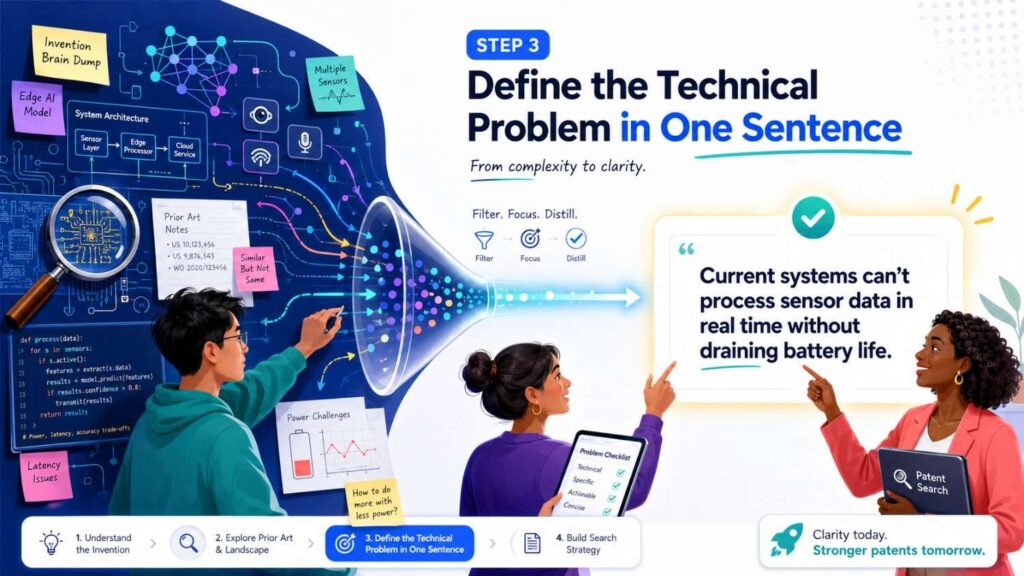
The technical problem should be plain and specific.
Do not write:
“Customers need better automation.”
Write:
“AI-generated workflow actions can run without enough support from the source data, which creates safety and audit risk.”
Do not write:
“Battery safety is hard.”
Write:
“Fast charging can create temporary pressure changes that look like swelling, causing false alerts when fixed pressure thresholds are used.”
The technical problem helps guide the search. It also helps later when counsel frames the patent application.
Step 4: Define the Technical Solution in One Sentence
Next, write what the invention does.
Use simple words.
For example:
“The system checks user permission, customer policy, and source-data support before allowing an AI-generated action to run.”
Or:
“The system compares pressure drift during matched charging windows and adjusts the swelling score based on charge rate and temperature.”
Or:
“The system normalizes a marker ratio by inflammation score before generating an early-stage risk result.”
This sentence should be clear enough that a founder, engineer, and patent attorney all understand the same thing.
If the team cannot write this sentence, the invention is not ready for a full search.
Step 5: Name the Technical Result
A patentability search should not only ask what is different. It should ask why the difference matters.
Write the technical result.
For example:
“Reduces unsafe AI actions.”
“Reduces false swelling alerts.”
“Improves signal quality during motion.”
“Lowers compute cost.”
“Improves early-stage diagnostic accuracy.”
“Reduces duplicate security alerts.”
“Improves robot safety before visual detection.”
The technical result gives the search a sharper purpose. It also helps the business decide whether the invention is worth filing.
Step 6: Break the Invention Into Elements
Break the invention into its key parts.
For a software or SaaS invention, elements may include data inputs, scoring steps, permission checks, model outputs, workflow triggers, review paths, audit logs, and feedback updates.
For hardware, elements may include structures, sensors, placements, signals, timing windows, materials, and control actions.
For biotech, elements may include sample type, markers, assay steps, normalization, patient group, dosing, formulation, or treatment result.
For robotics, elements may include sensor inputs, map data, prediction steps, control rules, motion changes, and feedback.
This element list becomes the comparison map.
A good rule is to include only the elements that matter to the technical result. Do not overload the list with routine parts.
Step 7: Decide the Search Depth
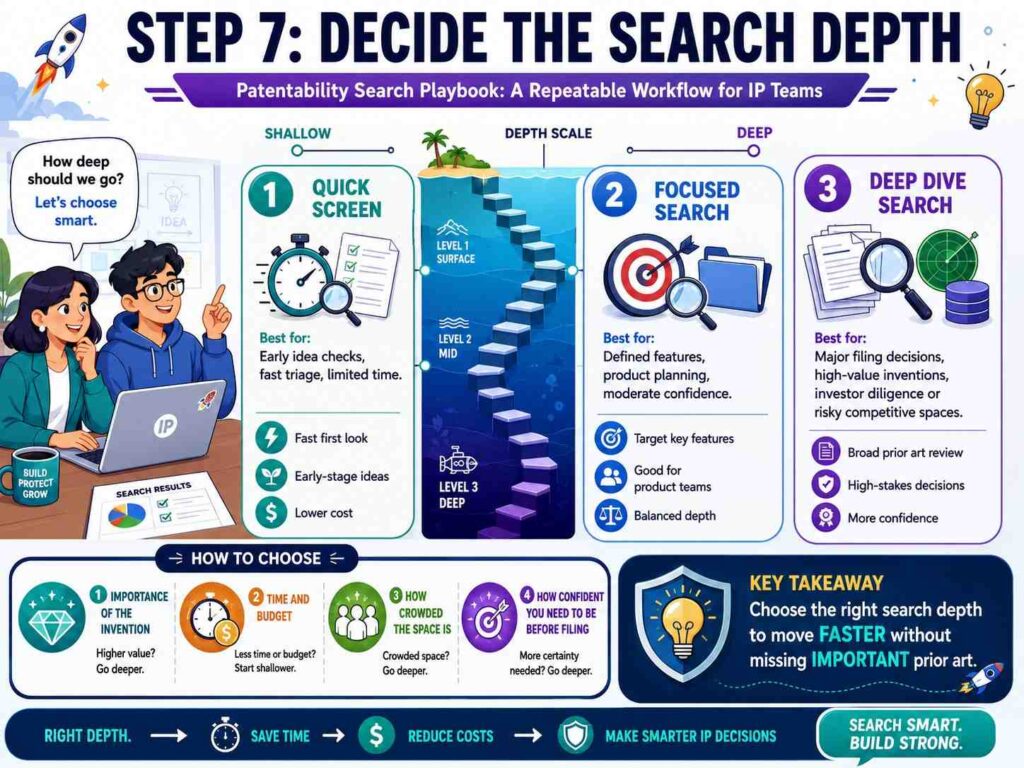
Not every invention needs the same search depth.
Use three levels.
A light search is for early ideas or low-priority features. It checks broad prior art and helps decide whether to keep exploring.
A focused search is for inventions that may be filed soon. It searches the key technical method, competitors, and field-specific sources.
A deep search is for core inventions, high-value filings, public disclosures, fundraising, partnerships, or crowded fields. It includes patents, non-patent sources, citations, competitors, foreign references, and attorney review.
This saves time.
Do not spend a deep-search budget on every small feature. Do not run a light search on the core invention before launch.
Step 8: Build the Search Term Set
Create search terms from the invention elements.
Use problem words, solution words, input words, action words, result words, older words, and competitor words.
For example, for AI action validation:
Problem words: unsafe automation, unauthorized action, unsupported action.
Solution words: validation, approval, blocking, source verification.
Input words: permission scope, customer policy, source data, evidence.
Action words: execute, block, route, approve, reject.
Result words: auditability, safe automation, compliance control.
Older words: task authorization, workflow approval, rule engine, access control.
This prevents one-query searching.
Search terms should evolve as the team finds new language in the prior art.
Step 9: Search by Source Type
Use the right source types for the field.
For SaaS and cloud, include patents, API docs, product help pages, GitHub, technical blogs, security standards, and release notes.
For AI, include patents, papers, preprints, model documentation, open-source repos, benchmarks, and product docs.
For hardware and robotics, include patents, drawings, manuals, datasheets, supplier catalogs, videos, standards, and papers.
For biotech and MedTech, include patents, papers, clinical trial records, protocols, labels, instructions for use, regulatory records, sequence databases, and conference abstracts.
The playbook should require the searcher to state which sources were searched and which were not.
That makes the conclusion more honest.
Step 10: Save the Search Log
Every search should leave a trail.
Record the date, source, query, filters, results, and notes.
This does not need to be fancy. It does need to be consistent.
A search log helps when counsel asks how the search was done. It also helps when the same feature comes back later.
A clean search log protects time.
It also gives the company a stronger record of how the filing decision was made.
Step 11: Pick the Top References
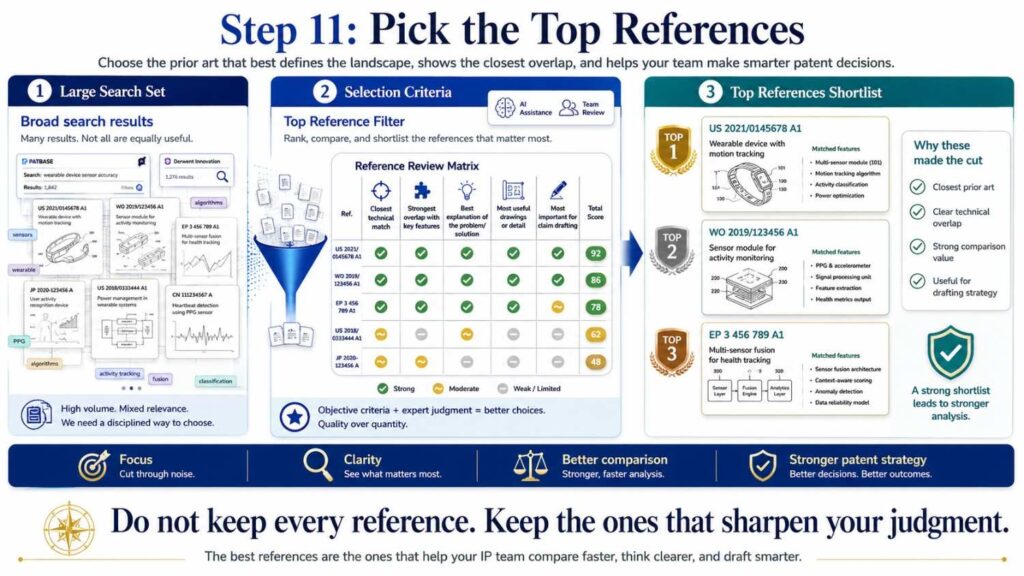
After searching, choose the closest references.
Do not list everything.
Pick the references that matter most because they show the same problem, same method, same structure, same workflow, same input, same timing, same output, or same result.
For each top reference, write a short plain-English note:
What it teaches.
Why it matters.
What it appears to miss.
This makes review faster and sharper.
Step 12: Build the Element Map
Create a simple element map.
Put the invention elements on one side and the closest references across the top.
For each reference, mark whether it shows each element:
Yes.
No.
Partial.
Unclear.
Then add a short note where needed.
This is the part of the playbook that turns search into analysis.
Without the element map, the team may argue by feeling.
With the element map, the team can see whether one reference shows the whole invention or whether the prior art only shows scattered pieces.
Step 13: Identify the Claim Anchor
The claim anchor is the part of the invention that appears different and valuable.
It should be the technical feature the filing is built around.
For example:
Source-data validation before AI action execution.
Matched-window pressure drift scoring.
Inflammation-normalized marker ratio.
Pre-visual blind-corner risk prediction.
Tenant-scoped audit packet generation.
Skin-contact and motion-based alert confidence.
The claim anchor should pass three tests:
It appears different from the closest prior art.
It creates a technical result.
It matters to the business.
If it fails any of those tests, the team should rethink the filing angle.
Step 14: Write the “Do Not Claim Broadly” Note
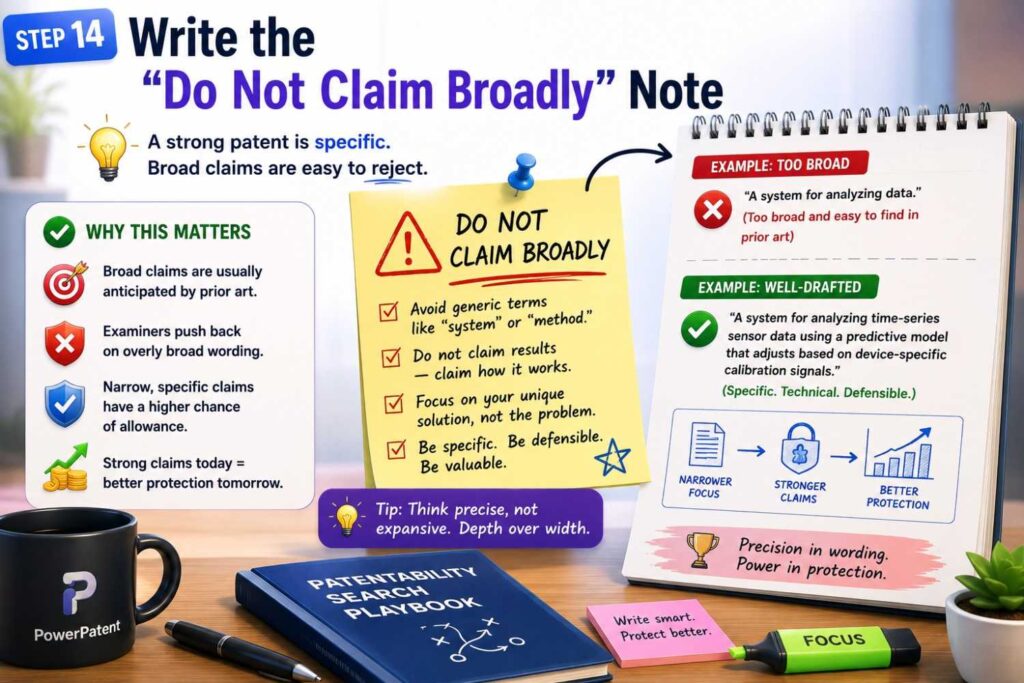
This is a powerful step.
After finding prior art, state what should not be claimed broadly.
For example:
“Do not claim generic AI workflow automation.”
“Do not claim pressure-based battery swelling detection broadly.”
“Do not claim wearable heart monitoring broadly.”
“Do not claim Marker A for Disease X broadly.”
“Do not claim robot collision avoidance broadly.”
This note keeps the filing disciplined.
It helps counsel avoid wasting effort on claims that are likely to run into prior art.
Step 15: Write the Recommended Claim Focus
Now write the claim focus in plain words.
For example:
“Focus on validating AI-generated actions using permission scope, customer policy, and source-data support before execution.”
Or:
“Focus on pressure drift comparison during matched charging windows, with risk adjustment based on charge rate and temperature.”
Or:
“Focus on the normalized marker ratio in low-volume plasma samples for early-stage patient risk.”
This does not replace legal claim drafting. It gives the attorney and business team a shared target.
Step 16: List Backup Positions
Backup positions are narrower versions that still matter if the broad claim is challenged.
For SaaS, backup positions may include policy source types, source confidence measures, audit logs, review routing, blocking actions, and tenant rules.
For AI, they may include source trust inputs, model confidence conflicts, second-model review, human review, feedback updates, and prompt risk.
For hardware, they may include sensor placement, timing windows, calibration, materials, operating modes, and control actions.
For biotech, they may include sample types, marker ranges, assay conditions, patient groups, dose ranges, and formulations.
Backup positions should be real and valuable.
Do not add random details just to create fallback claims.
Step 17: Check Design-Around Risk
Ask how a competitor could avoid the likely claim.
Could they change a notification channel?
Use a different sensor?
Use a nearby threshold?
Move the step earlier?
Replace human review with automated review?
Use a different sample type?
Use a different model?
If the answer is easy, the claim focus may be too narrow.
The team should then ask whether the invention can be framed around the deeper technical logic rather than one easy-to-change detail.
Step 18: Check Detectability
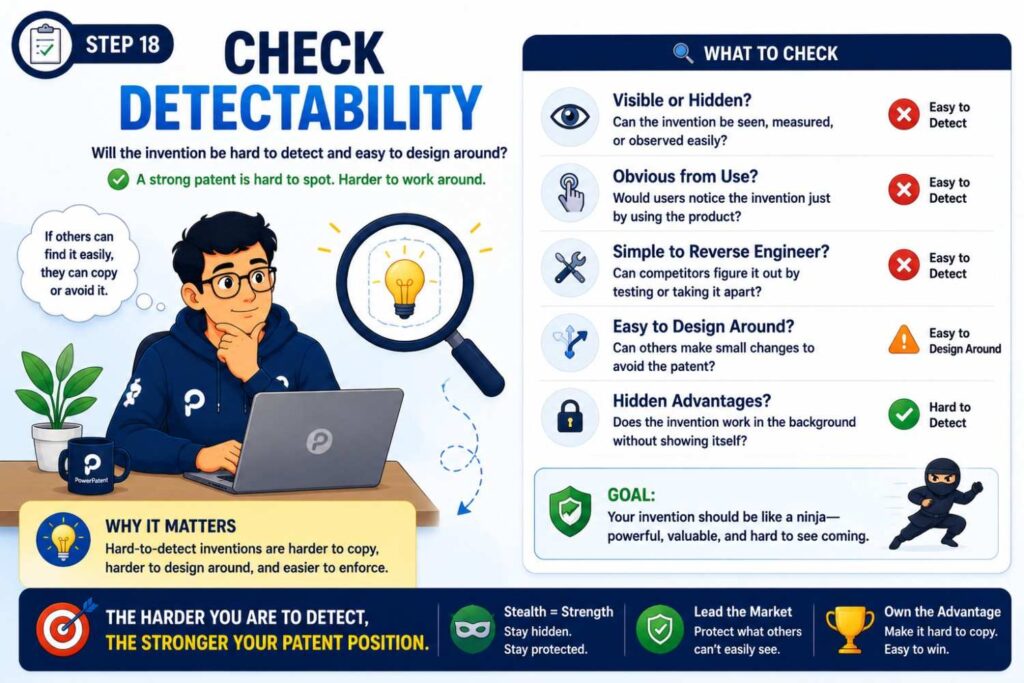
Ask whether the company could tell if a competitor uses the invention.
This matters for business value.
A visible device structure may be easy to detect.
An API validation state may be visible.
A report output may reveal the workflow.
A hidden model training method may be hard to detect.
A manufacturing condition may be invisible.
If detectability is low, the team should consider whether a trade secret strategy is better or whether the claim can focus on observable system behavior.
Step 19: Check Disclosure Timing
Before recommending a filing path, check timing.
Will the invention appear in a launch page, API docs, GitHub repo, product manual, white paper, conference talk, clinical trial record, investor deck, demo, or partner presentation?
Has it already been shared?
Was it confidential?
This step can change the recommendation.
A strong but private invention may allow more time for search and data.
A soon-to-be-public invention may require fast action.
Step 20: Decide Patent, Trade Secret, or Hold
After the search and mapping, decide which protection path fits.
File if the invention has a meaningful gap, business value, enough support, and disclosure urgency.
Consider trade secret if the valuable method is hidden, hard to reverse engineer, and can be kept confidential.
Hold if the invention is promising but needs more technical detail, data, or roadmap clarity.
Drop if the remaining claim is weak, crowded, easy to avoid, or low-value.
This decision should be written down.
Step 21: Prepare the Attorney Review Packet
Before sending to patent counsel, gather the key materials.
Include the invention sentence, problem, solution, result, elements, search log, closest references, element map, claim anchor, backup positions, business value, disclosure timing, and open questions.
Then ask a specific question.
For example:
“Should we file on this claim anchor before API docs publish, or should we search more around source-data validation?”
This gives counsel context and makes review faster.
PowerPatent helps teams create this kind of attorney-ready packet so search results lead to better filing decisions. See how PowerPatent works.
Step 22: Capture the Final Decision
After attorney review, update the record.
Write the decision clearly.
For example:
“File provisional focused on source-data validation before execution of AI-generated actions. Include backup support for policy sources, source confidence, review routing, blocking actions, and audit logs. Do not claim broad AI workflow automation.”
Or:
“Do not file now. Search shows broad marker claim is risky. Gather data on inflammation-normalized marker ratio and revisit before conference submission.”
Or:
“Treat backend scoring weights as trade secret candidate. File on visible workflow control behavior.”
This decision record is one of the most valuable outputs of the playbook.
Step 23: Assign Owners and Deadlines
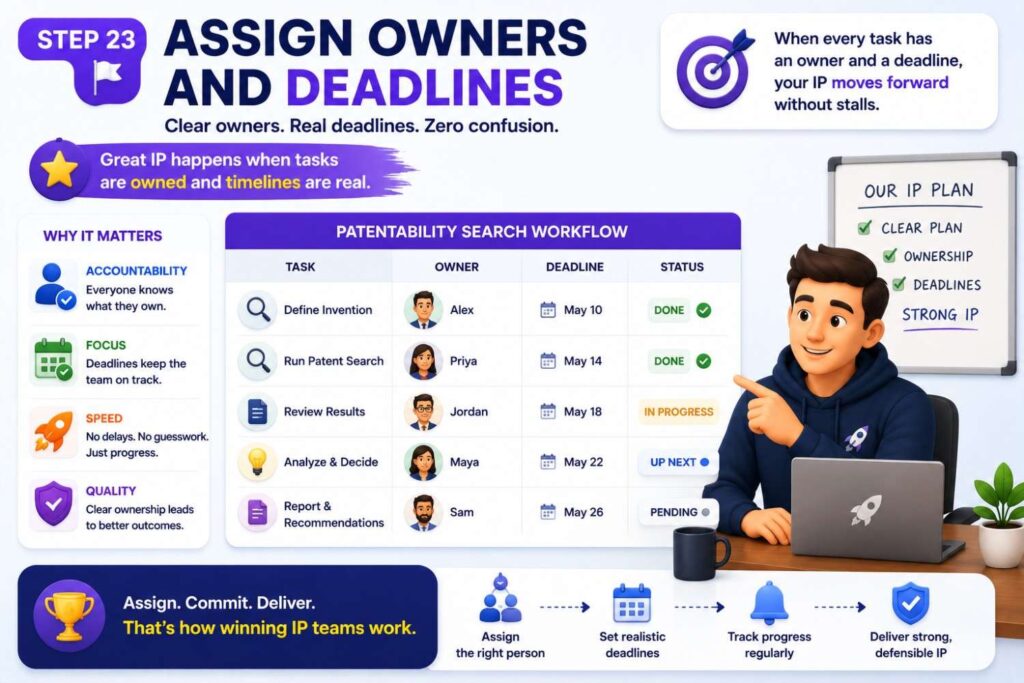
A decision without owners can still fail.
Assign who will provide technical diagrams, who will gather data, who will review public disclosure timing, who will coordinate with counsel, and who will approve filing spend.
Set deadlines around real business events.
For example:
“Draft filing before API docs publish.”
“Collect prototype data before non-provisional drafting.”
“Review poster before conference submission.”
“Decide trade secret controls before partner demo.”
This keeps IP work connected to company operations.
Step 24: Feed the Portfolio Map
Finally, add the result to the company’s IP portfolio map.
Mark the invention as filed, planned, held, trade secret candidate, dropped, or needs more search.
Also tag the product area, roadmap feature, competitor relevance, and public disclosure date.
Over time, this creates a clear view of the company’s IP position.
It helps the team see where patents are strong, where gaps remain, and where future filings should go.
A Simple Operating Rhythm for the Template
This template works best with a regular rhythm.
For example, an IP team can review new invention records every two weeks, run focused searches on priority items monthly, and hold attorney review sessions before major launches, demos, publications, or fundraising milestones.
The cadence can be light.
The key is consistency.
A repeatable rhythm prevents last-minute patent scrambles.
It also teaches teams that IP review is part of building, not a separate legal chore.
The Template Should Scale With the Company
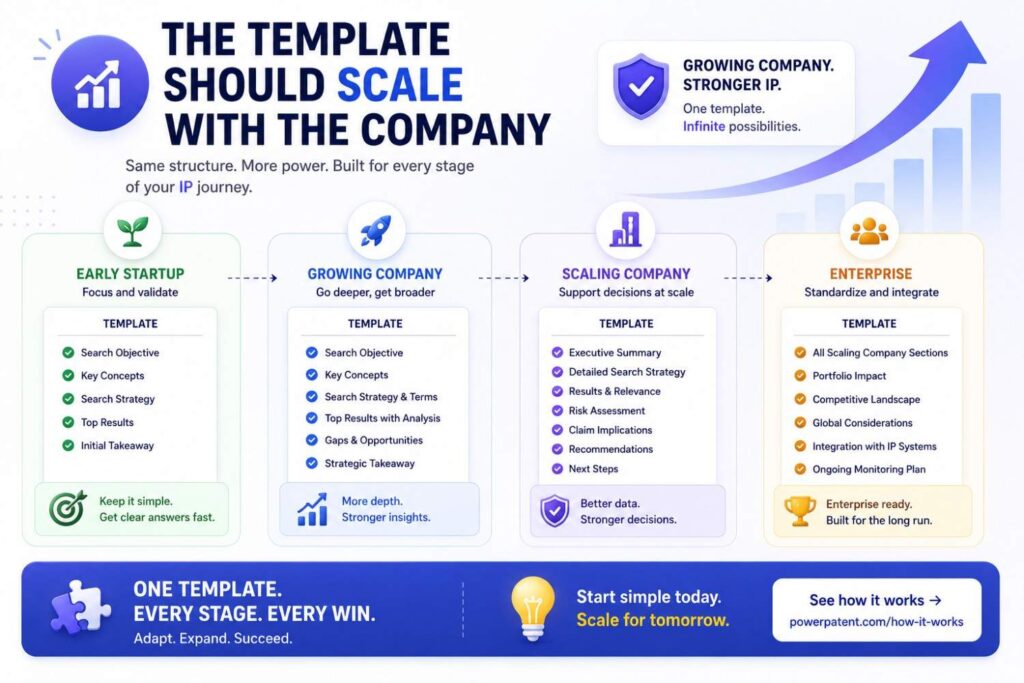
An early startup may use this template in a simple shared document.
A growing company may use structured tools, dashboards, attorney workflows, and portfolio tracking.
The process can scale, but the logic stays the same.
Capture the invention.
Search the right sources.
Map the closest art.
Find the claim anchor.
Tie it to business value.
Get attorney review.
Make a decision.
Record the decision.
That is the heart of the playbook.
PowerPatent helps teams put this workflow into practice without creating extra drag, so founders can protect important inventions while staying focused on building. See how PowerPatent works.
Example: SaaS Playbook in Action
Imagine a SaaS company has built a new AI automation feature.
The product team calls it:
“AI workflow copilot.”
The IP team does not search that phrase alone.
They ask for the technical invention.
The engineers explain:
“The system proposes workflow actions using AI, but before the action runs, it checks user permission, customer policy, and whether source data supports the action. If support is weak, it blocks or routes the action to review.”
The search question becomes:
“Does prior art show pre-execution validation of AI-generated workflow actions using permission, policy, and source-data support?”
The search covers patents, SaaS docs, API guides, workflow automation tools, AI agent papers, security policies, and competitor help centers.
The closest references show AI task suggestions, permission checks, policy approval, and audit logs. None clearly shows source-data support validation before execution.
The element map shows the likely gap.
The business value is clear: enterprise customers need trust before letting AI act.
The recommendation is:
“File on the validation layer before API docs publish. Do not file broadly on AI workflow automation. Include backup claims for source confidence, review routing, audit logs, and policy sources.”
That is a playbook outcome.
It is clear. It is fast. It is strategic.
Example: Hardware Playbook in Action
A battery startup has a safety feature.
The product team calls it:
“smart swelling detection.”
The IP team asks for the technical method.
The engineers explain:
“The system measures pressure, but instead of using a fixed threshold, it compares pressure drift during matched charging windows and adjusts the risk score based on charge rate and temperature.”
The search question becomes:
“Does prior art show matched-window pressure drift scoring for battery swelling risk during charging?”
The search covers patents, foreign publications, battery papers, product manuals, sensor supplier materials, and citation trails.
The closest art shows pressure sensors and fixed thresholds. Some references adjust for temperature. None clearly shows matched charging window drift comparison with charge-rate adjustment.
The business value is false-alert reduction during fast charging.
The recommendation is:
“File on matched-window pressure drift scoring if prototype data supports the result. Include backup claims for window definitions, context signals, sensor placements, and charging-control outputs.”
The broad idea is crowded. The specific method may be stronger.
Example: Biotech Playbook in Action
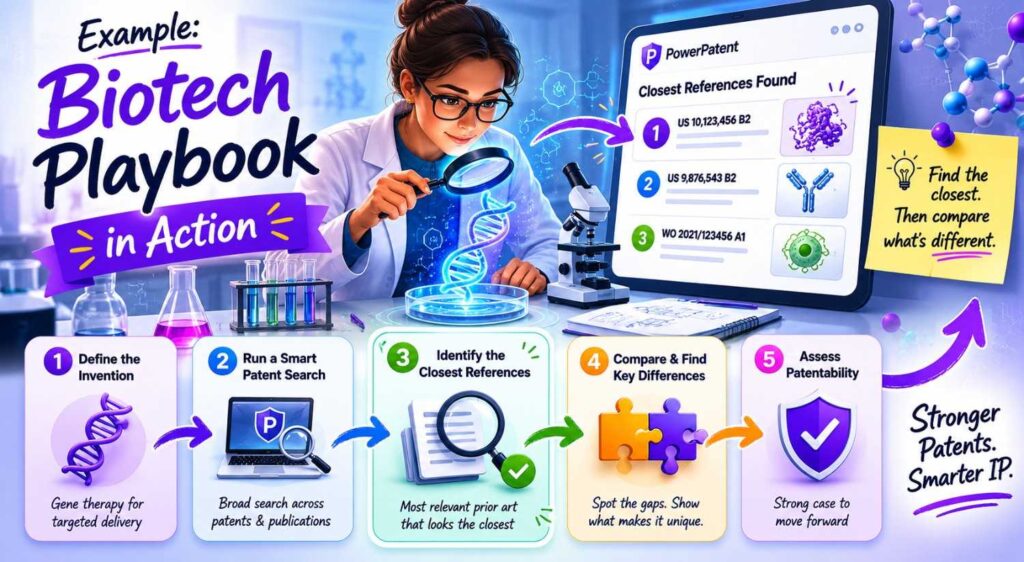
A diagnostic company has an early detection method.
The founder says:
“We found a new way to detect Disease X.”
The IP team asks for details.
The scientists explain:
“Marker A is measured with Marker B from a low-volume plasma sample. The ratio is normalized by inflammation score. This improves early-stage risk detection in patients with high inflammation.”
The search question becomes:
“Does prior art show an inflammation-normalized Marker A to Marker B ratio in low-volume plasma samples for early-stage Disease X risk?”
The search covers patents, papers, clinical trial records, assay protocols, disease biomarkers, related diseases, and marker databases.
The closest references show Marker A for Disease X and Marker B in related disease studies. None clearly shows the normalized ratio in the target sample and patient group.
The business value is reducing false positives.
The recommendation is:
“File around the normalized marker pattern if supporting data is strong enough. Do not claim Marker A alone. Include backup claims for sample types, threshold ranges, patient groups, and assay conditions.”
The playbook prevents a weak broad marker filing and points to a better claim.
How to Measure Whether the Playbook Is Working
A patentability search playbook should make the IP process clearer, faster, and more useful to the business.
But you should not judge the playbook only by how many searches were completed or how many patent applications were filed. Those numbers can be misleading.
A company can file many patents and still miss the real invention. It can run many searches and still make poor decisions. It can create long reports that nobody uses.
The better question is this:
Is the playbook helping the company make smarter IP decisions before money, time, or public disclosure is at risk?
That is the real measure.
Measure Decision Quality, Not Just Activity
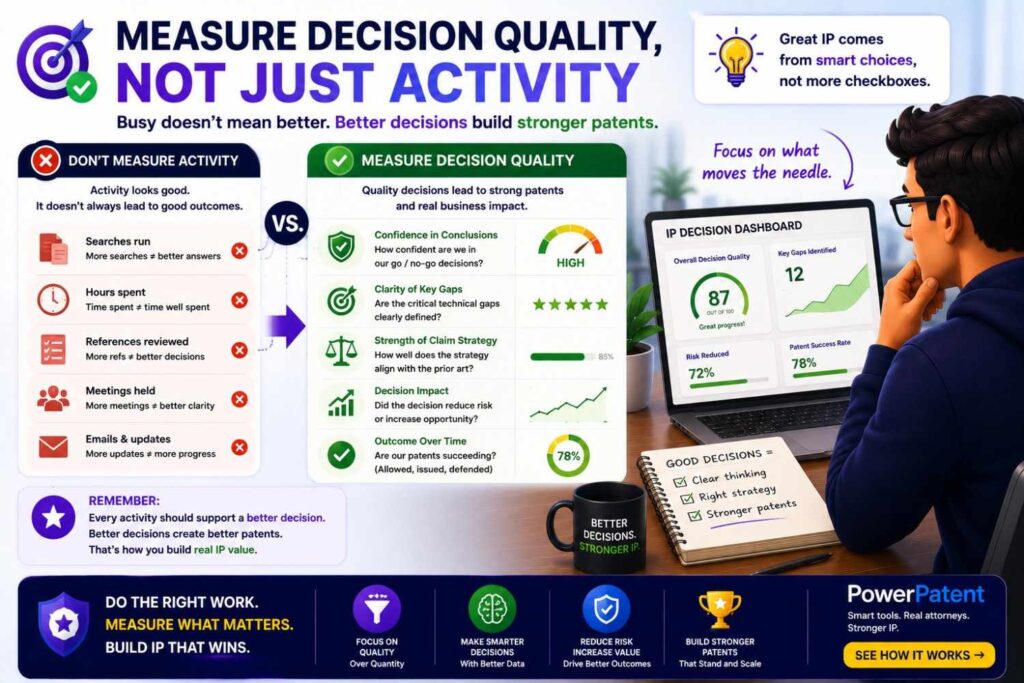
A weak IP process measures activity.
How many invention forms were submitted?
How many searches were run?
How many patents were filed?
Those numbers are useful, but they do not tell the whole story.
A strong playbook measures decision quality.
Did the search lead to a clear file, narrow, pivot, trade secret, search more, or drop decision?
Did the team understand why the decision was made?
Did the filing focus on the strongest technical gap?
Did the patent attorney have enough information to give useful advice?
Did the business avoid filing on weak ideas?
Did the search reveal a better invention inside the product?
Those are better signs.
A good playbook should reduce fuzzy outcomes. If every search ends with “maybe” or “needs more review,” the process is not working well enough. The workflow should move the team toward a clear next step.
Track Time From Invention Capture to Decision
Speed matters, especially for startups.
But speed should mean faster clarity, not rushed filings.
One useful metric is the time between invention capture and a decision.
For example:
When did the invention enter the system?
When was it triaged?
When was the search completed?
When did counsel review it?
When did the company decide to file, narrow, pivot, search more, keep secret, or drop?
If this process takes too long, valuable features may be publicly disclosed before the IP team acts. If it happens too fast with poor detail, the filing may be weak.
The goal is steady, reliable movement.
A healthy playbook helps the team make timely decisions without skipping the hard questions.
Track How Often Searches Change the Filing Strategy
A useful search should influence strategy.
If every search simply confirms the original filing idea, the team may not be digging deeply enough.
Track how often search results cause the team to change direction.
For example:
The team starts with a broad SaaS automation idea, but the search shifts the filing to source-data validation.
The team starts with a broad hardware sensor idea, but the search shifts the filing to sensor placement and timing.
The team starts with a broad diagnostic marker idea, but the search shifts the filing to a normalized marker ratio.
The team starts with a product feature, but the search shows a manufacturing method is stronger.
These shifts are a sign the playbook is working.
A good search does not always say “yes.” Sometimes it improves the claim focus. Sometimes it prevents a bad filing. Sometimes it finds the real invention.
Track Weak Filings Avoided
A strong playbook should help the company avoid bad patent spend.
This can be measured.
Track inventions that were dropped or paused because the search showed high risk, weak business value, easy design-around risk, poor detectability, or lack of technical support.
This is not a failure metric.
It is a savings metric.
For example:
“Dropped broad AI workflow claim because prior art showed the main elements.”
“Paused wearable alert filing because the only difference was a notification format.”
“Moved backend scoring formula to trade secret review because the method was hidden and hard to detect.”
“Delayed diagnostic filing until more data supports the marker ratio.”
These decisions protect budget.
They also show that the IP team is acting strategically, not filing everything that sounds new.
Track Attorney Review Efficiency
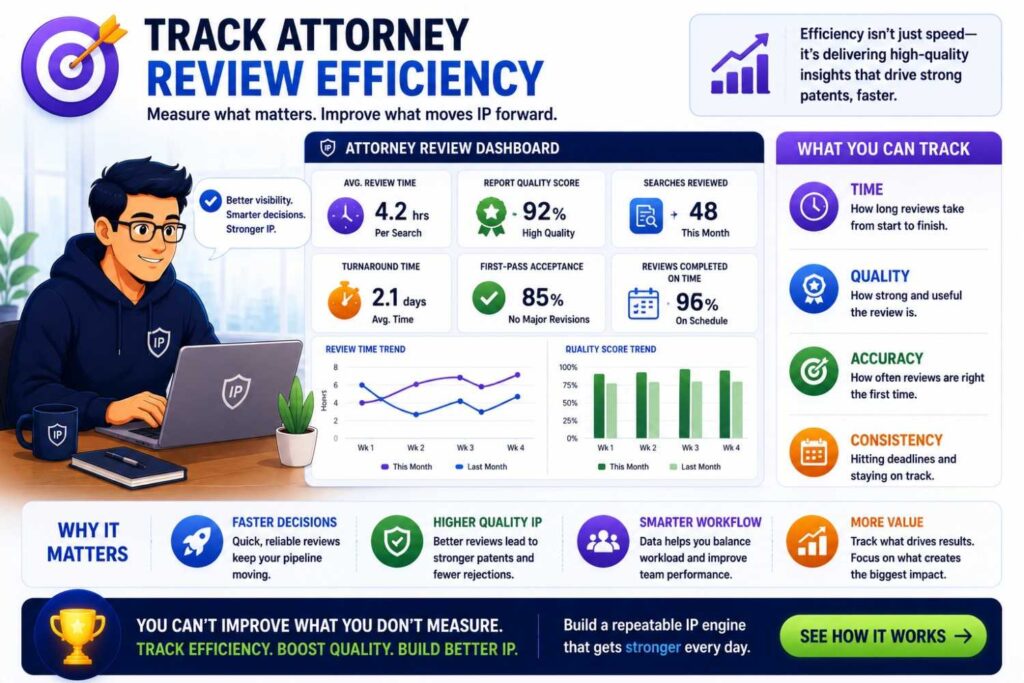
Patent counsel can move faster when they receive better inputs.
Measure whether the playbook improves attorney review.
Useful signs include:
Fewer clarification calls before counsel understands the invention.
Faster claim strategy feedback.
Better attorney comments on first review.
Fewer requests for basic technical information.
More complete invention disclosures.
Clearer prior art maps.
Better backup claim ideas before drafting begins.
If attorneys keep asking, “What is the actual invention?” the playbook is not capturing enough detail.
If counsel can quickly say, “The strongest claim angle is here,” the workflow is working.
PowerPatent helps teams organize invention details, search findings, and attorney questions so counsel can spend more time on strategy and less time chasing missing context. See how PowerPatent works.
Track Claim Focus Improvements
A good playbook should improve claim focus.
Before the playbook, filings may have started from broad product language.
After the playbook, filings should start from sharper technical gaps.
For example:
Before: “AI compliance automation.”
After: “Pre-execution validation of AI-generated workflow actions using permission, policy, and source-data support.”
Before: “Battery swelling detection.”
After: “Matched-window pressure drift scoring based on charge rate and temperature.”
Before: “Robot obstacle avoidance.”
After: “Pre-visual hidden crossing risk prediction using sound direction, map geometry, and traffic history.”
This shift is measurable.
Review draft invention statements before and after search. If they become more specific, more technical, and more tied to business value, the playbook is helping.
Track Public Disclosure Saves
One of the most valuable outcomes of a playbook is catching inventions before public disclosure.
Track how often the workflow identifies a disclosure risk before it becomes a problem.
For example:
A product team plans to publish API docs that reveal an AI validation workflow.
A founder plans to present a conference slide showing a diagnostic method.
A robotics team plans to post a demo video showing a control behavior.
A SaaS team plans to open source code that reveals a sync repair method.
A MedTech team plans to share a clinical workflow in a pilot deck.
When the playbook catches these moments early, it protects options.
Create a simple metric:
How many potential public disclosures were reviewed for patent impact before release?
This metric is especially important for fast-moving teams.
Track Portfolio Fit
A good playbook should produce filings that fit the company’s portfolio strategy.
Ask:
Do the filings protect the core product?
Do they support the roadmap?
Do they cover different layers of the moat?
Do they align with what customers value?
Do they help with fundraising or enterprise sales?
Do they protect features competitors would copy?
If the company files many patents but they do not map to product value, the playbook is not working.
A useful review is to map each filing to a business driver.
For example:
Trust and safety.
Cloud cost reduction.
Diagnostic accuracy.
Manufacturing scale.
Robot safety.
Data privacy.
AI reliability.
Clinical workflow.
Enterprise compliance.
If a filing does not support any business driver, ask why it exists.
Track Inventor Engagement
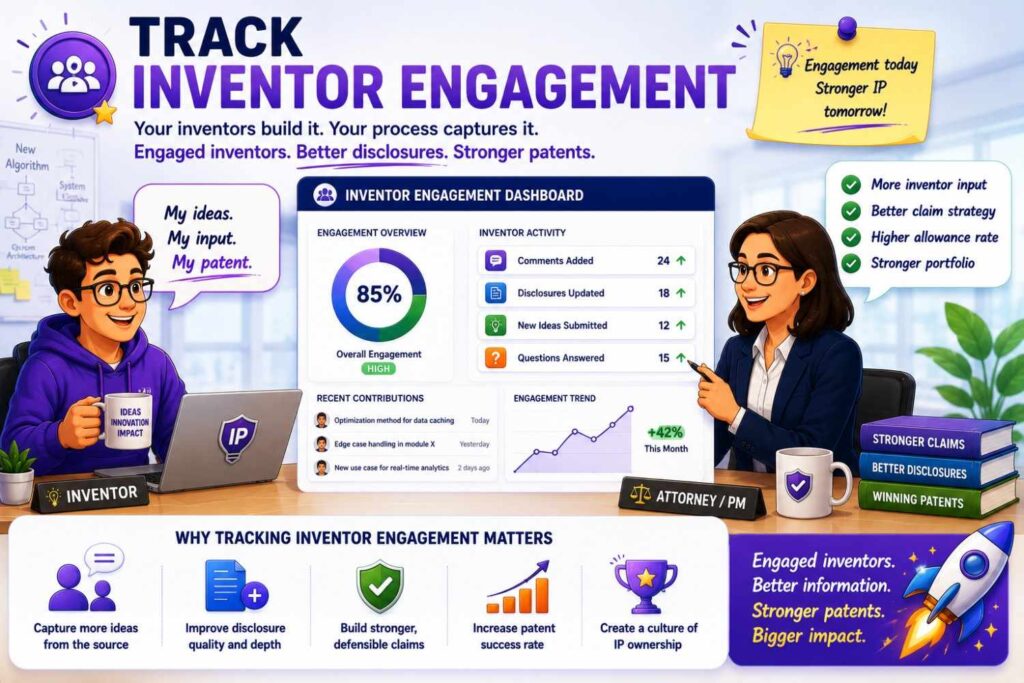
A playbook only works if inventors use it.
Measure whether engineers, scientists, product teams, and founders are participating.
Look for signals like:
More invention submissions from technical teams.
Better quality invention notes.
More engineers attending search review meetings.
More early warnings before public disclosure.
More roadmap features flagged for IP review.
More technical alternatives captured before drafting.
If submissions are low, the playbook may be too hard, too legal, or poorly explained.
If engineers submit vague notes, they may need better examples.
If only founders submit invention ideas, the company may be missing deeper technical work.
A good playbook should make inventors feel that IP review is part of building, not a legal chore.
Track Search Reuse
A search report should not be used once and forgotten.
Measure whether prior search work is reused.
For example:
Does a search report help a later continuation filing?
Does it help a roadmap review?
Does it help investor diligence?
Does it help a new attorney understand the portfolio?
Does it prevent duplicate searches?
Does it help decide whether a new feature is different from an old filing?
If search reports are never reused, they may be too hard to find, too unclear, or not connected to portfolio planning.
The playbook should create durable records.
A good search report should still be useful six months later.
Track Decision Consistency Across Teams
A repeatable playbook should make decisions more consistent.
Without a playbook, one product team may get a full search while another gets none. One invention may be filed quickly while a more important one gets missed. One attorney packet may be clear while another is vague.
Track whether similar inventions are handled in similar ways.
For example:
Core platform inventions should get deeper search and attorney review.
Minor UI changes should be triaged quickly.
Hidden backend methods should trigger patent-versus-trade-secret review.
Features near public disclosure should get fast review.
Roadmap features should be captured before they become launch materials.
Consistency does not mean every invention gets the same treatment. It means the treatment matches the risk and value in a predictable way.
Track Budget Impact
A playbook should help the company spend patent budget better.
Track budget outcomes.
Did the company reduce low-value filings?
Did more filings map to core product value?
Did attorney time shift from basic fact-gathering to claim strategy?
Did the company avoid last-minute rush fees?
Did the playbook help prioritize filings before fundraising, launch, or partnership talks?
Did it help decide when not to file?
Patent budget should not be measured only by cost.
It should be measured by strategic return.
A smaller number of stronger filings may be better than a large number of weak ones.
Track Quality of Filing Inputs
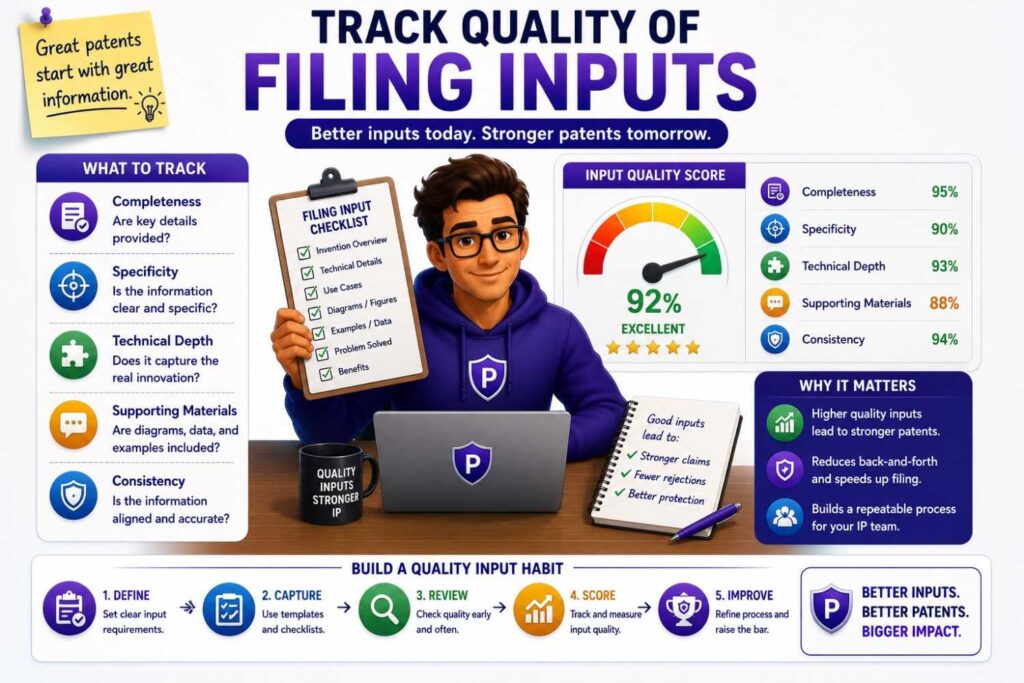
Before the playbook, invention disclosures may be vague.
After the playbook, they should include better technical detail.
Measure whether attorney packets include:
A clear invention statement.
The technical problem.
Key elements.
Closest prior art.
Element mapping.
Business value.
Disclosure timing.
Backup positions.
Open questions.
Roadmap variants.
If these items are missing often, the playbook needs adjustment.
Good inputs make good filings more likely.
Track Outcomes During Patent Examination
Patent examination takes time, so this is a lagging measure. But it is still useful.
Over time, track whether applications that went through the playbook have better prosecution outcomes.
Look for signs like:
Fewer severe prior art surprises.
More useful claim amendments.
Better ability to distinguish over examiner references.
More fallback positions available.
Fewer abandoned cases due to weak support.
Claims that still map to product value after amendment.
No playbook can guarantee allowance.
But a strong playbook should reduce avoidable problems.
Track Whether Search Leads to Better Roadmap Choices
A mature IP team uses search findings to support product strategy.
Track whether search reports influence roadmap decisions.
For example:
A search shows a broad feature is crowded, so the team invests in a more defensible technical workflow.
A search shows a hidden manufacturing method may be valuable, so the team protects it as a trade secret.
A search shows competitors are filing around one area, so the company explores a different technical path.
A search shows a future feature may be patentable, so product avoids public disclosure until filing.
This is a sign the playbook is becoming a business tool, not just a patent process.
Track Leadership Confidence
A strong playbook should make leadership more confident in IP decisions.
Executives should be able to answer:
Why are we filing this?
What does it protect?
What prior art was closest?
Why is the claim angle worth it?
What is the risk?
What are we not filing?
What should stay secret?
What disclosures matter?
If leaders cannot answer these questions, the playbook may not be communicating well enough.
The goal is not to turn executives into patent lawyers. The goal is to give them a clear IP decision story.
Run a Quarterly Playbook Review
The playbook should improve over time.
Hold a short quarterly review.
Ask:
Which searches led to good decisions?
Which filings were rushed?
Which invention disclosures were too thin?
Which public disclosures were almost missed?
Which reports were most useful?
Which reports were ignored?
Which teams submitted strong ideas?
Which teams need more training?
Which search sources were most valuable?
Which parts of the workflow slowed people down?
This review keeps the process alive.
Do not wait a year to fix a broken workflow.
Use a Simple Scorecard
A useful scorecard can be simple.
Track:
Inventions captured.
Inventions triaged.
Searches completed.
Average time to decision.
File, narrow, pivot, search more, trade secret, drop decisions.
Filings tied to core business drivers.
Disclosure risks caught before release.
Attorney review turnaround.
Reports reused in later decisions.
Weak filings avoided.
Do not overload the scorecard.
The goal is visibility, not bureaucracy.
A scorecard should help the IP team see whether the playbook is creating better decisions.
Watch for Warning Signs
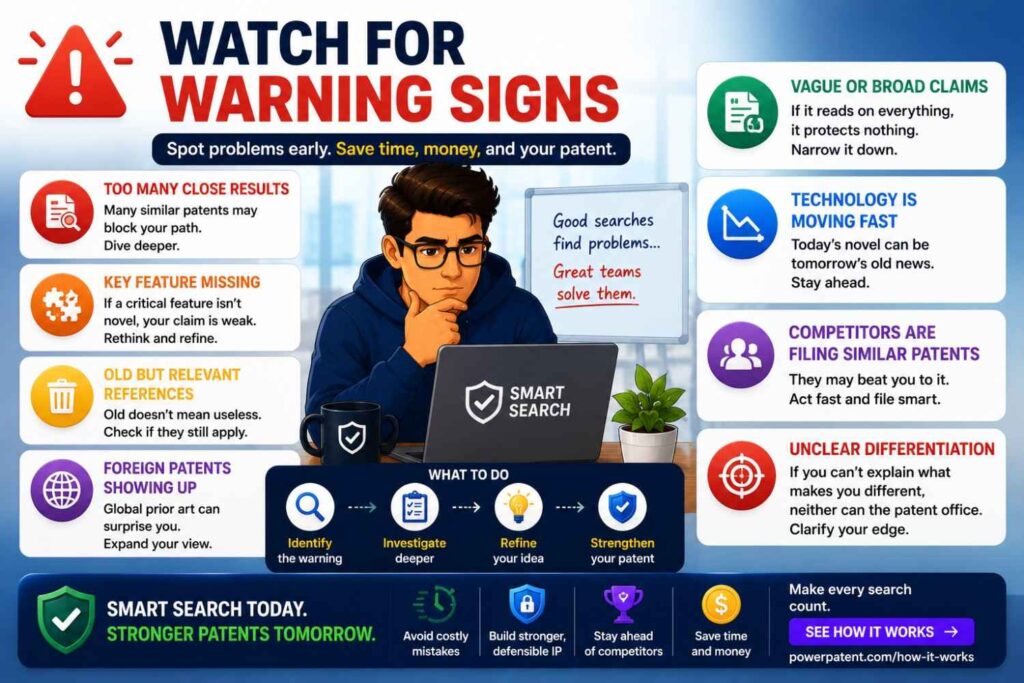
A playbook may look active but still fail.
Watch for warning signs.
Every invention gets filed.
No inventions get dropped.
Reports end with “no exact match found.”
Attorneys keep asking for basic invention details.
Searches do not include non-patent sources.
Engineers are not involved.
Public disclosures are reviewed too late.
Claims keep focusing on product categories.
Trade secret review never happens.
Search reports are never reused.
Leadership cannot explain the filing strategy.
These signs mean the workflow may be producing activity, not strategy.
Improve the Playbook Based on Real Friction
When the playbook fails, do not blame the team first.
Look for friction.
Is the invention form too long?
Are search responsibilities unclear?
Are attorneys involved too late?
Are product teams unaware of disclosure risk?
Are engineers unsure what counts as an invention?
Are reports too dense?
Are recommendations too vague?
Are decisions not recorded?
Fix the process.
A playbook should make good behavior easy.
The Best Measure Is Better Patent Decisions
At the end, the best measure is simple.
Are you making better patent decisions?
Better decisions mean the company files on stronger inventions, avoids weak filings, catches public disclosure risk earlier, gives attorneys better inputs, protects business value, and builds a portfolio that matches the roadmap.
That is what the playbook is for.
Search is not the end product.
The decision is the end product.
PowerPatent helps IP teams build this kind of repeatable workflow by connecting invention capture, search organization, attorney review, and filing strategy in one smoother process. See how PowerPatent works.
Common Playbook Mistakes to Avoid
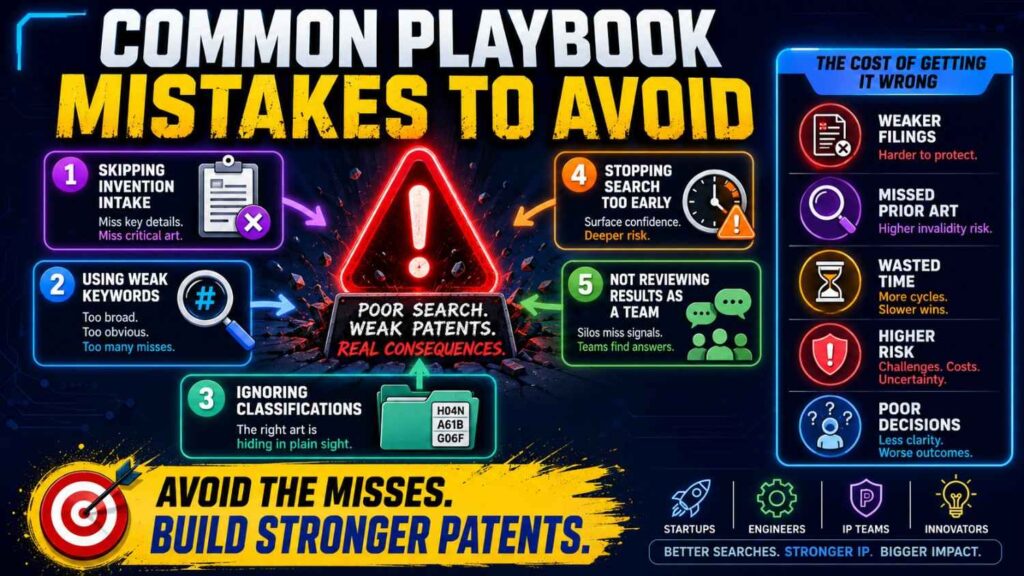
Do not make the workflow too heavy.
If it is painful, teams will avoid it.
Do not search without first defining the invention.
That leads to noise.
Do not rely only on patents.
Important prior art often lives elsewhere.
Do not let “no exact match” become the conclusion.
Map elements.
Do not ignore business value.
Patentability alone is not enough.
Do not skip attorney review for core inventions.
Legal judgment matters.
Do not forget public disclosures.
Timing can change the whole plan.
Do not file on everything.
Budget should follow strategy.
Do not let reports disappear.
Use them to guide portfolio planning.
A playbook is only valuable if people use it.
Final Takeaway
A patentability search playbook gives IP teams a repeatable way to turn invention ideas into filing decisions.
It helps teams capture the real invention, search the right sources, compare prior art clearly, identify the strongest gap, assess risk, connect the gap to business value, and decide what to do next.
The best playbook does not slow the company down.
It gives the company control.
It helps avoid weak filings. It helps protect the real technical edge. It helps founders speak about IP with confidence. It helps attorneys draft from better inputs. It helps the business spend patent budget wisely.
Search is not the end goal.
The decision is the goal.
And when your team is ready to turn invention capture, search results, attorney review, and filing strategy into a stronger repeatable workflow, PowerPatent can help you move faster with smart software and real patent attorney oversight.