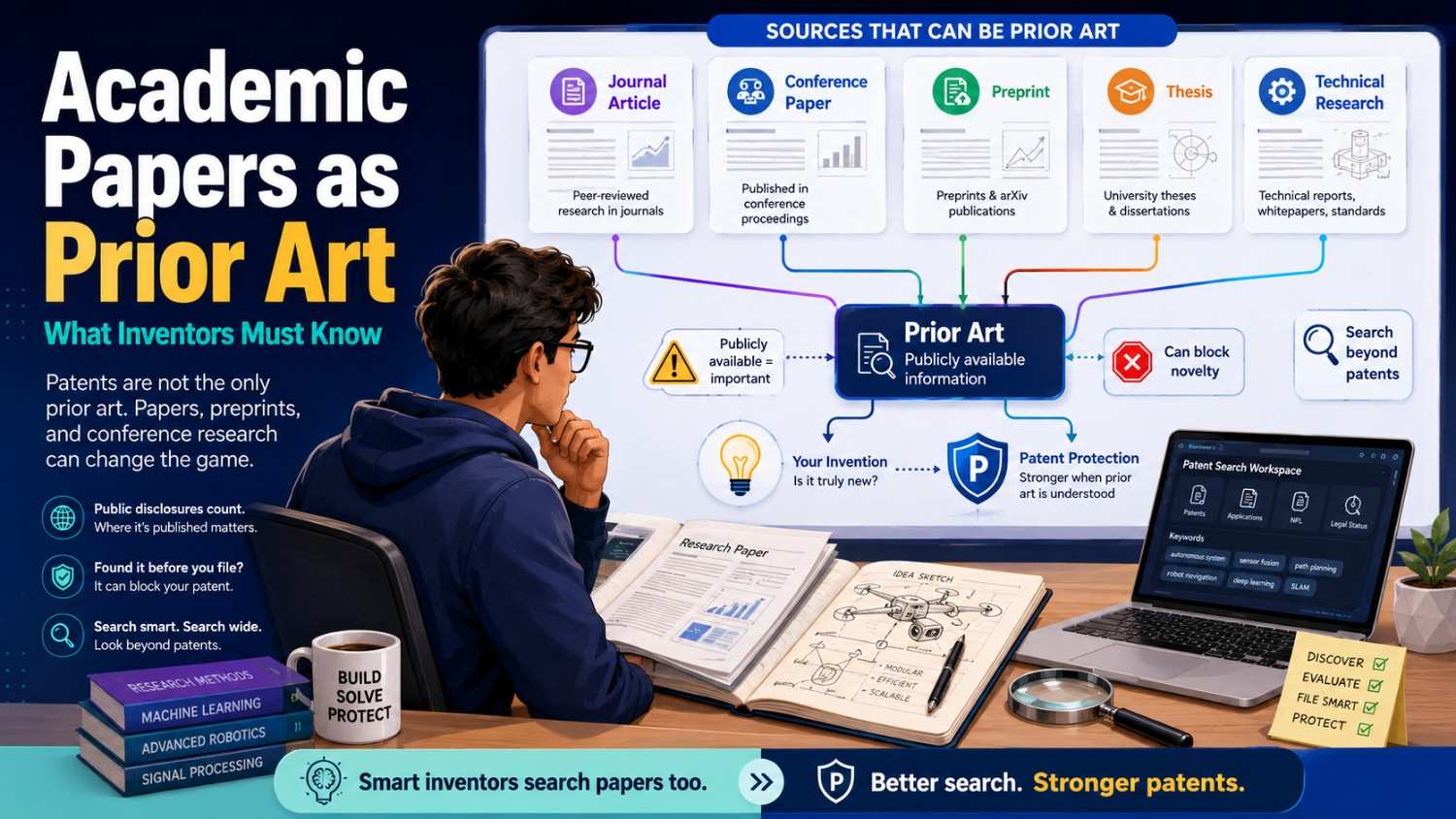
Academic papers can help or hurt a patent. They can show that your idea is strong. They can also show that someone already shared the same idea before you filed.
That is why founders, engineers, and inventors need to understand them.
This guide explains, in simple words, how academic papers can count as prior art, how to search them, how to read them, and how to use them to build a smarter patent plan.
PowerPatent helps founders turn technical ideas, research, code, and product work into stronger patent filings with smart software and real patent attorney oversight. You can see how it works here: https://powerpatent.com/how-it-works
What Prior Art Means in Plain English
Prior art is old public information that may be used to test whether your invention is really new.
That old information can come from many places. It can come from patents. It can come from patent applications. It can come from product manuals, websites, videos, conference slides, public code, standards, posters, public talks, and academic papers.
For this article, we are focused on academic papers.
An academic paper is not just “research.” In patent work, it can be a serious source of prior art. A paper from a university, lab, conference, journal, research group, or public preprint site may describe an idea before your patent filing date.
Under U.S. patent law, prior art can include things that were patented, described in a printed publication, in public use, on sale, or otherwise available to the public before the effective filing date of the claimed invention. The USPTO also explains that non-patent printed publications can be used as prior art.
That may sound formal, but the idea is simple.
If the public already had access to the same idea before you filed, you may not be able to patent that same idea.
This does not mean every paper kills every patent.
A paper must be looked at carefully. What did it actually say? When was it public? Could people in the field find it? Did it teach the same thing as your invention? Did it only discuss a goal, or did it show a real method? Did it leave out the part that makes your invention different?
Those details matter.
A founder should not panic just because a paper is in the same field. But a founder should not ignore it either.
Academic papers are often where early technical ideas appear first. In AI, biotech, robotics, quantum, semiconductors, climate tech, medical devices, and software infrastructure, research papers can come years before products.
That means your patent search should not stop at patent databases.
You need to search the research world too.
Why Academic Papers Matter So Much for Startups
Startups often move fast. That is good. Speed helps you learn. Speed helps you sell. Speed helps you win.
But speed can also create blind spots.
A founder may believe an invention is new because no product looks the same. But an academic paper may have described a similar method years earlier.
This happens often in deep tech.
A machine learning founder may build a new model workflow and later find a paper from a research lab that used a similar training method.
A robotics team may design a better grasping system and later find a conference paper that tested the same control idea.
A medical device startup may build a screening tool and later find a journal article that described the same scoring method.
A climate tech company may design a new sensor system and later find a university paper that tested the same sensor layout.
The market may not know the paper. Customers may not know it. Investors may not know it. But patent examiners and competitors may still find it.
That is why academic papers matter.
They are often quiet. They do not always become products. They may sit behind a strange title. They may use different words than your team uses. But they can still shape your patent path.
A paper may create risk if it shows the same invention before you filed. A paper may also help you if it shows that the problem was known but not solved in your way. It may show that others tried and failed. It may show gaps in the field. It may help you explain why your method is different.
In other words, academic papers are not only threats.
They are maps.
They help you see what came before, what is crowded, and where your invention may still stand out.
If your startup is working in a research-heavy field, you should make academic paper search part of your patent process from the start.
PowerPatent helps technical teams bring research context, product notes, code, models, and invention details into one clearer workflow. That makes it easier to work with real patent attorneys without slowing down your team. Learn more here: https://powerpatent.com/how-it-works
When an Academic Paper Can Count as Prior Art
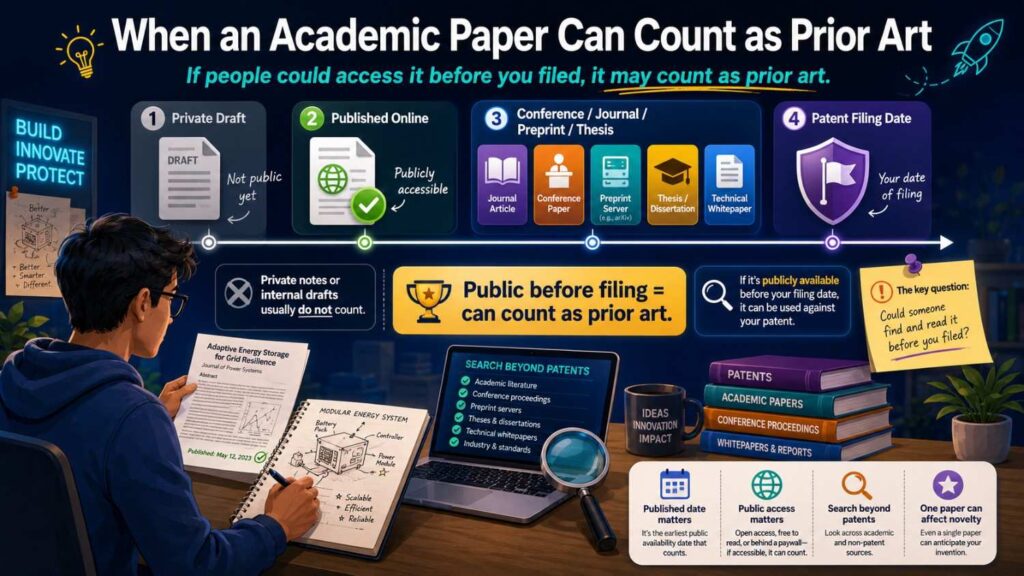
The key idea is public access.
A paper can matter as prior art when it was available to the public before the date that matters for your patent.
The USPTO’s patent examining manual explains that, for printed publications, the key question is whether the reference was publicly accessible. In simple terms, the paper must have been available enough that people interested in the field could find it with reasonable effort.
This is important.
A paper does not have to be famous. It does not have to be read by thousands of people. It does not have to be printed on paper. Online publications can also count when they are publicly accessible.
A journal article can count.
A conference paper can count.
A thesis can count.
A dissertation can count.
A public preprint can count.
A paper in an online database can count.
A technical report from a university can count.
A poster or slide deck may count in some cases, depending on the facts.
The question is not, “Did the inventor know about it?”
The question is closer to, “Was it available to the public before the filing date, and does it teach the invention?”
That can surprise founders.
Many inventors think prior art only means patents. That is not true. A strong academic paper can be just as important as a patent.
A paper can be written by a professor, a student, a company researcher, a government lab, or a nonprofit group. It can be in a journal or on a public website. It can be from another country. It can be in another language.
If it was public and it teaches the same idea, it may matter.
This is why a patent search should include both patents and non-patent literature. Google Patents, for example, lets users search patents and also includes non-patent literature in its index.
But tools alone are not enough.
You need a strategy.
The Filing Date Is the Line in the Sand
For inventors, the filing date is one of the most important dates in the whole patent process.
A filing date is the date your patent application is filed. In many cases, prior art is measured against that date.
Under current U.S. law, prior art includes certain public information that came before the effective filing date of the claimed invention.
That means timing matters.
If a paper came out before your filing date, it may be prior art.
If your own paper came out before you filed, it may also create problems, though U.S. law has some grace period rules that may apply in certain cases. Those rules can be tricky, and other countries can be stricter. You should talk to a patent attorney before you publish.
This is a big deal for academic founders.
Many researchers are trained to publish fast. That is how academic careers work. Papers, posters, preprints, conference talks, and grant reports are part of the research world.
But startups live in a different world.
If the same invention will be the core of a company, public disclosure before filing can create real patent risk.
This does not mean you should never publish. It means you should plan.
Before you post a preprint, submit a paper, present at a conference, publish a thesis, open-source code, or share a detailed technical blog, pause and ask:
Is there an invention here that may be worth protecting?
If the answer is yes, talk to a patent attorney before the disclosure.
This one step can save a lot of pain.
PowerPatent is built for this kind of speed. It helps founders capture the invention quickly and work with real patent attorneys so they can move toward filing before public details create trouble. See the workflow here: https://powerpatent.com/how-it-works
Academic Papers Can Hurt Novelty
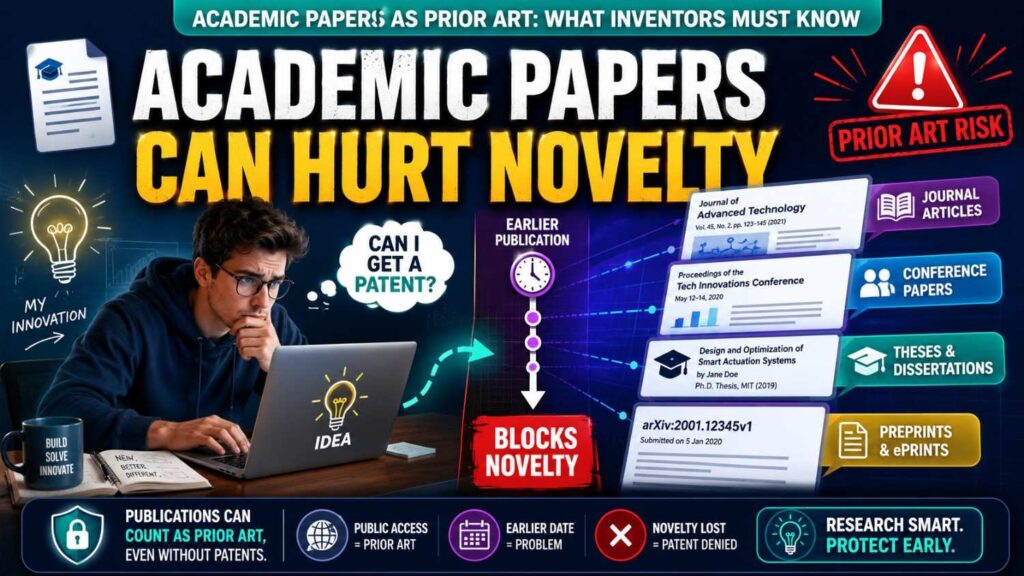
Novelty means newness.
In plain English, your invention must be new compared with what came before.
If one academic paper clearly describes every important part of your invention before you filed, that paper may hurt novelty.
For example, imagine your startup wants to patent a method for detecting battery failure in drones.
Your method uses temperature data, vibration data, and flight pattern data to predict failure before landing.
Now imagine a university paper from three years ago describes the same method. It receives the same data, uses the same process, and produces the same warning.
That paper may be a serious problem.
It does not matter that the paper never became a product. It does not matter that the paper came from a lab. It does not matter that your team built a nicer version.
If the paper teaches the same claimed invention, it may block broad patent protection.
But details matter.
Maybe the paper only used temperature data, while your system uses temperature plus vibration plus flight path changes.
Maybe the paper only worked after a battery fault began, while your system predicts risk before the fault.
Maybe the paper used lab data, while your system works in live drone fleets and changes flight plans in real time.
Maybe the paper predicted failure, but did not control the drone.
Those differences may matter.
So do not stop at “the topic is similar.” Read the paper closely.
A similar problem is not always the same invention.
The key question is what the paper actually teaches.
Academic Papers Can Hurt Non-Obviousness
Even if no single paper shows your whole invention, several papers may be combined to argue that your invention was obvious.
This is harder to understand, but the basic idea is simple.
A patent is not only tested for newness. It is also tested for whether the invention is a real step forward.
If one paper shows part A, another paper shows part B, and a person in the field would have had a clear reason to combine them, your invention may face a harder path.
For example, one paper may show a model that predicts crop disease from leaf images. Another paper may show a drone system that maps farm fields. Your invention may combine drones and image-based disease prediction.
Is that patentable? Maybe. Maybe not.
It depends on the details.
Did your system solve a hard technical problem? Did it work in a new way? Did it combine data in a special manner? Did it reduce false alarms? Did it handle poor lighting? Did it choose flight paths based on model uncertainty? Did it improve real-world action?
A simple mix of known parts may be harder to protect. A specific technical improvement may still be strong.
Academic papers are very important here because they often show building blocks. They may show algorithms, experiments, materials, device structures, lab methods, or data techniques.
A good patent strategy must look at those building blocks and ask what your invention adds.
This is where founder clarity matters.
Do not say, “We use AI for farming.”
Say, “Our system changes drone flight paths based on uncertainty in the disease model, so the drone collects extra images only where the model is unsure.”
That is more specific. It gives your patent attorney something real to work with.
Academic Papers Can Also Help You
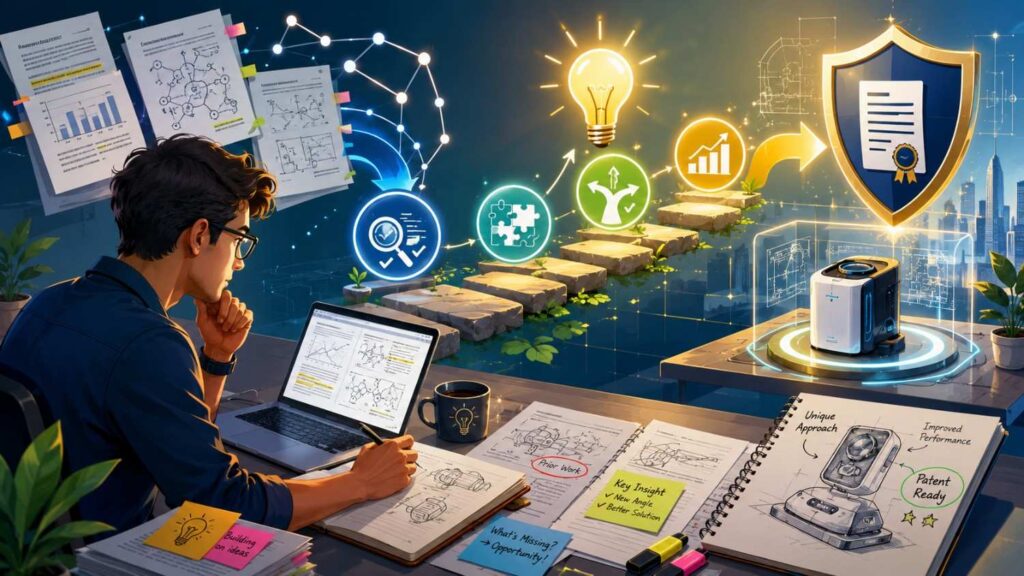
It is easy to think of prior art as bad news.
But academic papers can help you too.
They can show that the problem was real. They can show that old methods had limits. They can show that experts cared about the issue. They can show that the market or technical field had a need for better tools.
A paper may say that a method works only in lab settings. Your invention may make it work in the field.
A paper may show a model that needs too much data. Your invention may work with less data.
A paper may describe a device that is too large. Your invention may shrink it.
A paper may show a sensor that fails in heat. Your invention may solve that.
A paper may show a slow process. Your invention may make it fast enough for real-time use.
A paper may show a manual workflow. Your invention may automate the hard step.
In that case, the paper becomes part of your story.
It shows the old world.
Your invention shows the better path.
This is why you should not hide prior art from your patent attorney. Share the closest papers. Share the papers that worry you. Share the papers that shaped your thinking.
A good attorney can help decide how the paper affects the filing strategy.
PowerPatent helps founders organize this context so attorney review is faster and clearer. That is useful because strong patent work starts with a clear technical story. You can explore the process here: https://powerpatent.com/how-it-works
Do Not Search Only Patent Databases
Patent databases are important. But they are not enough.
If your invention is in a research-heavy area, academic papers may be the main source of old public work.
This is especially true in AI, machine learning, biotech, chemistry, materials, robotics, batteries, chips, climate tech, cryptography, medical imaging, diagnostics, and quantum computing.
In many of these fields, papers come before patents. Researchers publish early. Labs share methods. Conferences move fast. Preprint servers spread ideas before journals finish review.
That means a patent-only search can miss key references.
A founder may search patents and feel safe. Then a patent examiner finds a paper. Or a competitor finds one later and uses it to challenge the patent.
That is not where you want to be.
A smarter search uses both patent sources and paper sources.
Patent search tells you what companies and inventors tried to protect.
Paper search tells you what researchers publicly taught.
Together, they give a better map.
Where to Search for Academic Prior Art
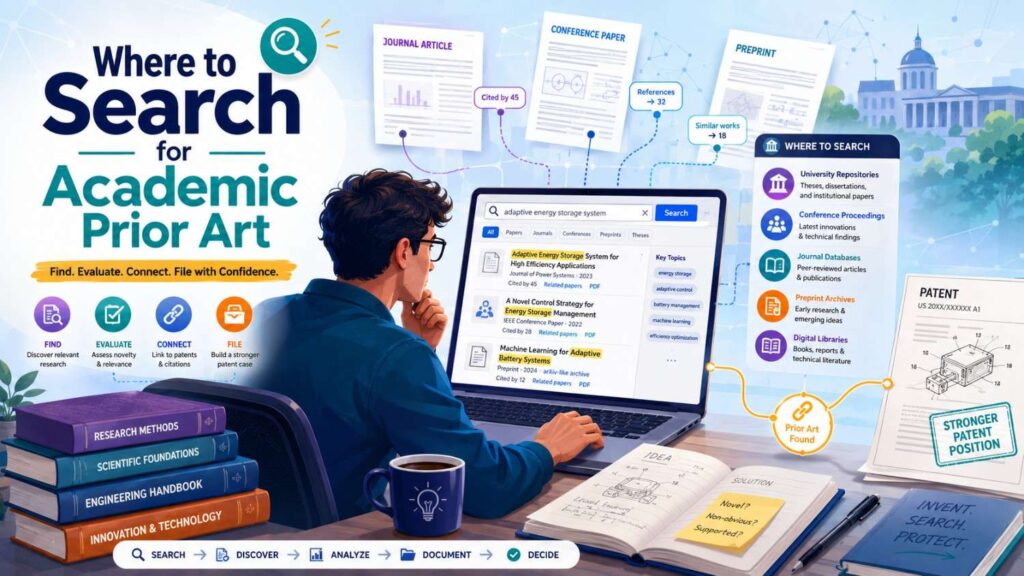
You do not need to become a librarian. But you do need to know where to look.
A good academic search may include Google Scholar, Semantic Scholar, PubMed for medical and life science topics, IEEE Xplore for electrical and computer fields, ACM Digital Library for computing, arXiv for preprints, SSRN for some social science and finance topics, bioRxiv and medRxiv for life science and medical preprints, university thesis databases, conference websites, standards groups, and general web search.
For patent search, Google Patents can be useful because it searches patent documents and includes non-patent literature. The USPTO and other patent offices also provide patent search systems, while Google Patents is often easier for early searching.
Do not depend on one source.
Each database has gaps.
Some papers are indexed in one place but not another. Some conference papers have odd titles. Some preprints are later published under a different title. Some theses are buried in university repositories. Some lab reports only show up in web search.
Search broadly at first. Then go deeper in the sources that fit your field.
For software and AI, start with Google Scholar, arXiv, Semantic Scholar, GitHub, Google Patents, and major conference sites.
For medical devices, start with PubMed, Google Scholar, clinical literature, Google Patents, FDA public materials when relevant, and conference abstracts.
For chips and electronics, start with IEEE, ACM, Google Scholar, Google Patents, and standards documents.
For biotech and chemistry, start with PubMed, Google Scholar, bioRxiv, medRxiv, journal databases, Google Patents, and technical reports.
For robotics, start with IEEE, arXiv, Google Scholar, conference sites, lab pages, and Google Patents.
Search is not about one magic tool. It is about using the right mix.
Start With Your Invention, Not the Paper
Many inventors search too soon.
They open a database and type a phrase before they have clearly described the invention. That leads to weak results.
Before you search papers, write down your invention in plain words.
Start with this sentence:
“My invention helps [user] solve [problem] by using [method] to produce [result].”
For example:
“My invention helps warehouse robots pick soft items by using camera data and touch sensor data to adjust grip before the item slips.”
Now break that into parts.
The user is warehouse robots.
The problem is picking soft items without slipping or damage.
The method uses camera data and touch sensor data.
The result is grip adjustment before slip.
Now you have search paths.
You can search soft object robotic grasping.
You can search camera and tactile sensing.
You can search slip prediction.
You can search grip adjustment before slip.
You can search warehouse robot soft item handling.
This is much better than searching “robot picker.”
The paper world uses many names. Your product name will not help much. Your brand name will not help. Your internal feature name may not help.
Search the problem, method, data, and result.
Build a Word Bank for Paper Search
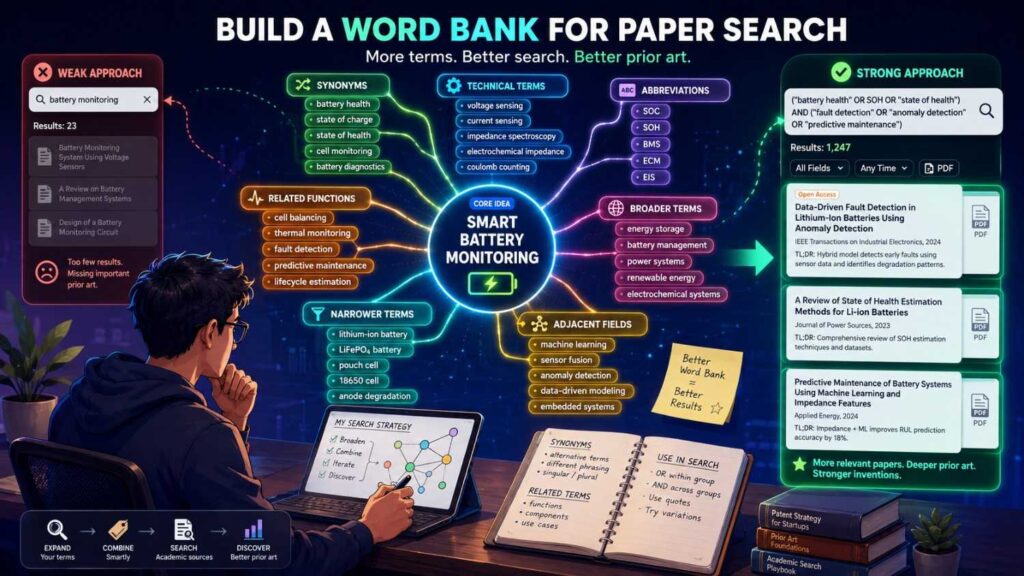
Academic papers often use different words than founders use.
A startup may say “AI agent.” A paper may say “autonomous task planning system.”
A startup may say “smart sensor.” A paper may say “embedded sensing node.”
A startup may say “fraud score.” A paper may say “transaction anomaly probability.”
A startup may say “doctor copilot.” A paper may say “clinical decision support system.”
A startup may say “energy optimizer.” A paper may say “load control algorithm.”
Build a word bank before you search deeply.
Write down your team’s words. Then add formal words. Then add older words. Then add words from papers you find.
For example, if your invention is about checking AI answers against sources, your word bank may include answer checking, source verification, grounding, factual consistency, attribution, faithfulness, hallucination detection, entailment, retrieval augmented generation, claim verification, response validation, evidence matching, and unsupported text.
Each word opens a new search path.
Academic paper search depends on this because researchers can be very precise. They may not use market language. They may not use the newest buzzword. They may use math terms, field terms, or older terms.
Your first search teaches your second search.
When you find a close paper, look at its title, abstract, keywords, methods section, and cited papers. Add new terms.
Then search again.
This loop is how you find the deeper work.
Search the Problem First
Start with the problem your invention solves.
This gives you a wide view.
If your invention reduces false alerts in patient monitors, search for patient monitor false alarm reduction.
If your invention improves battery safety, search for battery fault detection and thermal runaway prediction.
If your invention speeds up model training, search for distributed training bottleneck reduction.
If your invention protects private data, search for privacy preserving data analysis.
The goal at this stage is not to find the exact same invention. The goal is to learn the field.
What have researchers tried?
What words do they use?
What limits do they mention?
What data sets do they use?
What approaches appear again and again?
This helps you see whether your invention is in a crowded field or an open one.
It also helps you find the papers that later become key prior art.
A problem-based search is especially useful because academic titles often focus on the problem or technical task, not the final product.
Your product may be a “smart factory dashboard.” The paper may be about “predictive maintenance using vibration signal classification.”
Your app may be a “health coach.” The paper may be about “personalized intervention timing based on wearable sensor data.”
Your cloud tool may be a “cost saver.” The paper may be about “resource allocation for distributed workloads.”
Search the problem. Then search the method.
Search the Method Next
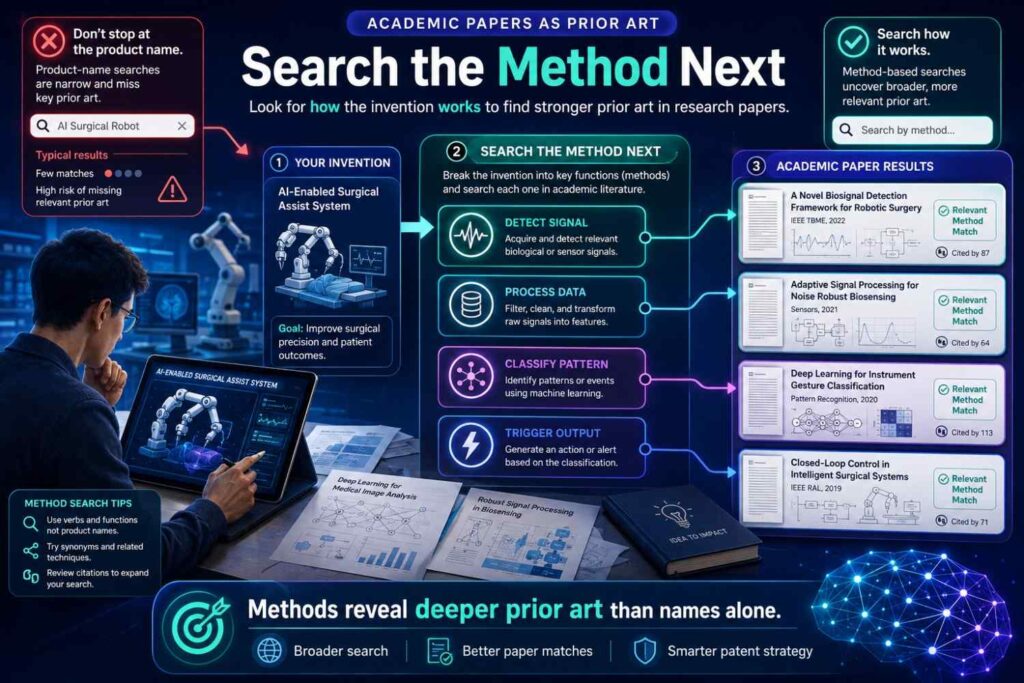
A method is how your invention works.
In academic papers, the method is often the most important part.
If your invention uses a new model training process, search that process.
If it uses a sensor arrangement, search that arrangement.
If it uses a control rule, search that rule.
If it uses a material treatment, search that treatment.
If it uses a data pipeline, search that pipeline.
For example, suppose your invention detects fake insurance claims by comparing claim text, repair images, and past provider behavior.
Do not search only “insurance fraud AI.”
Search multimodal fraud detection, image text fraud detection, repair image anomaly detection, provider behavior fraud model, and claim document image comparison.
The method search is where close papers often appear.
A paper may not mention your industry. It may use the same method in another field.
For example, a method used to detect fake medical claims may have first appeared in bank fraud research. A sensor fusion method used in drones may have first appeared in autonomous cars. A routing method used in cloud systems may have first appeared in telecom networks.
That still matters.
A good search looks at the same field and nearby fields.
Search the Data
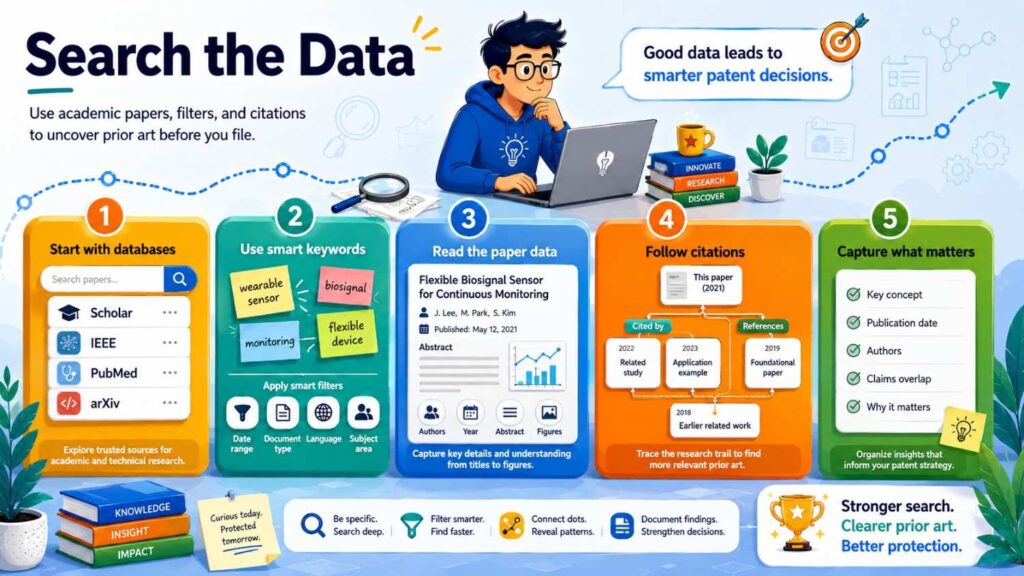
In many inventions, the data is the secret.
This is true for AI, software, diagnostics, fintech, security, climate, logistics, and robotics.
Ask what data your invention uses.
Images?
Text?
Sensor values?
Logs?
Network events?
Patient records?
Transaction data?
Weather?
Location?
User behavior?
Machine state?
Genomic data?
Chemical signals?
Then search those data types with the problem and method.
For example:
“weather data supply chain delay prediction”
“network log anomaly detection access behavior”
“patient note risk prediction vital signs”
“camera tactile data robotic grasping”
“satellite image crop disease detection”
“transaction graph fraud detection”
Data search helps you find papers that may not use your product label but use the same information flow.
It also helps you find your unique angle.
Maybe papers use camera data, but not tactile data.
Maybe papers use patient vitals, but not nurse notes.
Maybe papers use transaction data, but not device fingerprint data.
Maybe papers use weather data, but not supplier delay history.
Those gaps may matter.
Do not just search “AI for X.” Search what the AI sees.
Search the Output
Every invention produces something.
A warning.
A score.
A command.
A label.
A map.
A recommendation.
A control action.
A model update.
A report.
A changed setting.
Search that output.
For example, if your invention creates a risk score for code deployments, search deployment risk score, software release failure prediction, code change risk scoring, and rollback prediction.
If your invention creates a control signal for a machine, search automatic control signal optimization, adaptive machine control, and predictive control based on sensor data.
If your invention creates a medical triage label, search patient triage classification, clinical risk stratification, and urgent care prediction.
Academic papers often describe tasks by output. They may say “classification,” “prediction,” “segmentation,” “optimization,” “ranking,” “control,” or “recommendation.”
Use those words.
A founder may think in product terms. A researcher may think in task terms.
Bridge the gap.
Search the Failure Your Invention Prevents
This is one of the best search moves.
Most inventions exist because something goes wrong.
A model gives false answers.
A machine breaks.
A patient risk is missed.
A battery overheats.
A robot drops an item.
A network slows down.
A fraudster slips through.
A sensor drifts.
Search that failure.
If your invention prevents AI hallucinations, search hallucination detection, factual inconsistency, unsupported generation, source mismatch, and answer faithfulness.
If your invention prevents robot slip, search slip detection, grasp failure prediction, object deformation, and tactile grip control.
If your invention prevents cloud waste, search idle resource detection, workload underutilization, and resource allocation inefficiency.
If your invention prevents medical false alarms, search alarm fatigue, false alarm suppression, and patient monitor alert reduction.
Failure words are useful because researchers often study failures directly.
A paper might not say “startup product.” It might say “reducing false positives in anomaly detection.” That may be exactly your space.
Search the failure. Then search how your invention prevents it.
Read Academic Papers in Layers
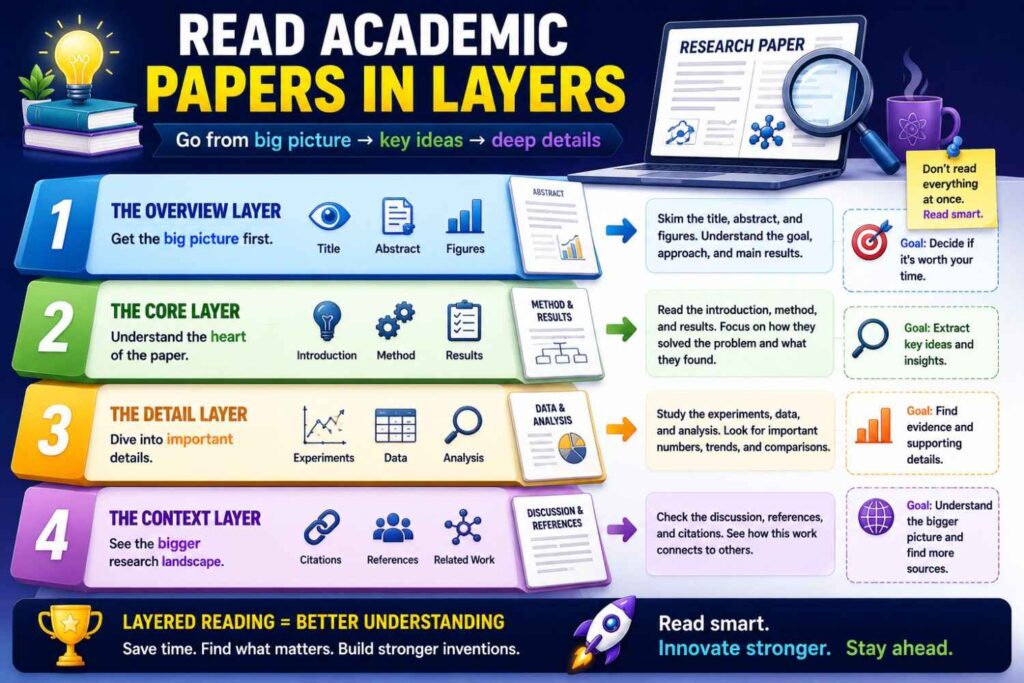
Academic papers can be dense.
You do not need to read every paper from start to finish.
Start with the title. It tells you the area.
Then read the abstract. It tells you the problem, method, and result.
Then check the figures. Figures often show the system, workflow, data, or experiment.
Then read the introduction. It explains why the work matters.
Then read the method section. This is where the prior art risk often lives.
Then read the results. It shows what was tested.
Then read the conclusion and limits. This may show what the paper did not solve.
Then check the references. This is where you may find older, closer papers.
For patent search, the method section is often the key.
A paper can have a similar title but a different method. Or it can have a boring title but a very close method.
Do not judge by title alone.
For each close paper, answer these questions in plain words.
What problem does the paper solve?
What data or materials does it use?
What steps does it perform?
What does it produce?
What does it not do?
How is your invention different?
You do not need fancy legal words. You need clear technical comparison.
Pay Close Attention to Dates
Dates can change everything.
For each close paper, record the first public date you can find.
Was it posted as a preprint?
Was it presented at a conference?
Was it published in a journal?
Was it available in a thesis database?
Was it on a lab website?
Was there an earlier version?
A journal publication date may not be the first public date. A preprint may have appeared months earlier. A conference paper may have been available before the journal version. A thesis may have been placed in a library or repository earlier.
The date question can be subtle.
But founders should at least capture what they see.
Record the title, authors, source, link, publication date, preprint date if any, conference date if any, and notes.
If a paper is close and the date is near your filing date, tell your attorney.
Do not guess. Do not hide it. Do not assume it does not matter.
Let a patent professional review it.
Your Own Academic Paper Can Be Prior Art
This is the part many academic founders miss.
Your own paper can create patent problems.
If you publish your invention before filing a patent application, that public disclosure may be used against you in some places. In the United States, there are grace period rules that may help in certain cases, but those rules are not simple and they do not protect you everywhere.
Many countries are much less forgiving about public disclosure before filing.
That means a founder who wants global patent rights should be very careful before publishing.
This applies to journal papers, preprints, conference papers, posters, talks, thesis publications, public grant reports, public demos, blog posts, and open-source releases.
The safest habit is simple:
File before you disclose.
Not always a full final patent application. Sometimes a provisional application may be the right first step. But you should talk to a patent attorney before sharing the details.
This is one of the most common startup mistakes.
A research team publishes first, then forms a company, then tries to file patents later. By then, options may be weaker.
PowerPatent helps founders move quickly from invention detail to filing path, with attorney oversight, so teams can protect important work before they share too much. Start here: https://powerpatent.com/how-it-works
Conference Papers and Posters Can Matter
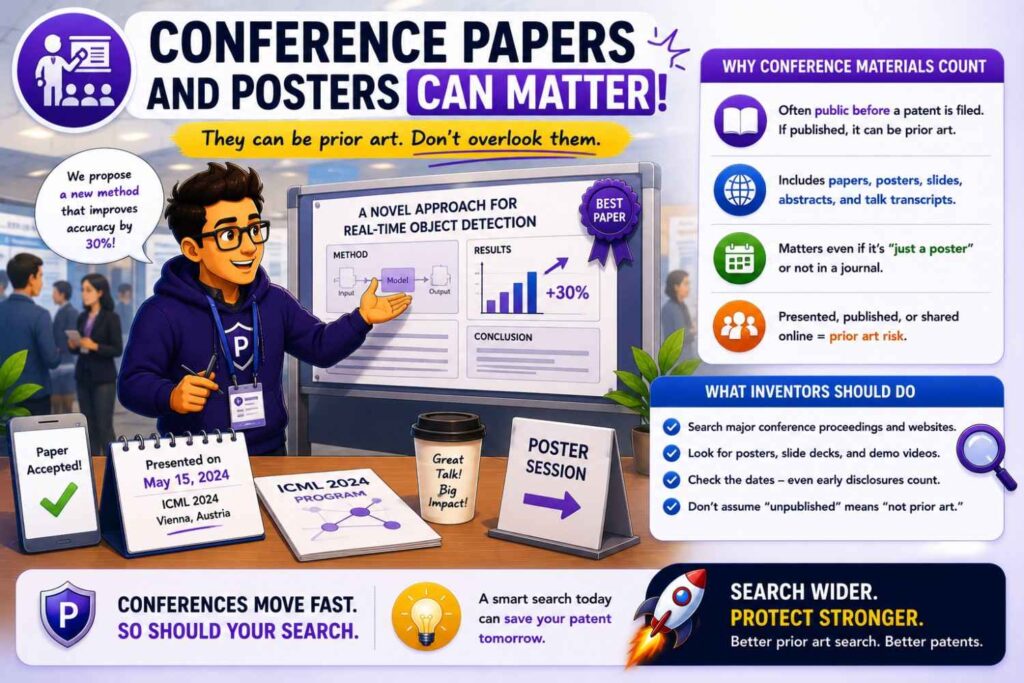
Do not ignore conference materials.
In fast fields, conferences are where ideas appear first.
AI, robotics, chips, security, networking, computer vision, medical imaging, and human-computer interaction all move quickly through conferences.
A conference paper may be public before the full journal article. A poster may reveal key details. A slide deck may show a method. A workshop paper may describe early results. A demo abstract may explain the system enough to matter.
The legal effect depends on public access and what was disclosed. But from a search strategy view, you should treat conference materials seriously.
Search conference names in your field.
For AI, search major machine learning and computer vision venues.
For robotics, search robotics and automation venues.
For medical devices, search clinical and engineering conferences.
For chips, search design automation, circuits, and semiconductor conferences.
For security, search cybersecurity and systems venues.
Also search the author names.
A researcher may publish a short workshop paper first, then a longer paper later, then a patent application after that.
The earliest public version may matter.
Theses and Dissertations Can Matter
Graduate theses and dissertations can be easy to miss.
They may be long. They may use different titles. They may sit in university repositories. They may include details that later papers leave out.
For deep tech startups, theses can be very important.
A PhD student may describe a full method, device, model, or experiment in a dissertation. That dissertation may be public before your filing date.
Search thesis databases and university repositories when the invention is close to academic research.
Use words like dissertation, thesis, repository, university, PDF, and the technical terms from your word bank.
Also search professor and lab names.
A thesis may not rank high in normal search results. But it may be the closest prior art.
Do not skip it if the invention is core to your company.
Preprints Can Matter
Preprints are papers shared before formal journal review.
In many technical fields, preprints move fast. A paper may appear on a preprint server long before it appears in a journal.
That early date can matter.
For example, an AI paper may be posted publicly on arXiv before your patent filing date. Even if it is later published in a conference, the preprint date may be the key date to review.
Preprints can also change over time.
Version one may have one set of details. Version two may add more. Version three may change claims or experiments.
If a preprint is close, capture the version and date.
Do not only save the latest page. Save notes about which version you reviewed.
This is useful for your attorney and for your own records.
Papers From Companies Can Matter Too
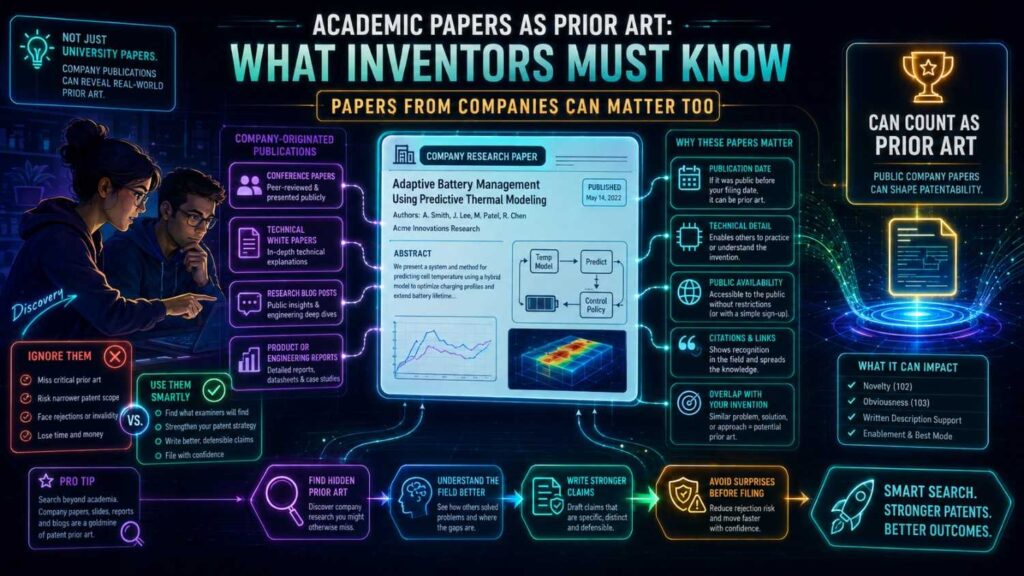
Not all academic-style papers come from universities.
Large companies publish research papers. AI labs publish preprints. Cloud companies publish systems papers. Medical device companies publish studies. Chip companies publish conference work. Security companies publish technical reports.
These can all matter.
A company paper may describe a method before the company files a patent or releases a product.
A startup may think, “No product does what we do.” But a company research paper may show that a large lab already tested a similar method.
Search company research pages.
Search names of known competitors.
Search lab names.
Search papers by big companies in your field.
This is especially important in AI, cloud infrastructure, chips, robotics, and healthcare.
Public Code Connected to Papers Can Matter
Many papers now come with code.
That code may be on GitHub or another public platform. It may include implementation details that the paper does not fully explain.
For inventors, this can matter in two ways.
First, public code can help you understand what the paper really taught.
Second, public code may itself be public information.
If a paper is close, check whether it links to code, data, models, demos, notebooks, or documentation.
For software and AI inventions, this is very important.
A paper may describe the model at a high level. The code may show the exact steps.
A paper may mention a pipeline. The repo may show the pipeline structure.
A paper may describe a data process. The code may show the data cleaning rules.
Record the repo link and date if you can.
If it is close, share it with your attorney.
Do Not Assume Paywalled Papers Are Safe
Some founders think a paper behind a paywall cannot count because not everyone can read it.
That is risky.
Public accessibility does not always mean free. A journal article may be accessible to people in the field through libraries, subscriptions, databases, or indexing.
The real question is more about whether interested people could find and access it with reasonable effort.
Do not ignore a paper just because it costs money to download.
If it is indexed, published, and available through normal academic channels, it may matter.
From a founder’s point of view, treat paywalled papers as worth reviewing if the title and abstract are close.
You may be able to find a preprint, author copy, thesis version, conference version, or summary. But for legal review, get the actual paper if it seems important.
Do Not Assume Foreign Papers Do Not Matter
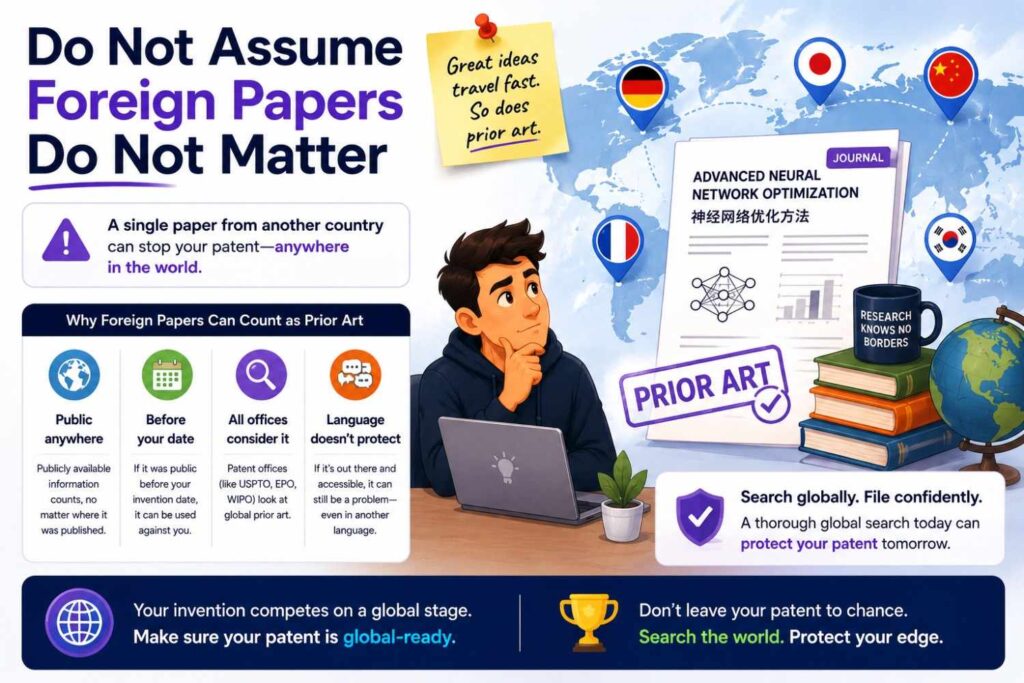
Prior art can come from outside your country.
A paper from Japan, Germany, China, India, Korea, France, Brazil, or anywhere else may matter if it was publicly available and teaches the invention.
Do not search only English if your field has strong research in other languages.
At least search English abstracts and international databases. Many papers have English titles or abstracts even if the full text is in another language.
For high-value inventions, a deeper search may need foreign-language review.
This is common in fields like electronics, batteries, automotive systems, medical devices, robotics, and telecom.
A smart search looks beyond your local market.
How to Compare a Paper to Your Invention
When you find a close paper, do not just mark it “bad” or “same.”
Compare it carefully.
Use plain language.
Start with the problem.
Does the paper solve the same problem?
Then look at the inputs.
Does it use the same data, materials, signals, or user actions?
Then look at the method.
Does it perform the same steps in the same order?
Then look at the output.
Does it produce the same result, score, control action, structure, or report?
Then look at the setting.
Does it work in the same field or a nearby field?
Then look at what is missing.
Does the paper leave out your key data source? Does it skip your control step? Does it only work offline? Does it require human review? Does it fail in real time? Does it use a different sensor? Does it lack the feedback loop? Does it not show the hardware arrangement?
The missing pieces matter.
But be careful.
Do not invent differences that are not there. Be honest. If the paper is close, say it is close.
A clear comparison helps your attorney more than a hopeful one.
The Best Search Notes Are Simple
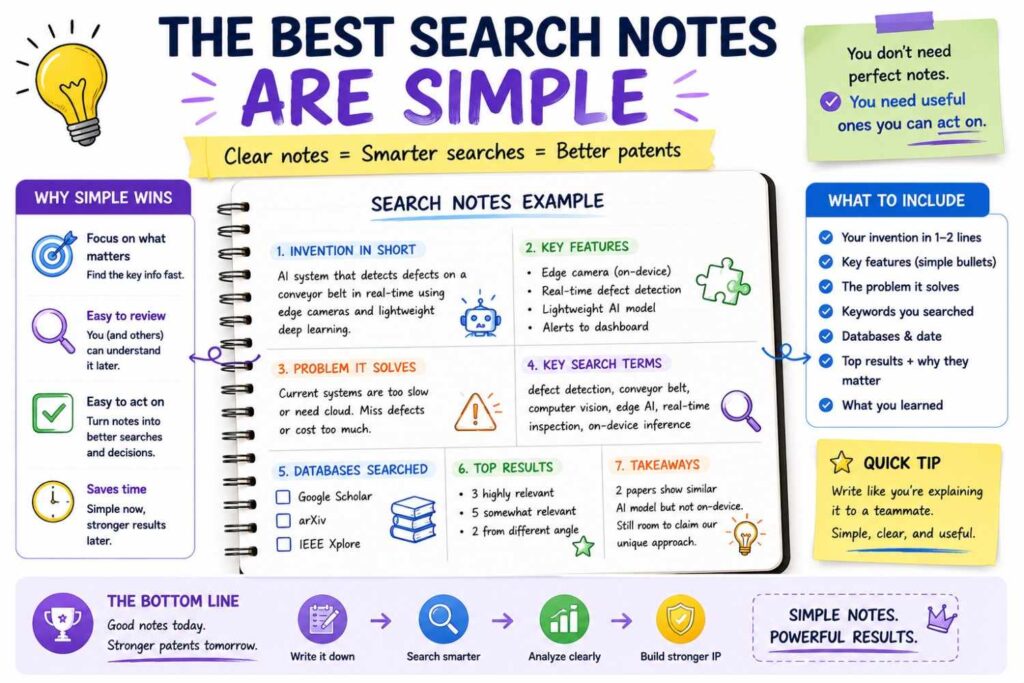
You do not need a perfect report.
You need useful notes.
For each close paper, record the title, authors, date, source, link, key method, key figures, and why it matters.
Then write a short comparison.
For example:
“This paper predicts battery failure using temperature and voltage data. It does not appear to use vibration data or change device operation before risk rises. Our system combines temperature, voltage, and vibration, then reduces power draw before a failure threshold.”
That note is useful.
Here is another example:
“This paper checks generated answers for factual support using retrieved documents. It does not appear to perform claim-by-claim blocking inside a customer support workflow. Our system checks each support answer claim against product docs and account data before release.”
That is clear.
Do not write vague notes like “kind of similar” or “not the same.”
Say what is similar. Say what is different.
Look at What the Paper Cites
A close paper is a door.
The references are the hallway behind it.
When you find one relevant paper, look at the papers it cites. Those older papers may be even closer.
Also look at papers that cite it. Those newer papers may show how the field changed.
This is called citation chasing, but you do not need the formal term. Just follow the trail.
If one paper is close, ask:
What work came before it?
Who built on it?
Did the same authors publish more?
Did the lab file patents?
Did a company later use the method?
This can quickly reveal the main players in the field.
It also helps you find the true starting point of an idea.
Sometimes the paper you find is not the earliest paper. It may be one of many.
Keep going until you understand the chain.
Search Author Names and Lab Names
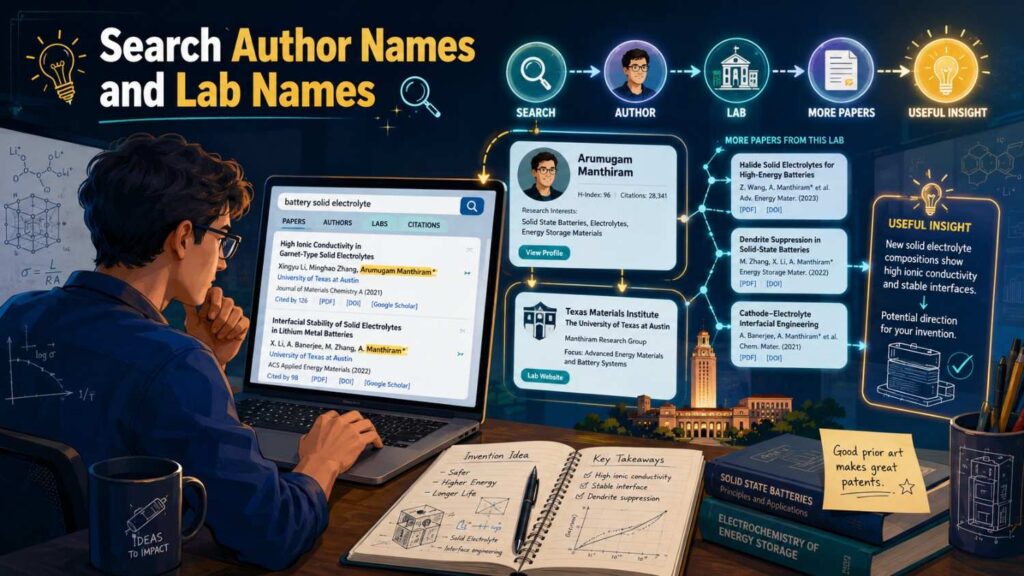
Researchers often publish many papers around one theme.
If you find a close paper, search the authors.
Look for their lab pages, Google Scholar profiles, university pages, patents, talks, slides, theses, and company links.
A professor may have ten related papers. A student may have a thesis with more details. A company researcher may also be named on patents.
Search the lab name too.
For example, a robotics lab may publish a paper, a video, code, and a patent application around the same project.
A medical AI lab may publish a paper, clinical abstract, data set, and model card.
A materials lab may publish a paper, dissertation, and conference poster.
The author trail can be very useful.
Do not overdo it for every weak paper. But for close papers, it is worth the time.
Search Papers and Patents Together
Academic papers and patents often connect.
A researcher may publish a paper and file a patent.
A company may file a patent and later publish a paper.
A university may publish a thesis and file a patent through its tech transfer office.
Search both directions.
If you find a close paper, search the title, author names, lab name, and key terms in Google Patents.
If you find a close patent, search the inventor names and technical terms in Google Scholar.
Google Patents can also surface non-patent literature, which can help connect paper search and patent search. (Google Patents)
This combined search gives you a better map.
It may reveal that the paper is part of a larger patent family. Or it may show that the paper was never patented, which still matters for prior art but may change the business picture.
What If a Paper Is Close but Not Exact?
This happens all the time.
A paper may be close enough to worry you but not close enough to end the story.
Do not panic.
Instead, find the exact difference.
Maybe the paper uses the same input but a different method.
Maybe it uses the same method but in a different field.
Maybe it produces the same output but does not automate the action.
Maybe it works offline but not in real time.
Maybe it needs clean lab data, while your system handles noisy field data.
Maybe it tests one part, while your invention is a full system.
These differences can shape your patent plan.
Your broad idea may need to become more specific. That is not bad. A focused patent can still be very valuable if it protects the part competitors need.
For example, “AI for customer support” may be too broad and crowded.
But “claim-level support checking for generated technical support answers using product docs and live account data before release” may be a stronger angle.
A close paper helps you find that angle.
What If a Paper Shows Your Exact Idea?
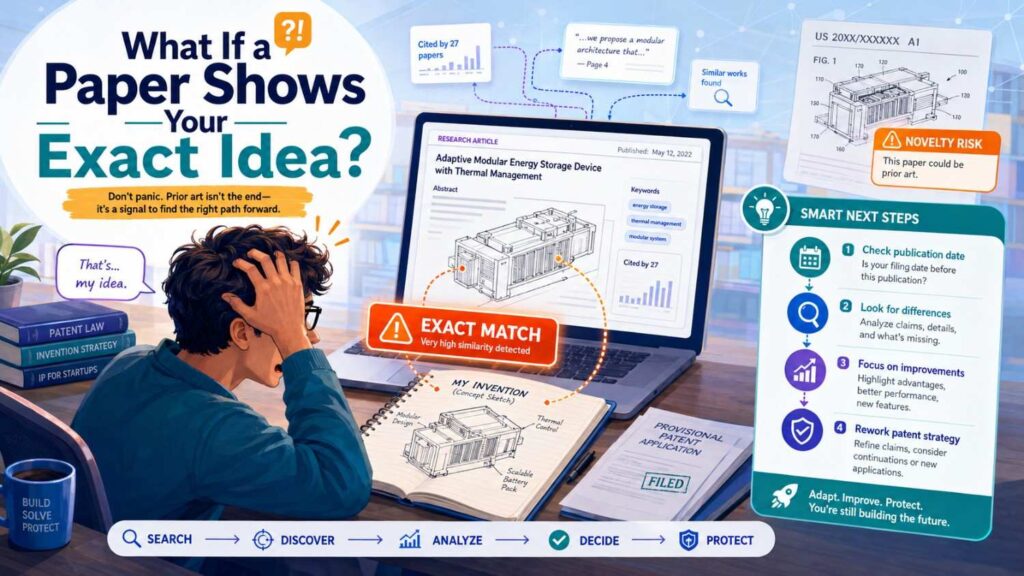
This is hard, but it is better to find out early.
If a paper truly shows your exact idea before you filed, broad patent protection may be difficult.
But you may still have options.
Maybe your product includes an improvement not shown in the paper.
Maybe your system works in a new setting.
Maybe you solved a scaling issue.
Maybe your hardware structure is different.
Maybe your data pipeline is new.
Maybe your user workflow is new.
Maybe your deployment method is new.
Maybe your invention has several parts, and only one part appears in the paper.
Do not make the decision alone.
Bring the paper to a patent attorney. Ask what remains protectable. Ask whether a narrower filing makes sense. Ask whether some parts should be kept as trade secrets. Ask whether new improvements should be filed quickly.
A scary paper does not always end the patent story.
But it should change the strategy.
Academic Papers Can Shape Claim Strategy
Patent claims define the legal fence around the invention.
You do not need to draft claims yourself, but you should understand the idea.
If academic papers show broad concepts, your claims may need to focus on the specific improvement.
For example, if papers show using AI to detect machine faults, your claims may focus on your special sensor mix, timing, control action, or feedback loop.
If papers show drug screening with a certain marker, your claims may focus on a new marker combination, sample handling method, or decision rule.
If papers show robot grasping with tactile sensors, your claims may focus on your pre-slip adjustment method, sensor placement, or object-specific grip model.
If papers show AI answer checking, your claims may focus on your claim-level verification process, source matching, user workflow, or output gate.
This is why search before filing is so useful.
It helps you avoid claims that are too broad and easy to reject. It helps your attorney build around the real difference.
PowerPatent helps teams turn invention details and search findings into a clearer attorney workflow. That can help founders move faster and avoid weak, rushed filings. See how PowerPatent works here: https://powerpatent.com/how-it-works
Do Not Overshare While Searching
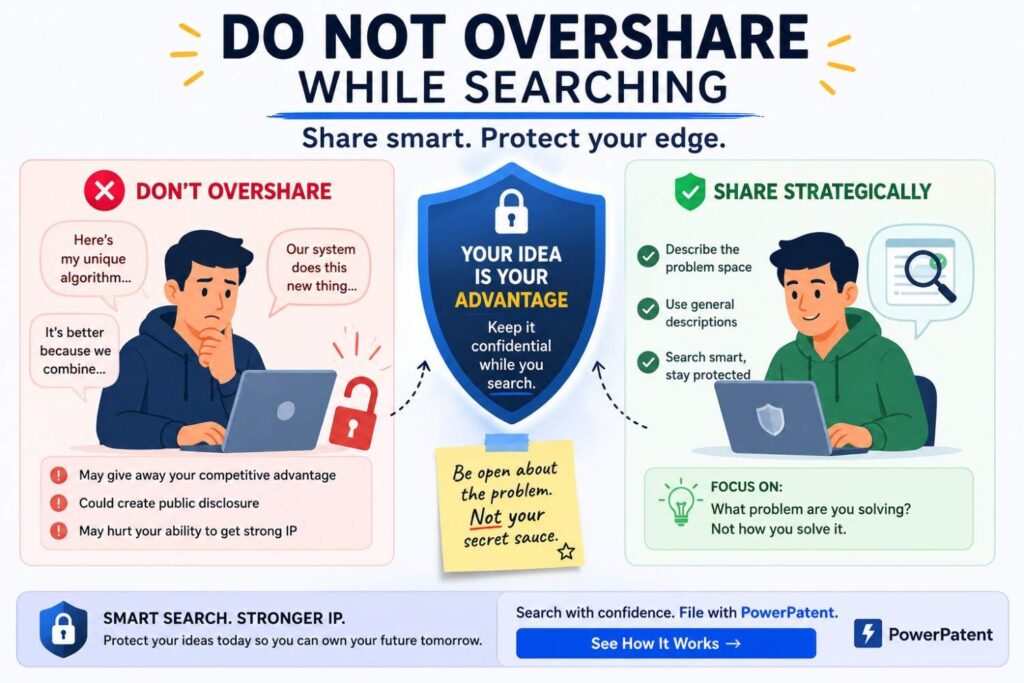
Some founders search by posting questions online.
That can be risky.
They may write, “Has anyone built a system that uses X data and Y model to do Z before filing a patent?”
Now they have publicly described the invention.
Do not do that.
Search quietly. Use public databases. Ask your attorney. Work under confidentiality when needed.
Do not reveal the secret sauce in public forums, social media, open Slack groups, Discord channels, GitHub issues, or public research communities before filing.
You can search without exposing your full method.
Use general search terms. Keep private details private.
Be Careful With University Rules
If your invention came from academic work, ownership may be complex.
A university may have rights. A sponsor may have rights. A government grant may create duties. A lab agreement may control who owns what. A student, professor, or company partner may need to be named.
This article is not legal advice, but founders should take this seriously.
Before building a company around university research, review agreements and talk to counsel.
This is especially important if the work used university labs, grant money, professor time, student work, sponsored research, or licensed materials.
A strong patent plan is not only about prior art. It is also about who owns the invention.
Do not wait until fundraising or acquisition diligence to clean this up.
How Academic Founders Should Plan Before Publishing
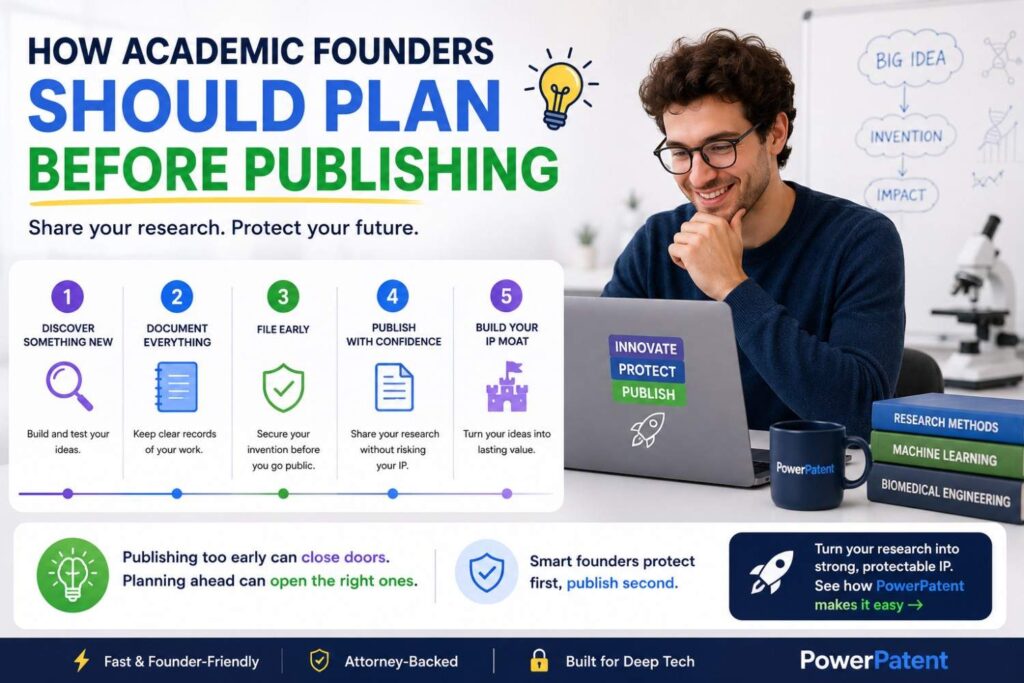
Academic founders face a real tension.
You need to publish to build your career and credibility. But you may also need to file patents to protect the company.
The answer is not to stop publishing.
The answer is to plan the order.
Before you submit or post a paper, identify whether it includes a patent-worthy invention.
If yes, prepare an invention disclosure.
Talk to a patent attorney.
File before public disclosure when appropriate.
Then publish.
That order can protect both goals.
The patent filing does not need to block the paper. In many cases, filing first can let the team publish with more confidence.
The key is timing.
If you wait until after the paper is public, options may shrink.
PowerPatent is built for founders who need this to move quickly. You can bring technical material into the platform, organize the invention, and work with real patent attorneys so you are not stuck in a slow back-and-forth. Learn more here: https://powerpatent.com/how-it-works
How Startup Teams Should Handle Research Papers Internally
Do not leave paper search to one person.
A founder, technical lead, and patent attorney should all play a role.
The founder knows the business value.
The engineer or scientist knows the technical edge.
The attorney knows how prior art may affect the patent path.
Together, they can read papers more effectively.
For each invention, keep a simple research folder.
Save close papers.
Save notes.
Save dates.
Save key figures.
Save your comparison.
Save questions for counsel.
This does not need to be heavy. It just needs to be consistent.
A messy search is easy to forget. A clear search becomes an asset.
The Difference Between Inspiration and Prior Art
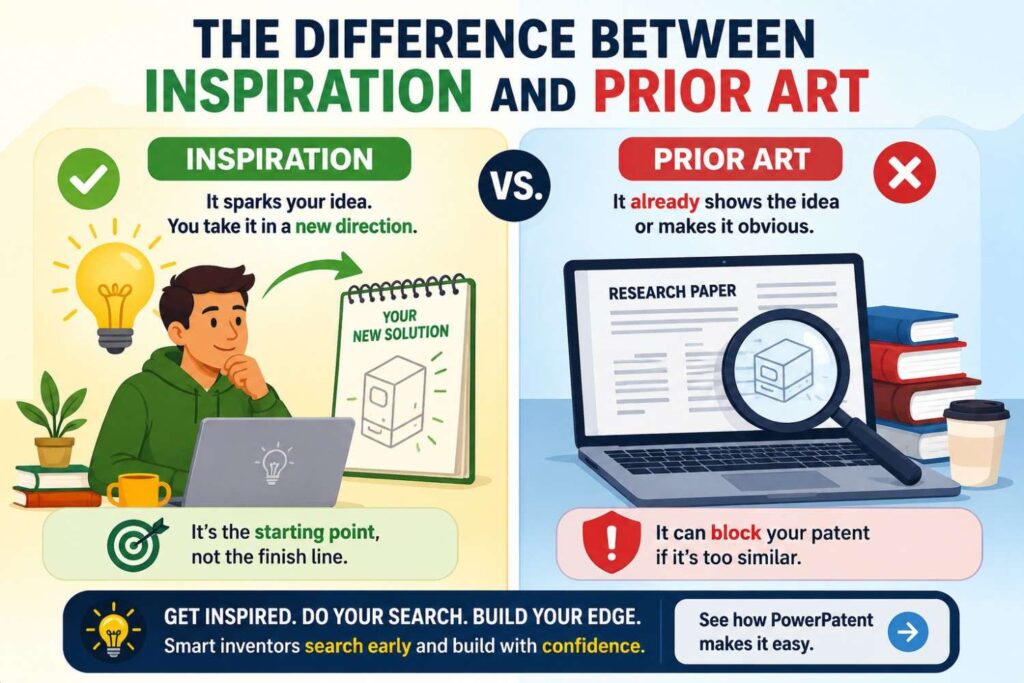
Many inventions start from research.
You may read a paper and think of a better way.
That is normal. Innovation often builds on public work.
But there is a difference between being inspired by a paper and patenting the same thing as the paper.
If the paper gives the broad idea, and your team creates a specific improvement, the improvement may be the patent story.
For example, a paper may show that a certain model can detect disease from images. Your invention may make the method work on low-quality phone images in rural clinics by using a special image check, retake guide, and confidence workflow.
The paper inspired the field. Your invention solves a practical gap.
That is a clearer story.
Do not try to claim the whole field if the paper already opened it.
Claim the improvement you truly made.
Academic Papers Can Reveal Failed Paths
One of the best things about papers is that they often explain limits.
A paper may say the method fails when data is noisy.
It may say the model does not generalize.
It may say the sensor drifts over time.
It may say the process is too slow.
It may say the device is too costly.
It may say the method needs expert setup.
These limits can point to invention opportunities.
If your product solves one of those limits, that may be important.
For example, a paper may show a medical model that works only with clean hospital data. Your invention may adapt the model to messy clinic data.
A paper may show a robot grasping method that works only for rigid objects. Your invention may handle soft, deformable objects.
A paper may show a battery safety method that detects overheating too late. Your invention may detect risk earlier using weak signals.
The paper’s weakness can become your patent story.
Look for limits. They are often hidden treasure.
Do Not Treat “AI” as the Invention
This is especially important today.
Many founders say their invention is “AI for X.”
That is not enough.
Academic papers are full of AI methods. Patent offices have seen many AI claims. Investors have seen many AI pitches.
You need to be specific.
What data does the AI use?
What decision does it make?
What step does it automate?
What does it do better?
What technical problem does it solve?
What happens before and after the model?
What feedback improves it?
What guardrail makes it safe?
What action does it trigger?
When searching academic papers, do not search only “AI for contract review” or “AI for logistics.”
Search the real method.
“clause obligation extraction contract graph”
“delivery delay prediction weather supplier data”
“model output verification source evidence”
“automatic triage patient portal message clinical risk”
The more specific your search, the better your patent strategy becomes.
Do Not Treat a Research Result as a Product Invention
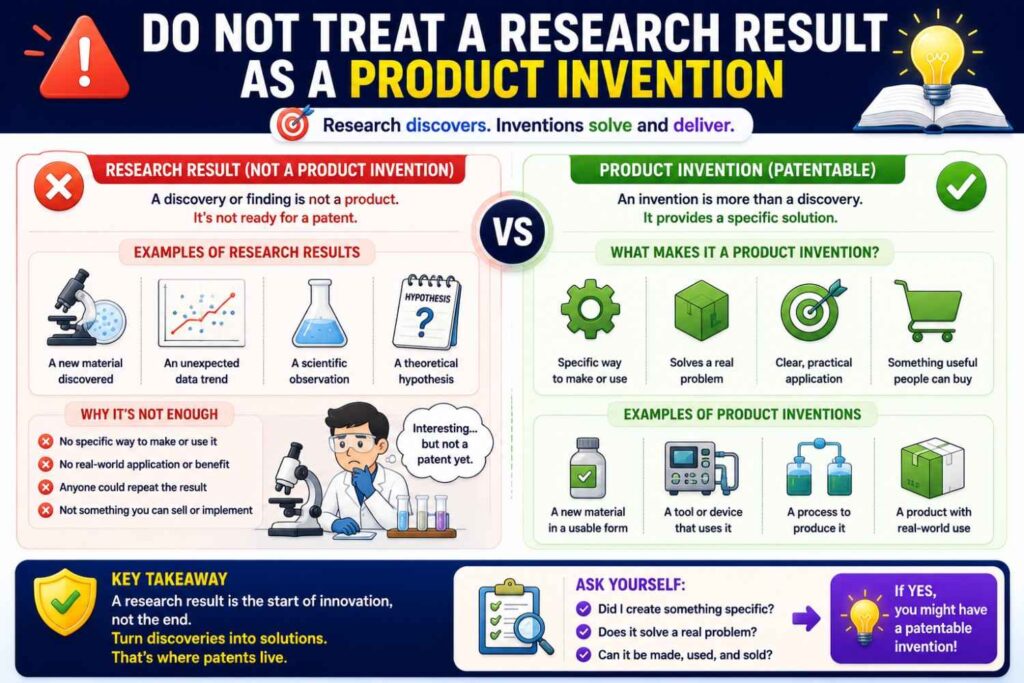
Sometimes a paper shows a result, but not a working product system.
That can matter.
A paper may prove that a model works on a small data set. Your invention may turn it into a live system with real-time updates, user controls, privacy checks, fail-safe actions, and deployment logic.
The paper may still be prior art for the model idea. But it may not show the full product system.
This distinction is important.
Many startup inventions live in the gap between research and real-world use.
That gap can include scaling, reliability, user workflow, system architecture, edge deployment, privacy, safety, control, data cleaning, feedback, monitoring, and integration.
Search papers for the core method. Then search for the product system features.
Your patent angle may sit in that bridge.
Search for Negative Results Too
Most founders only search for papers that prove a method works.
Also look for papers that say a method does not work well.
Negative results can show why your solution matters.
A paper may say a sensor type is unreliable in humid conditions. If your invention fixes that, the paper helps tell the problem story.
A paper may say a model fails when data shifts. If your invention detects drift and adjusts, that matters.
A paper may say a manual workflow is too slow. If your invention automates it safely, that matters.
Negative results may not block your invention. They may support the need for it.
They can also help your patent attorney explain the technical problem.
Search Before Fundraising
Investors may ask about IP.
They may ask whether you have filed patents.
They may ask what makes your technology defensible.
They may ask whether university research creates risk.
They may ask whether a known paper already covers the idea.
You do not want to hear that question for the first time in a partner meeting.
Do the search earlier.
You do not need perfect certainty. But you should know the closest papers and have a clear answer for how your invention differs.
That shows maturity.
It tells investors you are not just excited. You are careful.
It also helps your attorney file smarter before diligence begins.
Search Before Product Launch
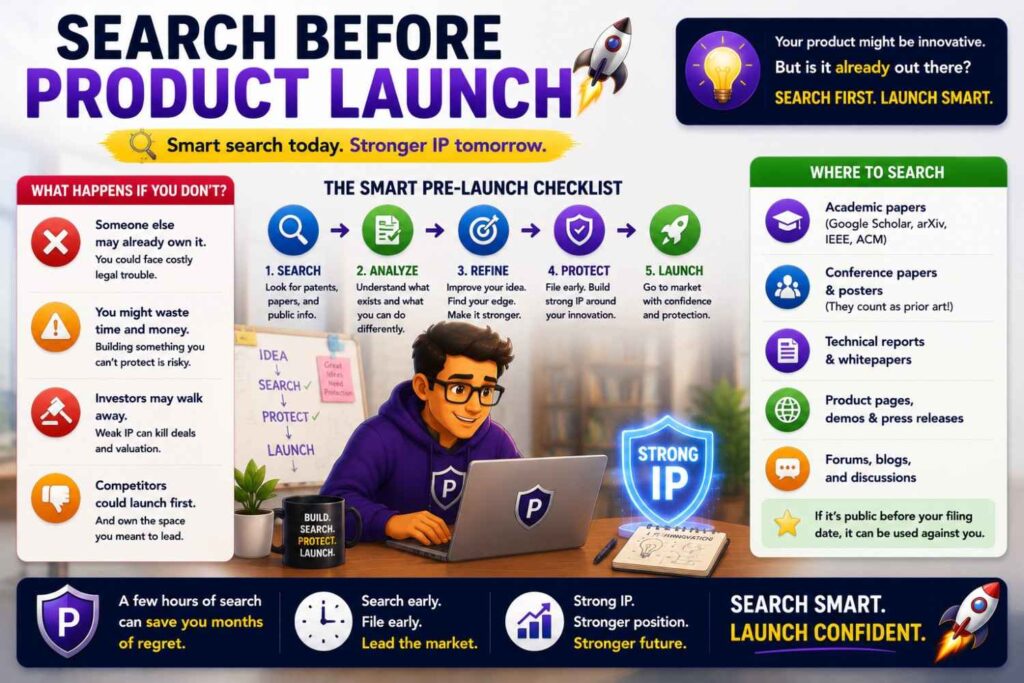
A product launch can reveal how your system works.
A public demo, technical blog, docs page, API guide, benchmark, white paper, or open-source release may disclose important details.
Before launch, review whether any new invention is being revealed.
Then search papers and patents around it.
If the feature is important, consider filing first.
This is especially important for technical launch content. Founders often publish deep engineering posts to attract customers and talent. Those posts can be great for growth, but they may also disclose inventions.
Protect first when needed. Publish after.
Search Before Open Source
Open source can be a strong business move.
It can build trust. It can drive adoption. It can attract developers.
But it can also disclose technical details.
If the code includes a new invention, filing after open-source release may be harder.
Before you open-source a key repo, ask whether the code reveals a patent-worthy method.
Search papers and patents.
Talk to counsel.
Decide what to file, what to publish, and what to keep private.
Do not treat open source and patents as enemies. Many companies use both. But the order matters.
How to Use Papers to Write Better Patent Background
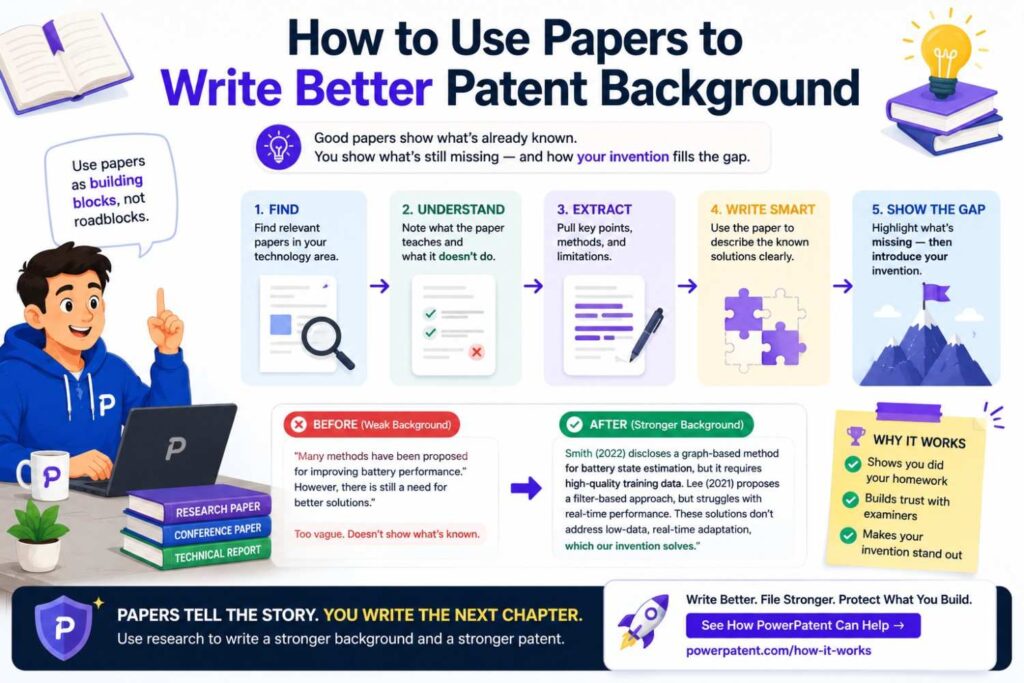
A patent application often explains the old problem.
Academic papers can help with that.
They show what others tried. They show limits. They show technical pain. They show why the field needed a better approach.
But be careful. The patent application should be written by a patent professional. You do not want to admit too much or describe prior art carelessly.
As a founder, your job is to share the papers and explain what you learned.
Your attorney can decide how to use that context.
PowerPatent gives technical founders a better way to bring this material into the patent process so the attorney has the right facts sooner. See how it works here: https://powerpatent.com/how-it-works
How to Turn Paper Search Into Patent Angles
After you search, do not stop with a pile of PDFs.
Turn your findings into invention angles.
An invention angle is a clear statement of what may be protectable.
For example:
A system that verifies each AI-generated support answer claim against product docs and live account data before sending the answer.
A drone battery safety method that predicts failure using temperature, vibration, and flight behavior, then changes route before landing risk rises.
A wearable worker safety system that learns each worker’s normal motion pattern and adjusts fatigue alerts by task and shift length.
A robot grip method that predicts slip before it happens using camera and touch data together.
A cloud training system that detects stalled GPU jobs from model signals and cluster state, then releases resources before cost spikes.
Each angle is specific.
Each one can be searched.
Each one can be compared to papers.
This is much better than saying “AI safety,” “battery prediction,” “worker wearable,” “robot hand,” or “GPU cost tool.”
The paper search helps you move from a broad idea to a sharp invention.
How to Decide Whether a Paper Is “Close”
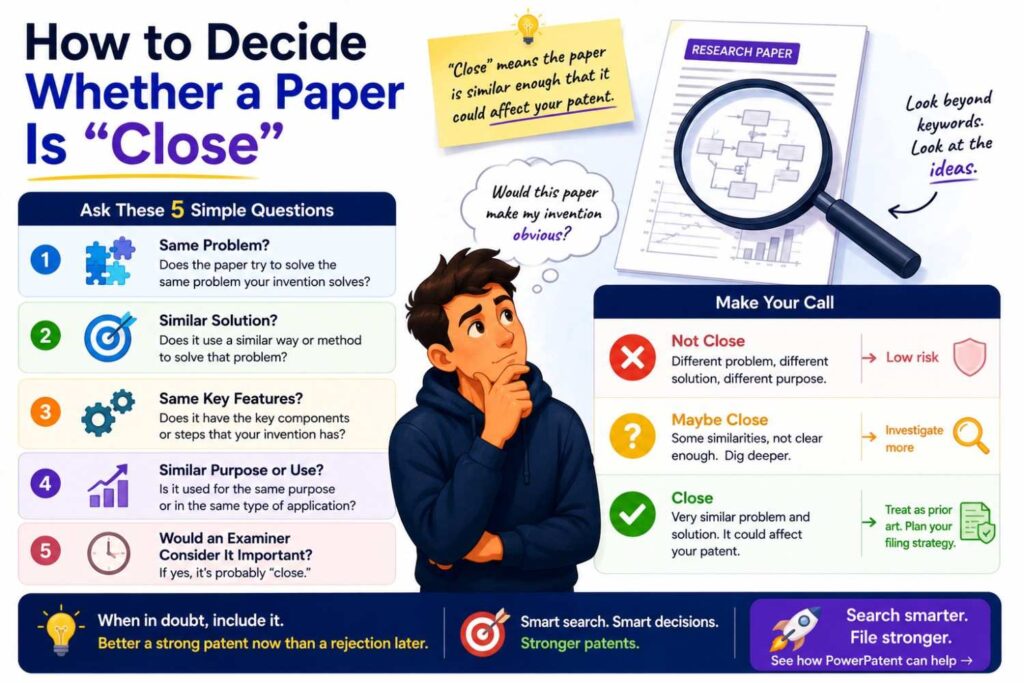
A close paper usually shares more than the same field.
It may share the same problem, same input, same method, same output, or same system design.
A weak paper only shares the general topic.
For example, if your invention is about reducing false alerts in ICU monitors using patient-specific baseline changes, a paper about hospital alarms in general is broad. A paper about patient-specific alert thresholds is closer. A paper that uses the same baseline method and same vital signs is very close.
Think in layers.
Same field is one layer.
Same problem is closer.
Same data is closer.
Same steps are closer.
Same output is closer.
Same timing is closer.
Same full system is closest.
This simple view helps you avoid fear and false comfort.
Do Not Ignore Old Papers
Old papers can be powerful.
A paper from 1998 may still matter. A dissertation from 2005 may still matter. A conference paper from 2012 may still matter.
Do not assume old means irrelevant.
Many modern startups use better hardware, faster compute, more data, or improved tools to make old ideas practical. That can create real inventions. But the old paper may still limit how broadly you can claim the idea.
For example, an old paper may describe the concept of using sensor data to predict machine failure. Your invention may improve it with real-time edge processing and a special control action.
The old paper does not erase your improvement. But it may block a claim to the broad idea of sensor-based failure prediction.
Old papers help you find the right level.
Do Not Ignore Very New Papers
New papers matter too.
A paper posted last month may affect a patent filed today if it came out before your filing date.
Fast fields move quickly. AI is the clearest example. A new preprint can appear and spread across the field in days.
Before filing, run a fresh search for key terms.
This is especially useful if your team has been developing for months. The field may have changed while you built.
You do not need to chase every paper forever. But before filing a key application, make sure the search is not stale.
Academic Papers and Trade Secrets
Not every technical advantage should be patented.
Some things may be better kept as trade secrets.
A trade secret is information you keep private because it gives your business value. Examples may include data cleaning rules, internal model tuning, manufacturing settings, lab recipes, supplier know-how, or ranking weights.
Academic papers can help decide what to patent and what to keep secret.
If papers make the broad idea public, but your internal method is hard to reverse engineer, you may choose to patent some visible system parts and keep other parts secret.
If a competitor can easily see or copy the feature, patenting may be more important.
If the invention will be published, sold, inspected, or disclosed to partners, trade secret protection may be weaker.
This is a strategy call. Talk to counsel.
PowerPatent helps founders think through what they are building and what may be worth filing, with attorney oversight to guide the hard calls. Learn more here: https://powerpatent.com/how-it-works
A Practical Example: AI Medical Triage
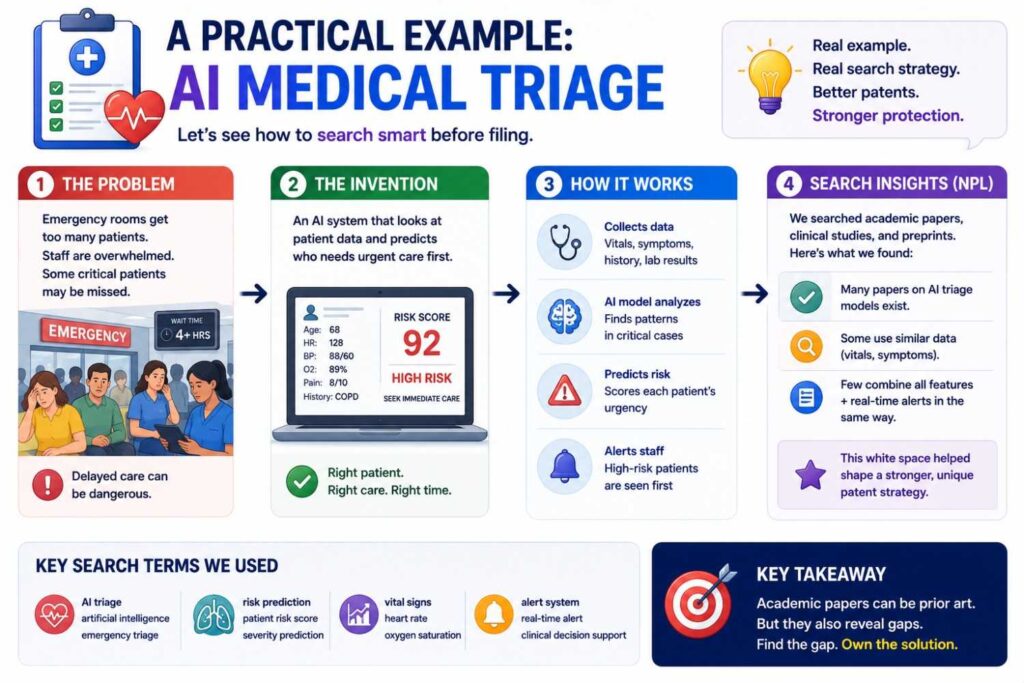
Imagine your startup built an AI tool that reads patient messages and routes urgent cases to nurses faster.
A weak search would be “AI medical inbox.”
That may miss the real research.
A stronger search starts with the invention sentence.
“Our system reads patient portal messages, extracts symptoms, compares them with patient history, assigns urgency, and routes high-risk messages to nurses before normal queue order.”
Now search academic papers around each part.
Search patient portal message triage.
Search clinical message urgency classification.
Search symptom extraction from patient messages.
Search patient history risk scoring.
Search nurse inbox prioritization.
Search clinical natural language processing triage.
Search false negative urgent message detection.
You may find papers that classify patient messages. You may find papers that extract symptoms. You may find papers that rank risk from patient history.
Now compare.
Does any paper combine message text, patient history, and routing workflow?
Does any paper trigger nurse review before normal order?
Does any paper handle certain high-risk symptoms?
Does any paper update the model based on nurse feedback?
Maybe the broad idea is crowded. But your specific workflow may be different.
That is the patent angle.
A Practical Example: Battery Safety
Imagine your startup built a system that predicts battery failure in warehouse robots.
The system uses heat data, charge history, vibration data, motor load, and route patterns. When risk rises, it changes the robot’s route and charging plan.
A weak search would be “battery safety robot.”
A stronger search includes battery fault prediction, thermal runaway early detection, vibration battery health monitoring, robot battery route control, state of health prediction, charge cycle risk, and energy management for mobile robots.
Academic papers may show battery failure prediction from heat and voltage.
Other papers may show robot route planning.
Other papers may show charging optimization.
Your invention may combine these in a live control loop.
Now the key question is whether papers show that combination.
If not, the angle may be:
“A mobile robot battery safety system that predicts failure from battery signals and robot operating patterns, then changes route and charging behavior before risk crosses a threshold.”
That is sharper than “battery safety.”
A Practical Example: AI Code Review
Imagine your startup built a tool that checks pull requests before merge.
It uses code changes, service dependencies, production incidents, and runtime logs to predict whether the change may break a key user path.
A weak search is “AI code review.”
A better search includes code change risk prediction, software defect prediction, pull request analysis, runtime log code review, service dependency risk, deployment failure prediction, incident history software release, and test selection from production traces.
Academic papers may show defect prediction from code changes.
Other papers may show test selection.
Other papers may show dependency analysis.
Other papers may show incident prediction.
Your edge may be the link between production incidents, affected services, and merge blocking.
Search that exact mix.
Then compare the closest papers.
Maybe no paper uses incident history to block merge for affected revenue paths. That could be important.
A Practical Example: Climate Sensor Hardware
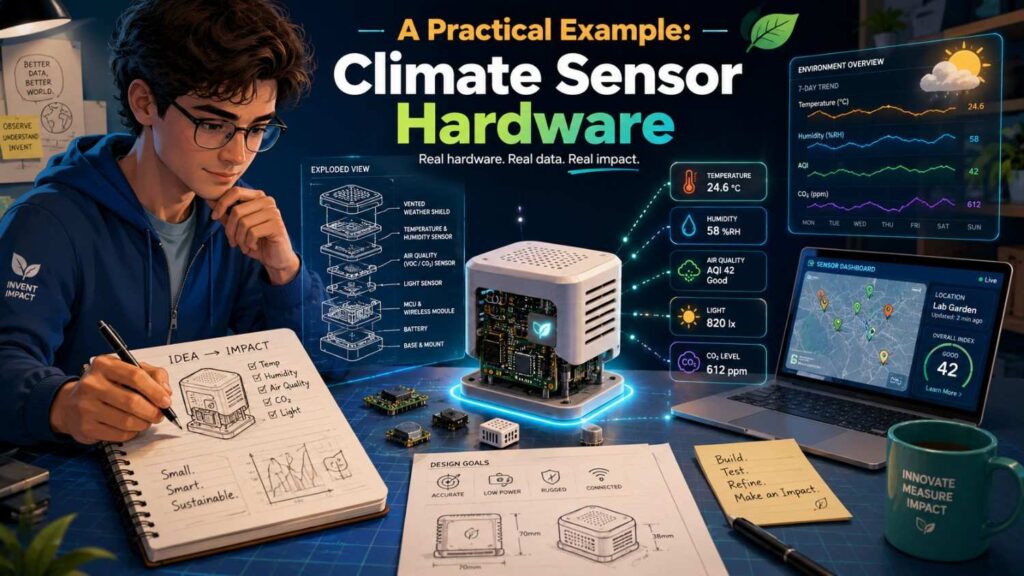
Imagine your startup built a low-cost methane sensor network for farms.
The system uses a special sensor housing, wind data, calibration logic, and farm layout data to locate leak sources with fewer sensors.
A weak search is “farm methane sensor.”
A better search includes methane source localization, low-cost gas sensor calibration, wind-based gas plume detection, agricultural methane monitoring, sensor drift correction, distributed gas sensor network, and farm emission mapping.
Academic papers may show gas sensor networks.
Other papers may show wind-based plume models.
Other papers may show calibration methods.
Your invention may be the specific housing plus calibration plus farm layout method.
Search each part and the combination.
A paper that shows gas sensing alone is not the whole story. A paper that shows your exact calibration and source location method may be close.
The Founder’s Prior Art Search Workflow
A simple founder workflow can work well.
Start by writing the invention in one clear sentence.
Then break it into problem, users, inputs, method, output, and benefit.
Build a word bank with product words, research words, old words, and technical words.
Search papers by problem.
Search papers by method.
Search papers by data.
Search papers by output.
Search papers by failure.
Search close author names and lab names.
Search patents connected to close papers.
Save the closest papers.
Compare each one to your invention.
Share the results with a patent attorney before filing or disclosing.
That is enough to make you much smarter than a founder who only searches one keyword.
Common Mistakes Inventors Make With Academic Papers
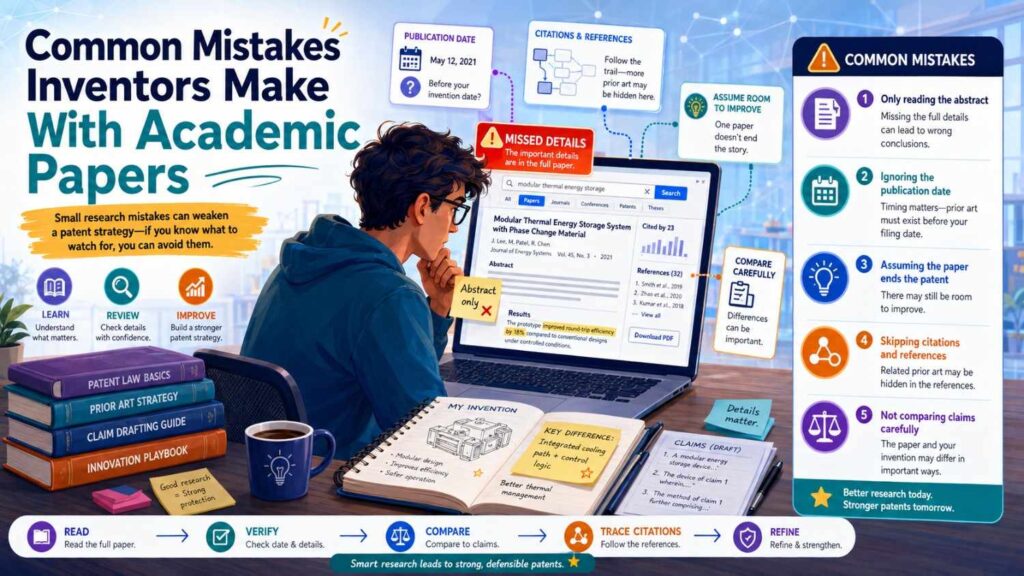
The first mistake is ignoring papers completely.
The second mistake is searching only one phrase.
The third mistake is reading titles but not methods.
The fourth mistake is ignoring dates.
The fifth mistake is assuming their own paper is harmless.
The sixth mistake is waiting until after a conference or launch to think about patents.
The seventh mistake is hiding close papers from counsel.
The eighth mistake is thinking a similar paper always kills the invention.
The ninth mistake is thinking a paper in another field cannot matter.
The tenth mistake is failing to search author names, citations, and preprint versions.
These mistakes are common because founders are busy. They are building the company.
But they are also avoidable.
What to Send Your Patent Attorney
When you are ready to talk to a patent attorney, do not just send twenty PDFs with no notes.
Send a simple package.
Include your invention summary.
Include your key search terms.
Include the closest papers.
Include publication dates.
Include your plain-language notes.
Include what you think is different.
Include upcoming disclosure dates.
Include product plans.
Include what competitors may copy.
This makes the attorney’s job easier. It also helps you get better advice.
The goal is not to do the attorney’s job. The goal is to give them strong raw material.
PowerPatent makes this easier by helping founders structure invention details and connect them with real patent attorney review. You can see how the platform works here: https://powerpatent.com/how-it-works
Why Speed Matters
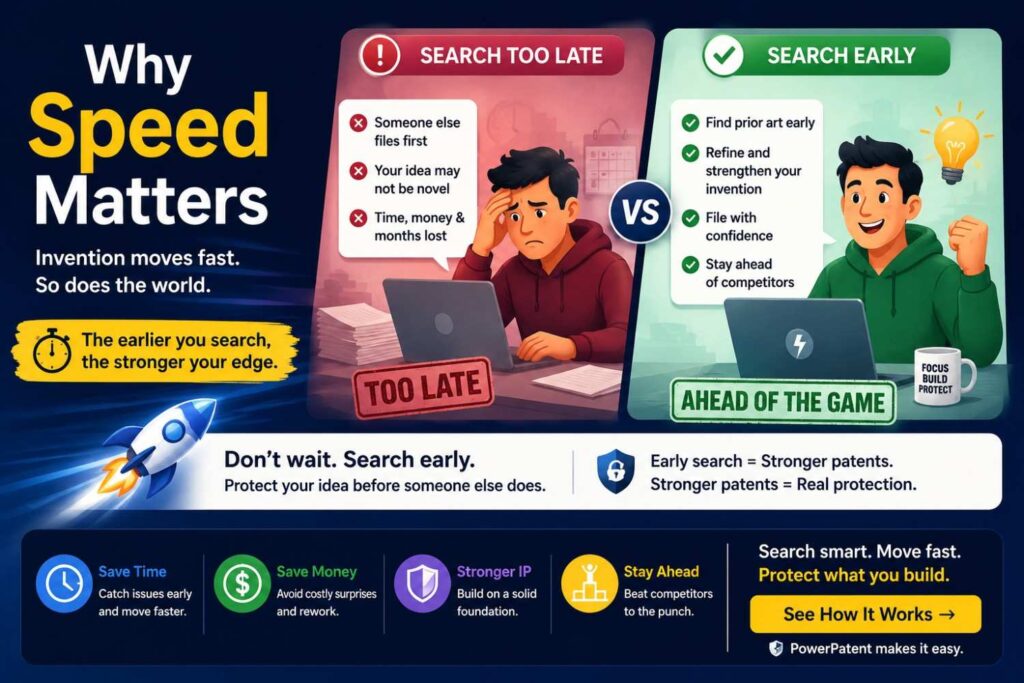
Patent work often fails because it starts too late.
The team writes the paper.
The team posts the preprint.
The team launches the product.
The team publishes the technical blog.
The team opens the repo.
Then someone asks, “Should we file a patent?”
That order is risky.
A better order is:
Find the invention.
Search the papers.
Talk to counsel.
File when appropriate.
Then publish, launch, or share.
This does not need to take months. With the right process, it can move quickly.
The key is to build patent thinking into your normal product and research flow.
Why PowerPatent Is Built for Technical Founders
Founders do not need old-school patent friction.
They need a fast, clear way to protect what they are building.
PowerPatent combines smart software with real patent attorney oversight. That means founders can bring in technical notes, code context, invention details, diagrams, and research background, then move toward a filing with more structure and less delay.
This matters when academic papers are involved.
You need to capture what your invention does.
You need to compare it to the field.
You need to explain the difference.
You need to file before public disclosures create avoidable risk.
PowerPatent helps make that process feel less like a legal maze and more like a clear build step.
See how it works here: https://powerpatent.com/how-it-works
Final Thoughts
Academic papers are not just background reading.
They can be prior art. They can shape your patent. They can reveal risk. They can also show the gap your invention fills.
For inventors, the goal is not to fear papers. The goal is to use them well.
Search them early.
Read them with care.
Track the dates.
Compare the details.
File before you disclose when protection matters.
And when the invention is important to your startup, do not handle it alone.
PowerPatent helps founders protect technical work faster with smart software and real patent attorneys. If your team is turning research, code, models, or product breakthroughs into something valuable, now is the right time to build a stronger patent plan.
Start here: https://powerpatent.com/how-it-works