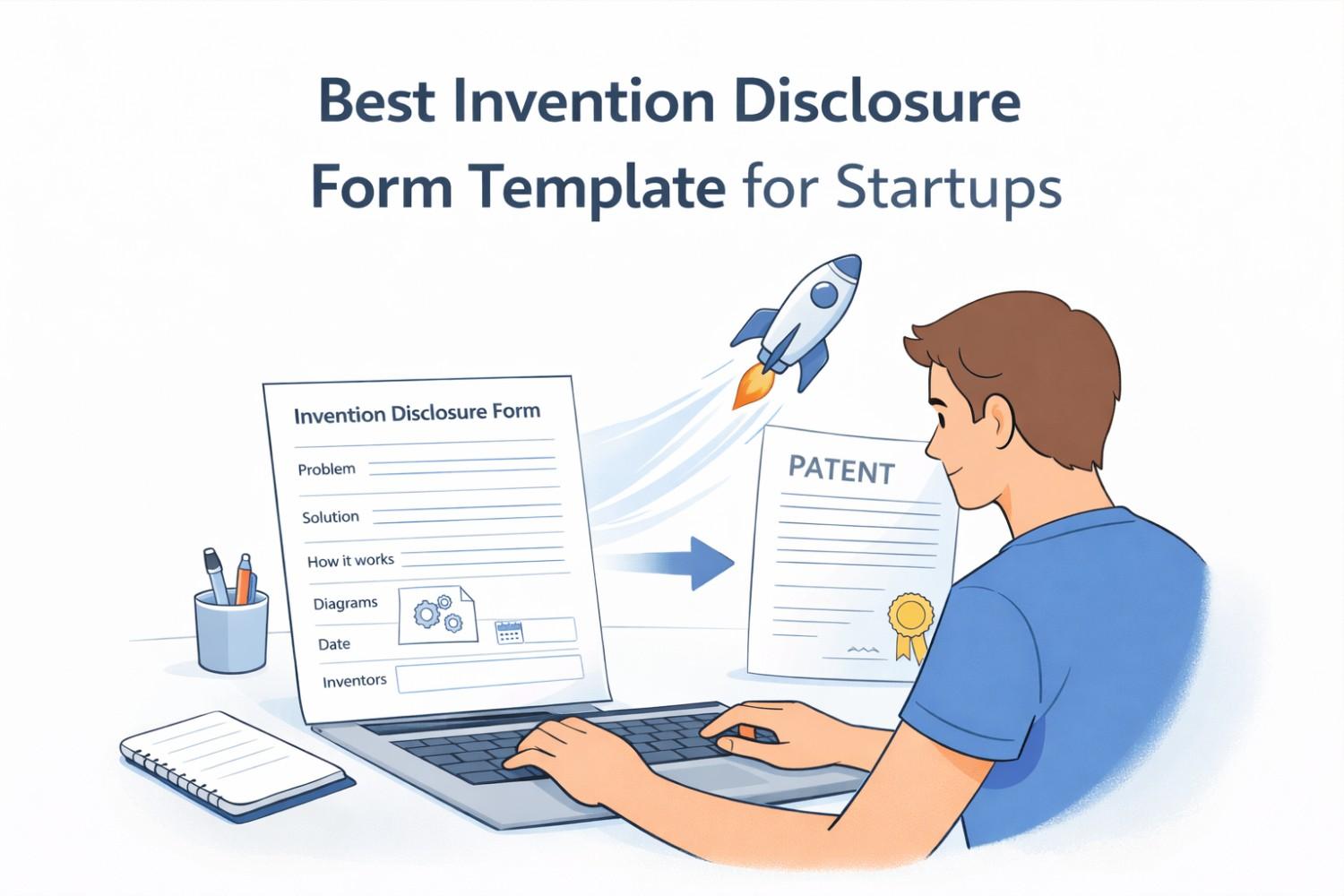
If you are building something new, you need to capture it before it slips through your fingers. Ideas move fast inside a startup. Code changes daily. Models improve every week. Features evolve after every user call. If you do not write down what you invented, when you invented it, and how it works, you risk losing control of it. An invention disclosure form is not paperwork for later. It is your safety net today. It turns your raw idea into something real that can be protected, defended, and owned. In this guide, I will show you what the best invention disclosure form looks like for startups, how to use it the right way, and how to turn it into a strong patent without slowing down your build.
What an Invention Disclosure Form Really Is (And Why Startups Need One Now)
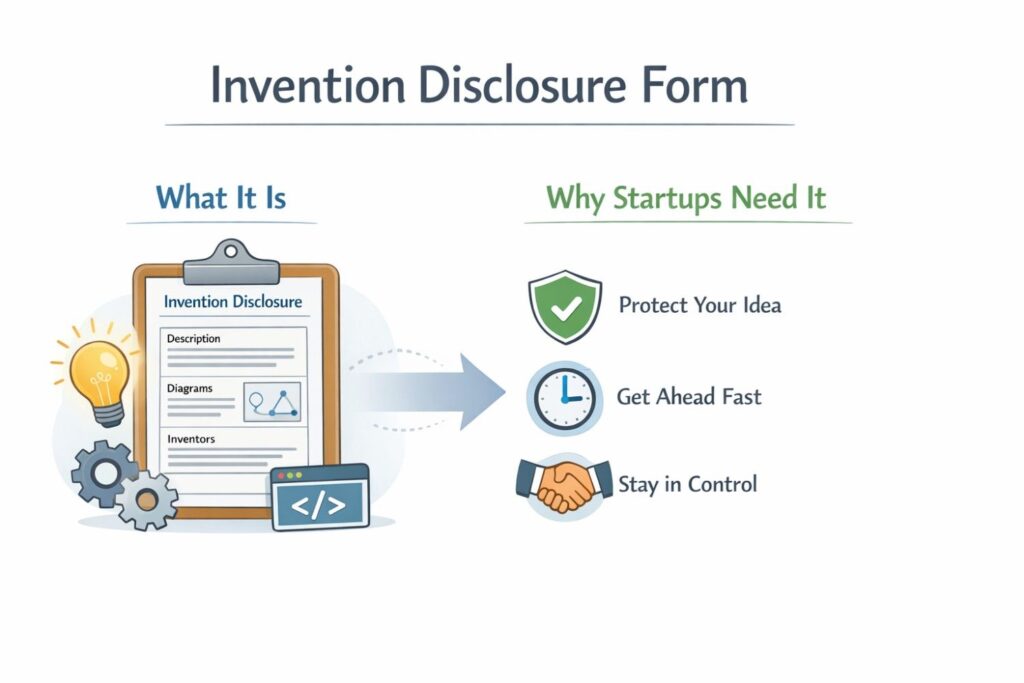
An invention disclosure form is not just a document. It is a turning point. It is the moment when a loose idea becomes a defined asset. For a startup, that shift is powerful.
You are not just building features. You are building value. And value must be captured clearly if you want to protect it, raise money on it, or sell it one day.
Many founders think patents start with lawyers. They do not. They start with clarity. The invention disclosure form is where that clarity begins.
It forces you to slow down for a moment and describe what you actually created, how it works, and why it matters. That process alone often reveals gaps, strengths, and angles you did not see before.
If you are building fast, this step feels optional. It is not. In fact, the faster you move, the more important it becomes.
It Is a Snapshot of Your Innovation at a Specific Moment
Startups evolve quickly. What you ship today may look very different in three months. That is normal. But when it comes to protecting your work, timing matters.
An invention disclosure form captures your invention as it exists right now. It locks in the details of the system, the architecture, the method, or the model before it changes.
This matters because protection depends on what you can prove and describe clearly.
The most strategic move you can make is to treat each major technical breakthrough as its own snapshot.
When your team solves a hard scaling issue, creates a new training method for your model, or designs a novel hardware setup, pause and document it. Do not wait for a “perfect” version. Capture it while it is fresh.
If you build this habit into your sprint cycles, you will never scramble later trying to remember how something worked six months ago.
It Turns Tribal Knowledge Into Company Property
In early-stage teams, a lot of knowledge lives in people’s heads. One engineer knows how the data pipeline really works. Another understands why the compression method is unique.
A founder may be the only one who sees the big picture of how everything connects.
That is risky.
If someone leaves, that knowledge leaves with them unless it has been documented. An invention disclosure form forces that hidden insight onto paper. It transforms personal know-how into company-owned knowledge.
From a business view, this is critical. Investors do not invest in undocumented ideas. Acquirers do not pay top dollar for systems that only exist in Slack threads and memory.
They want to see structured proof that your startup owns real, defined innovation.
Make it standard practice that when a core technical decision creates a competitive edge, it gets written into a disclosure form. Over time, this builds a library of protected value inside your company.
It Bridges the Gap Between Builders and Attorneys
Most engineers dislike legal talk. Most lawyers are not deep inside your codebase. The invention disclosure form acts as a bridge between those worlds.
When written correctly, it speaks in clear, technical language. It explains how the invention works without legal fluff.
That gives attorneys something solid to work with when drafting a patent application. It also reduces back-and-forth that wastes time and money.
Here is where startups gain an edge. Instead of waiting until you hire a law firm to explain everything from scratch, you prepare strong disclosures as you build.
When you work with a platform like PowerPatent, which combines smart software with real patent attorneys, those disclosures become the fuel for fast, high-quality filings. You avoid delays because the hard thinking is already done.
If you want to see how that process works in real life, you can explore it here: https://powerpatent.com/how-it-works
It Forces Strategic Thinking About What Is Truly Unique
Many founders believe their product as a whole is the invention. That is rarely the case. Often, the true invention lies in a specific method, algorithm, architecture, or system flow.
When you fill out a disclosure form properly, you must answer hard questions. What problem does this solve? How is it different from existing solutions? What technical step makes it possible? Why would it not be obvious to others?
This exercise sharpens your strategy. You begin to see which parts of your product are defensible and which are easy to copy. That insight can shape your roadmap.
You may decide to double down on deeper technical innovation instead of surface-level features.
A powerful move is to write the disclosure as if you are explaining it to a smart competitor who is trying to replicate you. If you can describe the technical edge clearly and show why it is not obvious, you are on the right track.
It Protects You Before You Pitch
Startups pitch constantly. You pitch investors, partners, enterprise clients, and sometimes even the press. In those conversations, you often reveal parts of how your system works.
If you have not documented your invention before those discussions, you are exposed. Even if someone does not copy you directly, proving ownership later becomes harder.
An invention disclosure form gives you a time-stamped record of what you created and when. That record can support future filings and strengthen your position if questions arise.
A smart practice is to complete a disclosure before any major demo day, fundraising round, or conference where you plan to discuss technical details. Think of it as putting on armor before stepping into the arena.
It Reduces Expensive Mistakes Later
One of the biggest mistakes startups make is waiting too long. They build for years, then decide to “do patents,” only to realize key details were never documented.
Engineers have moved on. Early versions are forgotten. Important design decisions are blurry.
At that point, recreating history is painful and costly.
Filling out disclosure forms in real time solves this. It spreads the effort over months instead of compressing it into a stressful rush. It also improves the quality of your patent filings because the information is fresh and accurate.
If your goal is to build long-term value, do not treat documentation as an afterthought. Treat it as part of the build process itself.
It Strengthens Your Position in Due Diligence
When investors conduct due diligence, they look for more than revenue and growth. They examine your intellectual property. They want to know what is protected, what is pending, and what is simply an idea.
If you can show a clear chain of invention disclosures that led to filed patents, it signals discipline. It shows you take protection seriously. It tells them your moat is not accidental.
Even before patents are granted, strong disclosures backed by attorney review create confidence. With PowerPatent, for example, your disclosures are not just stored.
They are reviewed and turned into defensible filings with real legal oversight. That combination of speed and credibility matters during fundraising.
You can see how that works in practice here: https://powerpatent.com/how-it-works
It Creates Internal Alignment Around Innovation
In many startups, teams focus on shipping. That is good. But without a shared understanding of what counts as true innovation, valuable breakthroughs may go unnoticed.
An invention disclosure form can serve as a signal inside the company. When someone submits one, it highlights that a meaningful technical leap has occurred.
It creates a culture where deep problem-solving is recognized and captured.
You can make this even more strategic by reviewing disclosures in leadership meetings.
Discuss what new inventions emerged this quarter. Explore how they align with your long-term vision. Decide which ones should move toward patent filing first.
This turns intellectual property into a living part of your strategy, not a dusty folder.
It Is the First Step Toward a Real Patent, Not the Last
Many founders misunderstand the role of the invention disclosure form. They see it as paperwork to satisfy a lawyer. In reality, it is the foundation of the entire patent process.
When done right, it feeds directly into a strong application. It provides the raw material attorneys need to craft broad, defensible claims. It reduces guesswork. It cuts delays.
More importantly, it keeps you in control. You are not handing your invention over and hoping someone else understands it. You are shaping how it is described from the start.
For startups that care about speed and precision, this is critical. You want to move fast without cutting corners. You want real protection without old-school delays.
That is exactly why modern platforms like PowerPatent exist.
They let you capture your invention in simple language, combine it with smart tools, and have real patent attorneys guide it to a filed application. It is protection built for builders.
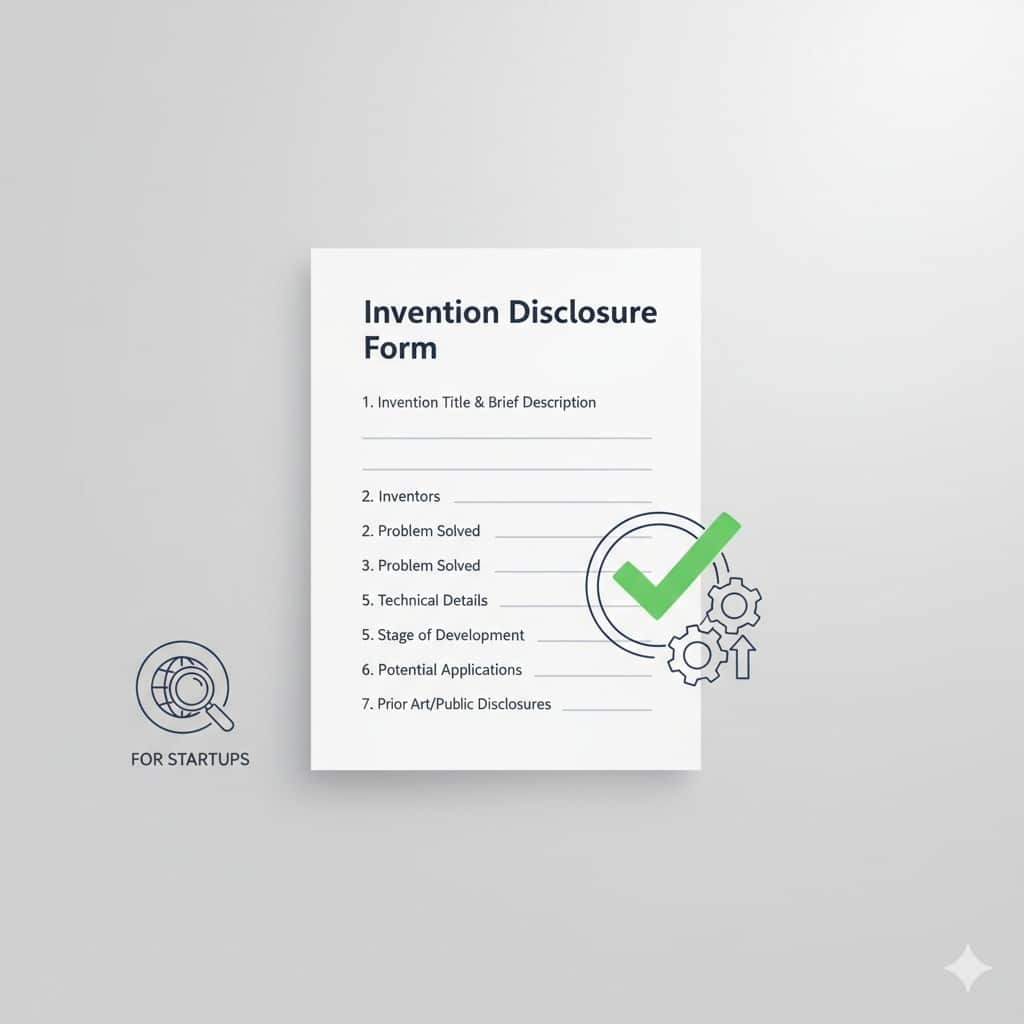
If you are serious about owning what you create, do not wait. Start documenting now. Turn each breakthrough into a clear, structured disclosure. Then turn that disclosure into a defensible asset.
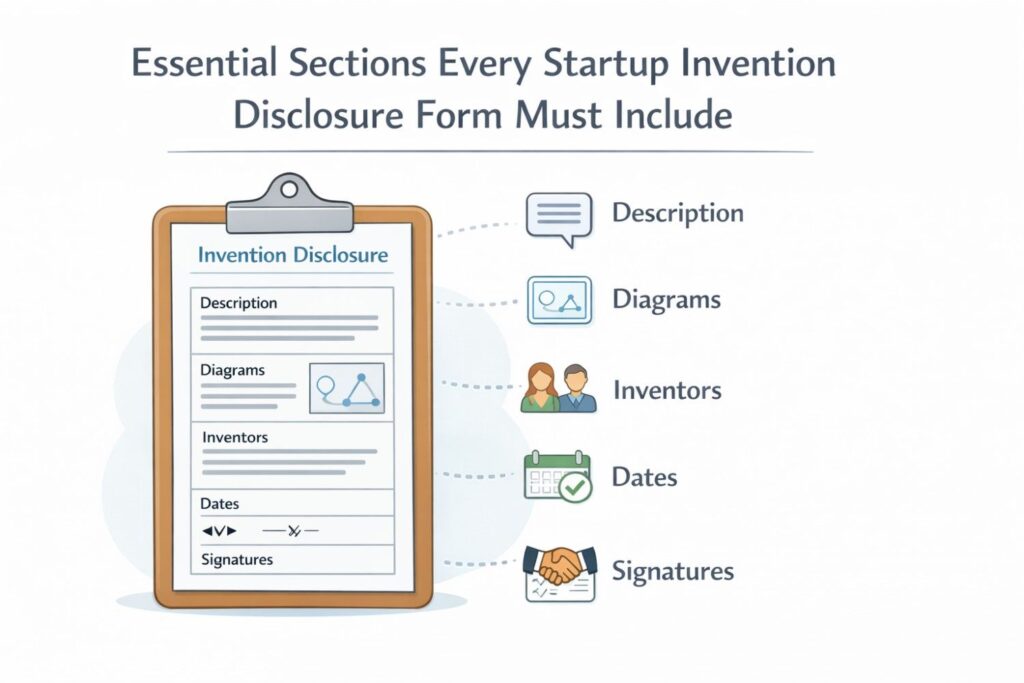
The Essential Sections Every Startup Invention Disclosure Form Must Include
If you want your invention disclosure form to actually protect your startup, it cannot be vague. It cannot be rushed. And it cannot be copied from some generic legal website.
It needs to reflect how your team builds, how your product works, and how real technical breakthroughs happen inside a startup.
An invention disclosure form is not just a record. It is the raw material that turns into a patent. If the foundation is weak, the patent will be weak. If the foundation is clear and strategic, the protection becomes much stronger.
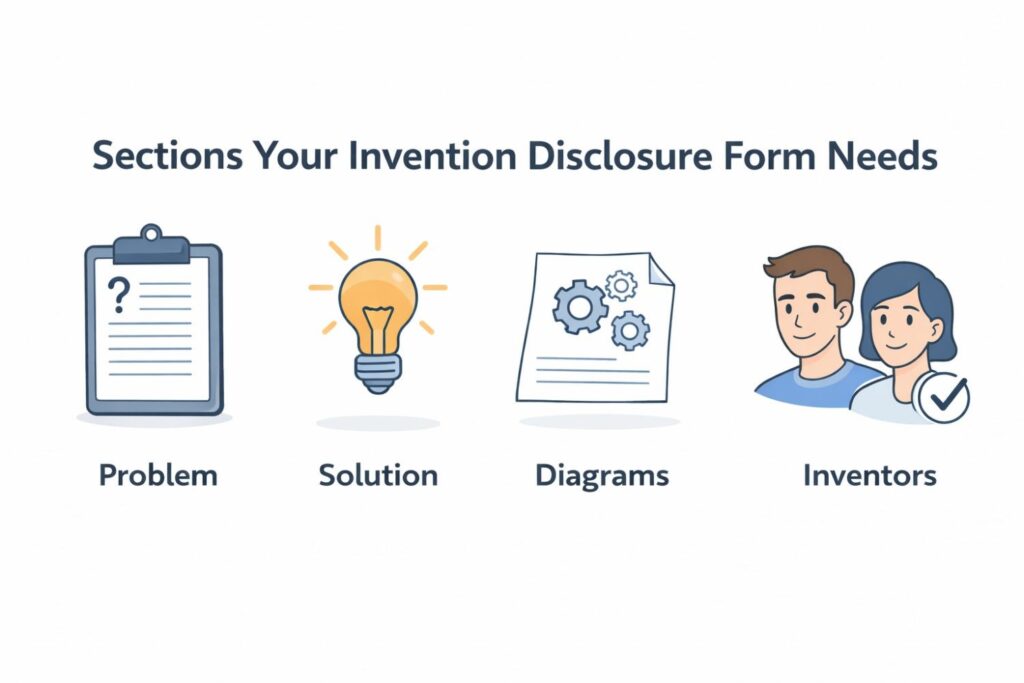
Let’s walk through the core sections every startup-focused invention disclosure form must include, and more importantly, how to approach each one so it builds real business value.
A Precise Technical Title
Every strong disclosure begins with a title that clearly reflects the technical heart of the invention.
This is not branding. It is not your company tagline. It is a short statement that captures what the invention actually does at a system or method level.
The title should signal the core concept. When someone reads it, they should understand the technical focus without reading anything else. If your invention relates to a distributed model training system, say that.
If it relates to a new data compression approach for edge devices, say that.
Why this matters is simple. The title frames the invention. It influences how attorneys think about claim scope. It also helps you internally track what types of innovation your company is producing over time.
When founders take this part seriously, they often realize their invention is more specific and powerful than they first thought.
A Clear Description of the Technical Problem
This section forces discipline.
You need to explain what technical limitation or challenge existed before your invention. Not the market pain. Not the business opportunity. The technical gap.
Was there too much latency in real-time processing? Did existing systems fail when scaling across multiple nodes? Did current algorithms require too much memory to run efficiently on mobile devices?
Be specific. Describe the constraints. Describe the failure points. Describe why prior approaches were not good enough.
This section is strategic because it builds context. When an attorney later drafts your patent application, this background strengthens the story.
It shows that your invention solves a defined technical issue, not just a vague idea.
A strong problem description also sharpens your own thinking. It makes you see exactly where your edge lies.
A Detailed Explanation of the Invention
This is the engine of the disclosure.
Here, you explain how your invention works from start to finish. You describe the architecture, the process flow, the system components, and how they interact. If there is an algorithm, explain its logic.
If there is hardware, describe how it is arranged and why.
Do not worry about legal words. Focus on technical clarity.
Walk through the invention step by step. What happens first? What happens next? What triggers each action? What inputs are required? What outputs are generated?
If helpful, describe a real-world use case where the system operates. That often reveals details that broad summaries miss.
This section should answer one simple question: if another skilled engineer read this, would they understand what makes your system unique and how it functions?
If the answer is not clearly yes, add more depth.
The Specific Novel Elements
Many founders assume their entire product is the invention. In reality, the true innovation is often a specific method, structure, or technical approach within the product.
This section isolates that core novelty.
What exactly is new? Is it the way data is filtered before processing? Is it a new sequence of training steps? Is it a unique coordination method between devices in a network?
Name the specific elements that did not exist before, at least to your knowledge. Explain how they differ from typical systems in your space.
This part is crucial for strategy. It helps you and your attorney focus on protecting what truly matters. It prevents filing patents that are too broad and get rejected, or too narrow and easy to design around.
When startups use a modern system that combines structured disclosures with real attorney oversight, this clarity leads to stronger and more efficient filings.
That is exactly how platforms like PowerPatent are built to work. You can see the full process here: https://powerpatent.com/how-it-works
Alternative Versions and Broader Applications
Startups often document only what they have built so far. That is a missed opportunity.
Your disclosure should explore how the invention could be implemented in other ways.
Could the same method apply to different data types? Could it operate in a cloud environment and also on edge devices? Could parts of it be used independently?
You do not need to build these versions. You just need to describe them as possible variations.
This forward-thinking approach allows patent claims to be written more broadly. It increases the chances that competitors cannot easily work around your protection by making small changes.
Think beyond your current roadmap. Capture the wider vision while it is still fresh in your mind.
Inventor Identification and Contribution Details
Inside fast-moving startups, roles blur. Ideas are shared in whiteboard sessions and Slack threads. Over time, it becomes hard to remember who contributed what.
Your invention disclosure form must clearly record each inventor and their specific contribution.
Who first proposed the core concept? Who developed the algorithm? Who refined the architecture? Who solved the key scaling problem?
Being accurate here is not just administrative. It protects the validity of your future patent. Incorrect inventor listings can cause serious problems later.
The best time to clarify contributions is right when the invention is documented. Memories are fresh. Conversations are easier. Tension is lower.
Treat this as part of building trust within your team.
Dates of Conception and Development
Timing matters in intellectual property.
Your form should record when the invention was first conceived and when it was actually implemented or tested. Even approximate dates are helpful.
This creates a timeline that shows the progression of your innovation. It also strengthens your internal records in case questions arise later.
For startups raising capital, this documentation can quietly add credibility. It shows that your innovation is not accidental. It evolved in a structured way.
Make it a habit to log these dates as soon as the invention is identified.
Supporting Documents and Technical Evidence
Words are powerful, but visuals and artifacts often speak louder.
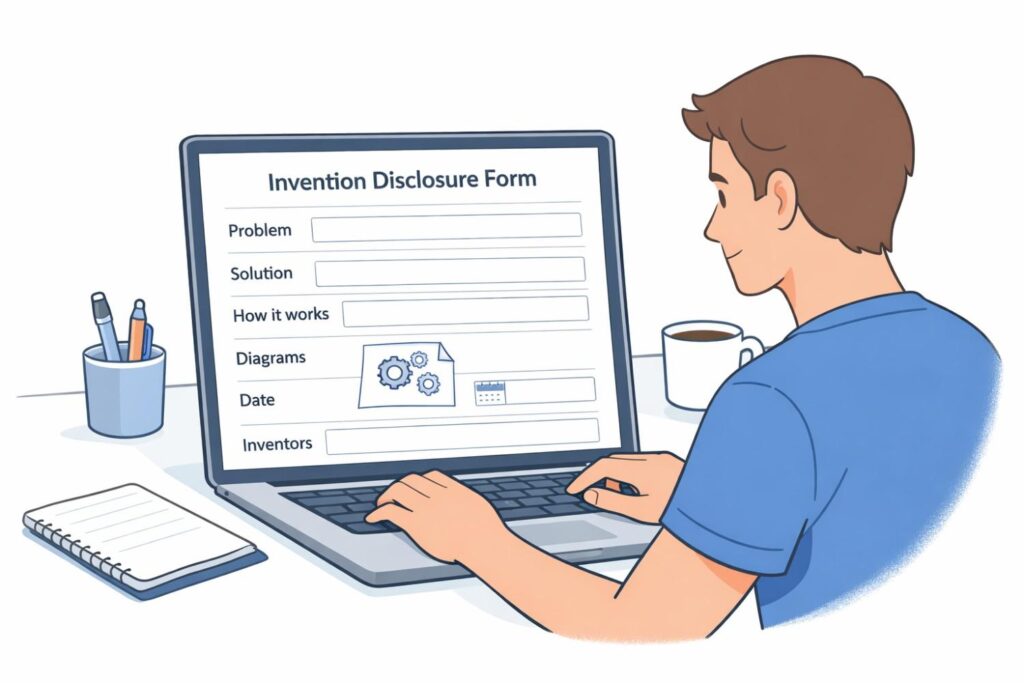
Your disclosure form should allow you to attach diagrams, system architecture drawings, code excerpts, test results, flowcharts, and screenshots. These materials provide context and clarity.
They also make it much easier for patent attorneys to understand your invention quickly and accurately.
When you use a system designed for technical founders, uploading these materials should feel natural, not painful. The smoother the process, the more likely your team will adopt it.
And adoption is everything. A perfect form that no one uses is worthless.
Internal Review and Approval
A strong disclosure process does not end when the form is submitted.
There should be a light internal review. A technical lead or founder should confirm that the invention is clearly described and strategically important. This ensures that real breakthroughs are prioritized for patent filing.
When combined with a platform that provides real attorney guidance, this review stage becomes even more powerful. It ensures that what moves forward is not just documented, but shaped into defensible intellectual property.
If you want to understand how startups move from structured disclosures to filed patents without the old delays and heavy costs, take a look here: https://powerpatent.com/how-it-works
The key message is simple. The sections in your invention disclosure form are not random. Each one plays a role in transforming your innovation into a protected asset.
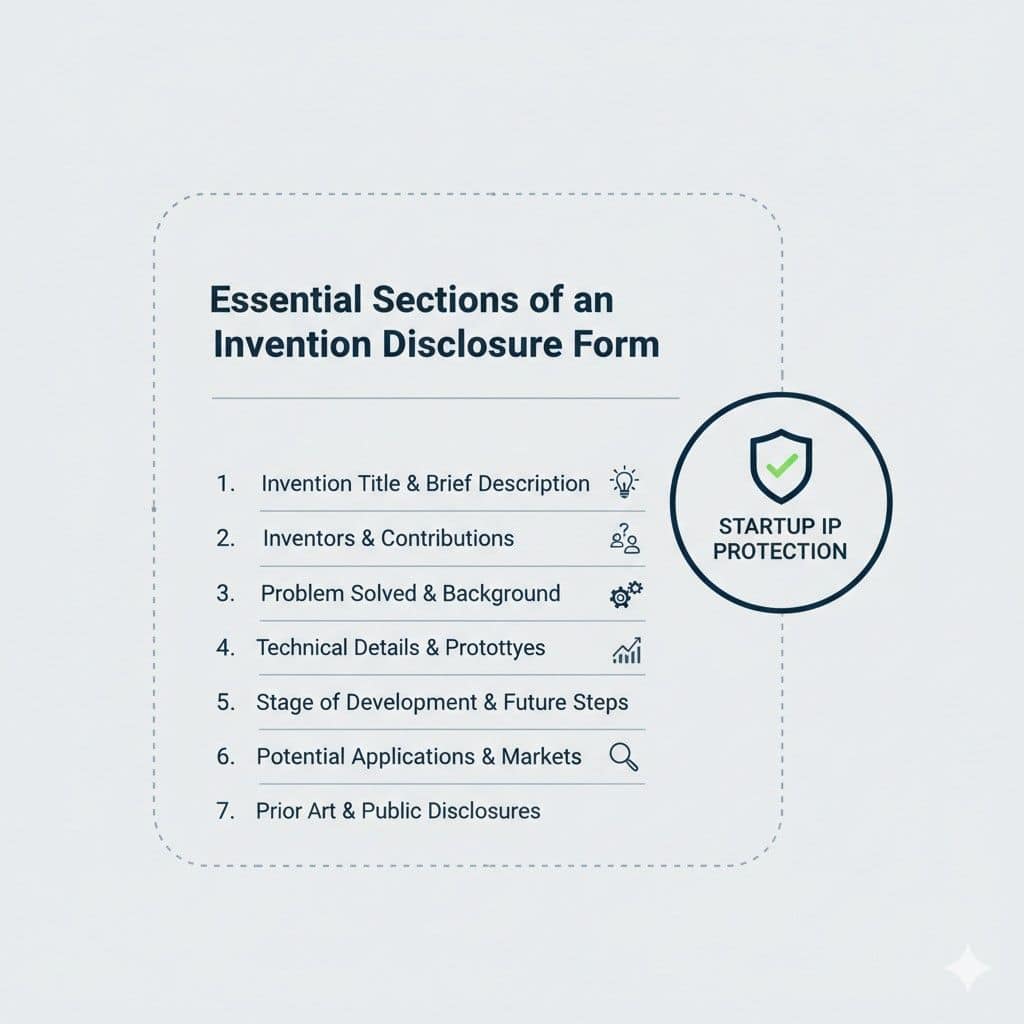
When structured properly, the form becomes a strategic tool, not a legal chore.
How to Fill Out an Invention Disclosure Form So It Actually Protects You
An invention disclosure form can either become your strongest shield or just another forgotten document in a folder.
The difference is not the template. It is how you fill it out.
Most startups rush this step. They write a short summary, attach nothing, and assume the patent attorney will “figure it out.” That approach weakens your protection before it even starts.
If the disclosure lacks depth, the patent built on top of it will likely be narrow, easy to challenge, or easy to work around.
If you want real protection, you must approach the disclosure like you approach writing production code. With care. With clarity. With intent.
Let’s break down how to do this the right way.
Think Like a Builder, Not a Marketer
The biggest mistake founders make is writing their disclosure like a pitch.
They talk about how amazing the product is. They explain how users love it. They describe business benefits.
None of that helps protect the invention.
Protection depends on technical detail. It depends on explaining how something works, not how impressive it sounds.
When filling out your form, imagine you are explaining your system to a senior engineer who wants to understand the internal logic. Remove all marketing language. Replace it with structure, steps, and mechanisms.
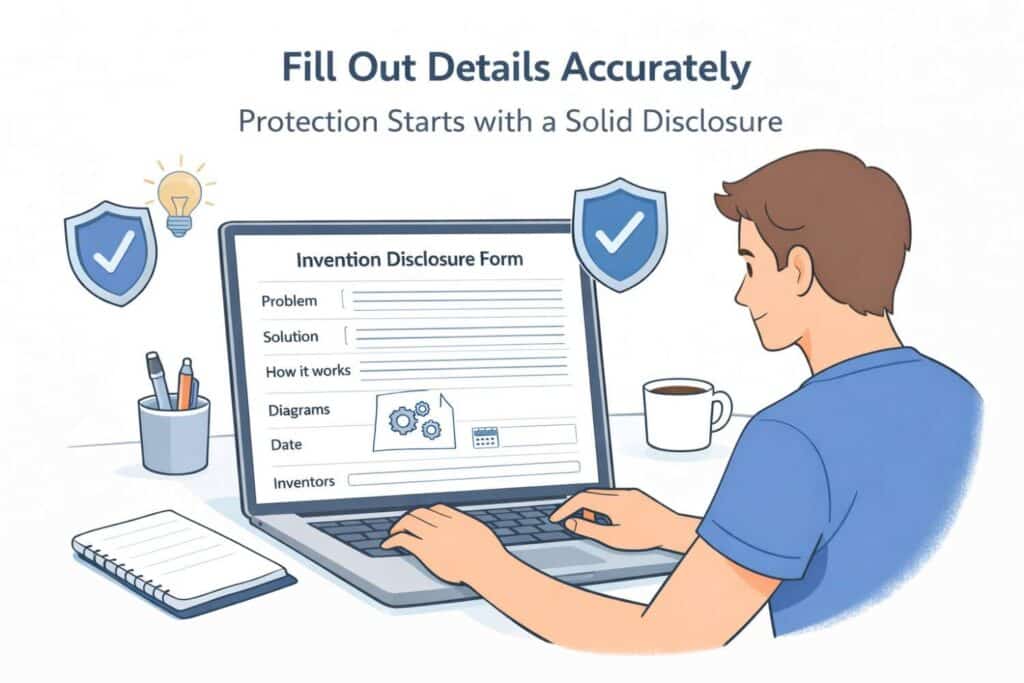
Instead of saying your system is “smarter,” explain what calculation makes it smarter. Instead of saying it is “faster,” explain what architectural change reduces delay.
Clarity builds strength. Vague language weakens everything.
Slow Down and Capture the Core Mechanism
Every invention has a core engine. That engine might be an algorithm, a process, a hardware setup, a data structure, or a unique sequence of operations.
Your job is to isolate that engine and explain it carefully.
Walk through the invention step by step. What happens first? What data enters the system? How is it transformed? What rules are applied? What decisions are made? What output is generated?
If your invention involves multiple components, describe how they interact. If it relies on specific thresholds, weights, or training methods, include that detail.
Do not assume the reader knows what is obvious to you. Write it down.
A strong disclosure often feels longer than expected. That is a good sign. Depth creates options later when drafting claims.
When you use a system like PowerPatent, this depth becomes incredibly valuable.
The more clearly you describe the mechanism, the easier it is for real patent attorneys to shape broad and defensible claims around it. You can see how that process works here: https://powerpatent.com/how-it-works
Use Concrete Examples to Expose Hidden Detail
Abstract explanations often hide important pieces.
One of the most powerful ways to strengthen your disclosure is to include a real example of your invention in action.
Describe a specific scenario. For example, explain how your system processes a user request from start to finish. Or describe how your model adapts after receiving new data. Walk through actual inputs and outputs.
As you do this, you will notice small decisions and technical steps that you might otherwise skip. Those details often become the backbone of strong patent claims.
Examples turn theory into structure. Structure turns into protection.
Be Honest About What Makes It Different
Many founders struggle here. They assume their invention is unique, but they do not clearly explain why.
Do not write “this approach is new.” Instead, explain what existing systems do differently. Show the contrast.
If other systems process data in batches and yours processes it continuously, say that. If others require manual tuning and yours adjusts automatically based on feedback, explain the mechanism behind that automation.
The goal is not to attack competitors. The goal is to define technical distinction.
This is strategic. When your disclosure clearly outlines differences, it becomes much easier to defend novelty later. It also helps your attorney avoid writing claims that overlap with known systems.
Clarity at this stage reduces rejection risk later.
Think Beyond Version One
Another mistake startups make is describing only the exact version currently running in production.
Your invention may have broader potential than your current implementation shows.
When filling out the form, ask yourself how else this idea could be implemented. Could the same process run on different hardware? Could it apply to different industries? Could certain steps be optional? Could parts of the system operate independently?
Document those possibilities.
You do not need to build them. You only need to describe them as logical extensions.
This expands the scope of what can be protected. It reduces the chance that a competitor can make a small tweak and avoid your claims.
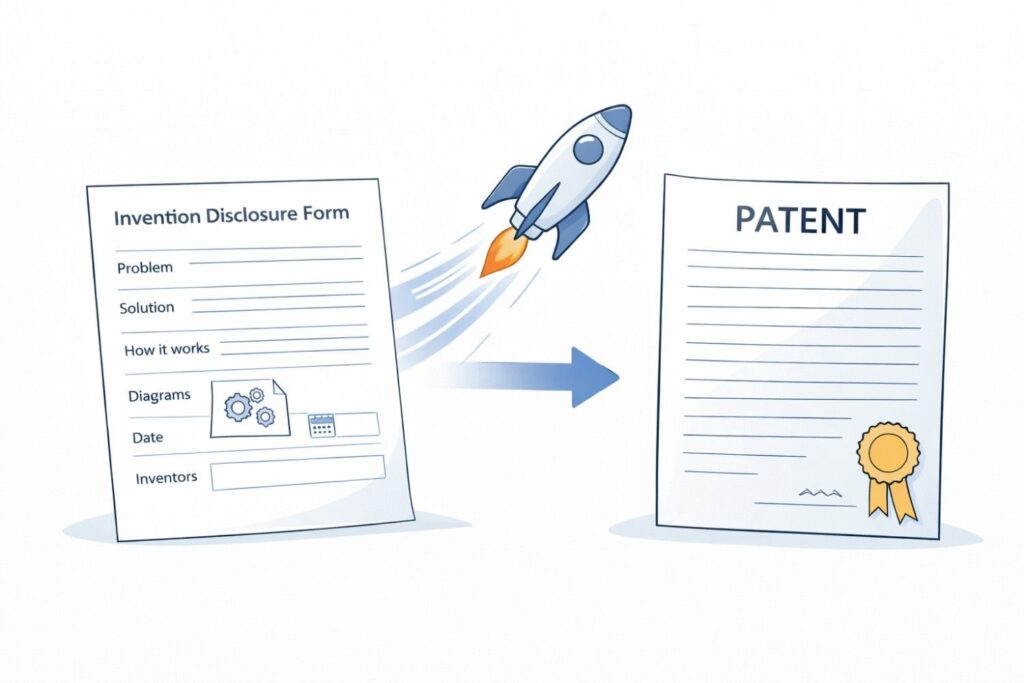
Strong protection often comes from thinking one layer beyond what you have already built.
Document the Timeline While It Is Fresh
Memory fades quickly in startups.
When completing your disclosure, record when the idea first emerged. Record when it was tested. Record when it was implemented.
Even approximate dates are better than nothing.
This creates a clear record of development. It also shows progression if questions arise later.
The key is to do this immediately after a breakthrough, not months later during a fundraising rush.
Make it part of your sprint cycle. When a major technical milestone is reached, pause and document it.
That habit alone can save you serious trouble down the road.
Clarify Inventor Contributions Early
Inside startups, collaboration is fluid. Ideas are shared freely. Over time, it becomes hard to pinpoint who contributed what.
When filling out the disclosure, have open conversations about contributions right away.
Who proposed the core idea? Who solved the critical problem? Who designed the architecture?
Be specific. Do not guess later.
Correct inventor listing is not just a formality. It affects the validity of your patent. Getting it wrong can create risk.
Handling this early keeps the process clean and professional.
Attach Real Supporting Material
A powerful disclosure is not just text.
Include system diagrams. Include architecture charts. Include key code snippets if relevant. Include experimental data or test results that show the invention working.
These materials make your explanation stronger. They also speed up the patent drafting process because attorneys can see the structure visually instead of guessing from paragraphs.
If your disclosure process makes it easy to upload these materials, your team is far more likely to provide them.
Modern platforms built for engineers understand this. They are designed to handle real technical artifacts, not just text boxes.
That is part of what makes PowerPatent different. It combines smart software that engineers can use comfortably with real legal oversight behind the scenes.
If you want to see how that blend of speed and attorney review works, you can explore it here: https://powerpatent.com/how-it-works
Review Before You Submit
Before finalizing your disclosure, read it once as if you were an outsider.
Ask yourself one simple question. If I had no prior context, would I understand exactly how this invention works and why it is different?
If the answer is no, improve it.
Add missing steps. Clarify vague phrases. Replace general words with specific descriptions.
This extra ten minutes can dramatically improve the quality of your future patent.
Treat It as an Asset Creation Moment
At the end of the day, filling out an invention disclosure form is not paperwork. It is asset creation.
You are converting innovation into documented value. You are building something that can increase company valuation, strengthen your fundraising story, and protect your competitive edge.
When done correctly, this process does not slow you down. It gives you confidence. It lets you share your vision with investors and partners knowing your core technology is documented and moving toward real protection.

If you build this discipline early, it becomes part of your culture. Innovation gets captured. Protection becomes proactive. And your startup gains leverage that many others ignore until it is too late.
Turning Your Disclosure Into a Strong Patent Without Slowing Down Your Startup
Many founders hesitate at this stage.
They understand the value of documenting inventions. They complete the disclosure.
But when it comes to turning that disclosure into a real patent filing, fear creeps in.
Will this take months?
Will attorneys drag us into endless calls?
Will this distract the team from shipping product?
These concerns are valid. Traditional patent processes are slow. They are expensive. They often pull founders into long back-and-forth cycles that drain energy.
But here is the truth. Filing a strong patent does not have to slow down your startup. If done correctly, it can run in parallel with your build. The key is having the right structure and the right support.
Let’s walk through how to move from disclosure to defensible patent without losing momentum.
Treat the Disclosure as the Heavy Lift
If your invention disclosure is thorough, you have already done most of the hard thinking.
You have defined the technical problem.
You have explained the mechanism.
You have identified what makes it different.
You have explored variations.
That depth becomes the raw material for your patent application.
When founders complain about patent delays, it is often because the process starts with vague notes and scattered explanations.
Attorneys must spend weeks extracting details. That is where time is lost.
If your disclosure is clean and structured, the drafting process becomes far more efficient. The attorney is not guessing. They are refining and shaping.
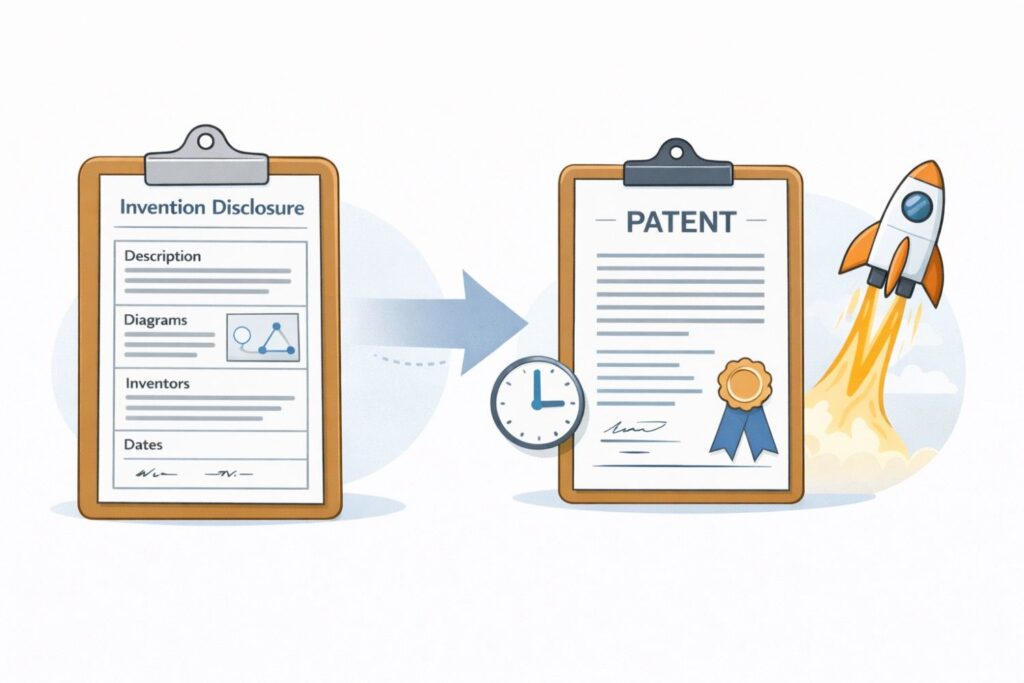
This is why startups that use a disciplined disclosure process move much faster from idea to filing.
Move Quickly While the Details Are Fresh
Speed matters at this stage.
Once the disclosure is complete, do not let it sit for six months. The longer you wait, the more the invention evolves. The more it evolves, the harder it becomes to align the patent with the current product.
A strong strategy is simple. When a breakthrough is documented and leadership agrees it is core to the company’s advantage, move it into filing within weeks, not quarters.
This keeps protection aligned with innovation.
It also reduces risk if you are about to raise capital, launch publicly, or enter partnership discussions.
Filing early does not mean filing carelessly. It means acting while clarity is high.
Work With Systems Built for Startup Speed
The biggest bottleneck in traditional patent filing is process friction.
Emails go back and forth. Drafts sit untouched. Questions pile up. Weeks pass between revisions.
Startups do not operate that way. They move in sprints.
If your patent process does not match your startup speed, it will always feel like a burden.
This is where modern platforms designed specifically for technical founders change the game.
Instead of endless email chains, structured software captures your disclosure, organizes your materials, and routes everything to real patent attorneys who understand deep tech.
The result is not rushed work. It is focused work.
PowerPatent was built exactly for this moment. It combines smart AI tools that help structure and refine your invention with real attorney oversight that ensures the final application is strong and defensible.
You get speed without sacrificing quality.
You can see how the process works step by step here: https://powerpatent.com/how-it-works
Stay Involved, But Do Not Get Stuck
Another fear founders have is getting pulled too deep into legal details.
Here is the right mindset. Stay involved at the strategic level. Let professionals handle the formal structure.
Review drafts carefully. Make sure the technical explanation is accurate. Confirm that key variations are included. Clarify anything that feels off.
But do not try to write legal claims yourself from scratch. That is not your highest leverage use of time.
Your job is to protect the core innovation while continuing to build the product.
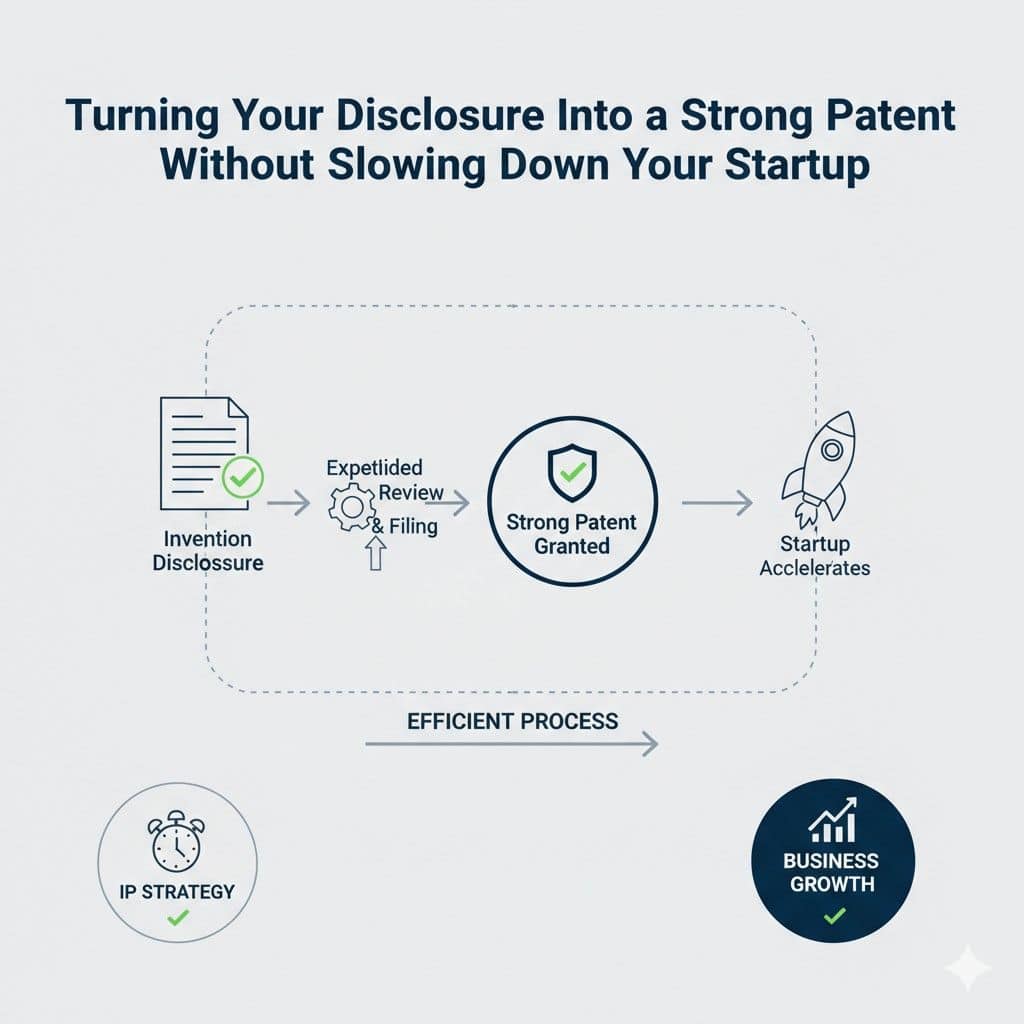
With the right system, this balance becomes natural. You provide technical depth. Attorneys translate it into proper patent language. The process moves forward without constant friction.
File Broad Enough to Matter
A weak patent protects a narrow implementation. A strong patent protects the underlying concept.
This difference is critical.
If your claims only cover the exact code you wrote, a competitor can change small details and avoid infringement. But if your patent captures the broader mechanism or system architecture, it becomes much harder to design around.
This is why the earlier sections of your disclosure matter so much. The variations you described. The alternative embodiments. The broader applications. All of that supports stronger claims.
When working with experienced patent attorneys, push for strategic breadth. Ask whether the claims cover the concept or just the example. Make sure the core idea is protected, not just one version.
Strong protection increases valuation. It strengthens your position in acquisition talks. It builds a real moat.
Keep Filing as You Innovate
One patent rarely defines a startup.
As your product evolves, new inventions will emerge. New optimizations. New architectures. New workflows.
Build a rhythm. Document. Review. File. Repeat.
This creates a growing portfolio that reflects the true depth of your innovation.
Investors love this. It signals discipline. It shows long-term thinking. It proves you are not just building features, but building defensible technology.
And when the process is streamlined, this rhythm does not feel heavy. It feels strategic.
Use Patents as a Business Lever, Not Just Legal Armor
A strong patent is more than protection. It is leverage.
It strengthens investor conversations because you can point to filed applications protecting your core tech. It builds confidence with enterprise partners who care about ownership. It adds weight in competitive markets.
When you combine disciplined invention disclosures with fast, attorney-backed filings, you move from reactive to proactive.
Instead of worrying about someone copying you, you build knowing your innovation is documented and protected.
That confidence changes how you operate.
The Real Goal: Protect While You Build
The fear that patents slow down startups comes from outdated processes.
When documentation is structured and filing is streamlined, protection runs alongside development. It does not block it.
Your engineers keep shipping.
Your product keeps improving.
Your IP portfolio keeps growing.
That is the ideal state.
If you are serious about turning your technical breakthroughs into real, defensible assets without getting buried in legal complexity, take a closer look at how PowerPatent works.
It was designed specifically for founders who want strong IP without slowing their startup: https://powerpatent.com/how-it-works
You are already building something valuable. The only question is whether you are capturing and protecting it as you go.
Wrapping It Up
Startups move fast. That is your strength. But speed without protection can quietly destroy value. An invention disclosure form is not paperwork. It is the bridge between raw innovation and real ownership. It captures what your team builds before it gets lost in Slack threads, code commits, and shifting roadmaps. It forces clarity. It turns ideas into assets. When structured correctly, your disclosure form becomes a strategic tool. It sharpens your thinking. It highlights what is truly unique. It creates clean records of contribution and timing. It lays the groundwork for strong, defensible patents.