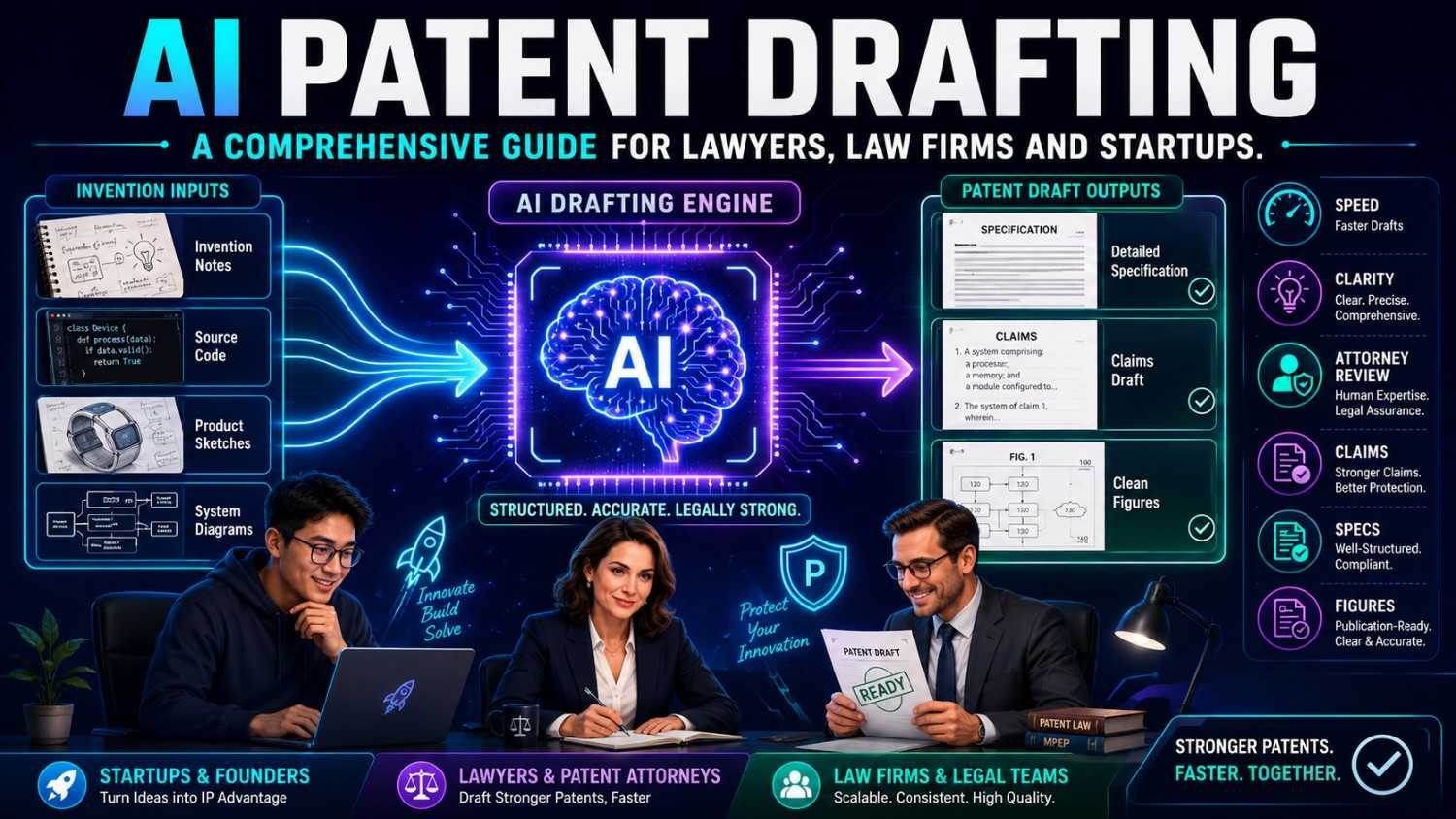
AI patent drafting is changing how patents get made. It is helping lawyers move faster. It is helping law firms serve more clients with less friction. It is helping startups protect hard technical work before the market copies it.
But AI is not a magic button.
A strong patent still needs clear thinking, smart strategy, deep technical detail, and real human review. AI can help with the heavy lifting, but it should not be left alone to make legal or business calls.
This guide explains how AI patent drafting works, where it helps, where it can go wrong, and how lawyers, law firms, and startups can use it in a safe and useful way.
PowerPatent helps founders turn code, models, systems, and inventions into real patent filings with smart software and real patent attorney oversight. To see how the process works, visit https://powerpatent.com/how-it-works.
What AI patent drafting really means
AI patent drafting means using artificial intelligence to help create, review, organize, or improve a patent application.
That may sound simple, but patent drafting is not just writing. It is not the same as asking a tool to write a blog post, sales email, or product page. A patent application is a technical and legal document. It must explain the invention in a way that is clear, complete, and useful later.
A patent draft often includes a title, background, summary, drawings, figure descriptions, detailed examples, claims, and other filing parts. Each part matters. Each part has a job. If one part is weak, the whole filing can suffer.
AI can help with many of these parts. It can turn inventor notes into a draft outline. It can summarize technical documents. It can help create figure descriptions. It can point out unclear terms. It can help lawyers compare claim language with the rest of the draft. It can help founders explain their inventions in plain words. It can help law firms save time on repeated drafting steps.
But AI does not replace legal judgment.
Patent drafting is part writing and part strategy. The words matter, but the choices behind the words matter even more. A patent professional must decide what the invention really is, how broad the claims should be, what details must be added, what risks must be avoided, and how the filing fits the business goal.
This is why the best use of AI in patent drafting is not “push button, get patent.” The best use is “use AI to move faster, then use human judgment to make it strong.”
That is also why PowerPatent combines smart software with real attorney oversight. The software helps founders and inventors move quickly. The attorney review helps avoid costly mistakes. Learn more here: https://powerpatent.com/how-it-works.
Why AI patent drafting matters now
Patent work has always had a speed problem.
Startups move fast. Engineers build fast. Product teams test, ship, break, fix, and improve every week. A founder may go from idea to demo in days. A machine learning team may test five model versions in a month. A robotics team may change hardware based on field data. A software team may launch a new feature before the patent team even sees the invention.
Traditional patent work often moves more slowly.
The usual process may include an invention form, a meeting, a draft, inventor review, legal edits, more review, and then filing. That process can work well when everyone has time. But startups rarely have extra time. Founders are raising money, hiring people, talking to customers, building product, and trying to win the market.
This is where AI can help.
AI can reduce the friction at the start. It can help turn messy notes into clean invention summaries. It can help ask better follow-up questions. It can help organize drawings, product specs, code comments, and design notes. It can help lawyers understand the invention faster. It can help inventors explain what matters without learning legal language.
That speed matters because patent timing matters.
If a startup waits too long, it may disclose the invention before filing. It may publish a paper. It may show a demo. It may release code. It may pitch investors. It may share details with partners. In some cases, those actions can reduce patent options, especially outside the United States.
The point is not to scare founders. The point is to build a better system.
A startup should not have to choose between moving fast and protecting what it builds. With the right workflow, patent capture can happen while the team is still building. AI makes that easier.
The old patent workflow was not built for modern startups
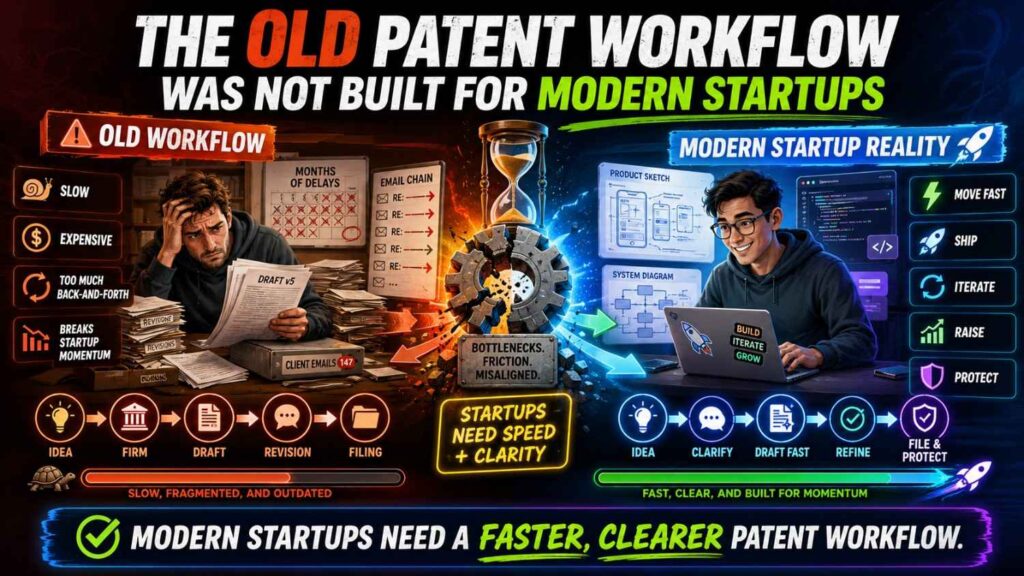
The old patent workflow assumes that invention details are easy to collect.
They are not.
In a real startup, invention details are scattered everywhere. A key idea may be in a Slack thread. Another may be in a GitHub commit. Another may be in a model training note. Another may be buried in a product roadmap. Another may live only in the head of one engineer who is busy fixing a launch bug.
By the time the patent lawyer gets involved, the facts may be hard to find.
This creates a problem. A patent lawyer can only draft from what they know. If the invention disclosure is thin, the draft may be thin. If the founder explains the idea at a high level only, the application may miss the real technical edge. If the team forgets to explain alternate versions, the claims may be too narrow.
A weak draft can look fine on the surface. It may be long. It may use formal words. It may include claims. But if it misses the real invention, it may not protect much.
AI helps by making invention capture easier.
Instead of asking an engineer to fill out a long blank form, an AI-guided system can ask simple questions. What problem were you solving? What did the old system do? What did your system change? What data does it use? What steps happen first? What happens if the input is bad? What is optional? What might change in a future version?
These questions help pull out the real invention.
For startups, this is a big win because it turns patent work into a guided process instead of a legal chore. For lawyers, it means better input. For law firms, it means fewer gaps and less back-and-forth.
PowerPatent is built around this idea. It helps technical teams capture invention details in a clear way, then supports attorney-reviewed patent drafting. See the workflow here: https://powerpatent.com/how-it-works.
AI patent drafting is a tool, not a replacement for lawyers
Some people talk about AI as if it will replace patent lawyers.
That view misses the point.
AI can write. AI can summarize. AI can compare text. AI can generate draft language. But patent work is not only text work. It is judgment work.
A patent lawyer does much more than fill pages. A good patent lawyer asks what the invention really is. They look for the core idea. They think about future product changes. They consider what competitors may copy. They decide how to claim the invention. They check whether the draft supports the claims. They avoid harmful wording. They think about the company’s business goals.
AI can help with these tasks, but it cannot fully own them.
For example, AI may draft a claim that sounds broad. But broad is not always good. If the claim is too broad and not supported, it may be rejected or may create problems later. AI may also draft a claim that is too narrow because it copies the current product too closely. That may leave room for competitors to work around it.
A human reviewer must decide.
That reviewer should understand both patent law and the technology. This is especially true for deep tech startups. If the invention involves machine learning, robotics, semiconductors, biotech tools, cybersecurity, energy systems, or advanced hardware, the details matter a lot.
AI can speed up the process. It can reduce blank-page time. It can help organize the record. It can find inconsistencies. It can suggest options. But it should not make the final legal call.
The safest model is human-led and AI-assisted.
That is the model founders should look for.
The best AI patent workflow starts before drafting
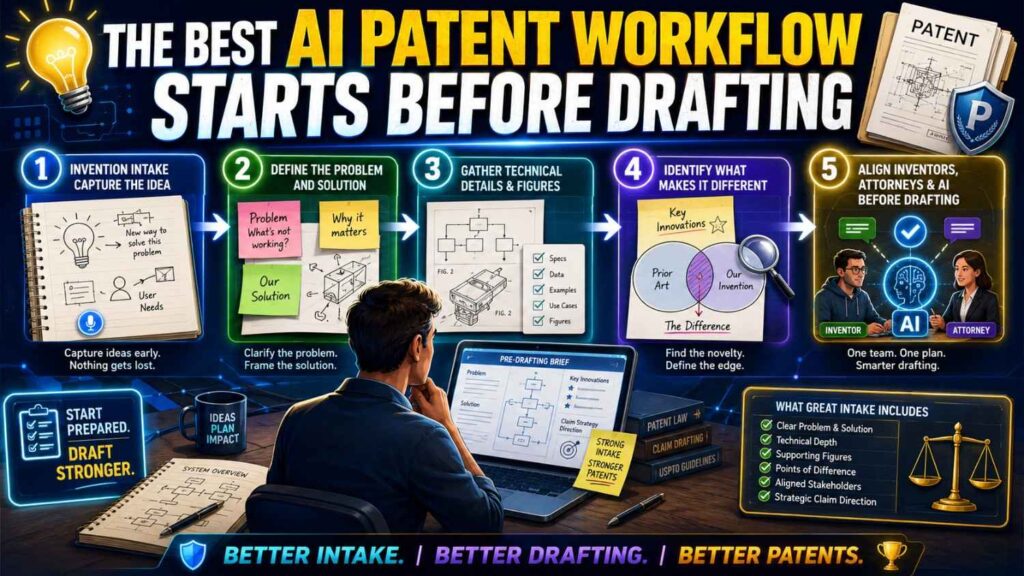
Many people think AI patent drafting starts when the tool writes the application.
In practice, the best use of AI starts earlier.
The most important work is invention capture. This is the step where the team collects the facts that will become the patent. If this step is weak, the draft will be weak. If this step is strong, the lawyer has much more to work with.
Good invention capture answers basic but powerful questions.
What problem did the team face? Why was the old way not enough? What did the team build? What are the key steps? What parts are required? What parts are optional? What data is used? What hardware or software components are involved? What happens in edge cases? What makes the result better? What other versions could work?
A founder may not know how to answer these questions in patent language. That is fine. They should not have to. AI can help ask the questions in plain words and turn the answers into a useful invention record.
This is where AI can create real leverage.
A lawyer who starts with a rich invention record can spend more time on strategy. A lawyer who starts with vague notes must spend time chasing basic facts. Better input leads to better output.
For startups, this also protects against memory loss. In fast-moving companies, details vanish quickly. Engineers change teams. Code changes. Product plans shift. The reason behind a design choice may be forgotten. Capturing the invention early helps preserve the story.
That story matters. A strong patent is not just a claim to an end result. It explains how the invention works and why it matters.
What AI can do well in patent drafting
AI is useful when the work involves reading, organizing, summarizing, checking, or creating a first pass.
It can help take a messy set of notes and create a clean outline. It can help convert an inventor interview transcript into key points. It can help identify system parts and method steps. It can help draft figure descriptions. It can suggest alternate embodiments. It can compare claim terms against the specification. It can rewrite dense technical notes in clearer language.
AI can also help spot missing details.
For example, if a draft says a system “selects a model,” AI can ask how the model is selected. Is it based on latency? Cost? Accuracy? User type? Sensor confidence? Data quality? Hardware limits? That follow-up question may reveal a patentable detail.
If a draft says a device “adjusts operation,” AI can ask what operation is adjusted. Speed? Power? Temperature? Timing? Pressure? Signal strength? Sampling rate? Control mode? That may turn a vague statement into useful technical support.
If a draft says a platform “uses feedback,” AI can ask what feedback means. Is it user feedback, system feedback, model feedback, sensor feedback, or error feedback? When is it collected? How is it used? What changes because of it?
This type of questioning can improve the draft.
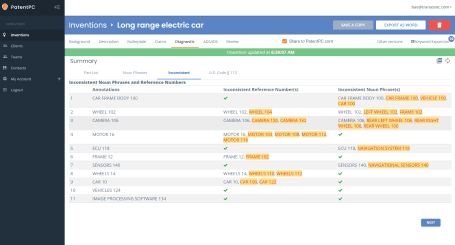
AI can also help with consistency. Patent applications often use repeated terms. If one part of the draft says “ranking score” and another says “priority score,” that may create confusion. AI can help find and fix these issues.
It can help lawyers work faster without skipping thought. It can give attorneys a first structure, then the attorney can improve it.
That is a strong use case.
Where AI can go wrong in patent drafting
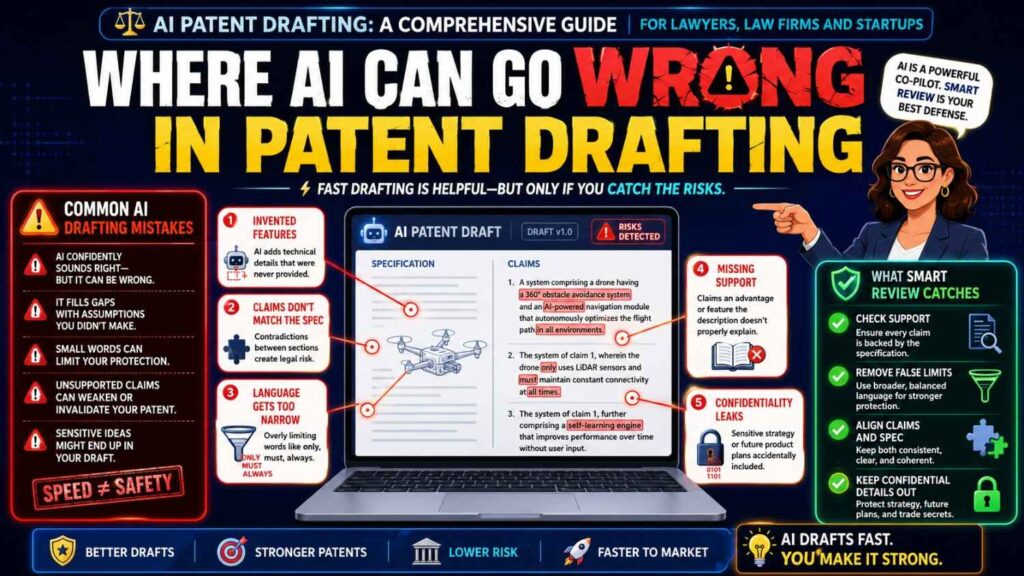
AI can be wrong in quiet ways.
It may add details that sound likely but are not true. It may say the system uses a neural network when it uses a rule-based model. It may say the device sends data to a server when it works offline. It may say training happens weekly when training happens only once. It may invent a sensor, a database, a user step, or a performance result.
These mistakes are dangerous because they can look harmless.
A founder may read a draft quickly and miss them. A lawyer may assume the facts came from the inventor. A law firm may move too fast and fail to verify. Later, those wrong facts can cause trouble.
AI can also make an invention sound more generic than it is.
This is one of the biggest problems. A startup may have a smart technical breakthrough, but AI may describe it with soft words like “improves performance” or “uses artificial intelligence” or “optimizes the process.” Those words sound nice, but they do not explain the mechanism.
Patents need the mechanism.
How does the system improve performance? What data is used? What step is new? What changes inside the system? What is the technical reason it works?
AI may also produce claims that look official but are weak. The claims may include unnecessary parts. They may miss the most important step. They may fail to cover future versions. They may be too close to the current product. They may not have enough support in the description.
This is why human review is not optional.
AI can help create a draft, but a human must check the facts, the strategy, and the legal strength.
Human review is the heart of safe AI patent drafting
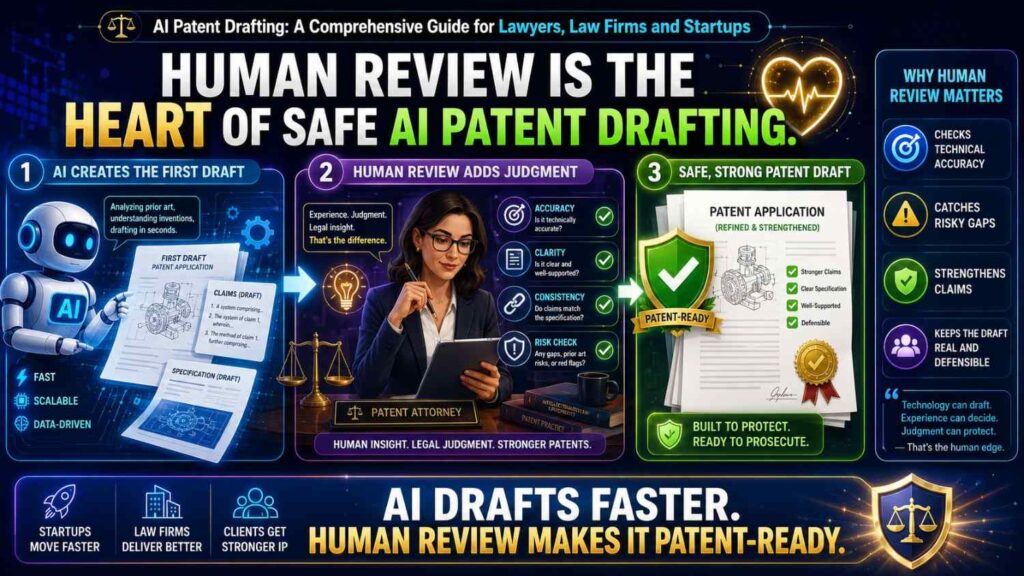
Human review is what turns AI output into professional work.
A good reviewer does not only fix grammar. They check whether the draft is true. They check whether it covers the invention. They check whether the claims match the description. They check whether the language is clear. They check whether the draft gives the company future room.
For lawyers, this is part of the job. For law firms, it is a quality control duty. For startups, it is the difference between a filing that merely exists and a filing that may actually help the business.
Human review should happen at several points.
First, the inventor should review the technical facts. Does the draft describe the system correctly? Are any steps wrong? Are any parts missing? Are the examples real? Are future versions included?
Second, the patent professional should review the legal structure. Are the claims supported? Is the scope reasonable? Are terms clear? Does the draft avoid harmful admissions? Does the application fit the filing plan?
Third, the business team should review the business fit. Does this filing protect what matters? Does it map to the product? Does it support fundraising, partnerships, or market defense?
This may sound like more work, but AI can make each step easier. The key is to review the right things, not everything from scratch.
PowerPatent helps combine guided software with attorney review so founders can move faster while keeping human judgment in the process. Visit https://powerpatent.com/how-it-works to see how it works.
AI patent drafting for lawyers
For lawyers, AI can remove a lot of low-value work.
Patent lawyers spend many hours organizing notes, preparing outlines, drafting routine sections, checking terms, and revising text. Some of that work needs legal skill. Some of it is simply time-consuming.
AI can help with the time-consuming parts.
It can summarize technical material before an inventor call. It can prepare a first list of questions. It can turn meeting notes into a structured invention summary. It can create a first draft of certain sections. It can compare claim language with the specification. It can flag terms that are used only once. It can help prepare a review checklist.
This does not make the lawyer less important. It makes the lawyer’s time more focused.
Instead of spending hours building a rough structure, the lawyer can spend more time on claim strategy, technical depth, and risk. Instead of manually checking every repeated term, the lawyer can use AI to find possible issues, then apply judgment.
AI can also help lawyers serve startup clients better.
Startups often need speed. They want simple updates. They do not want long delays or confusing legal talk. AI-assisted workflows can make the process more responsive. Lawyers can give clients clearer invention summaries, faster drafts, and better visibility into what is happening.
But lawyers must set boundaries. They should not rely on AI without review. They should not use tools that put client secrets at risk. They should not let AI decide legal strategy. They should not submit work they have not checked.
The best lawyers will use AI the way great builders use power tools. The tool increases output, but the craft still belongs to the person.
AI patent drafting for law firms
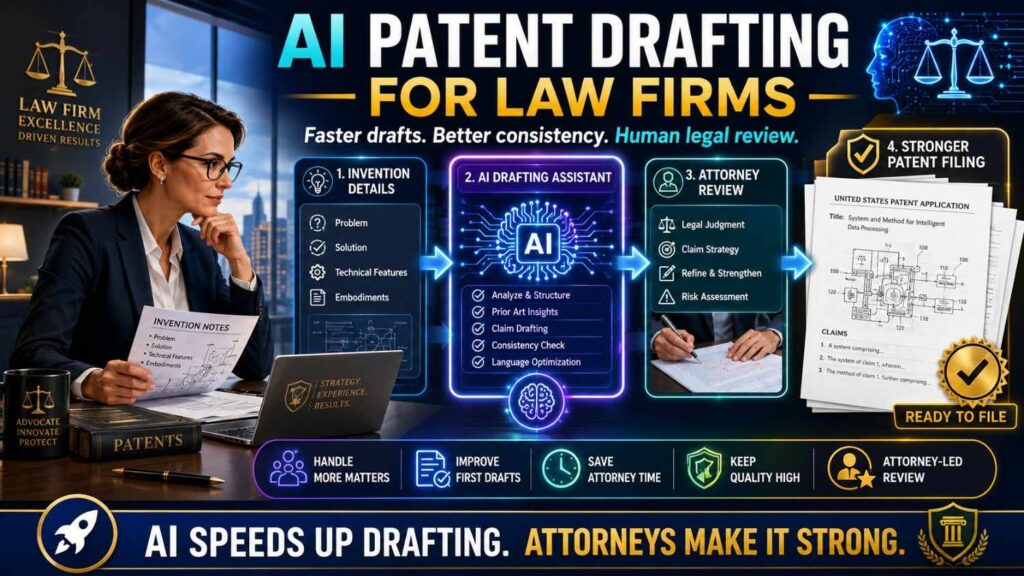
For law firms, AI patent drafting is not just a drafting aid. It is a business model shift.
Firms that use AI well can improve speed, quality, and client experience. Firms that use it poorly may create risk at scale.
The biggest advantage is process consistency.
In many firms, patent quality depends heavily on the individual attorney or agent. Some people ask great inventor questions. Some use strong templates. Some are careful with claim support. Others may be less consistent. AI can help standardize the early workflow.
A firm can create better intake flows. It can build technology-specific question sets. It can create review rules. It can use AI to check whether each draft includes key sections, definitions, examples, and fallback positions.
This is especially useful for firms that serve startups. Startup clients often have less formal documentation than large companies. They may need help explaining the invention. A guided AI process can make the intake smoother and reduce the time lawyers spend chasing basic details.
AI can also support more predictable pricing.
Traditional hourly billing can make startups nervous. They may fear surprise costs. AI-assisted workflows can reduce drafting time and make fixed-fee or staged pricing easier. That can make patent services more accessible while still preserving attorney review.
But firms need governance.
They need approved tools. They need data rules. They need review standards. They need training. They need to know when client consent is needed. They need to make sure attorneys remain responsible for final work.
AI should not become an invisible shortcut. It should become a visible, controlled part of the firm’s workflow.
The firms that win will not be the ones that use AI the most. They will be the ones that use it with the best process.
AI patent drafting for startups
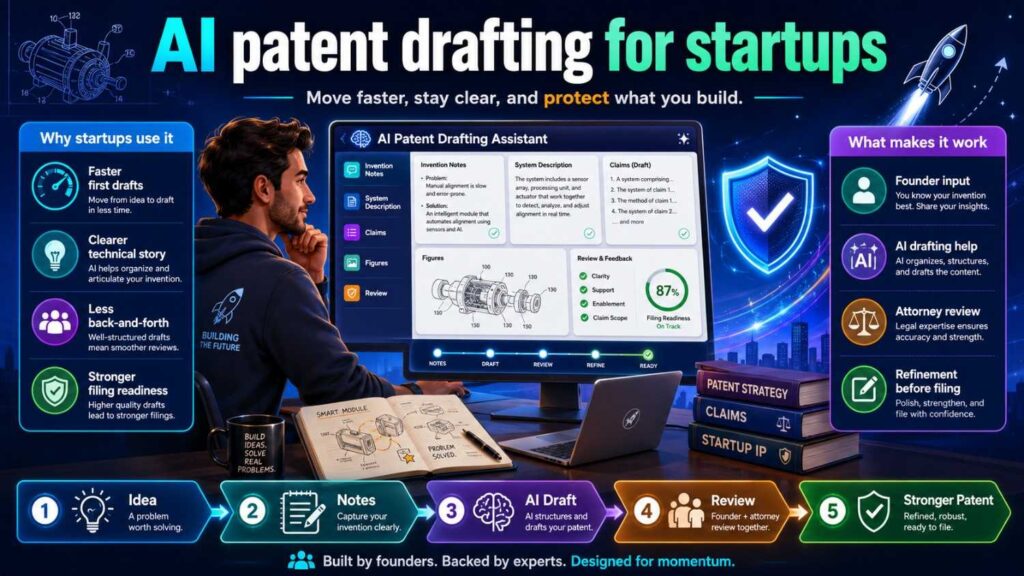
For startups, AI patent drafting can feel like a breakthrough.
Patent work has often felt slow, expensive, and hard to understand. Founders may know they need protection, but they may not know when to start, what to file, or how to explain the invention.
AI can make the first step easier.
A founder can describe the product in normal words. An AI-guided workflow can ask follow-up questions. It can help organize the invention. It can turn raw notes into a clearer summary. It can help the attorney understand the invention faster.
This is especially helpful for technical founders who do not want to stop building just to learn patent language.
But startups should be careful.
A patent is not valuable just because it was filed. A weak patent may do little. A rushed AI-only filing may miss the real invention. It may fail to support future claims. It may use narrow product details that change next quarter. It may leave out the hard technical part that competitors would copy.
Startups should use AI to speed up the process, not to avoid expert review.
Founders should focus on explaining the invention clearly. What was hard? What did the team try? What failed? What finally worked? What is different from old systems? What would a competitor copy? What might the company build next?
Those answers are gold.
A good patent team can turn them into a stronger filing.
PowerPatent helps startups do exactly this. It gives founders a guided way to capture inventions and move toward attorney-reviewed filings. Learn more at https://powerpatent.com/how-it-works.
AI patent drafting for software inventions
Software patents need careful drafting because software can sound abstract if it is described poorly.
A weak software draft may say, “The system uses AI to improve user experience.” That is not enough.
A stronger draft explains the technical steps. It says what data enters the system, how the data is processed, what rules or models are used, what output is created, and how the system changes because of that output.
Software inventions often live in the details.
The invention may be a new way to route data. It may be a way to reduce latency. It may be a method for choosing between models. It may be a system for syncing local and cloud data. It may be a security process. It may be a new user authentication flow. It may be a way to compress information, rank results, detect errors, or control access.
AI can help identify these details, but only if the tool asks the right questions.
For example, if a founder says, “We use AI to score leads,” the drafting process should go deeper. What inputs are used? Is the score updated in real time? How is missing data handled? How is the model trained? What happens when confidence is low? What action does the system take after scoring?
If a founder says, “We reduce server load,” the process should ask how. Does the system cache certain results? Does it predict demand? Does it shift work to the device? Does it batch requests? Does it use a smaller model under certain conditions?
These details make the invention more concrete.
For software patents, the goal is to show the technical solution, not just the business result.
AI can help lawyers and founders reach that level of detail faster.
AI patent drafting for machine learning inventions
Machine learning inventions can be tricky because the invention is not always the model itself.
Many teams use known model types. That does not mean they have nothing patentable. The invention may be how the model is trained, how data is prepared, how outputs are used, how the system handles uncertainty, or how the model is deployed in a real product.
A machine learning patent draft should explain more than “we use a neural network.”
It should explain the inputs, outputs, training process, feature creation, data cleaning, labeling, model selection, update process, confidence scoring, error handling, and deployment setting when those details matter.
For example, a startup may have a model that predicts equipment failure. The patent value may not be the idea of prediction by itself. It may be the way the system combines sensor signals, filters noise, detects drift, chooses a threshold, and sends control instructions before failure occurs.
A healthcare AI startup may not have invented image classification. But it may have created a special way to combine image features with patient history while reducing false positives in a specific device workflow.
A cybersecurity startup may not have invented embeddings. But it may have invented a way to create live behavior fingerprints from network events and update risk levels without heavy compute cost.
These are the details AI-assisted drafting should pull out.
A generic AI tool may miss them. It may produce smooth words about “AI-driven analysis” and “improved accuracy.” That is not enough.
The drafting process should force clarity.
What is the data? What is the transformation? What is the decision? What changes because of the decision? What makes this better than the old way?
When those answers are clear, the patent draft becomes stronger.
AI patent drafting for hardware inventions
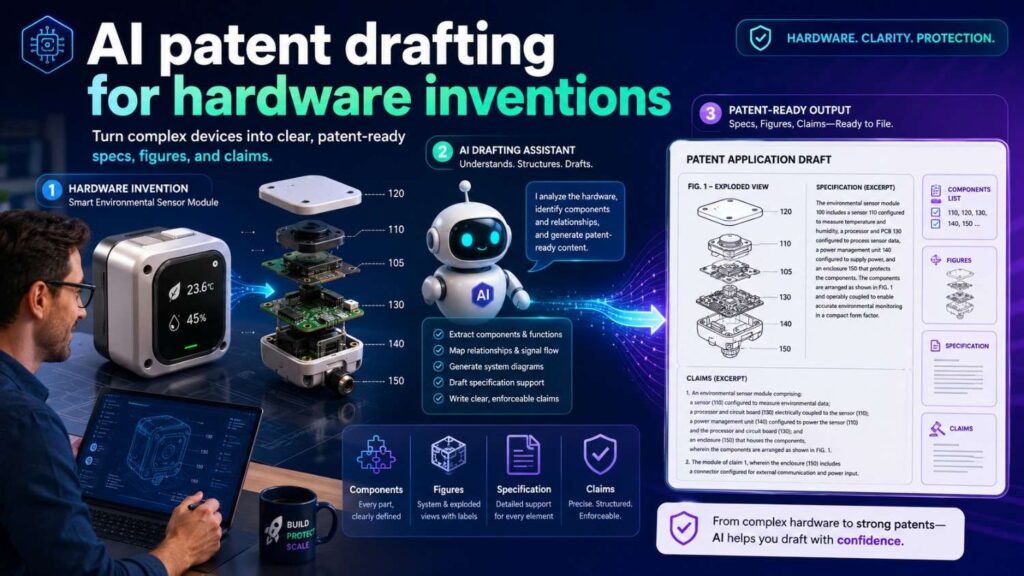
Hardware patents need physical detail.
A hardware invention may involve shape, structure, placement, materials, signals, connections, movement, heat, force, pressure, timing, or manufacturing steps. If those details are missing, the draft may be weak.
AI can help organize hardware information, but it needs good input.
Drawings matter. Photos matter. CAD files may matter. Block diagrams matter. Test data may matter. Notes from engineers matter. A strong hardware patent draft should explain how parts fit together and how they work.
For example, a robotics invention may involve sensors, motors, controllers, safety checks, path planning, and feedback loops. A battery invention may involve materials, layers, charging steps, thermal control, and cycle behavior. A semiconductor invention may involve circuit blocks, memory layout, timing, power control, or fabrication steps.
AI can help turn all this into a draft structure. It can label parts. It can create figure descriptions. It can ask whether parts are required or optional. It can suggest alternate arrangements.
But it cannot guess physical facts.
If the tool invents a part that does not exist, that is a problem. If it ignores a key physical connection, that is also a problem. Human technical review is essential.
Deep tech startups should take this seriously. Their inventions may be hard to copy, but only if the patent captures the right technical details.
PowerPatent is designed for technical teams that need to protect complex inventions without slowing down the company. The platform helps move from raw technical input to attorney-reviewed patent work. See more at https://powerpatent.com/how-it-works.
AI patent drafting for biotech, medtech, and life sciences
Biotech and medtech patent drafting can be especially sensitive.
These inventions may involve lab results, device design, treatment methods, diagnostic workflows, biological materials, software-controlled devices, or manufacturing processes. The facts must be accurate. The details must be clear. The filing strategy must be careful.
AI can help organize data and draft plain-language summaries. It can help compare different examples. It can help create structured descriptions of methods, device components, or workflows.
But AI should not be trusted to create scientific facts.
If an application includes test results, ranges, biological effects, clinical details, or experimental examples, those details must come from real data and must be checked by the team. AI can help format and explain, but it should not invent or “smooth over” missing evidence.
For medtech devices, AI can help map the flow of data through sensors, processors, displays, alerts, and control logic. For diagnostic inventions, it can help explain how a sample, image, signal, or patient data set is processed. For biotech tools, it can help organize method steps and examples.
But human review must be strict.
A wrong detail in these fields can have serious effects. It can hurt the patent. It can mislead reviewers. It can create business risk.
The best approach is to use AI for structure and clarity, while keeping scientific and legal judgment with people.
AI patent drafting for climate tech and energy startups
Climate tech and energy startups often build inventions that combine hardware, software, chemistry, and control systems.
That mix can be hard to draft.
A clean energy invention may involve sensors, models, physical devices, grid signals, weather data, control logic, storage systems, or manufacturing processes. A carbon capture invention may involve material choices, flow paths, reaction conditions, regeneration steps, and monitoring. A battery startup may have innovations in cell design, charging, thermal control, materials, or diagnostics.
AI can help these teams explain complex systems in simple structure.
It can ask what inputs are measured, what decisions are made, what physical change occurs, and what result improves. It can help prepare method flows and system diagrams. It can help separate the core invention from optional features.
But energy and climate inventions often need hard technical support.
If a startup claims improved efficiency, longer life, lower heat, reduced cost, or better stability, the patent draft should explain how and, where possible, include examples or data. AI can help write the explanation, but the facts must come from the team.
For startups in these fields, patent timing is also important. Many teams work with universities, labs, partners, grants, or manufacturers. Ownership and disclosure issues can get complex. Early patent capture helps reduce confusion.
A guided AI-plus-attorney workflow can help founders protect important inventions before public pilots, papers, demos, or partner talks.
AI patent drafting for cybersecurity startups
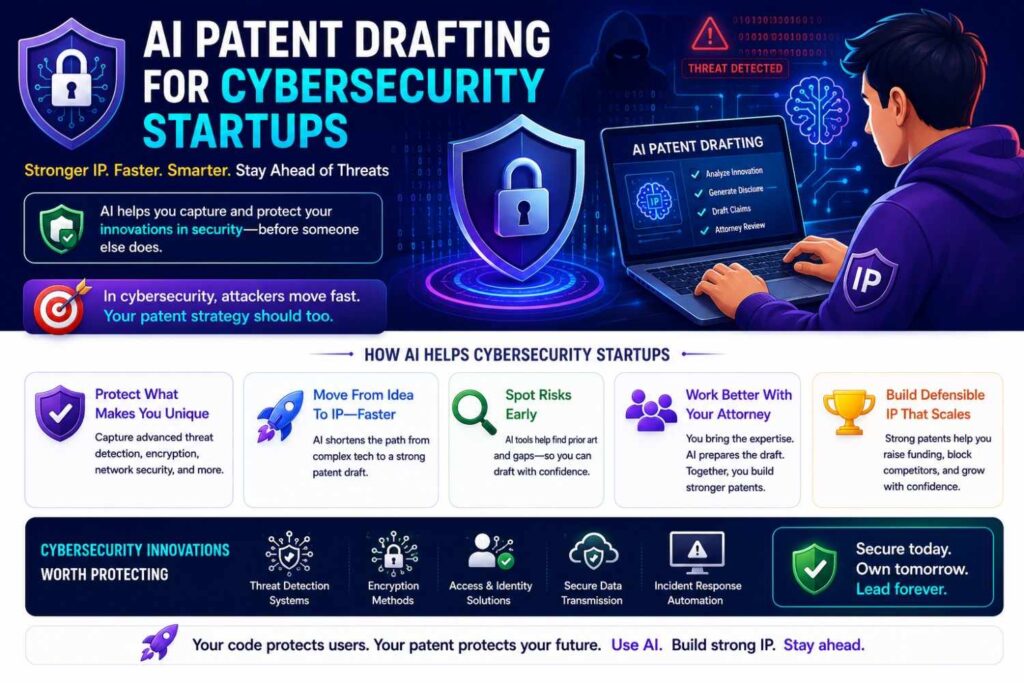
Cybersecurity inventions are often hard to explain because they involve fast-moving systems and invisible behavior.
The invention may be a way to detect attacks, score risk, route alerts, isolate devices, analyze logs, create fingerprints, protect identities, or enforce access rules. Much of the value may live in the workflow.
A weak draft may say, “The system detects threats using machine learning.”
A stronger draft explains what signals are collected, how they are normalized, how a behavior pattern is built, how risk is scored, how false positives are reduced, and what action is taken.
AI can help turn threat workflows into patent-ready descriptions. It can help organize event flows, detection steps, response actions, and model updates. It can help identify where the system differs from old security tools.
Cybersecurity patents should also think about attacker workarounds.
What would a competitor or attacker change? Could the system still work if logs are incomplete? What if the user identity is hidden? What if the device is offline? What if an attacker mimics normal behavior?
These edge cases can make the patent stronger if handled well.
AI can suggest these questions, but a security expert and patent professional should review the answers.
AI patent drafting for robotics and autonomous systems
Robotics inventions often combine software, hardware, sensors, control, planning, and safety.
This makes them good candidates for AI-assisted patent drafting, but also risky if drafted too broadly or vaguely.
A robot invention may involve sensor fusion, map creation, path planning, grasping, motor control, obstacle handling, human interaction, calibration, or failure recovery. The patent draft should explain the actual system, not just the goal.
For example, “the robot avoids obstacles” is a result. The draft should explain how the robot senses the obstacle, how it classifies the obstacle, how it updates its path, and how it controls movement.
AI can help break the system into parts. It can help prepare flowcharts. It can help ask what happens when sensors disagree. It can ask what fallback mode is used. It can ask whether control is local or remote. It can ask how safety limits are applied.
These questions matter.
Robotics patents should also include variations. The same invention may work with different sensors, arms, wheels, cameras, controllers, or environments. If the draft only describes one product version, it may be too narrow.
A smart AI workflow can help capture these variations early, while the engineers still remember why they made each design choice.
Claim drafting with AI
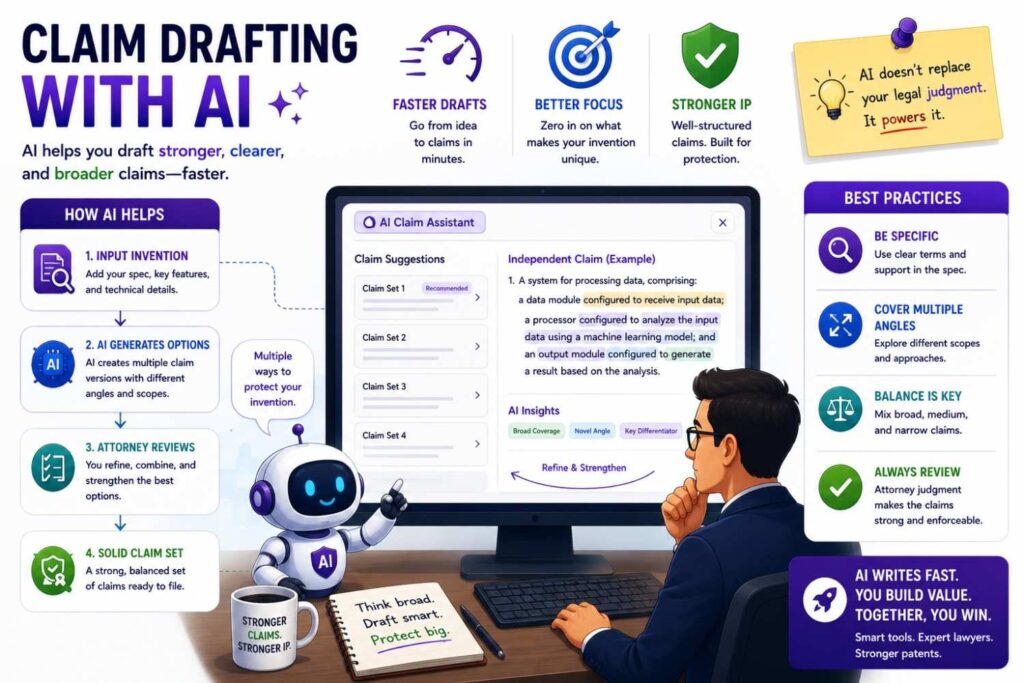
Claims are the most important part of many patent applications.
They define the boundary of the invention. They are the part competitors, examiners, lawyers, investors, and courts may study most closely.
AI can help draft claims, but this is one of the areas where human review is most important.
A claim can look good and still be weak. It may be too narrow. It may include an unnecessary feature. It may fail to cover the real invention. It may be too broad for the support in the application. It may use unclear terms. It may create an easy design-around.
AI does not always know the business goal.
For example, a startup may care most about protecting a data pipeline, but AI may write claims around the user interface. Or the company may care about a model selection method, but AI may focus on generic AI scoring. Or the real value may be in a device-control loop, but the AI may claim only the output.
Claim strategy should start with business and technical judgment.
What is the core invention? What would a competitor copy? What parts are required? What parts may change? What is the broadest fair version? What fallback versions should be included? What prior art is known? What examples support the claims?
AI can help after those questions are answered. It can suggest claim language. It can create dependent claim ideas. It can check whether claim terms appear in the description. It can compare different versions.
But the final claim set should be reviewed by a patent professional.
For startups, this is not the place to cut corners. Claims are where a patent’s value often lives.
AI and provisional patent applications
Many startups first file a provisional patent application.
A provisional filing can be useful because it gives the team a filing date while leaving time to refine the full non-provisional application later. It can be a good fit when a startup is preparing to disclose, fundraise, launch, or test with customers.
AI can help prepare provisional filings faster.
It can gather invention details, organize technical notes, prepare a structured draft, create figure descriptions, and help identify missing information.
But a provisional filing still needs substance.
Some founders think a provisional can be rough and still protect everything. That is dangerous. A provisional only helps later if it describes the invention well enough. If key details are missing, the later application may not get the benefit the founder expected.
AI can help avoid thin provisionals by asking better questions before filing.
What are the key steps? What are the alternate versions? What examples are available? What diagrams should be included? What parts of the product may change? What technical effect does the invention produce?
A stronger provisional gives the company a better foundation.
PowerPatent helps founders prepare for this process with guided invention capture and attorney oversight. See how it works at https://powerpatent.com/how-it-works.
AI and non-provisional patent applications
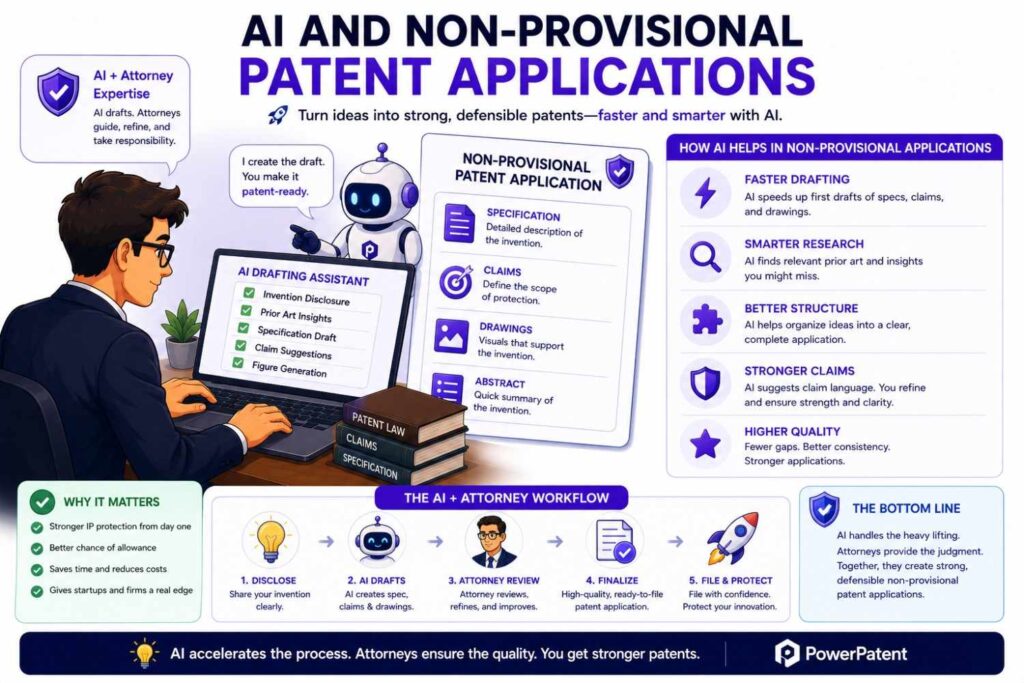
A non-provisional patent application is the full application that gets examined.
This draft usually needs more structure and care than a quick provisional. It should include clear claims, a detailed description, drawings, and enough support for future examination.
AI can help create a first draft from a strong invention record. It can turn provisional material into a more complete application. It can help expand examples, improve consistency, and align the claims with the specification.
But the attorney’s role is central.
The attorney must decide how to claim the invention, what to emphasize, what to add, and how to handle known prior art. The attorney must also think about how the application may be amended during examination.
A good non-provisional is not just a snapshot of the invention. It is a tool for the future. It should give the applicant room to respond to rejections. It should include fallback positions. It should avoid locking the invention into one narrow product version.
AI can help check whether those fallback positions are present, but the strategy must come from a human.
For law firms, AI can reduce drafting time while improving structure. For startups, it can make the process faster and more transparent. For both, the goal should be a better filing, not just a faster filing.
AI and patent office action responses
AI can also help after the patent application is filed.
When an examiner rejects claims, the applicant may respond with arguments, claim changes, or both. This is called prosecution. It can be slow and detailed.
AI can help summarize the office action. It can map the examiner’s rejection to claim language. It can compare cited references with the claim elements. It can help organize possible response paths. It can draft a first outline for attorney review.
This can save time.
But office action responses are strategic. A bad response can narrow claims too much. It can make harmful statements. It can miss a better amendment. It can argue the wrong point. It can hurt later enforcement.
AI should not decide the response strategy.
A patent professional should review the rejection, study the cited art, decide whether to amend or argue, and choose the best path for the client.
AI can make the process smoother, but the human must lead.
For startups, AI-assisted prosecution can also make the process easier to understand. Founders often find office actions confusing. A clear summary can help them see what happened and what choices exist.
This improves trust and decision-making.
AI and patent portfolio strategy

One patent can help. A smart portfolio can help much more.
A portfolio is a group of patents and applications that protect different parts of a company’s technology. For a startup, a portfolio can support fundraising, partnerships, licensing, exits, and defense against copycats.
AI can help with portfolio planning.
It can review product roadmaps and identify possible invention areas. It can compare new invention disclosures with existing filings. It can group patents by product feature. It can help find gaps. It can create plain-English summaries for leadership and investors.
This is useful because startups often file reactively. They file when someone remembers, when a launch is close, or when an investor asks. That approach may miss important inventions.
A better approach is to build patent capture into the product cycle.
When the team ships a major feature, ask whether there is a protectable technical idea. When the team solves a hard engineering problem, capture it. When a model, hardware design, or process improves in a meaningful way, record it. When the roadmap changes, review the patent plan.
AI can make this easier by scanning structured inputs and helping teams flag inventions.
But portfolio strategy is still a human business decision.
The company must decide what matters most. What technology is core? What would be painful if copied? What supports the long-term moat? What markets matter? What filings are worth the cost?
AI can help show the map. Founders and attorneys must choose the path.
How AI can improve patent quality
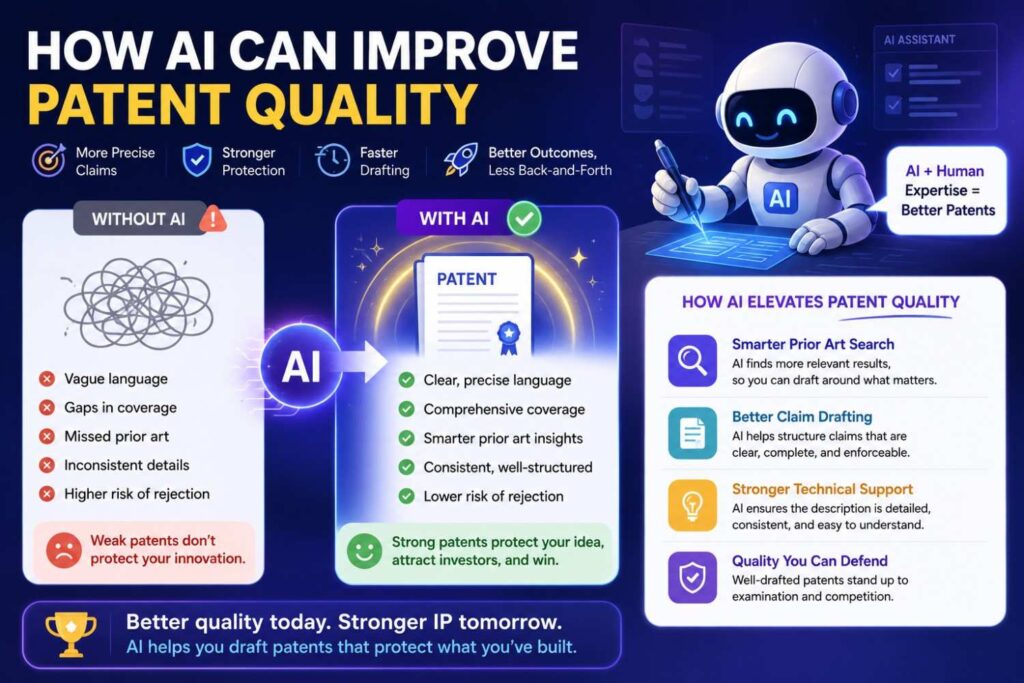
AI is often sold as a speed tool. But used well, it can also improve quality.
It can help ensure that drafts are more complete. It can catch inconsistent terms. It can point out missing examples. It can ask for alternate embodiments. It can help align claims and descriptions. It can help make dense writing clearer.
This matters because patent quality often depends on details.
A stronger draft may include several versions of the invention, not just one. It may explain different hardware setups, software flows, model choices, user devices, server systems, and control methods. It may include examples that support future claim amendments. It may define terms clearly. It may avoid unnecessary limits.
AI can help lawyers remember to include these things.
For law firms, this can become a quality system. Instead of relying on each person’s memory, the firm can use AI-assisted checks. Did the draft describe alternatives? Did it define the key terms? Did it explain the technical benefit? Did it include enough support for each claim?
This does not remove the need for legal review. It makes review more focused.
For startups, better quality means better confidence. A founder can know that the process did not just create a document. It captured the invention with care.
How AI can reduce patent costs without reducing care
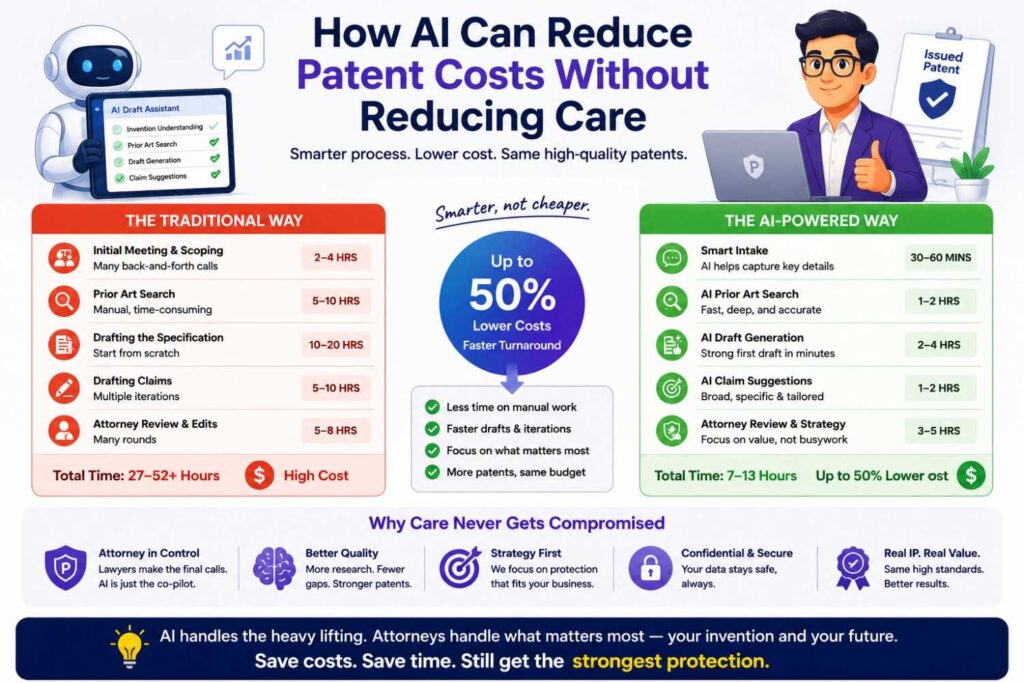
Patent drafting can be expensive because it takes skilled time.
AI can reduce some of that time by helping with intake, organization, drafting support, and review checks. This can lower friction and make patent work more accessible.
But cost reduction must be done carefully.
The wrong way to cut cost is to remove expert review. That may produce a cheap filing, but it may also produce weak protection. A startup may save money today and lose value later.
The better way is to use AI to reduce waste.
Do not make lawyers spend hours cleaning messy notes. Use AI to organize them. Do not make inventors struggle with blank forms. Use guided questions. Do not manually hunt every inconsistent term. Use AI to flag them. Do not start from a blank page when a structured first draft can help.
Then let the lawyer spend time on the work that matters most.
This is how AI can make patent work both faster and stronger.
PowerPatent is built around this balance. It helps founders move quickly with software while keeping real attorney oversight in the process. Learn more here: https://powerpatent.com/how-it-works.
What startups should prepare before using AI patent drafting
A startup does not need perfect materials before starting. But a few simple inputs can make the process much better.
The team should gather product notes, diagrams, screenshots, architecture charts, design docs, pitch decks, test results, and any written explanation of the invention. Code comments can also help if they explain why something was built a certain way.
The founder should also think about the story.
What problem did the team face? What was hard? What old method failed? What did the team build? What changed after the invention? What result improved? What would a competitor copy if they saw the product?
These answers help the patent process move faster.
The team should also identify who contributed to the invention. This does not always mean the most senior people. It means the people who helped create the inventive idea. Getting inventorship right matters.
Finally, the team should think about timing. Has the invention already been shown publicly? Is a launch coming? Is a paper planned? Is a customer pilot scheduled? Is a fundraising round near?
These facts help the patent team choose the right filing path.
A good AI workflow will ask for these details in a founder-friendly way. It should not force founders to become patent experts.
What lawyers should ask before using an AI patent tool
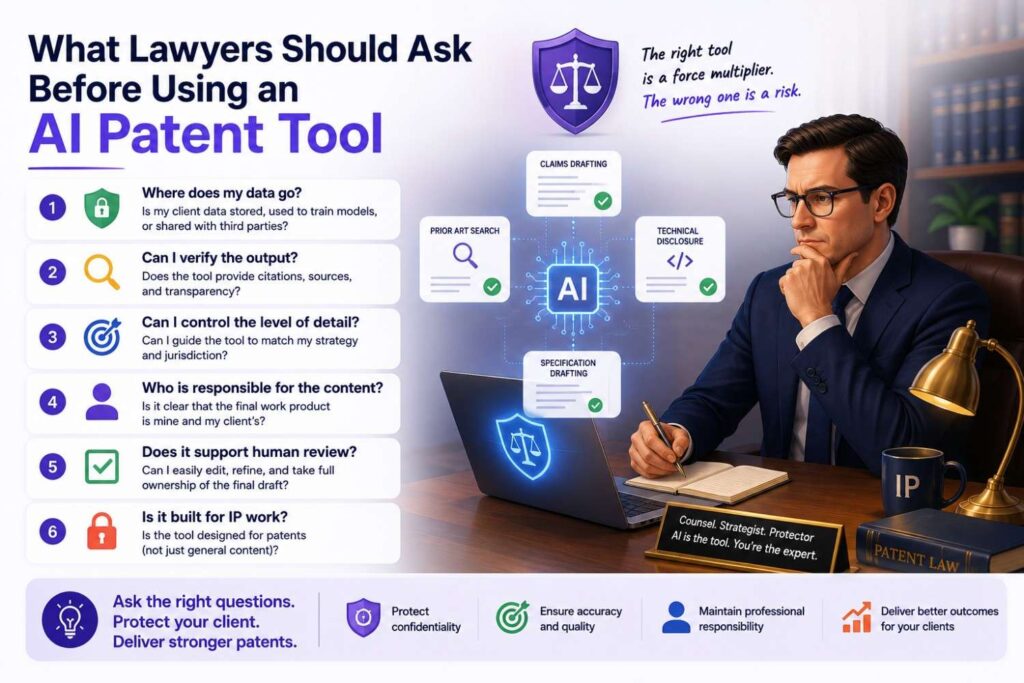
Lawyers should be careful when choosing AI patent tools.
The tool should fit professional duties, client needs, and firm workflows. It should not be chosen only because it creates text quickly.
A lawyer should ask whether the tool protects confidential information. They should ask whether data is used to train public models. They should ask whether the tool keeps matter data separate. They should ask whether output can be traced to inputs. They should ask whether the tool supports review and editing. They should ask whether it helps with technical depth or only writes generic language.
The lawyer should also ask how the tool handles patent-specific tasks.
Can it help with invention intake? Can it suggest inventor questions? Can it create claim support checks? Can it help with figure descriptions? Can it track terms? Can it work with technical documents? Can it support different technology areas?
A general writing tool may help with simple summaries, but patent drafting needs more.
For law firms, the tool should also fit team workflows. Partners, associates, agents, paralegals, and clients may all touch the process. The system should make collaboration easier, not more confusing.
The best AI patent tools support human judgment instead of hiding it.
Building a strong AI patent drafting process
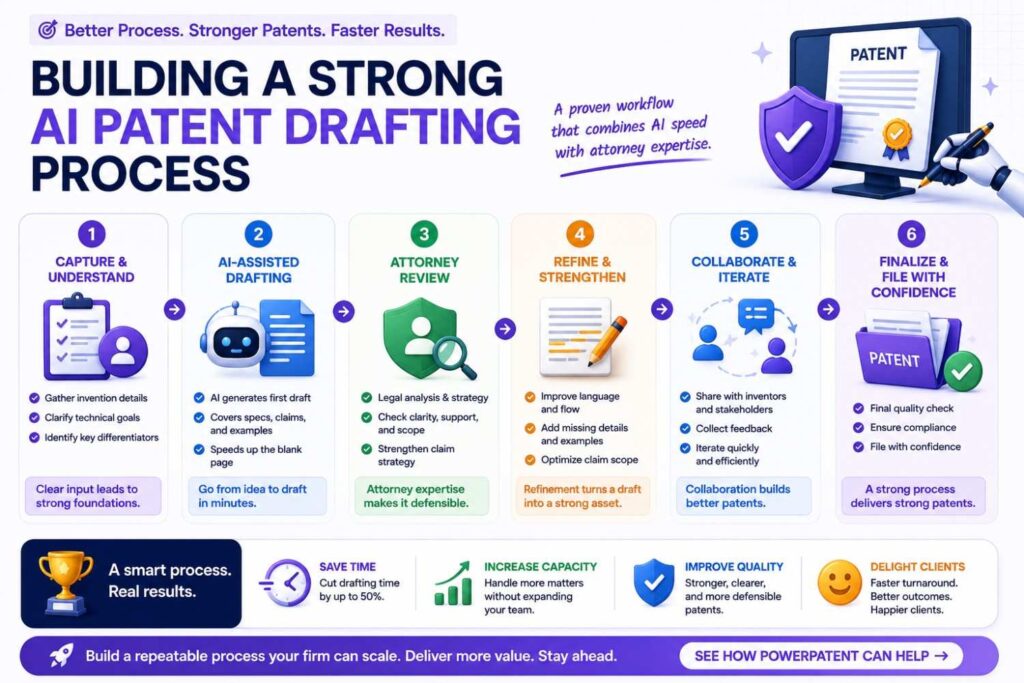
A good AI patent process should feel clear from start to finish.
It should begin with invention capture. The inventor explains the idea in plain words. The system asks follow-up questions. The team adds diagrams, examples, and technical notes.
Then the process should create a structured invention summary. This summary should explain the problem, old methods, new system, key steps, technical benefit, and variations.
Next, the lawyer should review the summary and decide claim strategy. This is where the human expert shapes the protection.
After that, AI can help create a first draft. The draft should include a clear description, drawing support, examples, and claim ideas.
Then the lawyer reviews deeply. The inventor reviews for technical accuracy. The lawyer revises again. The final filing is checked and submitted.
This staged process works better than asking AI to draft everything at once.
It keeps the work grounded in facts. It gives lawyers control. It gives inventors a clear role. It helps avoid fake details and weak claims.
For startups, this process also feels less scary. The founder does not need to understand every legal rule. They just need to share the invention clearly and review the result.
The danger of generic AI patent language
Generic language is one of the biggest risks in AI patent drafting.
AI often likes broad, smooth phrases. It may say a system is “configured to optimize performance” or “adaptively improve outcomes” or “enhance user engagement.” These phrases sound polished, but they may not add much value.
Patent drafts need clear technical content.
A strong draft should say what the system does. It should explain the data, steps, parts, rules, model behavior, hardware action, or control logic. It should describe how the result happens.
For example, instead of saying “the system improves accuracy,” the draft should explain that the system filters training samples based on confidence scores, retrains a model using a weighted subset, and applies a second-stage validation step before outputting a result.
Instead of saying “the device saves power,” the draft should explain that the device lowers sampling frequency when motion is below a threshold and switches to a higher sampling mode when a signal pattern indicates likely activity.
Instead of saying “the platform improves recommendations,” the draft should explain how user actions, item features, time-based signals, and feedback are combined to adjust ranking.
This level of detail is what makes a draft useful.
AI can help create this detail if guided well. But if the prompt is vague, the output may be vague.
Good AI patent drafting depends on good inputs, good questions, and good review.
How AI helps with drawings and figures
Drawings are a major part of many patent applications.
They help explain the invention. They show parts, steps, systems, screens, flows, or structures. A good drawing can make a complex invention easier to understand.
AI can help decide what drawings may be useful.
For a software invention, it may suggest a system architecture diagram, a data flow diagram, a method flowchart, and a user interface example. For a machine learning invention, it may suggest a training flow, inference flow, feedback loop, and model update process. For a hardware invention, it may suggest component views, cross-sections, assemblies, and control diagrams.
AI can also help write figure descriptions.
It can explain what each figure shows and how the parts relate. It can keep reference terms consistent. It can help align the figures with the detailed description.
But the figures themselves must be accurate.
A drawing should not show parts that do not exist unless they are valid alternate versions. It should not leave out key parts. It should not lock the invention into one narrow design unless that is intended.
Inventors and attorneys should review drawings carefully.
A strong patent draft often uses drawings as a backbone. The written description walks through the figures and explains the invention step by step.
AI can speed that work, but human review keeps it correct.
AI patent drafting and prior art
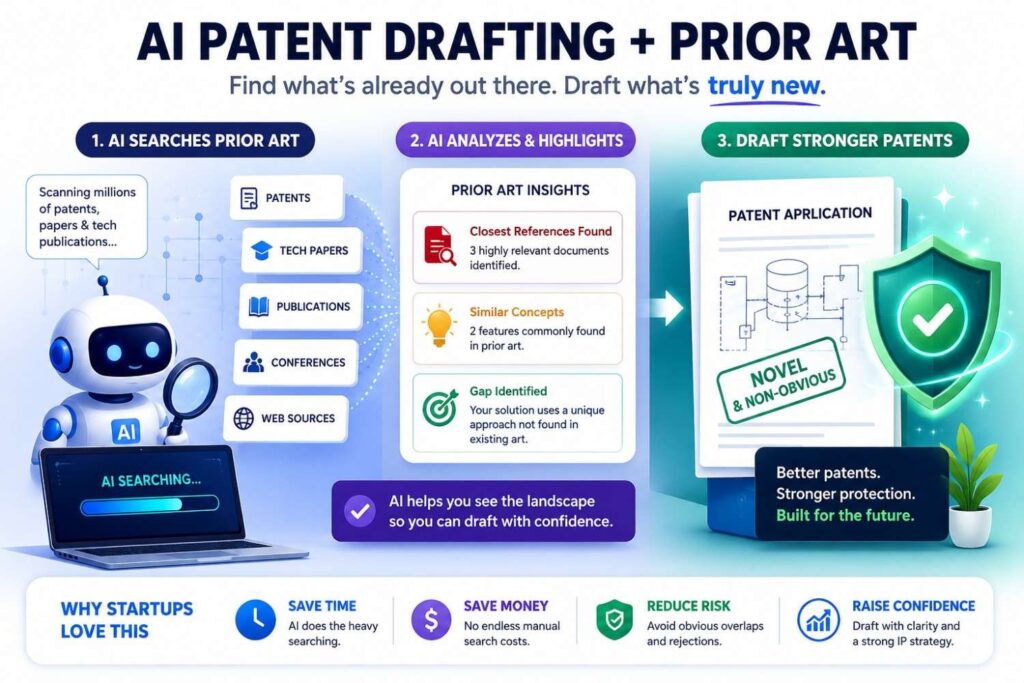
Prior art includes earlier patents, publications, products, papers, and other public information that may affect patentability.
AI can help with prior art work. It can suggest search terms. It can summarize documents. It can compare references with invention features. It can help organize results.
But prior art search is not simple.
A useful search may need technical skill, database knowledge, classification searching, keyword strategy, date analysis, and judgment. AI may miss important references. It may misunderstand a document. It may claim that a reference teaches something it does not. It may overlook non-patent literature.
For drafting, prior art awareness can be very useful.
If the team knows the closest old approach, the application can better explain the improvement. It can include examples that show the difference. It can avoid claiming what is already known. It can build stronger fallback positions.
For startups, prior art work can also reveal market facts. It may show active competitors, old failed approaches, crowded areas, or open spaces.
AI makes this easier to start, but it should not be treated as perfect.
A human should review important references before making legal decisions.
AI patent drafting and patent eligibility
Patent eligibility can be a key issue for software and AI inventions.
In simple words, not every idea can be patented just because it is useful. Patent offices often look for a real technical invention, not just an abstract idea or business concept written on a computer.
This is why drafting matters.
A patent application should explain the technical problem and the technical solution. It should describe how the system works, not only the result it wants. It should show how the invention improves a machine, process, device, network, model, or technical workflow.
AI can help by asking mechanism-focused questions.
What changes in the system? What data is transformed? What device is controlled? What technical limit is improved? What computer process is made faster, safer, more accurate, or more reliable? What is the specific technical method?
These answers can help the draft tell a stronger story.
But eligibility analysis is legal work. A patent attorney should review the claims and description with that issue in mind.
This is another reason AI-only patent drafting can be risky. The draft may sound broad and exciting, but if it reads like a result without a technical solution, it may face problems.
AI patent drafting and international filings
Startups often think first about the United States, but many companies later care about other countries.
International patent strategy can be complex. Filing rules, timing, costs, subject matter standards, and examination practices vary by country. A draft that works well in one place may need changes for another.
AI can help organize international filing information and prepare draft materials. It can help create summaries for foreign counsel. It can help compare claim versions. It can help track deadlines and family members.
But international strategy should be planned early.
If a startup may want protection in Europe, China, Japan, Korea, Canada, Australia, or other markets, the first filing should be prepared with that in mind. The original disclosure should include enough technical detail to support later filings.
This is especially important for AI and software inventions, where different patent offices may apply different standards.
Founders do not need to know all of this alone. But they should tell their patent team where the company may sell, manufacture, partner, or face copycats.
AI can help collect that business context, while attorneys guide the strategy.
AI patent drafting and investor diligence
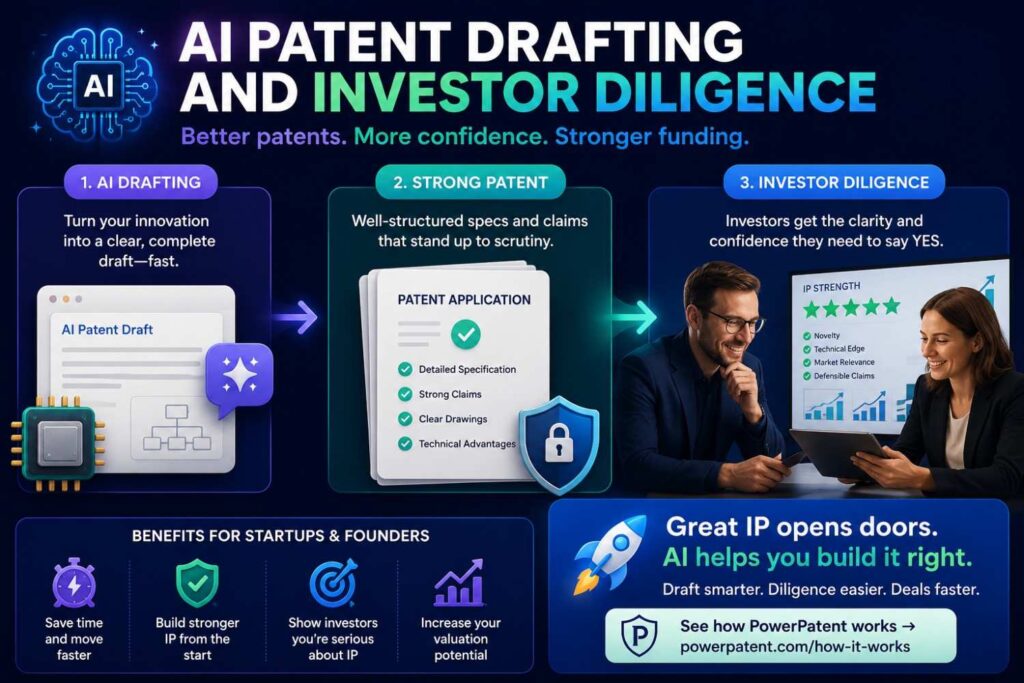
Investors may review a startup’s patents during fundraising.
They may ask whether applications have been filed. They may ask who owns the IP. They may ask whether employees and contractors assigned their rights. They may ask whether the patents cover the core product. They may ask whether the company filed before public disclosure.
A strong AI-assisted patent process can help startups prepare for these questions.
It can keep invention records organized. It can map filings to product features. It can create simple summaries of what each filing covers. It can help the company show that it has a thoughtful IP plan.
This does not mean startups should file patents only for show.
A weak “patent pending” label may not impress serious investors if the filing does not cover the core technology. Investors care about whether the company has a real moat.
The better goal is to file thoughtfully.
Protect the hard technical work. Capture inventions before public disclosure. Make sure ownership is clean. Keep records clear. Build a plan for future filings.
PowerPatent helps founders move toward that kind of process with software and attorney support. Start here: https://powerpatent.com/how-it-works.
AI patent drafting and founder control
One reason founders like AI patent drafting is that it gives them more visibility.
Traditional patent work can feel like a black box. The founder sends notes, waits, gets a dense draft, and struggles to review it. That process can be frustrating.
AI-assisted workflows can give founders more control.
They can see the invention summary. They can answer guided questions. They can review key features before the full draft. They can understand how the patent maps to the product. They can spot missing details earlier.
This matters because founders know the business context.
A lawyer may know patent strategy, but the founder knows the market, roadmap, competitors, and product direction. The best patent work combines both views.
Founder control does not mean the founder becomes the lawyer. It means the founder stays close to the invention story.
That is healthy.
When founders understand what is being filed and why, they make better decisions. They can also build a stronger patent habit inside the company.
AI patent drafting and engineer experience
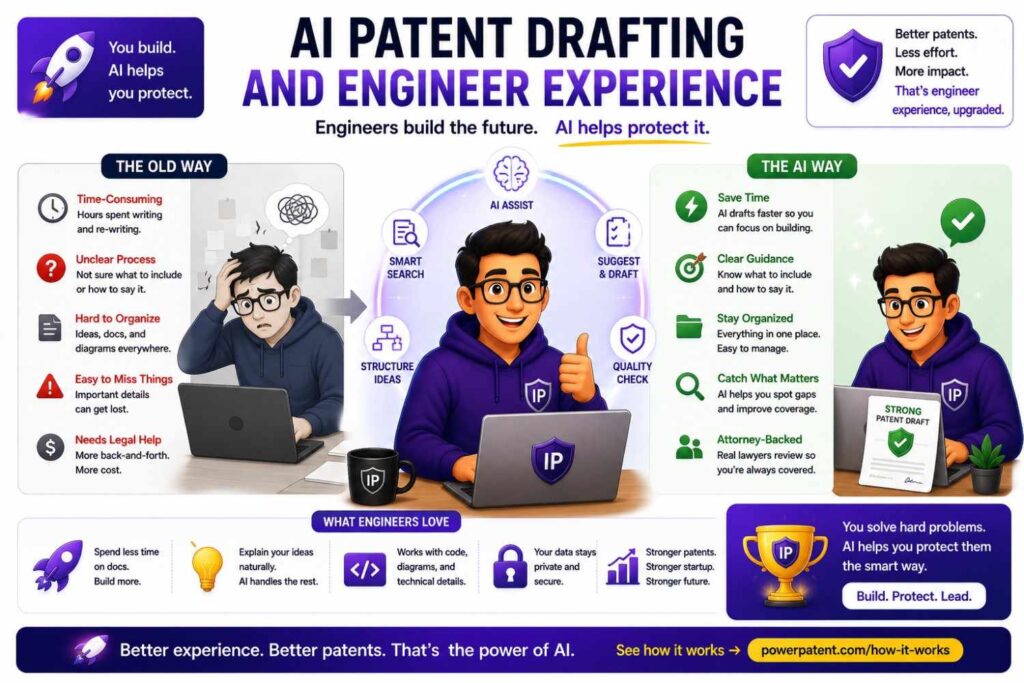
Engineers are often the source of the invention, but patent processes are not always built for them.
Many engineers dislike long legal forms. They may not know what counts as patent-worthy. They may think an invention is “just implementation” when it is actually valuable. They may understate their work because the solution feels obvious after they solved it.
AI can improve the engineer experience.
Instead of asking engineers to write legal descriptions, the system can ask simple technical questions. What did you change? Why did you change it? What failed before? What tradeoff did you solve? What data or signal mattered? What happens in edge cases?
Engineers can answer those questions more naturally.
AI can then organize the answers for the patent team. This makes the process less painful and more accurate.
A good patent culture does not force engineers to become lawyers. It helps them explain their work in a way lawyers can use.
This is especially important in fast-moving startups, where engineers may not have time for long patent meetings. A guided, simple process can capture more inventions with less disruption.
AI patent drafting and invention mining
Invention mining means finding patent-worthy ideas inside a company.
Many startups have more inventions than they realize. They may think only big breakthroughs count. But patentable ideas can also come from technical improvements, system designs, data workflows, control methods, user-device interactions, manufacturing steps, or performance optimizations.
AI can help with invention mining by reviewing product updates, technical notes, engineering tickets, roadmap items, and design documents.
It can help spot areas where the team solved a real technical problem. It can ask whether the solution is new. It can help rank ideas by business value. It can create short summaries for review.
This is useful because founders often miss inventions while they are busy building.
For example, a startup may focus on the main product and overlook the infrastructure that makes it work at scale. That infrastructure may be valuable. Another team may focus on the model output and overlook the data cleaning method that makes the model reliable. That method may be valuable too.
AI-assisted invention mining can help teams see their own work more clearly.
But a patent professional should still review which ideas are worth filing.
Not every idea deserves a patent. The goal is not to file everything. The goal is to protect what matters.
AI patent drafting and trade secrets
Not every invention should be patented.
Sometimes a trade secret may be better. A trade secret is information the company keeps confidential because it gives the company an advantage. Examples may include certain formulas, data sets, manufacturing settings, internal processes, or model tuning details.
Patents and trade secrets work differently.
A patent requires disclosure. In exchange, the applicant may receive a limited right to exclude others. A trade secret depends on secrecy. Once the secret is public, protection may be lost.
AI can help teams compare what should be patented and what should be kept secret, but this decision needs human strategy.
A startup should ask whether the invention can be reverse engineered. If competitors can figure it out from the product, patenting may be more attractive. If the value is hidden and can be kept secret, trade secret protection may make sense.
AI drafting tools should not automatically include every secret detail in a patent draft. Some details may support the invention. Others may be better left out, if not needed.
This is another reason attorney oversight matters.
A good patent strategy protects the business, not just the document.
AI patent drafting and ownership
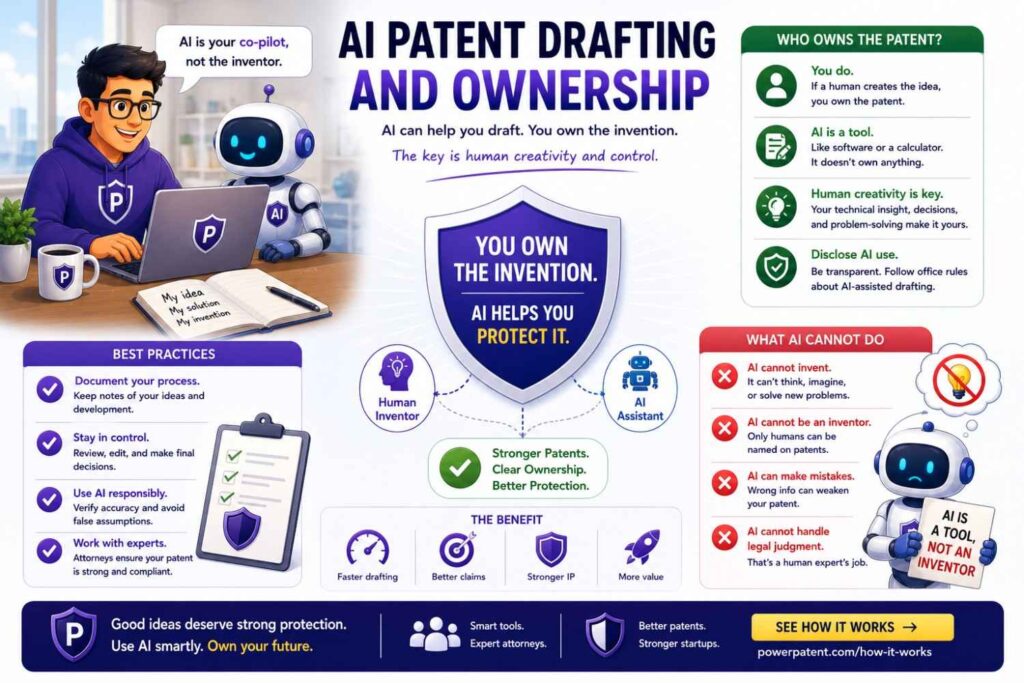
Patent ownership can become messy if it is not handled early.
Startups often work with founders, employees, contractors, advisors, university labs, vendors, and partners. If invention ownership is unclear, problems can appear during fundraising, acquisition, or licensing.
AI patent workflows can help collect ownership-related facts.
Who contributed to the invention? Were they employees or contractors? Did they sign invention assignment agreements? Was any university or government funding involved? Did any partner help create the invention? Was outside code, open-source software, or third-party data used?
These questions do not replace legal review, but they help flag issues early.
For startups, this is very important. Investors and acquirers often care deeply about whether the company actually owns its IP.
A patent filing is stronger when ownership is clean.
AI can help create the checklist, but lawyers should resolve the issues.
AI patent drafting and open source software
Many startups use open source software.
That is normal. But it can raise questions when the invention involves code, platforms, models, or libraries.
AI patent drafting tools can help ask whether open source components are involved. They can help identify which parts of the system are built by the startup and which parts come from third parties.
This matters because patents should focus on what the startup invented, not what it merely used.
Open source use may also create license duties. Those duties are separate from patent drafting, but they can affect business and legal strategy. A startup should understand them early.
If the invention improves how an open source tool is used, configured, extended, or combined with other systems, that may still be valuable. The key is clarity.
What did the startup create? What was already available? What is the new technical contribution?
AI can help organize that story.
AI patent drafting and data sets
Many AI startups depend on data.
The invention may involve how data is collected, cleaned, labeled, filtered, weighted, transformed, stored, or used in training. These details can be very important.
AI patent drafting should ask about data.
Where does the data come from? What type of data is it? How is it cleaned? How are bad samples removed? How are labels created? How is bias handled? How is privacy protected? How is data updated over time? What features are extracted? What happens when data is missing?
These answers may reveal the real invention.
A company may think its invention is the model, but the data process may be the stronger technical edge. Another company may think its invention is the app, but the core value may be the way live data updates predictions.
Data-related patents require care. The draft should not expose secrets unnecessarily, but it should include enough detail to support the claims.
Again, this is a strategy call.
AI can help surface the issue. Humans must decide how to handle it.
AI patent drafting and model prompts
As AI products grow, some inventions may involve prompts, prompt workflows, tool use, retrieval systems, agent systems, or model orchestration.
A startup may build a system where prompts are selected based on context, user type, data source, risk score, or task result. Another startup may build a system where multiple models work together. Another may use retrieval from a private knowledge base with special ranking, filtering, or verification.
AI patent drafting for these systems should avoid vague language.
It should explain the workflow. What input is received? How is context built? How is the prompt selected or generated? What data is retrieved? How are sources ranked? How is output checked? What happens when the model is uncertain? What tool does the system call? What final action is taken?
The invention may not be “using a prompt.” It may be the way the system controls, verifies, routes, or improves model behavior.
This is a fast-moving area. Startups building AI products should capture these details early.
PowerPatent helps founders turn AI systems, models, and workflows into patent-ready invention records with attorney oversight. Learn more at https://powerpatent.com/how-it-works.
AI patent drafting and code
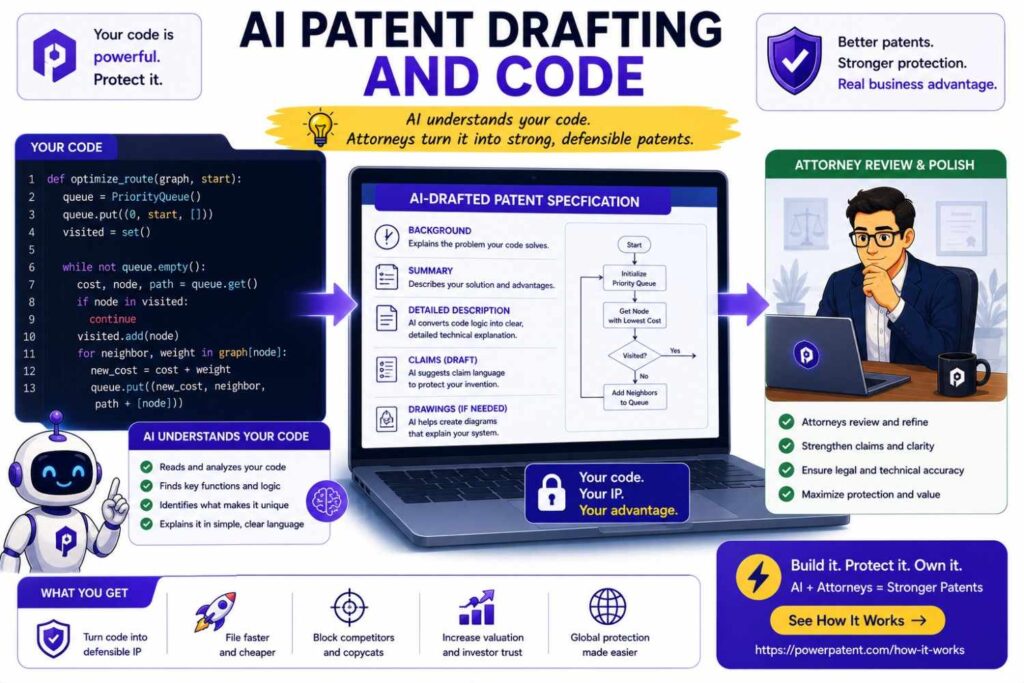
Code can be a rich source of invention detail.
A patent application usually does not need to include full source code. But code can help explain how the invention works. Comments, function names, architecture files, and commit messages may reveal important design choices.
AI can help summarize code-related material for patent drafting. It can identify modules, data flows, logic steps, and system interactions. It can help turn technical implementation into plain-language explanations.
But code summaries must be checked.
AI may misunderstand code. It may infer behavior that is not there. It may miss why a design choice matters. Engineers should review any code-based summary before it becomes part of a patent draft.
For startups, this is a huge opportunity. Many inventions are hidden in engineering work. If the patent process can connect with code and technical docs, it can capture stronger inventions with less founder effort.
The key is to use secure tools and proper review.
AI patent drafting and technical examples
Examples make a patent draft stronger.
A patent should not only describe the invention in broad terms. It should show how the invention can be used. Examples help support claims and make the invention easier to understand.
AI can help create example sections from real inputs.
For a software invention, an example may describe a user request, data processing steps, model output, and system action. For a hardware invention, an example may describe a device state, sensor signal, control response, and result. For a machine learning invention, an example may describe training data, feature extraction, confidence scoring, and output handling.
But examples must be real or properly framed.
AI should not invent test results. It should not make up numbers. It should not claim performance gains without support. If numbers are used, they should come from the team.
The best examples are clear and useful. They show how the invention works without over-limiting it.
A patent professional can decide how much detail to include and how to phrase it.
AI patent drafting and fallback positions
Fallback positions are alternate claim paths.
They matter because a patent application may face rejections. If the broadest claim is rejected, the applicant may need narrower claims that are still valuable. A strong specification includes support for those narrower paths.
AI can help identify fallback positions.
It can ask what features are optional, what variations exist, what substeps improve performance, what parameters matter, and what alternate structures can be used. It can help create dependent claim ideas and supporting description.
For example, if the broad invention is a model selection system, fallback positions may involve the specific score used for selection, the type of model pool, the trigger for switching models, or the way output confidence is handled.
If the broad invention is a sensor control system, fallback positions may involve the sensor type, threshold logic, calibration step, control mode, or failure response.
These details can be valuable later.
A thin AI-generated draft may miss fallback positions because it focuses only on the main idea. A better AI-assisted workflow asks for them on purpose.
This is one reason structured drafting beats simple prompting.
AI patent drafting and avoiding design-arounds
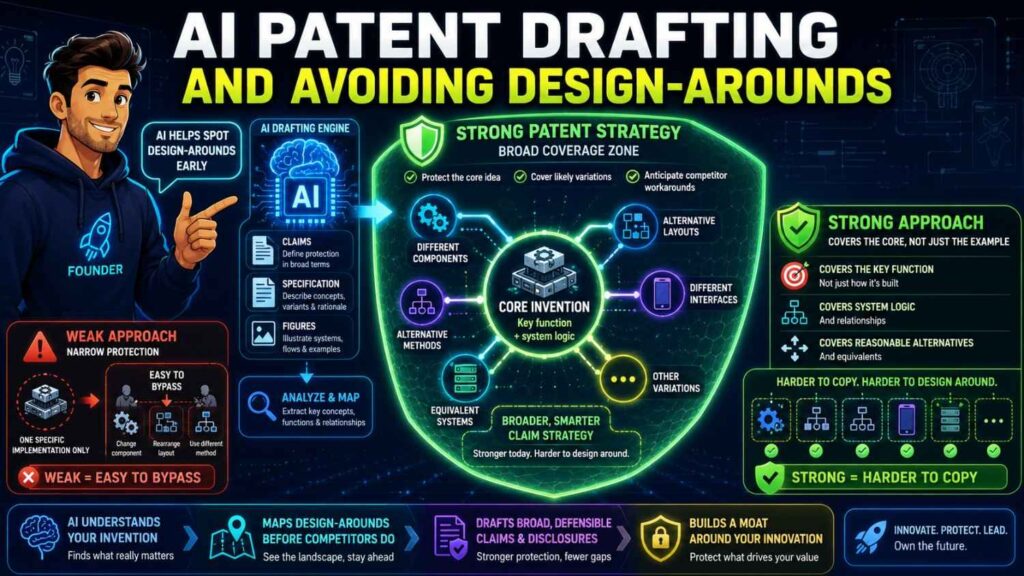
A design-around happens when a competitor avoids a patent by changing something small.
Good patent drafting thinks about this early.
If the claims include unnecessary details, competitors may avoid them. If the draft only describes one version, competitors may build another. If the patent focuses on a surface feature, competitors may copy the deeper system while changing the interface.
AI can help brainstorm design-arounds.
It can ask what a competitor might change. Could they use a different model? A different sensor? A different order of steps? A different threshold? A different device? A different data source? A different user flow?
These questions can lead to broader and better-supported drafting.
But this is also a legal strategy issue. The goal is not to claim more than the invention supports. The goal is to claim the real invention in a way that does not make copying easy.
Patent professionals are trained to think this way.
AI can support that thinking, but it should not replace it.
AI patent drafting and plain English
Patent applications often use formal language, but they should still be clear.
Clear writing helps everyone. Inventors can review the draft better. Lawyers can revise it faster. Examiners can understand it more easily. Investors can read summaries with less confusion.
AI can help simplify dense writing.
It can turn long technical notes into clearer explanations. It can define terms. It can break complex flows into steps. It can remove needless wordiness.
But simple does not mean shallow.
A patent draft can use plain words and still include deep technical detail. In fact, simple language often makes technical depth easier to see.
For PowerPatent’s audience, this matters a lot. Founders and engineers do not want legal fog. They want to understand what is being protected.
A strong AI patent workflow should make patents feel less mysterious.
That does not mean oversimplifying the law. It means explaining the work in clear human language.
AI patent drafting and client communication
AI can improve how patent lawyers communicate with clients.
Clients often want to know where things stand. They want to understand what was filed. They want to know what the claims cover. They want to know what the next step is.
AI can help create plain-English updates.
It can summarize the invention. It can explain the filing status. It can list open questions. It can prepare review notes for inventors. It can create short summaries for founders or boards.
This improves client experience.
For law firms, better communication can be a major advantage. Startups want speed, but they also want clarity. They do not want to wonder what is happening.
For founders, clear communication builds confidence. They can make better decisions when the patent process is visible.
PowerPatent puts clarity at the center of the process. Founders can see how modern patent workflows work here: https://powerpatent.com/how-it-works.
AI patent drafting and attorney training
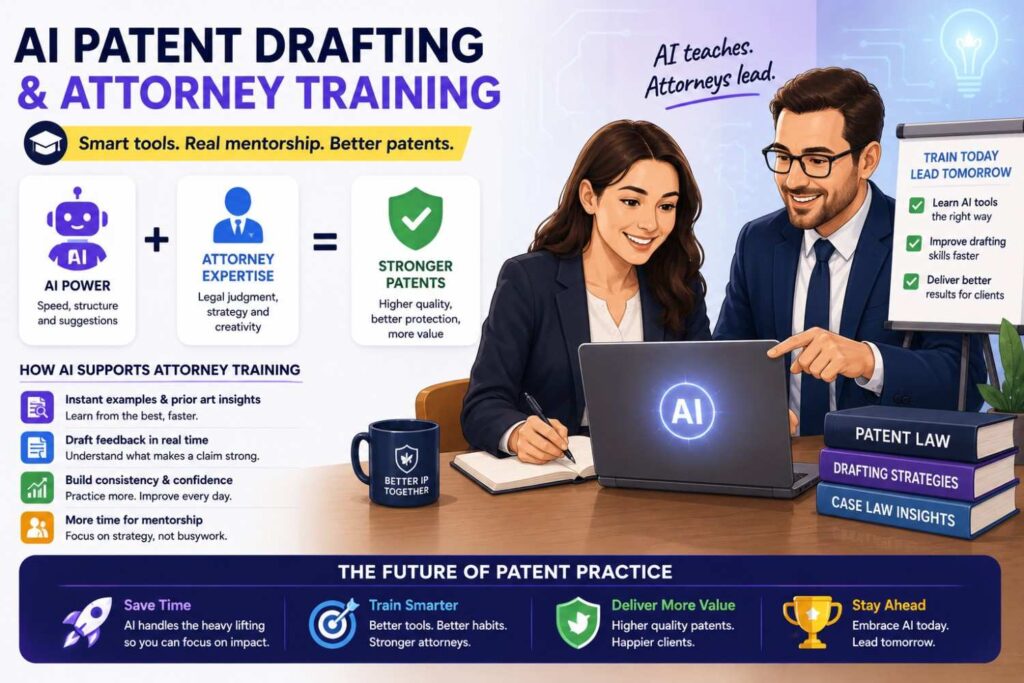
AI will change how new patent lawyers and agents learn.
In the past, junior professionals often learned by drafting sections, reviewing office actions, and revising based on partner feedback. AI may now create first drafts faster, but juniors still need to learn the craft.
Firms should not let AI become a crutch.
New lawyers still need to understand claim strategy, specification support, prior art, eligibility, amendments, and inventor interviews. They need to learn how to spot weak language and bad assumptions.
AI can actually help training if used well.
A junior attorney can compare AI draft versions. They can study why a partner changed claim language. They can use AI to test understanding. They can ask for issue spotting and then check the results.
But training must include skepticism.
The right question is not “What did AI write?” The right question is “Is this right, and why?”
Firms that train lawyers to challenge AI will produce better work.
AI patent drafting and firm profitability
AI can improve law firm profitability if firms use it thoughtfully.
Patent drafting is time-intensive. If AI reduces low-value time, firms can serve clients faster and improve margins. They may also offer new service models for startups that previously avoided patent work because of cost.
But firms should be careful not to race to the bottom.
If AI is used only to make cheap, low-quality filings, the firm’s reputation may suffer. Better firms will use AI to improve both speed and quality.
They can spend less time on mechanical drafting and more time on strategy. They can deliver better invention capture. They can offer clearer client updates. They can manage portfolios more actively.
This creates value clients can feel.
A firm that helps startups protect key inventions quickly and clearly will stand out.
AI patent drafting and startup speed
Speed is not only about filing faster.
Speed is about reducing delay between invention and protection.
A startup may create important inventions every month. If the patent process only happens once a year, many ideas may be lost. AI can help create a lighter, ongoing capture process.
When engineers solve a hard problem, they can record it. When the product changes, the team can flag it. When a founder prepares for a launch, the patent team can review what needs filing.
This creates a living IP process.
The startup does not need to pause building. It just needs a simple system to capture what matters.
That is where AI is most powerful. It turns patent work from a rare, heavy event into a smoother habit.
PowerPatent helps startups make that shift by combining easy invention capture, smart drafting support, and attorney review. Start here: https://powerpatent.com/how-it-works.
AI patent drafting and quality control checklists
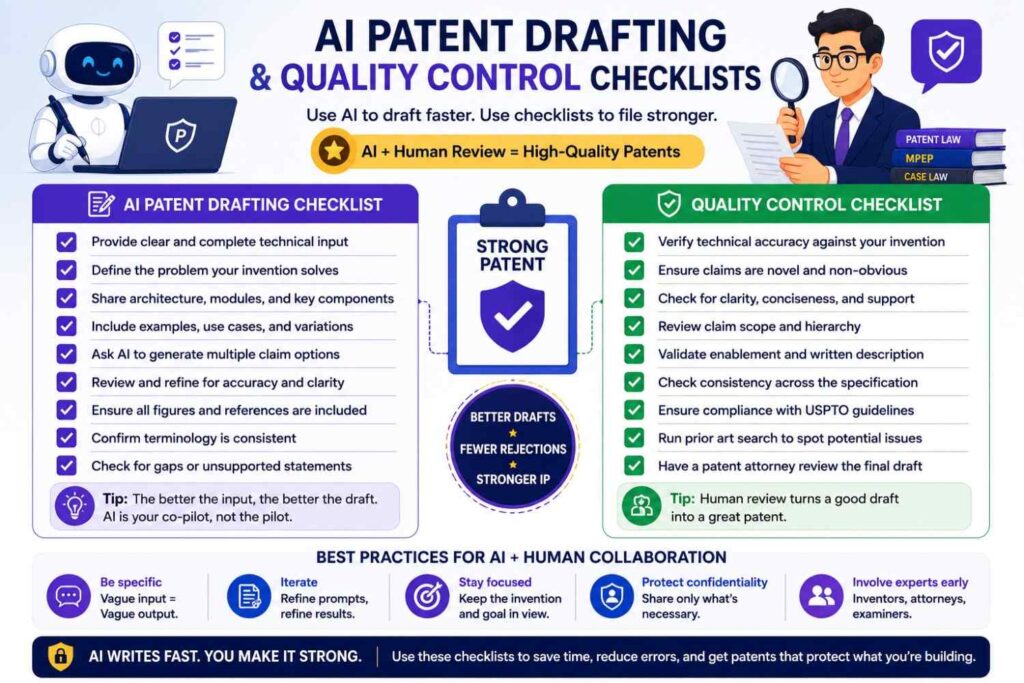
Quality control is essential in AI-assisted drafting.
Every AI-assisted draft should be checked for technical accuracy, claim support, term consistency, missing details, drawing support, inventor names, ownership issues, and confidentiality concerns.
This does not need to feel like bureaucracy. A good system can build these checks into the workflow.
For example, before a draft goes to filing, the system can ask whether each claim term appears in the description. It can ask whether each figure is described. It can ask whether the inventor confirmed technical facts. It can ask whether public disclosure dates were checked. It can ask whether the filing matches the business goal.
These checks reduce risk.
They also make the process more repeatable. A law firm can maintain quality across many matters. A startup can avoid missing key steps.
AI is good at reminding people. Humans are good at judging what the reminders mean.
Together, they make a stronger system.
AI patent drafting and the role of templates
Templates can help patent drafting, but they can also create lazy work.
A template gives structure. It can make sure key sections are included. It can speed up routine tasks.
But a template should not make every invention sound the same.
AI can make this problem worse if it fills templates with generic language. A strong AI workflow should use templates as a frame, then fill them with real invention detail.
For example, a machine learning template may include sections on training data, model structure, inference, feedback, and deployment. But the actual content must be specific to the invention.
A robotics template may include sensors, actuators, control logic, safety, and environment mapping. But again, the details must be real.
The best templates guide thinking. They do not replace thinking.
Law firms should build templates that ask better questions, not just produce more words.
AI patent drafting and ethical use
Ethical AI use in patent drafting comes down to honesty, care, and responsibility.
Do not pretend AI did no work if that matters to the client or process. Do not submit AI output without review. Do not expose client secrets in unsafe tools. Do not rely on fake citations. Do not let AI make inventorship calls. Do not make claims that are not supported by the invention.
Lawyers must remain responsible for their work.
Startups should also use AI responsibly. Founders should not assume an AI-generated patent is safe to file. They should not include made-up data. They should not skip ownership checks. They should not disclose secrets through public tools.
Responsible use is not hard. It just requires a clear process.
Use secure tools. Capture real facts. Review carefully. Keep humans in charge.
That is the right model.
How to tell if an AI-assisted patent draft is weak
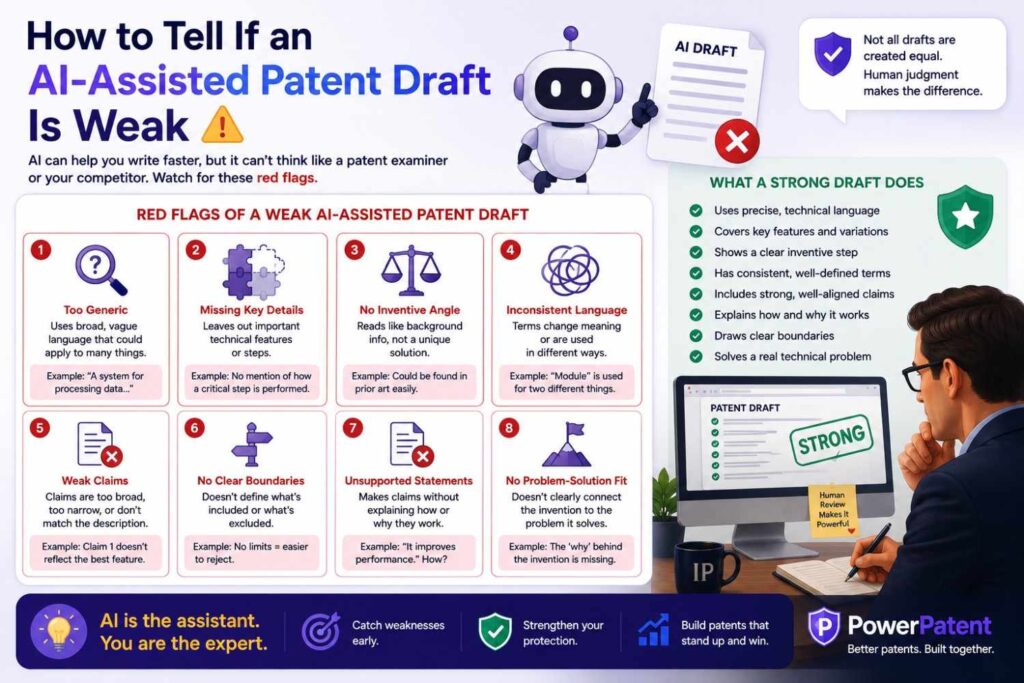
A weak AI-assisted patent draft often has warning signs.
It may sound polished but vague. It may repeat broad phrases without explaining how the invention works. It may use many buzzwords. It may describe benefits without describing mechanisms. It may include claims that do not match the detailed description. It may fail to include alternate versions. It may not mention edge cases. It may have inconsistent terms.
Another warning sign is that the inventors cannot recognize their own invention.
If engineers read the draft and say, “This sounds fancy, but it is not what we built,” the draft needs work.
A strong draft should feel accurate to the technical team. It should also feel strategic to the patent professional. It should explain the invention in a way that is clear, specific, and useful.
If the draft could apply to almost any company in the field, it is probably too generic.
Good patent drafting makes the invention stand out.
How to tell if an AI-assisted patent draft is strong
A strong AI-assisted patent draft feels grounded.
It explains the problem clearly. It describes the old approach without making careless admissions. It explains the new system in enough detail. It includes useful drawings. It gives examples. It describes variations. It supports the claims. It uses terms consistently. It matches the business goal.
It also gives the company options.
If the examiner rejects broad claims, the application has fallback detail. If the product changes, the filing still covers the core idea. If a competitor tries a small change, the claims may still matter.
A strong draft is not always the longest draft. More words do not always mean more protection. The right words matter more.
AI can help create more complete drafts, but humans must make them strong.
The future of AI patent drafting
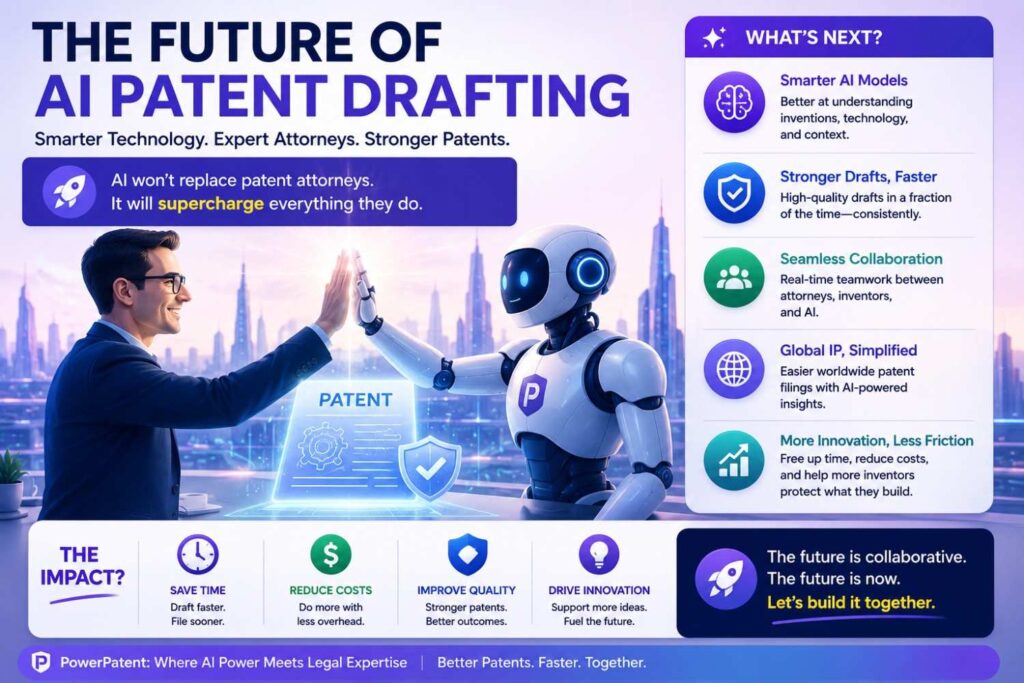
AI patent drafting will keep improving.
Tools will get better at reading technical documents. They will get better at understanding code, diagrams, and invention records. They will get better at checking claim support. They will get better at comparing drafts to prior filings. They will get better at helping inventors answer the right questions.
But the future will not be AI alone.
The future will be AI plus expert humans.
Founders will bring the business and product vision. Engineers will bring technical truth. Patent lawyers will bring legal strategy. AI will help connect the work, reduce friction, and speed up the path from invention to filing.
This is a better future for startups.
Patent work can become less slow, less confusing, and less painful. More founders can protect what they build. More lawyers can focus on high-value judgment. More law firms can serve clients with speed and care.
The old patent process was built for a slower world. The new process should match how modern companies actually build.
Why PowerPatent is built for this moment
PowerPatent exists because founders need a better way to protect inventions.
Deep tech startups are building real technical value. They are writing code, training models, designing hardware, creating systems, and solving hard problems. But the old patent process often feels too slow and too hard to use.
PowerPatent helps close that gap.
The platform uses smart software to help capture inventions and move patent work forward. It helps founders explain what they built in a guided way. It helps organize technical detail. It helps reduce the confusion that often slows patent work down.
But PowerPatent also keeps real patent attorneys involved.
That matters because patents are not just documents. They are business assets. They need careful review. They need strategy. They need human judgment.
For founders, this means speed without flying blind. For engineers, it means a simpler way to explain inventions. For law firms and attorneys, it means better inputs and a more modern workflow.
To see how PowerPatent helps startups go from invention to filing, visit https://powerpatent.com/how-it-works.
Final thoughts
AI patent drafting is powerful when it is used the right way.
It can help lawyers work faster. It can help law firms improve process and client service. It can help startups protect inventions earlier and with less friction.
But AI should not be treated as a replacement for patent judgment.
A strong patent still needs real technical facts, smart claims, clear writing, careful review, and a filing strategy that fits the business. AI can support each of those steps, but humans must stay in charge.
The best path is simple: use AI to capture, organize, draft, and check. Use attorneys to guide, review, and protect. Use founders and engineers to make sure the invention is real and complete.
That is how AI patent drafting becomes more than a speed trick. It becomes a better way to protect what matters.
PowerPatent helps startups do this with smart software and real attorney oversight. To learn how your team can turn inventions into stronger patent filings faster, visit https://powerpatent.com/how-it-works.