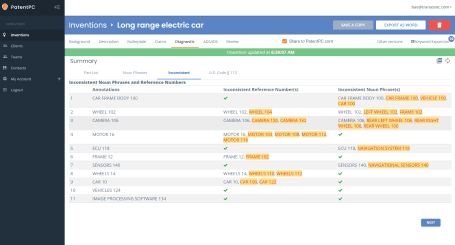
If you are building an AI or machine learning product, you are sitting on real intellectual property right now. Not someday. Not after you raise funding. Right now. The problem is most founders do not capture it properly. They build fast, ship code, train models, tweak prompts, improve pipelines—and none of it gets written down in a way that can turn into a strong patent. That is where an invention disclosure form comes in. It is not paperwork for lawyers. It is the bridge between your raw technical work and a real, defensible patent. And if you do it right from the start, you save time, money, and stress later.
Why AI and Machine Learning Inventions Get Lost Without a Proper Disclosure Form
AI startups do not fail to protect their inventions because they are careless. They fail because they move fast. Models get trained. Pipelines get adjusted. Prompts get refined.
Data flows get optimized. Small changes stack up into real breakthroughs. But none of it gets captured in a clear, structured way.
Months later, when someone says, “We should file a patent,” no one remembers exactly what made the system unique in the first place.
This is how valuable intellectual property disappears. Not because it was weak. But because it was never written down correctly.
Below is what really happens inside growing AI companies—and how to stop your inventions from slipping through the cracks.
Speed Kills Memory
When you are building AI systems, every week feels different. You tweak model architecture.
You swap out training data. You change feature engineering steps. You adjust evaluation metrics. Each change feels small in the moment.
But those small changes often contain the true invention.
Iteration Moves Faster Than Documentation
AI teams live in notebooks, version control, and dashboards. You are focused on performance metrics. Accuracy improves. Latency drops. Costs go down. You ship.
What does not happen is structured documentation of why the improvement happened.
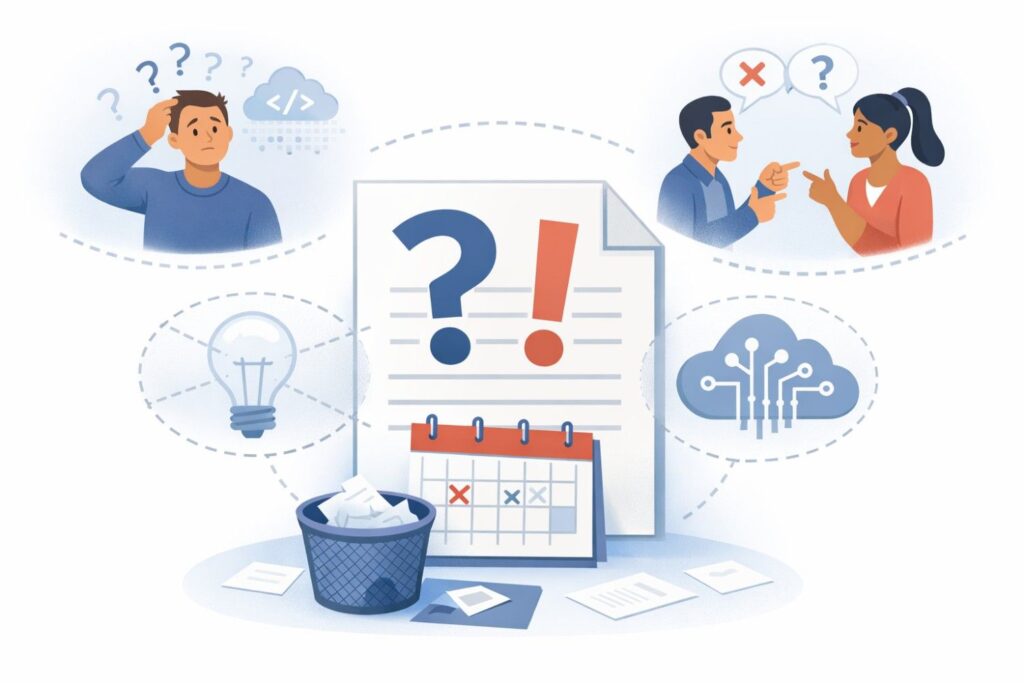
Six months later, you cannot clearly explain what was new, what was obvious, and what was truly inventive. That makes it almost impossible to draft a strong patent.
Action you can take now: after every major model milestone, pause and document what changed, why it mattered, and what problem it solved. Do not wait for a lawyer to ask. Capture it while it is fresh.
Technical Details Get Lost in Slack and Git
The real insight behind your system is often buried in casual messages. Someone says, “What if we combine embeddings this way?” Another engineer replies with a quick experiment. It works. You move on.
That exchange may contain the core inventive concept.
But Slack threads disappear. Git commits do not explain reasoning. Experiment logs do not capture intent.
An invention disclosure form forces you to extract the thinking behind the code. It turns scattered ideas into a clear technical story.
Without that step, your invention exists only in fragments.
AI Feels Like Math, Not an Invention
Many founders assume that models cannot be patented because “it is just math” or “everyone uses neural networks.” That belief alone causes inventions to go undocumented.
But patents are not about claiming math. They are about how you apply it to solve a real-world technical problem in a new way.
The System Is the Invention
In AI, the invention is rarely just the model. It is how data flows into it. How it is cleaned. How it is labeled. How it is trained. How outputs are validated. How results are used downstream.
If you do not document the entire system, you shrink your invention down to something that looks generic.
A proper disclosure form pushes you to explain the full workflow. It captures the architecture, not just the algorithm.

That is the difference between a weak filing and a defensible one.
Improvements Are Often Patentable
Small technical improvements can be valuable. A new way to reduce training time. A custom loss function tailored to your domain. A novel feedback loop between users and model updates.
Founders often ignore these because they seem incremental.
But incremental in AI does not mean obvious.
If you do not write down the improvement clearly, you cannot later argue that it was new and non-obvious. The invention disclosure form forces you to explain what existed before and what changed.
That comparison is critical.
Team Knowledge Is Fragile
AI companies rely heavily on key engineers. One or two people may deeply understand the system. Everyone else sees pieces.
If those people leave, take a vacation, or simply move to another project, knowledge fades quickly.
Oral Explanations Are Not Enough
Many teams rely on internal demos or whiteboard sessions. Someone explains the system architecture once. Everyone nods. Then work continues.
But verbal explanations do not create a legal record.
An invention disclosure form captures that explanation in writing. It becomes part of your company’s core IP memory.
That is strategic protection, not bureaucracy.
Investors Expect Clarity
When you raise money, investors ask about defensibility. If your answer is vague, it signals risk.
You need to explain clearly what is unique about your AI system.
If you already have strong disclosure documents prepared, that conversation becomes easy. You can speak with confidence because you understand your own innovation deeply.
Without documentation, you scramble to reconstruct what happened months ago.
Competitors Move Quietly
In AI, competitors often work on similar problems. They may not copy you directly. But they are exploring adjacent solutions.
If they file patents before you do, your ability to protect your own invention shrinks.
Public Releases Can Block You
Publishing a paper, open-sourcing part of your system, or even giving a conference talk can affect your ability to patent in many regions.
If you have not completed a disclosure before going public, you risk losing rights.
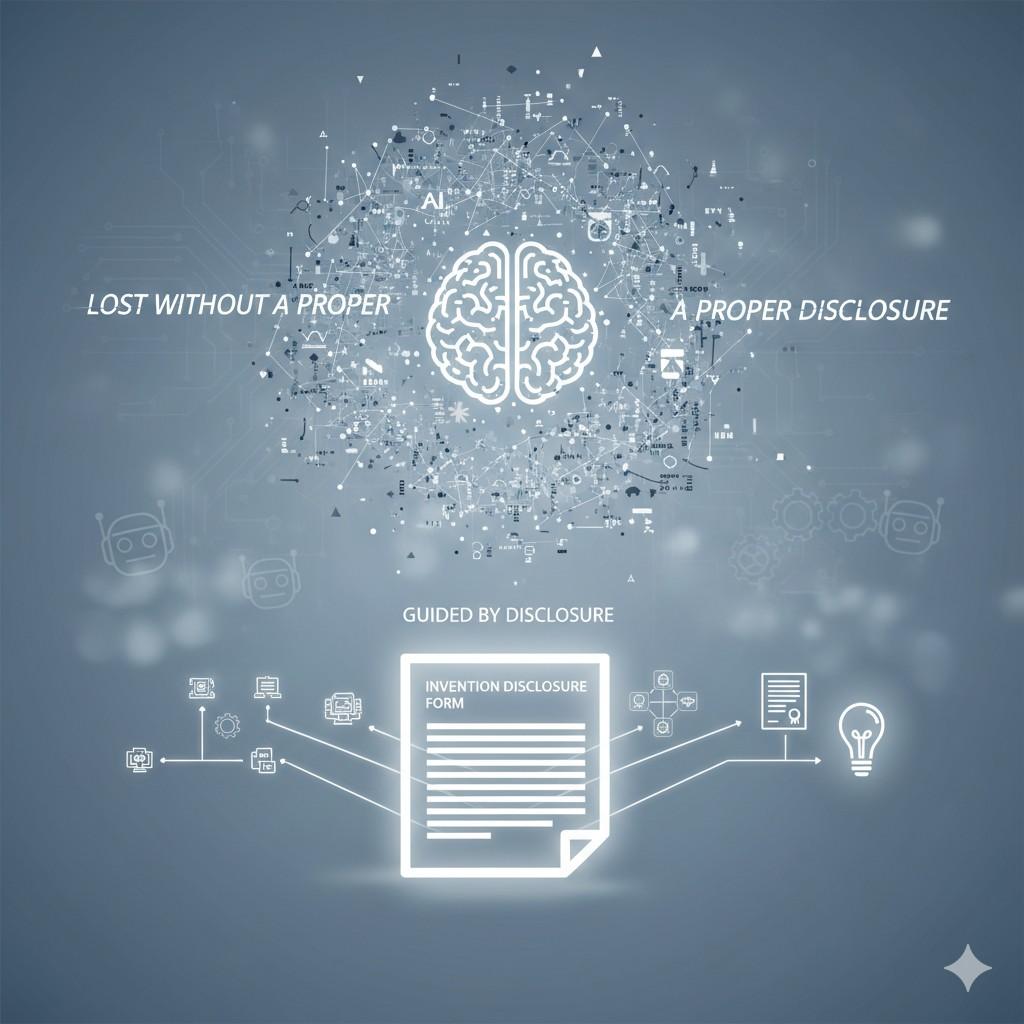
A disciplined invention disclosure process creates a checkpoint before major announcements. It ensures you pause and ask, “Should we protect this first?”
That simple habit can save your company long term.
Being First Matters
Patent systems reward those who file early.
If you delay documenting your AI invention because you think you will “do it later,” someone else may formalize a similar idea first.
The invention disclosure form is your starting line. It allows you to move quickly toward filing while your innovation is still fresh and before the competitive window closes.
Complexity Makes It Hard to Explain Later
AI systems become complex very fast. You add modules. You add monitoring layers. You integrate external APIs. You deploy across cloud environments.
Six months later, even you may struggle to explain the exact original architecture.
Memory Fades, Even for Founders
Founders often believe they will always remember how the system evolved. In reality, once the product grows, your focus shifts to growth, sales, hiring, and fundraising.
Details blur.
An invention disclosure form acts like a snapshot in time. It records the system at a specific stage, along with the reasoning behind design choices.
That snapshot is powerful evidence when drafting patent claims.
Clean Documentation Reduces Legal Cost
When you eventually work with patent counsel, the quality of your documentation directly affects cost and speed.
If you hand over messy notes and partial code, attorneys spend hours trying to extract the invention. That increases fees and delays.
If you provide a structured, thoughtful disclosure, the drafting process moves faster and with fewer revisions.
That saves money and keeps you focused on building.
The Real Risk: Under-Claiming Your Own Innovation
The biggest danger is not losing everything. It is claiming too little.
If your invention is poorly documented, the resulting patent may be narrow. It may cover only one version of your model instead of the broader system. It may miss alternative implementations.
That limits your protection.
A strong invention disclosure encourages you to think bigger. It pushes you to describe variations, extensions, and alternative flows.

That broader thinking allows patent claims to cover more ground.
And broader protection means stronger leverage against competitors.
A Strategic Habit, Not a One-Time Task
The smartest AI companies treat invention disclosure as an ongoing practice. Not a one-time form to fill out before filing.
They create an internal culture where technical breakthroughs are captured early.
You can start small. Assign someone responsible for tracking potential inventions. Set a monthly review where engineers discuss meaningful technical improvements. Use structured prompts to guide documentation.
Most importantly, do not wait until you “feel ready” to file a patent. By then, the details may already be diluted.
If you want to see how modern AI teams turn raw technical work into real, defensible patents without slowing down product development, take a look at how PowerPatent works: https://powerpatent.com/how-it-works
It is built specifically for founders and engineers who move fast but still want strong protection.
When you combine disciplined invention disclosures with smart software and real attorney oversight, you stop losing innovation to chaos.
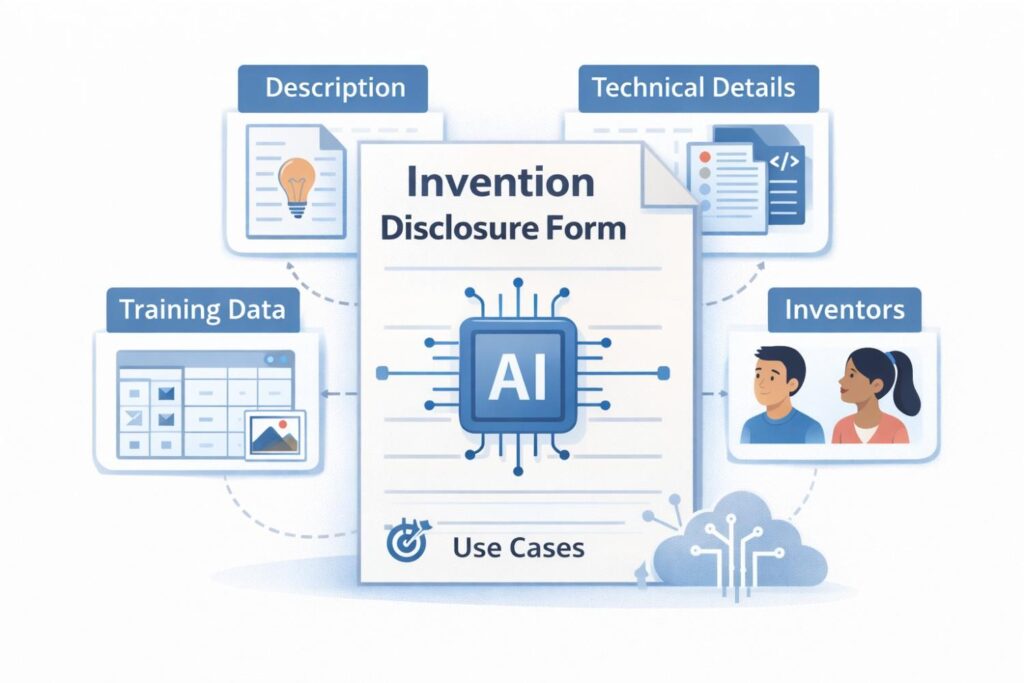
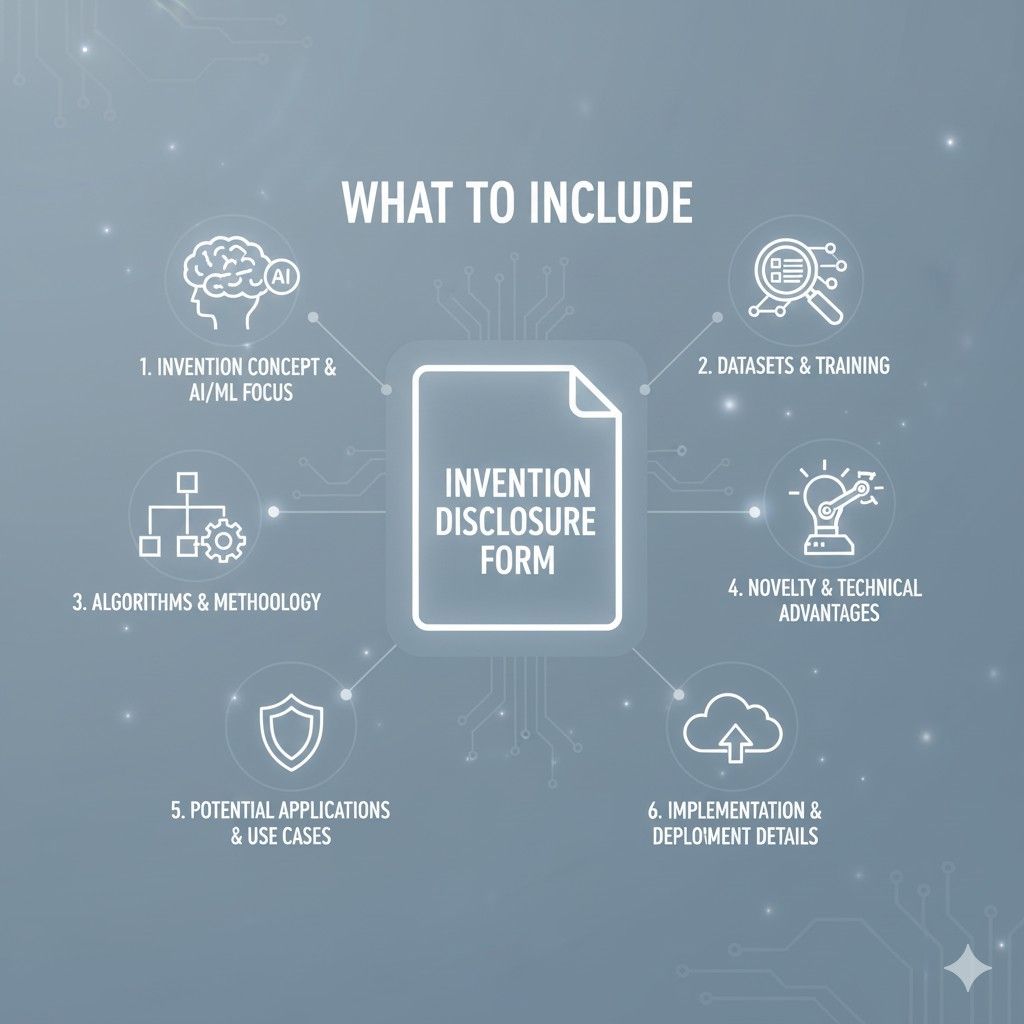
What to Include in an Invention Disclosure Form for AI and Machine Learning
An invention disclosure form is not a legal document. It is not meant to sound impressive. It is not a pitch deck. It is a clear explanation of what you built, why it matters, and how it works. That is it.
But when it comes to AI and machine learning, many founders either write too little or write the wrong things. They attach code. They paste model summaries. They link to GitHub. That is not enough.
A strong disclosure explains the idea in plain language first, then walks through the technical details in a way that someone outside your company can understand. It should tell the full story of the system, not just one part.
Let’s break down what actually belongs in a powerful AI invention disclosure—and how to approach each part strategically.
Start With the Problem, Not the Model
Before you explain your neural network or training setup, you need to explain the real-world problem your system solves.
Describe the Pain Clearly
What was broken before your solution existed? What were users struggling with? What technical limits were in the way?
Be specific.
If you built an AI fraud detection system, do not just say “detects fraud.” Explain what existing systems could not do. Were they too slow? Did they fail on certain patterns? Did they require too much manual review?

Patents are stronger when they are tied to concrete technical problems.
Your disclosure should clearly answer: what was not working, and why?
Explain Why Existing Solutions Fell Short
This is where you show context. What approaches were already used in the industry? What were their limits?
Do not attack competitors. Just describe the technical gap.
Maybe existing models required too much labeled data. Maybe they failed in low-resource environments. Maybe they could not scale in real time.
When you explain this gap clearly, you create space for your invention to stand out.
Describe the System as a Whole
Many teams make the mistake of focusing only on the model. But in AI, the system is often the real invention.
Map the Full Workflow
Walk through the system step by step.
How does data enter the system? How is it cleaned or transformed? How is it labeled or enriched? How is it fed into the model? What happens after the model generates output?
Do not assume anything is obvious.
Even small preprocessing steps can be important. A new way to filter noise or structure input data may be the key innovation.
Write this section as if you are teaching a new engineer how the system works.
Explain Interactions Between Components
AI systems rarely operate in isolation. They connect to APIs, databases, user interfaces, and monitoring tools.
If your invention involves how these components interact, explain that clearly.
For example, maybe your model updates itself based on user feedback in a unique way. Or perhaps you built a feedback loop that improves accuracy over time without full retraining.
Those interactions often carry patent value.
Detail the Model Architecture With Context
Now you can talk about the model itself. But do not just paste a diagram or say “we use a transformer.”
Explain what is different.
Focus on What Is Unique
If you modified a standard architecture, describe how.
Did you combine multiple models in a new sequence? Did you design a custom loss function? Did you add a constraint that changes how training works?
The key is to isolate the inventive step.
You do not need to claim you invented neural networks. You need to show how you applied or modified them in a new way to solve the problem described earlier.
Explain Why Design Choices Matter
Every architecture decision should connect back to the problem.
Why did you choose this structure? Why did you combine certain inputs? Why did you design the training process in this way?
This reasoning is critical.
Patent strength often comes from explaining not just what you built, but why it works better than other options.
Describe Training in Practical Terms
Training is often where hidden innovation lives.
Capture Data Strategy
What kind of data did you use? How was it collected? How was it prepared?
If you created a new method for labeling data or generating synthetic data, document it clearly.
If your system reduces the amount of required labeled data, explain how.
Data strategy can be highly protectable when it involves technical processes.
Explain Optimization and Performance Gains
Did you reduce training time? Improve stability? Lower compute cost?
Describe how you achieved that.
If you built a distributed training setup that works differently from common approaches, that is important.
If you use a unique validation process that improves generalization, document it.
Small technical improvements can have large business impact. But only if they are written down clearly.
Include Real Examples and Use Cases
Abstract descriptions are not enough.
Give concrete examples of how the system operates.
Walk Through a Sample Scenario
Take a real input and describe what happens step by step.
What data enters? What transformations occur? What output is generated? What decision is made?
This helps translate technical design into practical application.
It also helps patent drafters later create stronger, clearer claims.
Show Variations
Do not limit your disclosure to one example.
If your system could work in multiple industries or contexts, mention that.
If the same architecture could be adapted with small changes, describe those alternatives.
This expands the scope of protection.
Identify What Makes It Hard to Copy
One strategic way to strengthen your disclosure is to ask: if a competitor tried to copy this, what would be difficult?
Is it the training method? The system architecture? The feedback loop? The deployment setup?
Write that down.
This exercise forces you to think about the core value of your invention.
It also helps ensure your patent focuses on the real differentiators.
Document Early Versions Too
Many founders only describe the current system. That can be a mistake.
If earlier versions contained important ideas, capture them.
Even if the product evolved, those earlier technical approaches may still be patentable.
Sometimes the first breakthrough is more protectable than the polished version.
Clarify Ownership and Contributors
Your disclosure should clearly identify who contributed to the invention.
In AI startups, multiple engineers often collaborate.
Make sure you capture who did what and when. This avoids confusion later.
It also protects your company from disputes.
Write It So a Smart Outsider Can Understand
A final test: can a skilled engineer outside your company understand your system just by reading the disclosure?
If the answer is no, it needs more clarity.
Avoid internal shorthand. Avoid unexplained acronyms. Avoid vague statements like “we improved performance significantly.”
Say how. Say why. Say what changed.
Clarity now prevents expensive back-and-forth later.
If you want a structured way to capture all of this without turning it into a paperwork burden, look at how PowerPatent guides founders through the disclosure process: https://powerpatent.com/how-it-works
It is built to translate technical thinking into strong patent foundations, with real attorneys reviewing every step.
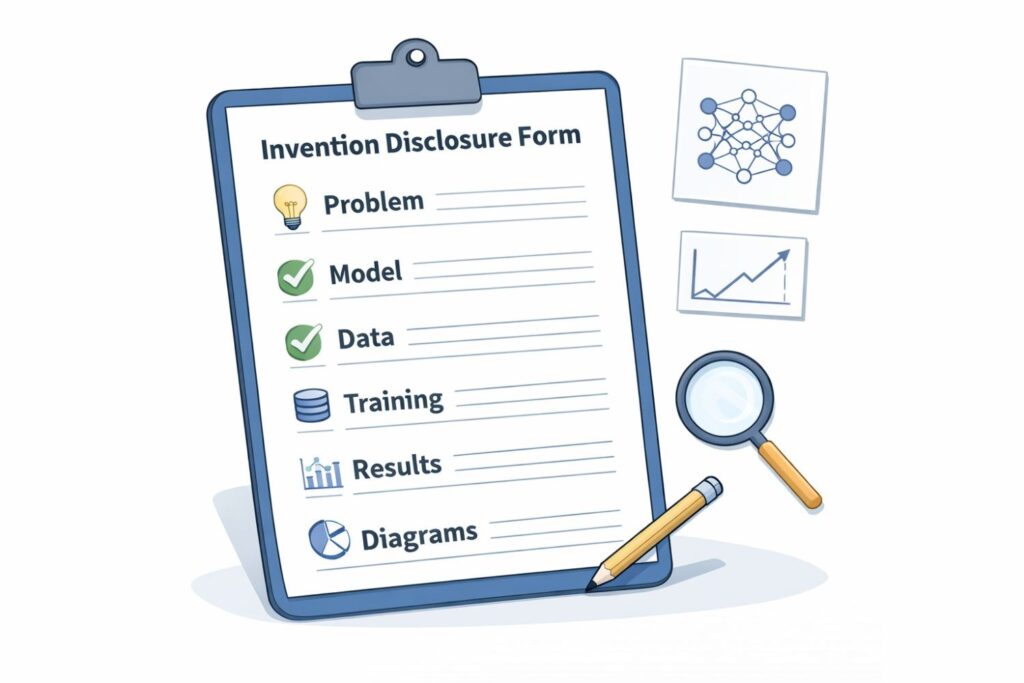
A well-prepared invention disclosure does not slow you down. It gives you control. It turns fast-moving AI development into protected, defensible assets.
When you document properly, you stop guessing about your IP.
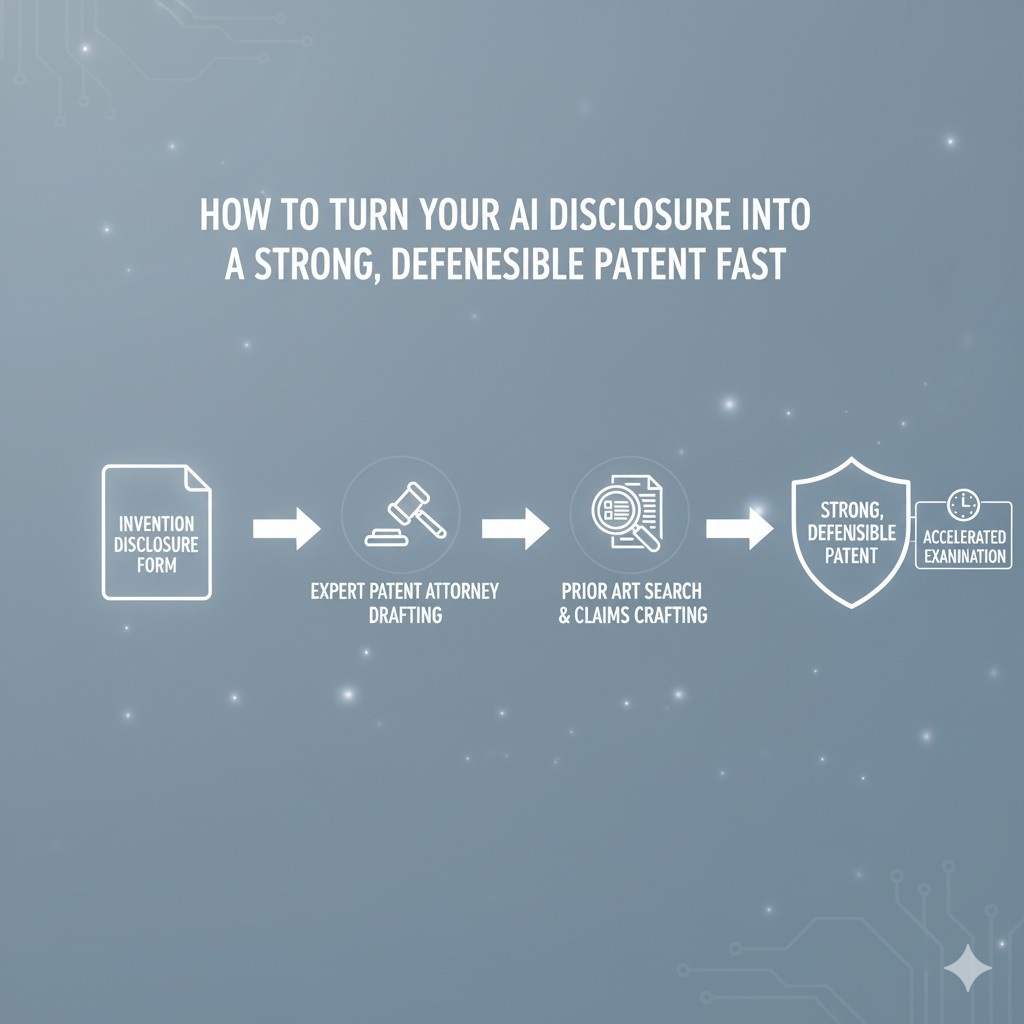
How to Turn Your AI Disclosure Into a Strong, Defensible Patent Fast
Writing a solid invention disclosure is a powerful first step. But it is only the beginning.
A disclosure by itself does not protect you. It becomes valuable when it is shaped into a patent that is broad enough to matter and specific enough to hold up under pressure.
Speed matters. In AI, markets move quickly. Competitors file early. Investors ask about defensibility. You cannot afford a slow, messy patent process.
The good news is this: if your disclosure is done right, turning it into a strong patent does not have to drag on for months. It can be focused, strategic, and fast.
Let’s walk through how to do that the smart way.
Move Quickly While the Details Are Fresh
Momentum is your advantage.
Right after you complete your invention disclosure, your technical thinking is still sharp. You remember the design choices. You remember what failed before you found what worked. That context is gold.

If you wait six months, you lose clarity. If you move now, you preserve it.
Lock In the Core Idea First
Before drafting begins, identify the heart of the invention. Not the entire system. Not every feature. The core concept that makes your solution different.
Ask yourself: if a competitor copied only one thing from us, what would it be?
That is the concept your patent must protect.
Everything else can support it, but that central idea needs to be claimed clearly and broadly.
A strong patent is not about describing everything. It is about protecting the right things.
Avoid Over-Narrow Thinking
Many founders make their patents too small. They describe exactly how their current product works and nothing more.
That is risky.
Your patent should cover variations. Alternative implementations. Different model types that could achieve the same result. Future versions of your system.
Your disclosure likely already hints at these possibilities. Now is the time to expand them thoughtfully.
Think in terms of principles, not just code.
Translate Technical Detail Into Legal Strength
Patent language is different from engineering language. But the substance comes from you.
The more clearly you explain your system’s technical advantages, the stronger the patent can be.
Focus on Technical Improvement
Patent examiners care about technical improvement. Not business impact. Not market size.
You need to show how your AI system improves computer functionality, processing efficiency, model performance, system architecture, or another technical aspect.
For example, if your model reduces compute load, explain how. If your architecture improves response time, show why. If your training method improves accuracy with less data, detail the mechanism.
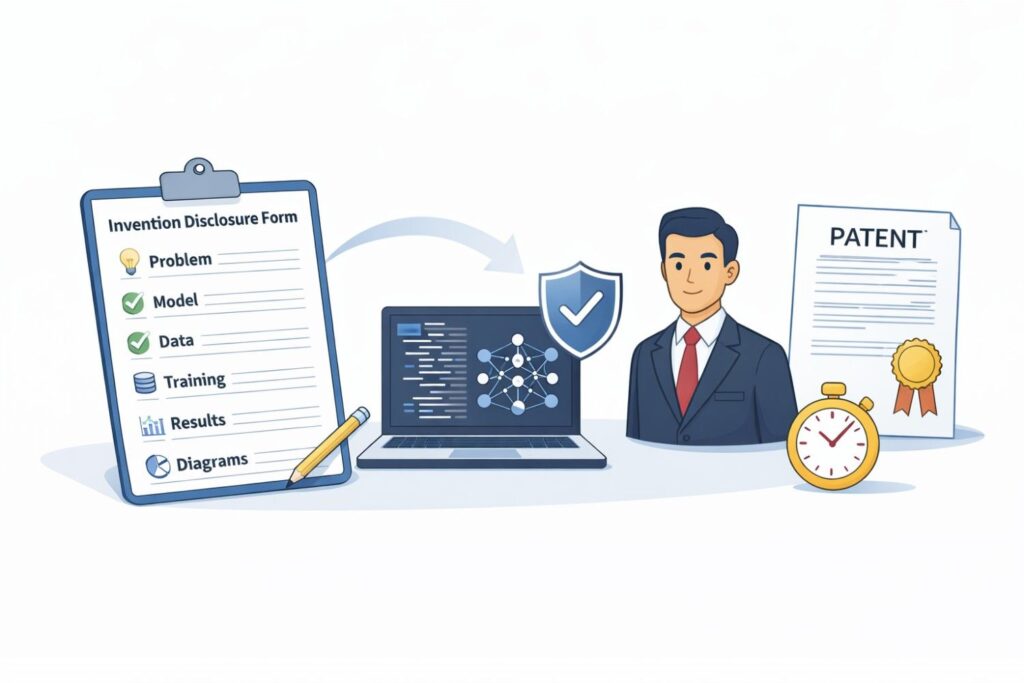
The patent must highlight technical benefit, not just outcome.
That framing is critical.
Connect Every Feature to a Problem
Earlier in your disclosure, you described the problem your system solves. Now that connection must become tight and explicit.
Each key feature in your patent should tie directly to solving that problem.
This creates a logical chain. Problem. Limitation of existing systems. Your technical solution. Measurable improvement.
That chain makes your patent harder to attack.
Work With People Who Understand AI
AI patents are not the same as mechanical patents or simple software patents.
The person drafting your patent must understand machine learning workflows, training processes, data handling, and system architecture.
If they do not, you will spend weeks correcting misunderstandings.
Worse, your claims may miss what truly matters.
Attorney Oversight Is Not Optional
AI is a complex area with evolving rules. Courts often scrutinize software and AI patents closely.
You need real patent attorneys involved. Not just automated document generators.
At the same time, you do not want endless back-and-forth that slows your team down.
This is where a hybrid approach works best. Smart software to organize and structure your invention. Real attorneys to refine claims and ensure compliance.
That combination gives you speed and strength.
If you want to see how this works in practice, PowerPatent was built exactly for this purpose: https://powerpatent.com/how-it-works
It helps founders turn raw technical insight into strong patent filings without drowning in paperwork.
Draft Broad Claims First, Then Support Them
Claims define your protection. They are the boundary lines.
A smart strategy is to draft broad claims that capture the core inventive concept, then add narrower claims that cover specific implementations.
Think Beyond One Model Type
If your invention works with a neural network today, could it work with another type of model tomorrow?
If yes, your patent should not be locked to one architecture.
Use language that captures the functional concept, not just the current implementation.
This ensures that even as your technology evolves, your patent remains relevant.
Protect the Workflow, Not Just the Algorithm
In AI, workflow is often where the value lies.
Data ingestion. Preprocessing. Feature extraction. Model inference. Post-processing. Feedback loops.
If your innovation sits in how these steps interact, your claims should reflect that.
Do not let your protection shrink to a single mathematical step.
File Early, Then Improve
Many founders think they need a perfect patent application before filing. That slows everything down.
You can file a strong initial application that captures the core invention. Then, as your system evolves, you can file additional applications to cover improvements.
This layered approach is powerful.
It gives you an early filing date, which is critical. It also allows you to build a portfolio over time.
In AI, where systems evolve quickly, this approach aligns well with product development cycles.
Align Patent Strategy With Business Goals
Your patent is not just a technical document. It is a business asset.
Ask yourself how you plan to use it.
Is it for investor confidence? Competitive leverage? Licensing? Acquisition value?
Your strategy may change how broadly you file, how many variations you include, and how quickly you expand your portfolio.
If you are raising funding soon, speed may be critical.
If you are entering a crowded market, broad coverage may matter more.
Make sure your patent plan matches your growth plan.
Reduce Friction Inside Your Team
One hidden reason patents get delayed is internal friction.
Engineers feel pulled into legal meetings. Founders feel overwhelmed. Drafts sit unread in inboxes.
To move fast, you need a streamlined workflow.
Clear invention disclosures. Structured review sessions. Defined timelines. Simple feedback loops.
When the process feels manageable, your team stays engaged.
When it feels chaotic, it stalls.
Modern tools can remove much of this friction by guiding engineers through structured questions and turning their answers into draft-ready material.
That is how you compress timelines without sacrificing quality.
Treat Patents as Part of Product Strategy
The strongest AI companies do not treat patents as an afterthought. They treat them as part of the product roadmap.
When planning major technical milestones, they ask: is this protectable?
When launching new features, they review: have we captured the underlying invention?
This mindset shifts patents from reactive to proactive.
It also ensures you are not scrambling after a competitor files first.
Build Confidence Through Clarity
At the end of the day, a strong patent starts with clarity.
Clear problem. Clear solution. Clear technical improvement.
Your invention disclosure gives you the raw material. A focused drafting process shapes it into enforceable protection.
When done right, this does not slow your startup down. It gives you leverage. It strengthens your story with investors. It builds a moat around what you are creating.
If you are building AI and want to move from idea to filed patent without the traditional law firm drag, take a serious look at how PowerPatent works: https://powerpatent.com/how-it-works
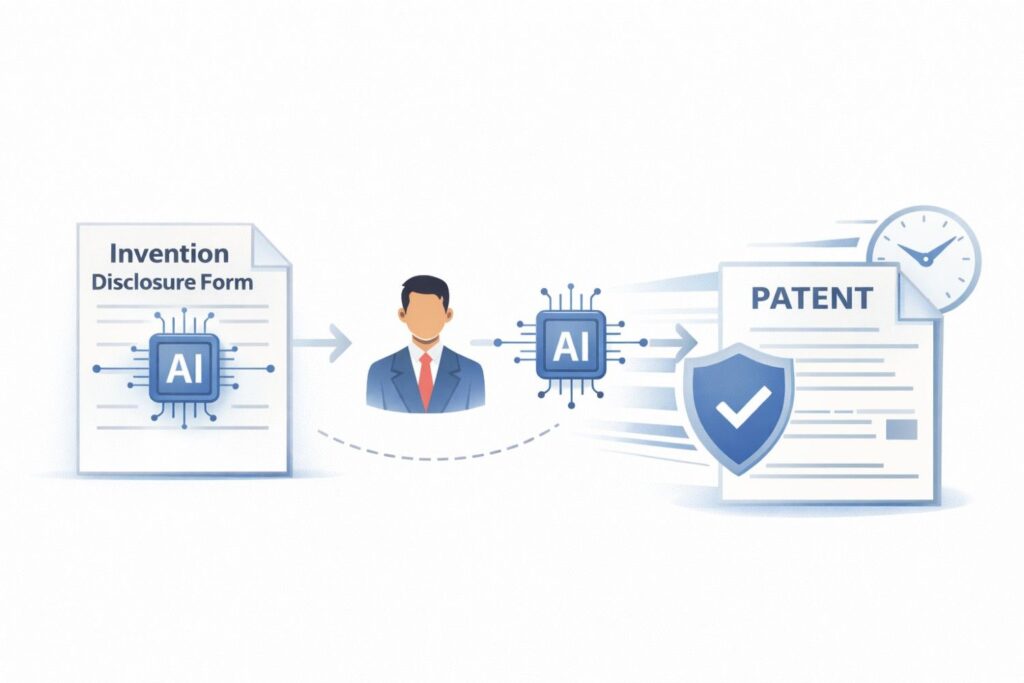
It combines intelligent software with real patent attorneys so you can move quickly and confidently.
Because in AI, speed matters.
Wrapping It Up
If you are building AI or machine learning systems, you are not just writing code. You are creating long-term assets. But those assets only become real protection when they are captured clearly and turned into strong patents. An invention disclosure form is not busy work. It is your safeguard against forgetting what makes your system special. It forces you to slow down just enough to document the technical breakthroughs hidden inside fast iteration cycles. It turns Slack messages, model tweaks, and training insights into something concrete.