A patent redline review is where small words can carry big weight. One changed phrase can make your patent stronger, weaker, wider, or too narrow to matter. For a founder, engineer, or inventor, this part can feel slow and hard to follow. You want speed, but you also need care. You want smart edits, but you do not want a mistake hiding inside your patent claim.
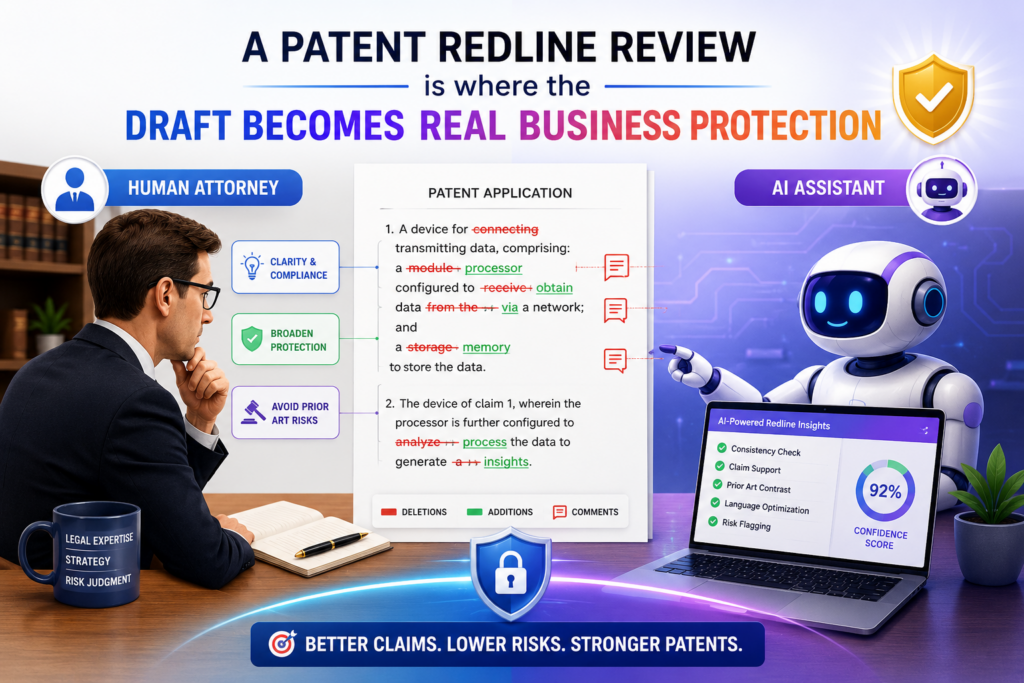
A patent redline review is where the draft becomes real business protection
A patent draft is not finished just because the words are on the page. The first draft is only the start. The redline review is where the real work begins. This is the stage where each change is checked with care.
It is where broad words are tested. It is where weak words are removed. It is where the invention is shaped into something that can help the company, not just sit in a file.
For a founder, this can feel like a strange mix of code review, product planning, and risk control. You are looking at lines of text, but those lines may decide how much room your company has to grow.
A patent that is too narrow may not stop a copycat. A patent that is too vague may cause problems later. A patent that misses the real point of the invention may fail to protect the thing that makes your startup special.
That is why redline review matters so much. It is not just about grammar. It is not just about clean writing. It is about making sure the patent says the right thing in the right way.
The redline is not just editing text
In a normal document, a redline shows what changed. In a patent, a redline shows what protection may change. That is a much bigger deal.
A small edit can change the whole meaning of a claim. For example, changing “a model” to “the model” may look tiny, but it can affect how the claim is read.
Changing “receiving data” to “receiving sensor data” may make the claim clearer, but it may also make it narrower. Adding a feature from one example may seem helpful, but it may also box the patent into only that example.
This is why founders should not treat patent redlines like a fast doc review. You are not just accepting changes because they sound cleaner. You are asking what each change does to your moat.
Does it make the claim easier to understand? Does it cover the real system? Does it avoid known prior work? Does it still leave room for future versions of the product?
At PowerPatent, this is one reason the process combines smart software with real attorney review. The software can help move fast, spot issues, and organize edits.
But the review still needs legal judgment from a real patent attorney. That mix gives founders speed without leaving the hard calls to guesswork. You can see how that works here: https://powerpatent.com/how-it-works
The best redline asks what the founder is really trying to protect
A strong redline review starts with a simple question: what is the real invention?
That question sounds easy, but it is often where teams get stuck. Many founders describe their invention as the full product.
Engineers may describe it as a stack, a flow, a model, or a set of modules. Investors may see it as a market edge. The patent draft needs to turn all of that into clear claim language.
This is where a redline can help or hurt. A good redline moves the draft closer to the heart of the invention. A bad redline may make the patent sound more formal while pulling it away from what matters.
For example, a startup may build a new system that cuts cloud cost by predicting compute demand before jobs run. The invention may not be “using AI for cloud management.”
That is too broad and too generic. The real invention may be how the system watches certain signals, ranks jobs, predicts load, and shifts resources before waste happens. During redline review, every edit should support that core idea.
This is also why founders should stay involved. You do not need to become a patent expert. You do need to help explain what makes the system different. You know which parts took real work.
You know which parts competitors would want to copy. You know which parts may change in the next product version. That context is gold during redline review.
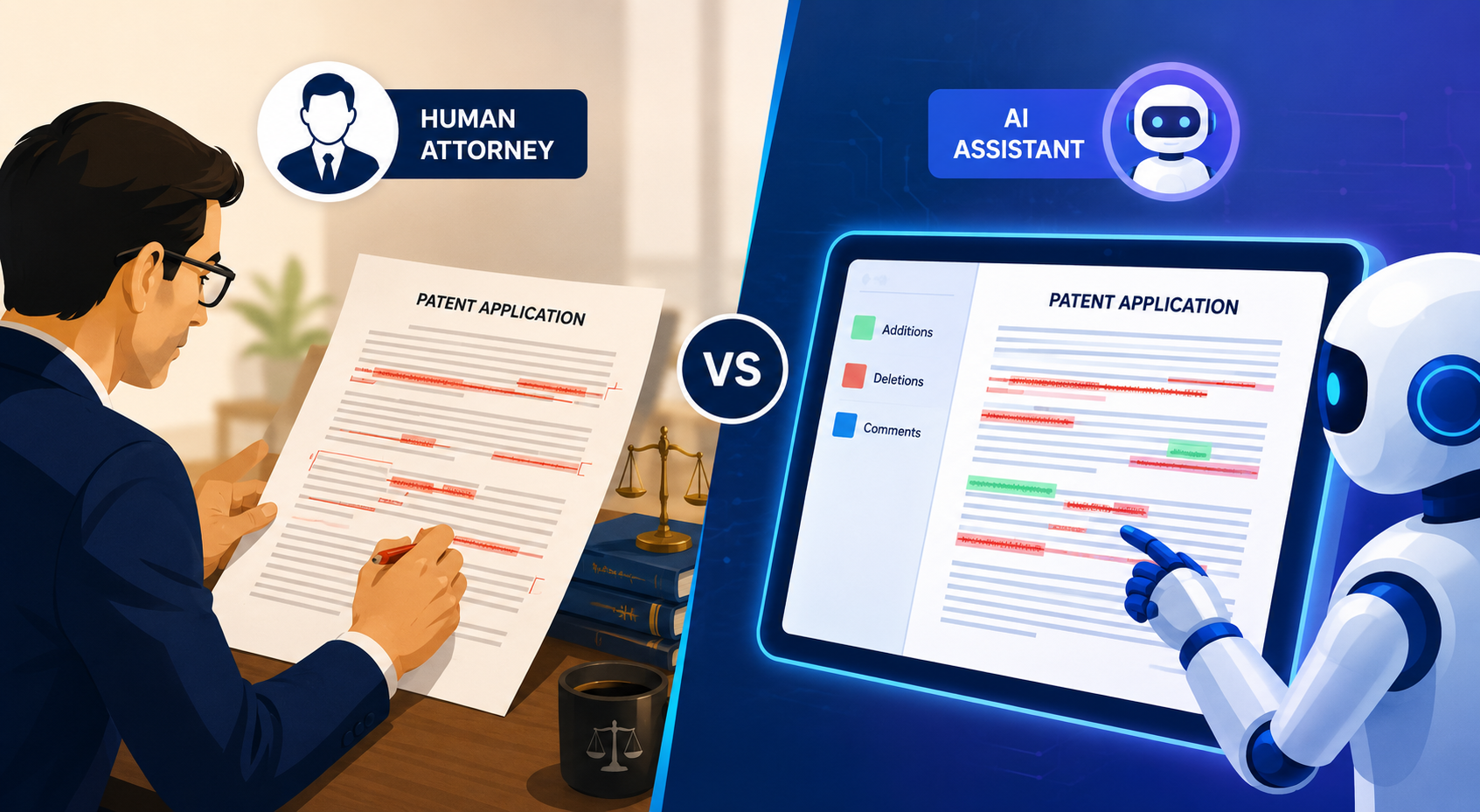
When a human attorney and an AI assistant are used the right way, the review gets better. The AI can help surface unclear wording, compare versions, and point out missing support.
The attorney can judge what the changes mean for claim scope, risk, and long-term value. The founder can bring the product truth. The best results happen when all three roles work together.
A human attorney sees risk that plain text does not show
A human patent attorney does more than read the redline. A good attorney reads behind it. They look at the claims, the examples, the drawings, the product roadmap, the known market, and the way the patent may be used later.
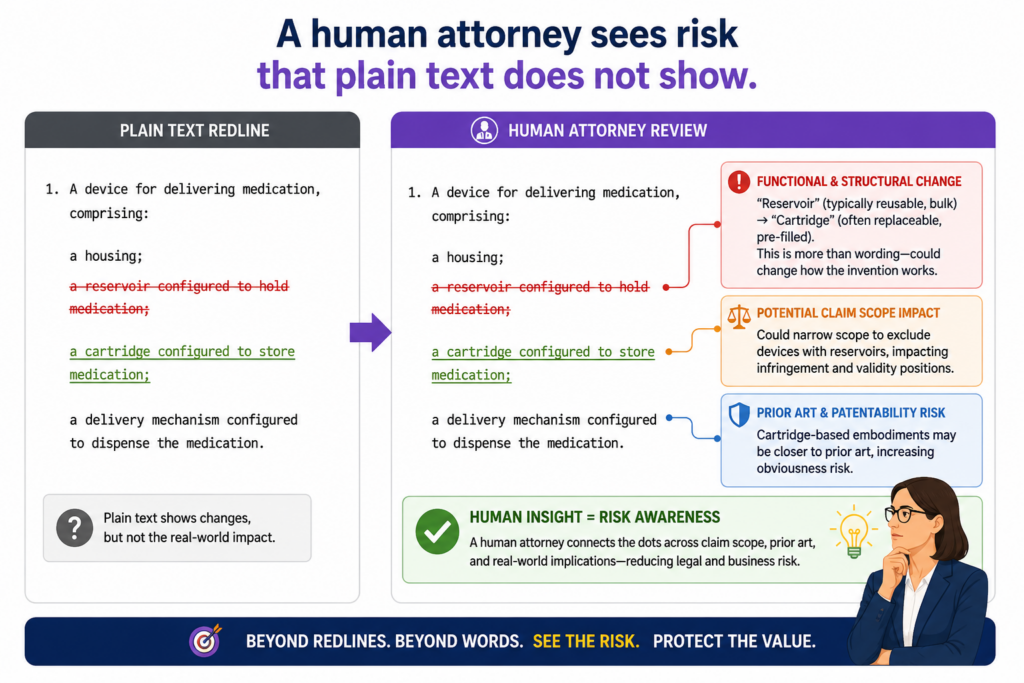
They are not just asking whether a sentence is clear. They are asking whether the patent can stand up when it matters.
That is the core value of human review. It brings judgment. It brings pattern matching from past patent work. It brings an eye for traps that may not look like traps to a founder or to software.
Some edits sound better but create risk. Some changes make the invention too narrow. Some words may create openings for competitors. A trained attorney is watching for those things.
This does not mean the human attorney should work in the old slow way. Founders do not want endless email chains, vague comments, and weeks of delay. They need fast review that still has real care behind it.
The right model is not slow human work against fast AI work. The right model is faster human work supported by smart tools.
The attorney understands the business goal behind the claim
A patent is not written in a vacuum. It sits inside a business.
That business may be raising money, preparing for diligence, building a data moat, entering a new market, or trying to stay ahead of a large company. The redline review should reflect that.
A human attorney can ask questions that connect the patent to the company’s real plan. Is this patent meant to protect the core platform? Is it meant to cover a new model training method?
Is it meant to block a likely copycat path? Is it meant to support a funding round? Is it meant to build a family of patents over time?
These questions matter because they shape the edits. A patent for a deep tech platform may need broader system coverage.
A patent for a hardware device may need careful support for parts, signals, timing, and physical layout.
A patent for AI software may need clear steps that explain more than a black box result. The redline should match the goal.
An AI assistant can help organize these issues, but it does not own the business judgment. It can suggest clearer words. It can flag terms that may need support.
It can compare claim language with the description. But the human attorney must decide whether the change helps or hurts the protection.
The attorney can protect the founder from clean but dangerous edits
One of the hardest things about patent redlines is that a bad edit may look good.
A sentence can become smoother while the protection becomes weaker. A claim can become easier to read while losing the feature that made it broad.
A phrase can become more precise while giving competitors a path around the patent. This is why founders should be careful with any redline that only focuses on making the draft sound polished.
In patent work, cleaner is not always stronger. The goal is not pretty writing. The goal is clear, useful protection.
For example, an edit may change “training data” to “labeled training data” because the example uses labeled data. That may be fine if labels are always required. But what if the product later uses weak labels, synthetic labels, or no labels at all?
That one edit may limit the patent in a way the team does not want. A human attorney should catch that and ask the founder whether the narrower wording is truly needed.
The same thing can happen with hardware. A draft may say a device has a “wireless sensor.” A redline may change it to “Bluetooth sensor” because that is the current prototype.
But if future versions may use Wi-Fi, UWB, cellular, or another protocol, the edit may be too narrow. A human attorney can keep the patent tied to the invention, not just the first build.
This is where attorney review earns its place. The attorney is not just fixing words. They are protecting options.
They are helping the founder avoid locking the patent into today’s version when tomorrow’s version may be more valuable.
PowerPatent helps make this easier by giving founders a smarter way to work with patent attorneys, drafts, and technical details in one process.
The aim is simple: move fast, keep control, and avoid costly mistakes before they become hard to fix. Learn more here: https://powerpatent.com/how-it-works
An AI assistant can speed up the review, but it should not be the final judge
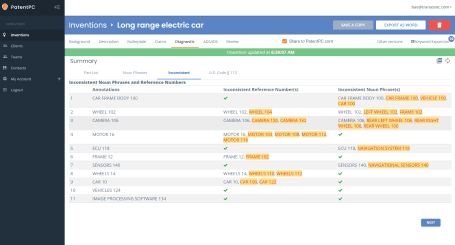
An AI assistant can be very useful in patent redline review. It can read large drafts quickly. It can compare claim terms. It can point out where a term appears in one section but not another.
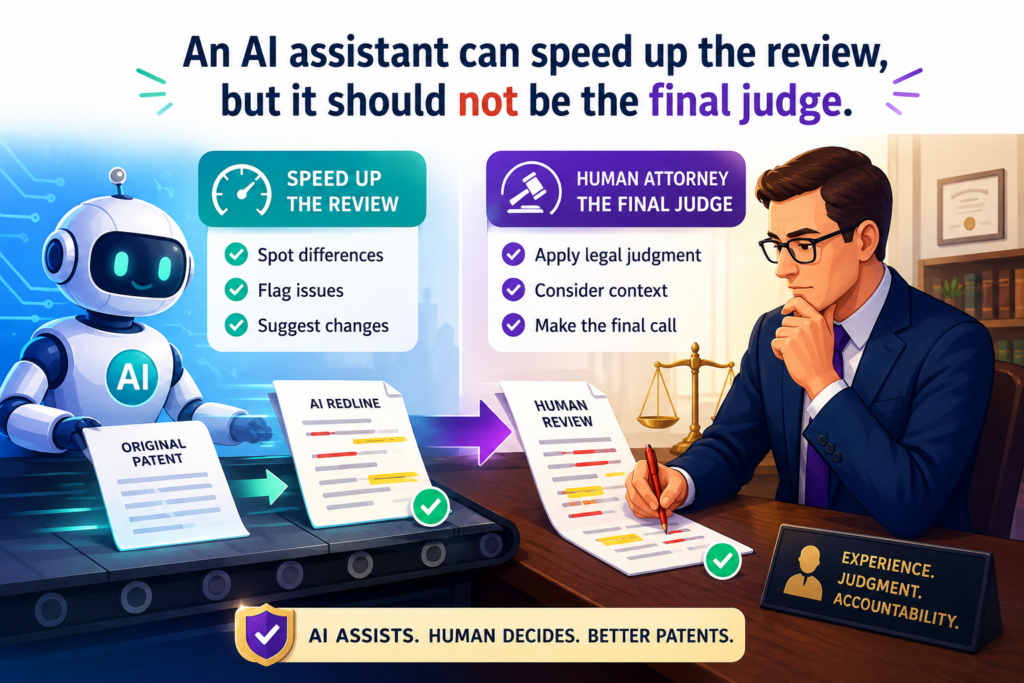
It can help rewrite rough text into clearer language. It can find gaps that a busy team may miss. For founders, this can save time and reduce friction.
That speed matters. Startup teams move fast. Product details change. Engineers ship new versions. Fundraising deadlines appear.
A patent process that takes too long can become a blocker. AI can help reduce that drag. It can make the redline process feel less like waiting and more like building.
But speed is not the same as judgment. An AI assistant can help review a patent redline, but it should not be the only reviewer.
It does not truly know your company strategy. It does not carry legal responsibility the way an attorney does.
It may sound confident while missing the deeper issue. That is why the best use of AI is support, not replacement.
The strongest use of AI is to catch the first layer of issues
AI is very good at helping with the first pass. It can find messy wording, uneven terms, missing references, and places where the draft may confuse the reader.
It can help turn raw invention notes into a cleaner review path. It can also help the founder understand what changed without reading every line from scratch.
For example, an AI assistant can help answer practical questions during redline review. Did the claim term change from “prediction engine” to “inference engine”? Was that change made everywhere?
Does the description still use the old term? Is the same part called three different names? Did a redline add a limit that is only shown in one example? These are the kinds of checks that software can help with.
This creates a better workflow for everyone. The founder gets a clearer view of the draft. The attorney spends less time on basic cleanup.
The team can focus on the deeper calls that matter more. This is where AI can make the patent process faster without turning it into a blind shortcut.
AI works best when it is guided by the invention story
An AI assistant needs context. Without context, it may over-edit. It may make the text sound clean but generic.
It may remove useful detail. It may choose a word that seems right but does not match the technical truth. The better the input, the better the output.
This is why founders should feed the review with the real invention story. What problem did the team solve? What failed before?
What is different about the approach? What parts are required? What parts are optional? What parts may change later? What would a competitor likely copy first?
When AI has this context, it becomes more useful. It can help check whether the draft reflects the true invention.
It can help map features to examples. It can help explain changes in plain words. It can help the founder prepare better questions for the attorney.
Still, there is a line AI should not cross. It should not make the final call on claim scope. It should not decide whether a narrowing edit is worth it.
It should not replace a human attorney’s review of legal risk. It should not be treated as the final source of truth.
The safest and smartest path is to use AI for speed, structure, and clarity, then use a real patent attorney for judgment, strategy, and final review. That is the kind of model PowerPatent was built around.
It helps founders get the benefits of smart software while still having real attorney oversight where it counts. You can explore the process here: https://powerpatent.com/how-it-works
A strong redline review starts before the first edit is made
A good patent redline review does not begin when someone opens the document. It begins before that. It begins when the founder, engineer, and reviewer agree on what the patent is meant to protect.
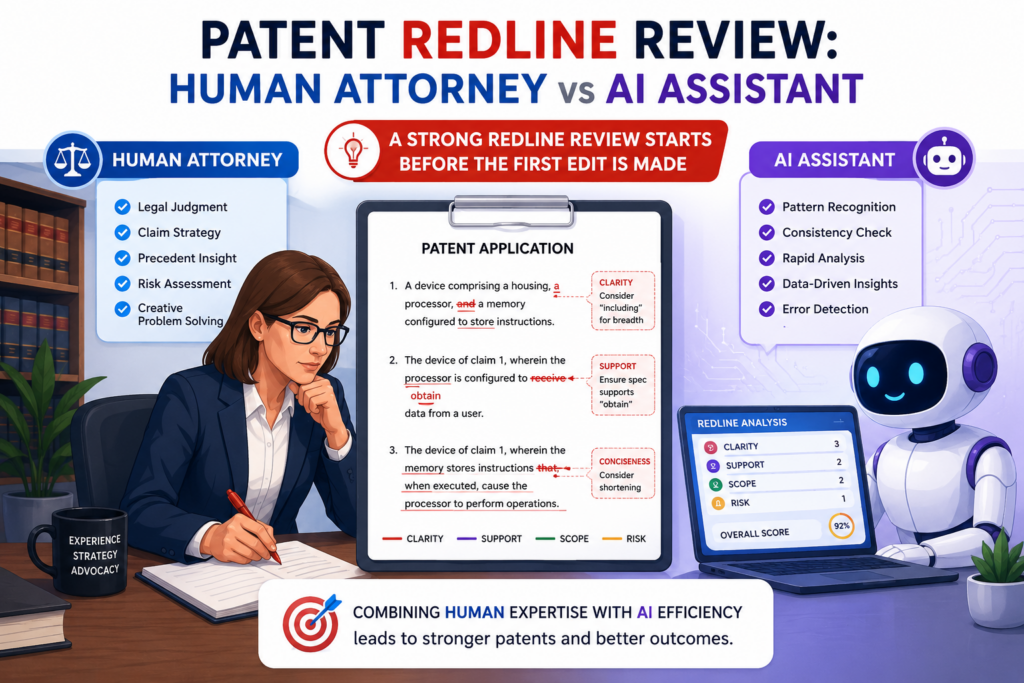
Without that shared view, the redline can become a word game. People start changing phrases, moving commas, and cleaning sentences, but no one is asking the harder question: does this edit help the patent protect the business?
This is where many startups lose time. The team sends a draft around. Someone comments on wording. Someone else asks if the claims are too broad. An engineer says a term is not quite right.
A founder worries the draft sounds too narrow. Then the attorney has to untangle all of it. The review slows down because the team is reacting to the draft instead of guiding it.
The better way is to set the goal first. Before touching the redline, the team should know the core invention, the must-have features, the optional features, the likely future versions, and the parts a competitor may try to copy.
This does not need to be a long memo. It can be a clear set of notes. But it must exist in some form, because it gives the review a target.
When that target is clear, both the attorney and the AI assistant become more useful. The attorney can make sharper judgment calls. The AI can flag issues with better context.
The founder can review changes with more confidence. The whole process becomes less messy because the team is not guessing what the patent is supposed to do.
The review should focus on the invention, not the current product alone
A common mistake is to review the patent as if it only needs to match the current product. That feels natural because the current product is what the team knows best.
It has real code, real screens, real parts, and real users. But a patent should often protect more than the first version.
This matters a lot during redline review. If every edit ties the patent to the exact product that exists today, the company may lose room later.
A startup may change the model, the workflow, the interface, the sensor, the database, the training method, or the deployment setup. If the patent only protects the first build, then the company may outgrow its own patent.
A human attorney can help keep the review balanced. The patent should not be so broad that it has no support. It should not be so narrow that it only protects one build.
The right review looks for the middle path. It protects the real idea while leaving room for product changes that are likely to happen.
An AI assistant can help here too, but only when it is used with care. It can compare the draft against product notes and find places where the claim seems tied to one version.
It can spot words that may be too specific. It can help the team ask better questions. But the final call still needs human judgment, because claim scope is not just a writing choice. It is a business choice.
The best question is not whether the edit sounds good, but whether it keeps the moat strong
Every redline change should face one simple test: does this help the moat?
That question keeps the review grounded. It stops the team from chasing pretty words. It stops the review from turning into a style debate. It forces everyone to look at the real purpose of the patent.
For example, an edit may replace a broad term with a more exact term. That may be helpful if the broad term is unclear. But it may be harmful if the exact term cuts out future versions.
Another edit may add steps to make a claim easier to follow. That may help if the claim needed structure. But it may hurt if those added steps make it easier for others to avoid the patent.
Founders should learn to ask this question during review. They do not need to know every patent rule. They do not need to argue over legal wording. They only need to stay close to the business value.
When a change appears, the founder can ask whether it still covers the core system, whether it still covers the likely next version, and whether it still blocks the most likely copycat move.
This is also why PowerPatent is built for modern teams. The point is not to make founders manage legal work alone.
The point is to give them a smarter process where software helps with speed and structure, while real patent attorneys help with judgment and protection.
That gives founders more control without turning patents into a slow side project. You can see the process here: https://powerpatent.com/how-it-works
The human attorney is strongest when the redline changes claim meaning
The claims are the heart of the patent. They define what the patent is trying to protect. This is why claim redlines deserve the most care. A change in the description may matter.
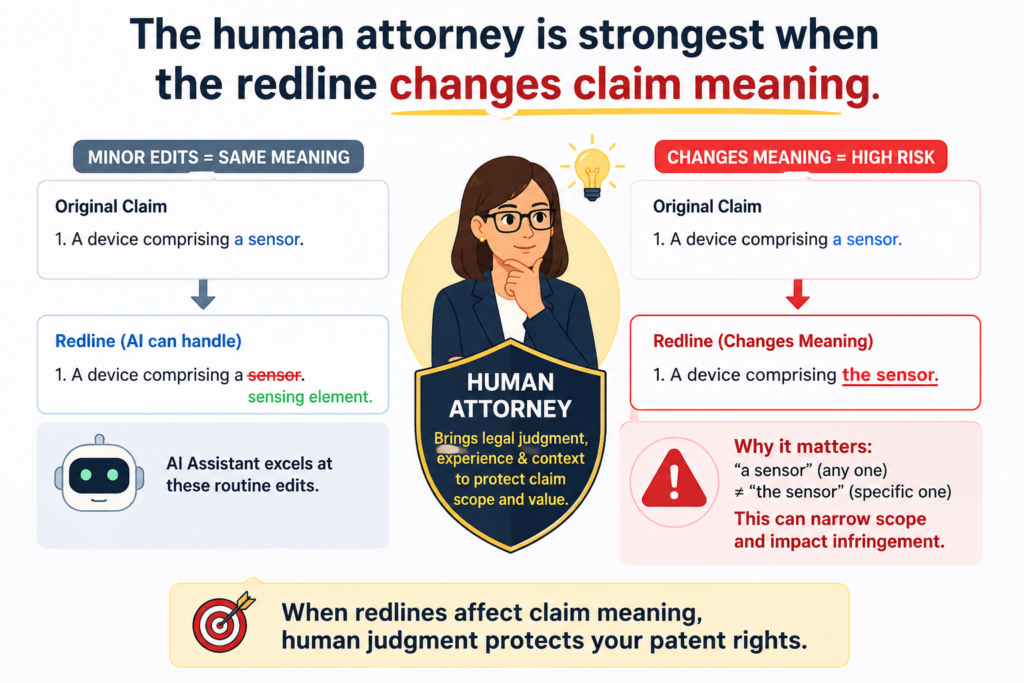
A change in a drawing label may matter. But a change in the claims can change the real edge of the patent.
This is where a human attorney is often most valuable. Claims are not normal sentences. They are built to define a boundary. If the boundary is too small, the patent may not help much.
If the boundary is too loose, it may be challenged. If the boundary uses the wrong words, it may miss the real invention.
A good attorney looks at the claim language and asks how it may be read later by a patent office, a competitor, an investor, or a court.
An AI assistant can help find claim changes. It can summarize them. It can explain that one term was added, removed, or replaced. It can show how a change flows through the rest of the draft.
This is useful. But it does not replace the attorney’s role in deciding whether the change is safe, needed, or smart.
For founders, the key is to treat claim redlines as high-signal moments. When the redline touches a claim, slow down.
Ask what changed. Ask why it changed. Ask what the company gains and what it gives up. That small pause can prevent big regret later.
Claim redlines can make protection stronger or smaller in ways that are hard to see
A claim redline may look simple on the page. A few words are added. A phrase is moved. A term is swapped. But the effect can be much larger than it looks.
Take a software invention. The first claim may describe a system that receives data, applies a model, and generates a control output.
During review, someone may add that the data comes from a “mobile device.” That may match the current product.
But if the invention could also work with a server, wearable, camera, sensor, robot, or industrial machine, the claim may now be smaller than it needs to be.
The edit may be correct in one sense and harmful in another. It may make the claim easier to support with the current example, but it may also remove other useful coverage.
That is exactly the kind of tradeoff a human attorney should review with the founder.
The same issue appears in AI patents. A claim may start with “training a model using input data.” A redline may change that to “training a neural network using labeled image data.”
If the real invention is about a wider training method, that edit may be too narrow.
If the patent only has support for labeled image data, the edit may be needed. The point is not that narrow words are always bad. The point is that they must be chosen on purpose.
Founders should never approve claim edits they do not understand
A founder should not accept a claim redline just because it came from a smart person or a smart tool.
This does not mean the founder needs to become a patent lawyer. It means the founder should ask for plain English.
A good review process should make claim changes easy enough to understand. If an edit narrows the claim, the founder should know that. If an edit makes the claim clearer, the founder should know that.
If an edit adds support for patent office review, the founder should know that too. The founder should be able to see the reason behind the change.
This is one place where AI can help a lot. It can create plain-word summaries of claim changes. It can show which words were added and what those words may do.
It can help the founder prepare questions for the attorney. But the attorney should still confirm the legal effect and make the final call.
The best workflow is simple. Let AI make the review easier to follow. Let the attorney explain the legal and business impact.
Let the founder confirm the technical truth. When those three parts work together, the redline becomes much stronger.
PowerPatent helps founders work this way by combining smart tools with real attorney oversight. That means you do not have to choose between moving fast and being careful.
You can keep the process clear, keep the review focused, and avoid guessing your way through high-stakes edits. See how PowerPatent works here: https://powerpatent.com/how-it-works
The AI assistant is strongest when the redline needs speed, structure, and clean comparison
AI shines when the review has many moving parts. Patent drafts can be long. Redlines can be dense. The same idea may appear in the claims, summary, drawings, examples, and technical description.
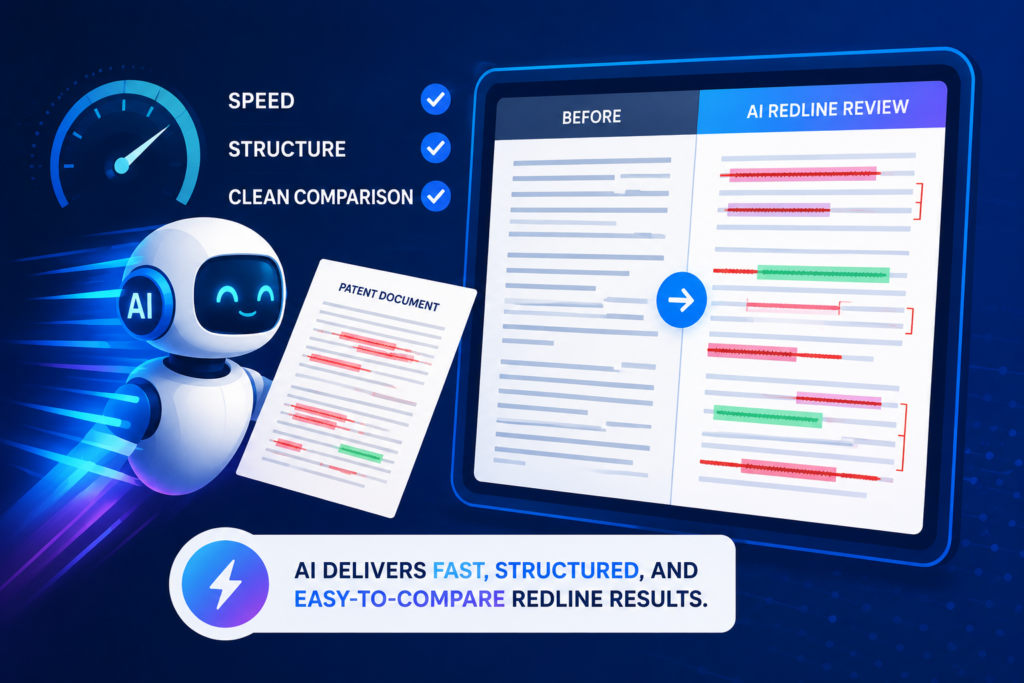
A small term change in one place may need to be checked across the whole draft. Doing that by hand takes time. It is also easy to miss something.
This is where an AI assistant can be a real force multiplier. It can help compare versions, find uneven terms, explain edits, and point out places that need review.
It can turn a messy redline into a clearer map. For busy founders and engineers, that can make the patent process feel less painful.
But the AI assistant works best when its role is clear. It is not the final judge. It is not the person responsible for legal strategy.
It is not a replacement for a patent attorney. It is a review helper. Used that way, it can save time without creating false confidence.
The best AI use is not “write my patent and tell me it is fine.” The best use is “help me see what changed, where the draft may be unclear, and what I should ask my attorney.” That is a much safer and more useful role.
AI can make the redline easier for technical teams to review
Engineers are used to reviewing code. They know how to look for logic, edge cases, and system behavior. Patent drafts are different. The language can feel slow and strange.
The same feature may be described in a way that sounds unlike the product. That gap can make engineers tune out, even though their input is vital.
An AI assistant can help close that gap. It can explain patent edits in product terms. It can show how a claim maps to a workflow.
It can identify where the draft may not match the technical design. It can help engineers focus on the parts where their input matters most.
For example, the AI can help answer whether a step in a claim is always required or only used in one mode. It can find where the draft says a module performs an action that is actually done by another service.
It can point out when the same data object is called by different names. These may sound like small issues, but they can matter a lot.
When engineers can review faster, the patent gets better. The attorney gets better facts. The founder gets fewer surprises. The final draft is more likely to match the real invention.
AI can reduce busywork so the attorney can spend more time on judgment
Patent attorneys should not spend their best time hunting for repeated terms, checking every instance of a phrase, or summarizing basic redline changes by hand.
Those tasks matter, but they are not the highest use of attorney judgment. AI can help with that first layer so the attorney can focus on the parts that require legal skill.
This does not make the attorney less important. It makes the attorney more focused.
The human reviewer can spend more time on claim scope, prior art risk, fallback positions, support, and business fit. Those are the areas where judgment matters most.
This is also better for founders. No founder wants to pay for slow process waste.
They want strong protection, clear answers, and forward motion. When software handles more of the structure and comparison work, the whole review can move with less drag.
Still, the team must be careful. AI can miss context. It can make a weak suggestion sound strong. It can over-smooth language.
It can suggest changes that are not right for patent claims. That is why AI output should be reviewed, not blindly accepted.
The winning setup is not human attorney versus AI assistant. It is human attorney plus AI assistant, with the founder still close to the technical truth.
That model gives you speed, clarity, and real oversight. It helps you act fast without treating your patent like a shortcut.
That is the idea behind PowerPatent. Founders should not have to choose between old-school delays and risky do-it-yourself tools. They should be able to use smart software, stay in control, and still get real patent attorney review when it counts.
Learn how PowerPatent helps modern startups protect what they are building here: https://powerpatent.com/how-it-works
A redline review should protect future versions, not just today’s build
Most startups file patents while the product is still changing. The first version may be live, but the best version is still ahead. The model may improve. The workflow may shift.
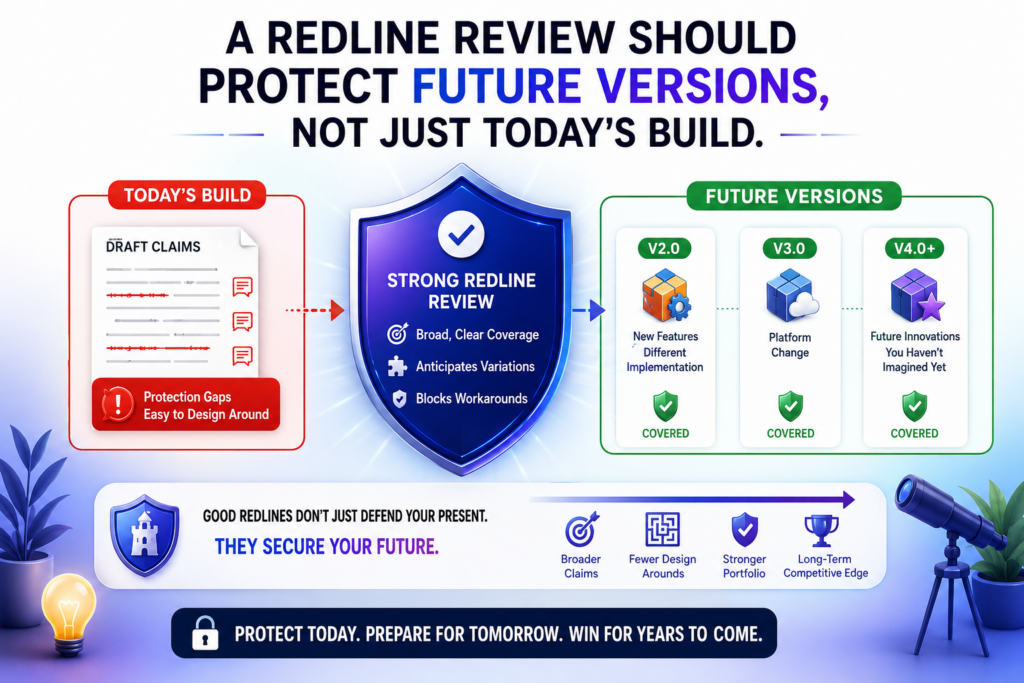
The system may move from one market to another. The data source may change. The hardware may get smaller.
The software may become more automated. This is why a patent redline review should not only ask, “Does this match what we built?” It should also ask, “Will this still matter when the product grows?”
That is one of the biggest gaps between a simple AI review and a full attorney-led review. AI can help compare the draft to your current notes. It can find mismatched terms.
It can point out when a claim does not match the product description. But it may not know which future paths matter most to the company.
A human attorney can help think through that future and avoid edits that trap the patent inside version one.
Founders should care about this because patents are long-term assets. The patent you file now may be used years later, when the company is bigger, the product is stronger, and the market has shifted.
If the redline review only protects the first demo, the patent may not carry enough weight later.
The current product is evidence, but the invention may be bigger
Your product is real proof that the invention works. It gives the patent draft a strong base. But the product is not always the full invention.
Many strong inventions are bigger than the first product screen, first model, first device, or first workflow.
For example, a startup may build a tool that reads support tickets and routes them to the right team. The first version may work only with email tickets.
During redline review, someone may add “email message” throughout the claims because that is what the product uses today.
That may sound accurate. But if the same invention can work with chat logs, voice transcripts, app reviews, or internal bug reports, that wording may be too tight.
A human attorney can help spot that issue. The attorney may ask whether “message,” “request,” or “user input” is a better term than “email message.”
The AI assistant can then help check whether the chosen term is used with care across the draft. The founder can confirm what the system can really support. That is how the review gets stronger.
This same pattern applies to AI systems, robotics, biotech tools, chips, clean energy systems, and medical devices.
The product may show one version. The patent may need to protect the deeper method, structure, or flow behind that version.
The redline should leave room for smart growth
A strong redline does not try to claim everything in the world. That is not useful. It also does not shrink the patent until it only covers one narrow setup. The right path is to protect the real invention in a way that leaves room for normal growth.
This means each edit should be checked against likely product changes. Will the system support new data types? Will it run on different devices? Will the model change?
Will the same method be used in another market? Will the hardware use a different sensor? Will the software move from cloud to edge, or from edge to cloud?
These questions should not slow the process down. They should make the review sharper. When founders answer them early, the attorney can make better edits.
The AI assistant can help test the draft for narrow terms. The final patent can become more useful because it is not tied too tightly to today’s build.
This is where PowerPatent gives founders a better path. You get software that helps speed up review, plus real attorney oversight to help protect the bigger picture.
That means you can move fast without giving up the care that strong patents need. See how it works here: https://powerpatent.com/how-it-works
A human attorney can read between the lines of the redline
A patent redline shows changes on the page, but the real meaning often sits between the lines. A word may be removed because it is risky. A phrase may be added because the patent office may ask for more support.
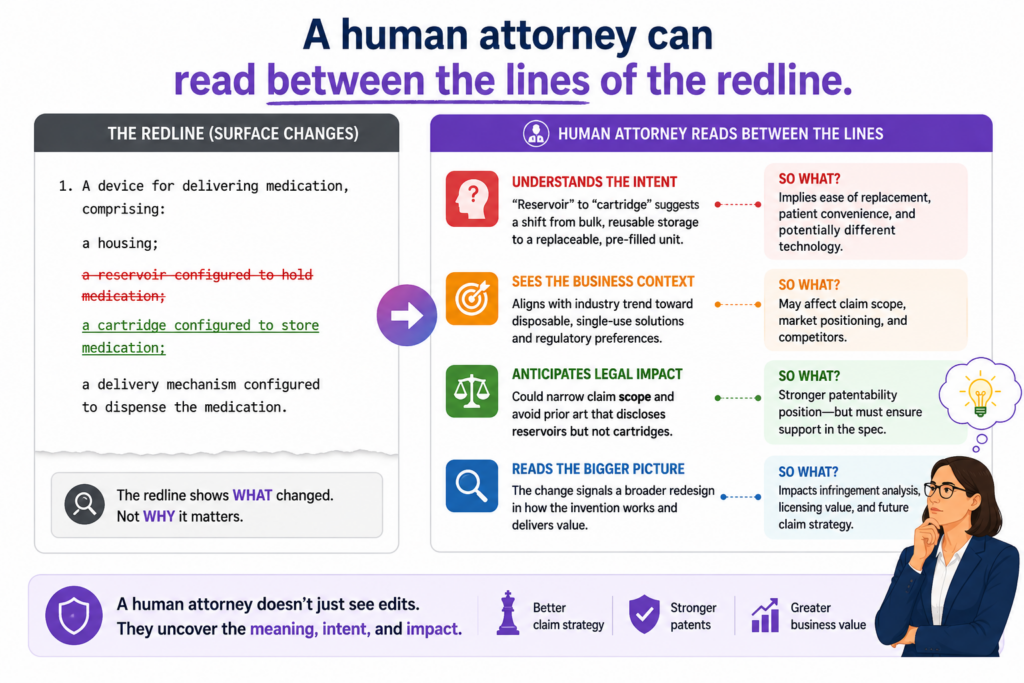
A claim may be narrowed because of known prior work. A sentence may be moved because it supports a later claim. These changes may not be obvious to a founder at first glance.
This is where a human attorney adds value that is hard to copy. The attorney can see why a change matters. They can explain what problem the edit is trying to solve.
They can also tell when an edit creates a new problem. A good attorney does not just say, “Accept this change.” They help the founder understand the tradeoff.
That tradeoff is the heart of redline review. Patents are full of tradeoffs. Broad language may give more room, but it may need stronger support. Narrow language may be easier to defend, but it may leave gaps.
More detail may help explain the invention, but too much detail in the wrong place may limit the claim. A human reviewer can balance these points in a way that pure text review cannot.
The attorney can connect patent wording to real-world conflict
A patent is not only written for the patent office. It is also written for the real world. It may be read by investors, partners, buyers, competitors, and future legal teams. It may be tested during diligence.
It may matter during a deal. It may become part of a larger patent family. That means the wording must be clear, useful, and tied to the company’s edge.
An AI assistant can help make the draft easier to read. It can help explain the redline. It can help compare terms. But it may not understand how a competitor may try to design around the claim.
It may not know which part of the market is most likely to copy the product. It may not know what investors will look for during a funding round.
A human attorney can bring that wider view. They may ask what feature a competitor would copy if they wanted the same result. They may ask which claim terms are too easy to avoid.
They may ask whether the redline protects the system as used by a customer, the backend process, the device, the trained model, the data flow, or the full platform.
Those questions turn the redline into a business tool. The review becomes less about words and more about leverage.
The best attorney review makes hard choices clear
Founders do not need vague advice. They need clear choices. A strong attorney review should explain when a change is low risk, when it narrows the claim, when it adds support, when it fixes a problem, and when it needs founder input.
For example, the attorney may say that adding a sensor type makes the claim easier to support, but may reduce coverage if future devices use other sensors. That is a clear tradeoff.
The founder can then decide whether the product roadmap makes that limit acceptable. The AI assistant can help check where that sensor term appears in the full draft. Everyone works from the same facts.
This is much better than a review where edits are accepted without discussion. Silent acceptance may feel fast, but it can hide risk. The founder may not realize the patent became narrower.
The engineer may not realize a key feature was described in the wrong way. The attorney may not get the product context needed to make the best call.
PowerPatent helps avoid that old pattern by making the patent process more transparent and founder-friendly. The goal is not to bury you in legal language.
The goal is to help you understand what matters, move with speed, and still get real attorney oversight on the choices that can shape your patent value. Learn more here: https://powerpatent.com/how-it-works
An AI assistant can help founders ask better questions during review
One of the best uses of AI in patent redline review is not replacing the attorney. It is helping the founder show up better prepared.
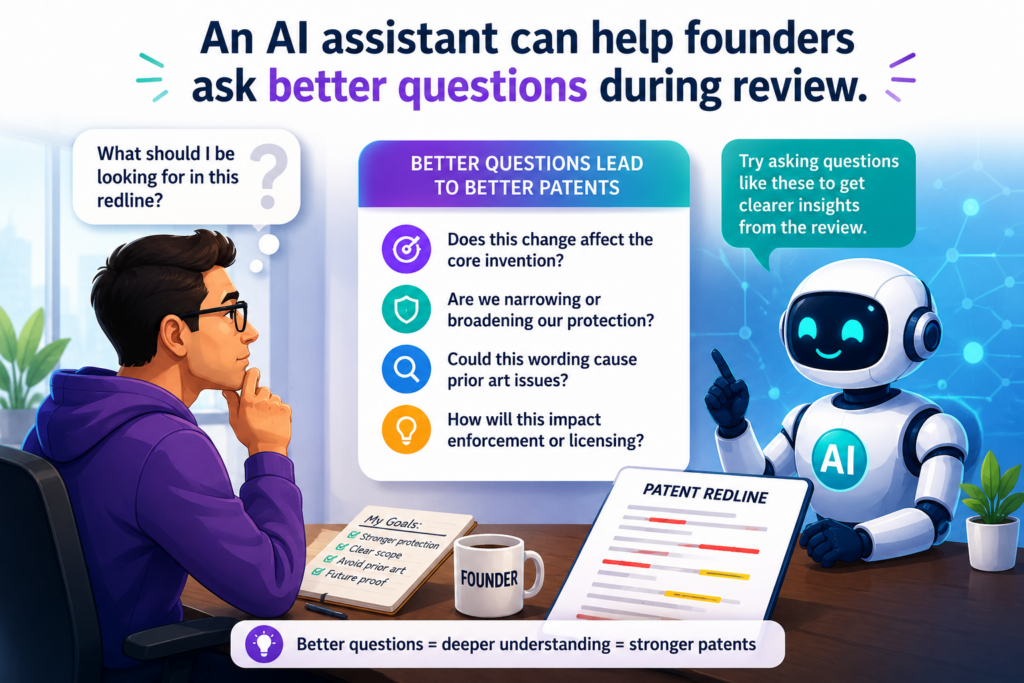
A founder does not need to read a patent like a lawyer. But a founder should be able to understand the main changes, spot places that affect the product, and ask sharp questions before the draft is filed.
This matters because founders often know the invention better than anyone else. They know which part was hard to build. They know which part customers care about.
They know which part the team may change later. They know which feature gives the startup a real edge. But if the redline is hard to read, that knowledge may never make it into the final review.
AI can help translate the redline into plain language. It can summarize what changed in the claims. It can show where new limits were added. It can flag terms that may be too narrow.
It can help prepare a simple review note for the attorney. This gives the founder more control without forcing them to become a patent expert.
Better questions lead to better patents
A redline review gets stronger when the founder asks the right questions. Not more questions. Better questions.
Instead of asking, “Is this okay?” the founder can ask, “Does this change make the claim narrower?” Instead of asking, “Does this sound right?” the founder can ask, “Does this still cover the version we plan to build next year?” Instead of asking, “Can we file now?” the founder can ask, “Are we protecting the part a competitor would copy first?”
AI can help generate those questions from the redline. It can look at the edits and turn them into plain prompts. It can point out where a term was changed from broad to specific.
It can identify where a feature was added to a claim but only shown in one example. It can help the founder walk into the attorney review with sharper focus.
This makes the attorney’s work better too. A patent attorney can give stronger advice when the founder brings clear product context. The review becomes a real working session, not a guessing game.
AI should help you understand the redline, not make you blindly trust it
There is one danger founders should avoid. Do not use AI to create false comfort. A clean summary is not the same as a correct legal review.
A confident answer is not the same as attorney judgment. A smooth rewrite is not the same as a stronger patent.
The safest use of AI is to make the redline easier to understand. It should help you see what changed. It should help you prepare notes.
It should help you ask your attorney better questions. It should not be the final voice on what to file.
For example, an AI assistant may say a claim edit “improves clarity.” That may be true. But the same edit may also narrow the claim in a way that matters. The attorney needs to review that tradeoff.
The founder needs to confirm whether the narrower wording still fits the product roadmap. The AI can support the process, but it should not close the loop alone.
This is why PowerPatent’s approach is so useful for startups. It brings together smart software and real patent attorneys, so founders can move quickly while still getting human review where it matters.
You do not have to pick between speed and care. You can have both in one clearer process. See how PowerPatent helps founders protect what they are building here: https://powerpatent.com/how-it-works
The safest review uses AI for speed and a human attorney for final judgment
The smartest patent redline review is not a fight between a human attorney and an AI assistant. It is a team process. Each side has a job. The AI assistant helps the work move faster.
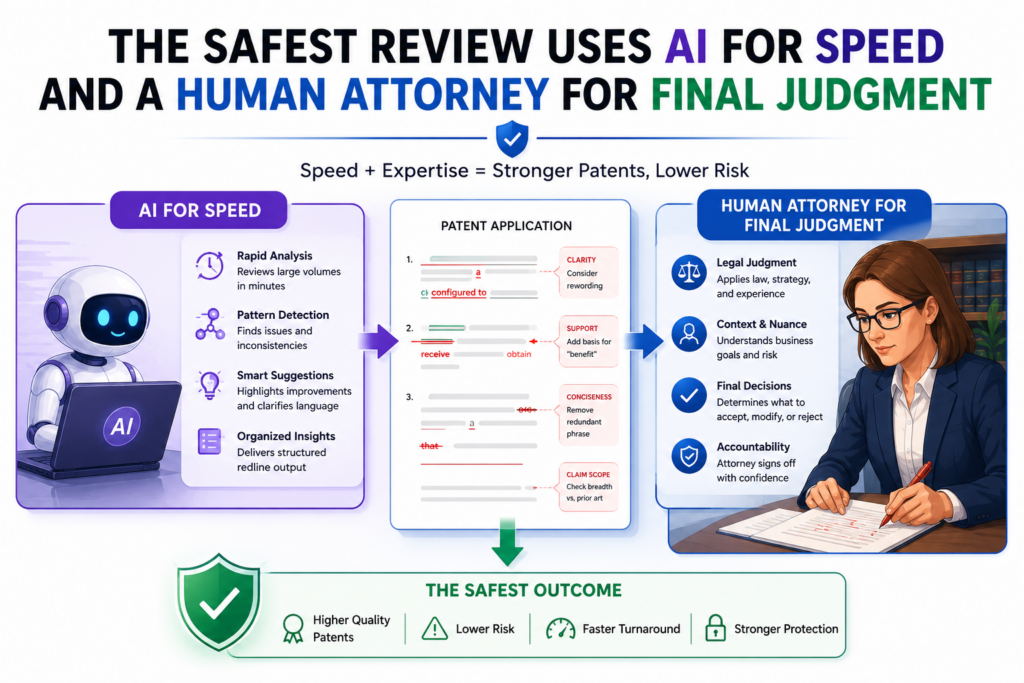
The human attorney helps make sure the work is sound. The founder brings the truth about the product, the roadmap, and the market edge. When those three parts work together, the review becomes stronger, faster, and much easier to trust.
This matters because patents are not just documents. They are business tools. A patent may help during fundraising.
It may support a deal. It may stop a copycat. It may raise the value of the company. It may help show that the startup owns something real. That is why the final review should not be left to speed alone.
AI can read fast, compare drafts, explain edits, and find basic gaps. That is powerful. But a patent redline review also needs judgment. It needs someone to ask whether the claim is still broad enough.
It needs someone to ask whether the draft has enough support. It needs someone to see when a clean edit creates a hidden limit. That is where a human patent attorney matters.
The best workflow gives each reviewer a clear role
A strong workflow starts by letting the AI assistant handle the heavy reading. It can summarize the redline. It can point out which claims changed.
It can flag terms that were added or removed. It can show where a feature appears in the claims but is weak in the description. This gives the team a faster way to see the shape of the review.
Then the founder checks the technical truth. This is the step many teams skip, but it is very important. The founder or engineer should ask whether the draft still matches how the invention works.
They should check whether the terms match the product. They should look for places where the draft sounds too tied to the current build. They should make sure the patent is not missing the part that was hardest to create.
After that, the attorney reviews the legal and business effect. This is where the human judgment comes in.
The attorney can decide whether an edit is needed, whether a claim is too broad, whether a term is too narrow, whether more support is needed, and whether the patent is ready to file.
The attorney can also explain the tradeoffs in plain language so the founder can make better choices.
This workflow is calm and clear. It does not ask AI to be a lawyer. It does not make the attorney waste time on basic cleanup. It does not leave the founder in the dark. It gives each person and tool the right job.
A smart process should make the founder feel in control, not overwhelmed
A patent process should not make a founder feel lost. It should not bury the team in long comments and strange phrases.
It should not force engineers to guess what a redline means. The process should help the founder understand what changed, why it changed, and what to do next.
That is one reason PowerPatent was built for modern startup teams. Founders need speed, but they also need real review.
They need smart tools, but they also need real attorneys. They need a process that respects how fast startups move while still protecting the work with care.
When AI and attorneys are used together, the founder gets a better experience. The review becomes easier to follow. The key decisions become clearer.
The draft improves faster. The risk of blind edits goes down. The team can move toward filing with more confidence.
This is the right way to think about patent redline review. Use AI to make the process faster and clearer. Use a human attorney to make the final judgment. Use founder input to keep the patent tied to the real invention.
That mix can help your startup avoid slow, old-school patent work while also avoiding risky shortcuts. You can see how PowerPatent brings this together here: https://powerpatent.com/how-it-works
A weak redline review often hides the real cost until later
A poor patent redline review may not hurt right away. That is what makes it dangerous. The draft may look clean. The comments may be resolved. The document may be filed on time.
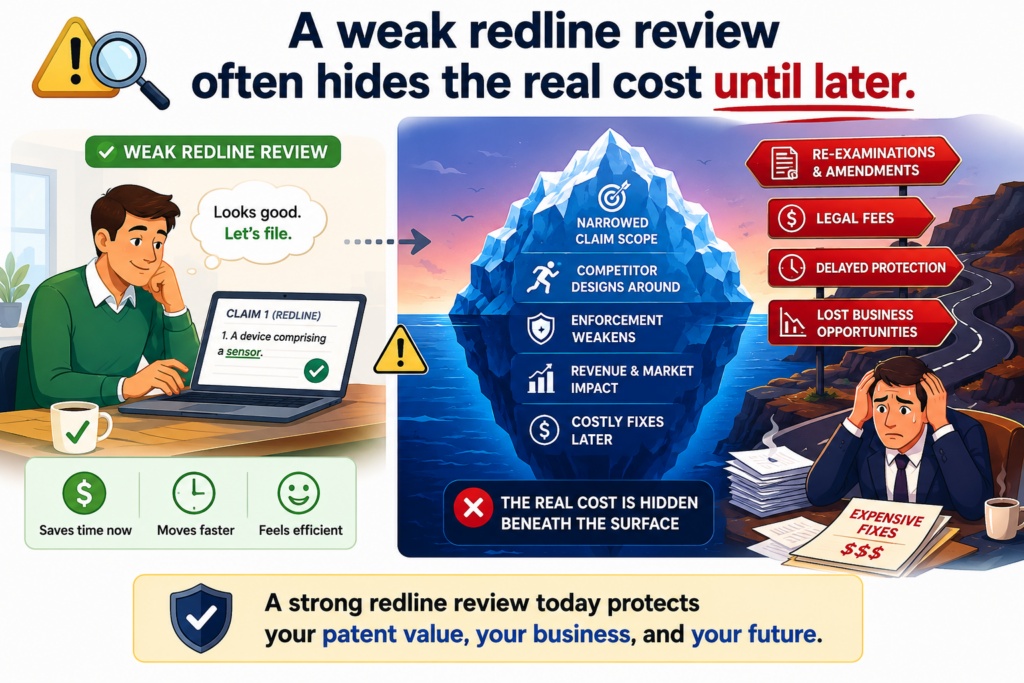
Everyone may feel relieved. But months or years later, the startup may learn that the patent missed the key point, used narrow words, lacked support, or failed to match the real product.
That late cost can be painful. It may appear during investor review. It may appear when a buyer studies the company. It may appear when a competitor launches something similar.
It may appear when the team tries to file a follow-on patent and finds that the first draft did not leave enough room. The mistake may have started as one small redline edit that no one questioned.
This is why founders should treat redline review as a high-value step, not a formality. The point is not to slow things down.
The point is to prevent small changes from becoming large problems. A careful review now can save time, money, and stress later.
The most expensive mistakes are often simple wording mistakes
Patent mistakes do not always look dramatic. Many are simple wording choices. A claim may use a term that is too narrow. A feature may be described as required when it should be optional.
A method may be tied to one data source when it could apply to many. A device may be limited to one type of sensor when the invention is broader.
A model may be described as one architecture when the key idea is the training method, the input flow, or the output control.
These mistakes can happen when the redline is reviewed too quickly. They can also happen when the reviewer focuses only on grammar or style.
In patent work, better wording is not just smoother wording. Better wording protects the invention with care.
AI can help find some of these issues. It can detect repeated narrow terms. It can compare claim language with the rest of the draft. It can warn when one section uses a different name for the same part.
These checks are useful. But the AI may not know whether the narrow term is needed or harmful. That is where the attorney and founder need to work together.
The founder knows what the product may become. The attorney knows how the wording may affect the patent. The AI helps both sides see the draft more clearly. That is a much safer review than blindly accepting changes.
The redline should be checked against the company’s next big move
A good review does not only ask whether the patent is ready for filing. It asks whether the patent supports the company’s next move.
That move may be a seed round, a Series A, a product launch, a partnership, a pilot with a large customer, or a sale of the company. The patent should help the business story.
If the startup is raising money, the patent should make the technical edge easier to see. If the startup is entering a market with large incumbents, the patent should focus on what those players may try to copy.
If the startup is building a platform, the patent should avoid being trapped inside one feature. If the startup is building deep tech, the patent should explain the hard part in a way that can be defended.
This is not fluff. This is practical. Patents have more value when they match the business. A redline review is the right time to check that match.
PowerPatent helps founders do this without dragging the process into months of back and forth.
The platform is made to help technical teams move faster, organize invention details, and work with real patent attorneys who can review the key choices.
That means the startup can protect its work with more confidence and less confusion. See how PowerPatent helps here: https://powerpatent.com/how-it-works
The founder’s job is to bring product truth into the review
A founder does not need to know patent law to take part in a redline review. But the founder does need to bring product truth.
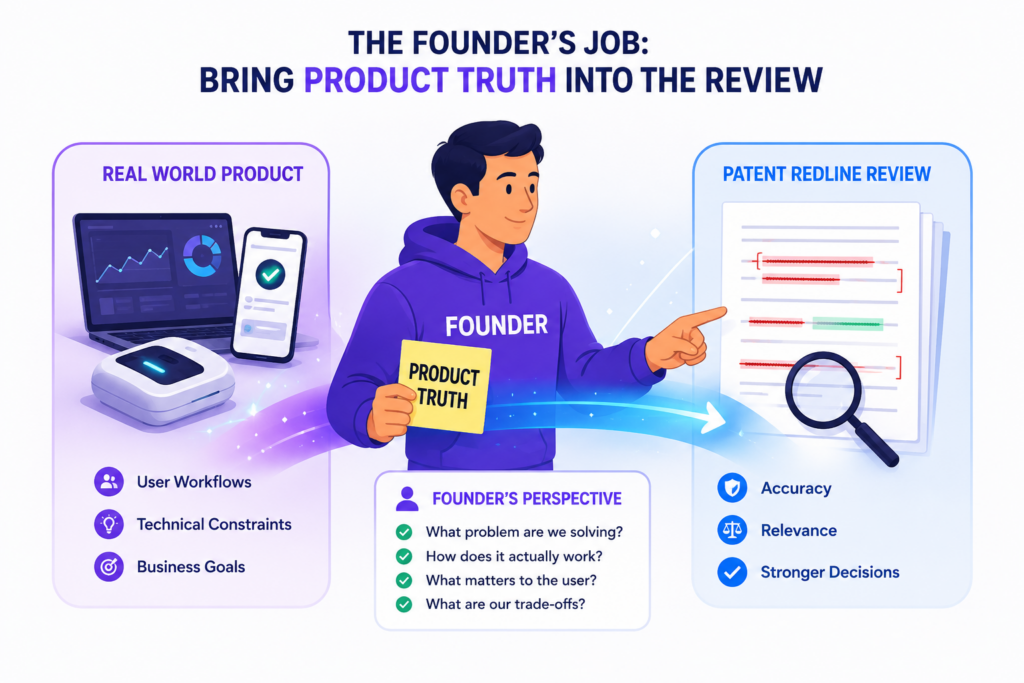
That means clear facts about what the invention does, why it matters, what parts are required, what parts may change, and what competitors would want to copy. No attorney or AI assistant can fully replace that knowledge.
This is especially true for technical founders. You may be close to the code, model, system, data flow, device, or research. You know what was hard. You know what did not work before.
You know what the team solved. That information can make the patent much stronger, but only if it enters the review process before filing.
Many founders hold back because patent language feels strange. They assume the attorney will handle everything. They may also assume the AI assistant can find the right answer from the draft alone.
That is risky. The best patents come from strong collaboration. The attorney brings legal skill. The AI brings speed and structure. The founder brings the invention’s real story.
The founder should review for truth, not legal polish
During redline review, the founder should not focus on making the patent sound fancy. That is not the job. The founder should read for truth. Does this describe how the system works? Does this include the main technical step?
Does this make a required feature sound optional, or an optional feature sound required? Does this use the right names? Does this leave out the part that made the invention hard?
These are simple questions, but they matter. A founder may notice that the draft says the model “classifies” data when it actually ranks, predicts, scores, or generates an action.
An engineer may notice that a claim says the client device performs a step when the server does it. A product lead may notice that the draft describes only one use case when the same invention works across several workflows.
Those comments can improve the patent more than style edits. They help the attorney make smarter choices.
They help the AI assistant check the right terms. They help the final draft match the real technology.
This is also where founders should speak up when a redline feels too narrow. If a change ties the claim to one version, one data type, one model, one sensor, or one interface, the founder should ask whether that limit is needed.
Sometimes it is needed. Sometimes it is not. The point is to make the choice on purpose.
The best review turns founder knowledge into stronger protection
A great redline review is not just a legal check. It is a translation process. It turns founder knowledge into patent language.
It turns engineering detail into business protection. It turns a rough invention story into a clearer asset.
This is why the founder should stay engaged, even when using AI and attorneys.
The founder does not need to control every word. The founder does need to make sure the patent protects the right thing. That is a powerful role.
The process can be simple. Read the claim changes in plain words. Check whether the draft still matches the invention. Mark any terms that feel too narrow or wrong.
Share future product paths with the attorney. Ask what each major change does to scope. Let AI help make the review easier, but let the attorney guide the final call.
That is the practical path. It keeps the founder in control without making patents feel like a second job. It also helps avoid the old trap where a startup files something it does not fully understand.
PowerPatent is built around this exact need. It helps founders turn technical work into strong patent filings with smart software and real attorney oversight.
You can move faster, stay closer to the process, and avoid the blind spots that come from doing everything the old way. Learn how it works here: https://powerpatent.com/how-it-works
Conclusion
A strong patent redline review should never force founders to choose between speed and care. AI can make edits easier to see, explain changes, and reduce slow work. A human attorney adds the judgment needed to protect claim scope, avoid narrow traps, and match the patent to the business.
The smartest path is both, used with clear roles. PowerPatent helps technical teams do that with smart software and real attorney oversight, so founders can protect hard work without losing momentum. See how it works here: https://powerpatent.com/how-it-works and move from draft to filing with more confidence and control starting today.