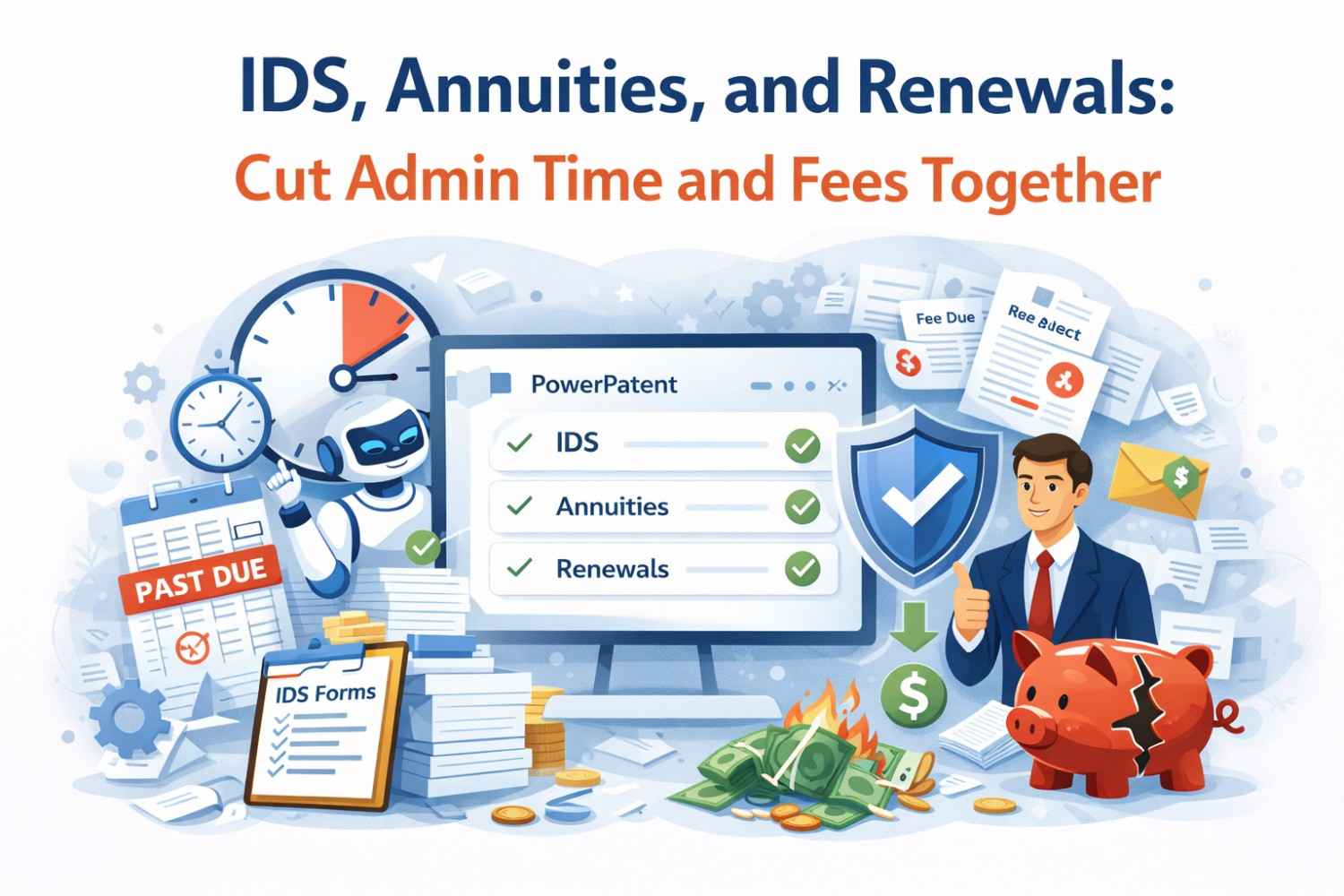
Every fast-moving startup hits the same wall at some point. You filed a patent. Then another. Then maybe three more. And suddenly you are buried in emails about IDS filings, annuity payments, renewal dates, deadlines, and government fees. None of it builds your product. None of it helps you ship faster. But if you miss something, it can hurt you in a very real way. This is where smart founders either lose time and money—or take control. In this guide, we are going to break down IDS, annuities, and renewals in plain English, show you how they quietly drain your focus and budget, and explain how to cut admin time and fees together without risking your protection. If you are building deep tech and want strong IP without the old-school chaos, this will matter to you.
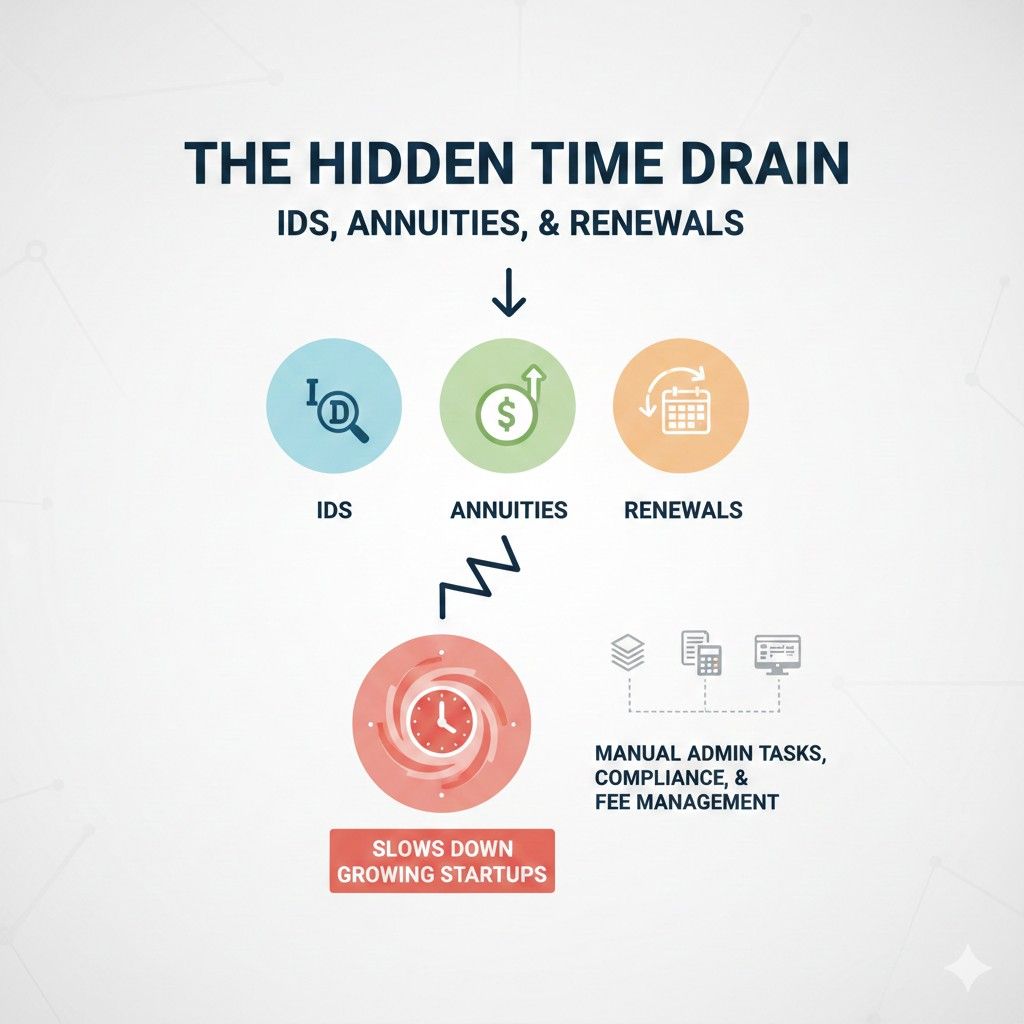
The Hidden Time Drain: Why IDS, Annuities, and Renewals Slow Down Growing Startups
Every startup begins with speed. You move fast, test fast, build fast. But patents move on a very different clock. They come with quiet tasks that sit in the background and slowly eat your time.
You don’t notice the drag at first. Then one day you realize your team is spending hours each month just keeping paperwork alive. IDS filings, annuity payments, and renewals do not look dangerous.
They look small. But small, repeated tasks add up fast. If you are not careful, they begin to slow your company down in ways you never planned for.
The Admin Creep That No One Plans For
Most founders plan for product work, hiring, fundraising, and customer growth. Almost no one plans for patent maintenance overhead. Yet once you file even a single patent, admin work begins.
And once you file in more than one country, that admin work multiplies.
IDS Work Does Not End After Filing
An Information Disclosure Statement, or IDS, sounds simple. You disclose prior art to the patent office. Done. That is what many founders think.
In reality, it rarely ends there. Every time new prior art appears in related applications, every time an examiner cites something new, every time you file a related patent, that information may need to be shared across cases.
If you have parallel filings in the U.S., Europe, and Asia, the information flow becomes even more complex.
What starts as a single filing turns into cross-referencing documents across multiple applications. If you miss a reference, it can create risk. So teams overcorrect.
They double-check everything. They forward long email threads. They ask attorneys to review the same documents again and again. Time disappears quietly.
A strategic move here is to create one central source of truth for all prior art across your portfolio. Instead of managing disclosures per application, manage them per invention family.
That shift alone can reduce duplicated review work. When your data lives in one place, updates can flow automatically instead of manually.
Annuities Sneak Up on You
Annuities feel harmless because they are predictable. You know you will owe maintenance fees at certain years. The problem is not the payment itself. The problem is the tracking.
As your portfolio grows, so do your deadlines. U.S. maintenance fees hit at 3.5, 7.5, and 11.5 years. Other countries have yearly payments. Some regions require local agents.
Currency exchange rates shift. Payment windows vary. Grace periods exist but come with penalties.
The real cost is not the government fee. It is the internal effort to track, confirm, approve, and document every payment.
Someone on your team must review invoices, confirm instructions, coordinate with finance, and verify that payments were processed correctly. That workflow repeats every year.
A smarter approach is to tie annuity decisions to business milestones, not just calendar reminders. Before each payment window opens, decide if the patent still supports your product roadmap or defensive strategy.
Make that decision early, then automate the payment path. When your portfolio decisions are proactive instead of reactive, you remove last-minute scrambling.
Renewals Create Decision Fatigue
Renewals look like routine maintenance. In practice, they create mental load. Each time a deadline approaches, you must ask: Is this patent still valuable? Should we keep it? Does it align with our product direction?
Are we entering this market?
If your company is growing quickly, those answers change often. Without a clear review system, each renewal becomes a fresh debate. That burns leadership time.
Decision fatigue is real. Founders already make hundreds of choices every week. Adding repetitive patent decisions on top of that drains energy that should be focused on customers and product.
You can cut this burden by mapping each patent to a clear business purpose when it is first filed. Is it protecting core technology? Blocking competitors? Supporting fundraising?
Entering a specific country? If that purpose is documented from day one, renewal decisions become faster. You compare the patent’s original goal to your current strategy.
If it still fits, you renew. If not, you let it go. No emotional debate needed.
The Real Cost Is Context Switching
The biggest hidden drain is not the fees. It is context switching.
Your engineering lead might be deep in code. Suddenly they need to review a prior art reference for an IDS update. Your COO may be negotiating a partnership deal.
Then an annuity invoice requires approval. Your founder might be preparing for a pitch. Then a renewal deadline email pops up.
Each interruption breaks focus. Studies show it takes time to return to deep work after a disruption. Multiply that by every patent-related email across the year, and the lost productivity becomes meaningful.
One strategic fix is to batch all IP admin work into scheduled review windows. Instead of reacting to every message as it comes, designate one monthly or quarterly session to review disclosures, deadlines, and payments.
That protects your team’s deep work time. It also creates a rhythm that reduces stress.
Email Chaos Multiplies Risk
Many startups manage patent admin through scattered email threads. An attorney sends an update. A founder replies. A paralegal forwards a reminder. Finance is copied later. Over time, important information lives across dozens of inboxes.
This setup creates two risks. First, deadlines can be missed if someone assumes another person handled it. Second, you lose visibility. When you cannot see your full portfolio status in one dashboard, you operate on guesswork.

The solution is not hiring more people to monitor inboxes. It is building or using a system where every deadline, filing, and payment is visible in real time. When visibility improves, stress drops. And when stress drops, decisions improve.
International Filings Multiply Complexity
If you are a deep tech startup, you may file internationally early. That is often smart. But every country has different rules. Different fee schedules. Different notice formats.
Some offices send paper mail. Others use online portals. Time zones differ.
What feels manageable with one or two filings becomes overwhelming at scale. You start relying heavily on outside counsel just to track dates. That means more emails, more invoices, and more admin overhead.
A powerful shift here is to centralize international coordination under one unified workflow. Instead of treating each country as a separate mini project, manage them as branches of the same core invention strategy.
This reduces duplication and keeps your team aligned around the bigger picture.
Manual Tracking Increases Human Error
Spreadsheets are common in early-stage startups. You might track patent deadlines in a shared sheet. At first, it works. But as filings grow, manual entry becomes risky.
One missed update can lead to late fees or lost rights. Even if you never miss a deadline, the mental pressure of worrying about it slows your team down.
Automation is not about being fancy. It is about reducing risk. When reminders, document updates, and payment confirmations are automated, your margin for error shrinks.
That frees your brain to focus on growth instead of fear.
Legal Bills Grow With Every Extra Touch
Every time you ask outside counsel to confirm a reference, review a filing, or process a payment, you incur fees. Some of these tasks are necessary. Many are process-driven rather than strategy-driven.
If your system is disorganized, attorneys spend time sorting, clarifying, and reconfirming details that should already be structured. That time shows up on invoices.
One practical move is to separate strategic legal advice from routine administrative tasks. Strategic advice should always involve experienced attorneys.
But routine tracking and document management can be streamlined with smart software that reduces back-and-forth.
Growth Makes the Problem Bigger
The more successful you become, the more patents you file. The more patents you file, the more IDS updates, annuity payments, and renewals you manage. The problem scales with your success.
This is why many founders feel fine early on, then suddenly overwhelmed two or three years later. It is not that patents are bad. It is that the system around them was not designed for growth.
The smartest move is to build infrastructure early. Even if your portfolio is small, set up processes that can handle ten times the volume. When growth comes, you will not feel buried.
The hidden time drain is real. It does not scream for attention. It quietly pulls hours from your week and dollars from your budget. But with the right systems, clear decision frameworks, and centralized visibility, you can remove much of that drag.

When patents support your growth instead of slowing it, they become a true asset rather than a background stressor.
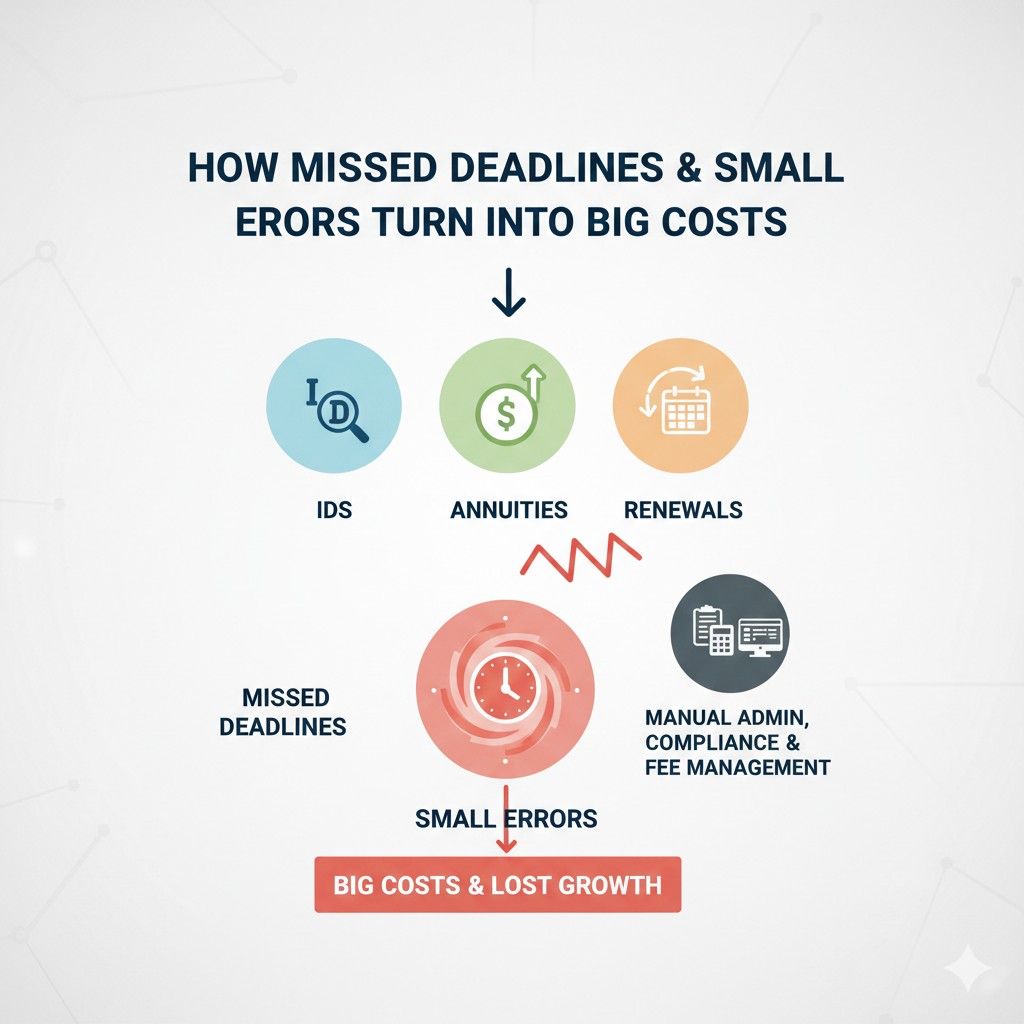
How Missed Deadlines and Small Errors Turn Into Big Costs
Deadlines in the patent world do not look dramatic. They arrive quietly. An email reminder. A calendar alert. A notice from a foreign agent. Most of them feel routine. But when one slips, the impact can be far bigger than the task itself.
In fast-growing startups, small errors rarely come from carelessness. They come from overload. When your team is stretched, even simple admin tasks can fall through the cracks.
And in patent management, small cracks can widen quickly.
Let’s walk through how that happens, and more importantly, how to prevent it.
The Domino Effect of a Missed IDS Update
An IDS filing may seem minor. You are simply telling the patent office about prior art that could be relevant. But timing matters. If a reference should have been disclosed and was not, you may face complications later.
At best, you may need to file corrective papers. That costs attorney time. At worst, the strength of your patent can be questioned in future enforcement or due diligence.
The issue often starts small. A search report comes in from a related case. It sits in someone’s inbox. The team assumes it has already been shared. Weeks pass.
Then an office action arrives, and everyone scrambles to confirm whether the disclosure was handled correctly.
That scramble costs money. It also creates risk.
The way to stop this is not through fear. It is through structure. Every new piece of cited art should enter one central system the same day it is received. Not next week. Not after review. Immediately.
Once logged, the system should flag related applications automatically. This removes guesswork.
When IDS handling is structured and visible, it stops being a source of anxiety.
Grace Periods Are Not Safety Nets
Many patent offices offer grace periods for late payments. On paper, this sounds reassuring. In reality, it is expensive.
Late annuity payments often come with penalties. Sometimes significant ones. In certain jurisdictions, reinstatement after lapse can require additional filings, declarations, or legal explanations.
Each added step increases attorney fees and administrative time.
More importantly, relying on grace periods builds bad habits. When teams assume there is always extra time, urgency fades. Over time, this increases the chance of a serious lapse.
The better approach is simple. Treat official deadlines as absolute. Set internal deadlines weeks earlier. Approve payments in advance. Confirm completion in writing within your system.
This habit alone can eliminate late fees across an entire portfolio.
Renewal Decisions Made Under Pressure
When a renewal notice arrives close to its deadline, teams often make rushed decisions. There is little time to evaluate market position, competitor activity, or product alignment. So the default choice is to renew.
This default behavior increases long-term cost. You end up maintaining patents that no longer support your strategy. Not because they are valuable, but because the decision was rushed.
Over time, this creates portfolio bloat. More patents. More annuities. More admin. Higher fees.
To avoid this, separate strategic review from payment execution. Evaluate renewals months in advance. Decide calmly. Once a decision is made, automate the payment process so it does not require another round of debate.
When renewal choices are intentional, portfolio quality improves while cost stabilizes.
Small Data Errors Multiply Across Countries
A minor clerical error can echo across jurisdictions. An incorrect priority claim. A mismatch in inventor names. A filing date entered incorrectly into a tracking sheet.
In one country, it may be easy to fix. Across multiple countries, corrections become complex and expensive.
International portfolios amplify small mistakes.
This is why manual spreadsheets and scattered records are risky. The more times data is re-entered, the higher the chance of error.
Centralized systems reduce duplication. Data is entered once and shared across all related filings. Less repetition means fewer errors.
Attorney Time Spent Fixing Instead of Building
When something small goes wrong, attorneys step in to correct it. That is necessary. But correction work often costs more than prevention.
Preparing reinstatement papers, drafting corrective statements, coordinating with foreign agents, and responding to office inquiries all require billable hours.
These are not strategic hours spent strengthening claims. They are reactive hours spent repairing damage.
When systems are proactive, attorney time shifts back to strategy. Stronger claim drafting. Smarter filing decisions. Better long-term positioning.
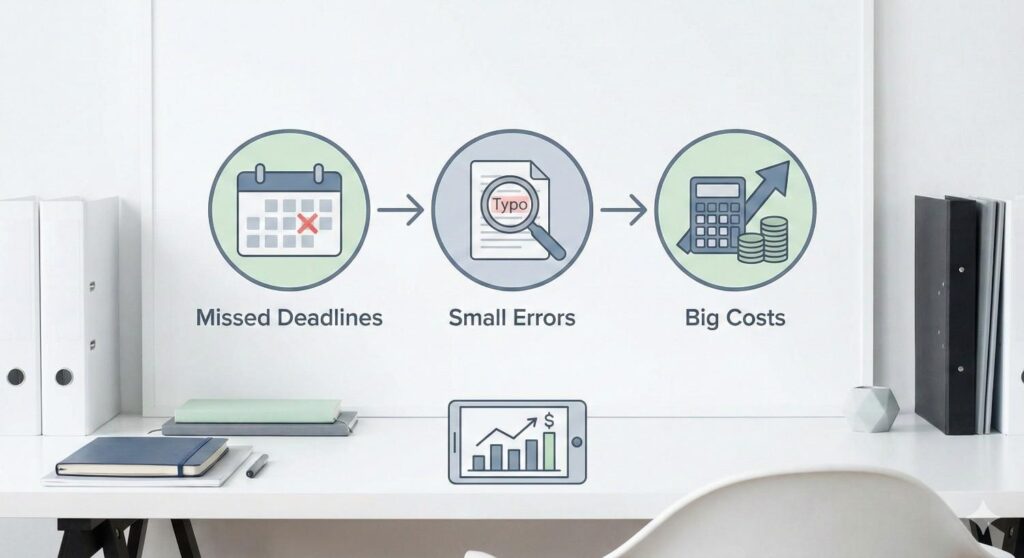
That shift not only reduces wasted cost but increases patent strength.
The Due Diligence Test
Every startup that plans to raise serious capital or pursue acquisition will face due diligence. During this process, investors and acquirers review your IP carefully.
They look for gaps. Missed deadlines. Inconsistent filings. Lapsed patents. Questionable disclosures.
Even small irregularities can raise questions. Those questions slow deals. They may reduce valuation. They may require additional legal cleanup before closing.
A messy portfolio does not just create admin headaches. It can impact exit outcomes.
On the other hand, a clean, well-documented, consistently maintained portfolio builds confidence. It signals operational discipline. It shows that the company treats its IP as a core asset.
The Hidden Cost of Constant Firefighting
When deadlines are managed poorly, teams live in reaction mode. Urgent emails. Last-minute approvals. Emergency coordination calls.
This environment creates stress. And stress reduces performance.
Firefighting also prevents long-term planning. When energy is spent putting out small fires, there is little room left for proactive strategy.
The goal is not perfection. The goal is predictability.
When patent workflows are predictable, surprises shrink. Teams operate calmly. Budgets stay steady.
How Modern Systems Prevent Escalation
The common thread behind missed deadlines and small errors is fragmentation. Information lives in too many places. Responsibility is unclear. Tracking is manual.
Modern patent platforms solve this by combining structured software with attorney oversight.
Deadlines are tracked automatically. Updates are logged centrally. Related cases are linked. Payment status is visible in real time. Attorneys review within the same environment instead of through scattered emails.
At PowerPatent, this integration is core to the model. Smart tools handle organization and reminders. Real patent attorneys provide legal strength. Founders maintain full visibility without being buried in admin.
The result is fewer small mistakes. And when small mistakes disappear, large costs rarely appear.

If you want to see how this system works in practice, you can explore it here: https://powerpatent.com/how-it-works
Small errors are never truly small in the patent world. But with the right structure, they are also preventable.
A Smarter System: Cutting Admin Work Without Risking Your Patent Rights
Most founders think they have to choose between two extremes. Either you stay deeply involved in every patent detail and lose time, or you hand everything off and hope nothing goes wrong. That false choice creates stress.
You can reduce admin work without weakening your protection. But it requires a smarter system. Not more emails. Not more spreadsheets. A clear structure that protects your rights while protecting your time.
Let’s break down what that actually looks like in practice.
Admin Should Be Invisible, Not Risky
The best patent systems feel boring. Deadlines are handled. Updates are logged. Payments are processed. You do not feel constant urgency.
Invisible does not mean careless. It means structured.
When patent operations run in the background with reliable tracking, your team can focus on building. The system quietly protects your rights without demanding daily attention.
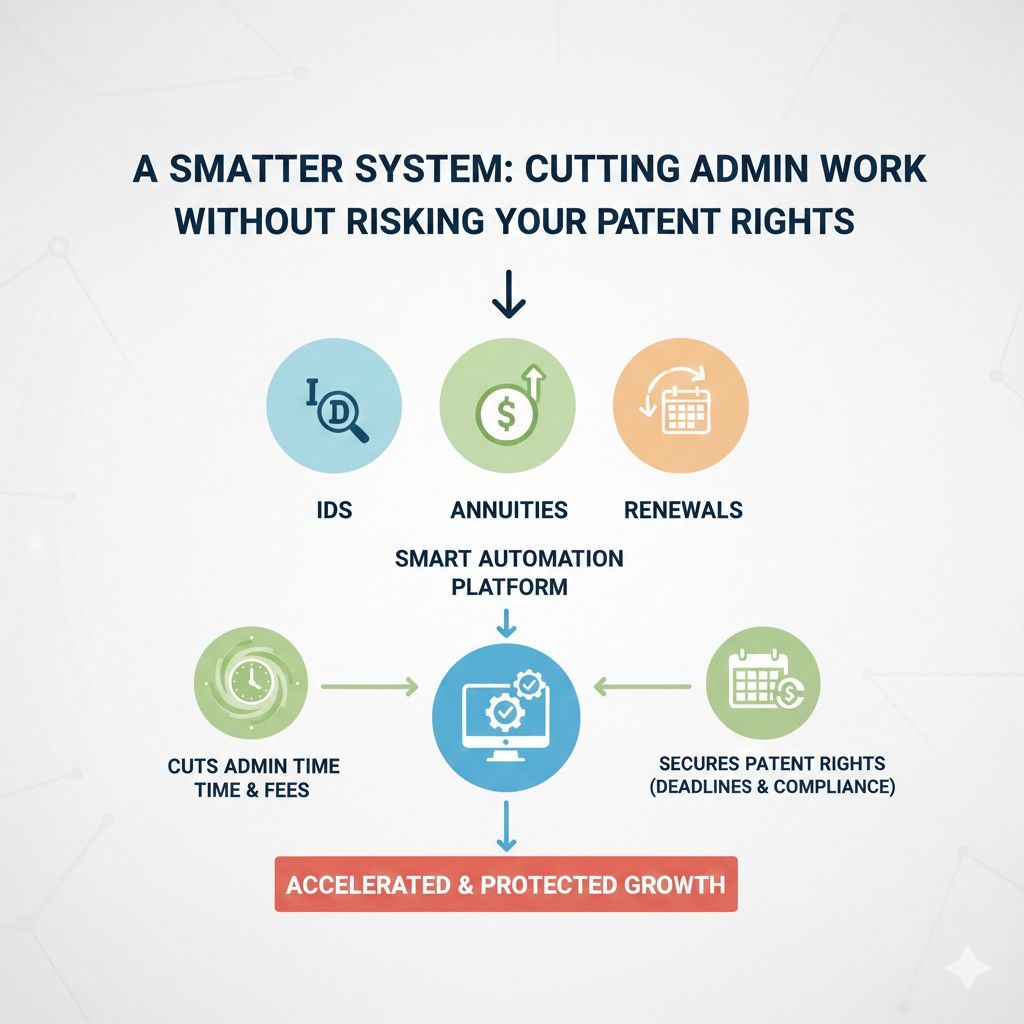
To reach that point, you must design for visibility and automation at the same time.
Centralize Everything, Then Simplify
The first step is centralization. Every filing, office action, cited reference, annuity schedule, renewal date, and payment record must live in one structured environment.
Without centralization, you cannot simplify. You are just moving pieces around.
Once centralized, simplification becomes possible. Duplicate reminders can be removed.
Manual tracking can be replaced with automated alerts. Email chains can be reduced because information is already visible to everyone who needs it.
At PowerPatent, this central view is built into the platform. Founders see their entire portfolio in one dashboard.
Attorneys work inside the same system. Nothing is hidden in private inboxes. That shared visibility is what cuts admin time safely.
If you want to see how this works in detail, you can review the workflow here: https://powerpatent.com/how-it-works
Automate the Mechanical, Protect the Strategic
Not every patent task requires human judgment. Some tasks are mechanical. Deadline tracking. Payment reminders. Status updates. Document storage.
These should be automated.
Strategic decisions, however, require human insight. Claim scope. Filing strategy. International expansion. Renewal evaluation.
These require experienced patent attorneys and leadership input.
A smart system separates mechanical work from strategic work. Automation handles repetition. Attorneys handle judgment. Founders handle direction.
When this separation is clear, time savings do not create legal risk. They remove friction around routine tasks while preserving quality where it matters.
Build Structured Workflows for IDS Management
IDS filings become chaotic when they are handled casually. References appear in different cases. Someone forwards a PDF. Another person assumes it was disclosed.
A structured workflow prevents this.
Every new cited reference should be uploaded into a shared system immediately.
The system should identify related applications automatically. A clear review path should exist, with attorney oversight built in. Once filed, confirmation should be logged visibly.
This removes uncertainty. It also prevents duplicate effort across related cases.
Over time, IDS handling becomes predictable and calm instead of reactive and stressful.
Pre-Approve Predictable Costs
Many patent expenses are predictable. You know when maintenance fees are due. You know roughly what prosecution responses cost. You know translation fees for specific countries.
Instead of approving each invoice under time pressure, pre-approve expected costs during quarterly planning.
This reduces emergency approvals. It also prevents delayed payments caused by internal bottlenecks.

Financial predictability reduces both stress and risk.
Align Patent Reviews With Business Milestones
Your patent portfolio should reflect your business reality. When your roadmap shifts, your IP strategy should shift with it.
Instead of reviewing patents randomly, tie review cycles to business events. Product launches. Market expansion. Major pivots. Fundraising rounds.
During these moments, evaluate coverage, upcoming renewals, and geographic scope. This keeps your portfolio lean and aligned.
When patents match strategy, renewals feel intentional instead of automatic.
Create Clear Escalation Rules
Not every update requires leadership review. But some do.
Define clear escalation triggers. For example, a potential lapse risk. A major change in claim scope. A decision about entering a new jurisdiction.
When escalation rules are defined in advance, your team knows when to involve you. This reduces unnecessary interruptions while ensuring critical decisions receive proper attention.
Clarity prevents both overreaction and underreaction.
Use Data to Improve Future Filings
A smart system does not only protect existing patents. It improves future ones.
Track how long applications take to move. Track common objections. Track cost per jurisdiction. Track grant rates.
When this data is visible, you can refine your filing strategy. You may draft claims differently. You may prioritize certain markets. You may budget more accurately.
Better data leads to better decisions. Better decisions reduce long-term cost.
Maintain Attorney Oversight Without Slowing Speed
The fear many founders have is that automation means cutting corners. That is not true when done correctly.
The key is combining software efficiency with real attorney review.
At PowerPatent, software handles structure, tracking, and organization. Real patent attorneys review filings, oversee disclosures, and guide strategy. Founders get the benefit of both speed and legal strength.
This combination reduces administrative waste without compromising protection.
If you are building advanced technology, you cannot afford weak patents. But you also cannot afford constant admin drag. The right system removes the drag while strengthening the core.
You can see how this integrated approach works here: https://powerpatent.com/how-it-works
Protecting Rights by Reducing Chaos
Chaos creates risk. Structured systems reduce it.
When deadlines are visible early, payments are automated, references are tracked centrally, and attorneys review within the same platform, small mistakes stop snowballing.
Admin time drops because repetition disappears. Fees stabilize because emergency fixes decline. Stress falls because visibility increases.
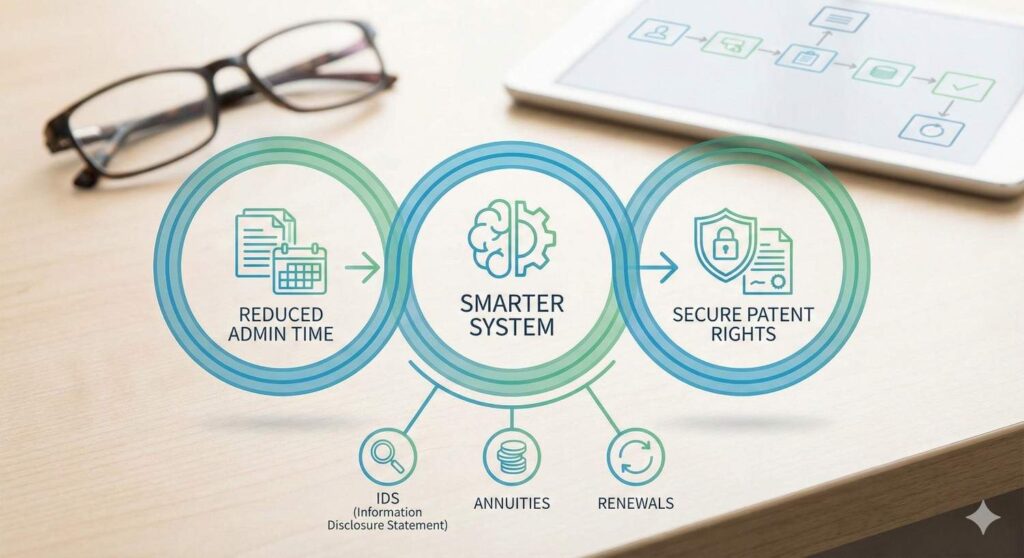
This is what a smarter system looks like.
You do not need more people to manage your patents. You need better design.
How PowerPatent Helps You Save Time, Lower Fees, and Stay Fully Protected
If you are building real technology, your patents matter. They protect your edge. They support fundraising. They give you leverage in the market. But managing them should not feel like a second job.
PowerPatent was built for founders who want strong protection without drowning in admin work. The goal is simple. Cut wasted time. Reduce unnecessary fees. Keep your rights secure. And do it in a way that fits how startups actually operate.
Here is how that happens in practice.
One Clear Dashboard Instead of Endless Email
Most patent chaos starts with scattered communication. One thread for an office action. Another for an IDS update. A separate chain for annuities. A spreadsheet somewhere else tracking renewals.
PowerPatent replaces that sprawl with one clean system.
You log in and see your full portfolio. Filing status. Deadlines. Upcoming payments. Linked applications. Everything structured and visible. No guessing. No searching through inboxes.
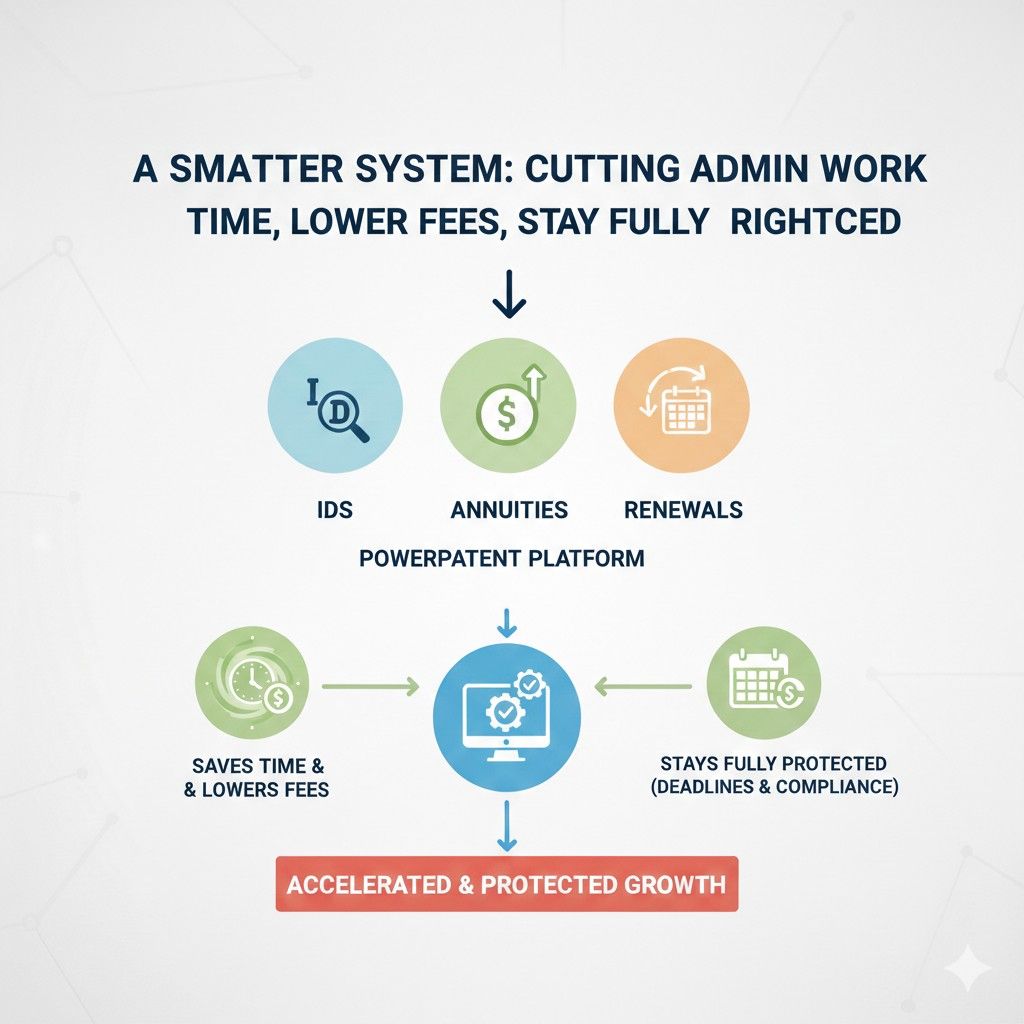
When information lives in one place, coordination becomes simple. Your team stops asking basic status questions. Your attorneys stop chasing missing details. You save time immediately because clarity replaces confusion.
If you want to see how this unified view works, you can explore the process here: https://powerpatent.com/how-it-works
Smart Automation That Prevents Small Mistakes
Deadlines are tracked automatically. Renewal windows are flagged early. Annuity payments are monitored before they become urgent.
This automation does not replace legal review. It replaces manual tracking.
When reminders trigger well before official deadlines, your team has breathing room. When payment confirmations are logged inside the system, no one wonders if something was handled.
Small mistakes disappear because the system catches them before they grow.
That alone can eliminate late fees, emergency filings, and unnecessary attorney hours.
Built-In Attorney Oversight for Real Protection
Speed means nothing if your patents are weak. That is why PowerPatent combines software with real patent attorneys.
Every filing is reviewed by experienced professionals. IDS updates are handled with proper legal oversight. Claim strategy is guided by experts who understand deep tech.
The difference is that attorneys work inside a structured platform instead of relying on endless back-and-forth emails. This shortens feedback loops and reduces billable noise.
You get strong, defensible patents without the slow, expensive workflow of traditional firms.
Structured IDS Management Across Your Portfolio
As your portfolio grows, IDS complexity grows with it. References appear across related cases. Foreign search reports trigger disclosure duties. Tracking manually becomes risky.
PowerPatent links related applications together. When new prior art appears, it is logged centrally. Related cases are visible. Review paths are clear.
This structure reduces duplicate work. It also lowers the chance of missed disclosures.
Instead of reacting to scattered documents, you manage disclosures through one organized system.
Predictable Costs Instead of Surprise Bills
Traditional patent management often produces surprise invoices. Extra time spent clarifying documents. Rush fees to meet deadlines. Reinstatement work after missed payments.
PowerPatent reduces those surprises.
Because workflows are structured and deadlines are visible early, emergency work declines. Because information is centralized, attorneys spend less time sorting through details.
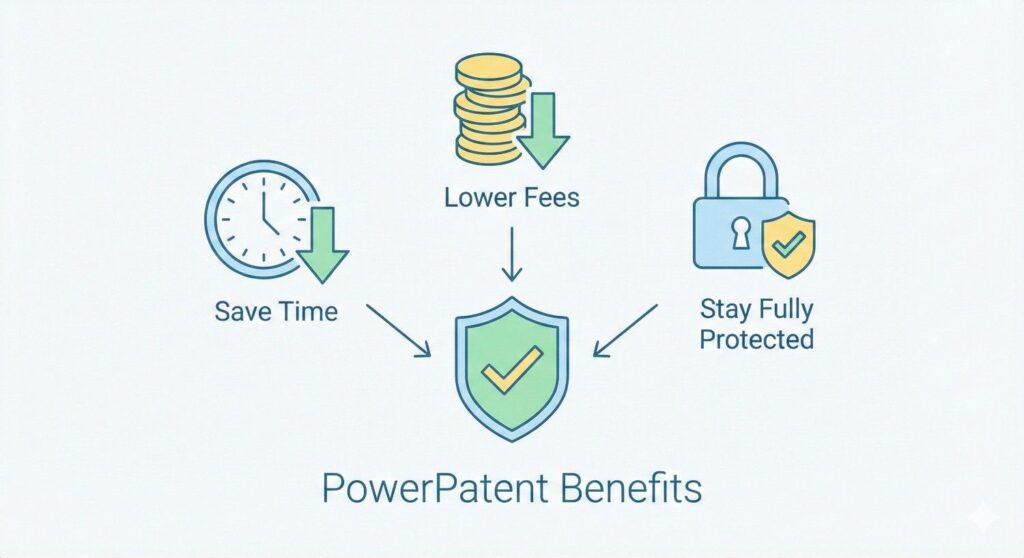
Because renewals are reviewed strategically in advance, you avoid maintaining patents that no longer serve your business.
The result is more predictable spending.
Predictability matters for startups. It allows you to plan, budget, and allocate capital confidently.
Renewal Decisions Based on Strategy, Not Panic
With PowerPatent, upcoming renewals are visible months in advance. This gives you time to evaluate each patent calmly.
Does it still protect a core feature?
Does it block a competitor in a key market?
Does it support fundraising or partnership goals?
When decisions are made early, you avoid rushed renewals that inflate your portfolio unnecessarily.
You keep what matters. You let go of what does not. And you do it with clear documentation and attorney guidance.
Clean Records for Fundraising and Diligence
When investors ask about your IP, you need clean answers fast.
PowerPatent gives you structured records. Filing history. Maintenance status. Geographic coverage. Linked applications. All accessible in one place.
Instead of scrambling to compile documents, you can present your portfolio confidently.
That confidence strengthens your position in negotiations.
Strong technology plus clean IP management sends a powerful signal.
Designed for Deep Tech Builders
Deep tech founders face unique challenges. Complex inventions. Rapid iteration. International ambition. High investor scrutiny.
PowerPatent is designed around that reality.
It helps you turn code, models, hardware designs, and breakthrough systems into well-structured patent applications quickly. It keeps the admin side organized as your portfolio grows.
It maintains attorney oversight without slowing your build cycle.
You stay focused on product. The system handles the background work.
If you are building serious innovation and want to protect it without chaos, this is worth exploring: https://powerpatent.com/how-it-works
Control Without Headache
The real benefit is control.
You see your deadlines. You see your costs. You see your coverage. Nothing is hidden behind layers of communication.
At the same time, you are not buried in routine tasks. Automation handles tracking. Attorneys handle legal depth. The platform connects everything.
Time saved compounds. Fees reduced compound. Stress reduced compounds.
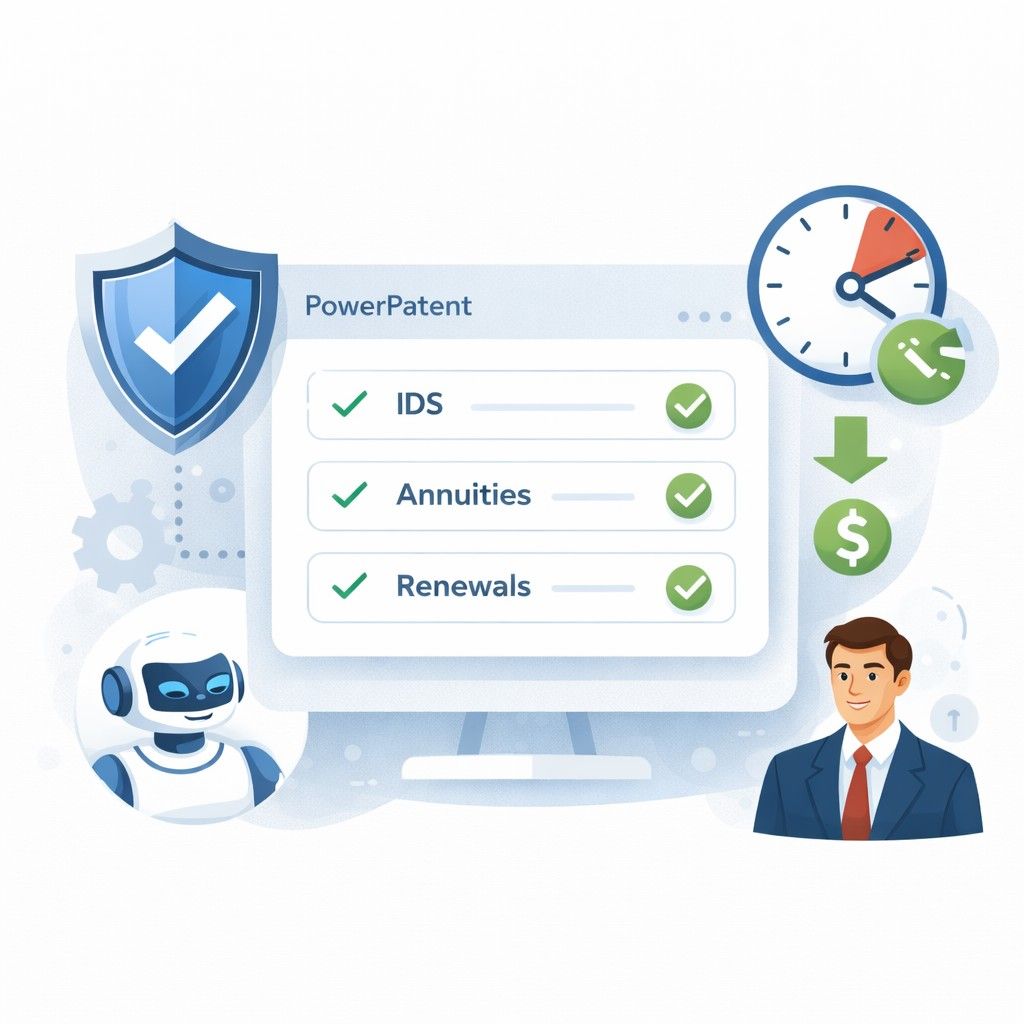
And your patent rights stay fully protected.
That is the goal. Strong IP. Lower admin load. Smarter spending. Full visibility.
Wrapping It Up
Patents are not the problem. Poor systems are. IDS filings, annuities, and renewals are part of owning serious intellectual property. They are not optional. But they also should not drain your team, inflate your bills, or create quiet risk in the background. When admin work is scattered, small mistakes turn into big costs. When deadlines are reactive, fees grow. When renewals are rushed, portfolios bloat. And when visibility is weak, stress rises. The fix is not filing fewer patents. The fix is building a smarter system.