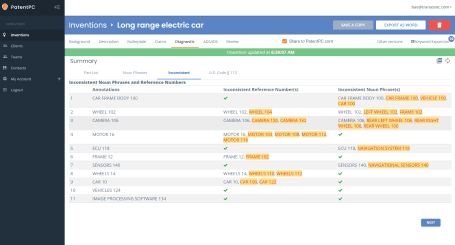
Most software founders wait too long to protect what they build. Not because they do not care. But because patents feel confusing, slow, and full of paperwork. The truth is simple: a well-built inventor questionnaire can turn your messy ideas, code, and product plans into a strong software patent without slowing you down. In this guide, you will learn exactly how to use inventor questionnaires the right way so you can capture your invention clearly, avoid costly mistakes, and move fast with confidence.
Why Most Software Patents Fail Before They Even Start
Most software patents do not fail because the idea is weak. They fail because the foundation is weak. The story is unclear. The problem is poorly explained. The invention is described in a rushed, surface-level way.
By the time a patent attorney sees it, key details are missing. Important technical depth is gone. What should have been a powerful asset turns into a narrow filing that is easy to work around.
If you are building a software company, this is not just a legal issue. It is a business risk. A weak patent can scare away investors, reduce your company’s value, and give competitors room to copy your core features.
The good news is that most of these failures are preventable. They happen early, long before the patent office reviews anything. They happen at the information capture stage.
This is exactly where inventor questionnaires come in. But to use them well, you first need to understand why most software patents break down before they even begin.
Founders Describe Features Instead of Inventions
The first big mistake happens when founders talk about what the product does instead of how it works.
When filling out early patent forms, many engineers write things like “our system matches users with content” or “our platform improves data processing speed.” That sounds fine at first.
But it is too shallow. It describes results. It does not describe the engine behind the results.
Patent examiners do not protect outcomes. They protect specific technical solutions.
If your questionnaire answers focus on dashboards, user screens, or business benefits, you are leaving out the most valuable part. The real invention often lives inside algorithms, data flows, system structure, and how components interact.
To avoid this, you must train yourself to answer every question one level deeper. When you describe a feature, immediately ask yourself how it actually happens in the code.
What triggers what? What data moves where? What rules control the logic? What happens when edge cases appear?
When filling out an inventor questionnaire, imagine that the reader cannot see your code. Because they cannot. Your job is to translate your code into clear technical steps. If you cannot explain it simply, it will not be protected strongly.
Teams Wait Too Long to Capture the Invention
Another silent killer of software patents is delay.
Startups move fast. Features evolve weekly. Architecture changes. Models get retrained. By the time someone says, “we should probably patent this,” months have passed.
The original insight is fuzzy. The early design decisions are forgotten. The clean version of the invention is gone.
When that happens, questionnaires get filled out based on memory. Memory is incomplete. Important technical decisions disappear. Small design choices that made the system novel never get written down.
This weakens the patent from day one.
A better approach is to treat inventor questionnaires as part of your build cycle. When you ship something new that feels unique, document it right away.
Even if you are not ready to file immediately, capturing the invention while it is fresh keeps the details sharp.
Make it a habit inside your team. When engineers merge a feature that solves a hard technical problem, pause and ask, “Is this patentable?” If the answer might be yes, start drafting answers in a structured questionnaire immediately.
Speed here does not slow you down. It protects your speed later.
If you want a system that makes this fast and guided instead of messy, you can see how it works at https://powerpatent.com/how-it-works. The goal is to capture invention while momentum is high, not months later when details are gone.
Founders Underestimate What Is Actually Novel
Many founders think their idea is too simple to patent. Others think only groundbreaking AI models qualify. Both are wrong.
Often, novelty hides in small design decisions. It can live in how you process data in stages. It can exist in how you reduce memory load. It can sit in how you handle failure states or distribute tasks across systems.
If your questionnaire only captures the “big idea,” you may miss the real invention.
When you answer questions about what makes your system different, do not compare yourself only to your competitors. Compare yourself to the basic way this problem is usually solved.
Ask yourself what most engineers would build first. Then look at where you did something different.
Did you reorder steps? Combine components in a new way? Add a feedback loop? Introduce a new rule set? Those differences matter.
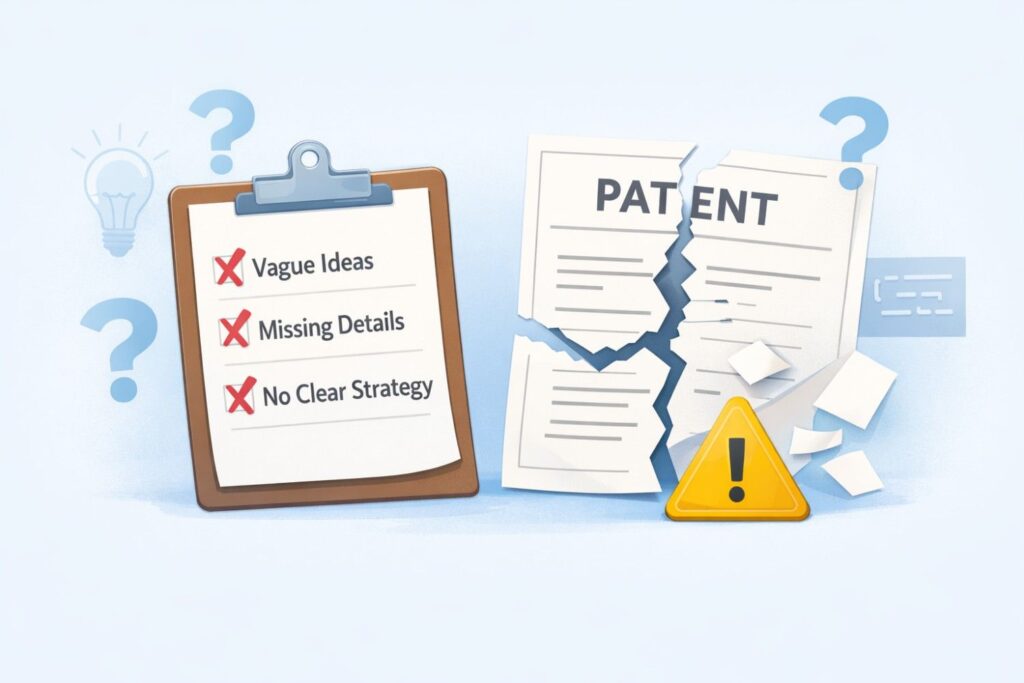
An effective inventor questionnaire forces you to think at this level. But you must engage with it seriously. Do not rush through it like admin work. Treat it like product strategy. Because it is.
Technical Depth Gets Lost in Translation
In many startups, engineers explain ideas to business teammates, who then summarize them for attorneys. With each layer, technical depth gets trimmed down. By the time it reaches the patent draft, the invention is simplified too much.
This is not anyone’s fault. It is a communication gap.
Software patents require detail. Not code, but structure. If your questionnaire does not guide you to explain architecture, data flow, and decision logic, the final patent will be thin.
When you fill out a questionnaire, write as if you are explaining the system to a senior engineer joining your team. Be precise. Use diagrams if helpful. Explain why each part exists.
Also explain alternatives. If your system could be implemented in more than one way, describe those variations. Strong patents cover multiple paths, not just the one you coded first.
This is where combining smart software tools with real patent attorneys makes a huge difference. A good system will prompt you for the right depth and then refine it with legal insight. You can explore how that balance works at https://powerpatent.com/how-it-works.
Companies Focus on Filing Fast Instead of Filing Strong
Speed matters in startups. But filing fast without clarity is expensive.
Some founders rush to submit a patent draft built from thin answers just to say they filed. Later, they realize the claims are narrow. Competitors design around them easily. Fixing it is costly or impossible.
A well-structured inventor questionnaire prevents this by forcing clarity before filing.
It slows you down in the right way. It makes you articulate the technical core. It reveals gaps in your explanation. It surfaces areas where you need more detail.
Think of it as code review for your invention. You would not deploy messy code to production. Do not file a messy patent application either.
Before you submit anything, review your questionnaire answers with the same care you give to product releases.
Ask whether someone outside your company could truly rebuild the invention from what you wrote. If not, it needs more depth.
Ownership Confusion Creates Hidden Risk
Another reason patents fail early has nothing to do with technology. It is about inventorship and ownership.
In fast-moving teams, multiple engineers contribute to a feature. Sometimes contractors are involved.
Sometimes ideas build on earlier prototypes. If the inventor questionnaire does not clearly identify who contributed to what, mistakes happen.
Wrong inventors listed on a patent can cause serious legal issues later. Investors look closely at this. Acquirers do too.
When you use an inventor questionnaire, do not treat the inventorship section lightly. Be honest and specific. Who contributed to the core technical solution? Who shaped the architecture? Who proposed the novel mechanism?
Document this clearly from the start. It is much easier to correct early than years later during due diligence.
A structured system that walks you through these details step by step can prevent painful surprises. If you want to see a streamlined way to manage this without slowing your team, visit https://powerpatent.com/how-it-works.
Lack of Strategic Framing
Many software patents fail because they are written too narrowly around the current product version.
Startups pivot. Features evolve. Markets shift. If your questionnaire only captures how your system works today, you may trap your protection in a narrow snapshot.
Instead, when answering questions, think bigger. What is the core technical concept behind this feature? How could it apply in other industries? How might it scale?
Describe broader use cases. Explain variations. Show how the invention could run in different environments or with different inputs.
This does not mean exaggerating. It means thinking strategically.
A good inventor questionnaire is not just a data form. It is a thinking tool. It forces you to zoom out and see your invention as an asset, not just a feature.
When you approach it with that mindset, you dramatically increase the strength of what you file.

Strong patents do not start in legal offices. They start with clear, detailed, well-structured invention capture. And that begins with how you answer the right questions.
What an Inventor Questionnaire Really Does (And Why It Matters)
Most founders think an inventor questionnaire is just paperwork. A form. A box to check before a patent gets drafted. That belief is costly.
An inventor questionnaire is not a form. It is the foundation of your patent. It is the raw material that decides whether your protection will be strong or fragile. If it is shallow, your patent will be shallow.
If it is detailed and strategic, your patent becomes a real business asset.
When used the right way, it forces clarity. It turns scattered thoughts into structured invention. It captures the real technical story behind your product. And it does this before lawyers start writing.
If you treat it like admin work, you get admin-level results. If you treat it like product strategy, you get serious protection.
It Forces You to Define the Real Problem
Every strong software patent begins with a clear technical problem. Not a market problem. Not a user complaint. A technical problem.
An inventor questionnaire pushes you to explain what was broken or inefficient before your solution existed. This step matters more than most founders realize.
When you define the technical pain point clearly, you create context. You show why your system is needed. You frame your invention as a solution, not just a feature.
If you skip this and jump straight to describing what your system does, you miss the chance to anchor your patent in a real technical gap.
As you fill out this section, slow down. Ask yourself what engineers were struggling with before you built your system. Was data too slow to process? Did systems fail under load?
Were models producing unstable results? Did existing architectures waste memory?
Be precise. Avoid vague phrases like “inefficient process.” Explain exactly what made it inefficient. The stronger your problem description, the stronger the story of your invention.
This is where many patents quietly weaken. They never clearly state what was broken.
It Translates Code Into Protectable Structure
Your code is not what gets patented. The structure behind your code is.
An inventor questionnaire helps you extract that structure.
It asks you to explain components, interactions, triggers, data paths, and logic flows. It turns thousands of lines of code into a readable explanation of how your system operates.
This translation step is critical. Patent examiners will never read your repository. They will read a written description. If that description is vague, the protection shrinks.
When answering questionnaire prompts about system design, imagine you are mapping the blueprint of a machine. Even if your product lives in the cloud, it still has moving parts.
Data enters. It gets processed. Decisions happen. Outputs are generated.
Explain these steps in sequence. Show how one part depends on another. If your system has special handling for edge cases, include that. If it uses a unique feedback loop or learning cycle, describe it clearly.
The goal is not to sound technical for the sake of it. The goal is to make the invisible visible.
This is why modern tools that guide you step by step can be so powerful. They help you surface technical details you might forget. When paired with real patent attorney review, this process becomes even stronger.
You can see how that combined approach works at https://powerpatent.com/how-it-works.
It Surfaces Hidden Variations You Should Protect
Many founders describe only the exact version of the system they built.
That is natural. You built one implementation. But your patent should not be locked to just that version.
A strong inventor questionnaire asks about alternatives. Could your system run on different hardware? Could the logic be reordered? Could the data format change? Could parts be combined or separated?
When you think through these variations early, you expand the scope of protection.
This is not about guessing random scenarios. It is about understanding the core concept behind your invention and recognizing that it can show up in different forms.
For example, if your innovation is about prioritizing data packets in a certain way, the underlying concept may apply across multiple network types.
If your model uses a new method to clean input data, that cleaning step might work in different domains.
By writing these variations down in the questionnaire stage, you give your future patent room to breathe. You avoid boxing yourself into one narrow example.
It Aligns Technical Teams and Legal Strategy
In many startups, patents feel separate from product. Engineers build. Lawyers file. There is little overlap.
An inventor questionnaire changes that dynamic.
It becomes a bridge between engineering and legal strategy. It forces engineers to explain their work in a structured way. It gives attorneys a clear technical base to build from.
This alignment reduces back-and-forth. It reduces misinterpretation. It reduces the risk of a patent draft that does not truly reflect the invention.
For businesses, this saves time and money. It also builds internal clarity. When your team sees their innovation described in a structured format, it sharpens their understanding of what makes your company unique.
Over time, this can shape roadmap decisions. You start recognizing patentable opportunities earlier. You design with protection in mind.

When this process is supported by software built specifically for founders, and reviewed by real attorneys who understand startups, it becomes even smoother.
If you want to explore that workflow, visit https://powerpatent.com/how-it-works.
It Creates a Record of Invention
Startups move fast. Memories fade. Team members leave. Code evolves.
An inventor questionnaire creates a snapshot in time. It documents what was invented, how it worked, and who contributed.
This record can be critical later. During fundraising, investors may ask how your core technology is protected. During acquisition talks, buyers will review your patents closely. If disputes arise, detailed records matter.
Without a structured capture process, you rely on scattered documents and Slack messages. That is risky.
When you complete a thorough questionnaire, you are not just preparing for a patent filing. You are building a clean record of innovation.
For founders thinking long term, this is a strategic move. It signals that you treat intellectual property as a real asset, not an afterthought.
It Forces You to Think Like a Competitor
One of the most powerful things an inventor questionnaire does is push you to think defensively.
Some prompts will ask what makes your approach different from existing methods. Others will push you to describe how someone might try to replicate your system.
When you engage with these questions honestly, you begin to see gaps.
Could a competitor change one step and avoid your method? Could they replace one component and achieve a similar result? Could they claim they are doing something “similar but different”?
By thinking through these scenarios at the questionnaire stage, you strengthen your eventual patent. You identify where broader protection is needed. You spot weaknesses early.
This mindset shift is valuable beyond patents. It sharpens your competitive strategy. It helps you understand where your true moat lies.
It Turns a Stressful Process Into a Guided One
For many founders, patents feel overwhelming because they do not know where to start.
An inventor questionnaire provides structure. It breaks a complex process into guided steps. Instead of staring at a blank page, you respond to targeted prompts.
When designed well, this process feels logical. It mirrors how engineers think. Problem. Solution. System design. Variations. Use cases.
This reduces friction. It lowers the mental barrier to getting started. And once you begin, momentum builds.
When this structure is delivered through modern software built for startups, the experience becomes even smoother. Add real attorney oversight on top of that, and you get clarity without confusion. You can see how this works in practice at https://powerpatent.com/how-it-works.
An inventor questionnaire is not busy work. It is the engine that powers a strong patent.
If you approach it with care, depth, and strategy, it transforms from a simple form into a powerful business tool.
How to Fill Out a Software Patent Questionnaire the Right Way
Filling out a software patent questionnaire is not about writing something that sounds impressive. It is about being clear, detailed, and strategic. This is where you decide how strong your protection will be.
If you rush it, your patent will reflect that. If you think deeply and explain carefully, you build something that can truly protect your company.
This process should feel like designing architecture, not filling out paperwork. You are mapping the structure of your invention so it can be protected properly. Done right, this step saves months of confusion and thousands in corrections later.
Start With the Core Technical Insight
Before you type a single answer, pause.
Every strong patent begins with one clear technical insight. Not the product vision. Not the business model. The technical breakthrough.
This is the moment when you solved a problem in a way that others had not. It might be a new data processing sequence. It might be a system that reduces load in a unique way. It might be a model training method that stabilizes output.
When you begin the questionnaire, anchor your answers around that insight.
If you are unsure what the core insight is, ask yourself this simple question: if a competitor copied only one part of our system to gain an advantage, what part would that be? That is often where the invention lives.
Write your answers so they revolve around that core mechanism. Do not drift into describing every feature in your product. Focus on the engine that creates the advantage.
Describe the Problem in Technical Terms
Most founders describe problems in user language. Slow dashboards. Poor user experience. High churn.
That is not what belongs here.
The questionnaire is asking for the technical problem. What was inefficient in the system? What constraint did you face? What failed under scale? What limitation existed in prior approaches?
Be specific. If memory usage was too high, explain why. If processing time increased exponentially with input size, describe that behavior. If distributed systems caused synchronization errors, explain how.
When you clearly define the technical pain point, your solution becomes stronger. The patent is no longer about a nice feature. It becomes about overcoming a defined technical barrier.
This clarity also helps attorneys draft broader protection. When the problem is framed well, the solution can be framed powerfully.
Walk Through the System Step by Step
One of the biggest mistakes founders make is skipping steps because they seem obvious.
Nothing is obvious to someone outside your codebase.
When the questionnaire asks how your system works, imagine you are explaining it to a senior engineer who has never seen your product before. Walk through it in sequence.
Explain what happens first. What input is received? How is it formatted? Where is it stored? What triggers the next step? What logic is applied? What happens if conditions are not met?
Avoid jumping from start to finish in one sentence. Break it down logically in paragraph form. Show the flow.
If your invention spans multiple services or modules, describe how they communicate. If your system depends on specific thresholds, timing conditions, or rule sets, explain them.
The goal is to capture structure, not marketing language.
Go Deeper Than the User Interface
User interfaces change often. Buttons move. Dashboards evolve. Patents built around screens are usually weak.
If your questionnaire responses focus heavily on what the user sees, you are likely missing the stronger layer underneath.
Shift your focus to backend logic. Data transformations. Model adjustments. System coordination. Decision engines.
Even if your product looks simple on the surface, the strength usually sits in how the system operates behind the scenes.
As you write, ask yourself whether removing the interface would still leave a technical method worth protecting. If the answer is yes, you are on the right track.
Capture Edge Cases and Failure Handling
Real systems do not operate in perfect conditions. They deal with missing data, corrupted inputs, network delays, and unexpected behavior.
If your invention handles these situations in a unique way, include that.
Many patents ignore edge handling. That is a mistake.
Sometimes the novel part of a system is not the main flow but how it reacts when things go wrong.
If your method adapts dynamically, reallocates resources, retries in a specific pattern, or shifts models based on confidence levels, describe it.

These details add depth. They show that your invention is robust and thoughtfully engineered.
Explain Why Your Approach Is Different
When the questionnaire asks how your solution differs from existing methods, avoid vague claims.
Do not write that it is “better” or “more efficient” without explanation.
Instead, describe how others typically solve the problem. Then explain what you changed.
Maybe most systems process data in a fixed order, but you reorder steps dynamically. Maybe others store raw data first, while you transform it before storage.
Maybe prior systems rely on centralized coordination, while yours distributes decision making.
Be concrete.
This comparison helps define the boundaries of your invention. It shows what makes it new.
Think Beyond the Current Version
Your product today is one snapshot. Your patent should not be locked to that exact version.
As you fill out the questionnaire, think about variations.
Could your system operate in a cloud environment or on device? Could it use different data types? Could the logic be applied in another industry?
Describe these broader possibilities if they are reasonable extensions of your core idea.
This does not mean speculating wildly. It means recognizing that your technical concept may have wider application than your current roadmap.
Capturing this early helps create protection that grows with your company.
Be Honest About Contributions
When identifying inventors, accuracy matters.
Only include those who contributed to the core technical concept. Not everyone who touched the code. Not managers who approved timelines. Not team members who tested the feature.
If someone helped shape the novel mechanism, they belong. If they implemented routine parts without contributing to the inventive concept, they likely do not.
If you are unsure, discuss it early. Cleaning up inventorship later can be painful.
A thoughtful questionnaire process makes this clearer. It forces you to tie each contribution to the actual inventive idea.
Write Clearly, Not Impressively
You do not need complex words. You do not need to sound academic.
Clear and simple explanations are stronger.
Short sentences help. Direct descriptions help. Avoid jargon unless it is necessary for accuracy.
If you cannot explain your system simply, it may mean your explanation is not yet clear enough.
Strong patents often begin with clear thinking expressed in straightforward language.
Review Your Answers Like a Product Launch
Before you submit your questionnaire for drafting, review it carefully.
Ask yourself whether a technical reader could rebuild the system from your explanation. Ask whether you skipped assumptions. Ask whether you described the real invention or just surface features.
Treat this review like shipping code. Once a patent is filed, major changes can be difficult.
If you want a process that guides you step by step, surfaces missing details, and pairs your answers with real patent attorney review, that is exactly what PowerPatent was built for. You can see how it works here: https://powerpatent.com/how-it-works.
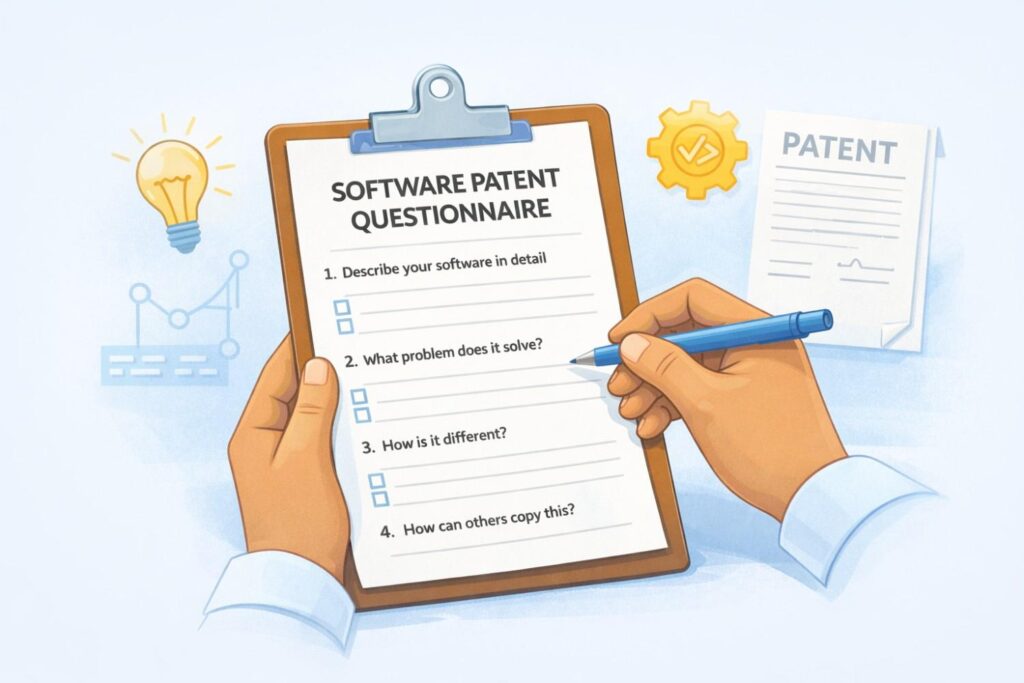
Filling out a software patent questionnaire the right way is not about bureaucracy.
It is about turning your technical edge into a durable asset. When done carefully, this single step can shape how well your innovation is protected for years to come.
Turning Your Answers Into a Strong, Defensible Patent Fast
Filling out the questionnaire is only half the job. What happens next is where speed and strength either come together or fall apart.
Many startups lose momentum after submitting their answers. Weeks pass. Drafts go back and forth. Key details are misunderstood. The final document feels disconnected from the original invention.
That delay is not just frustrating. It is risky.
The goal is simple. Move from raw answers to a strong, defensible patent without slowing down product development. That requires structure, clarity, and the right support.
Move From Raw Notes to Structured Claims
Your questionnaire answers are the raw material. But raw material alone does not protect you.
A patent becomes powerful through its claims. Claims define the legal boundaries of your invention. If they are too narrow, competitors can step around them. If they are too vague, they may not hold up.
This is why your answers must be transformed carefully.
The process should begin by identifying the core technical mechanism described in your questionnaire. Not the broad vision. Not every feature. The mechanism that creates the technical advantage.
From there, strong claims are built around that mechanism in layered form.
The broad layer protects the core concept at a high level. Narrower layers protect specific implementations, variations, and optimizations.
If your questionnaire captured variations, edge cases, and alternative system structures, this step becomes much easier. The attorney can draft claims that cover multiple paths instead of a single example.
This is how you move fast without sacrificing protection. Clarity up front leads to stronger claim drafting later.
At PowerPatent, this transformation is streamlined by combining guided software capture with real patent attorney review.
The system helps structure your invention before drafting even begins. You can see how that process works here: https://powerpatent.com/how-it-works.
Keep the Feedback Loop Tight
Speed does not mean rushing blindly. It means reducing friction.
Once a draft is prepared, review it while the invention is still fresh in your mind. Do not wait months. The longer you wait, the more details fade.
When reviewing, focus on accuracy first. Does the draft reflect how your system truly works? Are there steps missing? Are any parts described incorrectly?
Then focus on scope. Does the draft protect only the exact version you built? Or does it cover reasonable variations?
Be direct in your feedback. If something feels too narrow, say so. If an explanation feels unclear, clarify it.
A tight feedback loop prevents weak filings. It keeps the document aligned with the real invention.
Balance Speed With Strategic Depth
Founders often feel pressure to file quickly, especially before fundraising or product launch.
Filing quickly can be smart. But filing something weak just to meet a deadline can hurt you long term.
The right approach balances urgency with depth.
If your questionnaire was thorough, much of the heavy thinking is already done. That allows the drafting phase to move quickly without skipping substance.
If your questionnaire was rushed, the drafting phase becomes chaotic. Attorneys must chase missing details. You must dig back into code to answer new questions. Time gets lost.
The fastest path is often the most prepared one.
Think of it like deploying a system to production. Preparation reduces downtime.
Anticipate Examination From Day One
A strong patent is not just about filing. It is about surviving examination.
Patent examiners will compare your claims to existing technology. They will question whether your invention is truly new and whether it solves a technical problem.
If your questionnaire clearly defined the technical problem and detailed the solution steps, you are already in a better position.
Your description should show how your system improves performance, reduces resource usage, increases reliability, or overcomes a real constraint.
These technical improvements matter during examination.

When drafting moves fast but remains grounded in this technical depth, you reduce the risk of major rejections later.
That saves time, legal fees, and stress.
Build a Portfolio, Not a One-Off Filing
Turning one questionnaire into one patent is good. Turning a pattern of innovation into a portfolio is better.
Once your team understands how to capture inventions clearly, the process becomes repeatable.
Engineers begin to recognize patentable breakthroughs earlier. They document them faster. The company builds a steady pipeline of protection.
This does not mean filing patents for every small change. It means being intentional about protecting real technical advantages.
Over time, this portfolio becomes a signal to investors and competitors. It shows that your company owns its innovation.
The key is making the process simple enough that it does not disrupt product velocity.
That is why modern platforms that combine smart intake tools with attorney oversight matter so much. They remove the traditional bottlenecks without sacrificing quality.
If you want to see how startups are turning invention capture into a fast, repeatable system, explore https://powerpatent.com/how-it-works.
Avoid the Traditional Bottlenecks
In the old model, everything runs through slow communication cycles. Long email threads. Static documents. Delayed reviews.
That model does not fit startups.
To move fast, you need structured intake, guided prompts, centralized collaboration, and direct attorney review within the same workflow.
When your answers, diagrams, and clarifications live in one place, the path from idea to filing shortens dramatically.
More important, quality improves because nothing gets lost.
This is not about replacing attorneys. It is about giving them better raw material and cleaner communication.
That combination is what turns a questionnaire into a defensible patent quickly.
Protect What Matters While You Keep Building
The ultimate goal is simple. Protect your core technology without slowing your company down.
A well-used inventor questionnaire captures your innovation clearly. A structured drafting process turns it into layered claims. A tight feedback loop refines it. A smart system removes friction.
When all of this works together, patents stop feeling like a distraction. They become part of your growth strategy.
You keep shipping product. You keep raising capital. And in the background, your technical edge is being secured properly.
That is the difference between filing paperwork and building real intellectual property.

If you are building something valuable, do not leave it exposed. Turn your invention into a strong, defensible asset without the usual delays.
You can start that process today by seeing how PowerPatent works: https://powerpatent.com/how-it-works
Wrapping It Up
Software moves fast. Your product changes every week. Features evolve. Models improve. Systems scale. But your core technical breakthroughs deserve to be captured clearly and protected properly. An inventor questionnaire is not busywork. It is not just a form you fill out to satisfy a lawyer. It is the moment where your innovation becomes structured. It is where scattered ideas turn into defined technical solutions. It is where your competitive edge gets documented before it fades into memory.