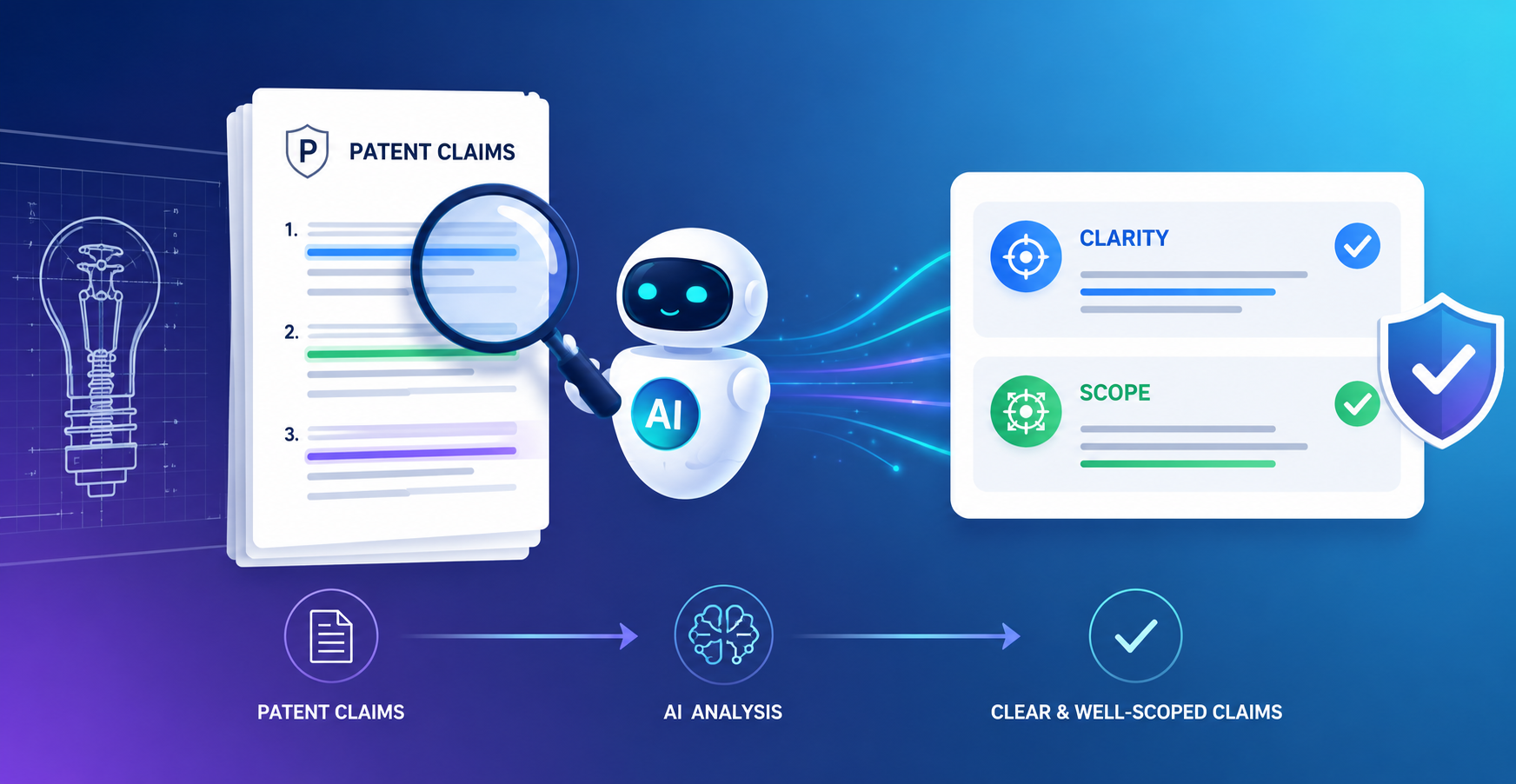
Patent claims are the part of a patent that says what your invention protects. If the claims are too narrow, others may work around them. If they are too broad, they may get rejected or become weak later. If they are unclear, your team may waste time, money, and energy trying to fix problems that could have been caught early.
AI helps founders see what the claim is really saying
Patent claims can look short, but they carry a lot of weight. A single word can change what the patent covers. A small phrase can make the claim too weak, too tight, or too hard to defend.
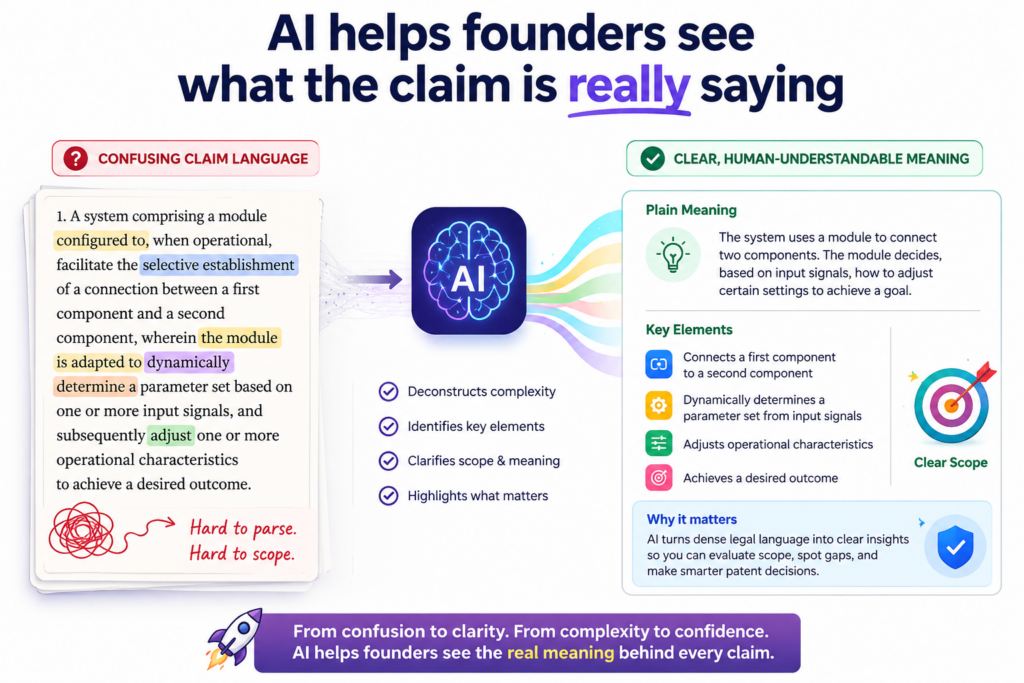
This is why many founders feel stuck when they first read claims. The words seem simple at first, but the meaning can be hard to track.
AI helps by turning dense claim language into plain meaning. It can explain what each claim appears to cover, what parts of the invention are required, and what parts may be left out.
This gives founders a better way to review the claim before it moves too far down the path.
AI can turn claim language into a clear working view
A patent claim is not just a sentence. It is a map of protection.
Every part in the claim matters. If the claim says a system has a sensor, a model, a processor, and a feedback step, then each of those parts may be needed to show that someone else is using the claim.
That can be hard to see when the claim is written in long, formal language. AI can break the claim into smaller parts and show what each part does. This helps the team see the real shape of the claim.
This makes review much easier for technical teams
Engineers often know the invention better than anyone. But they may not know how to read claim language. AI can help bridge that gap.
It can show the claim in a more natural form, so the engineering team can say, “Yes, that matches what we built,” or “No, that misses the key step.”
That feedback is powerful. It helps the patent team fix the claim early. It also helps avoid a common mistake: filing claims that sound fine but do not match the real product.
For a startup, this matters because time is short. The team may be shipping code, raising money, meeting customers, and building new features at the same time.
A claim review process that is slow or confusing can hold everyone back. AI helps make the review cleaner and faster.
PowerPatent is built around this kind of founder-friendly workflow. It helps turn complex inventions into clear patent work, while real patent attorneys stay involved. You can see how the process works here: https://powerpatent.com/how-it-works
AI helps spot unclear words before they become expensive problems
Clarity is not a nice extra in patent claims. It is central. If a claim is unclear, it can create trouble during review, during investor diligence, or later if the patent needs to be enforced.
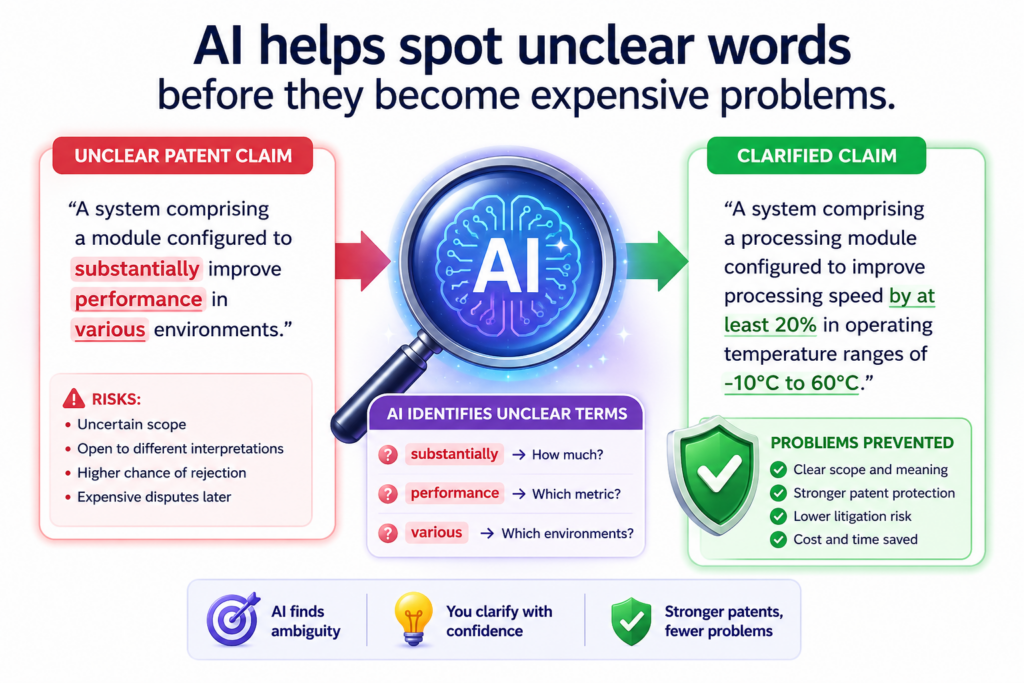
A claim should make it clear what is covered and how the invention is defined.
The hard part is that unclear words often hide in plain sight. A founder may read a claim and think it sounds fine.
An engineer may understand it because they know the product. But someone outside the company may read the same words and see confusion.
AI can flag vague terms that need a closer look
Some words sound useful because they feel broad. Words like “smart,” “optimized,” “dynamic,” “fast,” “secure,” or “better” may seem helpful in normal product talk. But in a patent claim, those words can be weak if they are not tied to clear structure or clear steps.
AI can scan for these words and ask a simple question: what does this mean in the claim? That question alone can prevent many issues.
If the word has a clear meaning based on the rest of the patent, it may be fine. If not, the team can fix it.
Clear claims protect the invention with less guesswork
The goal is not to make every claim long or packed with details. The goal is to make the claim clear enough that people can understand the boundary.
A strong claim should not force the reader to guess what the founder meant.
AI can help by pointing out where the claim may rely too much on loose language. It can also suggest places where the claim may need a clearer link between the invention and the result.
For example, a claim that says a model “improves prediction accuracy” may sound good. But the claim may need to explain how the model does that. Does it use a special feature set?
Does it update based on live data? Does it filter noise in a new way? Does it use a new training step? AI can help surface those questions.
That does not mean AI should make the final call. Patent claims need attorney judgment. But AI can help the team find weak spots sooner, which gives the attorney better material to work with.
AI helps check whether the claim is too narrow
A narrow claim may be easy to understand, but it may not give much protection.
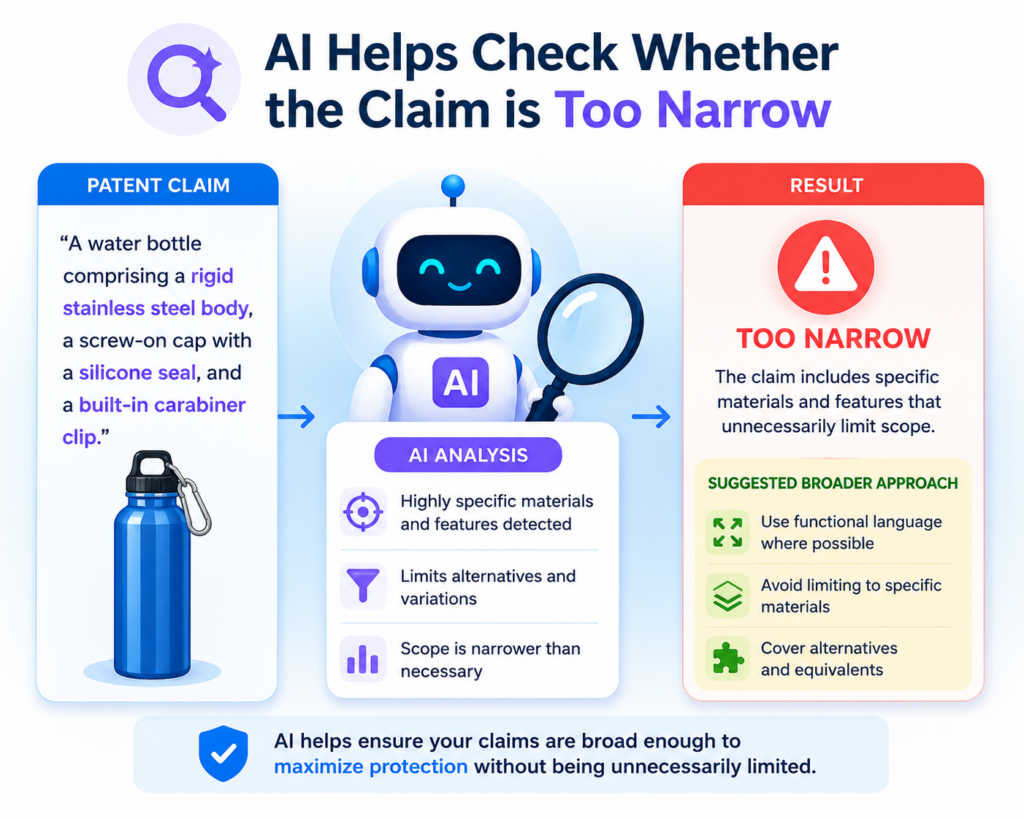
If the claim is packed with details that are not truly needed, another company may avoid the patent by changing one small thing. That is a serious risk for startups.
Founders often describe their invention based on the first version they built. That is natural. But the first version is not always the full invention.
A patent claim should often protect the core idea, not just the current product screen, model version, hardware layout, or workflow.
AI can find details that may limit the claim too much
AI can review a claim and point out details that may be optional. For example, the claim may require a mobile app, when the invention could also work in a web app.
It may require a cloud server, when the invention could run on a local device. It may require a certain type of model, when the core value is in the data flow or decision process.
These details may be right in some cases. But they should be there for a reason. AI helps by asking whether each part of the claim is needed for the invention to work.
This helps founders protect the core idea, not just one version
A strong patent strategy looks beyond what exists today. Your product will change. Your model may change.
Your data sources may change. Your user flow may change. If the patent only protects the first build, it may not protect where the company is going.
AI can help compare the claim against several versions of the invention. It can ask whether the claim still covers a future version, a lighter version, a hardware version, a software-only version, or a version used by a partner. This type of review can reveal where the claim is too tight.
This is especially helpful for deep tech teams. In AI, robotics, biotech tools, chips, climate tech, and advanced software, the first build is often just the start.
The valuable idea may sit under the surface. It may be in how data moves, how a model is trained, how signals are cleaned, how a device responds, or how a system makes decisions.
PowerPatent helps founders bring these details into the patent process without slowing the team down. The goal is to help you protect what matters while you keep building. Learn more here: https://powerpatent.com/how-it-works
AI helps check whether the claim may be too broad
A broad claim can be powerful, but only if it is supported. If a claim reaches too far beyond what the invention teaches, it may face trouble.
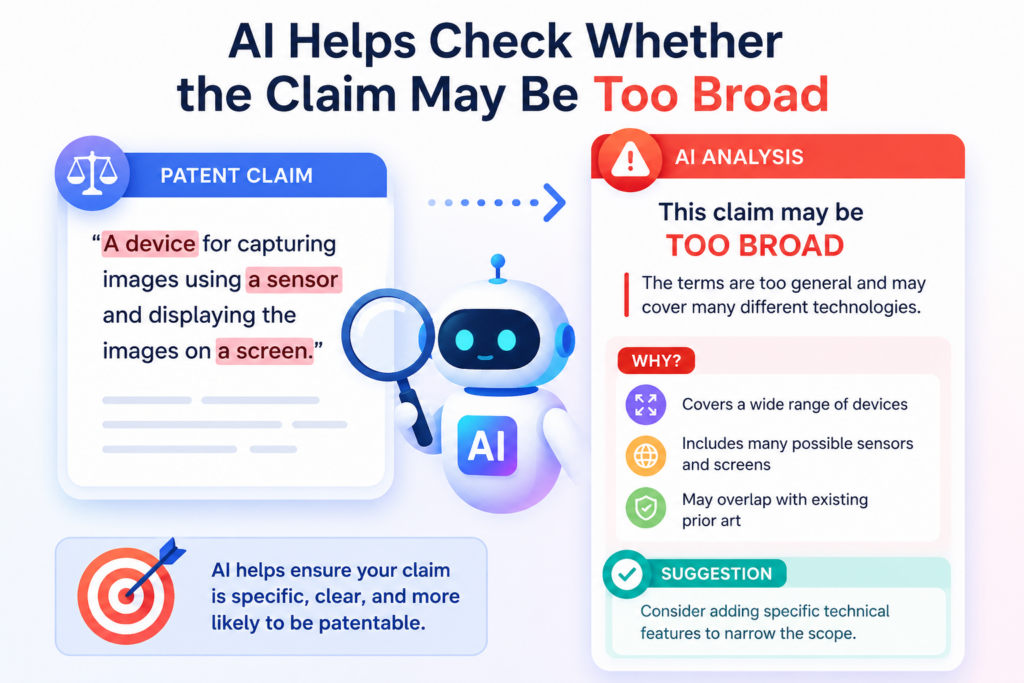
It may get rejected. It may need major changes. Or it may issue with language that looks wide but is hard to trust.
This is where AI can help the team take a more honest look. It can compare the claim against the invention details and ask whether the patent text gives enough support for the full reach of the claim.
AI can compare claim scope against the invention story
A patent claim should line up with the rest of the patent. If the claim covers several ways to perform the invention, the patent should describe those ways.
If the claim covers many types of data, devices, models, or steps, the patent should give enough detail to back that up.
AI can help spot gaps between the claim and the written description. It can flag a claim that uses wide words while the patent only explains one narrow example.
This gives the team a chance to add more detail before filing, when changes are easier.
Broad claims work best when the patent gives them strong support
Founders often want the broadest patent possible. That makes sense. A broader patent can be harder for competitors to design around.
But broad does not mean vague. Broad also does not mean unsupported.
The better goal is smart breadth. That means the claim is wide enough to protect the core invention, but clear enough and supported enough to stand up later.
AI can help find that balance. It can show where the claim might be trying to cover too much. It can also suggest where the patent may need more examples, more technical detail, or more ways the invention can be used.
For example, a startup may claim a system for “selecting an optimal model for a task.” That may be too broad if the patent only explains one use case in one field.
AI can flag that issue. The team can then decide whether to narrow the claim or add more support.
This kind of early review can save time. It can also reduce the stress of going back and fixing major claim issues later.
AI helps find missing pieces in the claim
Sometimes a claim is not wrong. It is just incomplete. It may describe part of the invention but leave out a key step.
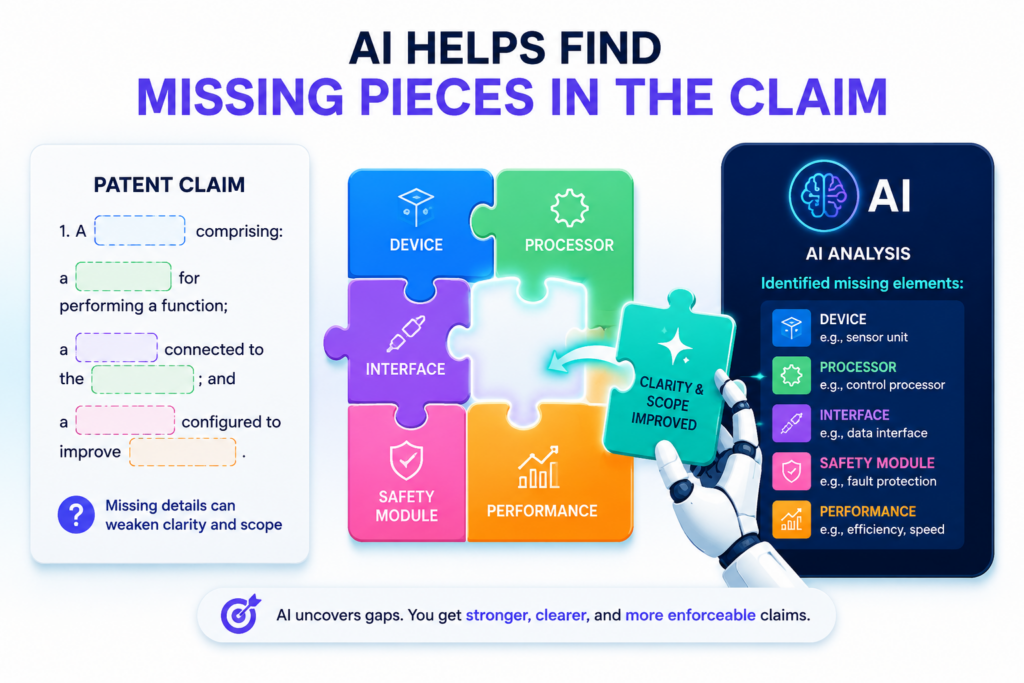
It may name a component but not explain how it connects to the rest of the system. It may claim an output but not describe the process that creates it.
These missing pieces can weaken the claim. They can also confuse reviewers, investors, or future partners who want to understand what the patent protects.
AI can check whether the claim includes the key invention steps
AI can compare the claim against the invention notes, product docs, diagrams, code comments, model flow, or founder input. It can then ask whether the claim captures the main technical steps.
This is useful because founders and engineers often explain their work in product language.
They may talk about what the feature does for the user. But a patent claim needs to capture the invention in a way that protects the technical value.
The best claims connect the problem, the method, and the result
A good claim usually tells a clear technical story. It shows what problem is being solved, what parts are used, and how the result is produced. It does not need to sound dramatic. It just needs to be clear and complete.
AI can help find places where that story breaks. For example, a claim may say that the system sends a recommendation to a user.
But it may not say how the recommendation is generated. If the invention is really about a new ranking method, that missing step is a big issue.
Or a claim may say that a robot adjusts movement based on sensor data. But it may not include the special filtering step that makes the movement stable. If that filtering step is the heart of the invention, the claim should not ignore it.
This is where AI can be very practical. It can act like a careful reviewer that never gets tired.
It can read the claim against the invention and highlight what may be missing. Then the attorney can decide how to fix it in a way that fits the patent strategy.
AI helps test whether the claim matches the real product
A patent claim should protect the real invention, not a rough idea that only sounds close. This is a common problem for fast-moving startups.

The team builds one thing, the patent draft describes another thing, and nobody notices until much later. By then, fixing it can take more time and cost more money.
AI can help close that gap. It can compare the claim against product notes, feature specs, system flows, model steps, and founder input.
It can then point out where the claim may not match what the product actually does.
The claim should follow the same path as the invention
When a founder explains an invention, they often start with the user benefit. They may say, “Our tool helps teams find risks faster,” or “Our model makes better decisions with less data.” That is useful, but it is not enough for a strong claim.
A claim needs to show the working path. It should explain what comes in, what happens inside the system, and what comes out.
If the claim skips the special part, the patent may miss the thing that makes the invention valuable.
AI can help check that path. It can ask whether the claim includes the input data, the processing step, the decision logic, the output, and the action taken by the system.
It can also find places where the claim says something the product does not really do.
This gives the founder a faster way to catch mismatch
Imagine your product uses a model that scores code changes before release. The key value is not just the score.
The value may come from how the model looks at past incidents, live test data, team behavior, and risk patterns. If the claim only says “generating a risk score,” it may be too thin.
AI can flag that gap. It can show that the claim may cover the output, but not the special way the output is made. That helps the founder and attorney strengthen the claim before filing.
This is where PowerPatent can be very useful. It helps founders bring product detail into the patent process in a cleaner way, while real patent attorneys review the work.
That means you do not have to choose between speed and quality. You can see the workflow here: https://powerpatent.com/how-it-works
AI helps find words that may create unwanted limits
Patent claims often get weaker because of small words that seem harmless. A claim may say the system “always” does something, when the product only does it sometimes.
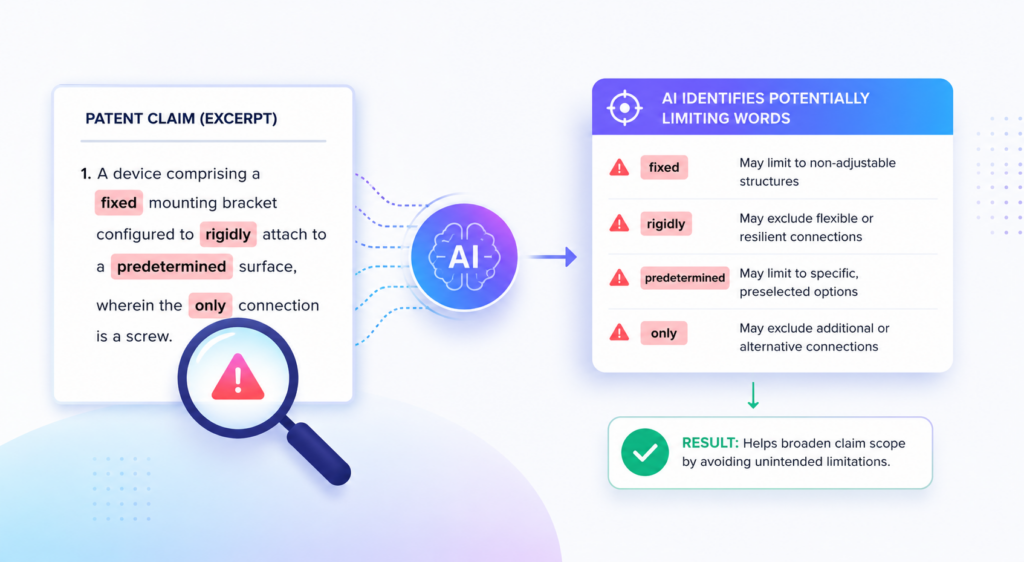
It may say the method uses “three” data sources, when the invention could work with two or ten. It may name one type of device when the idea could work across many devices.
These words can create limits. Some limits are useful. Others can make the claim easier to avoid. AI can help the team find these words before they become baked into the filing.
Small limits can change the reach of the patent
Every word in a claim matters. A word like “only,” “must,” “fixed,” “single,” “specific,” or “required” can narrow the claim. Sometimes that is needed to make the claim clear. But sometimes it gives away too much ground.
AI can scan the claim and highlight these limiting words. More importantly, it can help the team ask whether the limit is truly needed.
If the answer is yes, the word may stay. If the answer is no, the claim may need a better phrase.
For founders, this matters because competitors often design around patents by changing small details.
If your claim requires one exact step, one exact order, or one exact tool, another company may avoid the claim by doing the same core idea in a slightly different way.
Better claim review protects more versions of the invention
A startup’s product is never frozen. The first version may use one cloud service. Later versions may use another.
The first model may use one type of input. Later models may use more inputs. The first workflow may be fully automated. Later versions may include a human review step.
A claim should be checked against that likely growth. AI can help by asking whether each limit makes sense across future versions.
This does not mean every claim should be broad. It means the team should choose limits with care.
For example, a claim that requires “receiving image data from a mobile phone camera” may miss future versions that use a drone, a medical scanner, or a fixed sensor. If the invention is not truly about the phone camera, that language may be too narrow.
AI can make this review much faster. It can help founders see where a claim may lock the invention into one version.
Then an attorney can decide how to adjust the language without making the claim weak or unclear.
AI helps review the order of steps in method claims
Many software, AI, and deep tech patents use method claims. These claims describe a set of steps.
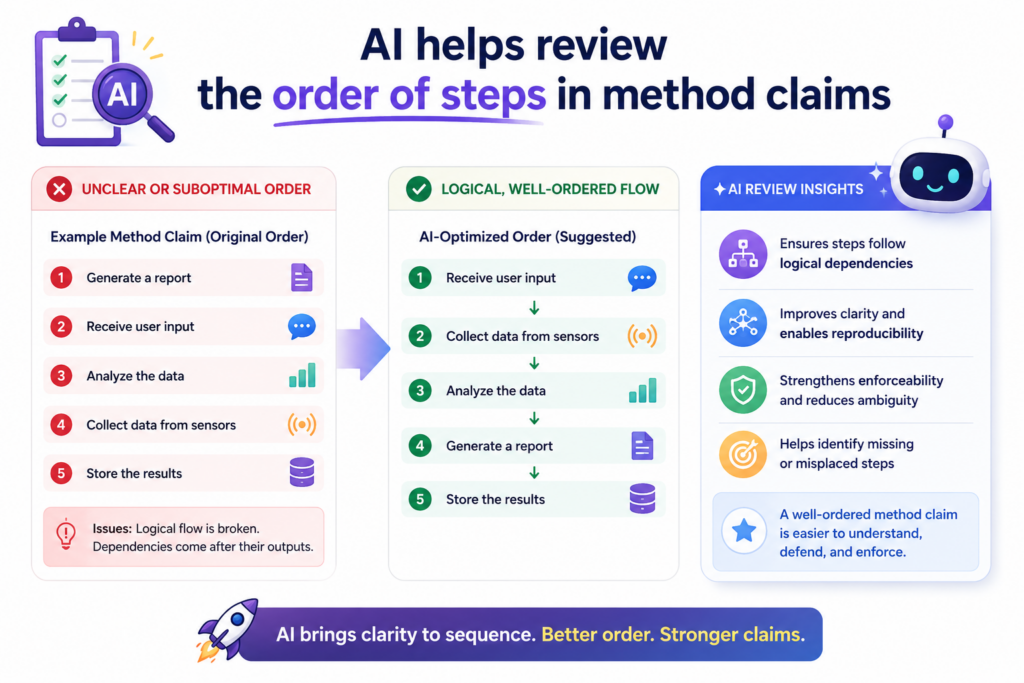
The order of those steps can matter a lot. If the claim says one step happens before another, that order may limit what the patent covers.
Sometimes the order is needed. Other times, the steps could happen in a different sequence. AI can help review whether the claim locks the invention into one order by mistake.
Step order should match how the invention really works
In a real product, some steps must happen in order. Data may need to be collected before it can be cleaned.
A model may need input before it can produce a result. A device may need a signal before it can respond.
But not every step has a fixed order. Some steps may happen at the same time. Some may happen in the background. Some may happen more than once. Some may happen only when a condition is met.
AI can help spot order words like “before,” “after,” “then,” “in response to,” and “upon.” These words are not bad. They can make the claim clear. But they should be used with care.
Flexible step language can help cover real-world use
Modern systems do not always run in neat, straight lines. A machine learning system may update in loops. A robot may process sensor data while moving.
A cybersecurity system may score risk, gather more data, and rescore the same event. A chip system may pass signals through many paths at once.
If the claim describes these systems as a simple chain of steps, it may fail to cover how the invention really works.
AI can help catch that issue. It can compare the claim language with the actual system flow and ask whether the order is too rigid.
This is very practical for engineering teams. Engineers can review the AI breakdown and quickly say whether the order is right.
They can also explain which steps are fixed and which steps are flexible. That gives the patent attorney better input.
The result is a claim that feels less like a rough sketch and more like a real map. It can be clear without being trapped in one exact sequence.
AI helps compare claim terms across the full patent draft
A patent claim does not stand alone. The same words should be used with care across the whole draft.
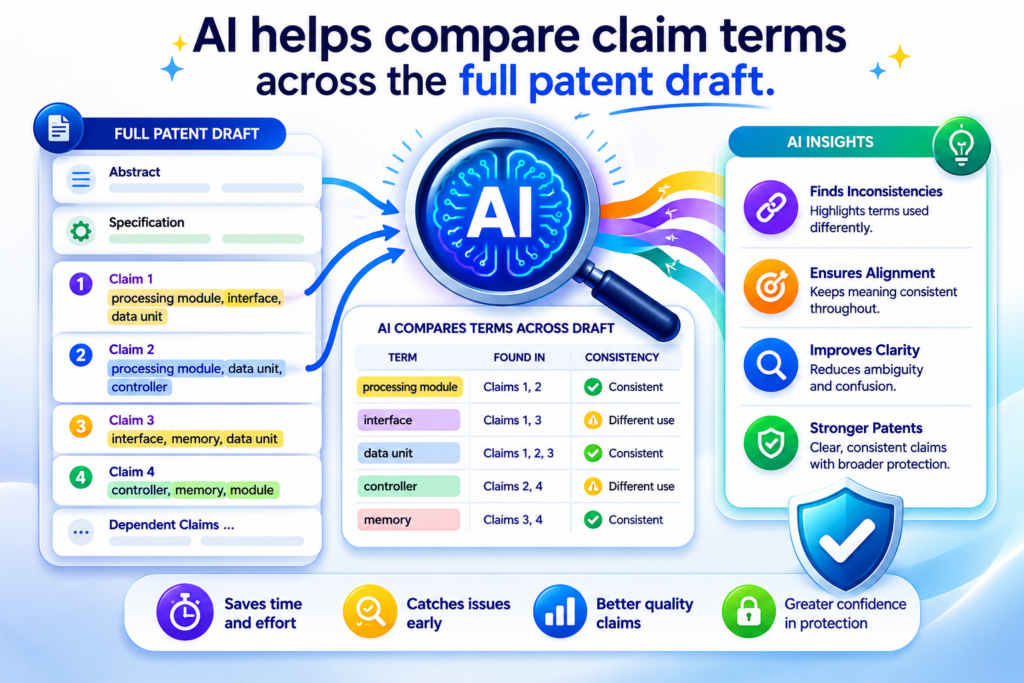
If one part of the patent says “training data,” another says “input data,” and another says “source data,” the reader may wonder whether those are the same thing or different things.
This kind of word drift can create confusion. It often happens when a team writes quickly or when many people add details to the same draft. AI can help find these issues faster than a manual review alone.
Consistent words make the patent easier to understand
Strong patent writing uses words with purpose. If two things are different, the words should show that difference. If two things are the same, the draft should not keep changing the name.
AI can scan the claims and the rest of the draft for term consistency.
It can find where a phrase changes, where a part gets renamed, or where the claim uses a word that is not explained elsewhere. That gives the team a cleaner draft.
This is not just about neat writing. Consistent terms help protect scope.
If a claim uses a key term, the rest of the patent should support that term. If the draft uses too many names for the same part, it may weaken the story.
Clean terms help both attorneys and inventors review faster
Founders and engineers are busy. They do not have time to decode messy wording. When the terms are clean, they can focus on the real question: does this protect what we built?
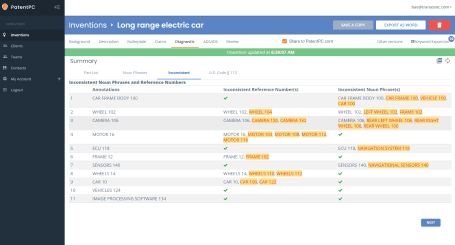
AI helps reduce noise. It can show a table-like view internally, but the real value is simple. It helps the team see whether the words line up.
It can point out that “risk signal,” “risk feature,” and “risk score input” may need clearer meaning. It can also show where a term appears in the claim but not in the description.
That gives the attorney a better starting point. Instead of spending time hunting for every mismatch, the attorney can focus on strategy, claim strength, and legal judgment.
PowerPatent uses smart tools to help make this kind of review smoother, while keeping real attorney oversight in the loop.
That is important because AI can flag issues, but experienced patent professionals still need to decide what the language should be. See how PowerPatent supports that process here: https://powerpatent.com/how-it-works
AI helps test whether the claim covers the business value
A patent is not just a technical document. For a startup, it is also a business asset. It can support fundraising, partnerships, exits, licensing, and market defense.
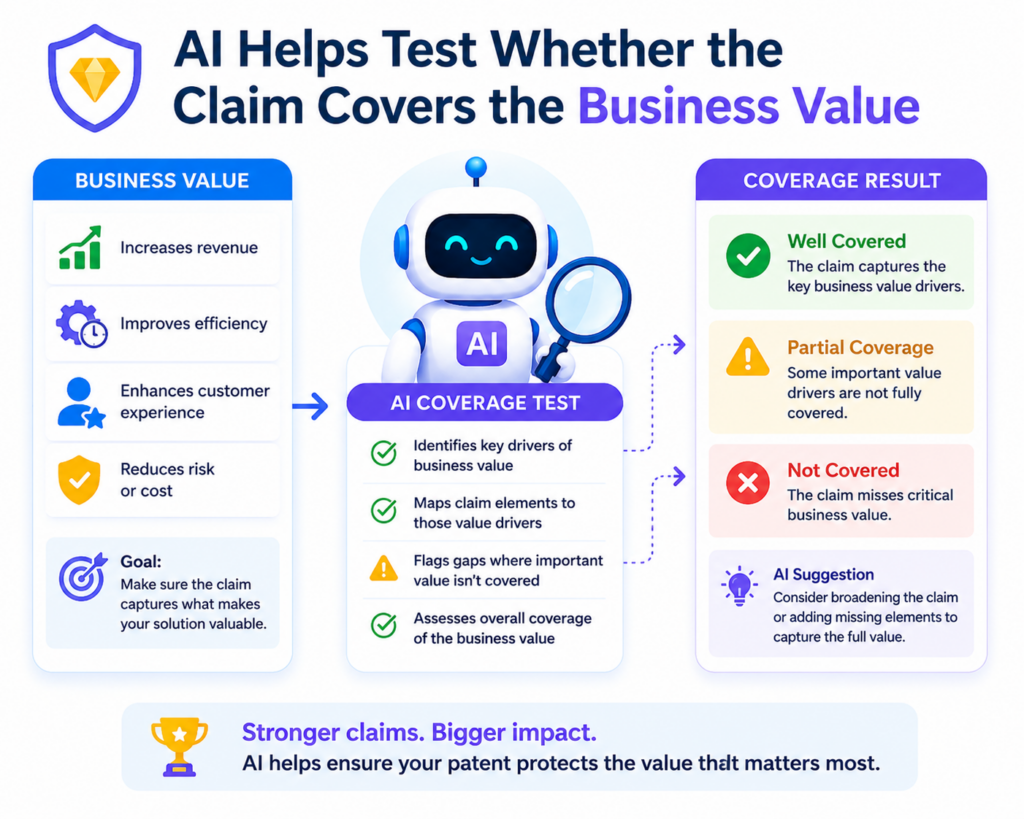
That means the claim should not only describe something technical. It should also protect the part of the invention that creates real value.
AI can help review claims through that lens. It can compare the claim against the company’s product edge, customer pain, roadmap, and moat.
The strongest claim often protects the reason customers care
A founder may build many clever things, but not all of them matter equally. Some features are nice.
Some are hard to copy. Some are central to why customers buy. The patent claim should focus on the important part.
AI can help by asking what the claim would stop a competitor from copying. If the answer is weak, the claim may need more work.
A claim that protects a small backend detail may not help much if competitors can copy the customer-facing value without using that detail.
This is not always easy to see. Engineers may focus on the hardest technical part. Founders may focus on the biggest customer benefit. The right claim often needs both views.
Better scope starts with knowing what must be protected
For example, an AI health startup may have a model that predicts patient risk. The real value may not be just the prediction.
It may be how the system combines missing data, doctor notes, lab trends, and time-based changes to produce a safer alert.
If the claim only protects the alert, it may be weak. If it only protects one model type, it may be too narrow. If it protects the special data handling and decision path, it may be much stronger.
AI can help guide that discussion. It can show where the claim lines up with the business value and where it does not. It can also help founders prepare better notes for the attorney, which can lead to a stronger filing.
This is one reason PowerPatent is built for founders who need speed without giving up control.
It helps turn invention details into patent work that is clear, focused, and reviewed by real attorneys. Learn more here: https://powerpatent.com/how-it-works
AI helps find claim language that may be hard to prove
A patent claim should not only sound strong on paper. It should also be useful in the real world. One big part of that is proof. If another company uses your invention, can you tell?
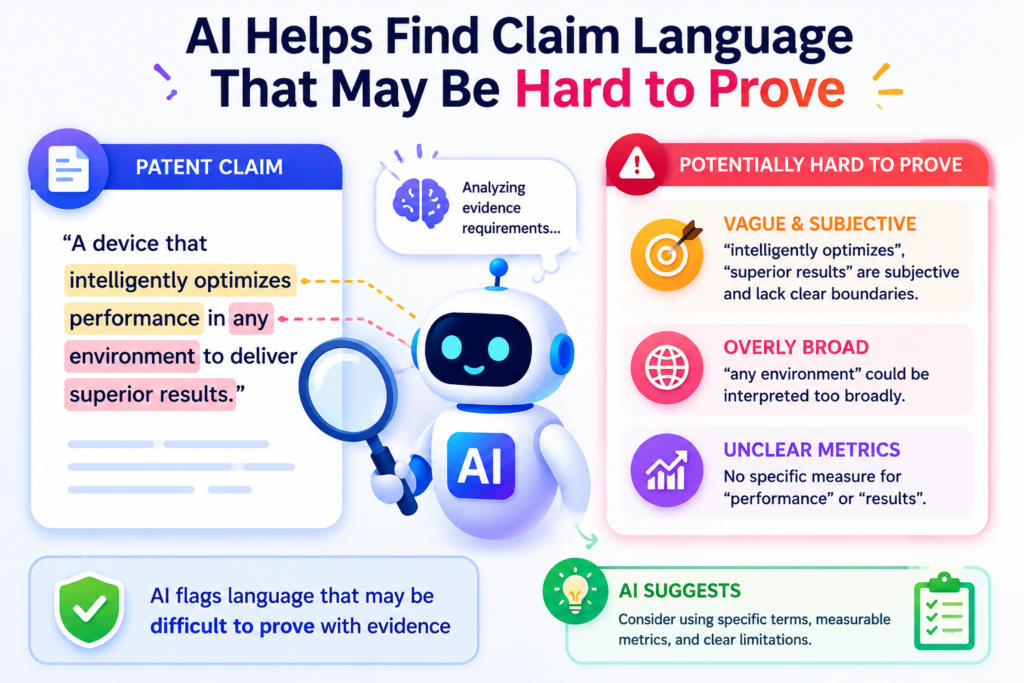
Can you point to facts that show they are doing what the claim says? If the answer is no, the claim may be hard to use later.
This is easy to miss during drafting. A claim may include steps that happen deep inside a system, behind a server, inside a private model, or within hidden code.
Those steps may be real and important, but they may be hard to see from the outside.
AI can help test whether each claim part can be observed
AI can review each part of a claim and ask a practical question: how would someone know this step is being used?
That question is simple, but it is very powerful. It pushes the team to think beyond the draft and look at how the patent may work in the market.
For example, a claim may require that a model uses a certain hidden training method. If that method cannot be seen from public product behavior, public docs, customer use, or system outputs, the claim may be harder to prove.
That does not always mean the claim is bad. It may still be worth filing. But the founder and attorney should know the tradeoff.
AI can help mark these hidden parts. It can also help show which claim parts are easier to observe, such as user steps, system outputs, data flows, public interface behavior, device actions, or visible changes in performance.
A claim is stronger when it protects value you can actually track
This does not mean every claim must be based only on visible features. Some deep inventions happen inside the machine.
But a smart patent plan often includes claims that cover both the deep technical method and the outside behavior linked to that method.
AI can help founders see this split. One claim may focus on the core model process. Another may focus on how the system receives data and produces a clear output.
Another may focus on how the device acts after the output is made. This gives the patent more useful angles.
For startups, this matters because patents are not just filed for decoration. They should help protect the company.
They should support investor trust. They should make copycats think twice. A claim that cannot be understood or tracked may not carry as much weight.
PowerPatent helps founders build a stronger review loop around these questions.
The software helps organize the invention, and real patent attorneys help shape claims with practical value. You can see how that works here: https://powerpatent.com/how-it-works
AI helps review whether the claim uses the right level of detail
A strong claim needs the right amount of detail. Too little detail can make the claim vague or unsupported.
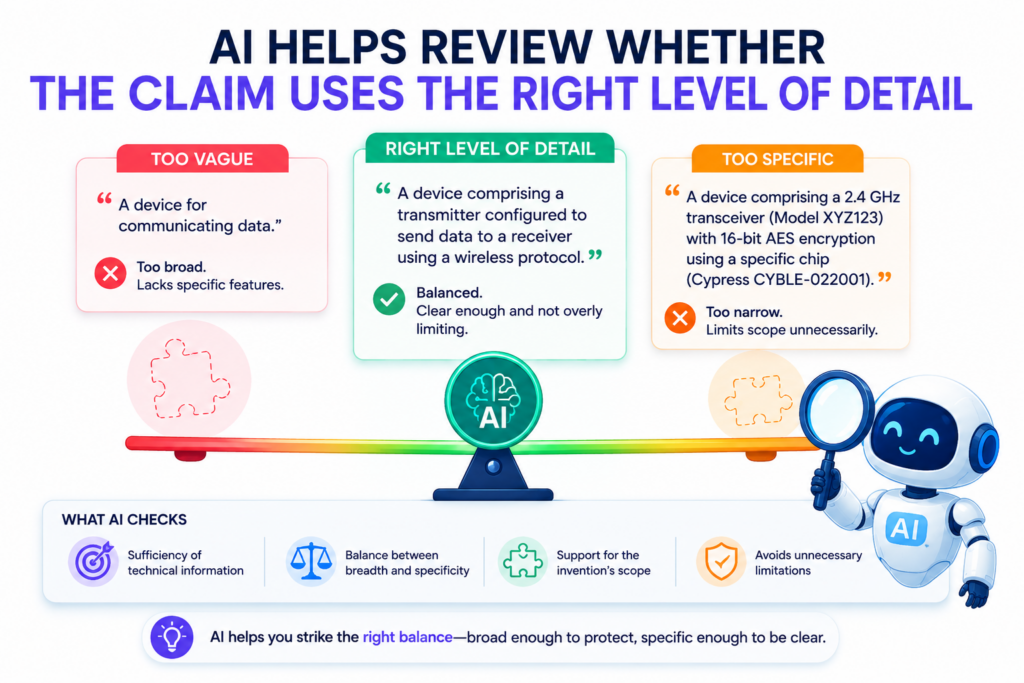
Too much detail can make the claim narrow and easy to avoid. The hard part is finding the middle. This is where AI can help the drafting team move with more care.
Founders often think more detail always means a better patent. Engineers may want to include every special setting, step, model, tool, and rule.
That level of detail can be useful in the full patent text, but it may not always belong in the broadest claim.
AI can separate core details from extra product details
AI can compare the claim to the invention and help sort what appears central from what appears optional.
It can ask whether a feature is required for the invention to work or whether it is just one version of the product.
For example, a system may use a dashboard, but the invention may not be the dashboard. The invention may be the way the system detects risk and sends a control signal.
If the claim requires the dashboard, the claim may miss other versions that use an API, a text alert, or an automated action.
The same issue appears in AI inventions all the time. A team may use a certain model type today.
But the real invention may be the training data flow, the feedback loop, or the way the model updates after deployment. If the claim is tied too closely to today’s model, it may not cover tomorrow’s version.
The best detail is the detail that protects the reason the invention works
Good claim detail should do a job. It should make the claim clear. It should support the scope. It should show the part that makes the invention different. It should not be there just because the current product happens to include it.
AI can help by flagging claim parts that look like implementation choices.
These may include a certain screen, a vendor tool, a file type, a fixed number, a sample threshold, or one exact data format. Some of those details may matter. Many may not.
This gives founders a better way to talk with the patent attorney. Instead of asking, “Is this claim good?” the team can ask a sharper question: “Which details protect the core invention, and which details only describe our first version?”
That kind of review can lead to better patents. It also helps founders feel more in control.
They can see why the claim says what it says, instead of treating the patent as a black box.
AI helps check whether claim scope matches the startup’s roadmap
A startup patent should not only protect what exists today. It should also support where the company is going.
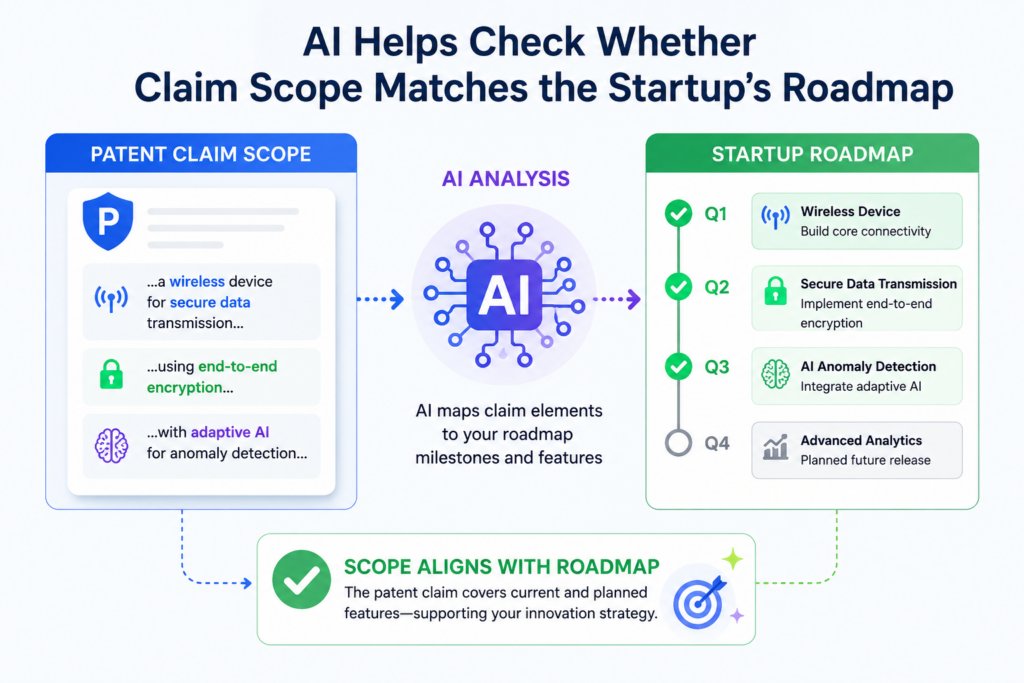
Your product may grow into new markets, new users, new devices, new data types, or new workflows. If the claim is written only around the current build, it may lose value as the company grows.
AI can help review claims against the roadmap. It can compare the current claim language with planned product paths and show where the claim may be too tied to one version.
The roadmap can reveal hidden scope problems
Founders often have future use cases in their heads, but those ideas may not make it into the patent draft.
The team may be moving fast, and the patent may be based on one demo, one deck, or one sprint. AI can help pull the larger picture into view.
For example, a climate tech startup may first use its system for factory energy control.
Later, the same invention may apply to buildings, batteries, or grid systems. If the claim only covers factory machines, it may miss the larger value.
A robotics startup may first build for warehouses. Later, the same motion planning method may work in hospitals or farms. If the claim is locked to warehouse shelves, the startup may have left value on the table.
Claims should protect the path the company is likely to take
This does not mean the patent should claim every dream the founder has. That would not be smart. The claim still needs support. The patent still needs a real invention.
But when the roadmap shows near-term and realistic uses, those uses should be considered during claim review.
AI can help by asking whether the claim covers alternate settings, alternate data sources, alternate devices, and alternate users that are part of the company’s plan.
It can also point out when the claim uses words that may block those future uses.
This can be a major advantage during fundraising. Investors often want to know whether the company has protection around the big market, not just the first pilot. A stronger claim set can help show that the patent plan matches the business plan.
PowerPatent is designed for this kind of founder-led review. It helps bring product, technical, and business context into the patent process, with attorney oversight to keep the work grounded.
See how PowerPatent helps founders move faster here: https://powerpatent.com/how-it-works
AI helps make claim review faster without making it careless
Speed matters for startups. You may need to file before a launch, before a demo day, before a pitch, before a public paper, or before a customer rollout.
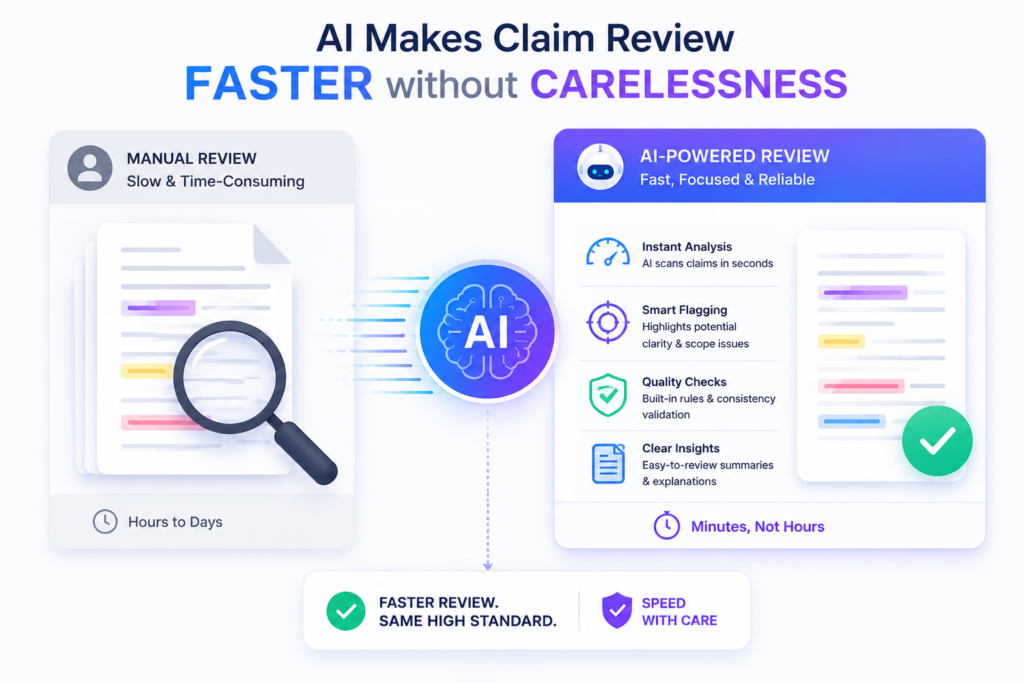
Waiting weeks for slow back-and-forth can create risk. But speed should not mean rushing into weak claims.
AI helps by cutting down the slow parts of review. It can read drafts quickly, compare terms, flag unclear words, find missing steps, and show possible scope issues. This gives the attorney and founder a cleaner starting point.
AI can handle repeat checks that slow people down
Much of claim review involves careful pattern checking. Are the same terms used the same way? Does the claim match the description?
Are the steps in the right order? Are there unsupported broad phrases? Are there narrow words that may not be needed?
AI is useful for this kind of work because it can keep checking without getting tired. It can review the same claim from different angles.
It can compare many parts of the draft quickly. It can help the team find issues that might be missed during a rushed manual pass.
But speed alone is not the goal. The goal is better review in less time. That means AI should support human judgment, not replace it.
Fast review works best when a real attorney makes the final call
Patent claims are too important to leave fully to software. AI can flag issues, but it does not know your full business plan, your risk tolerance, your investor needs, or the legal strategy behind the claim set.
A real patent attorney can weigh those points and decide what to do.
This is why the best model is not “AI alone.” The best model is AI plus expert review. The AI helps surface issues early. The founder brings product truth. The attorney shapes the final claim strategy.
That mix gives startups a better path. You move faster, but you are not guessing.
You get clearer claims, but you do not have to become a patent expert. You stay focused on building, while the patent process becomes easier to understand.
This is the core idea behind PowerPatent. It combines smart software with real patent attorney oversight, so founders can move with speed and confidence. Learn more here: https://powerpatent.com/how-it-works
AI helps founders give better input to their patent attorney
A patent attorney can do much better work when the founder gives clear input. The problem is that many founders do not know what details matter.
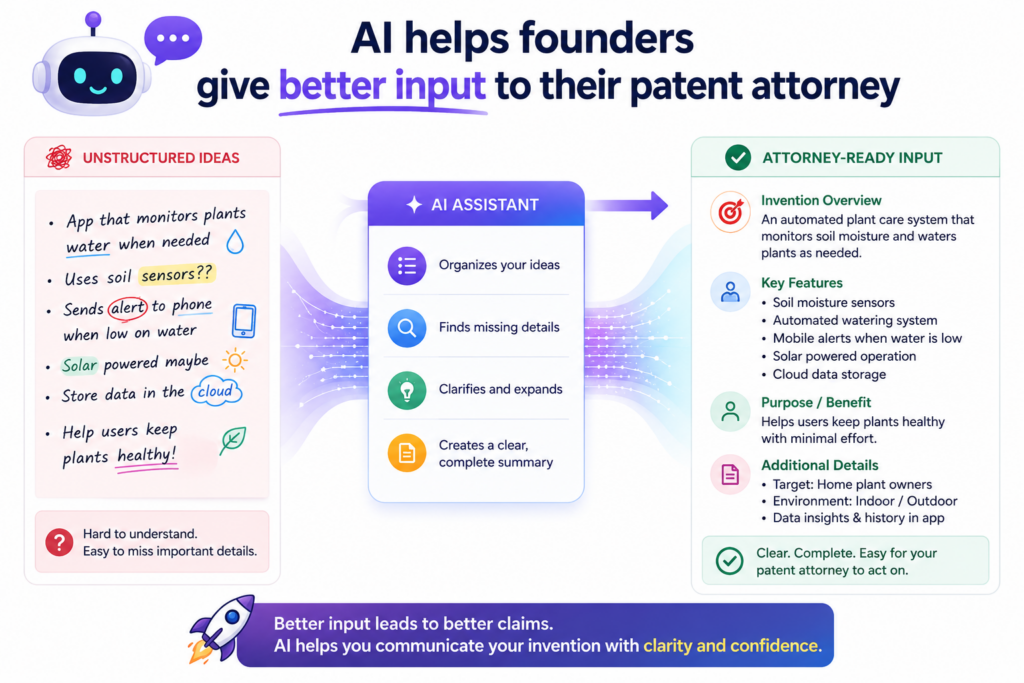
They may send a pitch deck, a product screenshot, or a short feature note and hope it is enough. Sometimes it is not.
AI can help founders prepare better invention input before and during claim review. It can ask sharper questions. It can point out gaps. It can turn rough notes into a cleaner technical story that the attorney can use.
Better founder input leads to stronger claim choices
A strong claim often depends on small technical facts. What data is used? What is changed? What is new about the flow?
What happens if the system does not use the invention? Which step creates the better result? Which parts are required and which are optional?
Founders may know these answers, but they may not write them down. AI can help draw those answers out.
It can review the claim and ask where the invention detail is thin. It can help the founder explain the invention in a way that is useful for claim drafting.
This makes the attorney’s job more focused. Instead of spending time trying to guess what the invention is, the attorney can spend more time building the right protection.
Clear input helps avoid weak claims and slow rewrites
When invention input is thin, the claim may become too generic. It may sound like many other patents. It may miss the real edge. Or it may need several rounds of rewrite once the attorney learns more.
AI can reduce that problem. It can help founders provide details earlier. It can also help engineers review the claim in plain language and confirm whether it matches the system.
This makes the whole process smoother. The founder feels less lost. The attorney gets better facts. The claim can become clearer and more focused.
For a busy startup, that is a real win. You do not need a slow, painful patent process. You need a guided process that helps you protect what matters while you keep building.
PowerPatent helps make that possible with smart tools and attorney-backed review. You can explore the process here: https://powerpatent.com/how-it-works
AI helps review claim clarity before the draft reaches a hard deadline
Startups often file patents under pressure. A product launch may be close. A customer demo may be set.
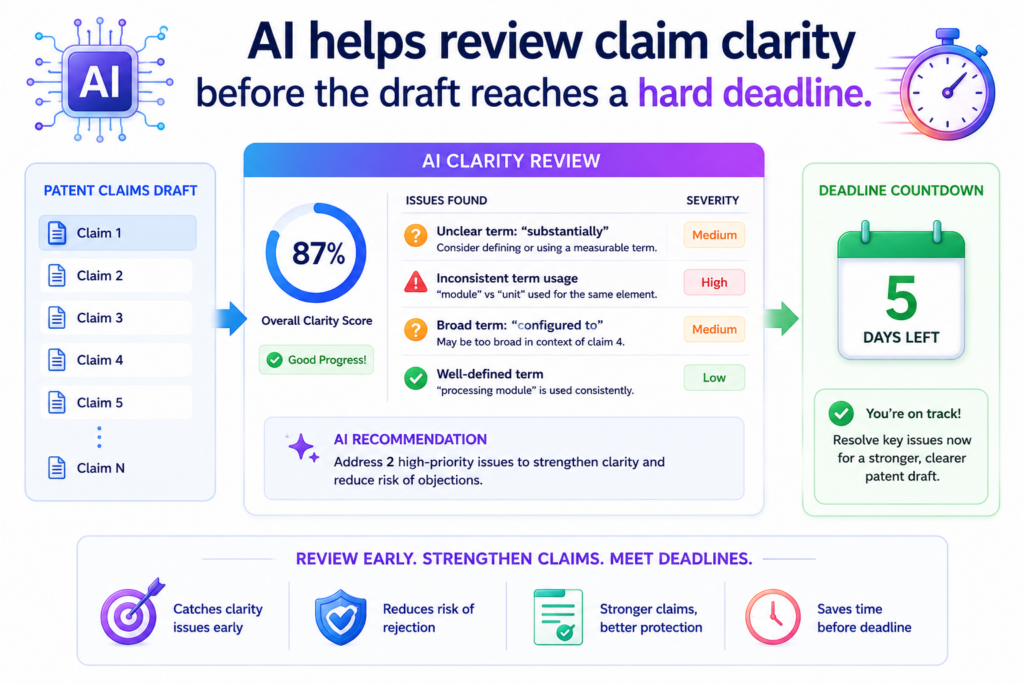
A founder may be about to publish a paper, speak at an event, share a deck, or open access to a new feature. When that happens, claim review can feel rushed.
That rush is risky. Claims are too important to check at the last minute with tired eyes. A weak claim may still get filed, but it may not protect the invention well.
A confusing claim may create delays later. A claim that misses the main idea may fail to support the company when it matters.
AI can help by giving the team an early claim check before the final legal review. It can catch problems while there is still time to fix them.
It can also help founders understand what needs attention, so they do not send vague feedback like “looks good” when the claim actually needs work.
AI can make early review feel less overwhelming for busy founders
Most founders are not trained to review claims. That is normal. You may know your product deeply, but patent claim language can still feel strange. It is easy to miss a problem because the words sound formal and polished.
AI can make the claim easier to inspect. It can explain what the claim appears to require. It can show which parts seem central.
It can point out unclear phrases, missing links, and words that may narrow the claim too much.
This turns review into a more practical task. Instead of asking, “Do I understand patent law?” the founder can ask, “Does this match what we built?” That is a much better question for a technical team.
The best early review gives the attorney better facts before filing
AI does not replace the attorney’s role. It helps prepare the ground. When the founder can give clearer comments, the attorney can make better choices faster.
For example, the founder may notice that the claim requires a user to press a button, but the product may later run fully in the background.
That is useful input. The attorney can decide whether the claim should be adjusted to cover both versions.
The founder may also notice that the claim leaves out the real signal processing step, the key model update, or the special control loop. AI can help bring those missing parts to the surface.
This matters because the best patent work is not built from guesswork. It is built from clear invention facts.
PowerPatent helps founders gather and review those facts with smart software and real attorney oversight, so teams can file with more confidence and less stress. You can see how it works here: https://powerpatent.com/how-it-works
AI helps review whether the claim has clear boundaries
A patent claim should tell the world where the protected space begins and ends. If the boundary is fuzzy, the claim can become harder to understand and harder to trust. Good claim review is really a boundary check.
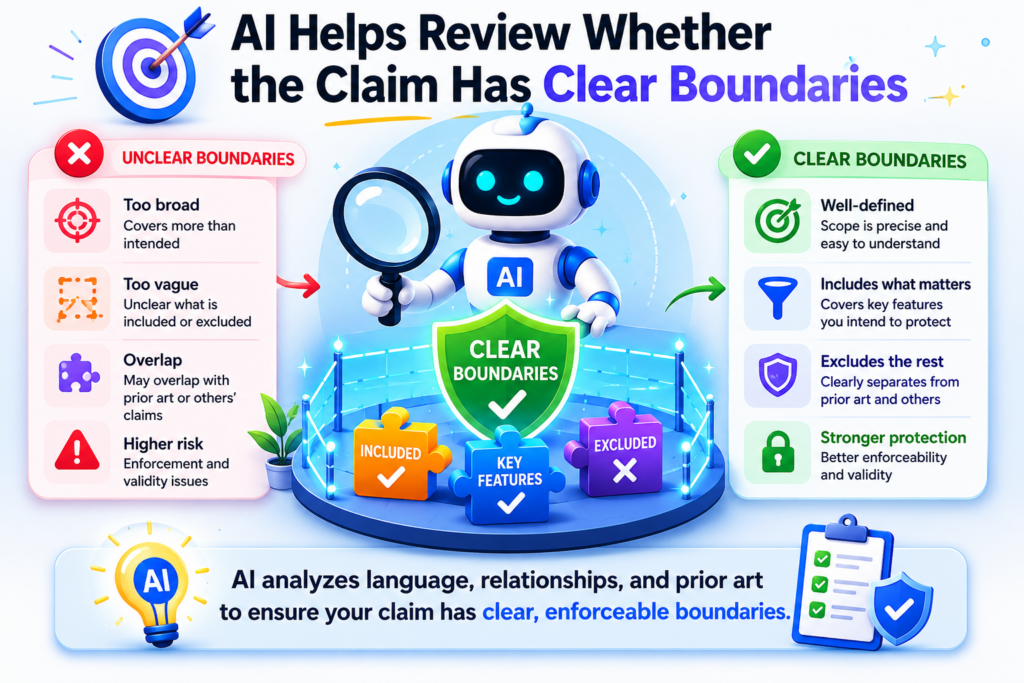
This is especially important for software and AI inventions. Many products use common words like data, model, score, engine, profile, signal, module, and rule.
Those words can be fine, but they need enough meaning around them. A claim that says too little may leave the reader guessing.
AI helps by checking whether each part of the claim has a clear role. It can ask whether the claim shows what the system receives, what it changes, what it produces, and how those pieces connect. That makes the boundary easier to see.
Clear boundaries help prevent confusion later
When a claim has clear boundaries, a founder can explain it more easily. An investor can understand the protected area faster.
An attorney can defend the strategy with more confidence. A future partner can see why the patent matters.
Unclear boundaries create the opposite effect. People may read the claim and still not know what is protected.
They may wonder whether the claim covers the product, the backend method, the model pipeline, the device action, or only one small feature.
AI can help identify this kind of confusion. It can point out claim terms that are introduced without enough context. It can also flag claim parts that seem disconnected from the rest of the invention.
A clear boundary does not mean a narrow claim
Some founders worry that making a claim clearer will make it smaller.
That is not always true. In many cases, clarity can make a claim stronger. A claim can be broad and clear at the same time when it focuses on the core invention.
For example, a claim that protects “processing data to improve output” may sound broad, but it may be too vague.
A clearer claim may explain the specific data relationship, the special update step, or the decision path that creates the result. That claim may still be broad, but now it has a real shape.
AI can help find that shape. It can show where the claim is too abstract and where it needs a more concrete anchor. It can also help the team avoid adding details that do not matter.
The goal is not to make the claim long. The goal is to make the claim useful. A useful claim gives enough detail to mark the protected space without trapping the invention inside one tiny product version.
AI helps review dependent claims for smarter backup protection
Many founders focus only on the first claim because it looks like the main one. But dependent claims matter too. They add backup positions.
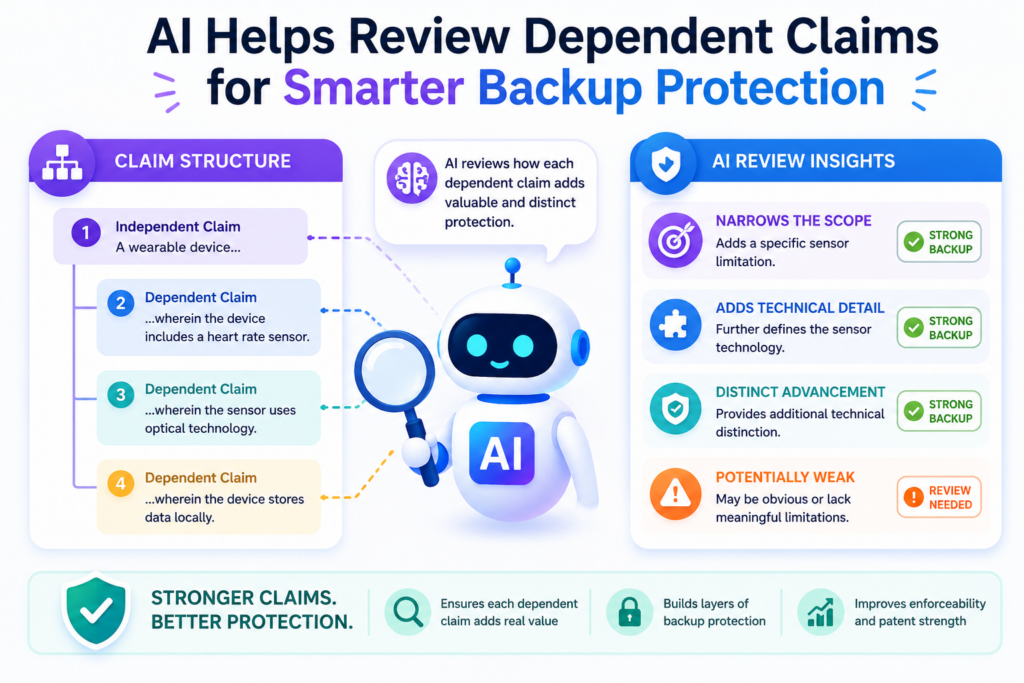
They can protect narrower versions of the invention. They can help preserve value if the broadest claim needs to change during patent review.
AI can help check whether these dependent claims are doing real work. This is important because weak dependent claims often repeat the same idea with small wording changes.
That does not help much. Good dependent claims should add useful layers of protection.
AI can compare the dependent claims to the main claim and ask whether each one adds a meaningful feature, a practical version, or a stronger fallback.
Backup claims should protect real product and market paths
A dependent claim should not feel random. It should connect to how the invention may be used, sold, deployed, or expanded.
It may cover a key model type, a special data source, a hardware setting, a safety step, a feedback loop, or a high-value customer use.
AI can help review whether the claim set reflects those paths. It can flag dependent claims that are too thin, too repetitive, or too disconnected from the product. It can also suggest areas where backup coverage may be missing.
For a startup, this can be very valuable. Your broad claim may face pushback. That is common. Strong backup claims can help keep meaningful protection alive.
A strong claim set gives the patent more than one way to win
Think of the main claim as the wide front door. The dependent claims are the other strong doors around the house. They should not all lead to the same place. They should protect different useful angles.
For example, an AI logistics startup may have a broad claim around dynamic route planning.
Strong dependent claims might cover how the system handles missing sensor data, how it updates routes based on warehouse congestion, how it predicts delay risk, or how it sends control commands to machines. Each layer should protect something real.
AI can help founders and attorneys see whether those layers are present. It can also help connect each dependent claim to a real technical or business reason.
This is where PowerPatent’s approach can make the process smoother. The software helps organize the invention and review the claims, while real attorneys help decide which backup positions matter most.
That combination helps startups avoid shallow filings and build stronger patent assets. Learn more here: https://powerpatent.com/how-it-works
AI helps review whether the claim reads like an invention, not a feature description
A feature description tells what the product does. A patent claim should protect how the invention works. That difference matters.
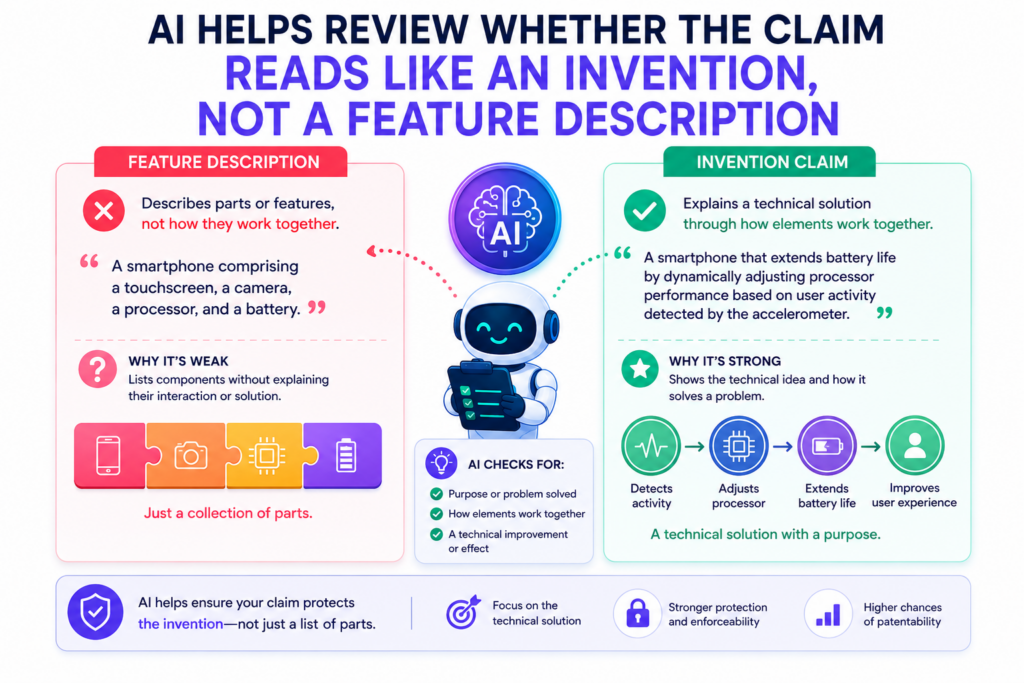
Many startup patent drafts become weak because they read like product copy. They describe benefits, screens, user actions, or outcomes, but they do not clearly claim the technical path behind those outcomes.
AI can help spot this problem. It can review the claim and ask whether it explains the actual mechanism or only states the result.
This is one of the most useful checks for founders because product teams naturally speak in outcomes.
A founder may say, “Our system gives better alerts.” An engineer may say, “Our pipeline normalizes noisy event streams before risk scoring.”
The second statement is often closer to the invention. AI can help move the review toward that deeper level.
Claims should protect the working method behind the result
A claim that only names a result may not be enough. It may say the system improves speed, accuracy, safety, routing, diagnosis, search, or control.
Those outcomes may be true, but the claim should also show what the invention does to create them.
AI can look for result-heavy language. It can flag places where the claim says what happens but not how.
Then the team can add or adjust language so the claim points to the real technical work.
This does not mean the claim must include every engineering detail. It means the claim should not hide the invention behind a broad promise.
The strongest claims often turn product value into technical protection
The magic happens when the claim connects customer value to technical structure. That is how a patent becomes more than a document. It becomes a business tool.
For example, a security startup may say the product “reduces false alerts.” That is the value.
But the invention may be a new way to group events, compare them to past attacks, remove low-risk noise, and adjust scores based on live behavior. A stronger claim should aim at that working method.
AI can help draw out this link. It can compare the claim with product notes and ask whether the technical reason for the value is present.
It can also help founders explain that reason more clearly to the attorney.
That matters because the best patents protect the thing competitors would want to copy. Not the slogan. Not the dashboard. Not the marketing promise. The real engine.
AI helps create a better review loop between founders, engineers, and attorneys
Patent claims get better when the right people can review them in a clear way. The founder understands the business.
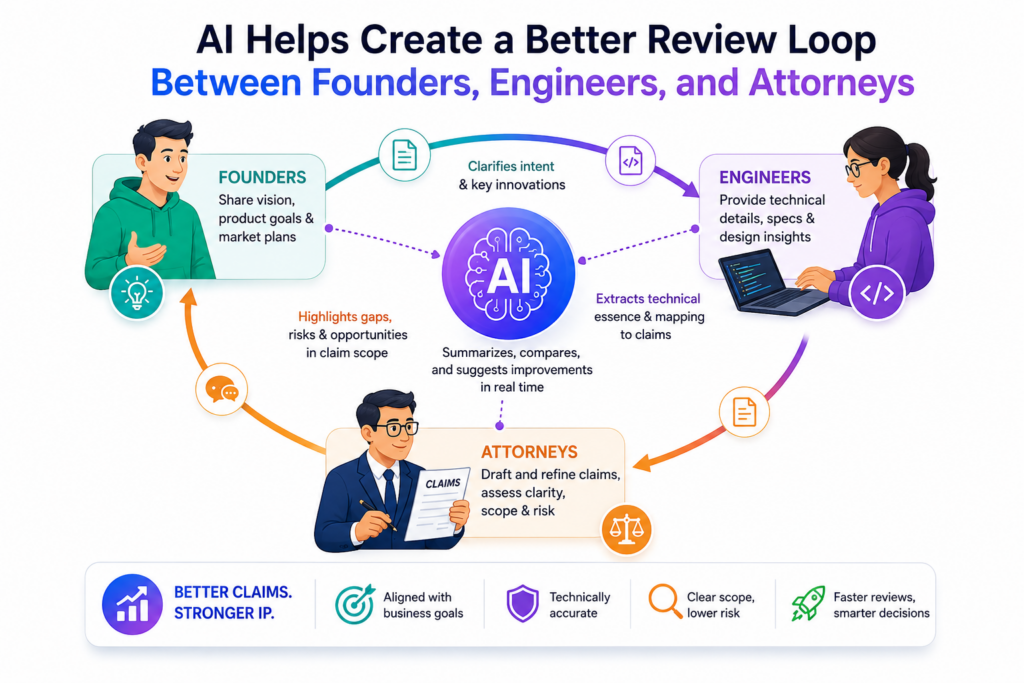
The engineer understands the build. The attorney understands claim strategy. When those three views come together, the patent is more likely to protect the invention well.
The problem is that these groups often speak different languages. Founders speak in market value.
Engineers speak in systems and tradeoffs. Attorneys speak in claim terms. AI can help translate between those worlds.
AI can explain claims in plain words, pull out technical parts, highlight scope choices, and help the team focus on the decisions that matter.
A shared review loop helps prevent silent mistakes
Silent mistakes happen when each person assumes someone else checked the important part. The founder assumes the attorney understood the product. The attorney assumes the draft matches the technical notes.
The engineer assumes the claim language has a legal reason. Nobody is careless, but the process still leaves gaps.
AI can help reduce those gaps by making the claim easier to review from more than one angle. It can show the founder what business value the claim appears to cover.
It can show the engineer what technical steps are required. It can help the attorney see where the team may need to clarify facts.
This makes review more active. It also makes feedback more useful.
Strong patents come from clear teamwork, not blind handoffs
The old way of filing patents often feels like a handoff. The founder sends notes. Someone drafts a patent. The founder reviews a dense document. Everyone hopes it works.
That is not ideal for fast-moving startups. A better process feels more like a guided build. The team can see what is being protected, where the risks are, and what decisions need to be made before filing.
AI helps make that possible, but attorney oversight is still key. The software can surface issues and speed up review. The attorney brings judgment. The founder brings context. The engineer brings truth from the system.
PowerPatent is built for this modern way of working. It helps founders move from invention to stronger patent work with smart software and real patent attorneys in the loop.
See how PowerPatent helps teams protect what they are building here: https://powerpatent.com/how-it-works
Conclusion
AI makes patent claim review faster, clearer, and more useful, but the real win comes when AI works with skilled human review. For founders, this means less guesswork, fewer slow rewrites, and a better chance of protecting the true value of the invention.
Clear claims help show what is covered, what may be too narrow, what may be too broad, and what needs stronger support. PowerPatent brings smart software and real patent attorney oversight together, so startups can protect what they are building with more speed and confidence. See how it works here: https://powerpatent.com/how-it-works