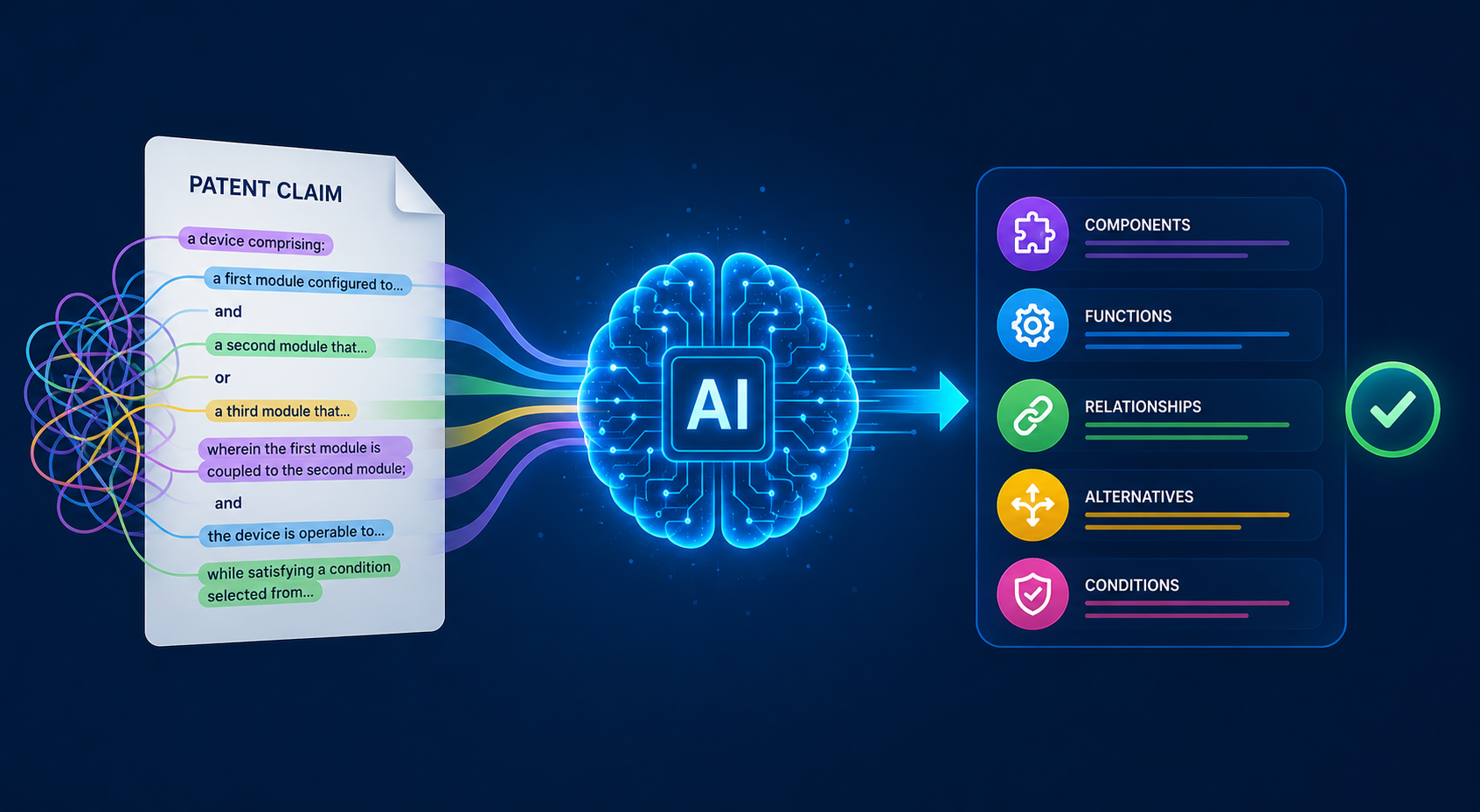
A strong patent claim is not just one big idea. It is often a chain of small parts that work together. Each part matters. Each step matters. Each limit in the claim can decide what is protected, what is left open, and what a competitor may try to work around.
Multi-limitation claims are hard because every small part has to work with every other part
A complex patent claim is like a map of how your invention works. It does not just say, “Here is the product.”
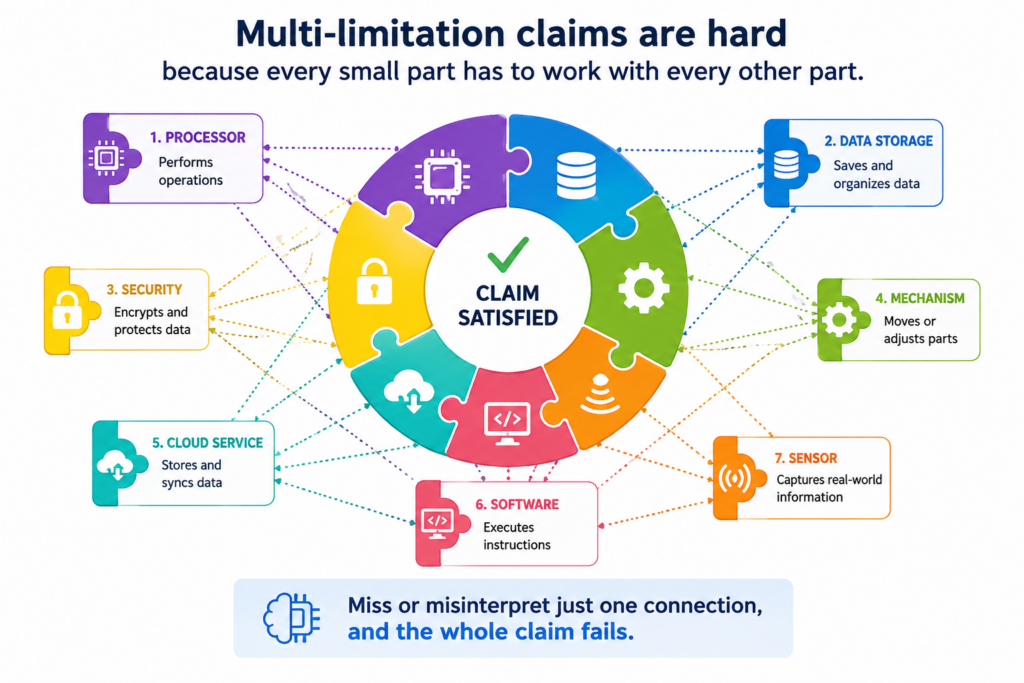
It says what parts are needed, how those parts connect, what each part does, and what makes the whole thing different from what already exists.
That is where many founders get stuck. The invention may feel clear in your head. It may also feel clear in your code, your model, your hardware, your workflow, or your demo.
But a patent claim is not a pitch deck. It is not a product page. It is not a short note that says, “We use AI to improve this process.” It has to draw a clear line around the invention.
That line is built with limits. A limit is a part of the claim that narrows what is covered. In a simple claim, there may be only a few limits. In a complex claim, there may be many.
For example, one claim might mention a sensor, a trained model, a data filter, a ranking step, a control signal, and a feedback loop. Each piece may sound simple by itself. The hard part is making sure all of them fit together in a way that protects the real invention.
A claim can look strong but still miss the point
Many weak claims do not look weak at first. They may be long. They may sound technical. They may include many parts.
But length does not equal strength. A claim can include many words and still fail to protect the most valuable part of the invention.
This happens when the claim focuses on surface details instead of the core idea. A founder may describe the screen, the server, the app, or the data format, but miss the deeper system that makes the invention hard to copy.
Or the claim may include too many narrow details, which can make it easier for someone else to avoid the patent by changing one small step.
This is why complex claims need careful thinking. The goal is not to make the claim sound fancy. The goal is to make it clear, useful, and hard to work around.
AI helps by turning a messy invention story into smaller claim parts
AI is useful because it can break a large invention into pieces. It can read a draft, a product note, a technical summary, or a set of engineering details and find the parts that may belong in a claim.
It can separate the input, the process, the output, and the feedback. It can also spot places where the draft jumps from one idea to another too fast.
This matters because founders often explain inventions in the same way they built them.
They start with the problem, then jump to the fix, then talk about the model, then mention the user flow, then return to the data system. That is normal. But a claim needs a cleaner path.
AI can help create that path. It can ask what receives the data. It can ask what changes the data. It can ask what decision is made. It can ask what action follows that decision.
It can ask whether the result improves speed, accuracy, safety, cost, control, or some other real-world outcome.
That does not replace a patent attorney. It gives the attorney and founder a better starting point. It helps the team move from “we built something cool” to “here are the claim parts that may matter.”
PowerPatent is built around this idea. The software helps turn technical work into a clearer patent draft, while real patent attorneys review the result so founders are not left guessing. You can see how that works here: https://powerpatent.com/how-it-works
The real value is seeing what each limit does
A good claim does not throw in parts at random. Each limit should have a reason to be there. It should help explain the invention, separate it from older ideas, or protect a key step that makes the system valuable.
When AI handles a complex claim, one helpful job is to map each limit to its role. Some limits define the structure. Some define the order of steps. Some define the data being used.
Some define how a model is trained or applied. Some define the final action. Some define the improvement.
This kind of mapping helps founders see the claim more clearly. It also helps reveal weak spots.
If a limit has no clear job, it may be extra weight. If a key feature is missing, the claim may be too broad in the wrong place or too thin where it matters most.
A smart claim review starts with asking what would happen if one limit were removed
One practical way to test a claim is to remove one limit in your mind and ask what changes. If nothing important changes, that limit may not be doing much work.
If removing it makes the claim lose the invention’s main value, that limit may be central.
AI can make this review faster. It can walk through each part and show how it supports the full claim. It can also flag unclear words, missing connections, and claim parts that may not match the rest of the invention story.
For a busy founder, this is a major win. You do not want to spend weeks going back and forth just to understand what your claim says.
You want a clear view fast, so you can protect the invention and keep building.
That is where PowerPatent helps. It gives technical teams a more direct way to move from invention details to stronger patent work, with smart tools and real attorney oversight working together. Learn more here: https://powerpatent.com/how-it-works
AI handles complex claims by building a clear logic chain from start to finish
A complex claim is not just a list of parts. It is a logic chain. One part leads to the next. Data is received, changed, compared, ranked, trained on, filtered, displayed, stored, or used to trigger an action.
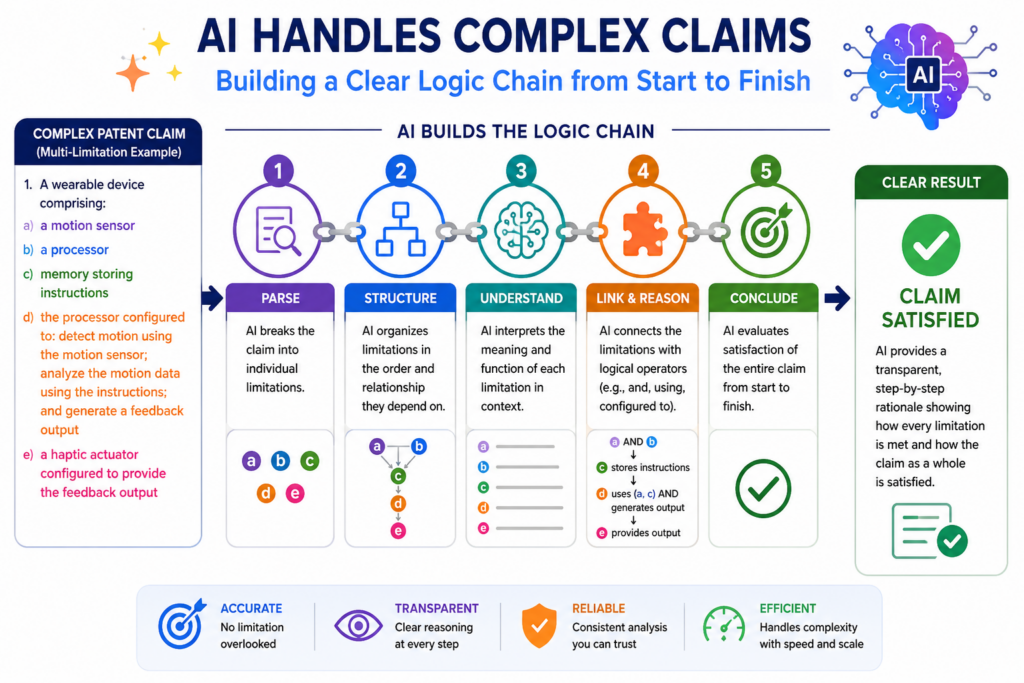
A device senses something, a processor decides something, a model predicts something, and a system responds in a specific way.
When that chain is clear, the claim is easier to understand. When the chain is broken, the claim becomes risky. A broken claim may leave the reader asking basic questions.
Where did this data come from? What uses this value? When does this step happen? What part creates the output? What makes the result better than a normal system?
AI can help by checking the chain. It can trace the flow from the first claim element to the last. It can look for missing links.
It can point out when a later step depends on something that was never introduced. It can also spot when two claim parts sound like they do the same thing but use different words.
Good claim logic protects the invention, not just the product
Founders often think about the exact product they are building right now. That is natural. The product is real. The code is real. The user problem is real. But a strong patent claim should often think beyond today’s version.
Your product may change. Your model may improve. Your interface may look different in six months. Your backend may move. Your data source may expand.
Your hardware may get smaller. If your claim is too tied to one version, the protection may not follow the business as it grows.
AI can help by finding the deeper pattern behind the current product. It can look at the invention and ask what stays true even if the product changes. Is the value in how the data is cleaned?
Is it in how the model picks between options? Is it in how the system learns from feedback? Is it in how the device reacts in real time? Is it in how the workflow removes a human step without losing trust?
These are the kinds of questions that help turn a product feature into a stronger invention story.
The best claims often protect the method behind the magic
A founder may say, “Our dashboard is the invention.” But the real invention may be the way the system turns noisy data into a useful action. Another founder may say, “Our AI model is the invention.” But the real value may be how the model is trained, how it selects signals, or how it updates when new data arrives.
AI can help separate the visible feature from the deeper method. This is important because competitors can copy the outcome while changing the look. They can move a button.
They can change a screen. They can rename a module. But if the protected claim captures the core method, the patent may be harder to avoid.
This does not mean the claim should be broad in a careless way. It means the claim should aim at the real engine of the invention.
That requires clear thinking, clean drafting, and review by people who know how patent claims work.
PowerPatent gives founders a better way to do this. The platform helps organize the technical details, surface the core invention, and support attorney review so the final work is stronger and easier to understand. You can explore the process here: https://powerpatent.com/how-it-works
AI also helps check whether the claim is too narrow or too loose
A claim can fail in two opposite ways. It can be too narrow, which means it covers only one exact version and leaves too much room for others to copy the idea with small changes.
Or it can be too loose, which means it sounds broad but does not clearly explain the invention.
Both problems are common. Both can cost founders later.
AI can help spot these issues early. It can compare the claim language against the invention details and ask whether the claim has too many product-specific limits.
It can also ask whether the claim skips over important technical steps. This gives the founder and attorney a better way to tune the claim before filing.
A strong claim needs balance. It should not be packed with every small detail from the first prototype. It should not be so thin that it feels like a wish. It should capture the real technical path in a way that makes sense.
The claim should be broad where the invention is broad and specific where the value is specific
This is one of the most useful ways to think about multi-limitation claims. Some parts of the invention may be flexible.
Other parts may be the secret sauce. The claim should treat those parts differently.
For example, the type of database may not matter much. The exact screen color almost never matters. The brand of sensor may not matter if many sensors can work.
But the way signals are combined, ranked, cleaned, or used to trigger a safer action may matter a lot.
AI can help sort those details. It can group features into what is core, what is optional, and what is only there because of the current product design.
This gives founders a clearer view of what should be claimed and what should stay in the description as support.
The best part is speed. Instead of waiting until late in the process to find out that a claim missed a key step, founders can see problems earlier. That means fewer delays, fewer costly rewrites, and more control.
That is the promise of PowerPatent. It helps technical founders move fast without treating patents like an afterthought. Smart software helps pull the invention apart.
Real attorneys help shape it into stronger patent work. Start here to see how it works: https://powerpatent.com/how-it-works
AI makes each claim limit easier to test before the claim becomes expensive to fix
A complex claim should not be treated like a block of text. It should be tested like a system. Every limit should be checked against the invention, the product, the older technology, and the way a competitor might try to copy the idea.
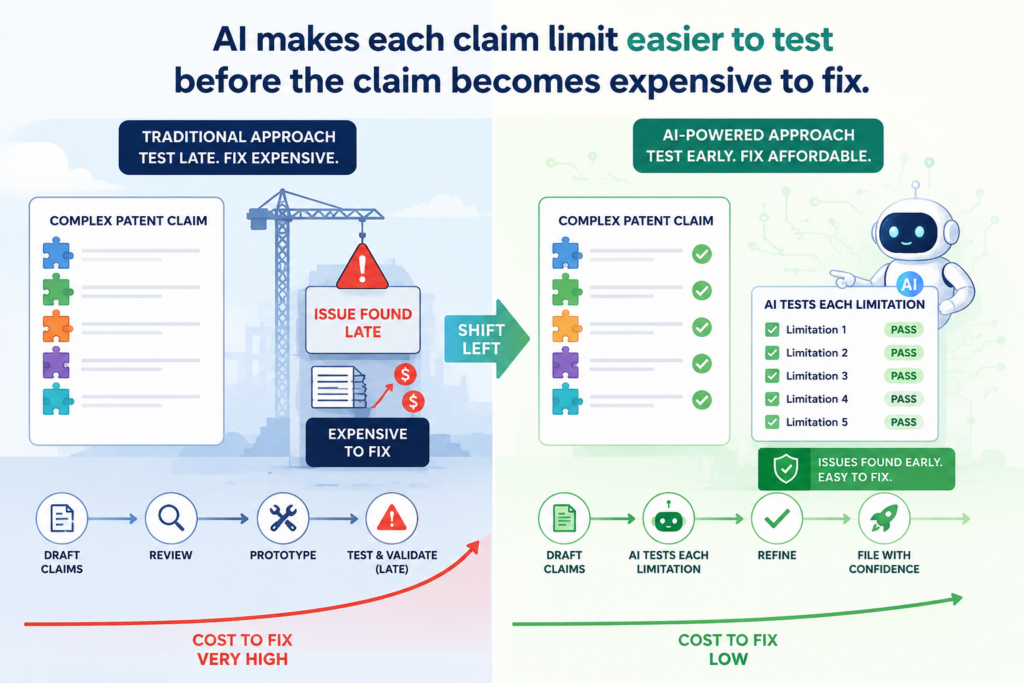
This is where AI can be very helpful. It can read a claim and separate each limit into a clear working part. Then it can help ask better questions. Does this limit match the actual invention?
Does it depend on another limit? Does it add real value? Does it make the claim stronger, or does it only make the claim longer?
For a founder, this changes the whole patent process. Instead of staring at dense claim language and hoping it is right, you get a clearer view of what the claim is doing. You can see the moving parts.
You can see which parts matter most. You can also see where the draft may need more work before it goes to filing.
A claim limit should earn its place in the claim
Every added limit can change the size and shape of protection. This is why care matters. A limit that is too narrow can make the claim easy to avoid.
A limit that is unclear can create confusion. A limit that does not connect to the rest of the claim can make the whole thing feel weak.
AI can help by asking what each limit is meant to prove. Some limits show how the system receives data. Some show how the data is changed. Some show how a model makes a decision.
Some show how the system acts after that decision. Some show why the invention works better than older tools.
When each limit has a clear job, the claim becomes stronger. It also becomes easier for the founder to understand.
That matters because founders should not feel locked out of their own patent strategy. You built the invention. You should be able to understand what is being protected.
A useful AI review looks for limits that create avoidable escape paths
One of the most practical things AI can do is help spot claim language that gives competitors an easy way around the patent. This often happens when the claim includes a detail that is not truly needed.
For example, a claim may say that a system uses a mobile app when the real invention could also work through a web app, a device screen, or an API.
A claim may name one type of data source when the method could work with several. A claim may describe one fixed order of steps when the value comes from the relationship between the steps, not the exact order.
AI can flag these places for review. It can ask whether a limit is required by the invention or only copied from the current product version.
That question is simple, but it is powerful. It helps the founder and attorney decide what belongs in the main claim and what may belong elsewhere in the patent.
This is one reason PowerPatent is useful for fast-moving teams. It helps surface these choices early, while real patent attorneys help make the final call.
That means the patent work can move faster without turning into guesswork. You can see how PowerPatent supports this process here: https://powerpatent.com/how-it-works
AI helps founders think like both builders and copycats
Engineers tend to explain how they built something. That is useful, but patent claims also need another view. They need to consider how someone else might copy the result without copying the exact build.
This is not about fear. It is about strategy. If your invention is valuable, others may try to reach the same result with small changes.
They may swap one model for another. They may change a data step. They may move a function from the device to the cloud. They may replace one signal with another signal.
AI can help run this kind of review. It can look at each claim limit and ask whether there are close substitutes.
It can point out places where the claim may be too tied to one setup. It can also help find broader words that still stay true to the invention.
The strongest claim work often starts with a simple copycat question
A good question for any founder is this: how would someone copy the value without copying the product?
That question can reveal a lot. It can show which parts of the invention are easy to change. It can show which parts are central.
It can show whether the claim is focused on the real technical edge or on surface features.
AI can make this review less painful. It can create a clearer picture of likely design changes and help compare those changes against the draft claim. Then the attorney can use that insight to shape stronger coverage.
This is the point where patent work becomes less like paperwork and more like business defense. You are not just filing a document.
You are protecting the hard work behind your product. You are giving your company more control over what it has built.
AI improves claim clarity by finding vague words before they cause trouble
Complex claims often fail because the language is not clean enough. The problem is not always the invention. The problem is how the invention is described.
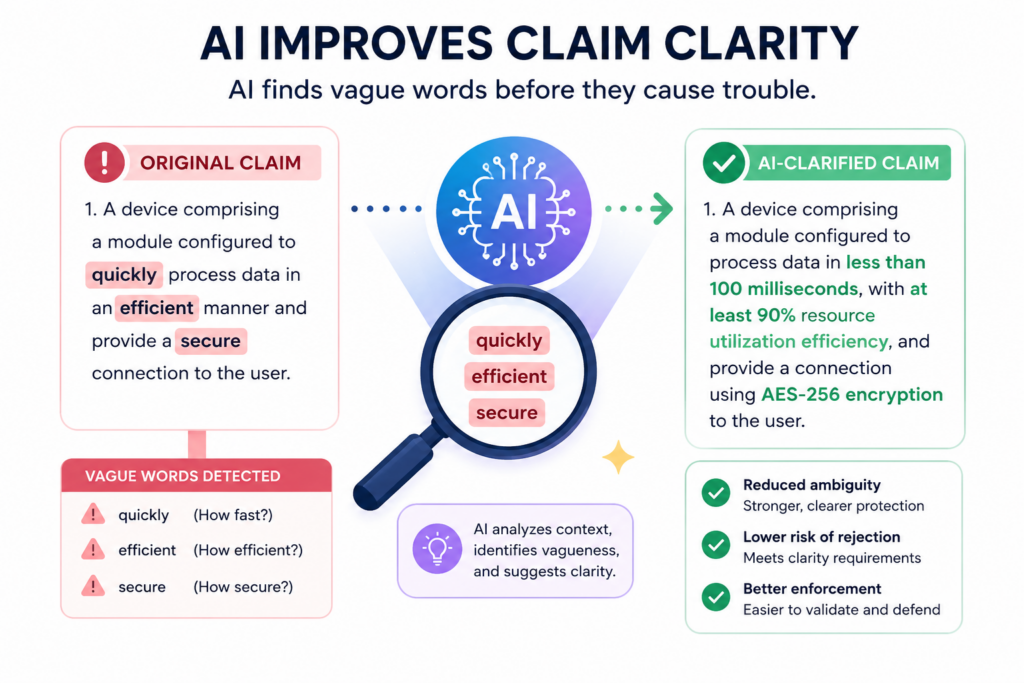
A founder may use words that feel clear inside the company but are not clear to an outside reader. A team may say “smart routing,” “dynamic scoring,” “optimized output,” or “context-aware control” and everyone on the team may understand what that means.
But a claim needs more than team shorthand. It needs enough detail to show what is actually happening.
AI can help by finding words that sound good but do not explain enough. It can point to terms that need support. It can show where a claim uses a result without explaining the action that creates that result.
This kind of review is especially useful for AI, software, robotics, medical devices, climate tech, chips, and other deep tech inventions where the system may include many layers.
Clear claim language does not mean simple invention language
Some founders worry that making a claim clear will make it weak. That is not the goal. Clear does not mean basic. Clear means the reader can follow the invention without guessing.
A strong claim can still protect a complex system. It can cover machine learning steps, sensor fusion, control logic, model updates, data pipelines, edge devices, hardware actions, or secure workflows. The key is to write the claim so the important parts can be tracked.
AI helps by keeping the logic visible. It can show whether the claim starts with the right subject. It can check whether each later part refers back to something already introduced.
It can also spot when the same item is called by two different names, which can confuse the claim.
The claim should not make the reader solve a puzzle
A patent claim should not feel like a riddle. If the invention needs a data set, the claim should make clear where it comes from.
If the system creates a score, the claim should make clear what creates it and how it is used. If a model updates a control action, the claim should show the path from input to update to action.
AI can help turn a fuzzy path into a clean path. It can flag missing links, unclear references, and steps that appear out of order.
This can save time because the founder and attorney do not have to find every issue by hand from scratch.
This does not mean the claim becomes plain English. Patent claims have their own style. But the logic inside the claim can still be clean. That is the part AI is good at helping with.
PowerPatent is designed for this kind of work. It helps technical teams turn raw invention details into more organized patent material, while real attorney oversight helps make sure the work is handled with care.
Founders can move faster and still avoid the trap of filing thin, unclear claims. See how it works here: https://powerpatent.com/how-it-works
AI can also help keep the claim tied to the real invention
A claim can drift. This happens when people keep editing the words but lose sight of the system.
The claim may begin by describing one thing and end by protecting something else. Or it may include terms that sound related but are not backed by the actual invention details.
AI can help compare the claim to the technical disclosure. It can ask whether each limit is supported by what the founder provided.
It can point out when a claim mentions a feature that is not explained anywhere else. It can also flag when the description talks about an important step that the claim never mentions.
This matters because a patent should not be built on loose wording. It should be built on the real invention. The better the connection between the claim and the technical story, the more useful the patent work can become.
The best drafting process keeps the founder close to the details
Founders should not hand over a few notes and disappear. The strongest patent work often happens when the founder stays involved, but in a way that does not drain the company.
AI helps make that possible. It can turn the invention into clearer questions. It can show the founder which parts need more detail.
It can reduce back-and-forth by making gaps easier to see. Instead of asking a broad question like “tell us more,” the system can help focus the review.
That makes the process feel less like a legal task and more like a product strategy task. The founder can explain what matters. The attorney can shape the protection. The software can help organize the moving parts.
AI helps connect claim limits to real business value
A patent claim is not only a technical tool. It is also a business tool. It should protect the part of the invention that gives the company an edge.
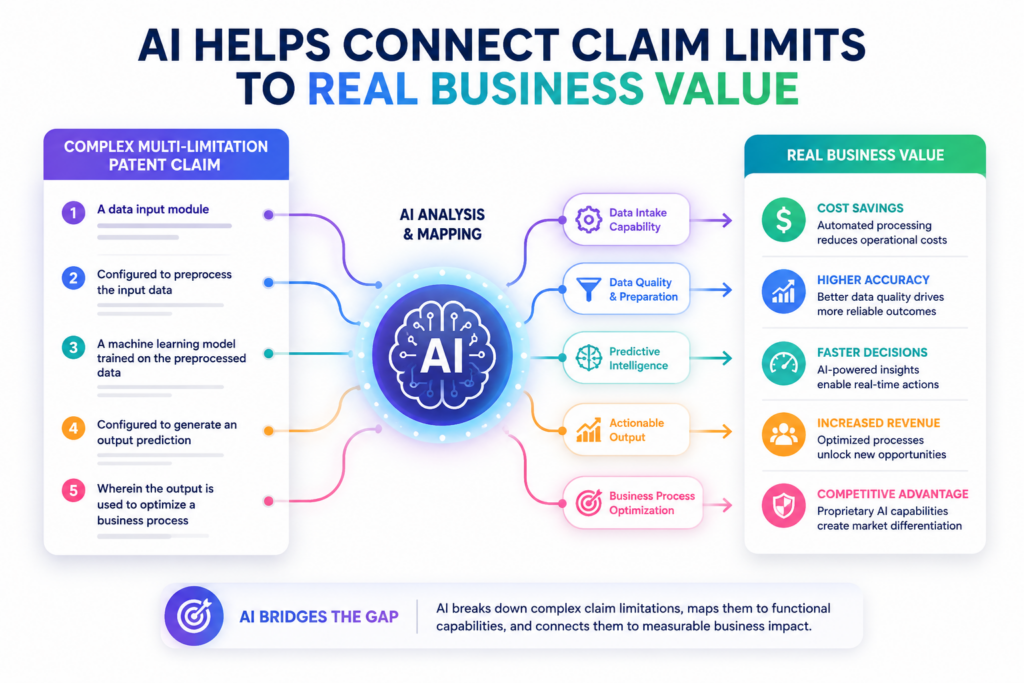
This is why founders should not look at claim limits only as words on a page. Each limit should be connected to value. Does it protect speed? Does it protect accuracy? Does it reduce cost?
Does it make the system safer? Does it make the workflow easier? Does it let the product do something others cannot do well?
AI can help connect the claim to these business outcomes. It can look at the technical steps and ask what benefit each step creates. That helps the team avoid filing claims that describe the product but miss the reason the product wins.
Strong claims are built around what makes the invention hard to replace
A feature may be useful, but not all useful features are the heart of the invention. The most important claim limits often cover what is hard to replace.
For example, a startup may have a system that predicts equipment failure. The dashboard may be useful. The alerts may be useful.
But the hard part may be how the system turns weak sensor signals into a reliable risk score before failure happens.
Another startup may have a tool that helps developers test code faster. The user flow may be nice. The reports may be clean.
But the true edge may be how the system chooses which tests to run based on code changes, past failures, and runtime cost.
AI can help pull out that deeper edge. It can compare the product details with the outcome and help show which parts create the strongest value.
A good claim review asks where the customer would feel the loss
One simple way to find the heart of an invention is to ask what the customer would miss most if it were removed. Would the product become slower? Less safe? Less accurate? More expensive? Harder to trust? Less automatic?
This question helps sort core features from support features. AI can help apply that thinking across a complex claim.
It can show whether the claim protects the parts customers actually care about, not just the parts that happen to be easy to describe.
That is a big deal for startups. A patent should support the company’s direction. It should help protect the reason customers choose you.
It should also help investors, partners, and future buyers understand that your technology has real depth.
PowerPatent helps founders think this way from the start. The platform brings smart software and attorney review together so patent work can be more strategic, more focused, and less painful. Explore the process here: https://powerpatent.com/how-it-works
AI makes patent work easier to fit into a startup’s real schedule
Startups do not have spare months to waste. Founders are building, selling, hiring, raising money, and solving fires every day. Patent work often gets delayed because it feels slow and hard to manage.
AI helps by making the early work more organized. It can turn rough invention notes into cleaner drafts. It can identify claim parts.
It can flag gaps. It can help prepare better materials for attorney review. That does not remove the need for legal judgment, but it makes the process smoother.
For founders, this means less confusion and fewer dead zones. You can move from idea to review faster.
You can make better decisions sooner. You can avoid waiting until after a launch, a funding round, or a competitor move to think about protection.
The right system helps founders protect more without slowing the company down
The best patent process should not pull a founder away from building for weeks. It should meet the founder where the work already lives, in product specs, code notes, model details, diagrams, demos, and technical docs.
AI can help turn those materials into a stronger starting point. Attorneys can then review, refine, and guide the filing strategy. This mix gives founders both speed and care.
That is the PowerPatent approach. It is built for technical teams that need serious patent work without the old slow process. The goal is simple: help founders protect what they are building while they keep building.
AI helps find hidden gaps between claim limits before they weaken the patent
A complex claim can look complete while still having small holes inside it. These holes are easy to miss because the claim may sound technical and full.
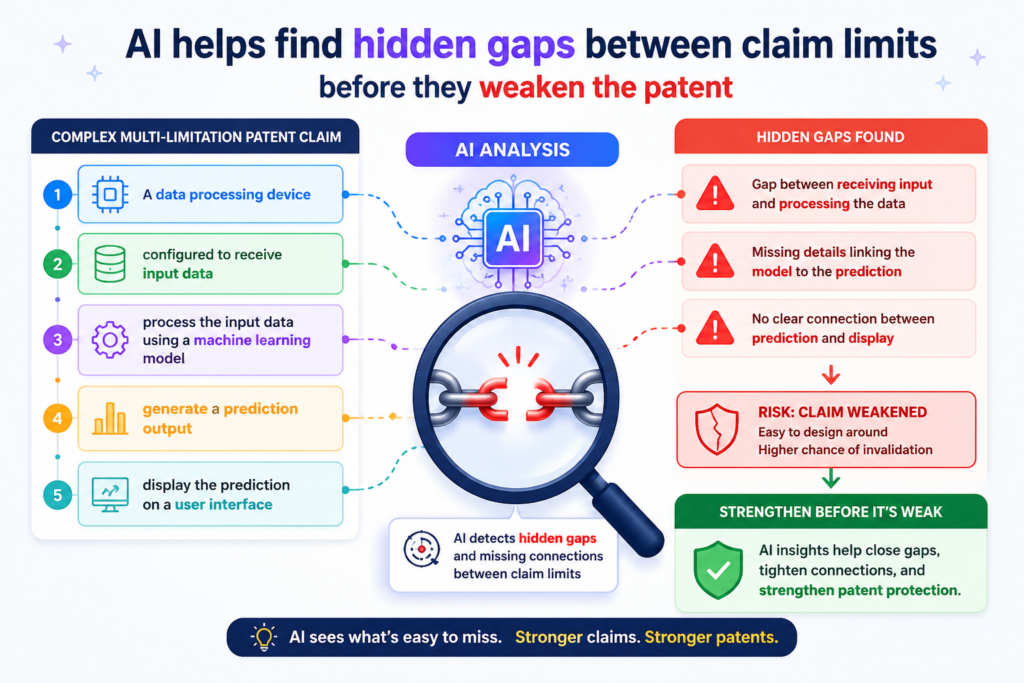
But a claim is not strong just because it has many parts. It is strong when each part connects cleanly to the next part and supports the main invention.
AI helps by reading the claim like a system. It can check whether each limit has a clear role. It can also see whether the claim introduces something but never explains how it is used.
This matters because a claim with missing links can create doubt. Doubt is not helpful when you are trying to protect a serious invention.
A gap often starts as a small missing connection
A common gap happens when a claim says the system “generates a score” but does not explain what data creates that score.
Another gap happens when the claim says a model “updates an output” but does not show what triggers the update. These may seem like small details, but small details can shape the strength of the claim.
AI can help point out these weak spots early. It can ask whether the input, process, and output are all clear. It can check whether the claim tells a full story from the first step to the final result.
That gives the founder and attorney a better way to fix the claim before the filing becomes harder to change.
A founder should be able to trace the claim without guessing
A useful test is simple. You should be able to read the claim and explain what happens in plain words.
You do not need to know every patent rule. You only need to see the path. The system receives something. It changes something. It makes a decision. It causes a result.
If that path is hard to follow, the claim may need work. AI can make the path easier to see. It can turn a dense claim into a clear map of parts, actions, and results. Then a real patent attorney can use that map to make better choices.
This is where PowerPatent helps founders move with more confidence. The platform helps organize the invention and spot issues earlier, while real attorney review helps shape the work into a stronger filing. See how it works here: https://powerpatent.com/how-it-works
AI helps separate core invention limits from extra product details
Founders often describe the invention through the product they have built. That is natural because the product is what the team can see and test.
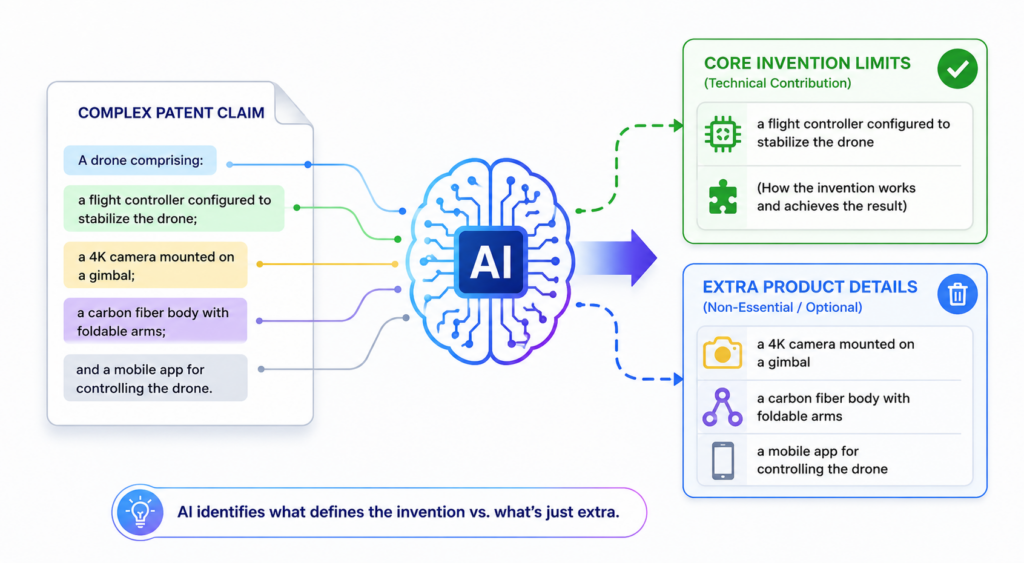
But a product is only one version of the invention. A patent claim should often protect the deeper idea that can live across many versions.
This is where AI can be very useful. It can look at the claim and help sort which parts are central and which parts are only current design choices. That difference matters.
A claim that includes too many product details may become easy to avoid. A competitor may copy the value while changing a small detail that was never truly important.
The first version of the product should not trap the whole patent
A startup’s first version is rarely the final version. The data may change. The model may change. The user flow may change.
The system may move from cloud to edge or from one device to many devices. If the claim is tied too tightly to the first build, the patent may not match where the company goes next.
AI can help by asking which parts of the invention would stay true even if the product changed. It can look for details that are useful but not required. It can also help find broader words that still match the real invention without becoming vague.
The key question is whether the detail is needed for the value to exist
A founder can test each limit by asking whether the invention still works if that detail changes. If the answer is yes, the detail may not belong in the broadest claim.
It may still belong somewhere else in the patent, but it may not need to narrow the main protection.
This kind of thinking can save real money later. It can help avoid claims that protect only one narrow version of the product.
It can also help avoid weak claims that sound broad but fail to explain the actual invention.
PowerPatent helps teams do this kind of sorting faster. The software helps pull out the core invention, and attorney oversight helps make sure the filing is not just fast, but thoughtful. Learn more here: https://powerpatent.com/how-it-works
AI helps keep claim language aligned with the technical story
A patent claim should not float away from the invention details. It should match the system the founder actually built or plans to build.
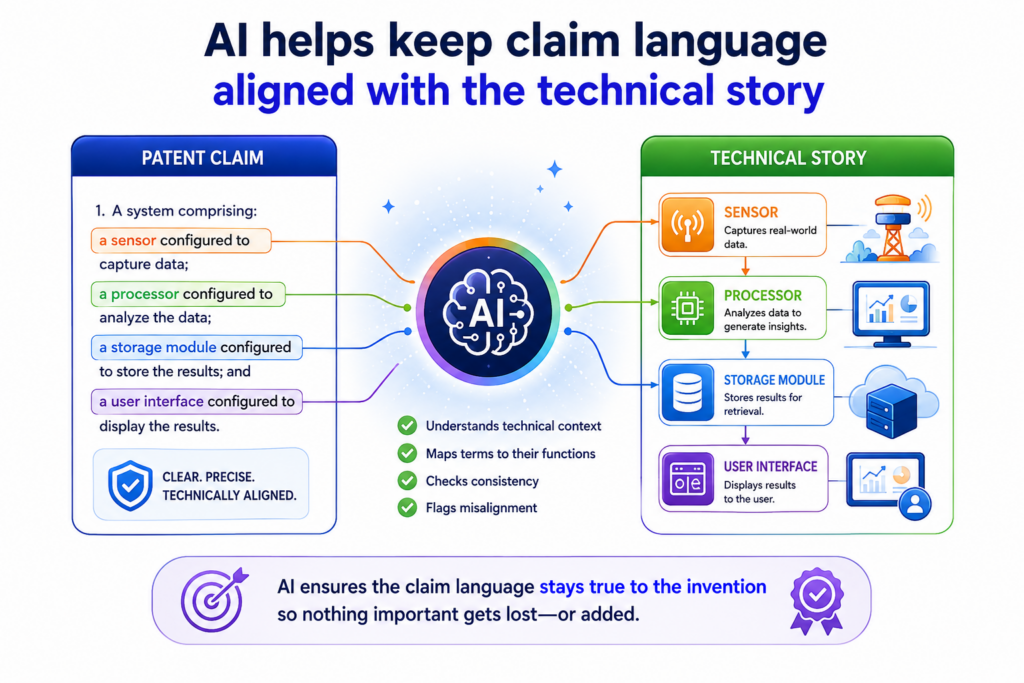
When the claim and the technical story do not line up, the filing can become weaker and harder to defend.
AI can help compare the claim against the invention notes, product docs, diagrams, model details, and workflow descriptions.
It can find places where the claim says one thing but the description says another. It can also spot important features in the technical story that never appear in the claim.
Alignment matters because every claim needs support
A strong claim should have roots in the full patent story. If the claim mentions a training step, the description should explain that step.
If the claim mentions a feedback loop, the description should show how it works. If the claim depends on a special data process, that process should not be hidden in the founder’s head.
AI can make this review much faster. It can check whether the same terms are used in a steady way.
It can point out when two words may be referring to the same part. It can also flag when a key step appears late in the description but is missing from the claim.
Better alignment means fewer surprises during review
The goal is not to stuff every detail into the claim. The goal is to make sure the claim has enough support and enough clarity.
When the claim matches the technical story, the whole filing feels more solid. The founder can understand it. The attorney can refine it. The company can move forward with more confidence.
This is especially important for AI and software inventions.
The real value often lives in how data is selected, cleaned, scored, ranked, trained on, or acted on. If those details are not tied together well, the claim may miss the real edge.
PowerPatent is built for technical teams that need this kind of clear connection.
It helps turn raw invention details into organized patent work, with real attorneys reviewing the result. You can see the process here: https://powerpatent.com/how-it-works
AI helps predict how a claim might be challenged or designed around
A strong claim is not only written for today. It is written with future pressure in mind. Someone may question it.
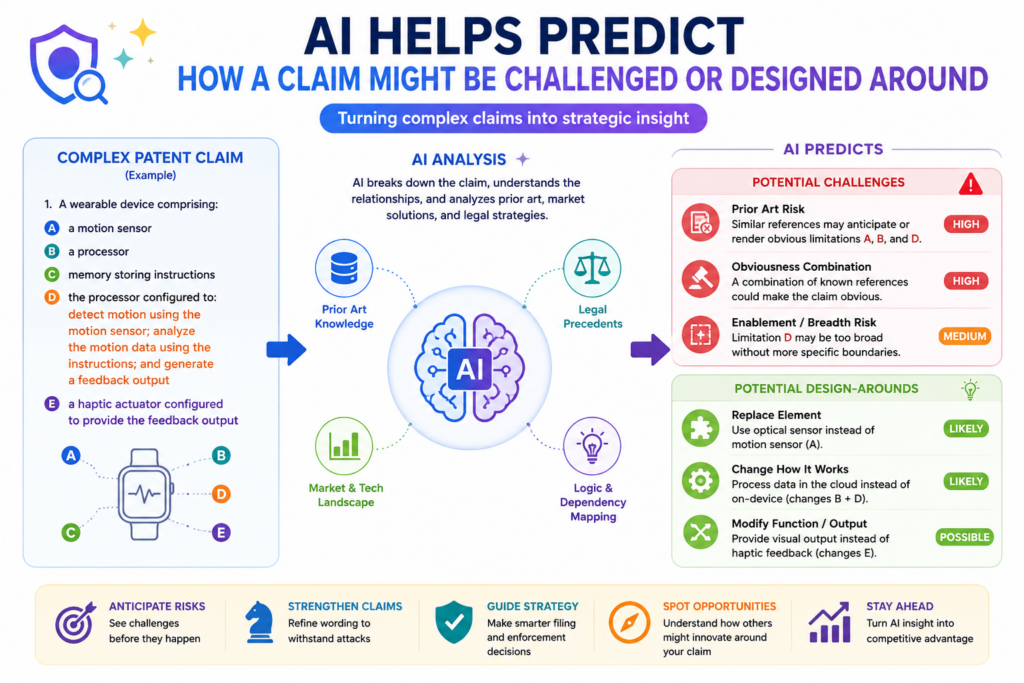
Someone may try to work around it. Someone may say the claim is unclear, too narrow, or not tied closely enough to the invention. Good drafting thinks about these risks early.
AI helps by testing the claim from different angles. It can look at each limit and ask how a competitor might change that part while keeping the same customer benefit.
It can also help show whether the claim depends too much on one tool, one data type, one workflow, or one setup.
Design-around thinking makes claims more practical
A design-around is a simple idea. It means someone tries to copy the value without copying the exact words of the claim.
This can happen when the claim includes a narrow detail that is not really needed. It can also happen when the claim misses the true step that makes the invention work.
AI can help founders see these risks before filing. It can ask whether a limit could be swapped out. It can ask whether another model, device, data source, or order of steps could create the same result.
These questions help the team decide where the claim should be broader and where it should stay specific.
The claim should protect the path to the result, not just the final result
A weak claim may focus too much on the final benefit. It may say the system improves accuracy or speeds up a task, but it may not explain the technical path that creates the benefit. That can be a problem because many systems can claim the same result.
A stronger claim shows how the invention gets there. It explains the important limits that produce the outcome.
AI can help find whether that path is clear or whether the claim is leaning too much on broad result words.
This is where software plus attorney review becomes powerful. AI can surface the risks.
A patent attorney can judge the best way to handle them. PowerPatent brings both into one process so founders can move faster without leaving strategy behind. Start here: https://powerpatent.com/how-it-works
AI helps founders turn invention notes into cleaner patent claim drafts
Most founders do not begin with perfect patent language. They begin with notes, diagrams, code comments, model results, customer pain points, and product plans.
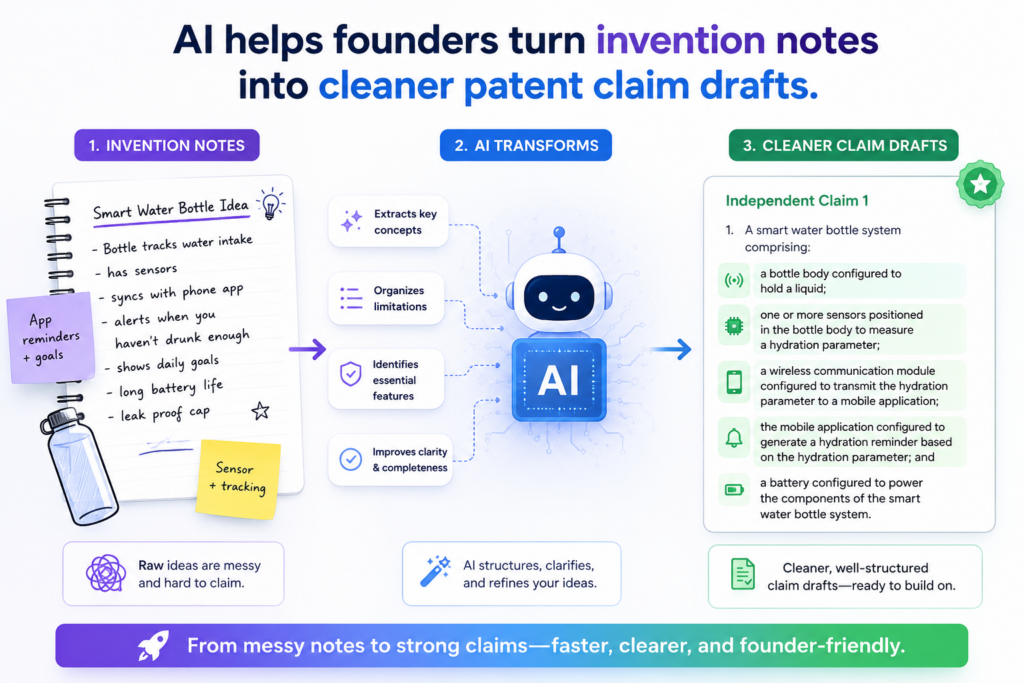
That raw material can be very valuable, but it needs structure before it becomes useful claim work.
AI helps turn that raw material into a cleaner starting point. It can pull out the main system parts. It can identify key steps.
It can connect inputs to outputs. It can show what the invention receives, what it changes, what it decides, and what result it causes.
The best starting material often comes from how the team already works
Founders do not need to stop building and write like lawyers. They can start from the materials they already have. A product spec may explain the workflow.
A model card may explain the data. A pull request may reveal a new technical step. A demo may show the user-facing result. A customer note may show why the feature matters.
AI can help turn these pieces into a more organized invention story. That makes attorney review more focused.
Instead of spending time digging for the basics, the attorney can spend more time on strategy, claim scope, and filing quality.
A clean draft helps the founder stay involved without slowing down
The founder’s knowledge is still critical. AI can organize, but it cannot replace the judgment of the person who built the invention.
The founder knows what was hard, what changed the product, what customers care about, and what competitors may try to copy.
A clean AI-assisted draft makes that founder input easier to give. It shows the claim parts in a way the founder can review. It makes gaps easier to see. It gives the attorney better raw material to refine.
This is the simple power of PowerPatent. It helps founders protect serious inventions without getting buried in a slow, confusing process. Smart software does the heavy organizing.
Real patent attorneys guide the filing. That means speed, control, and stronger protection can work together. See how PowerPatent works here: https://powerpatent.com/how-it-works
AI helps compare claim limits against older ideas so the claim does not protect the wrong thing
A patent claim should not be written in a vacuum. It has to sit in a world where other tools, papers, products, and patents may already exist.
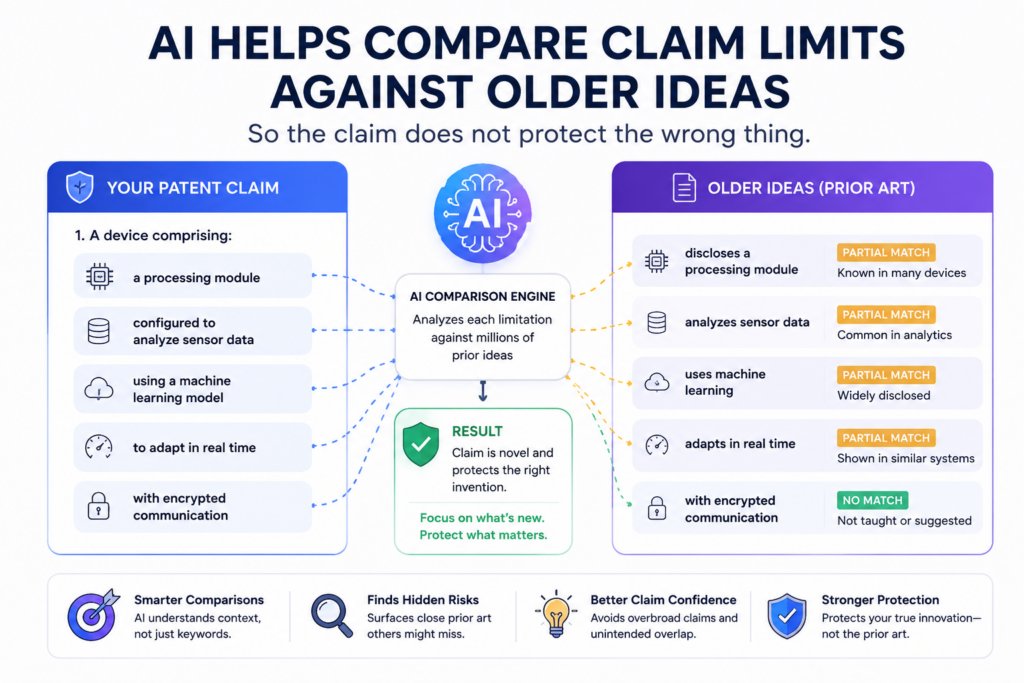
That is why complex multi-limitation claims need careful review against older ideas. The goal is not just to say what your invention does. The goal is to show what your invention does in a new and useful way.
AI can help by looking at each claim limit and asking whether that part seems common, special, or only special when combined with other parts.
This is very important for software, AI systems, medical tools, hardware devices, and deep tech platforms. In many cases, one part alone may not be new. The strength may come from the way many parts work together.
Older ideas can make one limit look ordinary, but the full chain may still be valuable
A founder may worry when one piece of the claim already exists somewhere else. That does not always mean the invention is weak.
Many strong inventions are built from known parts arranged in a new way. The key is to find what the full system does that older systems did not do.
AI can help compare the claim at two levels. First, it can look at each single limit. Then it can look at the full chain. This helps the team avoid panic over normal parts while still paying close attention to the true edge.
For example, a model, sensor, database, or alert may be common. But a specific way of filtering sensor data, updating a model, ranking risk, and triggering a control action may be much more meaningful.
The claim should point toward that combined value.
The most important question is what changes because your invention exists
A strong claim review should ask what the invention makes possible that was not practical before. Does it reduce false alerts? Does it make a device respond faster?
Does it help a model work with less data? Does it make a workflow safer without adding more human review? Does it turn messy input into a useful action?
AI can help surface those answers by linking each claim limit to a real technical result. This gives the attorney better material to work with. It also helps the founder understand why a certain limit matters.
PowerPatent helps founders organize this kind of review without drowning them in legal work.
The platform uses smart software to shape invention details and real patent attorneys to guide the filing. See how it works here: https://powerpatent.com/how-it-works
AI helps find the strongest order for claim steps so the invention reads like a working system
In many complex claims, order matters. A claim may describe receiving data, cleaning data, creating a score, comparing the score, selecting an action, and updating a model.
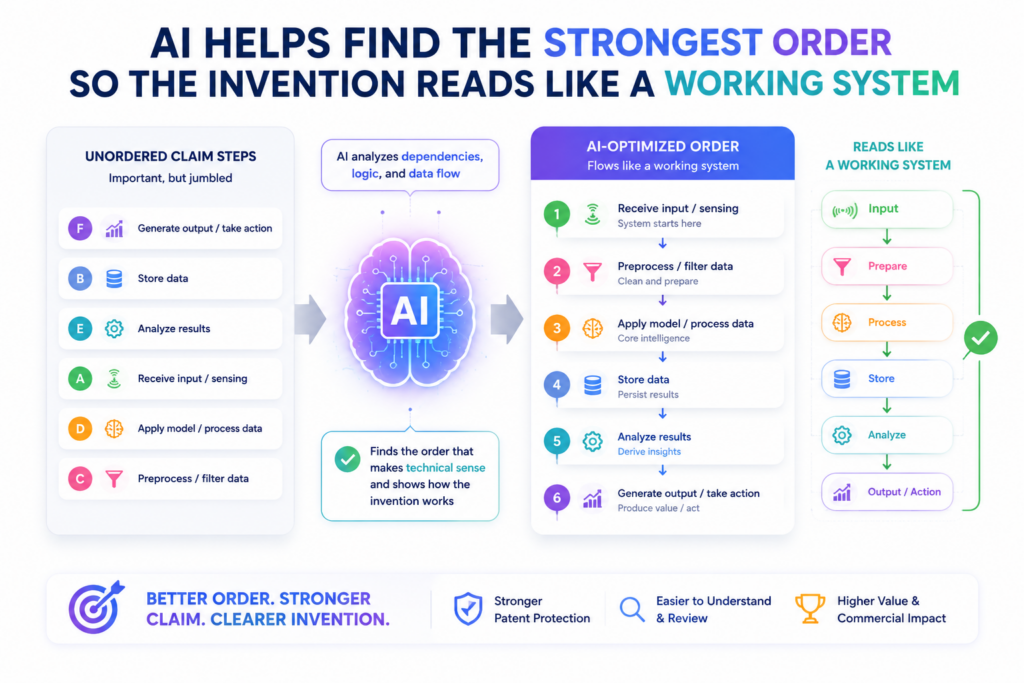
If those steps are mixed up, the claim can become hard to follow. Worse, it may fail to show the real path that makes the invention work.
AI can help by placing the claim steps in a clearer order. It can trace the flow from the first input to the final result.
This is helpful because founders often explain inventions in the order they discovered them, not in the order the system performs them.
A clean step order makes the claim easier to read and harder to misunderstand
Patent claims are already dense. A messy order makes them even harder. When the order is clean, the claim feels more like a working machine. The reader can see how one part feeds another part.
The attorney can see where support is needed. The founder can spot when something important is missing.
AI can also flag steps that depend on something not yet introduced. For example, if a claim says the system compares a risk score before the score has been created, that is a drafting problem.
It may seem small, but these small issues can create confusion later.
A clean order does not mean the claim must lock the invention into one exact sequence unless that sequence matters.
Sometimes the order is part of the invention. Sometimes the steps can happen in a different order and still create the same value. AI can help identify that question early.
The draft should make clear which steps are required and which steps are flexible
A smart claim does not make everything fixed by accident.
If a step must happen before another step, the claim should show that. If the order can change, the claim should avoid locking it down too tightly.
This is where AI can help founders think more carefully. It can ask whether the value comes from the sequence, the relationship between parts, or the final technical result. That helps avoid claims that are narrow for no good reason.
PowerPatent is useful here because it helps turn rough invention notes into structured claim material.
Then real patent attorneys can decide how to shape the language. That mix gives founders more speed without losing care. Learn more here: https://powerpatent.com/how-it-works
AI helps explain AI-based inventions without turning the claim into a black box
AI inventions can be hard to claim because the model may feel like a black box. A founder may say, “The model predicts the answer,” but that may not be enough.
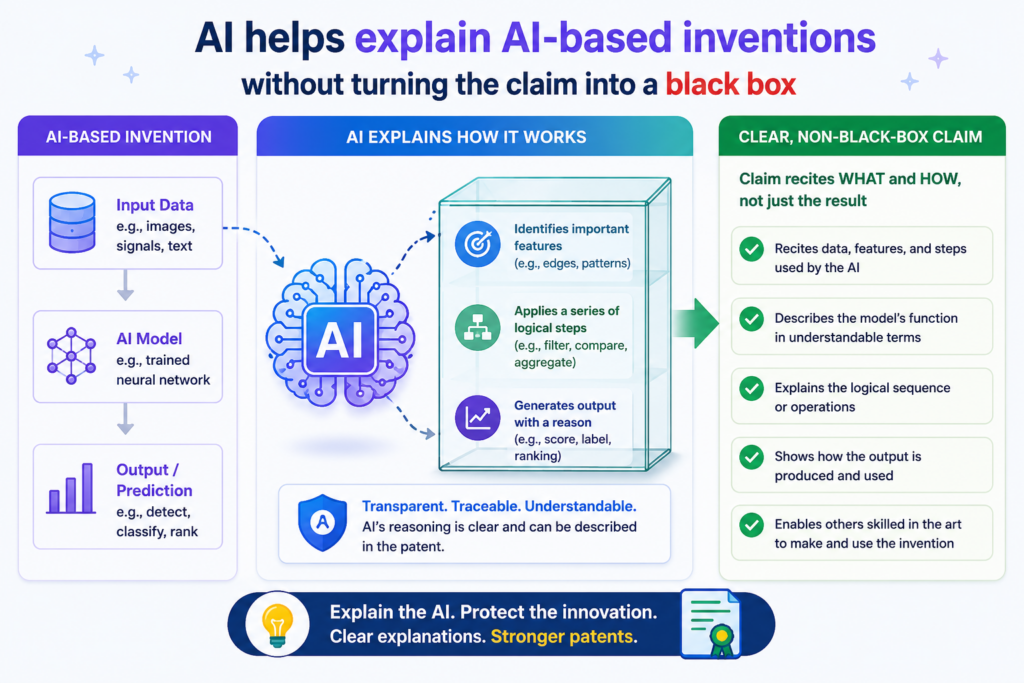
A patent claim often needs to explain the useful system around the model. It may need to show what data goes in, how the data is prepared, what the model produces, and how the output is used.
AI can help by forcing the claim to become more specific in the right places. It can ask what kind of input matters. It can ask what the model output controls.
It can ask whether there is a training step, a feedback step, a confidence score, or a rule that changes what happens next.
The model is often not the whole invention
Many founders think the model itself is the invention. Sometimes it is. But often, the real invention is the full system that makes the model useful in the real world. The model may be only one part of a bigger process.
For example, the value may be in how the system chooses training data. It may be in how the system handles weak or missing signals.
It may be in how it uses model confidence to route tasks. It may be in how it updates a device, a workflow, or a user action based on the model output.
AI can help pull out those details. It can show where the claim is relying too much on saying “using a machine learning model” and not enough on explaining the technical path.
A stronger AI claim shows how the model creates a useful action
A claim becomes more useful when it connects the model output to a real result. The result may be a device setting, a ranked list, a warning, a selected test, a changed control signal, a filtered data stream, or a better decision path.
This connection matters because it turns the claim from a loose idea into a working invention. It also helps show why the model matters. The claim should not make the reader guess how the prediction is used.
PowerPatent is built for founders working on these kinds of technical systems. It helps organize model details, data flows, and product logic so the patent work starts from a stronger place.
Real attorney oversight then helps refine the filing. You can explore the process here: https://powerpatent.com/how-it-works
AI helps avoid claims that sound broad but fail to say enough
A claim can sound broad and still be weak. This is one of the biggest traps in patent drafting. A founder may think a short claim with big words gives wide protection.
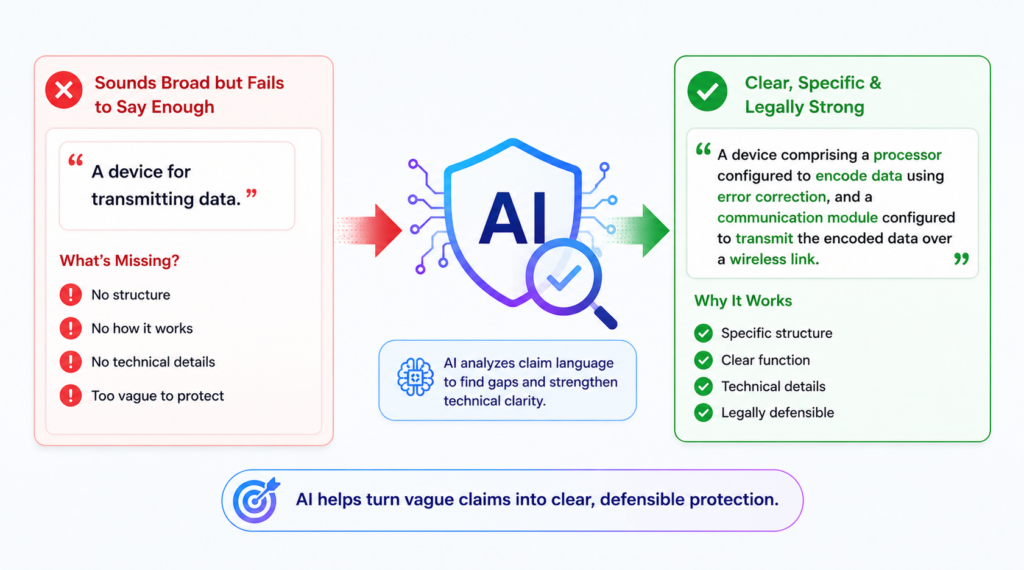
But if the claim does not explain enough about how the invention works, it may not carry the weight the founder expects.
AI can help by finding claim language that states a goal instead of a working method. Words like “optimize,” “automate,” “personalize,” “secure,” or “improve” can be useful, but they are not enough by themselves. The claim should show the action that creates the result.
Broad words need a clear technical backbone
A strong claim can still be broad. But it needs structure. It should say what the system receives, what it does with the input, what it creates, and how that created thing is used. Without that backbone, the claim may read like a wish.
AI can help test the claim by asking whether each important result has a clear cause. If the claim says the system improves accuracy, what steps create that improvement?
If it says the system reduces delay, what changes reduce the delay? If it says the system increases safety, what action makes the system safer?
These questions are simple, but they expose weak drafting fast.
The goal is not more words but better words
Fixing a weak claim does not always mean making it longer. Sometimes it means replacing vague result language with a clearer step.
Sometimes it means removing extra words that distract from the core method. Sometimes it means adding one missing connection that makes the whole chain work.
AI can help make those issues visible. It can show where the claim is thin and where it is overloaded. It can also help the founder explain the invention in cleaner terms before attorney review.
That is one reason PowerPatent is a strong fit for technical founders. It helps teams avoid the old pattern of slow, unclear drafting.
The software helps structure the invention, and real attorneys help turn that structure into stronger patent work. See how it works here: https://powerpatent.com/how-it-works
AI helps build claim sets that protect the invention from more than one angle
A single claim is important, but a patent filing often needs a set of claims that work together. The broad claim may cover the main invention.
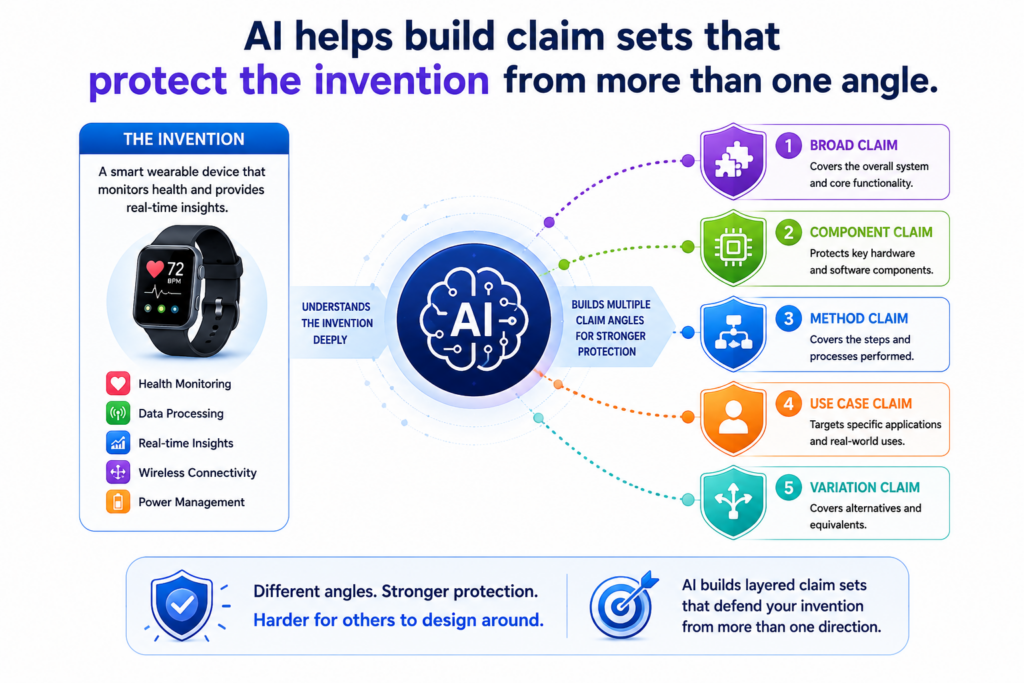
Other claims may cover useful versions, fallback features, training steps, data types, hardware setups, user flows, or control actions. This layered approach can make the filing more practical.
AI can help by finding natural claim layers inside the invention. It can look at the core method, then identify smaller features that support it.
It can also help separate must-have features from optional versions. This gives the attorney a better base for building a claim set.
Layered claims help protect both the big idea and the real product
Founders often want the broadest claim possible. That is understandable. But broad coverage is not the only goal. A strong filing may also need narrower claims that track the product more closely.
These narrower claims can help protect specific features that customers care about or that competitors may copy.
AI can help map this structure. It can show the main invention at the center. Then it can show related versions around it.
One version may use a certain data source. Another may use a feedback loop. Another may run on an edge device. Another may include a special ranking step.
This does not mean every idea should be claimed. It means the team can make better choices with a fuller view.
A good claim set gives the company more room to grow
Startups change fast. The first product may become a platform. A single model may become a set of models.
A workflow may move into a larger system. A hardware device may become part of a network. The patent filing should be drafted with that growth in mind.
AI helps by showing possible paths from the current invention to future versions. The attorney can then decide what belongs in the claims and what belongs in the description for support.
This helps the founder avoid filing a patent that only matches the product as it looked on one early day.
PowerPatent helps founders build this kind of foundation without getting stuck in a slow process.
It combines smart AI tools with real patent attorney review, so startups can move quickly while still treating protection as a serious business move. Start here to see how it works: https://powerpatent.com/how-it-works
AI helps turn messy technical input into claim language that a founder can actually review
Most inventions do not start as clean patent ideas. They start as notes in a doc, code in a repo, a design file, a model test, a customer problem, or a late-night fix that finally worked.
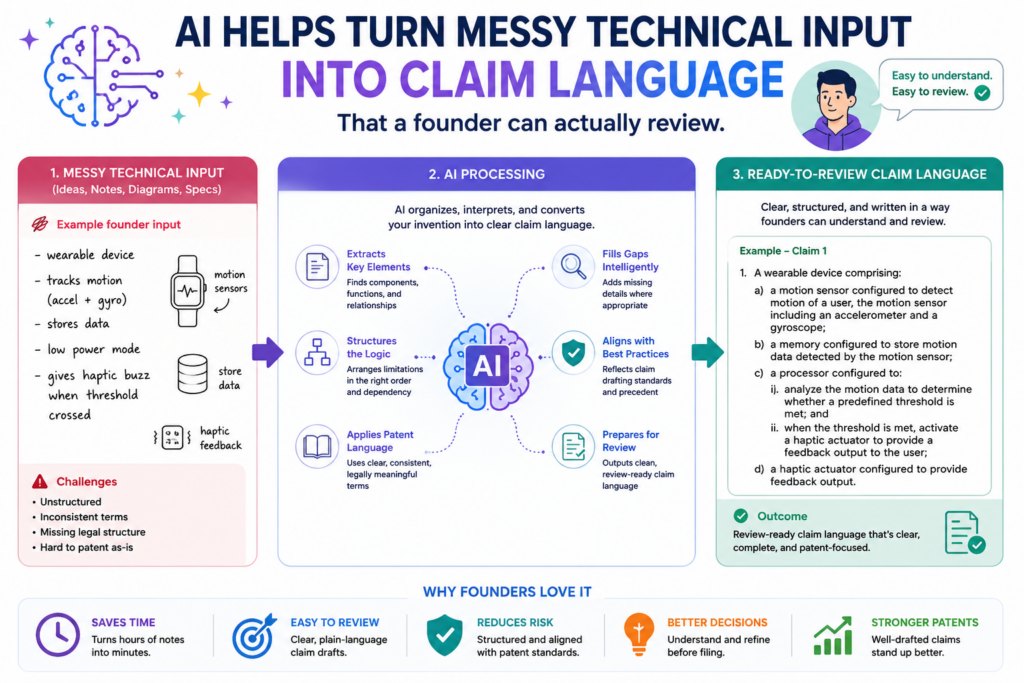
That raw material is full of value, but it is usually not ready for a patent claim.
AI helps by turning that messy input into a clearer invention story. It can pull out the parts that matter, group related steps, and show how the system moves from input to result. That gives the founder something they can actually read and react to.
This is important because the founder should not be a stranger to the claim. The founder knows what was hard to build.
The founder knows which part made the product better. The founder knows what a competitor would likely copy. AI helps bring that knowledge into the drafting process without forcing the founder to become a patent expert.
The best claim drafts often begin with normal founder language
A founder should be able to explain the invention in simple words first. The system takes this kind of data. It changes the data in this way.
It uses the changed data to make this decision. Then it causes this result. That simple chain is often the start of a stronger claim.
AI can help turn that normal language into a more structured draft. It can find the nouns, the actions, the inputs, the outputs, and the control points. It can also show where the founder may need to add more detail.
A clean first draft makes attorney review much more useful
When an attorney starts with organized invention details, the review can go deeper. Instead of spending most of the time trying to understand the basics, the attorney can focus on scope, risk, strategy, and claim strength.
That is the value of using PowerPatent early. The platform helps turn technical work into clearer patent material, then real patent attorneys help review and shape the filing.
This gives founders speed without leaving quality to chance. You can see how the process works here: https://powerpatent.com/how-it-works
AI helps spot when a claim is protecting a feature instead of the invention
A feature is not always the invention. A feature may be the visible part users see, while the true invention sits deeper in the system.
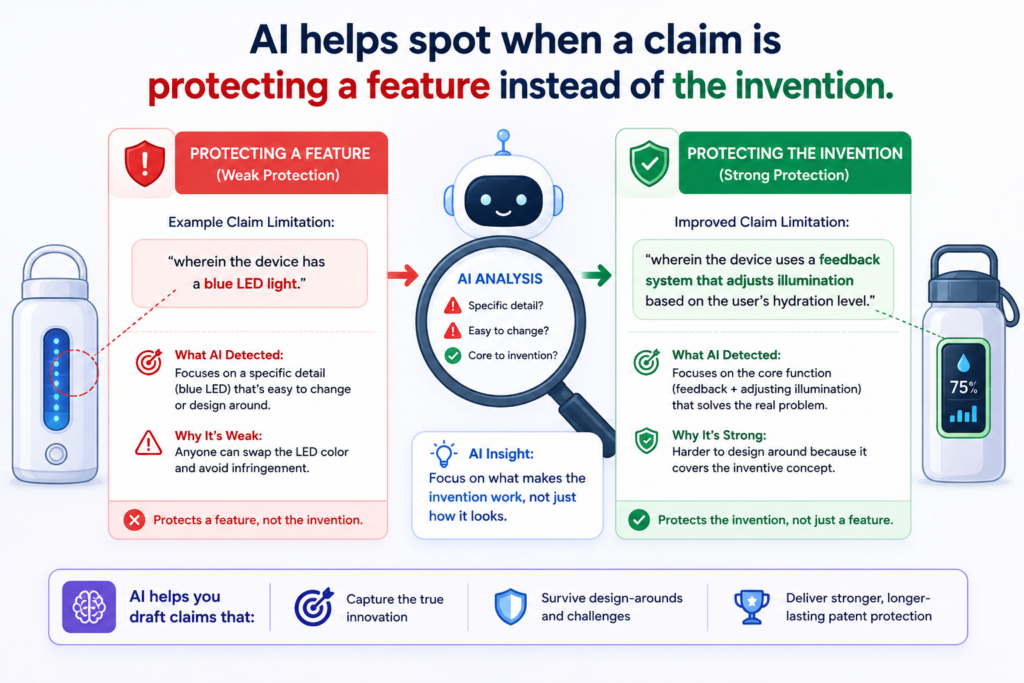
This is a common issue for startups because founders often talk about what the product does for the user, not the technical method that makes it possible.
AI can help separate the user-facing feature from the engine underneath it. This matters because a patent claim that only protects a feature may be easier to work around.
A competitor may change the screen, change the button, change the workflow, or change the label while keeping the same technical value.
The better target is often the process that creates the feature. That may be a data path, a ranking method, a feedback loop, a model update, a device control step, or a way of turning weak signals into useful action.
User value should guide the claim, but it should not replace technical detail
The customer benefit matters because it tells you why the invention is worth protecting. But the claim should not stop at the benefit. It should explain how the system creates that benefit.
For example, saying that a platform gives “better recommendations” is not enough.
The useful invention may be how it selects input signals, removes bad data, weighs user behavior, scores options, and changes the result in real time. AI can help pull out those steps and show where the claim needs more support.
The real invention is often found by asking what the product would lose if one part disappeared
A founder can test the claim by asking what would happen if a claimed part were removed. If the product still gives the same value, that part may not be central. If the product loses its edge, that part may be close to the heart of the invention.
AI can run this kind of review across many claim limits quickly. It helps identify which parts create real value and which parts may only describe the current product design.
With PowerPatent, founders can use this structure to move faster while still getting real attorney oversight. Learn more here: https://powerpatent.com/how-it-works
AI helps make dependent claims more useful instead of treating them as filler
Dependent claims should not be an afterthought. They can protect key versions of the invention, support fallback positions, and capture product details that may become important later.
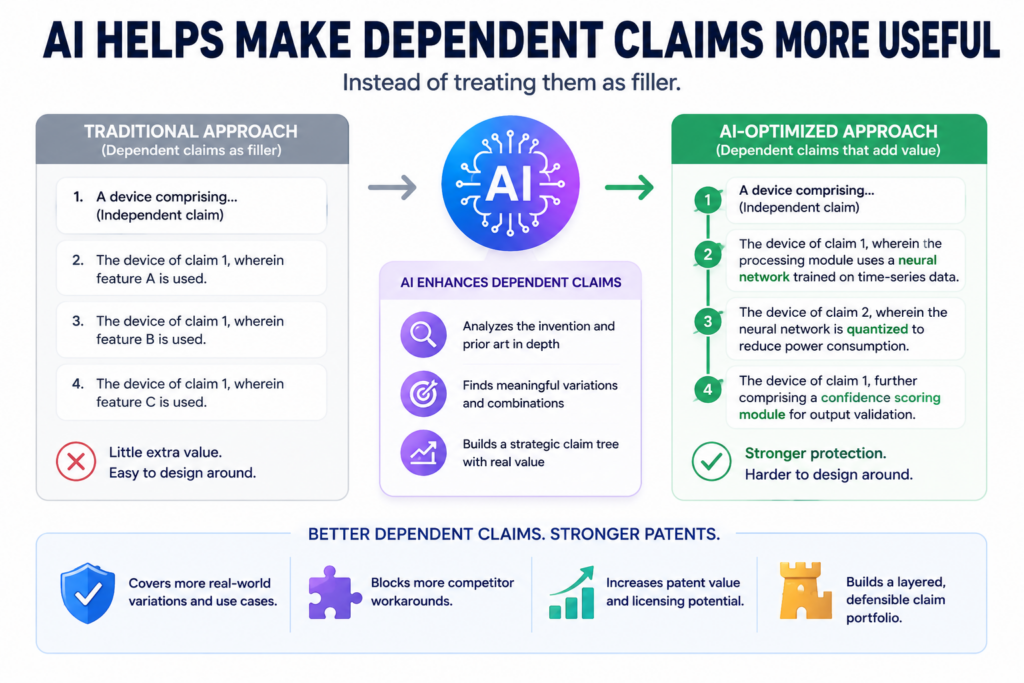
But many weak claim sets treat dependent claims like extra lines added at the end.
AI can help make dependent claims more purposeful. It can look at the main claim and find natural ways to add meaningful detail.
It can identify useful versions of the invention, such as a special data source, a training method, a ranking rule, a control action, or a feedback step.
This matters because a strong patent filing is not only about the broadest claim. It is also about the layers around that claim. Those layers can help protect the invention from more than one angle.
A good dependent claim should add real value to the claim set
A dependent claim should not merely repeat the same idea with different words. It should add a detail that matters.
That detail may reflect how the product works now. It may reflect a likely future version. It may also reflect a part that would be hard for a competitor to remove.
AI can help sort possible dependent claims by importance. It can compare the invention notes against the main claim and ask which extra details deserve their own protection.
This gives the attorney better choices and gives the founder a clearer view of the filing strategy.
Strong dependent claims can protect product depth without narrowing the main claim too early
One mistake is putting too many details into the main claim. That can make the main claim narrower than it needs to be.
A better approach may be to keep the main claim focused on the core invention while using dependent claims to protect important versions.
AI helps by showing which details may belong in the main claim and which may fit better as dependent claims. This is not a final legal decision, but it is a strong starting point.
PowerPatent helps founders organize this work so attorney review can be faster and more focused. See how PowerPatent works here: https://powerpatent.com/how-it-works
AI helps check whether the claim matches how the product may grow
A startup product changes fast. Today’s system may use one model, one data source, one workflow, or one device.
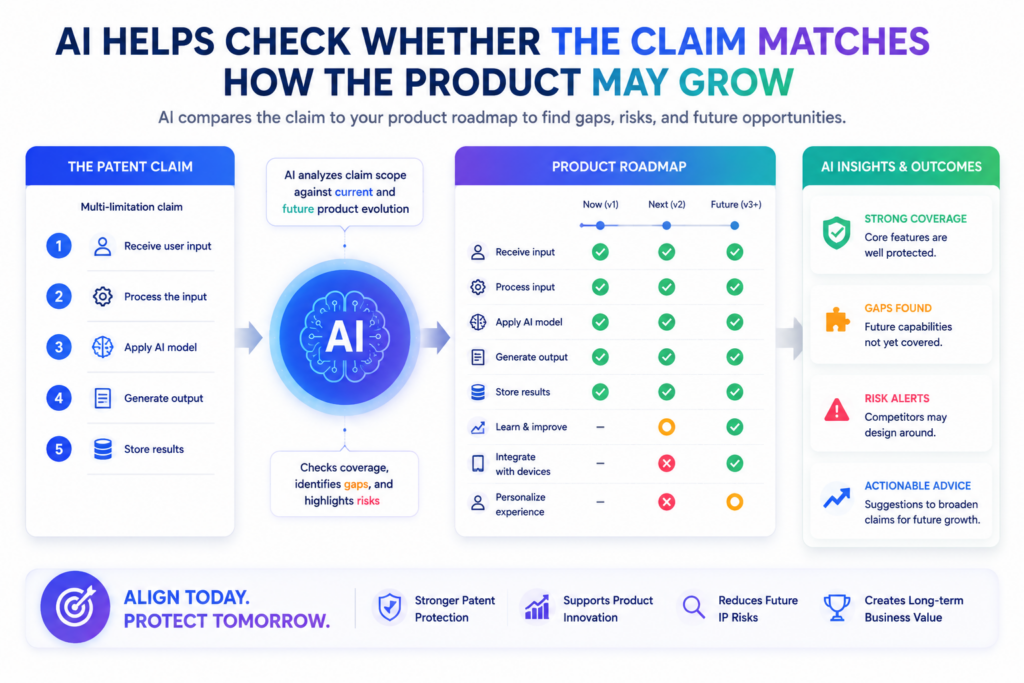
A year later, the product may include several models, new data streams, a new customer flow, or a larger platform. If the patent claim only fits the first version, it may not support the company’s future.
AI can help review claims with growth in mind. It can ask whether the claim is tied too tightly to the current build.
It can also help identify parts of the invention that may stay stable even as the product changes.
This is very useful for founders because patents often take shape while the company is still learning. The first filing should not ignore the current product, but it should also avoid trapping the invention inside one early design choice.
A claim should follow the durable idea, not just the first implementation
The durable idea is the part of the invention that remains true across versions. The interface may change.
The data may expand. The model may improve. The deployment may move from cloud to edge. But the core method may stay the same.
AI can help find that core method by comparing product details against the broader technical result.
It can ask which steps must remain for the invention to still work. It can also flag details that may be optional, replaceable, or tied only to the first release.
Future-aware claim drafting gives a startup more room to move
A patent should not block the company from evolving. It should give the company a stronger foundation as the product grows.
That means the filing should include enough detail to support today’s invention while also thinking about tomorrow’s versions.
PowerPatent is built for this kind of founder reality. The software helps organize invention details from the way teams already work, and real attorneys help shape the filing so it fits the business.
That can help founders protect more without slowing down the company. Explore it here: https://powerpatent.com/how-it-works
AI helps founders make faster decisions about what to file first
Many startups have more than one invention inside the same product. There may be a data invention, a model invention, a workflow invention, a hardware invention, and a user experience invention all wrapped together.
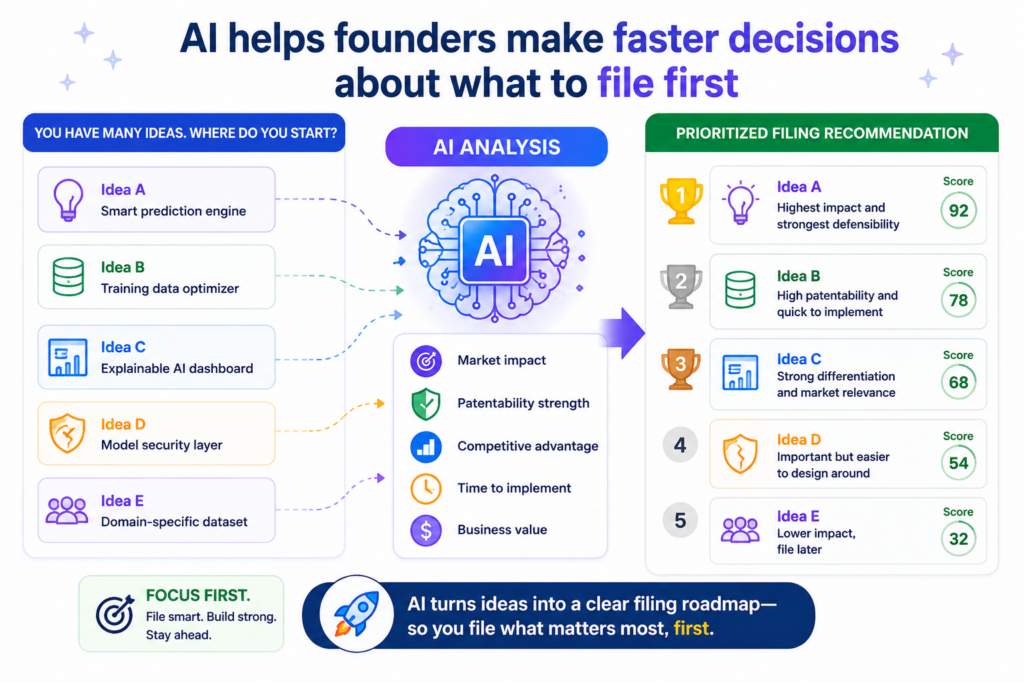
The hard question is not always whether there is something to protect. The hard question is what to protect first.
AI can help by breaking the product into possible invention areas. It can show which parts appear central, which parts seem tied to customer value, and which parts may be easy for others to copy. This gives founders a more practical way to make filing decisions.
Speed matters here. Waiting too long can create risk. But filing without a clear plan can also waste time and money. The right process helps founders move quickly while still making smart choices.
Filing strategy should match the business stage
An early startup may need to protect the core technical edge before a demo, launch, raise, or partnership.
A later startup may need to build a wider portfolio around several product lines. The best filing choice depends on where the business is and what risk it faces next.
AI can help prepare the raw analysis, but it should not make the final legal call alone. That is where attorney review matters. The software can surface patterns.
The attorney can help decide what should be filed, how broad the claims should be, and how the filing should support the company’s goals.
The best patent process helps founders act before the window gets tight
Patent work often becomes stressful when it is pushed too late. A launch is coming. A customer call is booked. A funding round is near. A competitor is moving fast. In those moments, founders need a process that is clear and fast.
PowerPatent helps founders avoid last-minute chaos. It combines smart AI tools with real patent attorney oversight so teams can move from invention details to filing-ready work with more control.
It is built for founders who want strong protection without the old slow process. Start here: https://powerpatent.com/how-it-works
Conclusion
Complex multi-limitation patent claims do not have to feel like a maze. With the right AI support, every limit can be checked, connected, and shaped around the real invention, not just the first product version. That gives founders more speed, control, and confidence when they need protection most. Still, AI should not stand alone.
Strong patent work needs smart software plus real attorney review, so the claims are clear, useful, and tied to business value. PowerPatent brings both together for technical teams that want to move fast without filing weak patents. See how it works here: https://powerpatent.com/how-it-works