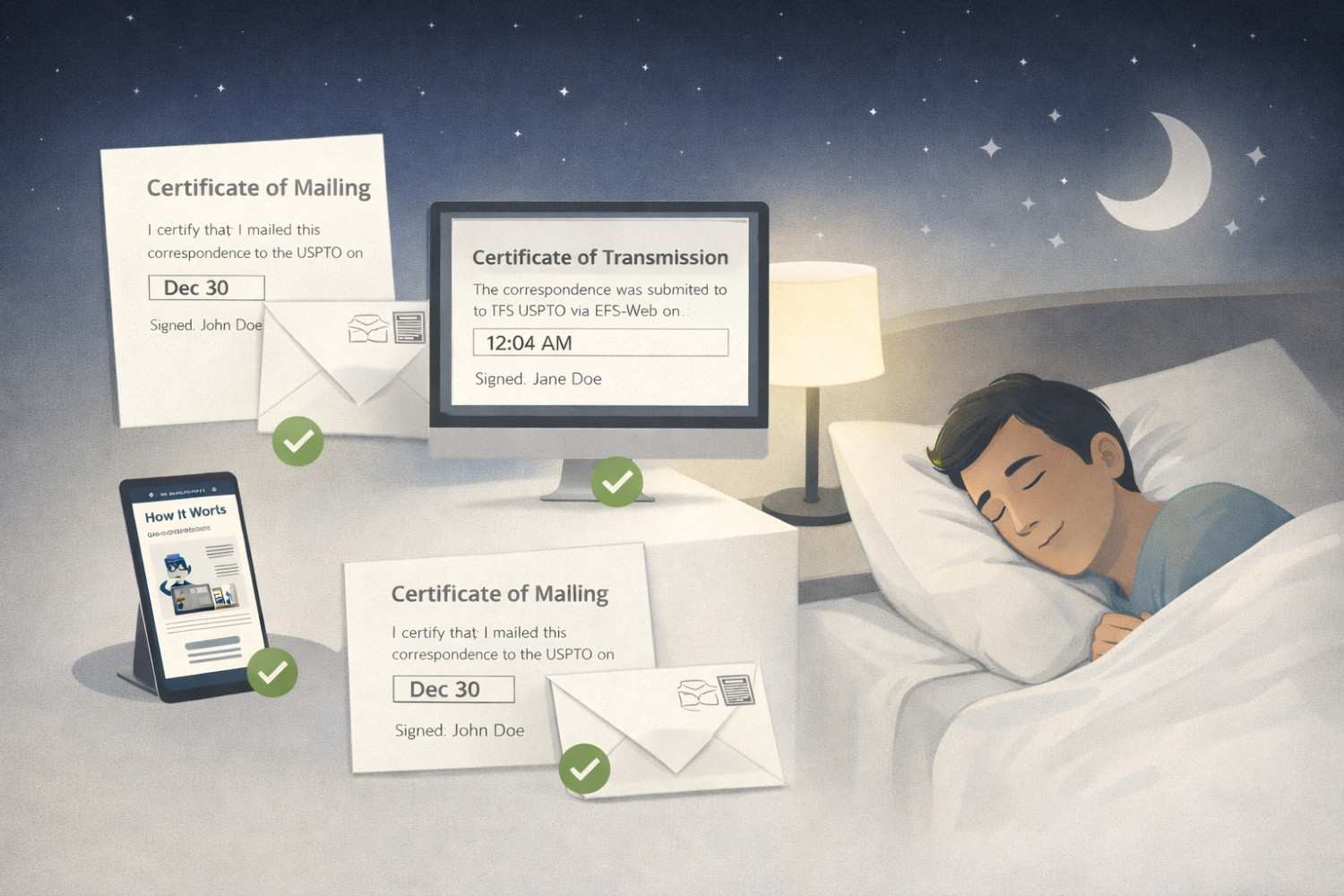
Patents do not care that you were coding late, shipping a release, or closing a deal. Deadlines still hit at midnight. And when they do, one small filing mistake can quietly cost you real rights. This article is about that exact moment. The after-hours filing. The last-day submission. The question of proof. We are going to break down, in very plain words, how the USPTO decides when something was filed, how you prove it, and why two short rules—37 CFR 1.8 and 37 CFR 1.10—matter far more than most founders realize.
Why Filing Time Actually Matters More Than Most Founders Think
Filing time sounds like a small detail. It feels administrative. Something clerks worry about, not builders. But for patents, filing time is not paperwork. It is substance.
It decides who wins when two people claim the same idea. It decides whether your own past actions hurt you. And it often decides this silently, without warning, months or years later.
Most founders only think about filing time when they are already stressed. Late night.
Deadline tomorrow. Something is “almost ready.” That is the worst time to learn how strict the system really is. Understanding this now gives you leverage later.
It lets you plan filings instead of reacting to them. And it helps you avoid mistakes that cannot be fixed.
The Patent System Runs on Time, Not Intent
The patent office does not care what you meant to do. It does not care how hard you worked. It only cares what it received, and when it received it.
If you intended to file on Tuesday but actually filed early Wednesday, the system treats that as Wednesday.
There is no grace for good faith. There is no credit for effort. Time is binary. Either the office recognizes your filing as on time, or it does not.
This matters because patent rights are often decided by a single day. Sometimes a single minute.
In crowded spaces like software, AI, hardware, and biotech, multiple teams are racing toward similar ideas. The winner is often the first person to get a valid filing on record.
Priority Is a Race You Do Not See
Most founders think competition is visible. Another startup launches. A paper is published. A product ships. Patent competition is invisible.
You never see the other filings while the race is happening. You only see the outcome later, when something is rejected or challenged. At that point, it is too late to adjust timing. The record is frozen.
Filing time is what locks in your priority date. That date becomes your anchor. Everything else is judged against it. Later disclosures by others may not matter if you filed first.
Your own disclosures may not hurt you if they came after filing. But all of this depends on the time stamp the USPTO accepts.
After-Hours Filing Is Where Most Mistakes Happen
During business hours, systems are calmer. People are available. Errors are caught earlier. After hours, founders file alone.
Late-night filings often happen under pressure. Maybe a demo is tomorrow. Maybe an investor asked a question. Maybe a conference paper is about to go live. These are exactly the moments when founders rush.
Rushing leads to small errors. Wrong document attached. Missing fee. Improper certificate.
Each of these can shift your effective filing time or invalidate proof of timeliness. The scary part is that you usually do not find out right away.
The Difference Between Submission and Acceptance
One of the biggest misunderstandings is assuming that submitting something means it counts.
The patent office distinguishes between when you try to file and when it legally recognizes the filing.
Those are not always the same. Systems can reject uploads. Payments can fail. Certificates can be invalid. If that happens, your clock keeps ticking.
Founders often assume that because they clicked submit before midnight, they are safe. That is not always true. What matters is whether the USPTO agrees that your filing met all requirements by that time.
Time Affects More Than Just Priority
Priority is the obvious issue, but it is not the only one.
Filing time affects whether your own actions hurt you. Public talks. Sales. Demos. Blog posts. Code releases. All of these can become prior art against you if they happen before a valid filing.

Many founders operate in public. They ship fast and share progress. That is good for growth, but risky for patents. Filing time is what draws the line between safe sharing and self-sabotage.
Deadlines Do Not Care About Context
The patent system is full of deadlines. Some are flexible. Many are not.
Response deadlines. Conversion deadlines. Priority deadlines. Missing one can mean abandonment or loss of rights. Filing after hours is often about meeting one of these cutoffs.
The system does not care why you filed late. It does not care about time zones, product launches, or investor meetings. It cares about compliance with its rules. Knowing those rules ahead of time changes how you plan.
The Real Cost of Getting Time Wrong
The cost of a filing error is rarely immediate. That makes it dangerous.
You may think everything is fine. The application goes pending. Months pass. Maybe years. Then an examiner raises an issue. Or a competitor files something similar. Or you try to raise a round and diligence starts.
That is when timing problems surface. At that point, fixing them is often impossible. The cost is not just legal fees. It is lost leverage, weaker claims, or no protection at all.
Filing Early Is Strategy, Not Caution
Some founders see early filing as being overly cautious. In reality, it is offensive strategy.
Early filing lets you move faster publicly. It lets you talk to customers without fear. It lets you publish and ship while competitors hesitate. Filing time buys you freedom.
But that freedom only exists if the filing is valid and properly timed. Sloppy after-hours filings undermine that benefit.
Treat Filing Time Like Shipping Time
Founders obsess over shipping deadlines. They track hours. They build buffers. They test systems.
Filing deserves the same respect. It should not be something you do at the last minute unless you have a system that supports that. Professional tooling, attorney oversight, and clear proof paths matter most when time is tight.
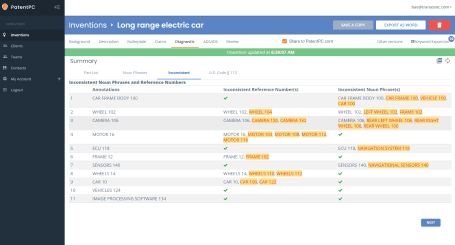
This is exactly where modern platforms help. PowerPatent is built for founders who file in real life, not in theory.
It combines smart software with real attorney review so filings are clean, timely, and defensible, even when done fast. If you want to see how that works in practice, this is the place to start: https://powerpatent.com/how-it-works
Action You Can Take Right Now
The most practical move is simple. Stop treating filing time as an afterthought.
Plan filings before public events. Build buffer days, not hours. Use systems that give you clear proof and attorney-backed review. Assume that if something can go wrong at 11:59 p.m., it will.
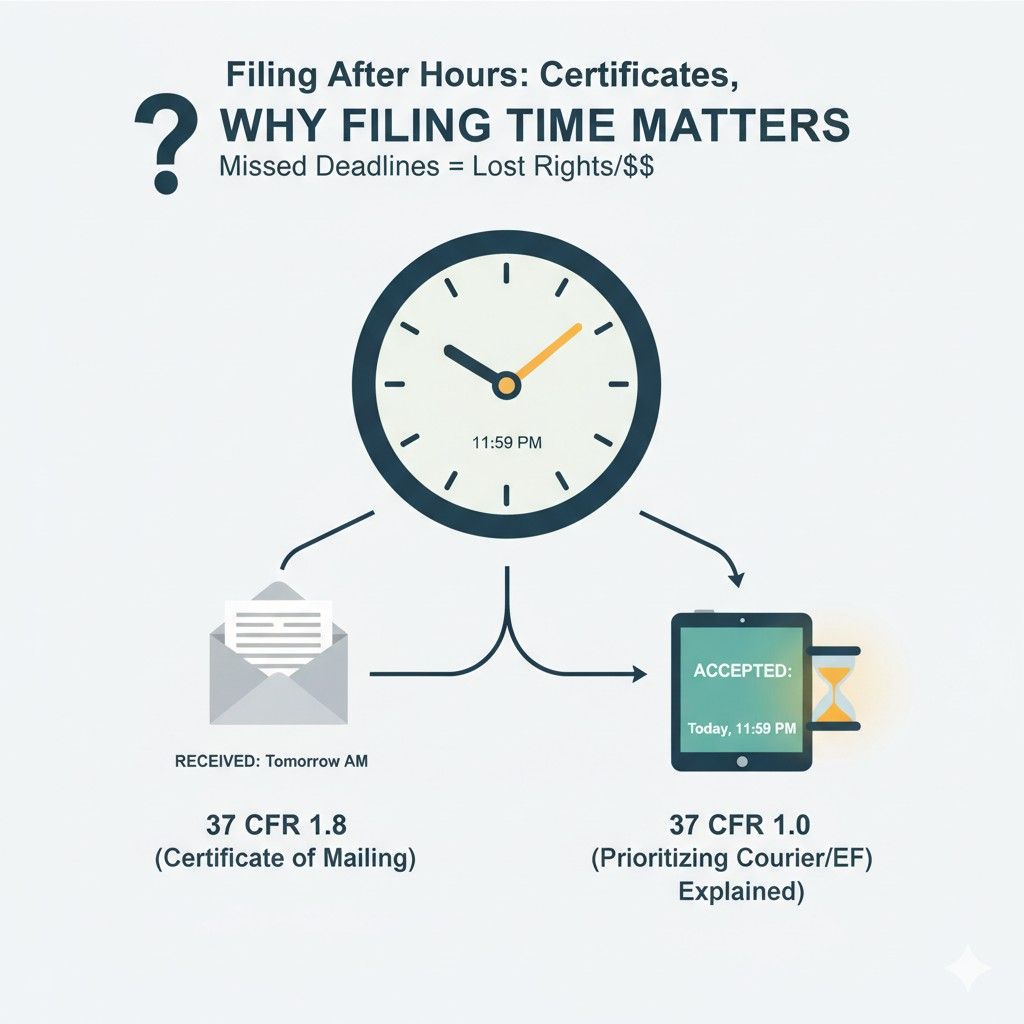
Filing time is not a technicality. It is the foundation. When you get it right, everything else becomes easier. When you get it wrong, nothing else matters.
What the USPTO Accepts as Proof When You File After Hours
When you file during normal hours, proof rarely comes up. The system is open. Payments clear.
Everything feels routine. After hours, proof becomes the entire game. If something goes wrong, proof is the only thing standing between you and a missed deadline.
Most founders assume proof means a receipt or a confirmation email. In patent filings, proof is more narrow and more strict.
The USPTO only accepts certain types of evidence, and it only accepts them if they meet very specific rules. Understanding this ahead of time changes how you file and how much risk you take late at night.
Proof Is About Rules, Not Common Sense
The USPTO does not apply common sense. It applies rules.
You may have strong evidence that you tried to file on time. Screenshots. Logs. Emails. Those often feel convincing. They usually do not matter. The office only looks at proof that fits within its regulations.
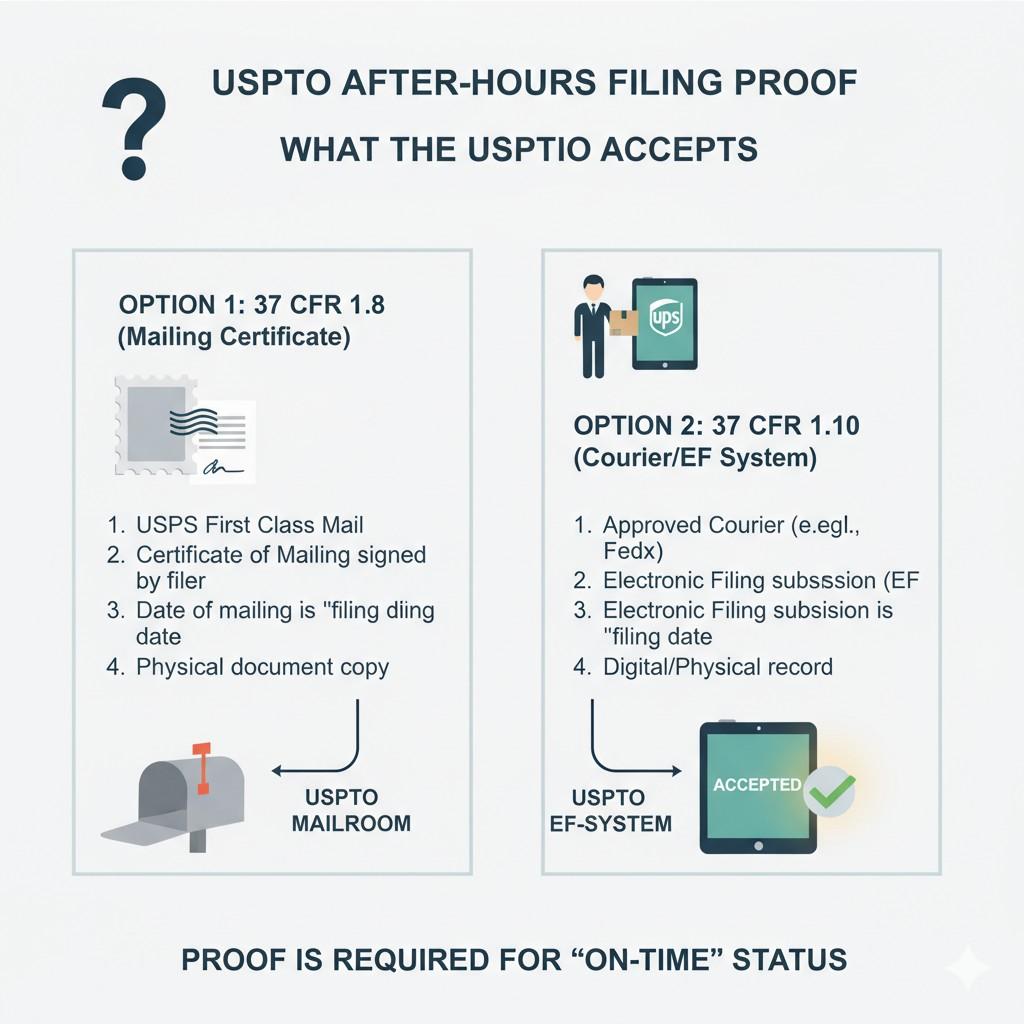
This surprises founders because it feels unfair. But the system is designed for consistency, not fairness. The same rule must apply to everyone, whether you are a solo founder or a public company.
The System Only Trusts Certain Signals
The patent office trusts its own systems first. If its records show a filing time, that is the starting point. Everything else is secondary.
When you file electronically, the timestamp generated by the USPTO’s system carries the most weight. If something interrupts that process, your ability to prove timely filing depends on whether you followed approved backup methods.
This is where many founders get caught. They rely on assumptions instead of recognized signals.
Confirmation Pages Are Not Always Enough
A confirmation page feels final. It looks official. It often includes a date and time.
But not all confirmations are equal. Some confirm receipt of documents. Others confirm submission attempts. Only certain confirmations count as proof of filing.
If a submission fails but still generates some output, founders may think they are safe. Later, they learn that the system never accepted the filing. The proof they relied on has no legal value.
Email Is Not Legal Proof
Email feels permanent. It is searchable. It is timestamped. That does not make it acceptable proof.
Emails from the USPTO can help explain what happened, but they rarely establish filing time on their own. Emails from your own system or team carry even less weight.
Founders often forward these emails to attorneys hoping they solve the problem. Most of the time, they do not.
The USPTO Wants Predictability
The reason the USPTO limits acceptable proof is predictability.
If every filer could argue based on custom logs or screenshots, the system would collapse into disputes. Instead, the office defines narrow paths that everyone must use.
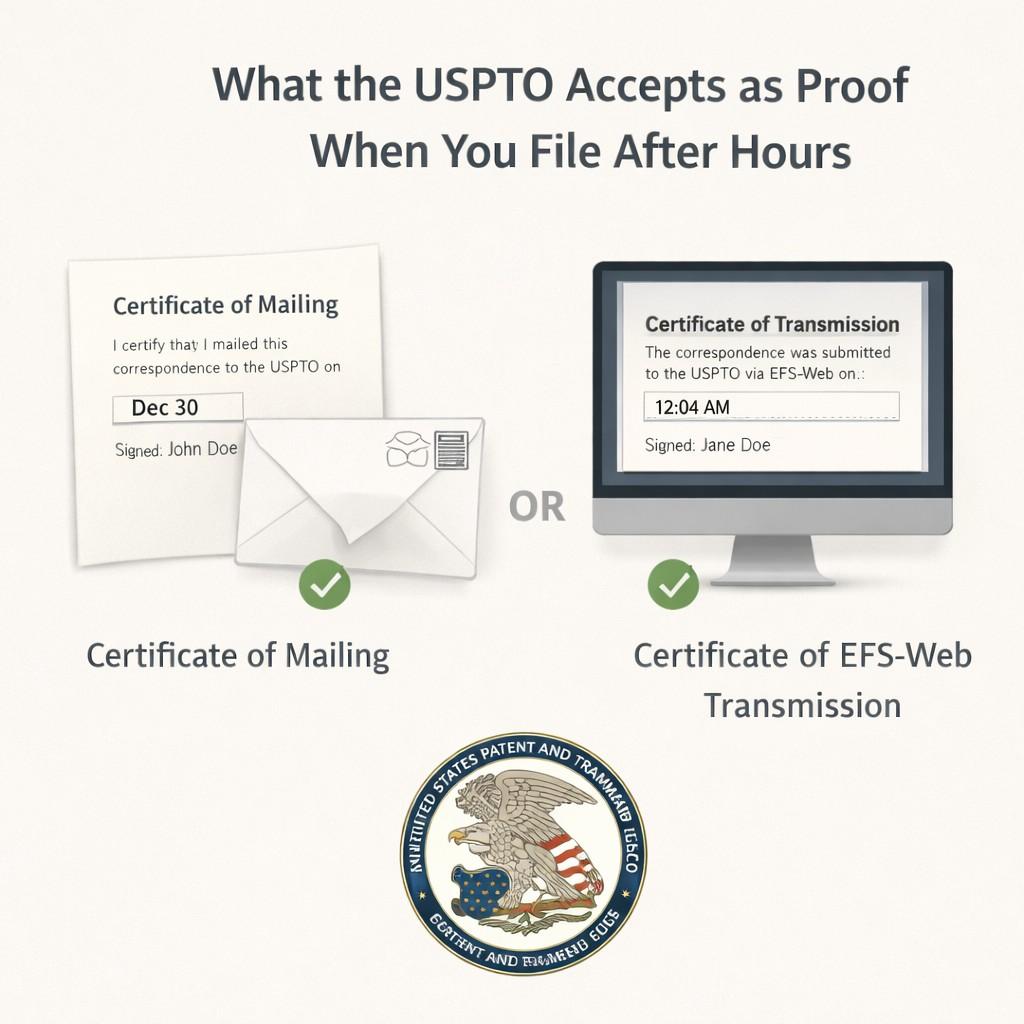
This makes the system rigid, but it also makes outcomes predictable. If you know the rules, you can plan around them.
Late-Night Filings Are Assumed Risky
The rules are written with an assumption that after-hours filings are risky.
Systems go down. Payments fail. Users make mistakes. The USPTO knows this. That is why special rules exist for after-hours filing. Those rules are not automatic. You must actively comply with them.
If you do not, the default assumption is that the filing date is whatever the system recorded, even if that hurts you.
Proof Must Be Created the Right Way
One of the most important ideas here is timing of proof creation.
Valid proof is often created at the moment of filing, not after. You cannot usually recreate proof later. If you miss the step when it matters, no explanation fixes it.
This is why experienced filers treat proof steps as part of filing, not as cleanup.
Human Memory Does Not Matter
Founders remember exactly what they did. What time they clicked. What screen they saw. That memory feels strong.
The patent system does not care. Memory is not evidence. Even sworn statements have limits when they conflict with system records.
This is uncomfortable, but it is reality. The system values objective, predefined signals over personal accounts.
Proof Problems Surface at the Worst Time
Proof issues rarely come up right away.
They appear when you least want them to. During diligence. During enforcement. During an office action. At that point, the stakes are high and options are low.
That is why smart founders handle proof early, even when everything seems fine.
The Real Lesson for Founders
The core lesson is simple. Do not improvise proof.
If you are filing after hours, you must know exactly what proof the USPTO will accept and make sure you generate it correctly. Hope is not a strategy. Good intentions do not survive audits.
This is one reason modern patent platforms matter.
PowerPatent is built to remove these edge-case risks by guiding filings through systems designed for real-world founder behavior, with attorney review to catch issues before they become permanent.
You can see how that works here: https://powerpatent.com/how-it-works
What You Should Change Going Forward
From a business perspective, treat proof as part of your IP asset.
Do not let late-night filings happen without structure. Use tools that surface confirmation details clearly. Work with systems that understand USPTO rules, not just document uploads.
When proof is handled correctly, filing time stops being a source of stress and starts being a strategic advantage.
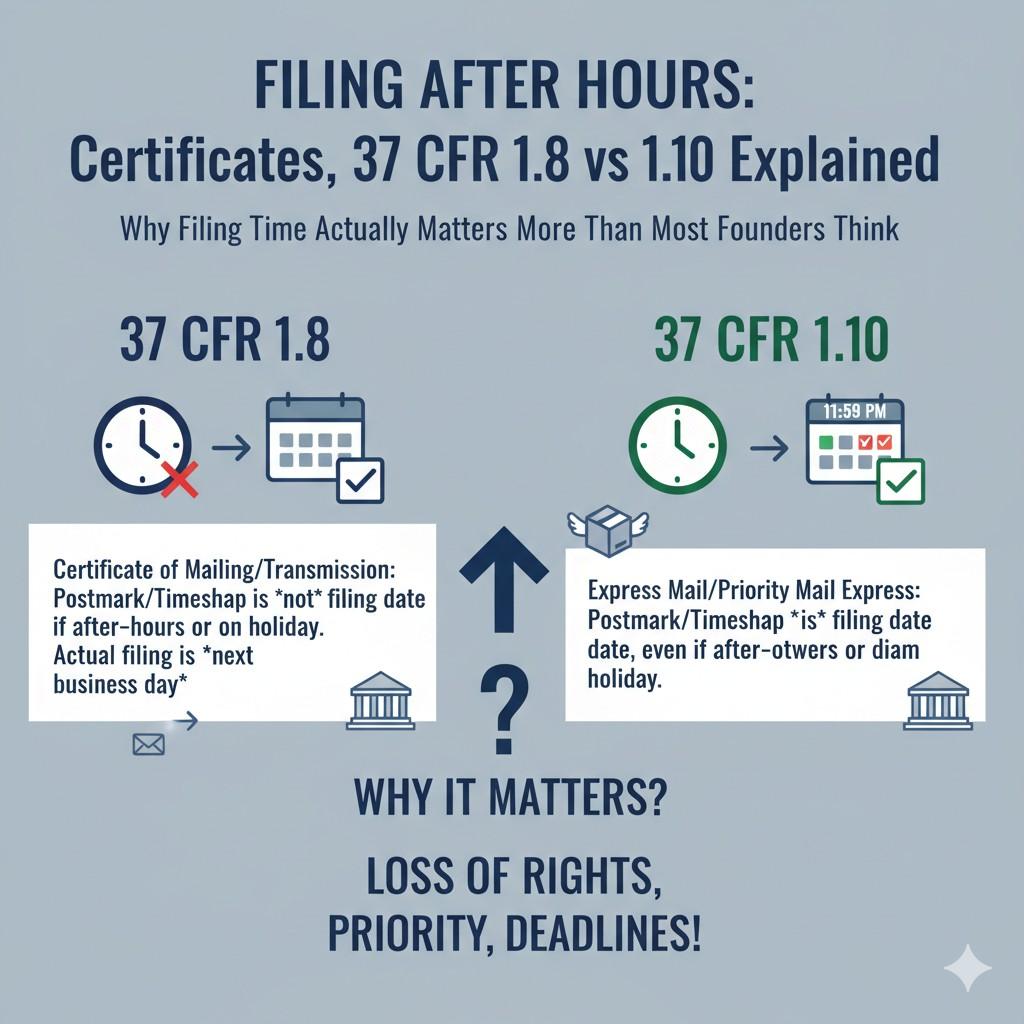
37 CFR 1.8 vs 37 CFR 1.10: Same Goal, Very Different Risk
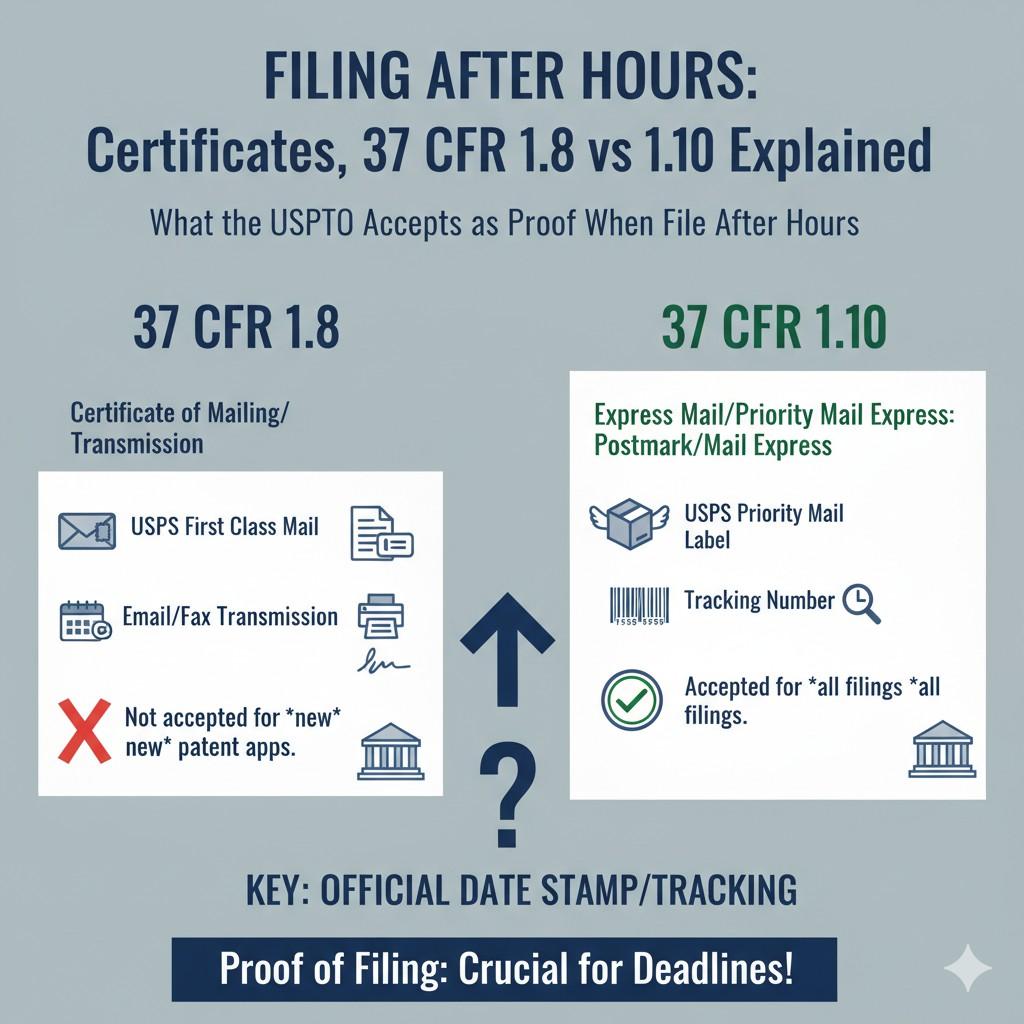
This section is where things start to feel technical, but the idea itself is simple. 37 CFR 1.8 exists to answer one question: how do you prove you sent something on time when the patent office did not receive it on time.
For founders who file after hours, this rule can feel like a safety net. In reality, it is more like a tightrope. It works only if you step exactly where you are supposed to.
What 37 CFR 1.8 Is Really Trying to Do
At its core, 37 CFR 1.8 is about trust. The USPTO is willing to trust you about when you sent a document, but only if you follow its script perfectly.
The rule allows certain papers to be treated as filed on the date you sent them, not the date the office actually received them. That sounds generous. It sounds founder-friendly. But the trust is conditional.
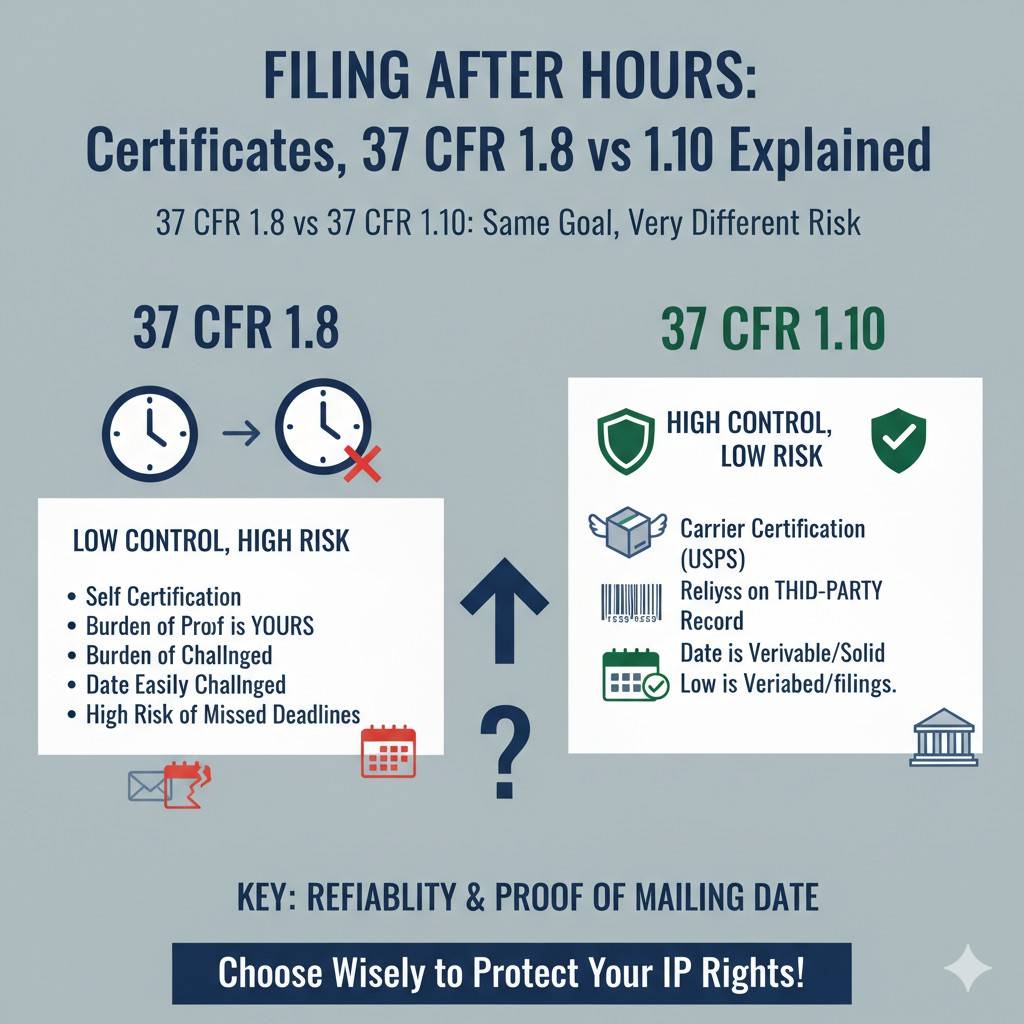
If you miss one requirement, the trust disappears completely.
Why Founders Misunderstand This Rule
Most founders hear about certificates of mailing or transmission and assume they are simple. Add a statement. Sign it. Done.
That assumption causes real damage.
37 CFR 1.8 is narrow. It only applies to specific types of papers. It does not apply to everything. And even when it does apply, the wording, timing, and method matter more than people expect.
Founders often use this rule casually, not realizing how unforgiving it is.
The Certificate Is Not a Formality
The certificate under 37 CFR 1.8 is not a courtesy note. It is a legal mechanism.
The certificate must say the right thing, in the right way, at the right time. It must be included when the paper is filed, not added later when there is a problem.
If the certificate is wrong, incomplete, or missing, the rule does not apply. There is no partial credit.
Timing Is the Entire Point
The irony of 37 CFR 1.8 is that it exists to deal with timing issues, yet it is extremely sensitive to timing itself.
The certificate must reflect the actual date of sending. Not the date you hoped. Not the date you planned. The date you actually transmitted the document.
If you prepare documents in advance but send them later, the certificate must match the send date exactly. Any mismatch can undermine the entire filing.
After-Hours Filings Increase the Risk
Late-night filings magnify every weakness in 37 CFR 1.8.
Founders are tired. Systems are slower. Payment issues are harder to resolve. Under those conditions, it is easy to generate a certificate automatically without checking details.
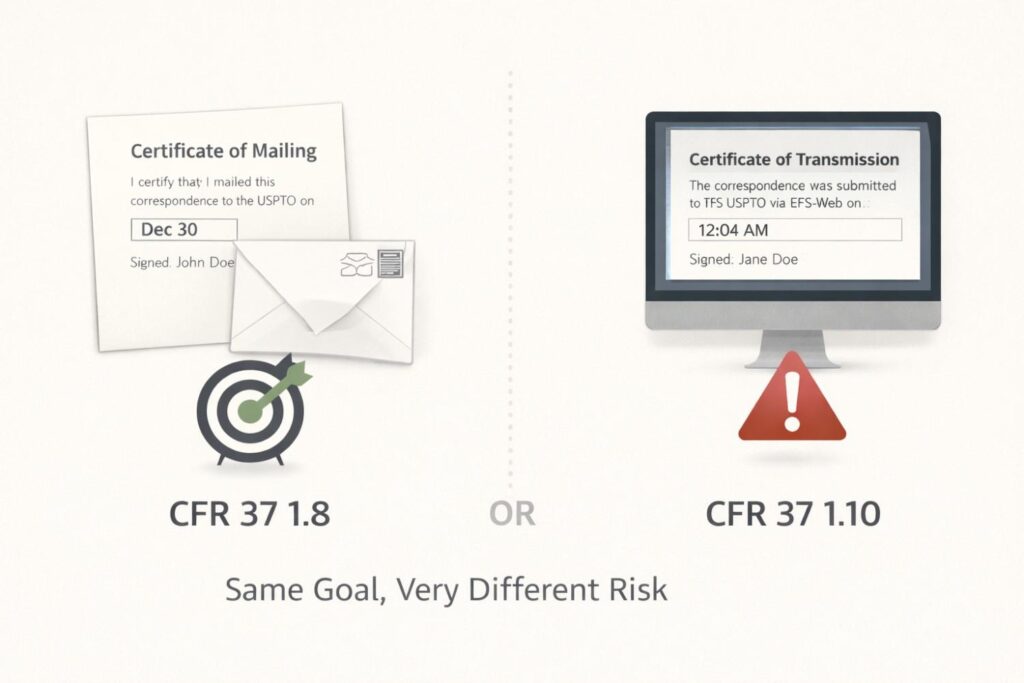
That is how mistakes happen. And because the certificate feels routine, founders rarely double-check it.
The Rule Does Not Cover Everything
This is one of the most dangerous misconceptions.
37 CFR 1.8 does not apply to initial patent applications. It does not protect priority dates for new filings. It mainly applies to follow-on papers, responses, and certain submissions.
Founders sometimes assume the rule protects their core filing. It does not. If you rely on it for the wrong document, you may think you are protected when you are not.
The USPTO Can Challenge the Certificate
Even when you include a certificate, the USPTO is allowed to question it.
If something seems off, the office can require additional proof. If you cannot provide it, the benefit of the rule disappears.
This means the certificate is not an absolute shield. It is a presumption that can be challenged.
Why This Matters for Business Strategy
From a business point of view, 37 CFR 1.8 creates uneven risk.
If you build your filing process around this rule, you are accepting that a small procedural error could cost you rights. That may be acceptable for low-value filings. It is rarely acceptable for core IP.
Founders should ask a hard question. Is this rule a backup, or is it part of the main plan?
The Hidden Cost of Getting It Wrong
When 37 CFR 1.8 fails, it often fails quietly.
The filing may appear accepted. The system may move forward. Only later does the issue surface, often when it is impossible to fix.
At that point, the cost is not just legal cleanup. It is weakened leverage in negotiations, uncertainty in diligence, and lost confidence.
How Smart Founders Use This Rule
The best use of 37 CFR 1.8 is conservative.
It should be a fallback, not a foundation. Something you understand deeply but rely on rarely. It works best when combined with systems that reduce the chance you ever need it.
This is why many modern teams move away from manual certificates and toward platforms that manage timing and compliance automatically, with attorney oversight to catch errors before they lock in.
PowerPatent is built with this reality in mind, so founders are not forced to gamble on procedural edge cases. You can see how that approach works here: https://powerpatent.com/how-it-works
The Takeaway Before Moving On
37 CFR 1.8 is powerful, but fragile.
It rewards precision and punishes assumptions. If you treat it casually, it can hurt you. If you respect its limits, it can save you in narrow situations.
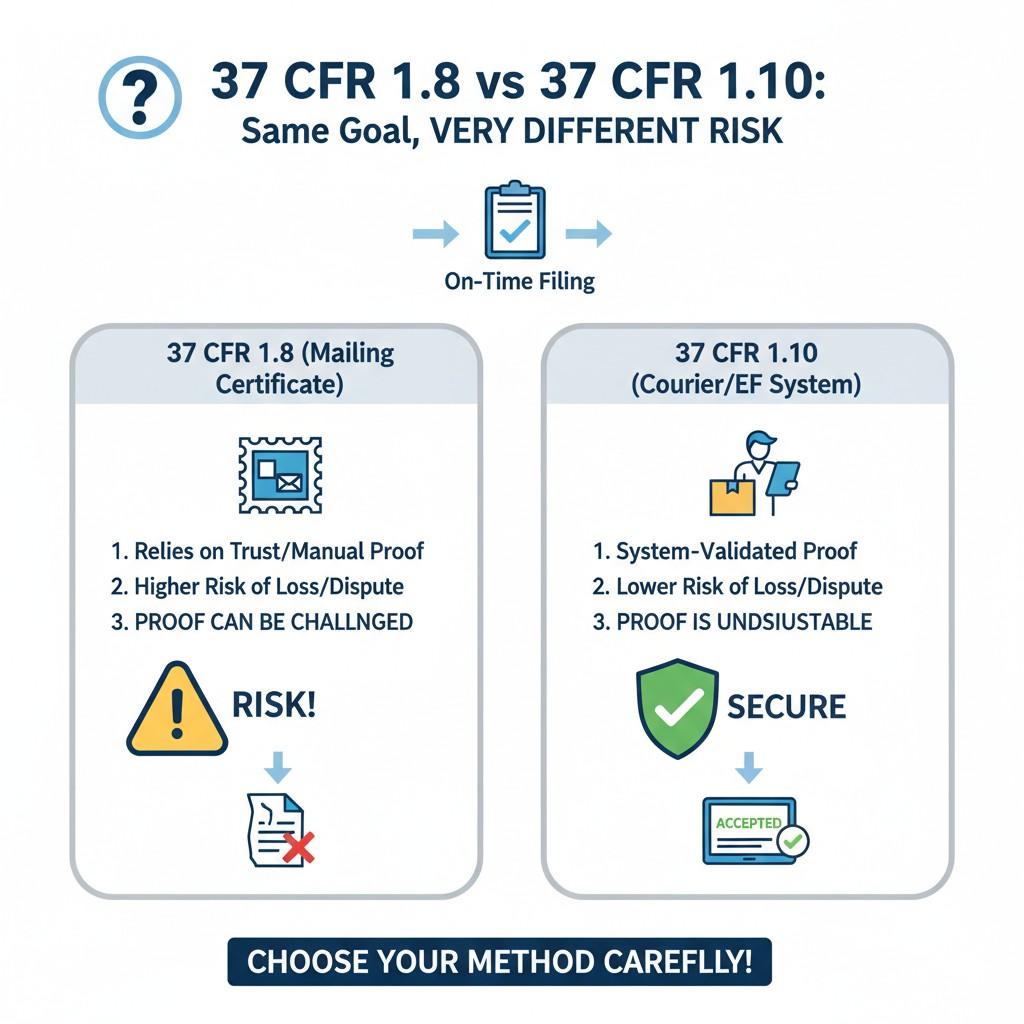
Understanding this rule is necessary. Relying on it as your main protection is risky.
How to File Late Without Losing Your Rights or Your Sleep
By the time founders reach this point, one thing is usually clear. Filing after hours is not rare. It is normal. Startups move fast. Deadlines collide with product work. The question is not whether late filings will happen.
The question is whether you will handle them in a way that protects the business instead of quietly putting it at risk.
This section is about control. Not legal theory. Not edge cases. Real decisions founders can make so filing stops feeling like a gamble.
Treat Filing as a Business Event, Not a Task
The biggest shift is mental.
Founders often treat filing like uploading a document. In reality, it is a business event. It locks in rights. It shapes leverage. It affects valuation.
When you treat it that way, behavior changes. You plan around it. You protect time for it. You avoid doing it half-awake at the end of a long day unless you have no other choice.
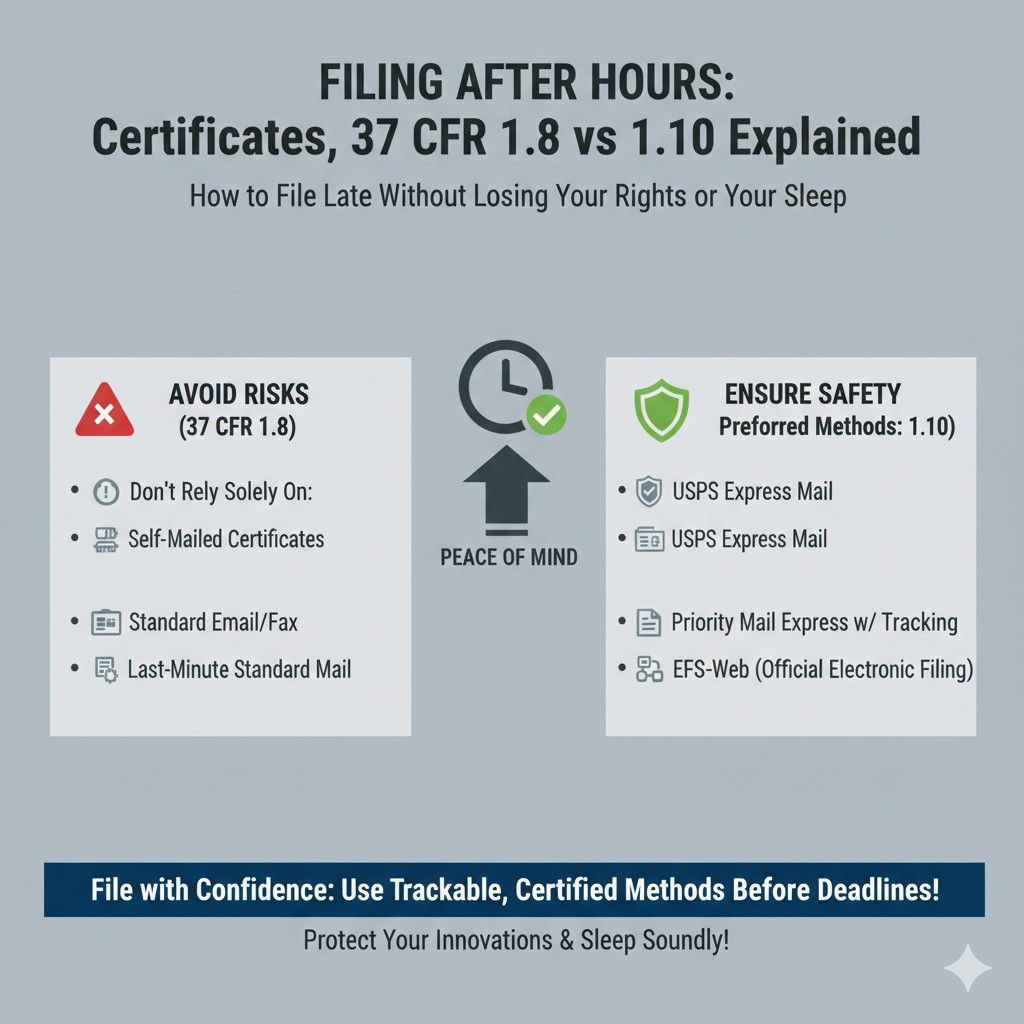
This alone reduces most risk.
Build Time Buffers That Match Reality
Many founders plan filings with theoretical time. “I need thirty minutes to upload.” That assumption is almost always wrong.
Real filings take longer. Files are bigger. Systems slow down. Questions appear. When filing after hours, support is not available.
Smart teams build buffers measured in hours, not minutes. They aim to finish well before the cutoff so the system, not stress, controls the outcome.
Separate Drafting From Filing
One quiet mistake founders make is combining drafting and filing into a single late-night sprint.
That increases error rates. Typos slip in. Attachments are missed. Certificates are wrong.
Separating these steps changes everything. Draft earlier. Review earlier. File later if needed, but only after everything is ready. Filing should feel boring. Boring is good.
Choose Certainty Over Cleverness
Founders love clever solutions. Patents reward boring ones.
Relying on exceptions, certificates, or backup rules may feel efficient, but it adds hidden risk. The safest path is usually the most direct one. System-based filing. Clear timestamps. Complete submissions.
If a strategy depends on explaining what you meant later, it is already risky.
Know When Not to File Late
There are moments when filing late is simply the wrong move.
If the filing is core to your company. If it anchors your valuation. If it underpins fundraising or licensing. Those are not filings to rush.
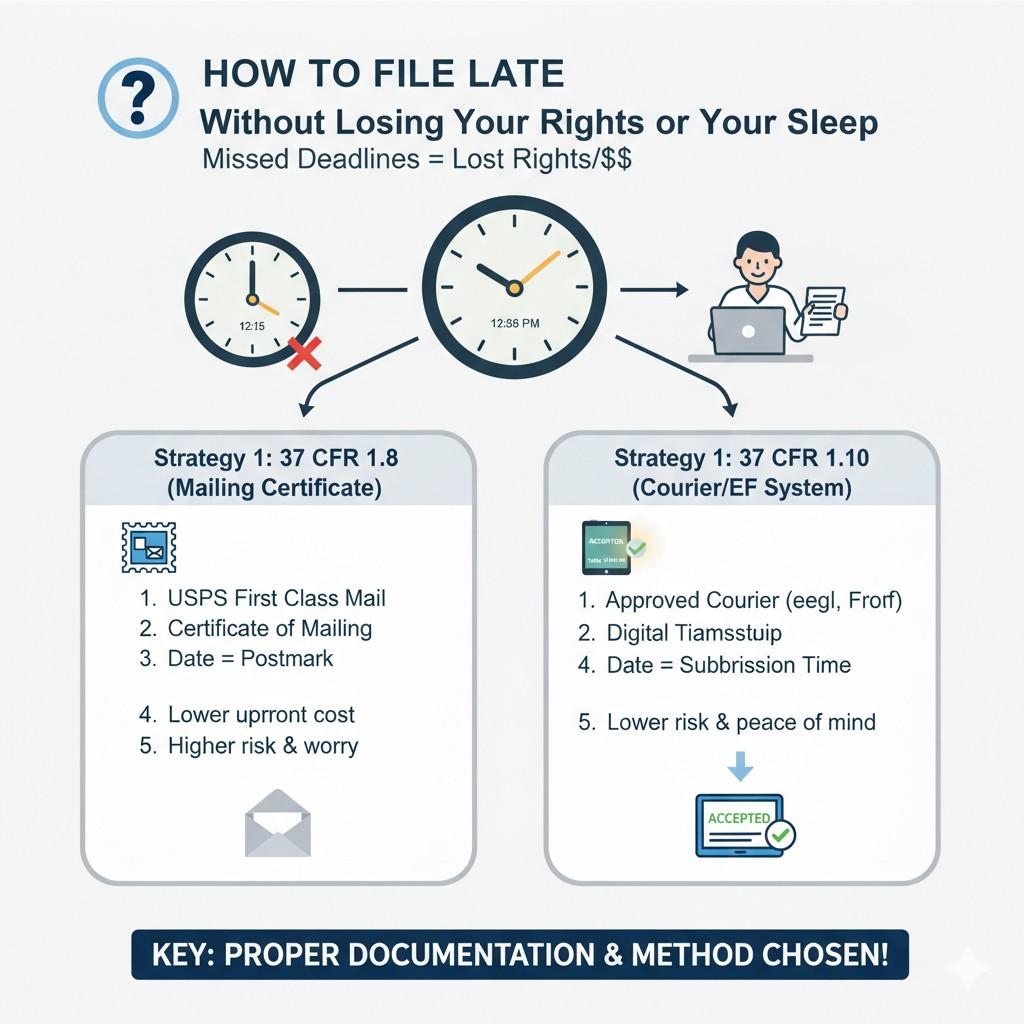
In those cases, delay the public event instead. Move the demo. Hold the post. Protect the filing. The business impact of a short delay is often far smaller than the cost of weakened IP.
Reduce Human Error as Much as Possible
Most after-hours problems are human, not technical.
People misclick. Forget steps. Assume things worked. The tired brain fills in gaps with optimism.
Reducing human involvement helps. Clear workflows. Guided steps. Attorney review. These are not luxuries. They are safeguards.
Why Modern Tools Matter More at Night
Old systems were built for daytime clerks, not founders.
Modern tools are built for how startups actually operate. Late nights. Distributed teams. Tight deadlines.
PowerPatent exists because founders should not have to become procedural experts just to protect what they are building.
The platform blends software that understands USPTO timing rules with real attorney oversight so filings hold up, even when done fast.
That is the difference between hoping and knowing. You can explore how that works here: https://powerpatent.com/how-it-works
Turn Filing Into a Repeatable Process
One-off stress is bad. Repeated stress is worse.
The goal is to make filing repeatable. Same process. Same checks. Same confidence every time. When filing becomes a system instead of an event, late nights stop being scary.
This also scales. As your company grows and filings increase, consistency becomes more valuable than speed.
Confidence Is the Real Outcome
The real benefit of getting this right is not just compliance.
It is confidence. Confidence to ship. Confidence to talk. Confidence to raise. When you know your filings are solid, you stop hesitating.
That confidence shows up in how you run the company.
The Final Thought for Founders
After-hours filing will never disappear. But panic around it can.
Understand the rules. Respect timing. Choose systems that remove guesswork. Do not rely on fragile backups when stronger paths exist.

Patents should support your momentum, not slow it down.
Wrapping It Up
Filing time is not a legal footnote. It is a business decision that quietly shapes everything that follows. When founders lose rights, it is rarely because the idea was weak. It is because timing was treated casually. The difference between 37 CFR 1.8 and 37 CFR 1.10 makes this clear. One asks the system to trust you. The other relies on the system to trust itself. For modern startups moving fast, certainty almost always beats explanation.