If you are building a chemical or pharma invention, your patent lives or dies on one quiet idea: can someone else read it and actually make and use what you claim without guessing. That idea is called enablement, and in chemical and drug patents, it is unforgiving. This article is about how enablement really works in chemical and pharma patents, with a sharp focus on representative species and guidance. Not theory. Not law school talk. Just what founders, scientists, and engineers need to know to avoid fatal mistakes and to lock down real protection.
Why Chemical and Pharma Patents Are Judged More Harshly Than Others
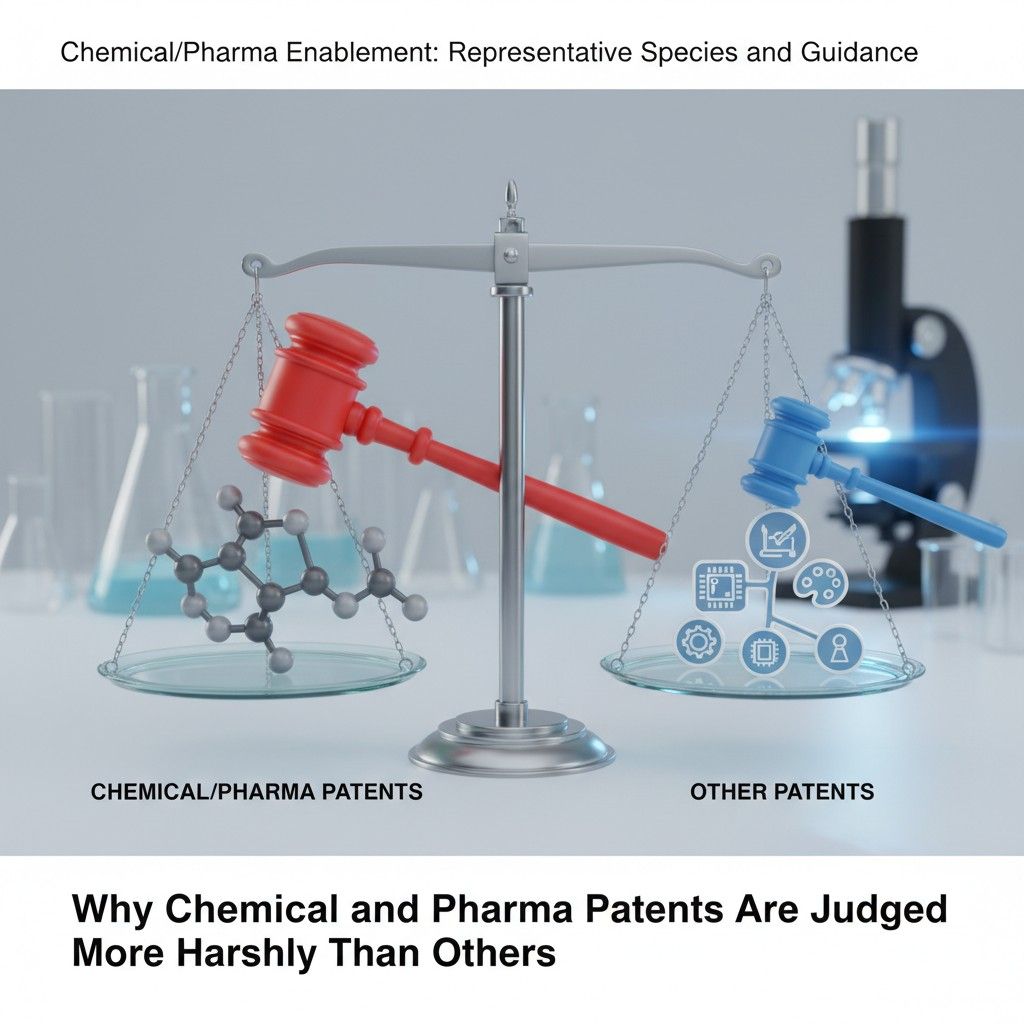
Chemical and pharma patents live in a different world from software or mechanical patents. The rules are not written differently on paper, but they are enforced very differently in practice.
Courts and patent offices expect far more proof, far more detail, and far more care. For businesses, this creates real risk, but also real opportunity if handled the right way.
This section explains why that harsher treatment exists, how it shows up during prosecution and enforcement, and what smart teams can do early to stay ahead of it instead of reacting too late.
Chemistry Is Less Predictable Than Most Technologies
In chemistry and pharma, small changes can cause huge differences. A tiny shift in molecular structure can turn an effective drug into something useless or dangerous.
Because of this, decision makers do not assume that one example naturally leads to many others.
From a business standpoint, this means you cannot rely on logic alone. You may feel confident that if compound A works, compounds B through Z will also work.
In practice, that belief has little value unless your patent shows real evidence or strong direction.
Actionable takeaway: when you discover something that works, assume nothing else will be assumed for you.
Treat each meaningful variation as something that needs to be explained, not implied. Even if you cannot test everything, you must guide the reader clearly toward what will work and why.
Broad Claims Trigger Immediate Skepticism
Chemical and pharma patents often aim for broad protection because the investment is high and the development timeline is long. This makes sense from a business view. The problem is that broad claims raise red flags right away.
Examiners and judges are trained to ask a simple question: did the inventor actually possess everything they are claiming, or are they guessing the rest? In chemistry, guessing is not forgiven.
This is why chemical patents are often attacked on enablement years after they are granted. The patent may look strong at first, but once money is on the line, opponents dig deep into whether the full scope was truly supported.
Actionable takeaway: before filing, map your claims backward. For each major chunk of scope, ask whether your description makes it feel earned.
If a neutral scientist would hesitate to try part of your claim without extra work, that is a warning sign you should address early.
The Field Is Crowded and Competitive
Chemical and pharma spaces are dense with prior work. Many molecules, pathways, and methods already exist. This makes it harder to stand out and harder to justify sweeping coverage.
Because so much is known, patent reviewers expect you to be precise. They expect you to explain exactly what is new, why it matters, and how it works across the scope you claim.
For businesses, this means patents cannot be treated as a formality. They are competitive weapons, and weak ones will be exposed quickly.
Actionable takeaway: position your invention clearly against known work. Do not just describe what you built.
Explain how it behaves differently and why that difference holds across your claimed space. This strengthens enablement and makes your story more credible.
Courts Have Been Burned Before
Modern enablement standards did not appear by accident. They are a response to past patents that claimed too much with too little support.
In chemical and biotech history, there are many examples of patents that blocked entire fields without teaching enough to justify it.
Courts now actively guard against this. They look closely at whether a patent teaches how to reach the full scope without undue effort.
From a business view, this means you are operating in a system shaped by past abuse. Even honest inventors feel the impact.
Actionable takeaway: write your patent as if a future judge will read it skeptically. Assume they will test whether your examples and explanations truly scale. This mindset leads to stronger, more defensible filings.
Enablement Is Judged With Hindsight
One of the hardest parts of chemical patent law is that enablement is often judged years later. At that point, your company may be successful, your product may be proven, and the stakes may be enormous.
Opponents will argue that what seems obvious now was not clear at the time of filing. They will isolate weak spots where guidance was thin or examples were narrow.
Actionable takeaway: document your thinking at the time of invention. Explain why you believed your approach would work across the claimed range. Even partial reasoning can matter later when your patent is examined with hindsight.
Chemical Patents Are Expected to Teach, Not Just Claim
In some fields, a patent can outline a system and let skilled engineers fill in the gaps. Chemistry and pharma do not get that leeway. The expectation is teaching, not just describing.
This includes teaching how to make compounds, how to test them, and how to understand which ones are likely to succeed. Silence or vague language is often interpreted against the inventor.
Actionable takeaway: treat your patent like a guide, not a fence. The more clearly you lead the reader, the easier it is to defend broad coverage later.
Functional Claims Invite Extra Scrutiny
Many chemical and pharma patents rely on functional language, such as compounds that achieve a certain result or activity. While this can be powerful, it also invites closer inspection.
Reviewers will ask whether the patent teaches how to find all compounds that meet the function, or whether it only shows a few lucky hits.
Actionable takeaway: if you use functional claims, back them with strong explanation. Show patterns, structure-activity relationships, or design rules that reduce guesswork. This turns function from a liability into a strength.
The Cost of Failure Is Higher
When a chemical or pharma patent fails, the damage is often massive. Years of research, trials, and funding may depend on that protection. This reality makes courts more cautious, not less.
Because the consequences are high, the standards are high.
Actionable takeaway: treat enablement as a business risk issue, not a legal checkbox. Invest early in getting it right. The cost is small compared to fixing a broken patent later, which is often impossible.
Why Early Strategy Matters More Than Later Fixes
Once a patent is filed, many enablement problems cannot be fixed. You cannot add new examples or new guidance after the fact. What is missing stays missing.
This is why chemical and pharma patents punish rushed filings more harshly than other fields.
Actionable takeaway: slow down just enough at the start to think through scope, examples, and guidance. Use tools and experts who understand how enablement actually gets tested.
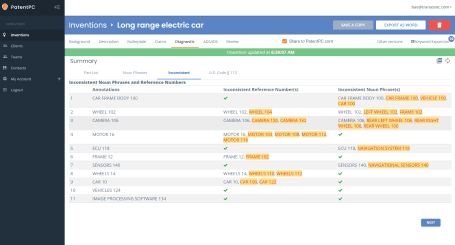
This is exactly where platforms like PowerPatent help founders move fast without cutting corners, combining smart software with real attorney insight. You can see how that works here: https://powerpatent.com/how-it-works
What “Representative Species” Really Means in Plain English
Representative species is one of those phrases that sounds academic but controls the fate of many chemical and pharma patents.
Most founders hear it too late, usually when an examiner or an opposing lawyer points out that their patent does not actually support what it claims.
This section explains what representative species truly means in real business terms, why it is so central to enablement, and how teams can use it strategically instead of defensively.
The Core Idea Behind Representative Species
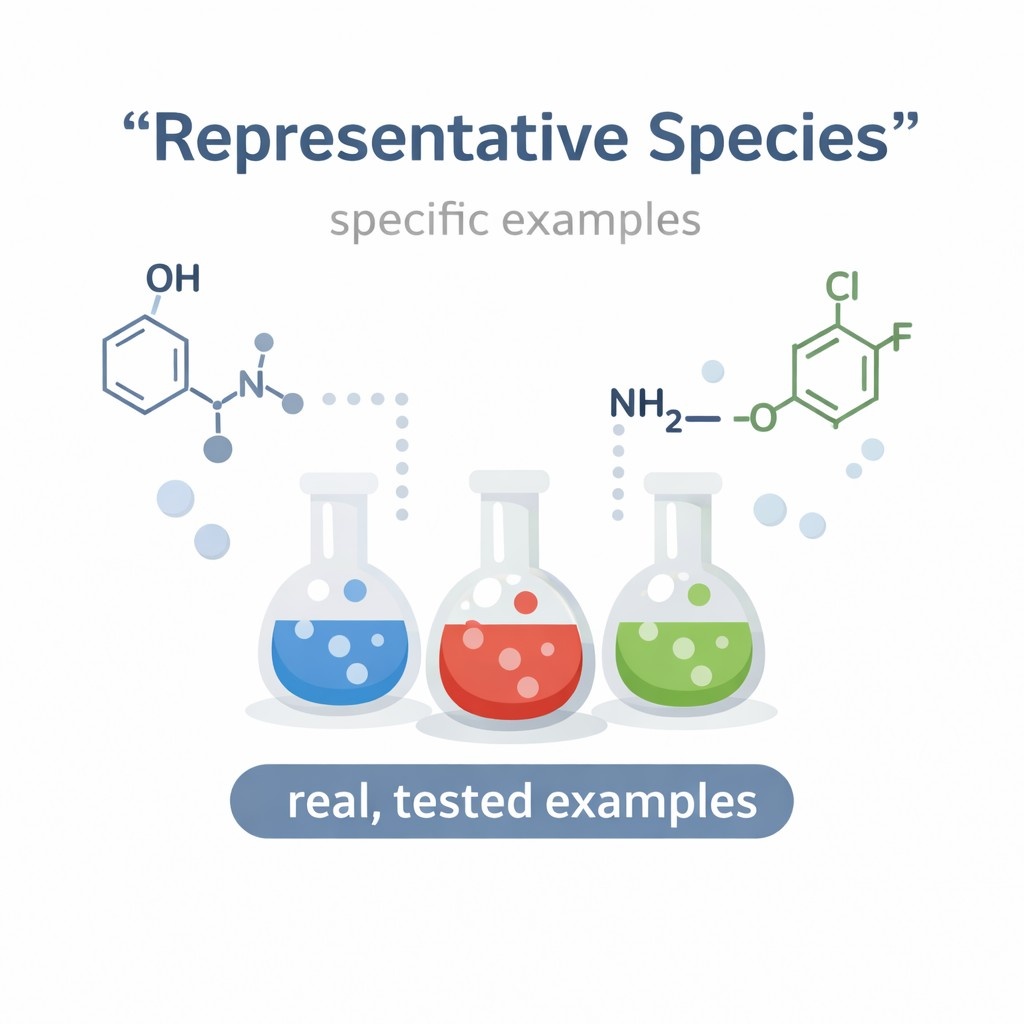
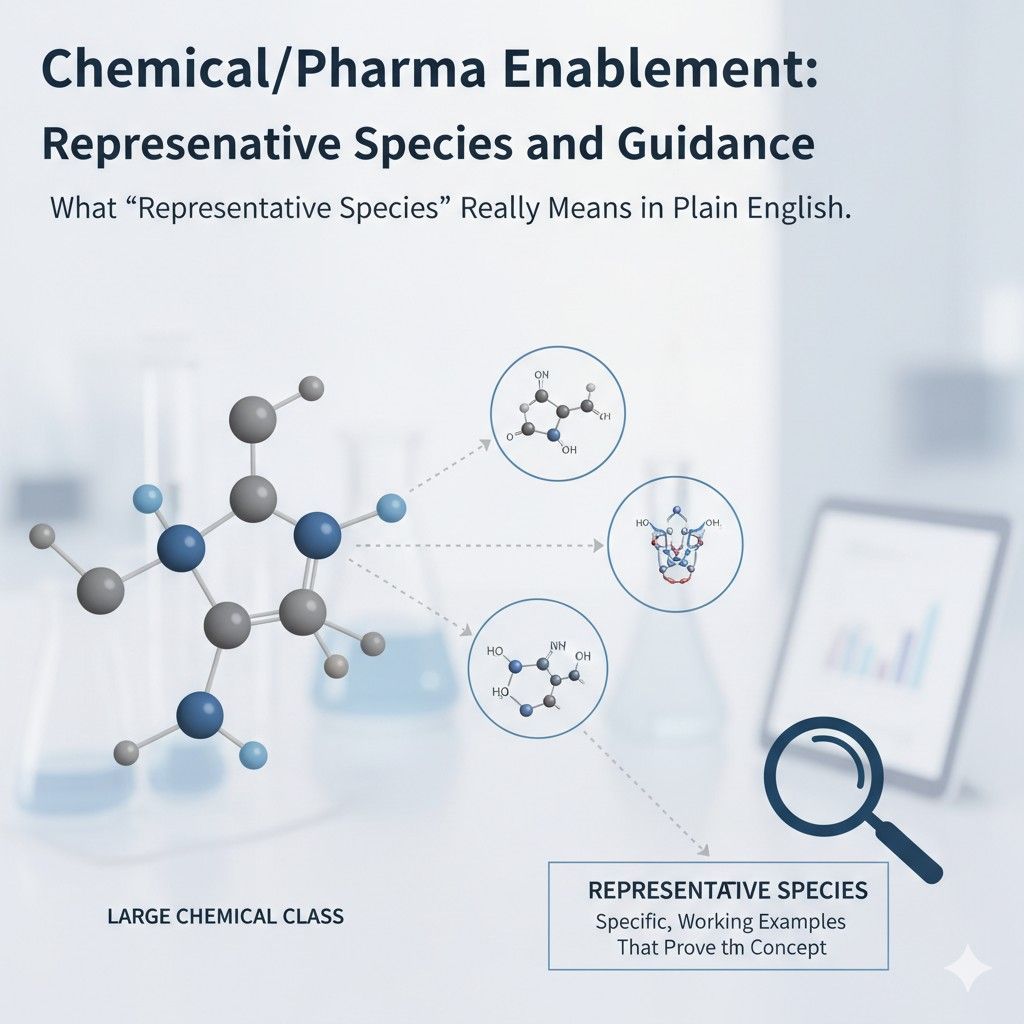
At its heart, representative species is about trust. When you claim a group of compounds, formulations, or molecules, the patent system asks whether your examples fairly represent that entire group.
In chemistry, one or two working examples rarely earn trust for a wide claim. The system wants confidence that your invention is not a one-off accident.
From a business point of view, this is not about pleasing examiners. It is about ensuring that competitors cannot later argue that your patent only really covers the few compounds you tested.
Why One Example Is Almost Never Enough
In many chemical patents, founders describe a broad class of compounds and then give a single working example. This feels efficient, but it is often fatal.
Chemistry does not behave linearly. A small change in structure can change everything. Because of this, reviewers do not assume that one species stands in for many.
Actionable insight: when you identify your first successful compound, treat it as a starting point, not proof of a class. Even a few additional variations, carefully chosen and clearly explained, can dramatically improve your position.
Representative Means Coverage, Not Quantity
There is a common misunderstanding that representative species means dumping dozens or hundreds of examples into a patent. That is not the goal.
What matters is whether the examples span the meaningful dimensions of your claim. If your claim covers different structures, substitutions, or functional ranges, your species should touch those areas.
Actionable insight: think in terms of coverage, not volume. Choose examples that show the edges and the middle of your claimed space. This shows that you understood the invention broadly, not accidentally.
Structural Diversity Carries More Weight Than Repetition
Ten examples that are minor tweaks of the same molecule often add less value than three examples that differ in meaningful ways.
Patent reviewers look for signs that you explored the space, not that you repeated the same success over and over.
Actionable insight: if resources are limited, prioritize diversity over depth. A small set of thoughtfully varied species often does more work than a long list of near-duplicates.
Functional Claims Still Need Structural Anchors
Many chemical and pharma claims are written around function, such as binding, inhibition, or therapeutic effect. While this can be powerful, it does not remove the need for representative species.
Purely functional claims without structural grounding raise immediate concern. Reviewers will ask how someone is supposed to find all compounds that meet the function.
Actionable insight: pair function with form. Even if your claim is functional, anchor it with clear structural examples and explain how those structures relate to the function.
Representative Species Are About Teaching, Not Showing Off
Some patents fail because they treat examples like trophies rather than tools. The goal is not to impress with complexity, but to teach how the invention works across its scope.
If a reader cannot see how your examples guide them toward other working versions, those examples lose value.
Actionable insight: after each example, explain why it matters. Even a short explanation of what it shows about the broader class can strengthen enablement significantly.
The Business Risk of Underrepresenting Your Claim
When representative species are weak, the patent may still issue. The danger appears later, during enforcement or due diligence.
Investors, partners, and acquirers often look closely at chemical patents. If they see broad claims supported by thin examples, confidence drops fast.
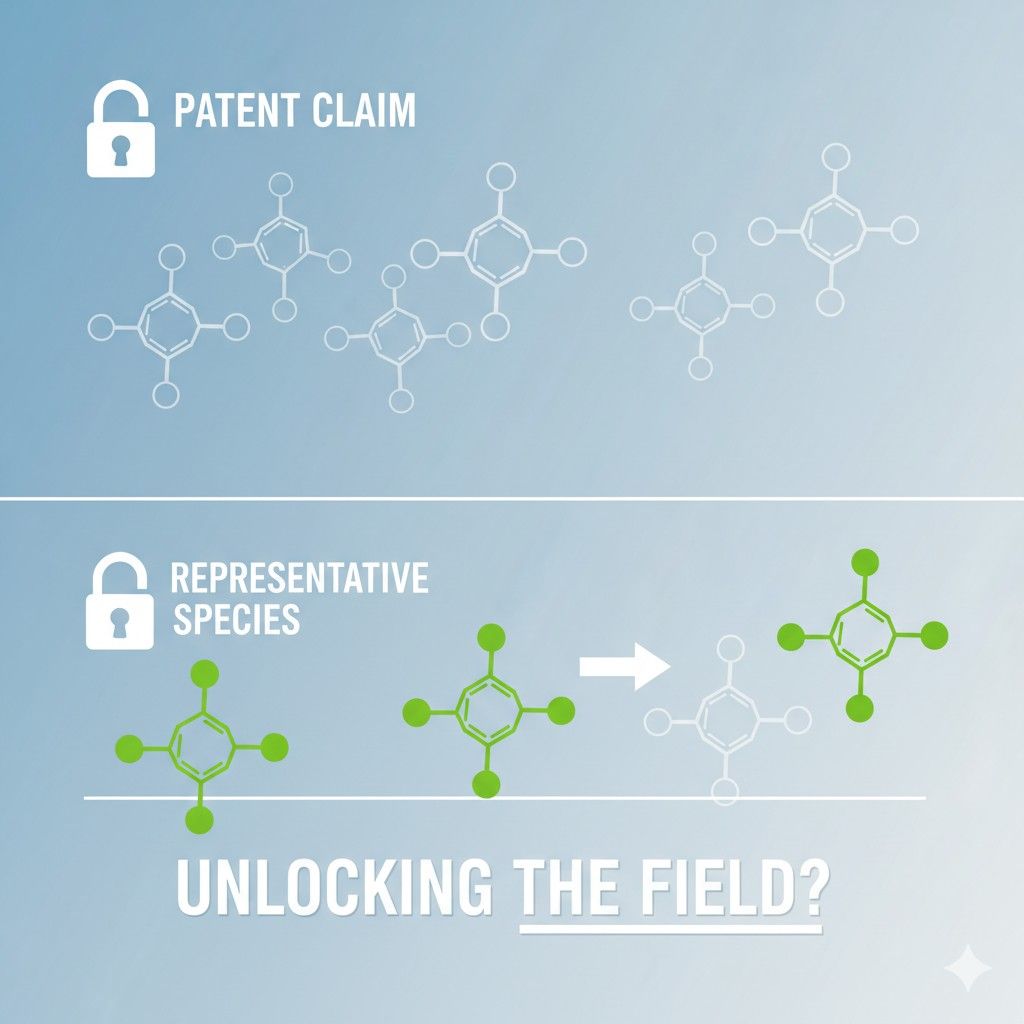
Actionable insight: think beyond issuance. Ask whether your species would convince a skeptical expert years later. This long view protects enterprise value, not just legal status.
How Examiners and Courts Actually Use Species
Reviewers often test representative species by asking whether a skilled chemist could reasonably predict success across the claim using what you disclosed.
If the answer depends on heavy experimentation or luck, enablement is at risk.
Actionable insight: reduce guesswork. Use your description to narrow paths and highlight patterns. This turns your species into guidance, not isolated data points.
Why Timing Matters in Choosing Species
The best time to choose representative species is when the invention is fresh in your mind. Later, it is easy to forget why certain variations mattered or seemed promising.
Actionable insight: capture species choices early, even if you cannot fully test them yet. Clear reasoning at filing time can matter just as much as experimental proof.
Turning Representative Species Into a Strategic Asset
When done well, representative species do more than satisfy legal standards. They shape how competitors design around you and how confidently you can assert your patent.
They define the story of your invention.
Actionable insight: align your species with your business goals. If certain variations are especially valuable commercially, make sure they are represented and explained.
This is where many founders benefit from structured guidance. Platforms like PowerPatent help teams think through representative species early, combining practical software workflows with real attorney insight so nothing critical is missed.

You can explore that approach here: https://powerpatent.com/how-it-works
In the next section, we will dive into guidance itself, how much is enough, how to provide it without overloading your patent, and how clear guidance turns broad claims into real, defensible protection.
How Clear Guidance Turns Broad Claims Into Real Protection
Guidance is the quiet force that decides whether a chemical or pharma patent stands strong or falls apart.
Many patents fail not because the invention was weak, but because the guidance was thin. Broad claims without guidance look like wishes. Broad claims with guidance look like ownership.
This section explains what guidance really means in chemical and pharma patents, how much is enough, and how businesses can use guidance to safely claim wide ground without inviting fatal attacks.
Guidance Is About Reducing Guesswork
In chemical inventions, the system does not ask whether something could work in theory. It asks whether a skilled person could make it work in practice without excessive trial and error.
Guidance exists to reduce that uncertainty. It shows the reader where to focus, what to try first, and what paths are likely to fail.
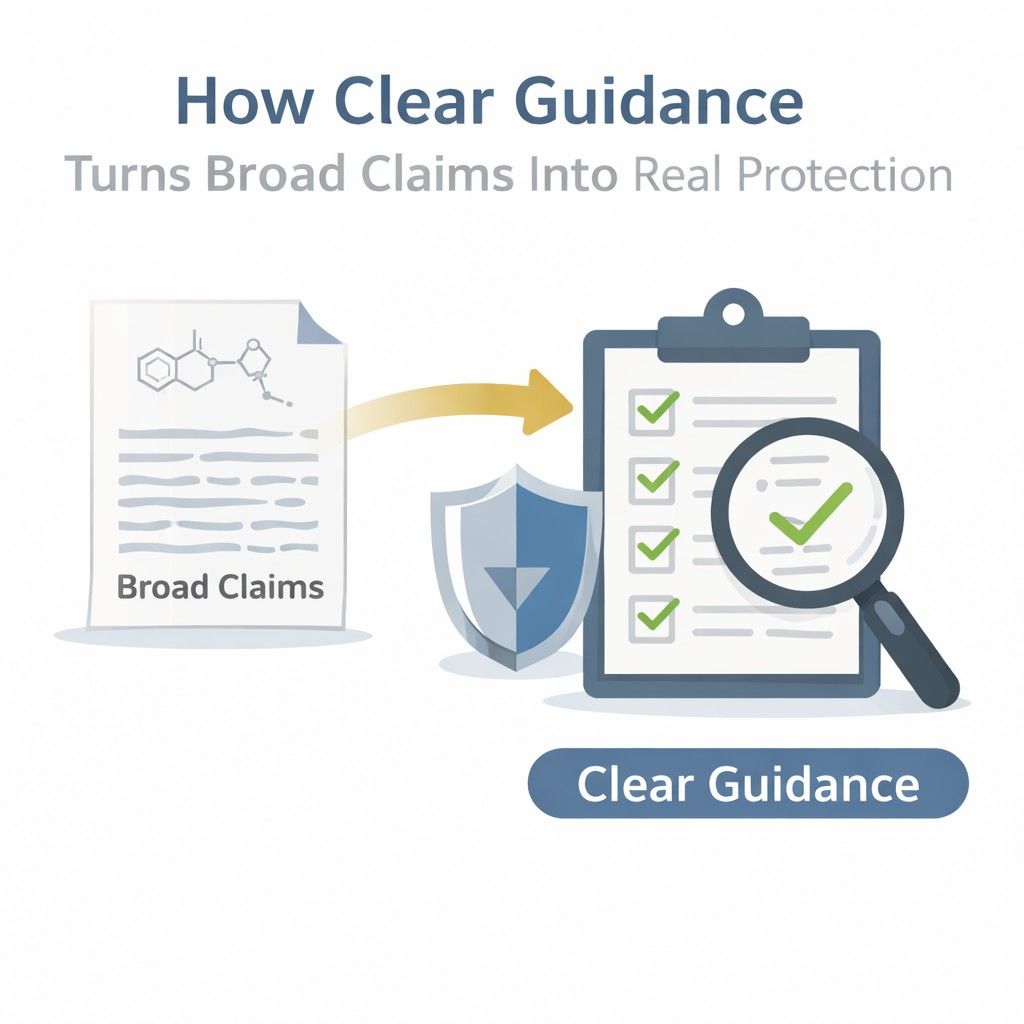
For businesses, this matters because uncertainty weakens exclusivity. The more guessing your patent leaves behind, the easier it is for others to argue that your claims were not truly enabled.
Explanation Often Matters More Than Data
Founders often assume that guidance means running more experiments. While data helps, explanation is just as powerful.
Why did a compound work? Why was a certain range chosen? Why does a modification improve or reduce activity? These answers guide future work and show that the invention was understood, not stumbled upon.
Actionable insight: when writing a patent, slow down and explain your thinking. Even simple reasoning can dramatically strengthen enablement and claim support.
Guidance Shows Possession, Not Just Possibility
One of the hidden goals of guidance is to prove possession. The patent system wants evidence that you actually had the invention, not just an idea of it.
Clear guidance shows that you explored the space, understood its limits, and knew how to move within it.
Actionable insight: write as if you are teaching a colleague how to extend your work. That tone naturally demonstrates possession and depth.
Ranges Without Guidance Are Fragile
Chemical and pharma patents often rely on ranges, such as concentration levels, molecular weights, or activity thresholds. Ranges are powerful, but they are also vulnerable.
Without guidance, a range looks arbitrary. Reviewers will ask why the range exists and whether all parts of it actually work.
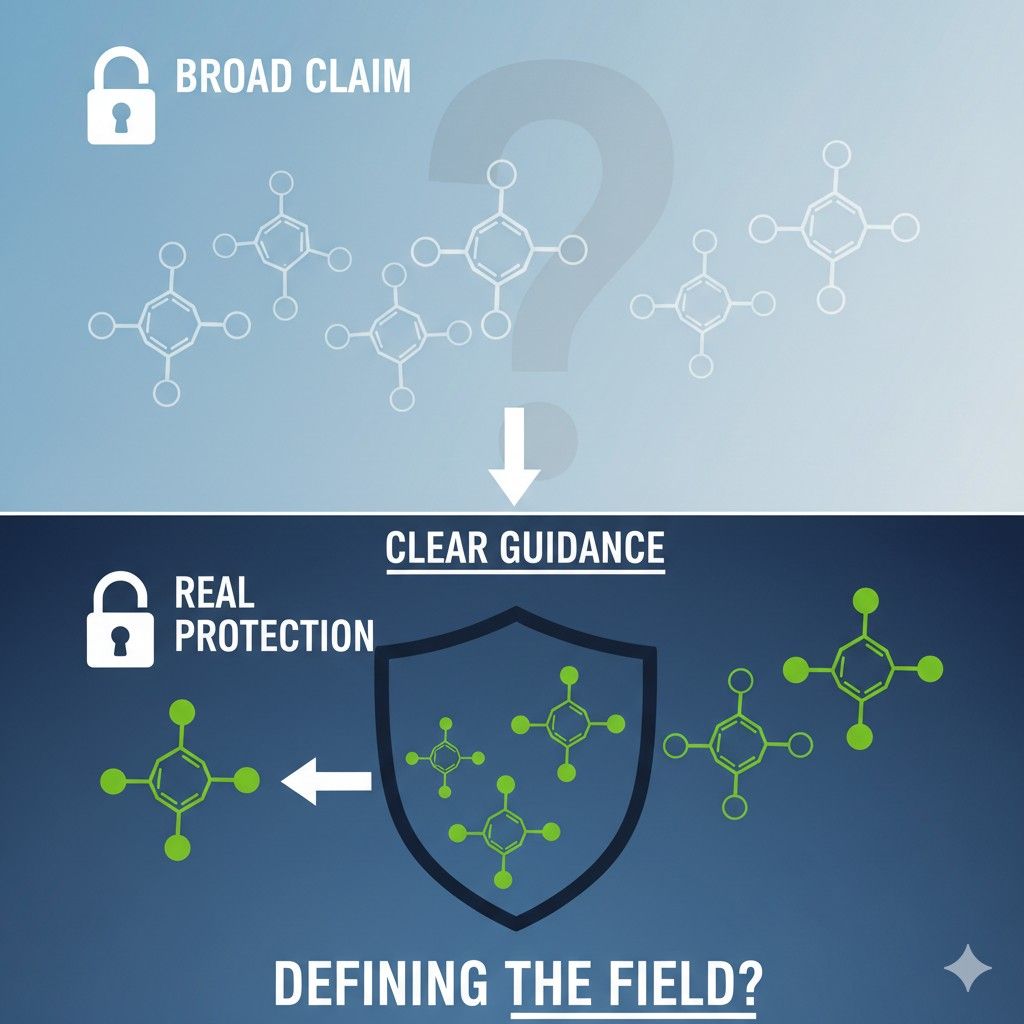
Actionable insight: whenever you claim a range, explain why its boundaries matter. Even a short explanation of what happens near the edges can make the range feel intentional and supported.
Guidance Can Be Predictive, Not Perfect
You do not need to test every possible variation to provide guidance. The system allows reasonable prediction, as long as it is grounded in disclosed principles.
Structure-function relationships, trends, and design rules all count as guidance.
Actionable insight: capture patterns early. If you notice that certain features consistently improve results, document that insight clearly. This allows your claims to stretch further with less risk.
Overly Vague Language Undermines Credibility
Phrases like may be, could be, or optionally can quietly weaken guidance if overused. While some flexibility is necessary, too much vagueness signals uncertainty.
In chemistry, uncertainty invites challenge.
Actionable insight: be confident where you can. If something reliably works, say so. Precision builds trust and strengthens enablement.
Guidance Helps Defend Against Design-Arounds
Strong guidance does more than satisfy examiners. It makes design-arounds harder.
When competitors understand the logic behind your invention, they also see that small tweaks may not escape your claims.
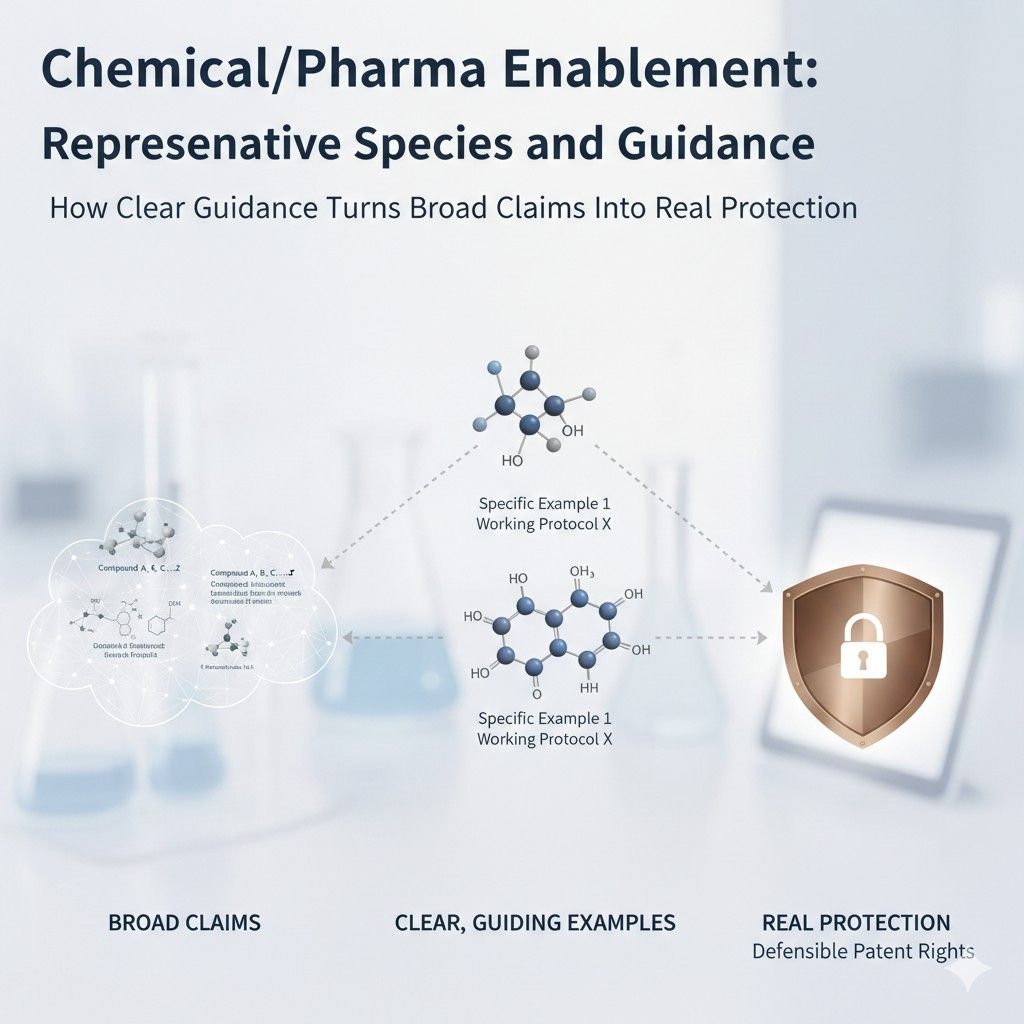
Actionable insight: explain the core drivers of success. This discourages shallow modifications and protects your commercial advantage.
The Balance Between Detail and Brevity
Many founders worry that adding guidance will bloat their patent. The goal is not length, but clarity.
A few well-placed explanations often do more than pages of dense description.
Actionable insight: focus guidance where it matters most. Identify the parts of your claim that feel broad or risky and strengthen those areas first.
Guidance Ages Well When Products Change
Products evolve. Formulations improve. New data emerges. Guidance helps your patent remain relevant as your technology grows.
A patent that only describes one snapshot in time may age poorly. A patent that teaches principles adapts.
Actionable insight: write guidance that survives change. Emphasize why things work, not just what worked once.
Why Guidance Is a Business Multiplier
Strong guidance increases valuation, improves licensing leverage, and reduces litigation risk. It turns a patent from a filing into an asset.
Investors and partners often sense when guidance is present, even if they cannot articulate it. It shows maturity and foresight.
Actionable insight: treat guidance as part of your business story. It signals seriousness and long-term thinking.

This is where many teams struggle to strike the right balance. PowerPatent helps founders build guidance naturally into their patents using structured workflows and real attorney feedback, so broad claims stay safe and defensible without slowing down development. You can see how that works here: https://powerpatent.com/how-it-works
Wrapping It Up
Chemical and pharma enablement is often treated like a legal hurdle. In reality, it is a strategic lever. The same work that strengthens enablement also sharpens your understanding of the invention, clarifies your roadmap, and protects the value you are building. Representative species and clear guidance are not about satisfying abstract rules. They are about proving that your invention is real, repeatable, and scalable. When done well, they show that your claims are not guesses, but earned territory.