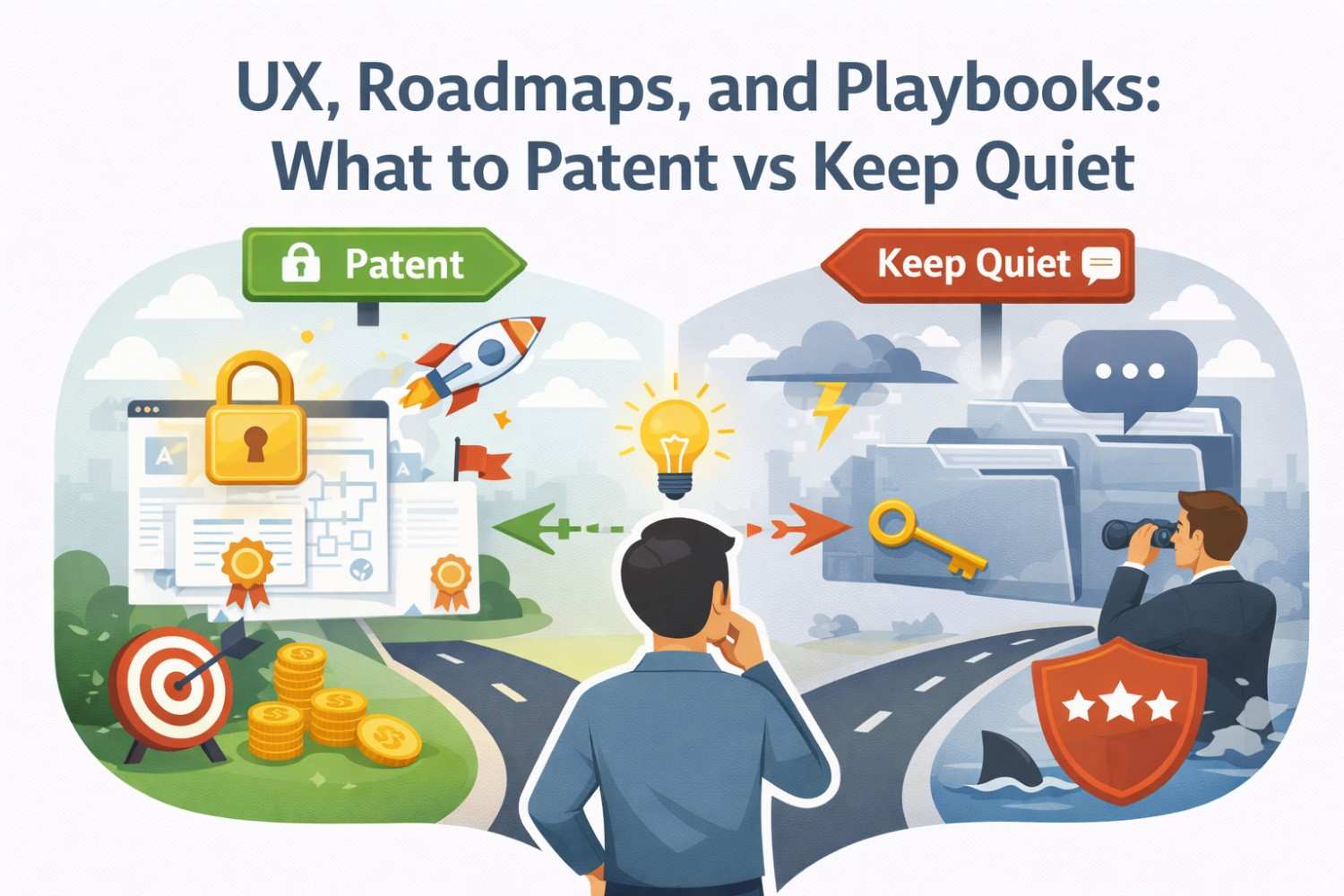
Most founders do not lose because their idea was bad, they lose because they shared the wrong things and stayed quiet about the right ones. UX flows, product roadmaps, and internal playbooks often carry more real value than the core tech, yet they sit in a gray area where teams either overshare or overhide. Some things should be patented early to lock in control and create leverage, while others should stay private because once they are published, they become a free guide for competitors.
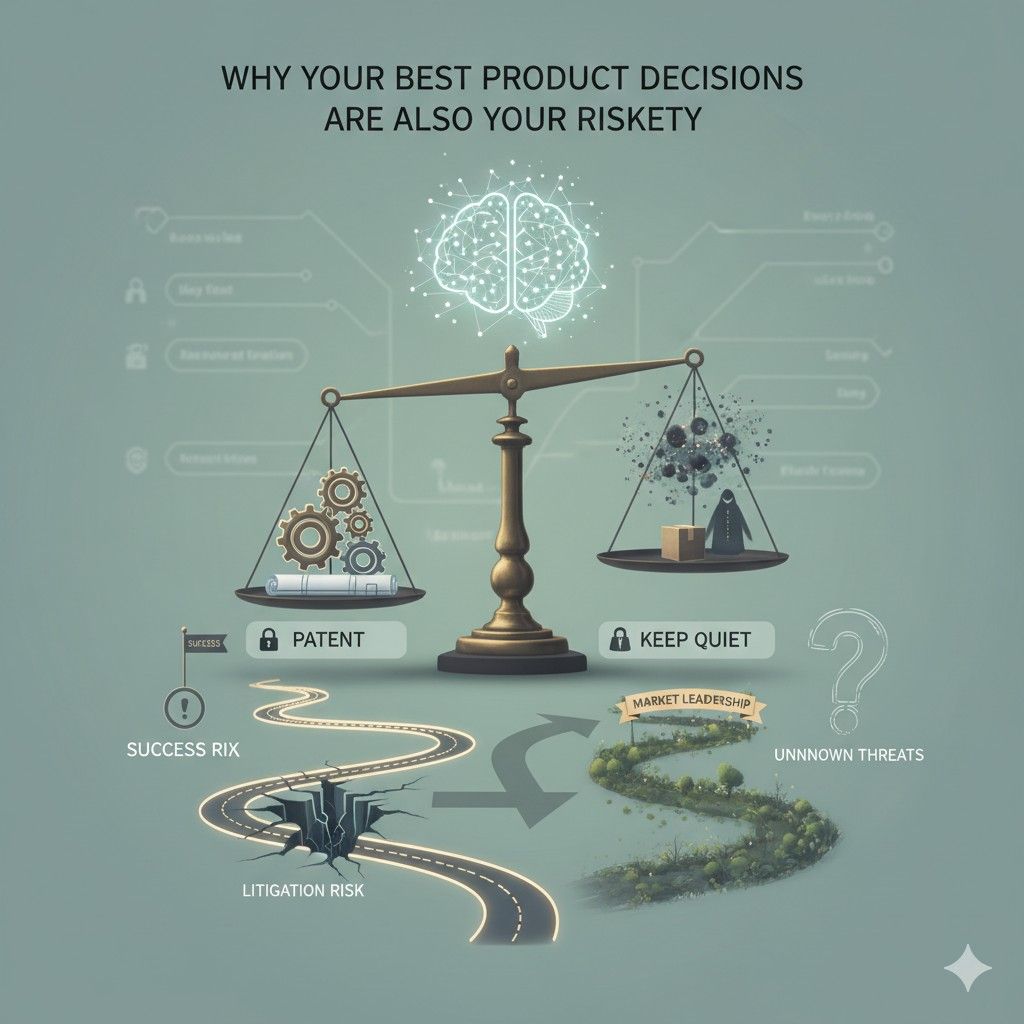
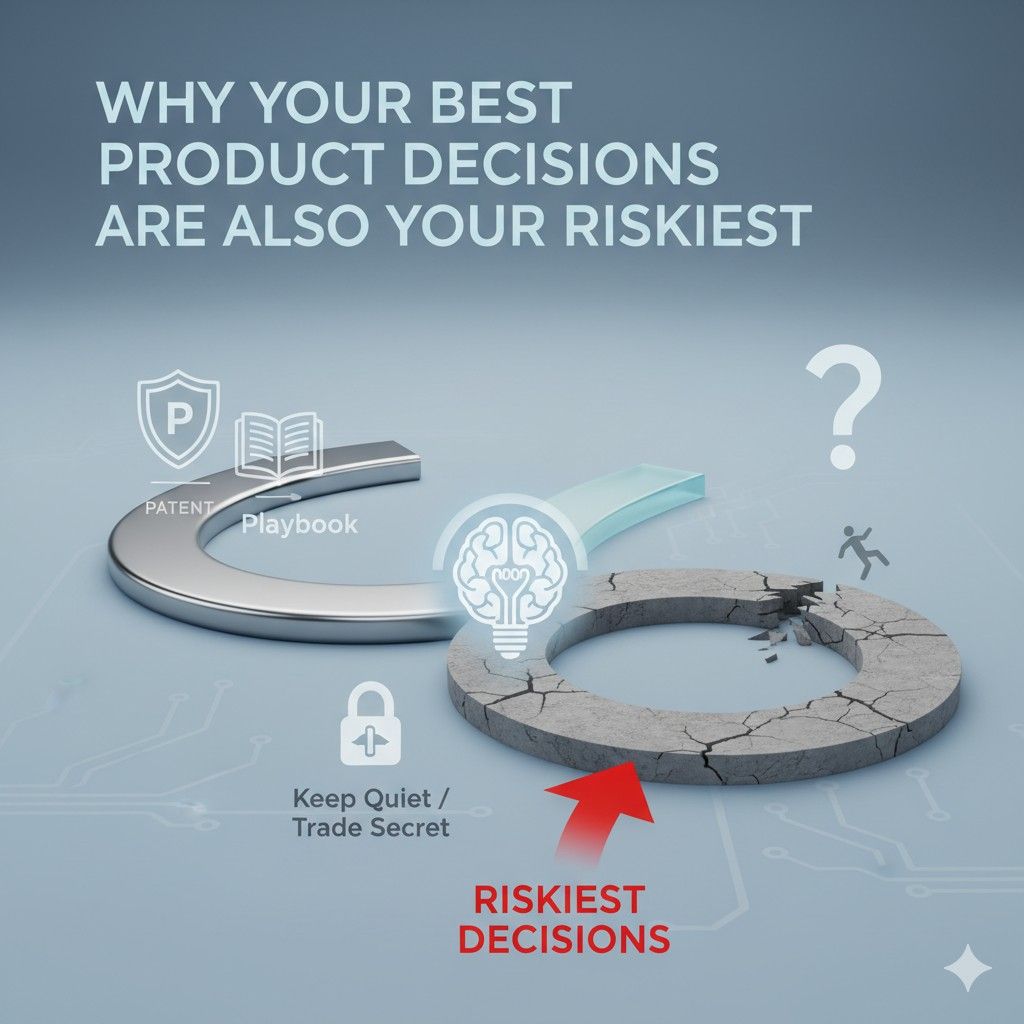
Why Your Best Product Decisions Are Also Your Riskiest
The most important work inside a startup rarely looks important in the moment. It does not feel like an invention. It feels like a small choice made under pressure. A shortcut. A rule. A flow.
A way of saying something that finally makes users move. These decisions pile up quietly, and before anyone notices, they become the reason the company works. That is exactly why they carry risk.
This section goes deeper into how everyday product decisions slowly turn into strategic assets, why they are easy to lose, and how founders can protect them without changing how they build.
The Gap Between “It Works” and “It’s Valuable”
Most teams celebrate when something starts working. Users sign up faster. Demos close more deals. Support tickets drop. These wins feel operational, not strategic.
That gap is dangerous.
The moment a decision creates repeatable results, it stops being just execution. It becomes value. And value, when left unprotected, has a habit of traveling.
Founders should train themselves to notice when effort drops but results stay high. That is usually the sign that a hidden system is doing the work.
Those systems are rarely obvious from the outside, but they can be discovered over time if nothing is done to protect them.
Good Decisions Feel Obvious After the Fact
One of the biggest risks of strong product judgment is that it feels obvious later. When a flow converts well or a message lands perfectly, the team forgets how hard it was to get there.
This creates two problems. First, founders undervalue what they built. Second, they assume others will not bother copying it.
In reality, competitors look for things that feel obvious because they are easy to justify internally. No one questions copying something that “just makes sense.”
A useful habit is to write down the thinking behind decisions that feel simple now but were not simple at the time. That thinking is often the most defensible part of the product.
When UX Stops Being Design and Starts Being Leverage
At an early stage, UX is about removing friction. Later, it becomes about directing behavior. The moment your UX consistently leads users to better outcomes for your business, it has crossed into leverage.
This is risky because UX decisions are visible. Screens can be recorded. Flows can be mapped. But the logic behind them is harder to see.
Founders should focus less on protecting screens and more on protecting sequences and rules.

What happens first, what is delayed, what is hidden, and what is forced. These patterns often matter more than any single interface element.
The Quiet Power of Constraints
Some of the strongest product decisions are about what users cannot do. Limits, defaults, and forced paths often drive clarity and trust.
These constraints are risky because they look like product taste. In truth, they are strategic decisions about control and focus.
When constraints lead to better outcomes, they should be treated as intentional systems, not accidental side effects. Naming them internally helps teams recognize their value and decide how much to reveal.
Roadmaps as Signals, Not Just Plans
A roadmap is often treated as a promise. In reality, it is a signal. It tells the world what you believe matters next.
The risk is not that someone builds the same thing. The risk is that someone understands your direction and moves earlier or faster in a way that blocks you.
Founders should separate internal alignment from external messaging. Internally, roadmaps should be clear and detailed. Externally, they should be framed around problems, not solutions.
This keeps momentum without exposing strategy.
Playbooks Are Compounding Assets
Playbooks are dangerous because they compress time. They allow new hires to perform like veterans. They turn chaos into process.
That compression is exactly what competitors want.
When teams casually share how they operate, they often give away years of learning. This usually happens through hiring pages, talks, or blog posts meant to attract talent or users.
A safer approach is to share principles without mechanics. You can explain what you value without explaining how you enforce it.
The Risk of Learning in Public
Learning in public builds trust and brand, but it also builds a trail. Over time, that trail can reveal how you think, test, and decide.
Founders do not need to stop sharing. They need to choose what layer they share. Outcomes are safer than methods. Lessons are safer than playbooks.
Before sharing, ask one simple question. If a competitor followed this exactly, would it save them time? If the answer is yes, pause.
When Silence Is a Strategic Move
Not all protection is about filing. Sometimes the smartest move is silence.
Silence buys time. It allows you to compound advantage before others understand what matters.
Founders often feel pressure to explain everything. In reality, clarity can be selective. You can be clear about your mission without being clear about your mechanics.
Turning Decisions Into Defensible Assets
The goal is not to patent everything. The goal is to recognize when a decision becomes foundational.
When a decision shapes many others, when it scales across users, and when it would hurt to lose, it deserves attention.
This is where structured protection helps. Not because it slows you down, but because it forces you to see what you actually built.
PowerPatent was designed for this exact moment. It helps founders capture real systems, not just ideas, while they keep moving.

You stay in control, real attorneys guide the process, and nothing pulls you away from building. You can see how it works here: https://powerpatent.com/how-it-works.
When Sharing Your UX Helps You — and When It Hands Competitors the Playbook
Sharing UX is one of the most misunderstood growth levers in startups. Founders are told to be open, transparent, and loud. Show the work. Teach the market. Build in public.
All of that advice is useful, but only when paired with judgment. UX sits in a dangerous middle ground. It is visible enough to copy, subtle enough to misunderstand, and powerful enough to decide who wins.
This section goes much deeper into how sharing UX can fuel growth while quietly increasing risk, and how smart teams decide what to show, when to show it, and what should never leave the room.
UX Is the Language Your Product Speaks
Every product communicates. Not with words, but with steps, pauses, defaults, and friction. UX is the language your product uses to guide users toward outcomes you care about.
When you share UX publicly, you are teaching others how that language works. Over time, they do not just learn what your product does. They learn how you think about users.
That is the risk most founders miss. The real exposure is not a screen. It is a mindset.
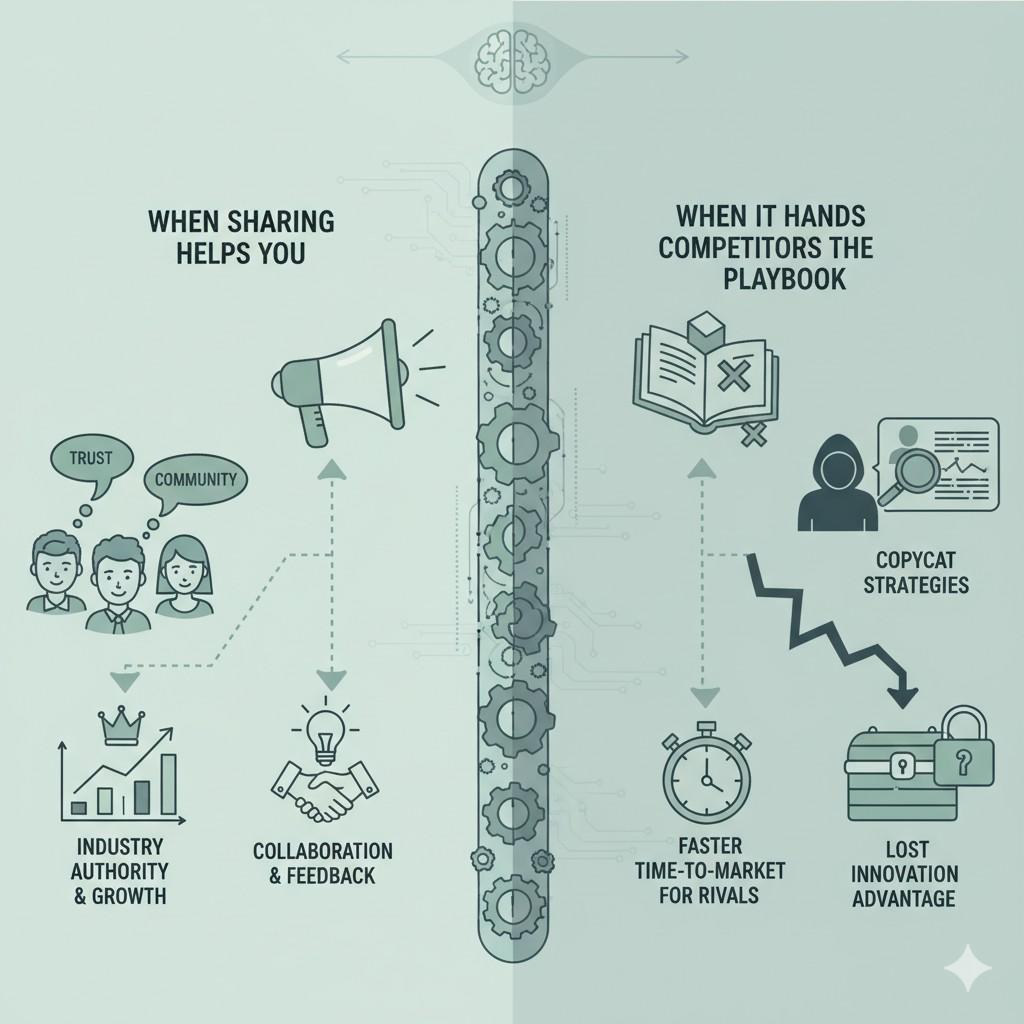
Before sharing any UX flow, it helps to ask whether it reveals how you frame user problems. If it does, that is strategic information, not just design.
Early UX Looks Simple but Carries Hidden Insight
Early-stage UX often looks bare. Few steps. Clear buttons. Straight paths. This simplicity is deceptive.
What outsiders see as clean design is usually the result of dozens of wrong turns. The insight lives in what was removed, not what remains.
When founders share early UX too openly, they erase the cost of that learning for others. Competitors get the final answer without paying the price.
A useful internal practice is to label early UX wins as fragile. Until they are battle-tested across many users and contexts, they should be treated as temporary advantages, not marketing assets.
Case Studies Can Become Instruction Manuals
Case studies are powerful sales tools. They show proof. They build trust. They shorten sales cycles.
They can also become instruction manuals.
When a case study explains how a user moved through your product and why each step mattered, it teaches others how to replicate the outcome.
A safer approach is to focus case studies on transformation, not process. Show where the user started and where they ended. Be careful about narrating every decision in between.
The Difference Between Showing and Teaching
Showing is letting people see results. Teaching is explaining how to achieve them.
Most founders unintentionally cross this line when they try to be helpful. They explain flows, logic, and reasoning because it feels honest.
The moment you teach, you transfer capability. That capability is what competitors want.

You can still be generous without being instructional. Talk about principles. Talk about outcomes. Avoid turning success into a tutorial.
UX Patterns Are Easy to Copy, Systems Are Not
Many teams worry about individual patterns being copied. Modals, progress bars, onboarding checklists. These are surface-level concerns.
What actually matters is how patterns are combined over time. The order. The dependencies. The timing.
When you share UX, avoid presenting it as a complete system. Fragmented views are harder to reverse-engineer. Full walkthroughs make it easier.
This does not mean being misleading. It means being partial by design.
Community Feedback Can Leak Strategy
User communities are gold. They surface problems quickly and build loyalty.
They also create public feedback loops.
When UX discussions happen openly, patterns form. Observers can see what users struggle with, what you prioritize, and how you respond.
Founders should still engage, but with discipline. Acknowledge issues without committing publicly to solutions. Move detailed decision-making into private channels.
UX Metrics Tell a Story You May Not Want Told
Sharing metrics around UX improvements feels like a win. Faster onboarding. Higher completion rates. Lower drop-off.
Those numbers tell a story about what you fixed and why it mattered.
Over time, metrics paired with UX screenshots can reveal exactly where your leverage lives.

If metrics are shared, keep them high-level. Avoid tying specific design changes to specific gains in public forums.
Design Narratives Create Mental Models
When you talk about your design philosophy, you are creating a mental model of your product.
That model can be copied faster than code.
Founders often underestimate how much competitors rely on narratives to guide their own product decisions. A clear narrative saves them time.
It is safer to talk about values than frameworks. Values inspire. Frameworks instruct.
The Long Memory of the Internet
Once UX is shared, it rarely disappears. Old blog posts, tweets, and talks become archives.
What felt harmless at seed stage may become dangerous at scale.
Founders should periodically review old content through a competitive lens. Ask whether it still serves the company. If not, consider updating or removing it.
This is not about hiding history. It is about reducing unnecessary exposure.
UX as Proof vs UX as Blueprint
There is a subtle but critical difference between using UX as proof and using it as a blueprint.
Proof shows that something works. A blueprint shows how to build it.
Your marketing should aim for proof. Your internal docs should hold the blueprints.
When these get mixed, value leaks.
Timing Is Everything
Sharing too late can slow growth. Sharing too early can erase advantage.
The safest time to share UX is when it no longer defines your edge. When your advantage has moved deeper into systems, data, or scale.
Until then, restraint is a form of speed. It gives you time to compound.
Protection Makes Sharing Safer
The goal is not silence. The goal is control.
When key UX systems are protected, founders can share with confidence. They know what is exposed and what is locked down.
This is where a clear patent strategy changes behavior. It removes guesswork. It lets teams be open where it helps and quiet where it matters.
PowerPatent exists to give founders that clarity without slowing them down. It helps capture real UX systems, decision logic, and flows while you keep shipping and talking to users.

You stay fast, but no longer vulnerable by default. You can see how it works here: https://powerpatent.com/how-it-works.
How Smart Founders Decide What to Lock Down and What to Keep Silent
Every startup reaches a point where instinct is no longer enough. Early on, everything feels fluid. Ideas change daily. Nothing feels permanent. Protection feels premature.
But as the product matures, certain choices harden. They stop changing. They start carrying weight. This is where smart founders slow down just enough to decide what should be protected and what should stay quiet.
This section is about developing that judgment. Not through rules, but through patterns that repeat across strong companies.
The Shift From Exploration to Commitment
In the beginning, most decisions are experiments. You try things because you are unsure. You change them because users push back. Nothing feels worth protecting.
Then something changes.
You stop asking “does this work” and start asking “how do we scale this.” That shift is subtle, but it matters. It means you are no longer exploring. You are committing.
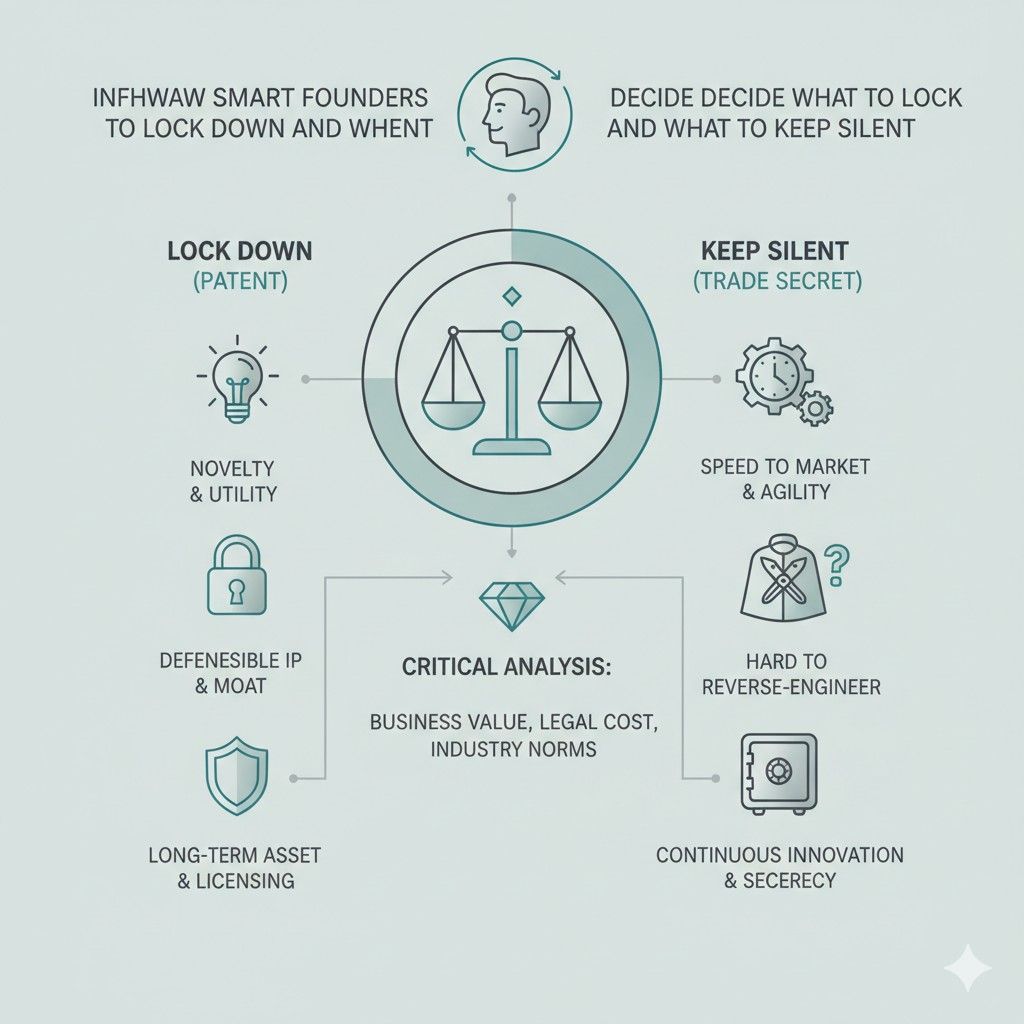
Commitment is the signal. When a decision becomes something you build around, hire around, and measure around, it is no longer temporary. That is when silence or protection becomes strategic instead of paranoid.
Decisions That Others Would Copy If They Could
A useful way to judge value is to imagine your competitor fully understanding one decision you made. Not copying it blindly, but understanding why it works.
If that understanding would shorten their path by months, you are looking at something worth protecting.
Founders often underestimate this because they live inside the product. What feels obvious internally can be transformative externally.
The best signal is regret. Ask yourself what you would regret most if it showed up in someone else’s product tomorrow. That regret usually points directly to what matters.
What Feels Operational Is Often Strategic
Many of the most valuable decisions do not live in product specs. They live in operations.
How leads are routed. How edge cases are handled. When humans step in. When automation stops. These are often framed as internal details.
They are not.
They encode how you think about risk, trust, and scale. Once copied, they are hard to differentiate on.
Founders should treat internal workflows with the same respect as product features. Some should remain invisible by design.
The Compounding Nature of Quiet Advantages
Loud advantages attract attention. Quiet advantages compound.
A decision that saves a user one minute does not matter much on day one. Over a year, it changes behavior. Over three years, it defines expectations.
The danger is that quiet advantages are easy to give away because they do not feel dramatic.

Smart founders protect what compounds, not what looks impressive in a demo.
The Difference Between Know-What and Know-How
Know-what is easy to share. Know-how is expensive to learn.
Most marketing focuses on know-what. What the product does. What problem it solves. What users get.
Know-how is how you make it work reliably. How you handle edge cases. How you sequence decisions.
Know-how should rarely be shared. It is where your time went. It is where your mistakes live.
Founders who blur this line often do so because they want to sound thoughtful. In reality, restraint signals maturity.
Silence Is Not the Same as Secrecy
Keeping quiet does not mean being deceptive. It means being selective.
You can be clear about outcomes without explaining mechanisms. You can explain values without revealing enforcement. You can share vision without sharing execution.
Silence becomes unhealthy only when it blocks trust. Strategic silence protects leverage without harming credibility.
This distinction matters because many founders overshare out of fear of appearing vague. In practice, confidence comes from clarity of purpose, not completeness of explanation.
Timing Turns Normal Decisions Into Assets
The same decision can be meaningless one month and valuable the next.
Timing changes everything.
A UX flow before traction is just a guess. After traction, it is proof. A pricing rule before revenue is theory. After revenue, it is leverage.
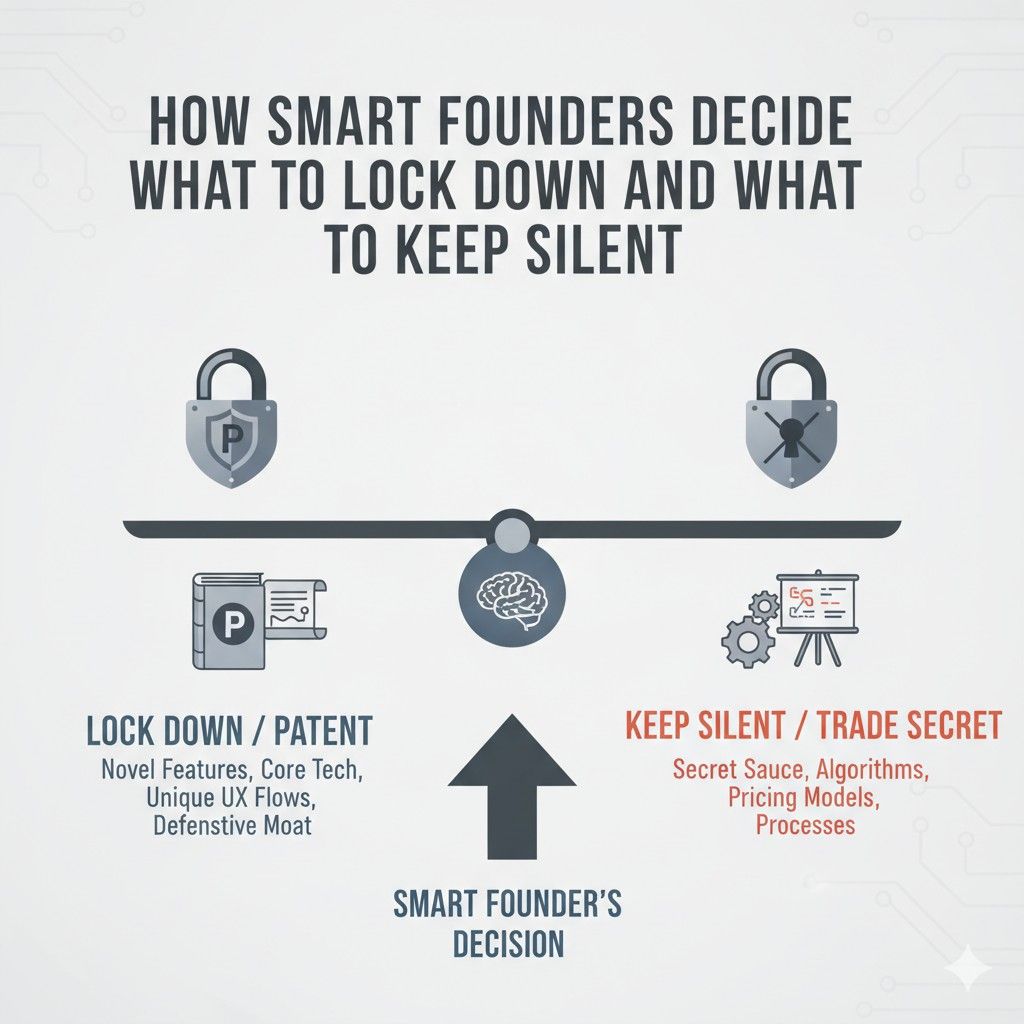
Founders should revisit old decisions periodically and ask whether their role has changed. What was once safe to share may no longer be.
This review habit is rare, but powerful.
What Should Never Be the First Thing You Share
If something only makes sense once everything else is in place, it should not be shared early.
These are often meta-decisions. How you prioritize. How you trade speed for quality. How you decide when to say no.
These decisions explain your success too clearly.
Sharing them early helps others avoid the confusion phase you already paid for.
Protection as a Confidence Tool
When founders know what is protected, their behavior changes.
They stop hesitating before sharing. They stop second-guessing every tweet or blog post. They speak more freely because the core is secured.
This is the hidden benefit of protection. It does not just reduce risk. It increases confidence.
Confidence shows up in clearer messaging, faster sales, and stronger partnerships.
The Cost of Waiting Too Long
Many founders wait until something is obvious to protect it. By then, it is often too late.
Once a system is visible and validated, it becomes harder to claim ownership. Others can point to public examples and argue it was already known.
Early protection is not about certainty. It is about optionality. It gives you room to decide later without losing ground.
Using Structure to Replace Guesswork
The hardest part of deciding what to lock down is uncertainty. Founders fear making the wrong call.
Structure helps.
When you document how a system works, what problem it solves, and why it exists, the decision often becomes clear on its own.
This is why modern protection workflows matter. They force clarity without forcing commitment.
PowerPatent was built to give founders that structure. It helps capture real systems, logic, and flows early, with real attorney oversight, without pulling you away from building.
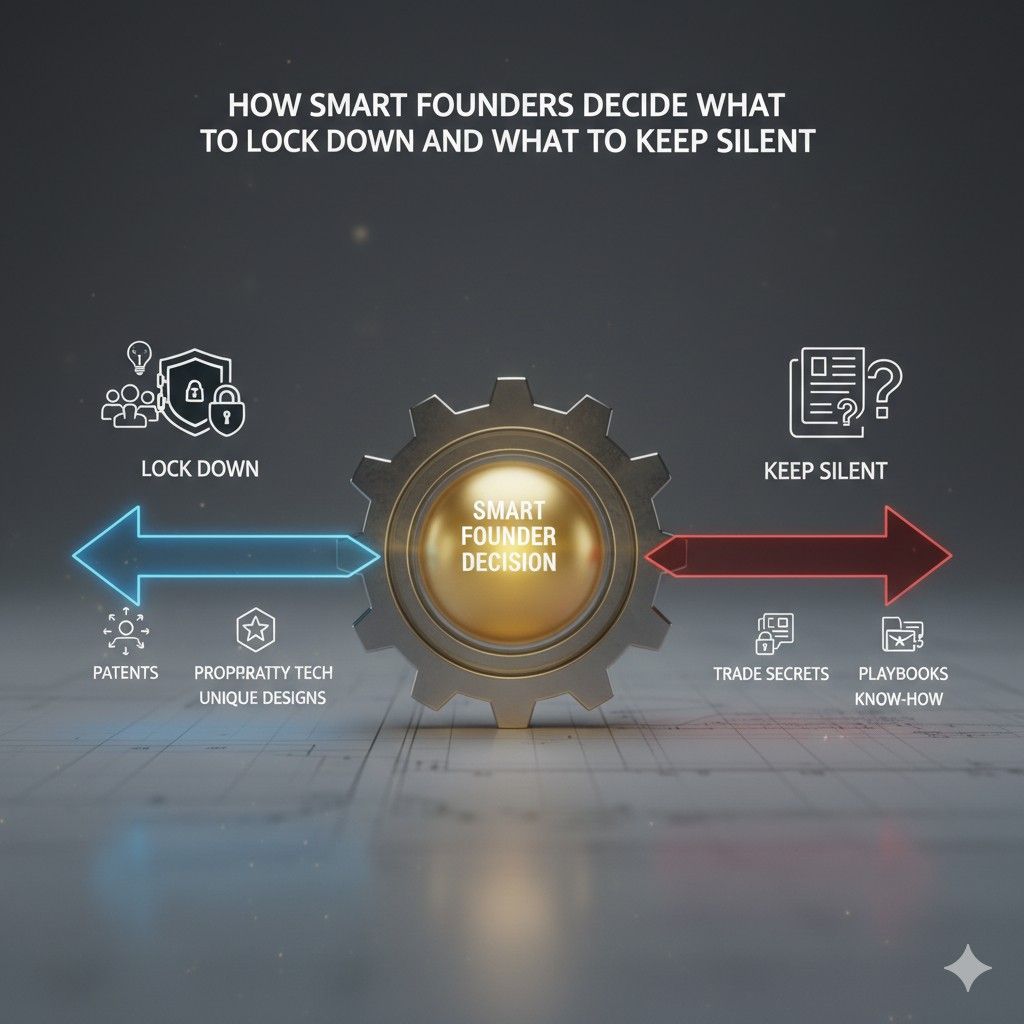
You move fast, but with a safety net. You can see how it works here: https://powerpatent.com/how-it-works.
Wrapping It Up
Most founders think patents are about big inventions and flashy breakthroughs. In reality, the most valuable things you build are quieter. They live in your UX decisions, your roadmaps, and your internal playbooks. They are the choices that took time to learn, pain to earn, and judgment to get right. And because they do not look like traditional IP, they are the easiest to lose. The real risk is not copying. The real risk is timing. Sharing something too early, explaining it too clearly, or assuming it is not valuable enough to protect. Once those decisions are public, you cannot pull them back. Silence, when used intentionally, buys you time. Protection, when used wisely, gives you control.