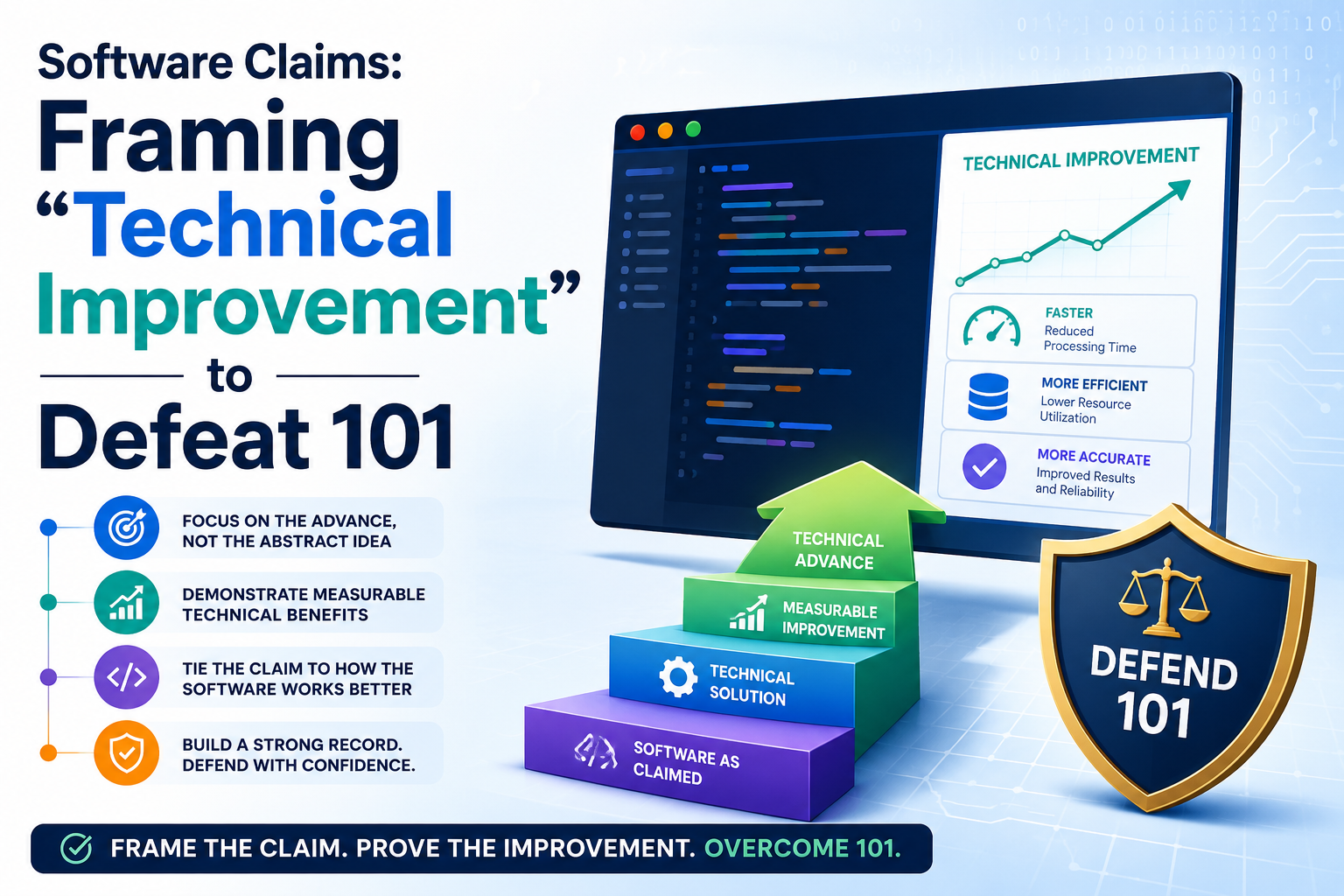
A software patent claim usually wins or loses on one simple question: did the invention make the computer work better, or did it just use a computer to do a business task? That is where PowerPatent helps founders turn raw invention notes into stronger patent stories, with smart software and real attorney review. You can see how that works here: https://powerpatent.com/how-it-works
A Software Claim Should Begin With The Machine Problem, Not The Business Goal
A strong software claim does not start with the hope that the product makes money, saves time for a user, or helps a company run better.
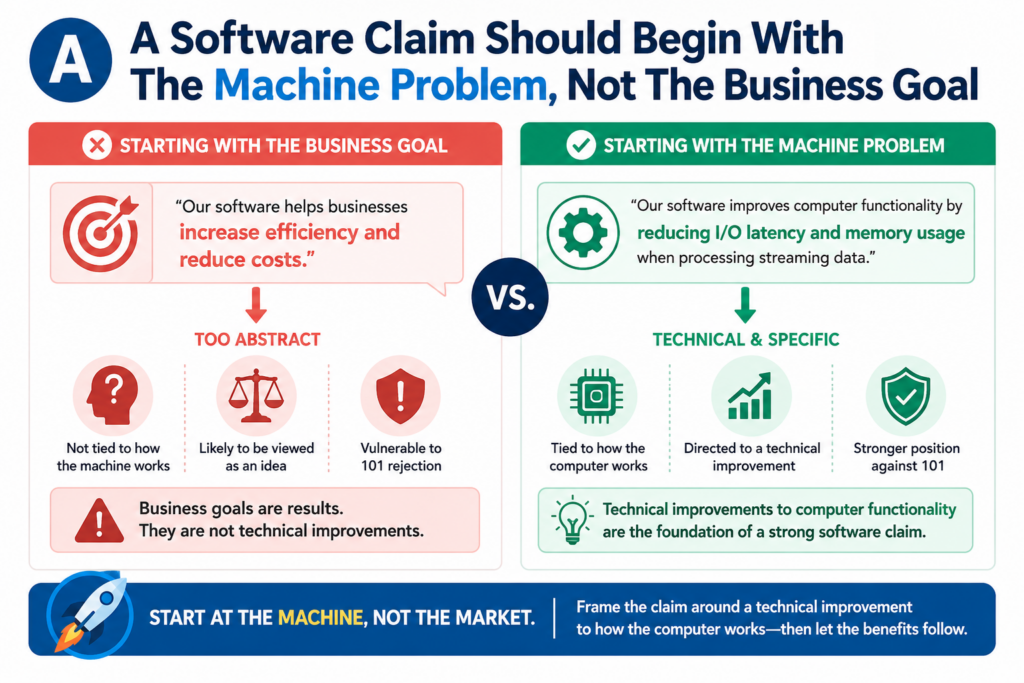
Those things may be true, but they are not the safest center of the patent story. A stronger claim starts with what went wrong inside the machine.
That small shift matters. When a software claim sounds like “take information, analyze it, and show a result,” it can look too broad. It can sound like a normal human thought done on a computer.
That is where a 101 rejection often starts. But when the claim explains a specific change in how the system stores, sends, cleans, ranks, compresses, trains, checks, or protects data, the story moves closer to a real technical improvement.
The USPTO’s eligibility guidance still focuses heavily on whether a claim is just an abstract idea or whether it is tied to a practical use in technology.
The 2024 USPTO update for AI inventions also pointed to practical application and technical improvement as key parts of the analysis for AI and software claims.
The Claim Must Show What The System Does Differently
The first draft of many software inventions sounds like a product pitch. It says the tool predicts churn, finds fraud, routes leads, scores risk, or recommends an action. That may be clear to a customer, but it is often too thin for a patent claim.
A better draft says how the system performs the task in a new way. For example, the invention may split a model into smaller parts so edge devices use less power.
It may change how cache entries are ranked so stale data is removed sooner. It may reduce false matches by changing how feature vectors are built before search. It may protect private data by creating a local mask before data ever leaves the device.
Those details do not make the article harder to read. They make the invention harder to dismiss.
This is where many founders miss value. They know the product works. They know it took months to build. But their notes often describe the user result, not the machine fix.
PowerPatent helps turn engineering work into a clearer patent story with software that captures invention details and real attorney oversight that helps shape them. See how the process works here: https://powerpatent.com/how-it-works
The Best Test Is Whether The Claim Would Still Make Sense Without The User Interface
A useful test is to remove the screen from the story. Take away the dashboard, buttons, alerts, and reports. Now ask what is left.
If nothing is left except a person getting better advice, the claim may be weak.
But if there is still a new data path, a new memory structure, a new model update flow, a new security step, a new network control rule, or a new way to reduce compute load, then there may be a stronger base for the claim.
This does not mean the user benefit is ignored. It means the user benefit is backed by a technical reason.
The claim should not only say, “the user gets a better answer.” It should show the machine steps that make the answer better.
The same idea applies to AI. “Using AI to make a decision” is usually not enough.
A stronger frame might explain how training data is filtered, how model drift is found, how confidence scores change the system path, how embeddings are built in a new way, or how the system keeps private data safe during model use. The technical act must carry the weight.
The Word “Technical” Means Nothing Unless The Draft Proves It
Founders often say their invention is technical because it involves code. That is understandable, but it is not enough.
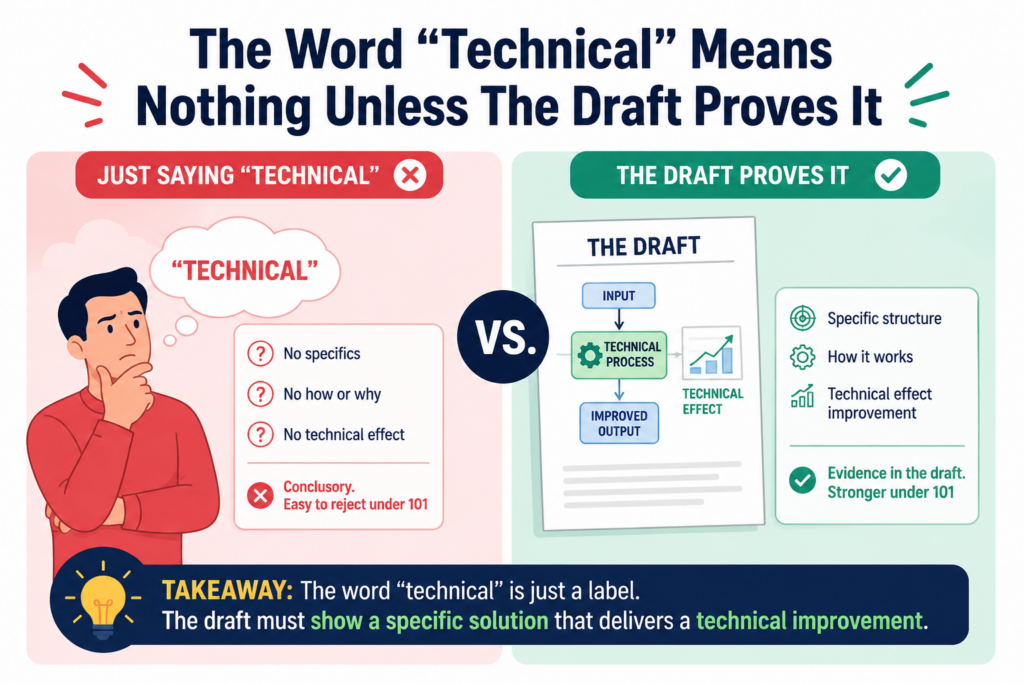
Almost every software patent has code somewhere. The better question is whether the invention changes how the computing system works.
A claim that uses a normal server, normal database, and normal rules to do a business task may still look weak. A claim that changes the way the server, database, model, sensor, device, or network behaves has a better story.
This is why the words “technical improvement” should not be sprinkled into a draft like seasoning. They need proof.
The patent application should explain the old problem, why common methods failed, what the new system does, and what measurable result came from the change.
A Real Improvement Often Shows Up As Less Waste Or More Control
Many strong software inventions are not flashy. They do not need to sound like science fiction. They solve plain machine problems.
The system may use fewer processor cycles. It may lower memory use. It may reduce network calls. It may avoid duplicate writes. It may prevent bad data from poisoning a model.
It may keep a session alive during a weak connection. It may stop a device from leaking data while still allowing useful search. It may improve fault recovery when one service in a larger system fails.
Those are not vague wins. Those are concrete system gains.
The claim should make the gain visible. The patent draft should not merely say that the system is “faster.” It should explain what step made it faster. Did the system precompute part of the result? Did it change the order of operations?
Did it reduce the size of a message before sending it? Did it select a smaller model only when a device had low battery? Did it stop polling and use an event trigger instead?
The more the claim ties the result to a specific machine step, the less it feels like an abstract goal.
A Strong Draft Connects The Pain, The Fix, And The Result
A simple way to frame the invention is to connect three things in a clean chain.
First, name the technical pain. Maybe the old system had slow lookup times because records were stored in a way that forced repeated scans.
Maybe the model made errors after deployment because incoming data changed over time. Maybe the device sent too much raw data to the cloud, which created privacy and bandwidth problems.
Second, name the technical fix. Maybe the invention builds a new index based on event timing.
Maybe it detects model drift by comparing live feature patterns against a stored baseline. Maybe it creates a compact local summary before any cloud request is made.
Third, name the technical result. The search gets faster. The model stays more stable. The network carries less data. The device uses less power. The system fails less often.
This is the basic story examiners, investors, and future partners can understand. It is also the story that helps attorneys draft with sharper aim.
The USPTO has continued to tell examiners to look at whether claims integrate an abstract idea into a practical application, and recent software and AI guidance has kept that issue in focus.
The practical takeaway is simple: do not let the application read like a goal. Make it read like a working system.
PowerPatent is built for this exact gap. Founders and engineers often have the real fix in their code, commits, diagrams, and product notes.
The hard part is pulling it out and shaping it into a patent-ready story before key details are lost. You can see how PowerPatent helps here: https://powerpatent.com/how-it-works
The Claim Should Avoid The Trap Of “Do It On A Computer”
One of the fastest ways to weaken a software claim is to describe a normal human task and add a computer at the end. That frame makes the computer look like a tool, not the thing being improved.
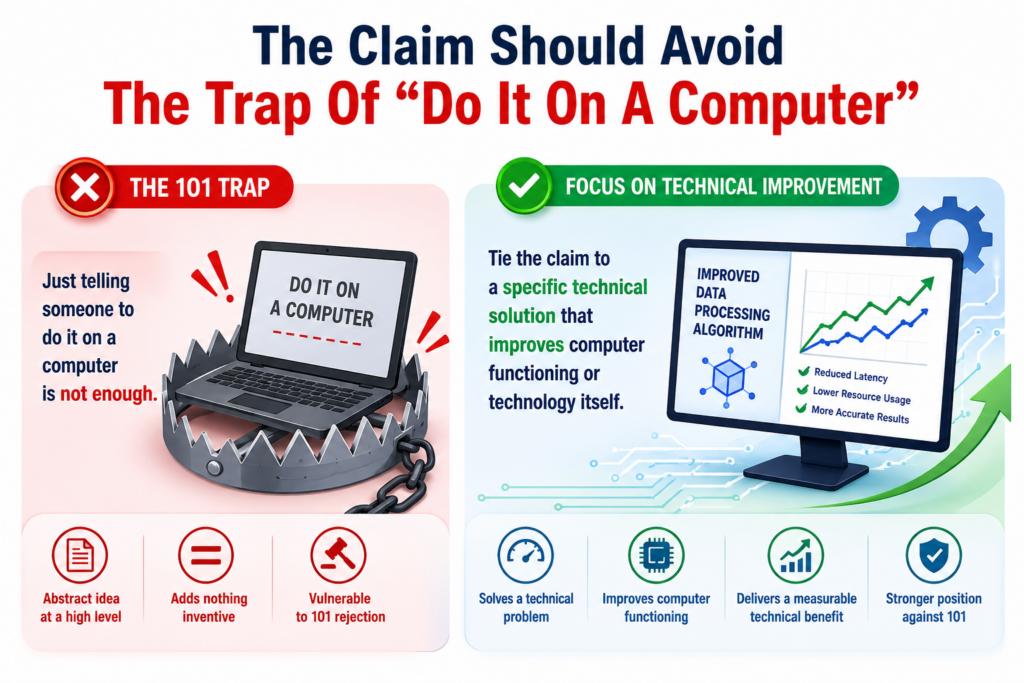
For example, “collecting loan data, comparing it to rules, and approving a loan” may sound like a business process. Adding a server does not always save it.
But a claim that improves how a distributed system verifies changing data from many sources, reduces conflicts, and updates a secure record may have a more technical center.
The difference is not word games. It is the difference between claiming the outcome and claiming the mechanism.
The Draft Should Make The Computer Necessary In A Specific Way
A stronger claim should make the computer necessary for more than speed. Saying “a computer can do it faster than a person” is usually not enough. The better frame is that the invention solves a problem created by computing itself.
Software systems create their own problems. Data gets stale. Models drift. Tokens expire. APIs fail. Memory fills up. Packets arrive out of order. Logs grow too large.
Permissions conflict. Users move across devices. Sensors produce noisy data. Attackers try to infer private records. These are not paper problems. They are system problems.
When the invention solves one of those problems, the claim should say so early and clearly.
A good claim might explain that the system detects when a cached prediction is no longer safe to reuse because a source feature has changed outside a set range.
Another claim might explain that the system delays a model update until a privacy score reaches a required level. Another may route a request through a smaller local model when latency would break the user flow.
These examples do not just say “use software.” They show why the software architecture matters.
The Founder’s Job Is To Capture The Engineering Reason Before It Gets Lost
In many startups, the best patent details live in small choices. A founder may say, “We made the model cheaper to run.”
An engineer may know the real reason: the system groups requests by feature overlap, reuses an intermediate vector, and avoids recomputing the full pipeline.
That engineering reason is gold.
It can be the difference between a claim that sounds like “predict results” and a claim that sounds like a real improvement in machine operation.
The first may invite a 101 problem. The second has a better chance of showing a practical technical change.
This is why invention capture should happen while the team is still close to the build. Waiting too long hurts the story. People forget why the old approach failed.
They forget the tradeoffs. They forget the edge case that forced the new design. Later, the patent draft becomes thin because the best facts are gone.
PowerPatent helps founders move while the details are still fresh. It gives teams a cleaner path to capture the invention, organize the technical story, and get attorney review without slowing the company down. Learn more here: https://powerpatent.com/how-it-works
The Specification Must Teach The Technical Improvement Before The Claim Needs It
A claim cannot carry the whole fight by itself. The claim is the front line, but the patent specification is the supply line.
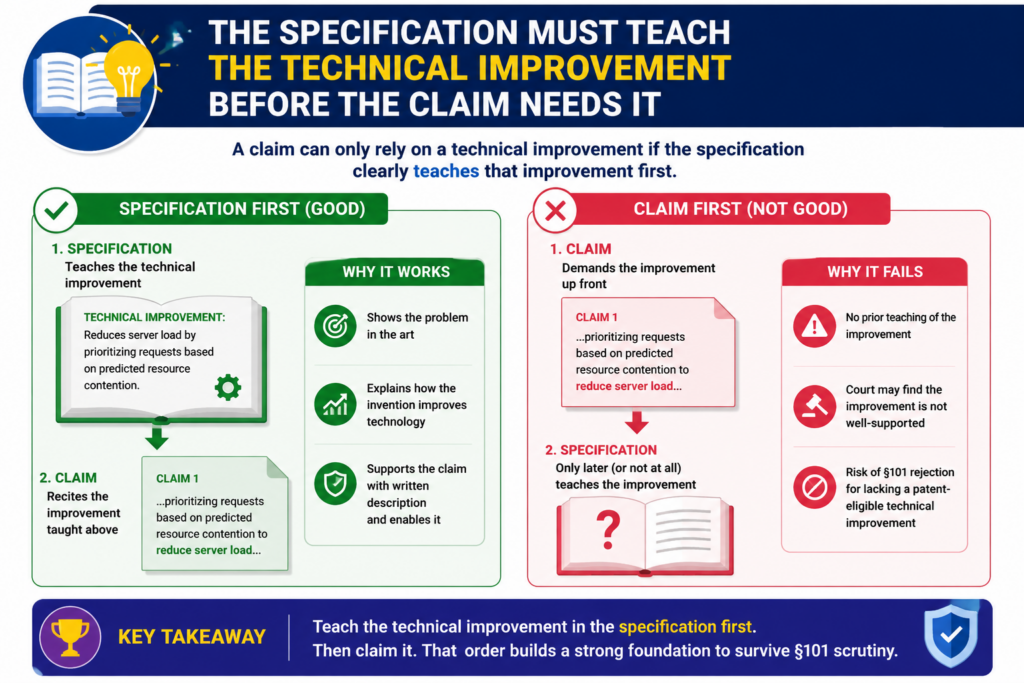
If the written description does not explain the technical problem and the technical fix, the claim may look thin when a 101 rejection arrives.
This is why founders should not treat the patent application like a short product summary. A product summary says what the tool does for users.
A patent specification should explain how the tool works inside the system and why that way is better than the old way.
The USPTO’s subject matter eligibility guidance points examiners to the claim as a whole and to whether the claim integrates an abstract idea into a practical application.
The USPTO has also said eligibility is separate from novelty, obviousness, and written support, which means a claim may still need to pass other tests even if it clears 101.
The Written Story Should Make The Improvement Hard To Miss
A strong software patent draft should not hide the best point in a vague sentence near the end. It should bring the machine problem forward early.
For example, do not just say the system “improves search results.” That sounds soft. Explain that the old system returned stale results because it refreshed indexes on a fixed schedule, even when fast-changing records had already shifted.
Then explain that the new system updates selected index parts based on detected change patterns, not just time. Now the improvement has a body. It has shape. It has a reason.
The same pattern works for AI tools. Do not just say the system “uses a model to improve accuracy.”
Explain what kind of error the old model made, what signal the new system adds, how the signal changes the model path, and what happens when confidence drops. That turns a bland AI story into a technical one.
The draft should also explain why the fix was not just normal use of a computer. If the problem comes from scale, speed, device limits, noisy signals, network delay, data conflict, model drift, or privacy risk, say that clearly.
These are system problems. They help show that the invention lives in the machine world, not just in the world of business ideas.
The Best Patent Drafts Preserve The Engineering Tradeoff
The most useful details often come from tradeoffs. A team may have tried a simple method first. It may have failed because it used too much memory, caused too many false matches, raised latency, broke privacy rules, or became unstable under load. That failed path matters.
A patent draft should explain the rejected approach in simple words. It does not need to shame the old method. It just needs to show the real technical pressure that led to the invention.
This is powerful because real engineering is never magic. It is a set of choices made under limits.
A claim that reflects those choices feels more grounded. It tells the examiner that the invention is not a wish. It is a working fix built for a hard machine problem.
This is also why founder notes should capture more than the final design. Early test results, failed paths, architecture changes, and performance pain can all help shape a better patent story.
PowerPatent helps teams pull these details together before they disappear into old tickets and forgotten Slack threads. You can see the process here: https://powerpatent.com/how-it-works
The Claim Language Should Show A Specific System Path, Not A Loose Result
Many weak software claims fail because they float above the work. They say a system receives data, processes data, and outputs a result. That may be true, but it says very little. It does not show a specific path through the system.
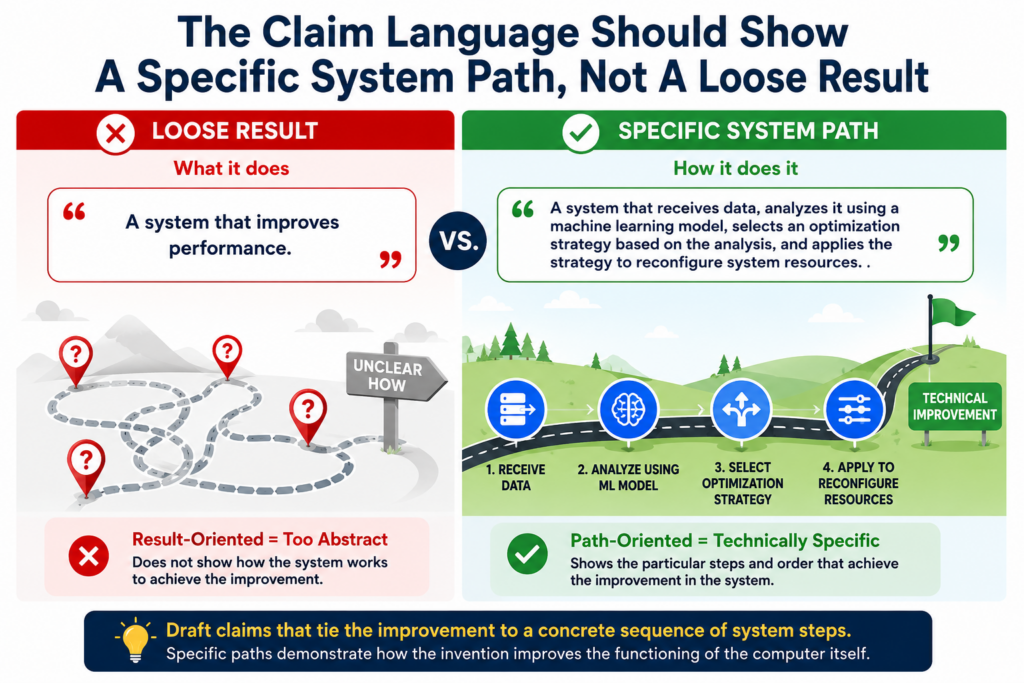
A stronger claim gives the invention a route. It shows where the data comes from, how it is changed, what decision is made, and how the system acts because of that decision.
The goal is not to add random detail. The goal is to name the steps that create the technical improvement.
The USPTO’s AI eligibility examples and guidance are built around the same kind of question: does the claim merely state an abstract idea, or does it apply the idea in a practical way inside a real technology setting?
A Strong Claim Makes Each Step Earn Its Place
Every important step in the claim should have a job. It should move the system toward the technical fix.
If a step only sounds impressive, cut it or rewrite it. Patent claims are not pitch decks. Words like “intelligent,” “advanced,” “seamless,” and “optimized” do not help unless the claim says how the system earns those results.
For example, “optimizing data transfer” is weak by itself.
A better frame might say that the system groups records by shared update windows, builds a compact change set, sends only the change set to a remote node, and rebuilds a local index after a match check.
That is not fancy language. It is just clearer engineering.
The same idea applies to model claims. “Generating a better prediction” is not enough.
A stronger claim may say that the system forms a feature group from live sensor data, compares it to a stored drift range, selects a retraining path when the drift range is exceeded, and blocks use of a stale output until the model passes a check. Now the claim has a real system path.
That kind of detail helps because it narrows the claim around the actual invention.
It also gives the attorney more room to argue that the claim is not trying to own a broad idea. It is claiming a specific way to make the system work better.
The Claim Should Not Depend On Magic Words
Some teams try to solve 101 by adding patent-sounding language. They add “processor,” “memory,” “module,” “engine,” and “non-transitory computer-readable medium” everywhere.
Those words may be needed in the right place, but they do not create a technical improvement by themselves.
The better move is to make the claim do real work. Say what is stored in memory that was not stored before. Say what the processor does in a different order.
Say what the module checks that old systems ignored. Say what the engine changes when a bad condition is found.
The power is in the action, not the label.
A claim can still use standard computer parts. Many real inventions run on normal servers, phones, chips, sensors, or cloud systems.
The key is that the claim should not rely on those parts as window dressing. It should show a new way those parts work together to solve a technical problem.
This is where PowerPatent can be helpful for busy founders. The platform helps turn rough invention notes into a clearer draft path, while real patent attorneys help shape the legal side.
That means your team can stay close to the product while still building a stronger patent record. Learn more here: https://powerpatent.com/how-it-works
The Technical Improvement Should Be Measurable Even When The Claim Does Not Use Numbers
A claim does not always need to include numbers. It may not need to say the system is 30 percent faster or uses 20 percent less memory. But the patent story should still make the improvement feel measurable.
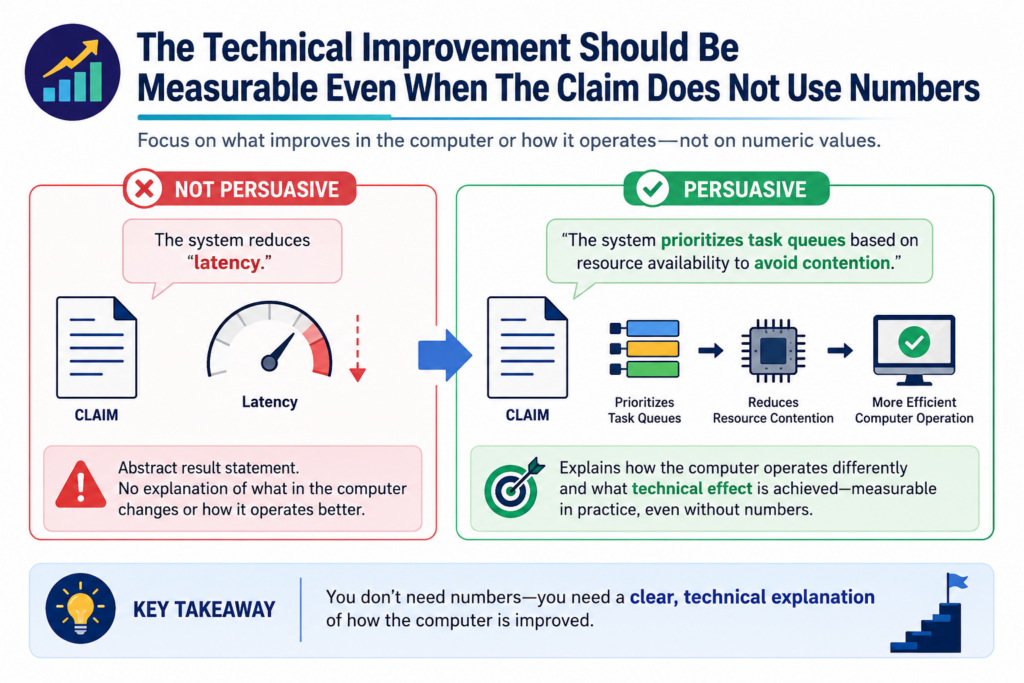
A measurable improvement is easier to believe. It gives the draft weight. It helps show that the invention is more than a desired result.
The improvement may be about speed, memory, power, bandwidth, security, accuracy, stability, fault recovery, privacy, data freshness, model trust, or device life. The key is to tie the result to a system change.
The Draft Should Explain What Gets Better And Why
A weak draft says the system is “more efficient.” A stronger draft says the system avoids repeated database scans by storing a new kind of lookup key. That tells the reader why efficiency improves.
A weak draft says the model is “more accurate.” A stronger draft says the system detects when new inputs differ from training patterns, then routes those inputs through a second check before using the output. That tells the reader why accuracy improves.
A weak draft says the system is “more secure.” A stronger draft says the device removes or masks private fields before sending a compact request to a remote service, while keeping enough signal for the remote service to return a useful result.
That tells the reader why security improves without breaking function.
These are simple examples, but the point is serious. A technical improvement should not hang in the air. It should be tied to cause and effect.
The patent draft can include test results when they exist. It can also include expected effects when supported by the design.
The goal is not to overpromise. The goal is to show the reader that the improvement follows from the actual system architecture.
Numbers Help, But The Story Must Come First
Performance numbers can help. But numbers alone do not save a weak claim.
If the draft says the system is faster but does not explain the new mechanism, the number may look like marketing.
If the draft explains the mechanism first, then the number becomes support. The story should make sense before the data appears.
For example, a founder may say, “Our tool cuts cloud calls by half.” That is useful. But the patent story should explain how. Maybe the system checks whether a local confidence score is high enough before making a remote call.
Maybe it batches low-priority updates. Maybe it stores a small local model for first-pass filtering. Maybe it sends compressed feature summaries instead of raw records.
Each of those paths points to a different invention. A good patent process helps find the right one.
This is why strong invention capture is so important for software startups. A founder may know the business value, but the patent value often sits inside the engineering cause.
PowerPatent helps teams capture that cause in a cleaner, faster way, with smart software and real attorney oversight. See how it works here: https://powerpatent.com/how-it-works
A Strong 101 Position Often Starts With A Strong Problem Statement
A software claim is easier to defend when the application explains the problem like an engineer would explain it.
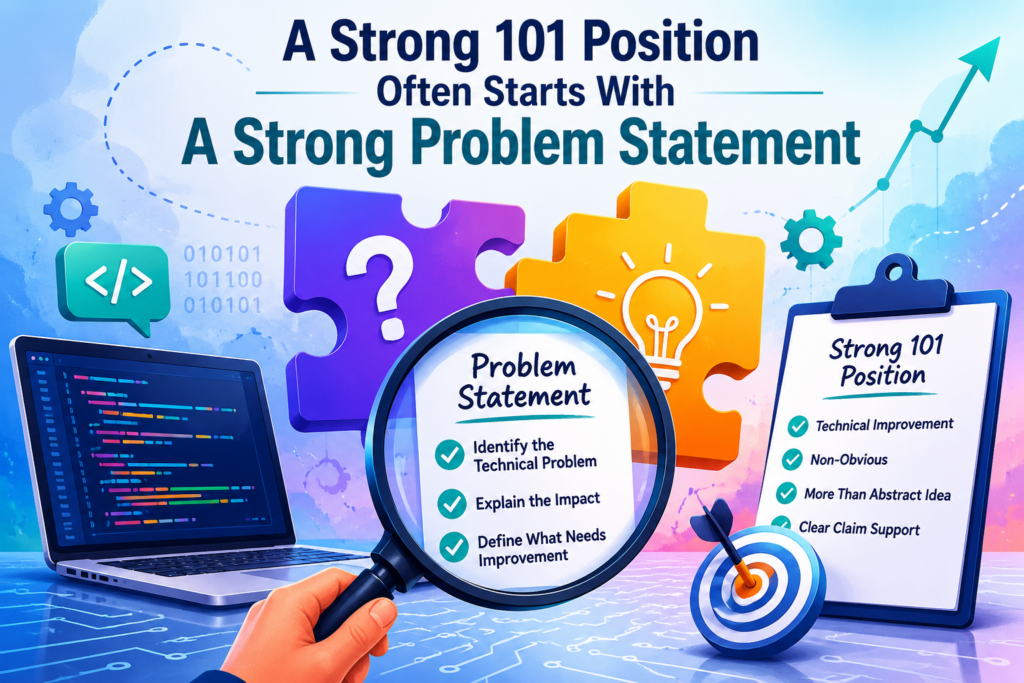
The problem should not be “users need better insights” or “companies need smarter decisions.” Those are market problems. They may be true, but they do not do much work in a 101 fight.
The stronger problem is closer to the machine. The system could not process live inputs fast enough. The database could not update without locking too many records.
The model gave stale results after real-world data shifted. The mobile device had to send too much raw data to the cloud. The network could not keep state across broken sessions.
These are better starting points because they show that the invention is solving a technical limit, not just a human wish.
The USPTO’s current eligibility framework still looks at whether a claim recites an abstract idea and, if so, whether the claim integrates that idea into a practical application.
That is why the problem statement matters so much. It gives the examiner a clear path to see the invention as a working technical fix instead of a broad idea with computer words attached.
The Old System Should Be Described As A Technical Limit
A good patent story does not attack the old system in a vague way. It explains the limit in plain words. Maybe old systems refreshed all data on a fixed timer, which wasted compute when only a small part had changed.
Maybe old systems sent full files when a small change record would have worked. Maybe old systems used one model for every case, even when some cases needed a lighter path and others needed a deeper check.
That level of detail helps because it shows the invention was not made in a vacuum. It came from pressure inside the system. A founder does not need to write like a lawyer to explain this.
In fact, simple words often work better. The draft can say that the old system kept doing extra work, lost track of fresh data, used too much memory, created delay, or exposed more data than needed.
The goal is to make the reader feel the technical pain before the claim presents the fix. When the pain is clear, the fix has a reason to exist. Without that pain, the claim may look like a broad request to own a result.
The Problem Should Read Like A Clear Bug Report With Stakes
A strong problem statement can sound like a clean bug report. It should name the bad condition, say when it happens, and explain what breaks because of it. This does not need to be dramatic. It needs to be exact.
For example, instead of saying “current tools are inefficient,” the draft might explain that a server repeats the same feature extraction step each time a related request arrives, even when part of the feature set has not changed.
That repeated step increases latency and compute cost under high traffic. Now the problem has edges. It is not just “efficiency.” It is a specific waste in a specific part of the pipeline.
That style also helps founders talk to patent counsel faster. The team can bring code notes, logs, system diagrams, and test results that show where the pain came from.
PowerPatent is built to help teams capture those details early, organize them, and move toward attorney-reviewed filings without dragging the company into a slow, old process. You can see the workflow here: https://powerpatent.com/how-it-works
The Claim Verbs Should Show Control Over Computer Behavior
Patent claims live and die by verbs. Weak verbs make the invention sound like a result. Strong verbs show the system doing real work.
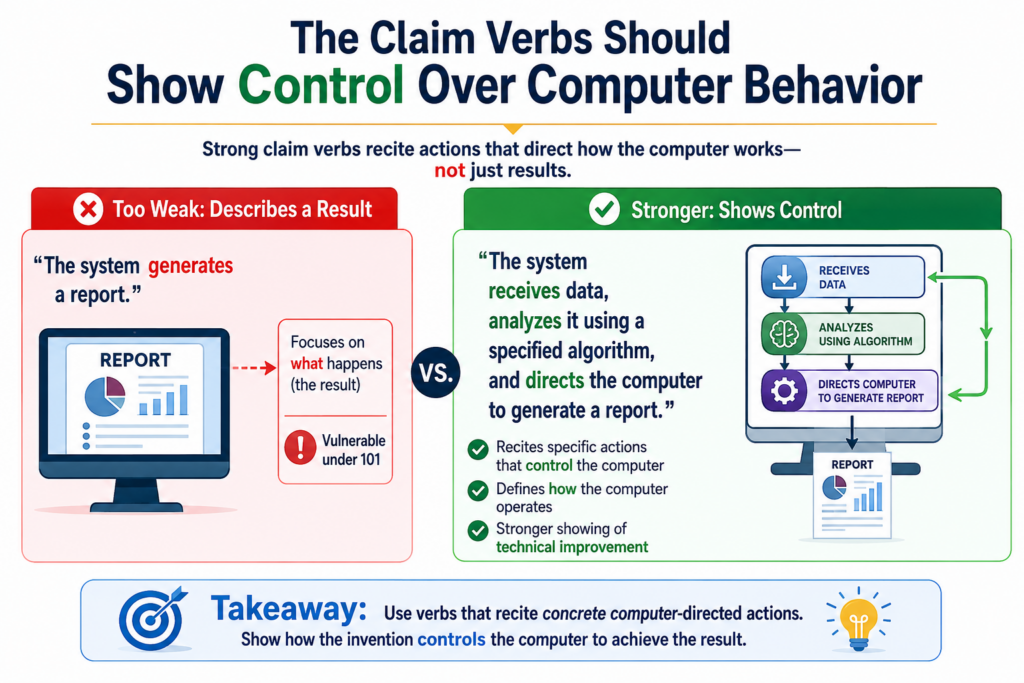
Words like “analyze,” “determine,” “process,” and “generate” are not bad by themselves. They are common in software claims.
The problem is that they can become empty when the claim does not explain how the system analyzes, determines, processes, or generates. If every step is broad, the claim may look like a normal mental process moved onto a computer.
A better claim uses verbs that show a specific change in system behavior. The system may partition, throttle, mask, encode, rank, compare, route, reject, cache, rebuild, compress, synchronize, validate, or update.
These verbs are not magic. They work only when tied to concrete data, rules, structures, model states, or system limits.
Weak Verbs Hide The Invention When The Claim Needs To Reveal It
A weak claim might say that the system receives user data, analyzes the data, and provides a recommendation. That may describe the product, but it does not reveal the invention. It leaves the hard work hidden behind broad words.
A stronger claim might say that the system receives sensor values, builds a time-windowed feature set, compares the feature set against a stored drift range, selects a local or remote model path based on that comparison, and blocks an output when a confidence rule fails.
That version still uses simple language, but it shows a path through the machine.
This is where a lot of software teams can make a real jump in quality. The invention is often already in the code, but the first patent notes flatten it.
The notes say “we improve routing” when the real invention is a new way to split requests across nodes based on latency, load, and data freshness.
The notes say “we improve security” when the real invention is a new masking step before a model call. The claim needs the real mechanism.
Strong Verbs Build A Clear Chain From Input To System Action
The best verbs create cause and effect. The system does not merely “use data.” It changes the path because of the data. It does not merely “score a risk.” It changes access, storage, model choice, network routing, or device behavior because the score crosses a defined line.
This matters because technical improvement often shows up as control.
The invention controls when data is sent, how much data is sent, which model runs, which cache entry is trusted, which record is updated, which session is restored, or which request is denied. That control is what makes the claim feel like engineering.
The Federal Circuit’s Enfish decision is often discussed because the claims focused on a specific self-referential database structure that improved computer operation, not just a business result stored on a computer.
The lesson for founders is practical: explain the specific structure or process that makes the system work better.
PowerPatent helps teams move from product verbs to invention verbs. That shift can make the patent draft clearer, stronger, and more useful for the business. Learn how PowerPatent helps founders protect technical work here: https://powerpatent.com/how-it-works
AI Claims Should Protect The Pipeline, Not Just The Prediction
AI claims can run into trouble when they sound like this: collect data, run a model, and output a prediction.
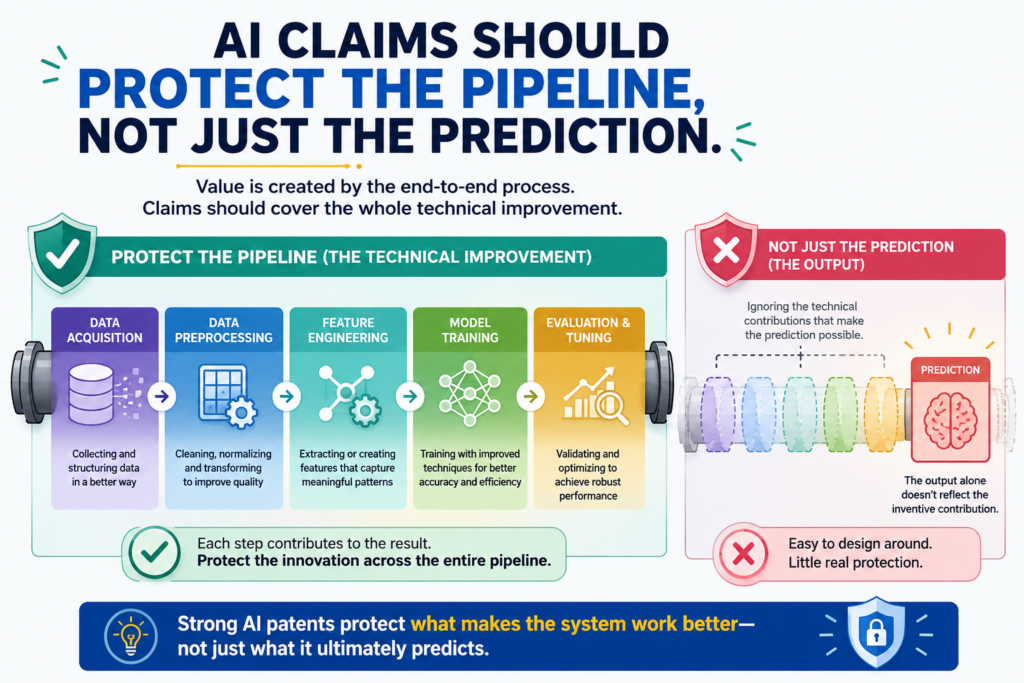
That frame is easy to understand, but it can be too thin. It may sound like a black box that does a normal decision task.
The stronger AI patent story usually lives in the pipeline. How is the data prepared? How is noise removed? How is private data protected? How is drift detected?
How is the model selected? How does the system handle low confidence? How does it keep the output safe, current, or useful after deployment?
The USPTO’s 2024 AI eligibility update was made to help examiners apply subject matter eligibility rules to AI inventions, including the same practical-application focus used for other software claims.
That does not mean every AI claim is safe. It means the draft should make the practical technical use clear.
The Model Step Must Do A Job Inside The Larger System
A model is not a patent strategy by itself. Saying “we use machine learning” is usually not enough. The question is what the model changes inside the system.
A better claim might show that a model output controls how records are cleaned before storage. Another might show that a confidence score changes which network path is used.
Another might show that a local model filters data before a cloud model sees it, reducing bandwidth and protecting private data. Another might show that a drift signal stops an old model from being used until a new check is passed.
Those are stronger stories because the model is not just giving advice. It is part of a controlled technical process. It changes what the system stores, sends, blocks, updates, or runs next.
This is especially important for founders building AI infrastructure, dev tools, security tools, biotech software, robotics systems, fintech systems, or enterprise automation.
The best invention may not be “the model predicts X.” The best invention may be the way the system feeds, checks, deploys, guards, or updates the model.
The Safest AI Story Often Comes From Guardrails, Data Flow, And Deployment
Many AI teams focus on model quality, but the patent value may come from the parts around the model. A team may have built a clever way to remove sensitive fields before inference.
It may have created a way to keep embeddings fresh without rebuilding everything. It may have made a model run on a small device by changing the input path. It may have built a fallback system for low-confidence outputs.
These details matter because they show practical engineering. They also help avoid a claim that sounds like the broad idea of using AI to make a decision.
The patent draft should explain why the AI system behaves better because of the new pipeline. It should not rely on hype. It should show the actual path from data to action.
If the system reduces false positives, explain the technical step that causes that reduction. If it lowers cost, explain which compute step is skipped, reused, or moved. If it protects privacy, explain what is changed before data leaves the device or server.
PowerPatent gives AI founders a faster way to turn these technical details into a patent-ready record, with software that helps gather the story and real attorney oversight that helps shape the filing. Explore the process here: https://powerpatent.com/how-it-works
The 101 Response Should Match The Claim, The Specification, And The Real Product
A 101 rejection is not always the end of the road. But the response is much stronger when the claim, the written description, and the real product all tell the same story.
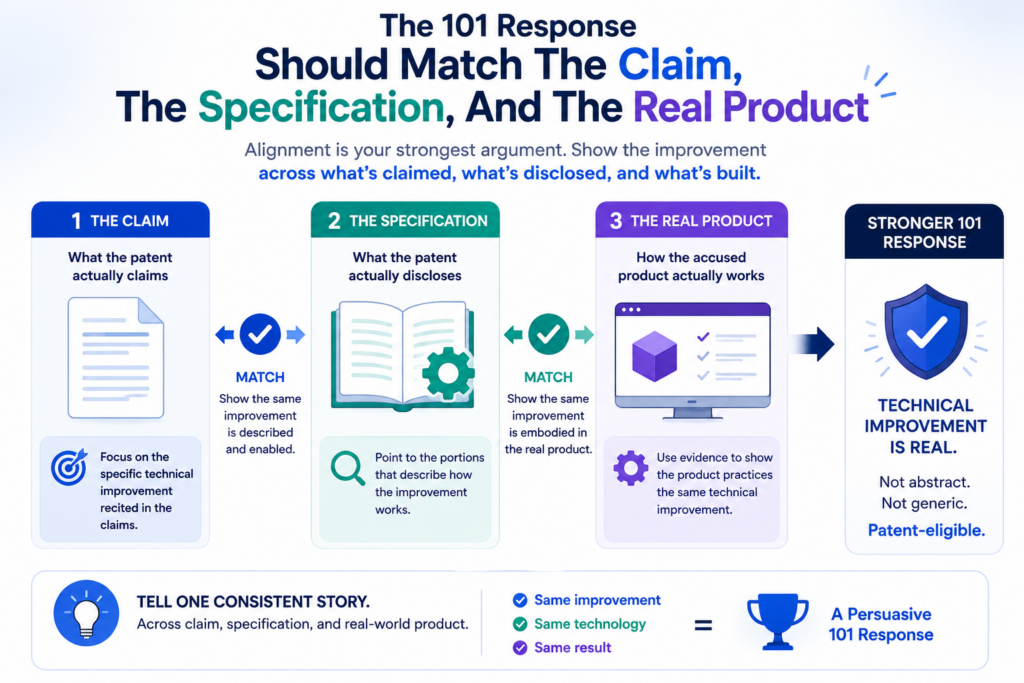
If the claim says one thing, the specification says another, and the product proof points to a third, the argument becomes harder.
The response should not merely say, “This is technical.” It should point to the claim language, the specification, and the actual improvement.
The USPTO’s MPEP discusses both the Alice/Mayo framework and the idea that an improvement to computer function or another technology can support eligibility. That is why the response should be grounded in the actual system steps, not in broad labels.
The Best Argument Is Built Before The Rejection Arrives
The strongest 101 response is often written before anyone receives a rejection. It is built into the first filing. The application already explains the old system.
It already names the technical limit. It already teaches the new process. It already describes why the new process improves how the system works.
When that groundwork exists, the response can point back to it.
The attorney can say the claim is not just a result because the claim recites a specific sequence, data structure, control rule, model path, or system action. The attorney can also point to the specification to show why that sequence matters.
Without that groundwork, the response may become harder. The team may try to argue technical improvement, but the application may not give enough support.
That is why invention capture and drafting quality matter so much at the start.
The Product Evidence Should Support The Patent Story Without Replacing It
Product evidence can help the team understand the invention, but the claim still needs to stand on its own.
A demo video, benchmark, investor deck, or customer story may show that the system has value. But patent eligibility depends on the claim and how the invention is described in the application.
The product story should feed the patent story. If customers love the tool because it gives answers faster, the patent team should ask what changed in the system to make that speed possible.
If users trust the tool because it makes fewer mistakes, the team should ask what technical check reduced those mistakes.
If buyers care because the tool keeps data private, the team should ask what masking, splitting, storage, or routing method made that privacy work.
That is the founder move. Do not stop at the outcome. Chase the machine reason underneath it.
PowerPatent helps founders do this while the company is still moving fast. It combines guided software with real patent attorney review, so teams can capture the technical heart of the invention without turning patents into a giant distraction. Start here: https://powerpatent.com/how-it-works
A Good Claim Should Not Try To Own The Whole Result
A common mistake in software patents is claiming the whole win instead of the new way the system gets there.
The claim tries to own “detecting fraud,” “matching users,” “ranking content,” “predicting risk,” “routing tasks,” or “finding errors.” That sounds broad. It also sounds like the kind of abstract result that can trigger a 101 problem.
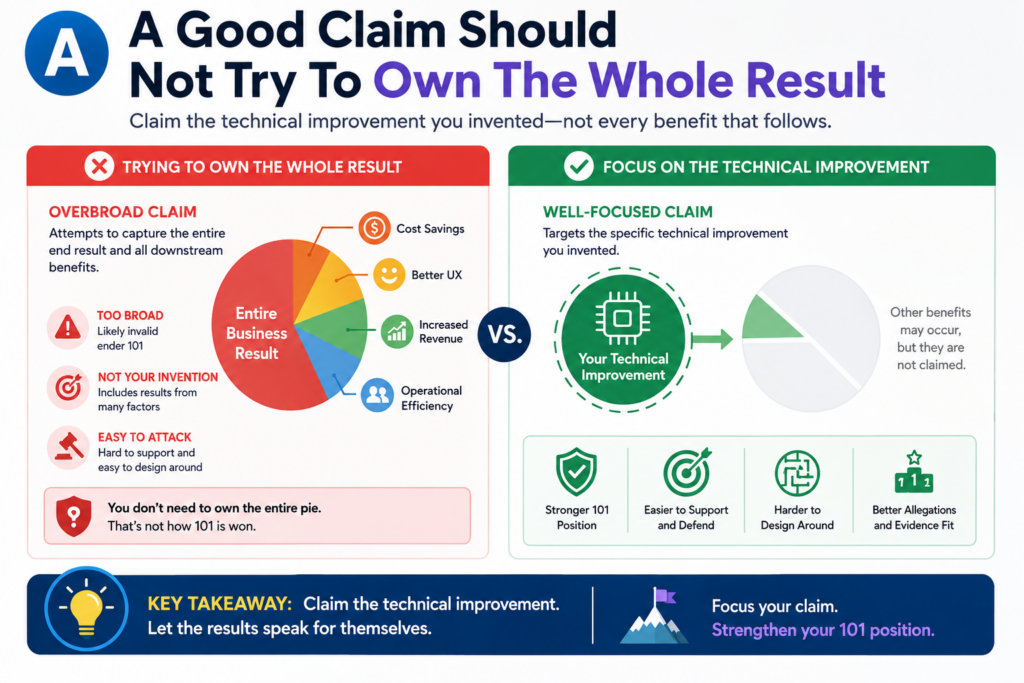
A better claim protects the specific path that makes the result possible. This is not about making the claim small for no reason. It is about making the claim strong enough to survive.
A claim with a clear technical path can still have real business value, especially if that path is central to how the product works.
The Alice case is the warning sign here. The Supreme Court held that generic computer implementation did not make an abstract idea patent eligible by itself.
That is why a software claim should not lean on a normal computer as the main point. It should show the new technical method that the computer carries out.
The Claim Should Protect The Engine, Not Just The Destination
Think of the product result as the destination. The technical improvement is the engine. A weak claim says, “arrive at the destination.”
A stronger claim says, “use this new engine path to arrive there with less waste, less delay, better safety, or better control.”
For example, a startup may build a tool that finds risky transactions.
The broad result is fraud detection. But the invention may be a new way to update risk scores without recomputing every account, or a new way to compare live transaction features against a compact stored profile, or a new way to block a transaction only when two independent machine signals agree.
Those are different inventions. They may support different claims. They may also create a stronger answer to 101 because each one points to a concrete technical process.
The same is true for workflow software. “Assigning tasks to workers” may sound like a business idea.
But “changing task routing based on live device state, queue load, network delay, and stale data flags” may sound much more like system control. The claim should live in that second frame.
The Narrower Technical Path Can Create A Wider Business Moat
Founders sometimes worry that a technical claim is too narrow. That worry is fair, but it can lead to the wrong move.
A broad claim that gets rejected or later breaks may give less protection than a focused claim tied to the real system advantage.
A strong patent strategy often uses layers. One claim may cover the core technical path. Another may cover a key variation.
Another may cover a device setup, server process, model path, or storage method. The point is not to claim everything at once. The point is to build a fence around the parts that matter.
This is where smart drafting matters. The attorney needs to understand what the product does, but also what parts competitors would copy if the product works.
The claim should aim at that copied technical move. It should not float above it.
PowerPatent helps founders capture that core move while the work is still fresh. The platform helps turn raw technical details into a cleaner invention record, then real patent attorneys help shape the filing. You can explore the process here: https://powerpatent.com/how-it-works
The Specification Should Give The Examiner Words To Say Yes
A patent examiner has to read the claim and apply the eligibility rules. The easier the application makes that job, the better.
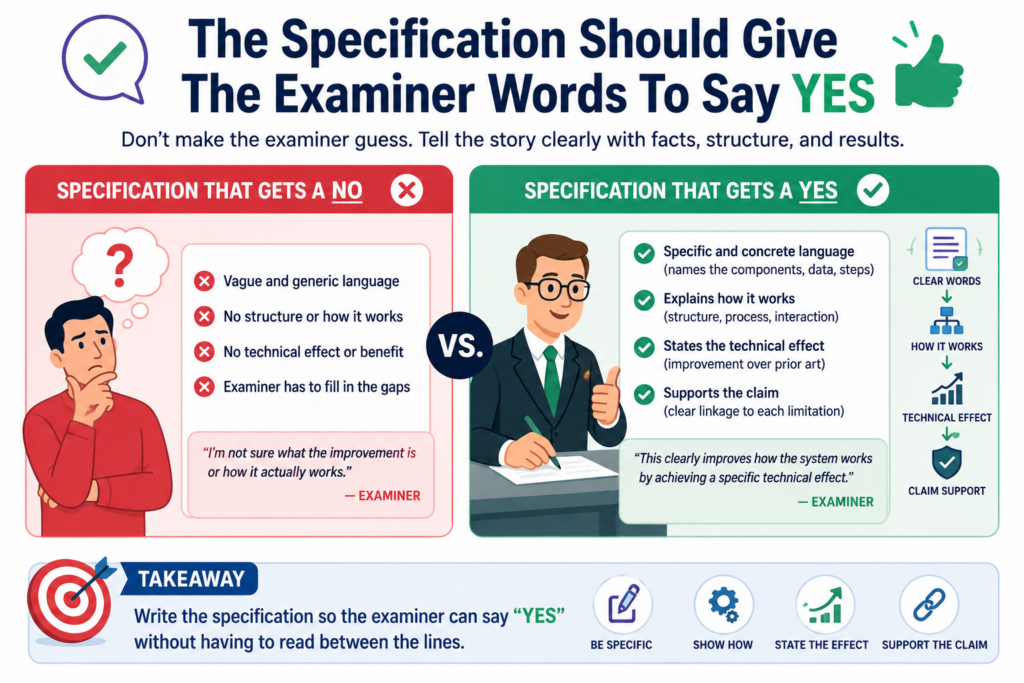
The draft should not force the examiner to guess where the technical improvement is. It should explain it in plain words and then tie those words to the claim.
The USPTO’s MPEP explains that a claim reciting a judicial exception may still be eligible when it integrates that exception into a practical application.
The MPEP also points to improvements in computer function or another technology as important in that analysis.
That means the written description should do more than describe screens and user steps. It should give the examiner a clean technical story that matches the claim language.
The Draft Should Repeat The Core Improvement In Different Useful Ways
A strong application should explain the improvement from several angles without saying the same sentence again and again. It can explain the old technical problem. It can explain the new architecture.
It can explain the data flow. It can explain the system behavior before and after the change. It can explain how the claim steps create the result.
This helps because different readers focus on different parts. An examiner may look for the practical application.
A future investor may care about the moat. A buyer may care about whether the patent covers a real feature. A future court may study the claim and specification together.
The application should not use empty labels. Saying “the invention improves computer technology” is not enough. The draft should say what part of computer technology improves.
It may be storage, retrieval, synchronization, model deployment, inference cost, authentication, latency control, cache validity, or error recovery.
Simple language is fine. In fact, it often works better. “The system avoids rebuilding the full index when only a selected group of records changed” is clear. “The system improves computational performance through advanced indexing” is weaker because it hides the reason.
The Claim Should Reflect The Same Improvement The Specification Teaches
The 2024 USPTO AI eligibility examples say that, when considering whether a claim includes an improvement to a computer or technology, the specification and the claim are both important.
The technical explanation should be present in the specification, and the claim should reflect that asserted improvement.
That is a very practical drafting lesson. If the specification says the invention reduces memory use by building a compact table, the claim should not only say “generate a recommendation.”
If the specification says the invention improves model safety by blocking stale outputs, the claim should not only say “predict a result.”
If the specification says the invention reduces network traffic by sending changed fields instead of full records, the claim should include the data handling path that creates that result.
This is where a founder’s early notes can make a big difference. The best draft often starts with clear answers from the build team.
What changed? Why did it matter? What failed before? What system action now happens because of the new step?
PowerPatent is made to help teams capture those answers without turning the patent process into a huge drain. See how it works here: https://powerpatent.com/how-it-works
The Claim Should Turn Data Into A System Change
Many software inventions use data. That alone does not make them strong or weak. The key question is what the data does inside the system.
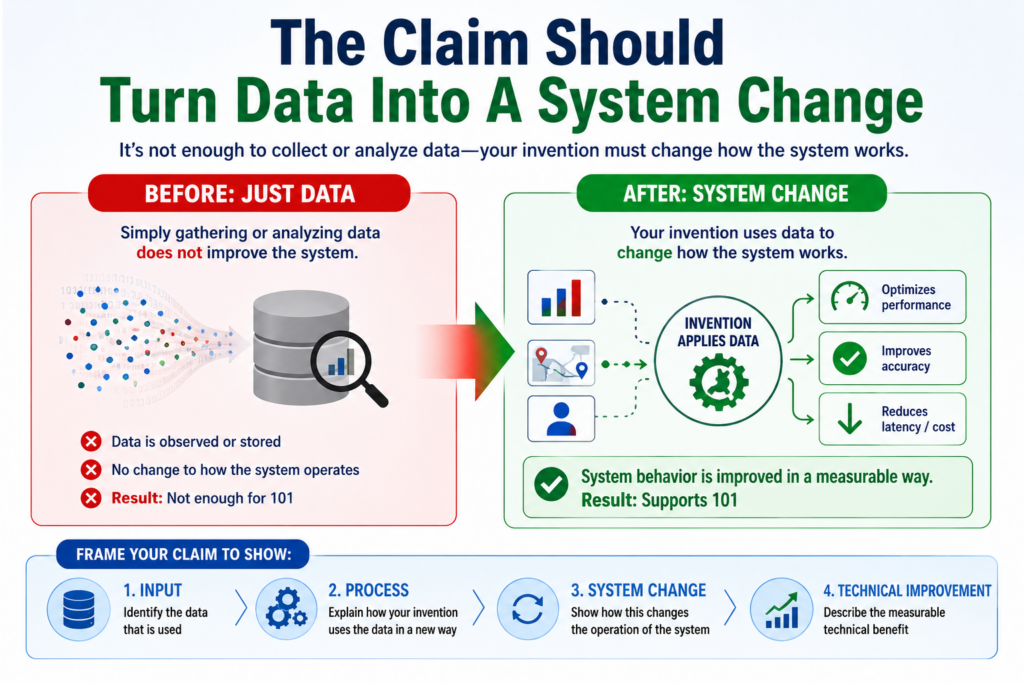
If the data is only collected, reviewed, and shown to a user, the claim may look like information handling.
If the data changes how the system stores, routes, secures, updates, or runs something, the claim has a stronger technical story.
This is a useful rule for founders: do not stop at the data output. Follow the data until it changes machine behavior.
A Strong Claim Uses Data As A Control Signal
A control signal is data that causes the system to act in a certain way. It may tell the system to choose one model instead of another.
It may tell the system to use local storage instead of cloud storage. It may tell the system to refresh a cache, block a request, compress a payload, re-rank a queue, or trigger a recovery step.
That kind of claim often feels more technical because the data is not just information for a person. It becomes part of system control.
For example, a claim that “scores a document and displays the score” may feel thin.
A claim that uses the score to select a secure processing path, mask certain fields, and prevent storage of unsafe content has more machine action. The result is not just a better report. The result is a changed system state.
This point matters even more for AI. A confidence score, drift score, anomaly score, or similarity score should not sit alone. The claim should explain what the system does because of the score.
Does it stop a model output? Does it request more data? Does it use a smaller model? Does it avoid sending private fields? Does it rebuild an index? Does it switch to a fallback process?
The Best Data Claims Explain The Before And After State
A good data claim often has a before state and an after state. Before the key step, the system has a first state. After the key step, the system has changed.
That change might be a new cache status, a new access level, a new routing path, a new stored record, a new model version, or a new device mode.
This before-and-after structure helps the reader see that the invention is not only about thinking. It is about system behavior.
The Enfish case is often used as a helpful software example because the claims focused on a specific database structure that improved how the computer stored and retrieved data.
The Federal Circuit described the self-referential table as a specific data structure designed to improve computer operation.
The lesson is not that every software patent needs a new database table. The lesson is that structure matters. Data can be part of a strong claim when the claim shows how that data structure or data path improves the machine.
For founders, this means the strongest invention may be hidden in how the product changes state.
PowerPatent helps pull those details out of code, design notes, and founder explanations so the patent story is built around the true technical edge. Learn more here: https://powerpatent.com/how-it-works
The Application Should Avoid Empty AI And Software Words
Some patent drafts sound advanced but say very little. They use words like intelligent, adaptive, automated, dynamic, scalable, seamless, and optimized.
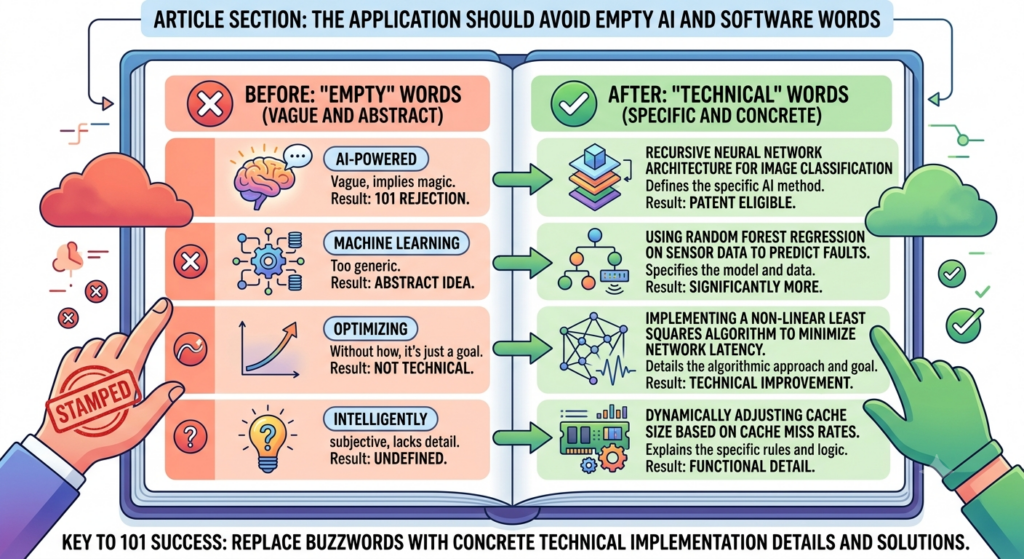
These words are not always wrong, but they can become filler if the draft does not explain the mechanism behind them.
A good software patent does not need to sound inflated. It needs to sound exact. Exact does not mean hard to read. It means the words point to real system steps.
The USPTO’s subject matter eligibility page states that its guidance explains how examiners and PTAB judges evaluate claims under Section 101, and the USPTO identifies the MPEP sections where current eligibility guidance appears.
That makes clarity in the claim and specification important because those are the materials being examined under the eligibility framework.
Strong Words Name The Thing That Actually Changes
Instead of saying the system is adaptive, say what changes and when. The model path changes when confidence falls below a set level. The cache refresh interval changes when update frequency rises.
The device switches modes when battery, latency, or privacy status crosses a rule. The server rebuilds only part of an index when a change set touches a defined record group.
Instead of saying the system is scalable, say how it handles load. It may split requests by feature overlap. It may reuse intermediate results.
It may move low-priority work to a delayed queue. It may store a compact summary to avoid repeated full reads.
Instead of saying the system is secure, say what is protected and how. It may mask fields before sending data. It may split identity data from model input.
It may create a token that expires when device context changes. It may block an output when the source data fails a trust check.
This kind of writing is not just clearer. It is more useful. It gives the attorney better claim material.
It gives the examiner a better view of the technical improvement. It gives the founder a stronger record of what the company actually built.
Simple Drafting Can Still Be Deep Drafting
Simple words do not make a patent weak. Vague words make it weak. A clear sentence about a new data path can be far stronger than a dense sentence full of buzzwords.
For example, “the system sends only changed fields to the remote node” is simple. It also tells the reader something real.
“The platform enables optimized cloud synchronization through dynamic intelligence” sounds bigger, but it gives the reader less.
The same applies to AI. “The system blocks use of the model output when the live input pattern is outside the training range” is clear. “The AI engine ensures trusted inference” sounds good, but it does not explain the technical act.
Founders should push for this level of clarity early. Before filing, ask whether each important term points to a real step in the system.
Ask whether a smart engineer could read the draft and understand the invention. Ask whether the claim would still make sense without marketing language.
PowerPatent helps teams move from buzzwords to build words. That is how software patents become more than paperwork.
They become a clear record of the technical edge your company is creating. Start here: https://powerpatent.com/how-it-works
The Claim Should Make The Abstract Part Serve A Concrete System Purpose
Many software inventions include ideas that can sound abstract when they are described too broadly. A system may rank, classify, compare, predict, or decide.
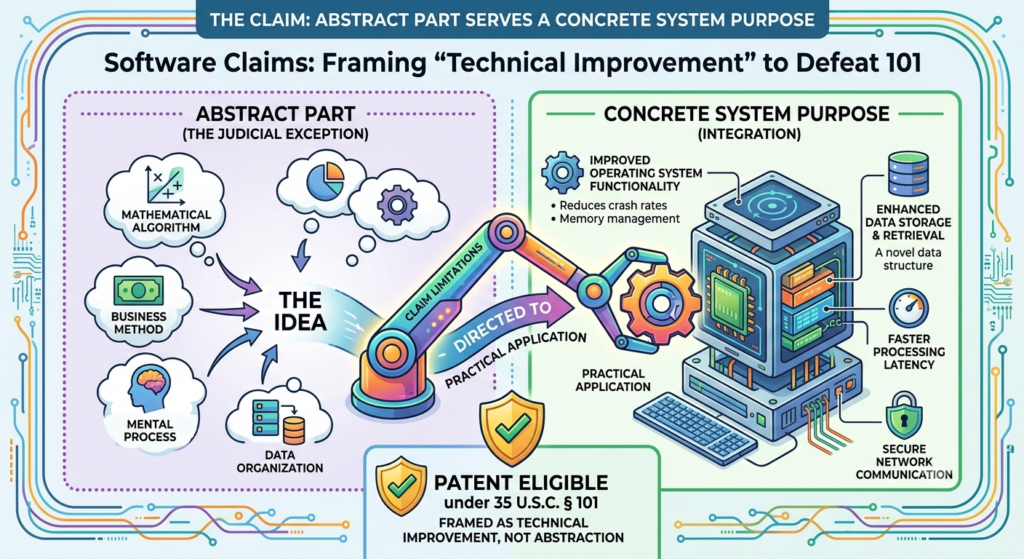
Those words can raise concern because people can also rank, classify, compare, predict, or decide in their minds.
The patent draft has to show that the software is not just doing a mental task faster. It has to show that the claimed steps serve a concrete system purpose.
The USPTO’s current eligibility framework asks whether a claim is directed to a judicial exception and, when needed, whether the claim integrates that exception into a practical application.
In software, that practical application is often strongest when the claim ties the logic to a change in computer function, network behavior, data handling, device control, or another technical field.
The Abstract Step Should Trigger A Machine-Level Action
A claim may need to include a score, rule, comparison, or classification. That is not always bad.
The problem comes when the score or classification just sits there as information. A stronger claim uses that result to control the system.
For example, a fraud score by itself may sound like a business judgment.
But a fraud score that changes how a server locks a session, masks stored fields, delays a transaction message, or routes the request to a second authentication path has a stronger technical role. The score is not just advice. It becomes a control signal.
A similarity score can work the same way. If the claim only says the system finds similar files and displays them, the story may feel thin.
If the claim says the similarity score causes the system to reuse a stored vector, skip a full model run, update only a selected index shard, or block duplicate storage, the score now changes how the computer works.
This is the move founders should look for. Do not stop at the smart result. Ask what the system does next because of that result. That next step may be where the patent story gets stronger.
The Best Claims Make The Decision Feel Like Part Of The Plumbing
A strong software claim makes the decision step feel like part of the system plumbing. It is not a loose thought. It is a switch, gate, filter, lock, route, or update step inside the machine.
This matters because most software value comes from control. The system controls what data moves, what gets saved, what gets hidden, what model runs, what request waits, what cache is trusted, or what user state is allowed.
When the claim shows that kind of control, it becomes easier to explain the technical improvement.
A founder can test the claim by asking a simple question. If the score or rule were removed, would the machine behave differently?
If the answer is yes, the claim may have a real technical hook. If the answer is no, the score may be only an output, and the draft may need more work.
PowerPatent helps teams find these hooks inside their real build. The software helps collect the invention details, and real patent attorneys help shape the story so the claim is based on the actual system advantage. See how it works here: https://powerpatent.com/how-it-works
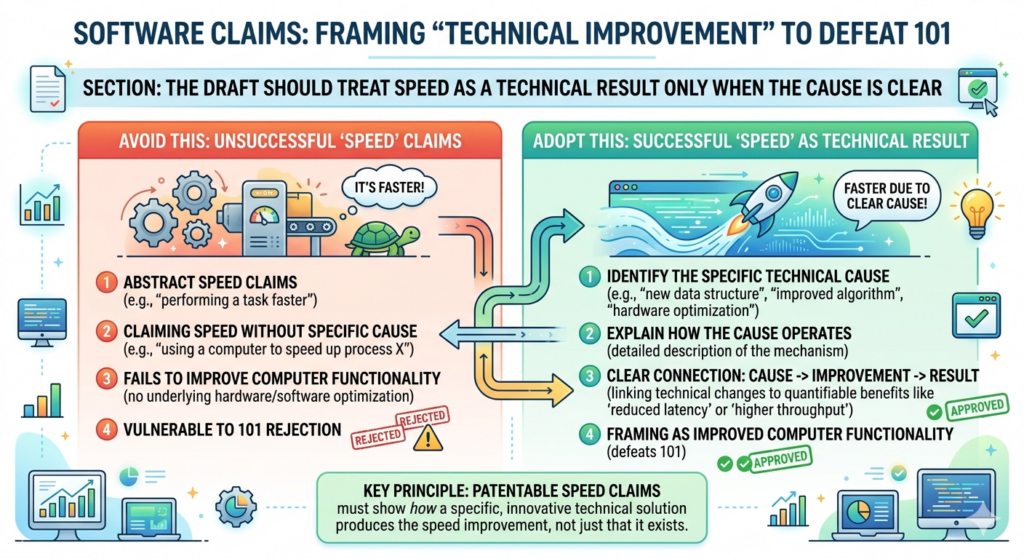
The Draft Should Treat Speed As A Technical Result Only When The Cause Is Clear
Speed is one of the most common claims founders make about software. The product is faster. The model responds faster.
The platform loads faster. The search returns faster. That may be true, but speed alone is not always enough. The patent draft should explain why the system is faster.
A claim that says a computer performs a task faster than a person may still sound like using a generic computer for an old task.
A stronger claim shows the new machine process that reduces delay, avoids wasted work, or changes the timing of system operations.
USPTO guidance continues to treat improvements to computer function or another technology as important in the eligibility analysis, but the improvement should be explained in the specification and reflected in the claim.
That means the draft should not rely on a vague promise of speed. It should show the mechanism that creates it.
The Claim Should Point To The Step That Saves Time
A startup may know that its system cuts response time, but the patent claim needs the engineering reason. Maybe the system avoids a full scan by keeping a compact index.
Maybe it runs a smaller model first and only calls a larger model when needed. Maybe it groups requests with shared features so one intermediate result can be reused. Maybe it moves part of the work to the device so the cloud does less.
Each of those examples is different. Each could lead to a different claim. That is why the patent process should not stop at “faster.” It should keep digging until the cause is clear.
The same point applies to latency. Low latency is not the invention by itself. The invention may be a new way to prefetch data, preserve state, prioritize packets, split tasks, compress fields, or delay noncritical steps.
Once the cause is clear, the claim can be framed around the system path that produces the faster result.
That framing helps with 101 because the claim no longer sounds like a result. It sounds like a working process inside the computer.
The Draft Should Explain Why The Faster Path Was Not Just Obvious Cleanup
A strong draft should also explain the constraint. Why did the team need this new path? Why was the normal method not enough? Maybe the normal method used too much memory.
Maybe it broke when traffic spiked. Maybe it made too many cloud calls. Maybe it gave stale results because the system waited for a full rebuild.
These details give the speed claim weight. They show that the invention was not just “make it faster.” It was a specific fix to a specific system limit.
This is important for founders because performance gains are often buried in engineering notes.
The patent team needs to capture the cause while the team still remembers it. A benchmark is helpful, but the claim needs the architecture behind the benchmark.
PowerPatent helps founders capture both sides: the real product benefit and the technical path that makes it happen.
That gives attorneys better material to draft from, without forcing the team through a slow back-and-forth process. Start here: https://powerpatent.com/how-it-works
Security Claims Should Explain The Protection Mechanism, Not Just The Threat
Security software can be strong patent material, but the claim has to avoid vague fear language.
It should not only say the system prevents attacks, protects users, or improves trust. It should explain what the system changes to reduce risk.
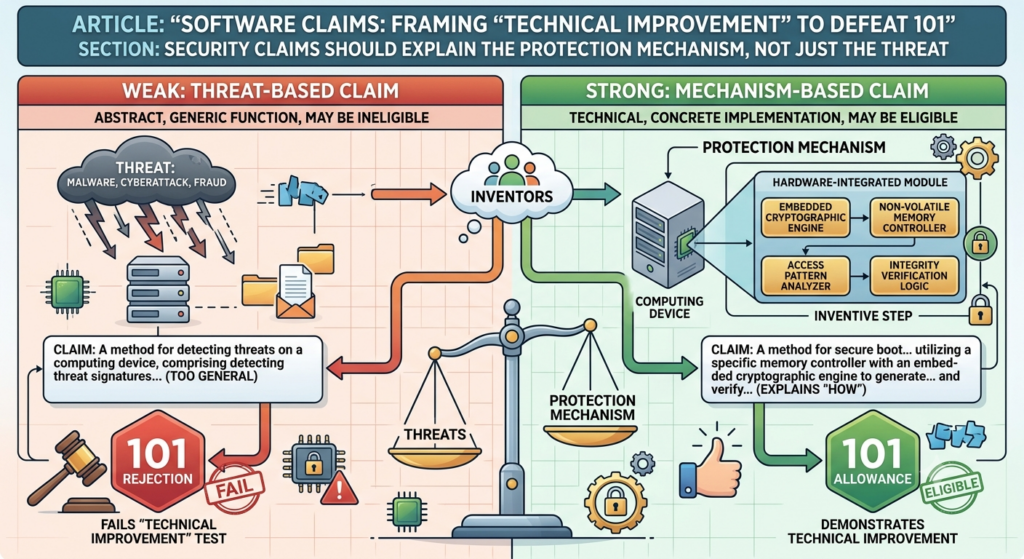
A technical security improvement may come from a new way to mask data, split identity fields, rotate tokens, verify device context, detect abnormal sessions, restrict model output, isolate risky files, or block unsafe requests. These are machine actions. They show how the system behaves differently.
The USPTO’s AI eligibility examples include an example where an AI-based anomaly detection claim can become eligible when the claim integrates the model output into a practical network-security application.
The lesson is not that all security claims are safe. The lesson is that the claim should show how the detection step improves or controls a real technical system.
The Claim Should Tie The Threat To A Concrete Change In System State
A weak security claim might say the system detects a threat and sends an alert. That may be useful, but it can sound like information reporting.
A stronger claim says that when the threat condition is detected, the system changes access rights, blocks a session token, masks a data field, moves a file to an isolated store, or reroutes traffic through a safer path.
That change in state matters. It shows that the system is not just telling a person about risk. It is controlling the machine in response to risk.
For example, an AI security tool may detect an abnormal login pattern. The stronger patent story is what happens next.
The system may compare device signals with a stored trust profile, assign a risk level, reduce permission scope, and require a second check before sensitive data can be loaded. That is more than detection. It is a control flow.
The same is true for privacy. “Protecting privacy” is a goal. The technical invention may be the way the system strips, masks, hashes, separates, or keeps data local while still allowing the product to work.
The Strongest Security Drafts Show The Tradeoff Between Safety And Use
Good security engineering often has a hard tradeoff. If the system blocks too much, users cannot work.
If it blocks too little, risk rises. If it masks too much data, the model may fail. If it sends too much data, privacy may suffer.
That tradeoff can make the patent story stronger. It shows why the invention matters. The draft should explain how the system keeps enough function while reducing risk.
For example, the system may send a compact feature summary instead of raw private data. It may keep identity fields separate from model inputs.
It may allow a low-risk action while blocking a high-risk action. It may run a local check before a remote service receives any data.
Those are the kinds of details that make a security claim feel technical and grounded.
For founders, the action step is simple. Do not describe security only as a promise. Describe the control path.
PowerPatent helps teams turn those control paths into a clearer patent record, with software that captures the invention and attorney oversight that helps shape the filing. Learn more here: https://powerpatent.com/how-it-works
Data Structure Claims Should Show Why The Structure Changes System Performance
A data structure can be a strong center for a software claim when the structure is tied to a real technical improvement.
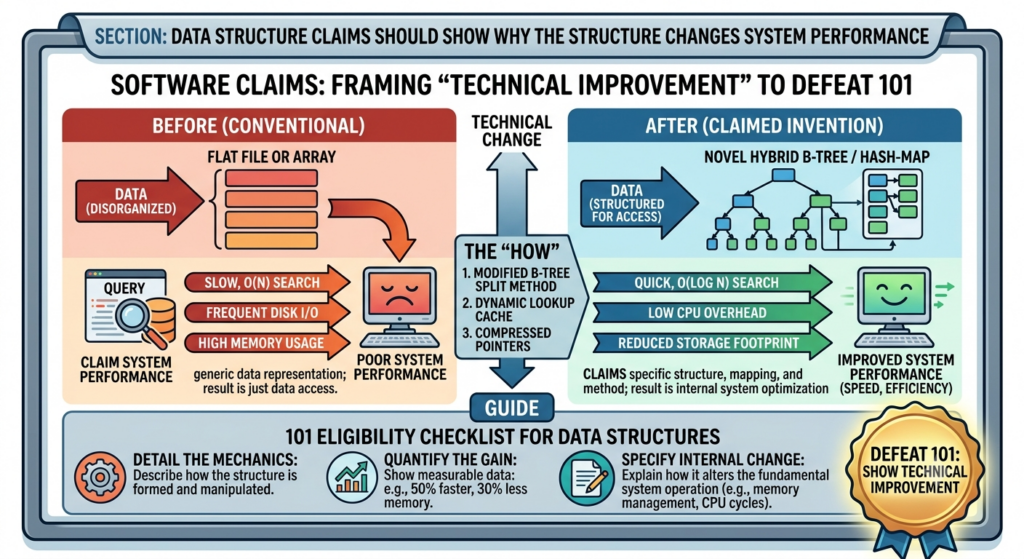
The structure should not be described as a container with a fancy name. It should be described as a way the system stores, finds, updates, links, or controls information better than before.
The goal is to show why the data arrangement matters. Does it reduce lookup time? Does it avoid duplicate storage? Does it keep stale records out of search results?
Does it allow partial updates instead of full rebuilds? Does it let the system enforce security rules closer to the data?
The Structure Should Not Be A Label Sitting On Top Of Ordinary Data
A weak draft may say the system stores a profile, table, graph, vector, or record. That may be true, but it does not yet show the invention.
A stronger draft explains what is inside the structure, how items are linked, when the structure is updated, and what system action the structure enables.
For example, a vector database claim should not only say that embeddings are stored.
It should explain how the system groups embeddings, refreshes selected groups, removes stale vectors, handles low-confidence matches, or avoids rebuilding the full store when only a narrow slice changes.
A graph claim should not only say that nodes and edges represent relationships. It should explain how the system changes edge weights, prunes paths, caches subgraphs, or routes decisions based on graph state.
A table claim should not only say that records are stored. It should explain how the table is arranged so retrieval, update, security, or synchronization works better.
This is where many software teams have hidden value. The product may look simple on the surface, but the real invention may sit in how the data is arranged behind the scenes.
The Data Structure Should Be Connected To A Working Claim Step
The data structure should not live only in the background section. It should connect to the claim. If the structure reduces search time, the claim should use the structure during search.
If the structure improves privacy, the claim should use the structure to block, mask, or separate data. If the structure helps model deployment, the claim should use the structure to select, update, or check model inputs.
The Federal Circuit’s Enfish decision is often cited because the claims were not just about storing information on a computer.
They focused on a specific self-referential table that the court treated as an improvement in computer operation.
The broader drafting lesson is to explain the structure and the system benefit together, not as separate thoughts.
A founder should ask one practical question before filing: what would break or become slower if this structure were replaced with a normal one? The answer may reveal the technical improvement that belongs in the claim.
PowerPatent can help founders capture that answer before it gets lost in code comments, schema changes, or architecture diagrams.
The platform helps technical teams move from raw build details to a stronger patent story, backed by real attorney review. See how it works here: https://powerpatent.com/how-it-works
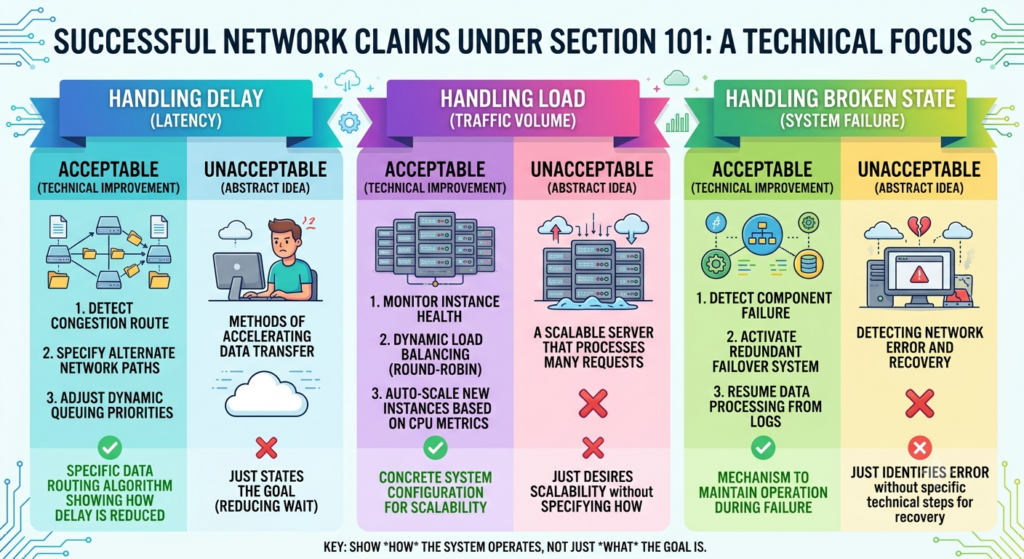
Network Claims Should Show How The System Handles Delay, Load, Or Broken State
Network software can be a strong place to frame technical improvement because networks fail in messy ways. Requests arrive late. Packets drop. Sessions expire.
Nodes overload. Devices move between connections. Cloud services respond at different speeds. A good claim should not hide these problems behind a broad phrase like “improved communication.”
It should explain how the system handles the network problem in a new and useful way.
This is where a founder can often find real patent value. The product may look like a normal app to users, but under the hood the team may have built a smarter way to keep data fresh, reduce calls, preserve session state, or route work when one service slows down.
The claim should connect network signals to system behavior
A weak network claim may say the system sends data from one device to another. That is not enough. A stronger claim explains what condition is detected and what the system changes because of that condition.
For example, the system may detect that a device has a weak connection and switch from a full cloud model call to a smaller local model.
It may detect that a server node is overloaded and route only high-priority requests to that node while delaying low-priority sync work.
It may detect that a session token is close to expiring and refresh only the state needed to keep the user flow alive.
Those are technical acts. They deal with real machine limits. They also give the claim a more concrete shape than “send, receive, and display.”
A network claim can also be stronger when it shows how the system avoids waste. Maybe the system sends only changed fields instead of a full object.
Maybe it groups updates into a compact message. Maybe it keeps a local shadow state so the device can keep working while the connection is poor. These details show a practical system fix.
The strongest network claims explain the bad condition and the recovery path
Network inventions often become stronger when the draft describes the recovery path. The claim should not only say that a failure is detected. It should explain what happens after the failure is detected.
A system may rebuild a session from a stored state token. It may replay only missed events. It may compare timestamps to avoid overwriting fresh data with stale data.
It may move requests from one queue to another based on latency. It may compress a pending payload when bandwidth drops below a threshold.
That recovery path is where the technical improvement often lives. It shows that the invention is not just about knowing something went wrong. It is about keeping the system working better when something goes wrong.
This also helps with 101 framing because the claim reads less like a broad result and more like a technical control process.
The USPTO’s eligibility framework looks at whether a claim is merely directed to an abstract idea or instead integrates the idea into a practical application.
A network recovery path can help show that practical application when the claim and specification explain it clearly.
PowerPatent helps founders capture these details before they are lost in backend tickets, incident notes, and architecture changes.
Start here to see how the platform turns technical work into a cleaner patent path: https://powerpatent.com/how-it-works
User Interface Claims Should Focus On Computer Function, Not Just A Better Screen
User interface inventions can be tricky. A better screen can help users, but a claim that only presents information in a nicer way may be weak.
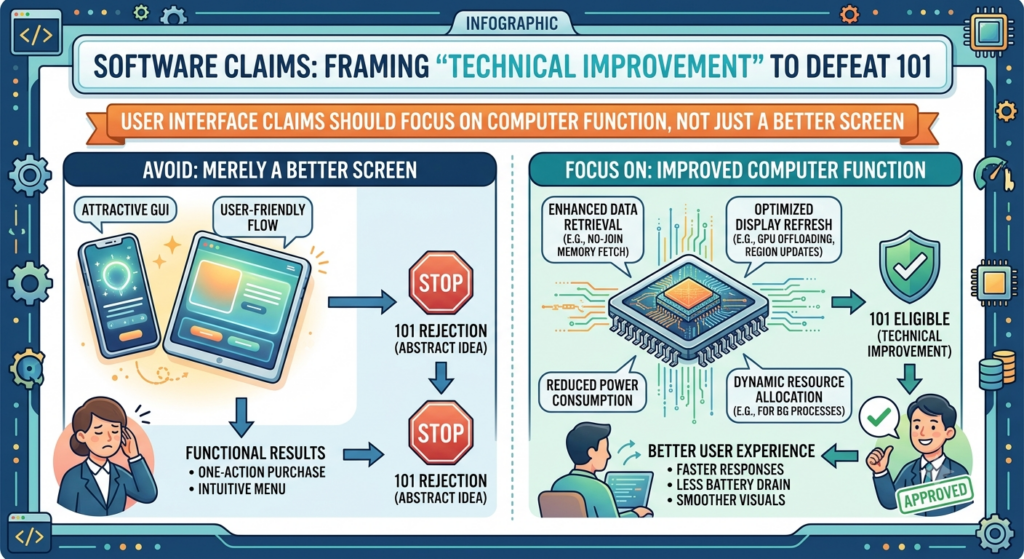
The safer path is to show how the interface changes the way the computer handles input, state, timing, error control, or system flow.
This does not mean user interface work is not technical. Good interface engineering can be very technical.
The key is to make the technical part visible. The claim should not stop at “displaying information.” It should show how the interface causes a better machine process.
The interface should do more than show a result
A weak claim may say the system displays a dashboard with a score.
A stronger claim may say that the interface receives a user action, changes a local state, triggers a limited data request, updates only a selected part of the display, and prevents a conflicting action until the update is verified.
Now the interface is not just a screen. It is part of a system that controls data flow and state.
This is especially useful for complex tools used by engineers, doctors, scientists, finance teams, or operators. The interface may reduce input errors by limiting choices based on live system state.
It may prevent unsafe actions until required data is loaded. It may show a warning only when a machine condition meets a certain rule. It may let the user work with partial data while the system completes a background sync.
These are not just design choices. They can be technical choices when they change how the system processes inputs and avoids errors.
The best interface claims tie the screen action to backend control
A strong user interface claim should show the bridge between the screen and the backend. What does the system do because the user moved, clicked, selected, dragged, approved, or changed something?
For example, the system may receive a user selection, create a filtered request, avoid loading a full dataset, and update only a changed field group. That could reduce latency and memory use.
Another system may receive a user edit, lock a related record, check a conflict state, and release the lock after a clean update.
That could reduce data errors. Another may show a live model confidence marker, then block a submit action when the confidence marker falls below a safe range.
The Federal Circuit has recognized software eligibility in cases where the claim was tied to a specific improvement in computer operation, such as the self-referential database structure in Enfish.
The broad lesson for interface claims is the same: the draft should explain the specific improvement, not only the user-facing benefit.
Founders should not throw away interface inventions just because they look simple. The team should ask what the interface changes inside the system.
PowerPatent helps capture that connection between product behavior and technical operation, with real attorney review to help shape the filing. Learn more here: https://powerpatent.com/how-it-works
Conclusion:
A software claim beats a 101 problem when it shows a real technical fix, not just a smart result.
The draft should explain the machine problem, the new system path, and the clear improvement that follows. That is how software patents become useful business tools, not slow paperwork.