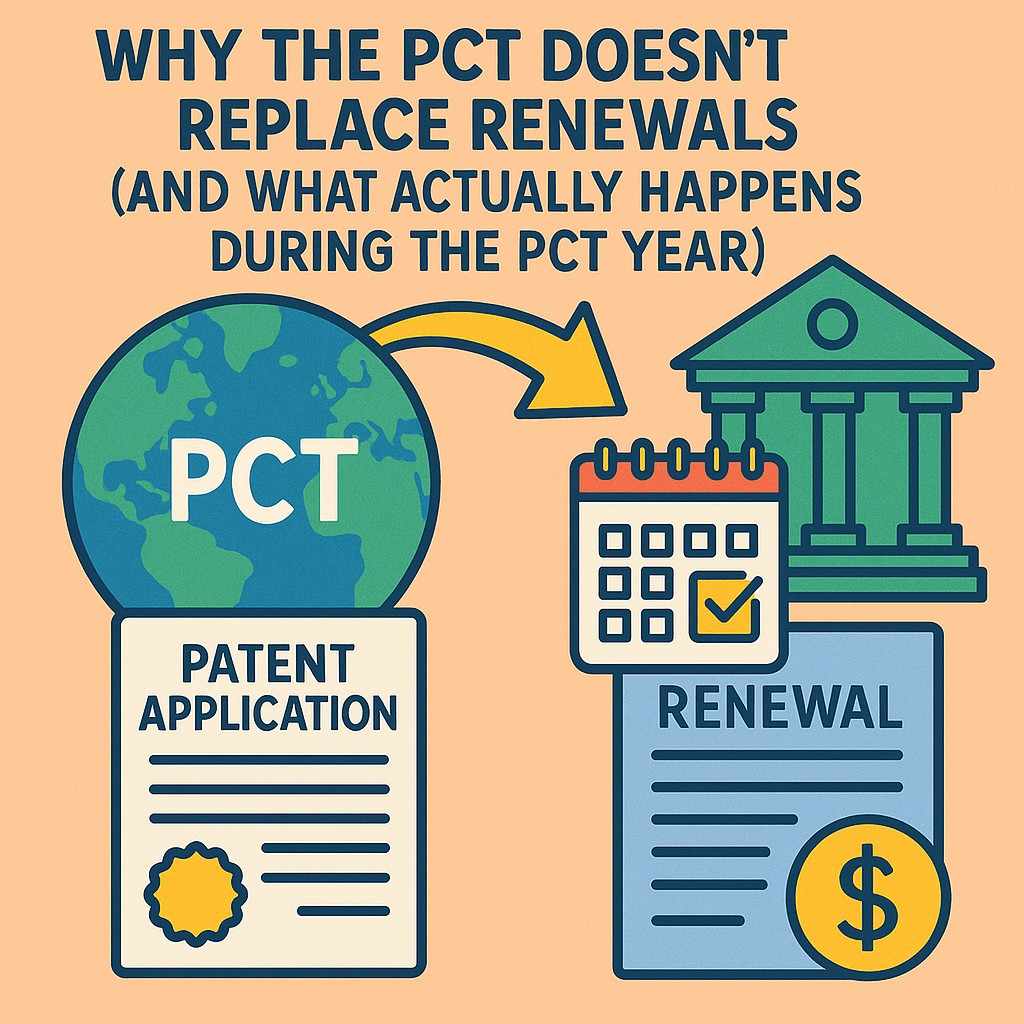
When you file a PCT application, it feels like you hit pause on all the messy parts of going global with your patent. But even during that pause, some things still need to be paid for. And once you move from the PCT stage into national stages, the money part changes again. Many founders think the PCT “covers everything” or that renewals wait until every country is picked. Sadly, that’s not how the system works. The truth is way more confusing than it should be, and small mistakes can cost you years of protection or force you to start over.
Why the PCT Doesn’t Replace Renewals (And What Actually Happens During the PCT Year)
The moment you file a PCT application, it feels like you finally get to breathe. You’ve put your invention into a global system, the clock slows down, and you get extra time to decide where you want protection.
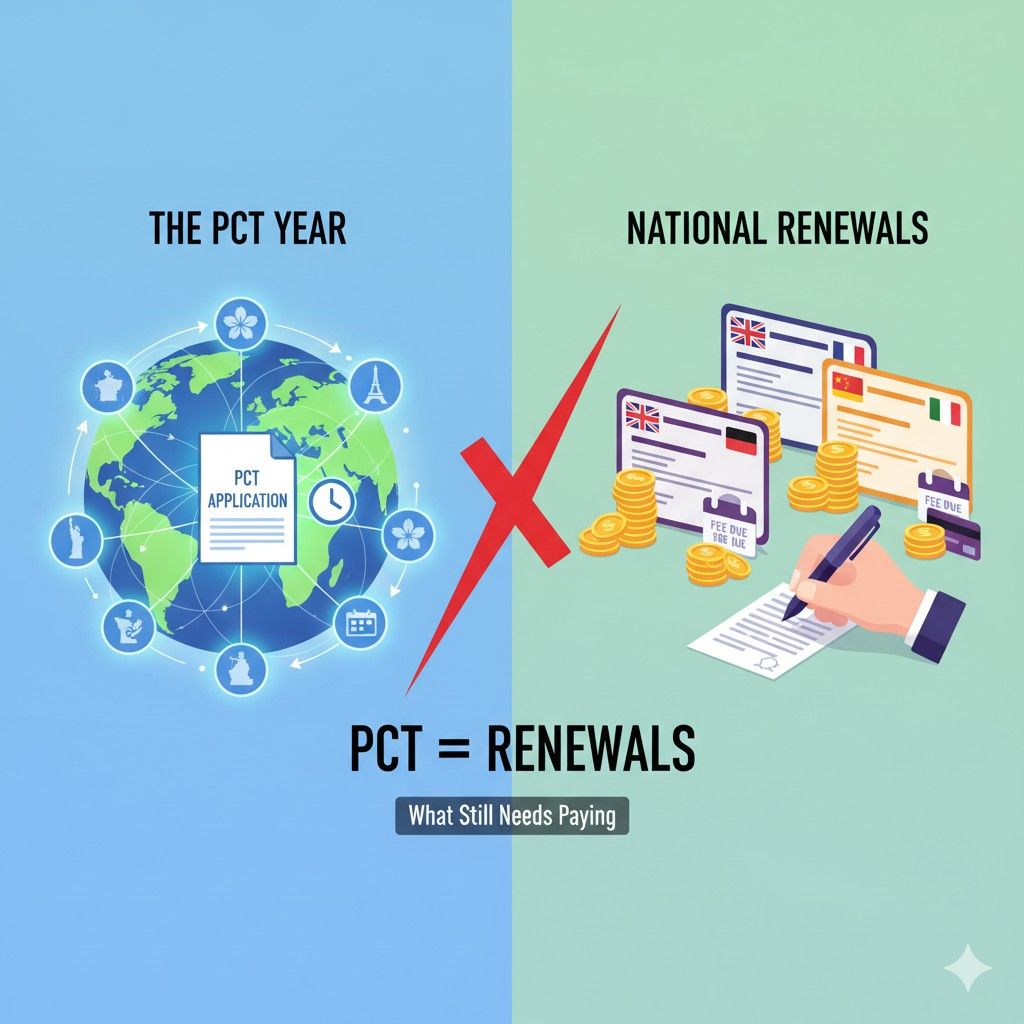
But even though the PCT system gives you time, it does not take away your responsibilities. The PCT does not cancel renewal fees that are already due in your home country, and it does not create a new global renewal schedule.
It only gives you a temporary structure to hold your international plan together while you prepare your national filings. And this misunderstanding is one of the easiest ways businesses lose rights, overspend, or fall out of compliance without realizing it.
Understanding what the PCT actually does during that first big year
During the first twelve months after your initial filing, everything still depends on your original application. The PCT comes into play only when you file it, and even then, it works like a giant waiting room.
You get a single international process to manage instead of racing into foreign offices right away. But the original filing still has a life of its own.
If your home country requires that you keep paying renewals to maintain your original priority application, that rule doesn’t suddenly disappear. The PCT doesn’t override national laws, and that alone is worth keeping in mind from the very start.
Most founders don’t realize this, because the PCT is marketed as a simple way to “file everywhere later.” And yes, it does give you that benefit. But the PCT never becomes your main case. It never replaces national filings. It is simply a bridge.
And like any bridge, you must keep the entry point open. If your priority application lapses because you forgot a renewal, the entire PCT structure you built collapses with it.
That is why many businesses get blindsided by fees even during what they thought was a quiet year.
Why missing renewals can quietly destroy your entire PCT plan
One thing that surprises many companies is how unforgiving the system is. If you forget to pay a renewal in your home jurisdiction, the patent office doesn’t look at your PCT and say, “It’s fine, you’re covered internationally.”
Instead, they treat your original filing as abandoned. And if your original filing collapses, the priority date you were counting on disappears. Without a priority date, your invention becomes vulnerable.
Competitors can publish, file, or build around you because the system no longer sees you as the first filer.
This is where things get painful. You might not even find out right away. Some founders only learn about the lapse when they try to enter a national stage and get rejected because their base application is already dead. At that point, there is no easy fix.
You can’t reverse time. You can’t rebuild the priority date. And you lose your rights permanently in many regions. It’s not dramatic; it’s just how the rules work.
This is why companies with serious technology treat renewals during the PCT year as a strategic task instead of a legal chore. Keeping the original application alive is the most basic form of risk control.
It’s the one thing that keeps your entire global patent plan from falling apart. And if you don’t have a system for tracking deadlines, it becomes easy to slip.
Many teams rely on spreadsheets, old email reminders, or scattered internal notes. And that’s where problems start, because one silent oversight can wipe out years of work.
How to manage the PCT year with clarity, predictability, and zero surprises
If your goal is to expand globally, you need a clear view of the timeline. Every country still expects you to follow its rules, even if you are in the PCT phase. That means you need to know not only when renewals are due but also how they change later when you enter national stages.
During the PCT year, the smartest way to operate is to treat renewals as non-negotiable business operations. Companies that do this build systems where someone is always watching the deadlines, and where things don’t depend on one person remembering.
Founders who move fast often assume renewals can wait until after fundraising or product testing. But patents don’t run on startup timelines. They run on legal timelines, and the legal timelines don’t care what else is going on in your business.
That means even during pivots, team changes, or funding delays, renewals still need to get paid. The PCT won’t protect you from administrative rules, and no patent office will give special treatment because you were busy building.
To make things smoother, you can centralize everything into one place instead of juggling random notes across email threads and internal tools.
PowerPatent helps with this because it shows you every important date on a simple dashboard, and it explains what each deadline means in plain, human language.
If you want to see how the workflow looks, you can check it out anytime → https://powerpatent.com/how-it-works
What international search and examination really cover and why they don’t replace your renewals
One common point of confusion is the belief that once you pay for the international search or the international preliminary examination, you’ve covered the main costs for the PCT phase.
It feels logical because the search and examination are the most visible steps. But those steps only tell you what the world thinks about your invention. They don’t keep your original filing alive.
They don’t maintain your rights in any country. They don’t extend your deadlines. They don’t cancel any national obligations. They simply give you insight so you can make smarter decisions when you later enter national phases.
This is why renewals remain separate. The PCT is built to evaluate your invention at a global level, not to maintain it at a national level. If it tried to merge both roles, the system would become unmanageable. So instead, each part plays its own role.
The PCT handles the evaluation and timing. You handle the renewals and maintenance. And the national offices handle the long-term legal protection.
Understanding this division of responsibilities helps founders plan budgets with accuracy. You avoid thinking that the international fees “cover everything,” and you stay grounded in the reality that your original application still needs attention.
When you treat the two processes as separate, you avoid the trap of unknown costs appearing later.
Why keeping renewals active gives you leverage in every negotiation
Many businesses don’t realize how valuable a clean renewal record is when they negotiate with investors, partners, or potential acquirers.
During due diligence, one of the first things a buyer checks is whether the patent family is alive and in good standing.
If they see that your priority application almost lapsed or did lapse, they see risk. They see uncertainty. And uncertainty lowers valuations fast.
This is another reason to never let renewals slide during the PCT year. Those early renewals act like proof that your foundation is stable.
They show that you are running a disciplined IP process instead of guessing your way through it. If you are planning to raise money, especially from investors who understand deep tech, this detail matters greatly.
A strong renewal record might not seem glamorous, but it signals that your rights are secure, your team is organized, and your invention can scale into multiple markets without legal gaps.
If you ever reach a point where you want a smoother way to stay organized without having to track everything manually, you can explore how PowerPatent automates those tasks and keeps everything synced across your entire patent family → https://powerpatent.com/how-it-works
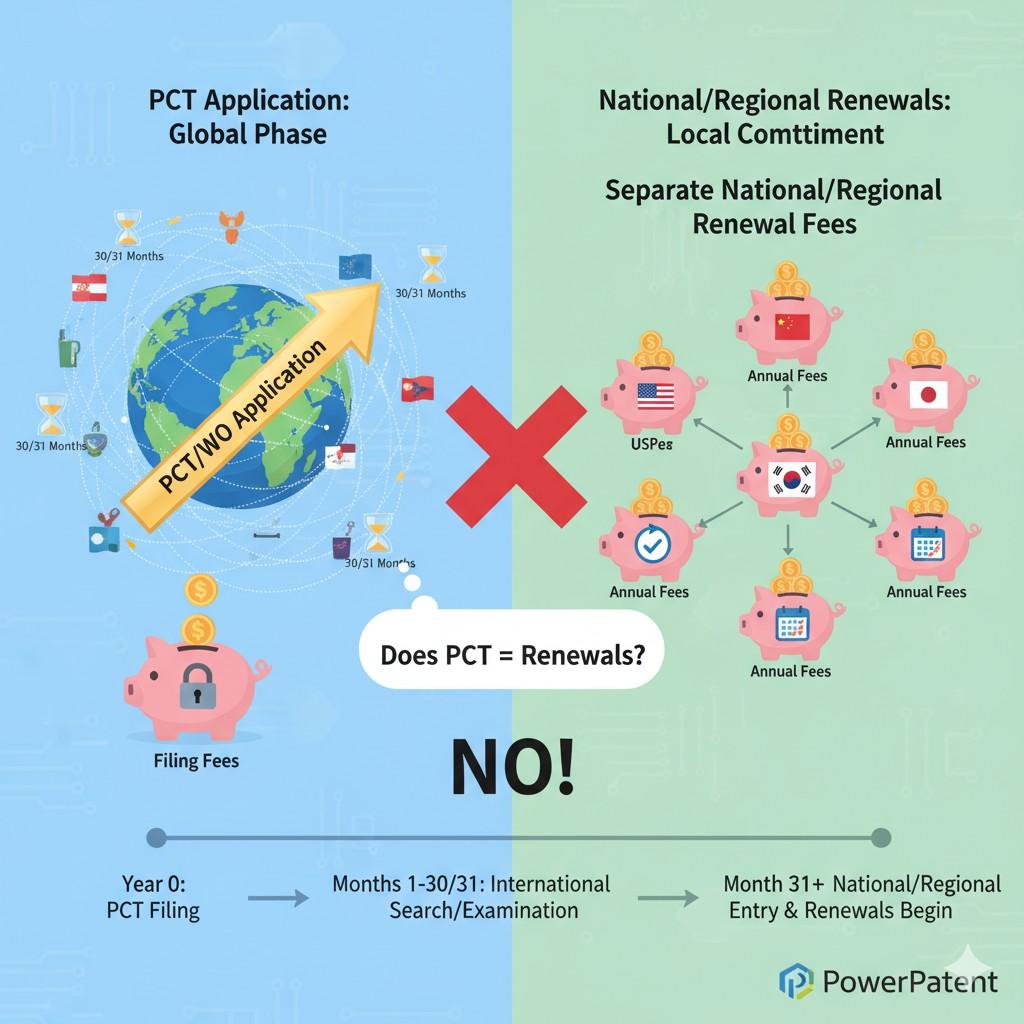
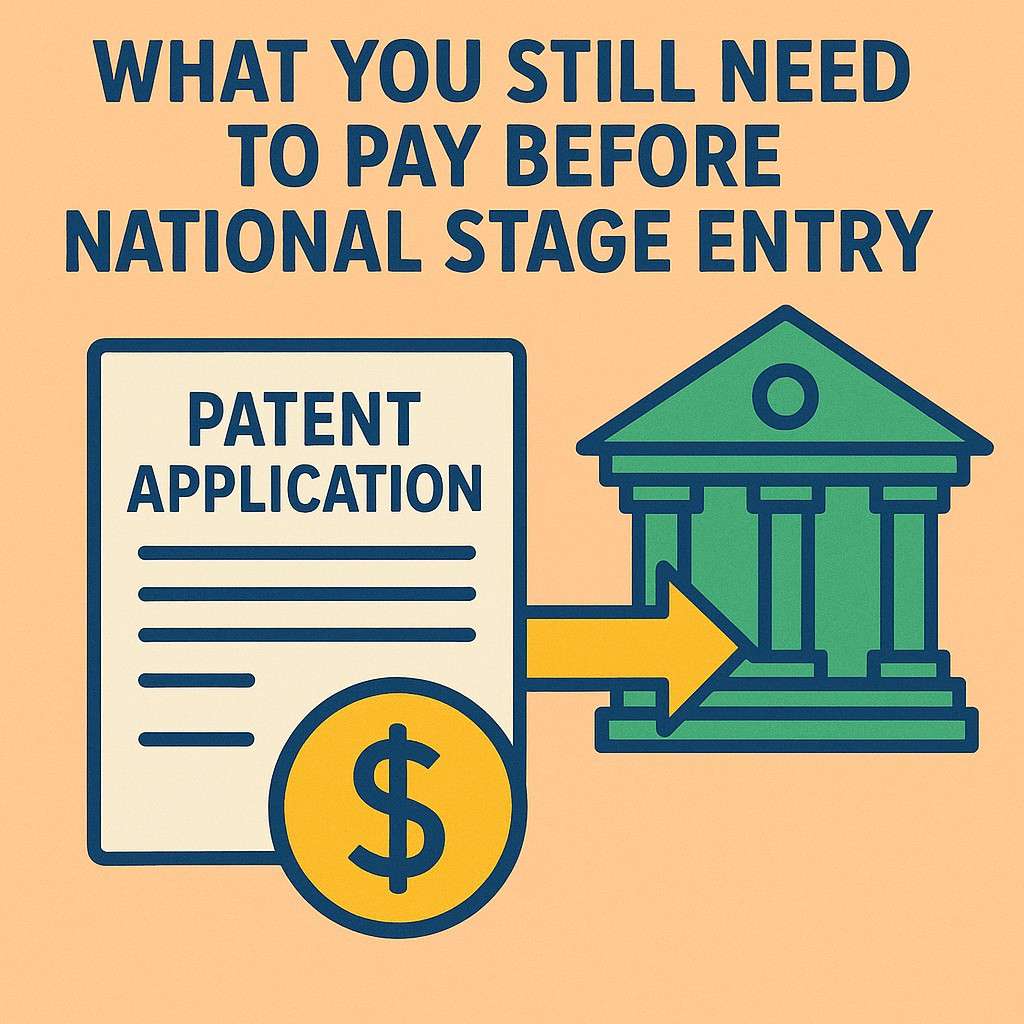
What You Still Need to Pay Before National Stage Entry
Before diving into the details, it helps to understand the mindset shift that needs to happen during this phase. The PCT gives you time, but it does not make the road cheaper.
It simply breaks the cost into stages so you can plan better. Many founders assume nothing major happens between filing the PCT and entering national stages, but that gap is full of hidden fees and important steps that keep your application alive.
The more clearly you see these early payments, the easier it becomes to prepare your global plan without stress.
Why the PCT year still carries financial weight even if you are not filing in other countries yet
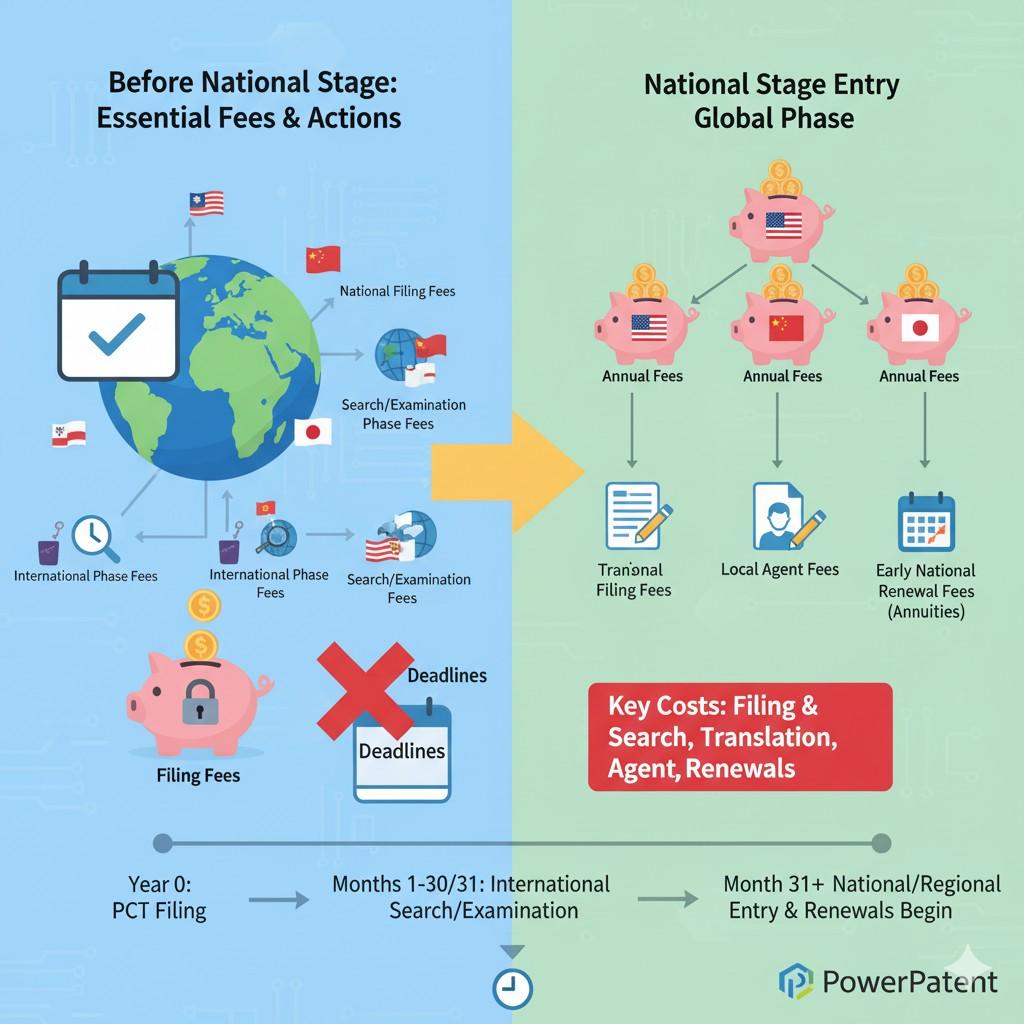
The PCT year looks quiet on the surface, but it is actually one of the most important parts of the process. This is the period when your international search is completed, when the written opinion arrives, and when you have the space to refine your claims before you lock them into national filings.
Every one of these steps carries costs, and each one plays a role in shaping your final patent family.
The international search fee is the first big payment most founders notice. But depending on the authority you choose, you may also face additional charges tied to your application’s length, number of claims, or the technology area.
These payments are not optional because the PCT system needs the search to examine whether your claims fit within the global landscape. Without it, there is no international foundation for your later filings.
Some founders try to avoid the cost by choosing the cheapest search authority.
But cheap rarely means better. If your examiner produces a weak or unclear report, you get little insight into the real risks waiting for you in national offices.
And that lack of insight means your national filings become more expensive later because each country must do more work. You end up paying more over time, even though the early choice looked affordable.
This is why the best strategy is to choose an authority known for strong, clear reports. It looks like an upfront cost, but it saves you long-term fees by reducing objections and simplifying prosecution later.
The quiet but important cost of refining your claims before you enter national phases
The PCT year also gives you a rare chance to adjust your claims after seeing the search results. Many founders skip this step because they think claim changes can wait until the national stage.
But waiting too long turns simple edits into costly battles. Once you enter multiple countries, every change must be repeated in every office. Lawyers charge per country.
Examiners take time. Objections multiply. And your budget suddenly catches fire.
If you refine your claims during the PCT phase, you fix these issues once instead of twenty times. You pay a single attorney to polish the claims instead of paying many attorneys later.
The cost is far smaller, and the impact on global protection is huge. The PCT system was designed to give you this breathing room. Using it early is one of the smartest financial decisions a business can make.
This kind of early claim tuning also shifts your negotiation power. Investors feel more confident when they see clean, narrowed claims that match your product.
Big companies respond better when your application looks solid and stable. Everyone prefers clarity over chaos. And the PCT year is your best window to create that clarity before costs multiply.
Why small administrative fees matter more than founders expect
Even outside the big payments, you will encounter administrative fees that seem minor but play a critical role in keeping your patent alive. Late fees, correction fees, and documentation fees appear when something small goes wrong.
And those small mistakes are often caused by simple things like a missing signature or a formatting error in the declaration.
Most founders don’t realize how fragile the system can be. A small mistake might require a correction request. A correction request might trigger a fee. A delayed response might push you into another penalty.
One small slip can spark a chain that ends in deadlines being missed. And when it comes to patents, missing a deadline is never a harmless event.
This is why many teams automate these checks instead of relying on memory or manual review.
With a platform like PowerPatent, small errors get flagged early and you get clear guidance on how to fix them long before they become costly. If you want to see how that workflow looks in practice, you can explore it here → https://powerpatent.com/how-it-works
Why translation planning becomes an unseen but major cost factor later if you ignore it now
Translations don’t matter during the PCT filing, but they matter greatly once you enter national phases. The mistake many businesses make is failing to prepare for this early.
Because once the national stage deadline arrives, you don’t get extra time. Some countries give you only a small window to produce full translations, and if the wording is off, the entire application can be rejected.
The reason this matters during the PCT year is simple. If you know which countries you are targeting, you can structure your claims so they translate cleanly.
Certain words translate easily into other languages. Certain claim styles translate poorly, increasing the risk of interpretation mistakes.
By writing your claims with translation in mind, you cut translation costs and reduce the chance of errors. This saves money, time, and stress when the national stage hits.
A well-planned PCT strategy always includes early translation awareness, because it affects every cost that comes after. If you refine your claims now, long before translation deadlines, you prevent a long list of expensive problems later.
How budgeting early turns a scary global process into a predictable business investment
The truth is, the money you spend during the PCT year helps you avoid far bigger costs later. It’s like reinforcing the foundation of a building before adding floors.
You can skip it, but you will pay more later and risk structural issues that slow everything down.
The founders who stay ahead of the process treat the PCT year like a planning window. Instead of reacting to deadlines at the last minute, they use this year to align their budget with their expansion plan.
This means they can enter national stages without fear or confusion, because they know exactly what’s coming next. They’ve already controlled the costs that most teams get surprised by.
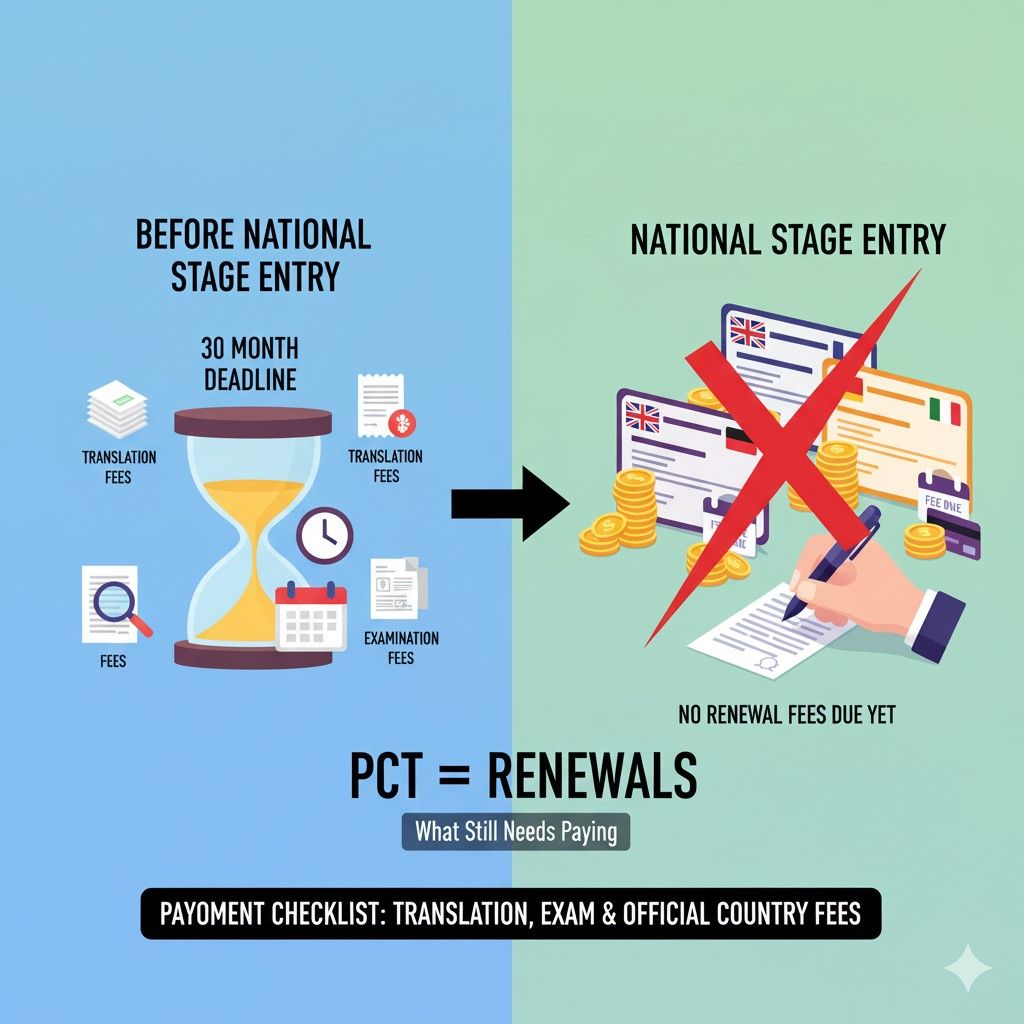
If you want this kind of predictable structure, PowerPatent gives you a simple timeline that shows every cost and deadline ahead of time.
It helps you see what matters now and what matters later, so you never get blindsided by fees again. You can see the process here → https://powerpatent.com/how-it-works
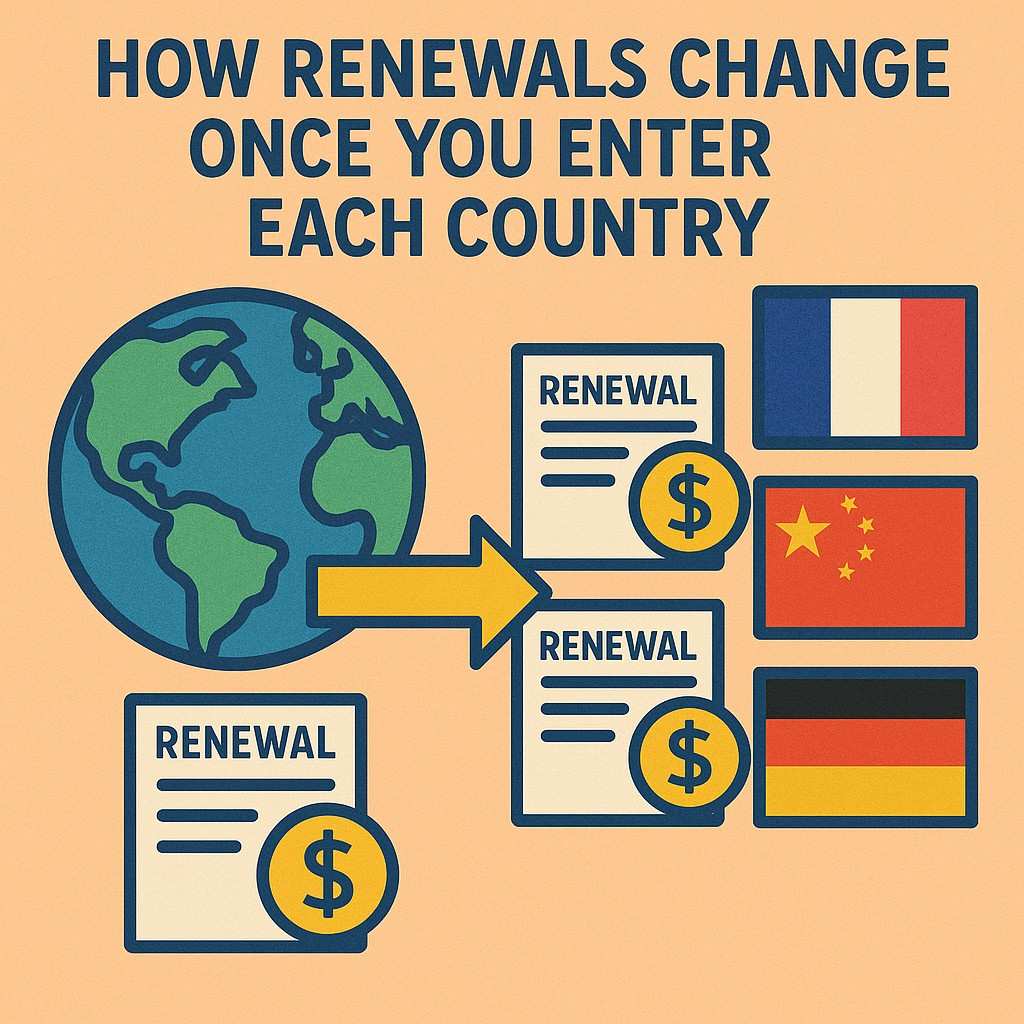
How Renewals Change Once You Enter Each Country
Before we get into the details, it helps to start with a clear picture of what actually happens the moment you leave the PCT system and begin entering individual countries.
This shift is where many founders get confused, because everything you understood during the PCT year stops applying the same way. Each country suddenly brings its own rules, its own deadlines, its own payment cycles, and its own consequences if you fall behind.
The structure is no longer centralized. You are now managing a group of independent patent offices, each moving at its own pace. And this is the point where strong renewal management becomes the difference between keeping your rights alive and losing protection without even realizing it.
Why national stage entry resets the entire renewal timeline
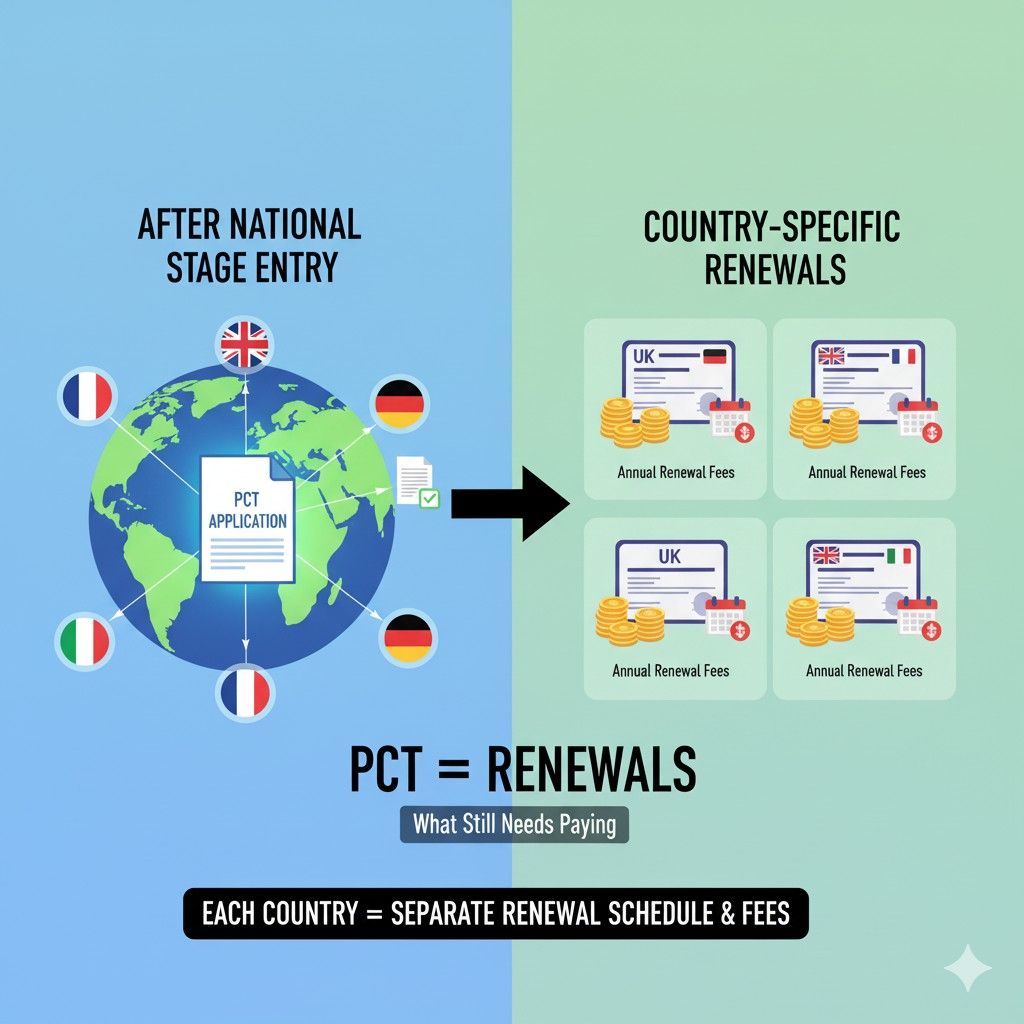
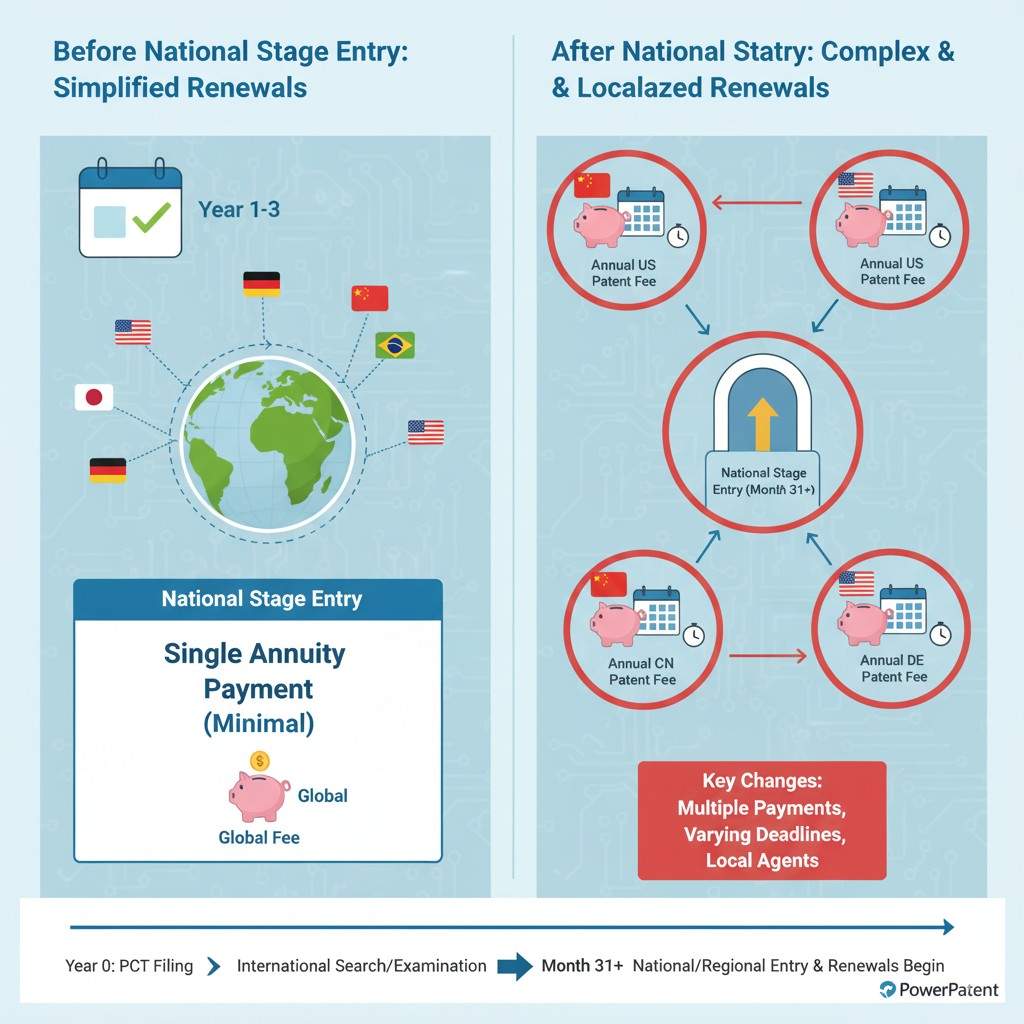
Once you enter national stages, the renewal rules change because every country treats your patent as if it were born inside that country. Even though your PCT application gave you more time, it does not carry renewal schedules into your national filings.
Every office begins counting renewals based on its own laws. Some countries restart the renewal clock from the date of your earliest filing. Others start from the moment you enter their national system.
Others follow hybrid rules that combine both. And almost none of this is intuitive.
This means you might pay nothing for renewals in some countries for several years, while in others you may have renewals due almost immediately after entry.
Two countries with similar laws can still have renewal schedules that don’t line up at all.
And even seasoned founders get caught off guard because they assume renewal timing stays synchronized across markets. But once you enter national phases, every country becomes its own universe with its own tempo.
One of the smartest things you can do at this stage is create a simple roadmap that shows each country’s renewal cycle.
Not a spreadsheet filled with legal jargon, but a simple visual timeline that shows when payments begin and how fast they accelerate.
When you see this clearly, you start making smarter business decisions because you know when your patent costs will rise, when they will level out, and when you might need to trim your coverage to stay lean.
If you want a system that builds this automatically for you, PowerPatent creates that timeline instantly so you don’t have to guess or track everything manually. You can see how that works here → https://powerpatent.com/how-it-works
Why renewals become more expensive and complicated after national entry
During the PCT year, your cost structure is simple because you are dealing with only one system. But once you move into national stages, you are dealing with ten, twenty, or sometimes thirty different countries.
Each one charges renewal fees at different amounts. Some are modest. Some are high. And some become extremely expensive in later years.
This is not because the system is trying to punish you. It’s because patent offices want to filter out weak patents that companies are not serious about maintaining. If someone isn’t willing to pay, the office assumes the invention is no longer valuable and lets it lapse.
As a result, renewal fees generally rise as the patent gets older. It forces you to regularly decide which markets truly matter to your business and which ones no longer justify the cost.
When founders don’t plan for this, they get hit with renewal shock.
They enter fifteen countries because it felt like the right move, but a few years later the fees climb so quickly that they start dropping protection in valuable markets simply because they didn’t budget ahead.
This isn’t a legal failure. It’s a planning failure. And it is completely avoidable if you map renewals early.
The most strategic founders decide their long-term markets before entering national stages.
They pick the countries that align with manufacturing plans, distribution goals, competitor footprints, licensing opportunities, or eventual exit strategies.
That way, when renewals rise in later years, they are paying for markets that actually matter, not markets they selected out of fear of missing out.
Why renewal timing affects your global IP valuation more than you think
Every investor, acquirer, and partner performs due diligence on your patents. And the one thing they always examine is the renewal history in each country.
They want to know whether you maintained your rights consistently. They want to know whether your protection is stable. They want to see that you paid renewals on time and did not let countries lapse without intention.
If they see gaps or inconsistencies, their trust in your IP portfolio weakens immediately.
A smooth renewal record tells the story of a company that takes its technology seriously, protects its core advantage, and plans ahead. This builds confidence.
And confidence raises valuation. When your portfolio shows stable, predictable renewals, it signals strength even if your team is small. It shows you have discipline. It shows you understand your strategy. And it shows potential partners that your IP foundation is secure.
This is why many founders use renewal planning as an actual business tool, not just an administrative task. It becomes part of the story you tell during funding rounds or partnership talks.
When you can show a clean record with no lapses, your portfolio looks more like a well-run asset and less like a loose set of filings. And that difference matters.
If you want your renewal timeline organized automatically so you can present it cleanly during due diligence, PowerPatent gives you a dashboard that keeps everything tidy, easy to export, and easy to explain. You can preview the workflow here → https://powerpatent.com/how-it-works
How renewal rules shift when a country requires local agents, translations, or extra documents
Some founders are surprised to learn that renewals in many countries cannot be paid directly. Certain offices require a local patent agent to handle every renewal.
Others require local language filings before renewals can begin. Some require power-of-attorney documents or local addresses before the first renewal becomes payable.
These rules can delay or activate renewals depending on how quickly you complete those steps.
This is why renewal timing does not look the same across countries. In some places, renewals begin the year you enter. In others, renewals start only after examination begins.
In a few, renewals begin before examination even starts. And in some, renewals begin only after certain documents are approved. That means your renewal schedule is influenced not only by the law but by how prepared you are when you enter the country.
The most prepared businesses make sure every document is ready before national entry. They have translations lined up. They have local agents identified.
They have power-of-attorney documents signed. This lets renewal schedules start smoothly with no last-minute surprises. It also prevents late fees, which can be quite stiff in some offices.
If you prefer not to manage all these moving parts manually, PowerPatent helps guide you through each country’s rules so you always know exactly what to prepare ahead of time.
It reduces confusion and keeps you ahead of every deadline. You can see how it works here → https://powerpatent.com/how-it-works
Why your renewal strategy should change as your business grows
In the early years, many founders maintain coverage in many countries because they are still exploring possibilities. But as your business grows, your renewal strategy should evolve with it.
You no longer need to pay for every market. You can start focusing on the markets where you have customers, partners, manufacturing, major competitors, or growth plans.
This is how you trim renewal costs without hurting your business.
A mature renewal strategy is not about keeping every patent alive forever. It is about keeping the right patents alive at the right time in the right places. Companies that do this well often save hundreds of thousands in renewal fees without losing strategic protection.
And they reinvest that money into engineering, product development, or expansion. Your patent portfolio becomes a strategic asset instead of a heavy financial burden.
If you want to track all of this in one clean place, PowerPatent makes it easy to adjust your renewal strategy as your business shifts and your market changes. You can see how that works here → https://powerpatent.com/how-it-works
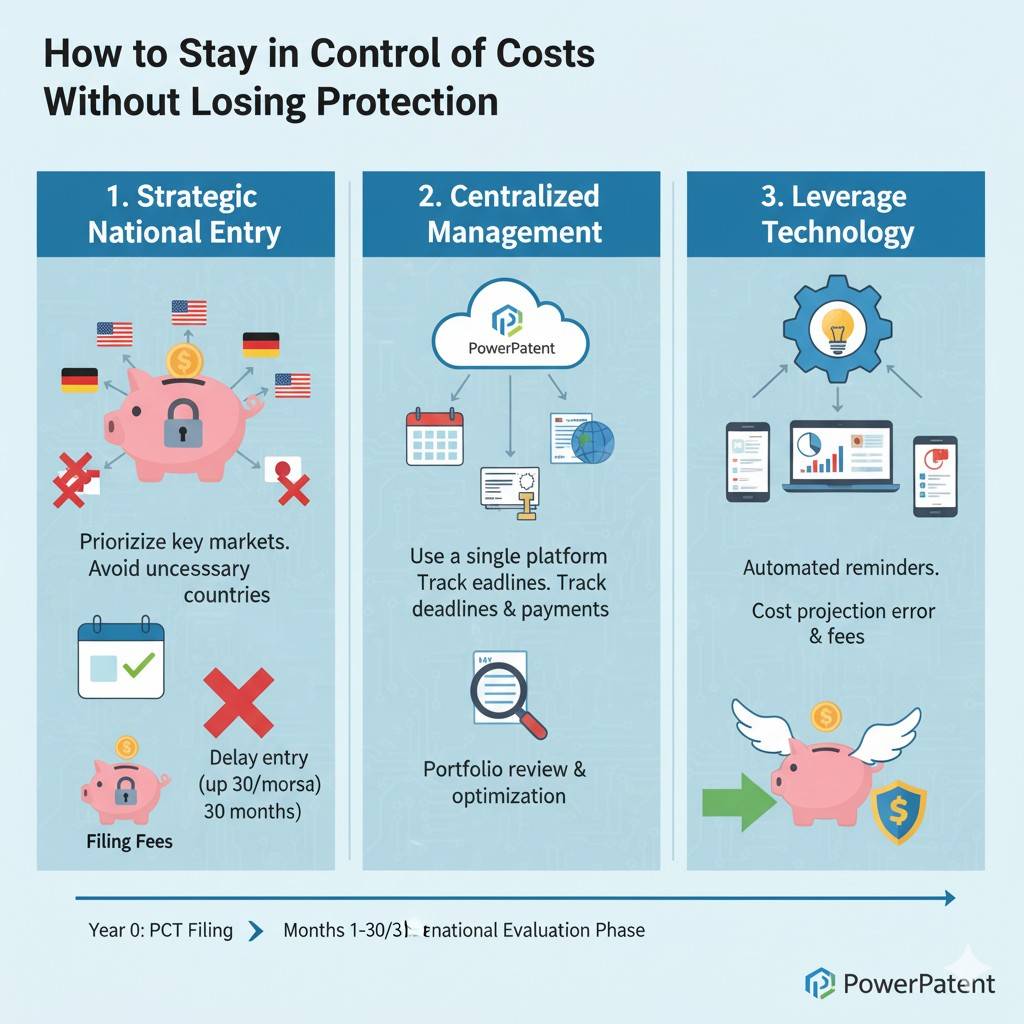
How to Stay in Control of Costs Without Losing Protection
This final part is all about taking back control. Once you enter national stages, the process can feel overwhelming because each country sets its own rules, and the renewal fees change in ways that don’t always make sense.
Many founders try to push through on instinct, but that usually leads to missed deadlines, rushed decisions, or paying for protection in places that don’t actually matter to their business.
The truth is,global patent renewals don’t have to be stressful or unpredictable.
When you understand how the system behaves and you set up the right structure for tracking everything, you can manage costs confidently without giving up any meaningful protection.
Your renewals become a strategic business tool rather than a never-ending cycle of surprise expenses.
Why knowing your true market focus reduces renewal stress overnight
One of the biggest reasons founders overspend on renewals is because they feel pressure to protect everything everywhere. It starts as a fear that a competitor in some country you barely think about might copy you, or that skipping a country could look weak during fundraising.
But the reality is that most successful patent portfolios are targeted, not global. A focused portfolio protects the markets that matter for revenue, strategic advantage, or potential exit value. Everything else is optional.
When founders get clear on their real footprint, renewal costs turn from a random burden into an intentional choice. Instead of paying simply because the deadline appears, you pay because the country aligns with where you are building, selling, or partnering.
That clarity alone removes eighty percent of the emotional weight of renewals. You stop feeling like the system is pulling you in every direction and instead feel like you’re steering the process.
With the right planning, this also becomes a powerful story during investor talks or partnership negotiations. You can explain not just where you filed, but why you filed there.
That kind of discipline shows you are building a thoughtful business, not just a scattered one. And investors respond strongly to that kind of precision.
How early forecasting turns renewals into predictable operating expenses instead of surprises
Many founders struggle with renewals because they treat them as something that happens to them rather than something they prepare for. The fees arrive, the deadlines come, and everything feels reactive. But renewals follow a predictable curve.
You can forecast them years in advance if you have the right information.
Once you know how each country calculates renewals and when obligations begin, the entire renewal path becomes a simple financial plan instead of an unpredictable minefield.
This forecasting is easier than most people think. When you map out each country’s schedule, you’ll notice patterns. Some countries stay stable for many years.
Others climb slowly. Others jump sharply. None of this is random. And once you see those patterns, you can plan budgets well ahead instead of patching together payments at the last minute.
This changes the entire experience. Renewals move from being a stressor to being just another operational cost you already accounted for.
If you prefer not to create a manual forecasting system, PowerPatent automates this. It gives you a clean view of what you owe this year, next year, and all the way through the life of each patent.
It becomes a single source of truth that removes the guesswork. You can explore that here → https://powerpatent.com/how-it-works
Why cutting countries strategically is better than trying to keep everything alive forever
At some point, every business reaches the stage where renewal fees get expensive. This happens around the middle and later years of the patent life. Renewals climb because that is how the system encourages you to let go of markets you no longer need.
Many founders feel guilty or anxious about dropping countries, as if it means they overlooked something important. But letting go of a market that no longer matches your strategy is not a mistake. It is smart business.
The strongest companies regularly review their portfolio and decide which countries still deserve investment.
If a market is not part of your distribution plan, not relevant to your competitors, not part of your manufacturing, and not part of your licensing goals, then the renewal fee becomes wasteful.
Giving up a patent in that market frees up budget for engineering, hiring, expansion, or maintaining patents where they truly make an impact.
Dropping a country does not mean you are weakening your IP position. It means you are sharpening it. And the more precise your portfolio becomes, the more powerfully it supports your business.
Investors notice when you focus on quality over quantity. Acquirers notice it too. You look organized, intentional, and strategic. And in IP, those qualities carry real weight.
How having a single place to track renewals saves you from costly administrative mistakes
Renewals get complicated not because the rules are complex, but because the rules are scattered across different offices and different timelines. When founders track renewals through spreadsheets, email reminders, or a folder full of PDFs from local agents, something eventually slips.
It might be a missed deadline. It might be a late payment. It might be confusion about what was already paid or what still needs approval. Even small errors can trigger penalties or cause your rights to expire.
This is why centralizing all renewal information into one system changes everything. A single dashboard means you always know what has been paid, what is coming up, what is overdue, and what changes happened recently. You get total control without needing to memorize anything.
And you remove the human error that usually causes the most expensive problems in patent management.
PowerPatent was designed for this exact challenge. It gives you one simple view of every renewal across every country in your portfolio. And it sends clear reminders written in normal language, not confusing legal terms.
This reduces the risk of human mistakes and keeps your rights secure even as your portfolio grows. You can see how it works here → https://powerpatent.com/how-it-works
Why renewals become easier when your claims, translations, and filings are aligned with your business goals
Renewal pain often begins long before renewals are due. It starts with claim sets that are too broad, translation challenges that slow processes down, or filings made in countries without a clear reason.
When early filings are chaotic, renewals inherit that chaos. But when your filings match your product strategy, your renewals become naturally simpler.
If your claims match your actual tech, prosecution finishes faster in most countries. Faster prosecution usually leads to cleaner renewal schedules. If your translations were done well during national entry, you have fewer corrections or amendments later.
Fewer amendments mean fewer delays. And fewer delays mean less risk of administrative disruptions that trigger renewal problems.
This is why your renewal strategy should always connect back to your business strategy. When filings, claim structures, markets, and product plans move together, renewals feel like just another smooth business process.
And when everything is aligned, renewals stop feeling like a constant fight and start feeling like maintenance of a strong, well-designed asset.
Why strong renewal management increases your exit value
When a company is evaluated for acquisition, partnerships, or major investment, the IP portfolio becomes a core part of the analysis. Buyers look closely at renewal records because they reveal whether your patents are stable and fully enforceable.
A clean renewal history sends a simple message: you understand your markets, you manage your assets well, and you protect what matters. A messy renewal history sends the opposite message.
Strong renewal management increases the perceived value of your IP. It reduces negotiation friction because buyers don’t need to fix anything. And it gives you leverage because your portfolio appears strong, organized, and strategically maintained.
A high-value IP portfolio is not defined by how many patents you have. It is defined by how well those patents are maintained.
Renewals are a big part of that. And when you manage them with clarity and consistency, your IP becomes a serious business asset, not just a group of filings.
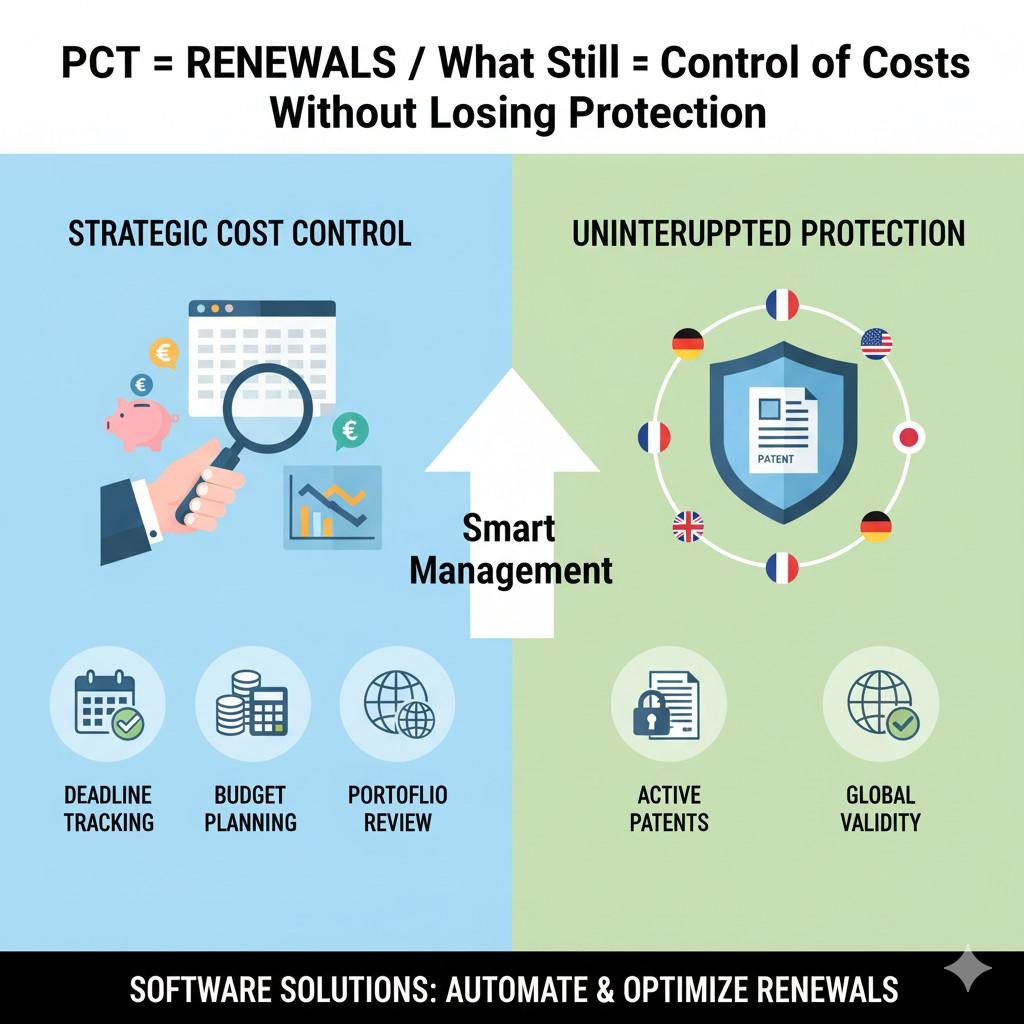
If you ever want a cleaner, simpler way to manage this without juggling multiple agents and timelines, PowerPatent gives you everything in one place.
It keeps your patents alive, your costs predictable, and your strategy aligned with how your business grows. You can see how the system works here → https://powerpatent.com/how-it-works
Wrapping It Up
Before you started reading, the renewal path probably felt like a foggy maze with moving deadlines, scattered fees, and rules that changed the moment you stepped outside the PCT system. Now you can see the real structure behind it. The PCT never replaces renewals. It simply gives you time to think. During that window, your original filing still needs to stay alive. Once you leave the PCT and enter national stages, every country behaves differently. And if you are not ready, the renewal fees, timing, translations, and local requirements can overwhelm even the most organized teams.