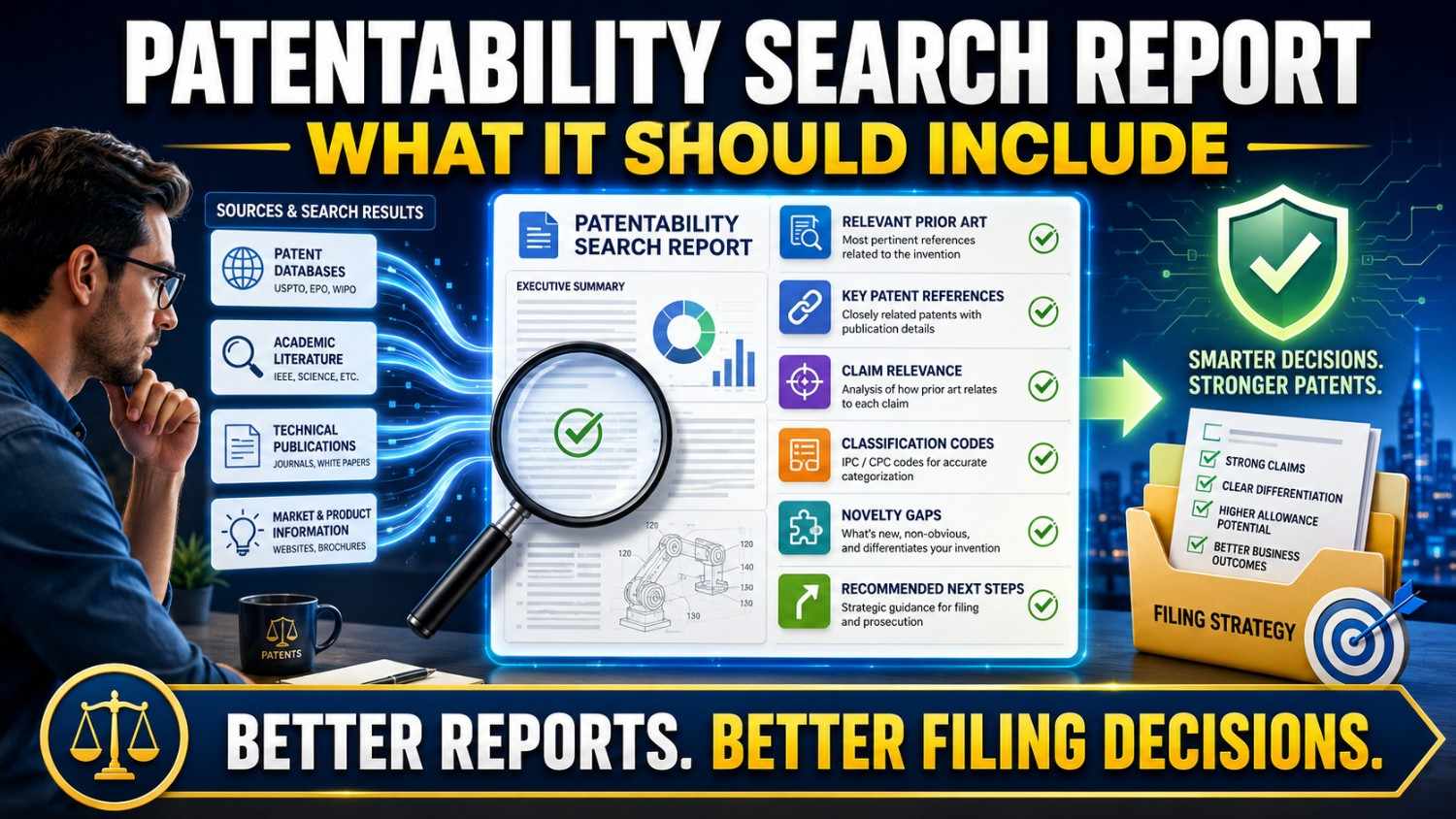
A patentability search report should not be a pile of links.
It should help you make a decision.
For a startup, that decision may be simple but important: file now, narrow the invention, search more, pivot to another feature, keep part of it secret, or drop the idea.
A good report turns search results into strategy. It shows what came before, what still looks different, what may be worth claiming, and what risks remain.
PowerPatent helps founders, engineers, and inventors turn invention notes, product details, search results, and attorney review into stronger patent filings with smart software and real patent attorney oversight. See how PowerPatent works here.
What a Patentability Search Report Is Supposed to Do
A patentability search report is a written summary of what was searched, what was found, and what the findings mean for your invention.
That sounds simple. But many reports miss the point.
Some reports are too thin. They say “no exact match found” and leave the team with false comfort.
Some reports are too dense. They list dozens of references but do not explain what matters.
Some reports are too legal. Founders and engineers cannot use them.
Some reports are too casual. They do not give a clear filing recommendation.
The best report sits in the middle.
It is technical enough to be useful. It is simple enough to read. It is honest about risk. It is tied to business value. And it helps your patent attorney make better claim decisions.
A search report should answer:
What is the invention?
What was searched?
What prior art came closest?
What does the closest prior art teach?
What does it not teach?
What appears to be the strongest technical gap?
What should the company do next?
If the report does not answer those questions, it is not finished.
Why Startups Need Better Search Reports
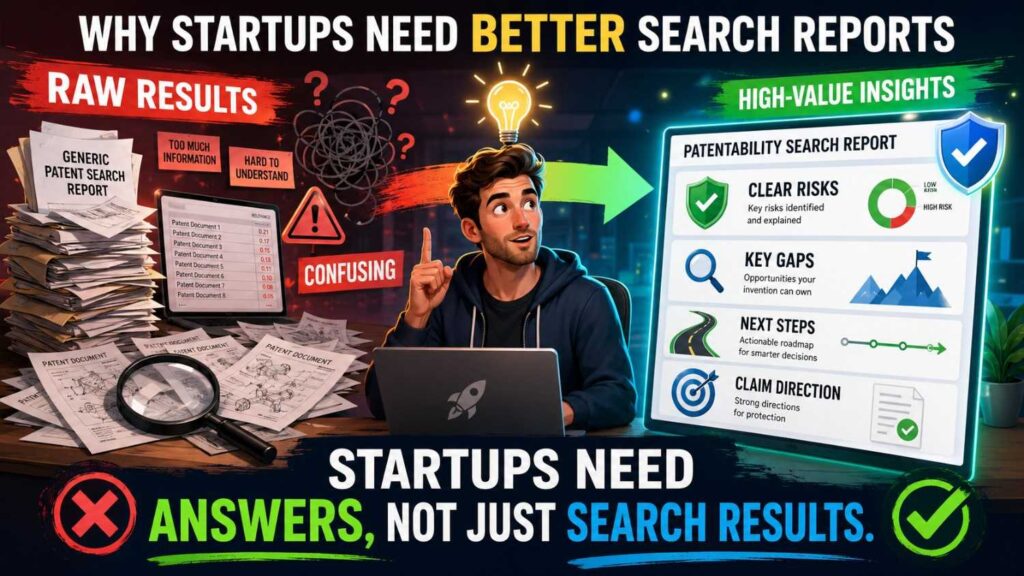
Startups move quickly.
The team may be building, fundraising, hiring, selling, testing, launching, and pitching all at the same time. Patent work can easily become an afterthought.
That is risky.
A weak patentability search report can lead to weak filings. It can cause the company to file on the wrong feature, miss the real invention, overclaim crowded ideas, or ignore close prior art.
A strong report helps the company spend patent budget wisely.
It can show that the broad idea is crowded but a narrower technical method is worth filing.
It can show that the product has several inventions, not just one.
It can show that an invention is better kept secret.
It can show that more testing is needed before filing.
It can show that a public launch is about to disclose something important.
It can also help founders talk with investors in a more grounded way.
Instead of saying, “We filed a patent on AI,” a founder can say:
“We searched the closest prior art. The broad AI workflow space is crowded, so our filing focuses on validating AI-generated actions against permission scope, customer policy, and source support before execution.”
That is much stronger.
A Search Report Should Start With the Invention in Plain Words
The first section should state the invention clearly.
Not the product category.
Not the marketing tagline.
The invention.
A weak report starts with:
“AI compliance platform.”
A stronger report starts with:
“The invention is a system that validates AI-generated workflow actions against user permission, customer policy, and source-data support before allowing execution, then records the decision in an audit log.”
A weak report starts with:
“Battery safety system.”
A stronger report starts with:
“The invention is a battery monitoring method that compares pressure drift during matched charging windows and adjusts a swelling risk score based on charge rate and temperature.”
A weak report starts with:
“Cancer detection test.”
A stronger report starts with:
“The invention is a diagnostic method that calculates a ratio of two markers from a low-volume plasma sample and normalizes the ratio based on inflammation score to reduce false positives in early-stage patients.”
This plain-English invention statement guides the whole report.
If the invention is vague, the search will be vague.
If the invention is clear, the search can be useful.
Include the Technical Problem
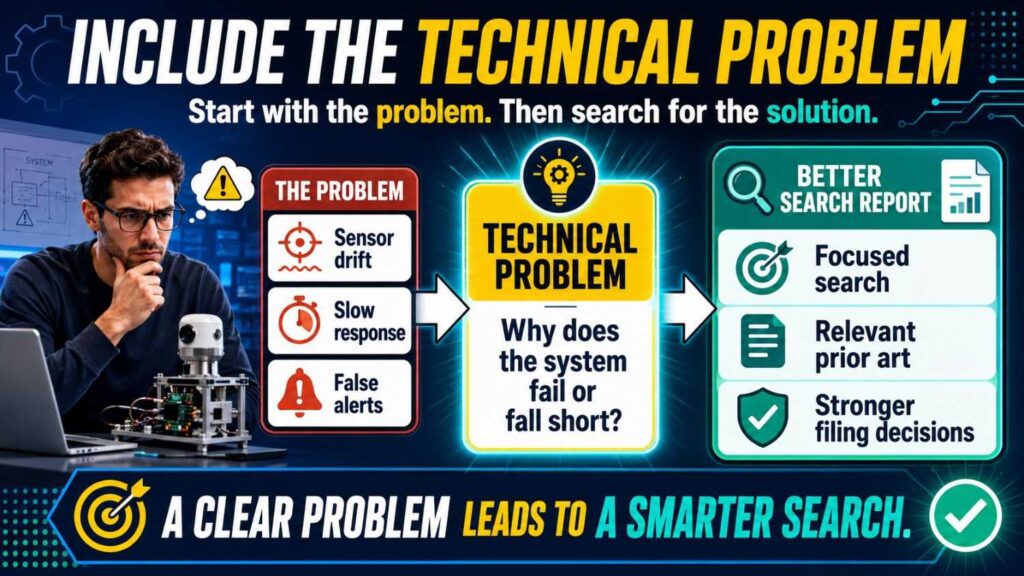
A strong report explains the technical problem.
This matters because prior art should be compared against the problem your invention solves.
For example, the problem is not just:
“Companies need easier compliance.”
The technical problem may be:
“Cloud evidence is spread across logs, tickets, documents, and user actions, and audit packets may expose unrelated tenant data if evidence is exported too broadly.”
The problem is not just:
“Robots need to be safer.”
The technical problem may be:
“A warehouse robot cannot visually detect a person or forklift hidden around a blind corner, but it must decide whether to slow before the object appears.”
The problem is not just:
“Battery packs need monitoring.”
The technical problem may be:
“Fast charging can cause temporary pressure changes that look like swelling, creating false alerts if pressure is measured with fixed thresholds.”
The technical problem helps explain why the invention matters.
It also helps the team search better.
If the search report does not name the technical problem, it may miss the real claim angle.
Include the Technical Solution
After the problem, the report should explain the solution.
This should be written in simple words.
For example:
“The system solves this by checking three things before an AI-generated action can run: whether the user has permission, whether the customer policy allows the action, and whether the source data supports the action.”
Or:
“The battery system solves this by comparing pressure drift only during matched charging windows, so pressure changes caused by normal fast charging are less likely to trigger a false swelling alert.”
Or:
“The robot solves this by using sound direction, map geometry, and recent traffic history to predict hidden crossing risk before visual detection.”
This section should not sound like a patent claim yet.
It should explain what the invention does and why.
A founder, engineer, and attorney should all be able to read it and understand the same thing.
Include the Technical Result
A patentability search report should not stop at what the invention does.
It should explain what improves.
This is the technical result.
For software, the result may be fewer unsafe AI actions, lower cloud cost, faster recovery, better routing, less data exposure, fewer duplicate alerts, or less human review.
For AI, the result may be fewer unsupported answers, better source support, lower compute, safer tool use, or better review routing.
For hardware, the result may be better signal quality, fewer false alarms, lower heat, improved durability, easier assembly, or safer control.
For robotics, the result may be earlier slowing, fewer unnecessary stops, safer movement, better gripping, or better fleet flow.
For biotech and MedTech, the result may be better accuracy, lower false positives, better stability, safer dosing, faster review, or improved patient workflow.
A strong report says:
“This gap matters because it reduces false alerts during fast charging.”
Or:
“This gap matters because it blocks AI-generated actions that appear confident but are not supported by source data.”
Or:
“This gap matters because the robot can slow before a hidden crossing object is visible.”
The result connects patent strategy to business value.
Include the Product Feature and Business Context
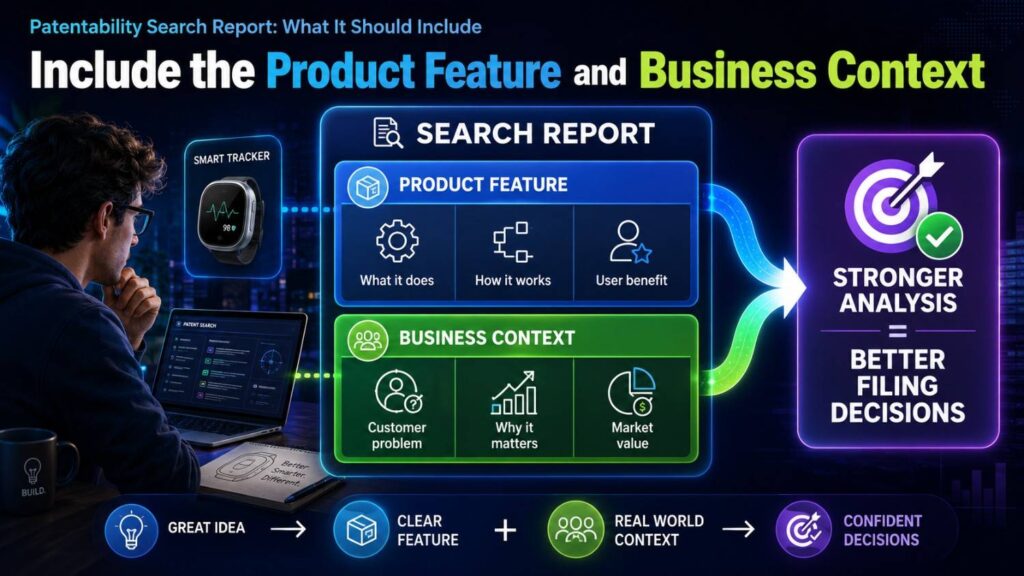
A patentability search report should connect the invention to the product.
This does not mean turning the report into a sales deck.
It means explaining why the invention matters to the company.
For example:
“This feature supports the enterprise trust story because customers need proof that AI actions will not run unless they are authorized and supported.”
Or:
“This method is tied to the product’s main battery safety claim because it reduces false swelling alerts during fast charging.”
Or:
“This diagnostic method supports the company’s clinical value because it may improve early-stage detection in patients with high inflammation.”
This section helps decide whether the invention is worth filing.
A technical difference with no business value may not deserve patent spend.
A narrower claim that protects a core product advantage may be worth filing.
For startups, business context is not optional. It is part of good patent strategy.
Include What Was Searched
A search report should say where the search was performed.
This sounds basic, but it is often missing.
A useful report should explain whether the search included patents, patent applications, papers, product documents, API docs, GitHub, standards, manuals, clinical trial records, regulatory materials, datasheets, conference materials, or other sources.
The right sources depend on the field.
For SaaS and cloud platforms, search product docs, API docs, help centers, open source, technical blogs, standards, and patents.
For AI and software, search patents, papers, preprints, GitHub, model docs, technical blogs, and product docs.
For hardware and robotics, search patents, drawings, manuals, datasheets, supplier catalogs, videos, papers, and standards.
For biotech and MedTech, search patents, papers, clinical trial records, protocols, labels, manuals, sequence databases, regulatory materials, and conference abstracts.
A report that says only “we searched patents” may be too narrow for many fields.
A report should give the reader confidence that the search looked in the places where relevant prior art is likely to live.
Include the Search Terms Used
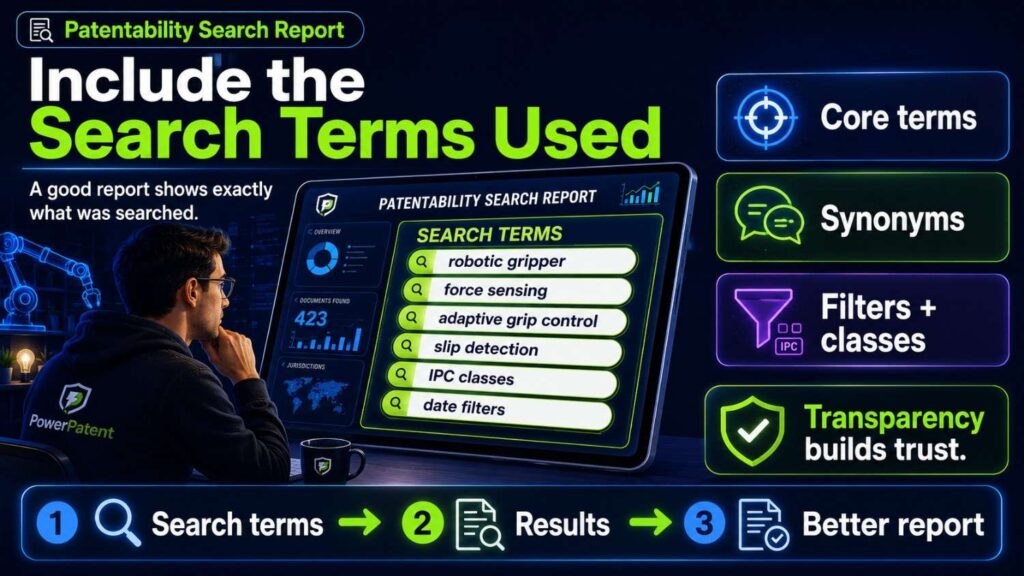
A good report should include the search terms.
This helps show how the search was performed and whether it was too broad or too narrow.
It also helps others repeat or extend the search later.
For example, for an AI action validation invention, useful search terms might include:
AI workflow action validation
source data support automated action
permission policy source verification workflow
LLM generated action approval
AI action audit log policy check
For a battery invention:
battery pressure drift charging window
cell expansion pressure fast charging false alarm
battery swelling charge rate temperature compensation
pressure sensor battery deformation matched charging
For a SaaS audit invention:
tenant scoped audit packet
compliance evidence field redaction
cloud log control mapping data minimization
audit evidence export tenant isolation
The report should also include synonyms and related terms.
This matters because prior art may use different language.
A weak search uses only the company’s own words.
A strong search uses the field’s words.
Include Search Strategy, Not Just Search Terms
Search terms are useful, but the report should also explain the search strategy.
Did the search start broad and then narrow?
Were competitors searched?
Were inventors searched?
Were patent classifications searched?
Were citations followed?
Were related fields searched?
Were older terms searched?
Were foreign references reviewed?
Were non-patent sources included?
A good search strategy shows discipline.
For example:
“The search started with broad AI workflow automation terms, then narrowed to pre-execution validation, source-data support, permission scope, and audit logging. Competitor help docs and API docs were also searched because the invention may be disclosed in product documentation.”
Or:
“The search first reviewed pressure-based battery swelling detection, then narrowed to pressure drift, charging windows, fast-charge false alerts, charge-rate adjustment, and temperature compensation. Patent citations from the closest battery monitoring references were followed.”
This helps the report feel more reliable.
It also helps patent counsel judge whether more searching is needed.
Include the Date of the Search
A report should state when the search was performed.
This matters because new patents, papers, product docs, and disclosures appear over time.
A search from six months ago may not reflect the current state of the field.
A report should say:
“Search performed on [date].”
It should also record key dates for close references, such as publication dates, patent filing dates, priority dates, product release dates, paper publication dates, or GitHub commit dates when relevant.
Timing matters in patent work.
A patent granted recently may have a much older filing date.
A paper may have a preprint date before the journal publication date.
A product doc may have release notes showing when a feature became public.
A startup’s own public disclosures also have dates.
A good report does not ignore timing.
Include the Closest Prior Art
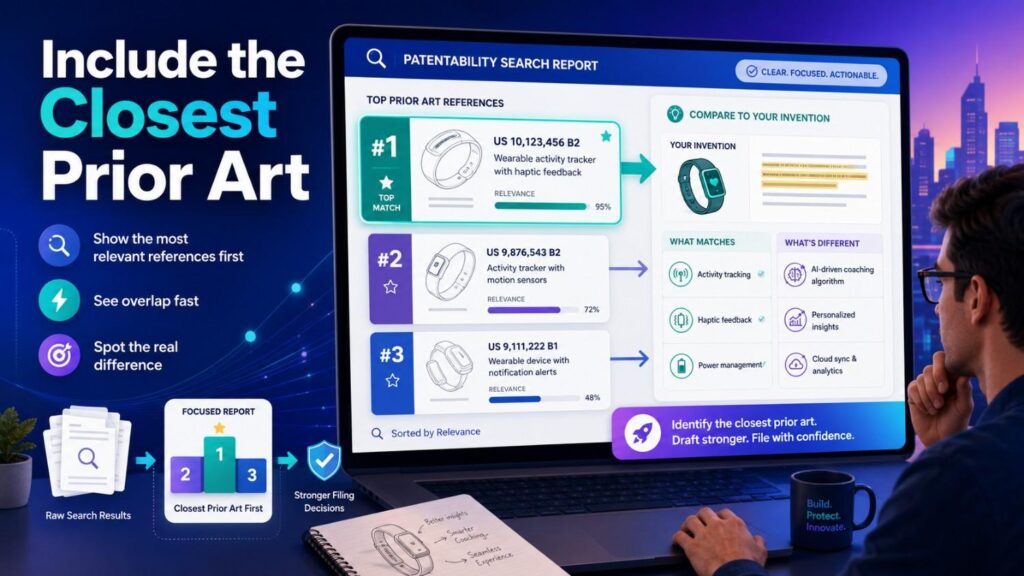
The most important part of the report is the closest prior art.
The report should not list every result with equal weight.
It should identify the references that matter most.
For each close reference, include:
The title.
The source.
The date.
The owner, assignee, author, or company if known.
A short summary.
Why it is relevant.
Which invention elements it appears to show.
Which elements it appears to miss.
A strong report does not bury the team in fifty links.
It focuses on the few references that could affect filing strategy.
The closest prior art is the reference that shares the most important features with the invention, not always the one with the same market label.
For example, the closest reference for a SaaS invention may be an old enterprise software patent.
The closest reference for a robotics invention may come from industrial automation.
The closest reference for a MedTech AI invention may be an older clinical workflow paper.
The report should identify the real threat, not just the obvious competitor.
Include a Short Summary of Each Close Reference
Each close reference should have a simple summary.
Not a long copy-paste.
Not a raw abstract.
A plain explanation.
For example:
“Reference A describes a workflow automation system that generates AI task suggestions and routes some tasks for approval. It appears to check user permission before task execution. It does not clearly describe checking source-data support before execution.”
Or:
“Reference B describes pressure-based battery swelling detection using a pressure sensor and fixed alert threshold. It does not appear to compare pressure drift during matched charging windows or adjust the score based on charge rate.”
Or:
“Reference C describes a biomarker associated with Disease X in plasma samples. It does not appear to use a ratio of Marker A and Marker B normalized by inflammation score.”
This makes the report readable.
It also helps founders and engineers understand the prior art without reading every full document immediately.
Include an Element-by-Element Comparison
This is the heart of a strong patentability search report.
The report should break the invention into elements and compare the closest references against those elements.
Use simple labels:
Yes.
No.
Partial.
Unclear.
Then add short notes.
For example, for an AI workflow action invention:
Element: AI generates a proposed action.
Reference A: Yes. It generates task suggestions.
Reference B: No. It routes workflows without AI.
Reference C: Partial. It recommends content but not executable actions.
Element: Checks user permission.
Reference A: Yes. It checks role permissions.
Reference B: Yes. It applies access rules.
Reference C: No.
Element: Checks source-data support before execution.
Reference A: No.
Reference B: No.
Reference C: Partial. It checks required fields but not source support.
Element: Allows, blocks, or routes the action.
Reference A: Yes.
Reference B: Yes.
Reference C: Partial.
This comparison turns search results into claim strategy.
Without it, the report is just a list of references.
With it, the team can see the gap.
Include the Strongest Technical Gap
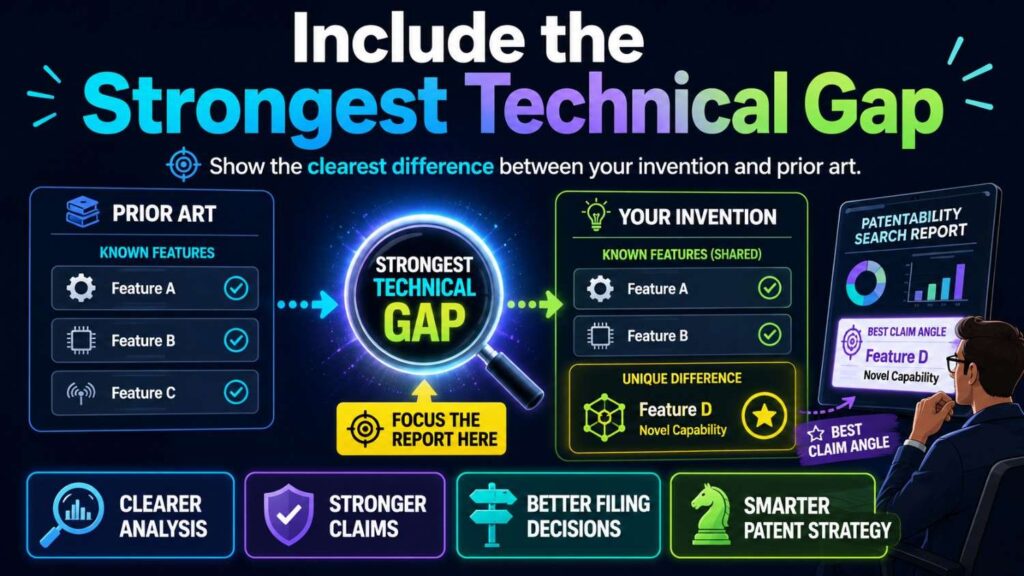
After mapping, the report should state the strongest technical gap.
This is the part the closest prior art does not appear to show.
For example:
“The strongest gap appears to be pre-execution validation of an AI-generated action against source-data support, in addition to permission and customer policy checks.”
Or:
“The strongest gap appears to be comparing battery pressure drift during matched charging windows and adjusting the swelling score based on charge rate and temperature.”
Or:
“The strongest gap appears to be an inflammation-normalized marker ratio for low-volume plasma samples in early-stage patients.”
This section should be very clear.
It should not say:
“The invention seems different.”
It should say exactly how.
The gap is where claim strategy begins.
Explain Why the Gap Matters
A gap is not enough.
The report should explain why the gap matters.
Does it reduce false alerts?
Improve safety?
Reduce cloud cost?
Improve accuracy?
Lower data exposure?
Improve review speed?
Reduce manual work?
Improve reliability?
Support a stronger clinical result?
The explanation should be tied to the technical result and the business value.
For example:
“This gap matters because confidence-only AI review may miss outputs that sound certain but are not supported by source data.”
Or:
“This gap matters because fast charging can create pressure changes that look like swelling, and matched-window comparison may reduce false alerts.”
Or:
“This gap matters because inflammation can cause false positives, and normalization may improve accuracy in patients with high inflammation.”
This section helps founders decide whether the gap is worth filing.
A small but important gap may support a useful patent.
A random gap may not.
Include Novelty Risk
The report should include a clear view of novelty risk.
Novelty risk means the chance that one reference already shows the full invention.
A simple rating can help:
Low.
Medium.
High.
But the rating must be explained.
For example:
“Novelty risk appears medium. No single reviewed reference clearly shows all elements, but Reference A is close and may be read broadly.”
Or:
“Novelty risk appears high for the broad claim because Reference B appears to show all major elements of generic pressure-based swelling detection. Risk appears lower for the matched-window drift scoring version.”
Or:
“Novelty risk appears low for the specific source-data validation workflow based on the reviewed references, but more searching is recommended in API documentation and workflow automation patents.”
This kind of risk statement is useful.
It avoids false certainty.
It also separates broad claims from narrower claim angles.
Include Obviousness Risk
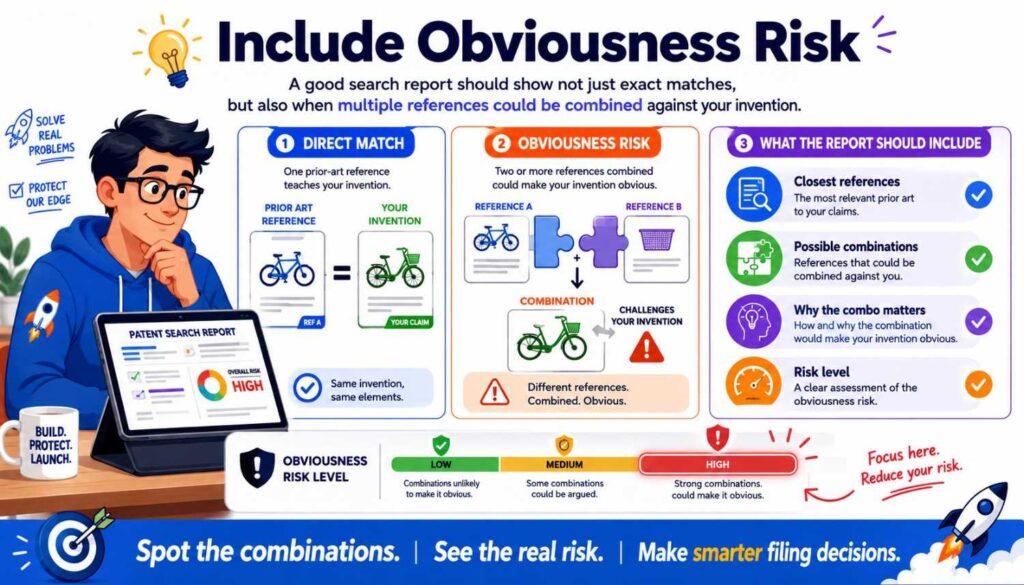
A report should not stop at novelty.
Even if no single reference shows the full invention, multiple references may show pieces.
That can create obviousness risk.
The report should identify whether the missing element appears in other references and whether combining references may be an issue.
For example:
“Although no single reference shows the full workflow, source reliability scoring and AI review routing appear separately in the prior art. Obviousness risk may depend on whether source-data validation before action execution can be framed as solving a different safety problem.”
Or:
“Pressure sensing, temperature adjustment, and charge-rate monitoring are each known. The stronger argument may be the specific matched-window drift comparison to reduce fast-charge false positives.”
Or:
“Marker A and Marker B are each known. The risk is whether using their ratio with inflammation normalization would be viewed as an expected combination.”
This section helps founders avoid overconfidence.
A claim can be new but still hard to get if the combination looks obvious.
Include Claim Strategy Notes
A strong report should include claim strategy notes.
This does not replace attorney drafting. But it should point to likely claim directions.
For example:
“Do not focus claims on generic AI workflow automation. The stronger claim focus appears to be source-data validation before execution of an AI-generated action.”
Or:
“Do not focus on a pressure sensor alone. The stronger claim focus appears to be pressure drift comparison during matched charging windows.”
Or:
“Do not focus on Marker A alone. The stronger claim focus appears to be a normalized marker ratio and patient subgroup.”
These notes help prevent bad filings.
They guide the attorney and founder toward the invention feature that appears most defensible.
PowerPatent helps teams move from search findings to claim strategy with smart software and real attorney oversight. See how PowerPatent works.
Include What Not to Claim
This is often missing, but it is very useful.
A report should say what looks crowded or risky.
For example:
“The broad concept of AI-generated task suggestions appears crowded.”
“The broad concept of pressure-based battery swelling detection appears crowded.”
“The broad concept of wearable heart monitoring appears crowded.”
“The broad concept of cloud compliance evidence collection appears crowded.”
“The broad concept of Marker A for Disease X appears known.”
This saves time.
It helps the team avoid filing claims that are likely to fail or become too narrow later.
Knowing what not to claim is part of strategy.
Include Backup Claim Ideas
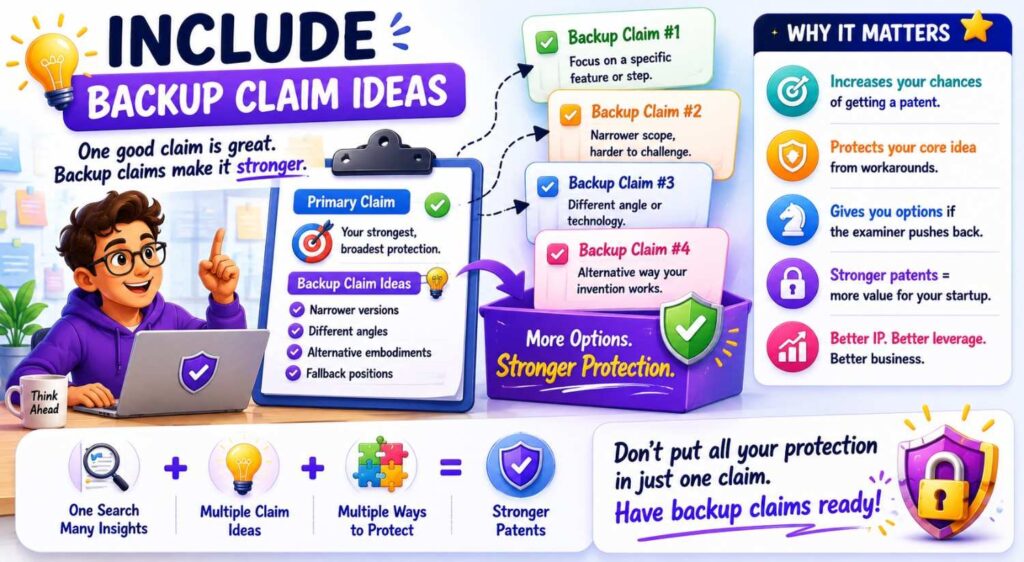
A good report should identify possible fallback positions.
If the broad claim is challenged, what narrower versions may still matter?
For SaaS:
Different policy sources.
Different source-data support scores.
Different review triggers.
Audit logs.
Tenant-specific rules.
Blocking versus routing actions.
For AI:
Model confidence.
Source trust.
Human review.
Second-model review.
Feedback updates.
Prompt risk scoring.
For hardware:
Sensor placement.
Timing windows.
Calibration steps.
Materials.
Control actions.
Operating conditions.
For robotics:
Alternate sensors.
Map inputs.
Speed control.
Rerouting.
Fleet warnings.
Near-miss feedback.
For biotech:
Sample types.
Marker ranges.
Patient subgroups.
Assay conditions.
Dose ranges.
Formulation variants.
Backup claims should not be random. They should still matter to the business.
A search report should help identify them before drafting starts.
Include Design-Around Risk
The report should ask whether competitors can easily avoid the likely claim.
A claim may be patentable but weak if it is easy to design around.
For example:
If the gap is an email notification, competitors can use in-app alerts.
If the gap is one exact threshold, competitors can use a nearby number.
If the gap is one specific sensor brand, competitors can use another sensor.
If the gap is one optional workflow screen, competitors can skip it.
A strong report should say:
“The current narrow difference may be easy to design around because it depends on one notification format.”
Or:
“The source-data validation step may be harder to avoid if competitors need the same enterprise trust result.”
Or:
“The matched-window drift comparison may be commercially important if false-alert reduction depends on that timing method.”
This helps decide whether filing is worth it.
Include Detectability Notes
A report should also consider whether infringement could be detected.
This is not always part of basic patentability, but it matters for business strategy.
If the invention is hidden inside backend code, AI model training, manufacturing steps, or lab processes, it may be hard to know whether a competitor uses it.
The report should note this.
For example:
“The scoring weights may be hard to detect from the product. Consider whether claims should focus on visible output behavior or whether parts of the method should be kept as trade secrets.”
Or:
“The audit packet output and API validation fields may make the method more observable.”
Or:
“The sensor placement may be detectable through teardown.”
Or:
“The cell culture condition may be difficult to detect and may be a trade secret candidate.”
Detectability helps founders decide whether a patent is the right tool.
Include Patent Versus Trade Secret Considerations
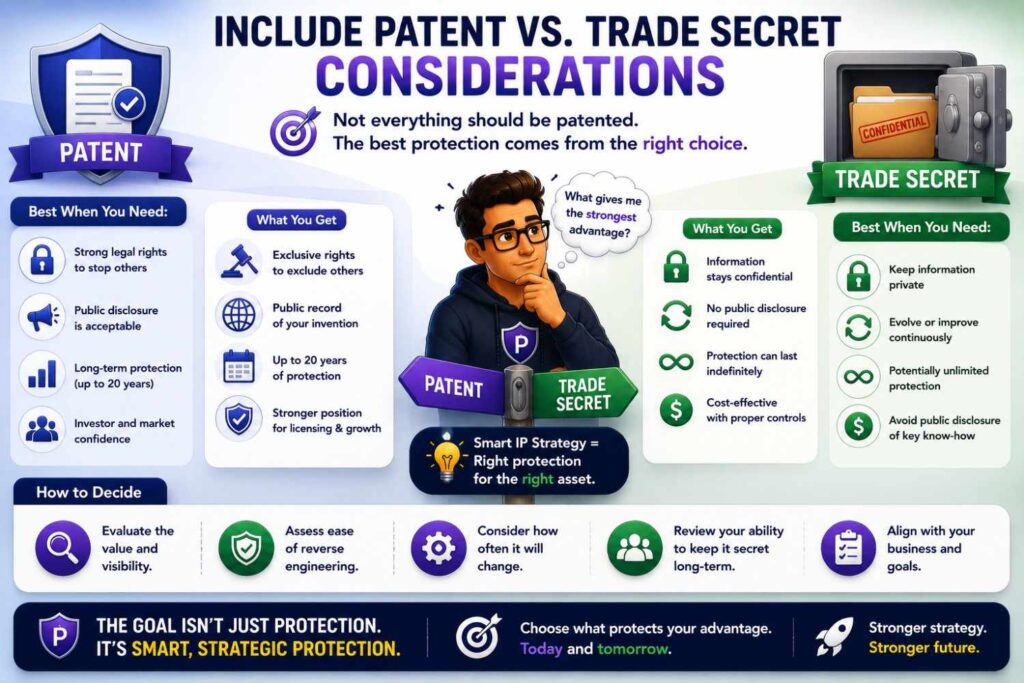
A strong report should flag when trade secret protection may be better.
This is especially important when the invention is hidden and hard to reverse engineer.
Examples include backend scoring methods, manufacturing parameters, cell culture conditions, private model tuning, internal quality control, and proprietary data cleaning methods.
The report should ask:
Will this feature be visible?
Will it be disclosed in docs, filings, labels, publications, or demos?
Can competitors reverse engineer it?
Can the company keep it secret?
Is patent space strong enough?
For example:
“Because the backend weighting formula is not visible to customers and may be hard to reverse engineer, trade secret treatment should be discussed. The visible workflow control step may be a better patent focus.”
This kind of note can save the company from disclosing something it should have kept secret.
Include Public Disclosure Risk
A report should state whether public disclosure is coming or has already happened.
This can include:
Launch pages.
API docs.
Product manuals.
Demos.
Conference talks.
Webinars.
GitHub repos.
White papers.
Clinical trial records.
Journal submissions.
Pitch decks shared without confidentiality.
Grant publications.
Product videos.
The report should say:
“API docs planned for June may disclose the validation workflow.”
Or:
“Conference poster planned next month may disclose marker ratio and patient subgroup.”
Or:
“GitHub release already disclosed parts of the sync repair method.”
Timing can change the recommendation.
If disclosure is near, the company may need to file quickly.
If disclosure already happened, the attorney needs the full facts.
Include Roadmap Coverage
A search report should not only look at today’s product.
If the roadmap includes real technical variants, the report should note them.
For example:
“The current version routes risky AI actions to human review. The roadmap includes second-model review and isolated execution.”
“The current battery system uses pressure and temperature. The roadmap includes strain sensing and pack compression history.”
“The current diagnostic uses plasma. The roadmap includes saliva and urine testing.”
“The current SaaS tool generates audit packets. The roadmap adds automated remediation actions.”
This matters because the patent application may need to describe real future versions.
A filing that only covers today’s version may become less useful as the product evolves.
The report should identify which roadmap features are technically developed enough to consider.
Include Competitor and Market Context
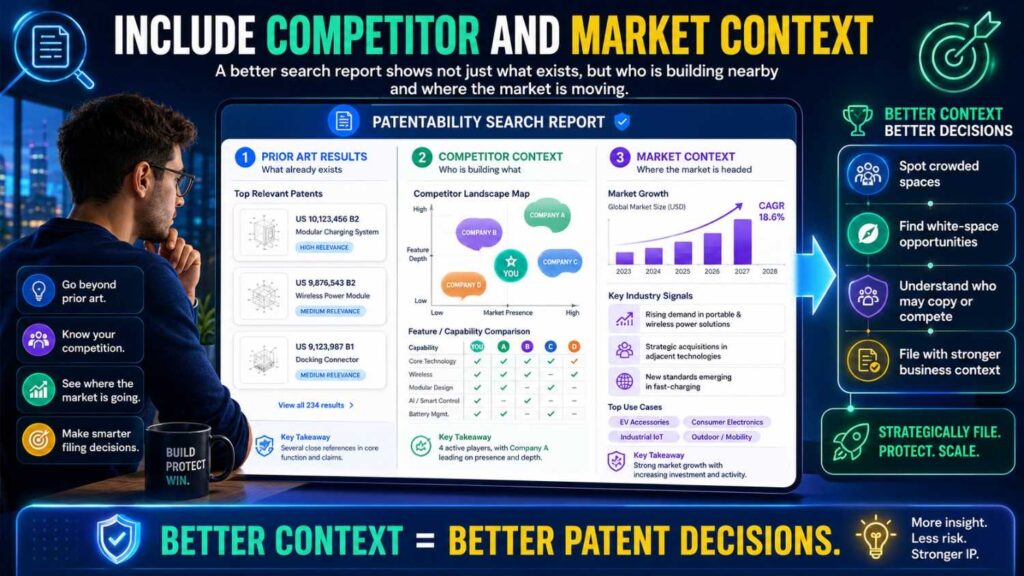
A patentability search report should not become a full market report, but competitor context can be useful.
The report should note close competitor patents, product docs, or public disclosures.
It should also note whether competitors appear to be filing around nearby features.
For example:
“Competitor A has several filings around generic compliance evidence collection, but none reviewed appears to show tenant-scoped audit packet generation.”
Or:
“Competitor B’s documentation describes AI task suggestions and approval workflows, but not source-data support validation.”
Or:
“Several large battery companies have filed on pressure-based swelling detection. Matched-window pressure drift scoring appears to be the more specific filing angle.”
This helps founders understand both risk and opportunity.
Include a Filing Recommendation
A report should end with a recommendation.
This is where many reports fail.
They summarize search results but do not say what to do.
A strong recommendation may say:
“File now on the source-data validation workflow before API docs publish.”
Or:
“File, but do not claim broad AI workflow automation. Focus on pre-execution validation using permission, policy, and source support.”
Or:
“Search more before filing because the closest references are unclear around source-data verification.”
Or:
“Do not file on the broad battery pressure sensor idea. Consider filing only on matched-window drift scoring if prototype data supports false-alert reduction.”
Or:
“Pause the broad biomarker filing. Gather more data on the normalized marker ratio and patient subgroup.”
Or:
“Consider trade secret treatment for the hidden scoring weights and patent the visible workflow behavior.”
A report without a recommendation is not a decision tool.
Include Next Steps
After the recommendation, include concrete next steps.
For example:
Gather more technical detail.
Ask engineers for diagrams.
Collect test data.
Run a second search on the narrowed angle.
Review public disclosure timing.
Prepare an attorney packet.
Draft a provisional.
Split the invention into two filings.
Review trade secret controls.
Update the roadmap invention list.
The next steps should be specific.
A weak next step says:
“Consider filing.”
A strong next step says:
“Prepare a provisional focused on source-data validation before API docs publish. Include backup examples for policy sources, source confidence, human review routing, audit logs, and automated blocking.”
That gives the team something to do.
Include Open Questions
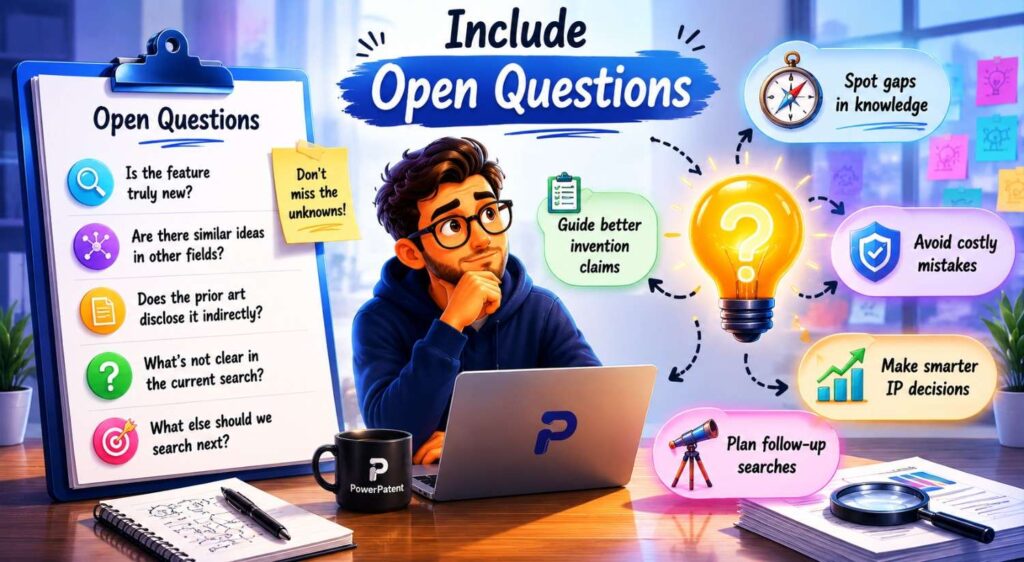
A good report should be honest about what is still unknown.
Open questions may include:
Does the reference fully disclose the missing feature?
Do we have enough data to support the result?
Is the roadmap feature technically ready?
Will API docs disclose the method?
Can competitors detect the hidden step?
Should the scoring formula be kept secret?
Does a foreign reference need better translation?
Should counsel review a close patent family?
Open questions are not a weakness.
They make the report trustworthy.
A report that pretends everything is clear is often less useful than one that says what still needs review.
Include Attorney Review Notes
If a patent attorney has reviewed the report, the report should include their comments or conclusion.
This may include:
Claim focus.
Recommended narrowing.
Backup positions.
Disclosure timing.
Trade secret considerations.
Need for more search.
Need for more technical evidence.
This section should be clear and action-oriented.
For example:
“Attorney review recommends avoiding broad claims to AI workflow automation and focusing on pre-execution source-data validation. Backup claim support should include policy sources, source confidence scoring, review routing, blocking actions, and audit logs.”
This turns the search report into a filing tool.
PowerPatent combines structured invention capture with real attorney oversight so search findings can become stronger filing decisions. See how PowerPatent works.
Include a Simple Executive Summary
Busy founders and executives need a short summary.
Put it near the top.
It should say:
What was searched.
What was found.
What the closest art shows.
What gap appears strongest.
What risk remains.
What action is recommended.
For example:
“The broad field of AI workflow automation is crowded. The closest references show AI task suggestions, permission checks, policy approval, and audit logs. The strongest gap appears to be source-data support validation before execution of an AI-generated action. This gap matters because it may reduce unsafe enterprise automation. Recommend filing on the validation layer before API docs disclose the workflow, with backup claims for source confidence, review routing, and audit logs.”
That summary is useful.
It helps leadership make a decision quickly.
The detailed report can support the summary.
Include a Technical Appendix When Needed
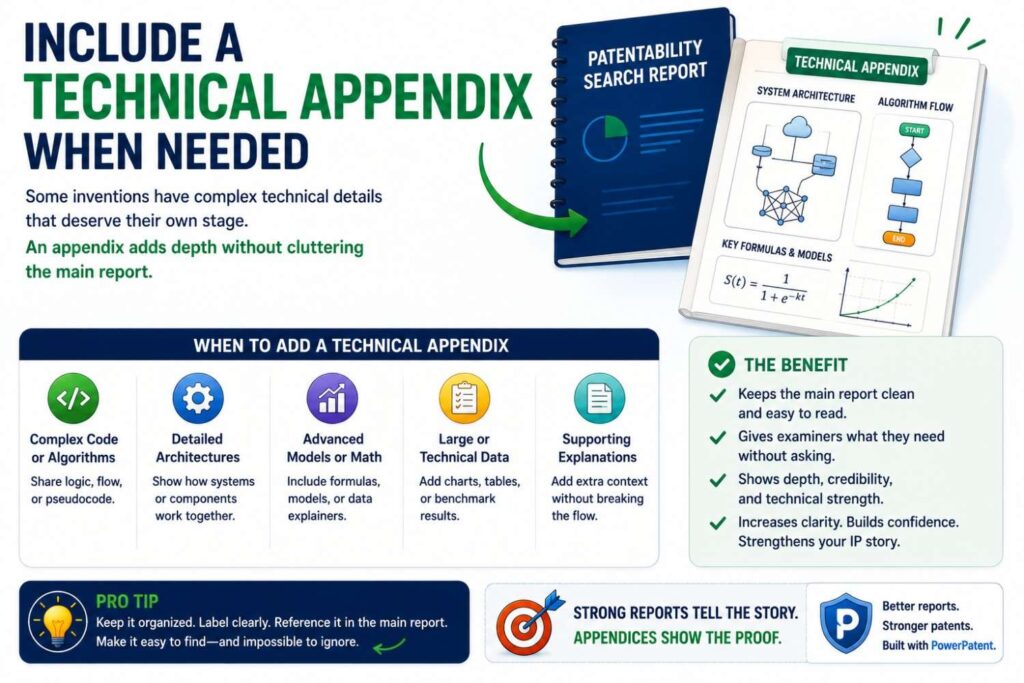
Some inventions need more detail.
A technical appendix can include diagrams, flowcharts, claim maps, search strings, patent classes, screenshots, sequence data, assay conditions, test data, API examples, or product manual excerpts.
This keeps the main report readable while preserving support.
For example, a SaaS report may include API field examples.
A hardware report may include annotated patent drawings.
A biotech report may include marker tables.
A robotics report may include control flow diagrams.
A MedTech report may include clinical workflow steps.
The main report should stay clear.
The appendix can hold the deeper material.
Keep the Report Clear Enough for Engineers
A patentability search report should not be written only for lawyers.
Engineers should be able to read it and say:
“Yes, that is the invention.”
“Yes, that is what the reference shows.”
“Yes, that is what the reference misses.”
“Yes, that gap matters.”
If engineers cannot understand the report, important details may be lost.
Use simple words.
Avoid long legal phrases where possible.
Explain prior art in plain language.
Show element maps.
Ask engineers to review the technical comparison.
Engineers often catch details that others miss.
Keep the Report Clear Enough for Business Leaders
Business leaders also need to understand the report.
They do not need every technical detail, but they need the decision.
They need to know:
Is this worth filing?
What is the risk?
What does the filing protect?
Does it support the product moat?
Is launch timing a concern?
Is more data needed?
Should budget be spent here or elsewhere?
A good report helps leadership choose.
A bad report creates confusion.
Avoid the “No Exact Match” Trap
A report should never rely only on “no exact match found.”
Exact matches are rare.
Prior art may be close without being exact.
The report should explain whether the closest art shows each claim element and where the meaningful gap lies.
“No exact match” is not a strategy.
A better statement is:
“No single reviewed reference appears to show all elements of the source-data validation workflow. However, related references show AI task generation, permission checks, and policy approval. The strongest gap appears to be source-data support validation before execution.”
That is far more useful.
Avoid the “Too Many Results” Trap
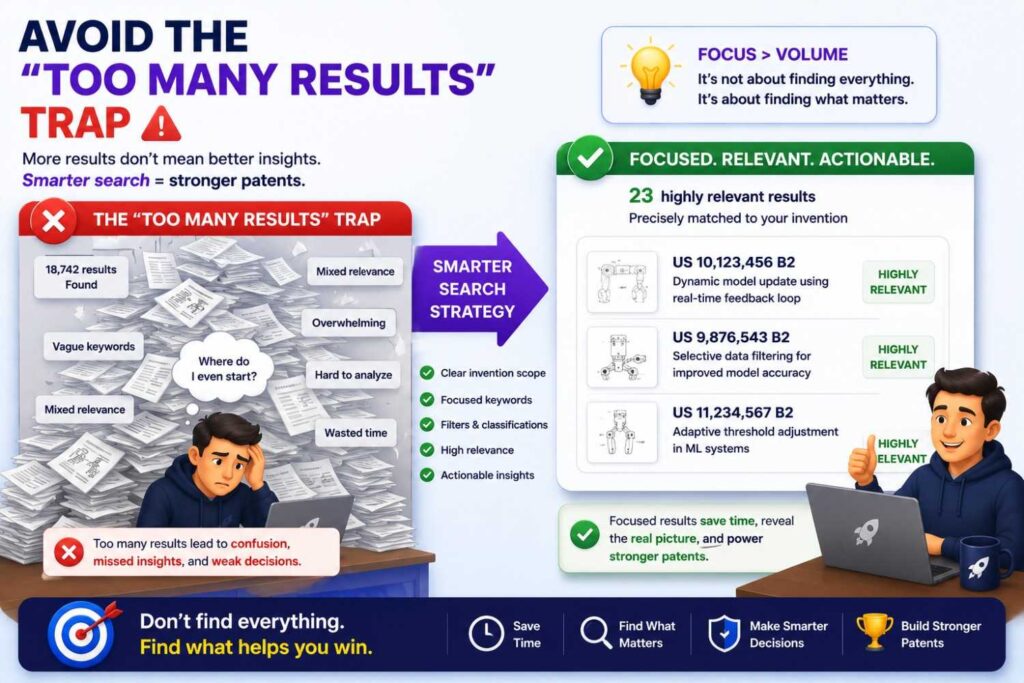
A crowded field does not always mean no patent is possible.
A report should not stop at “many references found.”
It should find the closest references and identify whether a specific gap remains.
For example:
“The broad wearable monitoring field is crowded. The stronger angle appears to be alert confidence adjustment based on skin-contact pressure and motion state.”
Or:
“The broad compliance automation field is crowded. The stronger angle appears to be tenant-scoped evidence packet generation.”
Crowded fields often still contain useful patent opportunities.
The report should help find them.
Avoid Copy-Pasting Abstracts
A report should not be a collection of copied abstracts.
Abstracts are often too broad or too vague.
The report should explain the reference in relation to the invention.
What does the reference teach?
Why does it matter?
Which elements does it show?
Which elements does it miss?
Copy-pasted abstracts do not answer those questions.
A useful report interprets, compares, and recommends.
Avoid Hiding Bad News
A good report is honest.
If a reference is close, say so.
If novelty risk is high, say so.
If the broad claim is likely blocked, say so.
If more search is needed, say so.
If the remaining difference looks weak, say so.
This does not hurt the company. It helps the company avoid bad filings.
A report that hides risk can lead to wasted budget and poor patent outcomes.
A report that names risk gives the company a chance to respond.
Avoid Overstating the Conclusion
A patentability search report should be useful, clear, and confident. But it should not promise more than the search can prove.
This is one of the most important parts of a good report.
A search report should not say, “This invention is patentable.”
It should not say, “There is no prior art.”
It should not say, “We are clear.”
Those statements sound strong, but they are risky. No search can see every reference in the world. No report can guarantee how a patent examiner will read the claims. No report can promise that a competitor will not find a closer reference later.
A better report gives a careful conclusion.
It says what was searched, what was found, what was not found, what appears to be the strongest gap, what risks remain, and what should happen next.
That kind of conclusion is more trustworthy. It also helps the business make better decisions.
Say “Based on the Reviewed References”
A strong conclusion should make clear that it is based on the search performed.
For example:
“Based on the reviewed references, no single reference was found that clearly shows all elements of the narrowed source-data validation workflow.”
That is much better than:
“No prior art exists.”
The first statement is honest and useful. The second statement is too broad.
This matters because patentability search is always limited by the search scope, databases, keywords, languages, dates, and available documents. Even a strong search may miss something. A later examiner may use different terms. A competitor may find a product manual, old paper, foreign filing, or archived document that did not appear in the first pass.
A careful conclusion protects the company from false certainty.
It also gives patent counsel a better starting point.
Separate “Not Found” From “Does Not Exist”
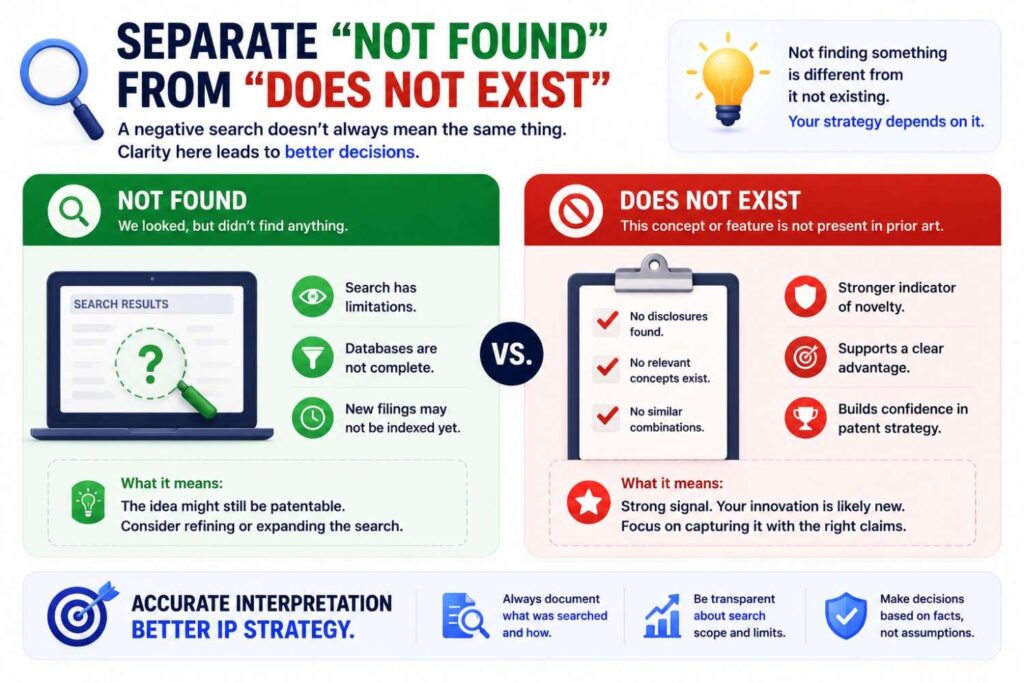
A search report should never treat “not found” as the same thing as “does not exist.”
Those are different.
“Not found” means the search did not uncover a reference.
“Does not exist” is a much bigger claim.
For example, a report can say:
“The search did not identify a reference that teaches matched-window pressure drift scoring with charge-rate and temperature adjustment.”
That is reasonable.
It should not say:
“No one has ever done matched-window pressure drift scoring.”
That may be impossible to know.
This distinction may feel small, but it matters. Overstated conclusions can lead founders to file too broadly, disclose too much, or speak too confidently to investors.
A search report should reduce risk, not create new risk through careless language.
Be Clear About the Claim Version Reviewed
Patentability depends on the claim version.
A broad version may be risky. A narrowed version may look stronger.
A report should say which version the conclusion applies to.
For example:
“Novelty risk appears high for a broad claim to pressure-based battery swelling detection. Novelty risk appears lower for a claim focused on pressure drift comparison during matched charging windows.”
That is useful.
It tells the business that the broad idea is crowded, but the narrowed angle may still be worth filing.
A bad conclusion would say:
“The invention appears patentable.”
Which invention? The broad version? The narrowed version? The current product? The roadmap version?
Good reports avoid that confusion.
They clearly state the claim angle being assessed.
Use Risk Levels, Not Absolute Labels
Business teams like clear answers. That is fair.
But patent search conclusions should use risk levels rather than absolute labels.
Instead of saying:
“Patentable.”
Say:
“Lower novelty risk based on reviewed references.”
Instead of:
“Not patentable.”
Say:
“High novelty risk for the broad claim because Reference A appears to show all major elements.”
Instead of:
“Clear.”
Say:
“No single reviewed reference clearly shows the full narrowed workflow, but related references show several components.”
This gives leaders a practical view.
They can still make a decision. They just make it with a realistic understanding of uncertainty.
A simple risk scale can help:
Low risk means no close reference was found for the specific claim angle, though risk remains.
Medium risk means close references exist but appear to miss an important element.
High risk means one or more references appear to show most or all of the claimed invention.
This is much better than yes-or-no language.
Explain Why the Risk Level Was Chosen
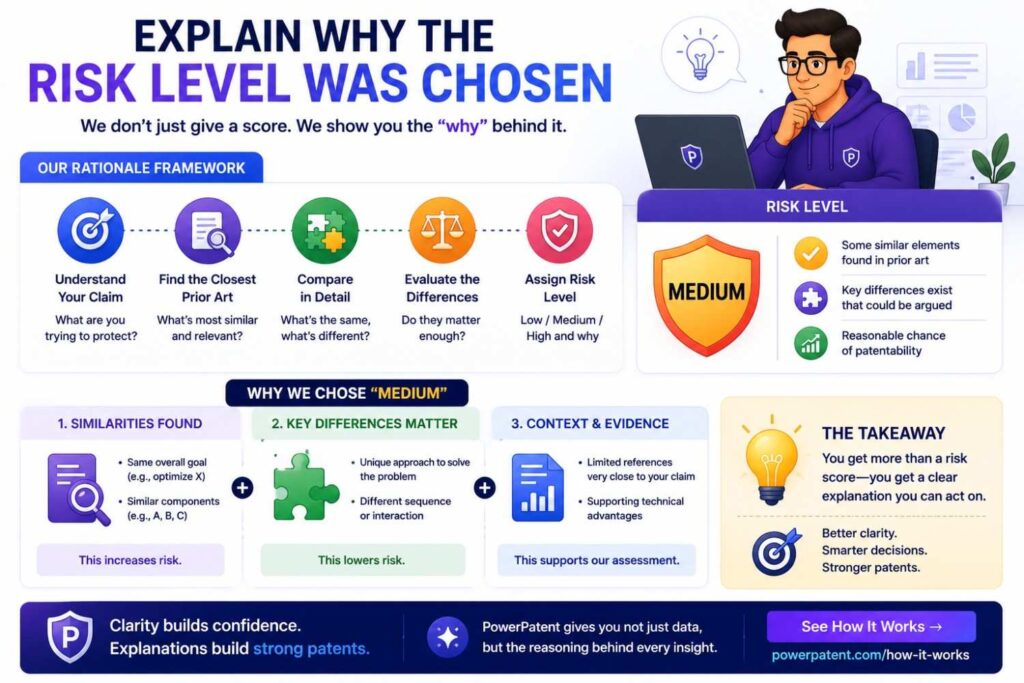
A risk label alone is not enough.
If the report says “medium risk,” it should explain why.
For example:
“Risk is medium because Reference A shows AI-generated actions, permission checks, and audit logging, but does not clearly show source-data support validation before execution. References B and C show related validation concepts separately, which may create obviousness risk.”
That kind of explanation helps the team understand the issue.
It also helps patent counsel decide whether to narrow, pivot, or gather more support.
A vague label like “medium risk” without explanation is not very useful.
A strong report always ties the conclusion back to the references and claim elements.
Avoid Investor-Safe but Legally Risky Language
Founders often want strong language for investors.
That is understandable. But overstated IP claims can hurt trust.
Do not write:
“Our invention is unique and patentable.”
Write:
“Our search suggests the broad area is active, but the strongest filing angle appears to be the source-data validation layer before AI actions execute.”
That is still strong. It is also more credible.
Investors do not need fake certainty. They need to know the company understands its moat.
A careful search conclusion can support investor messaging without overpromising.
For example:
“The search did not identify a single reviewed reference showing the full narrowed workflow. The filing strategy should focus on the source-data validation step, which is tied to enterprise trust.”
That sounds disciplined. It shows the company is not filing patents blindly.
Do Not Hide Close Prior Art to Sound Stronger
A report that hides close prior art is dangerous.
It may make the team feel better for a moment, but it can lead to bad filings.
A strong report names close references clearly.
It says what they show.
It says why they matter.
It says what they appear to miss.
For example:
“Reference A is close because it shows AI-generated task suggestions and permission checks. It does not appear to show source-data support validation before execution.”
That is more useful than pretending Reference A is not important.
Close prior art does not always kill a filing. Sometimes it helps define the stronger claim angle.
But the team needs to see it clearly.
State What Was Not Searched
A trustworthy conclusion should mention important search limits.
For example:
“This search focused on U.S. and international patent publications, academic papers, and competitor product docs. It did not include a full freedom-to-operate review or a full code repository search.”
Or:
“This search reviewed English-language and machine-translated patent references but did not include a full sequence database search.”
This does not weaken the report. It makes it more reliable.
A founder can then decide whether more searching is needed before filing, launch, fundraising, or partnership talks.
Search limits are not embarrassing. They are part of honest decision-making.
Separate Patentability From Freedom to Operate
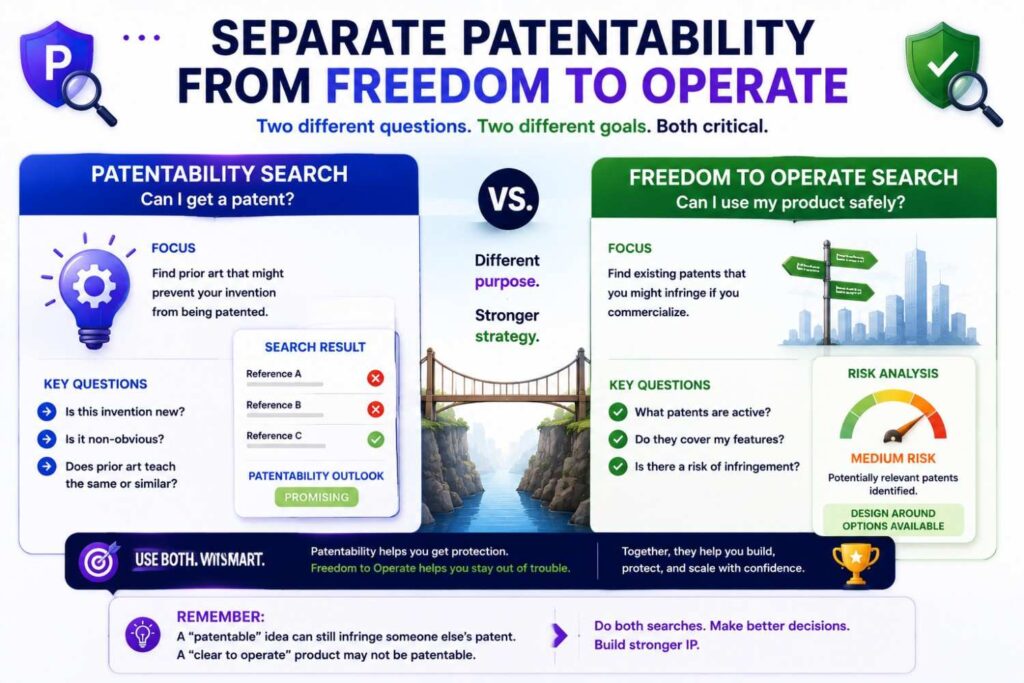
A report should not imply that a patentability search means the product is safe to sell.
Patentability and freedom to operate are different questions.
A patentability search asks whether your invention may be new enough to patent.
A freedom-to-operate review asks whether your product may infringe someone else’s active patent.
A report should avoid language like:
“We are clear to launch.”
That may not be true.
A better statement is:
“This report addresses patentability of the proposed invention, not freedom to operate for the product.”
This distinction protects the business.
It also helps founders know when they may need a different kind of legal review.
Make the Conclusion Actionable
A careful conclusion should still lead to action.
Avoid weak endings like:
“Further analysis may be needed.”
That may be true, but it is not enough.
A better conclusion says:
“Recommend filing on the narrowed source-data validation workflow before API docs publish. Include backup claims for source-confidence scoring, review routing, customer policy types, and audit logs. Recommend additional search on workflow validation prior art if time allows.”
Or:
“Do not file on the broad battery pressure sensor concept. Consider filing on matched-window pressure drift scoring after adding prototype data showing false-alert reduction.”
This keeps the report useful.
The goal is not to sound cautious for its own sake. The goal is to make a smart decision with clear risk boundaries.
Use “Confidence With Boundaries”
The best conclusion gives confidence with boundaries.
It does not say, “Everything is fine.”
It says:
“Here is what we know. Here is what we found. Here is the strongest gap. Here is the risk. Here is the recommended path.”
That kind of conclusion helps founders move forward without being reckless.
For example:
“Based on the reviewed references, the broad field of AI workflow automation is crowded. No single reviewed reference clearly shows the full narrowed workflow of validating an AI-generated action against permission scope, customer policy, and source-data support before execution. The strongest filing angle appears to be the source-data validation layer. Obviousness risk remains because related references show policy approval and AI task generation separately. Recommend attorney review and filing before API docs disclose the workflow.”
This is careful, but it is not weak.
It gives the business a path.
Create Two Versions of the Conclusion
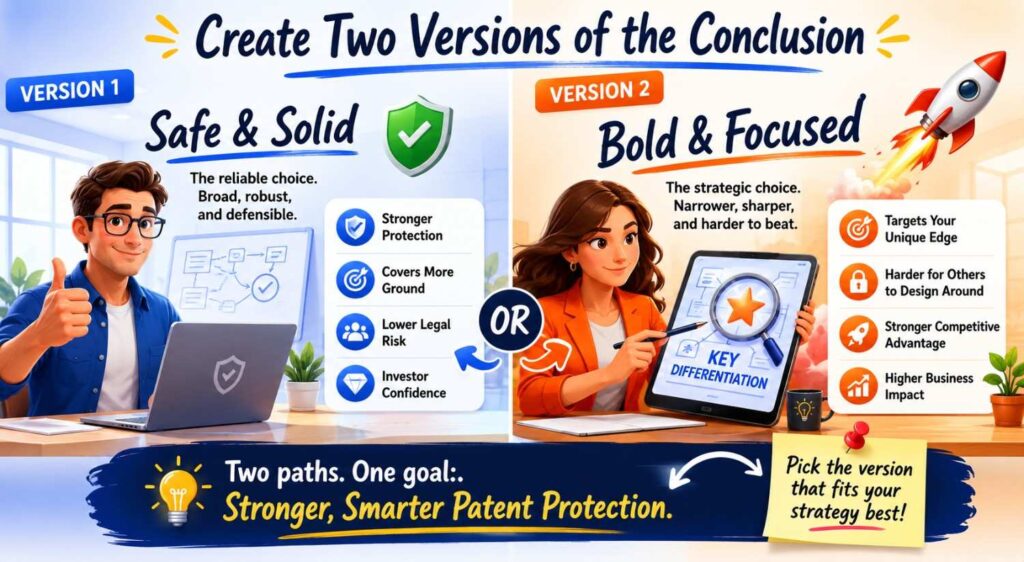
For important inventions, it can help to include two conclusion levels.
The first is an executive conclusion.
This is short and business-friendly.
For example:
“The broad field is crowded, but the narrowed validation workflow appears to have a meaningful gap based on reviewed references. Recommend filing before API docs publish.”
The second is a technical conclusion.
This gives the detailed basis.
For example:
“No single reviewed reference clearly discloses all elements of the proposed narrowed claim. Reference A discloses AI task suggestions and permission checks. Reference B discloses policy approval. Reference C discloses audit logging. None clearly discloses source-data support validation before execution of an AI-generated action. Obviousness risk remains because these features may be argued in combination.”
This gives executives clarity and gives patent counsel detail.
Both are useful.
Keep the Report From Becoming Marketing Copy
A patentability search report is not a pitch deck.
It should not use hype.
Avoid phrases like:
“Groundbreaking.”
“First of its kind.”
“Completely novel.”
“No competitors can do this.”
“Guaranteed patentable.”
These phrases can make the report less credible.
Use precise language instead:
“Appears not to be shown in the reviewed references.”
“Closest references do not clearly disclose.”
“Strongest identified gap.”
“Recommended claim focus.”
“Remaining risk.”
This language may sound less flashy, but it is much more valuable.
Serious investors, attorneys, and acquirers respect disciplined IP analysis.
Tell the Team What Not to Say Externally
A good report can also guide external messaging.
If the conclusion is nuanced, make sure the team does not turn it into an overstatement in a deck or sales call.
For example, the report may say:
“No single reviewed reference clearly shows the narrowed workflow.”
The pitch deck should not turn that into:
“We have invented the only AI workflow validation system.”
That is too broad.
Instead, the deck might say:
“Our patent strategy focuses on a specific validation layer for AI-generated actions, based on a search of related prior art.”
That is safer and more credible.
A strong report can include a short “external messaging note” for founders.
Revisit the Conclusion When Claims Change
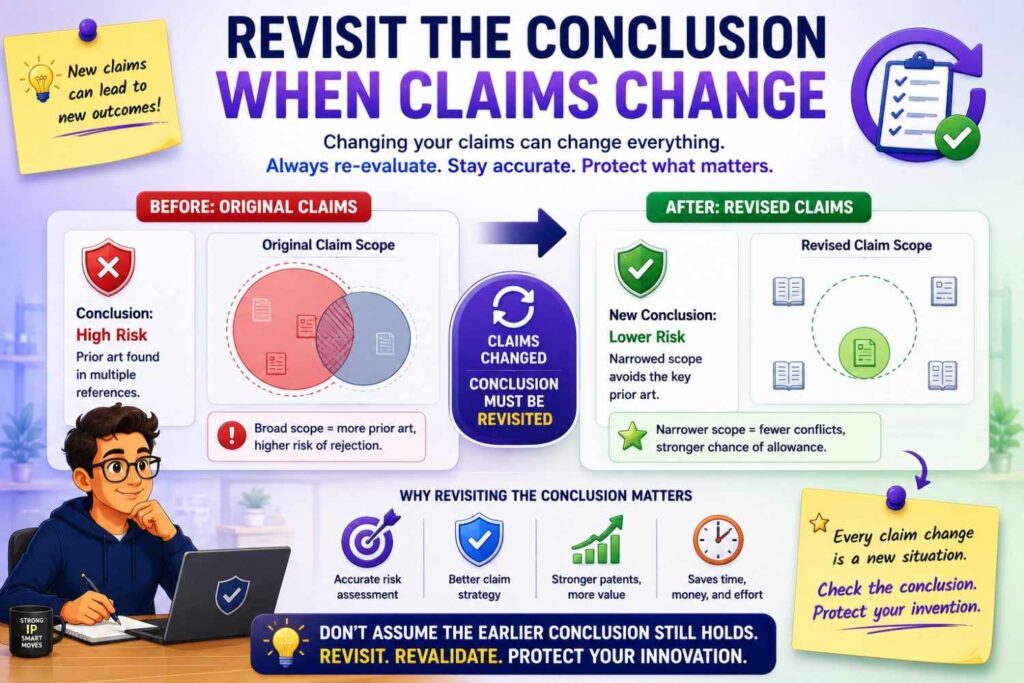
A conclusion applies to the invention version reviewed.
If the claims change, the conclusion may need to change too.
For example, the original report may focus on source-data validation. But during drafting, the claim may shift toward audit logging or policy approval.
That shift may change the prior art analysis.
Before filing, ask:
Does the report still match the claim?
Did the attorney add or remove elements?
Did the product team change the feature?
Did the claim broaden beyond what was searched?
Did the claim narrow into a feature that was not searched deeply?
If the answer is yes, update the conclusion.
A stale conclusion can mislead the team.
PowerPatent Helps Keep Search Conclusions Honest and Useful
The strongest patent decisions come from clear facts, not overstatement.
PowerPatent helps teams capture invention details, organize prior art, map claim elements, and work with real patent attorneys to turn search results into practical filing decisions.
That means founders can move fast without pretending the search proved more than it did.
The goal is confidence with clarity.
Not hype.
Not fear.
A smart next step.
A Strong Report Helps Draft a Better Patent Application
A strong search report directly improves the patent application.
It tells the attorney what the closest prior art is.
It shows which claim angles are risky.
It identifies the strongest gap.
It suggests backup positions.
It highlights technical results to describe.
It flags public disclosure timing.
It shows what evidence may help.
It clarifies what not to claim.
This can lead to a better filing.
Instead of drafting from a vague product summary, the attorney can draft from a clear invention map.
That is a major advantage.
A Strong Report Helps Fundraising
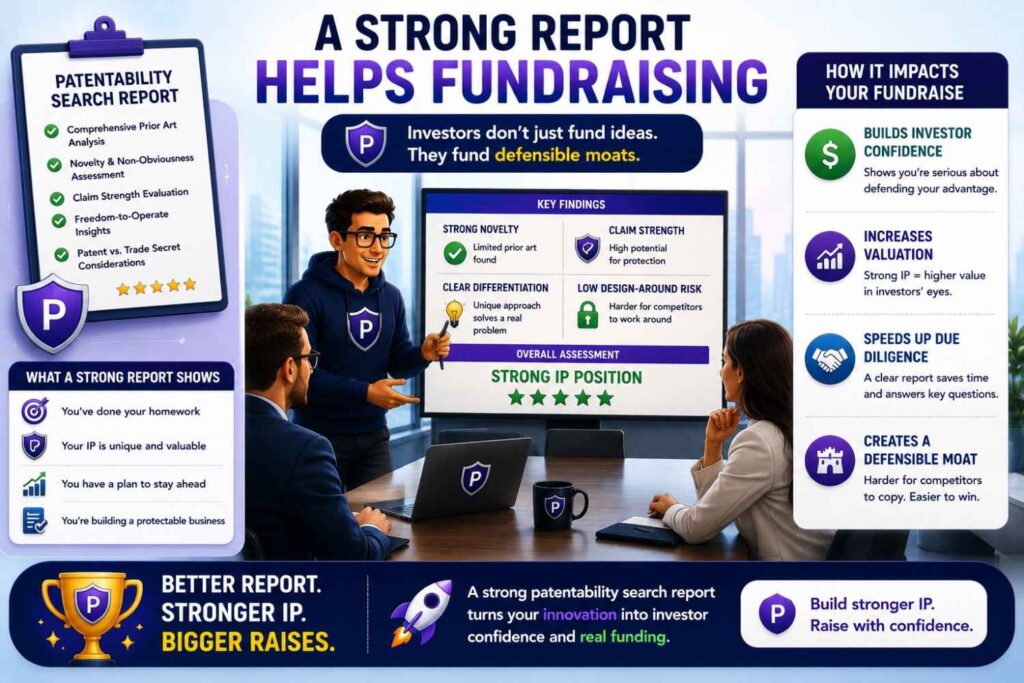
Investors often ask about IP.
A strong report helps founders explain the patent strategy without hype.
Instead of saying:
“We searched and found nothing like us.”
Say:
“The broad field is active, but our search suggests the strongest filing angle is the source-data validation layer before AI actions execute. That layer is tied to enterprise trust and is what our filing focuses on.”
This sounds more credible.
It shows discipline.
It shows that the patent strategy is tied to the product moat.
A Strong Report Helps Product Strategy
A good search report can also guide product decisions.
It may show that one feature is crowded while another is more defensible.
It may reveal competitor focus.
It may show white space.
It may suggest stronger roadmap features.
It may show that a backend method is more valuable than a frontend feature.
It may show that more data is needed to support a claim.
Patent search is not just legal work.
It can help the business choose where to invest.
A Strong Report Helps Avoid Bad Filings
A bad patent filing is rarely caused by one mistake.
It usually happens because the team files before the invention is clear, before the closest prior art is understood, or before the claim strategy is tied to business value.
A strong patentability search report helps stop that.
It gives the company a checkpoint before money is spent on drafting. It helps founders, engineers, and patent counsel see the same facts. It also forces the team to ask the hard question early:
Are we filing on the right invention?
It Stops the Team From Filing on the Product Category
One of the most common bad filings is a patent application aimed at the broad product category.
A SaaS company files on “AI compliance automation.”
A robotics company files on “robot collision avoidance.”
A biotech company files on “a biomarker test.”
A hardware company files on “battery monitoring.”
Those categories are often crowded. A report that only says “we searched and found related patents” does not help much. A strong report goes deeper.
It shows that the broad area is known, then points to the technical feature that may still be worth protecting.
For example:
“The broad battery monitoring space is crowded. The stronger filing angle appears to be pressure drift comparison during matched charging windows.”
That single sentence can prevent a weak, generic filing.
The report helps the team stop claiming the market and start claiming the method.
It Shows When the Invention Is Not Ready Yet
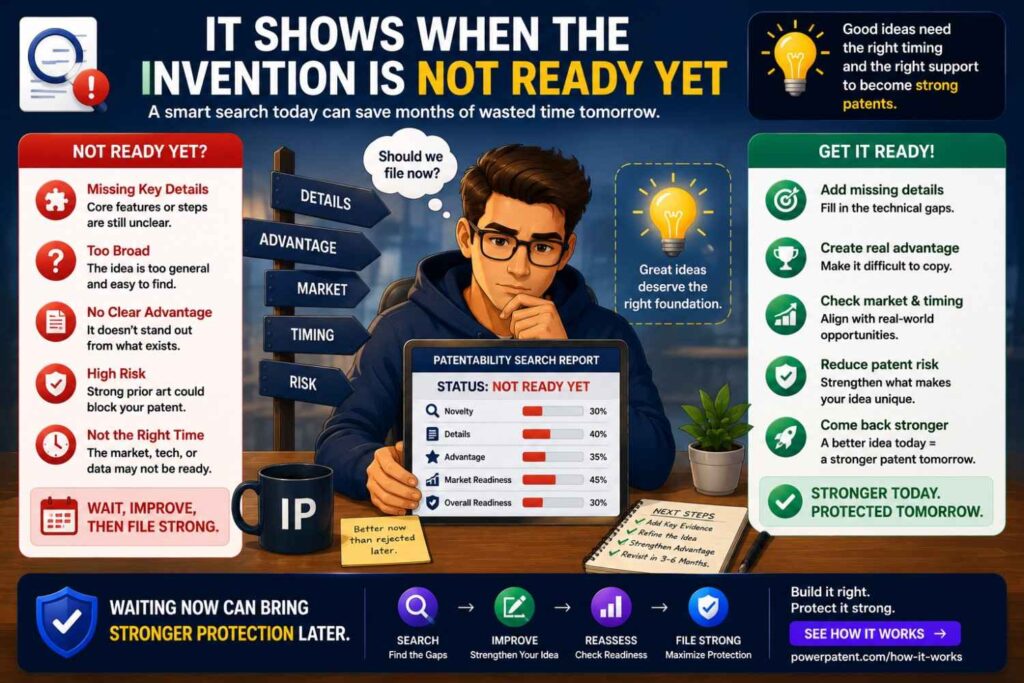
Sometimes the idea is promising, but the invention is not ready for filing.
The team may know the goal, but not the method. They may have a product concept, but not enough detail about inputs, steps, outputs, thresholds, alternatives, or technical results.
A strong search report can reveal that.
For example, the report may say:
“The search found many references around AI review workflows. The current invention description does not yet explain how source trust is calculated or how the review trigger differs from model-confidence review. More technical detail is needed before filing.”
That is not a failure.
That is a useful warning.
It prevents the company from filing a thin application that later cannot support strong claims.
For a startup, this matters because a rushed filing can feel like progress while quietly creating weak IP.
It Prevents “No Exact Match” False Confidence
A weak report often says, “No exact match found.”
That can be dangerous.
Exact matches are rare. Prior art may use different words, solve a related problem, or show most of the invention without looking identical.
A strong report avoids false comfort by naming the closest references and explaining what they show.
It may say:
“No single reviewed reference clearly shows all elements of the narrowed workflow. However, several references show AI action generation, permission checks, and policy approval separately. Obviousness risk should be reviewed.”
That is far more useful.
It tells the team that the idea may still have room, but the filing should not be careless.
This kind of honesty helps avoid overbroad claims that get crushed later.
It Prevents Panic When the Field Is Crowded
The opposite problem is panic.
A founder sees many patents and assumes the company cannot file anything.
A strong report helps avoid that too.
It does not treat a crowded field as an automatic stop. It separates the broad field from the specific invention.
For example:
“The broad field of wearable heart monitoring is crowded. The strongest gap appears to be adjusting alert confidence based on both skin-contact pressure and motion state before triggering an alert.”
This helps the team stay calm.
The report says, “Do not claim the crowded thing. Claim the useful difference.”
That can turn a scary search into a better filing strategy.
It Makes the Attorney’s Drafting Job Sharper
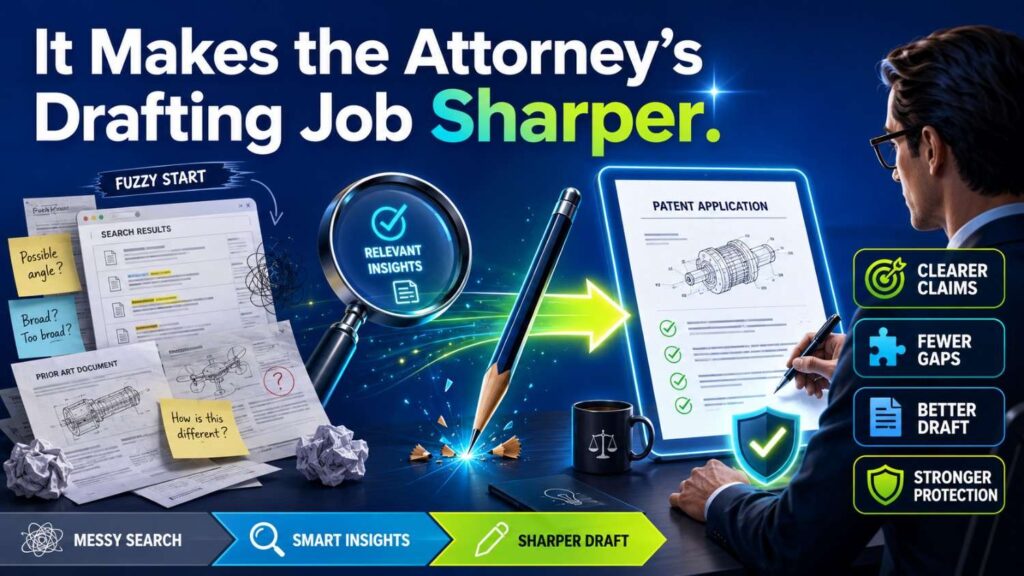
Patent attorneys can draft better applications when the search report gives them clear targets.
A weak report gives counsel vague inputs:
“Here are some related patents. Our product is different.”
A strong report gives counsel a map:
“The closest references show X and Y. They do not clearly show Z. Z matters because it creates this technical result. The filing should focus on Z, with backups for A, B, and C.”
That improves the draft from the start.
It helps the attorney avoid known prior art. It also helps them include the details needed for fallback claims.
Bad filings often happen when counsel is forced to draft from a thin product summary. A strong report gives counsel the technical and strategic context needed to write with precision.
It Forces a Business Value Check Before Filing
Not every patentable idea is worth filing.
A search report helps the team ask whether the remaining patent angle protects something that matters.
For example:
The report may find a small technical gap, but the gap may not drive customer value.
It may be easy to design around.
It may be hidden and better kept secret.
It may not match the roadmap.
It may protect a feature customers do not care about.
A strong report does not ignore this. It connects the technical gap to business value.
It asks:
Does this claim protect the reason customers buy?
Would competitors need this feature?
Can we detect copying?
Does it support funding, sales, partnerships, or acquisition value?
If the answer is weak, the report may recommend pausing or shifting focus.
That is how companies avoid paying for patents that look good in a file cabinet but do little for the business.
It Catches Design-Around Problems Early
A filing can be technically different and still weak.
That happens when competitors can avoid the claim with a small change.
A strong report flags this before drafting.
For example:
“The only clear difference is that the system sends the alert by email. This may be easy to design around because competitors can use other notification channels.”
Or:
“The claim angle depends on one exact threshold value. Consider whether the invention can be framed around the decision logic or threshold range instead.”
This is very practical.
It helps the team avoid claims that are narrow for the wrong reason.
A good search report does not just ask whether a claim can be allowed. It asks whether the claim would matter if a competitor tried to copy the product value.
It Helps Decide When to Pivot
Sometimes the report shows that the first invention idea is weak, but another part of the product is stronger.
That is a good outcome.
For example:
A SaaS search may show that workflow automation is crowded, but tenant-safe audit packet generation looks more open.
A robotics search may show that obstacle avoidance is crowded, but pre-visual hidden-risk prediction looks stronger.
A MedTech search may show that a sensor is known, but the signal-confidence workflow looks more valuable.
A biotech search may show that a marker is known, but the normalized marker ratio or patient subgroup may still be worth filing.
A strong report does not just say “risk found.”
It says where to move next.
That pivot can save the company from filing a weak application and help it protect the true technical edge.
It Helps Decide What to Keep Secret
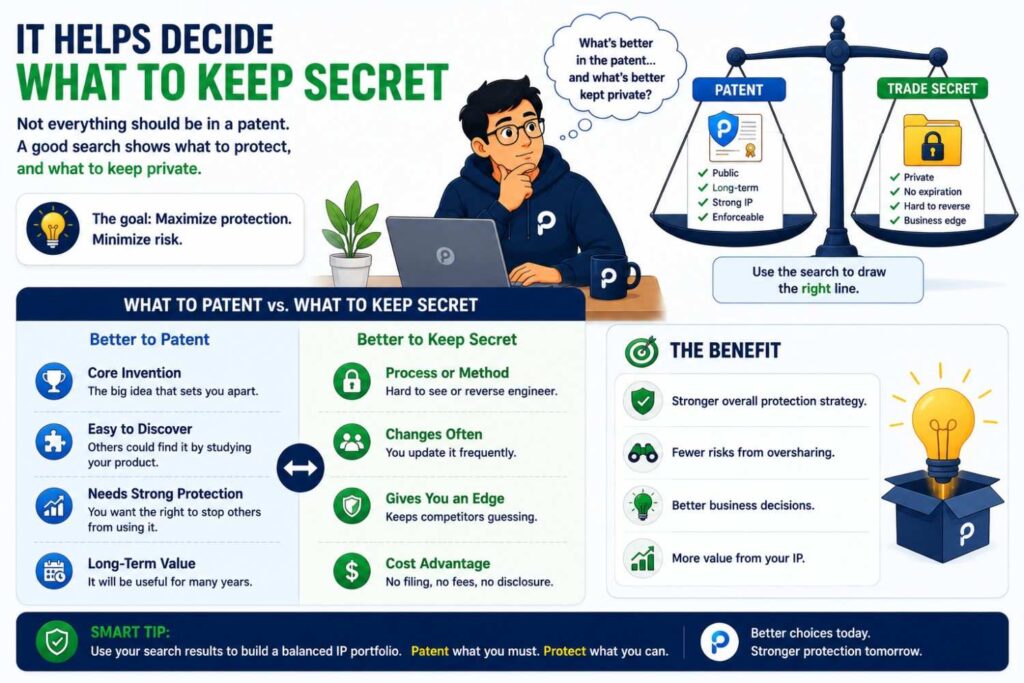
A bad filing can also happen when a company patents something that should have stayed private.
A strong report helps prevent that.
If the search shows that patent claims would be narrow, but the valuable method is hidden and hard to reverse engineer, the report can flag a trade secret discussion.
For example:
“The backend scoring weights may be difficult to detect from the product and may be better treated as trade secret. The visible workflow control step may be a better patent focus.”
This protects the company from disclosing valuable know-how in exchange for a weak patent position.
For startups, that choice can be critical.
Patents and trade secrets are both tools. A strong report helps choose the right one.
It Protects Against Public Disclosure Mistakes
A search report can also prevent timing mistakes.
Bad filings often happen after the invention has already been disclosed in a launch page, API doc, GitHub repo, conference talk, product demo, clinical record, or white paper.
A strong report should flag public disclosure risk.
For example:
“API docs planned next month may disclose the source-validation workflow. If filing is desired, file before publication.”
Or:
“The upcoming conference poster appears to disclose the marker ratio and patient subgroup. Patent counsel should review before submission.”
This turns the report into a practical launch safeguard.
It helps product, marketing, and legal teams coordinate before value is lost.
It Creates a Record of Why the Company Filed
A strong report gives the company a decision record.
Months later, the team can look back and see why a filing was made.
What was the invention?
What prior art was closest?
What gap mattered?
Why was the claim angle chosen?
What risks were known?
What alternatives were considered?
This record helps during later prosecution, investor diligence, acquisition review, and portfolio planning.
It also helps new team members understand the patent strategy.
Without a report, the reason for filing may live only in someone’s memory.
That is risky.
It Helps Avoid Repeating the Same Search
Startups move fast. People change roles. Product roadmaps shift.
Without a clear report, the same question may come back again and again:
“Did we ever search this?”
“Why did we not file on that?”
“Was this feature already covered?”
“What did the attorney say?”
A strong report prevents repeated work.
It stores the search logic, the closest references, the claim focus, the risks, and the decision.
That saves time.
It also keeps the company from reopening old debates every quarter.
It Turns Patent Spend Into a Deliberate Investment
Patent spend should be treated like business capital.
A strong search report helps founders decide where that capital should go.
It can rank invention opportunities by value, risk, timing, and readiness.
It can show which filings are urgent because public disclosure is near.
It can show which ideas need more data.
It can show which features are too crowded.
It can show which hidden methods may be trade secret candidates.
This makes patent work less reactive.
The company is no longer filing because someone had an idea in a meeting.
It is filing because the report shows a specific technical gap tied to business value.
That is how strong portfolios are built.
It Gives the Team a Clear “File, Fix, or Forget” Decision
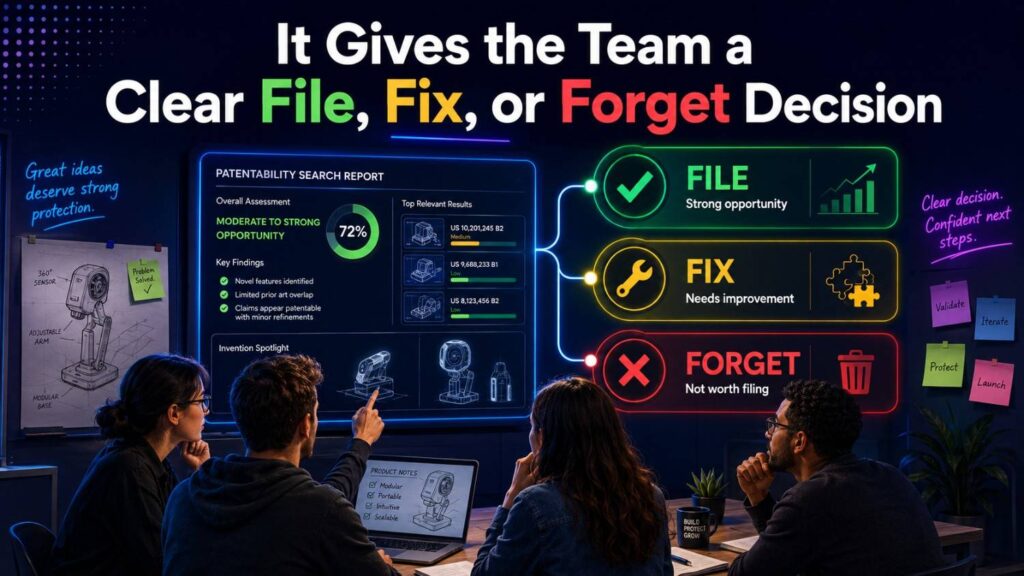
A strong report should help the company choose one of three paths.
File when the invention has a meaningful technical gap, business value, enough support, and timing pressure.
Fix when the idea is promising but needs more search, more technical detail, more data, better claim focus, or a narrower angle.
Forget when the remaining claim is weak, easy to avoid, low-value, or not worth the cost.
This simple frame keeps the report action-oriented.
The goal is not to admire search results.
The goal is to decide.
It Makes the Patent Process Faster Without Making It Sloppy
Founders want speed. Attorneys want enough detail. Engineers want clarity. Investors want confidence.
A strong report helps all of them.
It gives the attorney better inputs. It gives engineers a chance to confirm the technical gap. It gives founders a clear filing path. It gives leadership a business reason for spending the money.
This speeds up the process because the team is not starting from a vague idea.
But it also improves quality because the filing is grounded in the actual prior art and actual product value.
That is the balance PowerPatent is built for: faster patent work without losing the details that make filings strong.
See how PowerPatent helps founders file better patents faster.
A Practical Patentability Search Report Template
A founder-friendly report can follow this structure.
Executive summary.
Plain-English invention statement.
Technical problem.
Technical solution.
Technical result.
Product and business context.
Search date.
Sources searched.
Search terms and strategy.
Closest prior art.
Element-by-element comparison.
Strongest technical gap.
Why the gap matters.
Novelty risk.
Obviousness risk.
Claim strategy notes.
What not to claim.
Backup claim ideas.
Design-around risk.
Detectability notes.
Patent versus trade secret considerations.
Public disclosure risk.
Roadmap coverage.
Competitor context.
Recommendation.
Next steps.
Open questions.
Attorney review notes.
Technical appendix if needed.
This may look like a lot, but the report does not need to be long for every invention.
The key is that it should answer the right questions.
Example: SaaS Patentability Search Report Summary
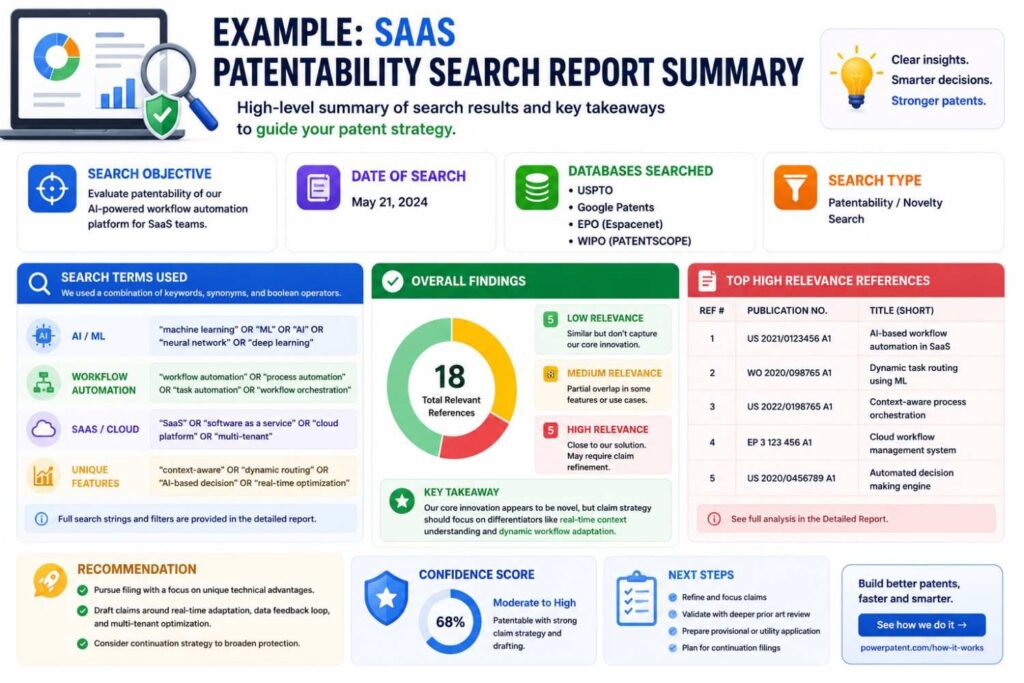
Here is what a strong SaaS summary may sound like:
“The invention is a cloud workflow system that validates AI-generated actions before execution by checking user permission, customer policy, and source-data support. The search covered patents, SaaS product docs, API docs, technical blogs, and competitor help centers. The broad field of AI workflow automation is crowded. The closest references show AI task suggestions, permission checks, policy approval, and audit logging. No single reviewed reference clearly shows source-data support validation before execution of the AI-generated action. This gap matters because it may reduce unsafe enterprise automation. Novelty risk appears medium for the broad concept and lower for the narrowed validation workflow. Obviousness risk remains because related references show separate validation concepts. Recommend filing before API docs publish, with claims focused on source-data validation and backup positions for source confidence, review routing, policy types, and audit logs.”
That summary is useful because it tells the team what to do.
Example: Hardware Patentability Search Report Summary
A hardware summary may sound like this:
“The invention is a battery monitoring method that compares pressure drift during matched charging windows and adjusts a swelling risk score based on charge rate and temperature. The search covered patents, foreign patent publications, battery papers, product manuals, and supplier materials. The broad concept of pressure-based swelling detection is crowded. The closest references show pressure sensors and fixed thresholds. No single reviewed reference clearly shows matched-window pressure drift comparison with charge-rate and temperature adjustment. This gap matters because it may reduce false alerts during fast charging. Recommend filing around the matched-window drift scoring method, with backup claims for different window definitions, context signals, sensor placements, and charge-control outputs.”
Again, the report does not just list results. It turns them into a filing plan.
Example: Biotech Patentability Search Report Summary
A biotech summary may sound like this:
“The invention is a diagnostic method that uses a ratio of Marker A to Marker B from a low-volume plasma sample and normalizes the ratio based on inflammation score to identify early-stage Disease X risk. The search covered patents, papers, clinical trial records, assay protocols, and marker databases. Marker A appears known for Disease X, and Marker B appears in related disease studies. No single reviewed reference clearly shows the specific normalized marker ratio in low-volume plasma samples for early-stage risk detection. This gap matters because it may reduce false positives in patients with high inflammation. Recommend attorney review before filing, with focus on the normalized marker pattern, sample type, patient subgroup, threshold ranges, and supporting performance data.”
This helps the company avoid claiming the marker alone and focus on the applied method.
How PowerPatent Helps Create Better Search Reports
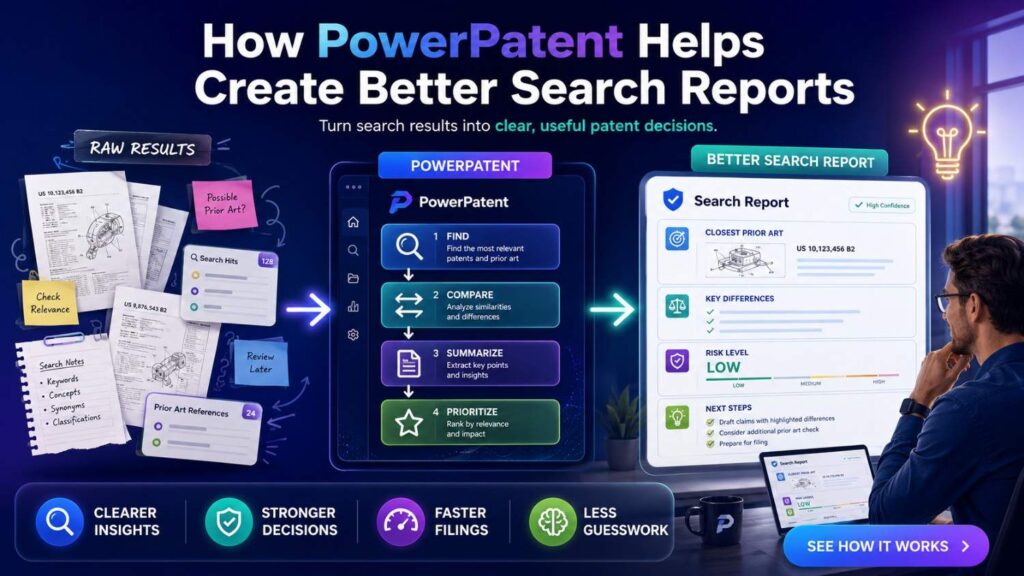
A strong patentability search report needs more than a few keywords.
It needs clear invention capture, technical context, prior art organization, element mapping, business value, and attorney review.
PowerPatent helps founders and technical teams bring those pieces together.
You can organize invention details, search findings, engineering notes, diagrams, product context, and filing questions in one process.
Then real patent attorney oversight helps turn that material into stronger filing decisions.
This helps startups avoid weak filings, missed inventions, and last-minute patent scrambles.
PowerPatent is built for teams that want speed without sacrificing quality.
Final Takeaway
A patentability search report should do more than prove that someone searched.
It should help the company decide.
A strong report includes the invention, the technical problem, the search scope, the closest prior art, element-by-element comparison, the strongest gap, risk analysis, claim strategy notes, disclosure timing, business value, and a clear recommendation.
It should be honest. It should be readable. It should be specific. It should help founders, engineers, and attorneys work from the same map.
The best report does not end with “no exact match found.”
It ends with a decision:
File.
Narrow.
Pivot.
Search more.
Pause.
Keep secret.
Drop.
That is how patentability search becomes strategy.
And when you are ready to turn invention notes, search results, product details, engineering work, and attorney review into better patent filings, PowerPatent can help you move faster with smart software and real patent attorney oversight.