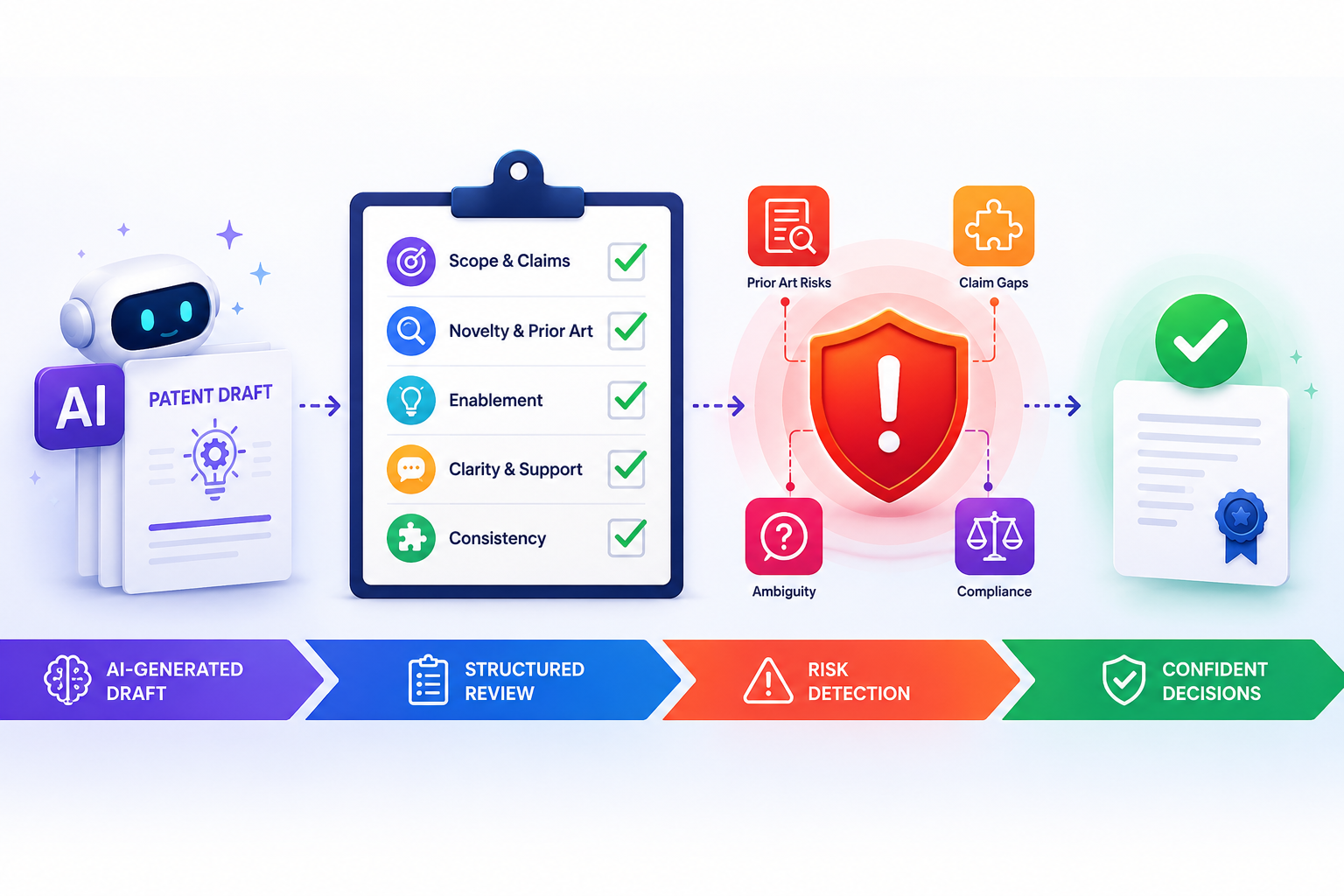
AI can help you draft faster. It can spot ideas, shape claims, and turn rough notes into a clean first version. But speed is not the same as safety. A patent draft can look polished and still hide big risks. At PowerPatent, we believe AI should speed up patent work, not replace careful review. Smart software plus real attorney oversight gives founders more control and fewer blind spots. See how it works here: https://powerpatent.com/how-it-works
Start by checking whether the draft protects the real invention.
An AI-generated patent draft can sound sharp even when it misses the core idea. This is the first risk.
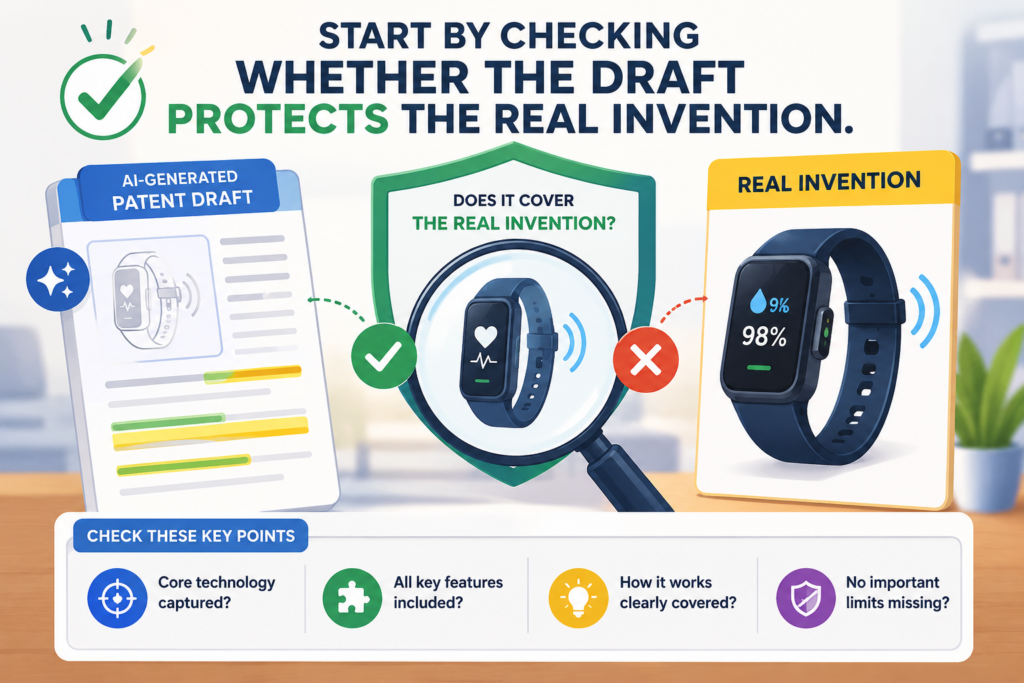
The draft may describe the product, the screen, the workflow, or the end result, but fail to protect the real step that makes the invention valuable.
For a founder, this matters because the product may change. The user interface may change. The code may be rebuilt.
The model may improve. The data flow may shift. But the core invention is the part you want to protect as your company grows.
Before you review grammar, claim style, or small details, ask one simple question: does this draft protect the thing we would hate to see a rival copy?
The draft should not only describe what the product does.
Many AI drafts are good at restating what you give them. If you feed in a product note that says your tool “uses AI to detect errors in lab reports,” the draft may write many pages about detecting errors in lab reports.
That sounds fine at first. But it may not explain the special way your system finds those errors, ranks them, checks them, or fixes them.
A patent draft should not stop at the result. It should show the path to the result. It should explain what is new about how the system works.
For example, a weak draft may say the invention “generates a risk score for each report.”
A stronger draft may explain how the system pulls values from the report, maps them to a known test type, compares them to a patient profile, applies a model trained on past corrections, and then flags only the items that cross a certain risk level.
The second version gives the reviewer something real to inspect. It gives a future patent attorney something stronger to shape.
It gives your startup a better chance of protecting the actual engine, not just the dashboard.
The best review starts with a founder’s gut check.
Do not start by asking, “Does this sound like a patent?” Start by asking, “Would this stop someone from copying our best idea?”
Read the draft like a rival would. Imagine a smart team wants to build the same feature without getting too close to your patent.
Would the draft make that hard for them? Or would they only need to change a few names, move one step around, or use a different model?
This is where AI drafts can be risky. They often describe the invention in smooth words, but they may not draw a clear line around the parts that matter.
A good review should mark every place where the draft feels too general, too soft, or too close to a product brochure.
If your team cannot point to the exact parts that make the invention special, the draft is not ready. You need to go back and add the real technical choices, tradeoffs, and steps that make the system work.
This is one reason PowerPatent pairs smart software with real attorney oversight. The goal is not just to create a draft fast.
The goal is to help founders see the risks early, fix weak spots, and move with more confidence. You can see how that process works here: https://powerpatent.com/how-it-works
Check whether the claims are too broad, too narrow, or aimed at the wrong thing.
The claims are the most important part of the patent draft. They define what you are trying to protect. If the claims are weak, the rest of the draft cannot save you.
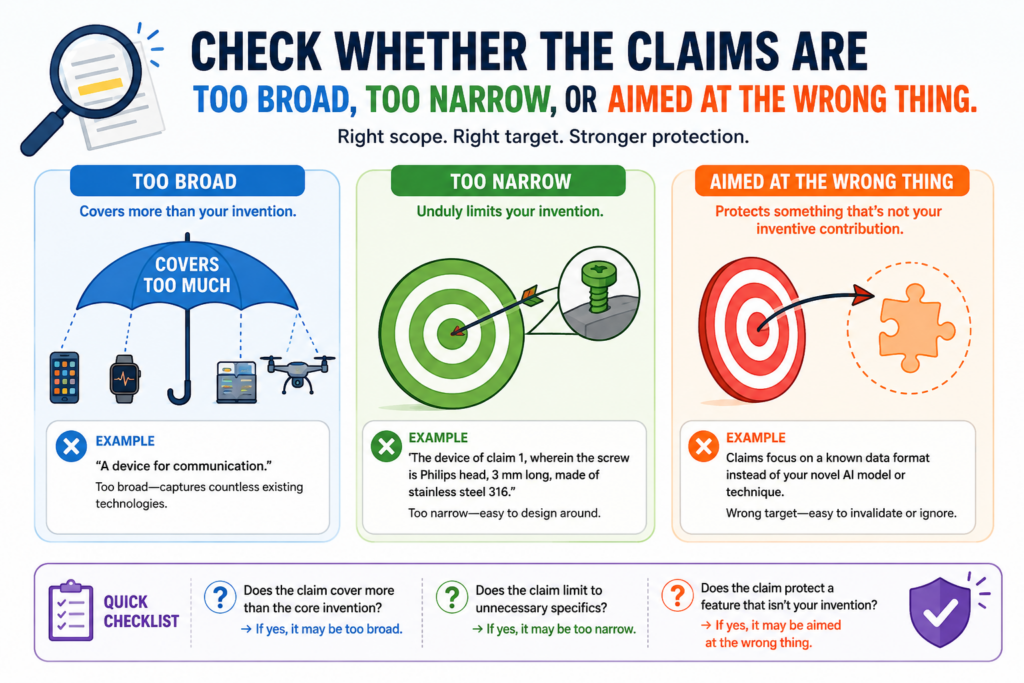
AI tools can generate claims quickly, but fast claims are not always strong claims. Some are too broad and easy to reject. Some are too narrow and easy to avoid. Some sound technical, but they point at the wrong feature.
Your job in the review is not to become a patent lawyer. Your job is to spot whether the claims match the business value of the invention.
A broad claim can sound powerful while creating hidden risk.
Founders often like broad claims because they sound big. A claim that covers “using artificial intelligence to improve software testing” may feel strong.
But broad words can be dangerous when they are not backed by clear detail.
A claim that is too broad may run into older work. It may look like something other people have already done. It may be hard to defend because it does not show the special step your team created.
The draft should claim the invention in a way that is wide enough to matter, but not so wide that it loses touch with the real system.
This balance is hard, and AI may not get it right without careful review.
Look for claims that use large words without support. Words like “optimize,” “automate,” “predict,” “recommend,” and “analyze” can be useful, but only when the draft explains how the system does those things.
A claim should not feel like a slogan. It should feel like a clear boundary around a working idea.
A strong claim should protect the move that makes the product hard to copy.
When you read each claim, ask what a rival would need to do to avoid it. If the answer is “they could change one small step,” the claim may be too narrow.
If the answer is “this claim covers almost every AI system in the field,” the claim may be too broad.
The best claims often protect the key move. That move may be how data is cleaned before it enters the model. It may be how the system chooses between two models.
It may be how the system checks its own output. It may be how the tool turns a user action into a better prediction.
For an AI company, the valuable invention is often not “we use AI.” Many teams use AI. The value is usually in the data path, the model setup, the feedback loop, the safety check, the user action, the training method, or the system design.
If the claims miss that value, the draft may look good but protect the wrong thing.
A narrow claim can quietly give away the bigger idea.
A claim can also be too small. This happens when the AI draft copies the current product too closely.
It may claim one exact screen, one exact model, one exact file type, one exact order of steps, or one exact hardware setup.
That may feel accurate, but it can trap your protection inside the first version of your product. Startups change fast.
Your first build is not always your final build. If your patent draft only protects today’s version, it may fail to protect the invention you build six months later.
This is a common risk when the draft is based only on a product spec, ticket, or demo script. The AI may describe the current implementation in detail, but not the bigger idea behind it.
The review should separate the invention from the first build.
Ask your engineers what parts could change without losing the core idea. Could you use a different model? Could the data come from another source? Could the same method work in another field?
Could the system run in the cloud instead of on a local machine? Could the user be a doctor today and a lab manager later?
These questions help you find the broader invention hiding inside the first version. They also help you add fallback options to the draft.
A good draft should cover the current product, but it should also leave room for likely changes.
This does not mean you should make wild claims. It means the draft should explain practical versions of the idea. It should show enough range so the patent does not become stale before the product grows.
PowerPatent is built for this exact problem. Founders need speed, but they also need a smarter way to catch claim risk before filing.
The mix of AI drafting and attorney review helps teams avoid the common trap of filing something that sounds complete but misses the future value. Learn more here: https://powerpatent.com/how-it-works
Make sure the draft explains the technical “how,” not just the business result.
A patent draft should not read like a pitch deck. A pitch deck sells the outcome. A patent draft should explain the working method. This is where many AI-generated drafts fall short.
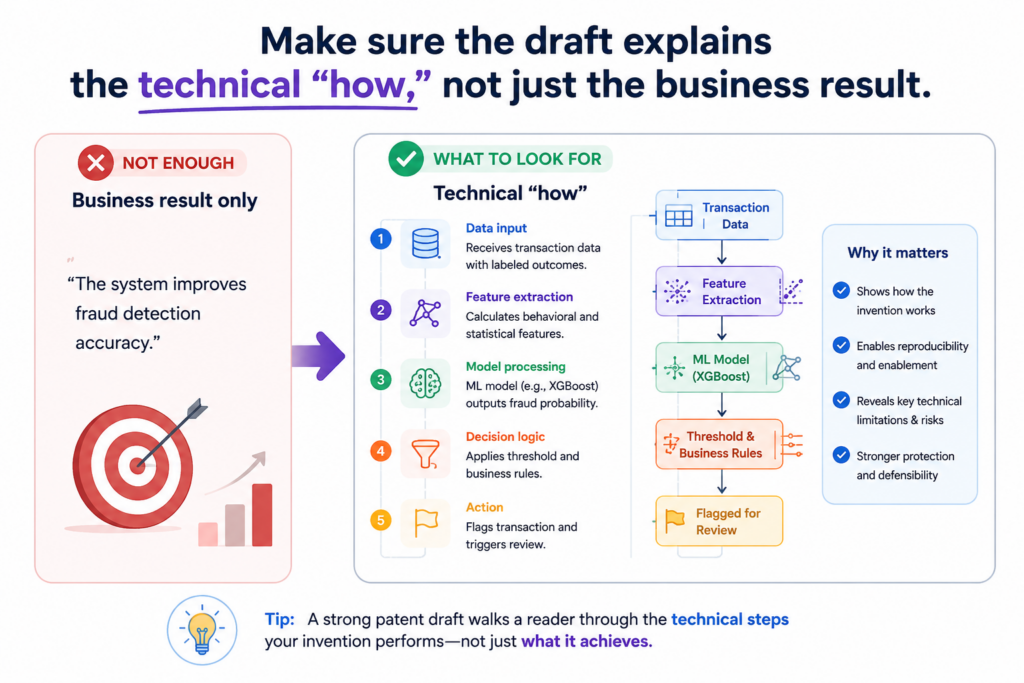
AI is very good at writing clean business language. It may say the invention “improves accuracy,” “reduces cost,” “saves time,” or “enhances performance.” Those may be true. But they do not show the invention clearly enough.
A strong draft should explain how the system gets that result. It should walk through the parts, the flow, the decisions, and the logic in plain but specific language.
The reviewer should hunt for empty outcome words.
When you read the draft, slow down every time you see a result word. Words like “improved,” “better,” “faster,” “safer,” and “more accurate” need support. The draft should not just claim those gains. It should explain what causes them.
For example, “the model improves fraud detection” is not enough. A stronger draft may explain that the system groups transactions by behavior type, compares new activity to a rolling pattern, weighs unusual events based on account age, and sends uncertain cases to a second model before making a final call.
That kind of detail shows the invention in action. It also gives the patent team more material to work with.
AI drafts often need this second layer. They may create a nice summary, but skip the working details because the source notes did not include them. That does not mean the invention is weak. It means the draft needs a better review.
The best details often live inside engineering choices.
Founders should bring engineers into the review early. The person who built the system may know details that never made it into the first draft. They may know why one model was chosen over another.
They may know why the system rejects certain data. They may know why a certain threshold matters. They may know how the tool handles edge cases.
These details can be gold. They help show that the invention is not just an idea. It is a working system with real choices behind it.
Ask the builder to explain the invention out loud as if teaching a new teammate.
Then compare that explanation to the draft. Anything important that was said out loud but does not appear in the draft should be added or flagged for review.
This is one of the simplest ways to catch missing risk. The draft should match the real build, not just the founder’s short summary.
Review the draft for missing versions, backups, and future product paths.
A patent draft should not protect only the happy path. It should also cover the other ways the invention may work. This is important because your startup will change.
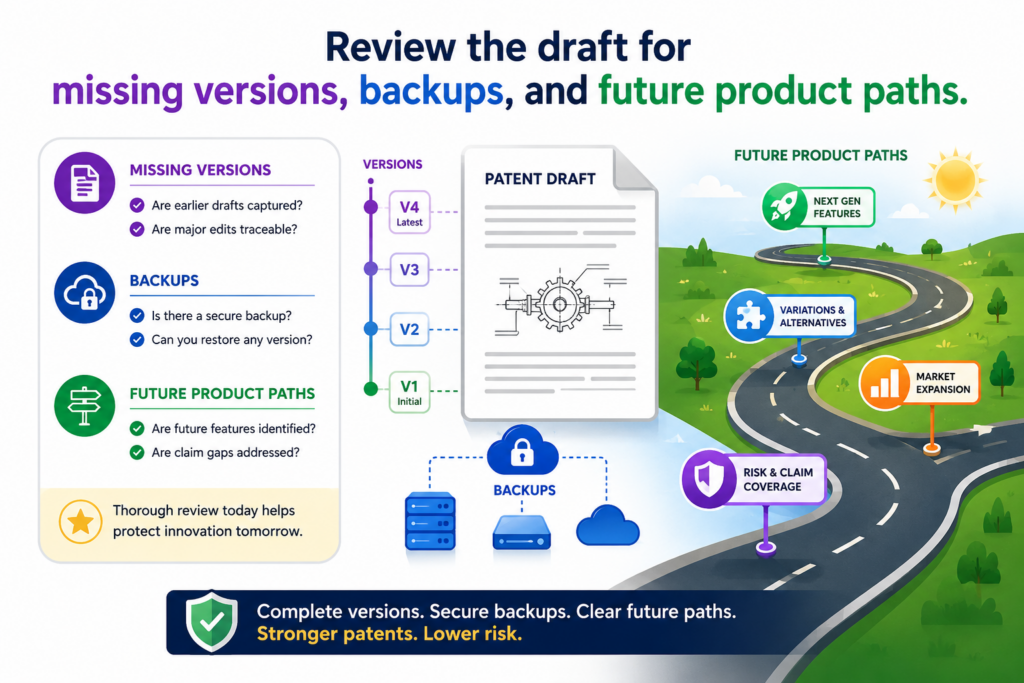
Your customers will ask for new features. Your team will swap tools. Your model may be updated. Your data may shift.
If the draft only describes one perfect setup, it may leave too much space for others to design around it. It may also fail to protect your own future product.
AI-generated drafts can miss this because they often mirror the first input. If the prompt says the system uses a certain model, the draft may lock onto that model.
If the notes mention one customer type, the draft may focus only on that user. If the design doc shows one data source, the draft may ignore other sources.
Strong drafts explain useful alternatives without becoming messy.
You do not need to list every possible version in the world. That can make the draft bloated. But you should include the versions that are real, likely, or useful.
For example, if your current system uses a large language model, but your team may later use a smaller domain model, the draft should leave space for both.
If your product currently reviews contracts, but the same method could review insurance forms or medical notes, the draft may need language that supports those paths.
If the system now runs after a user clicks a button, but later may run in the background, that may also matter.
The review should ask what parts are fixed and what parts are flexible. A patent draft should be clear about the invention, but not so locked to the first build that it becomes easy to avoid.
A good review protects the startup’s roadmap, not only today’s demo.
Your draft should be checked against the product roadmap. This is a simple but powerful step. Many teams skip it because they treat the patent as a record of what already exists. That is too narrow.
A useful patent draft should also support where the product is going. If your roadmap includes new data types, new model flows, new user roles, or new deployment methods, those may need to be reflected in the draft.
This does not mean claiming things your team has not thought through. It means making sure the patent draft does not ignore the natural next versions of your own work.
The founder should read the draft with one eye on the current build and one eye on the next release.
The engineer should check whether the draft covers likely changes in the stack. The patent reviewer should help decide which versions belong in the filing.
That is the kind of review PowerPatent is designed to support.
The software helps move fast, while attorney oversight helps make sure the draft is not boxed into one narrow product snapshot. See the process here: https://powerpatent.com/how-it-works
Check whether the draft gives enough support for each claim.
A claim should not stand alone. The rest of the patent draft should support it. Think of the claims as the fence, and the description as the ground holding the fence posts. If the ground is weak, the fence may not hold.
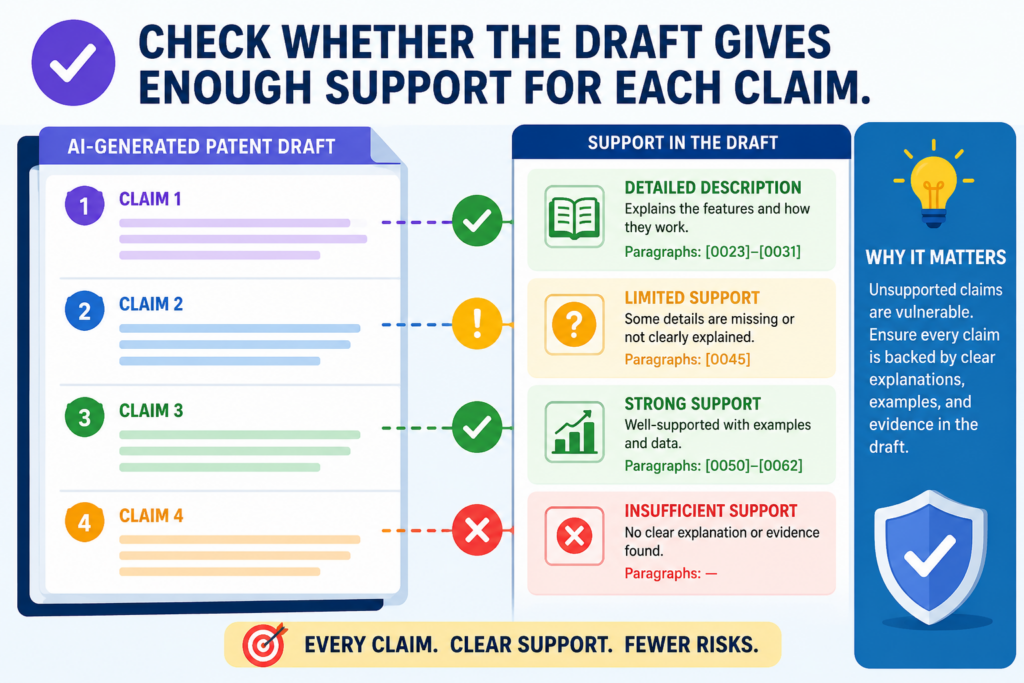
This is a major risk in AI-generated drafts. The claims may include useful words, but the description may not explain those words enough. That gap can cause trouble later.
When reviewing, do not read the claims by themselves. Pick a key phrase from a claim and search for where the draft explains it. If the phrase appears only in the claim, or only in a shallow way, flag it.
Every important claim term should be explained in the body.
Suppose a claim says the system uses a “confidence-based routing engine.” That may sound useful.
But the draft should explain what confidence means, how it is measured, what gets routed, where it gets routed, and why that step matters.
If the body only says “the system may use confidence-based routing,” that is not enough. The draft is repeating the term, not teaching it.
A stronger draft gives a plain example. It may explain that when the first model produces a result below a set confidence level, the system sends the case to a second review process, a second model, a human reviewer, or a stored rule set. That gives the claim real support.
This review step is slow, but it is worth it. It catches weak spots that are easy to miss when the draft sounds polished.
Support should be clear enough that another technical person can follow it.
The draft does not need to include source code. It does not need to expose trade secrets that should stay private.
But it should explain the invention well enough that a technical reader can understand how the claimed system works.
If the draft uses broad terms, it should give examples. If it names a module, it should explain what that module does. If it describes a model, it should explain the model’s role in the flow.
If it mentions training, it should explain what kind of data is used and what the training is meant to improve.
This is where a founder should be careful with AI text. AI may create clean labels for parts of the system that your team never named.
That can be fine, but those labels must be tied to real function. A made-up module name with no clear explanation can make the draft harder to trust.
A practical review should mark each claim phrase that feels vague, then ask whether the body gives enough detail. If not, add the missing explanation before the draft moves forward.
Review examples as if they are proof, not decoration.
Examples are easy to skip because they often sit in the middle of the draft and feel less important than the claims. That is a mistake.
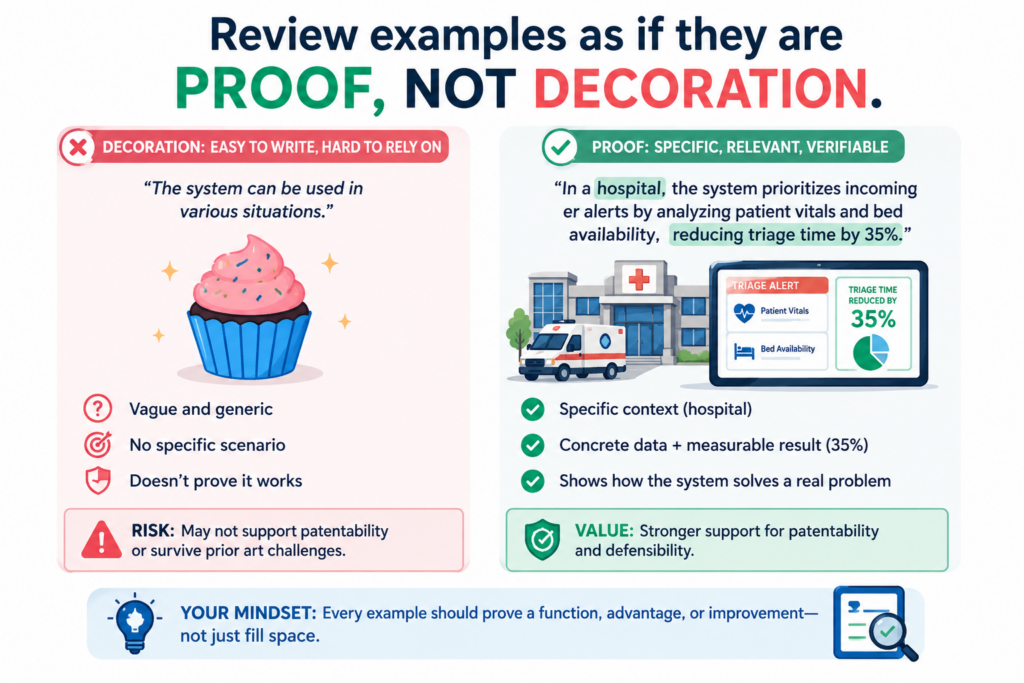
In an AI-generated patent draft, examples can reveal whether the tool truly understood the invention or only filled space with safe-sounding text.
A strong example does more than show one use case. It helps explain how the invention works in real life. It shows the inputs, the steps, the decision points, and the output.
It gives the draft weight. It also helps your attorney see where the protection should be stronger.
The examples should match how your product really works.
Start by reading the examples like a customer story. Ask whether the example could happen inside your real product.
If it feels fake, loose, or too generic, mark it. AI often creates examples that sound normal but are not tied to your actual system.
For example, a draft for an AI code review tool may say the system “reviews software and finds errors.” That is too thin.
A better example may show how the tool receives a pull request, checks changed files, maps the code to known risk patterns, compares the output against past fixes, and then gives the developer a ranked list of issues.
That kind of example is much more useful. It makes the invention easier to understand. It also helps show why the system is not just another generic AI tool.
A founder should ask one direct question while reading each example: would this example help someone understand why our invention is different? If the answer is no, the example needs work.
Good examples should show the hard part, not only the happy ending.
The strongest examples often show the messy part of the invention. They show how the system handles missing data, unclear inputs, low confidence results, bad user entries, model drift, or edge cases. These are the places where real engineering lives.
AI drafts often avoid mess. They prefer clean stories. But clean stories may hide the most valuable part of your work.
If your system solves a hard problem, the example should show that hard problem. If your tool works when data is noisy, the draft should say how.
If your model handles a rare case better than older tools, the draft should explain what happens in that case.
Do not let the example end with a vague line like “the system then provides an improved result.” That is not enough. The draft should explain what result is created, how it is used, and why that result matters.
This is one place where PowerPatent can help founders move faster without losing control. A smart draft is only the start.
The review process should help you sharpen the real story of the invention before filing. You can explore the process here: https://powerpatent.com/how-it-works
Check whether the drawings explain the invention clearly.
Drawings are not just pictures. They are a map of the invention. Even when the invention is software or AI, drawings can help show how data moves, how parts connect, and how decisions are made.
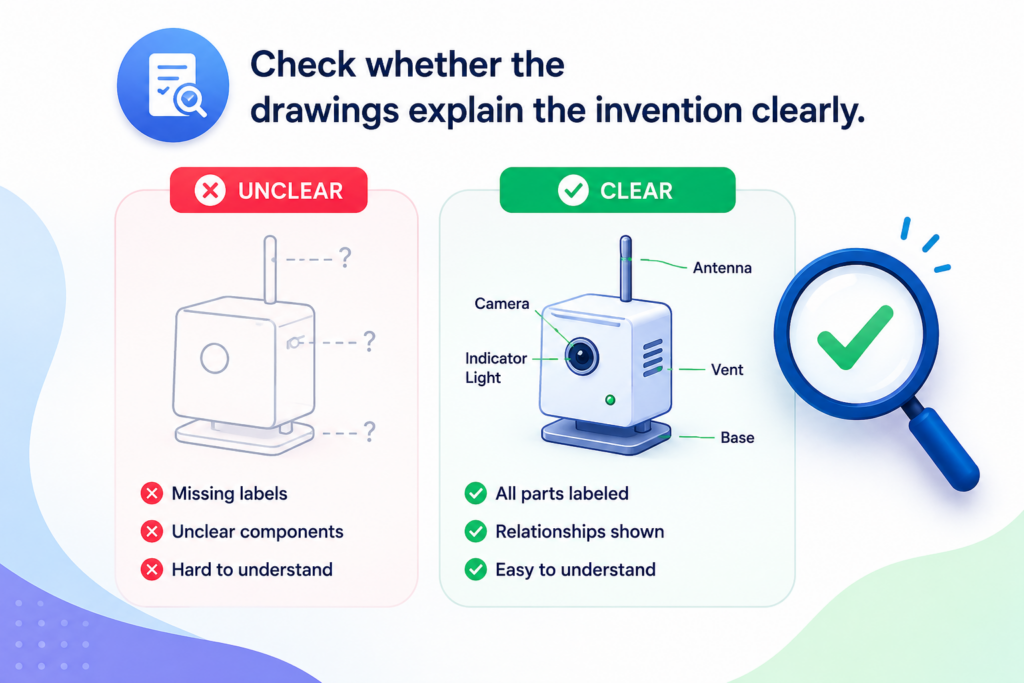
AI-generated drafts may include figure descriptions that sound fine, but the drawings or figure text may not truly match the invention. This creates risk.
A reader may struggle to understand the system. An attorney may have less support to work with. A patent examiner may miss what makes the invention different.
A useful drawing should make the system easier to explain.
Look at each drawing and ask whether it helps you explain the invention to a smart teammate.
If the drawing only shows a box labeled “AI engine,” it may be too shallow. If it shows ten boxes with no clear flow, it may be too confusing.
A good drawing should show the main parts of the system and how they work together.
It should show where data comes in, what happens to it, where the model fits, how the output is checked, and how the user or another system receives the result.
For AI inventions, a helpful drawing may show training data, input data, a model, a scoring step, a feedback loop, and an output action.
It does not need to show every tiny part. It should show the parts that matter for understanding the invention.
The drawing should also match the claims. If a claim talks about a routing engine, a validation step, or a feedback module, the drawings should help support those ideas. If the figures ignore key claim parts, flag that gap.
The figure text should not fight the drawing.
The draft should describe each figure in a way that matches the actual picture. This sounds basic, but AI drafts can get this wrong.
A figure description may mention parts that are not in the drawing. It may skip parts that are shown. It may use different names for the same item.
This creates friction. It makes the draft feel less careful. It can also create confusion later.
During review, compare every drawing label to the written description. If the drawing says “risk scorer” and the text says “confidence module,” decide whether they are the same thing.
If they are the same, use clear and steady wording. If they are different, explain the difference.
Founders should not treat this as cosmetic. Clear drawings help the whole patent feel stronger. They make the invention easier to teach. They also make review faster for the attorney.
A clean draft is not just about nice writing. It is about clear support.
That is why PowerPatent focuses on both speed and review quality, so founders can move fast without sending out a draft full of hidden gaps. Learn more here: https://powerpatent.com/how-it-works
Review the draft for prior art risk before you fall in love with it.
Prior art means earlier work that may be close to your invention. You do not need to use that term with your team if it feels too legal. Just think of it as old stuff that may already exist.
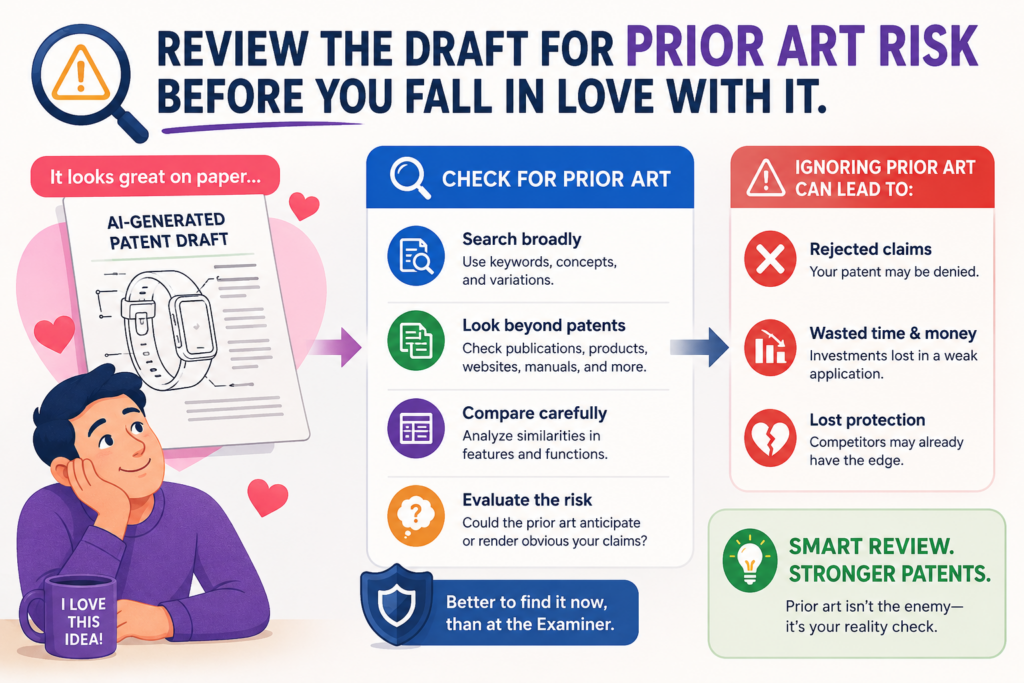
This is a serious risk with AI-generated drafts because the draft may make your invention sound more new than it is. AI is built to write with confidence.
It may present a common feature as if it is special. It may describe an old workflow in fresh words. That can make the draft feel stronger than it really is.
The draft should separate what is known from what is new.
A strong review asks what parts of the system are standard and what parts are truly yours. This matters because a patent draft should not act like every part is new.
Many inventions combine known parts in a new way. That can be fine. But the draft needs to focus attention on the new part.
For example, storing data in a database is usually not the invention. Sending an alert may not be the invention. Using a machine learning model may not be the invention by itself.
The invention may be the way your system chooses the data, trains the model, checks the output, adapts to user feedback, or links the prediction to a real action.
If the AI draft treats basic parts as the breakthrough, the claims may point in the wrong direction. The draft may also be harder to defend because it spends too much energy on things others already know.
The review should mark each feature as common, improved, or central. You do not need a long chart. You need a clear sense of what deserves focus.
A quick search can reveal weak spots before they become expensive.
Before filing, your team should look at close products, papers, public docs, and older patents in the same area.
This does not replace attorney review. It helps you become a better reviewer.
Search for the main result your invention provides. Then search for the technical method. Then search for the key input, output, and model flow. You are looking for anything that sounds close enough to make you nervous.
When you find close work, do not panic. Use it to sharpen the draft. Ask how your system is different.
Ask what technical choice your team made that the older work did not make. Ask whether the claims need to point more clearly at that difference.
This step is powerful because it turns fear into focus. Instead of hoping the draft is new, you start proving where it is different.
PowerPatent helps founders avoid blind filing. The platform gives teams a faster way to organize invention details and work with real patent attorneys who can help spot risks before they become costly delays. See how it works here: https://powerpatent.com/how-it-works
Watch for AI hallucinations that sound useful but are not real.
An AI-generated draft may include details your team never built, never tested, or never planned. These details can sound helpful.
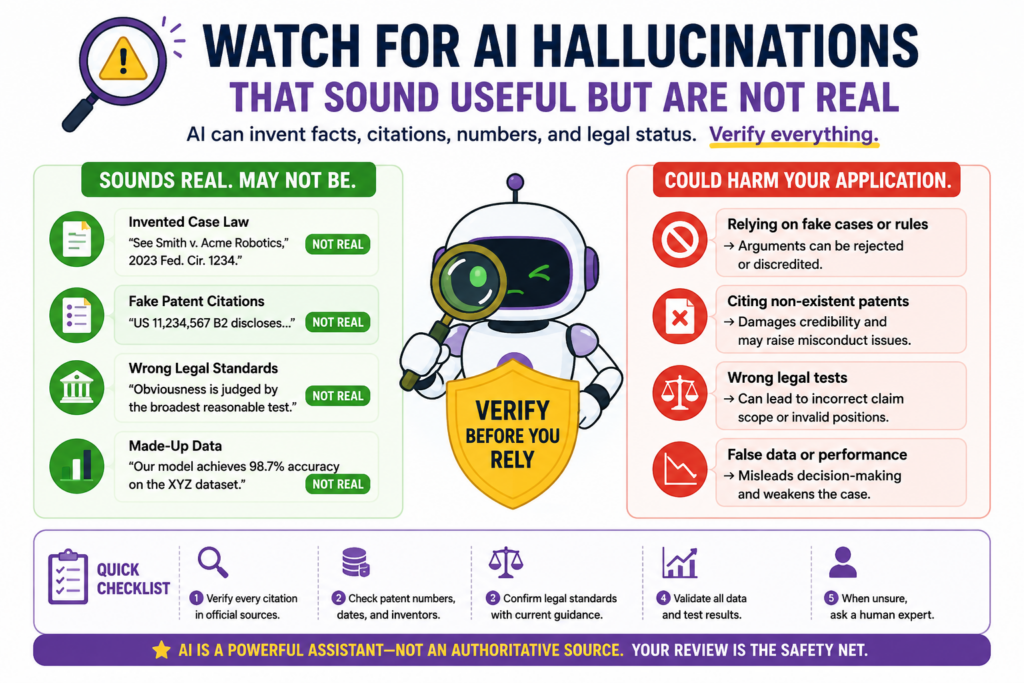
They may even make the invention look broader. But they can create risk if they are not grounded in your real work.
A patent draft should not be fiction. It should be clear, careful, and tied to what your team has actually invented or reasonably worked out. When AI adds made-up parts, the draft may become harder to trust.
Every technical detail should pass the engineer test.
Give the draft to the person closest to the build. Ask them to mark anything that feels false, strange, or overstated.
This includes model types, training data, sensors, databases, user actions, system parts, security steps, and performance claims.
AI may add a neural network where you used rules. It may describe real-time processing where your product runs in batches.
It may say the system uses user feedback when you have not built that loop. It may claim the model was trained on a certain kind of data that you do not have.
These errors matter. They are not simple wording issues. They can change the shape of the invention. They can also distract from the real point.
A good review should remove made-up details or rewrite them as optional versions only when they are truly reasonable and supported. Do not keep a detail just because it sounds impressive.
The draft should be ambitious without becoming untrue.
There is a real balance here. A patent draft should not be so narrow that it only covers one tiny version.
But it should not stretch into fantasy. The best draft explains the real invention and the likely versions your team can support.
When you see a detail that is not in the current product, ask whether your team has actually thought it through.
Could an engineer explain how it would work? Is it a natural version of the invention? Does it fit the same core idea? If yes, it may belong in the draft. If no, it should be cut or revised.
This protects your credibility. It also keeps the patent focused.
AI is useful because it can help you move faster from rough notes to a working draft. But the review must bring the draft back to reality.
That is why the best patent workflow is not AI alone. It is AI plus founder input, engineer review, and attorney oversight.
Check ownership before the draft becomes part of your filing plan.
AI can help write the draft, but it cannot know who truly created the invention unless your team gives it the right facts. This is a quiet risk.
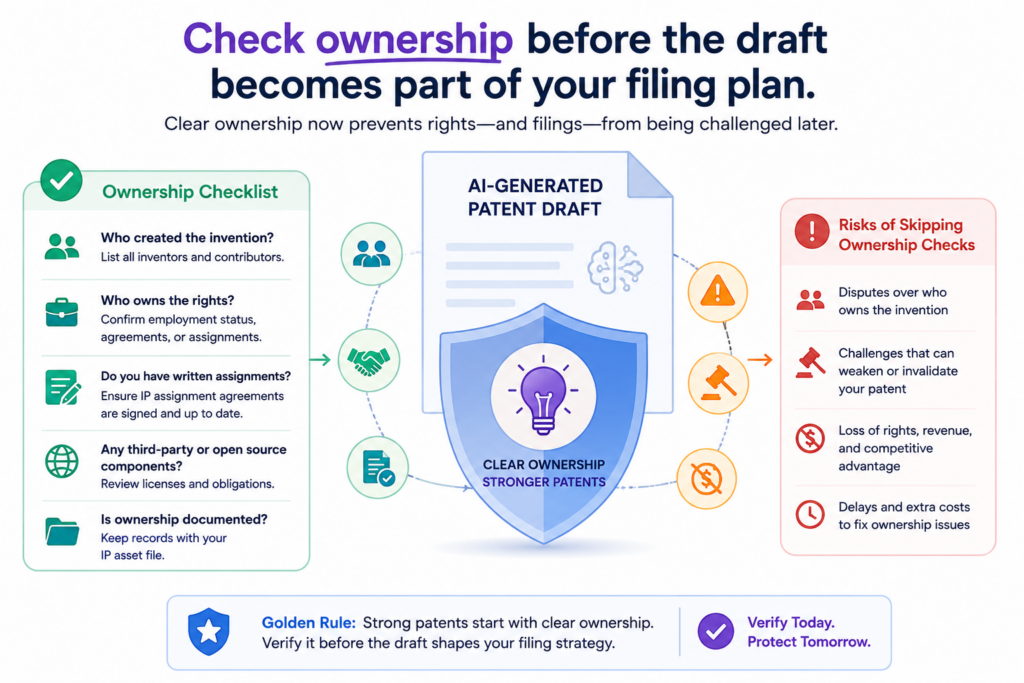
A draft may name the wrong people, leave out a key builder, or assume that the company owns everything when the paper trail is not clean.
For a startup, this is not a small detail. If the wrong people are listed, or if ownership is unclear, the patent can become harder to use later.
That can matter during fundraising, diligence, a sale, a license deal, or a dispute with a former team member.
The review should not stop at the words in the draft. It should also check the people behind the invention.
The named inventors should match the real creative work.
An inventor is not just anyone who worked on the product. It is not always the founder, the manager, or the person who wrote the most code.
The key question is who helped create the actual inventive idea that the patent is trying to protect.
This is why the claims matter so much. The inventors should be checked against what the draft claims as the invention. If the claims focus on a model routing method, then the people who created that method need to be considered.
If the claims focus on a data cleaning process, then the people who shaped that process may matter. If the claims focus on a special user feedback loop, then the person who came up with that loop may need to be reviewed.
AI may draft a patent from a product note and skip this issue completely. It may place names into the draft based on who gave the prompt, not who made the invention. That is not enough.
A clean review asks who made the key leap.
The easiest way to check this is to gather the people close to the build and ask what the core idea was, when it was formed, and who helped form it. Do not turn this into a blame game or a credit fight. Keep it factual.
Ask who saw the problem first. Ask who proposed the technical answer. Ask who changed the method in a way that made it work.
Ask who added the step that made the system faster, safer, or more useful. Ask who only followed directions after the idea was already formed.
These answers help the attorney review inventorship with more care. They also help the company avoid painful clean-up later.
PowerPatent helps founders bring these facts together early, so the attorney is not guessing from a thin draft.
The platform is built to help teams move fast while still keeping the right human review in the loop. You can see how it works here: https://powerpatent.com/how-it-works
Review filing timing before public details create risk.
A patent draft is not only about what it says. It is also about when you file it. This is a major point for startups because founders move fast.
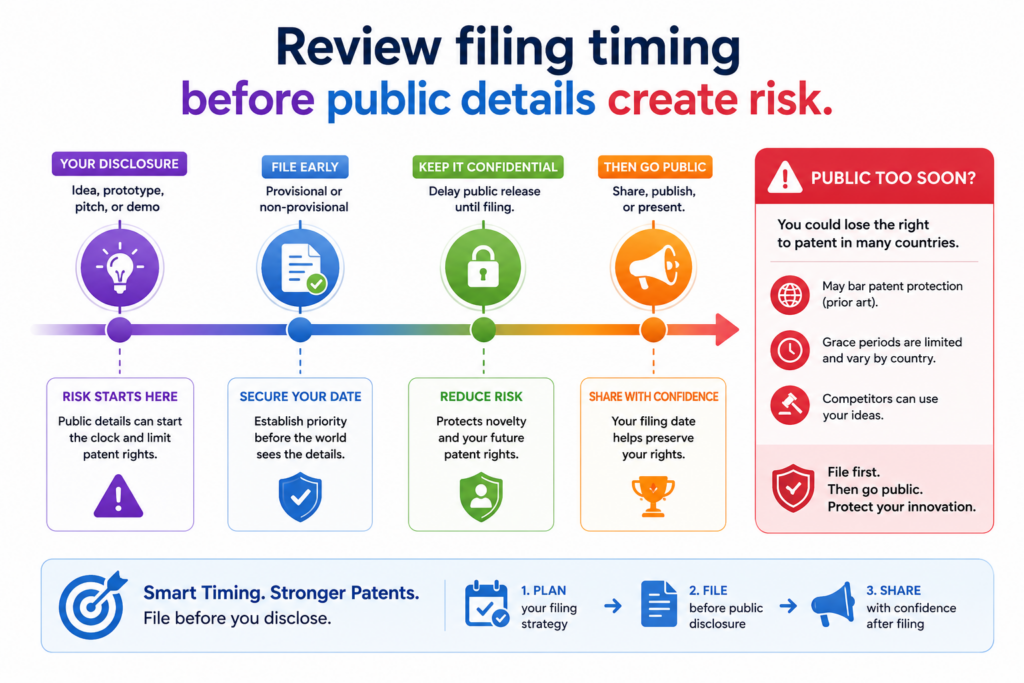
They pitch. They demo. They post. They share decks. They publish papers. They talk to customers. They launch beta programs.
All of that can be good for the business, but it can create patent risk if the invention is shared before the filing plan is clear.
An AI-generated draft may look ready, but timing can still hurt you. You need to review what has already been disclosed and what is about to be disclosed next.
The draft should be checked against demos, decks, posts, and launches.
Start with the public story of the invention. Has your team shown the feature in a demo? Has it been described on your website? Did a founder post a thread about how it works?
Did a conference talk explain the system? Did a customer pilot include technical details? Did an investor deck show the workflow?
These facts matter because a patent filing should be planned around what the world already knows and what it will know soon.
If a launch is coming in two weeks, the draft may need faster review. If the invention was already shown months ago, the attorney needs to know that before filing strategy is set.
If your team shared only the benefit but not the technical method, that may be different from sharing the full inner flow.
A simple disclosure check can save a lot of stress.
When reviewing the draft, create a clean timeline in plain English. Write when the idea was first formed. Write when the first working version was made.
Write when it was first shown outside the company. Write what was shared. Write who received it. Write whether there was any agreement in place.
This does not need to be fancy. It needs to be honest and clear.
Then compare that timeline to the patent draft. If the draft includes details that were already public, flag them. If it includes details that are not yet public, mark them as sensitive.
If a public launch is coming, make sure the filing plan is reviewed before that launch happens.
Founders often wait too long because patents feel slow. PowerPatent is designed to remove that friction.
Smart software helps turn invention details into a draft faster, while real attorney oversight helps check timing risk before the startup moves into the open. See the process here: https://powerpatent.com/how-it-works
Check whether the draft protects the business model, not just the technical feature.
A patent is not a trophy. It should help protect something that matters to the business.
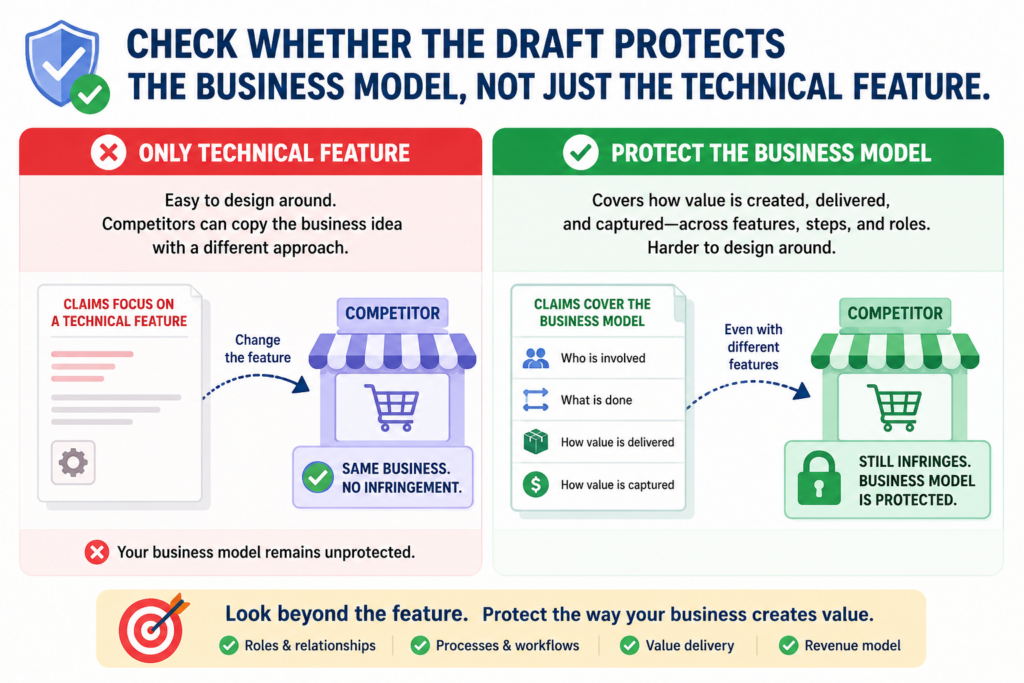
That may be a product feature, a data advantage, a workflow, a model process, a customer-facing action, or a system that makes the company hard to copy.
AI-generated drafts can miss this. They may describe the technical feature but fail to connect it to how the company wins. The result is a draft that sounds smart but does not protect the startup’s strongest position.
During review, founders should ask whether the patent draft maps to the business plan.
The draft should focus on what makes copying painful for rivals.
Not every technical detail deserves equal weight. Some parts are normal. Some are helpful but easy to replace.
Some are central to the company’s edge. A strong patent draft should spend more energy on the central parts.
For example, a startup may have an AI tool that helps factories predict equipment failure. The business value may not be the dashboard. It may be the way the system learns from sparse sensor data across different machine types.
Or it may be the way it turns noisy signals into a ranked repair plan. Or it may be the way it updates the prediction after a technician confirms the cause.
If the draft focuses mostly on showing alerts on a screen, it may miss the deeper value. That kind of mistake is common when AI writes from product language instead of invention language.
A business-aware review asks what must stay protected as the startup grows.
Look at your roadmap, sales story, and moat. Ask which parts customers care about most. Ask which parts would hurt most if a competitor copied them.
Ask which parts make the product cheaper, faster, safer, or easier to scale. Ask which parts make your data more valuable over time.
Then read the draft again. The strongest business value should be easy to find. It should appear in the claims, the examples, and the system description. It should not be buried on page twelve as a side note.
This does not mean turning the patent into a pitch deck. It means making sure the technical protection matches the company’s real edge.
PowerPatent helps founders make this connection earlier. The goal is not just to create a patent document.
The goal is to help the company protect what it is actually building toward. Learn more here: https://powerpatent.com/how-it-works
Review the draft for words that create needless limits.
Small words can create big problems. An AI-generated draft may use words that make the invention seem narrower than intended.
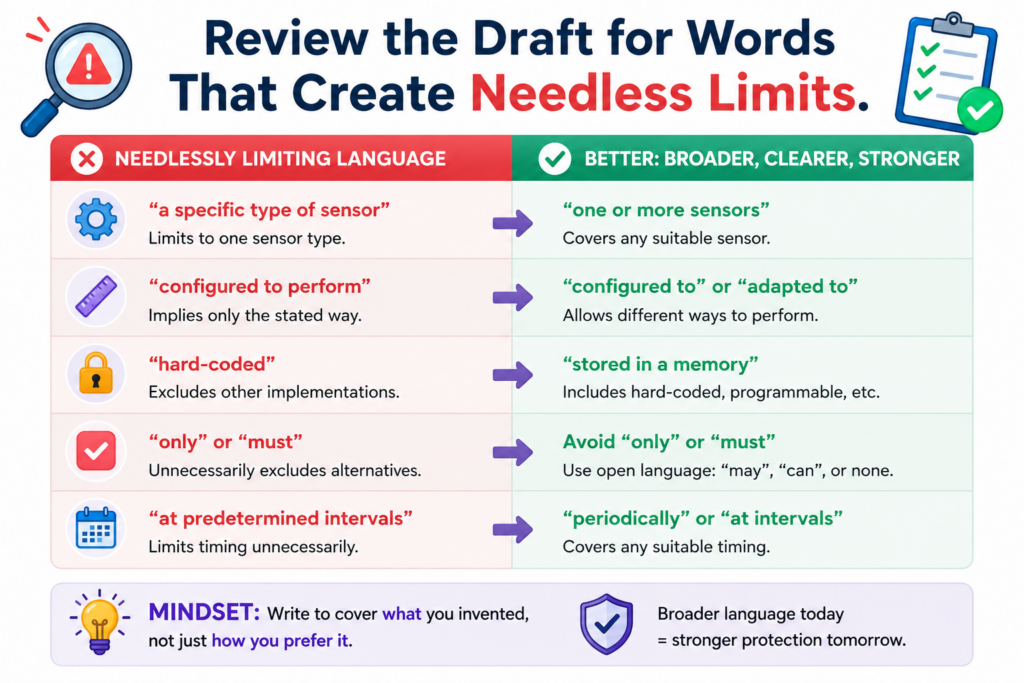
These words may not look dangerous during a quick read. They may even make the draft sound clear. But they can quietly lock the invention to one version.
This is why language review matters. Not grammar. Not style. Meaning.
A founder should look for words that make the draft too fixed, too absolute, or too tied to today’s build.
The draft should avoid locking the invention to one tool, one order, or one setting unless that limit matters.
Words like “must,” “always,” “only,” “required,” and “the invention is” should be reviewed with care. They are not always wrong, but they can create limits.
If the draft says the model always receives data from one source, a rival may use another source.
If it says the system must process steps in one order, a rival may change the order. If it says the tool only works in healthcare, a rival may apply the same method in finance or manufacturing.
The review should ask whether each limit is truly part of the invention. Some limits are important. If the invention depends on a certain order of steps, then that order should be stated.
If the invention needs a certain type of signal, that should be clear. But if the limit is just a current product choice, the draft may need broader wording and better examples.
Strong wording keeps the core firm and the details flexible.
Good patent drafting often protects the main idea while giving room for different versions. That means the draft should be clear about the core method, but careful with details that may change.
For example, instead of making the invention depend on one named model, the draft may describe a class of models, with the current model as one example.
Instead of tying the system to a mobile app, it may explain that the user interface can be a web app, mobile app, admin console, or system-to-system interface.
Instead of limiting the invention to one data format, it may describe different formats that can carry the same needed information.
This is not about being vague. It is about being accurate. The draft should tell the truth while not shrinking the invention by accident.
AI tools can write with confidence, but they may not know which product choices are fixed and which are flexible. That judgment needs founder input, engineer review, and attorney guidance.
Check whether the draft explains why the invention is better in a concrete way.
A draft that says the invention is better is not enough. It should explain why. It should show what problem existed, what the old way struggled with, and how the new system improves the result.
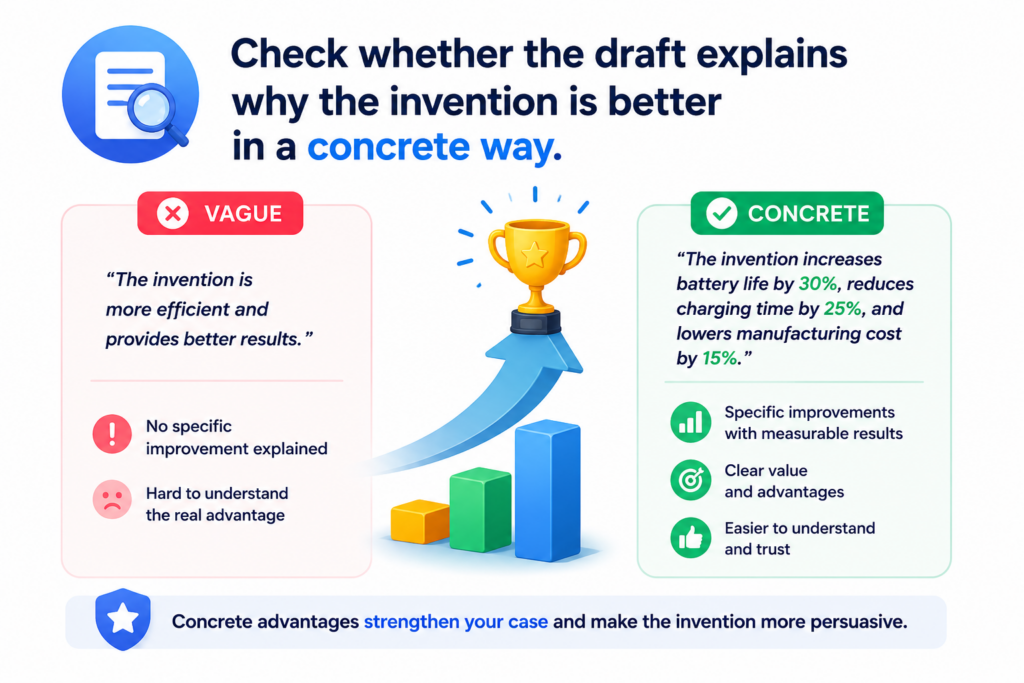
This does not need to be dramatic. It needs to be clear. The improvement should be tied to the technical design, not just the business result.
Many AI drafts use broad improvement words. They may say the invention is faster, more accurate, more secure, or more efficient. Those words can be useful, but only when the draft supports them with real reasons.
The improvement should connect to a specific technical choice.
Suppose a draft says an AI system reduces false alerts. That is a good benefit, but the review should ask how the system does that. Does it use a second model for uncertain cases?
Does it compare the prediction to past user corrections? Does it group signals by context before scoring them? Does it ignore low-quality inputs? Does it adapt the threshold based on risk level?
A concrete improvement gives the draft more strength. It helps show that the invention is not just a goal. It is a working answer to a real problem.
The same idea applies to speed. If the draft says the system works faster, explain why. Maybe it filters data before model processing.
Maybe it caches certain outputs. Maybe it splits large jobs into smaller tasks. Maybe it uses a lighter model for simple cases and a heavier model only when needed.
The best benefit language sounds measured, not inflated.
Avoid hype. A patent draft does not need to say the invention is revolutionary. It needs to show the real gain in a way that a technical reader can believe.
If you have test data, benchmarks, or customer results, those may help the attorney decide what to include.
If you do not have numbers yet, the draft can still explain the expected benefit based on how the system works. The key is to avoid empty claims.
A founder should mark any sentence that sounds like marketing and ask whether it should be supported, toned down, or removed. The draft should still be persuasive, but it should persuade through clarity.
This is one reason PowerPatent is useful for technical teams. It helps turn rough invention details into a more structured draft, while attorney oversight helps keep the language grounded and useful.
See how PowerPatent works here: https://powerpatent.com/how-it-works
Build a simple claim chart so you can see what each claim really covers.
A claim can feel clear when you read it once, but the risk often shows up when you break it apart. This is where a simple claim chart helps.
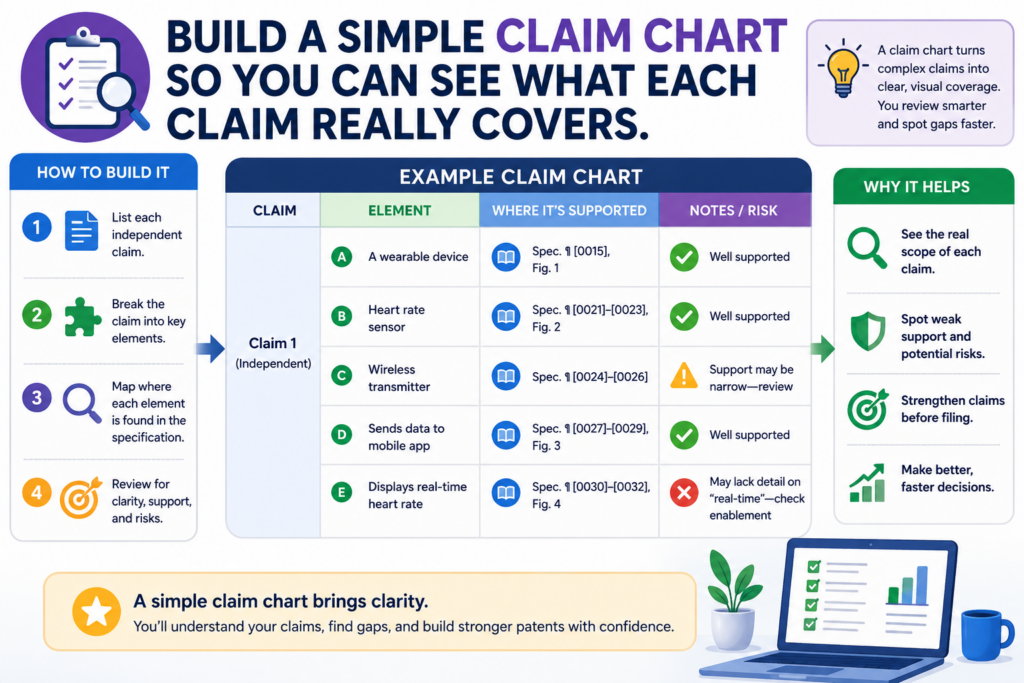
You do not need legal training to make one. You only need to slow the claim down and ask what each part means in the real product.
Think of the claim as a set of promises. The draft is saying, in effect, “This is what we want to protect.”
Your job is to check whether each promise matches the invention, has support in the draft, and matters to the business.
A claim chart helps you catch missing pieces before the attorney review. It also helps your team avoid vague talks like “the claims look okay.” That phrase is not useful.
A claim either maps to the real system or it does not.
A claim chart should connect each claim part to the product.
Start with one independent claim. Read the first phrase. Then find where that part appears in your product. If the claim says the system receives user input, ask what input that means.
If the claim says the system generates a score, ask what creates the score. If the claim says the system updates a model, ask when and how that update happens.
This is not busywork. It forces the draft to face the real invention. Many AI-generated claims look neat until you try to map them to the product.
Then you may find that a step is missing, a term is too broad, or a feature is described in a way your engineers would never say.
You may also find the opposite problem. The claim may include a small detail from the current build that does not belong in the main claim.
Maybe the claim says the system uses a certain file type, but the invention works with many file types. Maybe it says the user must click a certain button, but the action could be triggered in other ways.
The best chart makes weak claim language easy to spot.
For each claim part, write a plain note beside it. Say what it means in your product. Say where the draft explains it.
Say whether the part is core, optional, or too narrow. Keep the wording simple so a founder, engineer, and attorney can all follow it.
This makes the review more useful. Instead of saying “claim 1 feels broad,” you can say “claim 1 includes a required training step, but our product can work without training after deployment.”
Instead of saying “this sounds vague,” you can say “the phrase confidence signal is not explained in the description.”
That kind of feedback saves time. It gives the attorney real material to work with. It also helps the startup make better choices before filing.
PowerPatent is built for founders who want this kind of speed and control.
The software helps turn invention details into a strong working draft, while real attorney oversight helps catch the risks that software alone can miss. See how it works here: https://powerpatent.com/how-it-works
Hold an engineer review meeting before the draft goes too far.
A patent draft should not be reviewed only by the founder or only by the legal team. The people who built the invention need to read it too.
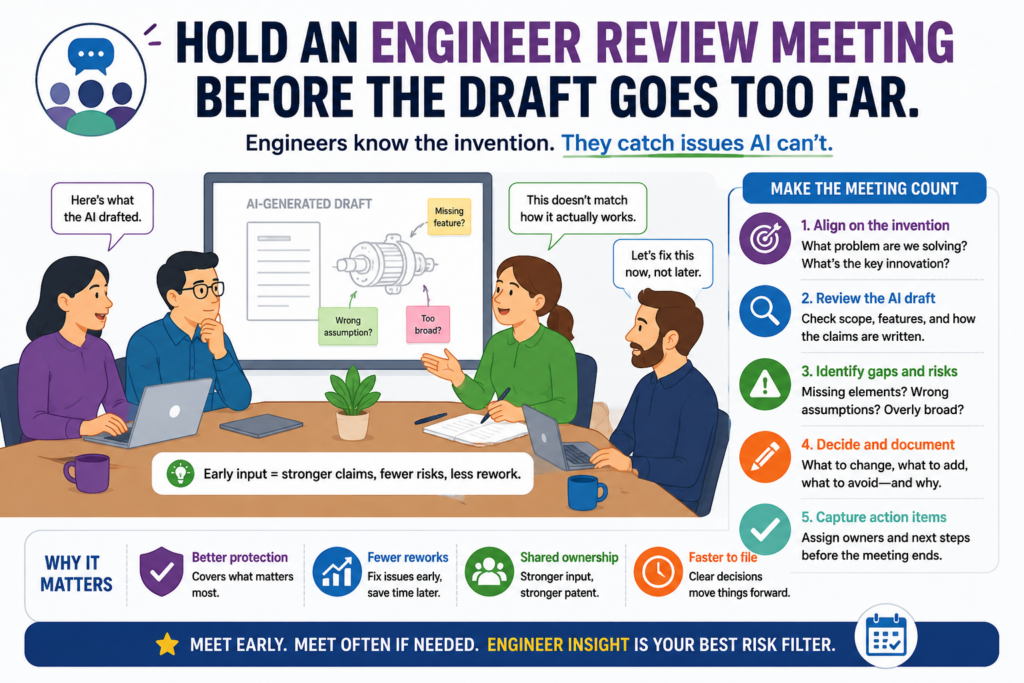
They know where the hard choices were made. They know which details are real, which are guesses, and which are not quite right.
This meeting does not need to be long or formal. It needs to be focused. The goal is to make sure the draft matches the invention before the wording becomes too polished to question.
AI-generated drafts can create a false sense of done. The pages look complete. The claims look official.
The examples sound smooth. But the draft may still miss the small engineering choices that make the invention worth protecting.
The engineer should review for truth, not style.
Ask the engineer to ignore whether the draft sounds like a patent. That is not their job. Their job is to check whether the draft is true, complete, and clear.
They should read the system flow and ask whether the steps happen in the right order. They should check whether the model is described correctly. They should check whether the input data is accurate.
They should check whether the draft adds parts that do not exist. They should also mark anything important that the draft leaves out.
This review is especially important for AI inventions because small technical choices can matter a lot. A model may not be the invention.
The invention may be how the model is selected, how the data is prepared, how the output is tested, or how the system reacts when the model is unsure.
If the draft only says “the AI model generates an output,” the engineer may know that the real value sits in the steps before and after that output.
The meeting should end with clear fixes, not loose comments.
Do not end the meeting with general notes like “make it more technical” or “add more detail.” Those comments are too broad. The review should produce specific fixes.
For example, the team might decide that the draft must add a missing validation step, remove a false training claim, explain how low-confidence outputs are handled, broaden the deployment options, or add an example for a key edge case.
This is how the draft gets stronger. Not by adding more words. By adding the right words.
A good engineer review also helps avoid later stress. When the attorney reviews the draft, they can see the real system more clearly. That makes the legal review sharper and faster.
This is the kind of workflow PowerPatent supports. It helps founders capture the invention while the details are fresh, then brings in attorney oversight so the filing is not based on a weak or unchecked draft. Learn more here: https://powerpatent.com/how-it-works
Review data and model details with extra care.
For AI inventions, the data and model details are often where the real risk sits.
The draft may say the system uses training data, input data, user feedback, embeddings, classifiers, prompts, rules, or model outputs. Each of these words needs care.
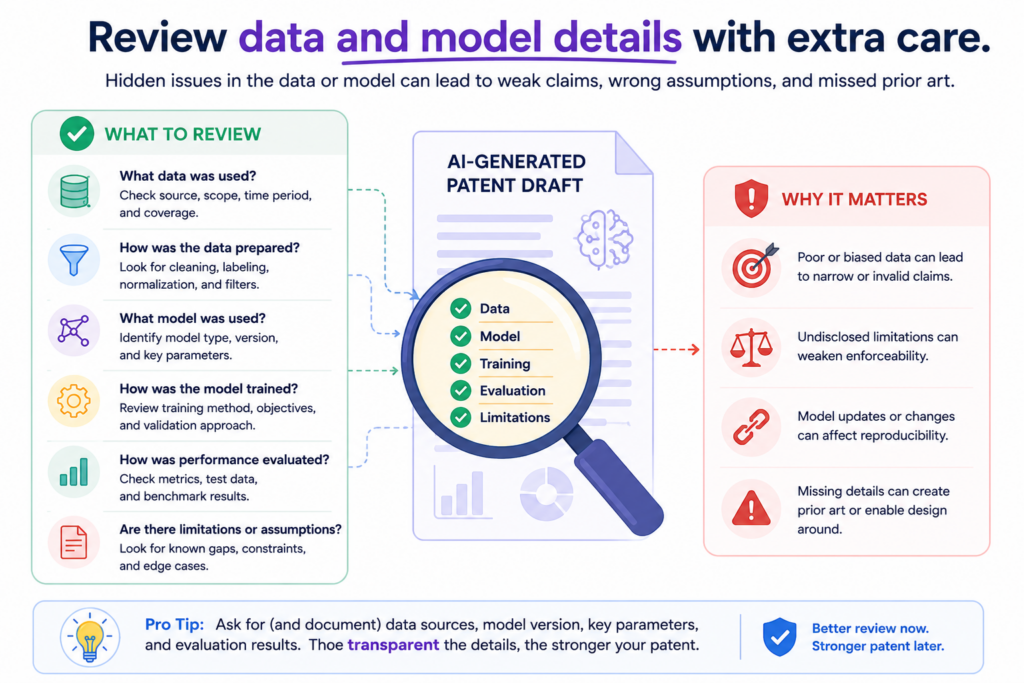
AI tools may write about data in a loose way. They may assume data exists. They may describe training that never happened.
They may say the system learns from users when it does not. They may use model names that are too narrow or too broad.
This matters because the patent draft should teach the invention in a way that is both useful and honest.
It should not expose secrets that do not need to be shared, but it should give enough detail to support the claims.
The draft should explain the role of the data, not just name it.
Do not be satisfied with a sentence that says the system “uses training data.” Ask what the data does. Does it train the model from scratch?
Does it tune an existing model? Does it help rank outputs? Does it create a user profile? Does it filter bad inputs? Does it compare a new case to old cases?
Those are different things. The draft should not blur them together.
The same is true for prompts and model instructions. If the invention uses a special prompt flow, the draft should explain the role of that flow without giving away private text that should remain secret.
If the system uses a model output as one step in a larger process, the draft should show that larger process.
Many startups do not need to claim the model itself. The model may be third-party, open-source, or replaceable. The invention may live in how the system uses the model. This is a key review point.
The model should not become a trap if it can change later.
Your draft should not lock the invention to one model unless that model choice is truly central. If your system works with a large language model today but may use a smaller model tomorrow, the draft should leave room for that.
If the invention can work with a neural model, a rules engine, or a hybrid system, the draft should explain that in a careful way.
This does not mean hiding the current setup. It means giving the current setup as one useful version while keeping the core idea clear.
Data details should also be reviewed for privacy and safety. Do not include customer data, private datasets, or sensitive training examples unless there is a strong reason and the attorney agrees.
A patent draft becomes public in many cases, so the team should be thoughtful about what it reveals.
PowerPatent helps founders organize these details before they become a mess.
The platform makes it easier to capture what matters, avoid loose AI language, and work with attorneys who can help protect the invention without exposing more than needed. See how it works here: https://powerpatent.com/how-it-works
Make the attorney handoff clean so the review is faster and sharper.
A patent attorney can do much better work when the handoff is clear. A messy handoff slows everything down. It also raises the chance that important details get missed.
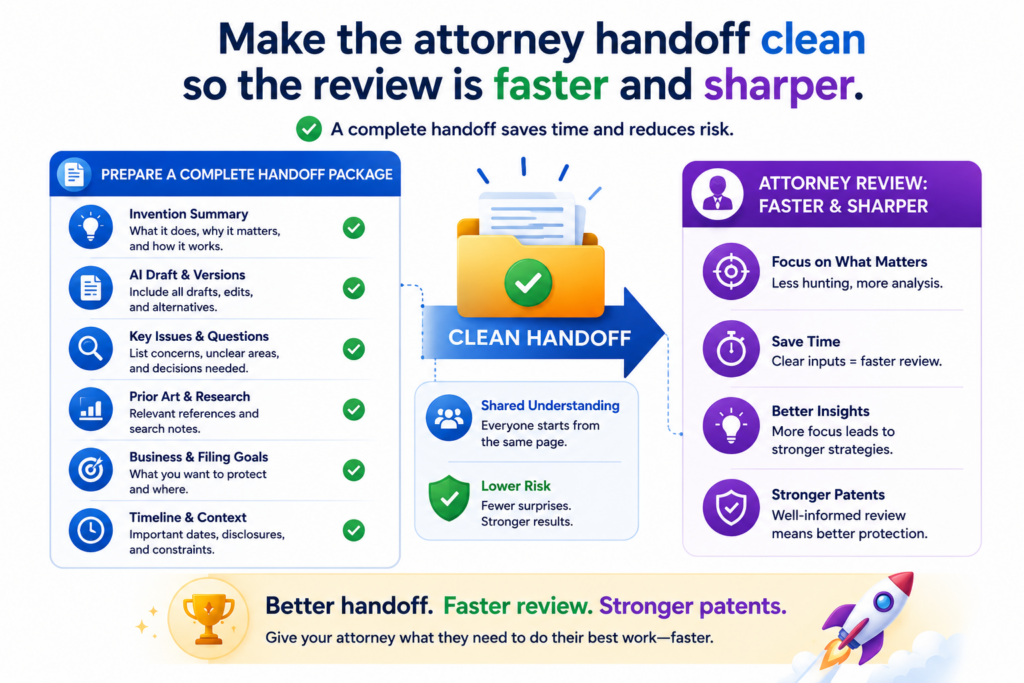
AI-generated drafts can create a strange problem here. Because the draft looks complete, the founder may send it over with very little context. That is risky.
The attorney needs to know what is real, what is optional, what is central, what has changed, and what the company plans to build next.
The draft is only one part of the handoff. The story behind the draft matters just as much.
The handoff should explain what the team believes is new.
Before sending the draft for attorney review, write a plain note that explains the invention in human words. Say what problem the team saw.
Say why old ways were not good enough. Say what your system does differently. Say which parts are most important to protect.
Keep this note simple. Do not try to sound legal. The attorney does not need buzzwords. They need the truth.
Also include the parts of the draft that made your team nervous. If a claim seems too broad, say so. If a model detail may change soon, say so. If an example feels weak, say so.
If a public demo already happened, say so. These notes help the attorney focus on risk instead of guessing where the issues may be.
A strong handoff does not hide uncertainty. It makes uncertainty visible.
The best handoff includes the draft, the roadmap, and the risk notes.
A good attorney review should not happen in a vacuum. The attorney should see the current draft, the core product flow, the likely next versions, and the known risks. That gives them a fuller picture.
For example, if your product roadmap includes a new feedback loop, that may affect the patent strategy.
If the current claim depends on a third-party model, the attorney may want to draft around the broader system instead. If a customer pilot has already shown part of the method, timing may matter.
This is how you move faster without cutting corners. You do not need endless meetings. You need clean facts in the right place.
PowerPatent is designed to make this easier for busy founders. It brings smart drafting tools and real patent attorneys into one workflow, so your team can move from idea to reviewed filing with less confusion and fewer delays.
You can explore the process here: https://powerpatent.com/how-it-works
Run a final pre-filing review that focuses only on risk.
The final review should not be a full rewrite. By this point, the draft should already be in good shape.
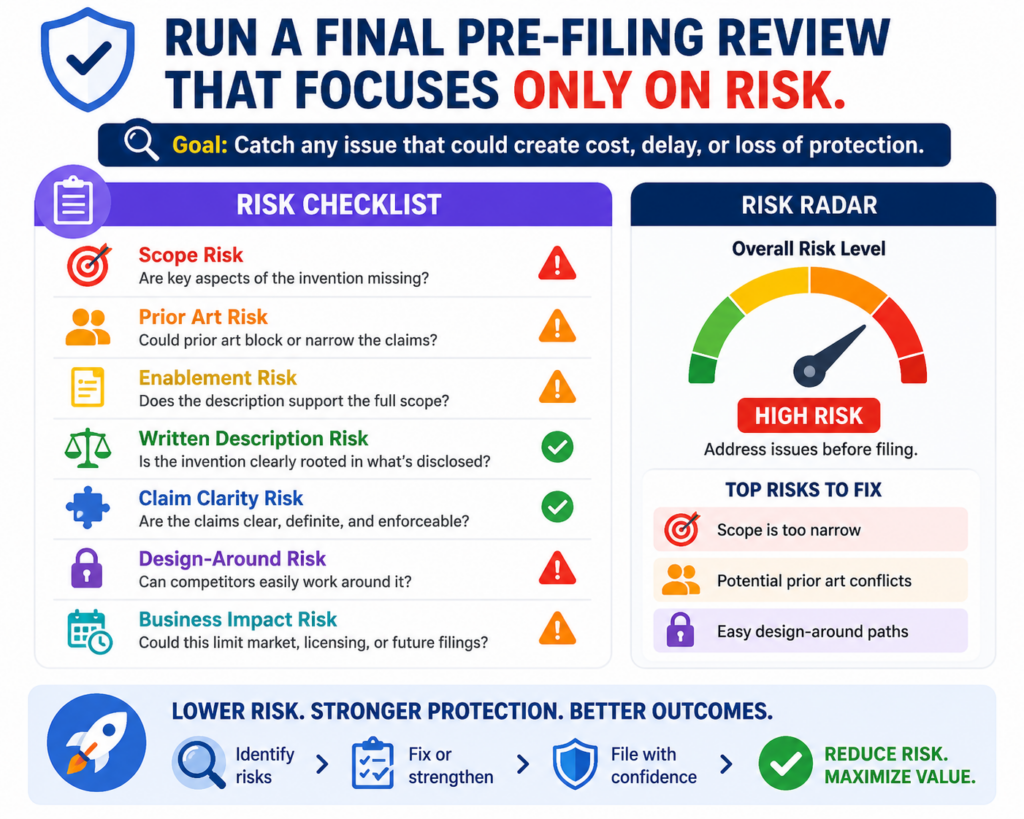
The final pass has one job: catch the risks that could hurt you after filing.
This review should be calm and strict. Do not skim. Do not assume that polished text means safe text. Read the draft as if a future investor, examiner, rival, or acquirer will study it closely.
The goal is not perfection. The goal is to avoid preventable mistakes.
The final pass should test the draft against real-world pressure.
Ask whether a competitor could easily avoid the claims. Ask whether the claims cover the product as built. Ask whether the description supports the claims. Ask whether the examples show the hard parts.
Ask whether the drawings match the text. Ask whether any AI-made detail is false. Ask whether timing, ownership, and public disclosure issues have been shared with the attorney.
This review should also check consistency. The same part should not have three different names. The same step should not appear in different orders unless both orders are intended.
The same model should not be described as required in one place and optional in another unless the wording is clear.
Small conflicts can create big confusion later. They are easier to fix before filing than after.
A strong final review gives the founder confidence before the button is pressed.
The best sign of a ready draft is not that it sounds fancy. It is that the team can explain what it protects, why that matters, and where the main risks have been checked.
The founder should be able to say, “This covers the core invention, not just the demo.” The engineer should be able to say, “This matches how the system works.”
The attorney should be able to say, “The draft has been reviewed for legal risk and filing strategy.”
That is the level of control startups should want. Not slow. Not scary. Not buried in legal words. Just a clear path from invention to protection.
AI can make patent drafting faster. But review makes it safer. When both work together, founders get the best of both worlds: speed and judgment.
PowerPatent helps founders protect what they are building with smart software and real attorney oversight.
It is built for teams that want strong IP without slowing down the company. See how it works here: https://powerpatent.com/how-it-works
Treat red flags as signals, not small edits.
A red flag is not always a reason to panic. Sometimes it is just a sign that the draft needs more care before it moves forward.
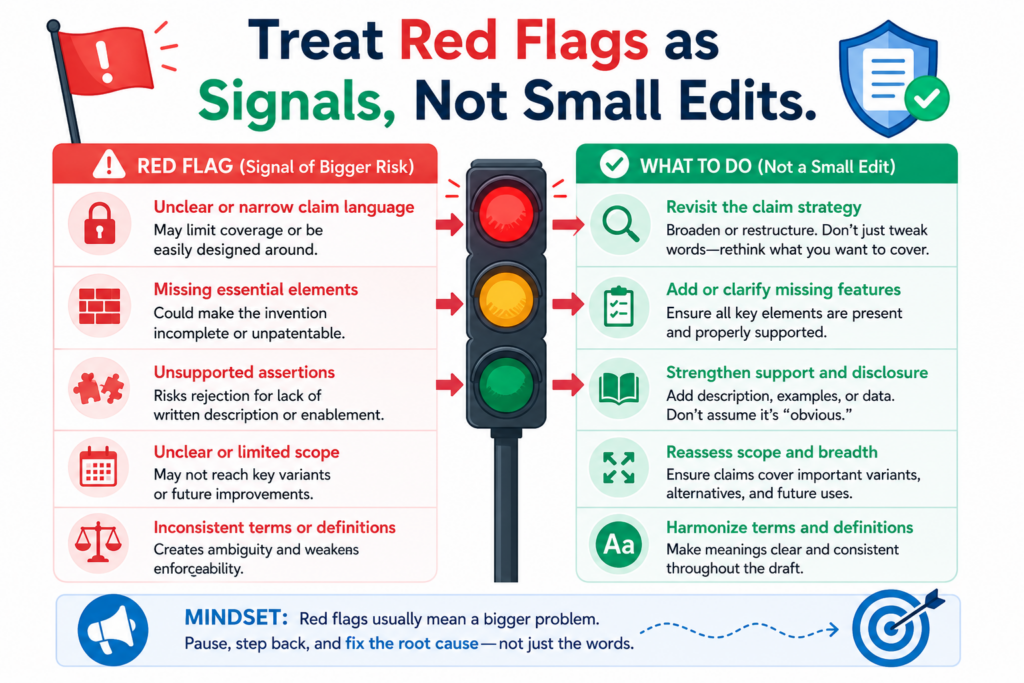
The danger comes when a team sees a red flag, shrugs, and files anyway because the draft looks good enough.
AI-generated patent drafts often hide risk inside clean language. The words may flow well. The claims may look formal.
The examples may sound complete. But the draft can still have gaps that weaken the filing.
A strong review process teaches your team to stop at these signals early. This saves time later. It also helps your attorney focus on the real issues instead of cleaning up avoidable mistakes.
A red flag usually appears where the draft sounds confident but feels thin.
The first red flag is a claim that sounds large but does not explain the real method. For example, a claim may cover “using AI to detect unsafe actions.”
That sounds useful, but it may not say how the system knows an action is unsafe, what data is used, or what happens after detection.
Another red flag is a draft that repeats the same broad words without adding detail. When the draft keeps saying “analyze,” “optimize,” “predict,” or “recommend,” but never explains the working steps, the review should pause.
A third red flag is a draft that does not match your product. Maybe it describes real-time alerts, but your product runs once per day.
Maybe it says the system learns from users, but your team has not built feedback learning yet. Maybe it names a model you do not use.
These are not harmless style issues. They change what the draft says your invention is.
Your review should turn each red flag into a clear fix.
Do not mark a sentence as “bad” and move on. That does not help. Write what is wrong in plain words. Say whether the issue is too broad, too narrow, false, unsupported, unclear, or missing from the claims.
Then decide what needs to happen. Some red flags need new technical detail. Some need a claim rewrite.
Some need an engineer to confirm the facts. Some need attorney judgment. Some need to be removed because they are not real.
This is where founders gain real control. You are not trying to do the attorney’s job. You are making the draft easier to review, easier to fix, and easier to trust.
PowerPatent helps founders catch these issues earlier by combining guided AI tools with real attorney oversight.
That means your team can move fast without treating the first AI draft as the final answer. See how it works here: https://powerpatent.com/how-it-works
Conclusion
AI-generated patent drafts can help founders move fast, but they should never be filed on trust alone. The safest review checks the real invention, the claims, the examples, the drawings, the data story, the roadmap, and every detail AI may have guessed.
A strong draft should protect what makes your product hard to copy, while staying true to how it works. With PowerPatent, founders get smart software for speed and real attorney oversight for confidence, so patent work becomes clear, faster, and less risky before a launch, demo, or investor meeting. See how it works: https://powerpatent.com/how-it-works