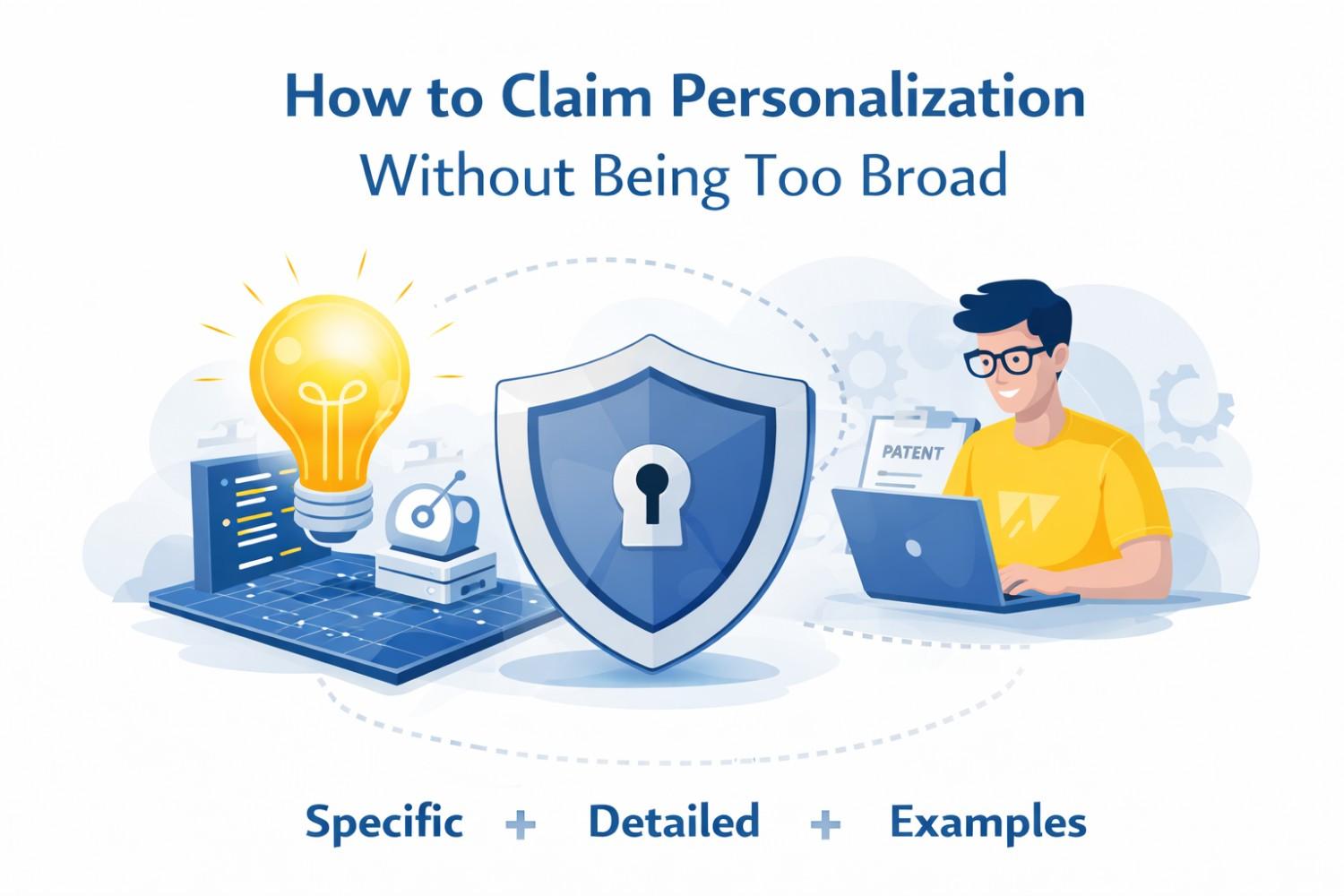
Personalization sounds like a big win when you are building something new. It makes products feel smarter. It helps users get better results. It can drive more clicks, more time in the product, more sales, and more loyalty. For many startups, personalization is not a side feature. It is the engine. It is the reason users stay. That is exactly why founders want to protect it. But this is where many patent drafts go off track.
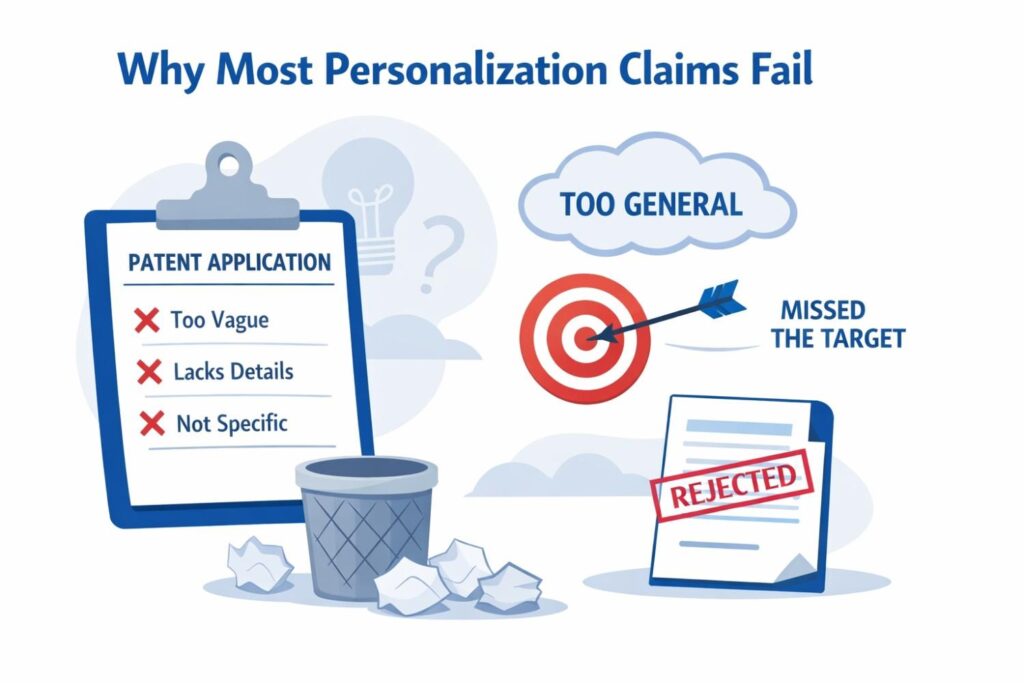
Why Most Personalization Claims Fail
Personalization sounds valuable on paper, so many businesses assume it should be easy to protect. That is usually where the trouble starts.
A team sees strong user engagement, strong retention, or a smart product experience and then tries to wrap a patent claim around the result. But patent strength does not come from how useful the result is.
It comes from how clearly the invention explains the real technical way that result happens.
That gap is why so many personalization claims fail. They are written around the promise, not the machine behind the promise.
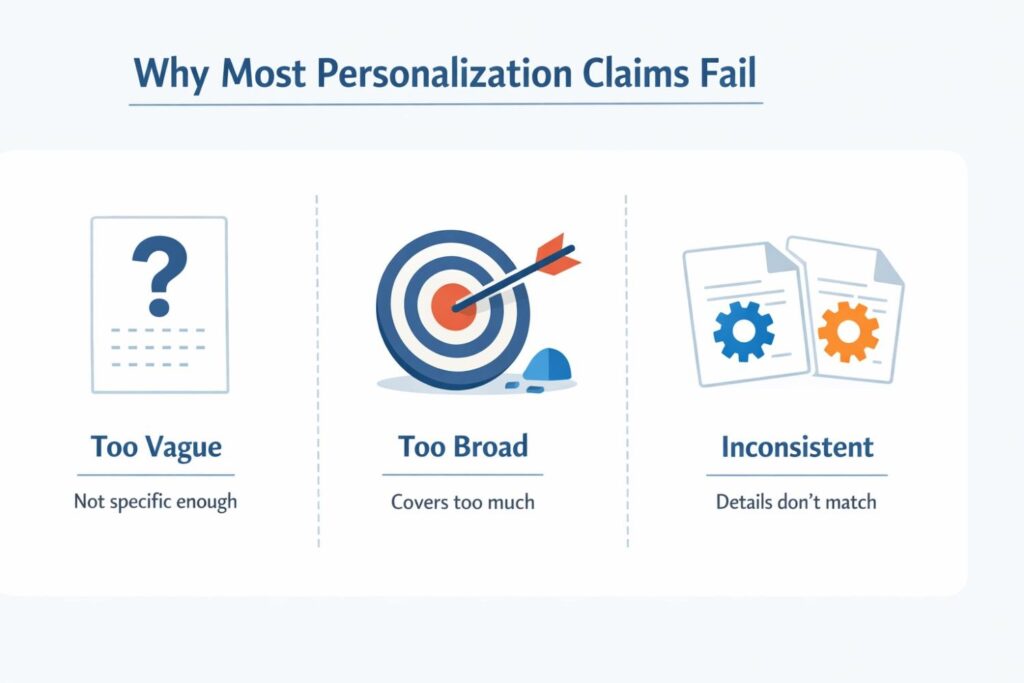
They talk about tailoring, adapting, learning, or improving relevance, but they do not clearly pin down what the system is actually doing differently. When that happens, the claim becomes easy to reject, easy to work around, or both.
For businesses, this is not just a drafting issue. It is a strategy issue. A weak claim can waste filing budget, create false confidence, and leave the real advantage exposed.
If personalization is a key part of your product, your claim has to do more than sound broad. It has to survive pressure.
The Problem Starts With Business Language
Many personalization features are first described in product language because that is how teams think day to day. The product team says the system shows the right content to the right user at the right time.
The growth team says the platform improves conversion through better recommendations. The leadership team says the experience feels more personal and drives retention.
That language is useful for planning, sales, and investor updates. It is not enough for a strong patent claim.
A claim fails when it stays trapped in business language. Words like relevance, fit, preference, customization, and engagement may describe value, but they do not explain the technical move.
If the claim sits at that level, it can sound like a goal statement. A goal is not the same thing as an invention.
The Claim Talks About What the Business Wants
A common mistake is claiming the benefit the company wants instead of the process the system performs.
That happens when the claim is built around improving outcomes for the user without showing the actual path from input to decision to output.
This matters because many old systems already aimed to improve relevance and user fit. If your claim only says your system does that too, then it can blend into a large pile of older work.
The more crowded the field, the more dangerous vague wording becomes.
A better move is to pause before drafting and ask a harder question: what does the system actually compute, compare, filter, rank, update, or enforce that makes the personalization happen in your specific way?
That answer is where protectable value begins.
The Team Confuses User Value With Technical Novelty
What users love is not always what makes the invention new. A startup might believe its big win is that users feel understood faster. That may be true. But the patent question is different.
The real question is why that happens in this system and not in a generic one.
Sometimes the new part is a special profile update flow. Sometimes it is how feedback is weighted. Sometimes it is how the system handles low-confidence states, sparse data, privacy limits, edge devices, or task switching.
Those are not always the first things a product team says out loud. Yet those details are often the strongest parts to claim.
Businesses that understand this early make better filing choices. They stop trying to patent the emotion of personalization and start protecting the engine that creates it.
Broad Words Create Thin Protection
A lot of claims fail because they try to cover everything in one sweep. The thinking sounds smart at first. If the claim is very broad, maybe it covers more competitors.
In reality, broad wording often creates a weaker position because it strips out the very details that make the invention stand apart.
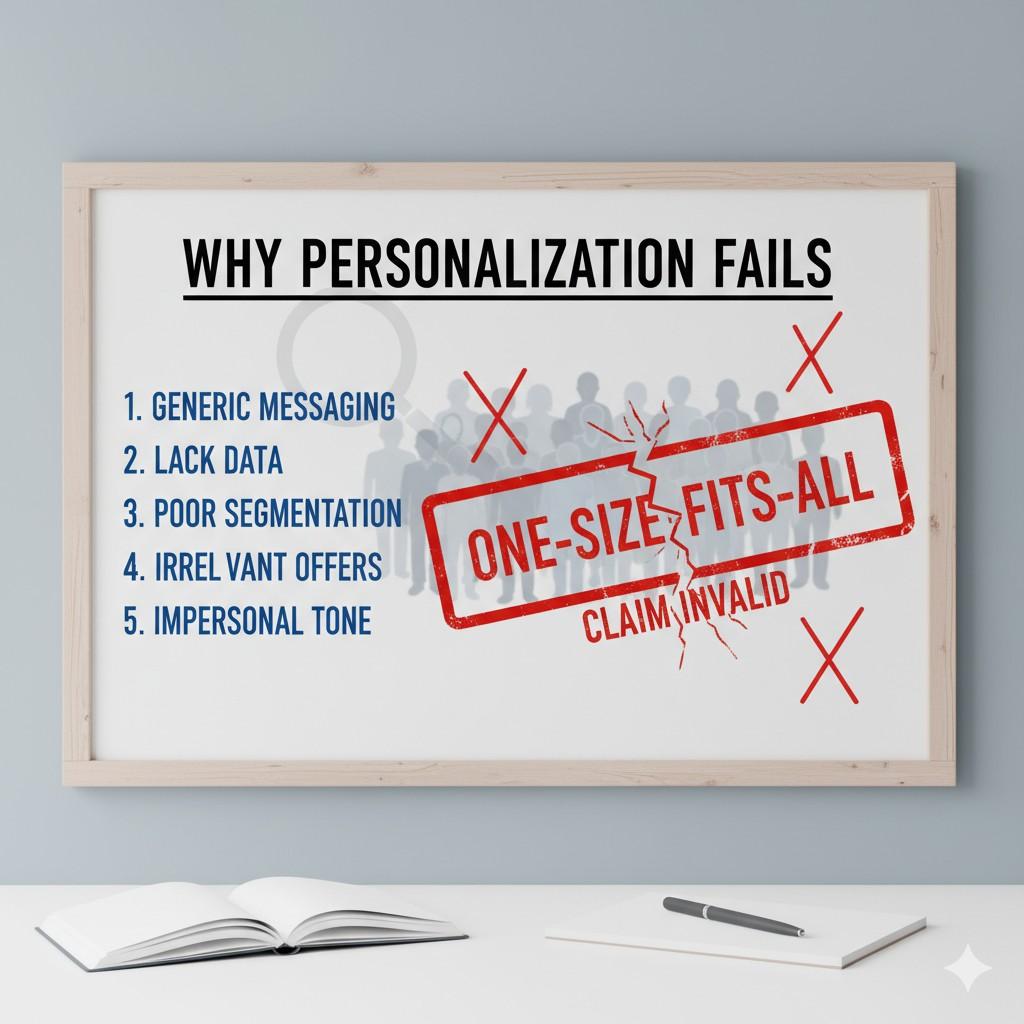
Broad claims can be useful when built on top of a strong technical core. But when broadness replaces the core, the claim becomes fragile.
Broad Does Not Mean Strong
Many businesses assume a broad claim is a powerful claim. That is only true when the breadth still rests on a clear inventive structure. If the wording becomes too open, the claim starts to look like a generic idea dressed up as a system.
That is especially risky in personalization because the basic concept has been around for years.
Content feeds, search ranking, ad targeting, recommendation engines, adaptive interfaces, and model tuning all involve some form of personalization.
So when a claim says little more than “adjust output based on user information,” it is often stepping into crowded ground.
The strategic move is not to remove all detail. It is to choose the right detail. The right detail gives shape to the claim without trapping it in one narrow implementation.
The Broad Claim Misses the Real Competitive Edge
Sometimes businesses make claims so broad that they leave out the feature that actually matters. In trying to cover every possible version, they erase the reason a competitor would care in the first place.
For example, the real edge may be that the system personalizes under strict latency limits, or across multiple sessions, or with very little training data, or without storing raw user history, or while honoring role-based rules.
If the claim leaves that out and only talks about personalization in general, the competitive advantage may sit outside the actual protection.
That creates a dangerous illusion. The company feels covered because the language sounds sweeping, but the claim may not lock onto the practical method that makes the product hard to copy.
Claims Fail When They Describe Outcomes Instead of Mechanics
A patent claim needs more than a desired result. It needs a story of operation. It should make clear how the system moves from data to action. When that flow is missing, the claim can look more like a wish than a technical solution.
This problem shows up often in personalization because teams focus on what the user sees.
The user sees a tailored recommendation, a ranked result, a customized interface, a tuned model response, or a workflow that changes to fit context. But the visible output is only the end of the chain.
The Last Step Is Not the Whole Invention
Businesses often over-focus on the final display or recommendation because that is the part customers notice. Yet patent strength usually sits deeper in the stack.
The valuable piece might be the way the system selects features, resolves conflicts between signals, creates a temporary user state, checks policy rules, or chooses between competing models.
If the claim jumps straight to the outcome, it skips the hard part. And the hard part is often where novelty lives.
A useful internal exercise is to describe the system without mentioning the final personalized output for a few minutes.
Force the team to explain what happens before the result appears. That exercise often reveals the real invention much faster than talking about the interface.
Results-Based Language Invites Easy Rejection
When claim language leans too hard on outcomes, it becomes easier for an examiner to say that older systems already did something similar. The more abstract the result, the easier it is to map that result onto old references.
A business should therefore look for claim language that captures the operational rule, not just the benefit. Instead of resting on “providing a personalized recommendation,” the stronger direction often focuses on how candidate items are selected, how the user state is generated, how conflicting factors are reconciled, or how the system updates itself after interaction.
That is a more durable frame because it is harder to dismiss as just another generic personalization step.
Many Teams Draft Around the Surface Feature
Companies often patent what they can see instead of what the system depends on. That leads to claims centered on the visible feature while the deeper architecture stays unclaimed or underdeveloped.
For personalization, surface-level claiming is common because the visible experience is easy to describe.
The product changes based on the user. That part is obvious. The hidden data flow is harder to explain, so it gets less attention. But the hidden layer is often where the strongest protection should sit.
User Interface Changes Are Only Part of the Story
A business may think its innovation is a dynamic dashboard, a changing content panel, or a smart recommendation card. But if dozens of other products also change interfaces based on user data, the claim cannot stop there.
What matters is the logic behind the change. Did the system create a short-lived intent state from recent actions? Did it combine static profile data with live behavior?
Did it choose among multiple personalization pathways based on confidence, compliance, or resource cost? Did it update a profile differently depending on the category of user action?
These deeper questions make the difference between claiming a familiar display concept and claiming a concrete technical approach.
Architecture Often Holds the Real Defensibility
Many businesses undervalue architecture when preparing patent material. They describe user value in depth and system design in passing. That is backwards if the goal is strong protection.
The architecture may include the components that ingest signals, normalize data, detect context, score candidates, enforce constraints, and produce a personalized output.
Even more important, it may define how those components interact over time. That interaction pattern can be a powerful place to claim.

If your system has a unique architecture for personalization, document it early. Do not assume the attorney or drafter will infer it from general product descriptions. Spell it out in plain words. Show what talks to what, when, and why.
The Real Thing You Need to Protect
Most founders talk about personalization as if the value lives in the final user experience. The app feels smarter. The results feel more useful. The screen feels tailored.
That is what the customer notices, so that is where many teams aim their patent thinking. But that is usually not the real thing to protect.
The real thing is the technical reason your product can personalize in a way others cannot easily copy. That reason is rarely just “we personalize.” It is usually a deeper system choice.
It may be the way you build user state, the way you combine signals, the way you handle uncertainty, the way you sequence decisions, or the way you balance speed, privacy, and relevance at the same time.
If your business wants patents that actually support growth, this shift matters. You are not trying to protect a marketing label. You are trying to protect the part of the machine that creates leverage.
Your Product Benefit Is Not the Same as Your Patent Asset
A business often confuses the thing it sells with the thing it should claim. That is normal. Teams spend all day thinking about customer value, revenue lift, and product advantage.
But patents work best when they protect the technical source of that advantage, not just the visible benefit.
When a company treats its headline product promise as the invention, it risks filing around language that sounds strong in a pitch deck but weak in examination.
The better move is to separate what the market experiences from what the system actually does under the hood.
Users Buy the Outcome, But Patents Protect the Method
Customers care that the product feels useful and personal. Investors care that the company has an edge. Patent protection sits behind both of those, but it does not come from repeating the same high-level story.
It comes from capturing the method that creates the result. That method may involve a decision engine, a profile update path, a confidence gate, a multi-stage ranking flow, a privacy-preserving transformation, or a rule for switching behavior in certain contexts.
Those are not always flashy. But they are often where the durable value sits.
A good internal rule is this: if a competitor copied your user-facing experience, what hidden system behavior would they most need to reproduce to get the same result?
That hidden behavior is usually much closer to the real thing you need to protect.
The Market Story and the Patent Story Should Work Together
This does not mean your business story and patent story need to be separate worlds. They should support each other. Your business story explains why the product matters. Your patent story explains why the product is hard to reproduce.
When those two stories line up, the result is powerful. The company can say not only that its personalization is useful, but also that there is a real technical foundation behind it.

That helps with product defense, fundraising, and long-term strategic leverage.
The Core Asset Is Often the Decision Logic
Many companies think their most valuable asset is the dataset or the interface. Sometimes that is partly true. But in personalization systems, the real edge often sits in the logic that turns raw information into a decision.
That logic can be much more valuable than the surface feature because it defines how the system behaves under real conditions. It determines what signals matter, when they matter, and how they influence the output.
Signal Selection Can Be the Invention
Not all data is equally useful. What makes one personalization system better than another is often the way it selects and weights inputs.
A company may use behavioral history, recent session events, device status, location context, user role, task type, or feedback patterns. The key question is not just what data exists. It is how the system decides which data matters right now.
That choice can become a strong part of the invention.
For example, a business may have built a system that downweights stale preferences, promotes short-term intent during active sessions, or uses a separate path when feedback quality looks unreliable.
These are not generic personalization statements. These are concrete decision rules.
A useful practice for businesses is to map the path from raw input to personalized output and identify every point where the system makes a meaningful judgment call. Those judgment calls often reveal the most protectable logic.
The Combination Rule Matters More Than the Inputs Alone
Two businesses can use the same categories of data and still have very different systems. One may simply average signals together. Another may apply them in stages.
Another may use one class of signals only when another class passes a confidence test. Another may separate persistent preferences from temporary intent.
That combining rule can be more important than any single input source. It shows how the system thinks. It can also be much harder for others to guess just by looking at the product.
This is why strong patent strategy should not stop at naming data sources. It should go deeper and explain how those sources interact.
The more clearly a business understands that interaction, the easier it becomes to protect something real instead of something generic.
What You Need to Protect Is Usually a System Choice Under Constraint
Great personalization does not happen in a vacuum. Real products operate under pressure.
They face latency limits, sparse data, privacy rules, noisy feedback, changing user intent, limited compute, and shifting product goals. What matters is not just that the system personalizes, but how it does so while living inside those limits.
That is often where the strongest patent material hides.
Constraints Turn Generic Features Into Specific Inventions
A personalization feature may sound ordinary until you see the condition it solves. Showing custom results is not new by itself.
But showing high-quality custom results with almost no history, or without central storage of sensitive activity, or within a strict response window, may involve a much more distinct technical approach.
Businesses should therefore stop treating constraints as background facts. Constraints are often what shape the inventive solution. The narrower the real-world pressure, the more likely the design response contains something defensible.
One smart move is to capture not just what the system does, but what it had to overcome to do it. That often produces much stronger patent content than a simple feature description.
Tradeoff Handling Is Often the Hidden Asset
Many teams do not realize that the real invention may be the way their system balances competing goals.
A product may need to be fast, accurate, private, stable, and explainable at the same time. Most systems cannot maximize all of those at once. They have to choose.
If your system handles that tradeoff in a smart way, that may be your core asset. For example, maybe it uses a lightweight first pass and a richer second pass.
Maybe it personalizes on-device while syncing only abstract state. Maybe it delays long-term profile updates until short-term noise settles. Maybe it falls back to contextual rules when confidence drops below a threshold.
Those are powerful technical choices. A company that can articulate them clearly will usually produce stronger patents than a company that simply says its product is more personal.
The Real Thing to Protect May Be the User Model Itself
In many personalization products, the secret is not the final recommendation or output.
It is the way the system represents the user. That representation may be a profile, a state object, a vector, a multi-layer memory, a dynamic session summary, or a mix of long-term and short-term signals.
If that representation is unique, it should get serious attention.
A User Profile Is Not Just Stored Information
Many teams describe the profile as if it were just a bucket of user data. But in a strong system, the profile is often an active structure.
It may include weighted attributes, confidence values, time decay, category-specific preferences, negative signals, inferred goals, or separate layers for stable and temporary interests.
That structure changes what the system can do. It can improve precision, reduce noise, and make downstream decisions more reliable.
If your business built a profile representation that works better because of how it is organized and updated, that is not just an implementation detail. It may be one of the most valuable assets in the stack.
To protect it well, the business should explain not only what is stored, but how the representation is created, changed, segmented, and used during decision making.
Update Rules Can Carry More Value Than the Stored State
A profile at rest is only half the story. The update rule may matter even more. How does the system react to a click, a skip, a correction, a long dwell, a fast exit, or a repeated pattern across sessions?
Does it treat strong signals differently from weak ones? Does it adjust immediately or in stages? Does it separate temporary intent from long-term preference?
These update choices define how the model learns. They shape the quality of personalization over time. They can also become a major point of distinction from standard systems that simply log behavior and recalculate scores.
From a business angle, this matters because update logic often reflects hard-won product learning. It is where teams encode what they discovered through trial, failure, and iteration.

That is exactly the kind of value worth capturing before it gets lost in day-to-day shipping.
How to Describe Personalization in a Way That Holds Up
Describing personalization well is where many good inventions either become strong patent assets or turn into weak, forgettable filings. The difference is not just writing skill.
It is business clarity. If your team cannot explain exactly how your system personalizes in a way that is concrete, practical, and tied to real system behavior, then your patent story will likely drift into vague language.
Once that happens, the claim gets easier to reject, easier to work around, and harder to defend as a real business asset.
For companies building products around adaptive experiences, smart workflows, recommendations, model tuning, dynamic interfaces, or user-specific outputs, this section matters a lot.
The goal is not to make personalization sound impressive.
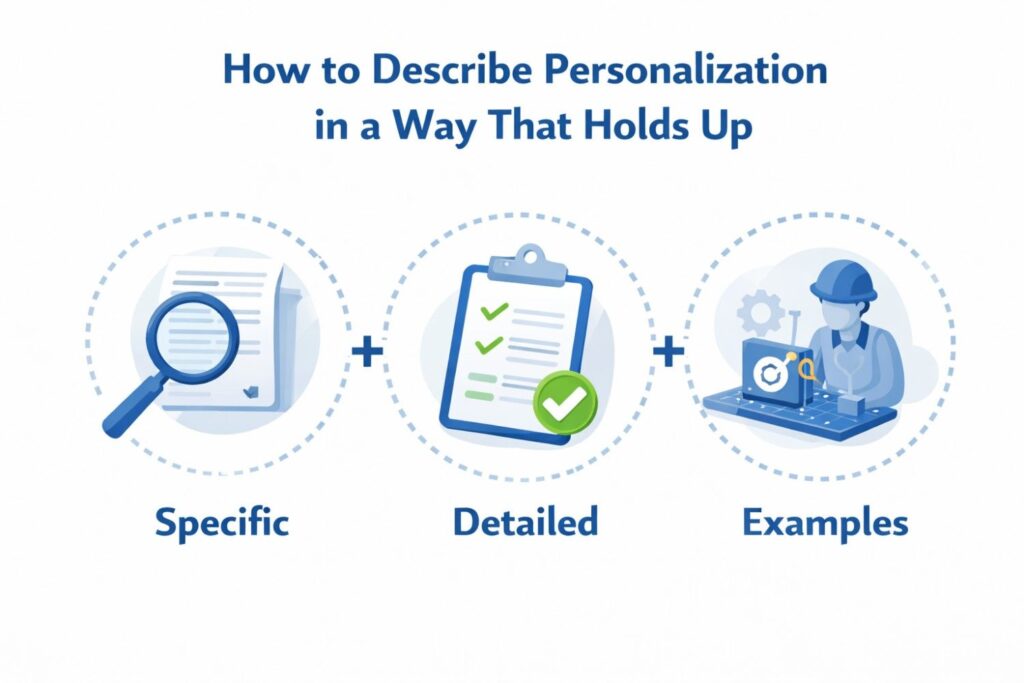
The goal is to describe it in a way that survives pressure. That means using language that is grounded in system behavior, tied to actual decisions, and broad in the right places without becoming empty.
Start With the System, Not the Promise
A lot of bad drafting starts when a company leads with the benefit instead of the engine. That happens because the benefit is easier to say. It sounds cleaner.
It matches how teams talk in product meetings and investor decks. But when you are trying to describe personalization in a way that holds up, the promise is only the surface. The system is what matters.
Describe What the Machine Does Before You Describe What the User Feels
The product may feel smarter to the user, but that feeling is not enough to anchor strong protection.
A better description starts earlier in the flow. It explains what the system receives, what it evaluates, what it changes, and how it decides.
Instead of saying the platform gives each user more relevant results, describe how the platform detects user context, forms a current-state representation, scores candidate outputs based on that state, and selects one path over another.
That kind of language gives the personalization structure. It tells the reader there is a real mechanism involved, not just a general goal.
For businesses, this is a strategic habit worth building across teams. Ask engineers and product leads to explain the feature as a step-by-step system flow before anyone writes the business benefit.
That order produces stronger patent material almost every time.
Product Language Should Follow the Technical Story, Not Replace It
Business language still matters. You want the application to reflect real value. But the value should come after the technical explanation, not instead of it.
A useful internal check is simple. If you remove all words like relevant, personalized, improved, tailored, and optimized from your draft, does the description still explain how the system works?
If the answer is no, the write-up is still too dependent on outcome language.
That is important because competitors and examiners both look for the same weakness. If the description sounds like a statement of intent rather than a technical method, it becomes much easier to challenge.
Use Concrete Verbs That Show Real System Behavior
Weak descriptions often rely on soft wording. They say the system can adapt, learn, customize, refine, or improve.
Those words are not always wrong, but they usually do not do enough work on their own. A stronger description uses verbs that show action inside the system.
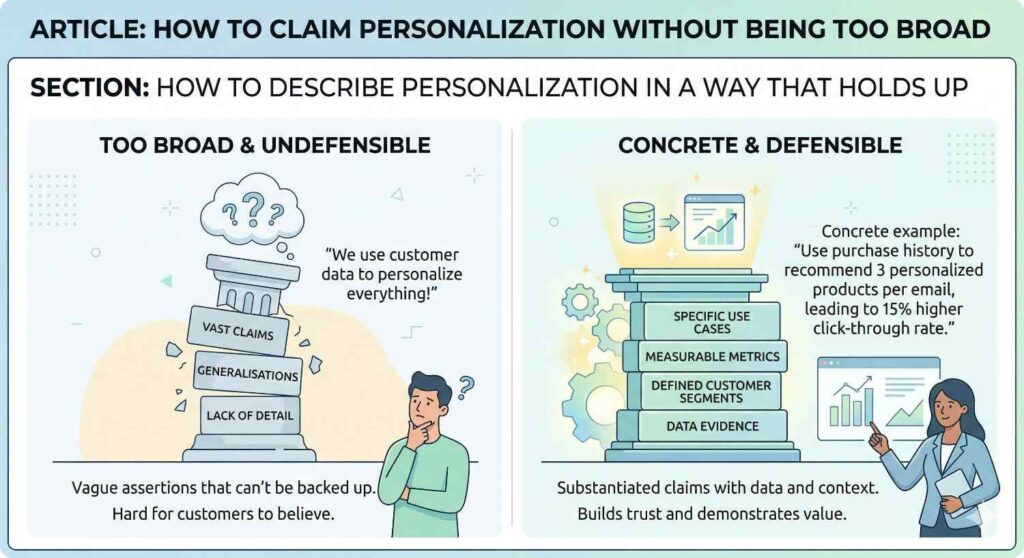
This matters because verbs shape the reader’s understanding of what the invention really is. Clear verbs make the personalization feel built, not imagined.
Good Descriptions Show Movement
The best personalization write-ups feel operational. They show the system receiving inputs, generating intermediate states, comparing alternatives, applying conditions, selecting outputs, and updating internal structures.
That kind of wording turns an abstract feature into a concrete process. It also helps businesses identify where their real edge sits.
A team may think the invention is “personalized ranking,” but once the flow is written out, they may discover the real value lies in generating a temporary user state, weighting recent signals more heavily under one condition, and delaying long-term updates until later validation.
The more clearly the system moves on the page, the more likely the description will support strong claims.
Avoid Empty Motion
Some drafts sound busy without saying much. They use many technical-sounding words but still avoid the actual mechanics.
For example, saying the system dynamically adjusts content based on user preferences and contextual indicators may sound polished, but it leaves major questions open.
What counts as context? How are preferences represented? What rule determines the adjustment? What happens first? What happens next?
A durable description answers those questions directly enough to reveal structure, while still leaving room for claim strategy.
It does not need to expose every code detail, but it does need to name the operational logic with enough clarity that the personalization feels like a real engineered method.
Break Personalization Into Stages
One of the best ways to describe personalization in a way that holds up is to stop talking about it as one big event.
Personalization is usually not a single step. It is a chain of steps. When businesses describe the full chain, they create more options for stronger claims and stronger support.
This also helps avoid the trap of over-focusing on the final output.
Stage One Is Usually Signal Collection
Every personalization system starts by taking in some form of information. That information may come from profile data, recent actions, session context, historical behavior, device state, user role, timing, location, or task type.
The write-up should not just mention these inputs as a pile of data. It should explain how the system treats them. Are some persistent and some temporary?
Are some trusted more than others? Are some only used under certain conditions? Are some transformed before they influence the output?
That framing helps businesses move from “we use user data” to “we use this class of information in this way for this stage of the flow.” That is much stronger.
Stage Two Is Often User-State Construction
Many systems do not personalize directly from raw signals. They create some intermediate representation first.
That may be a profile, a session summary, an intent model, a preference vector, a confidence map, or another state object.
If your system does this, describe it clearly. This intermediate layer is often one of the most valuable pieces in the whole invention. It can show how the system interprets the user at a given moment instead of simply storing raw history.
For businesses, this is also useful because it reveals where your real know-how may sit.
A company may assume its strength is candidate selection, but the real edge may actually be the method used to generate the current user state that drives all later decisions.
Stage Three Is Usually Decision Logic
Once the system has signals or a user-state representation, it has to make a decision. That may mean ranking, filtering, routing, matching, tuning, selecting, or suppressing outputs.
This stage should be described with special care because it is often where the invention lives. What rule drives the decision? Does the system compare multiple candidate outputs?
Does it apply a threshold? Does it choose between different personalization paths? Does it blend short-term intent with long-term preference? Does it switch behavior when confidence is low?
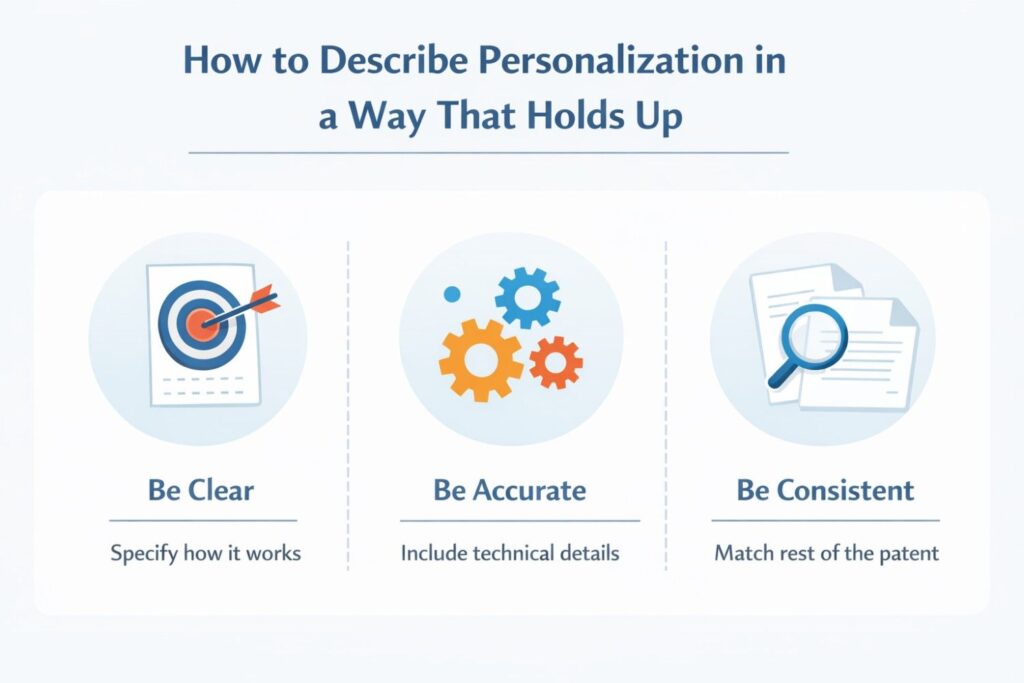
The stronger the description here, the more likely the resulting patent will protect something competitors cannot easily sidestep.
Stage Four Is Often Updating the System
A lot of personalization inventions do not end when the output is shown. They continue after user interaction.
The system may log feedback, weight the interaction, change the user model, alter future ranking logic, or adjust confidence values.
This update stage deserves real attention. It shows that the personalization is not just reactive in a one-time sense. It shows how the system evolves. It can also be where some of the strongest technical distinctions appear.
For a business, this is a key point. If the product gets better over time because of a unique update loop, that loop may be one of the most important things to describe and protect.
Explain the Rules, Not Just the Data
Many weak descriptions spend too much time naming data sources and too little time explaining how the system uses them. But data alone is rarely the invention. The system rule is usually what matters more.
This distinction is one of the biggest shifts a company can make in improving its patent quality.
Inputs Matter Less Than How Inputs Are Treated
Two systems may use clicks, searches, dwell time, device type, and profile history. That does not mean they are the same. One system may treat recent actions as temporary intent.
Another may use them only after repetition. Another may ignore them when they conflict with a stored long-term preference. Another may pass them through a privacy filter before they affect scoring.
That treatment rule is what creates real differentiation. It is what makes the system act like your system rather than a generic one.
Businesses should therefore describe not only what goes in, but what happens to it. Does the input get weighted, transformed, separated, delayed, combined, ignored, or validated? The answer adds substance fast.
Decision Conditions Deserve Specific Attention
A write-up becomes much stronger when it explains the conditions under which the system behaves differently. Personalization is often not a fixed process.
It changes depending on confidence, timing, history depth, task type, policy status, user segment, or available resources.
Those conditional behaviors can be highly valuable. They reveal that the invention is not just “use data to customize output.” They show that the system follows a practical logic under real-world conditions.
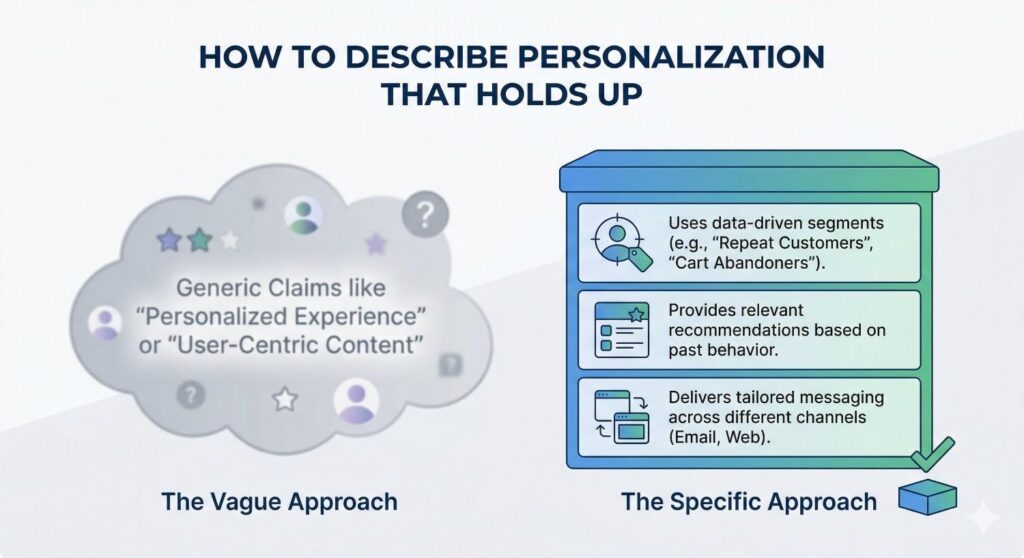
A helpful drafting habit is to look for every “if this, then that” moment in the product flow. Those moments often contain the strongest material for both claims and supporting description.
Wrapping It Up
Personalization can be one of the most valuable parts of a product. It can also be one of the easiest things to describe badly. That is the real risk. When a company talks about personalization in loose, high-level words, it often ends up protecting a vague idea instead of the real system that creates business value.