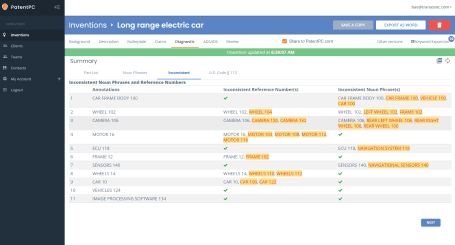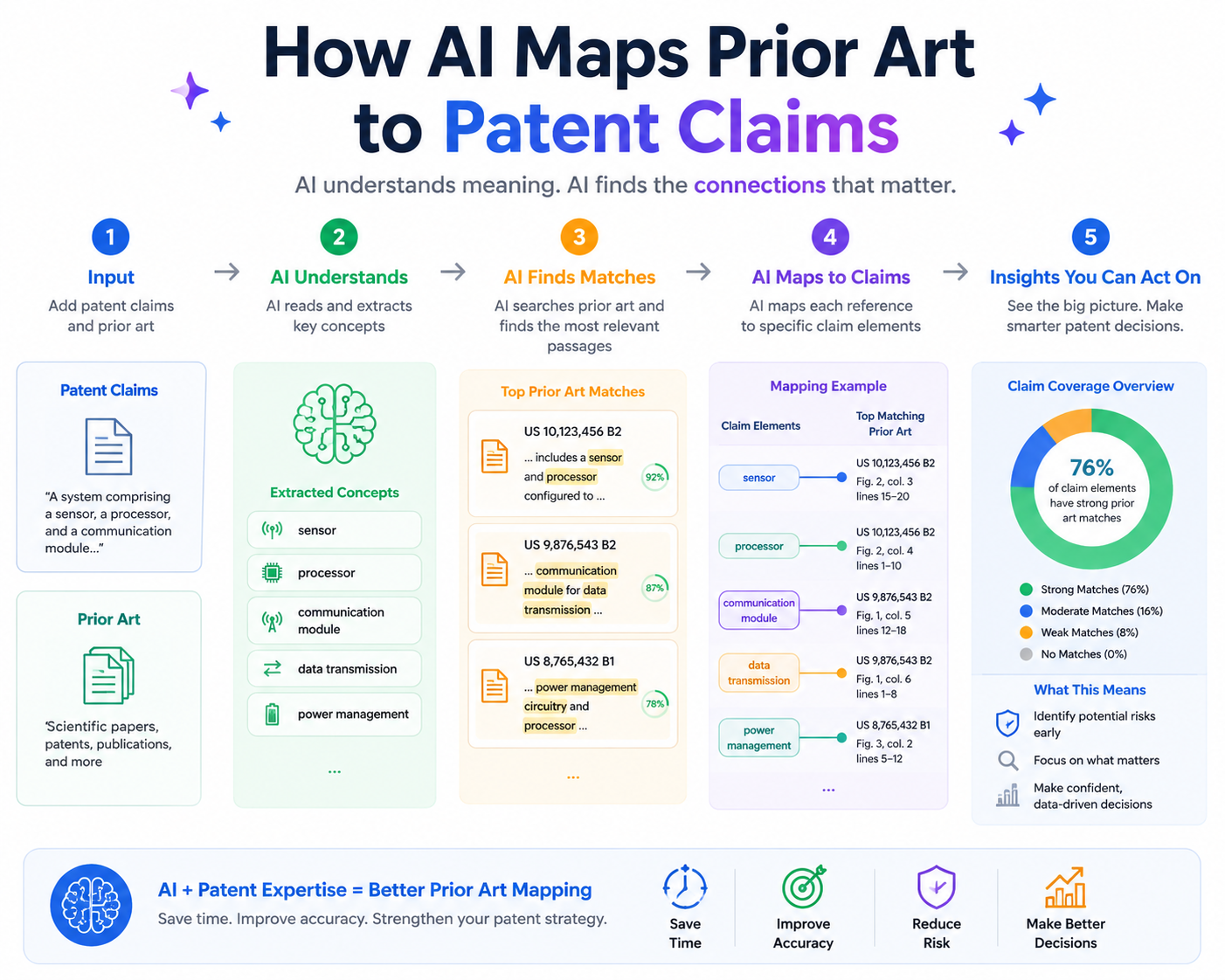
A patent claim is the line around your invention. Prior art is the old work that may sit near that line. When the two are compared by hand, the process can feel slow, messy, and hard to trust. AI helps by reading large sets of papers, patents, product pages, and technical notes, then showing how each piece may connect to each part of a claim.
AI starts by breaking the patent claim into small, clear parts
A patent claim can look like one long sentence, but it is not meant to be read like normal text. It is more like a map. Each phrase points to a part of the invention. One phrase may describe the data.
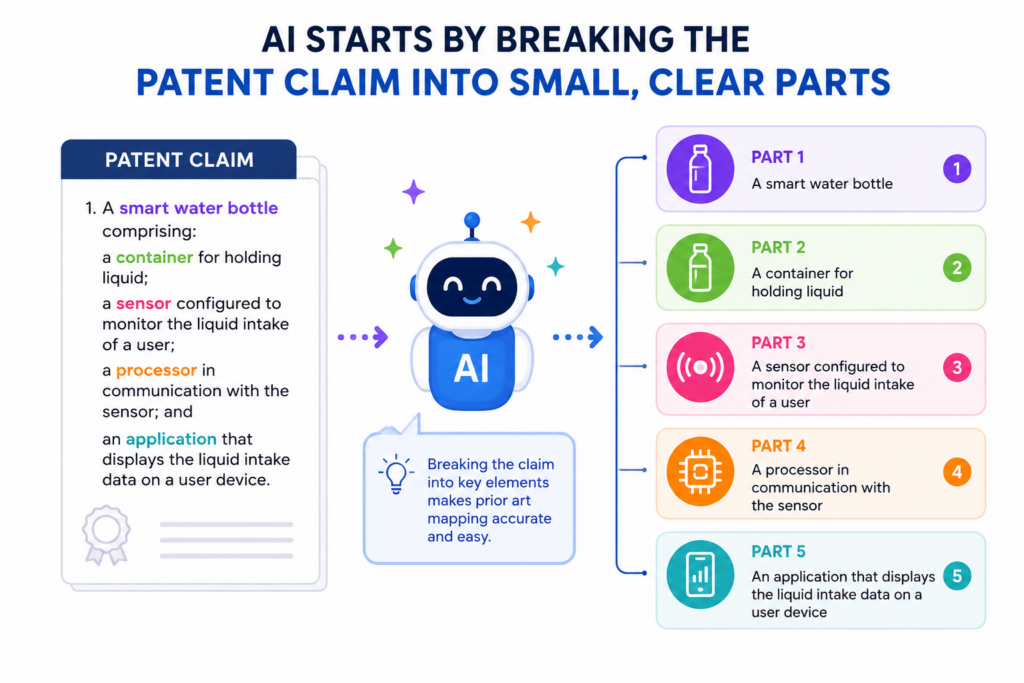
Another may describe the model. Another may describe the step that changes an input into an output. Another may explain how the result is used.
AI mapping begins by cutting that long claim into smaller parts. This is often called claim parsing, but the simple idea is this: the system tries to see each building block inside the claim.
It looks for the main thing being claimed, the actions being done, the parts involved, and the way those parts work together.
For a founder, this matters a lot. A weak review may only ask, “Is this idea new?” A strong review asks, “Is each part of this claim already shown somewhere else, and if so, where?” That second question is much more useful.
It helps you see what is safe, what is risky, and what may need to be changed before you file.
AI does not just search for matching words
A basic search tool looks for words. If your claim says “neural network,” it may look for documents with those same words. That is helpful, but it is not enough. Many inventions are described in different words.
One paper may say “machine learning model.” Another may say “classifier.” A patent may say “trained predictive engine.” A product page may say “smart scoring system.”
AI can go deeper because it can compare meaning, not just words. It can read a phrase in your claim and ask, “What is this really doing?” Then it can look for older documents that do the same kind of thing, even when the wording is different.
This is where the process becomes powerful. A founder may think an idea is clear and new because no one uses the exact same term.
But patent examiners often care about the function, not just the label. If an old document teaches the same step in a different way, it may still matter.
The first tactical move is to write claims in plain working language before they become legal text
Before a patent claim becomes formal, your team should describe the invention in simple words. What goes in? What happens inside the system? What comes out?
What makes it better than the old way? What is the key step that would be hard for another team to copy without using your idea?
This plain version helps AI understand the invention better. It also helps the attorney see the real value faster.
Engineers often know the invention deeply, but they explain it through code names, internal terms, or product language. AI can help translate that into a cleaner structure, but the source material still matters.
This is one reason PowerPatent is built for technical teams. The goal is not to make founders become patent experts.
The goal is to help them turn real engineering work into a clear invention story, then pair that with attorney review so the filing is not just fast, but strong. You can see how that works here: https://powerpatent.com/how-it-works
AI maps each claim part to the closest prior art it can find
Once the claim is broken into parts, the AI starts looking for older material that may match each part.
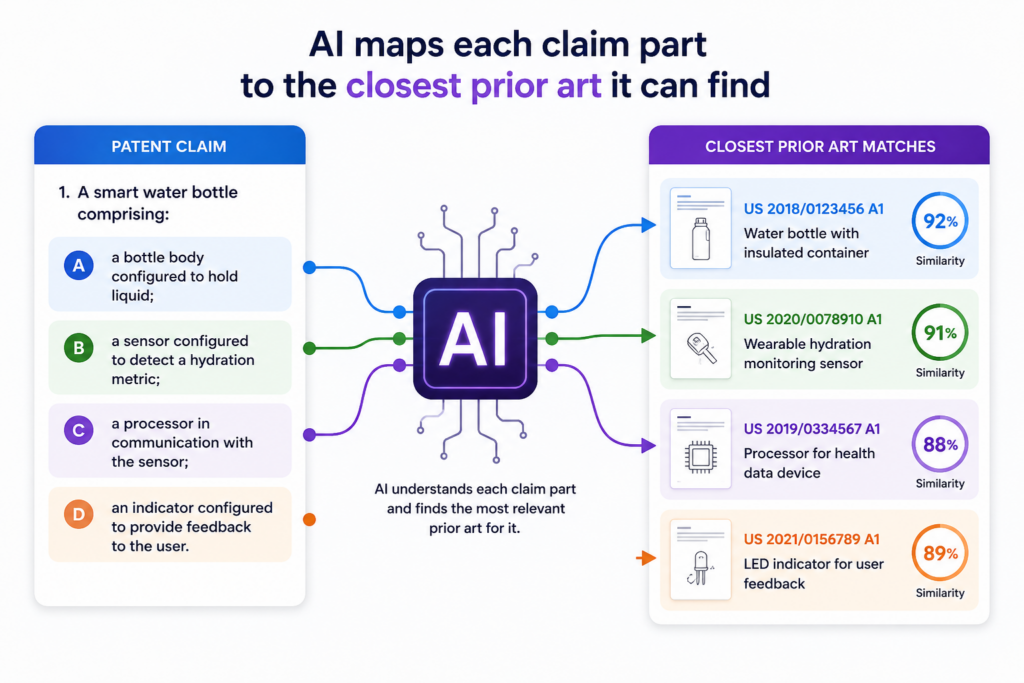
That older material may include patents, published patent applications, research papers, technical blogs, product manuals, standards, open-source notes, and public web pages.
The goal is not to find one scary document and stop. The goal is to build a clear map.
That map may show that one old patent describes the data intake step. A research paper may describe the model training method. A product page may describe the user workflow.
Another patent may describe the final output. This matters because a claim can be attacked in more than one way. Sometimes one document shows many parts. Sometimes several documents, when combined, create a problem.
This is where founders often get surprised. They may say, “No one built our exact product.” That may be true. But patents are not only about the full product.
They are also about the claimed parts and how those parts connect. AI helps show those connections before they become a delay, rejection, or expensive rewrite.
A good map shows both strong matches and weak matches
Not every match is equal. Some prior art may be very close. Some may only touch one small part. Some may use the same words but mean something different.
Some may solve a different problem with a similar method. AI can rank these matches and group them by how closely they line up with the claim.
The best output is not a giant pile of search results. A giant pile only creates more work.
A good AI system should show which parts of the claim are likely covered, which parts look open, and which parts need a human to review more closely.
This makes the attorney’s work sharper. Instead of spending time digging through a mountain of documents from scratch, the attorney can focus on judgment. Is the match real?
Does the old document teach the same thing? Is the claim still different in a meaningful way? Should the claim be changed? Should the invention story be reframed around the part that is truly new?
The second tactical move is to treat the map as a risk tool, not a yes-or-no answer
AI should not be used as a magic stamp that says “patentable” or “not patentable.” That is too simple, and it can be dangerous. The better use is to treat the map like an early warning system.
If the map shows that most of your claim parts already appear in older work, that is useful. It does not mean you should give up.
It means you may need to narrow the claim, focus on the real improvement, or add technical detail that shows what your team actually invented.
If the map shows that the old work misses one key step, that is also useful. That missing step may be where your strongest claim should focus.
It may become the heart of the filing. It may also shape how you describe the business value of the invention.
This is where PowerPatent helps founders move with more control. You do not want to file blind. You also do not want to spend months stuck in slow review cycles.
A smart workflow gives you early clarity, then lets real patent attorneys shape the filing around what matters. To see how PowerPatent helps teams do that, visit https://powerpatent.com/how-it-works
AI helps find the claim gaps that make the invention stronger
The most useful part of claim mapping is not finding what is old. It is finding what is still yours. Prior art can feel like bad news, but it can also be a guide. When AI shows where older documents stop, your team can see where the invention may begin.
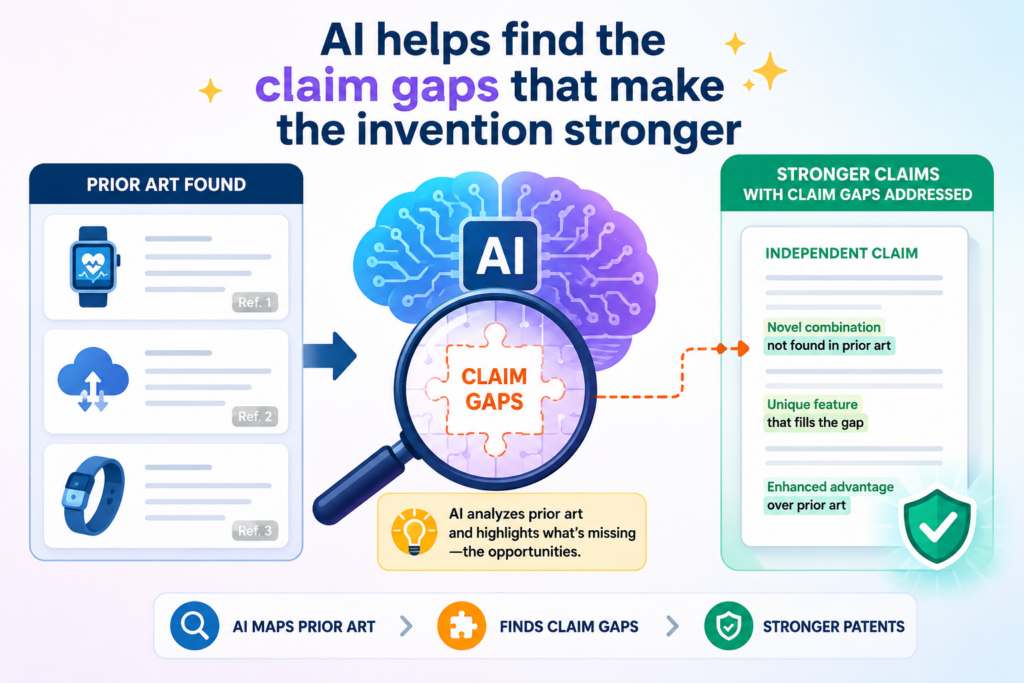
A gap may be a new way of handling data. It may be a new model update step. It may be a new way to reduce compute cost.
It may be a better control flow, a safer output check, a cleaner user action, or a system design that solves a pain point no one handled well before.
These gaps are not always obvious at first. Many founders are too close to the product.
They may think the invention is the whole platform, when the real patent value is a smaller technical move inside the platform. AI can help surface that smaller move by showing what the old world already had and what your system adds.
The strongest claims often come from the difference between your system and the closest old work
A broad claim may sound better because it covers more. But if it is too broad, it may run straight into prior art.
A smarter claim often starts with the closest old document and then draws a cleaner line around what your invention does differently.
This is not about making the patent small. It is about making it harder to knock down.
A claim that is built around a real technical difference can be much stronger than a claim that tries to cover everything but is easy to challenge.
For example, a startup may build an AI tool that reviews sensor data from machines. Many old systems may already collect sensor data and predict faults. A weak claim may just say the system uses a model to detect a fault. That may be too close to old work.
A stronger claim may focus on a special way the system cleans noisy readings, updates the model after a repair event, and changes alerts based on machine age. The value may live in that chain of steps.
The third tactical move is to ask what your system does that the closest prior art does not do well
This is the question every technical founder should ask before filing. Not “Is our product cool?” Not “Did we use AI?” Not “Are we first in the market?” The better question is: what does our system do, in a clear technical way, that the closest older work does not show?
Your answer should be concrete. It should point to a step, a structure, a rule, a data flow, a model behavior, or a system result.
It should not rely only on business words like faster, smarter, or easier. Those words are useful for marketing, but claims need more detail.
AI can help by comparing the claim to close documents and showing the missing pieces. The attorney can then decide how to use those pieces in the filing. This is the balance that matters.
AI finds patterns at scale. Attorneys apply legal and practical judgment. Founders bring the real product truth.
That mix is what modern patent work should feel like. Fast enough for a startup. Careful enough for real protection. Clear enough that the team understands what is being filed.
PowerPatent brings software and attorney oversight into one guided process, so founders can protect their work without losing momentum. See the process here: https://powerpatent.com/how-it-works
AI can compare claim language against many forms of public proof
Prior art is not only old patents. That is one of the biggest things founders miss. A public paper can matter. A product manual can matter. A conference slide can matter.
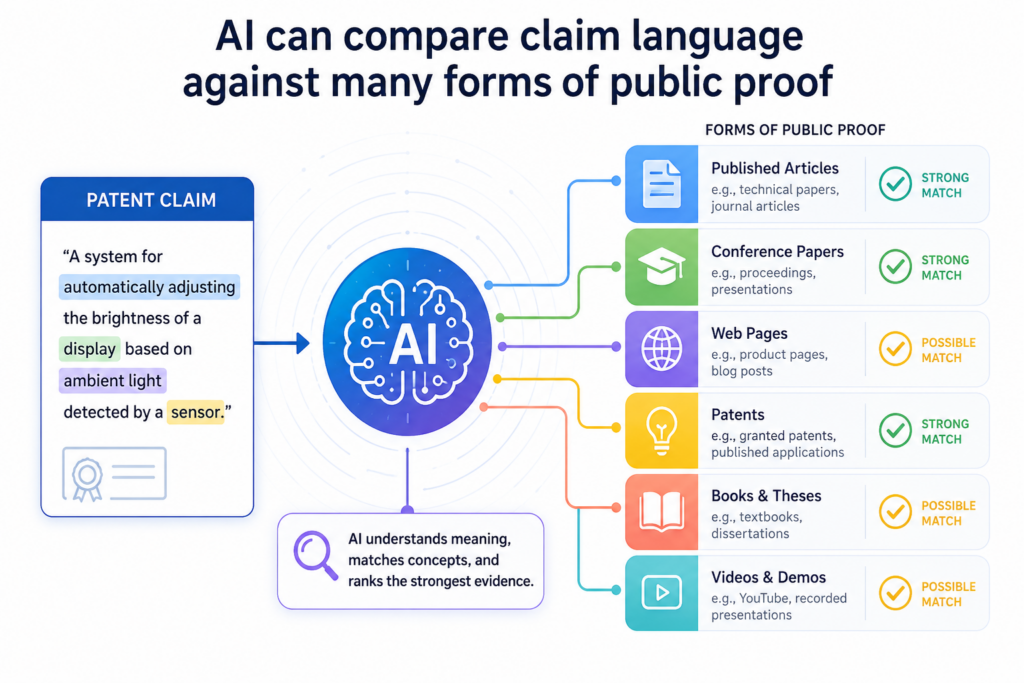
A public code repo can matter. A standard, help page, demo video, or technical note can also matter if it teaches the same idea before your filing date.
AI helps because it can scan across many kinds of text. It can pull signals from formal patent language and from plain product language.
This is important because startups do not live in a patent-only world. Your invention may sit near open-source work, academic work, old vendor tools, cloud docs, or technical posts written by engineers.
A narrow search may miss those sources. A broader AI review can give a more honest view of the field.
It helps your team avoid the trap of thinking, “We searched patents and found nothing, so we are clear.” That may not be enough.
Different sources teach different parts of the same story
A patent may describe the system structure. A research paper may explain the algorithm.
A GitHub readme may show how engineers use a similar tool. A product page may show the user-facing workflow. None of these sources alone may match your full claim, but each one can show a part of it.
AI can place these sources next to the claim and show which phrase each source may support.
This creates a more complete picture. It also helps your team see whether the invention is truly new as a system, or whether the value is in a more specific improvement.
For founders, this can save time. Instead of learning about a major issue after filing, you can spot it earlier. That gives you room to adjust. You may change the claim focus.
You may add better examples. You may file around the core feature before a launch. You may decide that a trade secret is better for one part while a patent makes sense for another.
The fourth tactical move is to share the messy technical material early
Do not wait until everything is polished. Early design notes, diagrams, model cards, architecture sketches, test results, internal specs, and code comments can help show what is real about the invention. These materials can also help AI and attorneys find the right words for the filing.
Many founders only share the pitch deck. That is usually not enough. A pitch deck explains why customers care.
A patent filing must explain how the invention works. The best material often comes from the engineering side, not the sales side.
This does not mean you need to dump every file into the process without care. It means you should give enough technical context to show the actual invention.
PowerPatent is designed to make this easier for busy teams. It helps turn technical work into a clearer patent path, with real attorneys involved so the final filing is not based on software alone. Learn more here: https://powerpatent.com/how-it-works
AI helps turn a vague invention into a claim-ready story
A founder may know the product is special, but still struggle to explain the invention in a way that can support a strong patent.
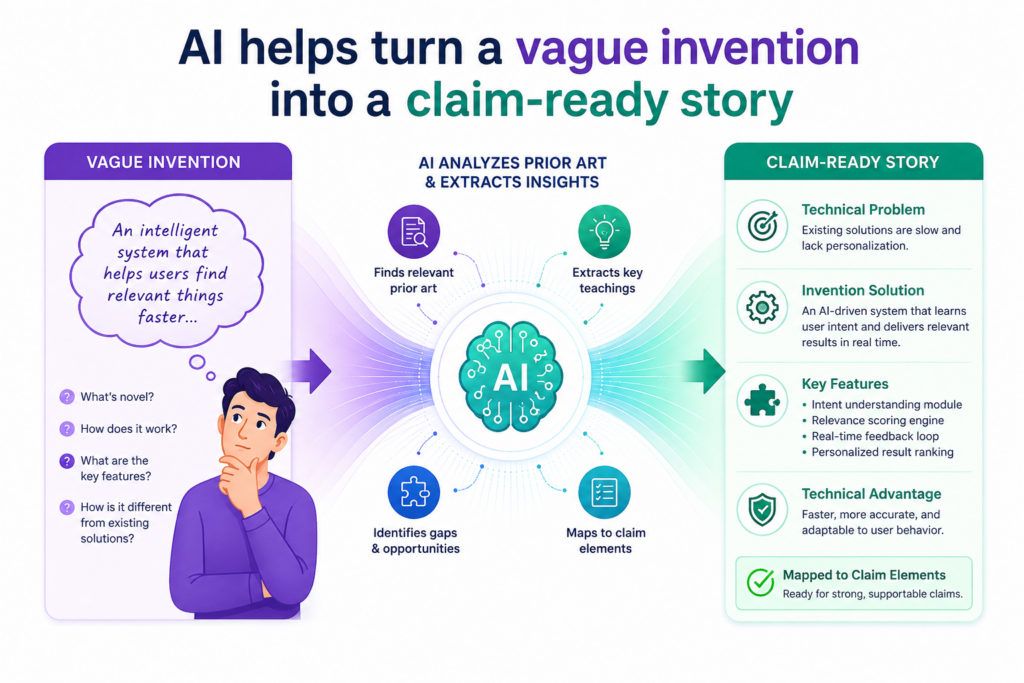
This is normal. Builders think in features, releases, tickets, models, users, and bugs. Patent claims need a cleaner shape.
They need to show the parts of the system, the steps the system takes, and the point where the new idea creates a better result.
AI can help bridge that gap. It can read notes, technical drafts, diagrams, and rough descriptions, then pull out patterns that may be useful for claims. It can spot repeated steps.
It can see which parts seem central. It can compare those parts to prior art and show which parts may be too common and which parts may deserve more focus.
This is not just a writing task. It is a strategy task. The claim-ready story should make the invention easier to understand, easier to compare, and easier to defend.
When the story is weak, the claim may become too broad, too thin, or too close to what others already disclosed. When the story is strong, the filing can focus on what the team truly built.
The invention story should explain the problem before it explains the feature
A strong patent does not only say, “Here is our feature.” It explains the technical problem the feature solves. That problem may be slow model training, noisy input data, high compute cost, poor routing, bad matching, weak security checks, or too many false alerts.
The exact problem depends on the field, but the rule is the same. The clearer the problem, the easier it is to see why the solution matters.
AI can help by finding prior art that tried to solve similar problems. This gives your team a useful mirror. It shows what others cared about, what they built, and what they missed. That makes your own invention story sharper.
For example, a startup may say, “Our system uses AI to approve invoices.” That is too broad.
A better story may say, “Our system compares invoice fields against past vendor behavior, flags unusual changes before payment, and updates the risk score after human review.”
That second version gives AI and the attorney more to work with. It has steps. It has signals. It has a feedback loop. It has a clearer point of difference.
The fifth tactical move is to write the invention as a chain of cause and effect
Before you file, describe the invention as a chain. The system receives something. It checks something. It changes something. It produces something. That output then causes another action. This simple chain can reveal the true claim path.
This is also where many weak filings fail. They describe the end benefit but not the working path.
They say the invention gives better results, but they do not explain why. AI can help find missing links, but your team should still provide the real technical reason.
When you use PowerPatent, the goal is to make that path easier. You bring the invention. The platform helps organize the raw material.
Real patent attorneys help turn it into a filing that is clear, careful, and tied to what makes your work valuable. You can see the full process here: https://powerpatent.com/how-it-works
AI shows when a claim is too broad before it becomes a problem
Broad claims sound attractive. They feel powerful because they seem to cover more ground. But a claim that reaches too far can run into old work fast.
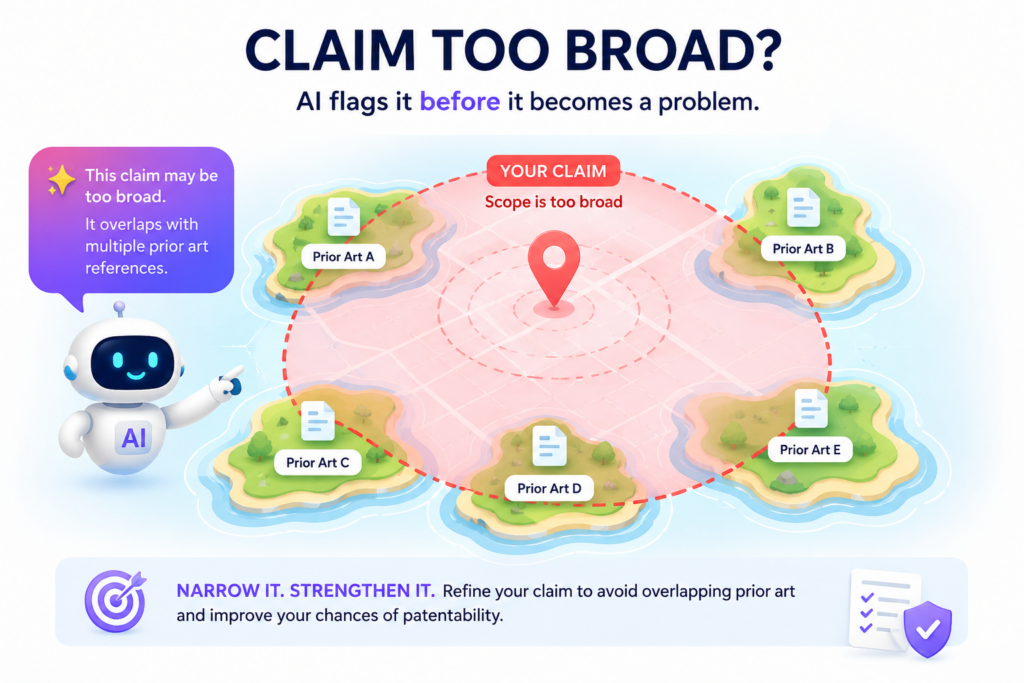
If the claim reads like a general idea instead of a real technical solution, prior art may be easier to find and harder to avoid.
AI helps by testing the claim against a large field of older material. If the same claim parts show up across many documents, the system can flag that the claim may be too broad.
This does not mean the invention has no value. It means the claim may need more detail.
That early signal is useful. It gives your team time to adjust before filing. You can add the key technical steps.
You can focus on the real improvement. You can avoid wasting time on claim language that sounds big but does not hold up well.
Strong claims are often clear before they are broad
A strong claim does not need to sound fancy. It needs to draw a clean line. The line should show what your system does and why that is different from the closest old work.
If the line is blurry, the claim can become hard to defend. If the line is clear, the claim can be easier to explain and easier to support.
AI can help show where the line is blurry. It may find that your claim says “analyzing data,” but the prior art already analyzes similar data. It may find that your claim says “generating a recommendation,” but old tools already do that too.
The stronger path may be in how the data is selected, how the model is updated, how the result is checked, or how the system responds after the result is produced.
This is why AI claim mapping should not be treated as a last step. It should happen while the claim is still flexible. The earlier you see the weak spots, the easier it is to fix them.
The sixth tactical move is to pressure-test the broadest version first
Start with the broad version of the claim, but do not fall in love with it. Use AI to see what prior art appears.
Then ask what must be added to make the claim more real, more technical, and more tied to your invention.
This approach keeps ambition and care in balance. You are not giving up broad protection. You are finding the broadest claim that still has a strong reason to exist.
For founders, this can change the whole filing experience. Instead of guessing what may work, you can see the risks sooner.
Instead of waiting for a rejection to learn where the claim is weak, you can improve the claim before it is filed. That saves time, reduces stress, and gives the attorney better material to shape.
PowerPatent was built around this kind of modern workflow. It helps founders move faster without filing blind, and it pairs smart software with attorney oversight so speed does not come at the cost of quality. Learn how it works here: https://powerpatent.com/how-it-works
AI helps explain why one prior art match is more important than another
Not every prior art result deserves the same attention. Some matches look close because they use the same words.
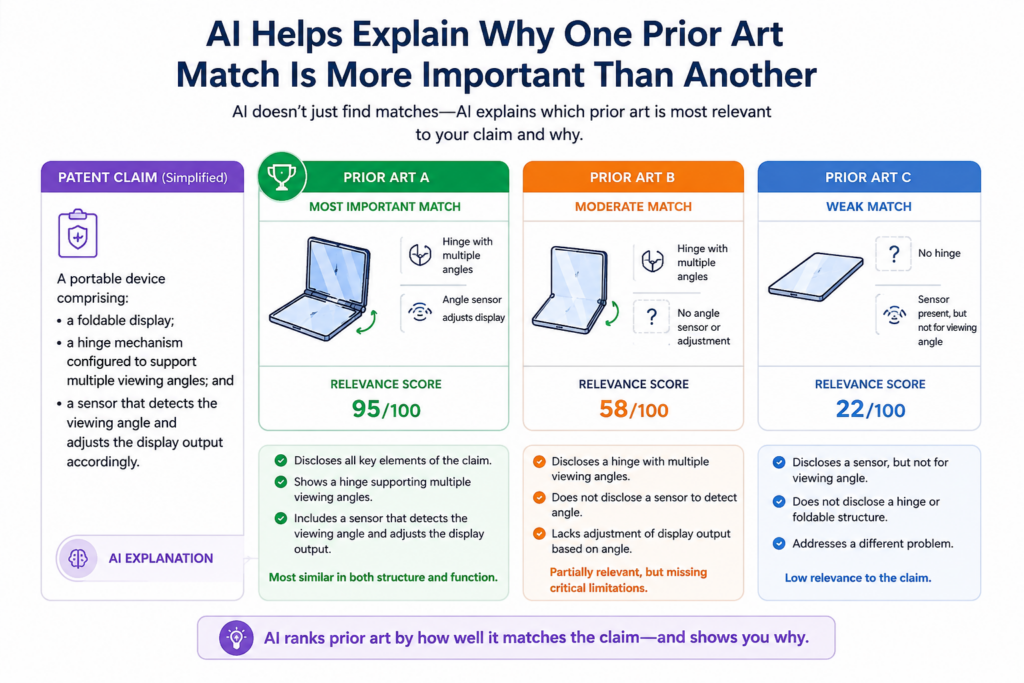
Others look less obvious but are more serious because they teach the same function. AI can help sort these results so your team does not waste energy on noise.
This is very helpful in deep tech. Many fields use shared terms. Words like model, engine, module, network, sensor, score, training, cluster, token, node, and pipeline appear everywhere.
A basic keyword search may bring back thousands of results. Many of them will not matter. A better AI tool looks at how the words are used, not just whether they appear.
The result should be a cleaner view. Which prior art teaches the same input? Which one teaches the same step? Which one teaches the same output?
Which one uses a similar structure but solves a different problem? Which one is close enough that an attorney should review it first?
Good ranking helps founders focus on the real fight
A messy prior art search can make a team feel stuck. When every result looks scary, founders may think their invention is already taken. But once the results are ranked and mapped, the picture often becomes clearer.
One document may cover the general field but miss the key step. Another may show a similar workflow but not the same technical method.
A third may be close on the model but not on the way the result is used. The point is not to ignore these documents. The point is to understand their role.
AI can help label the strength of each match. The attorney can then decide how much each one matters. This combination is important because AI can find and rank, but it should not be the only judge.
Patent work still needs human review, especially when the difference between two ideas is small but important.
The seventh tactical move is to review the top matches with a simple question
When you look at a prior art result, ask this: what exact part of our claim does this source show? Do not ask whether the whole document feels similar.
Do not ask whether the company is in the same market. Focus on the claim part.
This keeps the review grounded. It stops the team from reacting to broad fear. It also helps the attorney make better decisions. If a source shows only a minor part, it may not be a major issue.
If it shows the core step, it deserves more attention. If it shows many claim parts but misses one important link, that missing link may become the center of the strategy.
This is where claim mapping becomes practical. It turns prior art from a vague threat into a set of clear choices. You can change the claim. You can add support.
You can focus on another embodiment. You can file sooner on the strongest angle. You can also decide what not to claim because the field is already crowded.
AI helps find hidden words that may shape the claim strategy
Inventors often describe their work in their own language. They may use product names, internal terms, or words that make sense inside the company.
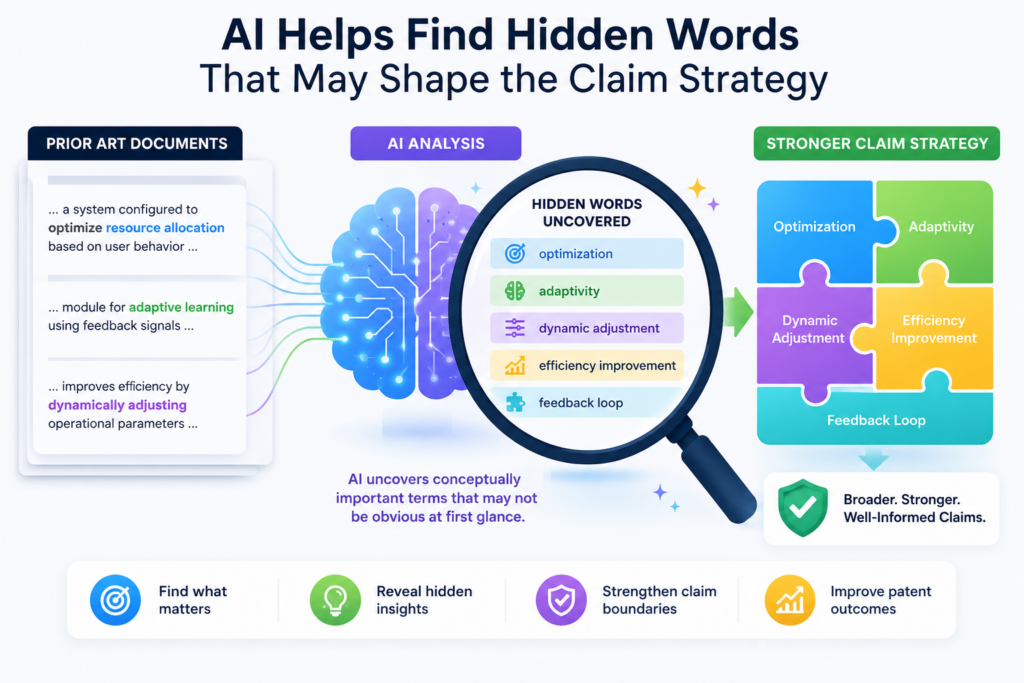
Prior art may use a totally different vocabulary. That gap can cause trouble if the search is too narrow.
AI helps close the gap by finding related terms and similar meanings. It can connect “fraud score” with “risk indicator,” “anomaly value,” or “transaction trust level.”
It can connect “agent workflow” with “automated task chain” or “multi-step execution plan.” It can connect “model update” with “retraining,” “fine-tuning,” “feedback adjustment,” or “adaptive learning.”
This matters because patent language is often broad and varied. Research language can be even more varied.
Product language may be simple and user-focused. AI can move across these styles and help find prior art that a normal search may miss.
Better words can lead to better claims
The goal is not to use big words. The goal is to use accurate words. A claim should not be so narrow that it only covers your current product wording. It should also not be so vague that it loses meaning.
The right words sit in the middle. They describe the invention in a way that is clear, fair, and hard to avoid with a simple name change.
AI can help suggest words that cover the technical idea without being tied to one internal label. The attorney can then decide which words are safe and useful.
This is important because claim wording can shape the value of the patent. A small wording choice may affect how the claim reads against both prior art and future competitors.
For a founder, this is a big deal. You are not just filing a document. You are building a protective layer around a core part of the company. The words need to match the invention today while still leaving room for the product to grow.
The eighth tactical move is to collect the terms your team uses and compare them to field terms
Before you start the filing process, gather the words your engineers use, the words your customers use, and the words that appear in papers or patents in your field.
AI can help connect these word groups. This makes the search better and the claim language stronger.
This step also helps avoid a common mistake. Some teams only describe the invention in customer language.
Others only describe it in code language. A strong filing often needs both the practical view and the technical view. The customer view shows why it matters. The technical view shows how it works.
PowerPatent helps teams bring these pieces together without turning the process into a slow legal maze.
The platform gives founders a better way to organize invention material, understand risk, and work with real patent attorneys who can shape the final filing. See how PowerPatent works here: https://powerpatent.com/how-it-works
AI helps show whether the claim has enough support in the invention details
A strong claim cannot float in the air. It needs support from the patent description.
That means the filing should explain how the invention works in enough detail so the claim feels tied to something real. AI can help by checking whether the claim language is backed by the material your team has provided.
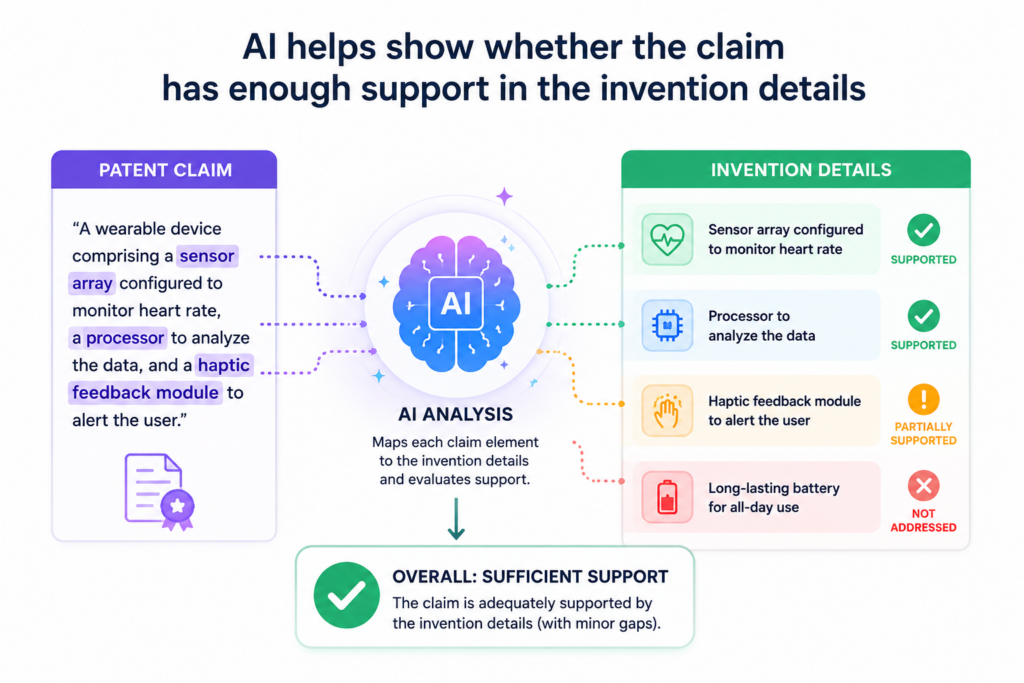
This is very useful for founders because early invention notes are often uneven. One part may be described in great detail. Another part may be assumed because the engineers already understand it.
A third part may live only in code, test results, or a whiteboard drawing. When this happens, the claim may look clear to the team but weak on paper.
AI can compare the draft claim against the invention disclosure and flag places where more detail may be needed. It may show that the claim mentions a scoring step, but the notes do not explain how the score is made.
It may show that the claim mentions a model update, but the draft does not explain what triggers the update. It may show that the claim mentions a control action, but the system response is not fully described.
Support is what turns a claim from an idea into a working invention
Many founders explain inventions from the top down. They start with the big result.
They say the system finds fraud, predicts failure, improves search, makes a task faster, or gives better answers. That is fine for a pitch. But a patent filing needs the working path under that result.
The filing should show the data path, the decision path, and the output path. It should explain what the system receives, what it checks, what it changes, what it stores, what it sends, and what happens next.
These details help the attorney shape claims that are not just broad, but also grounded.
AI can help spot thin areas before the filing moves too far. That can save real time.
It is much easier to add missing technical detail while the team still remembers the build choices than months later when the product has changed and the early reasoning is harder to recover.
The ninth tactical move is to fill the weak spots before claim drafting gets locked
Before the claim set is treated as final, review each key claim part and ask whether the patent description clearly explains it. If the answer is weak, add plain technical detail. Do not add fluff. Add the real how.
This is where PowerPatent helps technical founders move faster with more confidence. The platform helps organize invention details and gives attorneys a cleaner base to work from.
The result is a smoother path from raw idea to stronger filing, without forcing founders into a slow and confusing process. You can see how PowerPatent supports this workflow here: https://powerpatent.com/how-it-works
AI helps compare the claim against what an examiner may likely focus on
When a patent application is reviewed, the examiner often looks for old references that match the claim. The examiner may find one main document or combine more than one document.
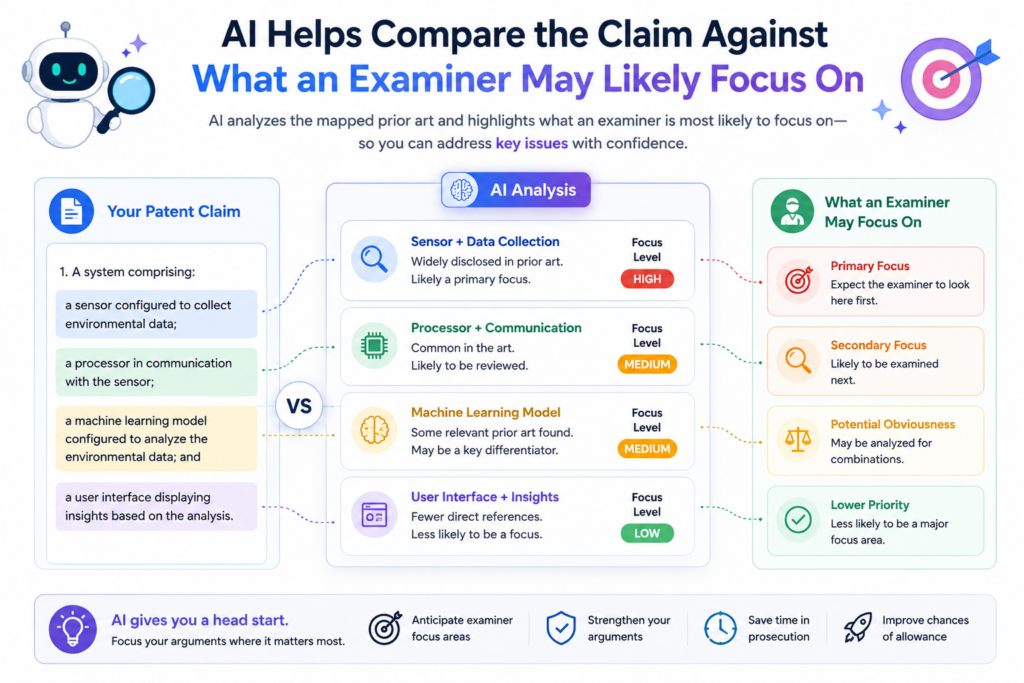
Founders do not need to know every rule behind that process, but they do need to understand the practical point. The claim will be compared against older work, and the closer the match, the harder the path may be.
AI can help founders prepare for this earlier. It can show which prior art references seem most likely to be used against the claim. It can also show which claim parts may invite the most pushback.
This does not guarantee what will happen, but it gives the team a better view before the application is filed.
That view matters. A startup may be racing toward a launch, a fundraise, a pilot, or a partnership. A surprise patent issue can create stress at the worst time.
AI mapping gives the team a way to see the likely pressure points sooner, so the filing can be shaped with more care.
Early examiner-style review can make the filing less reactive
Without early mapping, teams may wait until the patent office raises a concern. Then they react. They amend the claims. They explain the difference.
They try to work around the cited art. Sometimes that works well. Sometimes it leads to narrower protection than the team wanted.
A better approach is to think ahead. If AI shows that a certain prior art document is very close, the attorney can draft with that document in mind.
The filing can explain the key difference more clearly. The claims can be built around the strongest technical point. The examples can support the real improvement.
This does not mean the application will avoid every issue. Patent review is still a human process. But preparation helps. It lets the team file with eyes open instead of hoping the broadest version will pass.
The tenth tactical move is to draft around the closest known risk, not around the easiest story
The easiest story is often the one founders tell customers. It is clear, exciting, and benefit-driven.
But the strongest patent story may need to focus on a smaller technical feature that creates the benefit. AI can help reveal that feature by showing where the old work is closest.
Once that risk is known, the claim can be shaped with more purpose. The filing can spend more time on the key technical difference and less time on background that does not help. This makes the whole application cleaner.
PowerPatent is built for this kind of work. It gives founders a way to move fast while still bringing real attorney judgment into the process. That balance matters because the goal is not just to file something.
The goal is to file something that protects the work you are building. Learn how PowerPatent works here: https://powerpatent.com/how-it-works
AI helps founders avoid filing claims that only cover the current product screen
One common mistake is writing claims that are too tied to the current product. This happens when the invention is described only through the user interface, the current workflow, or the current release.
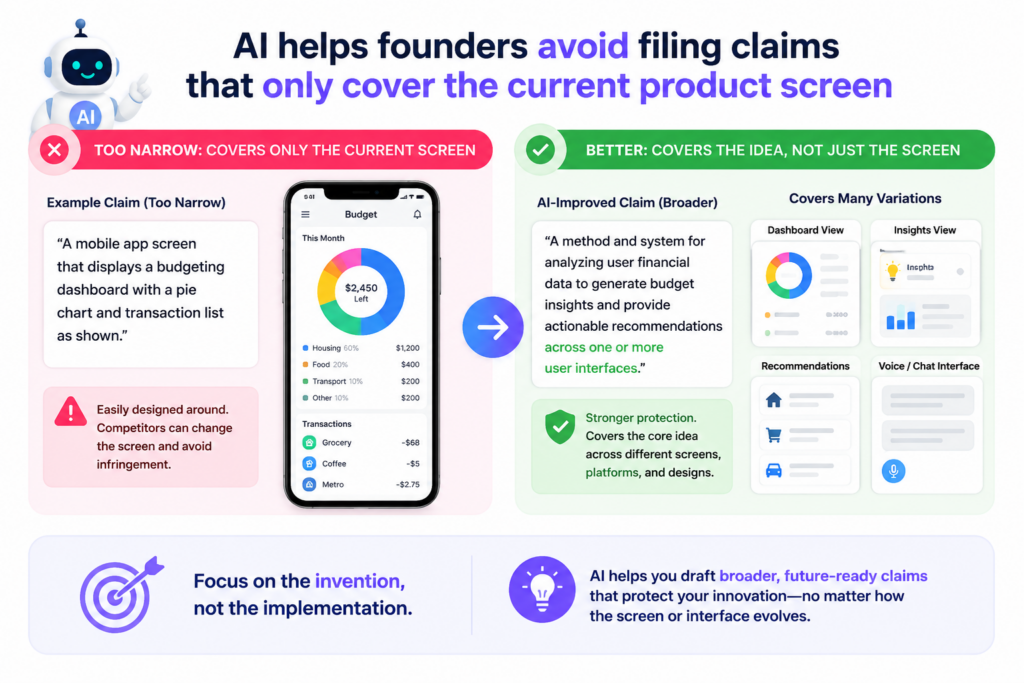
That may feel accurate today, but it can create a problem later. The product will change. Competitors may use a different screen, a different order of steps, or a different name for the same core method.
AI can help separate the deeper invention from the surface design. It can look at the product description and identify the technical process underneath.
Instead of focusing only on what the user clicks, it can help show what the system does behind the scenes.
For example, the screen may show a “review risk” button. But the invention may be in how the system gathers signals, weighs them, compares them with past behavior, and updates the next action. The button is not the invention. The working method behind it may be.
Product features change, but strong invention logic can last
A startup may rebuild its front end many times. It may rename features, change flows, add new plans, or move parts of the product into an API. If the patent claim is too tied to the first version of the product, it may not age well.
A stronger approach is to claim the core technical logic in a way that fits the real invention, not just the first interface.
AI mapping can help by showing whether prior art already covers the broad logic and where the newer technical difference sits. The attorney can then shape language that is not trapped by the current screen.
This is especially important for AI products. A model, pipeline, agent, or data system may be used in many product forms.
It may start as a dashboard, then become an API, then run inside another platform. The patent strategy should consider that growth from the start.
The eleventh tactical move is to describe the engine behind the feature
When preparing invention materials, do not stop at screenshots. Explain what happens after each input.
Explain what data is read, how the system decides, what changes in memory or state, and how the output affects the next step.
This gives AI better material to map and gives the attorney better material to claim. It also helps avoid shallow filings that sound like a product brochure.
A good patent filing should protect the machine under the hood, not just the paint on the outside.
PowerPatent helps founders capture this deeper layer without turning the process into a long legal project.
The platform is made for builders who want to protect real technical work while staying focused on shipping. See how it helps here: https://powerpatent.com/how-it-works
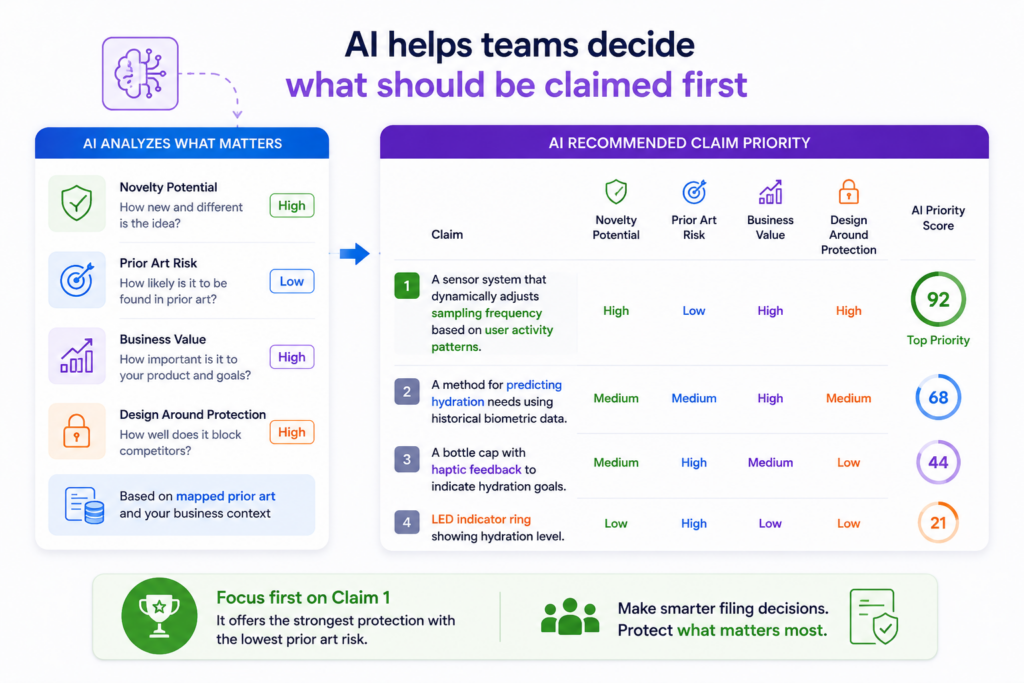
AI helps teams decide what should be claimed first
Most startups have more invention material than they realize. One product may include several patent-worthy ideas.
There may be a data process, a training method, a user workflow, a security layer, a scoring engine, a control system, or a deployment trick.
Trying to claim everything at once can make the filing messy. Ignoring valuable parts can leave protection on the table.
AI can help sort the invention material into possible claim paths. It can compare each path to prior art and show which ones look more crowded and which ones look more open.
It can also help reveal which parts appear most central to the product.
This is helpful because patent strategy is not just about what is new. It is also about what matters to the business. A technical feature may be clever, but not central.
Another feature may be simple but critical because competitors would need it to match your product. The best claim path often sits where technical difference and business value meet.
The first filing should protect the part that creates leverage
For a startup, leverage means the claim protects something competitors would care about.
It may cover a key system step, a hard-to-copy workflow, or a method that makes the product work better at scale. It should not only protect a side feature that no one needs.
AI can help by showing which claim paths have room around the prior art. Attorneys can then help decide which path makes sense for the first filing.
The team may also choose to file more than one application over time as the product grows.
This is where speed matters. If your team is about to launch, publish, demo, or talk to partners, waiting too long can create risk. A clear AI-assisted workflow can help you move sooner while still making smart choices.
The twelfth tactical move is to rank invention paths by strength and business value
Before filing, look at each possible invention path and ask two plain questions. How different is this from the closest prior art? How important is this to our product or market position?
The best starting point is usually the path with both answers strong. That is where AI mapping and founder judgment work well together.
AI helps show the field. Founders know what matters to the company. Attorneys shape that into a filing that can support real protection.
PowerPatent brings these pieces into one modern process. Smart software helps organize and compare the invention. Real patent attorneys help refine the strategy and filing.
For founders, that means less guesswork, fewer delays, and a better shot at protecting the work that makes the company valuable. Explore the process here: https://powerpatent.com/how-it-works
AI helps reveal when several small old ideas may be combined against a claim
A prior art problem does not always come from one old document that shows the whole invention. Sometimes the risk comes from a mix of older sources. One paper may show the data step.
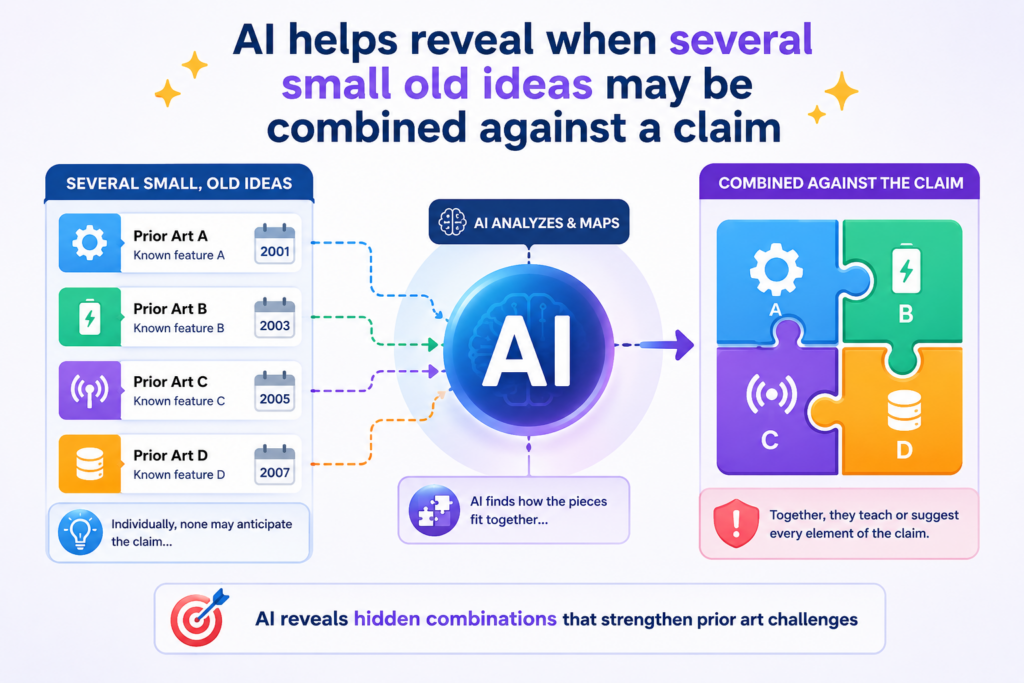
One patent may show the model step. One product guide may show the output step. Alone, each source may not look dangerous. Together, they may create a harder question.
This is where AI can be very useful. It can map each claim part to different sources and show where the claim may be built from pieces that already exist in the field.
That does not mean the claim is dead. It means the team needs to understand the chain and explain why the invention is still different.
For founders, this is a key point. Your product may feel new because no one built it in the same package.
But the patent question may look at whether the claimed steps were already known and whether it would have been natural for someone to put them together. AI can help surface that risk early, before the claim is filed in a weak form.
A combined prior art map can show where the real invention must stand
When AI shows several sources that match different parts of a claim, the most important question becomes simple.
What is the glue? In other words, what makes your system more than a normal mix of known parts?
The answer may be a new order of steps. It may be a special trigger. It may be a feedback loop.
It may be a timing rule, a data filter, a control action, or a system state that changes how the next step works. That glue can be the real invention.
This is often where weak filings miss the mark. They describe the parts, but not the relationship between the parts. They say the system has a model, a database, and an output tool.
But many systems have those things. The stronger story explains how those parts work together in a way that creates a new result.
The thirteenth tactical move is to focus on the link between the steps, not just the steps themselves
When your team reviews an AI prior art map, do not only ask whether each part appears somewhere.
Ask whether the old sources show the same connection between the parts. That connection can be a strong place to build the claim.
This is especially true for AI, robotics, biotech tools, cloud systems, chips, clean energy controls, and other deep tech fields.
Many core parts may already be known. The invention may live in how those parts are arranged, tuned, updated, or controlled.
PowerPatent helps founders capture these details before they get lost. Smart software can help find and map the old material.
Real patent attorneys can help decide which links matter and how to write them into a stronger filing. You can see how PowerPatent helps teams protect technical work here: https://powerpatent.com/how-it-works
AI helps show which claim words may create risk later
Claim words are not just labels. They shape what the patent may cover. A word that feels harmless can create a narrow claim. A word that feels strong can make the claim too broad.

A word that is not well supported can lead to pushback. AI can help spot these issues by comparing claim words against both the invention material and the prior art.
For example, a claim may say “real-time,” but the invention notes may not explain what real-time means in the system.
A claim may say “optimized,” but the filing may not explain what is being improved or how. A claim may say “automatically,” but the workflow may include human review. These words can matter.
AI can flag terms that appear often in prior art or terms that are vague in the draft.
It can also show where a word may be too tied to one version of the product. This helps the team clean up the claim before it becomes harder to change.
Good claim language should be clear enough to defend and broad enough to matter
The best claim words do not try to sound impressive. They try to be useful. They should describe the invention in a way that a technical reader can follow.
They should also leave enough room so the claim is not trapped by small design choices.
This balance is hard. Founders may want the broadest words possible. Attorneys may need to make sure those words are backed by the filing and not too close to prior art.
AI helps by giving both sides a clearer view of how the language behaves across a large set of older documents.
A smart claim may avoid product names, internal code names, and marketing phrases. It may use more general technical terms, but only when the description supports them.
It may also define the key step through function and structure, so the claim is not easy to dodge with a different label.
The fourteenth tactical move is to test every important word against three views
A good review asks how the word reads against your product, your invention details, and the closest prior art. If a word matches the product but not the technical details, add support.
If it matches too much prior art, consider a more specific phrase. If it is so narrow that a competitor can avoid it with a small change, ask whether the deeper idea can be claimed another way.
This is not about making the claim longer. It is about making each word earn its place. A clean claim can be more powerful than a crowded one.
PowerPatent helps founders avoid getting buried in this work. The platform helps organize invention details and prior art signals, while real patent attorneys guide the claim strategy.
That gives startups a better path than guessing, waiting, or filing a thin application that misses the core value. See how the process works here: https://powerpatent.com/how-it-works
AI helps founders prepare better answers before patent review begins
A patent filing does not end when the application is submitted. The patent office may ask questions. It may cite prior art. It may push back on broad claims. That is normal. What matters is how prepared the team is.
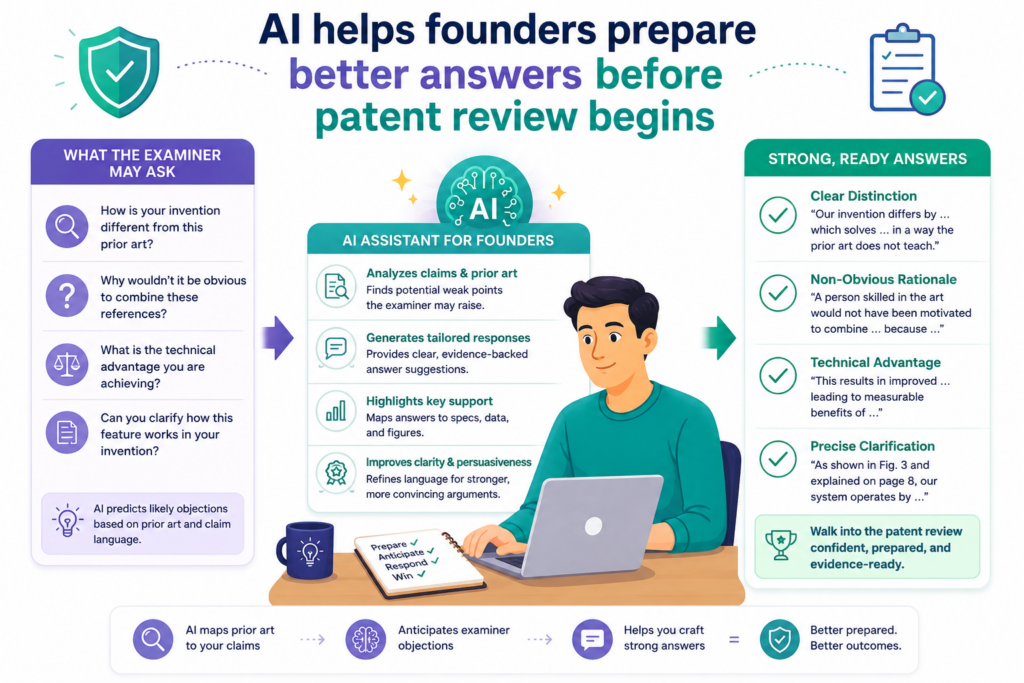
AI claim mapping can help before this review starts. By showing the closest prior art and the key claim gaps, AI gives the attorney a stronger base. The filing can include better examples.
The claim set can include fallback paths. The description can explain the core technical difference with more care.
This can make later review less stressful. The team is not starting from zero when a concern appears. They already know which old references looked close.
They already know which claim parts needed support. They already know where the invention’s strongest ground may be.
Early preparation can protect more than the first claim
A good patent application often includes more than one claim path. Some claims may be broad. Others may be narrower. Some may focus on the system.
Others may focus on the method, the data flow, the model update, or the control action. This gives the attorney more room to work during review.
AI can help suggest where those fallback paths may come from by showing which parts are less crowded.
If the broad claim faces pushback, a narrower claim may still protect the most valuable part of the invention. This is much better than filing with only one thin idea and hoping it survives.
For a startup, this matters because the business may depend on more than getting a patent number. The patent should support fundraising, deals, defense, and long-term value. A filing that has no room to adjust can become a weak asset.
The fifteenth tactical move is to build fallback positions from the start
When you prepare the application, ask what the claim should fall back to if the broad version faces strong prior art.
The answer may be a special data type, a timing step, a model update rule, a control loop, a hardware setting, or a user action that changes the system state.
These details should not be added as an afterthought. They should be described clearly in the filing. AI can help find which details may be useful. The attorney can decide how to include them and how to claim them.
This is one reason PowerPatent pairs software with real attorney oversight. AI can help move fast and find patterns, but the final filing needs human judgment.
PowerPatent gives founders both, so they can protect what they are building without slowing the company down. Start exploring the workflow here: https://powerpatent.com/how-it-works
AI helps teams spot what should not go into a patent claim
A strong patent strategy is not only about what to claim. It is also about what not to claim. Some details may be too easy to design around.
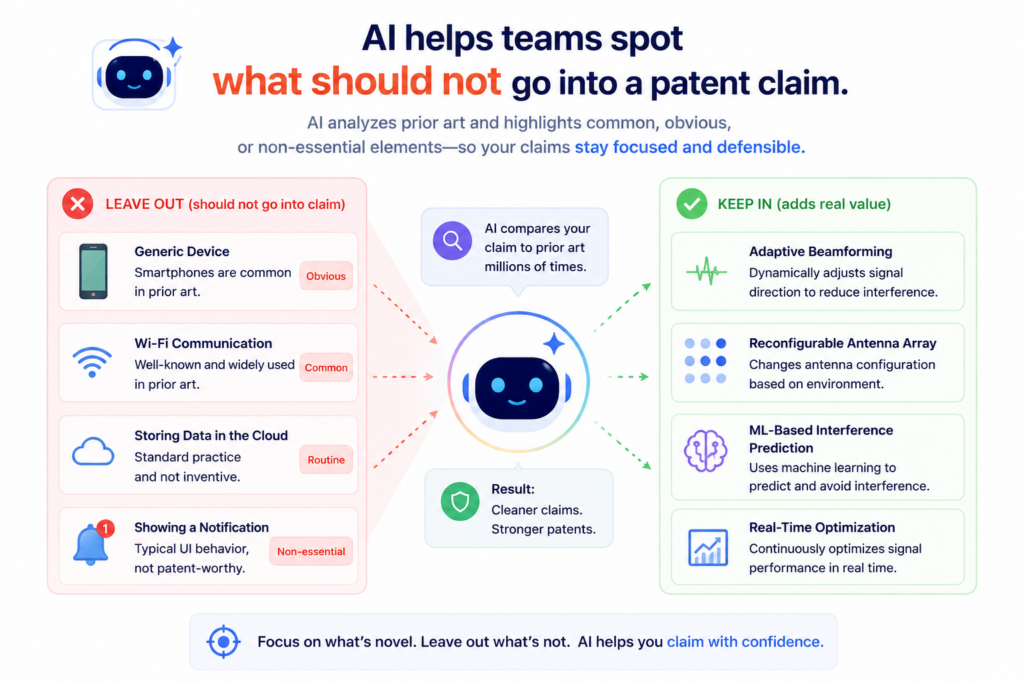
Some may be likely to change soon. Some may be better kept as a trade secret. Some may add limits without adding real protection.
AI can help by showing which details are common in prior art, which details are narrow product choices, and which details seem central to the invention. This makes it easier to avoid loading the claim with parts that weaken it.
For example, a startup may describe a model using one current architecture because that is what the team uses today. But if the invention is really in the data feedback loop, tying the claim to that one model type may be a mistake.
A competitor may use a different model and still copy the real idea. AI can help reveal this by comparing the claim language against other ways the same function appears in older work.
Leaving out the wrong detail can be risky, but adding the wrong detail can also hurt
A claim needs enough detail to stand apart from prior art. But it should not include every product choice. The goal is to protect the inventive core, not to write a full product manual into the claim.
This is where attorney review becomes vital. AI may show patterns, but a patent attorney helps decide what belongs in the claim, what belongs in the description, and what may be better left out.
That judgment can affect the value of the patent for years.
Founders should think of this as editing for strength. Every added phrase should have a job. It should help show the invention, avoid prior art, or preserve value. If it does not do one of those things, it may be adding weight without adding power.
The sixteenth tactical move is to separate core invention details from current build details
Before filing, review the invention material and sort the details in plain language.
Ask which details make the invention work, which details are only one version of the product, and which details may change as the system grows.
This does not mean you should hide useful technical detail. The patent description can include many examples.
But the claim should be shaped with care. AI mapping helps show where the core may be. Attorney review helps decide how to protect it.
PowerPatent is built for founders who want this kind of clarity. You can move fast, keep control, and still get real legal oversight where it matters.
Instead of guessing which details matter, you can use a guided process to build a stronger patent path. Learn more here: https://powerpatent.com/how-it-works
AI helps show where the claim should focus on the technical result
A patent claim should not only describe steps. It should help show why those steps matter in a technical way.
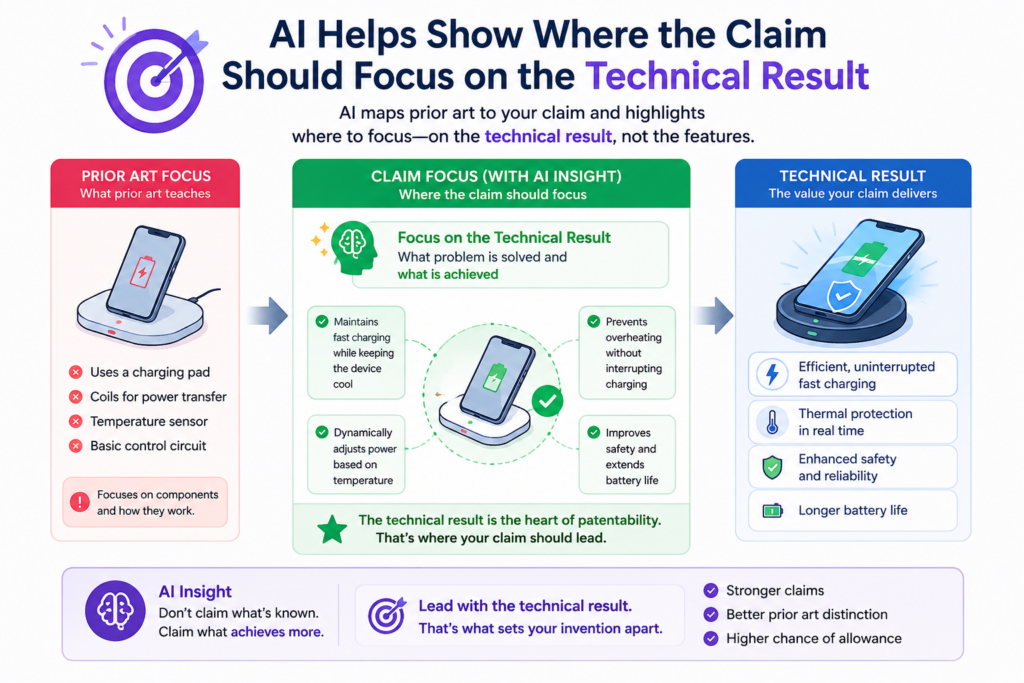
That does not mean the claim needs big words. It means the claim should point to a result that comes from how the system works.
For AI inventions, the result may be fewer false alerts, lower compute use, faster training, better routing, safer output, cleaner data, stronger matching, or more stable control.
The result should not be a vague promise. It should connect to the actual design of the system.
AI can help by reading the invention material and finding where the technical result appears. It can also compare that result against prior art.
If older systems already claimed the same benefit, your filing may need to explain how your system reaches that result in a different way. If the old systems did not solve the same problem well, that gap can become useful.
The best technical result is tied to a real system change
A weak filing may say the invention is “more accurate” or “more efficient” without showing the reason. A stronger filing explains the system change that causes the improvement.
For example, the system may remove noisy inputs before training. It may adjust weights after a human review. It may route edge cases to a different model. It may store a new state value that changes the next output.
AI mapping helps bring these links into view. It can show whether the old art includes the same system change. It can also show whether your improvement is truly tied to the claim language.
This matters because a claim that includes the right steps but misses the result may feel dry and weak. A claim that includes a result without the steps may feel too broad. The best version brings both together.
This is also helpful for founders who need to explain patents to investors or partners. A clear technical result is easier to understand.
It makes the patent feel tied to the business. It shows that the filing is not just paperwork. It protects something that helps the product win.
The seventeenth tactical move is to connect every key claim step to a useful outcome
When you review a claim, ask what each major step does for the system. Does it reduce noise? Does it improve a score?
Does it prevent a bad output? Does it make a later action safer or faster? If a step does not change anything important, it may not belong in the main claim.
This does not mean every step needs a dramatic result. Some steps are needed because they support the chain. But the core steps should lead to a clear technical outcome.
PowerPatent helps founders bring these connections into the filing process. Smart software can help organize the invention, while real patent attorneys help shape the claim around what matters.
That gives startups a better way to protect technical value without losing speed. See how PowerPatent works here: https://powerpatent.com/how-it-works
AI helps compare your claim against your own public disclosures
One of the easiest patent mistakes is forgetting what your own team has already shared. A blog post, demo, white paper, conference talk, GitHub repo, launch page, sales deck, or public API note can create issues if it was shared before filing.
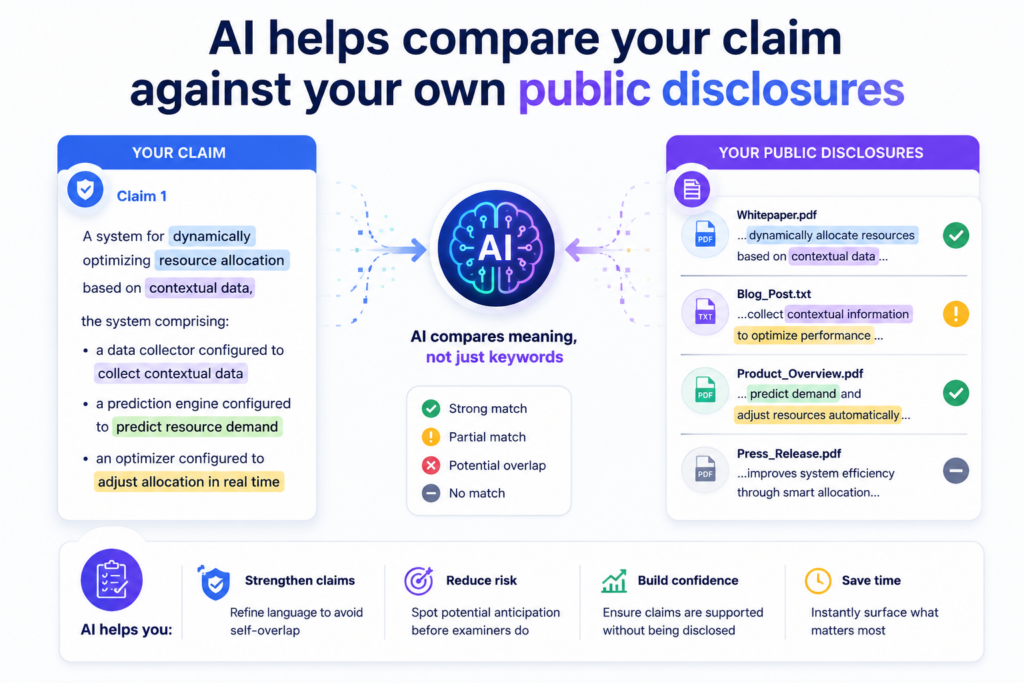
Founders move fast, and public content often goes out before the patent plan is ready.
AI can help by checking your own public material against the claim. It can look for places where your team already described parts of the invention.
It can also help show whether the public material is broad or detailed. This gives the attorney a clearer view of timing and risk.
This step is not about fear. It is about control. If you know what was shared, when it was shared, and how much detail it included, you can make better filing choices. You can also build a better habit for future launches.
Your own content can be useful, but timing matters
Public content may show that your team had the idea early. It may also explain the product in simple terms.
But if that content came before a patent filing, it can also create problems in some places. This is why founders should think about patent filings before big public moments.
AI mapping can help connect the dots. It can compare claim parts to your public pages and show where the overlap is strong.
That helps your team decide what to file now, what to update, and what to avoid sharing too early next time.
For technical teams, this is especially important because engineers often share more than they realize. A short architecture note or open-source comment can reveal a key method.
A demo video can show a workflow. A product help page can explain the logic behind a feature. These small items may matter later.
The eighteenth tactical move is to run a pre-launch patent check before publishing technical details
Before a major launch, your team should pause and ask what new technical ideas are about to become public. If a feature is important and not yet filed, review it before the announcement.
The goal is not to slow down the launch. The goal is to avoid giving away the invention before protection is in motion.
This is where PowerPatent can fit into a startup rhythm. It helps teams move quickly from invention material to a guided patent process, with attorney oversight built in.
That means you can protect key work before the public story gets ahead of the patent strategy. Learn more here: https://powerpatent.com/how-it-works
AI helps founders see which parts of the claim competitors may try to avoid
A patent claim is only useful if it protects something others may want to use. Competitors will not always copy your product exactly.
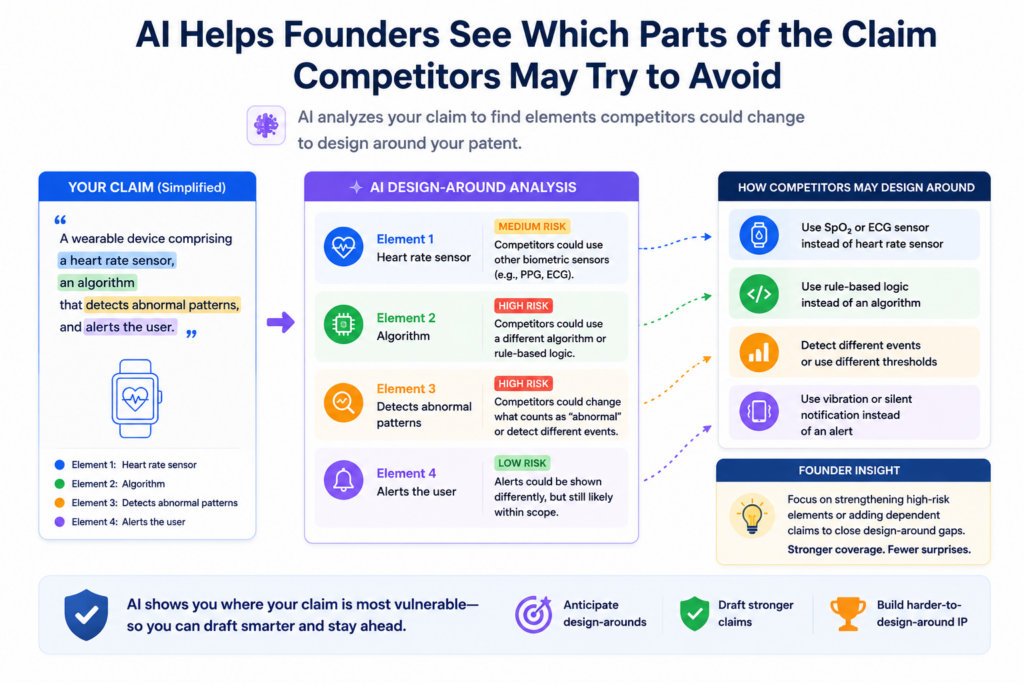
They may change the order of steps, use a different model, rename a module, shift work to another server, or replace one data source with another. A strong claim should be written with this in mind.
AI can help by showing alternate ways the same function appears in prior art and technical writing.
This can help the team see where competitors may have room to design around the claim. If the claim is tied to one narrow version, AI may reveal many nearby versions that do nearly the same thing.
That does not mean the claim should try to cover every possible path. It means the team should understand the field before choosing the claim shape.
A claim that is too narrow may be easy to avoid. A claim that is too broad may be easy to challenge. The goal is a claim that protects the real technical move without overreaching.
Strong claim mapping looks forward as well as backward
Prior art mapping is mainly about older work, but the insight can also help with future risk.
When AI shows how other systems describe similar methods, it helps your team think about how the market may build around the same problem.
For example, if the invention is a feedback loop that improves model output after user correction, a competitor may try to avoid the claim by changing the trigger, changing the stored value, or changing when the model updates.
If the filing only claims one narrow trigger, it may miss other versions. If the filing describes several examples, the attorney may have more room to shape protection.
This is why good patent work is not just about passing review. It is about building useful coverage. Passing review with a claim no one needs to avoid is not a win.
The better win is a claim that covers a meaningful part of the market while still standing on solid ground.
The nineteenth tactical move is to ask how a smart competitor would work around the claim
Before filing, read the claim like a competitor. Ask what small change could avoid it. If the answer is too easy, the claim may need work. The description may also need more examples that show the invention in different forms.
This is another place where software and attorney review work better together. AI can show patterns and alternate terms.
Attorneys can judge what those patterns mean for claim strategy. Founders can add real product insight because they understand how the market will likely move.
PowerPatent is built around that mix. It helps founders protect the technical core, not just the first product version.
It gives teams a smarter way to move from invention to filing with less delay and more confidence. Start here: https://powerpatent.com/how-it-works
AI helps turn prior art from a threat into a drafting guide
Many founders treat prior art like bad news. They worry that finding close art means the invention is not worth filing. In reality, prior art can be one of the best drafting tools.
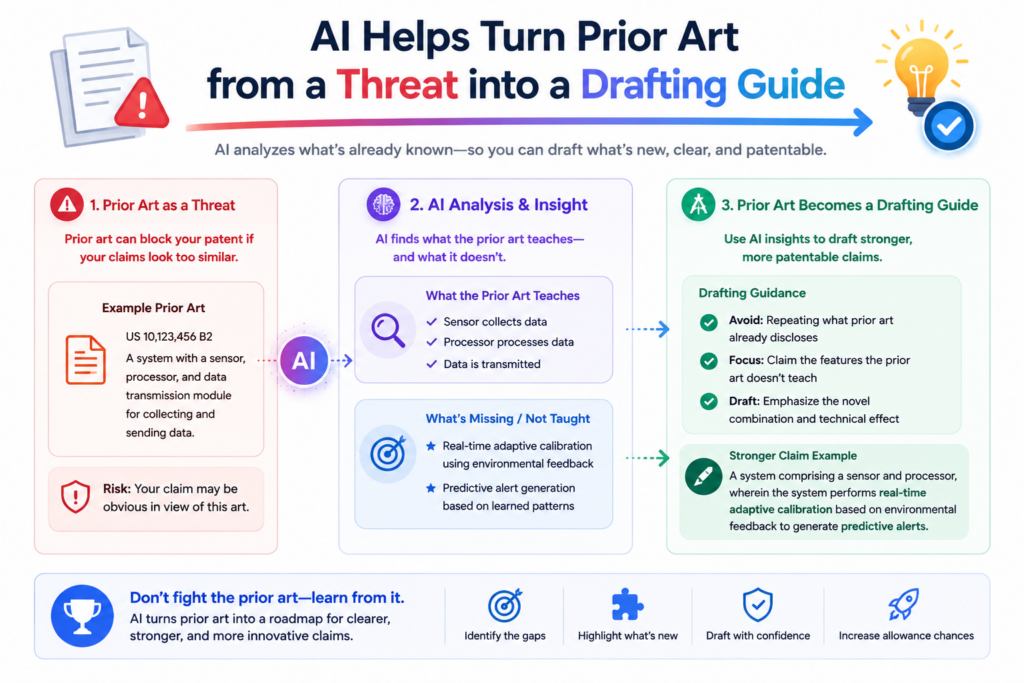
It shows the shape of the field. It shows what has been tried. It shows where the crowded areas are. Most important, it shows where your strongest difference may live.
AI makes this useful by turning a huge search problem into a clearer map. It can show which claim parts are common, which parts are rare, and which combinations deserve a closer look. This helps the team draft with more intent.
The goal is not to hide from prior art. The goal is to understand it early enough to make the filing better.
A patent application written with a clear view of the field can be more focused, more honest, and more useful to the company.
The best drafting starts with the closest art, not the easiest claim
It is tempting to start with a broad claim that sounds strong. But if that claim ignores the closest old work, the filing may face trouble later. A better path is to study the closest art first, then build the claim around the real difference.
AI can help by finding the close art faster. It can also show the specific claim parts that overlap.
This helps the attorney decide where to narrow, where to explain, and where to add support. It helps the founder understand why certain claim choices matter.
This process can also improve the invention story. When you see what others have done, you can explain your own work with more precision.
You can say, in plain terms, what the old systems missed and how your system fixes it. That is useful for patents, but it is also useful for fundraising, sales, partnerships, and team alignment.
The twentieth tactical move is to write a plain difference statement before drafting claims
Before the final claim language is drafted, write one clear paragraph that explains the difference between your invention and the closest prior art.
Keep it simple. Say what the old system did, what it failed to do, and what your system does instead.
This paragraph can guide the whole filing. It can help the attorney shape the claims. It can help the team avoid drifting into vague language. It can also help future readers understand why the invention matters.
PowerPatent helps make this kind of clarity easier. The platform supports a faster, more guided patent workflow, while real attorneys help make sure the filing is built around the true invention.
For founders who want protection without the old slow process, that mix can be a major edge. See how PowerPatent works here: https://powerpatent.com/how-it-works
Conclusion:
AI does not replace judgment; it sharpens it. By mapping prior art to each claim part, it helps founders see risk early, find the true invention, and file with more confidence. The key is pairing smart search with real attorney review, so speed does not weaken protection.
For startups, this means fewer blind spots, cleaner claims, and better decisions before launch, funding, or growth. If your team is building something hard to copy, protect it while the details are fresh. See how PowerPatent helps turn real technical work into stronger patent filings here: https://powerpatent.com/how-it-works