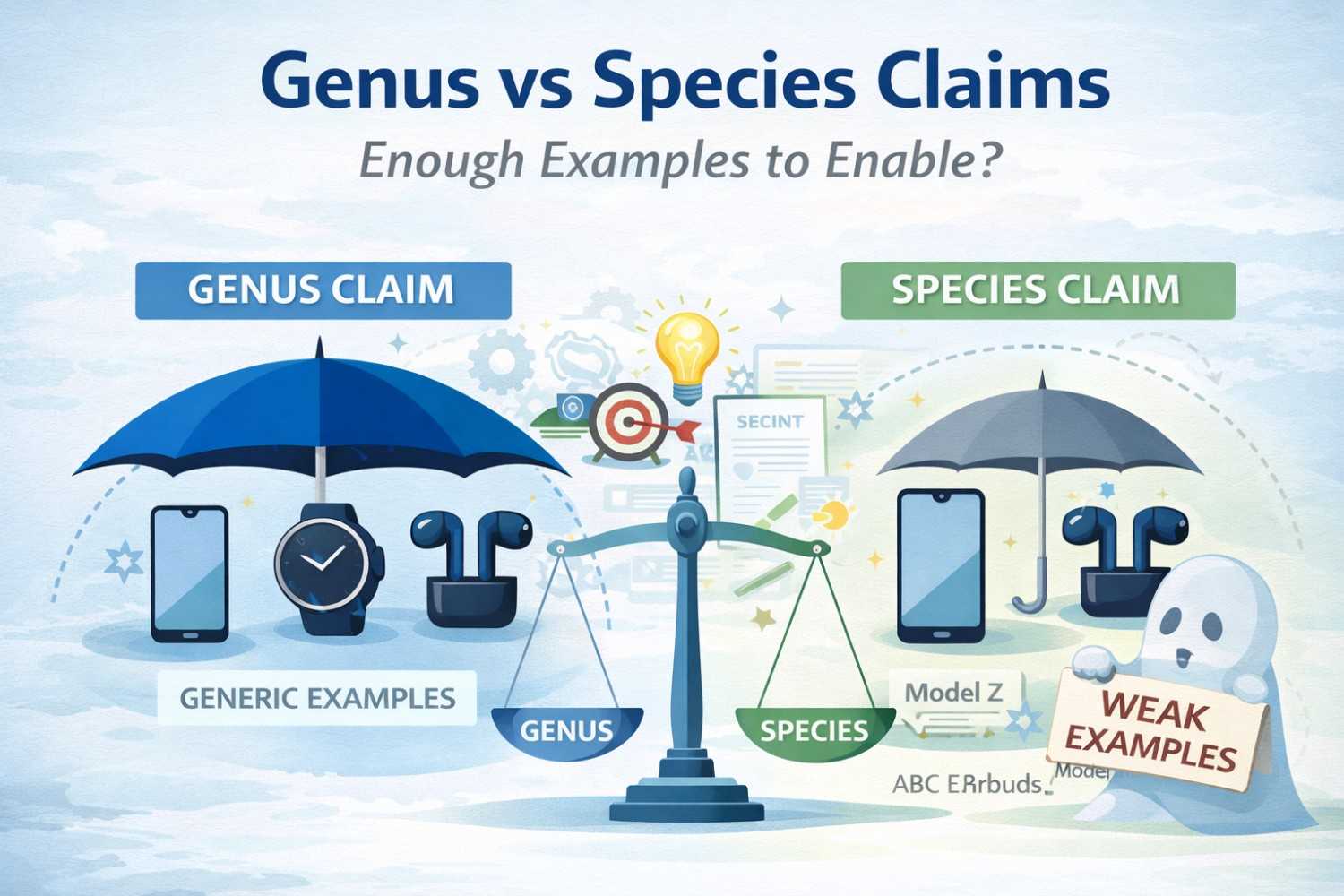
If you are building something new, your patent can either protect the whole idea or just a tiny slice of it. That choice often comes down to one question: are you claiming a big category, or just a few specific versions? This is where genus and species claims come in, and where many founders quietly lose protection without knowing it. This article is about that exact problem. We are going to talk, in very plain words, about what genus and species claims really are, why examiners care so much about “enough examples,” and how startups accidentally box themselves into weak patents. No filler. No theory for theory’s sake. Just what matters if you want protection that actually holds up.
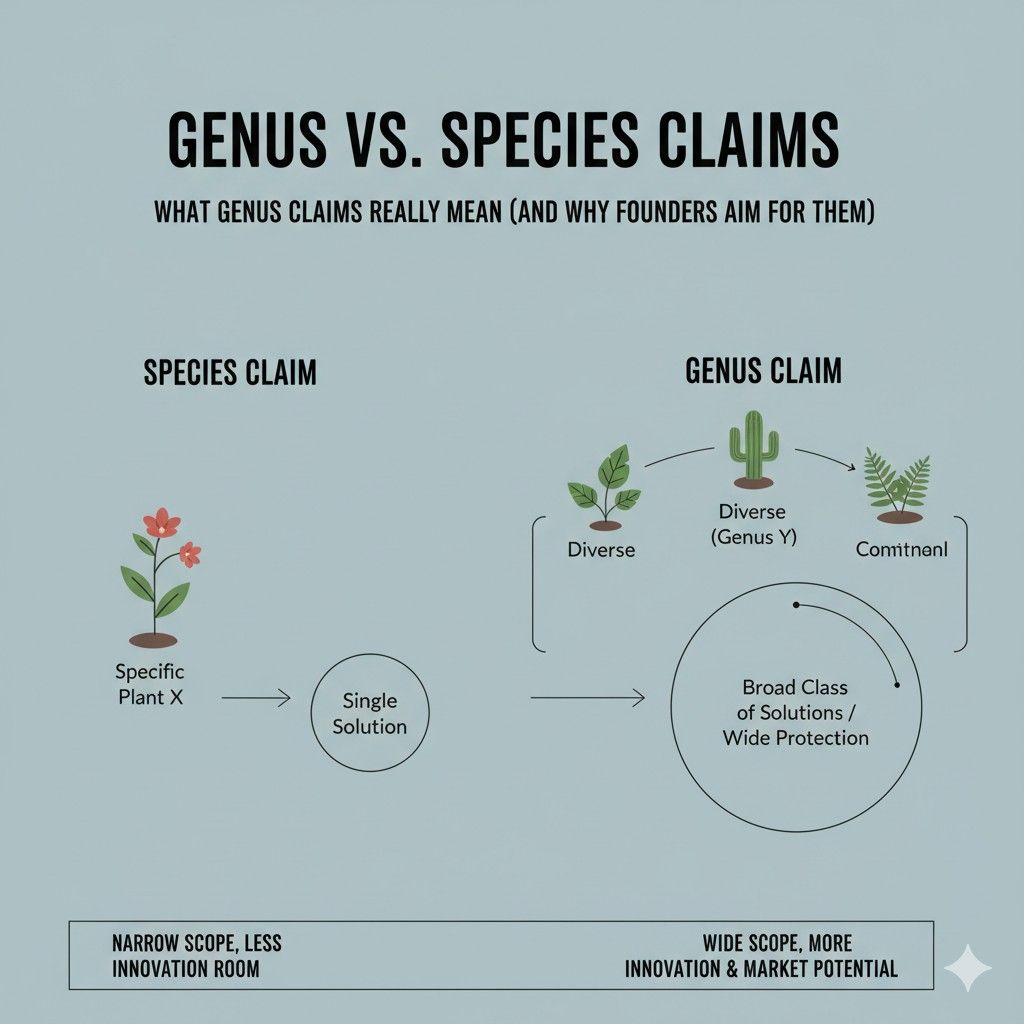
What Genus Claims Really Mean (And Why Founders Aim for Them)
Genus claims sit at the heart of strong patent strategy. They are the reason patents can protect a whole idea instead of a single version of it. For founders, this is usually the goal, even if they do not use this word.
When someone says “I want to protect the concept, not just my current build,” they are really saying they want a genus claim.
This section breaks down what genus claims truly are, why they are so powerful, and where founders often go wrong when they try to get them. The focus here is not theory.
It is about making choices that actually protect your business as it grows and changes.
The Simple Idea Behind a Genus Claim
A genus claim is a claim about a category. It covers a group of things that share a common idea, structure, or behavior. Instead of naming one exact solution, it describes the broader class that solution belongs to.
Think of it as drawing a fence around the whole field instead of just one plant. If done right, anyone building anything inside that field is stepping on your patent, even if their version looks different on the surface.
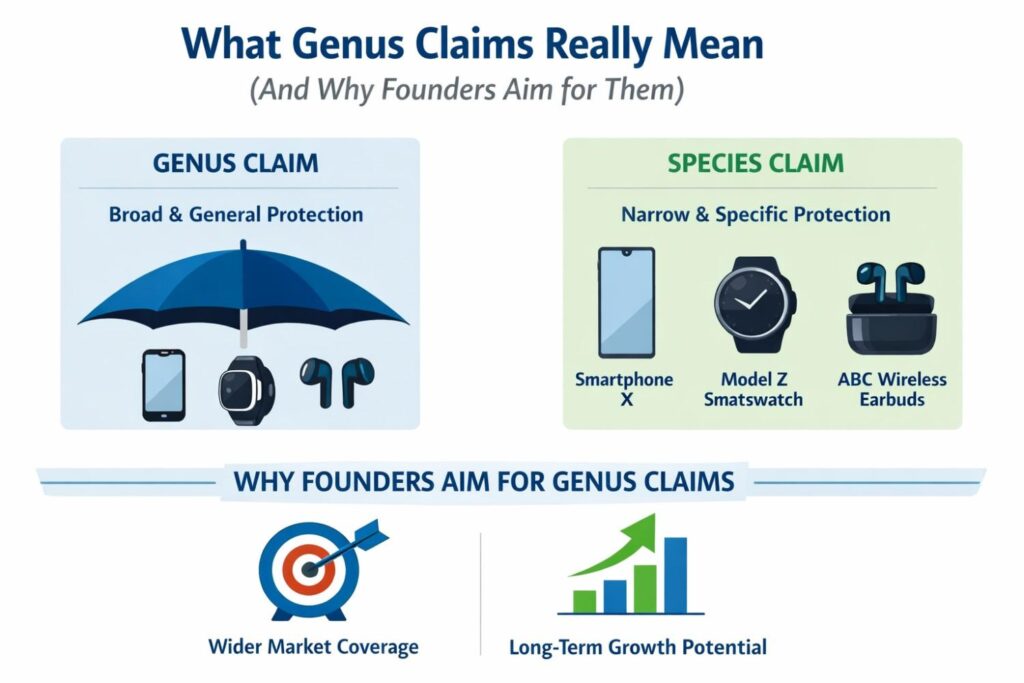
This is why genus claims matter so much to startups. Your product today is rarely your product in two years. A claim that only fits your current build can become outdated fast. A genus claim can grow with you.
Why Founders Naturally Want Broad Protection
Most founders aim for genus claims without realizing it. You are building something new because you believe the idea itself is valuable, not just one implementation.
You want to stop competitors from copying the approach, not just the exact code or setup you shipped first.
Genus claims give you leverage. They make your patent harder to design around. They increase the value of your company in due diligence. They also send a clearer signal to the market that you own the space, not just a corner of it.
Investors may not say “genus claim,” but they feel the difference. A patent that covers the whole approach feels safer and stronger than one that reads like a narrow instruction manual.
How Genus Claims Are Actually Written
A genus claim does not list every version of an invention. Instead, it focuses on what makes all those versions part of the same idea. This often shows up as functional language, system behavior, or relationships between parts.
The mistake many founders make is thinking that broad language alone creates a genus claim.
It does not. A claim can sound broad and still fail if the support underneath it is weak. The claim is only half the story. The rest lives in the description.
When you write or review a genus claim, ask yourself whether it would still make sense if your product changed shape, stack, or delivery method. If the answer is no, the claim may be narrower than it looks.
The Hidden Tradeoff in Genus Claims
Genus claims are powerful, but they are not free. The broader you go, the more the patent office will ask one key question: have you really shown that you own this whole category?
This is where many applications break down. Founders aim high, but only describe one working example in detail. The gap between the broad claim and the narrow example becomes the weak point.
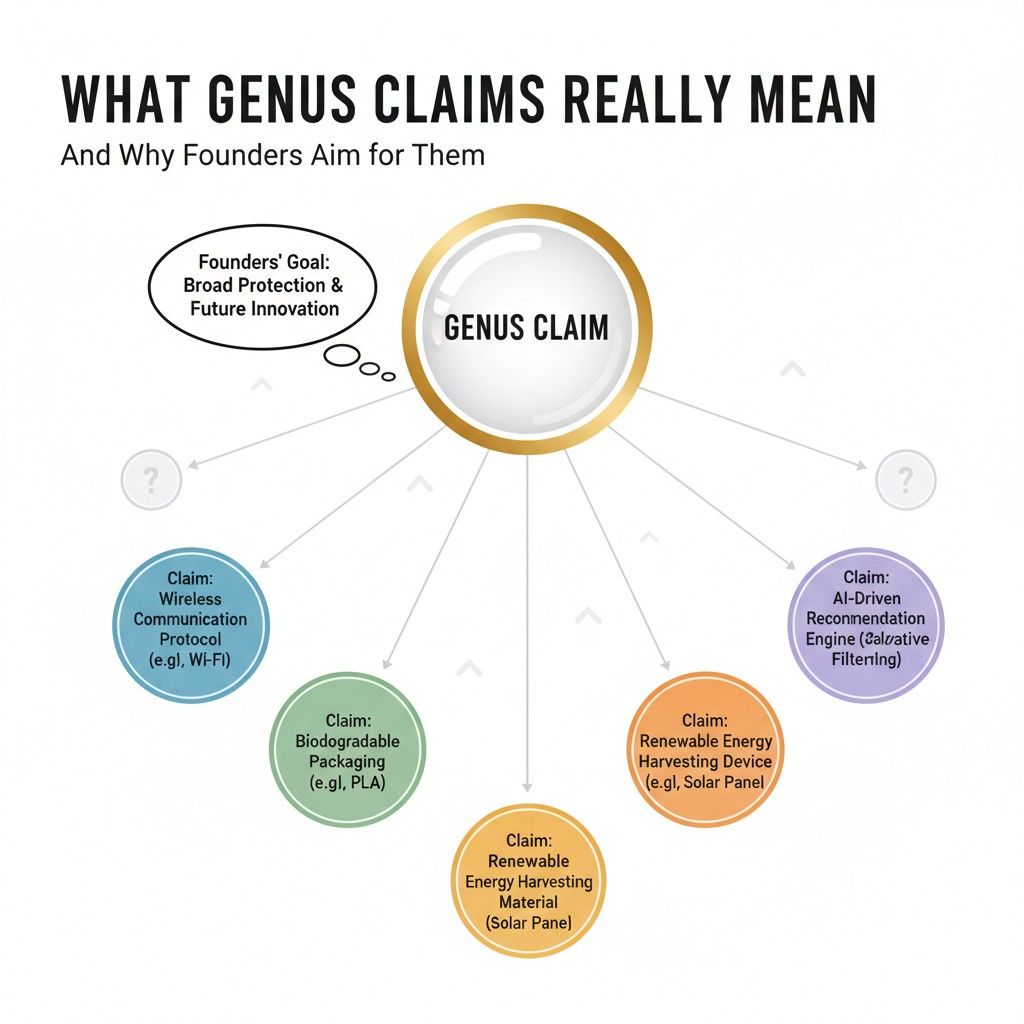
Examiners are trained to look for this gap. If they see a big idea with thin support, they will push back. Understanding this tradeoff early helps you decide how broad to go and how much work is needed to support it.
The Role of Examples in Supporting a Genus
A genus claim lives or dies based on how well the description teaches the full scope of the idea. Examples are not filler. They are proof that the big idea actually works in more than one narrow case.
For founders, this means thinking beyond the current product version. You need to show different ways the idea could be built, used, or adapted, even if you never plan to ship those versions.
This does not mean guessing wildly. It means mapping the idea space around your invention and choosing examples that show range.
When done well, these examples quietly hold up the broad claim during examination and later enforcement.
How Founders Can Think More Strategically About Scope
A useful exercise is to imagine a smart competitor trying to copy your idea while avoiding your patent. Where would they tweak things? What parts would they swap out?
Those imagined workarounds are clues about how broad your genus needs to be.
If your claim only covers one specific setup, those workarounds will succeed. If your genus captures the underlying idea, they will struggle.
This kind of thinking is hard to do alone, especially when you are deep in building. That is why strong patent strategy blends technical understanding with outside perspective.
Avoiding the Trap of Overreaching
One of the biggest risks with genus claims is overreaching. This happens when the claim tries to cover more than the description can reasonably support.
Overreaching often feels good at filing time but causes delays, rejections, and forced narrowing later.
A better approach is controlled breadth. Aim for the widest claim that you can clearly explain and back up with real examples. This creates a strong position that examiners respect and competitors fear.
Founders who rush this step often end up with patents that look broad but behave narrow. Taking the time to align claims and examples avoids that outcome.
How PowerPatent Helps Founders Get This Right
Genus claims are not about fancy language. They are about clear thinking and careful coverage. PowerPatent was built to guide founders through this exact challenge, using software to surface gaps and attorneys to help close them.
Instead of guessing how broad you can go, you get feedback early. Instead of writing one example and hoping it is enough, you are pushed to think through the real scope of your idea.
If you want to see how this works in practice, you can explore it here: https://powerpatent.com/how-it-works
This is where strong patents begin, not at the end.
What Species Claims Cover (And Why They Feel Safer Than They Are)
Species claims often feel more comfortable, especially to technical founders. They look concrete.
They feel precise. They match what you have actually built. Because of that, many startups lean on species claims more than they should, thinking they are being careful and realistic.
This section explains what species claims really protect, why they give a false sense of security, and how relying on them too heavily can quietly weaken your patent position over time.
The Core Idea Behind a Species Claim
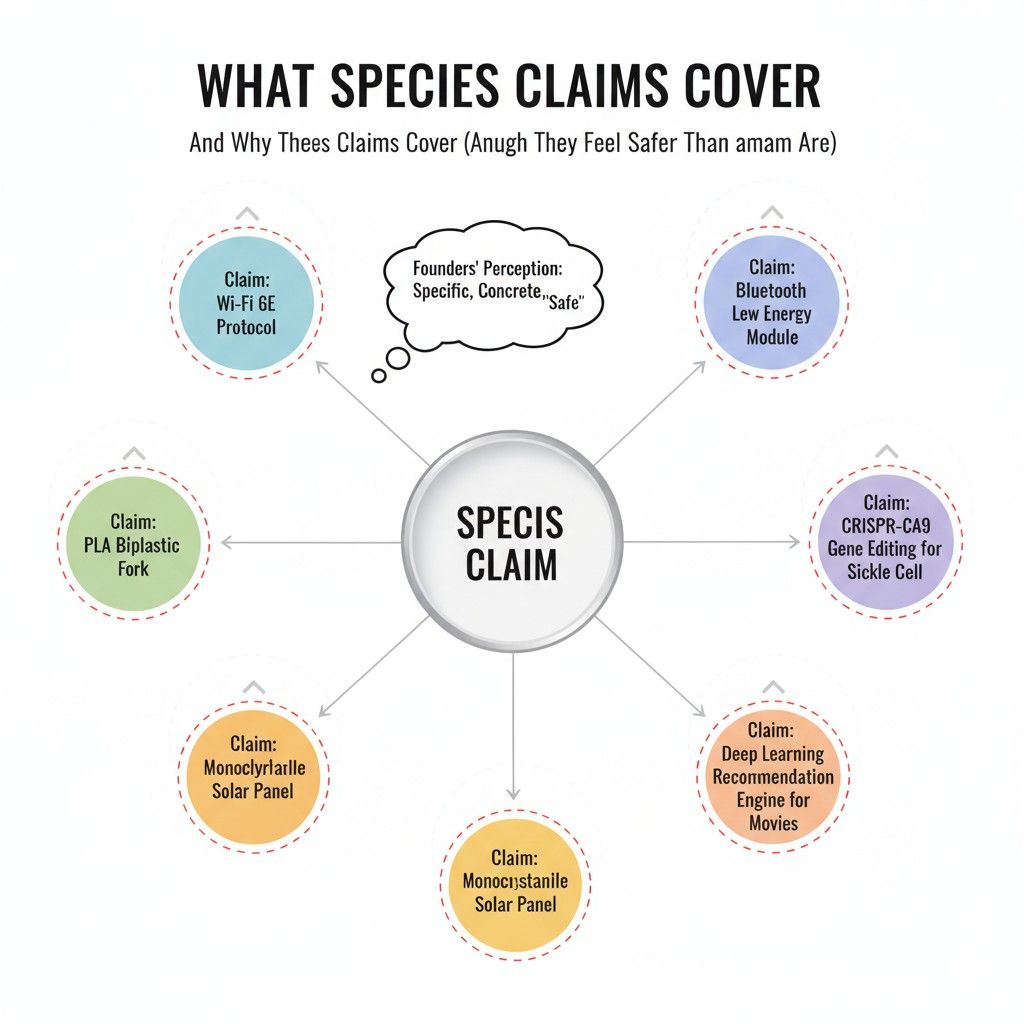
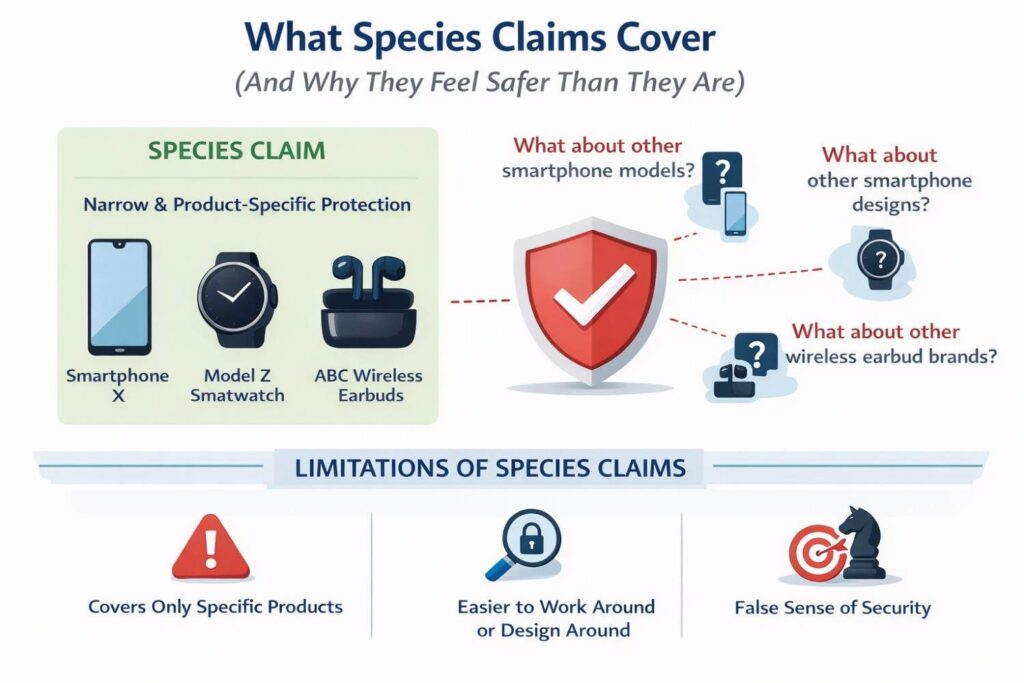
A species claim is about a specific version of an invention. It covers one particular way of doing something, using defined parts, steps, or structures. It is narrow by design.
This kind of claim is closely tied to what exists today. It often mirrors your current product, architecture, or workflow. Because it matches reality so closely, it feels solid and defensible.
That feeling is understandable. A species claim is easier to explain, easier to prove, and easier for examiners to understand. But ease is not the same as strength.
Why Species Claims Feel So Reassuring
Founders are builders. You trust what you can see and test. Species claims align with that mindset because they describe something real and finished.
There is also less fear when writing them. You are not guessing about future versions or alternative designs. You are simply documenting what works now. That reduces anxiety, especially for first-time patent filers.
The problem is that patents are not just about today. They are about stopping tomorrow’s competitors. Species claims rarely do that on their own.
The Narrow Fence Problem
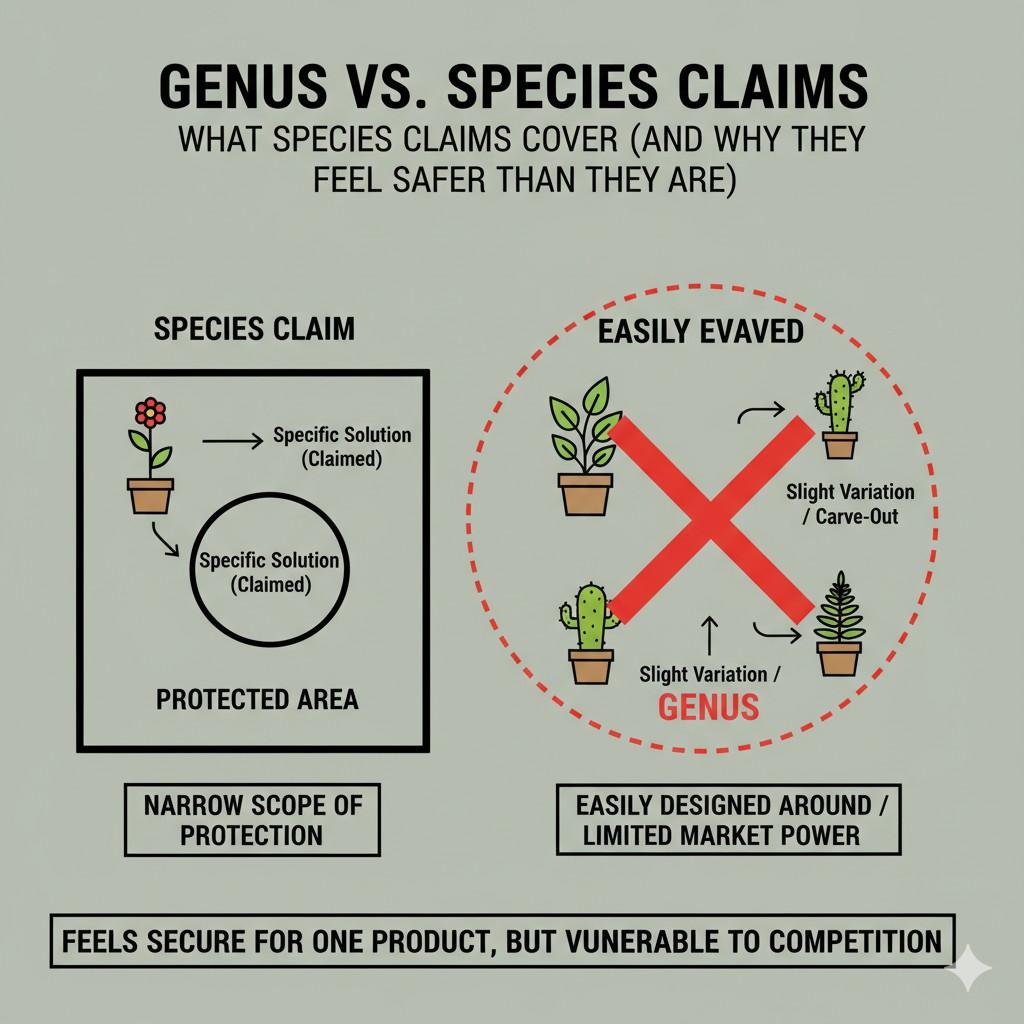
A useful way to think about species claims is as a small fence built tightly around one structure. Anyone who builds the same structure inside that fence is blocked. Anyone who builds just outside it walks free.
Competitors study patents carefully. When they see a narrow species claim, they look for small changes that move them outside the fence.
Different components, reordered steps, slightly altered data flows. Often, those changes do not hurt the product at all.
This is how startups end up with patents that are technically valid but practically easy to avoid.
How Species Claims Age Over Time
One of the biggest risks with species claims is how quickly they can become outdated. Your own product will evolve. You will refactor code, change infrastructure, improve performance, or adapt to new markets.
When that happens, your old species claims may no longer cover your own product. Even worse, they may not cover the most valuable version of what you are building in the future.
A patent that only protects your past is not doing its job.
Why Examiners Like Species Claims
From the examiner’s point of view, species claims are simple. They are easier to search, easier to compare against prior art, and easier to allow.
This creates a subtle trap. Applications that lean heavily on species claims often move faster through examination. That speed feels like success, but it can come at the cost of long-term value.
A fast allowance with narrow claims may look good on paper, yet fail to protect the business in any meaningful way.
The Business Cost of Species-Only Protection
From a business standpoint, species claims limit leverage. They are weaker in licensing talks. They carry less weight in acquisitions. They offer less comfort to investors who understand IP risk.
If your patent can be avoided with a minor design change, it does not strongly defend your market position. It becomes a checkbox instead of a moat.
Founders often realize this too late, when competitors are already active and the chance to broaden claims has passed.
When Species Claims Still Matter
This does not mean species claims are useless. They play an important role when used correctly. They can act as backups if broader claims are challenged. They can also capture valuable details that competitors might copy exactly.
The key is balance. Species claims should support a broader strategy, not replace it. They work best when paired with strong genus claims that define the real boundary of the invention.
Thinking of species claims as supporting characters, not the main story, helps keep strategy aligned with business goals.
How to Decide What Is Worth Claiming Narrowly
A practical approach is to ask which parts of your invention are truly optional and which are essential. Species claims are best used to lock down important implementations that you expect others to copy directly.
If a feature is easy to change without losing value, it should not be the only thing you protect. That feature belongs under a broader idea, not as the sole focus of protection.
This kind of thinking shifts patent drafting from documentation to strategy.
Using Species Claims Without Boxing Yourself In
The danger is not in species claims themselves, but in stopping there. Many weak patents exist because founders never moved beyond what felt safe.
Strong patents layer protection. They capture the idea at a high level and then reinforce it with specific examples. Species claims should make the broader claims stronger, not narrower.
This is exactly where guided tools and experienced review make a difference. It is hard to see these gaps when you are inside the product every day.
How PowerPatent Helps Avoid Species Traps
PowerPatent helps founders step back and see their invention as a space, not just a snapshot. The platform encourages thinking beyond one build and helps translate that thinking into claims that matter.
By combining structured input with real attorney oversight, founders avoid filing patents that only protect one moment in time.
If you want to understand how this approach works in practice, you can explore it here: https://powerpatent.com/how-it-works
Why Patent Examiners Ask: “Do You Have Enough Examples?”
This is the question that quietly decides the fate of many patent applications. Founders rarely hear it phrased this way, but examiners think about it constantly.
When they see a broad claim, especially a genus claim, they immediately look for proof that the inventor truly understands and owns the full idea.
Examples are that proof. They are not decoration. They are the bridge between a big idea and a legally solid patent.
This section explains why examiners focus on examples, what they are really testing, and how businesses can use this to their advantage instead of fighting it.
What Examiners Are Really Testing
When an examiner asks whether there are enough examples, they are not counting diagrams or pages. They are testing understanding.
They want to know whether the inventor has actually thought through the full scope of the claimed idea. Can this idea work in different forms, or is it just one narrow trick dressed up with broad words?
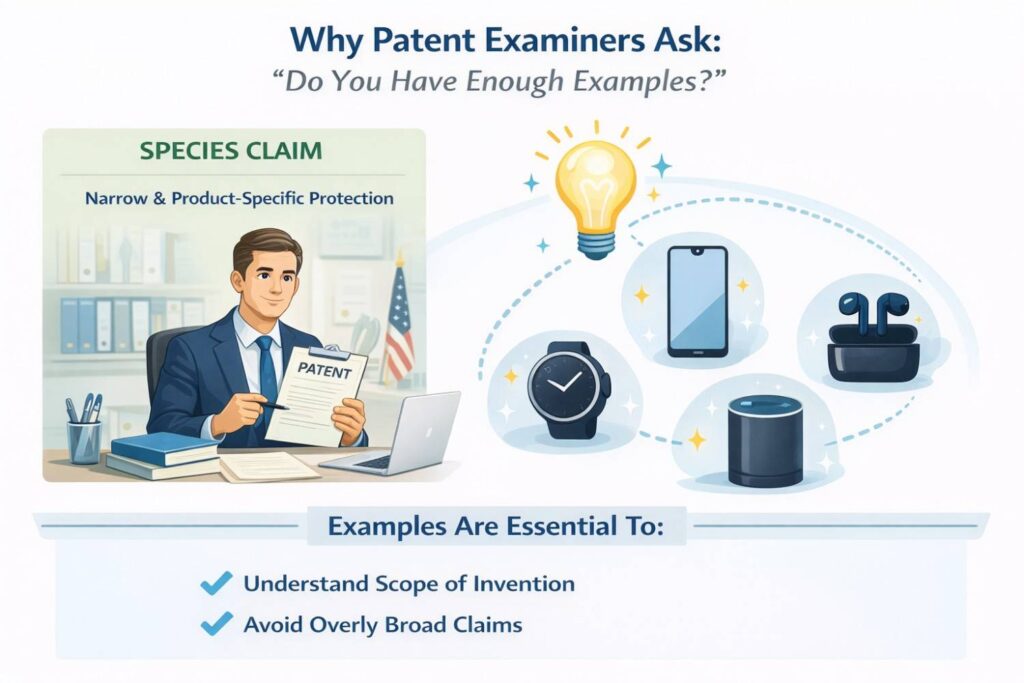
From the examiner’s point of view, a broad claim with weak examples looks risky. It suggests guessing rather than mastery. Strong examples signal that the inventor has explored the space and knows how the idea behaves under different conditions.
The Legal Idea Behind “Enablement” in Plain Words
Enablement sounds like a heavy term, but the core idea is simple. The patent should teach others how to make and use the invention without undue struggle.
For genus claims, this means teaching how to make and use the whole category, not just one corner of it. One example can rarely do that alone.
If a skilled person reads the patent and can only build the one version shown, the examiner will doubt whether the broader claim is justified. That doubt leads directly to rejection or forced narrowing.
Why One Good Example Is Often Not Enough
Founders often believe that one strong, detailed example should be sufficient. After all, it proves the idea works.
The issue is range. A single example shows that one point in the idea space works. A genus claim covers many points. The examiner needs to see that the inventor understands more than just that one point.
This is especially true in software, AI, and systems-based inventions, where small changes can lead to very different implementations. One example rarely represents the whole category.
How Examiners Think About Predictability
Examiners are more forgiving when an area is predictable. In simple mechanical inventions, fewer examples may be needed because variations behave in expected ways.
In modern tech, things are rarely predictable. Software systems, data pipelines, models, and networked components can behave very differently depending on design choices.
Because of this, examiners expect more teaching. More examples help show that the idea is not fragile or limited to one setup.
The Silent Comparison to Prior Art
Examples also help examiners compare the invention to what already exists. If the examples are narrow, the examiner may view the claim as overlapping heavily with known work.
When examples show different shapes of the idea, it becomes easier to see what is truly new and distinct. This strengthens the argument that the inventor is claiming a real advance, not just renaming existing ideas.
In this way, examples quietly do double duty. They support enablement and help distinguish over prior art.
How Founders Accidentally Undercut Their Own Claims
A common mistake is writing a broad claim and then filling the description with only the current product build. This sends mixed signals.
The claim says “this is a broad idea.” The examples say “this is the only way I know how to do it.” Examiners trust the examples more than the words in the claim.
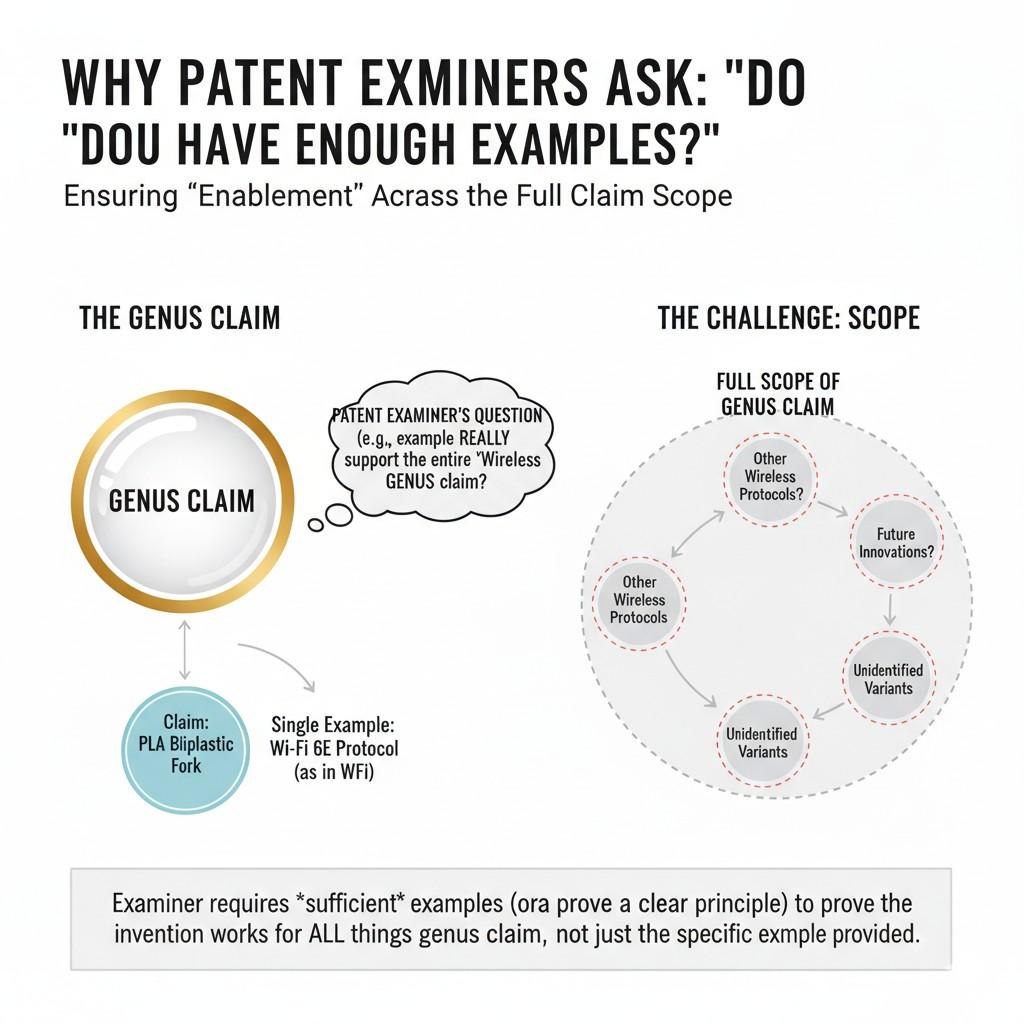
This mismatch often leads to rejections that feel confusing to founders. From the examiner’s view, they are simply aligning the claim with what was actually taught.
The Business Risk of Weak Example Coverage
Weak examples do not just risk rejection. They also weaken the patent after it is granted.
If a patent is ever enforced, courts look closely at what was actually taught. Broad claims supported by thin examples are easier to attack.
For a business, this means a patent that looks strong on the surface but cracks under pressure. Strong example coverage reduces this risk and increases confidence in the asset.
Thinking About Examples as Strategic Assets
Examples should be chosen strategically, not randomly. Each example should serve a purpose in showing the reach of the idea.
This means thinking about variations that matter in the market. Different architectures, different data flows, different environments, or different inputs. The goal is not volume, but coverage.
When examples are chosen this way, they make the examiner’s job easier and your claim position stronger.
How Early Planning Changes the Outcome
The best time to think about examples is before filing, not during examination. Once an application is filed, adding new examples is limited or impossible.
Founders who plan example coverage early can aim for broader claims with confidence. Those who do not often end up shrinking claims later to match what was actually described.
This is one of the biggest hidden costs of rushing patent filings.
How PowerPatent Guides Example Strategy
PowerPatent helps founders see where examples are doing real work and where gaps exist. The platform encourages thinking in terms of idea space, not just product snapshots.
With real attorney oversight, founders get guidance on how many examples are needed and what kinds actually strengthen claims. This avoids overloading the application while still supporting meaningful breadth.
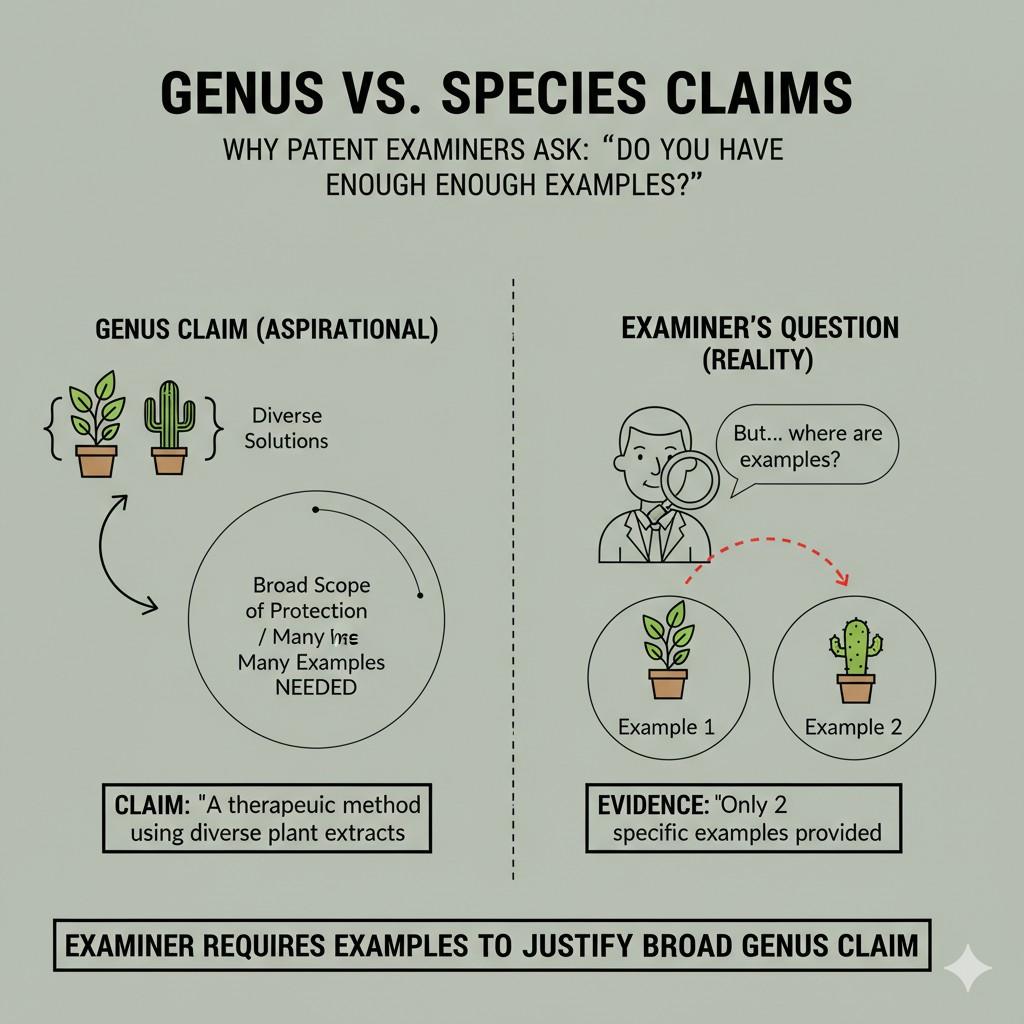
If you want to see how this approach works, you can explore it here: https://powerpatent.com/how-it-works
This is how broad ideas become defensible patents instead of risky bets.
How Weak Examples Quietly Shrink Big Claims
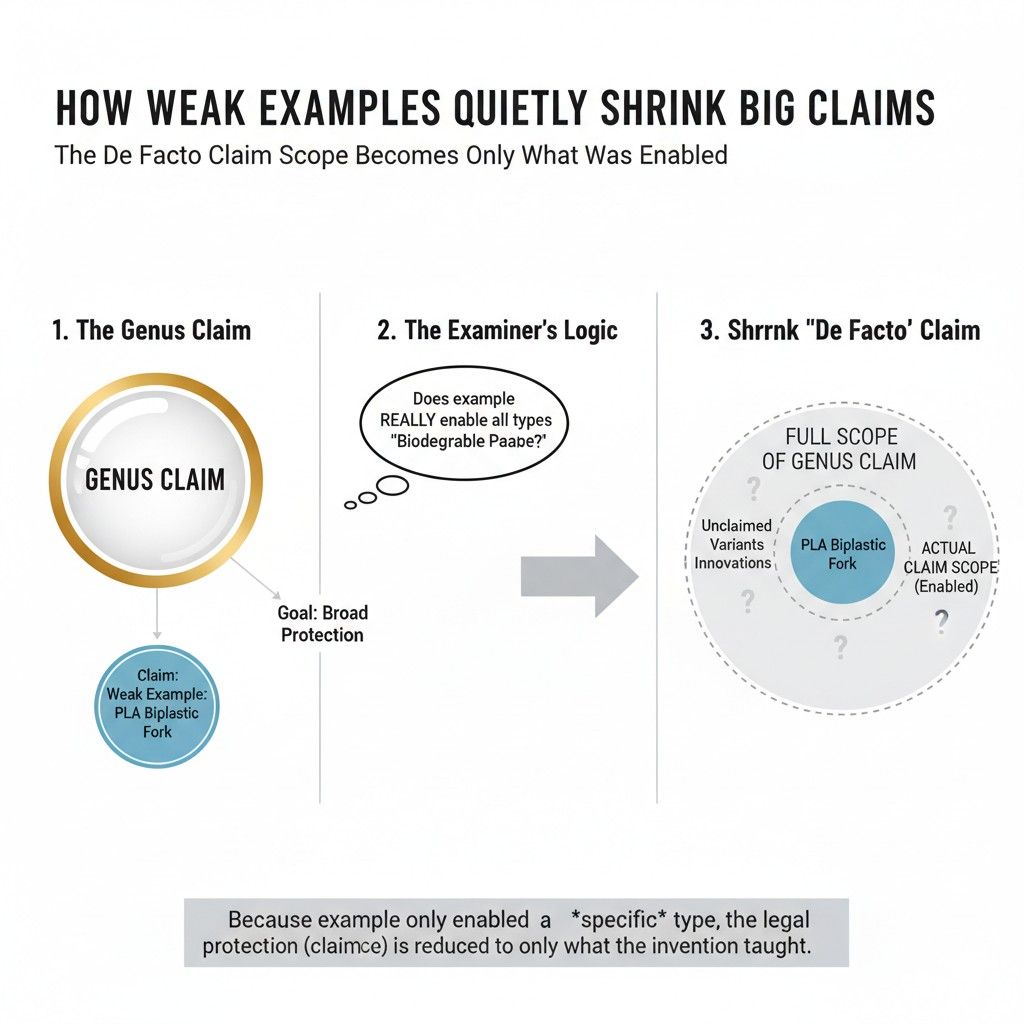
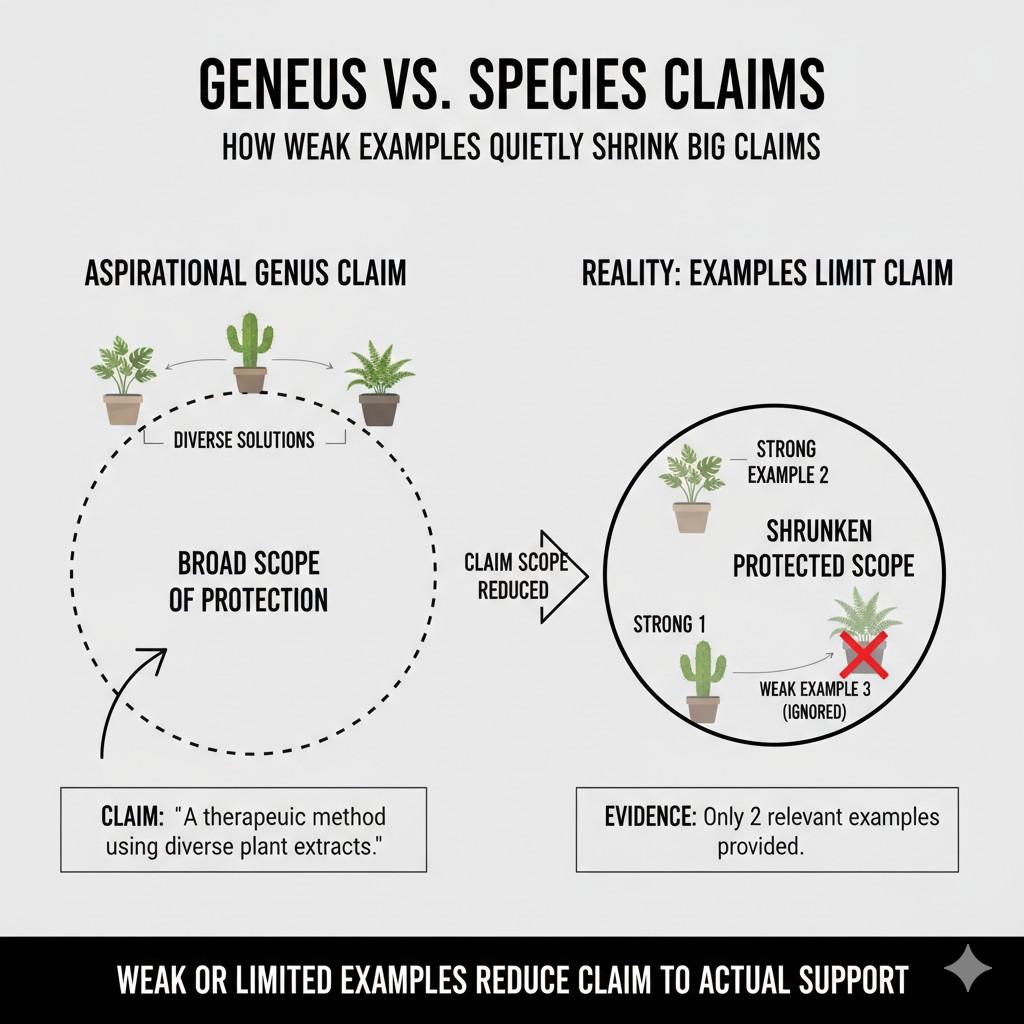
This is where many strong ideas lose their edge. The claims may look broad on paper, but weak examples slowly pull them inward. This shrinking does not happen all at once.
It happens during examination, during enforcement, and during real-world competition. By the time founders notice, the damage is already done.
This section explains how that shrinking happens, why it is often invisible at first, and what businesses can do early to prevent it.
The Gap Between What You Claim and What You Teach
Every patent has two voices. One voice is the claims, which say how big the invention is. The other voice is the description, which shows what the inventor actually knows how to build.
When those voices disagree, the description wins.
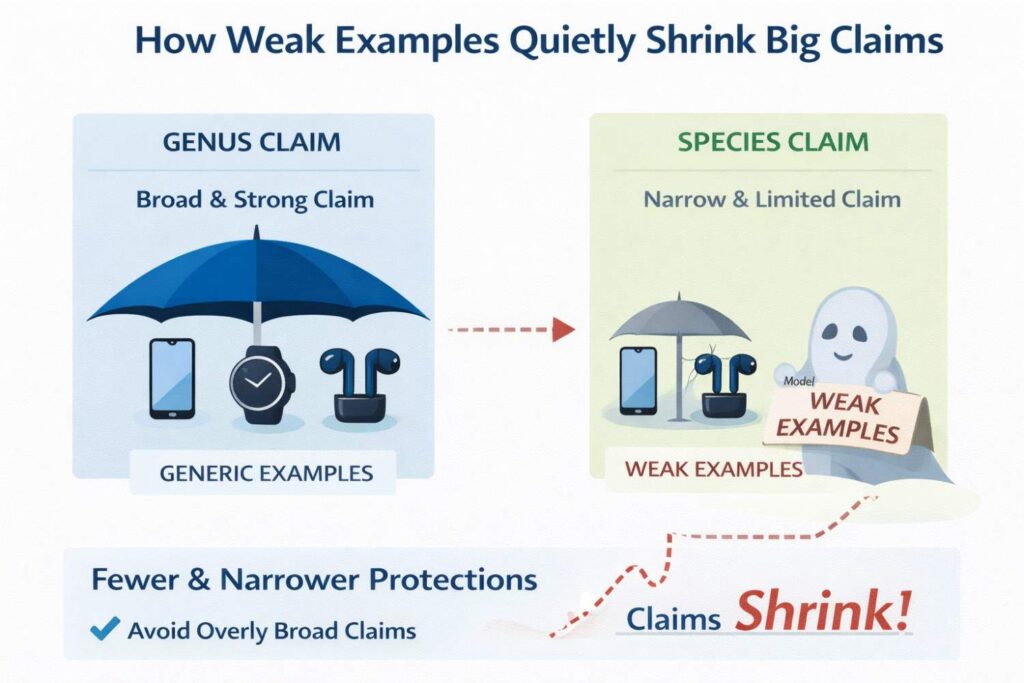
If the claim says “any system that does X,” but the examples only show one narrow system that does X in a very specific way, examiners and courts will trust the examples. The big claim starts to collapse toward the small teaching.
This is how broad ideas quietly become narrow rights.
How Narrow Examples Control Claim Interpretation
Even after a patent is granted, examples continue to matter. When a claim is interpreted, decision-makers look at the description to understand what the words really mean.
If every example uses the same structure or approach, that structure starts to define the claim, even if the claim language is broader. This can happen without anyone rewriting the claim.
From a business view, this means competitors may be able to argue that your claim does not cover them, simply because they built their version differently than your examples.
The Illusion of Breadth at Filing Time
At filing time, everything feels wide open. The claims are broad. The application is new. There is optimism that the idea is fully protected.
But filing does not lock in breadth. Teaching does.
If the examples do not match the ambition of the claims, the breadth exists only on paper. Examination pressure will expose that mismatch.
Founders often misread early feedback, thinking rejections are about wording. In reality, they are often about substance.
How Amendments Make the Shrink Permanent
During examination, applicants often amend claims to move things forward. This is normal. The danger lies in how those amendments interact with weak examples.
When claims are narrowed to match what is clearly supported, that narrowing is permanent. You cannot later grow the claim back out.
This is where early example strategy matters most. Strong examples give you room to negotiate. Weak ones force you to concede ground.
The Competitive Consequences of Quiet Shrinking
Competitors read patents closely. They look for patterns in examples. They design around what they see.
If your examples all point in one direction, competitors will go another. If your claim coverage has already shrunk toward those examples, their workaround may be completely legal.
From the outside, it may look like your patent was ignored. In reality, it was carefully avoided.
Why Founders Rarely Notice Until It Hurts
Most founders do not track claim scope over time. They celebrate allowance and move on.
The problems surface later, during fundraising, acquisition talks, or disputes. Someone asks whether the patent really covers a competitor. The answer is suddenly unclear.
By then, it is too late to add examples or broaden teaching. The patent reflects the thinking frozen at filing.
Turning Examples Into Defensive Coverage
Examples should be chosen not just to explain, but to defend. Each one should block a plausible workaround.
This means thinking like a competitor early. If someone wanted the same benefit but avoided your current build, what would they change? Those changes should appear in your examples, even if you never plan to use them.
When examples anticipate competition, claims stay broad in practice, not just in theory.
The Balance Between Detail and Flexibility
There is a fear that adding more examples locks you in. In reality, the opposite is often true.
Carefully written examples can show variation without rigidity. They can demonstrate flexibility while still teaching clearly.
The key is focusing on the idea, not the exact implementation. Examples should highlight what can change and what stays the same.
How Early Strategy Protects Future Versions
Your future product is unknown today. Your future competitors are unknown too.
Strong example coverage is insurance against that uncertainty. It ensures that when your product evolves, your patent still fits. It also ensures that when competitors emerge, they fall inside your fence.
This is not about predicting the future perfectly. It is about showing that you understand the space well enough to claim it.
How PowerPatent Prevents Silent Claim Shrinkage
PowerPatent is designed to catch these problems early, before filing locks them in. The platform pushes founders to think beyond one example and highlights where claims are stretching past support.
With real attorney review layered on top, founders get guidance on how to strengthen teaching without bloating the application or slowing down filing.
This combination helps preserve claim breadth not just at filing, but years later when it matters most.
If you want to see how this works and how it fits into a fast-moving startup workflow, you can explore it here: https://powerpatent.com/how-it-works
Strong patents do not shrink quietly. They are built to hold their shape.
Wrapping It Up
By now, the pattern should be clear. Genus claims are where real power lives, but they only work when they are backed by teaching that shows you truly own the idea. Species claims feel safe, but safety alone does not protect a business. Examples are the quiet force that decides whether your patent stays wide or slowly collapses inward. None of this is about gaming the system. It is about alignment. Your claims, your examples, and your business goals all need to point in the same direction. When they do, patents stop being paperwork and start being leverage.