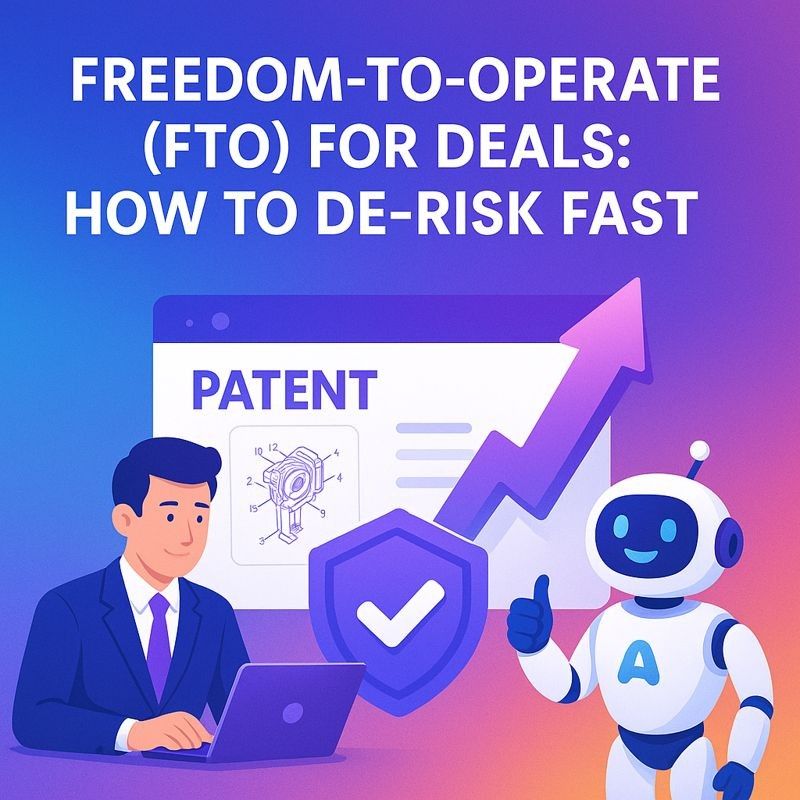
Every serious deal—fundraising, partnerships, licensing, M&A—quietly asks the same question: Can you actually use what you built without getting sued? That’s the heart of Freedom-to-Operate. And when a big moment is on the line, no founder wants slow answers, confusing legal speak, or last-minute surprises that tank momentum. You want clarity fast, you want risk off the table, and you want to walk into every deal with confidence instead of hope. FTO is how you get there, and it’s a lot simpler than it sounds when you approach it the right way.
Why FTO Matters the Moment Money Is on the Table
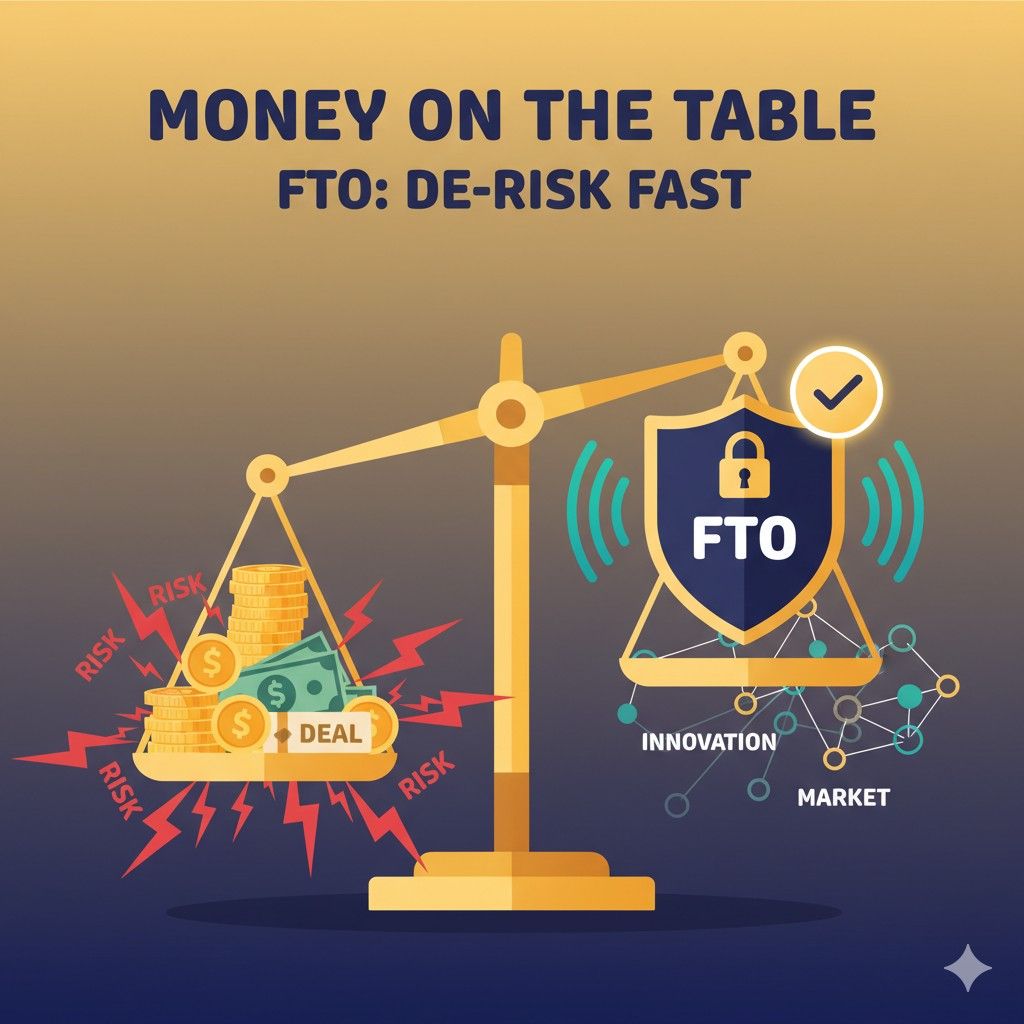
When real money enters the conversation, everything changes. Investors stop guessing and start checking.
Partners stop being polite and start protecting their own downside. Big buyers, big distributors, and big acquirers want to know exactly what they are stepping into.
This is the moment where Freedom-to-Operate becomes more than a legal exercise. It becomes a business filter, a stress test, and sometimes the deciding factor between a yes and a no.
The truth is simple. No one wants to invest in or buy something that might get blocked the second it launches.
And no founder wants to find that out late, after all the effort, after all the pitch meetings, and after all the promises made to the team. FTO steps in as the clear signal that you can build, sell, and scale without a silent trap waiting to spring open later.
How Deal Partners Quietly Evaluate Patent Risk
Every potential partner cares about one thing first: risk. They want to know whether someone else can claim ownership over the core of your product.
They want to know whether an established player could shut you down with a single letter. They want to know if their investment will be tied up in court instead of growth.
This is why FTO becomes a filter long before a contract is signed. If your technology touches a crowded space, the lack of clear FTO can slow the conversation instantly.
Even if no one says it out loud, experienced deal teams run their own checks.
They look at published patents. They look at competitive filings. They look at sectors known for aggressive litigation.

By the time they ask you about your FTO position, they already have an opinion. Your job is to stay ahead of that moment so you can control the story instead of reacting to it.
Why Speed in FTO Signals Business Readiness
A founder who can answer FTO questions fast sends a message. It tells investors you respect their time.
It tells partners you understand the market. It tells acquirers you have discipline built into your culture. Rapid clarity is a competitive advantage because most companies let this part drag on until the last minute.
The moment you show you already thought through risk, already checked the space, and already handled the potential roadblocks, you shift power back to your side of the table.
You look prepared, and prepared founders close deals faster.
How FTO Helps You Control Valuation
Valuation is rarely about pure technology. It is about how risky the technology is to use in the real world.
Strong FTO reduces perceived risk, and reduced risk increases value. It gives you leverage when negotiating ownership, royalties, or strategic commitments.
Without clear FTO, a buyer or investor will often discount the deal simply to protect themselves. They may ask for extra rights. They may limit the scope of your launch.
They may tie funding to legal milestones you have not planned for. But when you walk in with a crisp FTO story, you remove those excuses. You help them say yes at the price you want.
Why Early FTO Saves You from Costly Surprises
One of the most painful founder experiences is discovering an active patent that overlaps with your product right as a deal is about to close. At that stage, pressure is high, deadlines are tight, and workarounds feel impossible.
Teams scramble. Engineers rush. Attorneys rush. Everyone rushes. Deals fall apart not because the idea was bad, but because the risk surfaced too late.
Starting FTO early lets you make calm decisions instead of emergency decisions. You get time to adjust your design. You get time to secure licenses if needed. You get time to file your own patents that box out competitors. Instead of reacting, you get to shape your own path forward.
How Smart Startups Use FTO to Strengthen Their Pitch
Founders often fear bringing up patents in early conversations. They worry it slows the pitch, complicates the deck, or distracts from the vision.
But when used right, FTO actually strengthens your message. It proves that your product is more than a concept.
It shows that what you built has room to grow in the real world. It reinforces that your team is thoughtful, organized, and serious.
This is especially powerful when you are pitching to strategic partners who already operate in your space.
These companies care deeply about avoiding lawsuits. When you show your FTO process is clean and documented, they see a polished opportunity instead of a potential liability.
Why FTO Lets You Move Faster, Not Slower
Many founders believe FTO slows everything down. The truth is the opposite. When you understand where you stand, you eliminate hesitation. Engineers know what they can build.
Product managers know where the boundaries are. Sales leaders can speak with confidence. Deal teams can negotiate without stepping on unknown mines.
The entire company moves with a different energy when no one is waiting for legal clarity.
You save months simply by preventing rework, redesigns, and rushed legal fire drills. FTO becomes the subtle engine that keeps momentum high.
How FTO Reduces Post-Deal Conflicts
Most deal friction happens after signing, not before. Once the money moves, everyone looks more closely at the details. If a patent issue appears later, even a small one, it can trigger audits, delays, compensation adjustments, or even clawbacks.
Partners begin to question trust. Investors start to worry about oversight. The relationship becomes tense even if the technology itself is sound.
Strong FTO early prevents these sour moments later. It gives every party a shared foundation and keeps the relationship clean.
This matters even more for partnerships where both sides build together and need long-term alignment.
How FTO Gives You Confidence to Say No
Opportunity is not always opportunity. Sometimes a deal looks attractive until you discover that operating in that space exposes you to heavy patent risk. Without FTO, you might walk into that risk blind.
With FTO, you can make a calm choice to walk away.
Having the ability to say no is a form of power. It saves you from bad partnerships. It prevents you from entering markets that would drain legal budgets. It keeps your product roadmap honest and achievable.
FTO gives you clarity, and clarity gives you freedom.
How PowerPatent Removes the Stress from FTO
Traditional FTO work is slow, expensive, and often wrapped in dense language no one wants to decode. It is the kind of process founders push off until the last possible moment because they assume it will derail momentum.
But this is exactly why PowerPatent exists. You get attorney-guided FTO without the pain, without the cost shock, and without the long wait.
The platform blends smart software that scans and organizes the landscape with real human experts who check the work and help you understand what it means in simple, clear language.

This gives you something rare: fast answers you can trust. It lets you prepare for deals ahead of time instead of scrambling right before the closing call. And if you want to see how the platform works step-by-step, you can explore it anytime at https://powerpatent.com/how-it-works.
How to Clear Patent Risk Without Slowing Down Your Deal
The moment you start preparing for a deal, time becomes your most limited resource. Every conversation moves fast, every follow-up feels urgent, and every delay raises questions you do not want to answer.
This is why clearing patent risk must happen in a way that matches the pace of your deal, not the slow rhythm of traditional legal work.
When you approach FTO with speed in mind, you protect the deal without losing momentum, and you show everyone involved that you run your company with intention rather than reaction.
How Early Mapping Gives You Control
Before you try to solve any patent issue, you need a clear picture of the field you are stepping into. Early mapping is not legal theory. It is simply understanding who else is building in your space and what claims they have locked down.
When you see the landscape early, you gain a kind of calm control that lets your product roadmap breathe instead of tighten. You can choose where to build and where to avoid. You can step around crowded areas before they become walls in your way.
This early clarity becomes even more valuable during a deal because it shows partners you understand the terrain.

You are not guessing. You are not hoping. You know where your technology fits and where it leads. That confidence comes only from mapping sooner rather than later.
How Fast Triage Keeps You from Getting Stuck
Not every patent issue deserves hours of attention. Some matter. Some do not.
Some look scary but disappear once examined. Fast triage is the skill of knowing the difference within minutes instead of weeks. You look at the claims.
You look at your product. You see whether they truly touch. Most do not. Some do. The important thing is that you can tell quickly so you do not lose precious time treating every small risk as a crisis.
This ability to separate real threats from noise is what keeps deals alive. Without it, teams freeze, conversations slow, and partners sense hesitation. With it, you keep moving forward with clarity instead of panic.
How Designing Around Risk Protects Both Speed and Innovation
Many founders hear the phrase design around and imagine loss. They picture watered-down features or weaker performance.
In reality, design around is often a small shift that keeps your idea intact while removing someone else’s claim from your path.
A tiny change in method, timing, sequence, or structure can turn a blocked direction into a free one.
Smart founders treat design around as a creative challenge rather than a setback.
It becomes a way to sharpen the product instead of soften it. And when you can make these adjustments early, before deals lock you into deadlines, you stay in control of both your roadmap and your timeline.
How Communication Keeps Deals Smooth
You never want a partner or investor to learn about a patent risk before you do. You also never want them to feel surprised by something you already solved.
The safest path is steady, simple communication. When you share that you are already reviewing relevant patents, already evaluating overlaps, and already adjusting where needed, you establish trust that keeps deals stable.
This does not mean over-sharing technical complexity. It means giving clear signals that you run a thoughtful, disciplined process.
People invest in discipline because it reduces their own risk. It also keeps you from being asked harder questions later, when pressure is higher and time is shorter.
How Running FTO in Parallel Saves You Weeks
Old-school FTO often runs in a straight line. First the search. Then the review. Then the report. Then the discussion. Then the fixes. Then more review. This slow method kills deal momentum.
A modern approach runs these pieces in parallel. You can begin your design adjustments while you review claims.
You can align your engineering team while the legal team is still confirming boundaries. You can prep your deal materials while you digest the early findings.

This overlapping approach is how fast teams move without breaking anything. Each motion supports the next. Each step keeps the others alive. Instead of waiting for green lights, you travel the road while someone clears it ahead of you.
How Attorneys and Automation Working Together Give You Speed
Pure automation cannot give you full FTO clarity. Pure attorneys cannot give you the speed you need during a deal. The magic comes when both work together.
Software can scan thousands of patents in minutes and surface the ones worth looking at. Humans can interpret what actually matters, what does not, and what the claims truly mean.
When you merge these strengths, you get answers fast enough for the real world and accurate enough to trust in a deal room.
This blend removes the waiting period that usually slows everything down. You get fast signals, followed by expert judgment, followed by clear steps to move forward without noise.
How Clear Documentation Makes You Look Prepared
Every serious partner wants to see how you think, not just what you built. When you show simple, well-organized documentation of your FTO process, you prove that you understand the importance of defensible freedom.
This does not need to look like a law textbook. It only needs to make sense to anyone reading it.
A short explanation of what was checked, why it was checked, and what steps you took afterward is often enough to calm even the most risk-sensitive investor.
This documentation becomes a quiet asset during the deal. It reduces questions, shortens diligence, and helps you command better terms because you become the founder who leaves nothing to chance.
How Confidence Speeds Up Negotiation
Negotiations slow down when someone at the table feels uncertainty. Patent risk is one of the biggest sources of that uncertainty.
When you can speak with simple clarity about your FTO position, you allow the conversation to stay focused on the deal itself rather than potential legal shadows.
Confidence, in this context, is not bravado. It is clean, honest understanding of what you can build and sell without conflict. Deals with confident founders close faster because no one wastes time guessing what might go wrong.
How PowerPatent Helps You Clear Risk Without Losing Momentum
The traditional FTO process was never designed for startup speed. It was built for long cycles, slow reviews, and expensive back-and-forth.
PowerPatent changes that experience by giving founders a way to run FTO at the same pace they run their business.
The platform scans the landscape, organizes the results, highlights the meaningful patents, and hands them to human attorneys who refine the findings and translate everything into plain language.
You end up with fast clarity instead of long delays.

This is why so many founders use PowerPatent right before a deal. It keeps momentum alive, prepares you for tougher conversations, and removes the fear of hidden risks.
If you want to see exactly how the process works from start to finish, you can explore the workflow at https://powerpatent.com/how-it-works.
What Smart Founders Do to Stay Safe While Moving Fast
When you watch strong founders navigate growth, a pattern appears. They are fast, but they are not reckless. They move with purpose because they understand where the dangers are before anyone else sees them.
Freedom-to-Operate sits at the center of this discipline. It is the quiet work that keeps everything else flowing.
When you adopt the habits that experienced founders use, you stop operating from fear and start building with a sense of freedom that accelerates every deal, every roadmap decision, and every conversation with partners.
How Clarity Beats Guessing in High-Pressure Moments
Every fast-growing company hits situations where things move too quickly to run full analysis. Leaders must make calls with imperfect information. The founders who do well in these moments are not lucky.
They built clarity earlier, when the pressure was lower. They know the patent landscape. They know the boundaries. They know which areas are safe and which areas require a slight shift.
This simple awareness saves them from hesitation. Instead of guessing whether a new feature is risky, they already understand the territory well enough to move forward.

This makes their decision-making quicker, cleaner, and more confident. It also prevents the spiraling delays that happen when teams worry about what might go wrong instead of what they can make happen.
How Small Adjustments Early Prevent Expensive Problems Later
Smart founders understand that FTO is not about rewriting the product. It is about making thoughtful, tiny adjustments at moments when they cost almost nothing.
A method can shift. A sequence can change. A component can be swapped. These tweaks often happen quietly inside the engineering process long before anyone outside the company ever sees the product.
By making these changes early, founders avoid million-dollar headaches later. They prevent last-minute design shocks, they sidestep licensing battles, and they avoid having to redesign under the pressure of a live deal.
Early fixes are gentle. Late fixes are brutal. FTO gives you the timing advantage that keeps those fixes gentle.
How Smart Founders Use FTO to Strengthen Their Market Story
Founders often think the market story is about revenue, traction, and technology. All of that matters, but sophisticated partners also want to know whether the product has breathing room to scale.
FTO is part of that story. When you show that your product has clear space to operate, your market story becomes stronger because you’re not just building an exciting product. You’re building a product with room to grow.
This gives partners and investors a deeper sense of security. They can picture your next three years without the fear of someone blocking your path. Your narrative becomes not only exciting but durable.
How FTO Helps Cross-Functional Teams Move Together
Inside a fast startup, everyone wants to move quickly, but not everyone can see the same risks. Engineers may miss legal issues. Business teams may miss technical nuances. Sales may push for features that create unseen exposure.
When founders build a culture where FTO is understood in simple terms across the team, alignment improves. Engineers design with awareness. Product leaders make roadmap choices with confidence.
Sales knows what they can promise without putting the company in a bind. Everyone moves together instead of creating friction.
This cross-team clarity also makes you look more mature during deals. Investors can feel when a team is operating in sync. It signals lower risk and higher trustworthiness.
How Staying Curious Protects Your Edge
Smart founders stay curious about patents in their space not because they love reading them, but because each one is a clue. Published patents reveal where competitors are heading.
They show what technologies might soon enter the market. They point to new areas where you can innovate without stepping into someone else’s territory.
This curiosity becomes a strategic edge. Instead of reacting to what competitors build, you can anticipate where the field is moving and get ahead of crowded areas before they become traps.

This helps you choose smarter features, smarter markets, and smarter long-term bets.
How Smart Founders Turn Patent Risk into Product Strength
When a founder sees a potential patent conflict, the instinct is often fear. But experienced founders see something else: an opportunity to refine the product.
Patent constraints force clarity. They push teams to build in ways that are more distinct, more creative, and often more defensible in the long run.
Instead of feeling trapped, smart founders use these moments to sharpen their design and differentiate more deeply. This mindset changes everything. Suddenly patent risk becomes a shaping force rather than a stopping force.
How Knowing Your Boundaries Makes You Braver
One of the surprising gifts of FTO is the confidence it creates. Boundaries clarify where you can run fast. When you know what lanes are safe, you do not hesitate.
You do not slow down out of fear. You do not waste energy guessing whether your next step will cause a problem.
This confidence shows up in your product decisions, your pitch, your roadmap, and your team’s morale. It creates a sense of forward motion because everyone knows the ground they are walking on is stable.
How Smart Founders Prepare for Deal Diligence Before It Happens
Diligence is not the time to start learning about patent risk. Smart founders prepare long before that. They keep simple notes on how they evaluated patents.
They document the few risks they discovered and how they addressed them. They save work that shows thoughtful review.
This preparation matters more than most founders realize. When diligence begins, you do not scramble. You simply share the work you already did. The deal team sees a founder who runs a clean operation.
They see an organized process rather than a reactive scramble. This single difference can cut weeks from diligence and protect your valuation from unnecessary discounts.
How Smart Founders Use Tools That Match Their Speed
Old methods slow companies down. Smart founders choose tools that help them move at the speed of their deals. They do not bury themselves in manual searches or heavy legal reports.
They use modern software that surfaces the important patents quickly and pairs that automation with real attorneys who confirm and explain everything in plain language.
This blend of automation and expert review is what makes a fast FTO process possible. It removes guesswork without creating friction. It gives founders fast clarity in a form they can understand and use immediately.
How PowerPatent Helps Founders Stay Safe Without Losing Velocity
For years, startups avoided deep FTO work until late stages because traditional methods were too slow. But waiting always created more risk and more stress. PowerPatent changes that rhythm.
It lets founders understand their risk early, update it often, and move through deals with confidence. The software scans the field fast. Attorneys check the findings.
You get simple guidance, clear risk levels, and real steps you can take without slowing anything down.

This is why founders who care about closing deals smoothly rely on PowerPatent when the stakes rise. It brings calm, clarity, and speed together. If you want to see exactly how the process works, you can explore it at https://powerpatent.com/how-it-works.
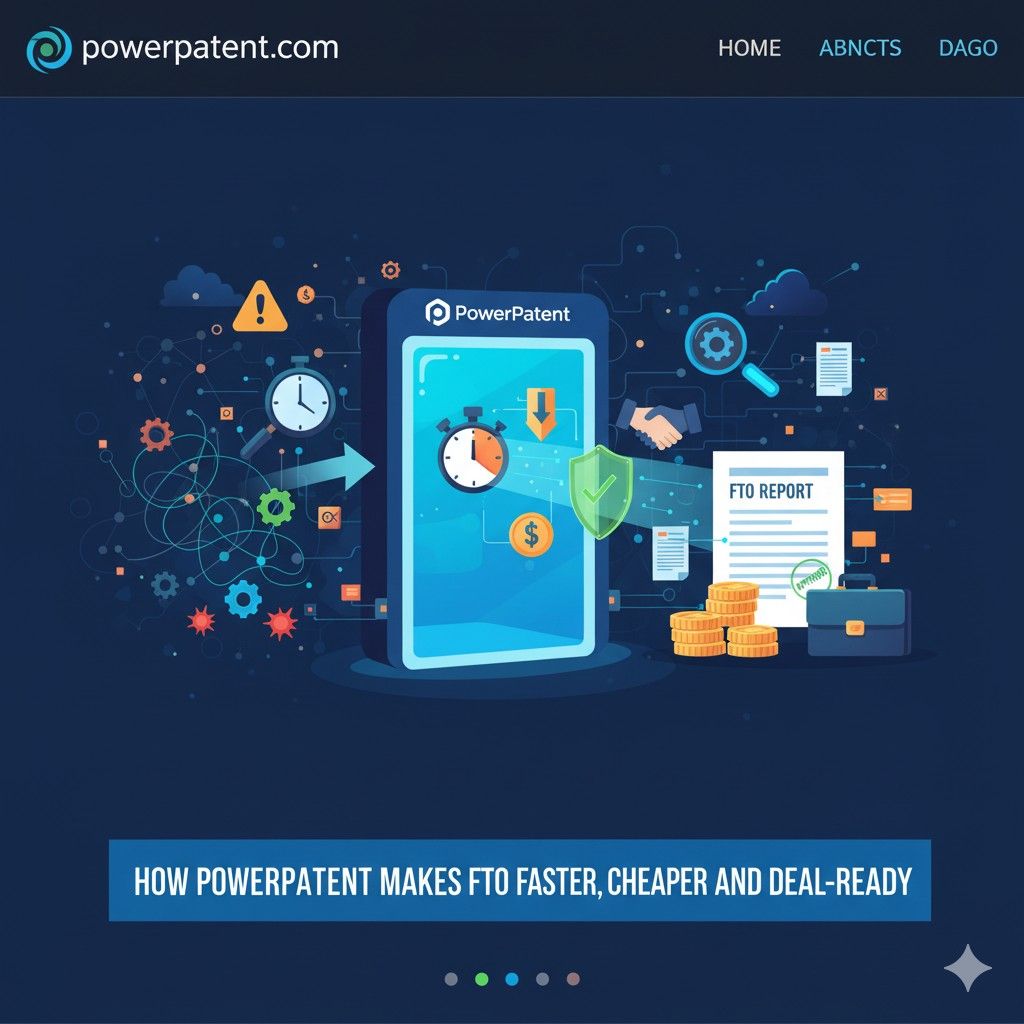
How PowerPatent Makes FTO Faster, Cheaper, and Deal-Ready
When a deal is on the line, founders need clarity they can use right away. They do not have time for slow searches, dense reports, or long attorney waits.
They need fast answers that are accurate, simple, and ready to share with anyone in a diligence room.
This is where PowerPatent changes the entire pace of the process. Instead of a legal bottleneck, FTO becomes a smooth part of how you prepare for growth.
Instead of slowing you down, it becomes the thing that helps you speed up with confidence.
How PowerPatent Turns a Complex Process into Something You Can Actually Understand
Most founders are not trained to read patents, and they should not have to be. Traditional FTO expects you to follow dense legal language that eats time and drains momentum.
PowerPatent takes that same complexity and flips it into plain, simple language you can understand in one pass.
This clarity is practical. It means you can make decisions without revisiting the same section fifteen times. It means your team can move forward without waiting for translation.
And it means your investors or partners can see, with no confusion, that you have a clean handle on your risk.

Simple language is not just a convenience. It is a strategic asset during a deal, because confusion often leads to hesitation, and hesitation can cost you the terms you want.
How PowerPatent Cuts Out the Waiting Time That Usually Slows Deals
The biggest frustration founders face during FTO is the dead time between steps. First you request a search. Then you wait. Then you receive a raw dump of documents.
Then you wait again for review. Then you receive a long explanation you cannot use. Then you ask questions. Then you wait again.
PowerPatent removes the dead time. It scans fast, organizes the findings, routes the important pieces to attorneys, and produces clean guidance in a fraction of the time.
Instead of waiting for days or weeks to understand the landscape, you can get clear signals in a time frame that matches the rhythm of your deal. This speed keeps diligence from dragging on and keeps your partner from losing excitement.
How PowerPatent Helps You Filter Out the Noise and Focus on Real Risk
Not every patent you find is a threat. Many look close but fall apart the moment an expert reviews the claims. Others appear small but require careful attention. The challenge is knowing which is which.
PowerPatent surfaces only what matters. It highlights patents that actually touch your product and filters out the noise that usually overwhelms founders.
This means you spend time on the patents that deserve attention instead of drowning in irrelevant matches. During a deal, this focus is vital because your team cannot afford to waste hours chasing ghosts. You need to act on what is real.
How Plain Language Guidance Helps You Make Decisions Faster
One of the biggest advantages PowerPatent gives you is decision-ready clarity. Instead of long reports filled with citations and legal phrasing, you get direct explanations of what each finding means.
You see whether a patent is low risk, medium risk, or high risk. You see why. You see what your options are.
This level of clarity shortens decision cycles across every part of your company. Engineering can adjust without guessing. Product can re-route features with confidence.
Business teams can answer partner questions instead of deferring everything to legal. And in a deal context, this clarity helps you stay calm and credible even when tough questions arise.
How PowerPatent Helps You Stay Prepared for Diligence Before It Starts
Most founders do not have a clean FTO folder ready when a partner requests diligence materials.
They scramble to pull together old emails, partial searches, screenshots of filings, and scattered notes from conversations with attorneys. This scramble does not inspire confidence.
PowerPatent gives you organized, deal-ready materials from the start. Everything lives in one place. Everything is documented. Everything is in simple language that even non-technical partners can understand.

When diligence begins, you do not run around piecing things together. You simply share the work you already have. This preparation alone can make diligence smoother and shorten the entire process by days or weeks.
How PowerPatent Lets You Update Your FTO Position as You Grow
FTO is not a one-time event. As your product evolves, new patents appear, new competitors emerge, and new features introduce new boundaries.
Traditional legal workflows make updates painful, slow, and expensive. Because of that, most startups skip updates entirely and hope nothing changed.
PowerPatent removes the pain from updates. You can run fast refreshes, check new features, and monitor the landscape without dedicating a full budget or waiting for long review cycles.
This lets you treat FTO as a living part of your product strategy instead of a one-time hurdle. When you always know where you stand, you can move faster, make bolder decisions, and step into new markets with more confidence.
How Every Search Is Reinforced by Human Expertise
Even the best software cannot interpret patent claims with the precision needed for real deals. Human judgment matters. Claims must be interpreted. Boundaries must be understood.
Risk must be weighed. This is why PowerPatent pairs every search with real patent attorneys who review, interpret, and translate the findings into practical next steps.
This blend of automation and expertise gives you the best of both worlds. Software handles the scale.
Humans handle the nuance. You get speed without losing accuracy. And you get expert validation without the traditional cost shock that keeps most startups from getting proper legal support.
How PowerPatent Helps You Design Around Risk Without Guessing
Design around is one of the most effective ways to avoid patent conflict, but most founders do not know exactly how far they need to adjust to stay safe. Small changes matter, but the right small changes matter more.
PowerPatent makes design around simpler by showing you where the boundaries are in clear terms. You see what the claims cover. You see what they do not.
You see where a slight adjustment gives you full freedom. This guidance means you do not over-correct or under-correct. You make precise choices that keep your timeline intact and your product strong.
How PowerPatent Gives Your Deal Partner More Trust and Less Uncertainty
For investors, acquirers, and strategic partners, uncertainty slows everything. Even small unknowns can cause delays, extra legal checks, or sudden shifts in valuation.
When you bring a clear FTO package from PowerPatent into the discussion, you remove those unknowns before they become barriers.
Partners see a founder who understands risk. They see a workflow backed by real attorneys. They see a clean explanation rather than a vague assurance. This changes the tone of the deal.
People negotiate more freely when they trust that the fundamentals are stable. You gain leverage simply by showing that your risk is understood, documented, and handled.
How PowerPatent Helps You Move Without Fear
The biggest gift that strong FTO gives founders is freedom. Freedom from hesitation. Freedom from late-stage surprises. Freedom from deals falling apart.
Freedom from wondering whether your next feature will land you in a dispute you cannot afford.
PowerPatent gives you this freedom in a form that fits the rhythm of a modern startup. Fast. Clear. Practical. Human. You get answers you can actually use, and you get them at a speed that matches the pace of your goals.
And whenever you want to see the full workflow, the step-by-step process is always available at https://powerpatent.com/how-it-works.
Wrapping It Up
Every deal you pursue carries a quiet question underneath all the excitement, the pitch decks, the demos, and the momentum. The question is simple but powerful: can you actually use what you built without running into a wall? Freedom-to-Operate is the answer that removes that doubt. When you understand your space, when you map the boundaries early, and when you show partners that your product can move freely in the market, you unlock smoother conversations, faster diligence, better terms, and far more confidence in the future you are building.