Sometimes the smartest deals in tech don’t happen in a boardroom… they happen in the fine print. And two tiny pieces of that fine print—field-of-use clauses and exclusivity clauses—can shape the entire future of your invention. They can open doors to new markets, or quietly shut them. They can help you move faster, or slow you down when you least expect it. Most founders don’t notice them until it’s too late, and by then the terms feel locked in stone.
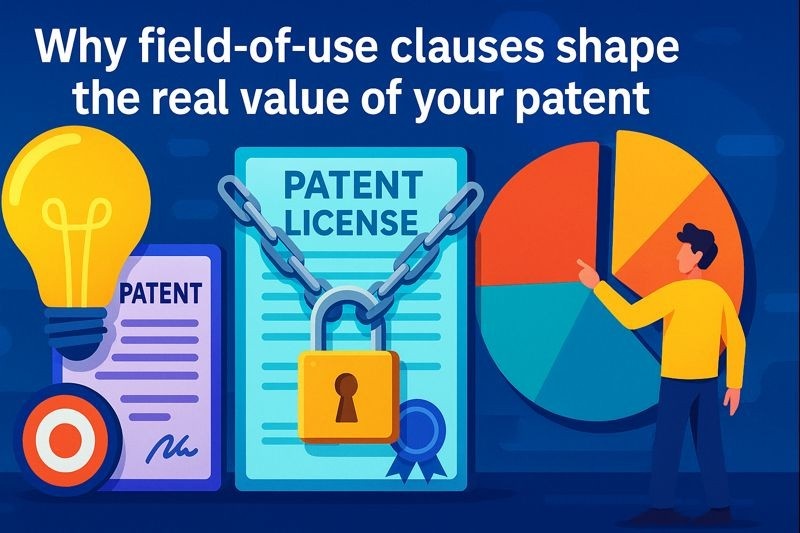
Why Field-of-Use Clauses Shape the Real Value of Your Patent
Field-of-use clauses sound simple, but they often decide how far your invention can travel and how much power you keep as your market grows.
This part of the agreement quietly defines who can use your tech, where they can use it, and what they can build on top of it.
When founders understand how this works, they stop treating the clause like legal filler and start using it as a lever for strategy, control, and long-term value.
How a Field-of-Use Clause Defines the Boundaries of Your Market
A field-of-use clause places a fence around how someone else may use your patented invention. That fence can be tiny, wide, or shaped in a way that lines up with your business goals.
Most founders do not realize that the shape of this fence often affects investor confidence, future licensing opportunities, and even your negotiating power with enterprise customers.
When the clause is drafted with intention, you keep room to expand, explore new industries, and run experiments without being blocked by your past agreements.
Why Narrow Fields Can Actually Strengthen Your Position
Many founders fear narrow fields because they think narrower means weaker. In reality, a tight field can protect your freedom to pivot.
A small license window lets a partner work in the zone they understand best while you keep the rest of the landscape for yourself.
This is especially helpful when you are still figuring out which markets will respond the fastest or where your tech will have the biggest lift.
A clear and narrow field lets you run tests in other directions without stepping on the rights you already sold.
How Broad Fields Can Create Leverage in Enterprise Deals
Sometimes a broad field is not a risk but a magnet. Large enterprise partners may only move forward if they know they can apply your invention across multiple departments or product lines.
In these moments, a wider field gives them comfort and gives you better terms, stronger revenue, or access to distribution.
When you offer a broader field, you can trade it for commitments that lower your risk, such as guaranteed volumes or shared development resources. The key is to offer breadth only when it strengthens your long-term plan instead of shrinking it.
Using Field-of-Use Clauses to Sequence Your Growth
A smart founder treats the clause as a timeline, not a cage. You can structure fields in ways that match how you want the business to unfold over the next few years.
For example, you might begin with one partner holding rights in a narrow corner of the market that is not your primary focus.
As you grow, you keep the bigger, more profitable fields for your own team.
Later, when you have traction and leverage, you can license those other fields for much higher value. This turns early deals into stepping stones rather than limits.
How Field-of-Use Choices Reduce Risk When You Are Pre-Patent
Many founders negotiate partnerships before their patent application is even filed. This is where trouble often begins, because the field-of-use language can lock you out of areas you have not fully explored yet.
When you file your patent early using a platform like PowerPatent, you enter negotiations with more confidence and more options. You can shape a narrow field today and still claim new fields tomorrow without rewriting your entire strategy.

Early protection means you negotiate from strength, not stress. You can always explore PowerPatent’s process at https://powerpatent.com/how-it-works.
Why Investors Pay Attention to Field-of-Use Restrictions
Investors quietly inspect your agreements to see whether you gave away too much too early. If the field-of-use clause is slanted toward your partner, they see a ceiling on your upside.
If the clause protects your ability to enter new markets, they see open runway.
Even if the rest of the deal terms look healthy, a poorly drafted field can make your company appear boxed in. This is why having clear boundaries and thoughtful licensing language is not just a legal detail but a fundraising advantage.
How To Use Field-of-Use to Carve Out Parallel Revenue Streams
A single invention can power many revenue paths when the fields are defined well. One field may support a consumer product partner. Another field can enable a medical use case.
A third might support industrial customers. Each field becomes its own business deal, its own licensing path, and its own long-term value. When you carve the fields intentionally, you multiply your options.
When you do it casually, you may give away an entire industry without realizing it.
The difference comes down to clear thinking early in the process and making sure your patent filing is broad enough to support multiple future fields.
How to Spot a Field-of-Use Clause That Could Trap You Later
You do not need legal training to sense danger. If the clause controls every possible application of your invention, you should pause. If the partner insists on covering future improvements you have not even built yet, pause again.
And if the clause includes vague language that can be stretched in many directions, slow down until it is clearer. These small phrases can turn into future arguments that drain your momentum.
The safest path is to tighten the wording and make sure the field reflects what the partner actually needs, not everything they could someday imagine.
Turning Field-of-Use into a Strategic Negotiation Tool
When you treat the clause as negotiable, not standard, you unlock new ways to shape the deal. You can offer a slightly expanded field in exchange for better pricing or support.
You can shrink the field while offering faster delivery or a pilot program. You can keep the field stable but change the timeline.
Each adjustment gives you leverage. Partners usually respond well when you explain the purpose behind each boundary, because it shows you are thinking about long-term alignment, not just legal detail.
Why Your Patent Filing Must Support the Fields You Want Later
A field-of-use clause is only as strong as the patent behind it. If your patent is too narrow, you cannot support multiple fields in the future. You lose flexibility and potential revenue.
When your patent is drafted well from the start, you can expand into new fields confidently.
PowerPatent helps founders do this by translating your technical work into a strong, broad patent filing that gives you more room to grow.

A well-built patent isn’t just protection; it is the foundation that lets you carve out future fields with clarity and confidence.
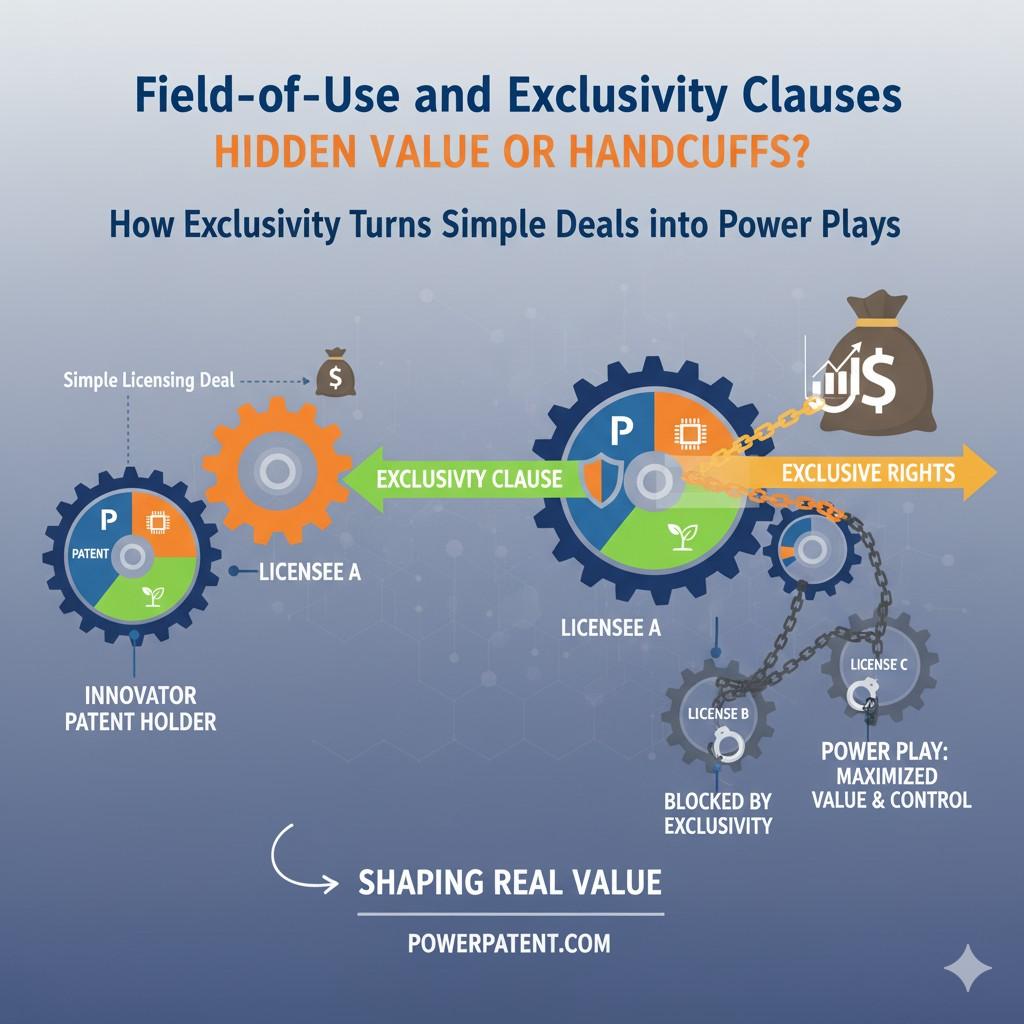
How Exclusivity Turns Simple Deals into Power Plays
Exclusivity is one of those phrases that looks harmless on the page but can reshape your entire business without making a sound.
Before founders realize it, a single exclusivity promise can stop them from selling to whole categories of customers or force them to depend on one partner’s speed, budget, or priorities.
At the same time, exclusivity can be a powerful lever when used with intention. It can help you close bigger contracts, strengthen partnerships, and create long-term revenue that feels steady instead of unpredictable.
The real skill is learning when exclusivity lifts you up and when it quietly limits your future.
Why Exclusivity Feels Attractive When You Are Early
When your startup is young and cash feels tight, any big partner offering a guaranteed deal can look like a lifeline.
Exclusivity is often the first thing they ask for. It gives them comfort because they know they will be the only player with access to your invention in a certain market.
But many founders underestimate how much this comfort costs. Once you commit, that part of your market is no longer yours to explore freely.

This is why exclusivity should never be given without a clear plan for what you get in return. If a partner wants to lock up part of your invention’s future, they should help build that future with real commitments, not vague promises.
How Exclusivity Changes Your Negotiation Power Over Time
Exclusivity can boost your leverage early in a deal because it gives you something valuable to trade. But once you agree, the balance shifts, and your partner now controls a portion of your roadmap.
If they move slowly, you move slowly. If their leadership changes and priorities shift, your product may stall with them.
And if they decide to renegotiate terms later, you may find yourself with less bargaining strength than you expected.
This is why exclusivity must be tied to performance milestones. When the partner meets them, they keep the exclusive rights. When they do not, the rights loosen, and you take back control.
How Exclusivity Can Become a Growth Accelerator When Structured Well
There are moments when exclusivity can actually make your company stronger.
A seasoned enterprise partner may offer not only money but distribution, integration support, or access to a customer base that would take years for you to reach alone.
In situations like this, exclusivity becomes a multiplier. It helps you move faster than your current resources allow.
But these deals only work when the exclusivity aligns with your plan and does not take away markets you expect to expand into soon.
When you protect your core and trade exclusivity only in areas you do not plan to enter for a while, the partnership lifts you instead of constraining you.
Why Clear Boundaries Matter More Than the Word Exclusivity Itself
Exclusivity is rarely absolute. Most agreements allow you to narrow or define the exclusive zone in many ways. You can restrict it to certain types of customers, specific industries, or a narrow channel.
You can limit it to particular use cases inside a product line. You can define the exclusivity in terms of geography or even in terms of product generations. The mistake many founders make is assuming exclusivity is a blanket commitment.
In reality, it is a negotiation puzzle you can shape to match your strategy. The more precise you are, the more value you keep, even inside an exclusive deal.
How to Use Time to Protect Yourself in Exclusive Agreements
One of the strongest tools a founder has is time. You can make exclusivity temporary. You can create phases where exclusivity stays in place only if specific goals are met.
You can include re-evaluation periods that let you adjust the rights as the market evolves. When you use time as a boundary, exclusivity stops looking like a lock and starts looking like a structured experiment.
If the partnership works, you renew or expand it. If it does not, you regain freedom without a messy negotiation.
Why You Should Never Give Exclusivity Before Filing a Patent
An exclusive deal made before your patent is filed can create long-term risks you never planned for. If the partner expects broad exclusive rights and your patent ends up narrower than expected, the agreement can create tension or confusion.
Worse, if you disclose too much too early without proper patent protection, you could limit your future ability to file at all. This is why founders who plan to negotiate exclusivity should protect their invention early.
PowerPatent makes it easy to file fast, stay covered, and enter negotiations with stronger footing. You can learn how the process works at https://powerpatent.com/how-it-works.
Why Investors Scrutinize Exclusivity More Than You Think
Investors look for freedom to operate. When they review your contracts, they are checking whether you still control enough of your market to grow. If they see wide exclusivity in key areas, they worry you have sold off your future too cheaply.
If they see exclusivity tied to milestones and performance, they respect the structure. Investors know exclusivity can be a useful tool, but they also know it can shrink a company’s upside.
When your agreements show that you protected your core markets, investors feel more confident backing your growth.
Using Exclusivity as a Tool for Predictable Revenue
Recurring revenue is one of the strongest signals of stability in a young company. Exclusivity can help create this predictability when structured around commitments instead of time alone.
A partner who wants exclusivity should commit to annual minimums, co-development support, marketing participation, or other actions that keep both sides invested.
When structured this way, exclusivity becomes less of a risk and more of a foundation. It gives you stable resources to build without losing your independence.
How Exclusivity Interacts With Field-of-Use Clauses
Exclusivity becomes far more manageable when paired with a strong field-of-use clause. The field sets the boundaries. Exclusivity applies within those boundaries.
When both are clear, you create a controlled sandbox where your partner can operate without limiting the rest of your business. Many founders overlook how these two clauses support each other.
A narrow field with exclusivity is very different from a broad field with exclusivity. One preserves your freedom.
The other locks up entire industries. When you treat these clauses as interconnected rather than separate, you gain more control over your long-term roadmap.
The Power of Asking One Simple Question During Negotiations
There is one question that can reshape an exclusivity request:
What do you actually need exclusivity for?
Most partners want exclusivity for only a portion of what founders assume. Many fear that competitors will move faster or that internal teams will not invest without exclusive rights.
When you ask this question early, you learn the real concern behind the request. Often you can address it without giving away broad rights.
You might offer early access, preferred pricing, co-branding, or a narrow exclusive slice that satisfies their need without sacrificing future markets. The question creates clarity, and clarity creates better deals.
Why Exclusivity Should Support Your Momentum, Not Replace It
Exclusivity should never be the reason you slow down innovation. It should not discourage you from improving your product or expanding your patent coverage.
If a partner expects you to freeze progress so they can catch up, you should step back and reconsider. Healthy exclusivity protects your invention while allowing you to build.

It does not force you to rely on another company’s speed or internal politics. When the partnership allows you to keep momentum, exclusivity becomes a strength. When it pulls you into someone else’s timeline, it becomes a weight.
When These Clauses Protect You… and When They Trap You
Many founders think field-of-use and exclusivity clauses only matter during closing. In reality, they matter most long after the ink dries.
These clauses sit quietly in the background, shaping how fast you can grow, how easily you can pivot, and how confidently you can enter new markets.
They can feel like armor when structured well, or like hidden handcuffs when drafted without intention.
This section helps you see the warning signs early, so you can use these clauses as tools for strength rather than sources of regret.
How Protection Comes From Clarity, Not Complexity
A clause protects you when it is clear. Most problems arise not from bad intentions but from vague language that allows each side to imagine something different.
When the language is simple, direct, and grounded in plain meaning, your future becomes easier to manage. You do not need complicated terms or dense legal sentences.

You need clarity about what your partner can do and what they cannot. You need easy-to-understand boundaries you can measure, defend, and reference as you grow. The cleaner the clause, the smoother the partnership.
When Field-of-Use Clauses Create Breathing Room
A well-drafted field-of-use clause gives you space. You can test new markets without conflict. You can run pilot programs without seeking permission. You can take your product in new directions without triggering disputes.
This breathing room is essential for young companies that pivot often. It allows you to answer new opportunities quickly without consulting a partner who may not share your urgency.
When the clause is narrow and tied to the partner’s true needs, you stay free to build where the momentum naturally takes you.
When the Clause Becomes a Cage
A field-of-use clause becomes a trap when it covers more ground than necessary.
You may find yourself blocked from using your own invention in areas you assumed were safe. You may lose investors who worry about your limited runway.
You may discover a stronger market later but be unable to enter it because the earlier agreement took too wide a slice. These traps rarely look dangerous at the start.
They show up later, when your business becomes more ambitious. The best defense is to draft the field with precision and protect the markets you expect to enter later.
How Exclusivity Protects You When Tied to Real Performance
Exclusivity feels safe when your partner has skin in the game. If they commit to hitting sales numbers, sharing resources, or co-developing improvements, exclusivity becomes a partnership instead of a restriction.
This structure protects your company because both sides move forward together. You are not stuck relying on a passive partner.
You are growing with someone who has real incentives to help you win. When exclusivity is tied to performance metrics, it becomes a shared roadmap instead of a one-sided lock.
When Exclusivity Freezes Your Momentum
The danger comes when exclusivity is tied to promises rather than action. If your partner slows down, you slow down.
If they do not market the product, your growth stalls. If they decide the opportunity is no longer a priority, you are stuck waiting for change that never comes.
Momentum is everything for startups. When exclusivity ties your progress to someone else’s timeline, it becomes a silent anchor.
The only way to prevent this is to link exclusivity to clear milestones that keep the partnership active and accountable.
When Clauses Limit Innovation Without You Realizing It
Sometimes founders sign agreements that limit more than sales. They accidentally restrict their ability to innovate, build extensions, or adapt the invention for new use cases.
These clauses often show up in small phrases that cover improvements, derivatives, or future versions. If the language is too broad, the partner may gain control over things you have not invented yet.
This kind of clause can freeze your creative work before it begins, and it can even affect your patent strategy if it interferes with how you expand your IP.

The safest path is always to make sure that future inventions remain yours unless you choose otherwise.
How to Use Carve-Outs to Escape Hidden Traps
Carve-outs are simple exceptions you add to preserve your freedom. They are small, precise pockets of protection that allow you to build, test, or sell in specific areas even inside an exclusive or narrow licensing structure.
When used well, carve-outs prevent the most common traps. You can reserve rights for internal R&D. You can keep the ability to serve noncommercial customers.
You can separate software versions, customer segments, or entirely new industries. Carve-outs help you stay flexible without weakening the agreement.
Why Early Patent Protection Keeps You Out of Contractual Trouble
Many founders negotiate licensing terms before filing their patent. This increases the chance that a clause will conflict with what the patent eventually covers.
A mismatch between contract language and patent scope creates confusion later and can weaken your bargaining position. When you protect your invention early through a strong patent filing, you gain clarity about what you own and what you can license.
This makes every clause easier to draft and safer to enforce. PowerPatent helps founders file fast and with broad coverage, giving you a strong foundation before you sign deals.
If you want to understand how the system works, you can explore it at https://powerpatent.com/how-it-works.
When Clauses Strengthen Your Valuation Instead of Shrinking It
Investors love contracts that show smart control. When they see a field-of-use clause that protects essential markets, they see long-term potential. When they see exclusivity tied to performance, they see discipline.
These clauses can elevate your valuation when they demonstrate that you know how to protect your invention while still creating revenue opportunities.
They show that you think about market sequencing, long-term positioning, and strategic licensing. When drafted well, these clauses become part of your advantage, not just paperwork.
When You Should Walk Away
Some deals look attractive but include clauses that will hurt more than help. If a partner demands exclusivity across your main market without strong commitments, stepping away may be the smartest move.
If they want to control improvements you plan to build internally, the cost may outweigh the revenue. If the field-of-use clause eats into markets where you expect to grow, long-term damage may exceed short-term benefits.
Walking away from a bad clause protects your future even if it delays your present. Strong companies grow from strong foundations, not rushed agreements.
Why You Should Review These Clauses Every Time You Innovate
Your invention evolves. Your company evolves. Your markets evolve. A clause that once served you may no longer fit your direction.
Regularly reviewing your agreements keeps you aware of hidden constraints that could limit your next move. You may discover opportunities to renegotiate as your leverage increases.
You may find markets you can now reclaim because terms expired or milestones were missed. Treat these clauses as living parts of your business strategy, not static documents to file away.
When Clauses Turn Into Your Competitive Edge
When used with intention, field-of-use and exclusivity clauses allow you to shape how your invention flows into the world. They help you choose partners wisely.
They protect your core markets. They let you slice your innovation into multiple revenue paths.

They show investors you understand how to stay in control as you scale. Instead of trapping you, they become strategic tools that expand your power.
How to Stay in Control with Smart IP and Even Smarter Agreements
When founders talk about control, they often think about equity, product decisions, or fundraising. But real control starts much earlier. It starts with your IP and the agreements that govern how others can use it.
The smartest founders treat their IP like the core engine of their company. They know every contract either strengthens that engine or slows it down.
This section shows you how to stay in charge by aligning your patent strategy, your licensing terms, and your business goals into one clean, simple system.
Why Strong IP Makes Every Agreement Safer
A solid patent is the backbone of every field-of-use and exclusivity clause. Without strong IP, your agreements rest on hope rather than enforceable rights.
When your patent is drafted well, you begin negotiations from a place of strength. Partners cannot stretch the boundaries of your invention because the patent defines them clearly.
You also gain more confidence to create separate fields, carve out new markets, and shape exclusivity that matches your growth strategy.

This is why early and strong patent protection is never a luxury. It is the foundation that gives you long-term control.
How Filing Early Gives You Room to Negotiate
When you file early, you protect your invention before entering discussions. This means you can speak openly with potential partners without worrying that your disclosures will harm your future filings.
It also keeps you from rushing into overly broad agreements just because you are scared someone might copy your idea. Filing early gives you calm. It gives you options.
And it gives you the freedom to structure deals that match your business plan instead of reacting under pressure. Platforms like PowerPatent help founders file quickly and clearly, giving you a strong footing before negotiations begin. You can explore the process at https://powerpatent.com/how-it-works.
How to Align Clause Boundaries With Your Market Map
Every founder has a mental picture of their market. There are the areas you want now, the areas you will want in a year, and the areas that are interesting but not a priority.
When you align your clause boundaries with this map, your agreements become tools that help your company grow in a clean, intentional way. You reserve the markets you plan to enter soon.
You license out areas that are useful but not essential to your roadmap. You structure exclusivity only in places where you do not expect to build internally.
This alignment stops your contracts from pulling your business in directions you never intended.
When to Keep Rights to Improvements No Matter What
Your invention will evolve. You will discover new features, new angles, and new ways to solve the same problem. You will create improvements that make your original idea far more valuable.
This is why you should almost always retain rights to improvements unless there is a very strategic reason not to.
Giving away improvement rights too early can trap you in a cycle where every new idea belongs to someone else.
It can block your future patents and limit your internal R&D. Your agreements should make it clear that improvements remain yours by default unless you intentionally decide to license them.
How to Protect Yourself Through Precise Language
The simplest language is often the safest. When you use plain, direct wording, there is less room for confusion, misinterpretation, or future disputes.
If your partner reads the clause and understands exactly what they can do, you have succeeded. Vague words can cause years of trouble.
They create openings for arguments and slow down business decisions. Precision is not about sounding legal. It is about being unmistakable. It is the difference between a clause that protects you and one that weakens you.
How to Make Negotiation Feel Collaborative Instead of Defensive
Many founders feel tense during negotiations because they worry the other side will think they are being difficult. But you can frame the conversation in a way that feels supportive and aligned. When explaining your boundaries, speak from business logic, not emotion.
Share your roadmap and explain why you need certain markets open. Describe how narrow exclusivity or a precise field-of-use helps both sides succeed long-term.
When partners understand your reasoning, they usually become more flexible. Transparency turns negotiation from a tug-of-war into a shared planning session.
How to Use Term Length as a Release Valve
One of the easiest ways to stay in control is to limit how long the rights last. A shorter term reduces risk because you can revisit the agreement once your company has grown stronger and your leverage has improved.
Time protects you when you are early because it allows reassessment before the agreement shapes too much of your future.
You can also use renewal periods tied to performance so that exclusivity continues only when the partner delivers real value. This creates accountability without adding conflict.
Why You Should Build Flexibility Into Every Agreement
No matter how confident you feel today, your direction will change. Your market will shift. Your customers will pull you somewhere new. And your product will evolve in ways you cannot predict yet. Your agreements should allow for this kind of natural growth.
You can build flexibility through carve-outs, limited exclusivity, narrow fields, evaluation periods, or rights that revert if milestones are missed. Flexibility keeps you safe when change arrives.

It keeps you from feeling locked in. And it gives you the space to make decisions based on new information instead of old obligations.
How Communication Prevents Most Future Conflicts
Many disputes happen not because a clause was bad but because expectations were never discussed openly. Before signing, walk through real examples of how the partner expects to use the invention.
Ask them what they think the agreement allows. Share your understanding. These simple conversations prevent misunderstandings and reveal places where the clause may need refining.
Clear communication upfront is far cheaper and easier than cleaning up confusion years later.
How to Turn IP and Contracts Into a Long-Term Advantage
When you master your IP and your agreements, you gain something rare in the startup world: control.
You know where your invention can go and where it cannot. You know which markets belong to you and which markets are licensed. You know how exclusivity lifts or limits your business.
You know how to expand without stepping into conflicts. This kind of clarity accelerates everything. It speeds up fundraising, because investors trust your structure.
It speeds up deals, because partners see you have a clear plan. And it speeds up growth, because you do not waste time untangling confusing commitments.
Why Smart IP Gives You Confidence to Scale
When your patent is strong and your agreements are clean, you can scale without fear. You can enter new markets confidently. You can negotiate with bigger partners without giving away too much.
You can build improvements knowing they belong to you. A strong IP foundation removes uncertainty from your decisions.
It gives you a sense of control that shows up in every conversation, negotiation, and pitch. It turns chaos into direction. It turns pressure into opportunity.
When You Should Bring in Expert Help
Even the clearest agreements benefit from expert guidance. A skilled patent attorney can spot risks you might miss and help keep your IP strategy aligned with your business goals.
The challenge is that traditional firms often move slowly and charge more than early-stage founders can afford.
PowerPatent offers a new model by combining smart software with real patent attorneys who review your work and make sure your filing is strong, broad, and aligned with your roadmap.
It is fast, it is founder-friendly, and it gives you the confidence that your IP will support every deal you sign.
How Smart Agreements Clear the Path for Better Deals Later
Great deals do not happen by accident. They come from earlier agreements that were structured well enough to preserve your freedom. When you protect your core markets and tie exclusivity to meaningful commitments, future partners see you as a disciplined operator.
They trust that you know how to manage your rights.
This trust leads to better terms, bigger opportunities, and more high-quality partnerships. Strong agreements compound over time, shaping a clean and powerful licensing strategy.
Why Staying in Control Is More Important Than Closing Fast
Speed is important, but control is priceless. If you rush into agreements that limit your future, the short-term win can turn into long-term frustration. A few extra days of thoughtful drafting can save you years of conflict.

Staying in control means knowing what you are giving, what you are keeping, and what each clause means for your roadmap. When you hold this mindset, you make wiser decisions and build a healthier company.
Wrapping It Up
Every founder eventually discovers that the real power in a deal doesn’t come from the headline numbers. It comes from the fine print that decides how your invention moves through the world. Field-of-use clauses and exclusivity terms may look like small details, but they hold some of the biggest levers in your growth. They can protect your freedom, strengthen your partnerships, and carve out new revenue streams. They can also restrict your future, limit your options, and quietly shape your entire company without ever raising a red flag. The difference always comes down to intention.