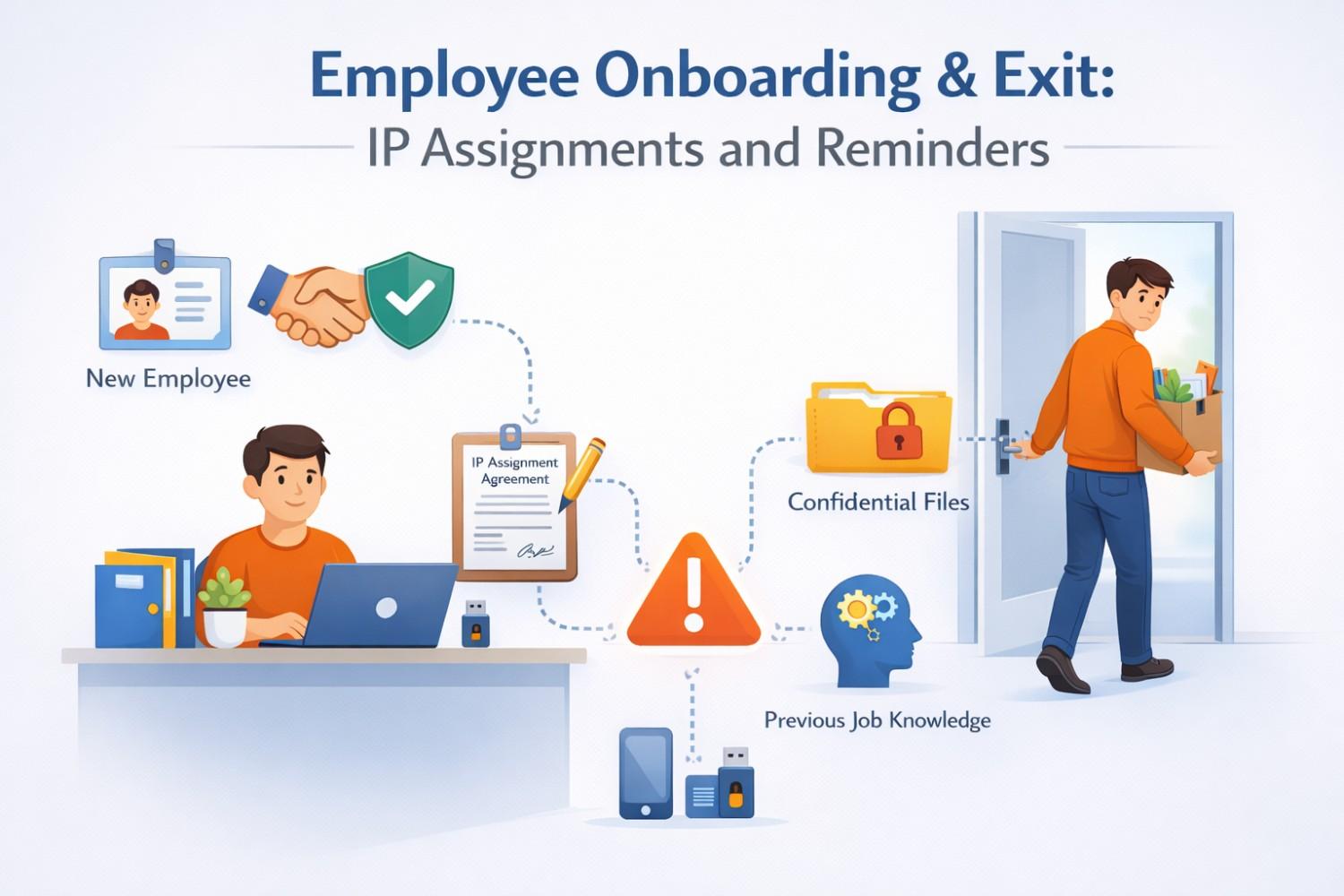
Every startup is built on ideas. Not desks. Not laptops. Ideas. The code you write at midnight. The model you sketch on a napkin. The shortcut your engineer figures out that saves weeks of work. That is the real value of your company. Here is the hard truth most founders learn too late: if you do not clearly lock down who owns those ideas, you may not own them at all. This problem shows up most often during two quiet moments that do not feel risky at the time. When someone joins your company. And when someone leaves. Onboarding and exit are not just HR tasks. They are IP moments. Miss them, and you can lose control of what you worked years to build.
Why Every New Hire Creates an IP Risk (Even When You Trust Them)
Hiring feels like progress. You finally have help. You are no longer carrying everything alone. It feels like relief. But from an IP point of view, hiring is also the moment when complexity enters your company for the first time.
This risk is not emotional. It is structural. It exists even when everyone is honest, aligned, and acting in good faith.
The moment a new person starts thinking, designing, coding, or advising inside your company, ownership questions are created automatically.
If you do not answer those questions clearly, the law will answer them for you later, and you may not like the outcome.
This section goes deep into why this happens and how founders can stay ahead of it in a calm, controlled way.
Employment Does Not Automatically Mean Ownership
Many founders believe that paying someone means owning what they create. This belief is common, intuitive, and wrong in many cases.
Employment laws vary by country and state, but one pattern is consistent. Ownership must be clearly assigned. Salary alone is not enough. Job titles are not enough. Verbal understanding is not enough.
If an agreement does not clearly say that all relevant work belongs to the company, there is room for dispute. Disputes do not show up when things are calm. They show up when money, exits, or conflict appear.

The safest assumption for founders is this. If it is not clearly written and signed, you do not fully own it.
Ideas Are Created in Small Moments, Not Big Ones
Founders often imagine IP as big breakthroughs. A major model. A new algorithm. A key architecture decision.
In reality, valuable IP is created in tiny steps. A small optimization. A shortcut. A clever workaround. A change that seems obvious in hindsight.
These moments happen constantly. During meetings. During chats. During reviews. During late-night debugging sessions.
Ownership questions apply to all of them. Not just the big ideas.
This is why IP risk exists even when no one is trying to invent anything. People create value simply by thinking about problems.
The Line Between Company Work and Personal Thought Is Blurry
People do not turn their brains off after work. They think in the shower. They think on walks. They think on weekends.
If an employee has a breakthrough while away from their desk, is that company IP? The answer depends entirely on what your agreements say.
If the boundaries are unclear, ownership becomes subjective. Subjective ownership leads to conflict.

Good IP agreements remove this ambiguity. They define what belongs to the company and what does not, without relying on memory or interpretation.
Early Conversations Can Accidentally Create IP
Some of the most valuable ideas appear before formal work even starts.
A new hire joins and starts asking smart questions. They point out a flaw. They suggest a better approach. They reshape the roadmap in their first week.
Those ideas matter. They can shape the product permanently.
If IP assignment is delayed, those early contributions can fall into a gray zone. Later, when diligence happens, this gray zone becomes a red flag.
The fix is simple but strict. IP assignments should be signed before or on day one. Not after onboarding. Not after the first sprint. Before meaningful contribution begins.
Founders Often Confuse Culture With Coverage
Many founders avoid strong IP language because they fear it feels cold or corporate. They want trust. They want a friendly culture.
This is a false tradeoff.
Clear ownership rules actually reduce tension. They prevent misunderstandings. They protect relationships by removing future arguments.
A healthy culture is one where expectations are clear, not implied.
When IP is handled upfront, no one feels tricked later.
Job Descriptions Do Not Protect You
A job description explains what someone is expected to do. It does not explain who owns the result.
Even detailed role descriptions do not replace proper IP assignment language.
If ownership is not explicitly transferred, job scope alone will not save you in a dispute.
Founders should treat job descriptions as operational tools, not legal protection.
Promotions and Role Changes Create New Risk
IP risk does not end after onboarding. It can reappear when roles change.
An engineer becomes a lead. A contractor becomes full-time. A researcher starts building product features.
Each shift changes the nature of the work being created.
If agreements are not updated or broad enough, gaps appear. Those gaps matter later.
Smart founders revisit IP coverage when roles expand, not just when people join.
Internal Tools Often Become Core Assets
Many teams build internal tools to move faster. Scripts. Dashboards. Automation.
At first, these tools feel disposable. Over time, they become essential. Sometimes they even turn into products.
If ownership was never clearly assigned, these tools can sit on shaky ground.
This is especially common when internal tools are built by one person and slowly adopted by the team.

Clear IP assignment ensures that internal innovation stays with the company as it grows.
Departures Change Incentives Overnight
While this section focuses on onboarding, the reason onboarding matters so much is because of what happens later.
When someone leaves, incentives shift. Memories change. Legal positions harden.
If IP ownership was unclear at the start, it will be questioned at the end.
Founders should think about onboarding as future-proofing. You are protecting the company you hope to build, not just the team you have today.
Investors See IP Risk Faster Than Founders Do
Founders live close to their teams. They trust them. Investors do not.
During diligence, investors look for clean ownership. They ask simple questions. Who owns the code? Who owns the models? Are assignments signed?
If the answer is unclear, deals slow down. Valuations drop. Terms change.
This is painful because it often surfaces years after the mistake was made.
Strong onboarding practices prevent these awkward moments before they exist.
Speed and IP Protection Are Not Opposites
Some founders delay IP work because they fear it will slow hiring.
That fear is outdated.
Modern systems make IP assignment fast, digital, and painless. No printing. No long meetings. No legal maze.
PowerPatent is built for this exact reality. It helps founders lock down ownership early while staying focused on building. It blends smart software with real attorney oversight, so nothing important is missed.
If you want onboarding to move fast without creating hidden risk, you can see how PowerPatent handles this here: https://powerpatent.com/how-it-works
Clarity Is a Gift to Your Team
Clear IP rules do not only protect the company. They protect employees.
People want to know where they stand. They want to build without worrying about future arguments.
When ownership is clean, everyone can focus on doing great work.
That is the real goal. Not control. Not fear. Just clarity.
Every new hire creates IP risk by default. Not because they are untrustworthy, but because ideas are valuable and ownership matters.
Founders who handle this early build stronger, calmer companies.
What Must Happen on Day One to Make Sure the Company Owns the Work
Day one feels symbolic. New laptop. New Slack account. A welcome message. A sense of momentum.
But from an IP point of view, day one is not symbolic at all. It is decisive.
What happens, or does not happen, on the first day often determines whether your company truly owns what gets built next.
This section focuses on what founders must lock in immediately, before work blends together and memories fade.
Day One Is About Setting the Ground Rules
The first day is the only moment when expectations are naturally discussed. After that, everything feels assumed.
If ownership is not clearly set at the beginning, it becomes harder to introduce later without awkwardness. People wonder why it matters now. They question motives. They hesitate.
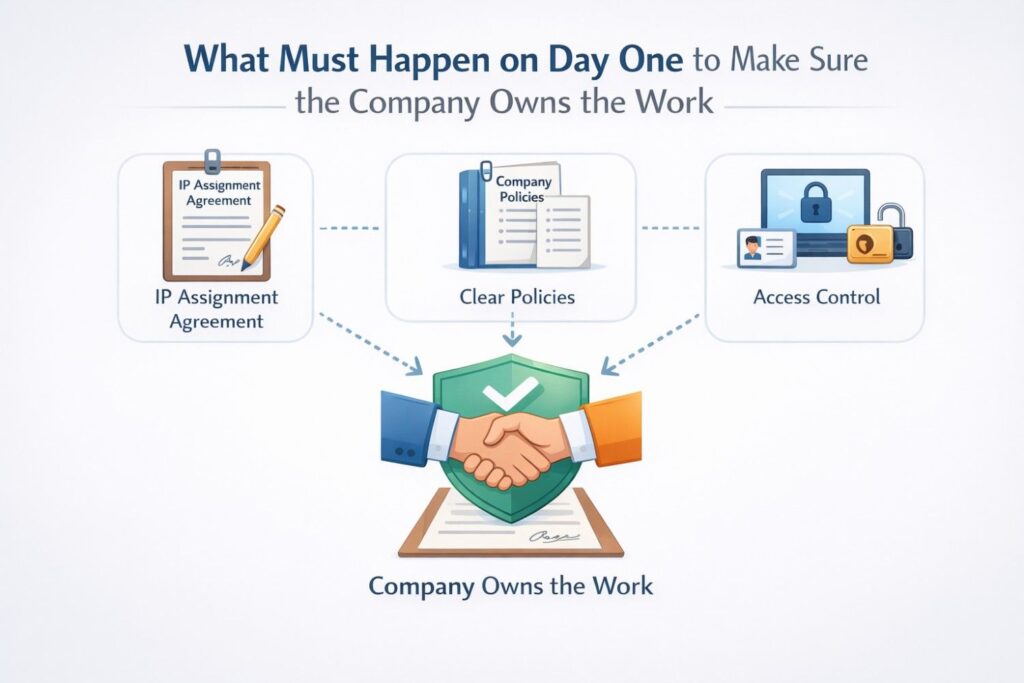
This is why day one matters so much. It is the cleanest moment to say, this is how we work, this is what belongs to the company, and this is how we protect what we are building together.
IP Assignment Is Not Paperwork, It Is Alignment
Many founders treat IP assignment as a formality. Something to sign and forget.
That mindset misses the real value.
IP assignment is a moment of alignment. It makes clear that the company is the home for the work being created. It turns effort into shared progress, not personal leverage.
When explained clearly and simply, most employees appreciate this clarity. It removes doubt. It removes fear. It lets them focus on doing great work without worrying about future confusion.
Timing Is More Important Than Length
Founders often worry about overwhelming new hires with documents.
The truth is that timing matters more than volume.
A short, clear IP assignment signed before meaningful work begins is far more powerful than a long agreement signed weeks later.
Ownership should be established before the first design decision, not after the first sprint.
Digital Signatures Remove All Excuses
There is no reason for delay anymore.
Digital tools allow IP assignments to be signed remotely, instantly, and securely. No printing. No scanning. No office dependency.
Founders who still wait for paperwork to catch up are choosing risk by default.
Modern onboarding should make ownership automatic.
Explain the Why, Not Just the What
People sign faster and feel better when they understand why something matters.
Founders should take a moment to explain that IP assignment protects the company, the team, and future growth. It is not about control. It is about building something that can survive funding, partnerships, and exits.

This short explanation builds trust instead of eroding it.
Make Ownership Broad but Fair
Strong IP assignments are broad enough to cover real work but fair enough to respect personal creativity.
They focus on work related to the company, not unrelated hobbies. They define scope clearly so there is no fear of overreach.
This balance matters. It shows respect while protecting the business.
Day One Sets the Tone for Discipline
How you handle IP on day one signals how seriously you take the business.
Clean onboarding tells employees that the company is thoughtful, organized, and built to last.
Sloppy onboarding sends the opposite message.
Culture is shaped by these small signals more than founders realize.
Founders Must Follow the Same Rules
Nothing undermines IP protection faster than founders being casual about it themselves.
If founders never signed assignments, or signed them late, gaps appear. Investors notice. Buyers notice.
Founders should hold themselves to the same standard as employees.
Ownership should be clean across the entire cap table, not just the team.
One Central System Beats Scattered Files
IP documents stored in inboxes, folders, and old drives become impossible to track.
On day one, every signature should flow into a single system that can be referenced later without digging.
This becomes critical during diligence, audits, or disputes.

PowerPatent is designed to centralize this process so founders are never scrambling to prove ownership years later. You can see how that works here: https://powerpatent.com/how-it-works
Onboarding Is a Legal Moment Disguised as HR
Founders often separate HR and legal in their minds.
In reality, onboarding is one of the most important legal moments in the life of a startup.
It is where rights are set, ownership is defined, and future arguments are quietly prevented.
Treating onboarding with care saves enormous time and stress later.
Delaying IP Assignment Is a Risky Bet
Some founders delay IP assignment to avoid friction.
This delay creates leverage for the wrong side later.
Once someone has contributed value, asking them to sign becomes a negotiation. On day one, it is simply part of joining.
Founders should never trade short-term comfort for long-term risk.
Clean Day One Practices Compound Over Time
Each clean hire reduces future risk. Each signed assignment strengthens the company.
Over years, this compounds into confidence.
Confidence attracts investors. Confidence speeds deals. Confidence protects founders.
Day one is where this compounding starts.

Day one is not about welcoming someone. It is about welcoming their work into the company, permanently and clearly.
Handled well, it becomes invisible. Handled poorly, it becomes a problem that resurfaces when you least want it to.
The Most Dangerous Moment for IP Is When Someone Leaves
When people think about IP risk, they usually picture hiring. Very few founders give the same level of attention to exits. That is a mistake. Exit is where IP problems stop being theoretical and start becoming real.
Leaving is not just a change in payroll status. It is a shift in loyalty, incentives, memory, and future plans.
Even the best team members, the ones who truly cared, begin to see the company from the outside. That change alone is enough to create risk if ownership is not already locked down with precision.
This section goes much deeper into why exits are so sensitive and how founders can protect the company in a calm, professional, and respectful way.
Exit Is When Legal Reality Finally Matters
During day-to-day building, legal ownership feels abstract. Everyone is focused on shipping, fixing bugs, and hitting milestones.
At exit, legal reality shows up.
This is the first time someone might look closely at what they signed, what they did not sign, and what they believe they created. If there are gaps, exit is when they are discovered.

Founders should assume that every departure will one day be reviewed by an investor, an acquirer, or a lawyer. That mindset changes how seriously exit should be handled.
Good Relationships Do Not Prevent Claims
Many founders rely on goodwill. They believe that because someone left on good terms, nothing bad will happen.
This belief is comforting and dangerous.
Most IP disputes do not start with anger. They start with opportunity. A former employee starts a new role. A new company enters a similar space. Questions arise. Lawyers get involved. Positions harden.
By the time a dispute exists, the relationship no longer matters. Only documents do.
Exit Clarifies What Was Never Clear Before
While someone is inside the company, ambiguity is tolerated. People avoid hard questions to keep things moving.
At exit, ambiguity becomes uncomfortable.
People suddenly ask themselves what they can take with them and what they cannot. If the answers are not obvious, risk increases.
Clear IP assignments remove this uncertainty long before exit happens.
Access Is Not Just Technical, It Is Strategic
Most founders think about access in terms of security. Accounts, passwords, systems.
Access is also about influence.
If someone keeps access to internal documents, designs, or discussions after leaving, they retain insight into how the company thinks. That insight is a form of IP.

Cutting access cleanly protects strategy as much as code.
Documentation Becomes Evidence
Notes, comments, commit messages, design docs. These things feel informal while someone is employed.
At exit, they can become evidence.
If ownership is unclear, internal documentation can be used to support claims on either side.
Founders should assume that anything written could be reviewed later and act accordingly.
Founders Often Delay the Hard Conversation
Talking about IP at exit feels awkward. Founders worry it will sour the relationship.
This leads to avoidance.
Avoidance creates silence. Silence creates assumptions. Assumptions create risk.
A short, professional confirmation of ongoing obligations is far less uncomfortable than a legal dispute later.
The Risk of Quiet Copying
Most IP misuse is not dramatic theft. It is quiet copying.
A former employee recreates a feature from memory. They reuse a structure they helped design. They apply the same approach in a new context.
Without clear ownership rules, this copying can be hard to challenge.
Strong IP coverage makes it clear what cannot be reused, even subconsciously.
Departures During High Stress Are Especially Risky
Not all exits are calm.
Layoffs, performance issues, disagreements, or sudden departures increase risk significantly. Emotions are high. Trust is low. Communication breaks down.
This is exactly when founders most need systems, not conversations.
When IP protection relies on personal rapport, it fails under stress.
Founders Often Forget About Advisory Roles
Some people leave employment but remain advisors, consultants, or informal helpers.
This creates a dangerous gray zone.
Work may continue. Ideas may be shared. Ownership may be assumed but not documented.
Founders should be especially careful to clarify IP boundaries when roles change rather than end completely.
Exit Is When Past Mistakes Surface
Even if onboarding was imperfect, problems may stay hidden for years.
Exit brings them to the surface.
Missing signatures, outdated agreements, unclear scope. These issues become visible when someone is no longer inside the system.
Founders should view exit as an audit moment and prepare accordingly.
The Long Tail of IP Risk
IP risk does not end on the last day.
Former employees may be involved in future companies, patents, or products years later. If your IP was not clearly assigned, it can resurface in unexpected places.
This is especially true in tight technical fields where ideas circulate quickly.

Clean ownership protects the company long after people move on.
Buyers Look Closely at Departures
During acquisitions, buyers often ask for lists of former employees and contractors.
They want to know who touched core systems and whether their IP was properly assigned.
If founders cannot produce clear records, deals slow or fall apart.
This is one of the most painful ways to learn that exit matters.
Professional Exit Processes Build Credibility
A calm, structured exit process signals maturity.
It shows that the company takes itself seriously. That it plans for the long term. That it respects both people and assets.
This credibility matters to investors, partners, and future hires.
IP Reminders Should Feel Routine, Not Personal
The best exit IP reminders feel routine.
They are not framed as accusations or warnings. They are framed as standard company practice.
This tone reduces defensiveness and increases compliance.
Routine beats emotion every time.
Systems Remove Emotion From the Process
Founders are human. They feel stress, disappointment, relief, and urgency during exits.
This is why systems matter most at this stage.
A system that automatically tracks who signed what, when, and under what terms removes emotional decision-making from a sensitive moment.
PowerPatent helps founders maintain this clarity across hiring, building, and exit. It keeps ownership records clean and accessible, so founders are never scrambling when someone leaves.
You can explore how this works here: https://powerpatent.com/how-it-works
Exit Is the Final Proof of Good Onboarding
A clean exit usually means onboarding was done right.
If everything is signed, stored, and understood, exit becomes procedural.
No debates. No stress. No surprises.
That is the real goal.

The most dangerous moment for IP is when someone leaves, not because people are bad, but because systems are tested.
Founders who prepare for exit while onboarding build companies that last.
Wrapping It Up
By now, one thing should be clear. IP problems do not come from dramatic moments. They come from quiet ones. A rushed hire. A missed signature. A polite exit where nothing uncomfortable was said. Employee onboarding and exit are not side tasks. They are two of the most important control points in the life of a company. Get them right, and IP becomes a strength that supports growth. Get them wrong, and IP becomes a shadow that follows the company for years.