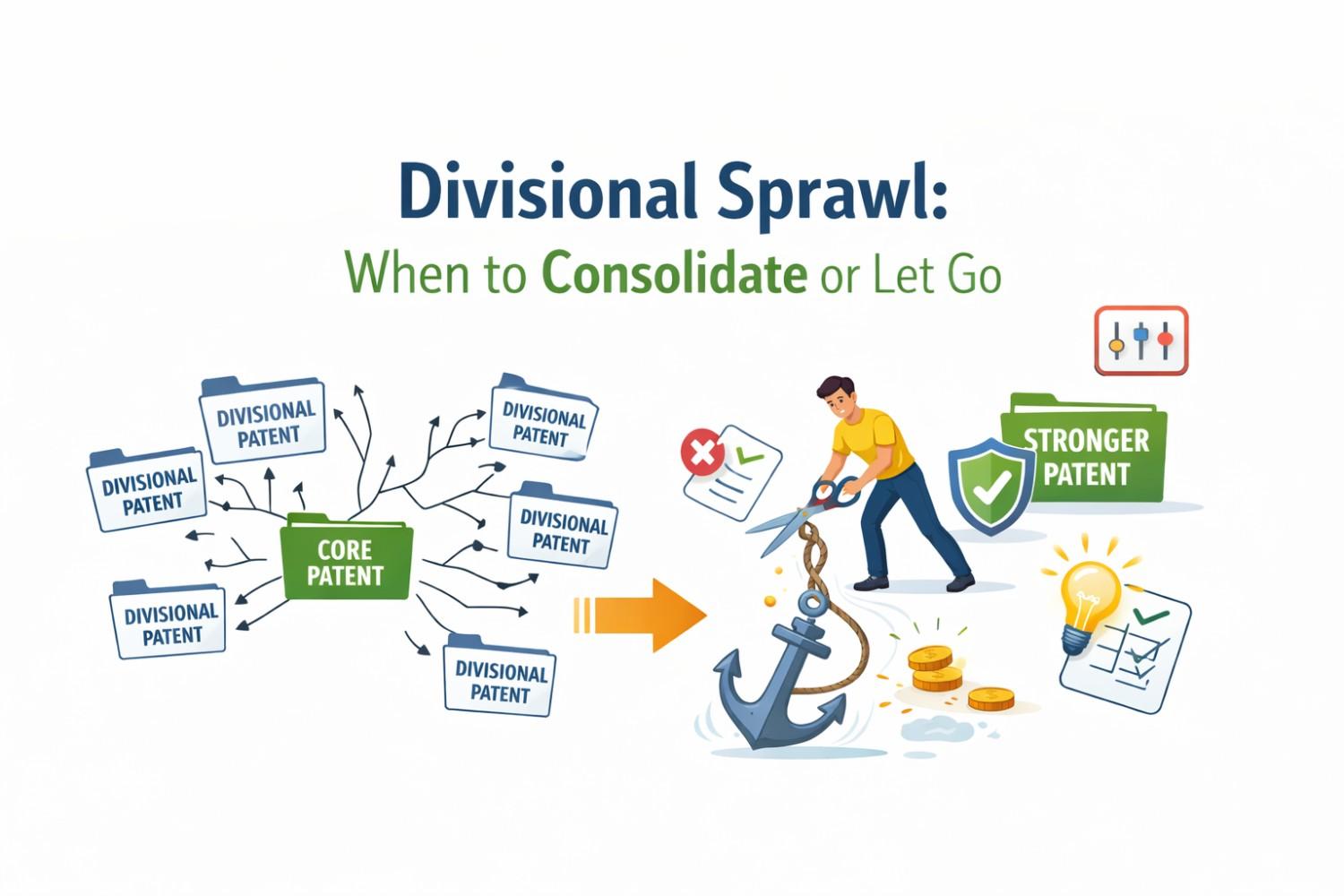
If you are building something new, fast, and powerful, the last thing you want is a patent mess slowing you down. But that is exactly what happens when “divisional sprawl” creeps in. One filing turns into two. Two turn into five. Soon you are juggling a web of related patent applications that drain time, focus, and money. The big question becomes simple: do you keep them all alive, or do you clean house? In this guide, we are going to break this down in plain English. You will learn when to consolidate, when to let go, and how to protect what truly matters—without burning cash or losing control.
How Divisional Sprawl Starts (And Why Smart Founders Miss It)
Divisional sprawl does not happen because founders are careless. It happens because they are ambitious. You are building fast. You are improving your product every week.
You are adding new features, new models, new hardware layers, new use cases. Each improvement feels important. Each feels like it deserves protection.
Over time, what started as one clean patent application becomes a growing web of related filings. It feels productive. It feels safe. But slowly, it becomes heavy.
Let’s break down how this really starts inside a growing company and why even very smart teams miss the warning signs.
The “Just in Case” Filing Mindset
Most sprawl begins with fear.
After filing your first patent application, you feel exposed. What if someone copies the improvement you are about to ship? What if the investor asks whether that new feature is protected? What if a competitor files first?
So you file another application “just in case.”
Then another.
Each one seems small. Each one feels like insurance. But insurance without a clear strategy turns into clutter. The problem is not filing divisionals. Sometimes they are necessary.
The problem is filing them without a long-term map.
A smart move here is to pause before every new filing and ask one simple question: if this is granted, does it change the power of our company? If the answer is unclear, that is a signal to slow down.

Protection should increase leverage, not just volume.
If you want help building that kind of clear filing plan from the start, this is exactly what PowerPatent was built for. You can see how it works here: https://powerpatent.com/how-it-works
Misreading the Patent Office Signals
Another common cause of divisional sprawl starts with how founders react to patent office feedback.
The patent office may say your application covers more than one invention. They may ask you to split it. That is normal. It does not mean your idea is weak. It simply means your original filing included multiple concepts.
But here is where things go sideways.
Instead of stepping back and choosing the strongest core idea, many teams reflexively file divisionals for everything. They think, “We already did the work. We might as well keep all paths open.”
That reaction is understandable. But over time, those extra paths become expensive lanes you must maintain. Each divisional requires attention, responses, legal review, and fees.
The more branches you keep alive, the more energy you burn.
A stronger approach is to treat every required split as a strategy meeting, not an automatic filing.
Ask which invention actually ties to revenue. Ask which claim blocks competitors from copying your core engine. Ask which version aligns with where the company will be in three years, not where it was when you first filed.
If you are not sure how to evaluate that, this is where having smart software plus real patent attorney oversight makes a difference.
PowerPatent combines both, so founders can make decisions based on business goals, not panic.
The Speed Trap
Fast-moving startups are proud of speed. That speed, however, creates a unique trap.
When your product evolves quickly, you often feel your original patent filing is outdated. So you file a divisional to cover version two. Then version three adds a new data pipeline, so you file again. Then you pivot slightly, and now there is another variation worth protecting.
Soon, your filings reflect every stage of your evolution. But your company no longer sells version one or two. You have moved on.
This creates sprawl because patents move slowly while startups move fast. By the time an early divisional is examined, your product may look completely different.
The smarter move is to think in terms of platforms, not features. Instead of protecting each version, protect the core engine that stays consistent across versions. Focus on what will still matter even if the interface changes.
Before filing a divisional for a product update, step back and map what has truly changed. Is it a cosmetic shift? Is it an optimization? Or is it a structural breakthrough?
Only structural breakthroughs usually deserve separate long-term protection.
Investor Pressure and Optics
Divisional sprawl also grows from outside pressure.
Investors love to see patent numbers. It feels like progress. It feels like defensibility. Some founders start filing more simply to show momentum in IP.
The problem is that quantity does not equal strength. A tight, well-designed portfolio that protects your main value driver is far more powerful than a stack of loosely connected filings.
When you feel pressure to “have more patents,” shift the conversation. Instead of talking about how many applications you have, talk about what they block.
Talk about how a competitor would have to redesign their system to avoid infringement. Talk about how your claims sit at the heart of your architecture.
Strong investors understand leverage. They care more about coverage depth than coverage count.
If you need a cleaner way to communicate that strategy, having structured filings and clear claim focus makes that much easier.
This is where using a platform built for founders, like PowerPatent, gives you clarity and confidence in those discussions.
The Emotional Attachment Problem
Founders fall in love with ideas. That is part of what makes them great builders. But that same passion can cause overprotection.
Maybe a feature did not gain traction. Maybe a hardware component was removed from the roadmap. But you already filed a divisional around it. Now you hesitate to abandon it because you invested time and money.
This is where sunk cost thinking quietly fuels sprawl.
A patent application is not a trophy. It is a business tool. If the underlying feature no longer supports your strategy, keeping the application alive just because you started it does not serve you.

A powerful habit is to run an annual IP audit. Not a legal review. A business review. Ask whether each divisional still maps to active product lines, current revenue plans, or future positioning. If not, question why it remains open.
Letting go of weak branches gives you more budget and attention for the branches that matter.
The “More Coverage Equals More Safety” Illusion
It feels logical to assume that the more patents you file, the safer you are. But coverage that is scattered across minor variations does not always create real protection.
Imagine a tree. If the trunk is strong, the tree stands. If you spend all your energy growing thin branches while the trunk is weak, the tree becomes fragile.
Many startups unintentionally focus on branch patents instead of trunk patents. They protect specific implementations instead of the core system logic.
Divisionals multiply around narrow ideas while the foundational concept remains underdeveloped.
This imbalance is a root cause of sprawl.
A stronger strategy is to pressure-test your core claim. If a competitor rebuilt your product from scratch, what is the one thing they would have to copy to compete? That is where depth matters. That is where claim expansion makes sense.
Everything else should be evaluated against that anchor.
Lack of Central Ownership
Divisional sprawl also appears when no one inside the company owns the full IP picture.
Engineering files ideas. Product suggests enhancements. Outside counsel drafts responses. Months pass. Applications multiply. But no single leader steps back to see the whole structure.
Without central ownership, each decision makes sense in isolation. Together, they form chaos.
The fix is simple but powerful. Assign one person responsibility for aligning IP with business strategy. That person does not need to be a lawyer. They need context.
They need to understand product direction, fundraising plans, and competitive threats.
When someone sees the entire portfolio at once, patterns become obvious. Overlaps become visible. Redundant divisionals stand out.
Tools help here too. A clean dashboard view of related applications, claim scopes, and timelines prevents blind growth. PowerPatent was built to give founders and teams that visibility without drowning them in legal language.
You can explore that approach here: https://powerpatent.com/how-it-works
Early Over-Drafting
Sometimes the root of sprawl is an overly ambitious first filing.
In an attempt to cover everything, the original application may bundle multiple inventive ideas together. When the patent office pushes back and asks for separation, divisionals naturally follow.
The lesson is not to file narrow applications. It is to file strategically layered ones. A well-structured initial filing anticipates possible splits and defines a clear hierarchy of concepts.
This reduces reactive divisionals later.
Before submitting any major application, it is wise to map the invention like a system. Identify the primary engine. Identify supporting mechanisms. Identify optional enhancements.
This makes later decisions about splitting cleaner and more intentional.
Growth Without Reflection
The final reason smart founders miss divisional sprawl is simple: growth consumes attention.
You are hiring. You are shipping. You are pitching. IP feels like a background task. As long as applications are “in progress,” it feels handled.
But unattended growth becomes tangled growth.
A quarterly fifteen-minute review of your patent family structure can prevent years of unnecessary filings. Look at how many active divisionals exist. Look at which ones are closest to grant.
Look at which ones have stalled. Ask whether each aligns with your next eighteen months of roadmap.
Small, regular reflection prevents large, painful cleanups later.

Divisional sprawl does not begin with bad decisions. It begins with small, reasonable decisions made without a clear long-term frame. The good news is that once you see how it forms, you can stop it early.
And if you want a smarter, founder-first way to manage filings so they grow with your company instead of against it, take a look at how PowerPatent works: https://powerpatent.com/how-it-works
The Hidden Cost of Keeping Everything Alive
At first, keeping every divisional open feels safe. It feels like strength. You tell yourself that more filings mean more protection. More protection means more power.
But over time, the weight begins to show. The cost is not just legal fees. The real cost hides in distraction, slow decisions, weak positioning, and lost leverage.
When too many applications stay alive without a clear purpose, your patent strategy stops being sharp and starts becoming noise.
Let’s look at what that really does to a growing company.
The Budget Drain You Don’t Notice at First
Every divisional application carries ongoing costs. There are response deadlines. There are filing fees. There are attorney reviews. There are government payments. Even small actions add up over years.
Early on, this seems manageable. A few thousand here. A few thousand there. But divisionals move slowly.
They can remain active for years. Multiply that by five or seven related filings, and suddenly a large part of your budget is tied to work that may not even support your current product.
This is money that could fund engineering hires. It could support product launches. It could extend runway.
The key shift is to treat each active divisional like a subscription. Ask yourself: if I had to re-buy this application today at full cost, would I? If the answer is no, that is a strong signal.

Strategic pruning frees real capital. That capital can strengthen the patents that actually defend your core system.
The Mental Bandwidth Tax
The financial cost is visible. The mental cost is not.
Every open divisional requires tracking. You must remember its scope. You must understand how it differs from related filings. You must coordinate responses with product changes. You must align it with fundraising narratives.
This creates a constant background load on leadership.
When you prepare for investor meetings, you review your portfolio. When you negotiate partnerships, you examine what is protected. When you think about competitors, you analyze claim coverage.
If your portfolio is cluttered, these reviews take longer and feel unclear.
Clarity creates confidence. Sprawl creates hesitation.
A tight, focused set of applications is easier to explain, easier to defend, and easier to leverage. That clarity matters during high-pressure moments.
This is one reason many founders move toward structured platforms that organize their IP visually and strategically. When everything is mapped clearly, decisions feel lighter. You can see how PowerPatent approaches that here: https://powerpatent.com/how-it-works
The Illusion of Defensive Strength
On paper, having many related filings may look strong. But strength is not about volume. It is about positioning.
If your divisionals overlap heavily or protect minor variations, they do not expand your defensive wall. They simply repeat similar ground.
In some cases, this creates internal competition between your own applications. Claims may conflict. Amendments in one case may limit arguments in another. What feels like expansion can become self-friction.
True defensive strength comes from layered coverage. One application secures the core architecture. Another protects key methods. A third may focus on integration paths. Each one should serve a distinct role.
If you cannot clearly describe the role of a divisional in one sentence, it may not be strategically aligned.
Slower Decision Cycles
When too many divisionals are active, each business move triggers more analysis.
You want to pivot your product slightly. Now you must evaluate how that pivot affects six pending applications.
You want to enter a new market. Now you must consider whether certain claims need adjustment. You want to license technology. Now you must review overlapping scopes.
This slows down strategic agility.
Startups win because they move fast. Your IP strategy should support speed, not restrain it.
Consolidating similar divisionals reduces the number of moving parts. Fewer active threads mean faster business decisions. The goal is not fewer patents for the sake of simplicity.
The goal is fewer distractions so your best protection stays strong.
Investor Due Diligence Risk
As your company grows, investors and acquirers will review your patent portfolio in detail. They will not just count applications. They will examine structure.
If they see a tangled web of overlapping divisionals with unclear purpose, they may question strategic discipline. They may wonder whether resources were allocated wisely.
They may worry about enforceability or claim coherence.
A clean portfolio tells a different story. It shows intent. It shows alignment with product direction. It signals that leadership makes thoughtful decisions.

Before major funding rounds, it is wise to simulate due diligence internally. Review each divisional and ask whether you can clearly justify its existence in terms of business value. If not, consider restructuring before outsiders do.
Platforms that combine software clarity with real attorney oversight can make this process smoother. Instead of reacting to due diligence stress, you stay prepared from day one. That is the idea behind PowerPatent’s model: https://powerpatent.com/how-it-works
Opportunity Cost of Weak Claims
When attention is divided across too many applications, claim quality can suffer.
Instead of strengthening your most important filing, you may spread amendments across several average ones.
Instead of deepening protection around your core engine, you may respond to minor examination issues in less critical divisionals.
This is opportunity cost.
Every hour spent on a low-impact application is an hour not spent fortifying your strongest position.
A smart review process ranks divisionals by strategic weight. Which one blocks competitors most directly? Which one anchors your valuation story? Those deserve the highest energy.
Letting weaker branches expire can actually strengthen your overall portfolio because it focuses effort where it matters most.
Administrative Complexity Compounds Over Time
Divisional sprawl often feels manageable in year one. By year three, complexity multiplies.
Deadlines overlap. Fee schedules vary. Different examiners handle related cases. Amendments in one case may require consistency in others.
Without tight coordination, small inconsistencies can creep in. These inconsistencies can limit arguments later or create confusion during enforcement.
Reducing the number of active divisionals lowers the risk of internal contradiction. It also makes long-term maintenance far simpler.
Consistency is power in patent strategy. Simplicity makes consistency easier.
The Emotional Weight of “Too Much”
There is also a psychological layer.
When founders look at a crowded IP dashboard, it can feel overwhelming. Instead of pride, they feel pressure. Instead of clarity, they feel uncertainty.
This emotional weight affects decision-making. It may cause delay. It may create avoidance.
Cleaning up divisional sprawl often produces immediate relief. Teams feel lighter. Strategy discussions become sharper. Focus returns.
That shift alone can justify consolidation.
Reclaiming Strategic Control
The hidden cost of keeping everything alive is not just money or time. It is control.
When your patent portfolio grows without intentional design, it begins to control you. You react to deadlines instead of shaping direction. You respond to examiner comments instead of guiding claim evolution with purpose.
The moment you audit and realign your divisionals with business goals, control returns.
You decide which battles to fight. You choose which ideas to emphasize. You invest in depth where it creates leverage.

That is how patents become strategic assets instead of administrative burdens.
And if you want a clearer, founder-first way to manage that alignment without drowning in paperwork, PowerPatent was designed for exactly this challenge. You can explore the approach here: https://powerpatent.com/how-it-works
When to Consolidate: Regain Control Without Losing Protection
Consolidation is not surrender. It is design. It is the moment you stop reacting and start shaping your portfolio on purpose.
Many founders fear consolidation because it feels like reducing coverage. In reality, smart consolidation often strengthens protection. It removes noise, sharpens focus, and builds depth where it counts.
The goal is not to shrink your patent presence. The goal is to make every active application carry real weight.
Let’s look at how to know when consolidation makes sense and how to do it without weakening your position.
When Claims Start Saying the Same Thing
If two or more divisionals protect slight variations of the same idea, that is your first signal.
Small wording changes do not create meaningful expansion. If the core logic, architecture, or method remains identical across filings, you may be paying to defend the same territory more than once.
Consolidation in this case means selecting the strongest application and reinforcing it. You refine the claims. You expand their coverage carefully. You let the weaker sibling filings fall away.

Before making that decision, map the exact differences between each set of claims. If those differences do not block a competitor from building around your system in a new way, they may not justify separate filings.
Strength comes from claim precision, not repetition.
When Product Direction Becomes Clear
Early in a startup’s life, direction shifts often. Filing multiple divisionals can make sense when you are still exploring paths.
But once your product-market fit becomes clear, your patent strategy should tighten around that path.
If some divisionals reflect features you no longer plan to build, consolidation becomes obvious. Protection should follow momentum.
Sit down with your product roadmap and compare it to your active patent family. Highlight where they overlap strongly.
Highlight where they do not. If certain filings no longer support the roadmap, consider merging their useful ideas into your strongest active case and releasing the rest.
This alignment reduces waste and increases clarity.
This is much easier when your portfolio is structured in a way that mirrors your product system.
Platforms like PowerPatent help founders see that alignment clearly without needing to decode complex legal documents. You can see how that works here: https://powerpatent.com/how-it-works
When Budget Pressure Demands Focus
There are seasons in every startup where capital must be preserved.
During those times, spreading resources thin across many divisionals can hurt more than help. Consolidation becomes a strategic survival move.
Instead of cutting randomly, evaluate which filings would create the most damage if lost. Which one would weaken your negotiating power the most? Which one anchors your long-term moat?
Protect those first. Strengthen them if possible. Allow lower-impact divisionals to expire gracefully.
This is not retreat. It is disciplined allocation.
A lean portfolio that protects the heart of your technology is more valuable than a broad portfolio that protects edges.
When Examiner Feedback Reveals Overlap
Patent examiners often highlight similar prior art across related cases. If multiple divisionals receive nearly identical rejections, that may reveal redundancy.
Instead of fighting the same battle in several places, consolidation lets you combine your strongest arguments into one focused application.
This approach reduces internal contradiction. It also increases the chance of obtaining meaningful claims rather than narrow ones spread across multiple cases.
When consolidating after examiner feedback, step back and reframe your invention at a higher level.
Identify the core inventive step that truly distinguishes your system. Build around that central idea instead of defending multiple smaller ones.

This requires thoughtful drafting and attorney oversight. The right combination of smart software and real human review makes this process more controlled and less stressful.
That balance is central to how PowerPatent operates.
When You Struggle to Explain the Strategy
Here is a simple test.
If you cannot clearly explain to a new executive or investor why each divisional exists, consolidation is likely overdue.
Every active filing should have a purpose you can describe in plain words. It should either protect your core engine, block a known competitor path, support licensing opportunities, or extend coverage into a future expansion area.
If a filing exists only because it was once filed, that is not strategy.
During consolidation, write a short internal statement for each remaining divisional describing its role. This exercise forces clarity. It transforms your portfolio from a collection of documents into a structured defense system.
The Process of Strategic Consolidation
Consolidation does not mean abruptly abandoning filings without thought. It is a deliberate review.
Start by grouping related divisionals into clusters based on technology area. Within each cluster, identify the strongest anchor case. This is usually the one with the broadest and most defensible claims.
Next, examine whether smaller variations can be incorporated through amendments or continuation strategy within that anchor case.
Then evaluate timing. Some divisionals may be close to allowance. Others may be early stage. The closer a case is to strong approval, the more carefully you assess its value.
Finally, make decisions based on forward impact, not past effort.
The clean result should feel lighter. Fewer active threads. Clearer purpose. Stronger claims.
Consolidation Builds Depth
There is a hidden advantage to consolidation that many founders miss.
When you reduce the number of divisionals, you free time and budget to deepen the most important ones. That depth can mean broader claims, stronger supporting descriptions, and better long-term enforcement power.
Depth discourages competitors more effectively than surface coverage.
Think of it as building a fortress. A wide fence with weak walls invites challenge. A focused fortress with thick walls creates hesitation.
Strategic consolidation thickens your walls.
Regaining Momentum
Once consolidation is complete, decision cycles speed up. Portfolio reviews become simpler. Investor conversations become sharper. Internal alignment improves.
Instead of feeling like you are managing a maze, you feel like you are steering a ship with a clear direction.
This momentum matters. Patents should support growth, not distract from it.

And if you want a system that keeps your filings organized and aligned with your business as you grow, PowerPatent was designed with that goal in mind. You can explore the full approach here: https://powerpatent.com/how-it-works
When to Let Go: Cutting Dead Weight Without Regret
Letting go of a patent application feels uncomfortable. It can feel like admitting a mistake. It can feel like losing protection. But in reality, knowing when to let go is a sign of strength.
It shows discipline. It shows clarity. It shows that you are running your company with intention, not emotion.
Not every idea deserves to live forever. Not every divisional needs to be pushed to grant. The strongest portfolios are not the biggest ones. They are the most aligned ones.
Let’s talk about how to recognize when it is time to release a divisional and how to do it without second-guessing yourself later.
When the Product Has Moved On
Startups evolve. What felt like the future two years ago may now be a footnote.
If a divisional protects a feature you no longer build, sell, or plan to revisit, its value shrinks fast. Protection only matters if it connects to real business movement.
Many founders keep these filings alive because they once felt important. But past importance does not equal future leverage.
Pull up your current product roadmap. Compare it line by line with each active divisional. If there is no clear connection to revenue, growth, partnerships, or competitive defense, ask why it remains active.
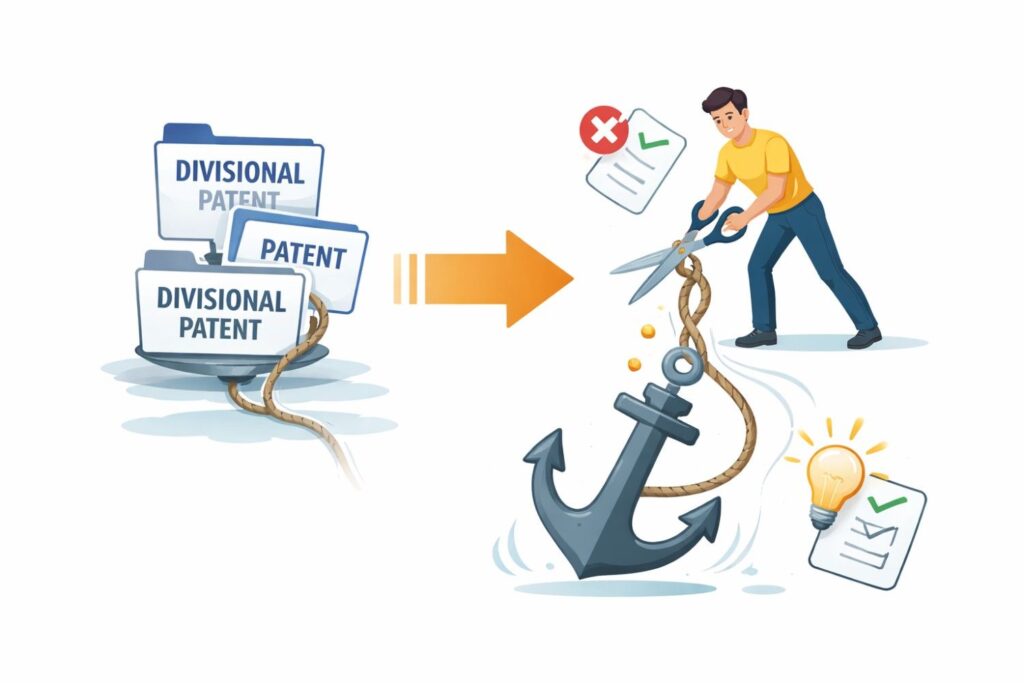
Letting it expire may free capital and attention for the filings that match where you are going now.
When Enforcement Would Not Make Sense
Imagine the divisional becomes a granted patent tomorrow. Ask yourself a simple question: would we actually enforce this if someone copied it?
If the answer is unclear or no, that filing may not justify continued investment.
Some divisionals protect narrow edge cases. Others cover internal optimizations that competitors would never bother copying. Even if granted, those patents might never be used in negotiation or defense.
Protection that you would never enforce does not add real strength.
Strong patents create leverage. Weak ones sit quietly and drain maintenance budgets.
When Market Timing Has Shifted
Technology cycles move quickly.
Sometimes a divisional protects an approach that was cutting-edge at the time of filing but is now outdated or replaced by a better method. If the market no longer values that approach, its strategic value declines.
This does not mean every older idea loses relevance. Some foundational concepts remain powerful for years.
But if industry standards, customer expectations, or technical architectures have clearly shifted away from what the divisional covers, reassess its place in your portfolio.
Patents should reflect where the market is heading, not where it used to be.
When the Cost to Continue Exceeds the Upside
At certain stages, divisionals require significant response work. You may face detailed office actions or complex amendments.
Before investing further, pause and calculate the upside.
If granted, would this patent materially increase valuation? Would it block a known competitor path? Would it strengthen licensing power?
If the expected impact is small, and the cost to continue is large, letting go may be the rational move.
This decision becomes easier when you have clear visibility into timelines, costs, and claim scope. A structured platform that shows this information clearly can prevent emotional choices.
That visibility is part of what makes modern tools like PowerPatent different from traditional approaches. You can explore that structure here: https://powerpatent.com/how-it-works
When It Creates Strategic Noise
Some divisionals complicate your story.
During fundraising or acquisition talks, too many loosely connected filings can confuse the narrative.
Investors want to understand your moat quickly. If your portfolio includes several outdated or peripheral applications, the signal gets buried in noise.

Letting go of weaker filings simplifies your message.
Instead of presenting a long list of application numbers, you present a clear system of protection built around your core technology.
Clarity builds trust. Trust builds value.
The Emotional Discipline of Letting Go
The hardest part of letting go is emotional.
You remember the brainstorming session when that idea was born. You remember the excitement of filing. You remember the early belief that this feature might define your product.
But startups are defined by adaptation. Growth requires shedding.
The decision to let a divisional lapse does not erase the learning behind it. It simply acknowledges that your energy must be focused where it drives the most return.
One helpful exercise is to reframe expiration as optimization. You are not losing protection. You are refining your defensive line.
When founders adopt this mindset, regret fades quickly.
Creating a Let-Go Framework
To avoid random decisions, build a simple internal framework.
Review divisionals once per year against three anchors: current product alignment, competitive blocking power, and long-term company vision.
If a filing does not strongly support at least one of these anchors, it becomes a candidate for release.
Make these reviews routine rather than reactive. Scheduled evaluation prevents last-minute stress when deadlines approach.
It also keeps your portfolio lean by design instead of by accident.
The Power of a Clean Portfolio
A clean portfolio feels different.
You can see the architecture clearly. Each filing has a role. Each claim has a purpose. Each dollar invested has intent behind it.
This clarity strengthens negotiations. It improves due diligence outcomes. It reduces internal friction. It makes future filing decisions easier.
Most importantly, it aligns your patents with your mission.
Patents are not trophies. They are tools. Tools should serve your build, not distract from it.
When you combine thoughtful pruning with smart drafting and real attorney oversight, you end up with protection that is both strong and manageable.
That combination is exactly what PowerPatent was designed to deliver for founders who want speed without chaos.
If you want to see how a modern, founder-first patent process can help you avoid divisional sprawl from the start, explore the full breakdown here: https://powerpatent.com/how-it-works

This is how you move from reactive filings to strategic control.
Wrapping It Up
Divisional sprawl is not a legal problem. It is a strategy problem. It starts with good intentions. You want to protect everything you are building. You want to stay ahead of competitors. You want to show strength to investors. But without a clear filter, protection multiplies faster than purpose. Over time, what felt like safety becomes weight. The real shift happens when you stop asking, “Can we protect this?” and start asking, “Should we?” That one question changes everything.