If you think filing a patent is the hard part, think again. The real danger often shows up years later, quietly, in the form of annuity payments. Miss one. Misread one. Pay the wrong amount in the wrong country at the wrong time—and your patent can disappear. No warning. No second chance. In this guide, we’ll walk through the hidden annuity traps country by country, explain why smart founders still get burned, and show you exactly how to stay protected without slowing down your startup. If you are building real technology and want to keep it safe worldwide, this is something you cannot afford to ignore.
The Silent Killer: How Annuity Deadlines Destroy Patents Without Warning
Annuity deadlines do not feel urgent when you are deep in product builds, hiring, fundraising, and shipping updates. They sit in the background. Quiet. Easy to ignore.
But they are one of the most common reasons strong patents die. Not because the invention was weak. Not because a competitor won. But because someone missed a payment window in a single country.
This is where many startups lose years of work. And most of the time, they do not even see it coming.
Let’s break down how this really happens—and how you can protect your company before it is too late.
The Illusion of “We Filed, So We’re Safe”
Once a patent is filed, many founders feel relief. The paperwork is done. The attorney filed it. The application number came in. It feels complete.
But filing is only step one.
Every country charges maintenance fees over the life of a patent. These are called annuities. They are not optional. If they are not paid on time, the patent rights can lapse. In many countries, reinstating is hard, expensive, or flat-out impossible.
The trap is that these payments are not due immediately. They come years later. By then, your team may have changed. Your original lawyer may not be involved.
The person tracking deadlines may have left. Or maybe you expanded into new countries and forgot how each one works.
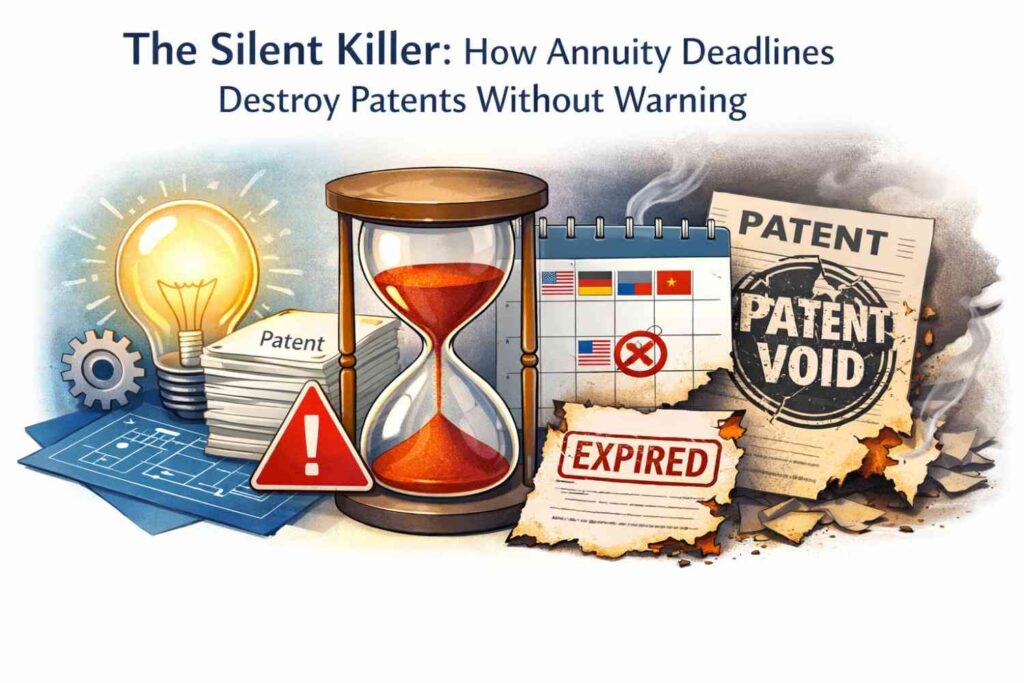
The danger grows quietly over time.
This is why strong companies treat annuities like mission-critical infrastructure, not admin work.
Why Annuity Deadlines Feel Invisible
Annuity deadlines do not show up in your Slack channels. They do not appear in your product roadmap. They are not discussed in board meetings. So they slip down the priority list.
That invisibility is what makes them deadly.
Unlike a missed product launch, there is no dramatic moment. There is just a silent expiration. One day your patent is active. The next day, it is gone in that country.
And here is the worst part. Your competitor does not get notified. They simply see that the patent lapsed. Then they move.
If your IP is part of your valuation, your licensing plan, or your long-term moat, this is not a small mistake. It can change everything.
The Compounding Risk of Global Filing
Many deep tech startups file in multiple countries. The U.S., Europe, China, Japan, Korea, maybe India or Canada. It makes sense. Your market is global.
But every country has its own schedule.
Some require payments before grant. Some require payments after grant. Some increase fees every year. Some offer short grace periods. Others are strict.
The more countries you file in, the more moving parts you create.
Without a single system tracking all of them together, risk multiplies.
What often happens is that founders assume their outside counsel or a foreign associate is handling it. Meanwhile, the associate assumes instructions will come from the startup. No one owns the full picture.
This gap is where patents quietly die.
How Budget Pressure Leads to Accidental Lapse
Startups live on cash flow.
When money is tight, founders look at expenses and ask hard questions. Annuity fees can look like something that can wait. Especially in early years when revenue is still growing.
But annuities do not wait.
In some countries, if you miss the regular deadline, you get a short grace period with a penalty. That penalty can double or triple the fee. In others, the grace period is strict and unforgiving.
When finance teams do not have clear long-term projections of annuity costs country by country, these payments can feel sudden and painful.

The smart move is to forecast annuity costs as part of your IP strategy from day one. Treat them like rent for your protection. If you know the cost curve ahead of time, you can decide early which countries matter most.
This is not about paying everywhere forever. It is about choosing on purpose instead of reacting under pressure.
The False Sense of Security From Reminders
Many founders believe they are safe because “the firm sends reminders.”
Reminders help. But they are not a strategy.
Emails get lost. People change roles. Payment approvals get delayed. Wire transfers fail. Time zones cause confusion. Sometimes reminders go to a former employee.
A reminder is only useful if someone owns the responsibility to act on it.
The real protection comes from clear internal ownership plus smart systems that track deadlines across all countries in one place. When you can see everything in a single dashboard, risk drops fast.
This is one reason modern tools matter. When your patents live inside a system designed for startups, not old-school paper workflows, visibility increases. And visibility is control.
If you want to see how that works in practice, you can explore how PowerPatent helps founders manage filings and long-term protection at https://powerpatent.com/how-it-works.
When Portfolio Growth Creates Chaos
Early on, you may have one patent family. Easy to track.
Three years later, you may have ten. Each with different filing dates. Different national phase entries. Different grant timelines. Different annuity schedules.
Now the calendar becomes a maze.
Without structured tracking, it becomes nearly impossible to know which payments are due in which year in which country.
This is where startups accidentally overpay in places they no longer care about—or underpay in places that matter most.
Strategic portfolio reviews should happen at least once a year. Look at each country. Ask simple questions. Is this market active? Are we selling here? Are competitors here? Is this part of a licensing plan?

If the answer is no, you can decide to stop paying on purpose. That is smart pruning.
If the answer is yes, then you double down and make sure those payments are locked in.
Intentional decisions protect value. Accidental lapses destroy it.
The Risk of Relying on Foreign Agents
When you file internationally, local agents in each country handle formal steps. They send invoices for annuities. They expect instructions.
But they do not know your strategy. They do not know your budget. They do not know which markets are core to your growth plan.
They simply process payments if told to.
If communication breaks down, deadlines pass. And once a patent lapses in certain countries, reinstatement may require proof that the failure was unintentional. That process can be slow and uncertain.
This is why central control matters.
Your startup should always have a clear master view of all deadlines across all countries. Do not rely on scattered email chains with foreign associates. Build one source of truth.
The Hidden Impact on Fundraising and M&A
Investors look closely at IP. So do acquirers.
If they discover that key patents lapsed in major markets because of missed annuities, confidence drops. Valuation can drop with it.
Worse, if a competitor entered a market after your lapse and built a position there, rebuilding protection may not be possible.
Annuity management is not admin work. It is asset management.
Treat your patents like property. If you forget to pay property tax, you lose the property. The same logic applies here.
Founders who understand this early protect their future leverage.
Turning Annuity Risk Into Strategic Advantage
Here is the good news. Once you understand the risk, it becomes manageable.
First, map every patent family and every country. Know the next five years of projected annuity costs. Not just the next payment. The next five years.
Second, align those countries with business goals. Expansion plans. Sales markets. Manufacturing hubs. Competitor hotspots.
Third, centralize tracking in one system. Not spreadsheets scattered across drives. Not inbox folders. A live system built for visibility.
Fourth, review annually. Do not assume yesterday’s plan still makes sense.
When you do this, annuities stop being scary. They become strategic tools.
And this is exactly where modern platforms shine. PowerPatent combines smart software with real attorney oversight so founders can see their entire portfolio clearly and avoid silent losses that hurt years later.

If you are building something valuable, take a look at how it works here: https://powerpatent.com/how-it-works.
Annuity traps are silent. But they are not mysterious.
With the right system, clear ownership, and proactive planning, you can make sure your patents stay alive exactly where they matter most.
Country-by-Country Annuity Traps That Catch Even Smart Founders
Every country has its own rules. Its own timing. Its own way of doing things. What works in the United States does not work the same way in Europe. What feels normal in Europe can be very different in China or Japan.
This is where even careful founders get surprised.
You assume the system is similar everywhere. It is not.
Let’s walk through how these traps show up across key regions and what you can do to stay ahead of them.
United States: The Three-Stage Shock
The U.S. system looks simple on the surface. You pay maintenance fees three times after grant. That sounds easy.
It is not.
The Long Gap Problem
In the U.S., the first maintenance fee is not due until several years after the patent is granted. That long gap creates false comfort. Teams forget. Staff changes. The patent gets buried in a database.
Then suddenly, a large payment is due.
Because the gap is long, many startups fail to budget properly. When the invoice arrives, it feels unexpected. If cash is tight, delay becomes tempting.
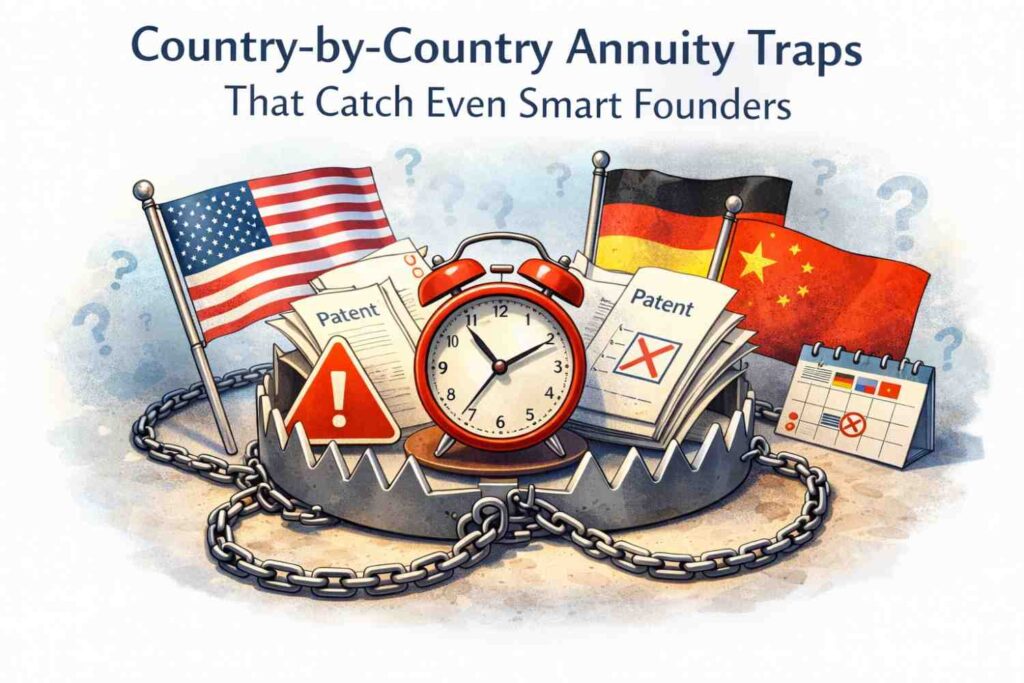
The smart move is to record U.S. maintenance fees at the time of grant and forecast all three payments immediately. Do not wait until reminders arrive.
Grace Period Confusion
The U.S. does offer a grace period with extra fees. That sounds helpful. But relying on grace periods as a habit is dangerous. It increases costs and creates risk if internal approval processes slow things down.
A better approach is to treat the official due date as non-negotiable. Use the grace period only for true emergencies.
Portfolio Blind Spots
Many startups assume U.S. patents are safe because they feel close to home. But when companies scale and add more patent families, tracking which patents have reached maintenance stages becomes harder.
Without a live dashboard showing grant dates and fee windows, visibility fades.
If your U.S. portfolio is growing, central tracking is no longer optional. It is necessary.
Europe: The Fragmentation Trap
Europe looks unified from the outside. It is not.
There is the European Patent Office phase. Then there is validation into individual countries. Then there are national annuities in each validated country.
Each step carries risk.
Pre-Grant Annuities at the European Level
During the European application phase, annuities must be paid to keep the application alive. Many founders assume payments only start after grant. In Europe, that is not true.
If you miss a pre-grant renewal, your application can die before it even becomes a granted patent.
The solution is simple but often ignored. Treat European applications as active cost centers from day one. Forecast pre-grant annuities separately from post-grant country fees.
Post-Grant Validation Chaos
After grant, you must validate in selected countries. Once validated, each country has its own annuity schedule and payment rules.
Germany may have one process. France another. Italy another. Spain another.
Invoices come from different local agents. Deadlines differ. Currency differs.
If you validate in five or ten countries, you now have five or ten separate annuity streams.
This is where things break down.
A common mistake is assuming that because the patent was granted centrally, renewals remain centralized. They do not.

To avoid this trap, build a country-by-country renewal map immediately after validation. Do not rely on scattered emails from local agents.
The Cost Escalation Curve
European national annuities increase over time. Later years can become expensive.
If you do not project those future increases early, you may suddenly face steep costs in years eight, nine, and ten.
Strategic review is critical here. As products mature, reassess whether each validated country still supports your revenue strategy. Make deliberate decisions before high-fee years arrive.
China: The Strictness Factor
China has become essential for many tech companies. Manufacturing, market size, competition. Filing there makes sense.
But annuity management requires discipline.
Tight Deadlines and Administrative Formality
China’s system is structured and formal. Missing deadlines can be difficult to fix. Procedures for reinstatement may require detailed explanations and additional steps.
This is not a system where casual tracking works.
If China is core to your supply chain or market expansion, treat its annuities as high priority.
One practical move is to align China renewal reviews with annual manufacturing or market strategy reviews. If your hardware is built there, losing protection can create direct competitive risk.
Currency and Payment Logistics
International payments can introduce friction. Exchange rates change. Bank processing times vary.
If you wait until the last minute to approve foreign payments, you increase the risk of administrative delay.
The smart habit is to approve foreign annuity payments well before deadline windows, especially in jurisdictions with strict processing rules.
Japan: Precision Matters
Japan values structure and exact compliance.
Early Payment Awareness
In Japan, annuities begin earlier than many founders expect. Payments start shortly after grant and continue annually.
Because Japan is often part of a broader Asia filing strategy, its deadlines can get lost among China, Korea, and other jurisdictions.

To avoid this, group Asia renewals in your internal calendar but still track each country separately. Do not assume similar rules mean similar deadlines.
Long-Term Cost Planning
Japanese annuities increase over time, similar to Europe.
If Japan is part of your long-term licensing or partnership strategy, budget for full-life protection from the beginning. Cutting off protection midway can weaken negotiation leverage later.
India and Emerging Markets: The Administrative Gap
India and other fast-growing markets are attractive. But administrative systems may feel less automated compared to the U.S. or Europe.
Communication Delays
Sometimes notices and communications move slower. Relying solely on external reminders may create gaps.
Internal tracking becomes even more important here.
When entering emerging markets, double-check that deadlines are recorded internally the moment national phase entry occurs. Do not assume smooth notification flows.
Strategic Market Evaluation
In high-growth markets, strategy may change quickly. A country that felt optional three years ago may become central today.
Annual review of these jurisdictions ensures you are not accidentally abandoning protection just as the market matures.
The Cross-Border Coordination Problem
The real trap is not any single country. It is coordination across all of them.
Different time zones. Different currencies. Different agents. Different legal systems.
Without a unified system, complexity grows quietly.
This is where modern infrastructure makes a difference.
When your patents live inside a platform built for startups, you can see every jurisdiction in one place. You can forecast costs. You can align payments with strategy. And you can involve real attorneys when decisions need legal judgment.
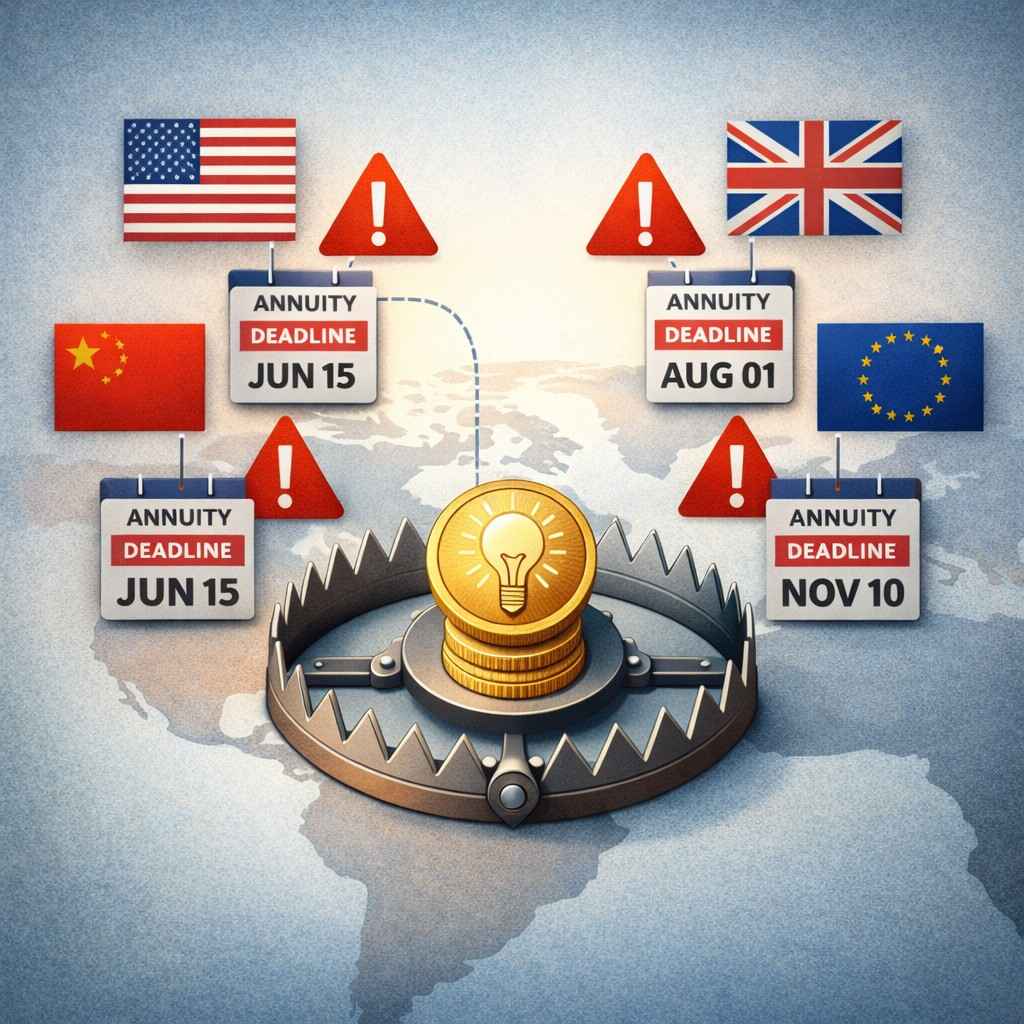
PowerPatent was built for exactly this reality. It combines smart software tracking with attorney oversight so you do not miss country-specific traps while scaling globally.
If your roadmap includes international growth, this is worth exploring: https://powerpatent.com/how-it-works.
Country-by-country annuity risk is real. But it becomes manageable when you replace scattered emails with structured visibility and intentional strategy.
How to Stay Protected Worldwide Without Losing Sleep or Missing Payments
Annuities only feel scary when you do not control them.
When you build the right system, they stop being surprise landmines and start becoming simple calendar events tied to strategy. The shift is not about hiring a giant legal team. It is about structure, visibility, and ownership.
This is where serious startups separate themselves from everyone else.
Protection Is Not a One-Time Event
Many founders treat patents like product launches. File it. Announce it. Move on.
But protection is not an event. It is an ongoing process.
Every patent you file creates a long tail of responsibility that can stretch twenty years. If you file in ten countries, that tail multiplies.
So the first mindset shift is this: filing is the beginning, not the end.
The moment you file, you should already be thinking about long-term maintenance. Not in a stressful way. In a strategic way.
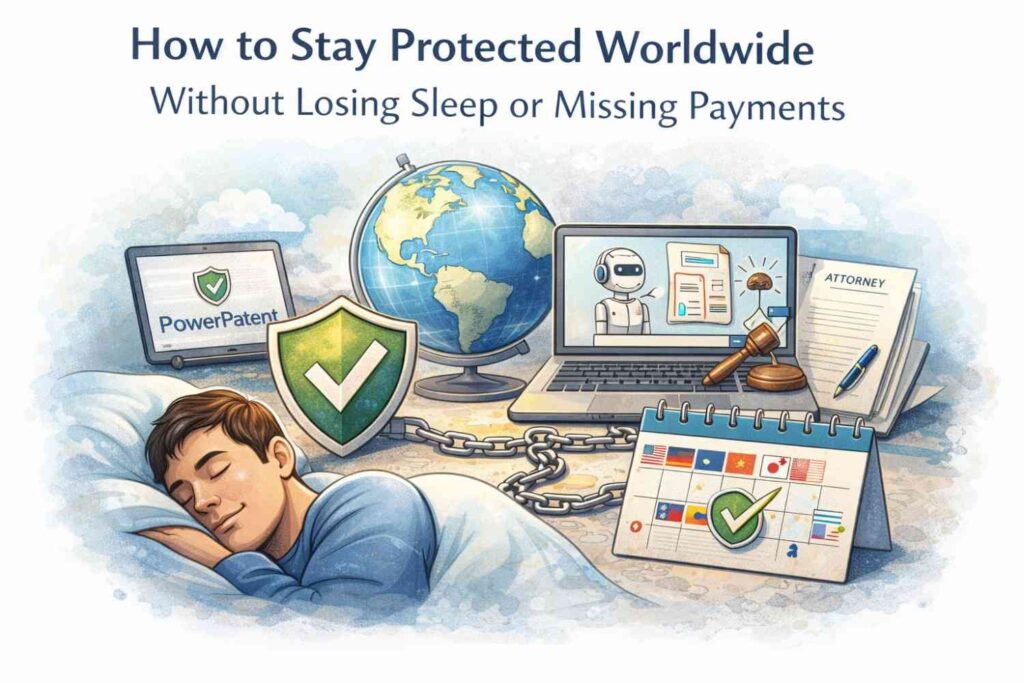
When you see patents as long-term assets, you naturally build systems around them.
Assign a Real Owner Inside the Company
Here is a quiet truth. If everyone owns annuity tracking, no one owns it.
In many startups, IP responsibility floats between the CTO, outside counsel, operations, and finance. That sounds collaborative. In practice, it creates gaps.
One person inside your company should be responsible for IP oversight. Not necessarily making every legal decision. But owning visibility.
That person should know, at any moment, how many patent families exist, which countries they cover, and when the next payments are due.
Without internal ownership, you are relying on reminders from the outside. And outside reminders are not strategy.
Build a Five-Year Financial View
Most companies look at the next invoice. Smart companies look five years ahead.
When you project annuity costs over a five-year window, you gain control.
You can see cost spikes coming. You can align payments with expected revenue. You can plan fundraising with real data. You can make early decisions about which countries matter.
This turns annuities from reactive spending into planned investment.
It also allows you to have informed board conversations. Instead of saying, “We just got a big patent bill,” you say, “Here is our five-year IP maintenance roadmap and how it supports our market expansion.”
That is a very different conversation.
Connect Patent Coverage to Revenue Maps
One of the biggest mistakes startups make is separating IP from business strategy.
Your patent map should mirror your revenue map.
If you sell heavily in Germany, protection there matters. If your product roadmap shows expansion into Japan in two years, Japanese protection deserves attention now. If a market is no longer strategic, that is a decision point.
When annuity reviews are tied to revenue discussions, decisions become logical.
Instead of asking, “Should we pay this fee?” you ask, “Does this market support our growth plan?”

That shift removes emotion and guesswork.
Review the Portfolio Every Year With Fresh Eyes
Your startup today is not the same as it was three years ago.
Markets shift. Competitors enter. Product lines change.
An annual IP review forces clarity.
Look at each patent family. Look at each country. Ask whether it still supports your mission. Some may become more important. Others may be ready to sunset.
Letting a patent lapse on purpose is not failure. Letting it lapse by accident is.
Intentional pruning strengthens your portfolio. Accidental loss weakens it.
Eliminate Spreadsheet Chaos
Spreadsheets feel organized at first. Rows. Columns. Dates.
But as your portfolio grows, spreadsheets break down.
Versions multiply. Someone forgets to update a cell. A formula gets overwritten. A file sits in someone’s personal drive.
Patents are too valuable to live inside fragile documents.
A modern startup needs a live system that tracks every jurisdiction, every deadline, every projected cost. A place where leadership can log in and see the entire picture in seconds.
This is not about being fancy. It is about reducing human error.
When everything sits in one clear dashboard, stress drops. Decision-making improves. Surprises disappear.
This is exactly why platforms like PowerPatent exist. They give founders visibility across countries, timelines, and costs, while real patent attorneys oversee the process to prevent mistakes.
If you want to see how a structured system changes the game, you can explore it here: https://powerpatent.com/how-it-works.
Create Early Warning Buffers
Deadlines should never be treated as final dates. They should be treated as outer limits.
Smart companies set internal deadlines earlier than official ones.
If a payment is due in December, internal review happens in October. Approval happens in November. Payment is processed with margin.
This buffer absorbs unexpected delays. Bank processing issues. Staff travel. Approval bottlenecks.

Operating with margin is a discipline. And discipline protects assets.
Involve Legal Strategy Before Cutting Costs
When cash gets tight, it is tempting to cut IP spending quickly.
But before stopping annuity payments in a country, involve counsel in the decision. There may be strategic factors you have not considered. A competitor filing pattern. A pending partnership. A manufacturing footprint.
Blind cost-cutting can create long-term regret.
Structured review creates confidence.
This is another advantage of combining software visibility with real attorney guidance. Data shows you the numbers. Attorneys help you interpret risk.
Treat Patents Like Leverage, Not Paper
Your patents are not decorative certificates. They are leverage.
They strengthen negotiation with partners. They support valuation in fundraising. They deter competitors. They create licensing pathways.
But leverage only exists if protection is active.
When investors perform diligence, they do not just check whether patents were filed. They verify status. They look at maintenance history. They confirm that key markets remain protected.
Strong annuity management sends a signal. It shows operational maturity.
Sloppy maintenance raises quiet concerns.
Build Calm Into the System
The ultimate goal is simple. You should never lose sleep over annuities.
When your portfolio is visible, forecasted, aligned with strategy, and reviewed annually, anxiety fades.
You know what is coming. You know why you are paying. You know where you are protected.
That clarity allows you to focus on building product and serving customers.
And that is the whole point.
PowerPatent was designed for founders who want that clarity without drowning in legal complexity. Smart software keeps everything organized. Real attorneys ensure nothing important slips through.
If you are serious about protecting your innovation globally, take a few minutes to see how it works: https://powerpatent.com/how-it-works.

Annuity traps only destroy patents when they are ignored.
With structure, visibility, and intentional strategy, they become just another managed part of running a world-class technology company.
Wrapping It Up
Patents do not usually die because the technology was weak. They die because someone missed a date. That is the hard truth. Annuity traps are not dramatic. They do not show up with flashing warnings. They hide in calendars. They sit in inboxes. They wait for a busy quarter, a team change, a funding delay, or a simple oversight. And then they erase years of effort.