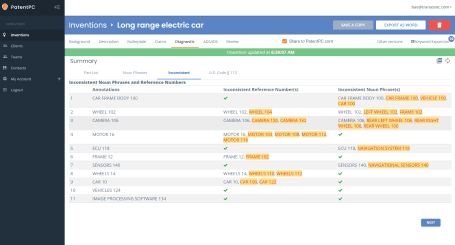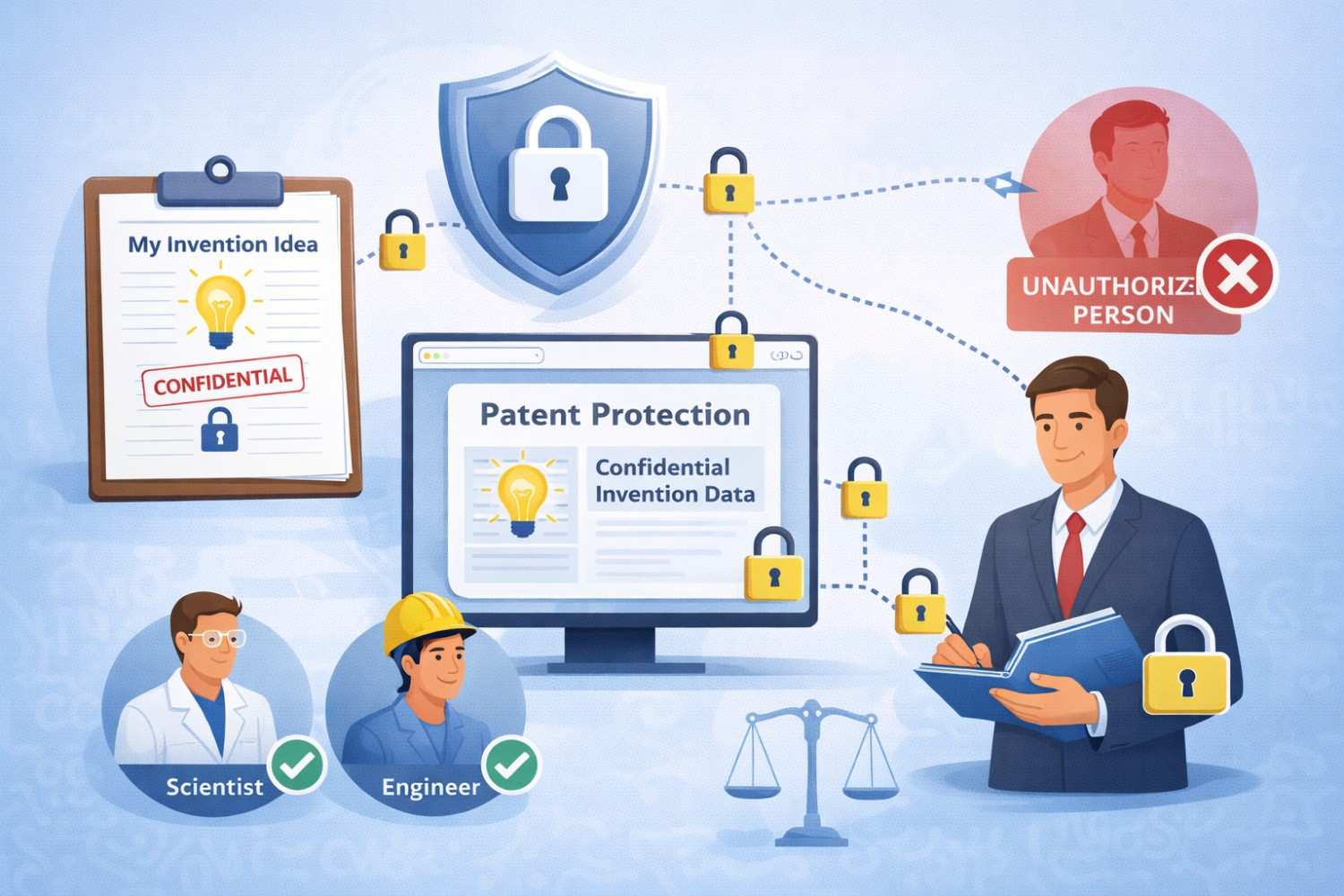
Your invention is valuable the moment it leaves your head. The second you write it down, share it in a form, or send it to a lawyer, it becomes something that must be protected. If your intake process is not secure, your idea is exposed before it even has a patent number. That is why confidentiality in invention intake is not a small detail. It is the foundation. In this article, we will break down exactly how secure forms and access rules should work, what most startups get wrong, and how to build a system that protects your ideas from day one. If you are building something real, you cannot afford to treat this lightly. If you want to see how a modern, secure patent process is built for founders, you can explore it here: https://powerpatent.com/how-it-works.
Why Invention Intake Is the Most Dangerous Moment for Your Idea
This is the stage almost no founder thinks about deeply enough. You are excited. You just built something new. Maybe it is a new model, a new system design, a new hardware layout, or a new way to process data.
You are ready to “start the patent process.” So you open a form, send a deck, or email details to someone. That moment feels small. It is not. It is the first real exposure of your invention.
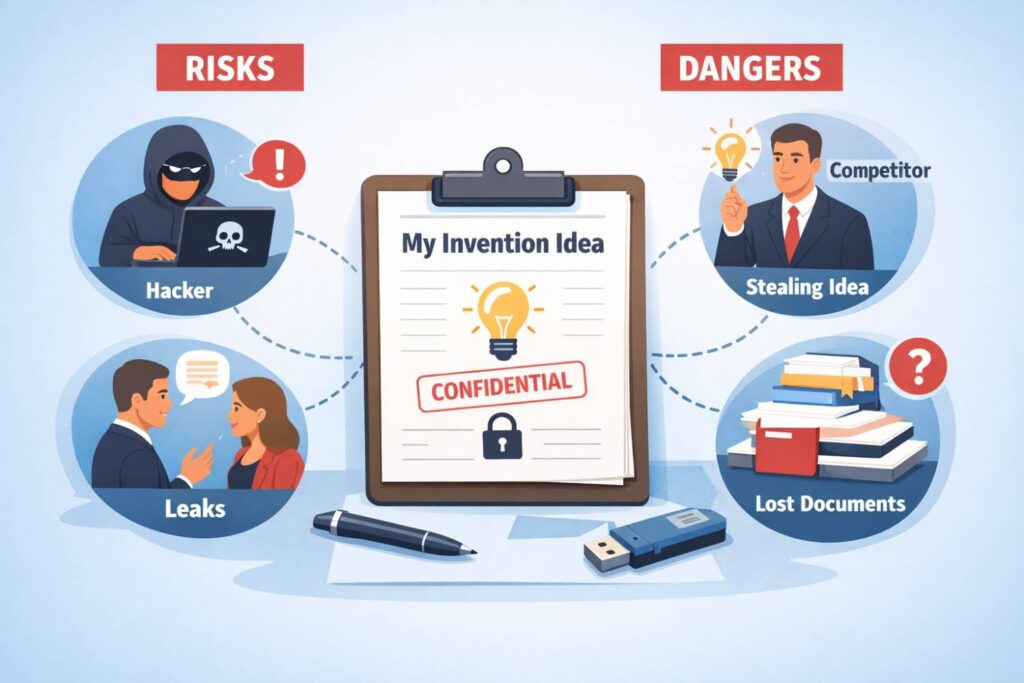
And if that step is loose, rushed, or built on weak systems, you have already created risk before protection even begins.
Invention intake is dangerous because it is when your idea leaves your private brain and enters shared space. That shared space must be controlled with care. If it is not, you are trusting luck instead of building security.
The First Transfer of Sensitive Information
The moment you document your invention, you create a record. That record contains technical details, system logic, architecture, and often business strategy.
It might include source code snippets, diagrams, training data structure, performance metrics, or experimental results. That is not just “background.” That is the crown jewel.
Many startups treat intake like a simple questionnaire. They think it is just a starting point. But from a legal and strategic view, intake is the first formal disclosure.
It sets the baseline for what exists, when it existed, and who had access to it. If the form is unsecured or if access is wide open, you lose control over that baseline.
Actionable advice here is simple but powerful. Before you share any invention details, pause and ask: where is this data stored, who can see it, and how is access logged?

If you cannot answer those three questions clearly, you should not submit a single line of your invention.
Email Is Not a Safe Intake System
A surprising number of early-stage companies still begin patent discussions through long email threads. They attach documents. They paste technical summaries into messages.
They forward chains to co-founders and advisors. Each forward multiplies exposure.
Email was never designed to protect intellectual property. It is easy to forward, easy to misaddress, and often stored across multiple servers and personal devices.
If you send your invention to the wrong contact by mistake, that disclosure cannot be undone.
Instead, founders should insist on secure submission portals with controlled access and encrypted storage. If a patent process begins with “just email me your idea,” that is a warning sign.
A modern system should guide you through a secure form built specifically for invention intake. It should limit who sees your data and create a clear audit trail.
If you want to see what a secure, founder-first intake process looks like, explore how PowerPatent structures it here: https://powerpatent.com/how-it-works.
Early Documentation Shapes Your Legal Position
The intake stage is not just about security. It also shapes the strength of your future patent. What you include, how clearly you explain it, and how it is time-stamped can affect your position later.
If intake forms are vague, unstructured, or rushed, you may leave out key variations of your invention. That gap can weaken your claims. If access rules are sloppy, you may later struggle to prove who contributed what.
Strategically, treat intake as a controlled capture of innovation. Do not think of it as “filling out paperwork.”
Think of it as freezing your invention in time. The system you use should encourage depth, not shortcuts. It should guide you to explain not only what your invention does, but how it works internally and why it is different.
A secure intake system should also record submission dates and maintain version history. This protects you if there is ever a dispute over timing or authorship. Without this structure, you are relying on scattered documents and memory.
The Risk of Over-Sharing Inside Your Own Team
Founders often focus on external leaks but forget internal ones. During intake, invention details may be shared across Slack channels, project boards, or shared drives.
The assumption is that everyone on the team can be trusted. Trust is important. But access should still be limited.
Not every employee needs full visibility into every invention. The more people who can access detailed intake documents, the greater the chance of accidental disclosure.
Someone may reuse a diagram in a public deck. Someone may copy a section into an investor update. These mistakes are rarely malicious. They are casual. And casual mistakes are common.
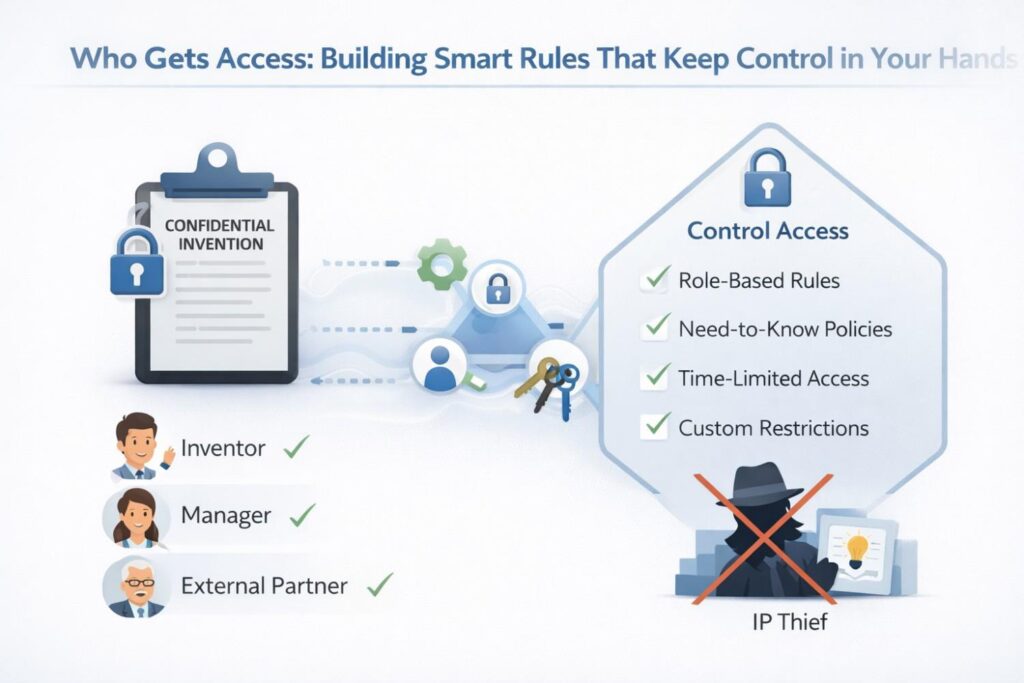
Smart access rules solve this. Access should be role-based. Only inventors, selected leadership, and designated legal reviewers should see full invention intake details. Others may see high-level summaries, but not deep technical descriptions.
If your current process allows anyone with a company email to open your invention documents, that is not a system. That is exposure.
Investor Conversations Can Create Hidden Exposure
Another dangerous intake moment happens when founders prepare to speak with investors. They often draft invention summaries to explain their edge.
Those summaries sometimes become the first written version of the invention. If those documents are not marked confidential or shared under proper agreements, you may create unnecessary risk.
A strong intake system should separate internal patent documentation from pitch materials.
Patent intake should live in a secure environment, not in a shared pitch folder. Investors do not need your full technical details. They need proof of progress and vision.
Before any investor conversation, ask yourself whether your invention has been documented securely and whether a patent strategy is in motion. If not, you are exposing your advantage without protection.
Contractors and Advisors Add Complexity
Startups move fast. You bring in contractors, machine learning experts, hardware designers, or fractional CTOs. They may contribute ideas during brainstorming sessions.
If those ideas are captured loosely in shared docs without clear intake rules, ownership can become messy.
Confidentiality in intake also means clarity around contributors. Your intake system should require clear identification of inventors and contributors at the moment of submission. It should capture who created what and when.
This is not about distrust. It is about precision. Clean records prevent future disputes. They also make attorney review smoother and faster.
Before giving contractors access to invention intake forms, ensure agreements are signed and access is time-limited. When their engagement ends, their access should end as well. Secure systems allow this. Casual systems do not.
Public Disclosures Happen Faster Than You Think
In fast-moving industries like AI, robotics, biotech, and deep tech, founders often publish blog posts, demos, or conference talks early to build credibility.
If intake is not handled first, you may publicly disclose key elements before filing protection.
The most dangerous version of this is when your marketing team does not know what is confidential. They may highlight technical breakthroughs that should have been captured in a patent application first.
A secure intake process should create internal alignment. Once an invention is submitted, the company should know it is sensitive. There should be clear rules around public discussion until legal review is complete.
If your intake system does not connect to your broader communication strategy, you are creating gaps.
Speed Without Structure Is Not a Competitive Advantage
Founders pride themselves on speed. But speed without structure creates weak foundations. If intake is rushed, informal, and scattered across tools, you are not being agile. You are being careless.
True speed comes from having a repeatable, secure system. A structured intake form that guides inventors through key questions actually accelerates patent drafting.
Controlled access reduces back-and-forth. Secure storage avoids later cleanup.
The goal is not to slow down innovation. The goal is to protect it while you move fast.
Modern platforms combine smart software with real attorney oversight to ensure that what you submit is both secure and strategically strong.
If you want to understand how that balance works in practice, take a close look here: https://powerpatent.com/how-it-works.
Build Confidentiality Into Your Culture
Finally, the most overlooked part of intake security is culture. Systems matter. Software matters. Access rules matter. But culture decides whether people follow them.
From day one, founders should treat invention details as assets. New hires should understand that technical ideas are confidential by default. Brainstorm sessions should have clear rules about documentation and storage.
No one should casually paste system architecture into random tools.
You do not need to create fear. You need to create awareness. When confidentiality is normal, intake becomes naturally secure.
Invention intake is the most dangerous moment for your idea because it is the first doorway between private innovation and shared knowledge. If that doorway is wide open, you are exposed.
If it is guarded with secure forms, tight access rules, and thoughtful process, you turn risk into strength.
How Secure Forms Protect Your Startup from Silent IP Leaks
Most IP leaks do not look dramatic. There is no hacker. No alert. No headline. Instead, they happen quietly. A document is copied. A link is shared. A form is stored in the wrong place.
Months later, you realize sensitive details traveled farther than you intended. By then, you cannot pull them back.
This is why secure forms matter more than most founders realize. They are not just “a way to collect info.” They are the first wall around your invention. If that wall is weak, everything built after it stands on shaky ground.
The Hidden Problem with Generic Forms
It is common for startups to use general tools to collect invention details. Shared docs. Basic survey tools. Internal wiki pages. Even project management boards.
These tools are easy. They are familiar. But they were not built for protecting high-value intellectual property.
Generic forms often lack strict permission controls. Anyone with the link can view or edit. Sometimes the link is public by default. Sometimes it is indexed by mistake.
A founder may believe the form is private simply because it is not widely advertised. That belief can be wrong.
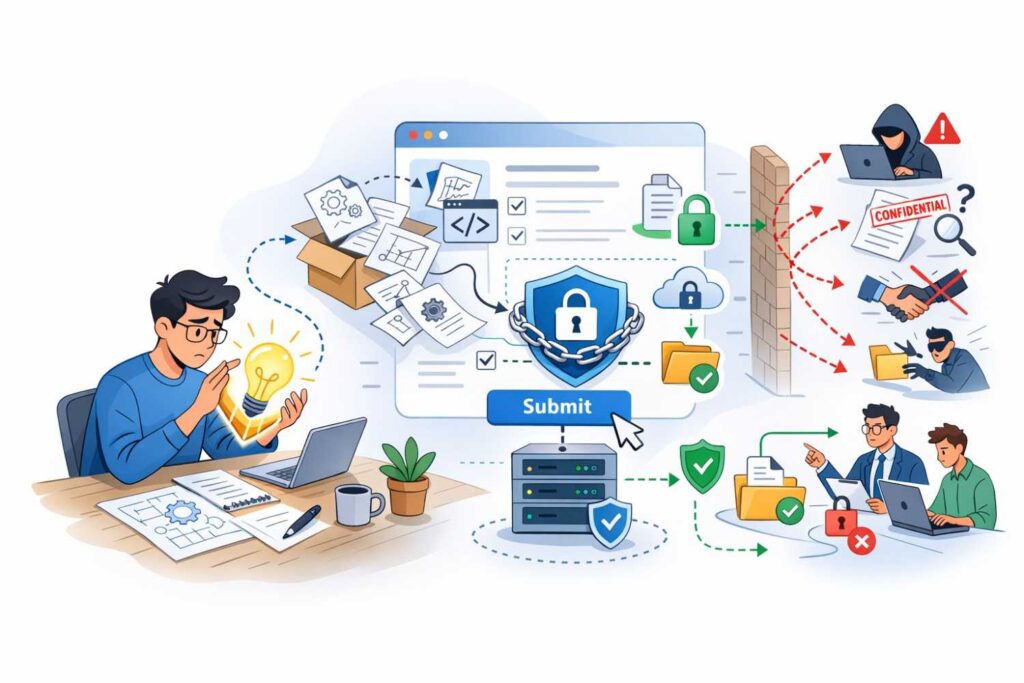
A secure invention intake form must be intentionally designed for confidentiality. It should require verified login access.
It should restrict who can open it. It should prevent downloading or copying without permission. It should track who views or edits the submission.
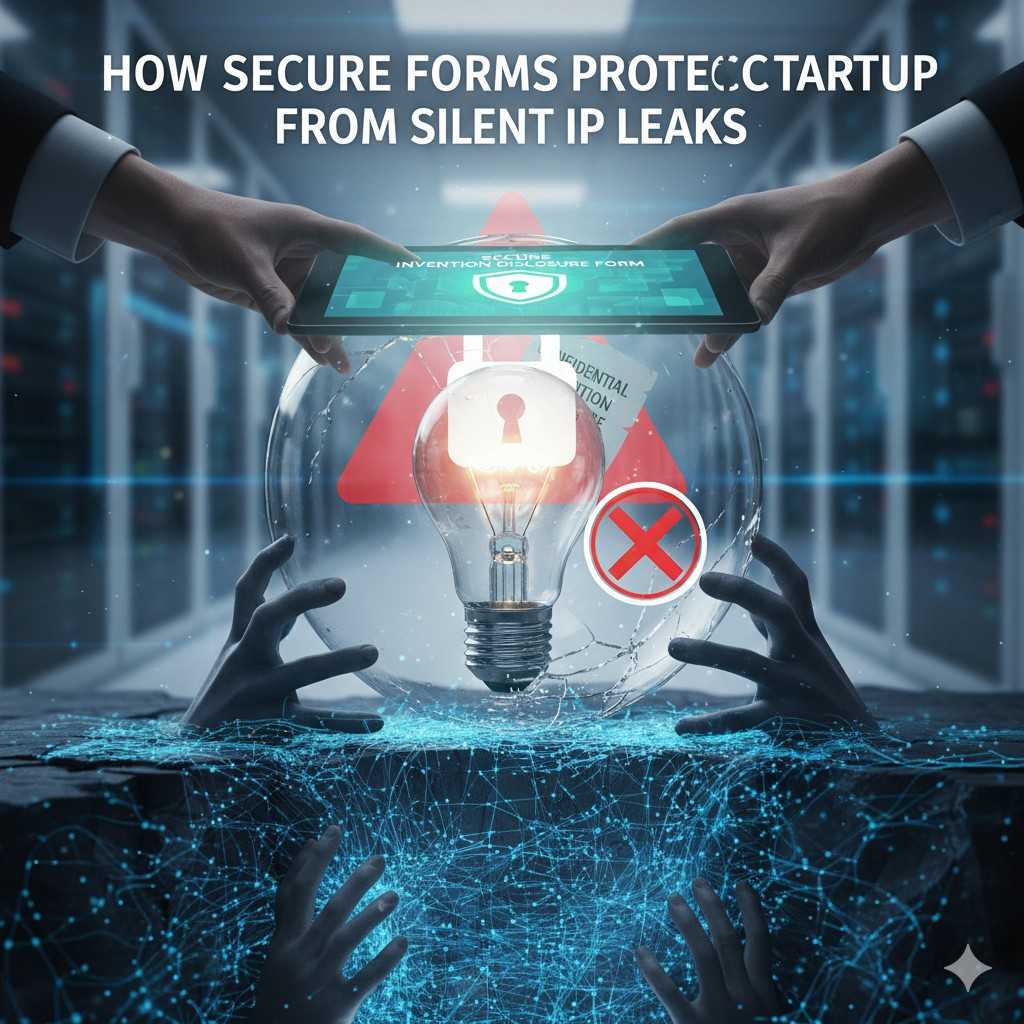
If your current intake process relies on “we trust our tools,” that is not protection. That is hope.
Silent Leaks Start with Small Oversights
IP leaks often begin with tiny decisions. Someone enables link sharing “just for convenience.”
A draft is duplicated into a less secure workspace. A contractor keeps a copy after their contract ends. Each step feels harmless. Together, they create exposure.
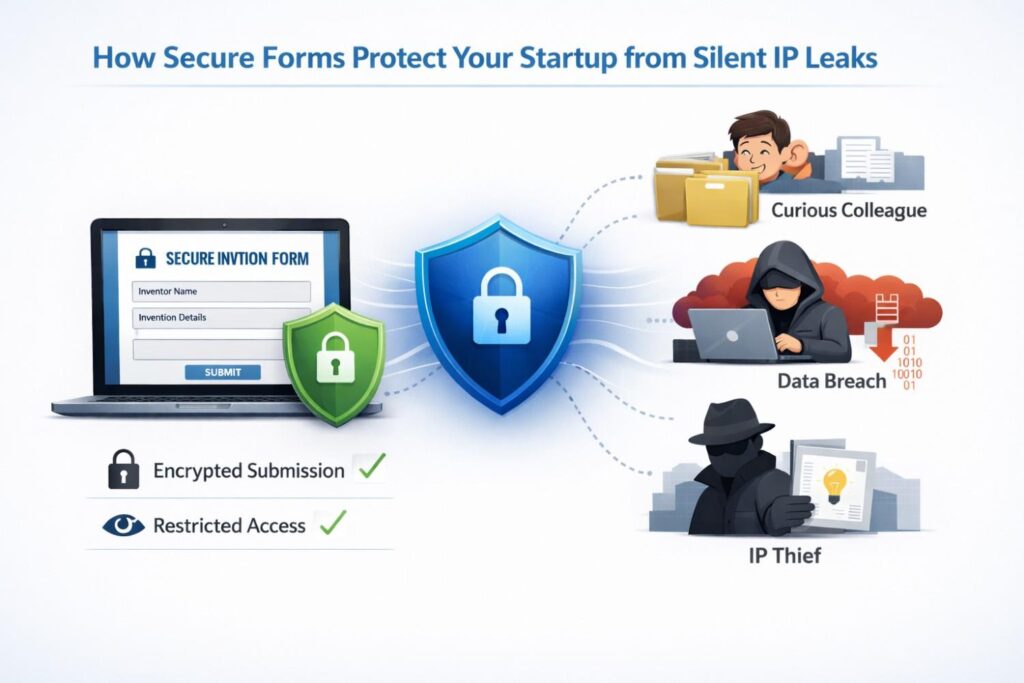
Secure forms reduce these risks because they limit what is possible. They do not allow open link sharing.
They enforce controlled access. They centralize sensitive information in one protected environment instead of spreading it across random tools.
When you design your intake system, assume mistakes will happen. Build guardrails that prevent those mistakes from turning into real damage.
A practical move you can make right now is to audit where your invention details live. Are they in Slack threads? Personal Google Docs? Email attachments?
If so, consolidate them into a single secure platform. The fewer places your invention exists, the lower your risk.
Encryption Is Not Optional
Many founders assume that because a tool is “cloud-based,” it must be secure. That is not always true. Secure forms should use strong encryption both when data is sent and when it is stored.
This ensures that even if systems are accessed improperly, the information remains unreadable without proper keys.
You do not need to become a security engineer. But you should ask clear questions. Is the data encrypted at rest? Is it encrypted in transit? Who manages the servers? Are backups protected?
If the answers are vague, that is a red flag.
Modern patent platforms built for serious startups treat encryption as a baseline, not a bonus feature. They understand that invention intake is not casual data. It is strategic capital.
If you want to see how a secure, encrypted system built for founders actually works, you can explore it here: https://powerpatent.com/how-it-works.
Controlled Access Reduces Internal Risk
Most founders think about external threats. In reality, internal sprawl is often the bigger issue. As your team grows, more people gain access to shared drives and tools. Permissions get messy.
Old accounts remain active. Former employees may still have access without anyone noticing.
Secure forms should operate with tight access control. That means only specific roles can submit, view, or edit invention details. Access should not be broad by default. It should be granted intentionally.
When someone leaves the company, their access should automatically end. When a contractor finishes a project, their permissions should be removed. These are simple rules, but they prevent serious future problems.
It is wise to assign one person or small group as gatekeepers for invention intake. They manage permissions. They review submissions. They ensure that nothing sensitive escapes into less secure systems.
Audit Trails Create Accountability
A secure form should not only restrict access. It should record activity. Who submitted the invention. When it was submitted. Who viewed it. Who made changes. These logs matter.
If there is ever confusion about ownership or timing, audit trails provide clarity. If there is suspicion of a leak, you can trace activity. Without this record, you are guessing.
For businesses raising capital or planning acquisition, this documentation becomes even more important. Investors and acquirers want to see clean IP ownership and process discipline.
A structured intake system with logs shows maturity. It signals that you treat your assets seriously.
Think of audit trails as insurance. You hope you never need them. But if you do, they protect you.
Secure Forms Encourage Better Invention Capture
Security is not only about blocking leaks. It is also about improving quality. When inventors use a structured, secure intake form, they are guided to provide deeper detail.
The system can prompt them to explain variations, edge cases, and alternative implementations.
This structured capture strengthens your patent strategy. It prevents important details from being forgotten or scattered across conversations. Everything lives in one protected record.
When intake is messy, invention details often remain half-documented. Weeks later, people struggle to remember key design decisions. Secure, structured forms reduce this friction.
The result is not only stronger confidentiality. It is stronger patents.
Avoiding Shadow Documentation
One of the biggest risks in growing startups is shadow documentation. This happens when teams create side documents outside the official intake system. They may believe the main system is too slow or too formal.
So they create their own version.
Shadow documentation breaks security. It spreads invention details into uncontrolled spaces. It creates multiple “truths” about what the invention is.
To prevent this, your official intake process must be both secure and easy. If it feels painful or outdated, people will bypass it. A modern platform should make submission simple while still maintaining strict controls.
When the secure option is also the easiest option, compliance becomes natural.
Preparing for Legal Scrutiny
At some point, your invention may face scrutiny. A competitor may challenge your patent. An investor may conduct due diligence. An acquirer may review your IP chain of title. In these moments, your intake process will be examined.
If you cannot show a clear, secure record of how inventions were captured and protected, confidence drops. Questions arise. Deals slow down.
Secure forms protect you not just from leaks, but from doubt. They show that you handled your ideas responsibly from the start.
This is why platforms that combine secure software with real attorney oversight create such a strong advantage. You are not just storing information safely. You are aligning security with legal strategy.
PowerPatent was built with this exact understanding. It gives founders secure intake tools backed by real patent attorneys who review and guide the process.
If you are serious about protecting what you are building, you can see how it works here: https://powerpatent.com/how-it-works.
Security as a Competitive Edge
Most startups focus on building faster than competitors. Few focus on protecting better than competitors. But strong confidentiality during intake can become a real advantage.
When your team knows their work is captured securely, they share more freely inside the protected system. When investors see disciplined IP handling, they gain trust.
When acquirers review your company, clean records speed up deals.
Security does not slow innovation. It supports it.
Silent IP leaks are dangerous because they often go unnoticed until damage is done. Secure forms act as a shield at the most vulnerable stage of your invention’s life.
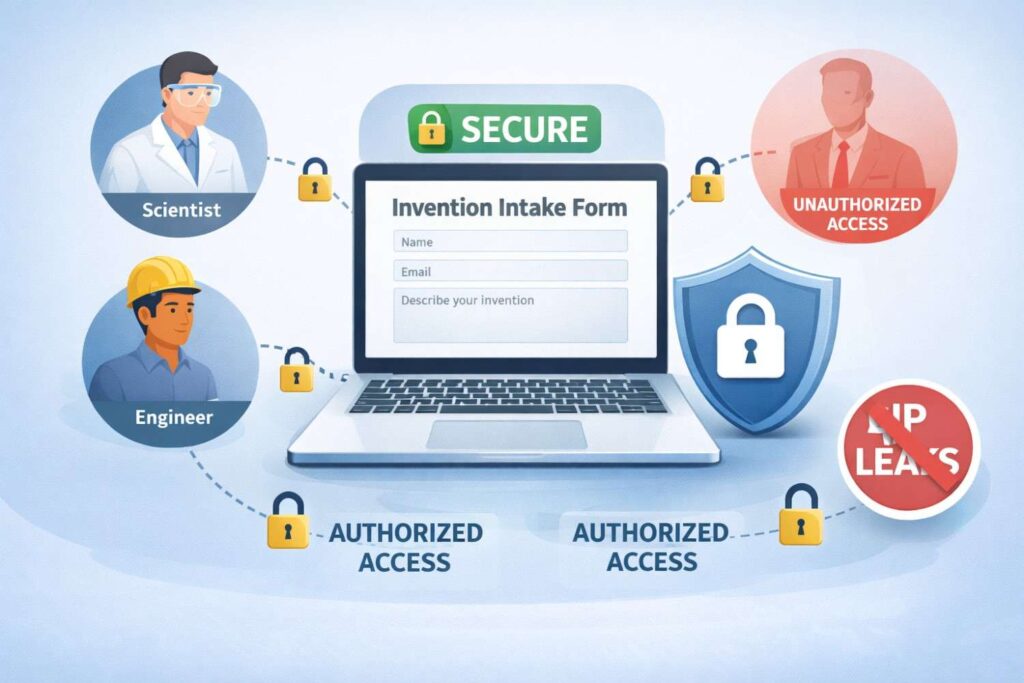
They reduce risk, increase clarity, and build long-term strength.
Who Gets Access: Building Smart Rules That Keep Control in Your Hands
Confidentiality is not only about secure forms. It is about people. The real question every startup must answer is simple: who gets to see your invention, and why?
If that answer is vague, your control is weak. If that answer is clear, written, and enforced by your system, your invention stays protected.
Access is power. The more people who can open, edit, or download your invention intake documents, the less control you truly have. Smart companies understand this early.
They design access rules before problems happen, not after.
Access Should Be Earned, Not Assumed
In many startups, access grows by default. A new hire joins and is added to shared folders. A contractor comes on board and receives broad permissions “just in case.” Over time, dozens of people can view sensitive invention details without anyone realizing it.
This is not intentional. It happens because no one stops to define access rules.
The better approach is to treat invention access as something that must be justified. Every person who can see detailed technical submissions should have a clear reason tied to their role.

If they are not directly involved in inventing, reviewing, or protecting the technology, they likely do not need full visibility.
This mindset alone changes everything. Instead of asking, “Why not give access?” you begin asking, “Why should they have access?”
Separate Inventors from Observers
Not everyone in your company plays the same role in innovation. Some create. Some manage. Some sell. Some market. While all roles matter, they do not all require deep technical visibility.
Your access system should reflect this.
Inventors and core technical leaders may need full access to invention intake records. Legal reviewers need access for evaluation. But marketing teams do not need raw system architecture details.
Sales teams do not need experimental data logs. Investors do not need internal drafts.
By separating inventors from observers, you reduce unnecessary exposure. You also reduce confusion. Fewer people editing or commenting on sensitive documents means fewer errors and fewer accidental disclosures.
A secure platform should allow you to define these layers clearly. It should make it easy to grant limited visibility without exposing the entire invention record.
If you want to see how a structured, founder-first system handles controlled access while keeping real attorneys in the loop, you can review it here: https://powerpatent.com/how-it-works.
Time-Based Access Prevents Lingering Risk
Access should not last forever.
One of the most common mistakes startups make is forgetting to remove permissions after a project ends.
A contractor who helped prototype an early version of your system may still have access months later. A former employee may still be able to log into shared tools.
This creates silent, ongoing risk.
Smart access rules include time limits. When someone’s role ends, their access ends. When a project phase closes, permissions are reviewed. This does not require drama. It requires discipline.
You can build this into your workflow. Each quarter, review who has access to invention intake documents. Ask whether each person still needs it. Remove access where it no longer makes sense.
It may feel small. It is not. Over time, this habit dramatically reduces exposure.
Limit Editing Rights Even Further
Viewing and editing are not the same. Too often, they are treated as equal.
Editing rights should be extremely limited. Only designated inventors and approved reviewers should be able to change invention intake records. This protects the integrity of your documentation.
If multiple people casually update the same record, key details may be overwritten. Version history becomes messy. Ownership can become unclear.
A strong system preserves the original submission and tracks every revision. It should never allow silent edits. Transparency inside the secure system builds confidence outside of it.
Before you expand editing rights, ask yourself what problem you are solving. If the goal is collaboration, consider structured comments instead of open editing. This keeps control centralized while still allowing input.
Leadership Should Model Confidential Behavior
Access rules do not work if leadership ignores them.
Founders often bypass systems because they feel urgent. They download documents to personal devices. They forward invention summaries through private email. They share drafts casually in meetings.
When leadership treats confidentiality lightly, the team will do the same.
Instead, founders must model discipline. Use the secure intake platform consistently. Avoid copying sensitive details into unsecured tools. Encourage the team to submit ideas through official channels.
Culture flows from the top. If you show that invention access is controlled and respected, others will follow.
Avoid “Open by Default” Settings
Many modern tools are designed for collaboration. That means they default to openness. Shared folders. Open comments. Broad permissions. These features are useful for general work. They are dangerous for invention intake.
Your secure invention environment should default to closed access. Permissions should be granted intentionally, not automatically.
This is especially important as your company grows. Early-stage startups may have five people who all know everything. At twenty people, that approach starts to crack. At fifty, it becomes risky.
Design your access model today for the company you plan to become, not just the company you are now.
Align Access with Legal Strategy
Access rules are not only about internal order. They connect directly to your legal strength.
If there is ever a dispute about inventorship, contribution, or ownership, clean access records help. They show who had visibility and when. They support your claim that sensitive details were handled carefully.
When platforms combine secure software with real attorney oversight, this alignment becomes powerful.
Attorneys can review intake submissions within the same protected environment, reducing unnecessary sharing and strengthening your legal position.
This is not about adding friction. It is about adding confidence.
PowerPatent was built with this exact balance in mind. Founders get a secure, structured intake system. Real patent attorneys review and guide the process within that controlled space.
The result is speed without chaos and protection without complexity. You can explore how that works here: https://powerpatent.com/how-it-works.
Control Is a Strategic Asset
Many founders think of access rules as administrative details. In reality, they are strategic assets.
When you control who sees your invention, you control its narrative. You decide when it becomes public. You decide how it is presented. You decide how it evolves.
Loose access erodes that control. Tight, thoughtful access preserves it.
Your invention is not just a feature. It is leverage. It can influence valuation, partnerships, and market position. Protecting access to it is not paranoia. It is leadership.
The goal is simple. Only the right people see the right information at the right time. No more. No less.
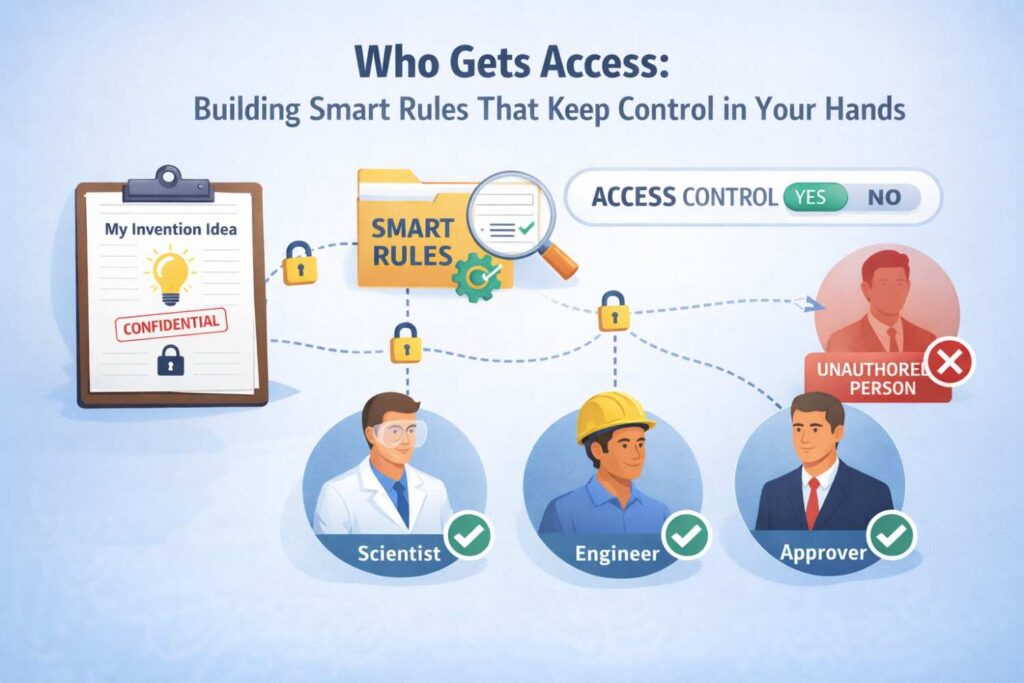
When you build access rules that are clear, enforced by secure systems, and aligned with legal guidance, you keep control where it belongs: in your hands.
How Modern Patent Platforms Combine Software and Real Attorneys to Lock It All Down
Security alone is not enough. Legal advice alone is not enough. If you rely only on software, you may move fast but miss key strategy. If you rely only on traditional law firms, you may get expertise but lose speed and control.
The real power comes when both work together inside one secure system.
That is what modern patent platforms do differently. They do not treat invention intake as a pile of emails passed to a law office.
They build a controlled environment where software handles structure and security, while real attorneys guide legal strength. This combination locks down your ideas from both a technical and legal angle.
Software Creates Structure from Day One
When a founder begins the patent process inside a modern platform, the experience feels guided. The system does not just ask, “Describe your invention.”
It walks you through focused questions that help capture depth. It prompts you to explain variations, edge cases, and real-world use.
This structure does two critical things.
First, it improves quality. Founders often underestimate what details matter. Smart forms pull out information that might otherwise be forgotten.
Second, it improves security. Every answer lives inside a protected environment. It is encrypted. It is time-stamped. It is stored in a central system designed specifically for confidential invention data.

Instead of scattered drafts across drives and inboxes, everything is captured in one controlled place. That is the foundation.
If you want to see how a secure, guided intake system works in practice, you can explore it here: https://powerpatent.com/how-it-works.
Real Attorneys Add Strategic Depth
Software can organize information. It cannot replace legal judgment.
A strong patent is not just a description of what you built. It is a strategic document designed to create defensible space around your invention. That requires human expertise.
When real patent attorneys review your intake inside the same secure platform, they can see the full technical context without risky back-and-forth over email. They can ask targeted follow-up questions.
They can identify where your claims should be broad and where they must be precise.
This collaboration happens inside the secure system, not across unsecured channels. That keeps confidentiality tight while improving legal quality.
The result is not just a patent filing. It is a well-shaped legal asset designed for protection, licensing, or acquisition.
One System Reduces Friction and Risk
Traditional patent workflows are fragmented. Founders draft summaries in one place. They send files through email. Attorneys revise documents in separate systems. Versions get passed around. Comments get lost.
Every handoff increases risk.
Modern platforms eliminate these gaps. Intake, review, revision, and filing preparation happen within one environment. Access is controlled at each stage. Only the right people see the right documents.
Because everything lives in one place, there are fewer chances for accidental sharing. There are fewer duplicate files floating around. There is less confusion about which version is final.
This reduces not only security risk but also mental load. Founders can focus on building while the platform maintains order.
Built-In Audit Trails Strengthen Your Position
When software and attorneys work together in a unified system, documentation becomes stronger.
Every submission is time-stamped. Every edit is recorded. Every review is logged. This creates a clear history of your invention’s development and protection process.
If you ever face due diligence from investors, this history becomes powerful proof. It shows discipline. It shows care. It shows that your company treats intellectual property seriously.
If a competitor challenges your patent, clean records can support your claims of originality and timing.
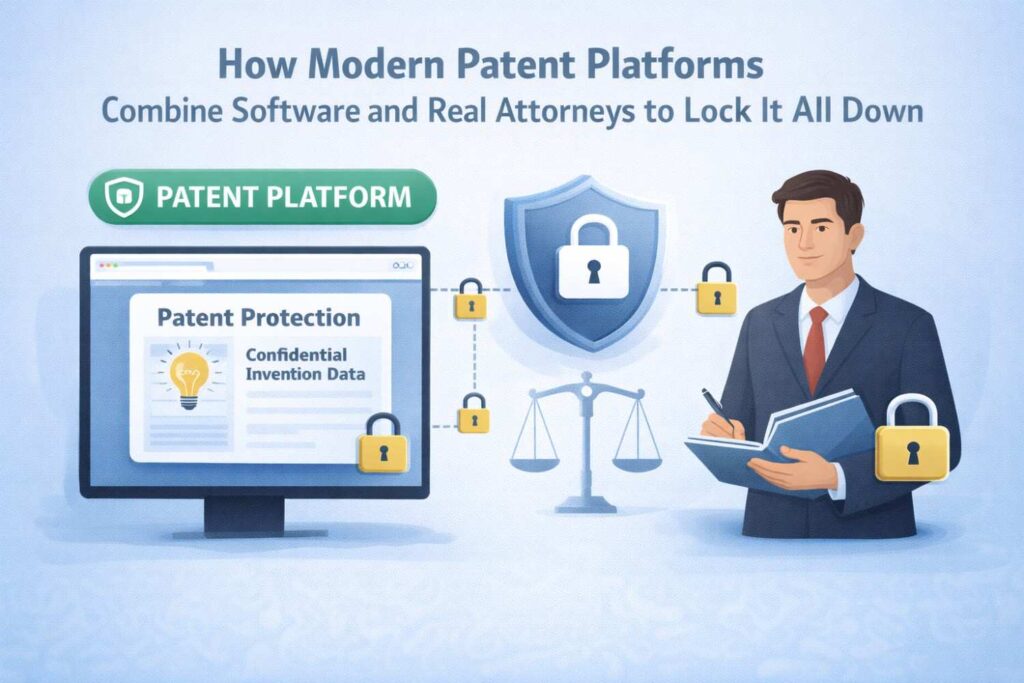
This level of documentation is difficult to achieve with scattered tools and email chains. It becomes natural when everything runs through a structured platform.
Secure Collaboration Speeds Up Filing
Many founders worry that adding structure will slow them down. In reality, it often does the opposite.
When attorneys can review well-organized, securely captured invention details, they spend less time chasing missing information.
When communication happens inside the platform, there is less confusion and fewer lost threads.
Secure collaboration becomes efficient collaboration.
Founders get clarity faster. Drafts move more smoothly. Filing timelines shrink without cutting corners.
This is especially important in fast-moving fields like AI, robotics, biotech, and deep tech, where delays can mean losing ground to competitors.
Control Stays with the Founder
One of the biggest frustrations founders have with traditional patent firms is loss of visibility. Once documents are sent, the process feels opaque. Updates arrive slowly. It is hard to see where things stand.
Modern platforms shift that balance.
Because the process runs through software, founders can see status updates clearly. They can track progress. They can review drafts in real time. They are not left guessing.
At the same time, access remains controlled. Only authorized team members and designated attorneys can view sensitive materials.
This balance of transparency and restriction gives founders something rare in the patent world: control without chaos.
PowerPatent was built around this principle. Secure software captures and protects your invention. Real patent attorneys review and guide strategy.
The system is designed for speed, clarity, and strong protection without the old-school friction. If you are serious about locking down your ideas the right way, you can see exactly how it works here: https://powerpatent.com/how-it-works.
Confidentiality Becomes a Competitive Advantage
When your patent process is secure from intake through filing, you gain more than peace of mind.
You gain leverage.
You can speak to investors with confidence, knowing your invention is properly documented and protected. You can scale your team without fear that sensitive details are spreading unchecked.
You can pursue partnerships knowing that your core ideas are locked down.
Modern patent platforms make this possible because they combine technical safeguards with legal insight. They treat confidentiality not as an afterthought, but as a built-in feature of the entire workflow.
In today’s world, where innovation moves fast and competition is global, that combination is not a luxury. It is a necessity.
Your invention deserves more than a basic form and a long email chain. It deserves a secure system backed by real experts who understand both technology and law.

When software and attorneys work together inside one protected platform, your ideas are not just documented. They are defended.
Wrapping It Up
Your invention is not just code. It is not just a prototype. It is not just an idea. It is leverage. It is future revenue. It is valuation. It is power. And the moment you begin the patent process, that leverage can either grow stronger or become exposed. Confidentiality in invention intake is not a small admin detail. It is the first real move in protecting what you built. If intake is loose, your foundation is weak. If forms are unsecured, silent leaks can happen. If access rules are unclear, control slowly slips away. If attorneys and tools are disconnected, gaps appear.