You built something real. It works. It solves a hard problem. Now you’re thinking about patents—but not just filing one and walking away. You’ve heard words like “continuation” and “parent application,” and now someone is telling you that you might want to keep one and drop the other. That sounds risky. It also sounds confusing. Let’s clear it up fast. This article will show you exactly when it makes sense to keep the continuation and drop the parent—or the other way around—so you protect what matters most without wasting time or money.
Before we go deeper, if you want to see how modern founders handle this without stress, take a quick look at how PowerPatent works:
👉 https://powerpatent.com/how-it-works
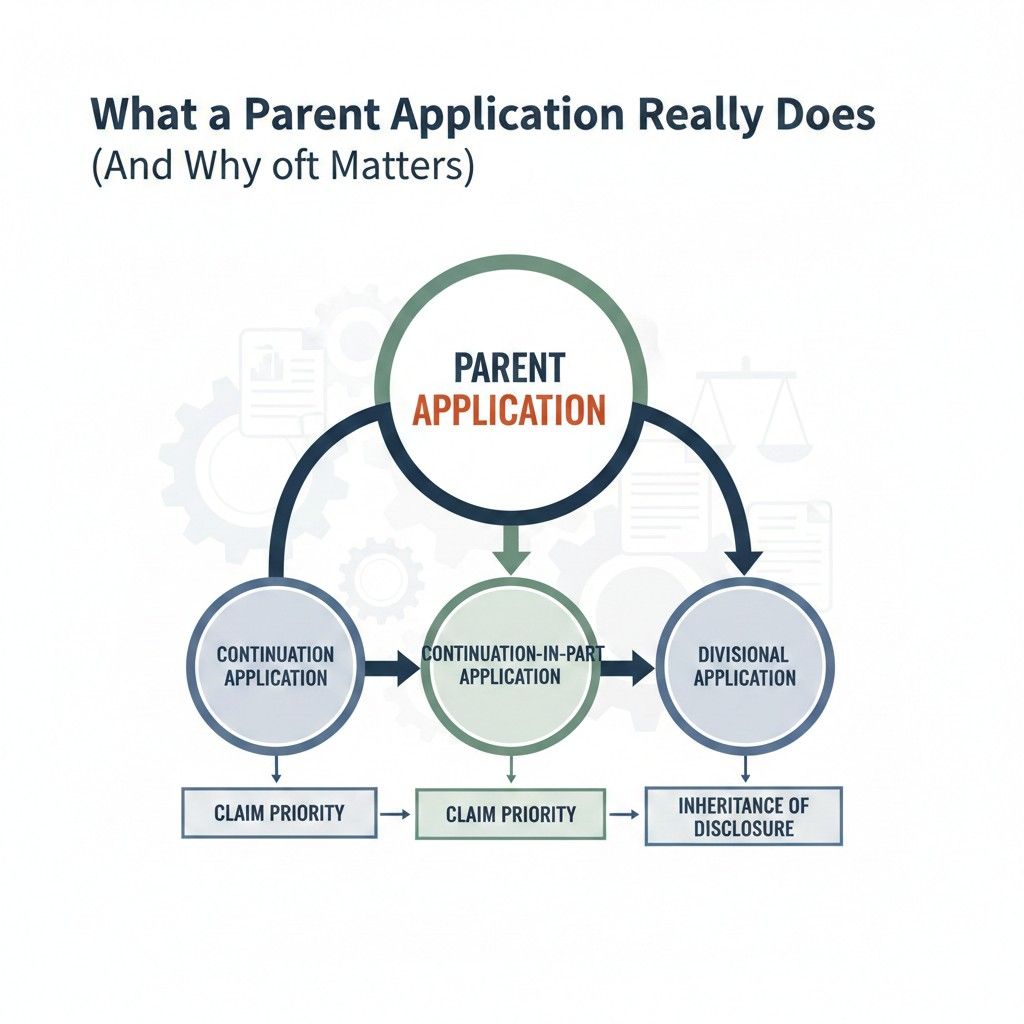
What a Parent Application Really Does (And Why It Matters)
Most founders think the parent patent application is just the first draft. It feels like step one in a long process. File it. Wait. Respond. Move on. But the parent is not just paperwork. It is the root of your patent tree.
Every continuation, every adjustment, every new claim you want later will depend on what you put into that first filing. If you misunderstand the role of the parent, you can lock yourself into a narrow box without even knowing it.
A smart founder treats the parent like a strategic asset, not a one-time form. It shapes your leverage with competitors.
It shapes how investors see your defensibility. It shapes how flexible you can be as your product changes. Let’s unpack what it really does for your business and how to use it the right way.
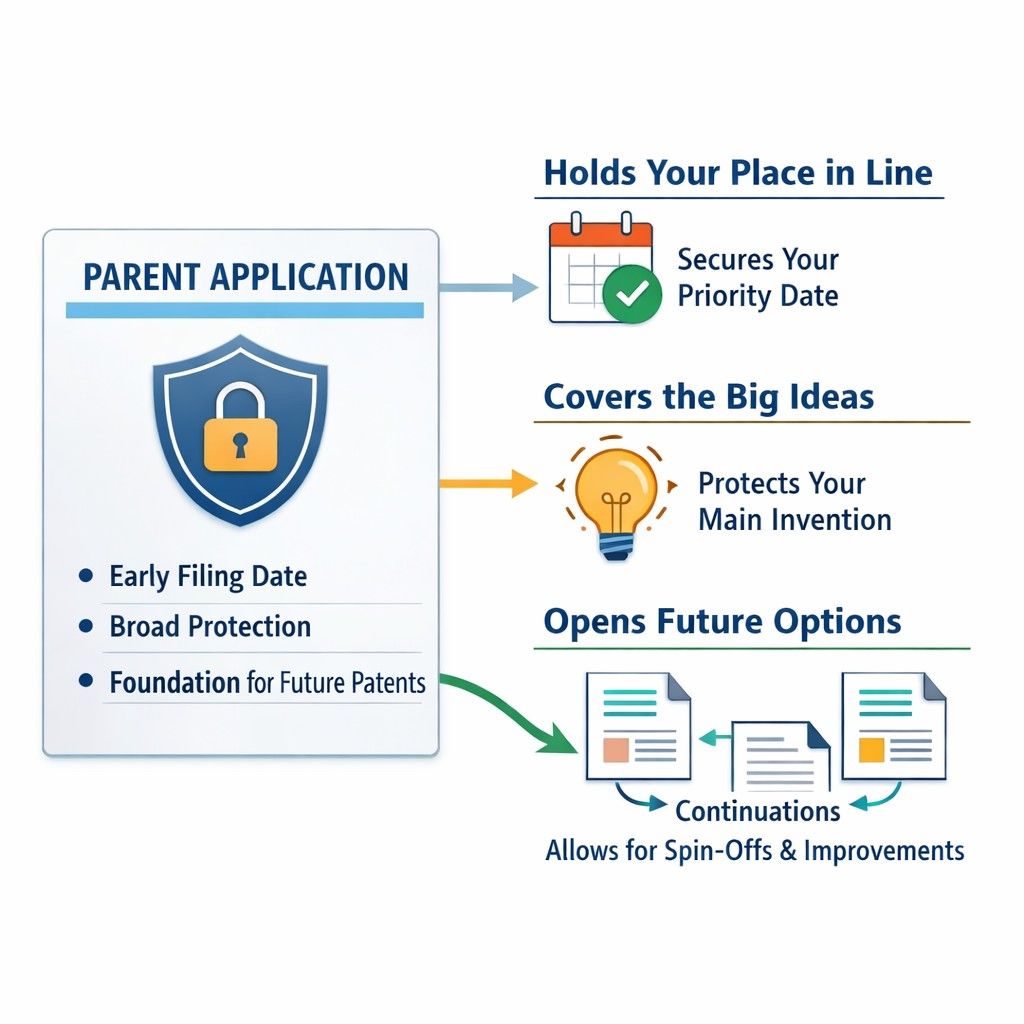
The Parent Sets Your Priority Date
Your priority date is your time stamp. It says, “We had this idea on this day.” That date can become the most valuable line in your entire patent strategy.
When you file a parent application, you lock in that date for everything that is fully described inside it.
That means if a competitor files something similar after your parent filing date, you are ahead. Even if they move fast. Even if they raise more money. Even if they launch sooner.
But here is where founders get tripped up. The parent only protects what is clearly written and supported. If your parent is thin, vague, or rushed, your priority date becomes weak.
You cannot later add new ideas and claim that old date unless the original filing truly supports them.
Actionable advice here is simple. Before filing a parent, think one year ahead. Ask yourself what features you might add. What new use cases could appear? What data improvements might change how your system works?
If it is even remotely possible, make sure it is described in the parent. You are not just protecting today’s version. You are protecting tomorrow’s roadmap.
If you want to see how modern startups draft parents that leave room to grow, you can explore the approach here: https://powerpatent.com/how-it-works
The Parent Defines the Playing Field
The parent application defines the story of your invention. It tells the world what problem you solve and how you solve it. That story becomes the base for everything that follows.
When examiners review your application, they use your parent as the starting point. When investors review your IP, they look at the parent to judge strength.
When competitors study your portfolio, they read the parent to see where you are strong and where you are weak.
This is why a parent should not be written as narrowly as your current product demo. It should describe the full concept. The broader system. The variations. The technical edge that makes your approach different.
For example, if you built an AI system that ranks job candidates, do not only describe your exact current model.
Describe the data sources, the scoring logic, the training method, the interface layer, and alternative ranking signals. Think like someone trying to design around you. Then close those doors before they even try.
The Parent Controls Future Continuations
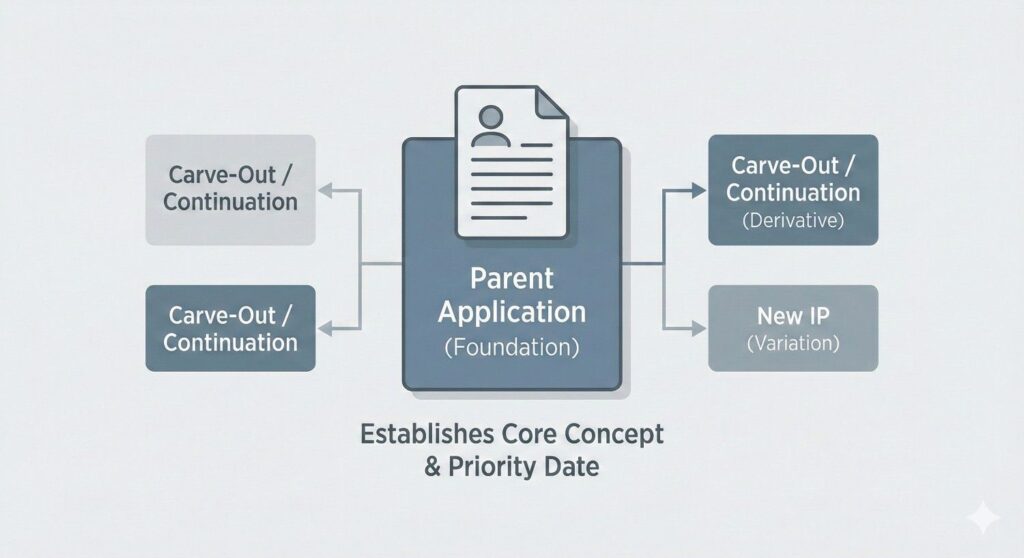
A continuation application is built on the parent. It uses the same written description but allows you to pursue different claim angles. That means the power of your continuation depends fully on how strong your parent is.
If your parent was drafted with depth and foresight, you can file continuations years later that target new competitors or new features without losing your early priority date. If your parent was rushed and shallow, your continuation options shrink fast.
Here is a strategic way to think about it. The parent is not just about getting one patent allowed.
It is about creating a platform for multiple patents. A well-written parent can support several continuations, each focused on a different angle of your invention.
You might have one continuation aimed at your core algorithm. Another aimed at your user interface. Another aimed at a specific industry use case. All built from the same root.
That flexibility only exists if the parent is drafted with intention. That is why working with real attorneys who understand deep tech matters.
Smart software can help you move faster, but oversight ensures your parent is built for long-term leverage, not short-term approval.
The Parent Impacts How You Negotiate
Patents are not just defensive tools. They are negotiation tools. If you ever raise capital, sell your company, or enter a partnership, your parent application will be examined closely.
Investors want to know if your IP creates a real barrier. Acquirers want to know if your patent coverage blocks others from copying your key advantage. Large companies want to know if they can design around you easily.
If your parent is narrow, it limits your negotiation power. If it is broad but well-supported, it increases your leverage.
A tactical move for founders is to align the parent’s scope with your long-term business model. If you plan to license your technology across industries, draft the parent to cover multiple sectors from the start.
If you plan to focus deeply on one vertical, ensure that vertical is described in detail so competitors cannot slip in with small tweaks.
Your patent strategy should mirror your business strategy. The parent is where that alignment begins.
The Parent Can Be a Strategic Shield
Many founders think patents are about suing people. In reality, they are often about preventing problems before they start.
When competitors see a well-written parent application with broad coverage, they may choose a different path. They may pivot their design. They may avoid your space. That silent deterrence is powerful.
But that only works if the parent clearly shows technical depth. If it reads like a marketing brochure, it will not scare anyone.
If it lays out system architecture, variations, performance improvements, and technical advantages, it signals seriousness.
A good question to ask before filing is this: if a smart competitor reads this parent application, will they think twice before copying us? If the answer is no, you may need to strengthen it.
The Parent Shapes Examination Strategy
Patent examination can take years. During that time, markets change. Products evolve. Competitors enter. The parent application becomes your anchor during that process.
If the parent is written with layered disclosure, you can adjust your claim strategy during examination. You can narrow, shift focus, or pursue different embodiments without losing your foundation.
If the parent is thin, you may be forced to accept narrow claims just to get something allowed. That might look good on paper but offer little real-world protection.
A practical step here is to think in terms of fallback positions. Even if your broadest claims are rejected, does the parent support narrower versions that still matter commercially?
Does it describe alternative methods that could still block competitors?
This is where thoughtful drafting pays off. It gives you room to maneuver instead of backing you into a corner.
The Parent Determines What You Can Safely Drop
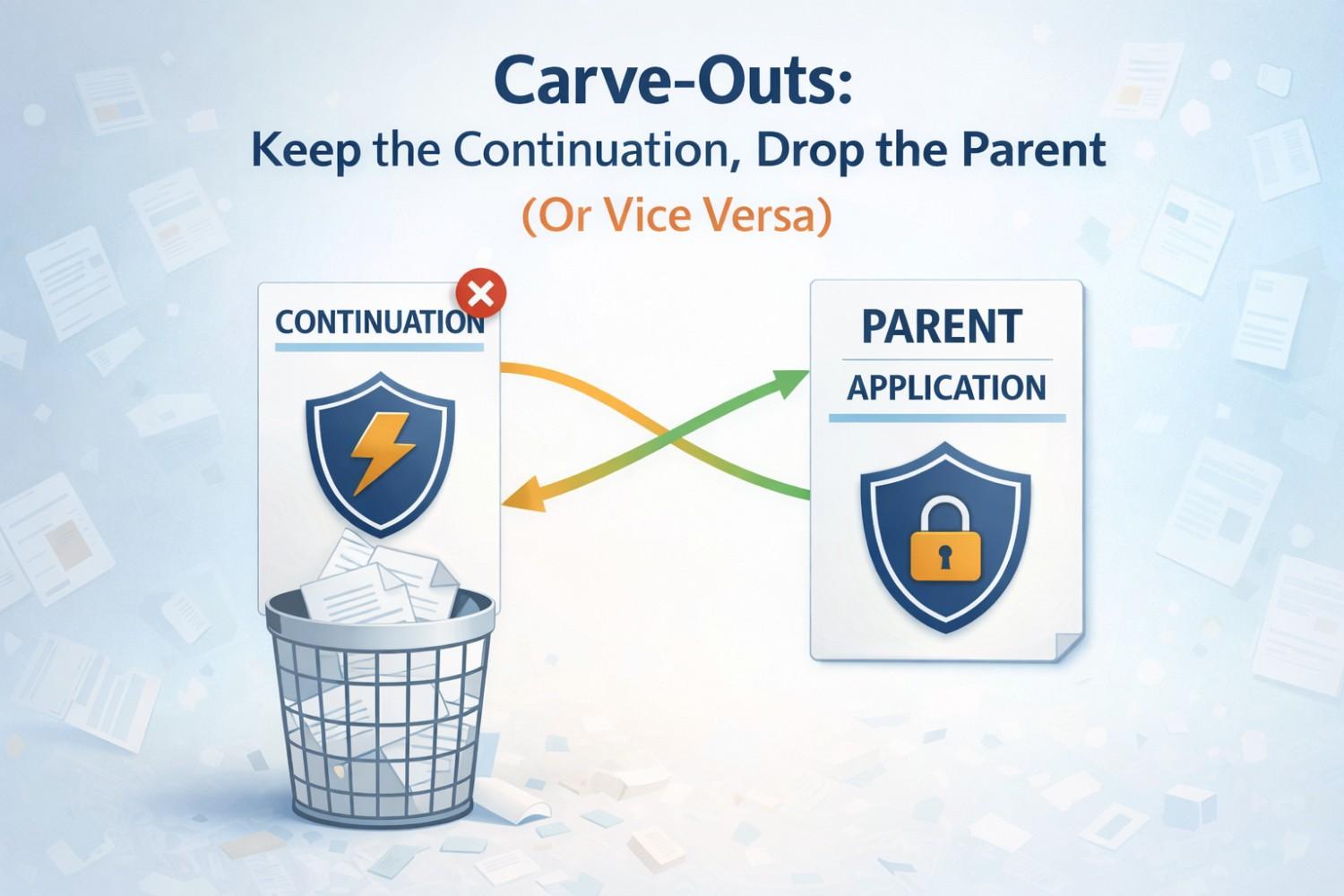
In a carve-out situation, you might consider dropping the parent and keeping a continuation. Or keeping the parent and dropping certain claims. That decision depends heavily on what the parent contains.
If the parent includes strong, flexible disclosure, you can afford to adjust your strategy later. If it does not, dropping it could mean losing critical support.
Before making any decision to abandon a parent, review what it truly covers. Does it describe your core innovation clearly? Does it support the claims you care about most? Does it give you the priority date you need against competitors?
These are not small choices. They can shape your company’s IP posture for years.
This is exactly why modern founders use platforms that combine AI speed with real attorney guidance. You want clarity before making a move that cannot be undone.
If you are building serious tech and want to make smart carve-out decisions, take a look at how PowerPatent supports founders step by step: https://powerpatent.com/how-it-works
The Parent Is Your Foundation, Not a Form
At the end of the day, the parent application is your foundation. Everything else is built on top of it. If the foundation is strong, you have options. If it is weak, you are stuck.
Treat it like you would treat your core product architecture. Plan for scale. Plan for change. Plan for competition. Write it with the future in mind.
When you understand what the parent really does, carve-out decisions become clearer. You stop guessing. You start acting with intent.
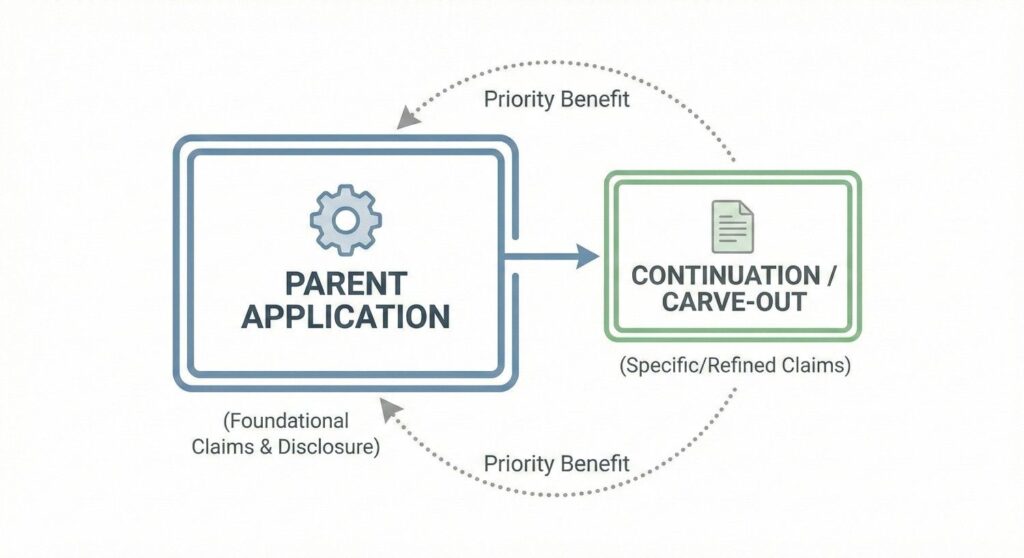
We have covered how the parent sets your priority date, defines your playing field, controls future continuations, impacts negotiations, acts as a shield, shapes examination strategy, and determines your flexibility in carve-out decisions.
When Keeping the Continuation Gives You More Power
There are moments in a startup’s life when flexibility matters more than closure. You may feel pressure to wrap up the parent case, get it allowed, and move on.
That feels clean. It feels done. But sometimes, the smarter move is to keep a continuation alive and let the parent go. This is not about giving up protection. It is about keeping control.
A continuation can act like a living option. It gives you the ability to reshape your claims as the market shifts. For deep tech founders, that can be far more valuable than locking in one narrow patent too early.
A Continuation Lets You Adjust as the Market Evolves
Your product today is not your product in two years. Features change. Users behave in new ways. Your revenue model may shift. New competitors show up with slightly different designs.
If your parent is heading toward allowance with narrow claims that only cover version one of your system, you may be freezing your protection at the wrong moment.
By keeping a continuation pending, you maintain the ability to adjust your claim strategy later.
That pending continuation becomes a flexible lever. You can draft new claims that target how competitors actually built their systems. You can focus on the features that turned out to matter most in the market.
You can align your claims with what is generating revenue, not what seemed important on day one.
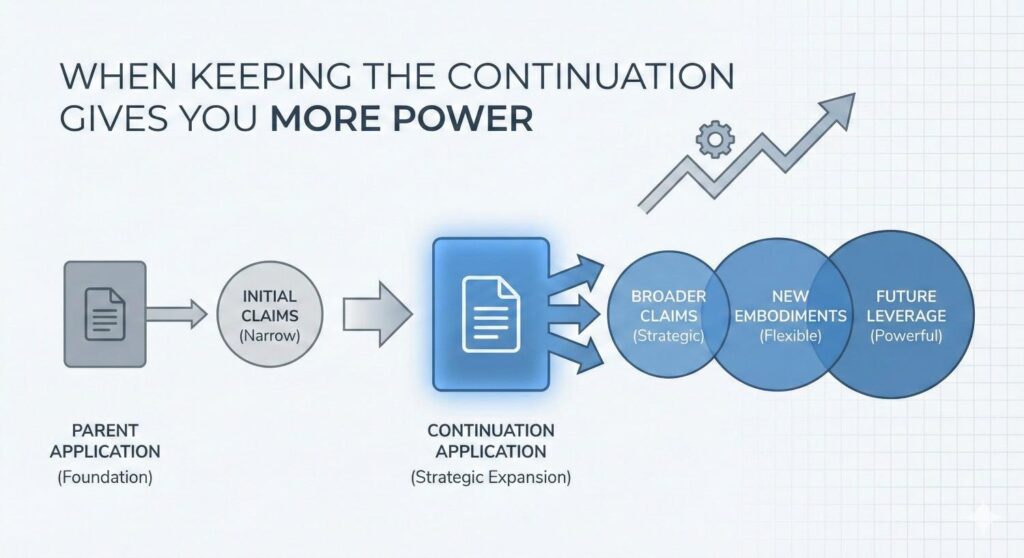
This is powerful because patents are not just about ideas. They are about blocking real-world behavior. A continuation lets you respond to real-world behavior instead of guessing upfront.
A Continuation Can Target Specific Competitors
Founders often think patents are broad shields. In reality, they can also be sharp tools.
If you see a competitor gaining traction with a design that overlaps your original concept, a continuation allows you to pursue claims tailored to that overlap.
You cannot add new matter, but you can frame claims differently within what your parent already disclosed. If your parent was written with depth, you may have multiple technical angles hidden inside it.
A continuation allows you to bring those angles forward strategically.
This is where the quality of the original parent matters. If it described alternative architectures, optional modules, and different data flows, you have room to draft claims that read directly onto a competitor’s product.
A tactical move here is to review competitor products periodically while your continuation is pending. Do not wait until your case is closed.
Compare their public materials, demos, and documentation with your original disclosure. Identify where there is alignment. Then adjust your claim strategy in the continuation accordingly.
This turns your patent process from passive to proactive.
A Continuation Extends Your Leverage Window
When a patent is allowed and issued, it becomes fixed. That can be good. But once everything is issued and closed, your ability to shape new claims from that same disclosure disappears.
Keeping a continuation pending extends your leverage window. As long as at least one continuation remains alive, you retain the option to pursue additional claims based on the same original filing date.
For startups entering partnership talks, acquisition discussions, or large enterprise deals, this can matter a great deal.
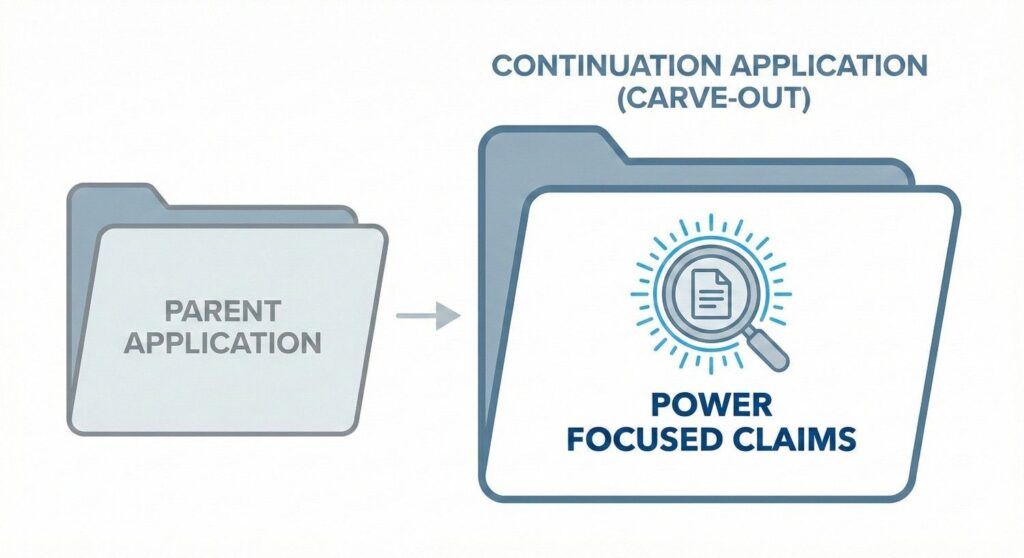
A pending continuation signals that your IP portfolio is still active and adaptable. It shows that you are not done shaping protection.
In negotiations, timing can shift leverage. If a large company knows that you still have a continuation pending that could lead to broader claims, it may influence how they approach licensing or collaboration.
This is not about threatening anyone. It is about maintaining strategic options.
A Continuation Helps You Avoid Premature Narrowing
During patent examination, examiners often push back. They cite prior art. They reject broad claims. There is a temptation to narrow quickly just to secure allowance.
Sometimes that is fine. But if you narrow too much in the parent and let it issue without preserving broader positions in a continuation, you may regret it later.
By filing a continuation before the parent issues, you can allow narrower claims in the parent while keeping broader or alternative claims alive in the continuation. This balances certainty with flexibility.
You secure one patent with defined scope while preserving room to fight for more in parallel. That layered strategy can protect both your present product and future expansions.
For founders, the key action step is to discuss continuation strategy before allowance, not after. Once the parent issues and no continuation is on file, your options shrink fast.
A Continuation Supports Product Pivots
Startups pivot. That is normal. You may start in one industry and later realize a stronger opportunity in another.
If your original disclosure described multiple use cases, a continuation can help you shift focus without losing your early priority date.
For example, if you first targeted healthcare but later found traction in fintech, a continuation could pursue claims tailored to financial workflows, as long as those workflows were described in the parent.
This is why it is wise to draft the parent with multiple industry contexts, even if you only plan to launch in one at the start. A continuation then becomes the bridge between your original idea and your evolved business model.
If you are building deep tech that could cross industries, it is critical to think about this early.
Platforms that blend AI drafting support with experienced patent attorneys can help ensure your parent disclosure is broad enough to support these future pivots.
You can see how that process works here: https://powerpatent.com/how-it-works
A Continuation Can Increase Portfolio Depth Without New Filings
Filing brand new patent applications costs time and money. A continuation, by contrast, builds on your existing disclosure and priority date. It can expand your portfolio without starting from scratch.
If your parent contains rich technical detail, you may be able to pursue multiple patents through successive continuations, each focused on a different claim strategy.
This can create a layered portfolio around a single core invention. One patent might focus on system architecture. Another on data processing. Another on user interaction. All anchored to the same original filing.
For investors, this signals depth. It shows that your innovation is not a single claim but a structured body of protection.
The actionable insight here is to review your original disclosure with fresh eyes.
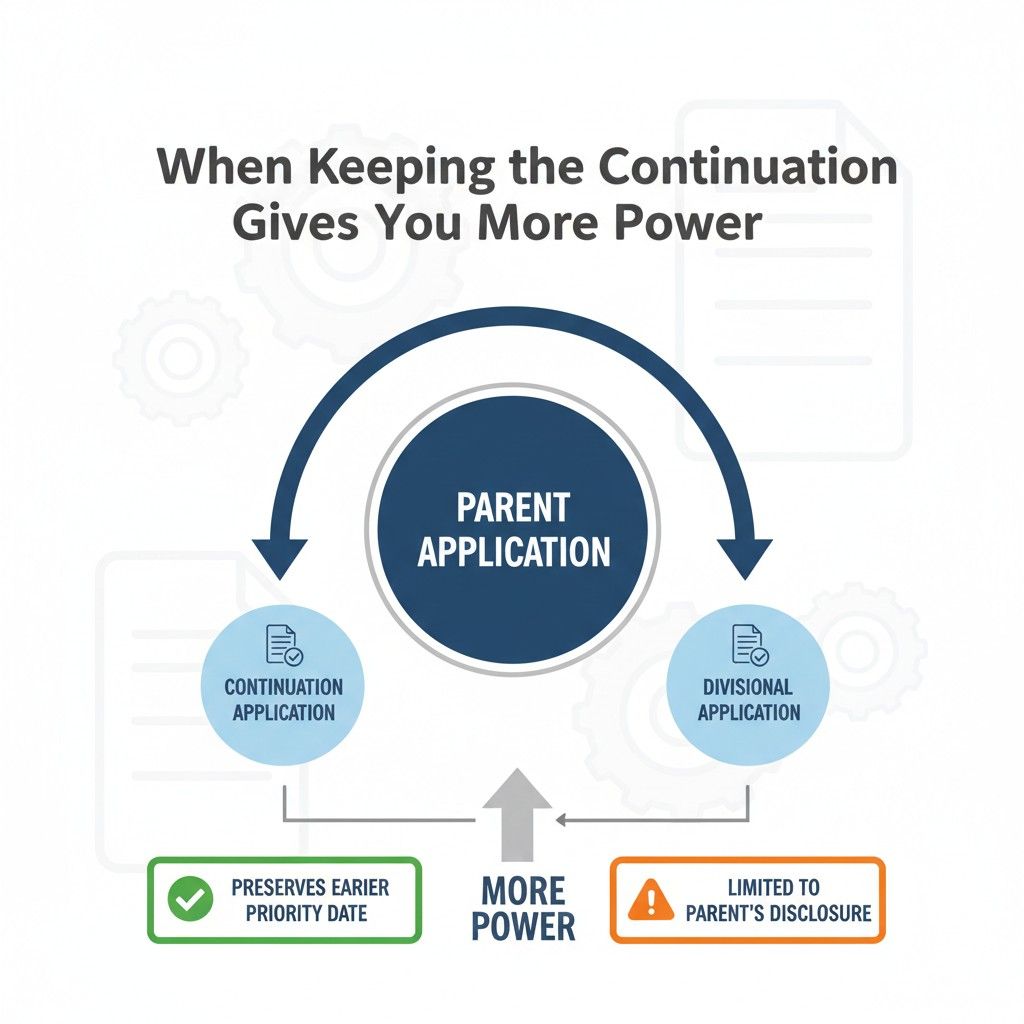
Ask what other claim angles it supports. Do not assume the first claim set captured everything valuable. A continuation is your second chance to extract more protection from the same technical foundation.
A Continuation Keeps Pressure on Competitors
In competitive spaces, visibility matters. If your parent publishes and competitors see your technology direction, they may try to design around it.
If you have a continuation pending, they cannot be fully certain where your final claim boundaries will land. That uncertainty can act as subtle pressure. It may slow down aggressive copying.
Again, this is not about litigation. It is about strategic positioning. A pending continuation shows that your IP strategy is active, not static.
From a business standpoint, this can complement your product roadmap. While you continue shipping features and improving performance, your continuation strategy quietly evolves in the background.
Knowing When to Let the Parent Go
There are cases where letting the parent proceed to issuance while focusing energy on the continuation makes sense.
If the parent claims have become too narrow to matter commercially, you might allow them to issue as a baseline while placing real strategic weight on the continuation.
This requires careful evaluation. You need to understand which claims map to revenue-driving features and which are mostly symbolic.
This is where many founders make costly mistakes. They focus on getting something allowed rather than getting the right thing allowed.
A thoughtful continuation strategy helps avoid that trap. It gives you space to refine your protection around what truly drives value in your business.
If you are unsure how to evaluate that tradeoff, working with a system that gives you visibility into your disclosure, claim coverage, and long-term roadmap can change everything.
PowerPatent was built for exactly this kind of decision-making. You can explore the full process here: https://powerpatent.com/how-it-works
Keeping the continuation is not about delaying progress. It is about preserving power. It is about staying flexible in a world where technology and markets shift quickly.
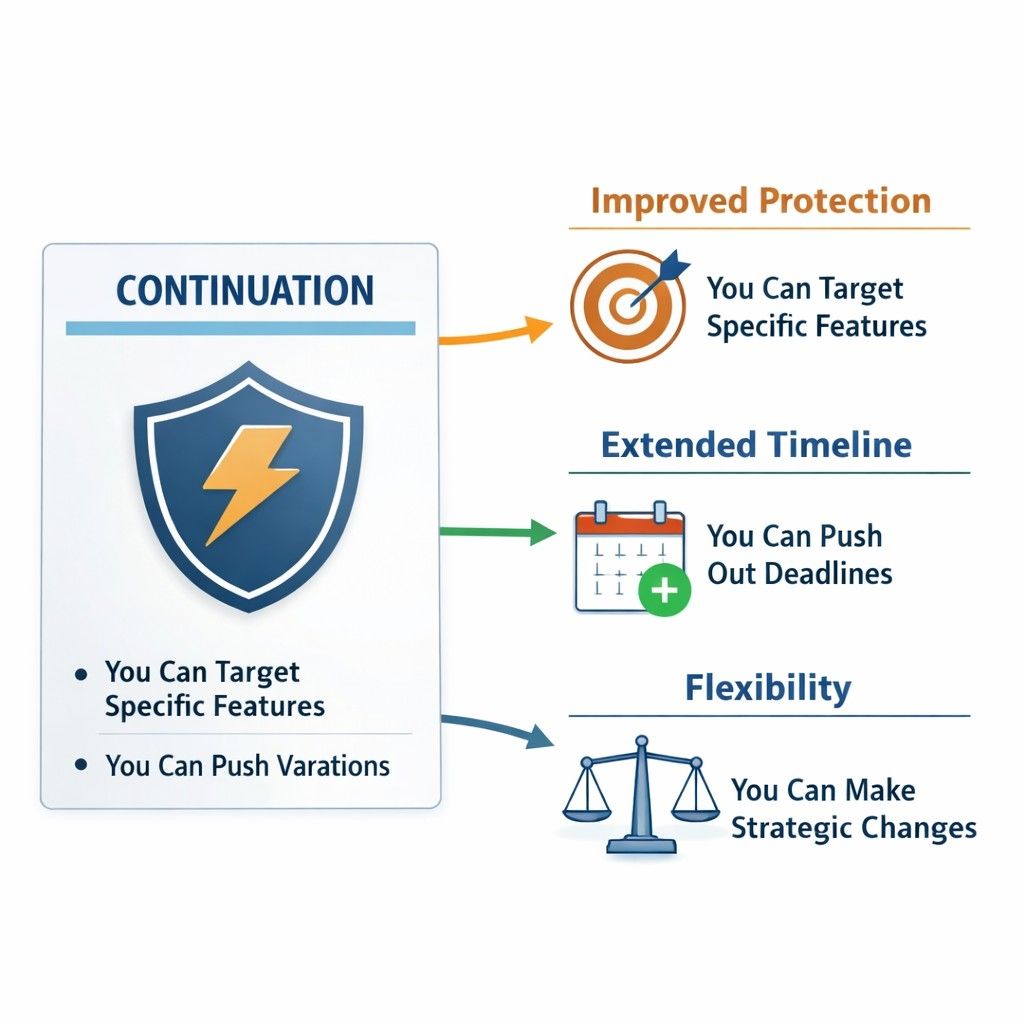
We have now explored how continuations can help you adapt to market changes, target competitors, extend leverage, avoid premature narrowing, support pivots, deepen your portfolio, and maintain pressure.
When It’s Smarter to Drop the Continuation and Stick With the Parent
There are times when holding onto a continuation feels powerful but is not the best move for your business. Flexibility is valuable. But clarity, speed, and cost control can matter even more.
In some cases, the parent application is the real asset, and the continuation becomes a distraction.
This is where strong founders separate motion from strategy. Just because you can keep a continuation alive does not mean you should. The real question is simple.
Does the continuation increase your leverage in a way that supports your business goals right now?
Let’s walk through when it makes sense to let the continuation go and focus on the parent.
When the Parent Already Covers What Drives Revenue
At the end of the day, patents are business tools. If your parent claims already cover the features that generate revenue, attract customers, and block competitors, keeping a continuation alive may not add much value.
Some founders assume more filings equal more strength. That is not always true.
If your parent is allowed with claims that map directly to your core system architecture and the key technical advantage competitors would need to copy, you may already have what you need.
In this situation, dropping the continuation can reduce cost and simplify your portfolio. You focus on enforcing or leveraging what you already secured instead of chasing incremental claim variations.
The tactical step here is to sit down and map your issued or soon-to-be-issued parent claims against your live product. Not your roadmap. Not your idea.
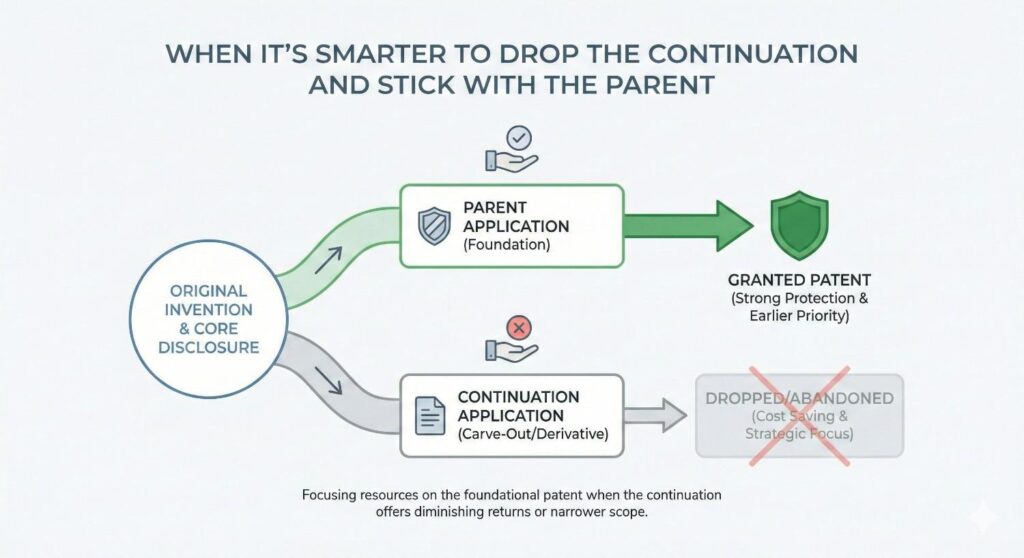
Your actual shipped product. Then map those same claims against your top two competitors. If the overlap is strong and meaningful, the parent may be enough.
When the Continuation Is Chasing Theoretical Angles
Sometimes a continuation exists because someone said it might be useful one day. It targets a variation that never made it into the product. It pursues a use case that never gained traction.
It protects an embodiment that sounded exciting during drafting but does not align with your market.
If your continuation is drifting away from your real business, it can quietly drain attention and budget.
A patent portfolio should mirror your strategy, not your past brainstorming sessions. If your company has narrowed focus, your IP should reflect that clarity.
A good test is this. If a potential investor reviewed your continuation claims today, would they see a tight link to your growth plan? Or would it feel disconnected? If it feels disconnected, the continuation may not deserve to stay alive.
This is not about abandoning protection. It is about sharpening it.
When Cost and Focus Matter More Than Optionality
Startups operate under constraints. Time is limited. Budget is limited. Leadership focus is limited.
Keeping a continuation alive means responding to office actions, coordinating with counsel, making strategic claim decisions, and paying ongoing fees. Even if each step seems manageable, it adds mental load.
If you are entering a critical growth stage, raising capital, or pushing hard on product-market fit, simplifying your IP posture can be smart.
There is strength in closing loops. Letting the parent issue, securing clear rights, and reducing open threads can make your company easier to understand for investors and partners.
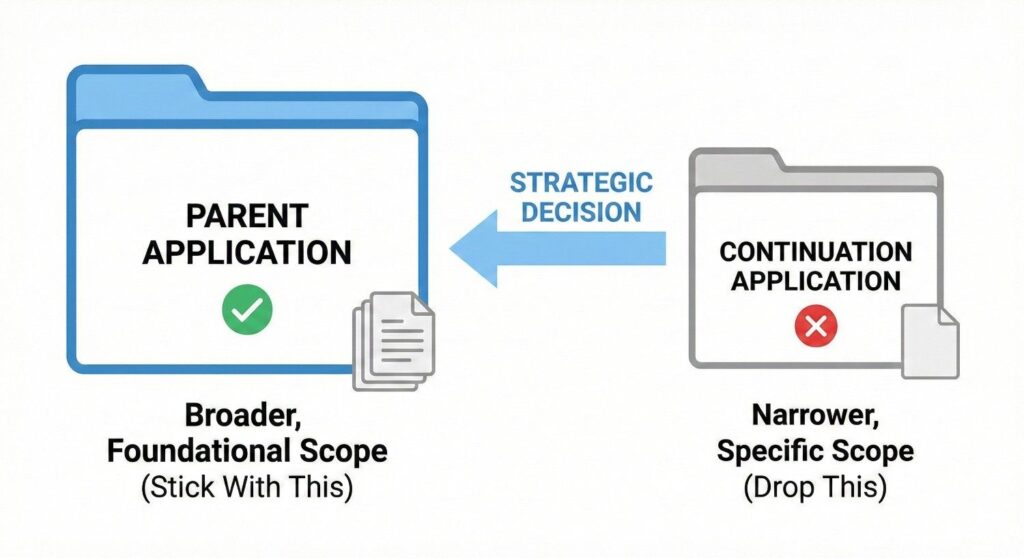
The actionable move here is to run a simple impact review. Ask how much incremental protection the continuation realistically adds over the parent.
If the increase in protection is small compared to the cost and complexity, dropping it may be the disciplined choice.
When the Parent Has Broad, Well-Supported Claims
If your parent was drafted with depth and foresight, it may already contain broad claims that are difficult for competitors to design around.
In that case, a continuation may offer only marginal expansion. And marginal expansion is not always worth extended prosecution.
The key is understanding the strength of your issued or pending parent claims. Broad does not mean vague. It means they capture the core technical concept in a way that competitors cannot easily sidestep by tweaking surface details.
If your parent claims focus on the underlying mechanism, data flow, or system architecture that defines your edge, you may already have strong defensive coverage.
This is where having real attorney oversight combined with modern drafting tools makes a difference. When the parent is done right from the start, you are less dependent on follow-on filings to fix gaps later.
If you want to see how founders are building that kind of strong foundation from day one, take a look here: https://powerpatent.com/how-it-works
When You Want a Clean Story for Acquisition
Acquirers often prefer clarity. A clean portfolio with issued patents that clearly map to the product can be easier to evaluate than a web of pending continuations with uncertain scope.
This does not mean continuations are bad. In many cases, they add value. But if you are approaching acquisition conversations and your parent already provides solid coverage, simplifying your structure can help.
Imagine sitting in a diligence meeting. You want to explain your IP in a clear, confident way. “Here is our issued patent. It covers this system, this method, and this architecture that drives our product.” That story is powerful.
If instead the discussion becomes complicated, with multiple pending claim strategies and uncertain boundaries, it may create friction.
The business question becomes this. Does the continuation improve your acquisition narrative, or complicate it?
When the Competitive Landscape Has Settled
In fast-moving spaces, a continuation gives you room to adapt. But in some markets, the competitive picture stabilizes. The main players are known. The core designs are visible.
If your parent claims already read on those designs, the urgency to keep shaping new claims decreases.
At that point, your energy may be better spent on enforcement readiness, licensing strategy, or expanding protection in new geographic regions instead of refining claim angles within the same disclosure.
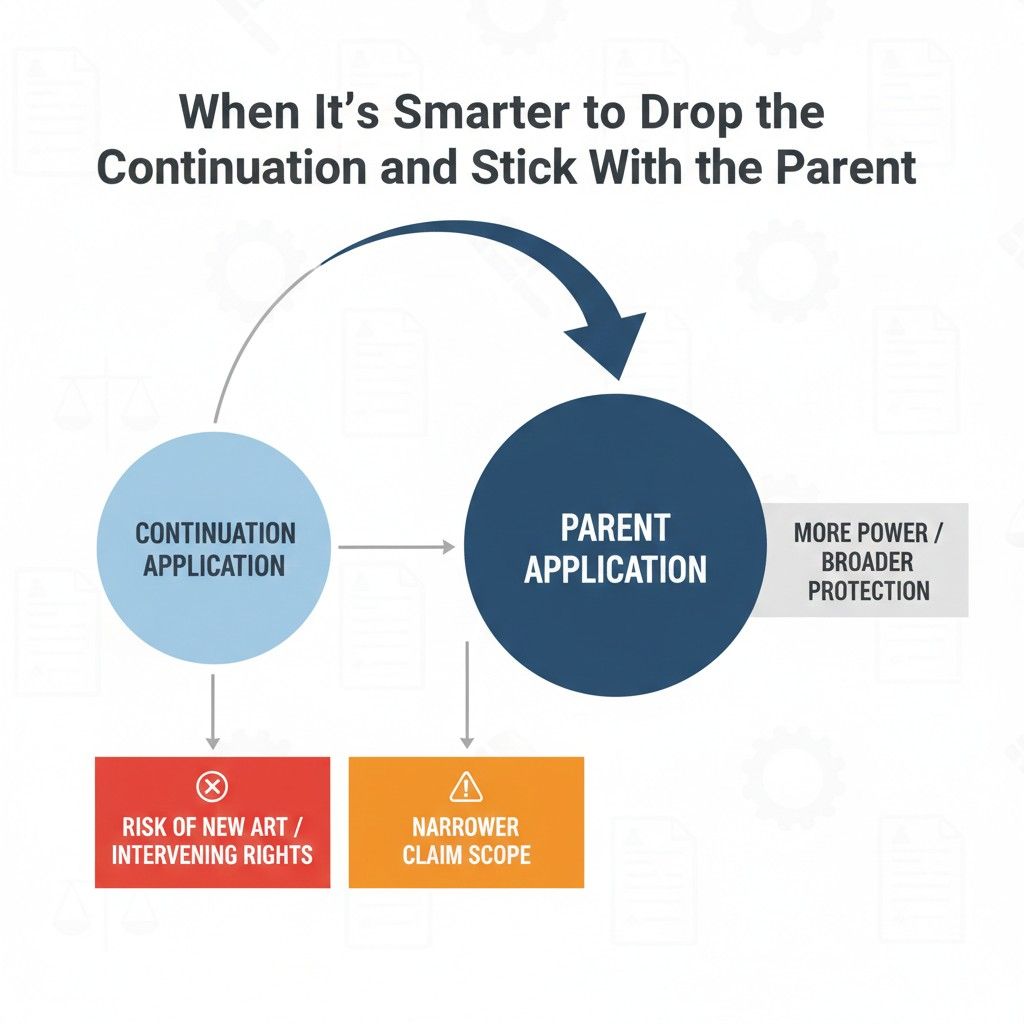
A strong parent can serve as a stable anchor in a settled field.
The key is honest assessment. Are competitors still shifting in ways that your current claims do not capture? Or has the field matured around a few clear architectures that your parent already addresses?
Your continuation decision should reflect that reality.
When Dropping the Continuation Sharpens Strategy
Sometimes letting go creates clarity. By dropping a continuation, you force your team to focus on what truly matters.
You stop asking, “What else can we claim?” and start asking, “How do we use what we already secured to strengthen our position?”
That shift can be powerful. It aligns legal strategy with business execution.
This does not mean you stop innovating or filing new patents in the future. It simply means you are intentional. New filings should reflect new inventions, not attempts to stretch an old disclosure beyond its natural business value.
The best founders treat their IP portfolio like their product roadmap. They prune what no longer fits. They double down on what drives growth.
Making the Decision With Confidence
Whether you keep the continuation or drop it, the decision should never be based on fear or habit. It should be based on alignment.
Alignment between your patent claims and your revenue model. Alignment between your filing strategy and your competitive landscape. Alignment between your legal spend and your stage of growth.
This is why having visibility into your patent assets matters. You should understand what each claim protects, how it maps to your system, and what leverage it creates.
Modern platforms that combine smart drafting software with real patent attorney guidance make that visibility possible. They help founders see their portfolio clearly instead of guessing.
If you are building serious technology and want to make carve-out decisions with confidence, not confusion, explore how PowerPatent supports founders from drafting through strategy: https://powerpatent.com/how-it-works
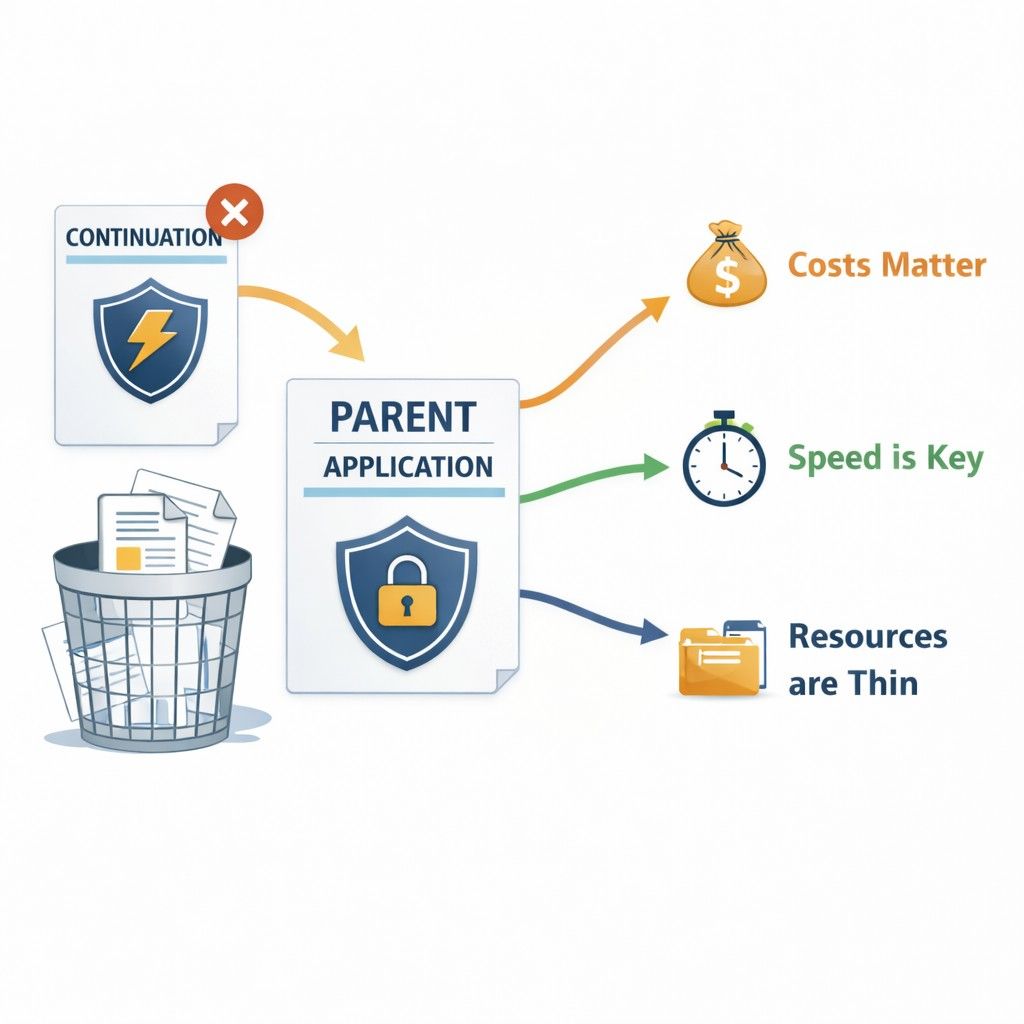
Carve-outs are not about paperwork. They are about power. Sometimes that power comes from keeping a continuation alive. Other times it comes from closing it and standing firmly on a strong parent.
The smartest move is the one that supports your business, not just your filing history.
Wrapping It Up
Carve-out decisions are not clerical tasks. They are business moves. When you choose to keep a continuation or drop a parent, you are shaping your company’s leverage, flexibility, and long-term protection. The real mistake founders make is treating patent strategy as something separate from product and growth. It is not separate. It is connected to how you compete, how you raise money, and how you defend your edge.