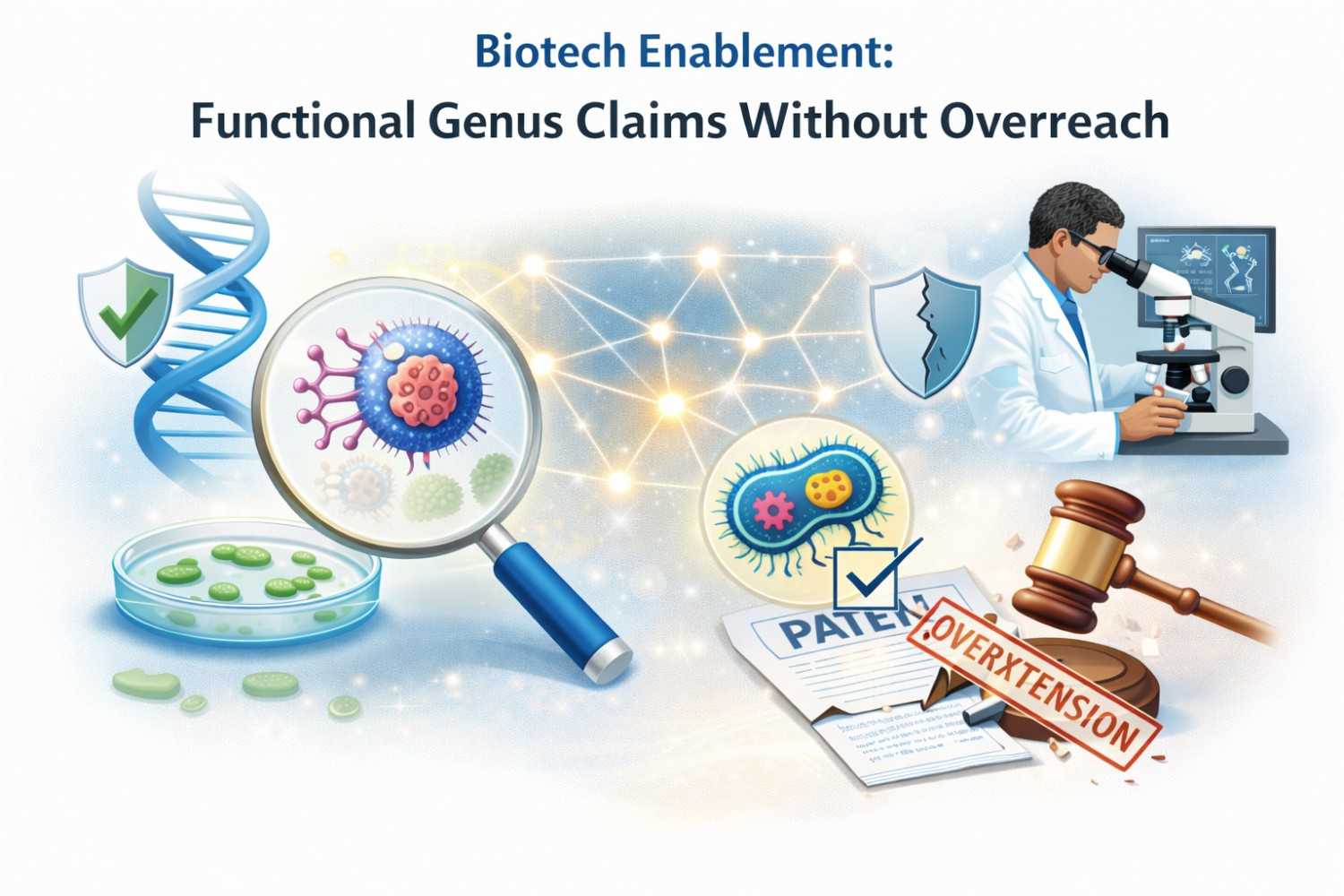
Biotech founders are building things that did not exist a few years ago. New proteins. New ways to edit cells. New tools that change how medicine works. The problem is not the science. The problem is protecting it the right way.
Many biotech patents fail not because the idea is weak, but because the patent goes too far or not far enough. Some claims are so broad they get rejected fast. Others are so narrow they are easy to work around. This is where functional genus claims matter, and this is also where most teams make costly mistakes.
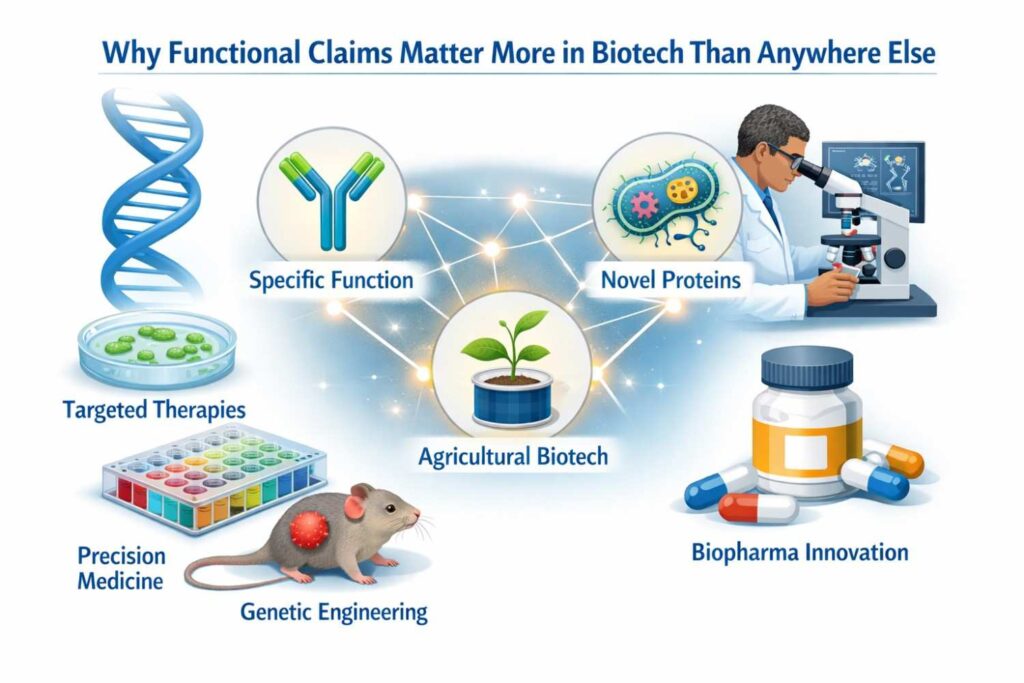
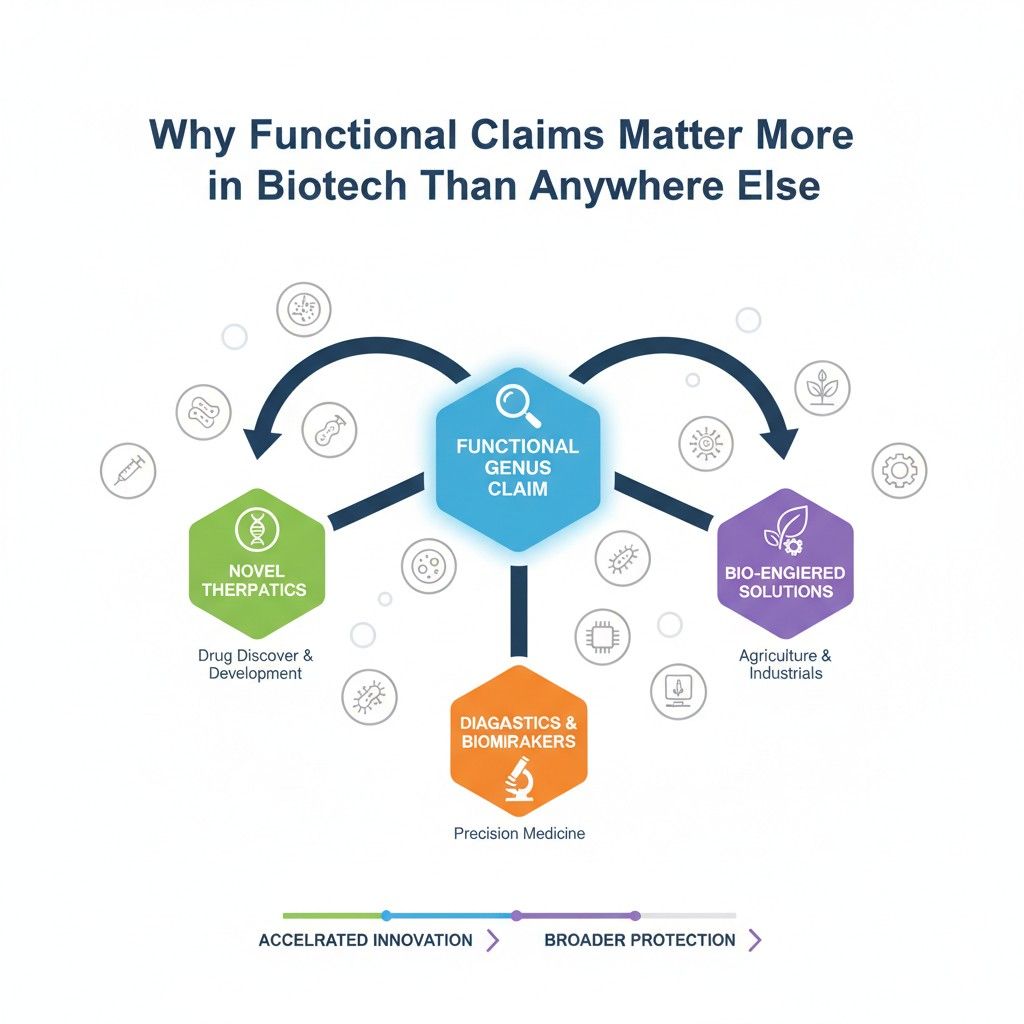
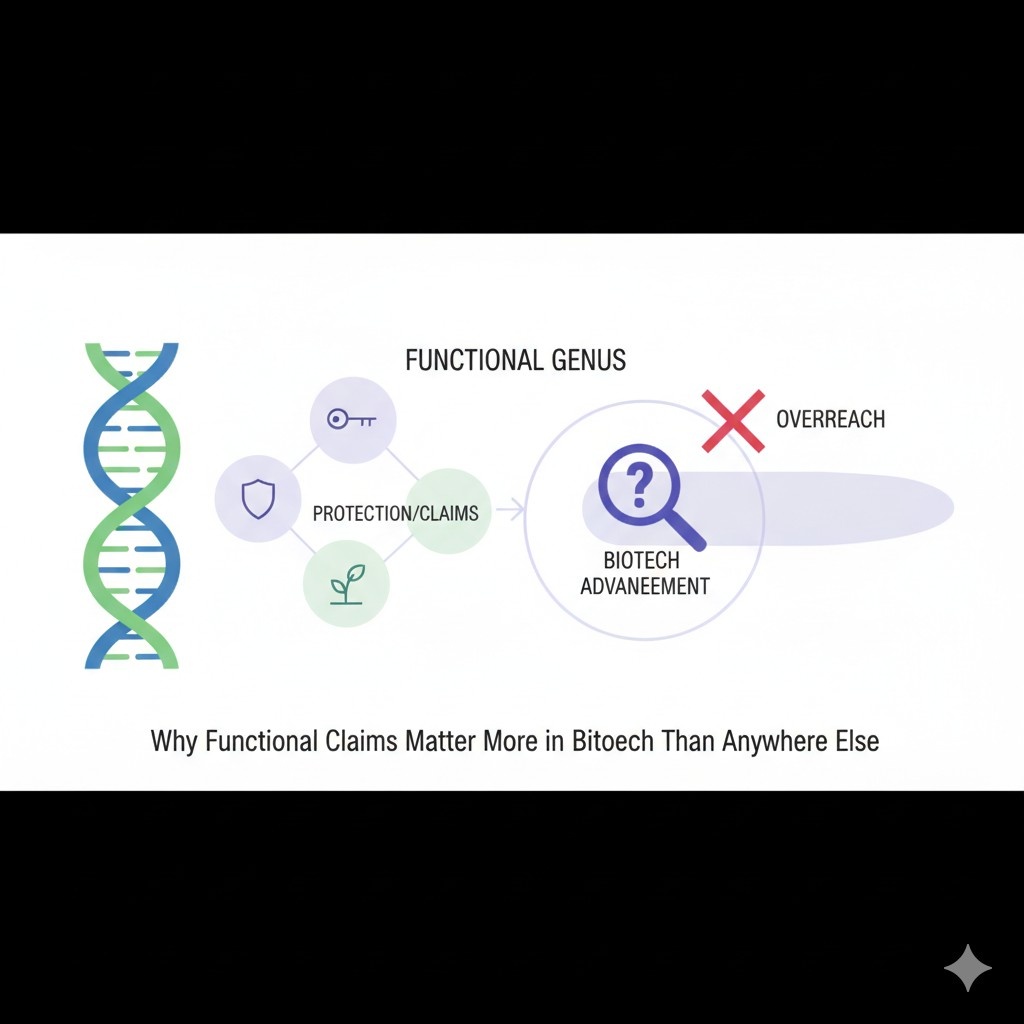
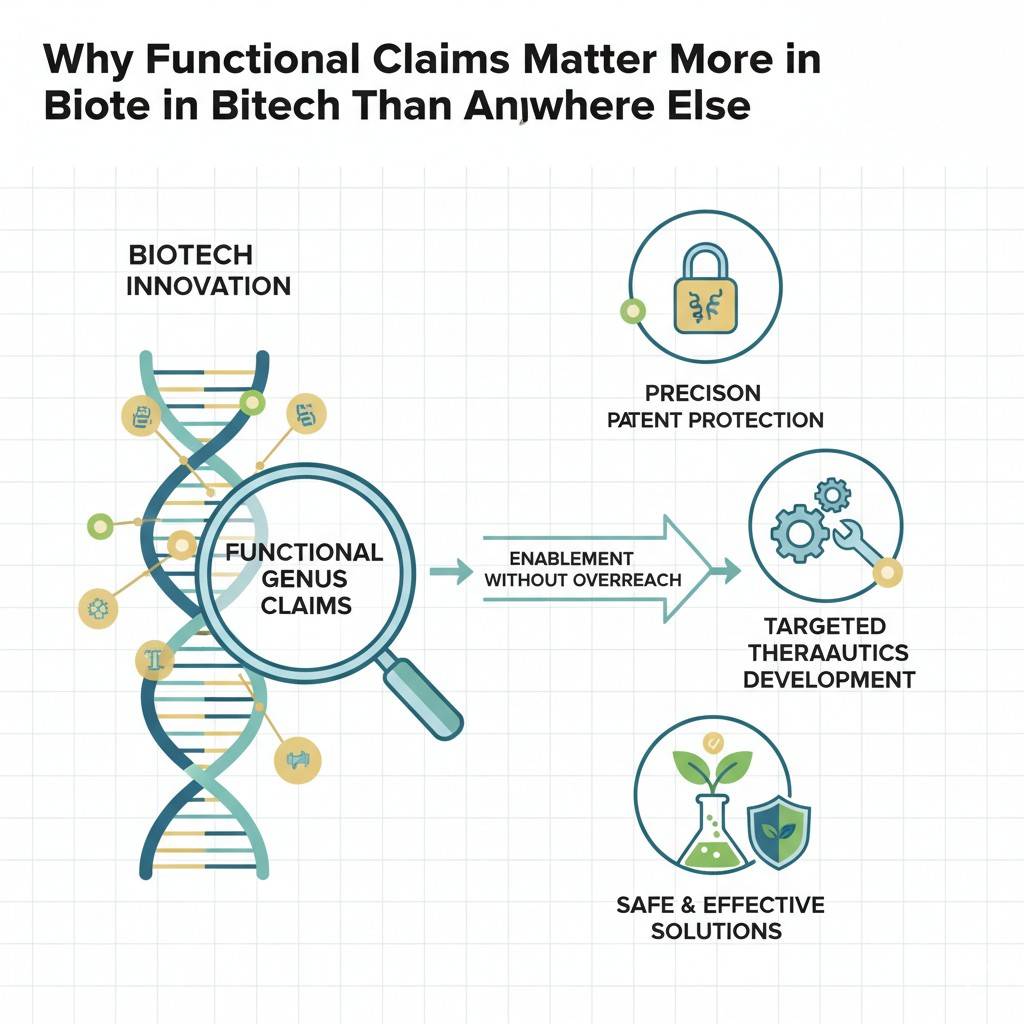
Why Functional Claims Matter More in Biotech Than Anywhere Else
Biotech inventions are not static objects. They are living systems, chemical behaviors, and biological outcomes. Unlike a wrench or a circuit board, the value is rarely in a single structure.
The value is in what the invention does inside a cell, a body, or a process. That is why functional claims are not optional in biotech. They are the core of real protection.
A biotech company that relies only on structure-based claims is usually protecting yesterday’s version of the science. A company that understands functional claiming is protecting the future versions as well.
This section explains why that difference matters so much and how founders should think about it early, before filing anything.
Biotech Innovation Moves Faster Than Structures Can Be Named
In biotech, the same function can be achieved by many different structures. A protein can be changed slightly and still do the same job. A sequence can be altered and still bind the same target. A delivery system can evolve while keeping the same outcome.
If a patent only names one structure, it is easy for others to step around it. They change the shape just enough and keep the function. From a business point of view, that is a disaster.
You did the hard work, proved the biology, and someone else captures the value.
Functional claims focus on what the invention achieves. That gives room for evolution while keeping protection intact. For founders, this means thinking less about exact sequences and more about biological results from day one.
Investors Look for Control, Not Just Clever Science
Investors do not read patents for fun. They read them to answer one question. Can this company stop others from copying them?
In biotech, control comes from owning the function, not just one example. If your patent only covers a narrow embodiment, investors will see risk. They know competitors can design around it.
They know future versions may fall outside the claims.
Functional genus claims, when done right, show that you understand the competitive space. They signal that you are not just protecting what you built in the lab last month, but what the product will become over the next five years.
A practical step here is to map your core business value to biological outcomes. Ask yourself what must happen for your product to work. Those outcomes are where functional claims belong.
Biology Does Not Care About Legal Categories
Patent law likes clean categories. Biology does not. Cells do not behave in neat boxes.
Proteins interact in messy ways. Pathways overlap. This mismatch is why biotech patents are hard and why generic claiming approaches fail.
Functional claims bridge this gap. They describe inventions in terms that match how biology actually works. Instead of forcing a biological system into rigid language, they focus on measurable effects and interactions.
For founders, this means working closely with patent professionals who understand both the science and the legal limits.
Tools like PowerPatent help translate lab reality into claim language that makes sense to examiners without losing biological truth. You can see how that translation works here: https://powerpatent.com/how-it-works
Enablement Is the Price of Broad Protection
Functional claims come with a cost. You must show that you can actually achieve the function across the full scope you claim. This is where many biotech patents fail.
Enablement is not about proving everything works in every case. It is about showing enough examples and guidance so that others could make it work without guessing.
In biotech, that usually means strong data, clear descriptions, and thoughtful explanation of why the function holds across variants.
A smart strategy is to generate data that supports the function, not just the lead candidate. Even small variations tested early can later support much broader claims. This is a business decision as much as a legal one.
Functional Claims Protect Against Silent Competition
In biotech, competitors often do not announce themselves. They tweak, test, and publish quietly. By the time you notice them, they may already be close to market.
Functional claims help prevent this. If your claims are tied to outcomes, not just structures, it becomes harder for competitors to hide behind small changes. This creates leverage. It also creates clarity when enforcing rights later.
Founders should think about where competitors are likely to innovate. Those paths should inform how functions are defined in the patent. This is not speculation. It is strategic foresight.
Regulatory Reality Makes Functional Protection Even More Critical
Biotech products often change during regulatory approval. Manufacturing tweaks happen. Formulations evolve. Delivery methods improve. If patents are too tied to early versions, protection can weaken over time.
Functional claims provide continuity. They allow the patent to stay relevant even as the product adapts to regulatory and manufacturing realities. This reduces the risk of ending up with a product that no longer fits its own patent.
An actionable move here is aligning patent strategy with regulatory strategy early. The function that matters in the clinic should be the function that anchors the claims.
Courts Care About What Was Taught, Not What Was Intended
When biotech patents are challenged, courts look closely at what the patent actually teaches. Broad functional claims without real teaching will fail. Narrow claims with strong teaching may survive but offer limited value.
The goal is balance. Teach enough to support the function while keeping claims wide enough to matter. This balance is difficult, but it is achievable with the right approach and tools.
Founders should treat the patent draft as a technical document, not marketing material. Clear explanations, honest limits, and real examples build credibility that pays off years later.
Functional Thinking Changes How Teams Document Research
One of the most overlooked benefits of functional claim strategy is how it shapes internal behavior. Teams that think in terms of function document experiments differently. They ask better questions. They notice patterns earlier.
This makes patent drafting easier and stronger. It also improves scientific understanding. Over time, this mindset becomes a competitive advantage.
A simple practice is encouraging teams to record not just what they tested, but what outcome they achieved and why it matters. Those notes often become the backbone of strong functional claims.
The Business Case for Getting This Right Early
Fixing weak biotech patents later is expensive and uncertain. Filing continuations can help, but they cannot invent missing enablement. The best time to think about functional scope is before the first filing.
Early clarity saves time, money, and stress. It also sends a strong signal to partners, investors, and acquirers that the company knows how to protect its edge.
PowerPatent was built to support this exact moment, helping biotech teams turn complex functions into clear, defensible patents without slowing down innovation. If you want to see how that works in practice, you can explore it here: https://powerpatent.com/how-it-works
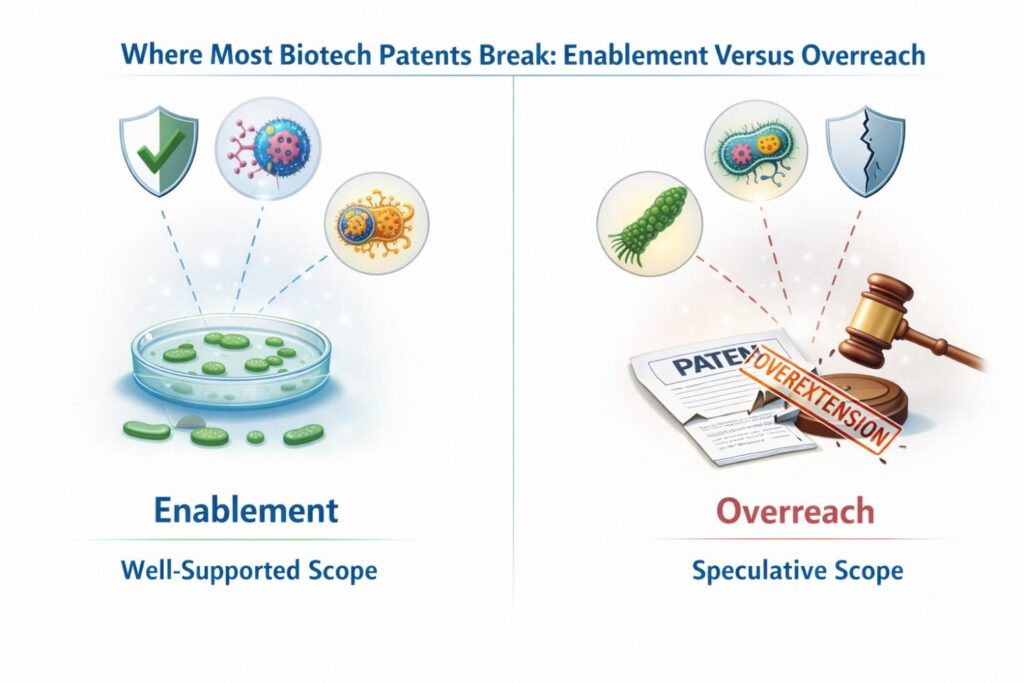
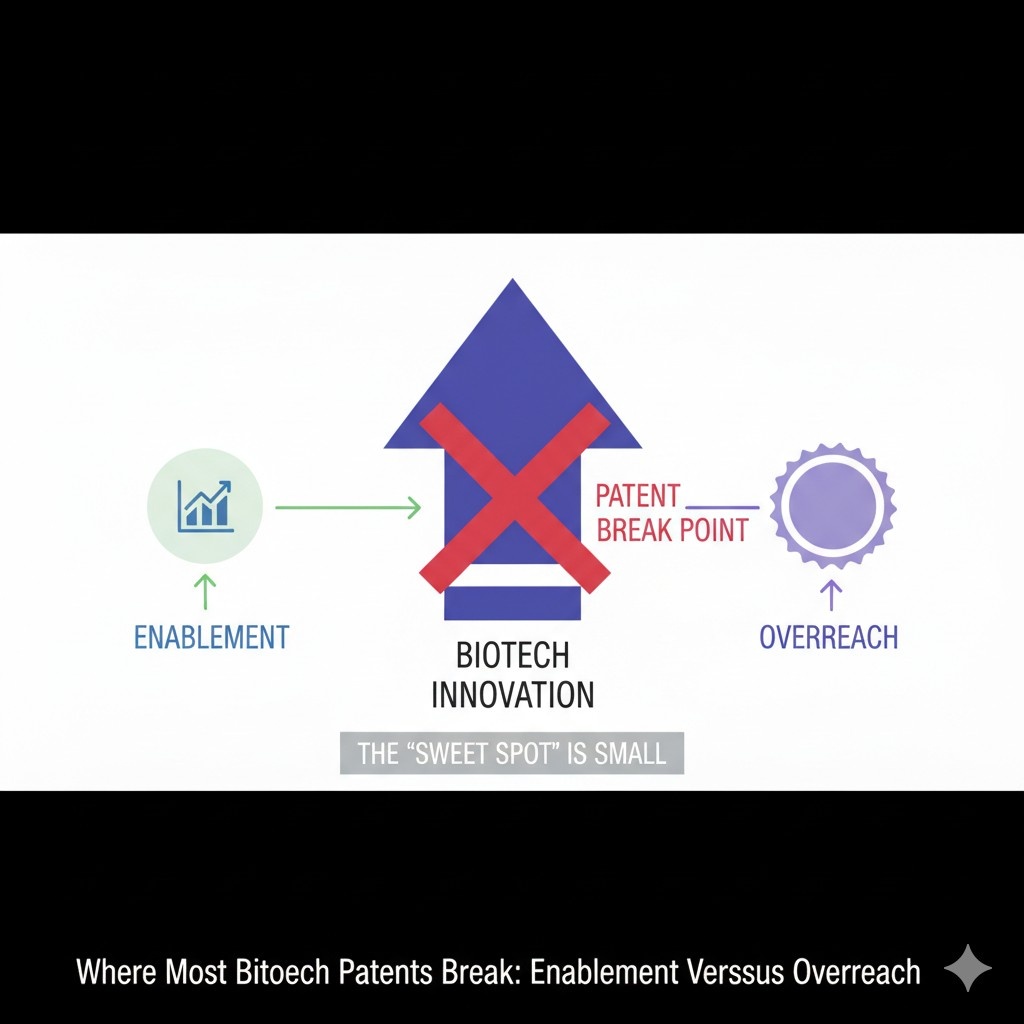
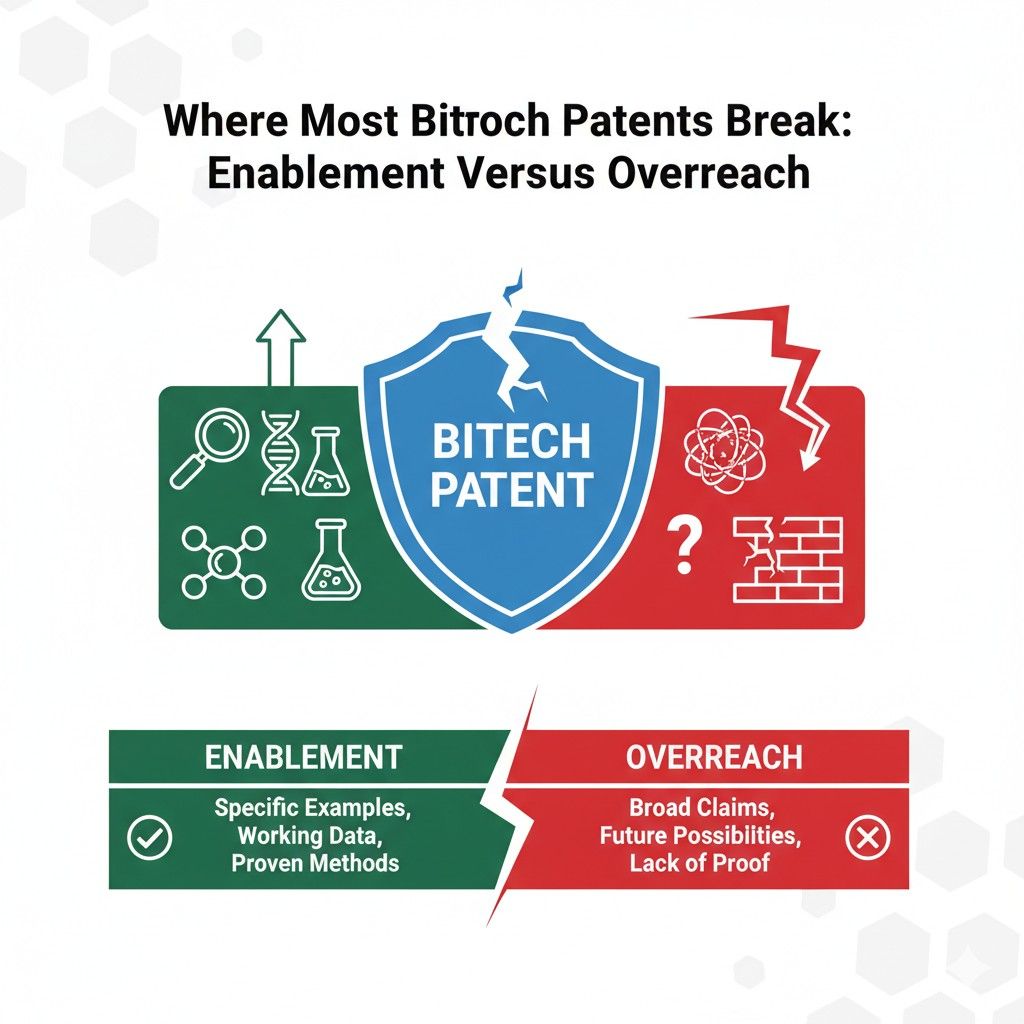
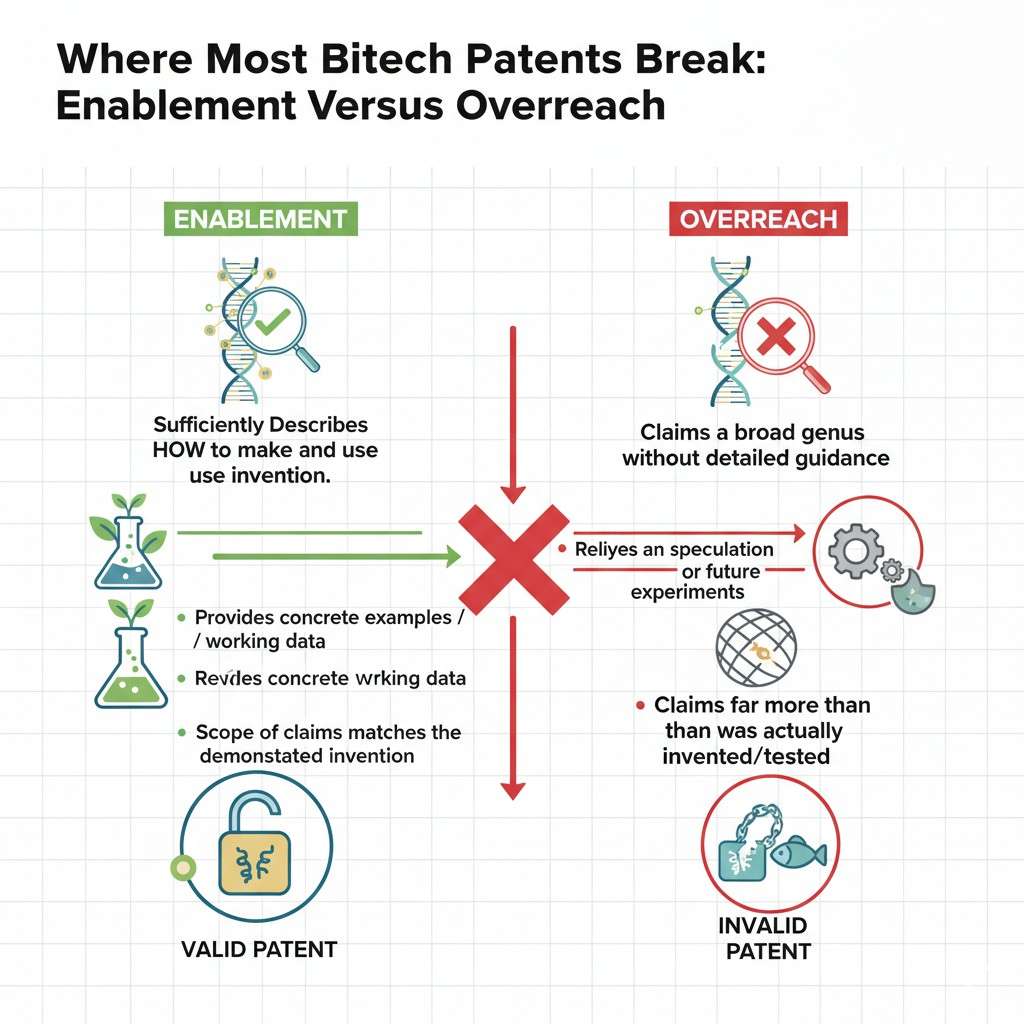
Where Most Biotech Patents Break: Enablement Versus Overreach
This is the section where reality hits. Most biotech patents do not fail because the invention is weak. They fail because the patent tries to claim too much without teaching enough, or teaches a lot but claims almost nothing.
Both mistakes are common. Both are expensive. And both are avoidable if founders understand where the line actually is.
Enablement and overreach are not abstract legal ideas. They are practical business risks. Get this balance wrong and your patent either dies during examination or looks strong on paper but collapses under pressure later.
This section explains where patents usually break and how companies can stay on the right side of that line.
Overreach Often Starts With Fear
Many founders worry that if they do not claim everything, someone else will. That fear pushes patents to stretch beyond what the science can support.
Claims start to cover broad biological outcomes without enough explanation of how to achieve them.
This feels safe at filing time, but it backfires. Examiners push back. Courts push harder. What looks like ambition often reads as guesswork.
A better approach is confidence, not fear. Confidence comes from knowing what you can actually enable today and how far that teaching reasonably extends.
Strong patents grow from solid ground, not from trying to fence off the whole field in one move.
Enablement Is About Teaching, Not Proving Perfection
One of the biggest misunderstandings in biotech patents is thinking enablement means proving that every possible variant works.
That is not true. Enablement means teaching someone skilled in the field how to make and use the invention without undue effort.
The problem is that many patents skip the teaching part. They show one example and then claim a whole universe. That gap is where patents break.
Founders should ask a simple question while drafting. If another skilled scientist read this, could they reasonably get similar results across the claimed scope? If the honest answer is no, the claim is too broad for the disclosure.
Single Examples Are Rarely Enough in Biology
In software, one example can sometimes support broad claims. In biotech, biology is too variable for that. Proteins misfold. Cells behave differently. Small changes can have big effects.
When patents rely on a single working example, they invite enablement challenges. Examiners and judges both know biology is unpredictable. They expect more guidance.
From a business standpoint, this means planning experiments with patents in mind. Running a few variations early, even small ones, can dramatically strengthen later claims. This is not busywork. It is asset building.
Overly Narrow Claims Create Silent Vulnerability
On the other side, many biotech patents break because they are too careful. They claim exactly what was tested and nothing more. This avoids enablement issues but creates a different problem.
Competitors do not need to copy you exactly. They only need to change enough to avoid the claims. In biotech, that is often easy.
A narrow claim may survive examination, but it may not protect the business. This is a quiet failure that often shows up during due diligence, when investors realize the moat is thin.
The Hidden Cost of Examiner Appeasement
During prosecution, it is tempting to narrow claims just to get allowance. Each amendment feels like progress. Over time, though, the patent can shrink into something that barely covers the product.
This is where strategic thinking matters. Not every rejection should be answered by narrowing. Sometimes the better move is explaining the enablement more clearly or pointing to supporting data already in the application.
Founders should stay involved during this stage. This is not just a legal back and forth. It is shaping the future value of the company’s IP.
Courts Punish Vague Functional Language
Functional claiming is powerful, but vague functional language is dangerous. Courts have little patience for claims that describe results without clear boundaries or teaching.
Phrases that sound impressive but lack substance are red flags. They suggest the inventor did not fully understand or could not fully explain how the function is achieved.
Strong functional claims are precise. They tie outcomes to measurable effects, conditions, or interactions. This precision protects against invalidation while keeping the scope meaningful.
The Timing of Data Matters More Than Most Founders Think
In biotech patents, what you include at filing time matters enormously. You cannot add new enablement later. Continuations help refine claims, but they cannot fix missing teaching.
This makes early decisions critical. Waiting to file until everything is perfect is rarely realistic, but filing too early without enough support is risky.
A balanced strategy is to identify the core function early and generate just enough data to support it broadly.
Tools like PowerPatent help teams see where that balance lies, without dragging out timelines. You can explore how this works here: https://powerpatent.com/how-it-works
Overreach Often Comes From Misreading Case Law
Many biotech teams hear about famous cases and overcorrect. They assume all functional claims are dangerous or that broad claims are dead. That is not accurate.
Courts do not reject functional claims outright. They reject unsupported ones. There is still room for meaningful breadth if the patent teaches well.
The lesson is not to avoid functional claiming, but to do it thoughtfully. Understanding why patents failed in past cases is more useful than fearing the outcome.
Enablement Is Evaluated Through a Business Lens
Although enablement is a legal standard, it is judged in context. The complexity of the field, the predictability of the science, and the state of knowledge all matter.
In cutting-edge biotech, some uncertainty is expected. What matters is whether the patent gives enough direction to move forward.
Founders should frame their inventions honestly. Overpromising hurts credibility. Clear explanations of why a function works, even with limits, often strengthen the patent rather than weaken it.
The Real Break Happens Years Later
Many weak biotech patents do not break immediately. They get granted. They sit quietly. The break happens later, during enforcement, acquisition, or litigation.
That is when enablement and overreach are tested for real. Fixing problems then is difficult and expensive.
The best protection is designing patents with that future moment in mind. Ask whether the claims would still make sense if challenged by a well-funded competitor years from now.
Turning This Risk Into an Advantage
Companies that understand this balance early gain an edge. Their patents are harder to invalidate and harder to design around. They also tell a clearer story to investors and partners.
This is not about being conservative or aggressive. It is about being intentional.
PowerPatent helps biotech teams navigate this exact tension, combining smart software with real attorney insight to avoid both overreach and underreach.
If you want to see how that process works, you can start here: https://powerpatent.com/how-it-works
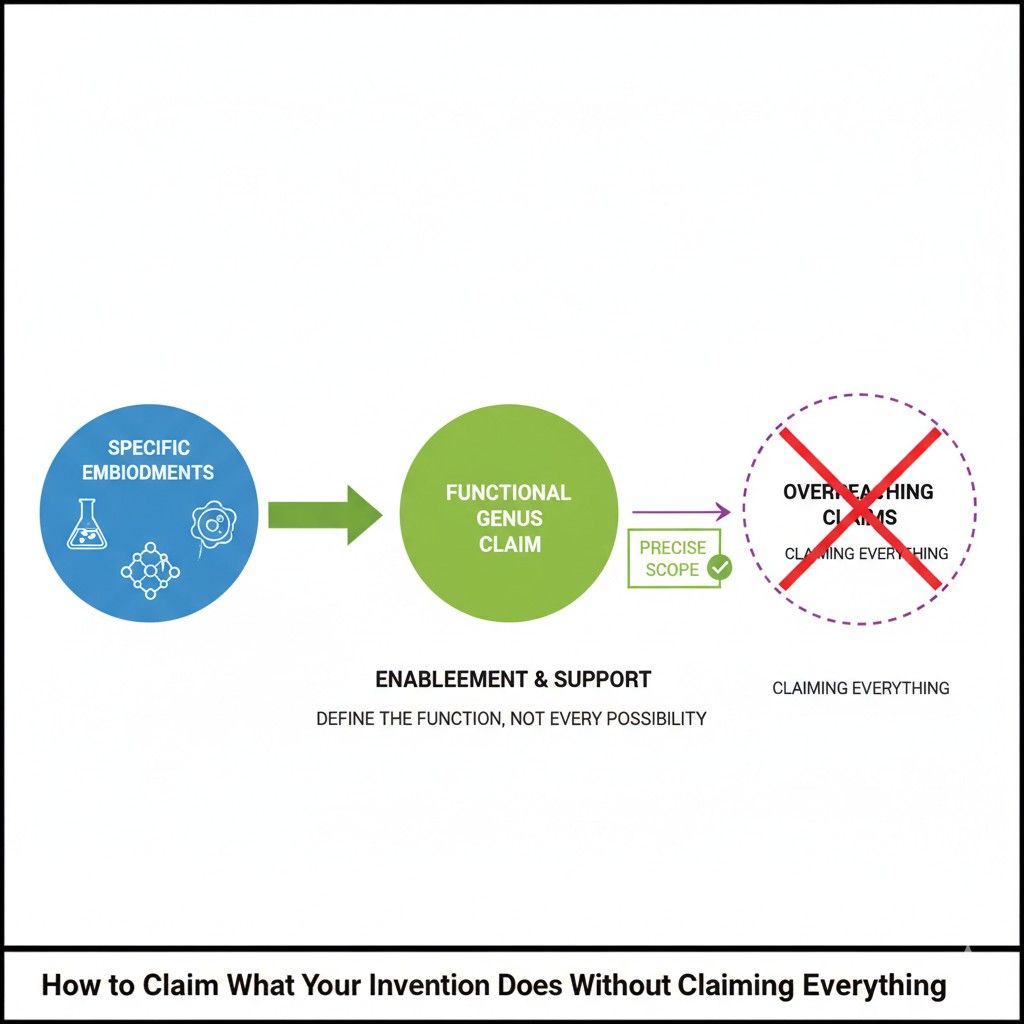
How to Claim What Your Invention Does Without Claiming Everything
This is the hardest part of biotech patenting and the most valuable one to get right. Claiming what your invention does, while staying grounded in what you actually taught, is where strong biotech patents are made.
This is not about clever wording. It is about strategy, clarity, and restraint.
Many teams think this skill belongs only to elite law firms. In reality, founders who understand their science deeply are best positioned to shape these claims. When the business goal and the biology align, the claims almost write themselves.
Start With the Business Outcome, Not the Molecule
The mistake most biotech teams make is starting claims at the molecular level. They focus on the sequence, the construct, or the formulation. Those details matter, but they are not the reason customers pay or competitors worry.
The real value is the outcome. Lower toxicity. Better binding. Faster response. More stable expression. Those outcomes should guide the claim strategy.
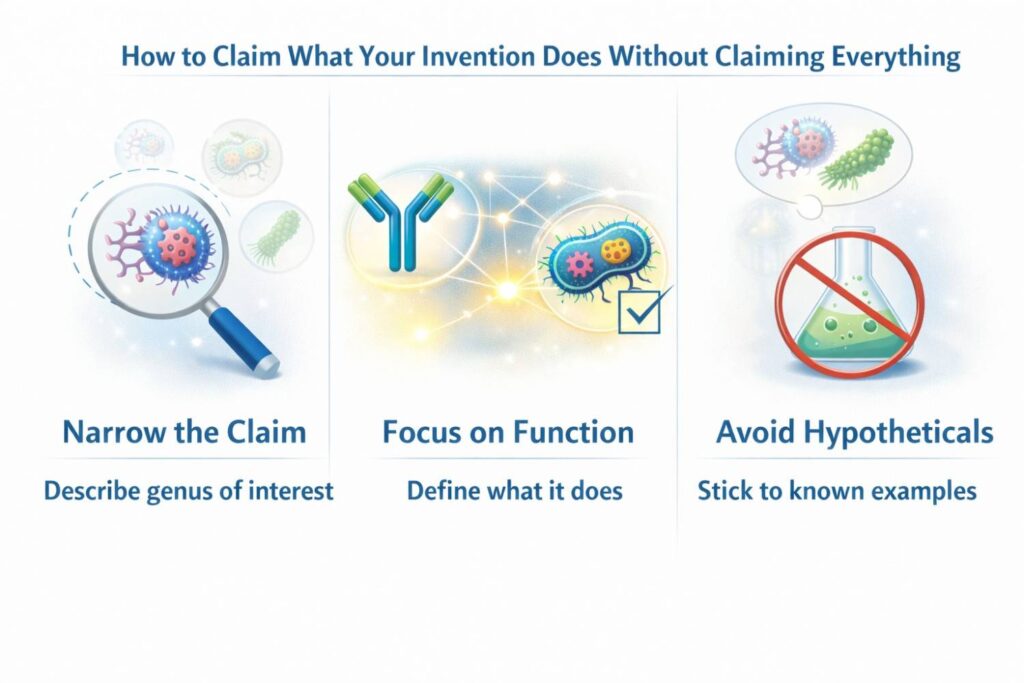
This does not mean ignoring structure. It means using structure to support the function, not replace it. The claims should protect the outcome that drives adoption and revenue.
Define the Function in a Way Biology Can Support
Not all functions are equal. Some are too vague. Some are too absolute. The key is choosing a function that is meaningful but measurable.
For example, claiming that something “improves treatment” is weak. Claiming that it “reduces a specific biomarker under defined conditions” is stronger. It ties the function to something observable.
Founders should work with their teams to identify functions that can be explained, tested, and repeated. If you cannot explain how you know the function exists, it is probably not ready to anchor a claim.
Use Examples to Show Range, Not Just Success
Many patents show one perfect example. That is rarely enough. What examiners and courts look for is evidence that the function holds across variation.
This does not require dozens of experiments. Even small changes, tested early, can show that the function is not fragile. Different cell lines. Slight sequence changes. Alternate conditions.
From a strategic point of view, this also helps the business. It reveals how robust the technology really is and where future development should focus.
Describe Why the Function Works, Not Just That It Works
One of the strongest ways to support functional claims is explanation. Not speculation, but reasoned description based on known biology.
When a patent explains why a function should persist across variants, it builds trust. It shows that the inventors understand the mechanism, even if not every detail is proven.
This kind of explanation often costs nothing extra. It comes from conversations scientists already have internally. Capturing it in the patent makes a huge difference later.
Avoid Absolute Language That Biology Cannot Promise
Words like “all,” “any,” or “always” are dangerous in biotech. Biology rarely behaves that cleanly. Absolute claims invite challenges.
A better approach is thoughtful boundaries. Define conditions. Define ranges. Define contexts where the function is expected.
This does not weaken the patent. It strengthens it by making it believable. Strong patents are not the broadest on paper. They are the hardest to knock down.
Think in Terms of Families, Not Individuals
Functional genus claims work best when the patent teaches a family of solutions, not a single hero example. The goal is to show that the invention is a concept, not a one-off.
This mindset changes how patents are written. Instead of spotlighting one molecule, the patent describes shared features, behaviors, or effects.
For businesses, this is critical. It protects future iterations and makes the IP more resilient as the product evolves.
Anticipate How Others Might Try to Design Around You
Claiming what your invention does requires thinking like a competitor. If someone wanted the same outcome, how might they approach it differently?
Those alternative paths should inform how functions are framed. The goal is not to block all science, but to cover reasonable substitutes that deliver the same value.
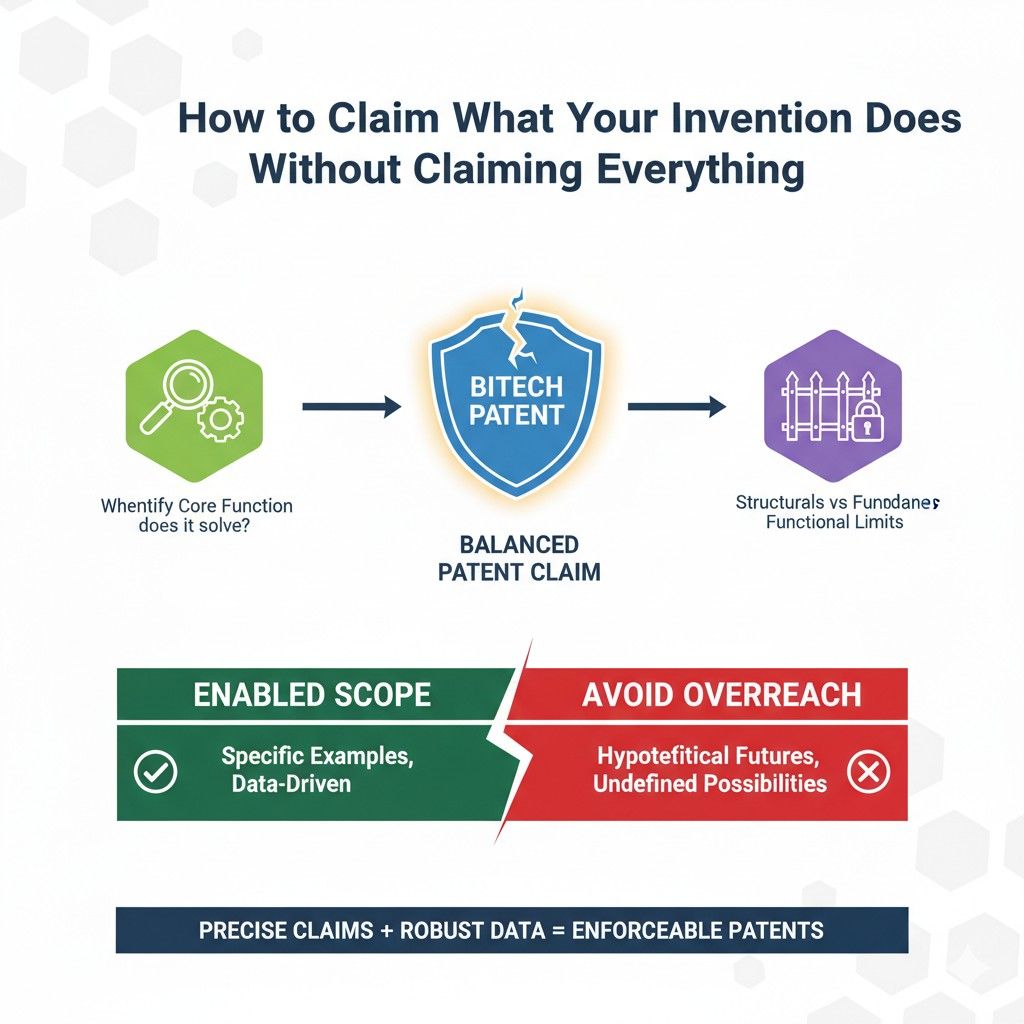
This is where business insight matters as much as legal skill. Founders know where shortcuts exist and where true differentiation lies.
Align Claim Scope With What You Can Defend Later
A claim is only as strong as your ability to defend it. Broad functional claims look good until challenged. Narrow ones feel safe but may not matter.
The right scope sits between those extremes. It covers what you can explain, support, and stand behind years later.
Founders should imagine explaining the invention to a skeptical expert under pressure. If the story holds, the claim is likely in the right place.
Use Continuations as a Strategy, Not a Rescue Plan
Well-written biotech patents often rely on continuation filings. These allow claims to evolve as the product and data mature.
The mistake is treating continuations as a way to fix poor initial disclosure. They cannot add missing teaching.
The smart move is using the first filing to lay a strong foundation of functions, examples, and explanations. Continuations then refine scope without risk.
Why This Approach Builds Long-Term Company Value
Patents written this way age well. They stay relevant as products change. They hold up in diligence. They deter competitors without inviting easy attacks.
This is not about legal elegance. It is about building a durable asset that supports growth, partnerships, and exits.
PowerPatent was built to help biotech teams do exactly this, combining clear thinking, smart software, and real attorney oversight so founders can claim what matters without slowing down innovation.
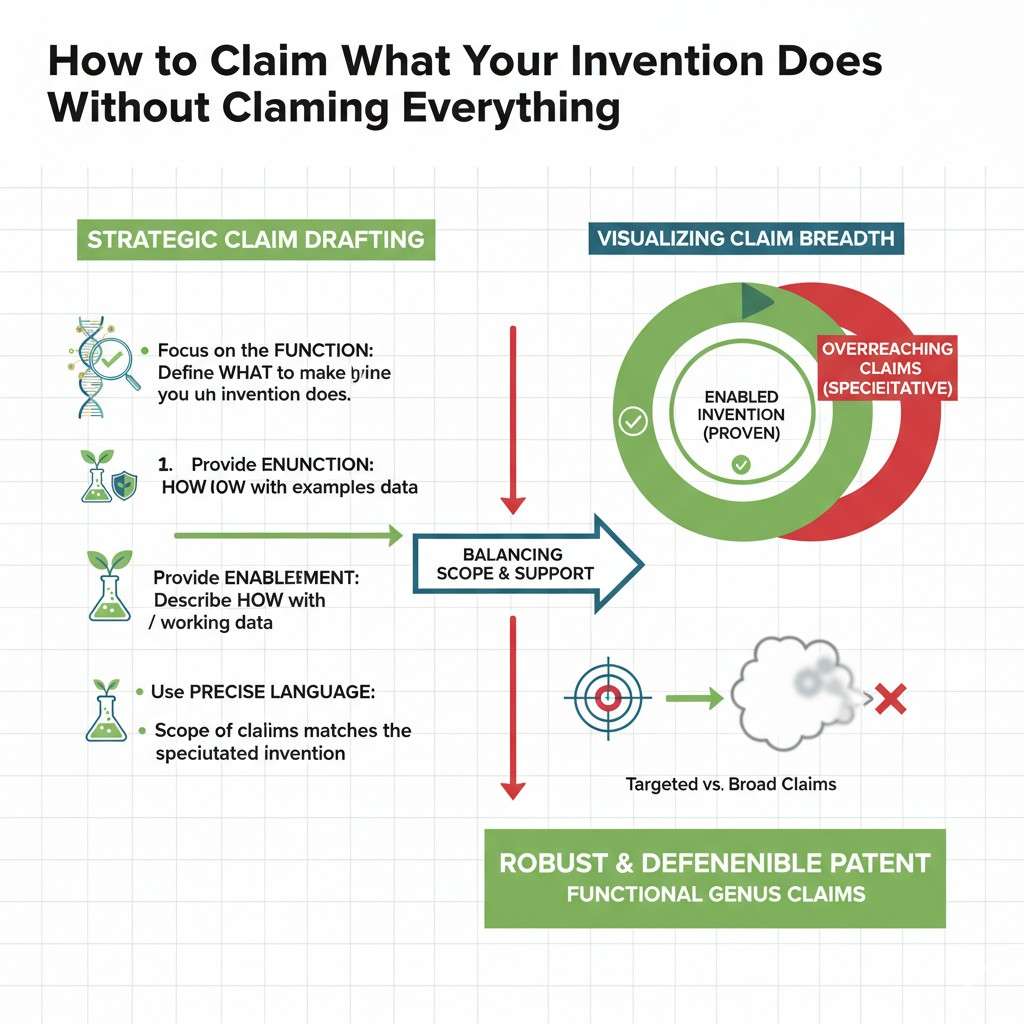
If you want to see how this works in practice, you can explore it here: https://powerpatent.com/how-it-works
This section brings the core ideas together. I can continue into a deeper discussion on practical drafting techniques, real-world pitfalls, and how teams should organize internally to support this strategy.
Wrapping It Up
Biotech patents are not trophies. They are tools. Their only real job is to protect the value of what you are building when it matters most. That moment usually comes much later, when competitors are closer, money is on the line, and decisions are irreversible.
Functional genus claims sit at the center of that protection. When done right, they let you own what your invention does, not just one narrow version of how it looks today. When done wrong, they either collapse under scrutiny or leave gaps others can walk through. The difference is not luck. It is strategy.