Most founders do not lose patent rights because their idea was weak.
They lose them because they described the idea the wrong way. Functional claiming sits right at the center of that problem. It is one of the most powerful tools in patent writing, and also one of the easiest ways to destroy your own patent if you push it too far. When used well, it lets you protect what your system does, not just what it looks like. When used poorly, it invites rejection, limits your coverage, or worse, makes your patent easy to attack later.
What Functional Claiming Really Means (In Plain English)
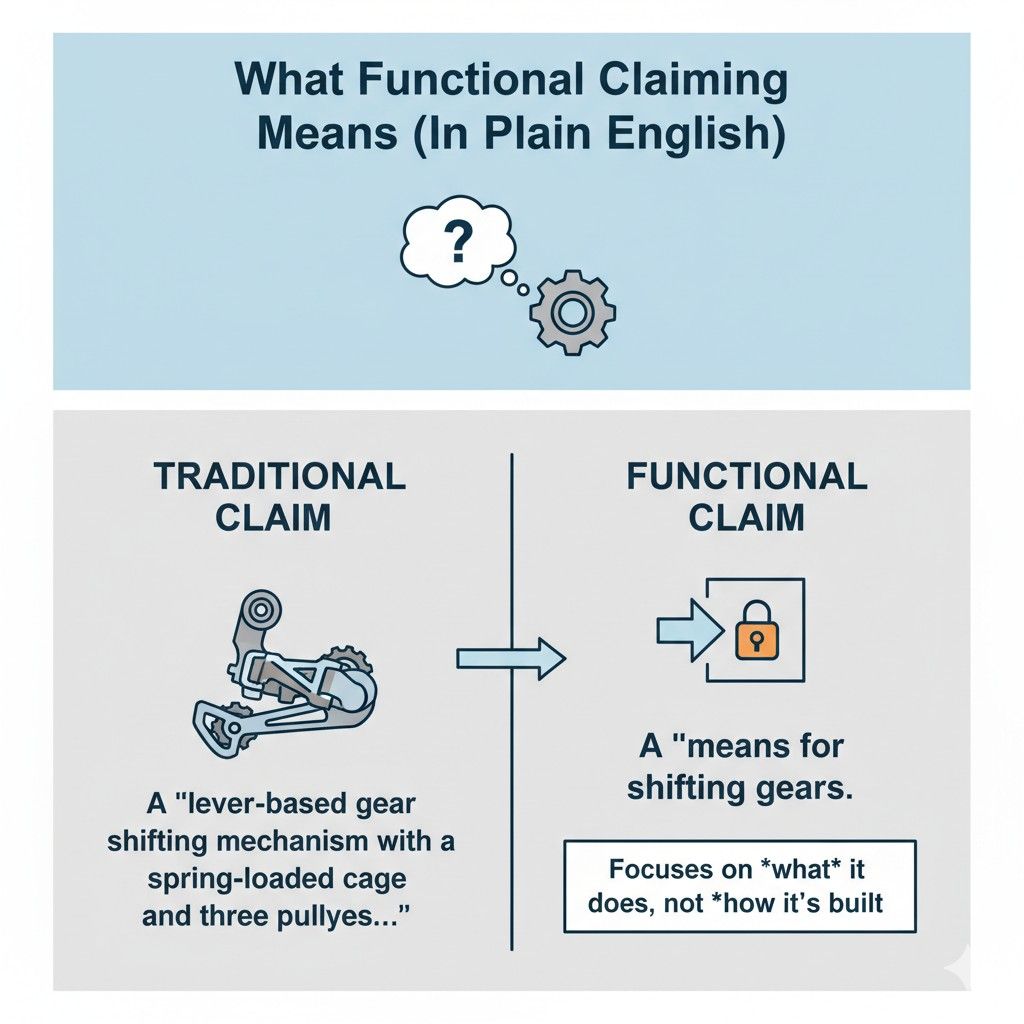
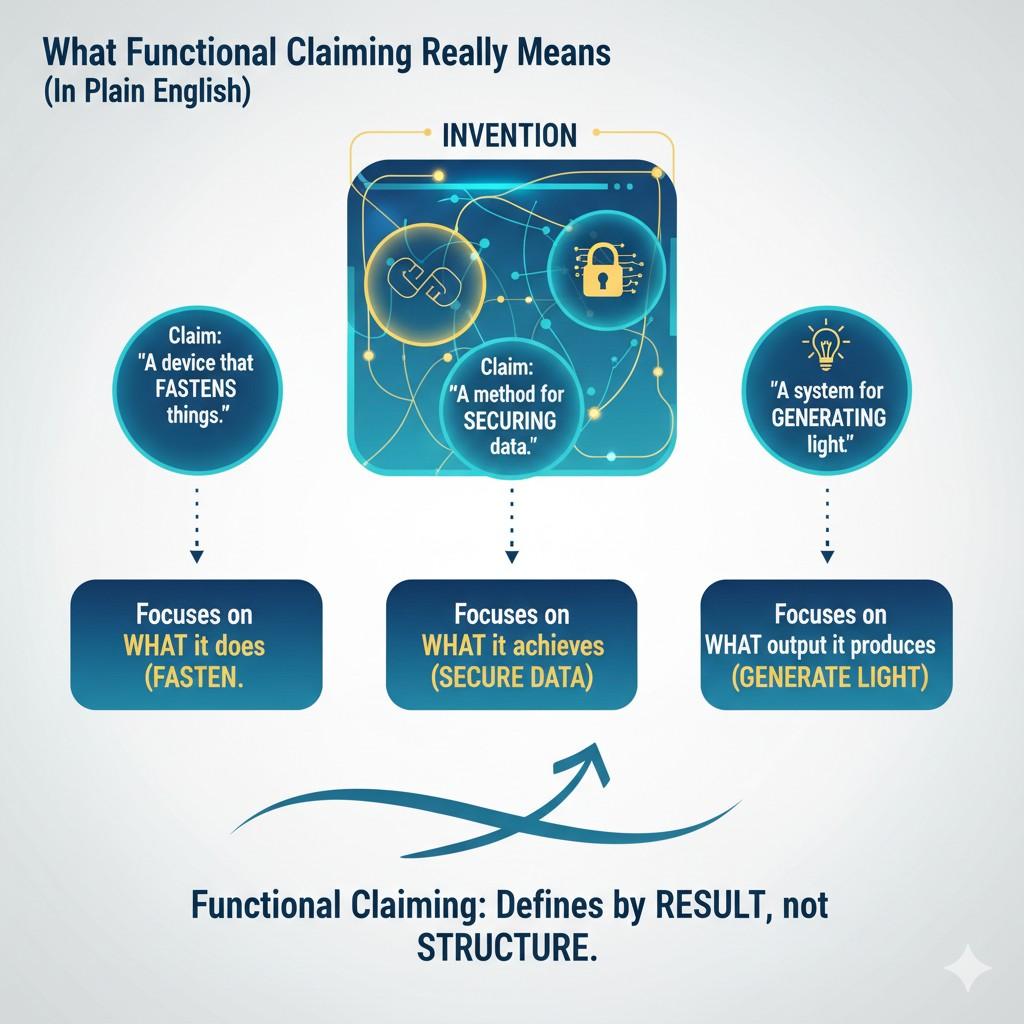
Functional claiming is not a trick. It is not a shortcut. It is a way of telling the patent system what your invention achieves in the real world, instead of getting trapped describing bolts, screens, or lines of code that may change next year.
For businesses, this is where patent value is either created or quietly lost.
Most modern inventions are valuable because of outcomes. Faster processing. Better decisions. Lower cost. Higher accuracy. Functional claiming is how you aim your patent at those outcomes.
But the law does not let you do this freely. It demands clarity, honesty, and real technical grounding.
This section breaks down what functional claiming actually is, how businesses should think about it, and how to use it as a strategic weapon instead of a liability.
Functional Claiming Is About Behavior, Not Parts
At its core, functional claiming describes what something does, not what it is made of. Instead of locking your patent to a specific shape, circuit, or block of code, you focus on behavior.
You explain how the system reacts, processes, decides, or produces a result.
For businesses, this matters because products evolve. Interfaces change. Models improve. Architectures get rewritten.
If your patent is tied too tightly to a specific setup, it ages fast. Functional language lets your patent grow with your product.
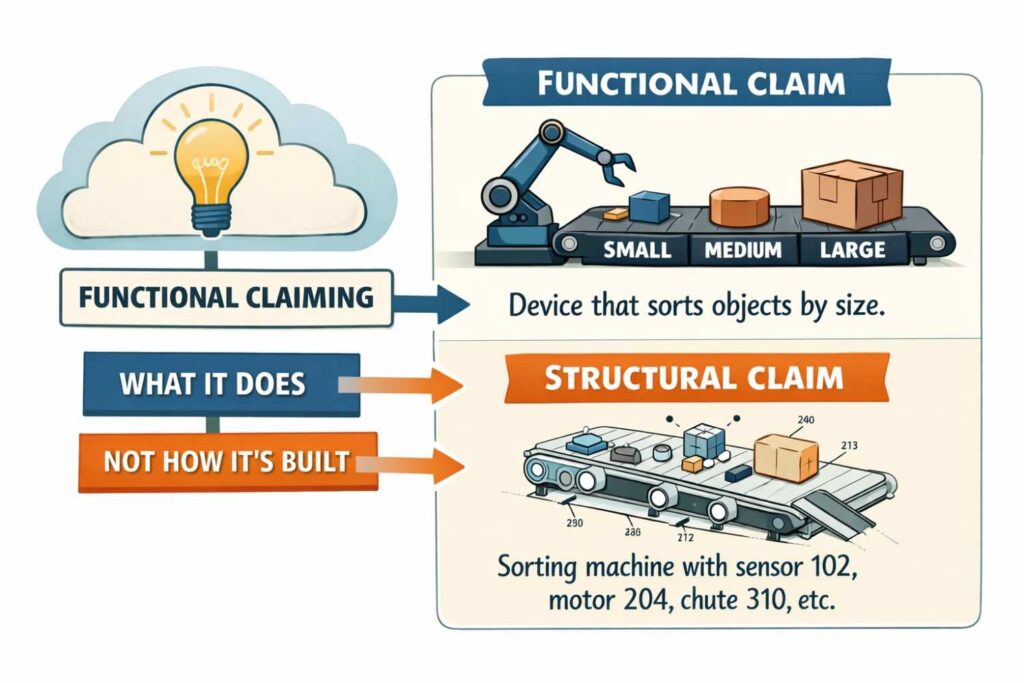
But this does not mean vague language. It does not mean claiming every possible way of doing something. It means clearly defining a function and anchoring it to a real, disclosed solution.
The strongest functional claims read like a description of how your product behaves when it is working properly, not a marketing promise and not a parts list.
Why Businesses Gravitate Toward Functional Language
Founders naturally think in terms of results. They talk about what their system enables, how it improves workflows, or how it solves pain points. That mindset aligns well with functional claiming.
The danger is assuming that because something sounds clear in a pitch deck, it will hold up in a patent. Patent law demands more discipline.
You are allowed to claim behavior, but only if you show you actually know how to make that behavior happen.
From a business view, functional claims are attractive because they can block competitors who copy the idea in a different technical form. If done right, they protect the concept, not just the current build.
This is exactly why investors look closely at patents that rely on functional language. They know the upside is huge, but only if the execution is disciplined.
Functional Claiming Is Not the Same as Being Vague
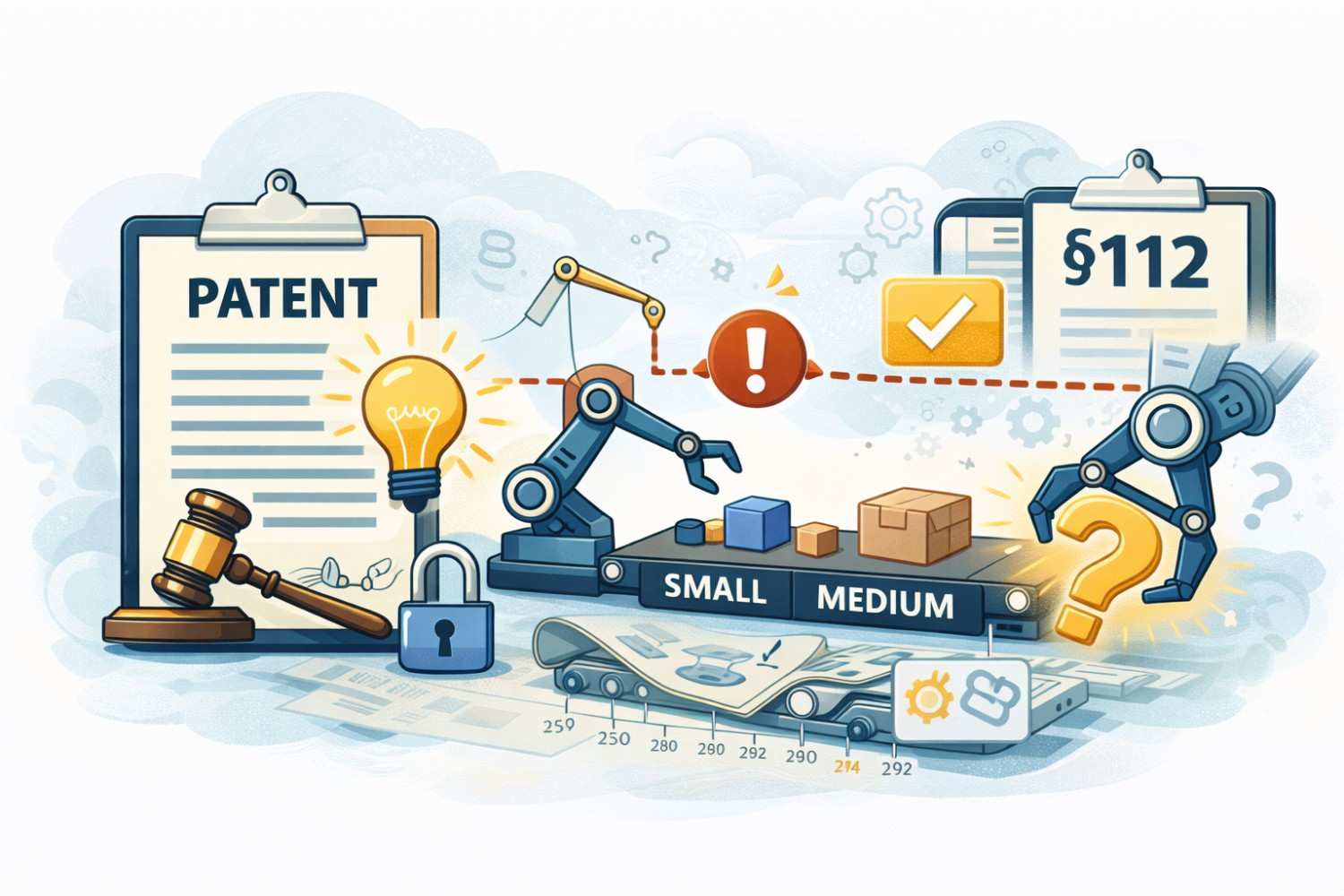
A common mistake is thinking functional claiming means being broad without detail. That is the fastest way to get rejected under §112.
Good functional claiming is specific about the result and specific about how the system achieves that result, even if it allows flexibility in implementation. Bad functional claiming just states an outcome and hopes the examiner fills in the blanks.
For businesses, this distinction is critical. A vague claim may look broad on paper, but it collapses under scrutiny. A precise functional claim often ends up being broader in practice because it is defensible.
When drafting, every functional phrase should trigger a simple question in your mind: could someone skilled in this field actually build this based on what I have described? If the answer is no, you are over the line.
How Courts and Examiners Read Functional Claims
Functional claims are not read with generosity. They are read with suspicion. Courts and examiners assume that functional language can hide overreach, so they look closely at what supports it.
They will compare the function you claim with the examples, descriptions, and explanations in your application. If the function seems larger than what you taught, they will narrow it or reject it.
From a business standpoint, this means your patent application is not just a formality. It is evidence. It must show that you actually possess the invention you are claiming.
This is where many startups fail. They rush the filing, describe one version of the product, and then try to claim every version. The law does not allow that.
Functional Claiming Is a Promise You Must Keep
When you claim a function, you are making a promise to the patent system. You are saying, “I know how to do this, and here is proof.” If that proof is thin, your claim weakens.
This is why functional claiming should be driven by engineers, not just lawyers. The best functional claims come from teams that deeply understand their system and can explain it clearly.
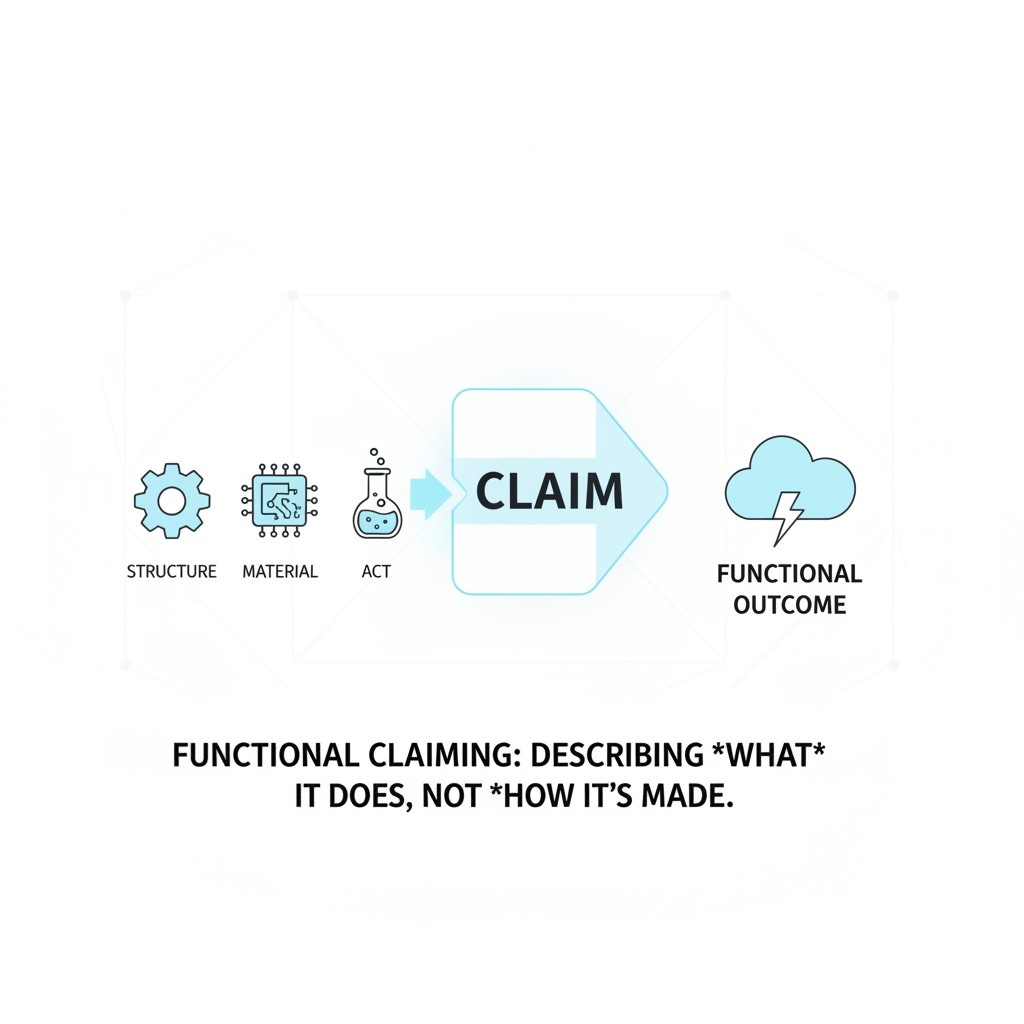
For businesses, the actionable takeaway is simple. Do not file until you can explain, in plain language, how your system achieves each claimed function. If you cannot explain it clearly, you do not yet own it in the eyes of the law.
The Business Value of Claiming Function Correctly
When done well, functional claiming creates real leverage. It lets you cover future versions, block clever workarounds, and negotiate from a position of strength.
It also sends a signal. Competitors reading your patent can see that you understand the problem space deeply. That alone can deter copying.
On the flip side, poorly drafted functional claims invite challenges. They give competitors room to argue that your patent is unclear or unsupported. That risk shows up during diligence, licensing talks, and exits.
This is why platforms like PowerPatent focus so heavily on functional clarity.
The software helps founders express what their invention does in a way that is precise, supported, and aligned with §112, while real patent attorneys review and refine it.
You can see how that works here: https://powerpatent.com/how-it-works
Turning Functional Insight Into a Drafting Strategy
The most practical way to approach functional claiming is to start from real system behavior. Not marketing claims. Not abstract goals. Actual steps and reactions inside your product.
Describe what triggers a function, what inputs are used, what processing occurs, and what output results. Then explain at least one concrete way the system accomplishes that function.
For businesses, this approach has a side benefit. It often surfaces hidden innovation. Teams realize they have built unique logic or flows they never thought to protect.
Functional claiming is not about stretching language. It is about revealing substance.
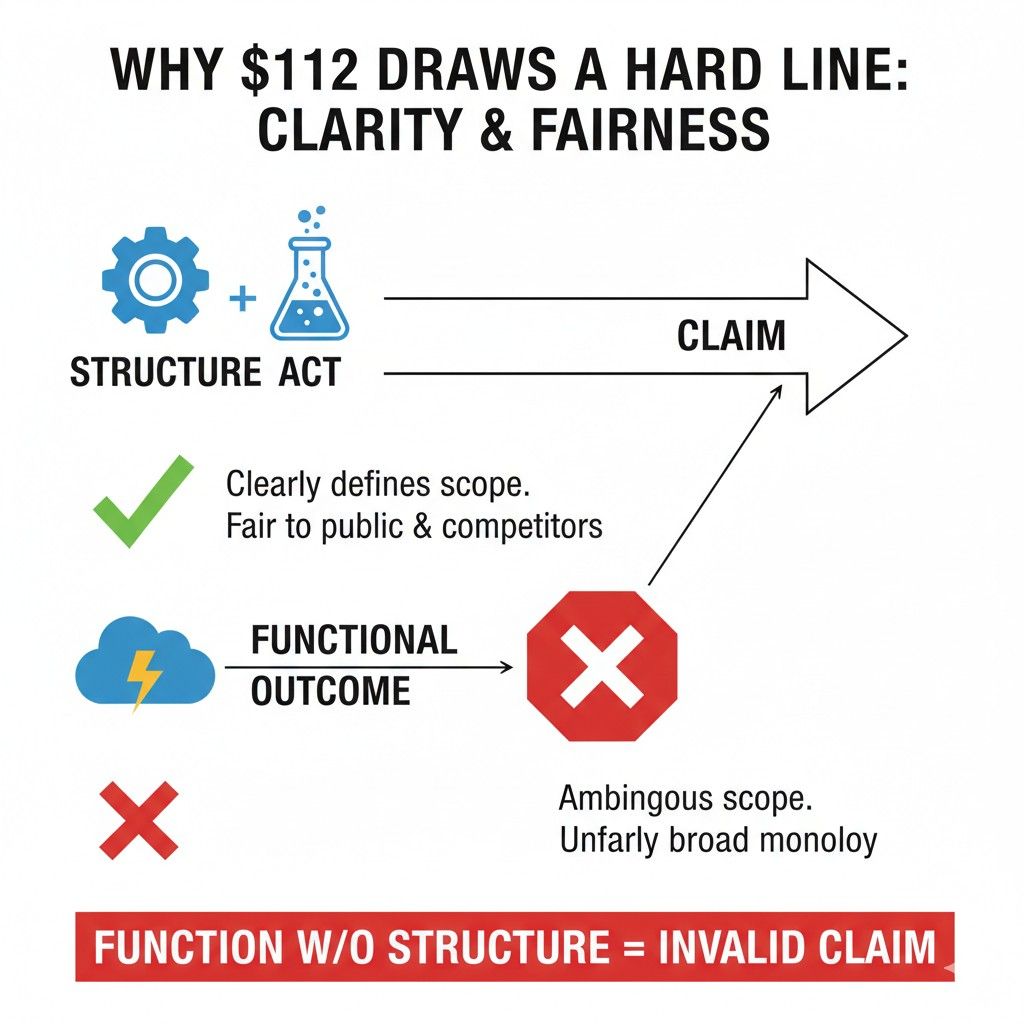
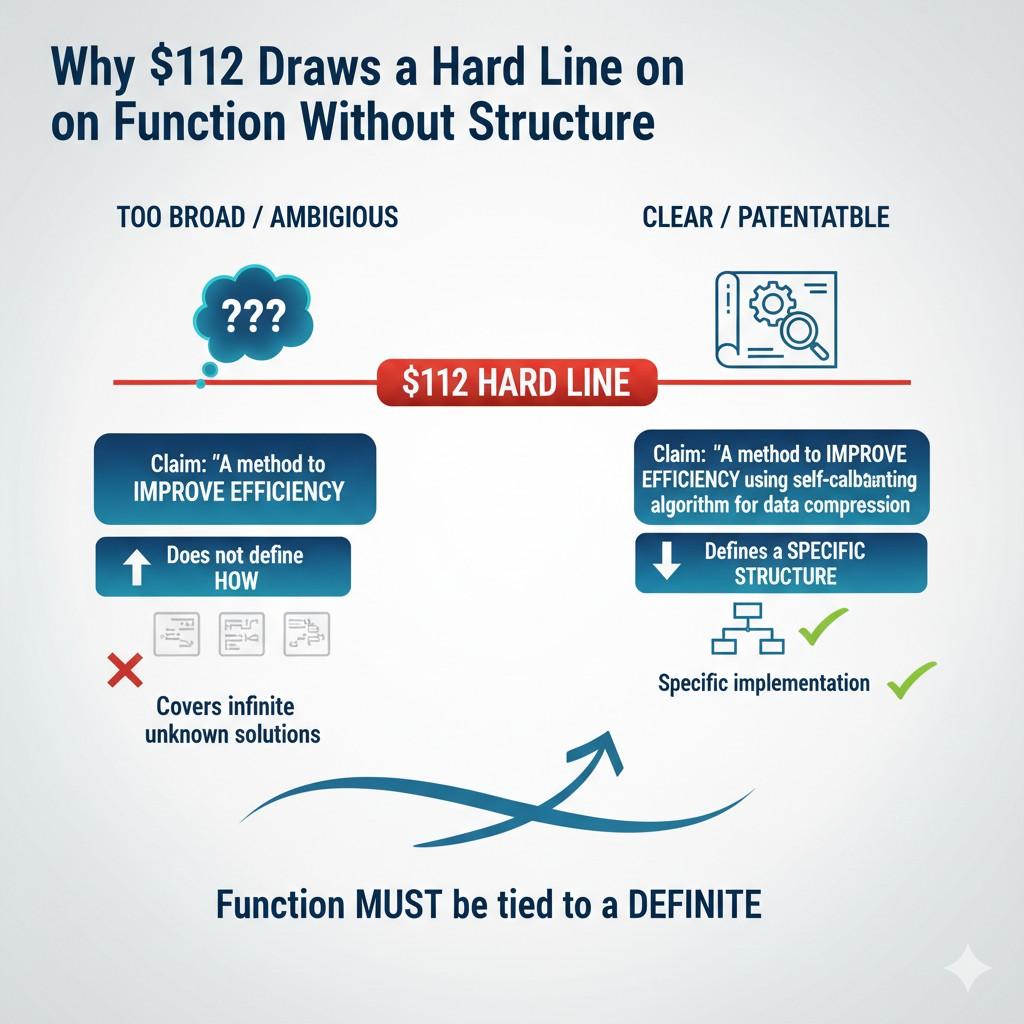
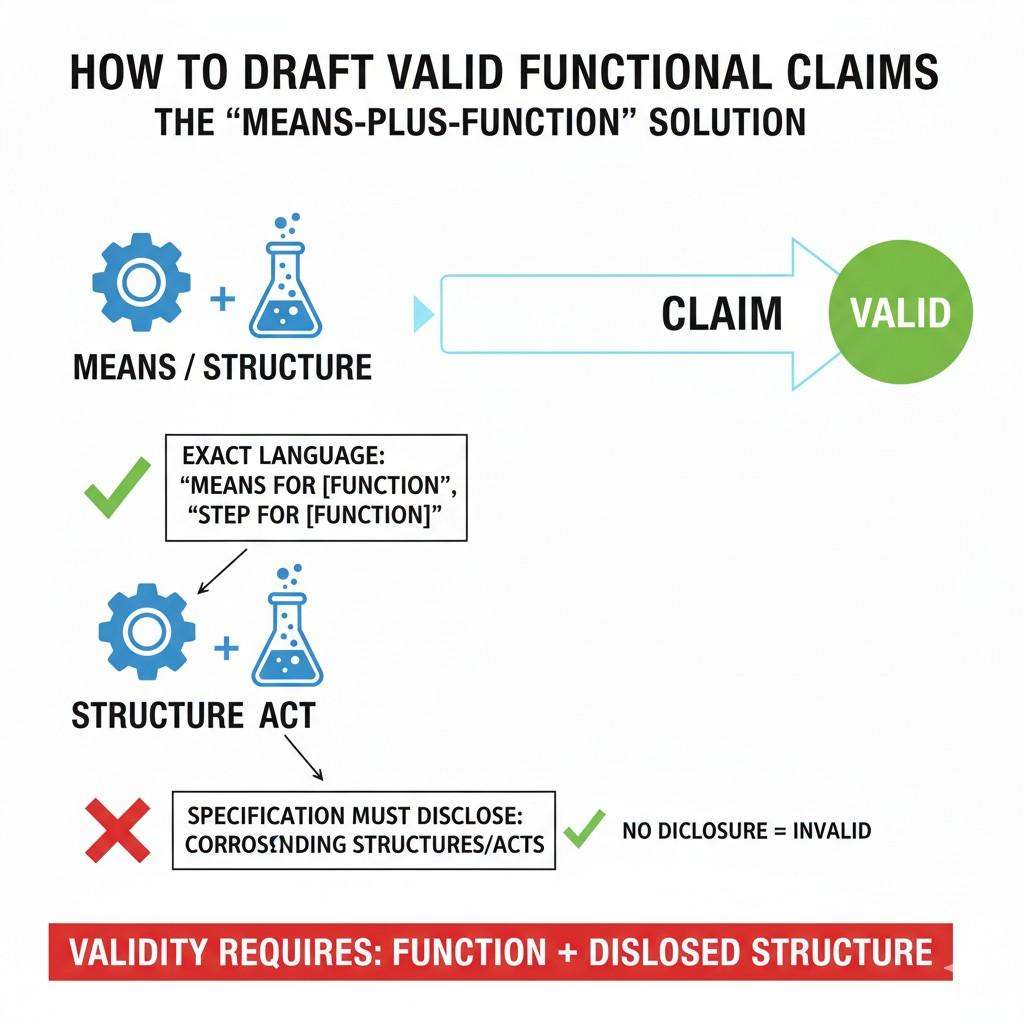
Why §112 Draws a Hard Line on Function Without Structure
Section 112 exists for one reason: to make sure patents reward real invention, not wishful thinking. When it comes to functional claiming, this rule becomes sharp and unforgiving.
Many businesses only learn about it after they receive a rejection or during a painful due diligence review. By then, the damage is often locked in.
Understanding why §112 draws this line helps you draft stronger patents from day one and avoid traps that quietly shrink your protection.
The Core Fear Behind §112
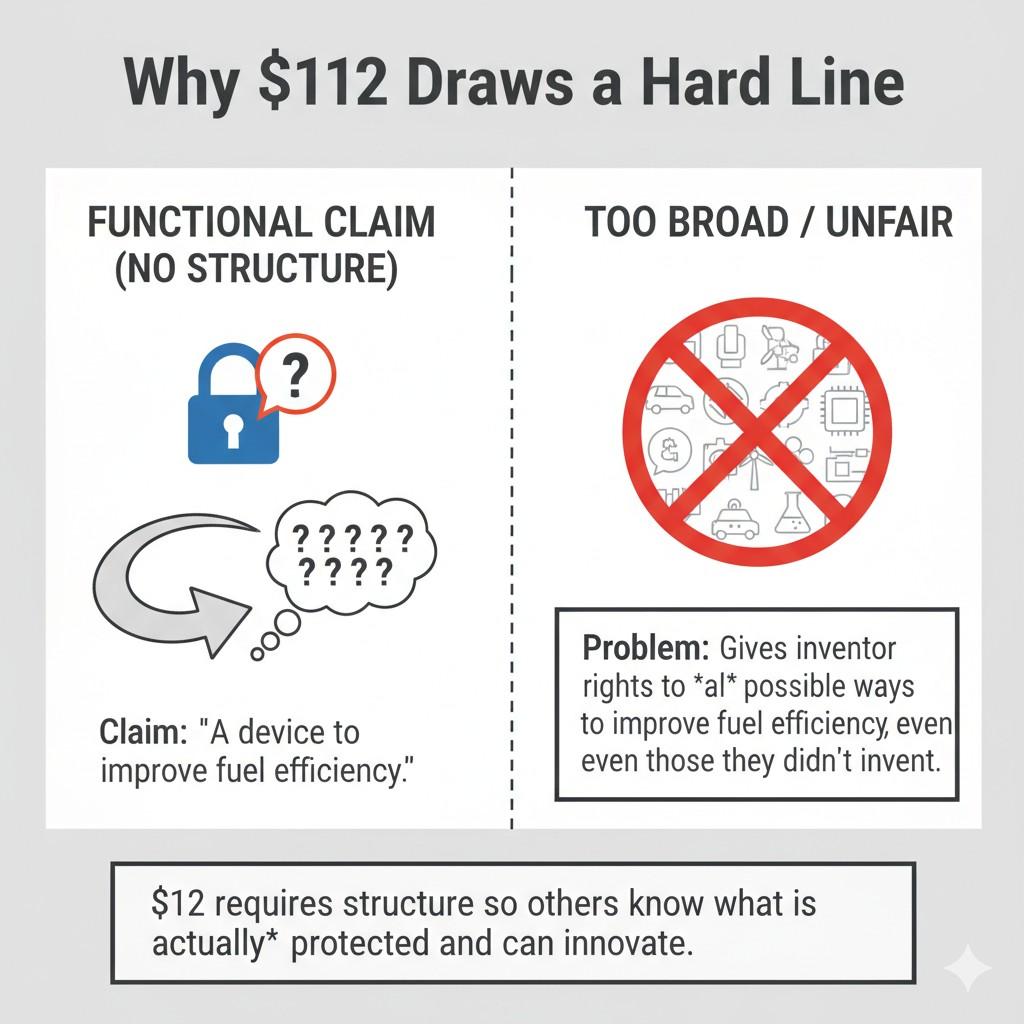
The patent system is afraid of empty ownership. It does not want someone to claim control over a result without actually teaching how to achieve it.
Functional claiming triggers this fear because it focuses on what happens, not how it is built.
If the law allowed pure function without structure, the first person to name a problem could block everyone else from solving it. That would freeze innovation instead of encouraging it.
So §112 acts as a gatekeeper. It allows functional language, but only when the inventor proves they truly possess the invention. This proof must be inside the patent itself.
For businesses, this means your patent application must stand on its own. It must show depth, not just vision.
What “Structure” Really Means in Modern Inventions
Many founders hear the word structure and think of physical parts. That is outdated. In software, AI, and data-driven systems, structure often means logic, steps, data flow, or system arrangement.
Structure is anything that explains how the function is achieved. It can be an algorithm description, a processing flow, a decision rule, or a system interaction.
What matters is that it is concrete enough that another skilled person could reproduce the behavior.
For businesses building fast, this is good news. You do not need to lock yourself into one exact implementation. You just need to show that the function is not magic.
Why Examiners Push Back on Functional Claims
Patent examiners are trained to look for gaps. When they see a claim that says something like “configured to determine” or “adapted to optimize,” they immediately look for support.
If the description does not clearly explain how that determination or optimization happens, the examiner assumes overreach. They are not accusing you of bad faith. They are enforcing §112 as written.
From a business view, examiner pushback is not random. It is a signal that your functional language is running ahead of your disclosure.
The fastest way to respond is not to narrow the claim out of fear. It is to strengthen the explanation so the function stands on solid ground.
The Line Between Flexibility and Overreach
Businesses want flexibility. They want claims that cover future versions and variations. §112 allows this, but only within the boundaries of what you actually taught.
If your patent shows one way to achieve a function, the law often allows coverage of equivalent ways. But if you show almost nothing, you get almost nothing.
The mistake many startups make is filing early with thin disclosure, then trying to claim broadly. That sequence almost always backfires.
A better strategy is to file when you can explain the core logic clearly, even if the product is not finished. That explanation becomes the anchor that lets you claim function safely.
How Courts Use §112 Against Weak Patents
Courts do not rewrite patents to save them. When a patent relies heavily on functional language, courts ask one simple question: did the inventor actually teach this?
If the answer is unclear, the claim can be ruled invalid. This can happen years after filing, often when the patent finally matters.
For businesses, this is the hidden cost of sloppy functional claiming. A patent that looks strong on paper may collapse when enforced.
This is why clarity up front is not just a legal concern. It is a business risk management decision.
Functional Claiming and Software Patents
Software patents live or die by §112. Software is abstract by nature, so functional language is unavoidable. The law knows this and allows it, but demands explanation.
Describing what your software achieves is not enough. You must describe how the software reaches that outcome. This does not require code, but it requires logic.
For businesses, the takeaway is simple. If you can explain your software’s behavior to a new engineer and they can rebuild it, you likely have enough structure for functional claims.
If you rely on phrases like “intelligently,” “automatically,” or “dynamically” without explanation, §112 will cut you down.
Why Overclaiming Hurts Valuation
During fundraising, acquisitions, or licensing, sophisticated reviewers look closely at functional claims. They ask whether the patent actually supports its breadth.
Overclaimed patents create risk. Risk lowers value. Even if no one challenges the patent today, the possibility that it could be invalidated tomorrow affects negotiations.
Businesses that understand §112 use functional claiming as a precision tool. They aim wide, but only where the ground is solid.
This is where PowerPatent helps founders think strategically. The platform guides you to express function with enough technical backing to satisfy §112, while attorney review ensures nothing crosses the line.
You can see that approach here: https://powerpatent.com/how-it-works
Reading §112 as a Design Constraint, Not a Barrier
The smartest teams treat §112 like an engineering constraint. It shapes how you express your invention, not whether you can protect it.
Once you accept that every claimed function needs support, the drafting process becomes clearer. You stop guessing and start explaining.
For businesses, this mindset shift is powerful. It turns patent writing into a reflection of real system understanding, not legal theater.
If you want, I can continue by showing exactly how to draft functional claims that stay aggressive without triggering §112 rejection, using practical patterns that work for modern startups.
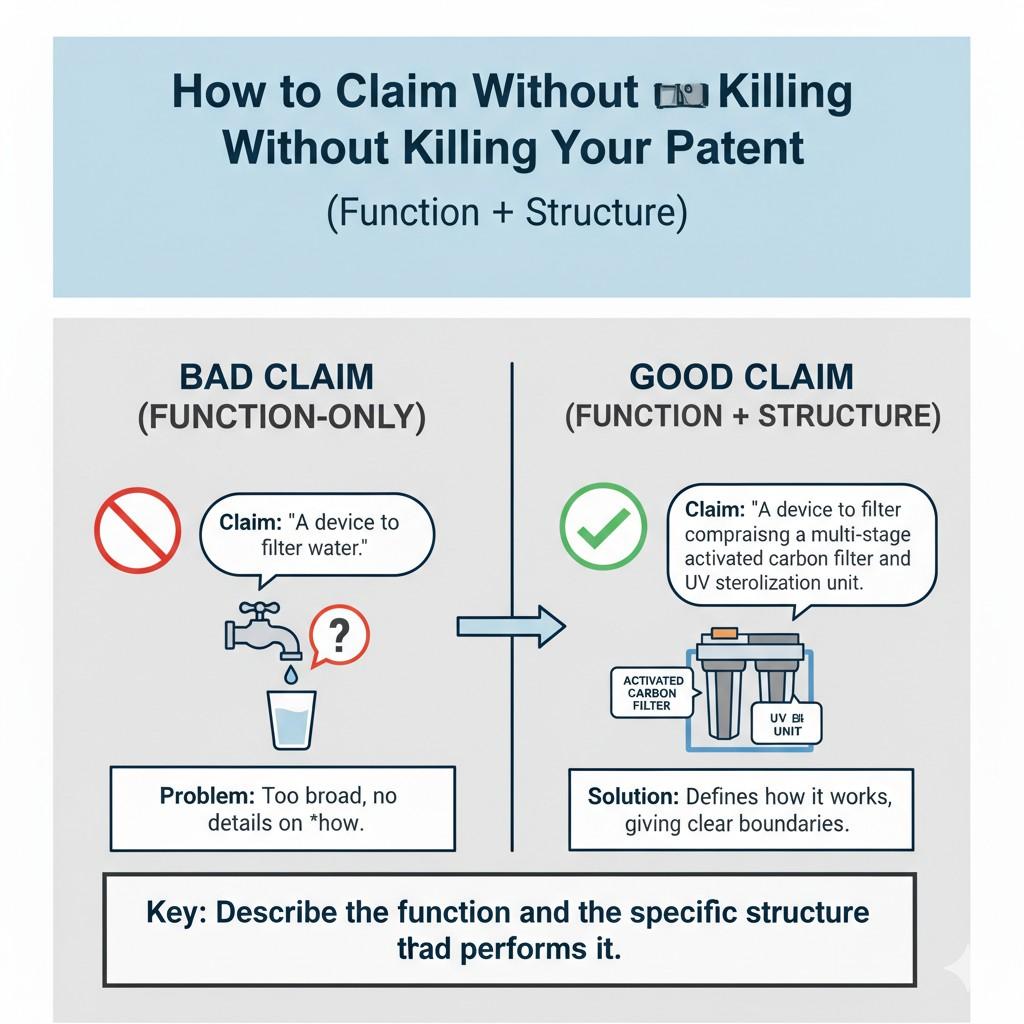
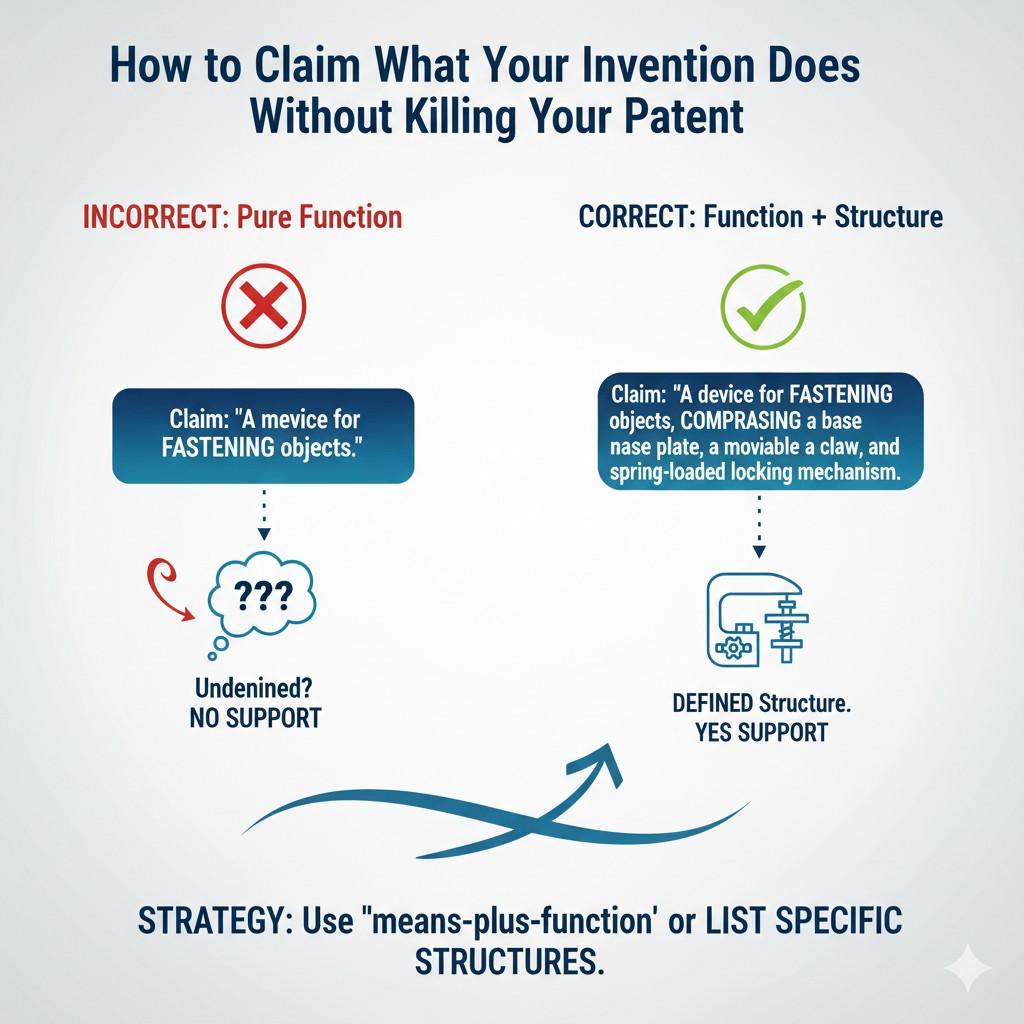
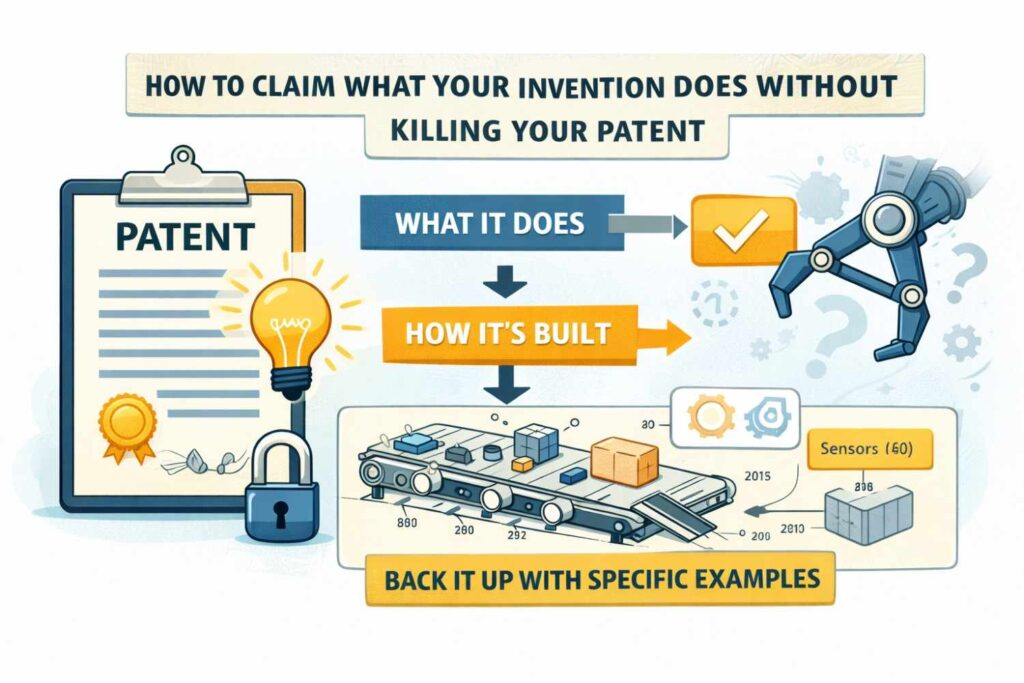
How to Claim What Your Invention Does Without Killing Your Patent
This is the section where theory turns into leverage. Functional claiming is only valuable if it survives examination, holds up later, and still gives your business room to grow.
The goal is not to be safe. The goal is to be strong without being reckless.
Many businesses think functional claiming fails because the law is unfair or unclear. In reality, it fails because inventors skip critical thinking steps when translating real systems into patent language.
This section shows how to do that translation the right way, with depth, control, and intent.
Start With the Real Problem Your System Solves
Every strong functional claim starts with a real-world problem, not a feature. Before writing anything that sounds like “configured to” or “adapted to,” you must be clear about the problem your invention actually fixes.
This is not marketing language. It is operational truth. What breaks without your system? What slows down? What becomes inaccurate, costly, or unreliable?
When you anchor functional claims to a concrete problem, your description naturally becomes more grounded. Examiners and courts respond better to claims that feel necessary rather than abstract.
For businesses, this also sharpens strategy. You stop claiming everything and start claiming what matters most.
Describe the Function as a Sequence, Not a Wish
One of the most effective ways to claim function safely is to think in terms of sequence. What happens first, then next, then after that. Even if your system runs in parallel or dynamically, you can still describe logical progression.
This approach does two things. It proves you understand the function deeply, and it gives structure to behavior without locking you into a single design.
Functional claims supported by clear sequences are harder to attack. They show possession. They show intent. They show that the function is not just an outcome, but a process.
From a business view, this protects you against competitors who copy your flow while changing surface details.
Use Functional Language, Then Immediately Earn It
Functional language should never stand alone. Whenever you describe what a component does, your description should quickly show how it does it.
This does not mean rewriting the claim inside the description. It means backing it up with explanation, examples, and logic.
Think of functional language as a headline and the description as proof. If the proof is thin, the headline collapses.
Businesses that win with functional claiming treat every functional phrase like a claim they must defend later. Because one day, they might.
Claim the Function at the Right Level of Abstraction
Abstraction is where many patents die quietly. Too high, and §112 rejects you. Too low, and competitors walk around you.
The right level sits where the function is clear, repeatable, and supported, but not tied to one narrow implementation.
This requires judgment. It also requires restraint. Claiming less can sometimes protect more, because it keeps your claims believable.
For businesses, this is not about playing small. It is about choosing the layer where your advantage actually lives.
Show Variations Without Losing Focus
One of the smartest ways to strengthen functional claims is to show that the function can be achieved in more than one way. This signals to the patent system that you are not guessing.
Variations do not need to be exhaustive. They need to be thoughtful. Different data sources. Different decision rules. Different system arrangements.
By doing this, you expand the practical reach of your functional claim without stretching its credibility.
This is where many startups miss opportunity. They file with a single example and unintentionally limit themselves. Later versions feel new, but legally they are not covered.
Avoid Magical Language That Raises Red Flags
Words like “automatically,” “intelligently,” or “optimally” are not illegal, but they are dangerous if left unexplained. They imply complexity and judgment.
When you use these words, you must explain what they mean in operational terms. What triggers the automation? What inputs drive the intelligence? What metric defines optimal?
Businesses should treat these words as warning lights. They are fine when supported. They are fatal when used as decoration.
Examiners are trained to challenge them. Courts are trained to distrust them.
Draft for a Skeptical Reader, Not a Friendly One
When writing functional claims, assume the reader wants to poke holes. Because someday, they will.
Ask yourself how a competitor would argue that your function is unclear, unsupported, or overly broad. Then fix that weakness in the description before filing.
This mindset changes everything. It turns drafting into defense.
For businesses, this is especially important because patents are often written once and relied on for decades. You do not get to clarify later.
Use the Description to Expand, Not Constrain
Many founders fear that adding detail will narrow their claims. In reality, the opposite is often true.
A rich description gives functional claims room to breathe. It lets courts interpret them broadly because the invention feels fully owned.
Thin descriptions force narrow readings. They box you in.
The trick is explaining without over-specifying. You describe principles, logic, and behavior without freezing form.
This balance is hard, which is why tools matter.
Why Process Matters More Than Templates
There is no template for safe functional claiming. Every invention is different. What works for one system may fail for another.
What matters is process. Asking the right questions. Stress-testing language. Aligning claims with disclosure.
This is where PowerPatent fits into the workflow. The platform guides founders to articulate function clearly, while attorney oversight ensures the result holds up under §112.
It is built to help businesses claim what their invention does without crossing into danger. You can explore that process here: https://powerpatent.com/how-it-works
Functional Claiming as a Business Discipline
The biggest shift happens when businesses stop seeing functional claiming as a legal trick and start seeing it as a discipline.
It forces clarity. It rewards real understanding. It exposes weak thinking early, when it is cheap to fix.
Teams that master this do not just get better patents. They get better at explaining their value, defending their edge, and planning their roadmap.
That is the real upside.
If you want, I can continue by showing common functional claiming mistakes startups make under §112 and how to spot them before filing.
Wrapping It Up
Functional claiming is not about stretching the law. It is about understanding it well enough to use it with confidence. Section 112 does not exist to punish innovation. It exists to make sure the people who claim ownership of an idea actually understand how it works. For businesses, this creates a clear dividing line. Teams that treat patents as paperwork tend to overclaim, underexplain, and hope for the best. Teams that treat patents as strategy use functional claiming to protect the real value of what they are building.