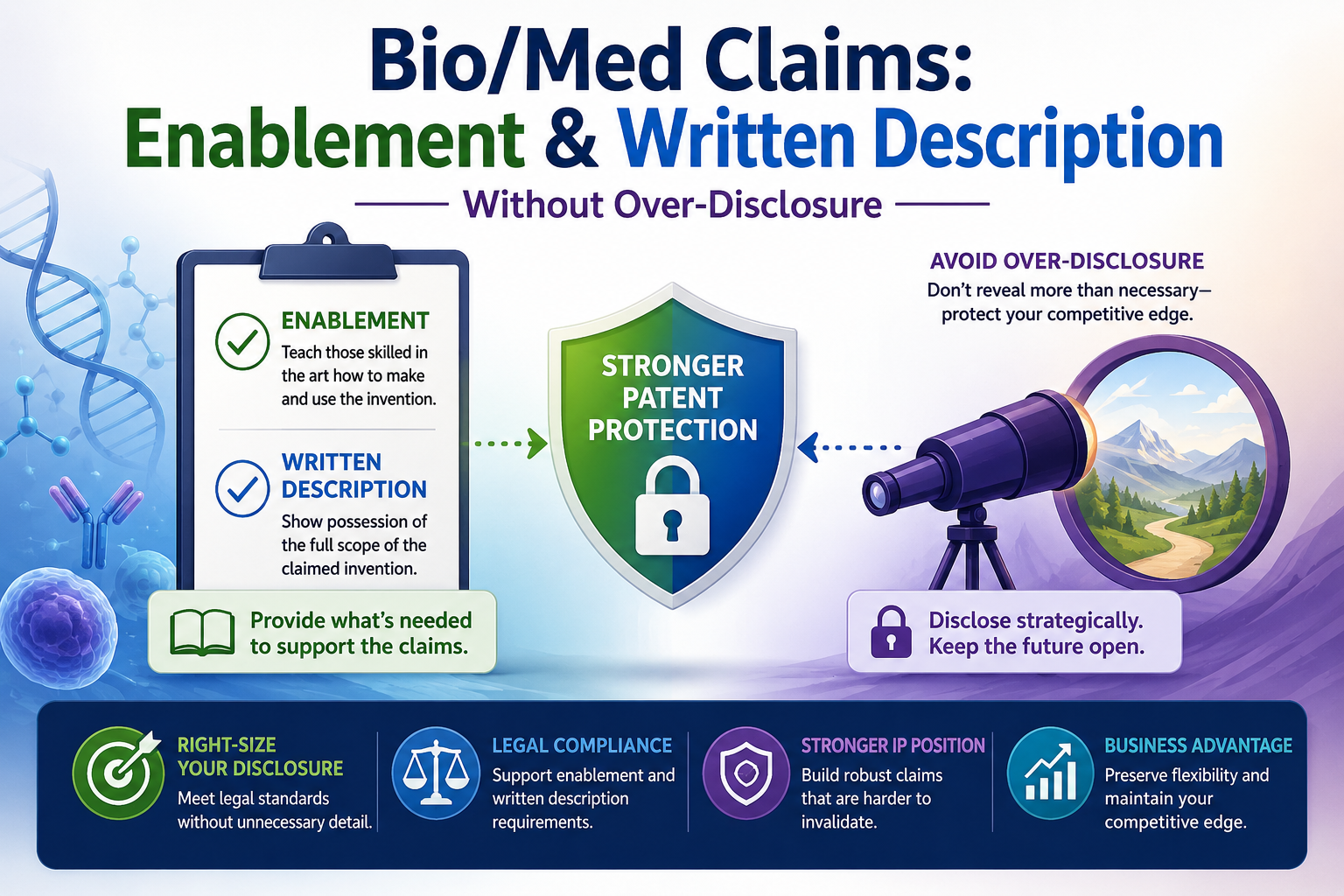
In bio and med tech, your patent can become one of your startup’s most valuable assets. But it can also create risk if it says too little, says too much, or describes the wrong things in the wrong way.
Bio and med claims need proof, but they do not need your whole secret vault
Bio and med inventions live in a tricky place. They are often built on data, tests, lab work, patient insight, chemical structure, device behavior, software logic, model output, or a mix of all of these.
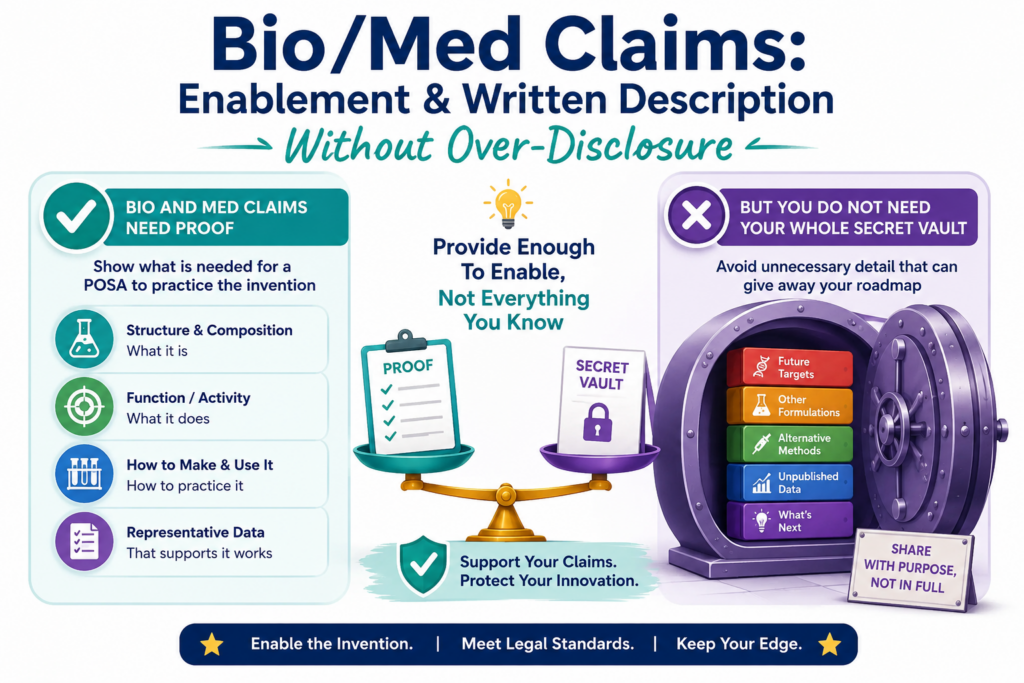
That means a patent filing must show more than a rough idea. It must show that the invention is real enough to support the claim.
But that does not mean you should pour every private detail into the patent.
A strong filing gives enough support to protect the invention. It teaches the key parts. It shows how the invention can be made or used.
It backs up the claim with clear examples. At the same time, it avoids turning the patent into a public recipe book for your whole business.
The real goal is not to say everything, but to say the right things clearly
Many founders think a patent is stronger when it includes more information. That is not always true. More words can help when they support the right claim.
More words can hurt when they expose trade secrets, future product plans, backup formulas, data that is not needed, or narrow details that competitors can use against you later.
The question is not, “How much can we disclose?”
The better question is, “What must we disclose to support the strongest useful claim?”
That shift matters.
In bio and med tech, the patent office wants to see that you were in possession of the invention. It also wants to see that a skilled person could practice the invention without too much guessing. That is the heart of written description and enablement.
But founders must also think like business owners. Every sentence becomes public. Every example may shape how the claims are read. Every narrow detail can become a door a competitor walks around.
A practical way to think about enablement without over-sharing
Enablement means the patent teaches enough so that a skilled person can make and use the invention. In plain words, the filing should not be a wish. It should not just say, “This treatment may work,” or “This system may detect disease,” with no real path for how.
For a bio or med invention, this often means the filing should explain what the invention is, what parts matter, how those parts work together, what examples support the claim, and what range of options can still work.
It may include test data, lab steps, model logic, device settings, biomarkers, patient groups, dosing ranges, sample handling steps, or system flow.
But enablement is not the same as giving away every raw file, every failed run, every supplier, every private process, every future use case, or every hidden product method. The patent should teach the invention, not expose the whole company.
This is where PowerPatent can help. The platform helps technical teams organize what matters, spot gaps, and work with real patent attorneys so the filing is not just full, but focused. You can see the process here: https://powerpatent.com/how-it-works
Written description is about showing you had the invention, not just hoped it would work
Written description is one of the most important issues in bio and med patents. It asks a simple question with big results: did you actually have the invention when you filed?
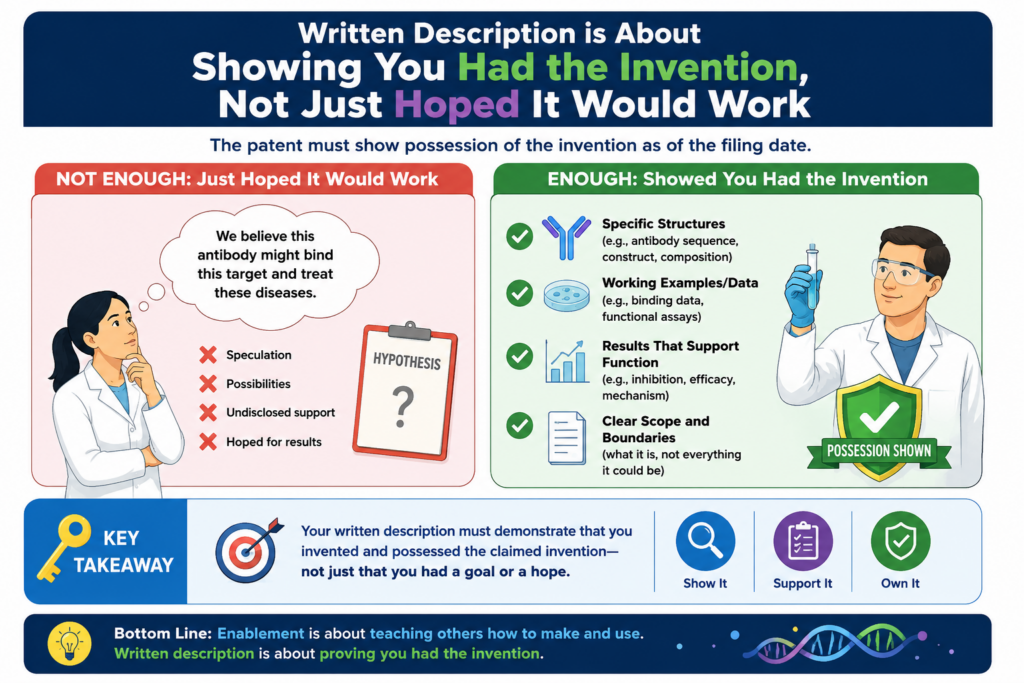
That matters because bio and med claims often reach across groups of things. A claim may cover a class of antibodies, a family of compounds, a range of doses, a set of biomarkers, a diagnostic rule, a cell therapy method, a medical device system, or a treatment plan for a patient group.
If the claim is broad, the filing needs enough support to show that the team truly had that broad idea, not just one small example.
A single example may not support a wide claim
A founder may say, “We tested one version and it worked, so we want to claim all versions that work the same way.”
That may sound fair from a business point of view. But in patent work, it can be risky. One working example may support a narrow claim.
It may not support a broad claim that covers a full class, a full pathway, or many types of patients. The filing needs to connect the example to the wider idea.
For example, imagine a startup finds that one biomarker pattern can predict response to a therapy. If the patent only shows one small patient group, one test method, and one exact threshold, it may be hard to claim every way of using that biomarker in all patient types.
The filing may need to explain why the marker matters, how it links to the disease state, what kinds of samples can be used, what ranges may work, and how the result can guide care.
That does not mean the company must reveal every future study plan. It means the filing should make the invention feel owned, not guessed.
The claim should match the story the patent can truly support
A strong patent has a clean match between the claim and the details. If the claim is about a method of treating a disease, the filing should support the treatment method.
If the claim is about a diagnostic tool, the filing should support how the tool detects or predicts something useful. If the claim is about a medical device, the filing should support the structure, function, and use of that device.
Problems often start when the filing tells one story but the claims try to cover another.
For example, the patent may describe one lab workflow, but the claims try to cover all workflows. The patent may describe one compound, but the claims try to cover a wide chemical class.
The patent may describe one AI model trained on one data type, but the claims try to cover all ways to detect a condition from any health signal.
This is where founders need care. You want claims that are broad enough to matter, but not so broad that they float above the support. A claim that cannot stand up is not a strong shield. It is a weak promise.
PowerPatent helps teams turn invention notes, data, diagrams, and product details into a cleaner patent story.
The point is to help protect what is real, valuable, and defensible without making the filing messy or risky. Learn how it works here: https://powerpatent.com/how-it-works
Over-disclosure can weaken your business even when it makes the patent look longer
More detail can be useful. But more detail is not always more protection.
A patent is public. Once it publishes, competitors, investors, partners, large companies, and future acquirers may read it.
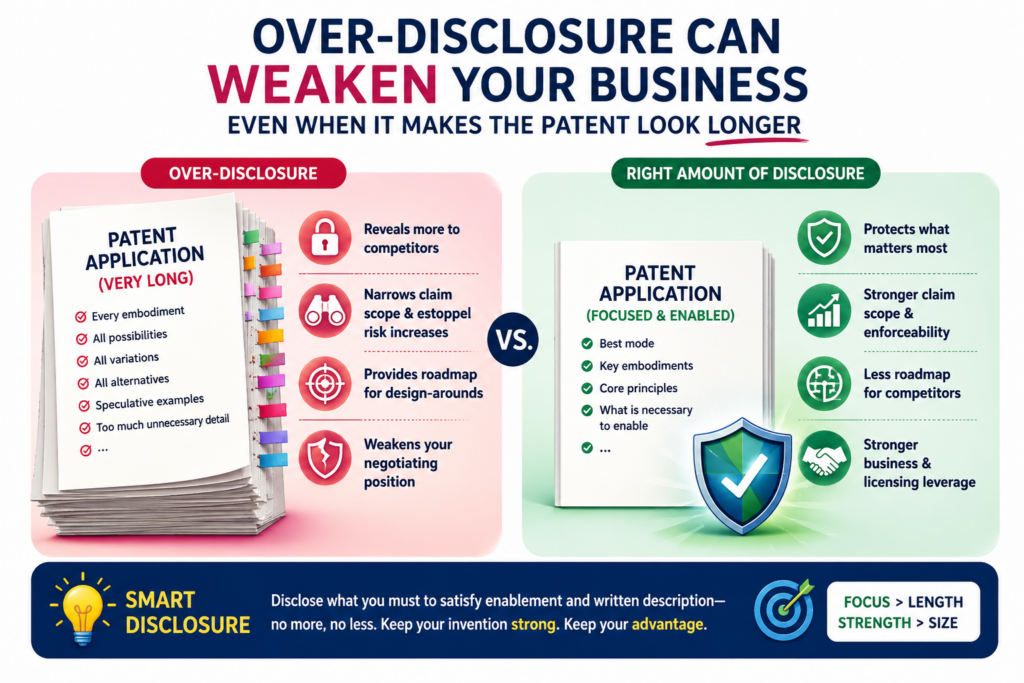
That means the filing should be written with both legal strength and business safety in mind. It should not be thin. But it should also not expose private know-how that does not need to be there.
In bio and med tech, the most sensitive information may not be the broad invention idea. It may be the little details that make the product work better.
It could be sample prep steps, patient selection rules, assay tuning, model training choices, device calibration, formulation tricks, manufacturing shortcuts, or internal decision logic.
The danger is giving competitors a head start
A patent gives public rights in exchange for public teaching. That is the basic trade. But the filing should not teach more than needed to support the claims.
If a competitor reads your patent and can copy your exact lab workflow, see your best ranges, avoid your claim language, and build a nearby product, the patent may have given away too much in the wrong way.
This is especially painful when the extra detail did not even help support the main claims.
This is why patent drafting is not just a writing task. It is a strategy task.
The team must decide what belongs in the patent and what may be better held as trade secret. A trade secret is information you keep private because it gives your company an edge.
Not every secret can stay secret, and not every secret should. But founders should at least make the choice on purpose.
The mistake is dumping everything into the filing because it feels safer.
The best filings protect the invention while keeping private know-how private
A good bio or med patent filing often uses enough examples to support the claim, but it does not treat the patent like a lab notebook. It may show representative data without exposing all raw data.
It may describe useful ranges without naming every internal favorite condition. It may explain system logic without revealing every production rule.
It may show how the invention works without disclosing every future product version.
The key is balance.
You want to give the patent office a clear reason to allow the claim. You want future readers to see that the team had the invention.
You want investors to see real depth. But you do not want to give rivals a free operating manual.
This is especially true for startups. You may still be learning. Your product may change. Your data may grow. Your best commercial use may shift.
A rushed filing that over-shares the wrong details can lock in a public record before the business is ready.
That is why founders should work from a claim-first mindset. Start with the business moat. Ask what must be protected.
Then decide what support is needed. Then decide what should stay out because it does not help the claim and may hurt the company.
PowerPatent was built for this kind of careful work. It helps founders move fast while still getting attorney-backed guidance, so the patent does not become a slow, costly guessing game.
See how startup patent drafting can work with less friction here: https://powerpatent.com/how-it-works
The safest claim strategy starts with the business goal, not the science dump
A bio or med patent should not begin as a pile of lab notes. It should begin with a clear business question: what part of this invention would hurt most if a competitor copied it?
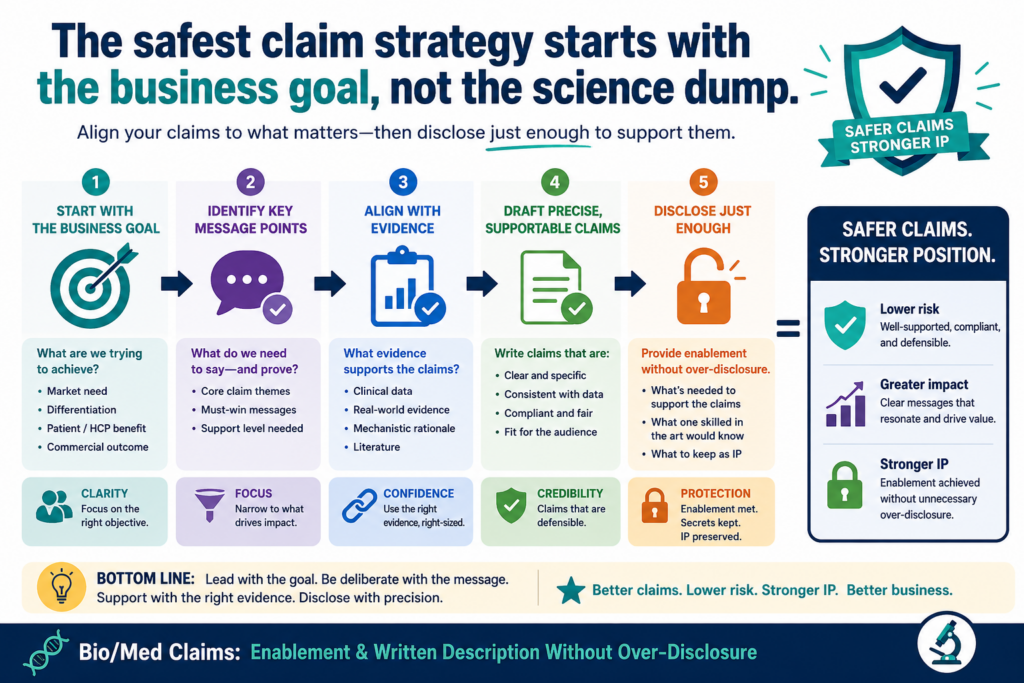
That answer should shape the claims.
Many technical teams start by describing everything they built. That feels natural because founders and scientists are close to the work. They know the pathway, the model, the assay, the device, the trial idea, the patient need, and the edge cases.
But a patent is not a product diary. It is a protection tool. The filing should be built around the parts that create real market power.
If the value is in a biomarker panel, the filing should support that panel and its useful variations. If the value is in a treatment method, the filing should support the patient group, the dose logic, the timing, and the expected result.
If the value is in a device workflow, the filing should support the hardware and software steps that make the device hard to copy.
The claim should guard the part of the invention competitors will want most
The best claims often cover the point where science meets money. That may be the test result that changes care.
It may be the dose rule that improves safety. It may be the device feature that reduces error. It may be the model output that gives a clearer diagnosis. It may be the formulation that makes a therapy stable.
A weak filing may describe these ideas, but not protect them well. It may spend pages on background science while the real invention gets only a short mention. That is a common problem.
Founders sometimes explain the problem in great depth, then rush through the solution. The patent ends up teaching why the market matters, but not enough about why the invention is hard to copy.
That is backward.
The filing should move fast from the problem to the inventive edge. It should explain the pain in the market only as much as needed. Then it should focus on the system, method, compound, assay, device, model, or workflow that solves the pain.
The support should be chosen to make the claim feel earned
Strong claims feel earned because the filing gives the reader a clear path from idea to use. This does not mean the filing must include every test result. It means the chosen details should carry weight.
For example, a med device startup may not need to share every internal design file. But it should explain the structure that matters, how the parts interact, how the device is used, and why those choices improve performance.
A bio startup may not need to reveal every raw dataset. But it may need enough examples, ranges, and reasoning to show that the claimed group is more than a guess.
This is where founders should avoid two bad extremes.
The first extreme is hiding too much. That can leave the claims weak. The second extreme is sharing too much. That can give away business secrets. A smart filing sits between those extremes.
It gives the patent office and future readers enough to trust the invention, while keeping private know-how out when it does not support the claim.
PowerPatent helps founders build this kind of claim-first strategy without slowing down the company.
The platform helps turn technical input into a clearer patent draft, with real patent attorney review built into the process. You can see how it works here: https://powerpatent.com/how-it-works
Enablement works best when the patent teaches repeatable paths, not scattered facts
Enablement is not about filling pages. It is about teaching a skilled person how to make and use the invention without too much trial and error.
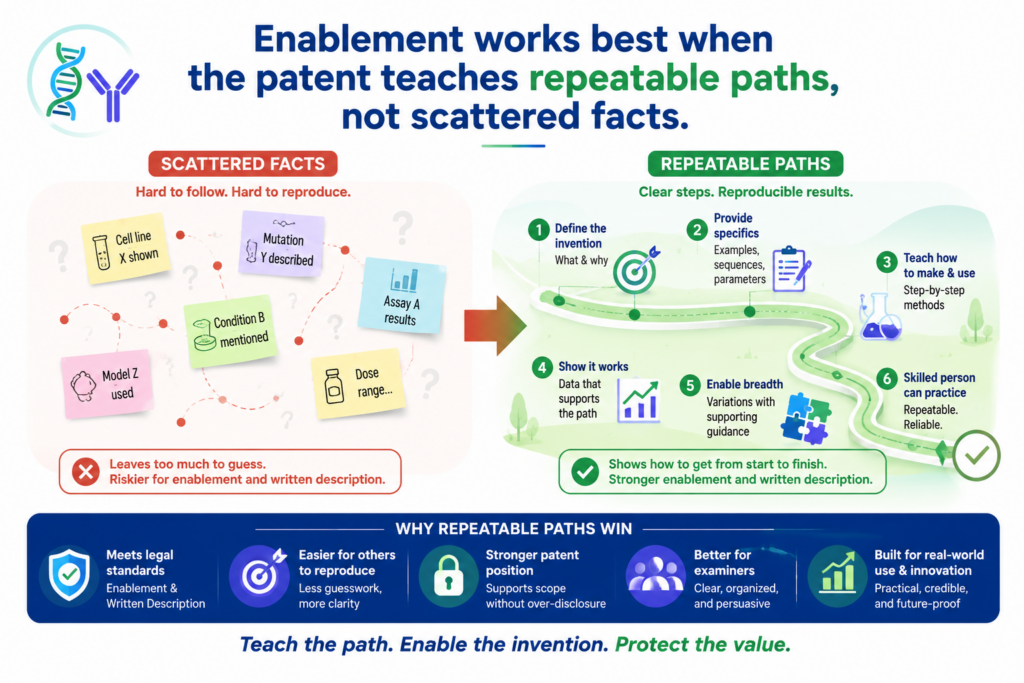
That point matters in bio and med work because results can depend on many small choices. A cell line may behave differently under different conditions. A medical device may give different readings based on placement or calibration.
A diagnostic model may change based on training data. A therapy may work in one patient group but not another. These details can matter a lot.
A strong patent does not need to solve every possible version of the invention. But it should give a repeatable path for what is being claimed.
The filing should show the practical steps that make the invention work
For a bio invention, this may mean describing the materials, conditions, measurements, and use cases that support the claimed result. For a med device invention, it may mean describing the sensor setup, signal handling, user flow, safety controls, and output.
For a digital health invention, it may mean describing how data enters the system, how the system processes it, and how the result is used in care.
The key is that the reader should not feel lost.
If the filing says a model can detect a disease, it should explain what kind of data the model uses and how the result is produced. If the filing says a treatment improves a patient outcome, it should explain enough about who is treated, what is given, when it is given, and what effect is expected.
If the filing says a compound class has a useful property, it should give enough examples or structure logic to support that class.
This does not mean the patent must reveal secret production tricks. It does not mean every private protocol belongs in the filing. It means the patent should teach the invention at the level needed for the claim.
The danger zone is when the claim is broader than the teaching
A claim becomes risky when it covers more than the filing teaches.
For example, a startup may test one assay with one sample type, then try to claim every sample type.
Or it may test one dosing schedule, then try to claim all dosing schedules. Or it may show one device layout, then try to claim all ways to perform the same broad function.
That gap can create trouble later.
A patent may look strong on filing day because the claim sounds wide. But if the support is thin, that wide claim may be attacked.
A competitor may argue that the patent did not teach enough. An examiner may reject the claim. An investor may see risk during diligence. A partner may ask hard questions before signing a deal.
The fix is not always to narrow everything. The better move is to support the right width. If you want a broader claim, the filing should explain why the broader group works.
It should include enough examples, enough reasoning, and enough fallback positions so the patent can adapt as the review process moves forward.
That last point is important. A good patent filing often includes layers. There may be a broad idea, a practical version, a preferred version, and a narrower backup version.
These layers help the company keep useful protection even if the broadest claim faces pushback.
PowerPatent is built to help technical founders capture these layers early, before key details are forgotten or scattered across docs, slides, code, and lab systems.
The goal is simple: move fast, protect the right thing, and avoid costly gaps. Start here: https://powerpatent.com/how-it-works
Written description gets stronger when the patent shows real possession of the full idea
Written description is often where bio and med filings get tested hardest. The issue is not only whether the invention works. The issue is whether the filing shows that the inventor truly had the claimed invention at the time of filing.
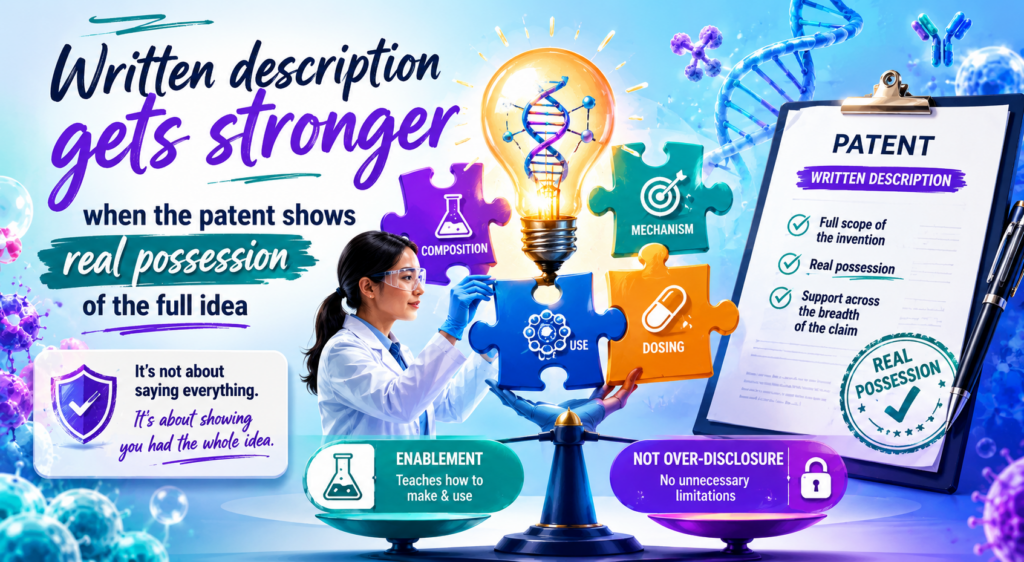
This sounds simple, but it can become difficult when claims cover groups, ranges, families, or future-facing uses.
A patent cannot simply point to a goal and claim every way to reach it. It should describe the invention with enough detail that the reader can see the inventor was not just hoping.
The filing should show possession through clear structure, clear examples, clear links, and clear boundaries.
A good written description makes the invention feel specific without making it too narrow
The filing should not sound like a wish list. It should not say that many things could work without showing why. It should not describe a result and leave the real invention blurry.
For example, saying “a system for improving diagnosis” is not enough by itself. The filing should explain what data is used, what the system does with the data, what output is created, and how that output improves a medical decision.
Saying “a compound for treating cancer” is also not enough by itself. The filing should explain which compound or class, what disease type, what mechanism or effect, and what use supports the treatment claim.
At the same time, the filing should avoid trapping the company inside one small version unless that is the only version the team can support.
The goal is to describe the invention with enough shape to prove ownership, while leaving room for normal product growth.
The best support often comes from carefully chosen examples
Examples matter because they make the invention concrete. They show that the team did more than imagine the result. But examples should be chosen with care.
A useful example should support the claim. It should show a working path. It should help explain the range of the invention. It should give the reader confidence. It should not be included just because it exists.
In some cases, one strong example may help support a narrow claim. In other cases, several examples may be needed to support a wider claim.
For a genus claim, a class claim, or a broad method claim, the filing may need enough representative examples to show that the team had more than one point on the map.
This is where many founders need guidance. They may know which data is most exciting, but not which data best supports the claim. The most impressive result is not always the most useful patent example.
Sometimes the better example is the one that shows the claim can work across a range. Sometimes it is the one that supports a fallback position. Sometimes it is the one that explains why a certain feature matters.
A strong filing is selective. It does not hide the invention. It does not overshare. It uses examples like load-bearing beams. Each one should help hold up the structure.
PowerPatent gives founders a better way to collect the right invention details and work with real attorneys who know how to shape them into stronger filings.
For bio and med teams moving fast, that can mean fewer missed details, fewer weak claims, and less wasted time. Learn more here: https://powerpatent.com/how-it-works
The best bio and med filings use layers so the company has room to grow
A strong patent filing should not protect only the version you have today. It should also leave space for the version you may build next, as long as the filing can honestly support it.
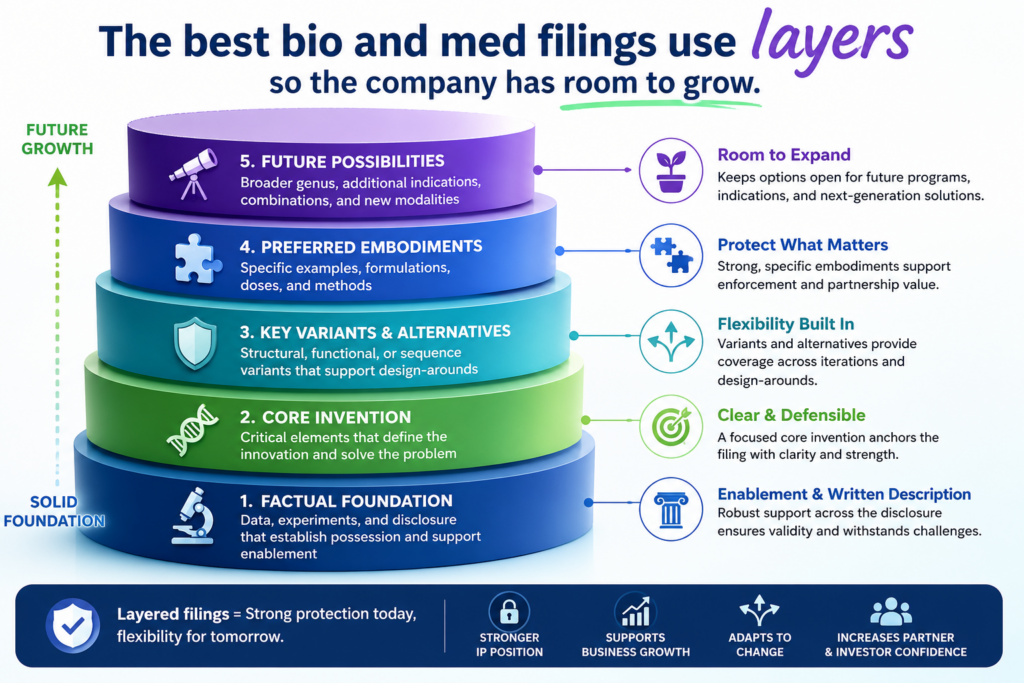
This is very important in bio and med work because the first version of the invention is rarely the final version. Your assay may change. Your patient group may get sharper. Your model may use new data.
Your device may move from a bench setup to a clinic-ready product. Your dose range may improve after more testing. Your manufacturing process may get cleaner. Your first patent filing should not block that growth by being too narrow too early.
At the same time, the filing should not make broad claims that are not backed by the invention. That creates risk. The answer is to use layers.
The patent should protect the main idea, the practical version, and the backup paths
Think of the filing as a set of rings around the invention. The outer ring is the broad idea you want to protect. The middle ring is the practical version that is likely to matter in the market. The inner ring is the strongest tested version. A good filing often supports all three.
For example, a startup may have a method for detecting a disease from a blood sample using a biomarker pattern. The broad layer may cover the use of the biomarker pattern to detect the disease.
The practical layer may cover the use of certain sample types, certain measurements, or certain thresholds. The narrow layer may cover the exact example tested by the team.
This gives the patent room to move. If the broad claim is challenged, the company may still have a useful middle claim.
If the middle claim is too wide, the company may still protect the tested version. That is much better than filing one huge claim with weak support or one tiny claim that competitors can easily avoid.
Layering also helps avoid over-disclosure. You do not need to share every future product idea. You need to disclose enough to support meaningful claim levels. Each layer should earn its place.
A useful filing keeps optional details useful without making them required
One quiet risk in patent drafting is making a detail sound required when it is only one option. This can happen by accident.
A team may describe its best workflow in a way that makes it seem like the only workflow. Later, when the product changes, that old wording can feel tight.
For instance, if a diagnostic method can use blood, saliva, or tissue, but the patent only talks about blood as if blood is required, the filing may not support the other sample types well.
If a device can use several sensor placements, but the filing describes only one placement as the invention itself, the claim may become too narrow. If a model can use different signal types, but the filing only describes one signal type with no broader support, competitors may find room to move around it.
The fix is not to throw in random options. The fix is to write with care. The filing should explain which parts are core and which parts are examples.
It should describe useful variations when those variations are real and supportable. It should make clear that certain features may be used in some versions, while other features are central to the invention.
This is where PowerPatent helps technical founders stay organized. Instead of sending scattered notes and hoping the important parts survive, teams can capture the invention in a clearer way and work with real attorneys who know how to build support around the right claim layers. See how it works at https://powerpatent.com/how-it-works
Over-disclosure often happens when teams confuse proof with raw detail
Founders often want to be safe. So they include everything. Every test. Every number. Every protocol. Every failed run. Every private setting. Every planned product path.
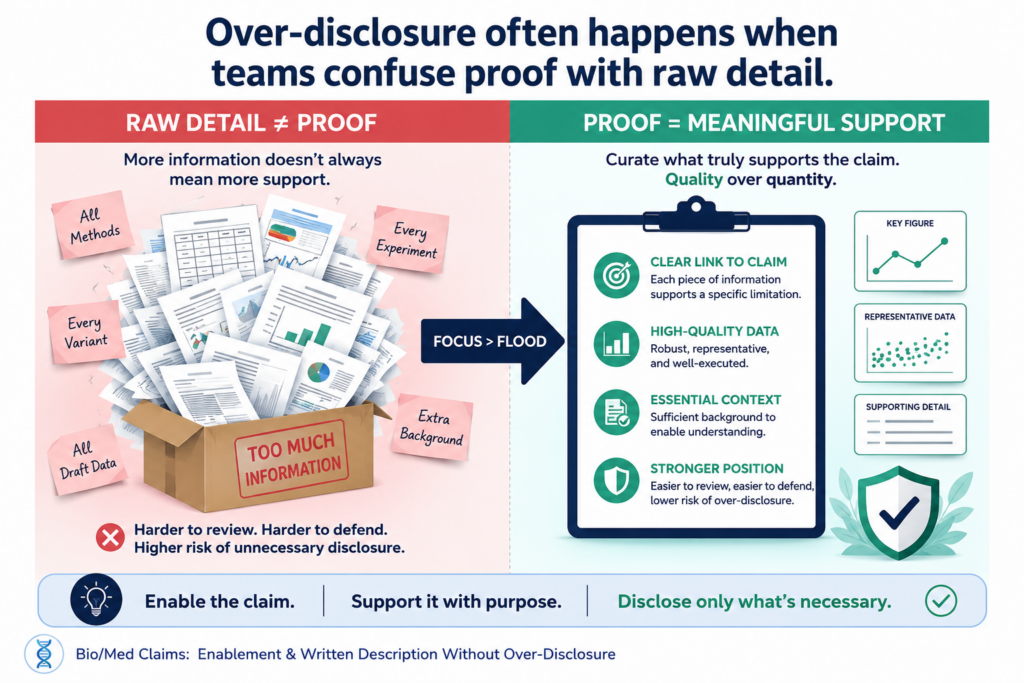
That may feel careful, but it can be dangerous.
A patent should include proof that supports the claim. It should not include raw detail just because the team has it. In bio and med filings, this line can be hard to see because data feels like strength.
But data only helps when it supports the patent story. Extra data can create noise. It can create limits. It can reveal private know-how. It can raise questions that did not need to be raised.
The strongest disclosure is focused, not flooded
A focused filing gives the reader the right facts at the right time. It explains the invention. It shows the key examples.
It supports the claim language. It gives useful ranges and variations where needed. It avoids turning the patent into a full research archive.
For example, a team developing a new therapy may have many animal study details. Some may support the treatment claim. Some may relate to internal study design. Some may show failed paths.
Some may raise side questions. The filing should not blindly include every piece. It should use the data that helps show the invention is real and useful.
The same is true for AI-driven medical tools. A filing may need to explain inputs, processing steps, outputs, and clinical use.
But it may not need to disclose every model weight, every private tuning step, every data cleaning rule, or every internal performance dashboard. Some details may be better kept private, especially when they are not needed to support the claims.
This is not about hiding the invention. It is about protecting the company while meeting the patent rules.
Before adding a detail, ask what job that detail is doing
Every detail in the patent should have a job. It should support a claim, explain a term, show a working example, create a fallback position, clarify a variation, or help a skilled person understand how to use the invention. If a detail does none of those things, it may not belong.
This simple test can save founders from over-sharing.
Say a med device team has a special calibration process that improves accuracy in production.
If the patent claims the device structure and user-facing method, and the calibration process is not needed to make the claim work, the team should think carefully before disclosing it. That calibration process may be a trade secret. Once published, it is public.
Say a bio platform company has a private scoring method that improves patient selection. If the scoring method is the invention, it likely needs to be described enough to support the claim.
But if the invention is a broader lab method and the scoring method is only an internal business tool, it may not need to be exposed.
The right answer depends on the invention, the claims, and the business plan. That is why founder judgment plus attorney review matters.
PowerPatent helps bring those pieces together faster, so teams can avoid both weak filings and careless public disclosures. You can explore the workflow here: https://powerpatent.com/how-it-works
A strong patent story makes the examiner, investor, and future partner trust the invention
A patent filing is written for the patent office, but it is also read by other people who matter. Investors may read it during diligence. Partners may read it before a deal.
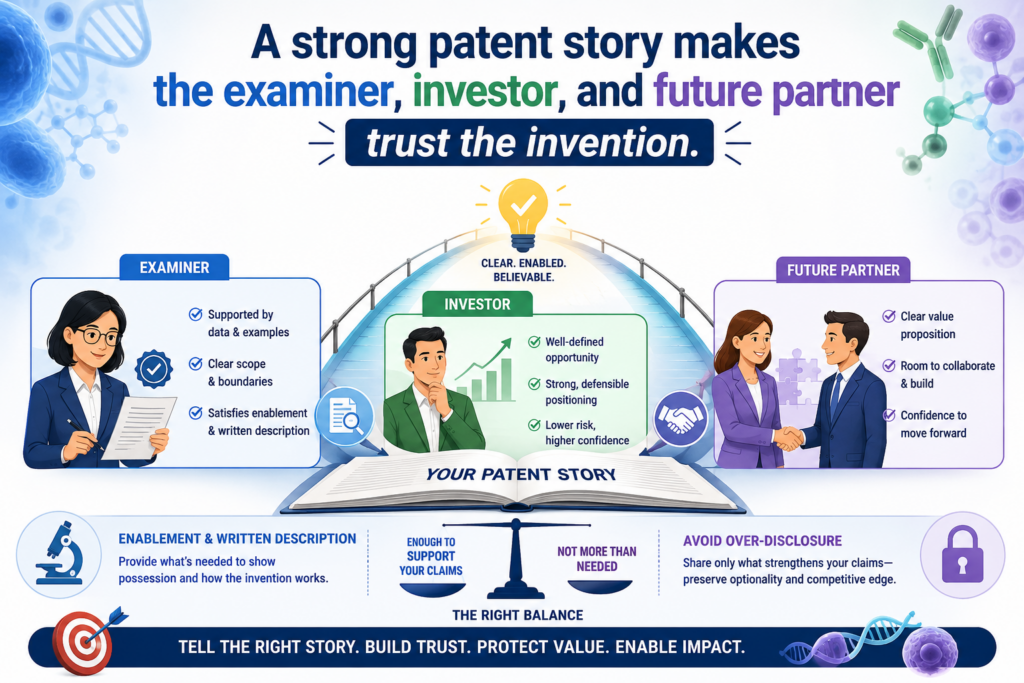
Acquirers may read it before a term sheet. Competitors may read it after publication. Your own team may read it years later when building the next filing.
That means the patent should not be a confusing dump. It should tell a clean and careful story.
The story should show what problem exists, what the invention does, why it is different, how it can be used, and what proof supports it.
This does not mean the writing should sound like marketing. It means the filing should be clear enough that a smart reader can understand why the invention deserves protection.
Clarity can make the patent feel stronger before anyone studies the claims
Claims are the legal center of the patent. But the rest of the filing gives those claims weight.
When the description is clear, the claims feel more grounded. When the examples are well chosen, the invention feels more real. When the language explains options without chaos, the company looks more prepared.
This matters in bio and med tech because trust is hard to earn. Many inventions are complex. Many markets are regulated. Many products require years of work before revenue.
A vague patent can make the whole company look early or uncertain. A clear patent can show that the team knows what it built and why it matters.
For example, if a startup claims a method for guiding treatment, the filing should not bury the treatment logic under pages of generic medical background. It should explain the decision path.
It should show how the input leads to the output. It should connect the result to a patient or provider action. It should support the key claim terms with examples.
That kind of clarity helps the patent office. It also helps investors see the moat.
The filing should make design-arounds harder without pretending to own the whole field
A design-around happens when a competitor studies your patent and builds something close, but outside your claims. You cannot stop every possible design-around. But you can make the easy ones harder.
The way to do this is not by claiming the whole field with no support. That usually backfires. The better way is to understand what competitors are likely to copy and make sure the filing supports claims around those points.
If the core value is a patient selection rule, support that rule from more than one angle when possible. If the value is a signal processing step in a device, explain why that step matters and how it can be implemented.
If the value is a biomarker combination, describe the combination, useful subsets if supportable, sample types, readout methods, and clinical use. If the value is a formulation, support the features that drive stability, delivery, or effect.
This is tactical patent work. It is not about stuffing the filing with more words. It is about choosing words that create real friction for copycats.
Founders should think of the patent as a business asset, not just a filing task. The right patent can support fundraising, partnerships, licensing, defense, and future exits.
The wrong patent can look busy but protect little. PowerPatent helps founders file with more control by combining smart software with real attorney oversight, so the work moves faster without losing the careful thinking that bio and med claims need. Start here: https://powerpatent.com/how-it-works
The claim language should not outrun the proof in the filing
A strong bio or med patent does not win by sounding broad. It wins by being broad in a way the filing can support. That is a small difference on paper, but a huge difference in real life.
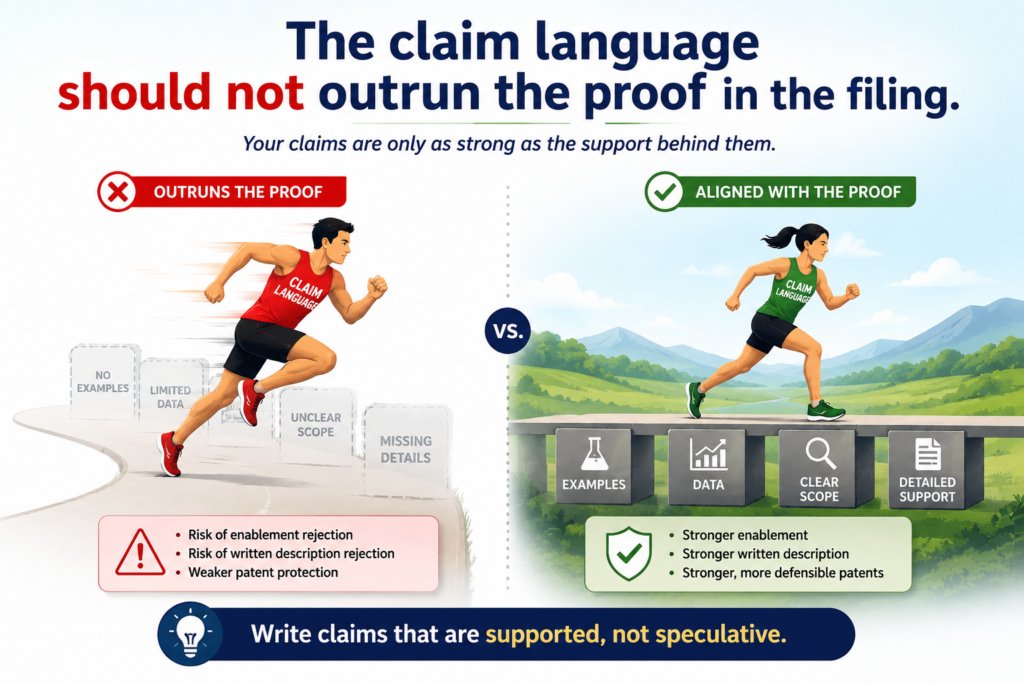
Founders often want claims that cover every future version of the invention. That makes sense. You are building a company, not writing a school paper. You want room to grow.
You want to block copycats. You want investors to see that the moat can expand. But broad words only help when the patent gives those words a strong base.
A claim that says too much with too little support can become a weak point. It may face pushback during review. It may be easier to attack later. It may sound bold, but it may not protect the business when the pressure comes.
A broad claim needs a clear bridge from the examples to the full invention
The filing should help the reader understand why the claim can reach beyond one exact example.
That bridge can come from structure, function, test results, known relationships, shared features, or a clear reason why different versions should work in a similar way.
For example, if your invention is a group of related compounds, the filing should not only show one compound and then claim the whole group. It should explain what shared parts matter and why those parts drive the useful result.
If your invention is a diagnostic method using a set of biomarkers, the filing should explain why the markers matter, how they are measured, and how the result leads to a useful medical action.
The same idea applies to software-heavy medical tools. If a claim covers a system that predicts risk from patient data, the filing should explain the data types, the processing flow, the output, and the practical use of that output. It should not simply say that any model can predict any risk from any data.
That kind of loose claim may sound powerful, but it can feel unsupported.
The best claim scope is wide enough to matter and narrow enough to defend
Good claim scope is not the widest sentence you can write. Good claim scope is the strongest useful fence you can build around the invention.
A founder should ask what a smart competitor would copy first. Would they copy the same biomarker set? The same dosing logic? The same sensor arrangement? The same patient selection rule? The same sample handling method? The same model output tied to a care step?
Once that is clear, the patent can focus support around those points.
This is also where fallback language matters. A filing can support a broad claim while also giving narrower versions that still have business value.
That way, if the broad claim faces trouble, the company is not left with nothing. It may still have protection around the version that matters most in the market.
This is why a patent should not be drafted from scattered text alone. It needs a clear map from business value to claim scope to support.
PowerPatent helps founders build that map faster by turning technical detail into structured invention input, then pairing it with real attorney oversight. You can see how that works here: https://powerpatent.com/how-it-works
Data should support the invention, not trap the company
Data is powerful in bio and med patents. It can make the invention feel real. It can help show that the team had more than an idea.
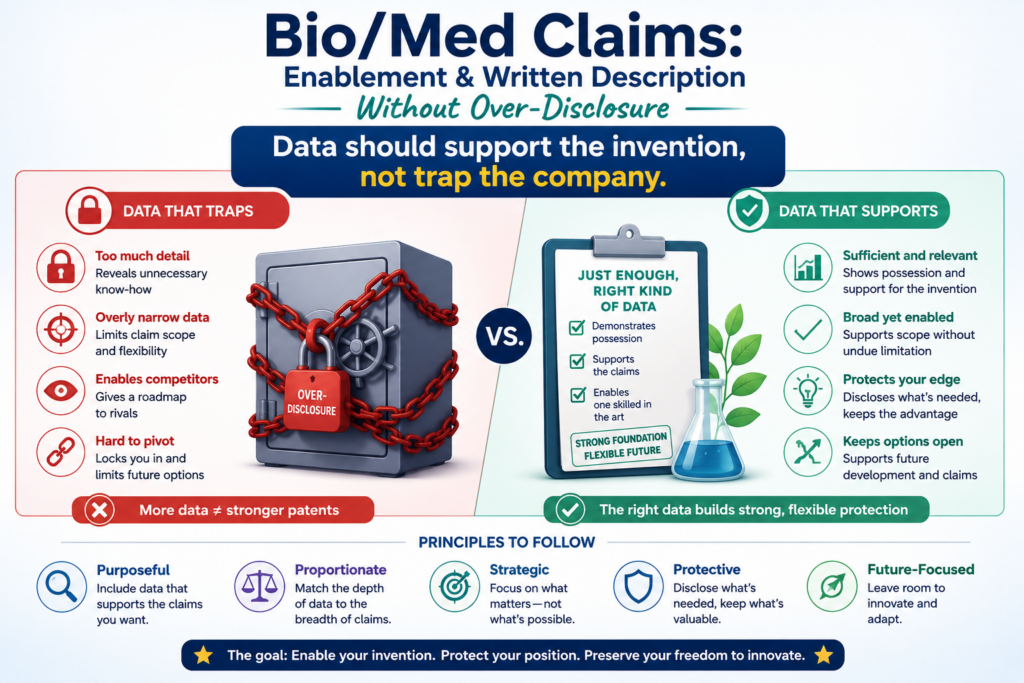
It can support treatment effects, detection accuracy, binding results, stability, safety, performance, or other useful outcomes.
But data can also create limits if it is handled poorly.
A patent filing does not need to become a full data room. It does not need to include every chart, every patient detail, every test run, or every internal result.
The goal is to include data that supports the claims and helps explain the invention. When data is added without purpose, it can create confusion. It can also reveal more than the business needs to reveal.
The right data gives confidence without giving away the whole method
In many cases, the filing can use representative data. That means data chosen because it shows the invention in action and supports the claim. It may show that a method works under certain conditions.
It may show that one version performs better than a control. It may show a useful range. It may show that a claimed feature changes the result.
The key is to make the data do real work.
For example, a startup with a medical diagnostic tool may want to show that its method can separate one patient group from another.
The filing may not need every raw patient record. It may need enough summary data, examples, and explanation to show how the method works and why the claim is fair.
A therapy company may want to show effect in a model system. The filing may not need every study file.
It may need the data that supports the treatment method, the dose range, the target patient type, or the mechanism that matters.
A device company may want to show signal quality, error reduction, or faster use. The filing may not need every engineering test. It may need clear examples that connect the device feature to the useful result.
Unneeded data can create questions you did not need to answer
Too much data can invite side issues. A weak result in a side experiment may distract from the core invention. A narrow test condition may make the invention look smaller than it is.
A private performance limit may give competitors a target. A detailed internal process may show rivals how to catch up faster.
This does not mean founders should hide bad facts or play games. It means the filing should be careful. Patent drafting is not a dump. It is a choice.
Before including data, ask what claim it supports. Ask whether it helps show enablement. Ask whether it helps show written description.
Ask whether it creates a useful fallback. Ask whether it gives away private know-how that could have stayed inside the company.
This kind of judgment is hard when a team is moving fast. Engineers, scientists, founders, and counsel may all see the invention from different angles.
PowerPatent helps bring those views together so the filing can be both detailed and disciplined. The goal is not to file more words. The goal is to file better protection. Learn more at https://powerpatent.com/how-it-works
The patent should protect future versions without making fake promises
Bio and med startups change fast. The first version of the invention may be rough. The next version may be cleaner, faster, safer, cheaper, or easier to use.
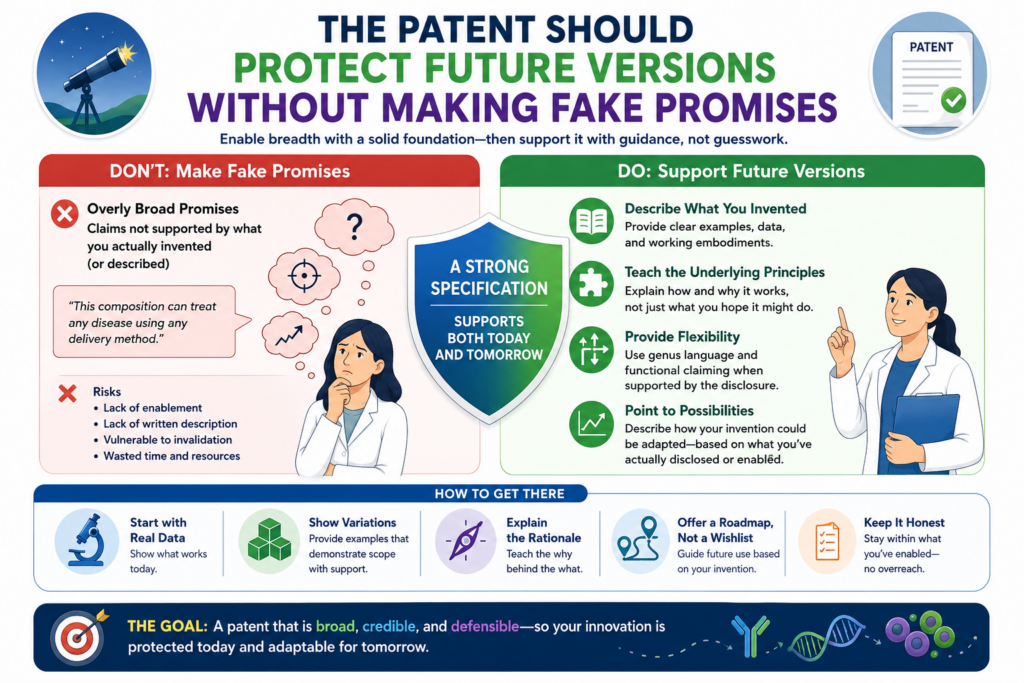
The best patent filings understand this. They do not freeze the company in its first prototype. They create space for honest growth.
But there is a limit.
A patent should not claim future versions that the team cannot support. It should not make guesses sound like facts. It should not describe dreams as if they are working products. That can weaken trust and create problems later.
The better path is to describe reasonable variations that flow from the invention. These variations should be tied to the core idea, not thrown in as random wishes.
Future-proofing works when the filing explains what can change and what should stay the same
A good filing helps readers see the difference between the core invention and the parts that may vary.
In a diagnostic invention, the core may be the use of a certain signal pattern to guide a medical decision.
The sample type, measurement tool, or threshold may have some room to vary if the filing supports that room. In a med device invention, the core may be the way sensors, controls, and outputs work together.
The housing shape or screen layout may change later without changing the heart of the invention.
In a therapy invention, the core may be a treatment method for a defined patient group. The exact dose, schedule, or delivery route may have supported options.
This is how a patent can stay useful as the product grows.
The filing should not describe one version so tightly that every later change feels outside the original story. It should also not describe every possible version in vague terms that have no support. It should identify the stable idea and then support real variations around it.
The best future protection comes from honest detail, not broad guesses
Founders sometimes worry that being specific will make the patent too narrow. That can happen if the filing is written carelessly.
But clear detail can also make the patent stronger. The trick is to explain details as examples when they are examples, and as required features when they are truly required.
For example, if a certain temperature range is helpful but not always needed, the filing should not make it sound like the whole invention depends on that range.
If a certain antibody sequence is one example in a larger supported group, the filing should explain the broader group with care. If one AI model type is used in testing, but other model types can perform the same claimed steps, the filing should support that idea with a clear technical reason.
This is not about being vague. It is about being precise.
A future-proof filing gives the startup more control. It helps the company protect the product it has today and the product it may build next. It also helps reduce panic later, when the roadmap changes and the old filing suddenly matters more than expected.
PowerPatent helps founders capture invention details early, shape them into a clear patent story, and work with real attorneys who can spot where more support is needed.
For fast-moving bio and med teams, that can make the difference between a filing that ages well and a filing that becomes a box. See the process here: https://powerpatent.com/how-it-works
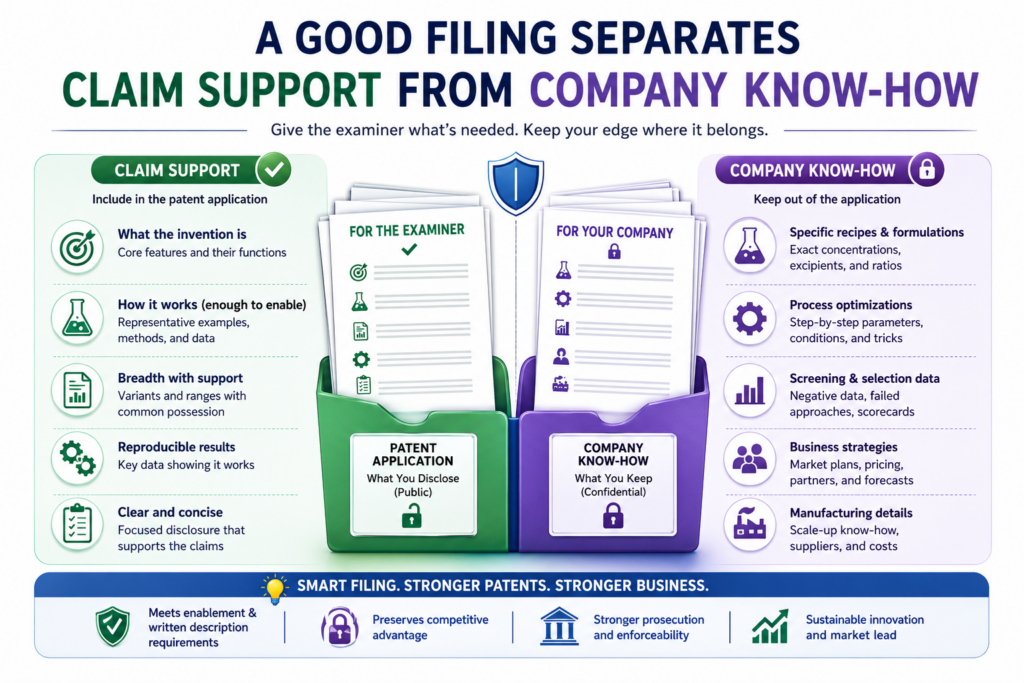
A good filing separates claim support from company know-how
Bio and med founders often carry two kinds of knowledge. One kind belongs in the patent because it supports the invention. The other kind may be better kept inside the company because it gives the team a private edge.
The hard part is knowing the difference.
Claim support is the information needed to show what the invention is, how it works, and why the claims are fair.
Company know-how is the quiet, practical knowledge that helps the team build faster, test better, make cleaner products, or get better results.
Some of that know-how may need to be disclosed. Some of it may not. The choice should be made with care, not by accident.
The USPTO treats enablement and written description as separate requirements.
In simple terms, the filing must teach how to make and use the invention, and it must also show that the inventor had possession of what is being claimed. That is why a filing can be detailed in one way but still weak in another.
The patent should reveal the invention, not every operating advantage
A startup may have a smart way to prepare a sample, tune a device, select a patient group, train a model, stabilize a molecule, or run a lab process. Some of those details may be central to the claimed invention. Others may be internal ways to get better results.
That difference matters.
If the claim is about a new sample prep method, then the sample prep details may need strong support.
But if the claim is about a biomarker panel, and the sample prep trick is only an internal quality step, the team should ask whether that trick really belongs in the filing.
If the claim is about a model that creates a medical score, the filing should explain the input, processing, output, and medical use.
But if the team has a private data cleaning rule that gives the model a small edge and is not needed for the claim, the team should think carefully before making it public.
The same is true for device settings, assay conditions, manufacturing steps, and product workflows. The patent should not become a public training manual for competitors unless those details are needed to support protection.
The cleanest test is whether the detail helps the claim survive
Before adding a sensitive detail, the team should ask a simple question: does this detail help the claim stand up?
If yes, it may belong in the filing. If no, it may be noise. Worse, it may be a gift to competitors.
This test helps founders stay disciplined. It keeps the filing focused on protection, not pride.
Many teams want to show how much work they have done. That is human. But a patent is not the place to prove effort. It is the place to protect the invention.
A strong filing may include selected examples, useful ranges, clear drawings, and enough practical steps to support the claims.
It may leave out raw data, internal dashboards, private tuning methods, supplier choices, exact production shortcuts, and future product plans that do not need to be public.
PowerPatent helps founders sort these details before they become part of the public record.
The platform makes it easier to capture the invention, shape the right disclosure, and work with real patent attorneys who can help avoid weak support and careless over-sharing. See how it works here: https://powerpatent.com/how-it-works
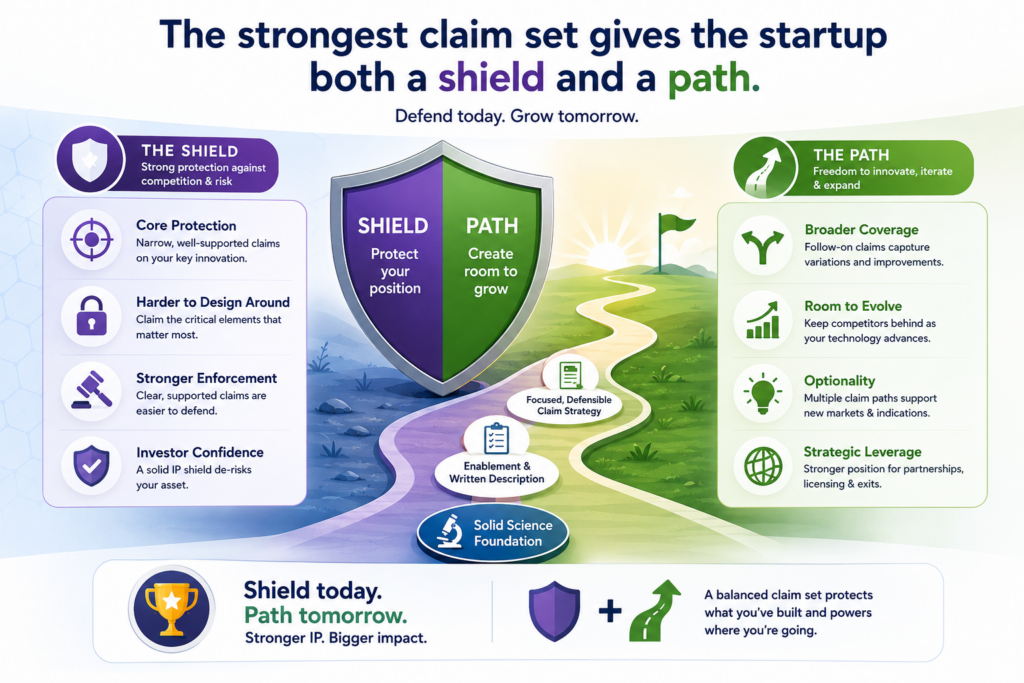
The strongest claim set gives the startup both a shield and a path
A single claim is rarely enough for a serious bio or med startup. The filing should give the company a shield against copycats and a path for future growth.
This is where claim sets matter.
A claim set should not be a random pile of broad and narrow statements. It should be built like a careful map. The broad claims should aim at the main business moat.
The middle claims should cover practical versions that competitors may copy. The narrower claims should protect the tested version and create fallback positions if the broader claims face pressure.
This layered approach matters because patent review can be hard. Claims may need to change. An examiner may ask for more support.
Prior art may force the company to narrow. If the filing has no useful layers, the startup may lose more protection than it should.
The best claim set is designed around how a competitor would copy you
A founder should picture the most likely copycat. Not a cartoon villain. A smart competitor with money, speed, and a team that reads your patent carefully.
What would they copy first?
They may not copy your whole product. They may copy the key decision rule. They may use the same biomarker group with a different lab tool.
They may build a device with a different housing but the same signal path. They may use another model type but the same medical output. They may change the dose schedule just enough to argue they are outside the claim.
Your filing should be ready for that.
This does not mean you can block every nearby idea. But you can make the easy escape routes harder. You do that by supporting variations that matter. You show which parts are central.
You explain practical options. You give the claim set enough depth so a competitor cannot avoid it with a tiny surface change.
The claim set should make sense to investors as well as the patent office
Investors do not want to read a filing that feels thin, vague, or fragile. They want to know that the company has a real moat. A strong patent story helps them see that.
The broad claim shows ambition. The middle claims show commercial sense. The narrow claims show proof. Together, they tell a better story than one huge claim with weak support.
For example, a diagnostic startup may claim a method for detecting a condition using a marker pattern. It may also claim certain marker groups, sample types, measurement steps, score outputs, and care actions.
A device startup may claim the system, the method of use, the signal handling, and the feedback output.
A therapy startup may claim treatment of a defined patient group, supported dose ranges, timing, and response markers.
This is not about making the patent longer. It is about making it harder to dismiss.
When the claims match the business, the patent becomes easier to explain in a fundraise, a partner meeting, or an acquisition talk. It shows that the team knows what it owns. It also shows that the team did not treat patents as paperwork.
PowerPatent helps founders move toward this kind of practical claim strategy without turning the process into a months-long drag.
The software helps organize the invention, and real attorney oversight helps turn that input into a filing that is built for business use, not just filing day. Learn more here: https://powerpatent.com/how-it-works
The description should be clear enough for a skilled reader and careful enough for your business
A patent is not written for the average person. But it should still be clear. Clear does not mean shallow.
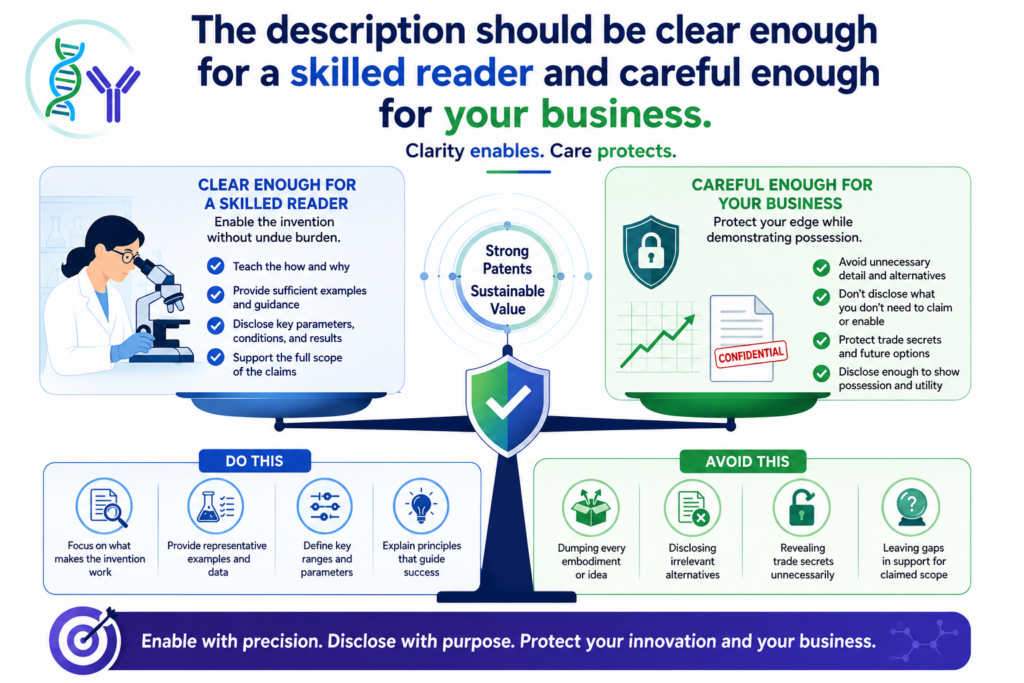
Clear means the reader can follow what the invention is, why it matters, and how the parts work together.
This matters even more in bio and med patents because the science can get dense fast. A filing full of long background, loose terms, and scattered examples can hide the invention.
That creates risk. The examiner may not see the point. Investors may not see the moat. Future attorneys may have less room to work with. Competitors may find gaps.
The USPTO’s guidance focuses on whether the filing gives enough detail for the claimed invention as a whole and whether a skilled person can make and use the full scope of the claim without undue experimentation. That is the bar the filing needs to be built around.
The best description uses plain structure for complex work
A strong description should walk through the invention in a clean order. It should explain the problem just enough.
Then it should define the invention. Then it should describe the parts, steps, variations, examples, and uses that support the claims.
This sounds basic, but many filings fail here.
They start with pages of broad background. They jump between ideas. They use terms before explaining them.
They bury the strongest example. They describe one product version so tightly that the claims lose room. Or they describe everything so broadly that nothing feels real.
A better filing has a clear spine.
For a therapy invention, the spine may be patient group, active agent, dose logic, timing, result, and support. For a diagnostic invention, it may be sample, marker, measurement, score, decision, and use.
For a device invention, it may be structure, signal, processing, output, user action, and result. For a software-med invention, it may be data input, processing flow, model or rule logic, output, and clinical action.
That structure helps the reader trust the invention.
Simple writing can still protect deep science
Some founders worry that simple writing makes the invention sound less advanced. It does not. Simple writing makes the invention easier to understand. The science can still be deep.
The claims can still be strong. The examples can still be technical. But the path through the filing should feel controlled.
Simple wording also reduces confusion. Confusion is expensive. It can lead to claim problems, review delays, investor questions, and avoidable attorney time. When the filing is clear from the start, the whole process can move with less friction.
This is one of the main reasons PowerPatent exists. Founders should not have to choose between speed and quality. They should not have to send messy notes into a black box and hope a strong patent comes out.
PowerPatent helps teams turn technical ideas into structured invention records, then pairs that with real attorney oversight so the filing is clear, careful, and built for protection.
For bio and med teams, that can be a major edge. The work is already hard. The patent process should not add more chaos. See how PowerPatent helps founders file better patents faster here: https://powerpatent.com/how-it-works
Enablement should answer the real use question, not every possible science question
A bio or med patent does not need to answer every question a scientist could ask. It needs to teach the claimed invention well enough that a skilled person can make and use it without too much trial and error.
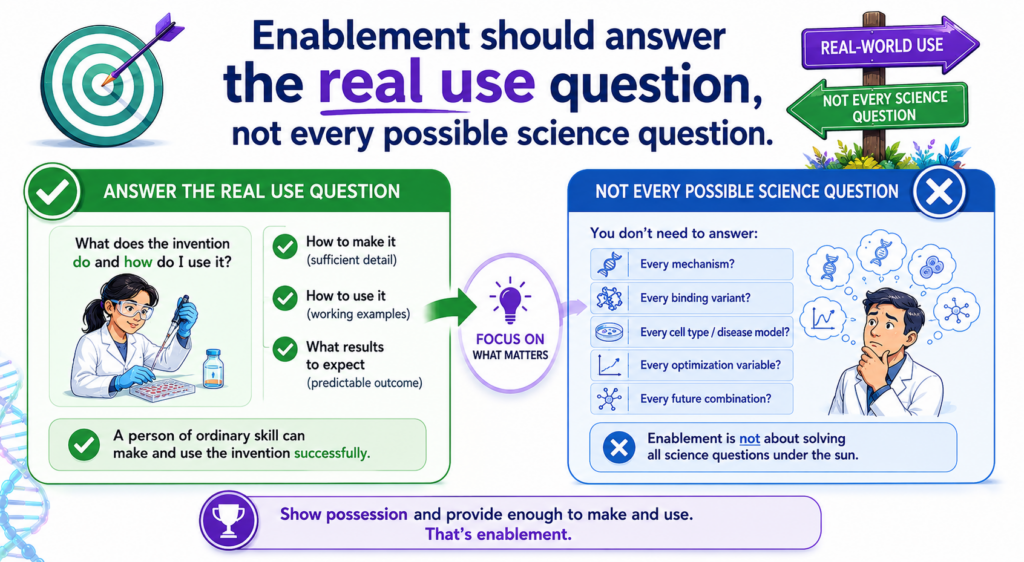
That is the core enablement issue. The USPTO still looks at whether the amount of testing needed would be undue, and it uses factors such as claim breadth, the nature of the invention, the predictability of the field, the guidance in the filing, and the examples given.
This is why enablement should be handled with care. If the claim is narrow, one clear path may be enough.
If the claim is broad, the filing may need more support. The wider the claim reaches, the more the patent should explain why that reach is fair.
Founders often feel pressure to answer every possible technical question. That can lead to over-disclosure.
But a strong filing is not a textbook. It is a focused teaching document for the invention being claimed.
The patent should teach the path that matters most
The best enablement work starts with the claim. What does the claim say the invention covers? What would a skilled person need to know to make and use that claimed invention? What details are needed to avoid guessing? What examples prove the path?
For a diagnostic claim, this may mean showing how the sample is obtained, what is measured, how the result is processed, and how the output is used.
For a treatment claim, it may mean explaining the patient group, the agent, the amount, the timing, and the intended effect. For a med device claim, it may mean explaining the parts, how they connect, how signals move, and how the user gets a useful result.
The filing should make that core path clear.
It does not need to include every supplier name, every failed build, every internal note, every exact lab setting, or every private quality control method unless those details are needed to support the claim.
Extra details can make the filing look rich, but they may not make it stronger. They may only make it easier for a competitor to learn from your work.
The safest enablement choices are tied to claim scope
A useful way to draft is to match the level of teaching to the level of the claim. If you want to claim many versions, the filing should teach why those versions are part of the same invention.
If you only have support for one version, the filing should protect that version well and build honest fallback paths around it.
This is where many startups get stuck. The team may know the science, but the patent needs a different kind of clarity. It must show enough without spilling everything.
It must support broad thinking without making wild claims. It must teach the invention without handing over the full operating system of the company.
PowerPatent helps founders make these choices with more control. The platform helps capture the invention in a structured way, then real patent attorneys help shape the filing so it supports the claims while protecting the company’s private edge. See how it works here: https://powerpatent.com/how-it-works
Written description should make ownership obvious from the first read
Written description is about possession. In simple words, the filing should show that the inventor actually had the invention at the time of filing. It should not read like a goal, a hope, or a broad wish.
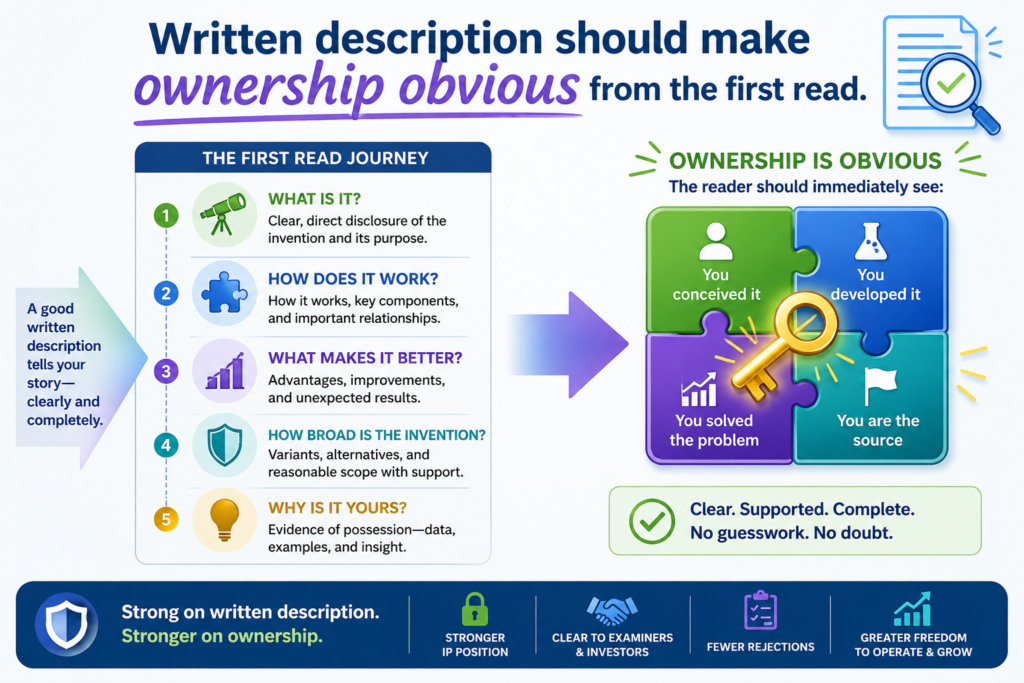
The USPTO’s written description guidance focuses on whether the application reasonably shows possession of the claimed invention.
This matters deeply in bio and med work because many claims cover groups. They may cover a family of molecules, a range of doses, a set of biomarkers, a type of patient, a class of devices, or a model that works across different data inputs.
The filing needs to show that the inventor had the claimed group, not just one small dot inside it.
A good written description makes the invention feel owned. It gives the reader enough detail to say, “Yes, this team had this.”
The filing should show the shape of the invention
Possession is not shown by broad language alone. A filing that says “any marker,” “any model,” “any dose,” or “any device” may sound roomy, but it can feel empty if the details do not support it.
The filing should show the shape of the invention. That shape may come from examples, common structure, shared function, clear boundaries, useful ranges, tested versions, or a reason why related versions work in the same way.
In bio and med patents, this shape is often the difference between a claim that feels real and a claim that feels like a land grab.
For a biomarker claim, the filing should explain the marker or marker group, how it is measured, what it means, and how it guides an action. For a compound claim, it should explain the structure or features that matter.
For a treatment claim, it should explain the patient, the treatment, and the result. For a medical AI claim, it should explain the input, processing, output, and practical use.
The clearer the shape, the stronger the story.
Good written description does not require reckless disclosure
Founders sometimes think they must reveal every future plan to show ownership. That is not true. The filing should not pretend to own what it cannot support, but it also does not need to expose every roadmap idea.
The right move is to describe the invention at the level the team can honestly support. If there are real variations, describe them with care. If there are tested examples, use the ones that help the claims.
If there are backup versions, include them when they matter. If there are private methods that do not support the claim, think hard before placing them in the public file.
A patent should make ownership obvious, not make competitors smarter for free.
PowerPatent helps founders turn invention details into a cleaner patent story before the filing becomes public.
That means the team can show real possession, support useful claim scope, and avoid dumping sensitive know-how into the patent by default. Learn more at https://powerpatent.com/how-it-works
Prophetic examples can help, but they should never replace real support
In bio and med patent filings, not every example has to come from a finished test. Some examples may describe how an invention can be practiced even if that exact test has not yet been run.
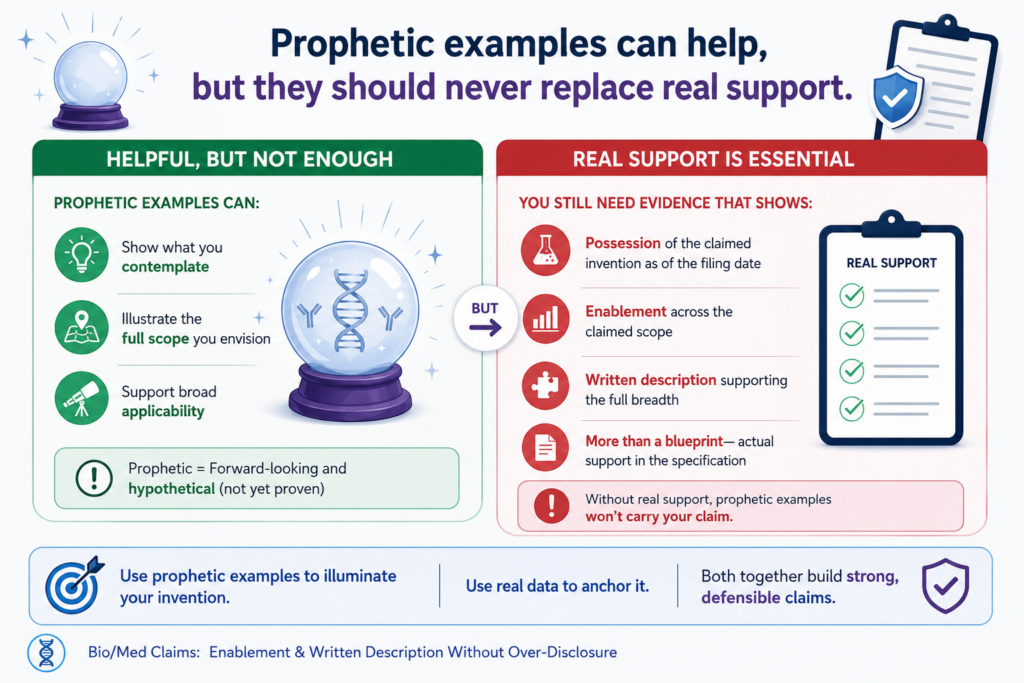
These are often called prophetic examples. They can be useful when used clearly and honestly.
But they are not magic.
A prophetic example should not be used to cover gaps that the invention story cannot support. It should not turn a guess into a fact. It should not make the filing look more complete than it is.
The USPTO recognizes working and prophetic examples in enablement analysis, but the full filing still has to teach the claimed invention in a way that meets the legal requirement.
For founders, the practical rule is simple. Use future-facing examples to show reasonable ways the invention can be used, but do not lean on them as a substitute for real invention depth.
A prophetic example should be tied to what the team already knows
A good prophetic example grows from the real invention. It is not random. It should be based on the science, system, device, assay, model, compound, or method already described in the filing.
For example, if a team has tested a diagnostic method in blood and has a sound reason to believe it can work in plasma, the filing may describe that variation if it is technically supported.
If a device has been tested with one sensor type and the same signal path can work with another known sensor type, the filing may describe that option if the support is real.
If a treatment method has early data in a model, the filing may describe a clinical use path with care, but it should not overstate what has already been shown.
The key is honesty.
A patent can be forward-looking without being loose. It can describe real variations without pretending they have all been tested. It can create room for growth without making the invention sound bigger than it is.
Real examples and future examples should work together
The strongest filings often use both tested examples and forward-looking examples. The tested examples show that the invention is real. The forward-looking examples show how the invention may be practiced in other supported ways.
Together, they can help build claim layers.
But the filing should make the difference clear. A reader should not be confused about what was done and what is described as a planned or possible use.
Confusion can hurt trust. It can also create trouble later when investors, examiners, partners, or courts study the record.
This is especially important for startups raising money. Investors may accept that a bio or med company is still early.
They may not expect every study to be complete. But they do expect the patent story to be honest, careful, and aligned with the company’s real progress.
PowerPatent helps founders avoid the common trap of either saying too little or saying too much.
With smart software and real attorney oversight, teams can capture what has been done, describe what can be supported, and build a filing that protects the invention without over-selling it. See how PowerPatent works here: https://powerpatent.com/how-it-works
The best mode question should be handled with care, not panic
Bio and med founders often ask a hard question: “Do we have to disclose our best version?”
The answer needs care. U.S. patent law includes a best mode requirement as part of the patent specification rules, while enablement and written description remain separate requirements under 35 U.S.C. 112(a).
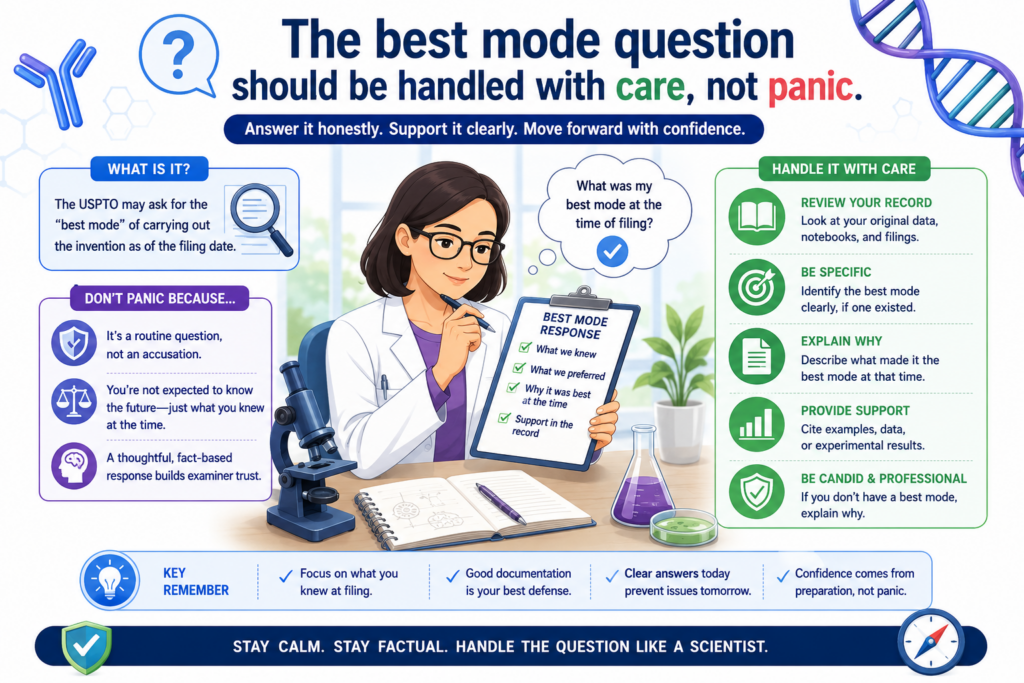
The USPTO treats these as distinct issues, which means a filing can teach enough in one way and still raise a different concern in another.
For founders, the practical point is simple. Do not play games with the patent filing. Do not hide the real invention while trying to claim it.
But also do not assume that every private company trick must be placed in the patent. The right answer depends on what is being claimed, what the team knows, and what details are truly part of the invention.
A rushed decision here can create problems. If the filing is too thin, the claims may be weak. If the filing is too open, the company may lose private know-how that could have stayed protected outside the patent.
The best version of the invention is not always the same as every best business process
A founder may have a best version of the product and also a best internal way to build, tune, test, or package that product. Those are not always the same thing.
For example, a startup may have a claimed diagnostic method based on a marker pattern. The best version of the invention may include a certain marker set, a certain sample type, and a certain scoring method. Those details may matter to the claim.
But the company may also have a private lab workflow that reduces cost or speeds up sample handling. That workflow may or may not be part of the claimed invention.
A med device team may claim a sensor layout and signal method. The best working device may use a certain calibration routine.
If that routine is central to the claimed result, it may need careful disclosure. If it is only an internal production advantage, the team should think hard before making it public.
The mistake is treating all “best” details the same.
The safer path is to decide what belongs in the patent before drafting starts
This decision should happen early. It should not happen after the first draft is already full of sensitive details.
Before drafting, the team should separate the invention from the operating edge. The invention is what the patent should protect.
The operating edge may include private tools, data cleaning steps, vendor choices, process controls, tuning methods, or internal shortcuts that help the company move faster.
Some operating edge may be needed to support the patent. Some may not. The key is to make that call with a real strategy.
This is where PowerPatent is useful for technical founders. Instead of throwing notes into a long document and hoping it becomes a good patent, teams can organize the invention, flag sensitive know-how, and work with real patent attorneys who understand how to balance support with business protection. See how that process works here: https://powerpatent.com/how-it-works
Broad bio claims need more than a result; they need a real path across the scope
A broad claim can be valuable. It can stop copycats from making small changes and pretending they invented something new. But in bio and med patents, broad claims also face sharper review because the field can be hard to predict.

The Supreme Court’s Amgen v. Sanofi decision is a useful warning for life science teams.
The Court agreed that claims directed to a broad group of antibodies were not enabled where the patent gave examples and methods that did not teach the full claimed scope without too much extra work.
The lesson for founders is not “never file broad claims.” The lesson is that broad claims need broad support. A patent should not just claim a result and leave the reader to find all the ways to get there.
A claim to a result can look strong but still be fragile
Many bio and med inventions are described by what they do. A molecule binds a target. A model predicts risk. A device reduces error. A therapy improves response. A test separates likely responders from non-responders.
That result matters. But a result alone is rarely enough.
The filing should explain the path to that result. It should show which features matter. It should describe useful examples.
It should make clear how a skilled person would practice the invention without starting a new research project.
For a biomarker invention, the patent should not only say that markers can predict disease. It should identify the marker pattern, how it is measured, and how the result is used. For an antibody invention, the filing should show more than the target.
It should give enough structural or functional support for the claimed group. For a medical AI invention, the filing should not simply claim “predicting disease with a model.”
It should explain the inputs, the processing steps, the output, and the medical action tied to that output.
A broad claim should feel like the natural reach of the invention, not a wish placed on top of it.
The filing should reduce guesswork for the skilled reader
Enablement often turns on how much work is left for the skilled reader. The USPTO guidance looks at the full scope of the claim and whether the filing teaches skilled people to make and use that scope without undue experimentation.
In simple terms, the patent should not make the reader hunt for the invention.
This is especially important when a startup wants to claim a class, range, family, or broad use case. The filing should give enough direction to make that scope believable.
It may need representative examples. It may need common features. It may need clear boundaries. It may need fallback positions that still protect the product if the broad claim must narrow.
Founders should be honest about what they can support today. That does not mean thinking small. It means building broad claims with real beams under them.
PowerPatent helps founders capture the technical facts behind those beams. The software helps organize the invention in a way that is easier to review, and real attorneys help shape the claim path so the filing is not just bold, but defensible. Learn more here: https://powerpatent.com/how-it-works
Conclusion
Bio and med patents are strongest when they prove the invention without exposing the company’s private edge. The goal is not to say everything. The goal is to say what matters, support the claims, and leave competitors with less room to copy or work around you. Good enablement shows how the invention can be made and used.
Good written description shows you truly had it. Smart disclosure keeps trade secrets safe where possible. PowerPatent helps founders move faster with smart software and real attorney oversight, so complex inventions become stronger filings with less stress today. See how it works: https://powerpatent.com/how-it-works