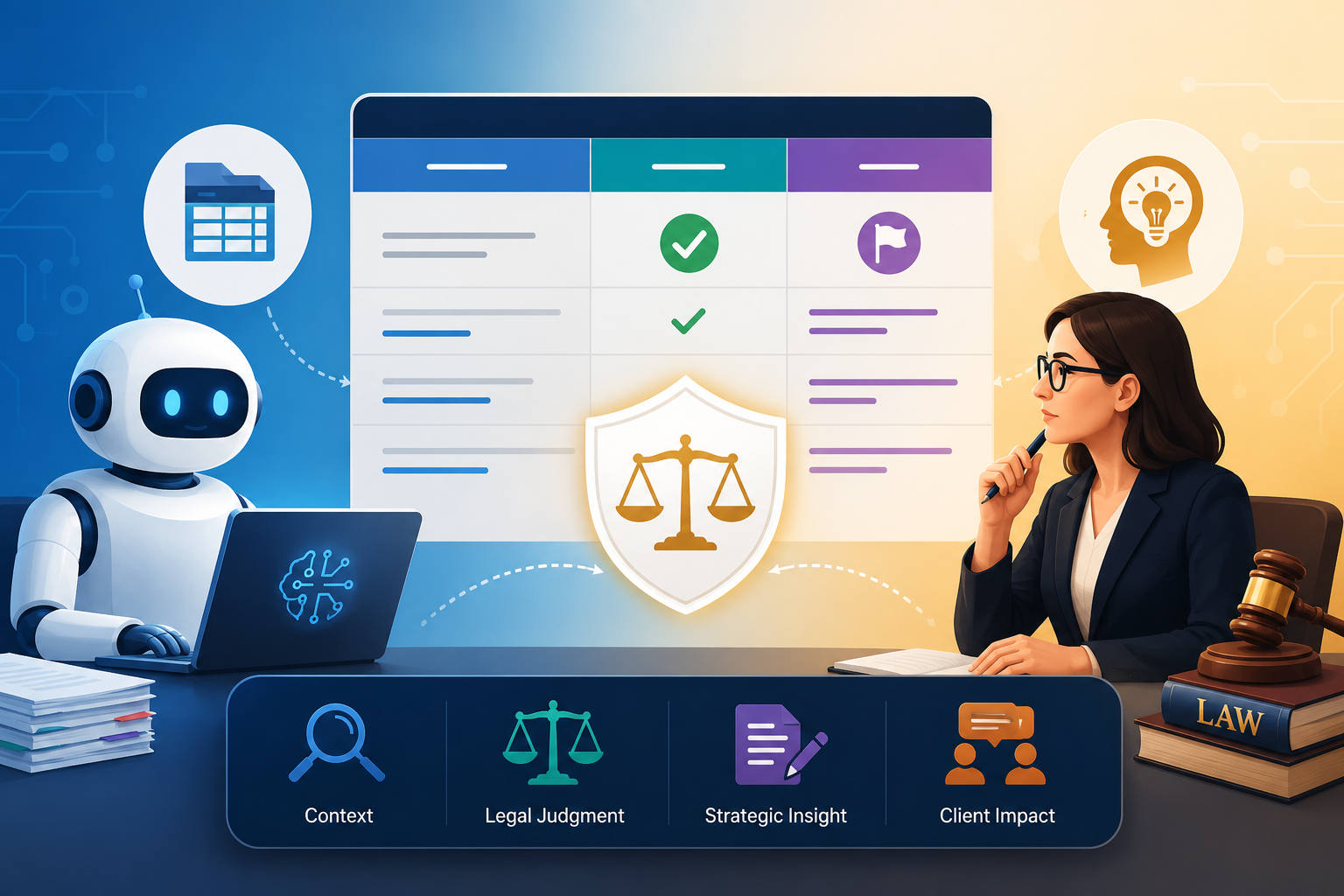
AI can read a patent, scan a product, and build a claim chart faster than any person could do by hand. That speed is useful. For startups, it can save time, cut busy work, and help teams see where an invention may be strong. But speed alone is not enough.
AI claim charting is fast, but speed is not the same as judgment
AI is very good at doing the first pass of claim chart work. It can read claim language, find matching words in product pages, pull details from manuals, compare parts of a system, and place early evidence into a chart.
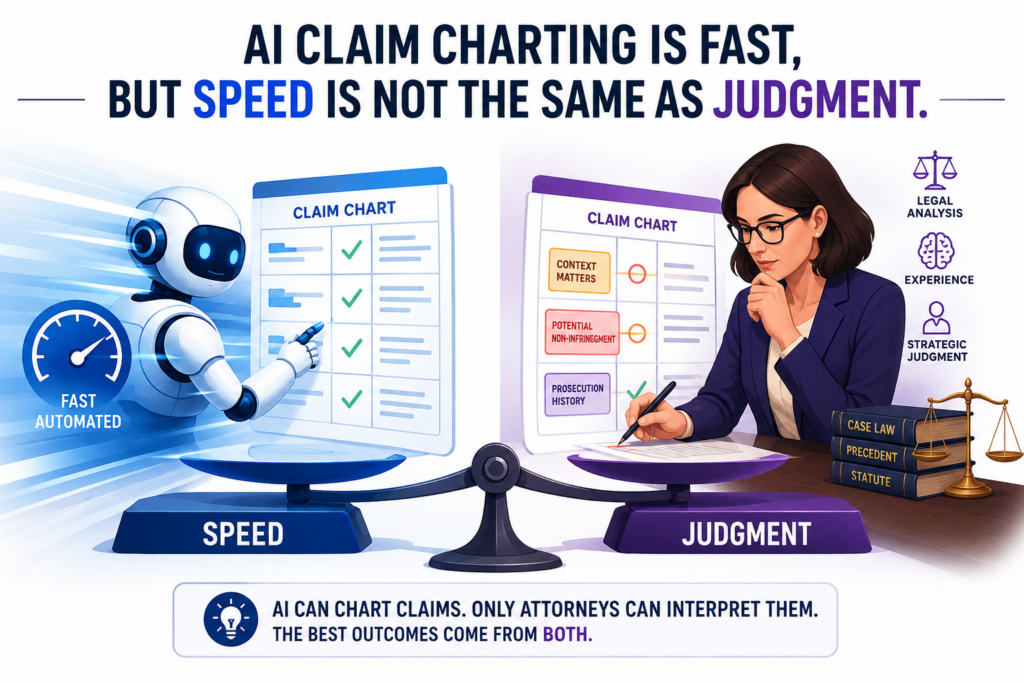
For a busy startup team, that can feel like magic. What used to take days can now happen in minutes.
But a claim chart is not just a search task. It is not only about finding words that look alike. It is about knowing what those words mean, how a court may read them, how a product really works, and whether the match is strong enough to matter.
That is where human review becomes the line between useful work and risky work.
AI can help build the chart. An attorney must review the chart before anyone relies on it.
AI can find signals, but a human must decide what those signals mean
A patent claim may use simple words that hide deep meaning. A phrase may look clear at first, but its real meaning may depend on the patent text, the drawings, the file history, older patents, and the way people in that field use the words.
AI may spot a product feature that appears to match the claim. But the key question is not just whether the feature looks close. The real question is whether it meets the claim in the way the law requires.
This matters because claim charts are often used in serious business talks. A founder may use one to talk with investors.
A patent owner may use one before sending a licensing letter. A company may use one to study risk before launching a product. In each case, the chart can shape high-stakes choices.
That is why attorney review should not be treated as a final polish step. It is part of the core work. It turns raw AI output into something that can guide real action.
The human role starts with asking whether the chart should exist in the first place
Before anyone charts a patent against a product, someone needs to ask a basic question: why are we making this chart? The answer changes everything.
A chart made for internal learning is not the same as a chart made for licensing. A chart made to understand a competitor is not the same as a chart made before filing suit.
A chart made to support investor confidence is not the same as a chart made to plan a product change. Each use needs a different level of care, evidence, and legal review.
AI does not know your business goal unless someone frames the task. It may build a chart because it was asked to build one.
A human attorney can step back and ask whether the chart fits the goal, whether the patent is worth charting, whether the product data is reliable, and whether the result could create more risk than value.
For a startup, this matters even more. Founders do not have time to waste on weak IP work. They need clear answers, fast action, and smart guardrails. That is the idea behind PowerPatent.
It helps teams move quickly with smart software while keeping real attorney oversight in the places where mistakes can be expensive. You can see the process here: https://powerpatent.com/how-it-works
Claim meaning must stay human because words in patents are not always plain
A claim chart starts with the claim. That sounds simple, but it is often the hardest part. The words in a patent claim are not always used in the way a normal person would use them.
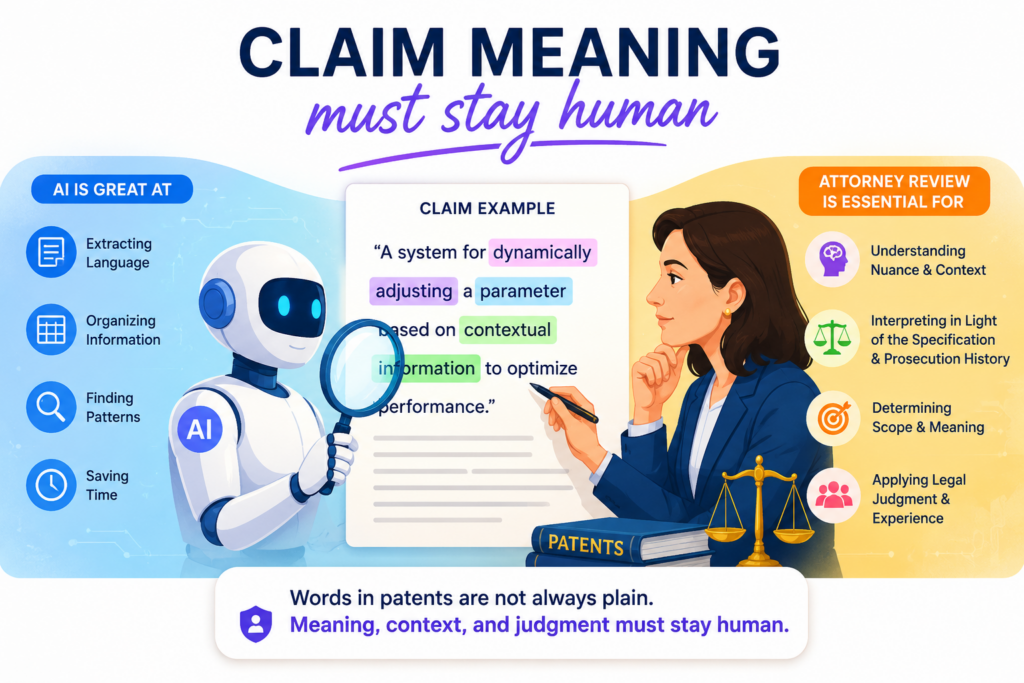
Sometimes the patent gives a word a special meaning. Sometimes the same word has a narrow meaning because of what the inventor said during the patent process. Sometimes a claim looks broad, but the patent text pulls it back.
AI can read the words. It can group them. It can compare them to product evidence. But it cannot safely make the final call on what the claim means in context. That is legal judgment, and it must stay human.
A claim chart is only as strong as its claim reading
When AI reads a claim too broadly, the chart may look strong when it is not. It may match a product feature that seems close but does not truly meet the claim. That can lead a founder to overvalue a patent or make a business move based on a weak read.
When AI reads a claim too narrowly, the opposite problem happens. The chart may miss a real match. A strong patent may look weaker than it is. A startup may leave value on the table.
A company may miss a chance to protect a core invention or may fail to see risk from someone else’s patent.
This is why an attorney does more than check grammar or format. The attorney studies the claim as a whole.
They look at each part of the claim, how the parts connect, and what must be shown for the claim to be met. They also look for terms that may need special care.
A good attorney review asks simple but powerful questions. What does this word mean in this patent? Does the product have this part?
Does the product do this step? Is the match direct, or are we stretching? What proof do we have? What proof is missing?
AI should not be allowed to smooth over hard claim terms
One major risk with AI claim charting is that the output can sound confident even when the match is thin.
AI may write a neat sentence that says a product includes a claimed feature. The sentence may look clean. The tone may sound sure. But a smooth sentence is not the same as proof.
This is especially dangerous with claim terms that involve function, timing, structure, data flow, control logic, or user action. A product page may say a system “optimizes” something.
The claim may require a very specific kind of optimization. Those are not the same thing. A product may say it uses “AI.”
The claim may require a model trained in a certain way, used at a certain step, with a certain output. Again, not the same thing.
The attorney’s job is to slow down at the exact points where AI may rush. The attorney looks for the gap between the product’s marketing language and the claim’s actual limits. That gap can decide whether a chart is useful or dangerous.
For deep tech startups, this is not a small issue. Your invention may involve code, models, chips, sensors, robotics, data systems, or medical tools.
The claim language may map to parts of the product that are not visible on a website. AI can help collect public clues, but it cannot always know how the system works under the hood. Human review is what keeps the chart honest.
Evidence selection must stay human because not all proof is equal
A claim chart lives or dies on evidence. A chart can look full and still be weak if the proof is poor. A chart can be short and still be strong if the proof is direct.
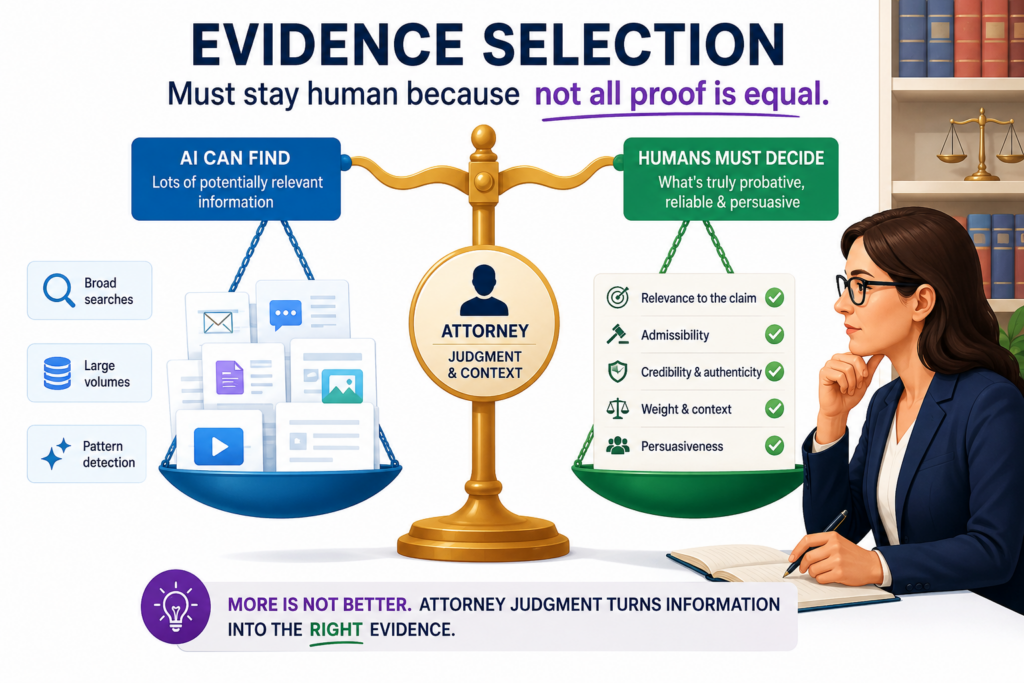
The question is not how much evidence AI can collect. The question is whether the evidence proves the right thing.
AI can gather screenshots, manuals, help pages, app text, product specs, code comments, public demos, API docs, and marketing claims.
That is useful. But someone still needs to decide what belongs in the chart, what should be left out, and what needs more support. That person should be a skilled human reviewer.
Good evidence must match the claim, not just the topic
A weak chart often has evidence that talks about the same general area as the claim but does not prove the actual claim part.
For example, the claim may require a server to receive a certain input, process it in a certain way, and send a certain output.
A product page may say the platform “uses smart automation.” That may be related, but it does not prove the steps.
AI may place that evidence in the chart because the words are close. An attorney will ask whether the evidence proves the point. That small difference is huge.
Strong evidence is specific. It shows the feature, step, structure, or result in a way that can be tied back to the claim. Sometimes it comes from technical documents.
Sometimes it comes from source material. Sometimes it comes from testing. Sometimes it comes from reverse engineering or product use. The right type depends on the claim and the product.
A human reviewer must also judge whether the evidence is reliable. A blog post may be less useful than a product manual. A sales page may be less useful than a technical guide.
A screenshot may be helpful, but only if it shows the right thing at the right time. A demo video may matter, but only if the steps are clear.
The attorney must protect the chart from overclaiming
Overclaiming happens when a chart says more than the evidence supports. This is one of the biggest dangers in AI-assisted claim charting.
It can happen fast because AI can turn weak material into strong-sounding text. A founder may read the result and feel confident, even though the claim match has not been proven.
Attorney review helps stop that. The attorney can mark evidence as strong, weak, missing, or unclear.
They can separate what is known from what is assumed. They can explain what else should be collected before the chart is used for a business decision.
This is not about being slow. It is about being safe and smart. Fast work is helpful only when the output can be trusted.
For founders, this can save real money. A weak claim chart can lead to bad outreach, poor investor messaging, wasted legal spend, or a missed chance to file better patents.
A strong reviewed chart can help a team understand its position and act with more confidence.
This is why PowerPatent is built around both speed and oversight. Smart software can help founders move faster, but real attorney review helps make sure the work is grounded, clear, and useful. Learn how PowerPatent supports that workflow here: https://powerpatent.com/how-it-works
Technical truth must stay human because products rarely work exactly as they are described
A product page often gives a clean story. The real system is usually messier. There may be hidden steps, back-end logic, third-party tools, trained models, private APIs, edge cases, and system rules that never appear in public text.
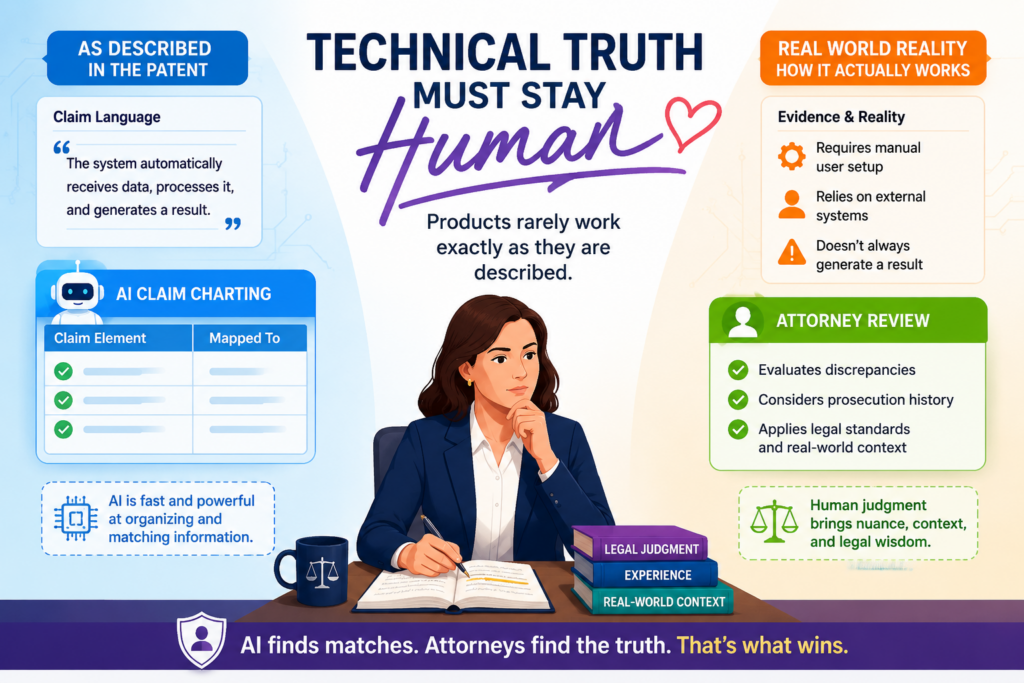
AI can read what is available. It cannot always know what is real inside the product.
That is why technical truth must stay human. A good claim chart does not just ask what the product says. It asks what the product does.
Human review connects legal words to real engineering facts
In AI claim charting, the attorney should not work alone in a vacuum. For complex inventions, the best review often includes input from engineers, product leads, inventors, or technical experts.
The attorney brings claim judgment. The technical team brings system truth. Together, they can decide whether the chart is solid.
This is very important for startups because the most valuable parts of the invention may be buried inside the system.
The public-facing feature may look simple, but the secret sauce may be in the model pipeline, the data structure, the control loop, the inference process, or the way the system handles failure. AI tools may miss that unless the right human guides the review.
A founder should treat the chart as a working document, not a finished answer from a machine. The chart should lead to better questions. Does our product actually do this step?
Is this part handled on the device or in the cloud? Is this output created by the model or by a rule layer? Is this feature always present, or only in some cases? Does the claim require all users to do the step, or only the system?
Those questions can change the chart. They can also change the patent strategy.
The best review process turns claim charting into invention insight
When done well, claim charting does more than support enforcement or licensing. It helps founders see what they have built.
It can reveal which features are most protectable, which parts need better patent coverage, and which claims may need future filings.
This is where AI plus human review becomes powerful. AI helps gather and organize the raw material.
The attorney helps turn that material into strategy. The founder gets a clearer view of the company’s IP position without being buried in legal work.
That is the kind of system modern startups need. Not slow paperwork. Not blind automation. Not legal theater.
They need a clear path from invention to protection, with smart tools and real human judgment working together.
PowerPatent was built for that kind of founder. It gives technical teams a way to move quickly, stay in control, and get attorney-backed support without the old delays. See how it works here: https://powerpatent.com/how-it-works
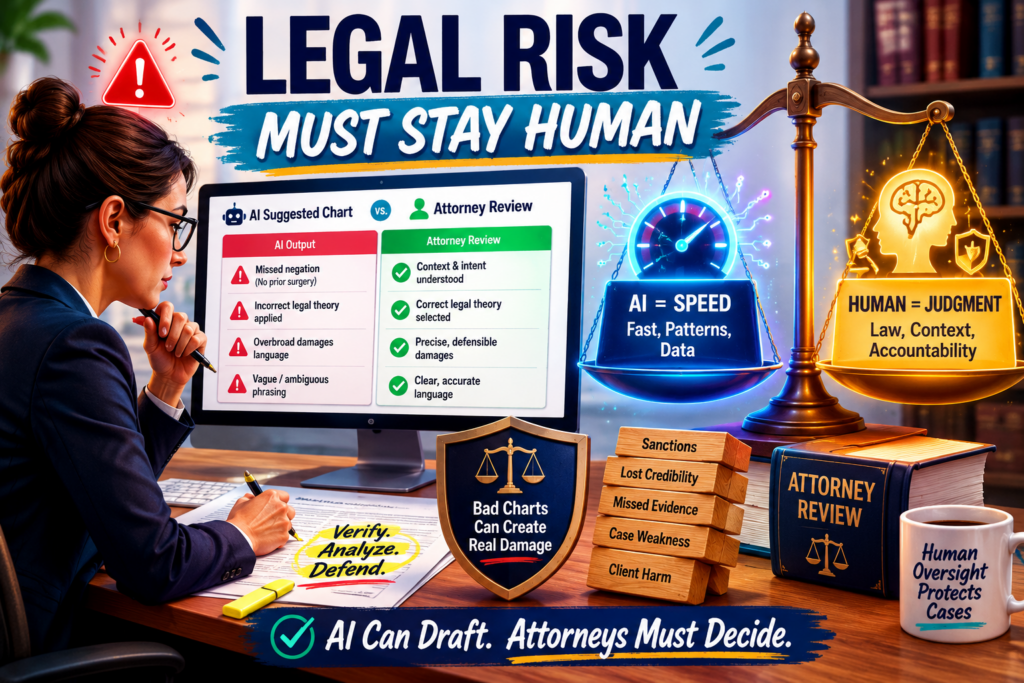
Legal risk must stay human because a bad chart can create real damage
AI claim charting can make a weak position look strong. That is the danger. A chart is not just a private note when it is used to guide a business move.
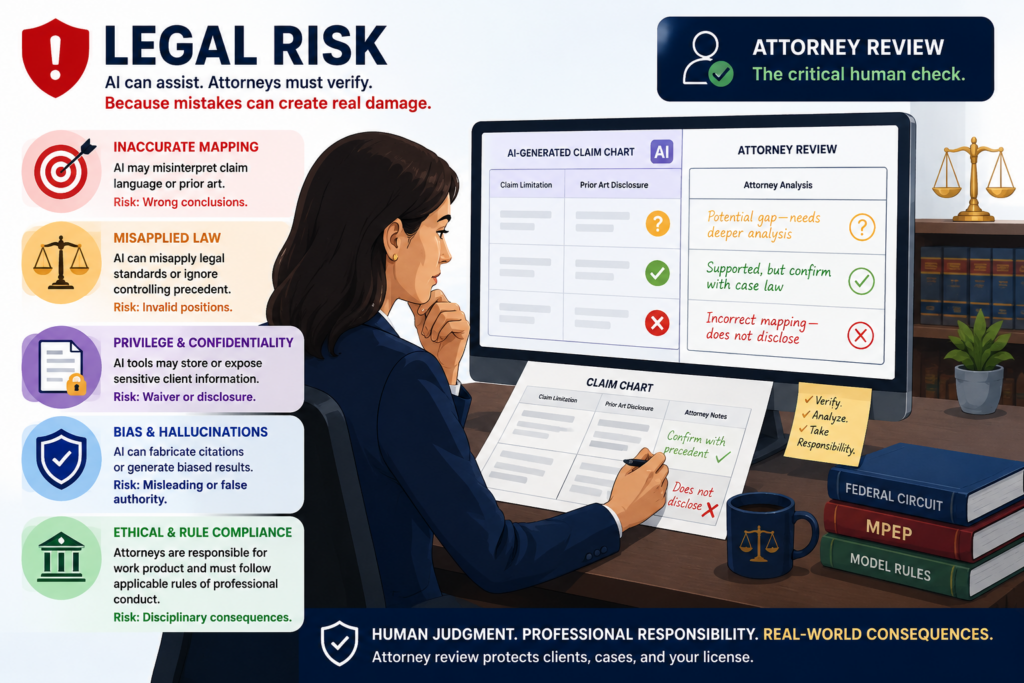
It can shape how a founder talks to investors, how a company speaks to a competitor, how a patent owner thinks about licensing, or how a product team studies risk.
A poor chart can push a team into the wrong move. It can lead to a letter that should not have been sent.
It can make a startup think a patent gives more cover than it really does. It can also cause a team to ignore a real issue because the AI missed a key claim part.
That is why legal risk review must stay human. An attorney is not there to slow down the process. The attorney is there to protect the founder from trusting a chart that has not earned trust yet.
A reviewed chart helps separate confidence from hope
Founders are builders. They move fast. They make hard calls with limited time. That mindset is often what makes a startup work.
But when it comes to patents, moving fast without review can create problems that are hard to undo.
A claim chart can feel convincing because it looks organized. It has columns. It has claim text. It has evidence. It may even have clean notes that explain the match.
But neat format does not mean legal strength. A chart can look complete while missing the one fact that matters most.
Human review brings discipline to the chart. The attorney looks at whether each claim element is truly supported.
They check whether the evidence is direct or only suggestive. They ask whether the chart is ready for its intended use or whether more work is needed.
This is not about killing momentum. It is about replacing guesswork with grounded confidence.
A founder should not have to wonder whether the chart is real or just polished. The review process should make that clear.
The attorney must decide what the chart can safely be used for
Not every chart should be used in the same way. Some charts are only good enough for early internal review.
Some are useful for a deeper product study. Some may support a business talk. Some may need much more work before they are shared outside the company.
AI cannot safely make that call by itself. The attorney must decide the proper use. That decision depends on the claims, the evidence, the product, the goal, and the risk.
A chart with public evidence may be enough for a first look, but not enough for a strong legal position. A chart that maps some elements well but leaves one element unclear should not be dressed up as complete.
This human judgment protects the founder. It also protects the company’s reputation. Sending a weak or careless claim chart can damage trust. It can make the other side question your seriousness. It can also create needless conflict.
A smarter path is to use AI for speed, then use attorney review for judgment. That is how modern patent work should feel. Fast enough for startup life. Careful enough for real stakes.
PowerPatent is built around that balance, helping technical teams move faster while keeping real attorney oversight in the loop. You can explore that process here: https://powerpatent.com/how-it-works
Business strategy must stay human because claim charts are not made in a vacuum
A claim chart should serve a business goal. It should not exist just because software can make it.
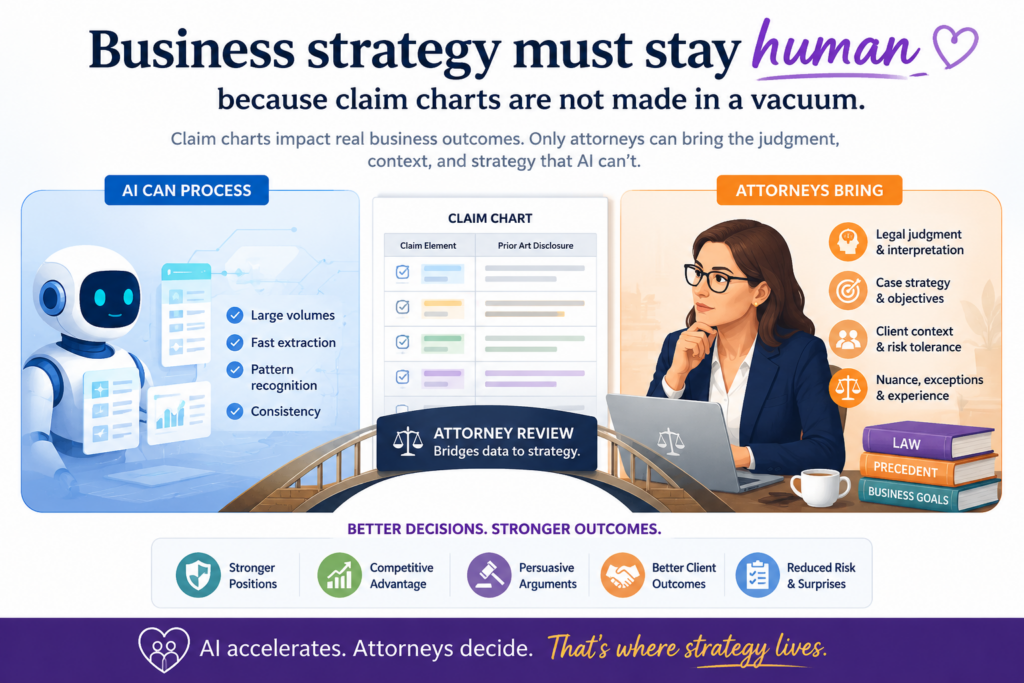
Before a team spends time on a chart, someone should know what decision the chart is meant to support. That is a human strategy question.
A startup may need to know whether its own patent covers its product. It may need to show investors that core technology is protected.
It may need to study a competitor. It may need to check whether a new feature creates risk. It may need to find gaps before filing more patents.
Those are different goals. They need different charts. They also need different levels of proof, detail, and attorney review.
The best chart answers the business question behind the legal task
Founders do not wake up wanting claim charts. They want answers. They want to know whether their work is protected.
They want to know whether they can launch with less fear. They want to know whether their patent story is strong enough for a seed round, a Series A, a deal, or an exit.
A claim chart is useful only when it helps answer that kind of question. If the chart is too broad, it creates noise.
If it is too narrow, it hides value. If it is too technical, the business team may not use it. If it is too shallow, the legal team cannot trust it.
An attorney helps tune the chart to the moment. For an internal founder review, the chart may focus on clear signals and gaps. For investor support, it may need a simple story that stays accurate.
For a licensing plan, it may need stronger evidence and tighter language. For a product clearance review, it may need to focus on risk and design choices.
AI can draft. It can organize. It can help compare. But the business purpose must be set by humans who understand the company’s stage, market, product, and goals.
Human review helps founders avoid spending effort in the wrong place
A startup has limited time. The wrong IP task can eat weeks and give very little back. This happens when teams chart weak patents, chart the wrong product, chase low-value claims, or build charts that do not support any clear decision.
Attorney review can stop that early. A good attorney can look at the claims and say whether they seem worth deeper work. They can point out which claim is most likely to matter.
They can flag when the evidence is too thin. They can also tell the founder when a new patent filing may be a better move than trying to force value from an old claim.
This is where the human role becomes very practical. It is not just legal review for legal review’s sake. It is business triage. It helps the team choose where to spend time.
For deep tech founders, this can be a major edge. You may be building something hard, new, and expensive to copy. Your IP work should help you protect that edge without pulling you away from building.
PowerPatent helps make that easier by pairing smart software with attorney-backed review, so founders can move with speed and stay focused on the work that matters. See how it works here: https://powerpatent.com/how-it-works
Inventor context must stay human because the best facts are often not in the documents
AI can read what is written. It cannot know what the inventor meant unless that meaning is captured somewhere. It cannot know why a design choice was made.
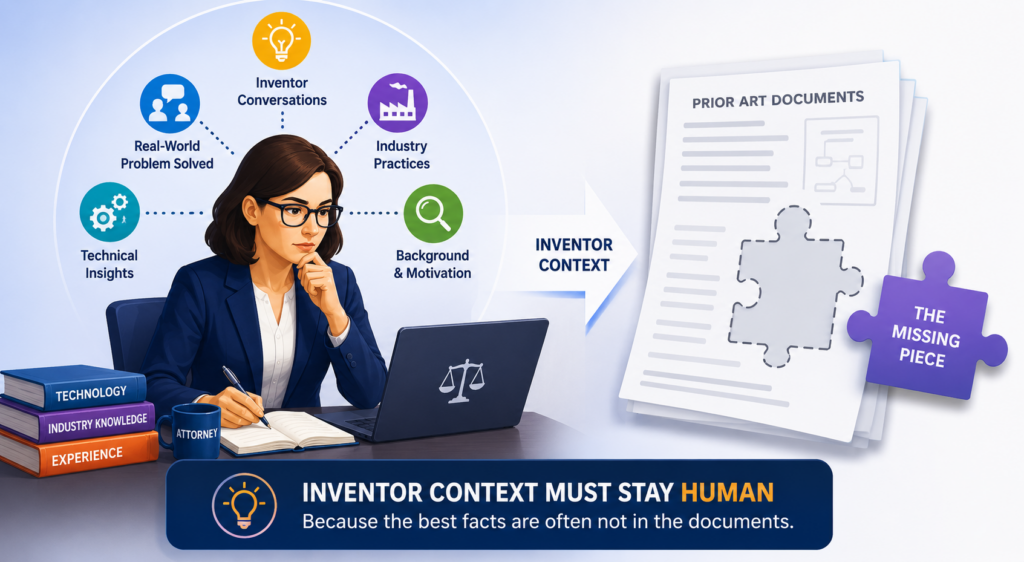
It cannot know which part of the system is truly new. It cannot know which feature took six months of hard work and which feature was added as a quick wrapper.
That context matters. In many claim charting projects, the most important facts are not found in public pages or old files. They live in the heads of the founders, engineers, and inventors. Human review brings those facts into the process.
The inventor can explain what the chart cannot see
A claim chart may show that a product has certain parts. But the inventor can explain why those parts matter.
They can explain what problem the system solves, what failed before, what tradeoffs were made, and how the product behaves in real use.
This kind of context can change the claim chart. It can help the attorney understand whether a claim term maps to a real system feature.
It can reveal that the product does the claimed step in a different way than the evidence suggests. It can also show that the public evidence is incomplete or misleading.
For AI systems, this is especially important. A model may produce an output, but the real invention may be in how the data is cleaned, how the model is updated, how results are ranked, how feedback is used, or how the system handles uncertain cases. A public demo may show only the surface. The inventor knows the engine.
The attorney’s job is to ask the right questions and turn that context into useful chart notes without overreaching.
The chart should not become a wish list. It should become a clear record of what is known, what is supported, and what still needs proof.
The human review should pull out the story of the invention
A strong claim chart is not just a match exercise. It can reveal the story of the invention. It can show how the patent connects to the product, why the protected feature matters, and where the company’s moat may be.
This story matters because patents are business tools. Investors, buyers, partners, and internal leaders do not want a maze of claim language.
They want to understand what is protected and why it matters. A reviewed chart can help translate technical invention into clear business value.
AI can help draft that first translation. But the final story should be shaped by people who understand the invention and the risk.
The attorney keeps the story accurate. The founder keeps it connected to the business. The engineer keeps it true to the system.
That mix is powerful. It turns claim charting from a dry legal task into a strategic asset. It gives the startup a clearer way to explain its edge without making claims it cannot support.
PowerPatent helps make that kind of collaboration easier. Founders can use smart tools to move fast, while real attorney oversight helps keep the work clear, useful, and grounded in the actual invention. Learn more here: https://powerpatent.com/how-it-works
Final language must stay human because words can raise or reduce risk
The final words in a claim chart matter. A small change in phrasing can change how the chart reads.
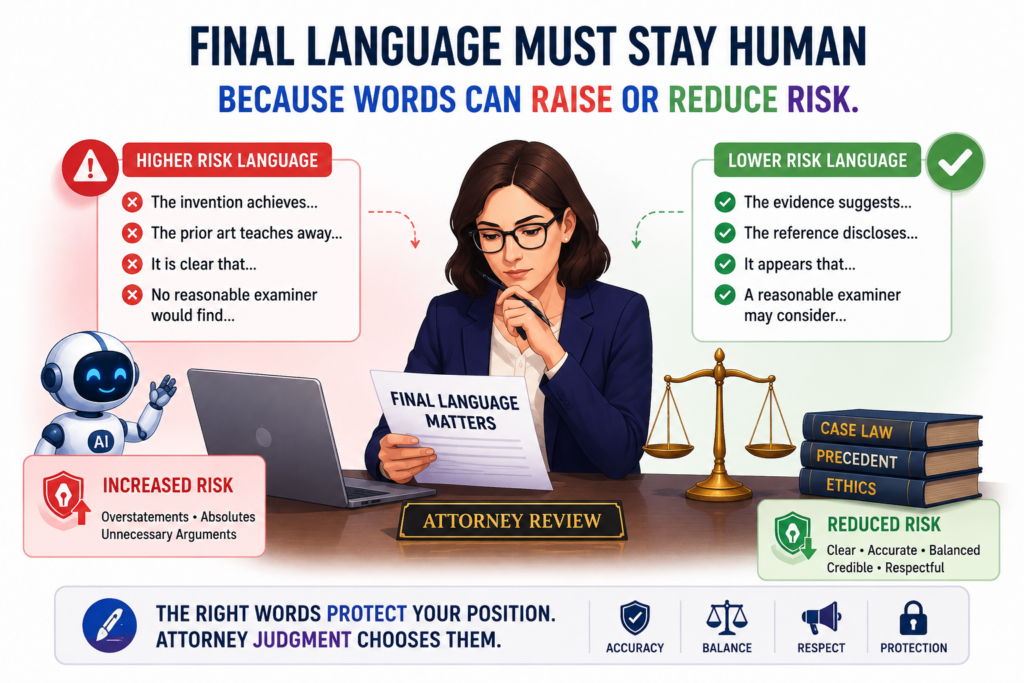
It can make the position sound stronger than it is. It can also make a strong position sound unsure. AI may not always understand that balance.
This is why final language should be reviewed by an attorney. The attorney knows how to describe a claim match in a way that is clear, fair, and tied to evidence.
That matters when the chart may be read by business leaders, investors, partners, or another company.
Strong language should be earned by strong evidence
A chart should not say that a product “meets” a claim element unless the support is strong enough for that statement. In many cases, softer language may be more accurate.
The chart may show that a feature “appears to correspond” to a claim part based on public materials. It may say that more technical proof is needed. It may explain that the evidence supports one reading but not another.
That may sound less exciting, but it is more useful. Overstated language creates false comfort. Careful language helps teams make better choices.
This is one of the places where AI can be risky. AI often writes in a confident voice. It may turn a loose connection into a firm statement.
It may fill in missing steps with smooth reasoning. It may fail to mark the difference between direct proof and an assumption.
An attorney keeps the chart honest. They make sure the words match the evidence. They also make sure the chart does not hide weak spots.
A clear weak spot is not a failure. It is a signal. It tells the team what to test, what to document, or what to ask next.
The right tone makes the chart more useful to the whole company
A claim chart should be readable. It should not be packed with legal words that only a lawyer can understand. It should explain the match in plain terms so the founder, product team, and business team can use it.
This does not mean the chart should be casual. It should be formal enough to be trusted, but clear enough to be used.
The best tone is direct, accurate, and calm. It does not hype. It does not hide. It shows what the claim says, what the evidence shows, and what the reviewer thinks.
That is the tone PowerPatent believes modern patent work should have. Founders should not need to decode legal fog to understand their own IP. They should be able to see what matters, act faster, and avoid costly blind spots.
AI can help produce the first draft of that language. Human review makes it safe to use. That is the key. The machine can help write the chart. The attorney must decide what the chart can say.
PowerPatent combines smart software with real attorney support so founders can get clear, fast, and reviewed patent work without the old-school friction. You can see the workflow here: https://powerpatent.com/how-it-works
Source review must stay human because AI can pull from the wrong place
AI can gather a large amount of source material in a short time. It can scan websites, public filings, help pages, product guides, videos, code notes, and old patent files.
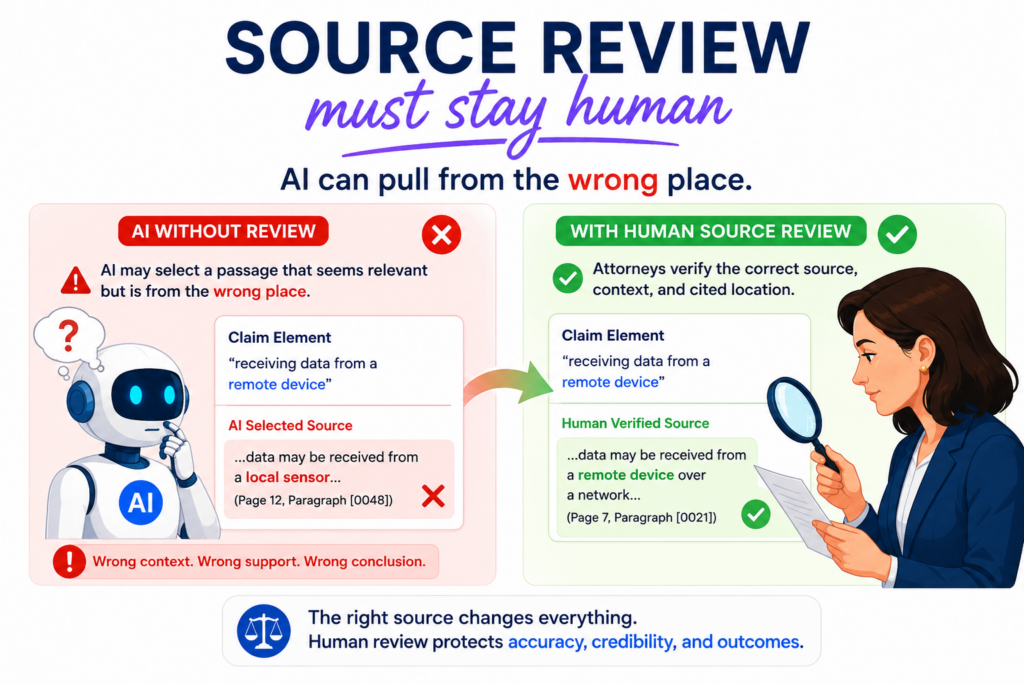
That reach is helpful, but it also creates a major problem. More sources do not always mean better sources.
A claim chart can become weak when it is built on stale, vague, or poor material. A product page from three years ago may not match the current product.
A marketing line may describe a dream feature, not a working feature. A copied blog post may repeat a claim without proving it. AI may not always know the difference.
Attorney review helps make sure the chart is built on sources that deserve trust.
A human reviewer must check whether the evidence is current and tied to the real product
A strong claim chart should show what the product does now, not what it did long ago or what a sales page once promised.
This is especially important for software, AI tools, cloud systems, and fast-changing platforms. Features change. Workflows change. APIs change. A claim chart based on old material can point the team in the wrong direction.
An attorney can ask when each source was published, whether it applies to the right product version, and whether the source is official.
They can also check whether a piece of evidence is direct enough to support the claim part it is being used for.
This is not busy work. It is risk control. A chart that uses weak sources may look full, but it may fall apart when someone asks hard questions.
The review should remove noise before the chart becomes a business tool
AI often collects too much. That can make the chart harder to read and harder to trust.
A long chart with weak proof is not better than a short chart with strong proof. It may even be worse because it hides the key facts inside a pile of noise.
A human reviewer should cut out sources that do not help. They should keep the chart focused on proof that maps to the claim. They should also mark where the source only suggests a match instead of proving one.
For a founder, this makes the chart more useful. You do not need a giant file that no one can act on. You need a clear view of what is strong, what is weak, and what needs more work.
PowerPatent helps founders get to that kind of clarity faster by pairing smart software with real attorney oversight. You can see how the process works here: https://powerpatent.com/how-it-works
Claim element mapping must stay human because one missing part can change everything
A patent claim is not met just because a product matches most of it. Each required part matters.
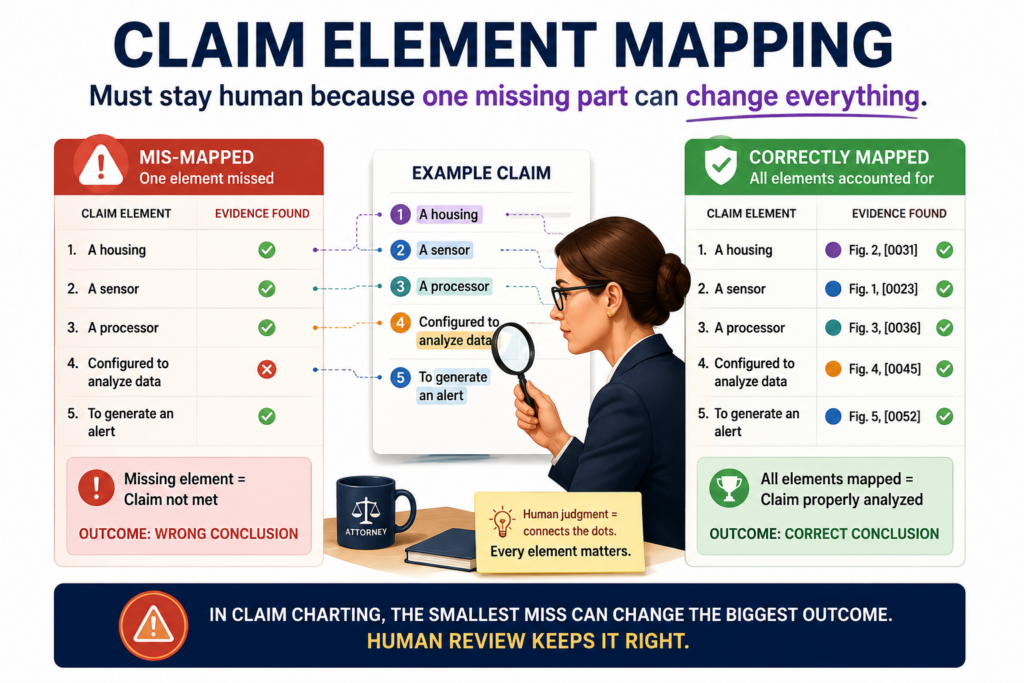
If one required part is missing, unclear, or not supported, the whole chart may be weaker than it looks.
AI can split a claim into parts and place evidence next to each part. That is useful. But the deeper review must stay human because claim mapping is not just matching text. It is checking whether every required feature or step is actually present.
This is where many AI charts can mislead teams. They may show a neat row for every claim part, but the proof in one row may not be enough.
A founder may see a complete table and think the case is strong. The attorney sees the missing link.
A reviewed chart should make gaps visible instead of hiding them
Gaps are not bad if they are clearly shown. In fact, they are one of the most useful parts of a good chart. A gap tells the team what to test, what to document, what to ask an engineer, or what to review with outside proof.
The danger is when AI fills gaps with guesswork. It may assume that if a system receives data, it must also process the data in the claimed way.
It may assume that if a model gives an output, it must use the same method described in the claim. It may assume that a user action happens because the product design seems to invite it.
Those assumptions can be wrong. A human reviewer must stop the chart from pretending that an assumption is a fact.
The attorney should label each claim part by strength
A practical review should not treat all chart rows the same. Some rows may have strong support. Some may have partial support. Some may need more evidence. Some may fail under the best reading.
That strength rating helps the startup make better calls. It shows whether the patent read is ready for a deeper step or whether the team should pause and collect more proof.
It also helps founders avoid spending time on weak claims when a stronger claim may be available.
This is one of the best uses of AI with human review. Let AI do the heavy lifting of first-pass mapping.
Let the attorney test each match, clean up the language, and show where the real strength is. That gives the founder speed without blind trust.
Product testing must stay human because public words may not show real behavior
Some claim charts can be built from public documents.
Many cannot. For complex products, the best proof often comes from using the product, testing workflows, watching outputs, reading logs, or studying how the system acts under different inputs.
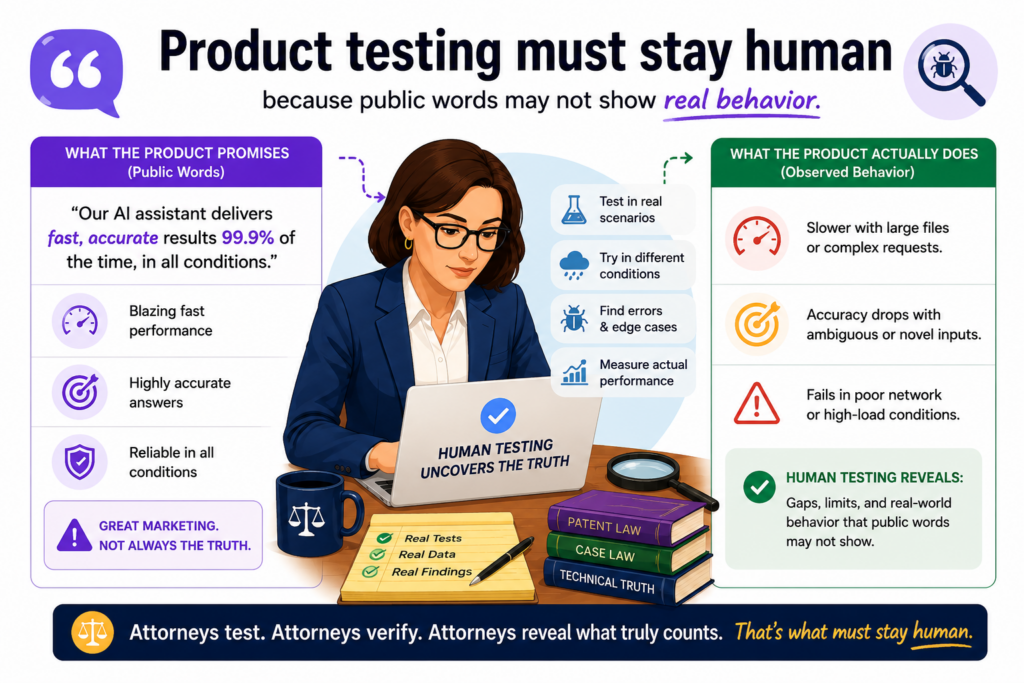
AI can help plan tests and organize results. But humans must decide what to test, how to test it, and what the results mean.
This is even more important when the product involves machine learning, sensors, network steps, medical tools, security systems, robotics, or cloud workflows.
A claim chart should not guess at product behavior when it can be tested.
Human testing can turn a weak chart into a stronger one
A product page may say a system “detects risk.” That tells you very little. The claim may require a system to receive sensor data, compare it to a threshold, update a score, and trigger a control action.
To chart that claim well, someone may need to test the product and record what actually happens.
That test may reveal a strong match. It may also reveal that the product works in a different way. Either result is useful because it replaces guesswork with facts.
An attorney helps connect the test to the claim. The engineer or technical expert helps run the test in a way that reflects real use. Together, they can decide whether the test result proves the claim part or only points in that direction.
Testing should be planned around the claim, not around curiosity
A common mistake is testing the product in a general way and then trying to force the results into a chart. That wastes time. The better approach is to read the claim first, find the key parts, and design the test around those parts.
This is where attorney review adds practical value. The attorney can say which facts matter most.
They can help avoid tests that look interesting but do not answer the legal question. They can also help frame test notes so they stay clear, accurate, and tied to evidence.
For startups, this is a better way to spend limited time. You do not need endless testing. You need the right testing.
PowerPatent helps founders move toward that kind of focused IP work, with smart tools that speed up the process and attorney oversight that keeps the work pointed at the right target. Learn more here: https://powerpatent.com/how-it-works
Confidential facts must stay human because sensitive information needs careful handling
Many claim charts involve sensitive facts. A startup may chart its own patent against its own product.
It may compare claims to source code, model design, data flows, architecture notes, customer workflows, or internal roadmaps. That information can be very valuable. It can also be risky if handled carelessly.
AI tools can help organize sensitive information, but the decision about what to include, where to store it, and who can see it must stay human.
A founder should never treat a claim chart like a simple document when it contains details about the company’s core technology.
Attorney review helps create the right guardrails.
The chart should show enough to be useful without exposing more than needed
A strong chart does not always need to include every sensitive detail. Sometimes it can refer to internal proof in a controlled way.
Sometimes it can separate business-facing notes from attorney-facing analysis. Sometimes it can keep source code excerpts out of the main chart and store them in a safer place.
The key is to match the level of detail to the use of the chart. An internal technical review may need more detail.
An investor-facing summary may need less. A licensing analysis may need strong evidence, but it also needs careful handling.
AI will not always know what should be hidden, softened, separated, or protected. A human attorney can help decide that.
Founders should control who sees the full chart
A claim chart can reveal how your product works. It can show which features you think are valuable. It can point to your patent strategy. It can even reveal where your protection is strong or weak. That is not something every person needs to see.
Human review should include access control. The founder, attorney, and core technical team should know who can view the chart and what version each person should see.
A board update may need a short summary. An engineer may need a technical task list. An attorney may need the full detail.
This helps the company move faster without being careless. It also helps keep patent work aligned with business needs.
PowerPatent is built for founders who want that kind of control, speed, and attorney-backed support without drowning in old-school process. You can explore the workflow here: https://powerpatent.com/how-it-works
Final sign-off must stay human because someone must own the judgment
AI can assist. AI can draft. AI can compare. AI can flag patterns. But AI should not be the final signer of a claim chart that may guide real business action. Someone must own the judgment.
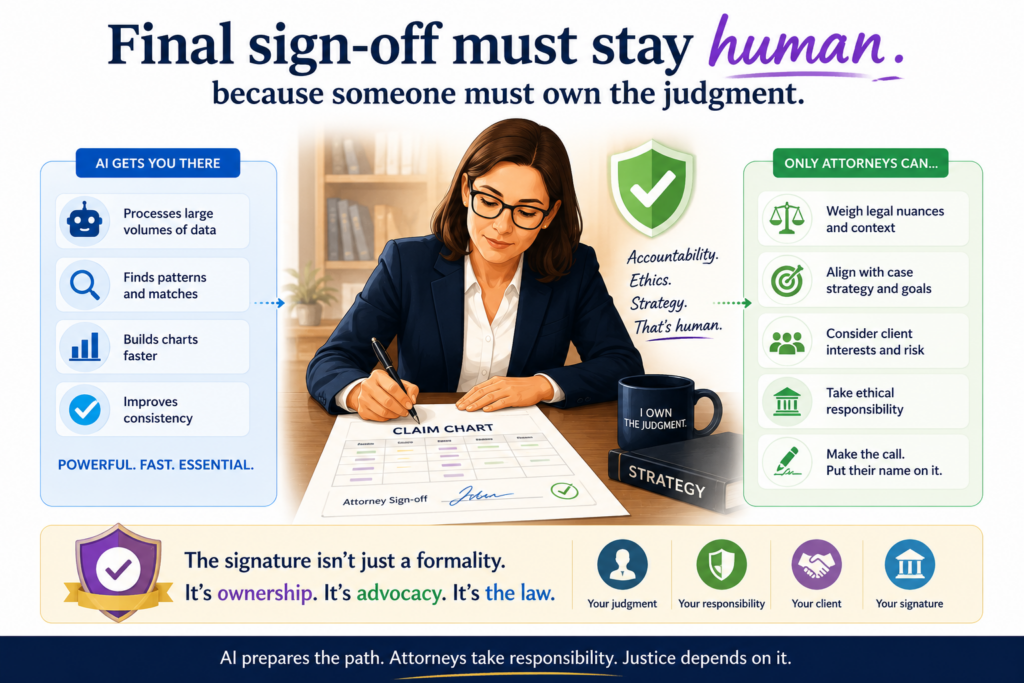
That someone should be a human attorney.
Final sign-off is not a rubber stamp. It is the moment where the reviewer asks whether the chart is ready for the purpose it is meant to serve. That requires legal skill, technical care, and business awareness.
A founder should know whether the chart is a first-pass draft, a reviewed internal tool, or a stronger document ready for a higher-stakes use.
Human sign-off creates accountability that AI cannot provide
A claim chart can affect major decisions. It can shape whether a company files more patents, reaches out to a possible licensee, talks to investors, changes product direction, or studies a competitor more closely. Those decisions need accountability.
AI cannot take responsibility for the result. It cannot explain its judgment in the same way a trained attorney can. It cannot weigh business risk with the full context of the company.
It cannot sit with the founder and say, in plain words, what is strong, what is weak, and what should happen next.
That is the value of final human review. It gives the founder a clearer basis for action. It also gives the chart a level of trust that raw AI output does not have.
The best sign-off gives founders a clear next step
The end of a claim chart should not leave the founder confused. It should answer the practical question: what should we do now?
Maybe the next step is to collect more product evidence. Maybe it is to file a continuation or new patent application.
Maybe it is to update the company’s patent story for investors. Maybe it is to pause because the chart is not strong enough. Maybe it is to study another claim that fits the product better.
That is where attorney review becomes more than checking work. It becomes strategy.
For founders, the goal is not to become patent experts. The goal is to protect what you are building without losing speed. AI can make the process faster, but human review keeps it grounded.
PowerPatent brings those pieces together with smart software and real attorney oversight, so technical teams can act with more confidence and fewer delays. See how it works here: https://powerpatent.com/how-it-works
Human review must catch false matches before they become false confidence
AI claim charting can make matches look easy. The tool reads the claim, scans the evidence, and fills the chart. In a clean table, each part seems to line up.
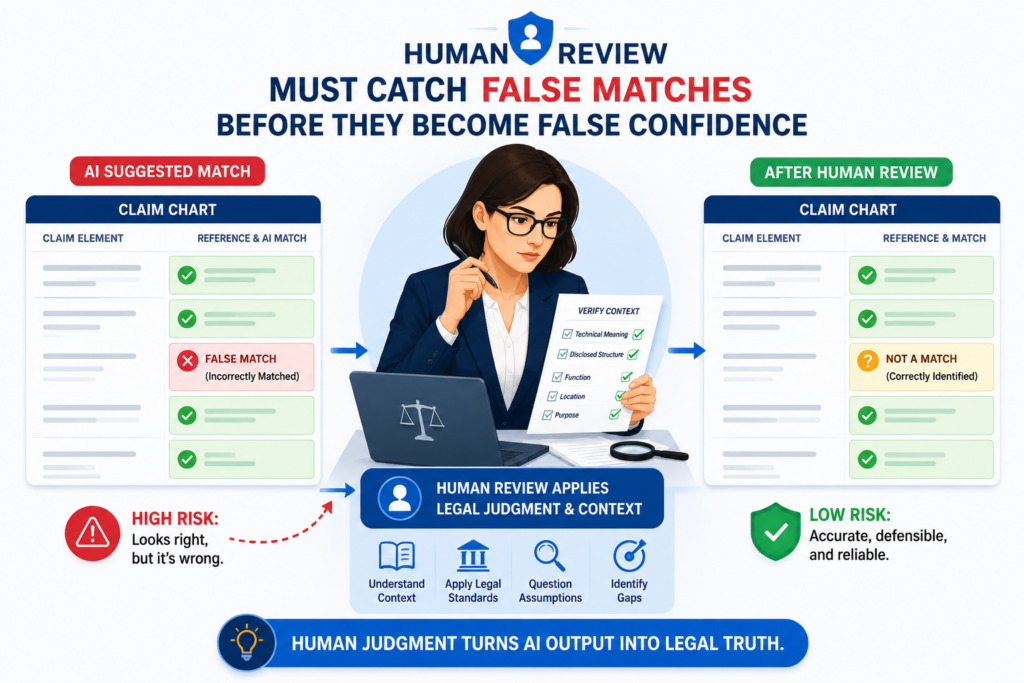
The trouble is that many of those matches may only be surface matches. The words may look close, while the real meaning is far apart.
This is one of the biggest reasons attorney review must stay human. A false match can lead a founder to believe a patent is stronger than it is.
That kind of false confidence can shape bad choices. It can affect fundraising, product plans, licensing talks, and patent filing strategy.
A false match often starts with words that seem to mean the same thing
Patent claims use words with care. Product pages use words to sell. Those two styles do not always line up.
A company may say its product “learns,” “detects,” “predicts,” “routes,” “optimizes,” or “automates.” Those words may sound like they match a claim. But the claim may require a very specific step, system, or result.
AI may see the same word in both places and treat that as a strong sign. A human attorney looks deeper.
They ask whether the product does the exact thing the claim requires. They ask whether the evidence proves that point or only hints at it.
This is where a chart can go from risky to reliable. The attorney does not just check whether the chart sounds right. They test whether it can stand up to hard questions.
A good review should pressure-test the strongest-looking rows first
The most dangerous parts of a claim chart are not always the empty rows. Empty rows are easy to spot. The greater risk is a row that looks strong but rests on weak proof.
A smart attorney review starts by pressing on the rows that seem too easy. Does the evidence truly show the claimed feature? Is there another way to read the product description?
Is the claim term broader or narrower than the AI assumed? Is the cited proof from the right product version? Would an engineer agree with the mapping?
This type of review can feel strict, but it protects the company. It keeps the chart from becoming a story the team wants to believe rather than a tool the team can trust.
For founders, this is not about slowing down. It is about moving with better judgment. PowerPatent helps teams use smart software for speed while keeping attorney oversight in place for the parts that require human judgment. You can see how that works here: https://powerpatent.com/how-it-works
Human review must decide when silence in the evidence matters
Sometimes the most important thing in a claim chart is not what the evidence says. It is what the evidence does not say.
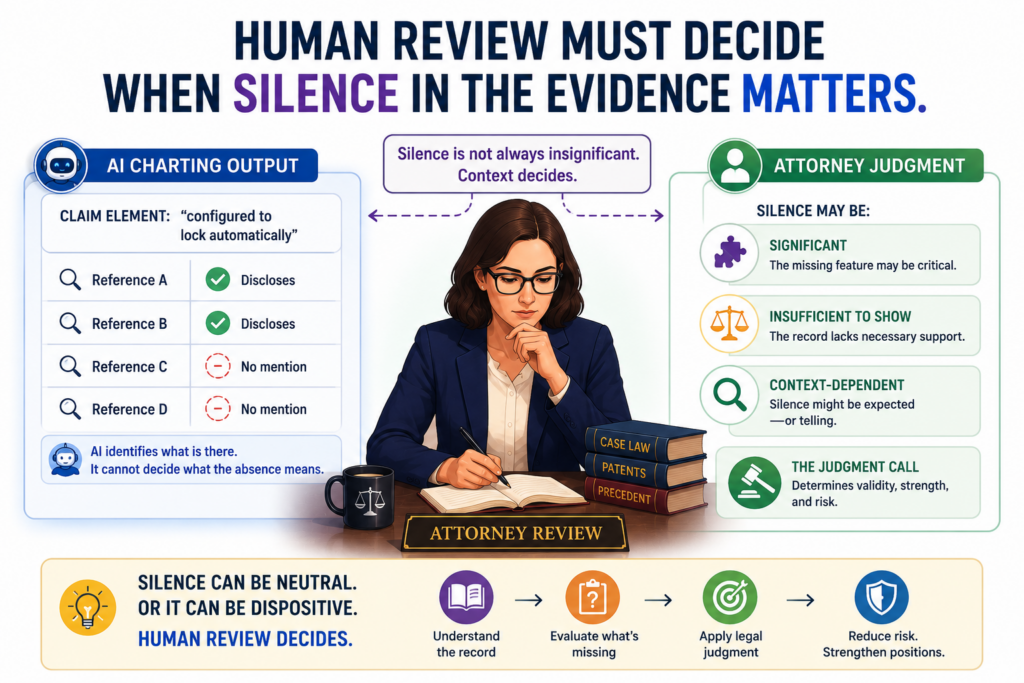
AI may fill a row with the best available source, even when that source does not truly prove the claim part. A human reviewer must decide whether that silence matters.
This is a subtle skill. A missing detail may be harmless in one chart and fatal in another.
It depends on the claim, the product, the use of the chart, and the type of evidence available. AI can flag missing facts, but it should not decide their legal weight on its own.
Silence can mean missing proof, not missing infringement or coverage
When a public source does not show a feature, that does not always mean the feature is absent. It may only mean the company has not described it publicly. This is common in software, AI, chips, medical devices, manufacturing systems, and internal cloud tools.
A founder should be careful here. If the chart is for your own product, your team may be able to confirm the missing point with internal documents, code, logs, or engineering input.
If the chart is for another company’s product, more research or testing may be needed.
An attorney helps separate these cases. They can say whether the missing proof is a serious weakness or just a next research step. That distinction matters because it changes what the company should do next.
The chart should say when more evidence is needed
A claim chart becomes more useful when it is honest about uncertainty. It should not pretend every row is complete. It should state when the evidence is partial, when a point is inferred, and when more proof is needed.
This is not weak writing. It is strong strategy. A founder who knows the gaps can act. A founder who is given a polished but uncertain chart may make the wrong call.
Human review brings that discipline. The attorney can mark uncertain areas in plain language. They can explain what would make the chart stronger. They can also help decide whether it is worth spending more time on the issue.
This is especially helpful for startups that need to move fast. You do not need every answer at once. You need to know which open questions matter most.
PowerPatent helps founders get that clear view without getting stuck in old, slow patent workflows. See the process here: https://powerpatent.com/how-it-works
Human review must shape the chart for the person who will use it
A claim chart is not useful just because it is accurate. It also has to be usable. The right chart for an attorney may not be the right chart for a founder.
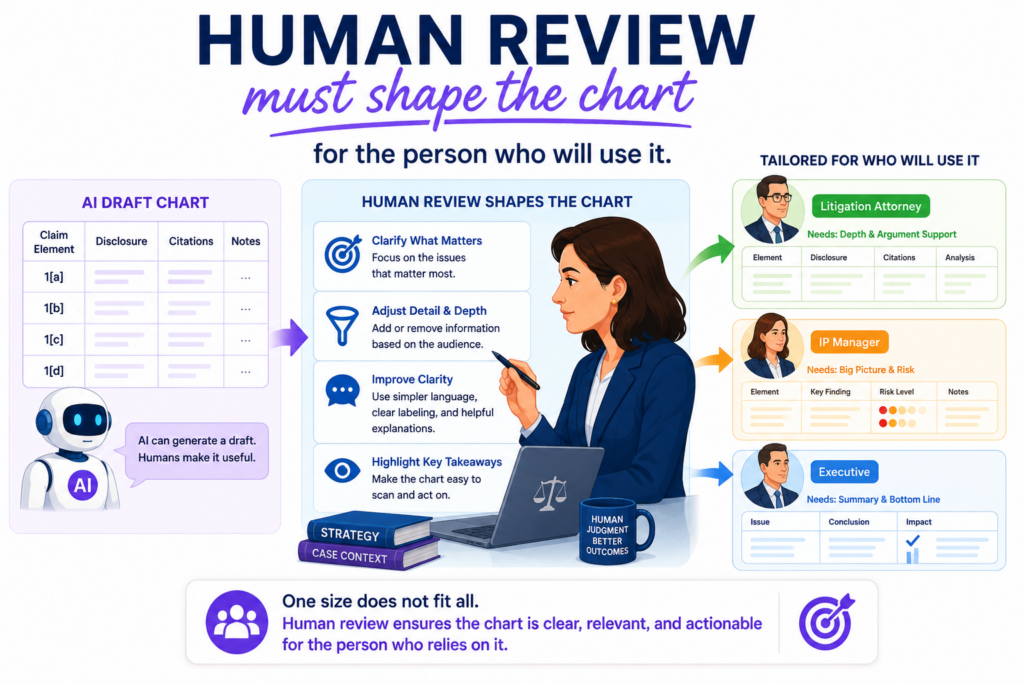
The right chart for an engineer may not be the right chart for an investor update. Human review helps shape the chart for the reader and the decision at hand.
AI can produce a standard format, but a standard format is not always the best format. The chart should match the purpose. That requires judgment, context, and a clear view of who will read it.
A founder needs clear action, not a wall of claim language
Many claim charts are hard to read because they are built like legal storage rooms. They hold a lot of material, but they do not guide action.
A founder may open the chart and see claim text, evidence, notes, links, and long explanations. After ten minutes, they still may not know what to do.
A human reviewer can fix that. The attorney can keep the full analysis where it belongs while giving the founder a clear summary.
The chart can show which claims appear strongest, which product features matter most, which gaps need proof, and which next step makes sense.
That does not mean the chart should be watered down. It means the chart should be clear. Clear work is not less serious. It is more useful.
The same facts can be framed differently for different business moments
A chart used before filing a new patent may focus on invention gaps and product coverage. A chart used before investor talks may focus on how the patent supports the company’s moat.
A chart used for licensing may need tighter evidence and careful wording. A chart used for internal product planning may focus on risk and design options.
AI may not know which version the company needs. A human attorney can help choose the right version and tone. This keeps the chart from being too casual for a serious use or too dense for a practical business meeting.
For deep tech founders, this matters a lot. Your team may be building advanced systems, but your patent story still needs to be clear. Investors and partners need to understand what you own and why it matters.
PowerPatent helps turn complex invention work into clear, attorney-backed patent action. Learn more here: https://powerpatent.com/how-it-works
Human review must keep AI from turning claim charts into legal theater
A chart can look impressive and still be empty. It can have long explanations, many links, polished language, and formal labels.
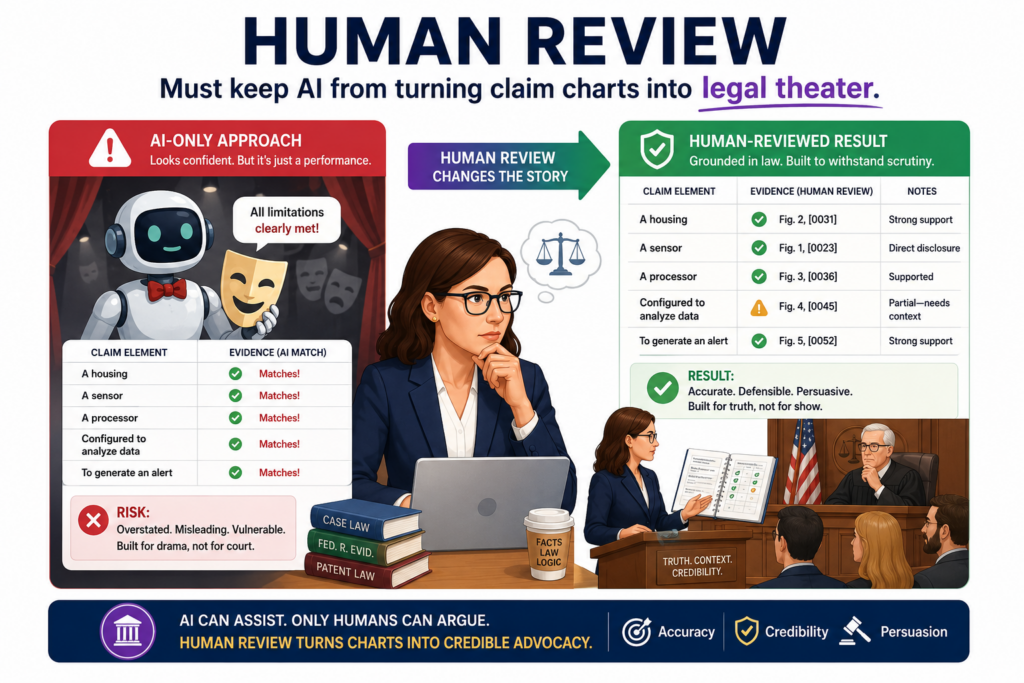
But if the analysis is weak, the chart is only theater. It looks like serious work without giving the company real value.
AI can make this problem worse because it is good at making documents look complete. It can produce confident text at scale. It can fill blank spaces. It can create a sense of order. But order is not the same as strength.
Attorney review keeps the work grounded in reality.
Real value comes from hard calls, not long charts
A good claim chart does not try to impress the reader with volume. It tries to answer the question clearly.
Does the product have this claim part? What proof supports that? What is missing? How strong is the read? What should the company do next?
Those questions require judgment. They also require the reviewer to make hard calls. Sometimes the answer is that the evidence is weak. Sometimes the better move is to chart a different claim.
Sometimes the patent does not cover the product as well as the founder hoped. Sometimes the chart reveals a strong position that should be used carefully.
AI can help surface the facts, but it should not hide from the hard calls. A human reviewer must make them.
The best review removes anything that does not help the decision
One mark of a strong attorney review is cutting. A weaker reviewer may leave everything in because it feels safer. A stronger reviewer removes noise and sharpens the point.
This is useful for founders because it saves time. You do not need to read five pages of vague evidence for one claim part.
You need the best evidence and the reason it matters. You need to know whether the row is strong, weak, or open.
This kind of clean review creates trust. It shows respect for the founder’s time. It also makes the chart easier to use across the company.
PowerPatent is built for this modern style of patent work. The goal is not to bury founders in legal material.
The goal is to help them protect what they are building with speed, clarity, and real attorney oversight. You can see how it works here: https://powerpatent.com/how-it-works
Human review must turn the claim chart into a next-step plan
A claim chart should not end with the chart. It should lead to action. After the review, the founder should know what the company can do now, what needs more proof, and what should be handled with care.
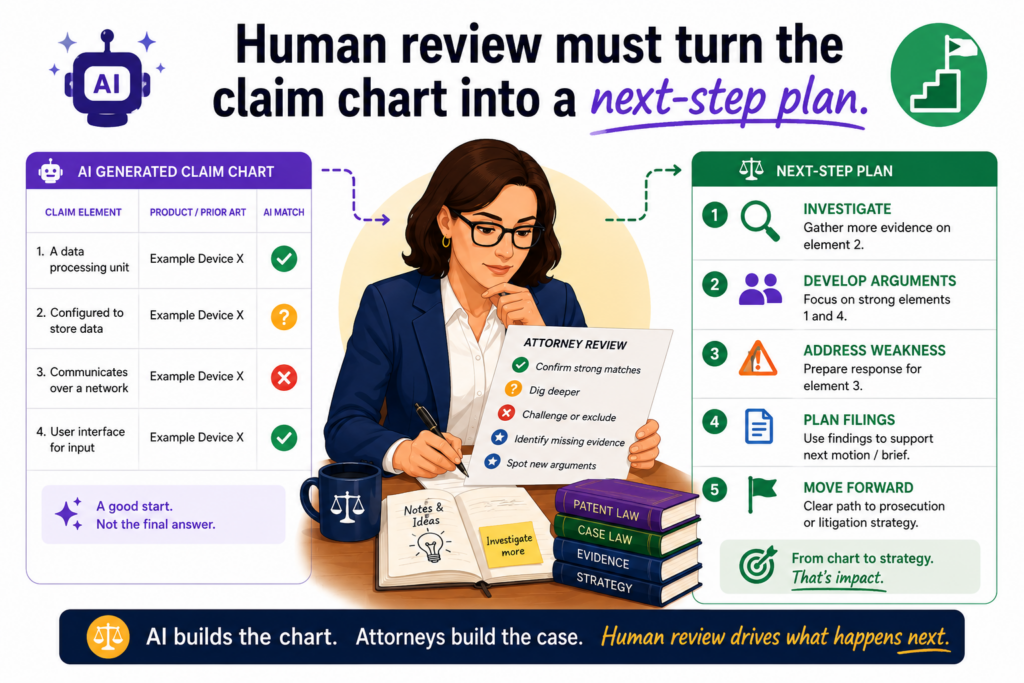
This is another reason the human role matters. AI can summarize a chart. It can suggest next steps.
But an attorney can tie those steps to the company’s legal position, business goals, product roadmap, and risk level.
That is where claim charting becomes useful strategy instead of a static document.
The next step depends on why the chart was made
If the chart was made to test patent coverage for your own product, the next step may be to file more claims around uncovered features.
If it was made to study a competitor, the next step may be to collect stronger evidence or compare another patent.
If it was made for investor readiness, the next step may be to turn the findings into a clear IP story. If it was made for product risk, the next step may be to review design options.
The same chart can point to very different actions. A human reviewer helps choose the right path.
This is important because founders do not need more documents. They need momentum. A chart that does not lead to a decision is just another file.
A reviewed chart that creates a clear next step can protect the company’s time and sharpen its IP strategy.
A good attorney review should end with plain guidance
The final review should not leave the founder guessing. It should explain what the chart shows in plain words.
It should state where the position looks strong. It should show where more work is needed. It should make the next move clear enough that the team can act.
This is where PowerPatent’s approach fits the way startups actually work. Founders want speed, but they also want confidence.
They want software that makes the process easier, but they still need real human judgment at key moments. That mix is what helps avoid costly mistakes and delays.
AI can draft the map. The attorney helps decide where the map leads.
PowerPatent helps founders turn complex inventions into stronger patent work with smart software and real attorney oversight. Start here to see how it works: https://powerpatent.com/how-it-works
Human review must protect the founder from treating AI output as legal truth
AI output can feel final because it looks clean. It may use formal words, cite evidence, and place each claim part in the right-looking box.
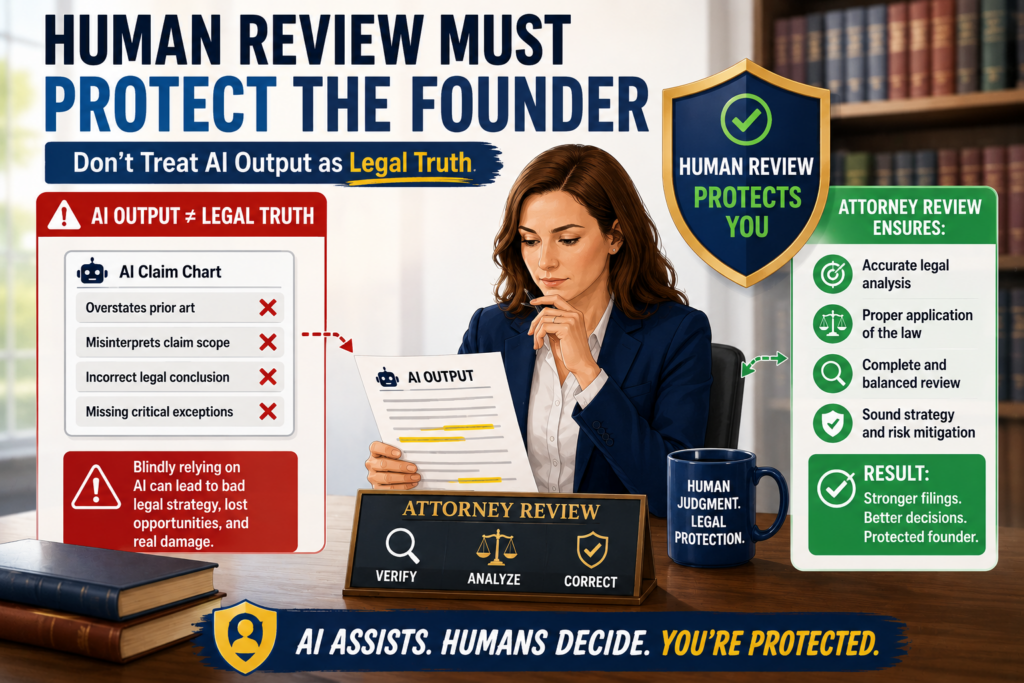
For a busy founder, that can create a strong pull to trust it and move on. That is understandable, but it is also risky.
A claim chart is not legal truth just because software made it. It is a draft until a human attorney reviews the claim meaning, the evidence, the gaps, and the business use.
The difference between a draft and a reviewed chart is not cosmetic. It is the difference between raw output and guided judgment.
A founder should know what level of review the chart has received
One of the most useful things an attorney can do is label the state of the chart clearly. Is this only an AI-generated first pass? Has it been checked for evidence quality? Has the claim language been reviewed?
Has a technical expert confirmed how the product works? Has the chart been cleared for internal use only, or can it support a more serious action?
That clarity helps the founder make better decisions. Without it, the founder may treat every chart the same. That can lead to overconfidence in a weak chart or hesitation around a strong one.
A good review process does not hide the stage of the work. It makes the stage clear. It tells the team what the chart can support right now and what it cannot support yet.
The reviewed chart should include plain warnings where needed
Attorney review should not make the chart harder to read. It should make the chart safer to use. When a claim part has weak proof, the chart should say so.
When a match depends on a certain claim reading, the chart should explain that in plain words. When a source is old or vague, the chart should flag it.
This kind of plain warning is not a sign of weak work. It is a sign of honest work. It helps the startup avoid bad moves and focus on the facts that matter most.
For founders, this is where PowerPatent’s model is so useful. The software helps create speed, but real attorney oversight helps keep the work from becoming blind trust in automation.
You can see how PowerPatent brings both together here: https://powerpatent.com/how-it-works
Human review must decide when a chart should lead to a new patent filing
A claim chart often reveals something bigger than the chart itself. It may show that an existing patent covers part of the product, but not the newest and most valuable feature.
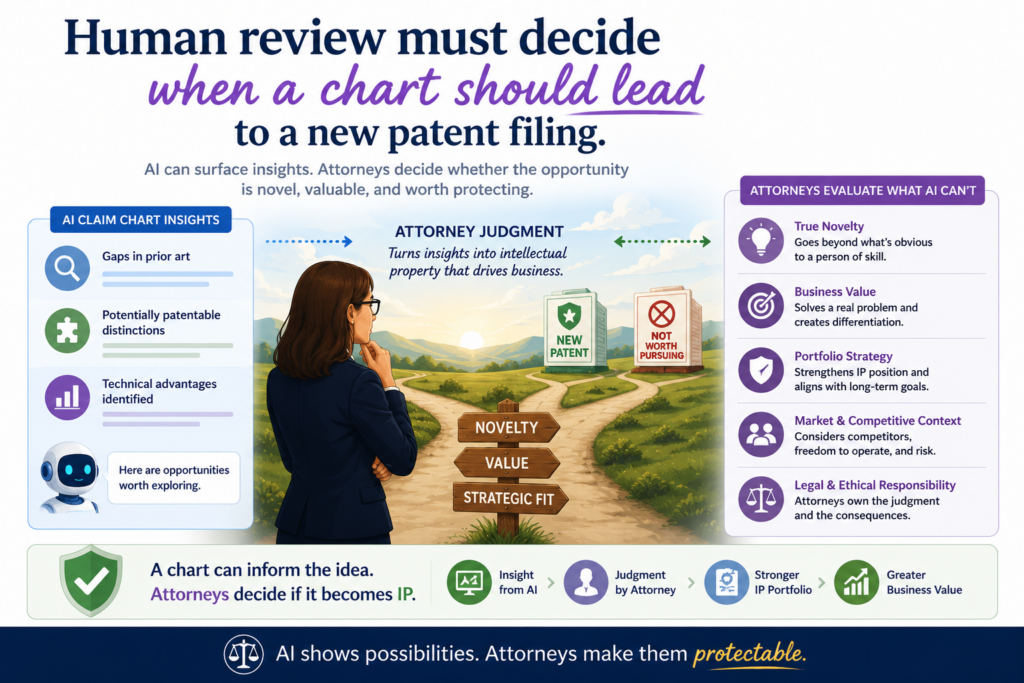
It may show that the claims are too narrow for the market. It may show that a competitor is moving into an area the startup has not protected yet.
AI can help spot these patterns, but a human attorney must decide whether the right next move is a new patent filing.
That decision requires more than charting. It requires knowing the invention, the business, the timing, and the company’s goals.
A chart can expose protection gaps before they become business problems
Many startups build faster than they file. That is normal. Product teams ship new features, improve systems, tune models, and rebuild workflows.
Over time, the product may move beyond the first patent filing. The old patent may still matter, but it may not protect the newest core value.
A reviewed claim chart can make that visible. It can show which product features are clearly covered and which features sit outside the current claims. That is useful because founders can act before the gap becomes painful.
The right answer is not always enforcement or licensing. Sometimes the smartest move is to file better claims around the live product.
Sometimes the best move is to protect a new workflow, a model improvement, a data pipeline, a device control method, or a system architecture that did not exist when the first filing was made.
The attorney must connect chart gaps to filing strategy
A gap in a claim chart is not just a missing row. It can be a roadmap for stronger protection.
The attorney can ask whether the uncovered feature is valuable, whether it is hard to copy, whether it supports the company’s edge, and whether it should be protected now.
This is where human judgment becomes very practical. AI might say the current claim does not cover a feature. A human attorney can say what that means and what to do about it.
For a founder, this can be the difference between having patents that look good on paper and having patents that protect the real business.
PowerPatent helps technical teams turn product knowledge into stronger patent filings with smart software and attorney-backed review. Learn more here: https://powerpatent.com/how-it-works
Conclusion
Attorney review in AI claim charting is not a blocker; it is the guardrail that makes speed safe. AI can read faster, compare faster, and draft faster, but it cannot own the final judgment. A human attorney must decide what the claim means, what the evidence proves, where risk sits, and what the founder should do next.
That balance gives startups the best of both worlds: quick work and trusted review. With PowerPatent, founders can protect hard technical work without getting trapped in slow legal process. See how it works here: https://powerpatent.com/how-it-works