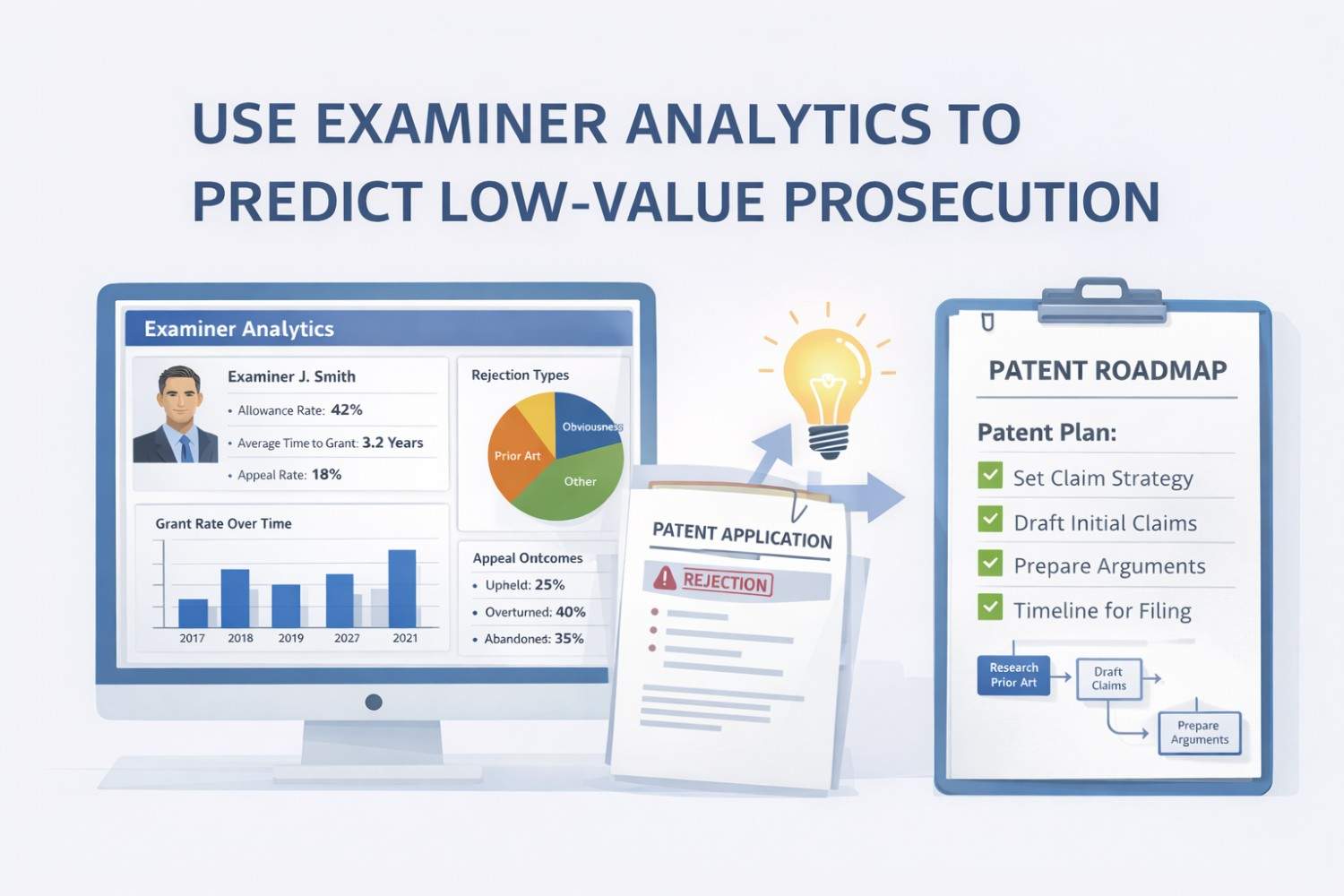
You do not win patents by guessing. You win by seeing patterns early and acting before you waste time and money. Examiner analytics lets you see how a patent examiner behaves before you ever respond to an office action. It shows you where cases stall, where claims shrink, and where founders burn cash for very little gain. When you know how to read that data, you can predict low-value prosecution before it drains your runway—and make smarter moves from day one.
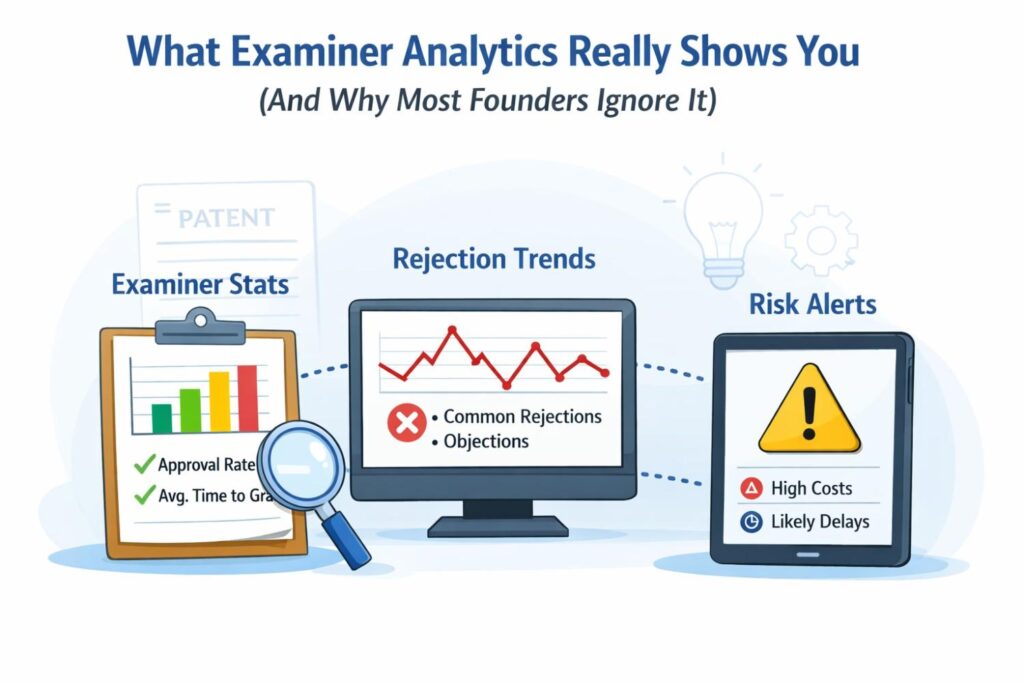
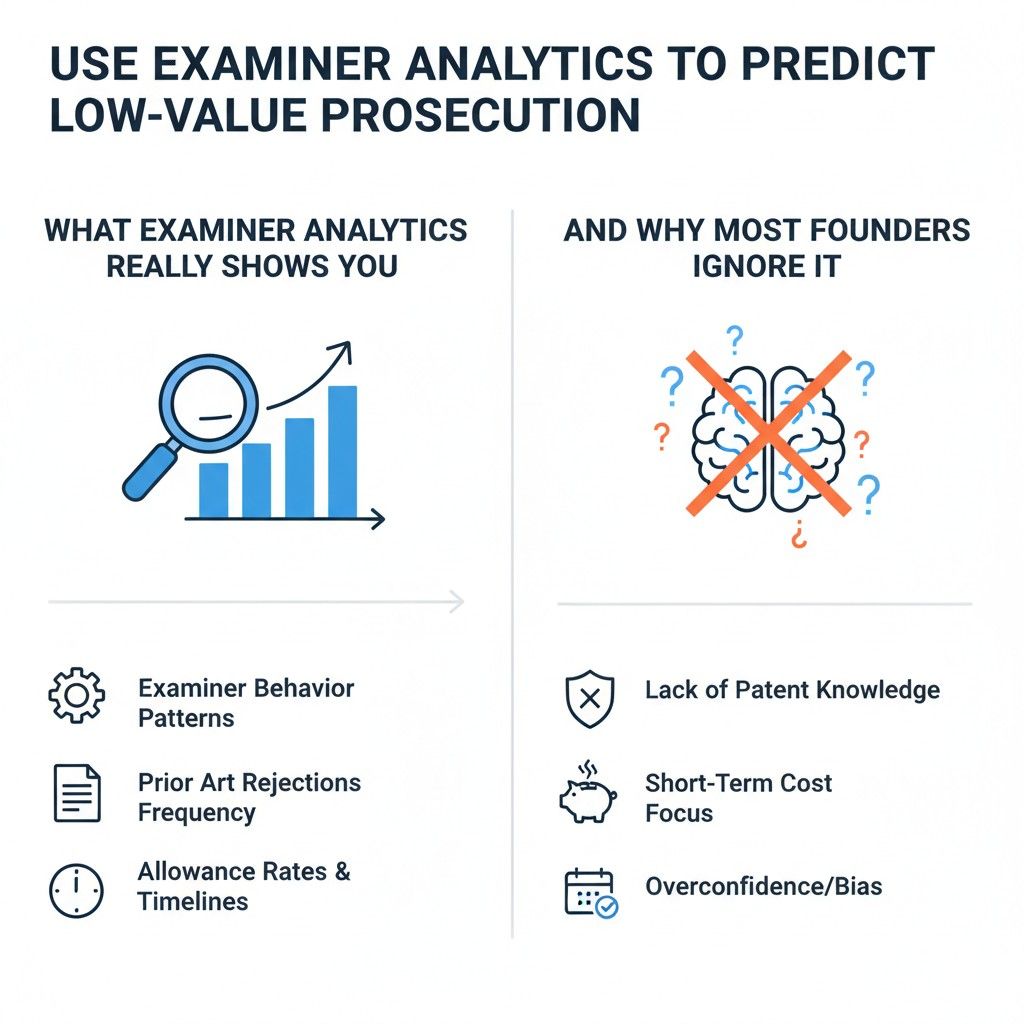
What Examiner Analytics Really Shows You (And Why Most Founders Ignore It)
Most founders think examiner analytics is just a set of numbers. It is not. It is a pattern map. It shows how a real human inside the patent office tends to act under pressure, under time limits, and across many cases.
When you learn how to read those patterns, you stop reacting to office actions and start planning your moves in advance.
This section breaks down what that data truly reveals and how you can use it to protect your runway and your edge.
It Reveals How Risky Your Path Really Is
At first glance, allowance rate sounds simple. Higher is better. Lower is worse. But that is only the surface. What really matters is what the allowance rate means for your specific type of invention.
If an examiner allows 70% of hardware cases but only 25% of software cases, and you are filing an AI-driven platform, that gap matters. It tells you your road may be tougher than it appears on paper.
This is where strategy starts. If you see risk early, you can prepare layered claims from the start.
You can draft independent claims that aim high and dependent claims that protect practical business use. You can prepare fallback language before the first rejection ever lands in your inbox.
Founders ignore this because they assume the process is fair and even across examiners. It is not. Different examiners behave differently. That is not good or bad. It is simply reality.
When you know the terrain, you walk differently.
It Shows How Long You May Be Stuck
Time kills momentum. Some examiners move quickly. Others take long stretches between actions. Some cases bounce back and forth for years before resolution.
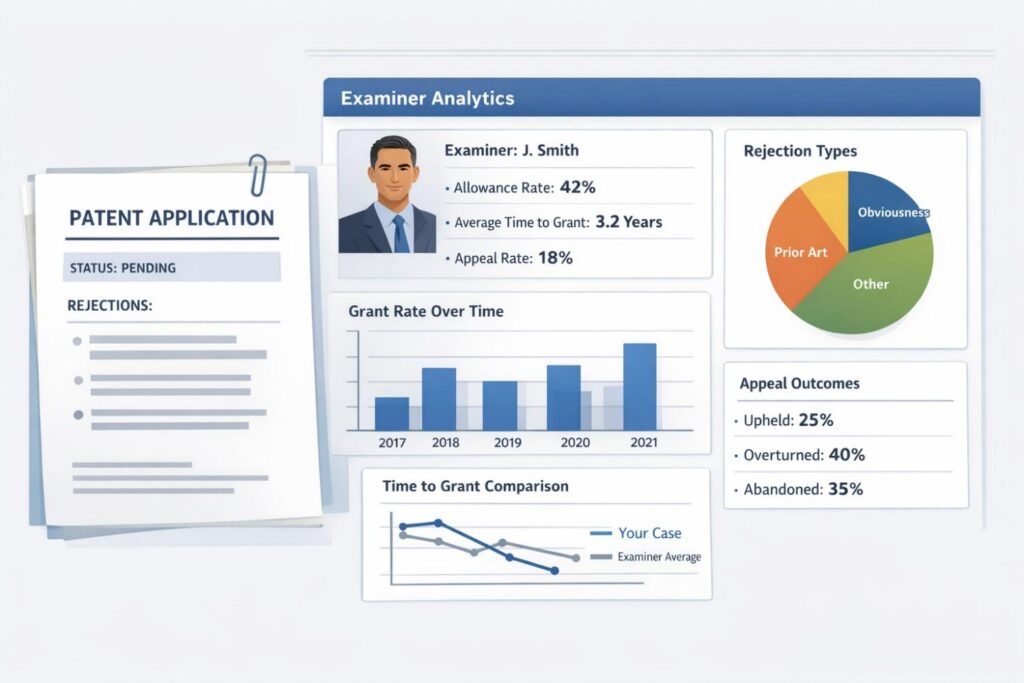
Examiner analytics often includes average time to first office action and average total pendency. These numbers are not just trivia. They tell you how long your capital will be tied up in uncertainty.
If you see that an examiner averages three years to final resolution, you can align your business decisions with that timeline. You may choose to file a continuation earlier.
You may plan investor conversations around realistic grant timing. You may even accelerate foreign filings if speed matters in a competitive space.
Many founders skip this step because they focus only on whether the patent will eventually issue. They forget to ask when.
Speed is part of value.
A patent that issues after your market window closes is not as useful as one that supports fundraising and partnerships while growth is happening.
It Signals How Hard the Examiner Pushes on Claim Scope
Not all rejections are equal. Some examiners push hard against broad claims but allow strong medium-scope claims. Others consistently narrow claims until they barely cover anything meaningful.
When you review past allowed claims from the same examiner, you begin to see patterns. Are the claims heavily amended? Do they include very specific technical limits? Are they tied to narrow embodiments?
This matters deeply for startups. If your competitive moat depends on broad platform protection, and your assigned examiner has a history of narrowing claims aggressively, you need to prepare early.
You may choose to file parallel claim sets. You may design claims that protect both core algorithms and system-level implementations.
You may plan for a continuation strategy that preserves broader attempts while securing a narrower patent for early issuance.
The mistake founders make is waiting until the third rejection to realize the examiner will not allow broad language. By then, amendments have already shaped the record.
Examiner analytics lets you predict that pressure before you respond the first time.
It Uncovers How the Examiner Uses Prior Art
Some examiners rely on a small set of references over and over. Others search widely and combine multiple references creatively. Some tend to stretch references into areas they barely touch.
If you look at cited prior art patterns across past cases, you can see how the examiner thinks. This insight helps you preempt rejections instead of constantly reacting to them.
For example, if an examiner frequently cites a specific technical paper in AI classification cases, you can review that paper before drafting claims. You can structure your claims to clearly separate from it.
You can prepare arguments in advance.
This reduces surprise.
It also reduces weak responses. Instead of rushing to counter new references under deadline pressure, you walk into prosecution prepared.
Most founders ignore this because they assume prior art is random. It is not. Examiner habits create predictable patterns.
Patterns create leverage.
It Highlights Whether Interviews Actually Help
Interviews can be powerful. They can also waste time. Some examiners change positions after discussion. Others rarely do.
Examiner analytics often shows how cases resolve after interviews. You can see whether allowance rates increase post-interview or whether rejections remain firm.
If the data shows that interviews rarely shift outcomes, you may choose to focus your effort on written arguments and claim refinement instead of multiple calls.
If the data shows strong interview impact, you schedule early and prepare carefully.
This shapes your communication strategy.
It also saves emotional energy. Founders often feel pressure to “fight harder” through calls and arguments. But effort without data can lead to frustration.
When you know how the examiner responds to interaction, you choose the right tool at the right time.
It Exposes Appeal Realities Before You Commit
Appeals are expensive. They take time. They can pay off in the right case. But they are not magic.
Examiner analytics may show how often appeals are filed in that art unit and how often the examiner’s decisions are reversed. If reversals are rare, you must weigh the cost carefully.
This does not mean you never appeal. It means you appeal strategically.
If your core technology defines your entire startup, and the data shows moderate reversal rates, appeal may be justified.
If the data shows almost no reversals, you may focus on claim adjustment or continuation strategy instead.
Ignoring this insight can lead to emotional decisions.
Data helps you stay rational.
It Helps You Protect Business Value, Not Just Legal Status
The biggest mistake founders make is confusing patent issuance with business protection. A patent that does not align with your product roadmap, future features, or revenue model can still issue. But it may not defend what matters.
Examiner analytics helps you decide whether to push for broader coverage now, secure narrower coverage quickly, or split strategies across multiple filings.
For example, if the examiner is known to resist abstract claims in your field, you may focus on system-level implementations that mirror how customers use your product. That may produce stronger enforcement value later.
This is where legal insight meets business thinking.
You do not want a patent that protects a technical detail you no longer use. You want protection around the features that drive growth.
Examiner patterns influence what kind of claims survive.
You need to plan around that reality.
Why Founders Ignore This Power
Many founders believe patent prosecution is outside their control. They assume once the application is filed, the process runs on rails.
That mindset leads to passive decisions.
Examiner analytics feels technical. It feels like something only large law firms use. But modern tools make it accessible. The real barrier is not complexity. It is awareness.
When you build products, you look at data before shipping. You track metrics. You analyze user behavior. You adjust based on signals.
Patent strategy deserves the same discipline.
The truth is simple. If you ignore examiner behavior, you are choosing to operate blind.
If you study it, you gain foresight.
And foresight protects your runway.
When you combine smart analytics with real attorney guidance, you transform patent prosecution from a reactive process into a strategic one. That is exactly how modern startups should approach intellectual property.
If you want to see how software and attorney oversight work together to give you this level of clarity, you can explore the full process here: https://powerpatent.com/how-it-works
In the next section, we will dig into the warning signs that your case may be drifting into low-value territory—and how to course correct before it is too late.
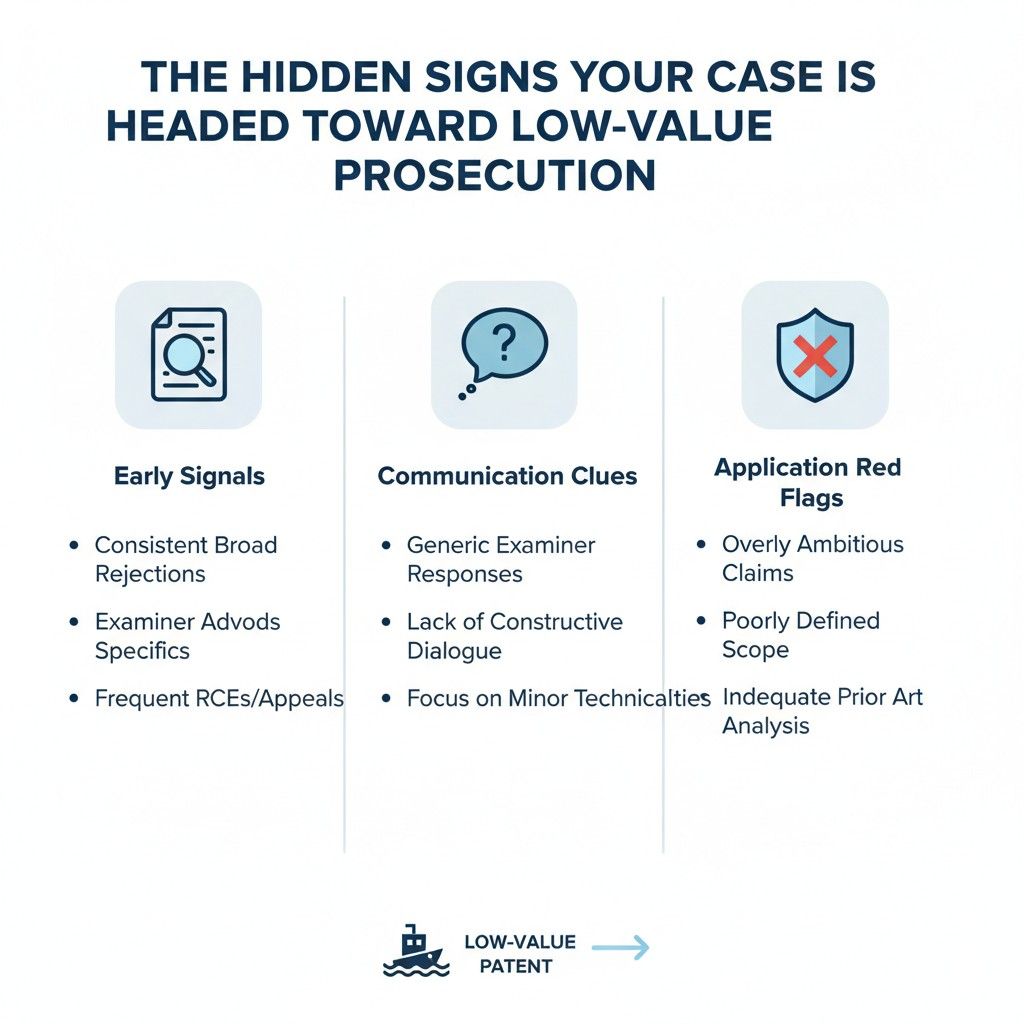
The Hidden Signs Your Case Is Headed Toward Low-Value Prosecution
Most patent cases do not fail all at once. They slowly drift. One amendment here. One narrowed phrase there. A small concession that feels harmless in the moment.
Then, two years later, you have a patent that technically issued—but no longer protects what gives you an edge.
Low-value prosecution does not announce itself. It creeps in.
The key is learning how to spot the signals early, before your claims shrink beyond usefulness and before your budget is drained. This section will show you what to watch for and how to act fast when you see risk building.
When Every Amendment Cuts Closer to the Bone
Amendments are normal. Almost every patent application faces at least one rejection. The issue is not whether you amend. The issue is what those amendments are doing to your protection.
If you notice that each office action response forces you to add more technical detail that narrows your claim scope, that is a signal.
If your independent claim starts broad and platform-level but slowly turns into a claim tied to a very specific implementation, you are losing ground.
This does not mean you should never narrow claims. It means you should narrow with intent.
Before agreeing to a limitation, ask a simple business question: if a competitor builds around this exact limitation, does my patent still matter?
If the answer is no, you are trading value for allowance.
A smart move here is to separate your strategy. Secure narrower claims for early issuance if needed, but file a continuation that preserves broader versions. That way, you are not forced to choose between speed and strength.
Without that separation, you may lock yourself into a narrow scope permanently.
When the Examiner Repeats the Same Core Rejection
Another warning sign is repetition. If the examiner continues to rely on the same prior art reference across multiple rounds, even after you amend, it tells you something.
It may mean the examiner views your invention as sitting squarely inside that reference. It may mean their mental model of your case is fixed.
If you see this pattern, you need to change approach. Repeating the same style of argument rarely shifts a fixed position.
Instead of arguing language tweaks, consider reframing the invention. Emphasize a technical improvement the prior art does not teach.
Tie claims more clearly to performance gains, system architecture, or measurable results.
Sometimes, a fresh claim structure works better than another written argument.
The mistake is assuming more words will change the outcome. Often, clarity and repositioning work better than volume.
When Your Independent Claims Start Looking Like Dependent Claims
Independent claims should protect your core idea at a meaningful level. If they begin to read like narrow feature lists, that is a red flag.
This often happens slowly. You add one limitation to overcome a reference. Then another to avoid combination logic. Soon, your main claim includes so many specifics that competitors can sidestep it by making small adjustments.
If you review your current independent claim and realize it describes only one exact product configuration, you may be drifting into low-value territory.
At that point, step back and assess whether the business value justifies continuing along that path.
Sometimes, it makes sense to allow that narrow claim to issue quickly while preserving broader language in a continuation. Other times, it may be better to push harder early before too much narrowing becomes part of the official record.
The key is awareness.
You cannot protect what you do not actively monitor.
When Office Actions Multiply Without Progress
It is normal to receive a first non-final rejection. It is normal to receive a final rejection. But when you move into repeated cycles without meaningful forward motion, you should pause.
If three or four rounds pass and the examiner’s position remains mostly unchanged, that is a signal.
Each round costs attorney time. Each response consumes focus. Each delay pushes issuance further out.
At this stage, you should reassess the expected value of the patent relative to your business goals.
Is this patent central to your moat? Is it key for fundraising? Is it necessary for licensing strategy? Or is it one piece among many?
If the value is high, escalation strategies such as interviews, examiner appeals conferences, or adjusted claim sets may be justified. If the value is lower, it may be smarter to redirect effort toward new filings that better align with your roadmap.
Low-value prosecution is often not about failure. It is about opportunity cost.
What else could you protect with the same resources?
When Your Claims Drift Away From Your Product Roadmap
Startups evolve fast. Features change. Architecture shifts. New use cases appear.
If your prosecution path forces you to emphasize elements that no longer reflect your real product, you risk ending up with outdated protection.
For example, imagine you initially built a centralized system, but your product moved toward a distributed architecture.
If your amendments tie claims to centralized processing because that was easier to argue, your patent may not cover your current model.
That is dangerous.
Prosecution should track your real business direction, not freeze you in the past.
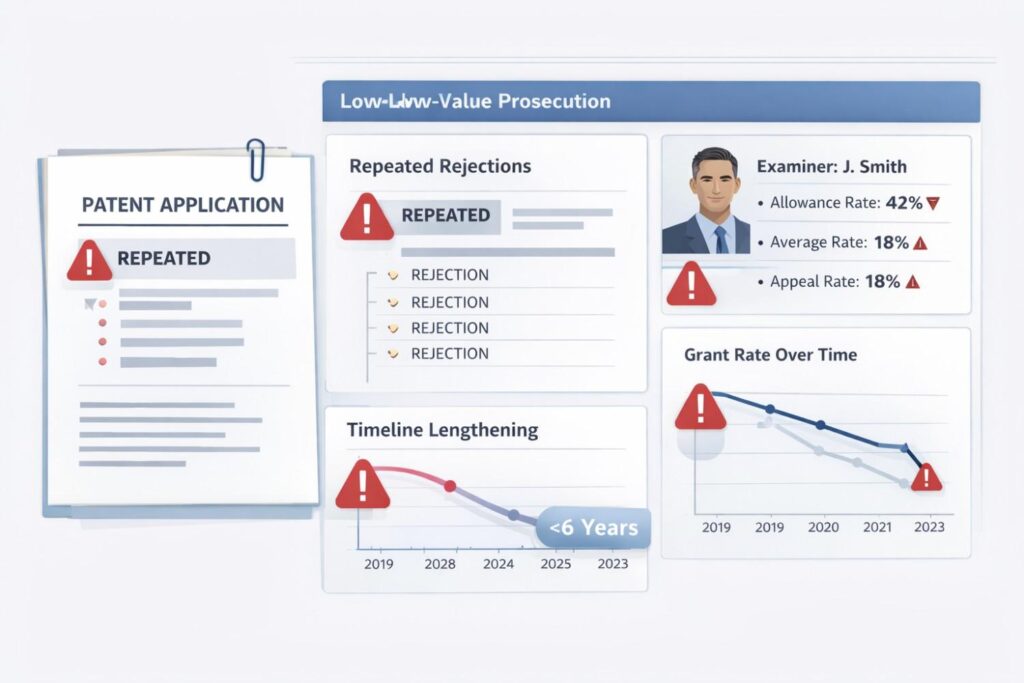
This is why examiner analytics and active oversight matter. If you know an examiner tends to resist certain claim styles, you can anticipate friction and plan filings that align with both examiner behavior and your future product.
Do not let short-term allowance pressure pull you away from long-term strategy.
When You Feel Pressure to “Just Get Something Allowed”
Emotional fatigue is real in patent prosecution. After multiple rejections, it is tempting to accept narrow claims simply to close the file.
But relief is not the same as value.
Before agreeing to heavily limited claims, ask whether the patent will deter a well-funded competitor. If the answer is uncertain, reconsider your approach.
Sometimes, filing a continuation and closing the current case with moderate scope is wise. Other times, pushing for stronger coverage is worth the extra effort.
The decision should be driven by business logic, not frustration.
Examiner analytics can help remove emotion from the equation. When you see historical patterns, you understand whether resistance is typical or unusual. That context changes how you respond.
When Appeal Looks Attractive But Data Says Otherwise
Appeal can feel like a clean reset. A new panel reviews the case. Fresh eyes examine the arguments.
But if examiner-level data shows very low reversal rates in that art unit, appeal may simply extend the timeline without improving your outcome.
Before choosing that route, review the examiner’s history with appeals. Look at how often decisions are upheld.
If reversal is rare, consider alternative strategies such as adjusting claim structure or filing a continuation with improved drafting.
Appeal should be a strategic tool, not an emotional reaction.
When Your Patent Stops Supporting Your Funding Story
Investors look beyond the word “patented.” They examine claim scope. They assess whether the patent meaningfully blocks competitors.
If your claims have narrowed to the point where workarounds are easy, the story weakens.
During prosecution, periodically review your claims through an investor lens. Would this patent, as currently drafted, strengthen your valuation?
If not, intervene early.
That might mean revisiting strategy with counsel, leveraging analytics to forecast likely outcomes, or shifting budget toward filings that align more tightly with your differentiation.
A patent is not just a legal asset. It is a business signal.
Turning Warning Signs Into Action
The worst outcome is not rejection. It is drifting for years without strategic oversight.
When you detect warning signs, pause. Review examiner behavior data. Compare your current claim scope with your original goals. Assess timeline impact. Measure expected business value.
Then decide intentionally.
At PowerPatent, this is exactly how we help founders stay in control. Smart software surfaces examiner patterns. Real attorneys interpret those signals and guide strategy. You are never left guessing whether your prosecution path is building real protection or slowly shrinking it.
If you want to see how this approach works in practice, and how you can predict value before committing resources, explore the process here: https://powerpatent.com/how-it-works
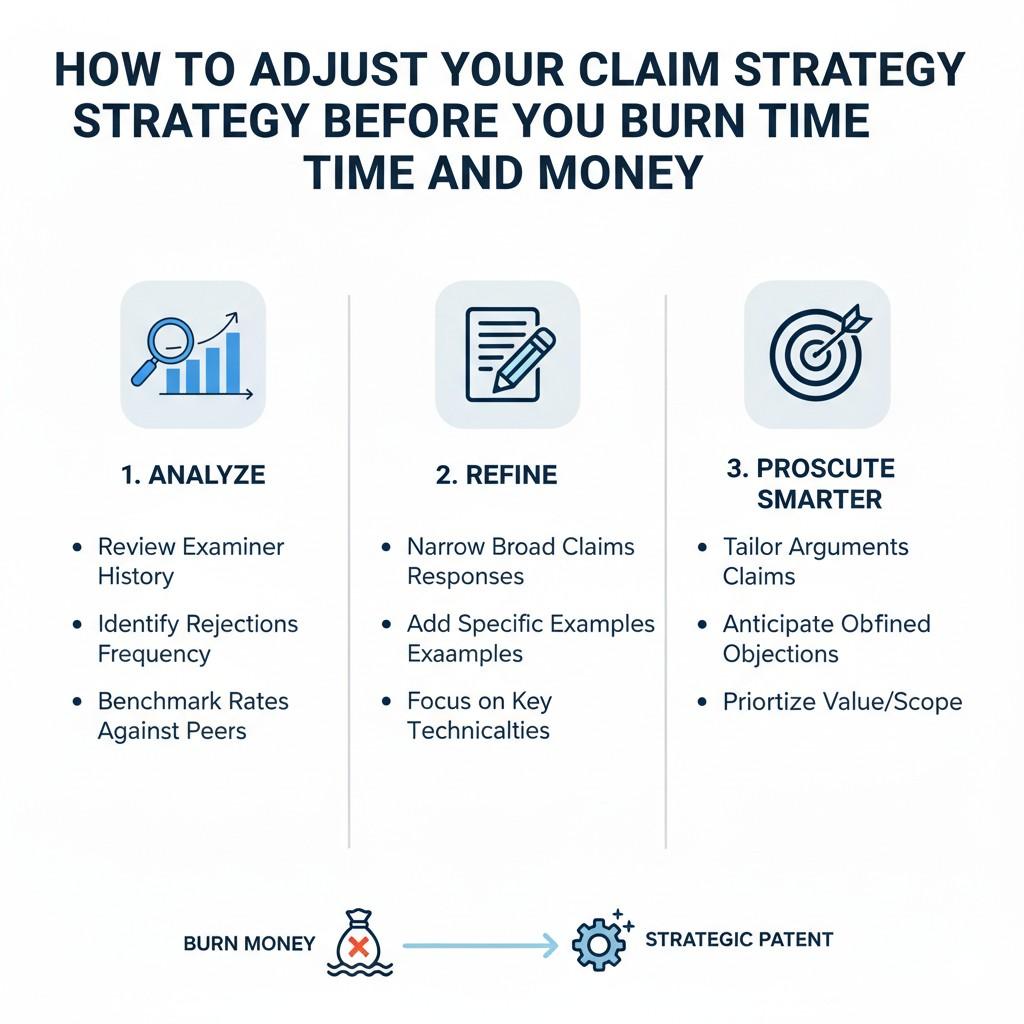
How to Adjust Your Claim Strategy Before You Burn Time and Money
Most founders only adjust strategy after things go wrong. After the second rejection. After the budget stretches thin. After the claims have already narrowed.
That is too late.
The strongest patent strategies are shaped before the first office action arrives.
When you use examiner analytics early, you can design your claims to survive the likely pressure points. You can protect what matters without walking into predictable traps.
This section is about proactive control. Not reaction. Not damage repair. Real control from the start.
Start With Business Value, Not Legal Language
Every strong claim strategy begins with a simple question: what exactly gives your company leverage in the market?
It is not enough to describe how your system works. You must identify what makes it hard to copy.
Is it the model architecture? The training pipeline? The way components interact? The speed gains? The data processing flow? The hardware integration?
Before drafting claims, define the business advantage in plain language. If your patent does not protect that advantage, it will not help you when competitors emerge.
Once that advantage is clear, you can layer claims around it. Examiner analytics then helps you test how much resistance that advantage may face.

If examiners in your art unit push back hard on functional language, you may need to express that advantage through structural elements. If they resist abstract framing, you may tie improvements to measurable technical effects.
The goal is not to dilute your idea. The goal is to frame it in a way that survives scrutiny while still protecting your moat.
Design Claims in Tiers From Day One
One of the most powerful adjustments you can make is to stop thinking in a single-claim mindset.
Instead of betting everything on one broad independent claim, build structured layers. A broader claim that aims high. A medium-scope claim that reflects your real-world implementation. Narrower claims that protect specific high-value features.
This is not about padding the application. It is about creating flexibility.
If examiner analytics shows that broad claims in your field face heavy resistance, your medium-scope claims may become your early allowance candidates. Meanwhile, broader claims can be pursued in a continuation.
Without this layered approach, you are forced to narrow your only independent claim over time, which can permanently weaken your position.
With layering, you separate timing from protection strength.
You give yourself options.
Anticipate the Examiner’s Common Objections
Examiner analytics often reveals patterns in rejection types. Some examiners rely heavily on obviousness combinations. Others focus on subject matter eligibility. Some frequently challenge written description support.
If you know these tendencies early, you can draft around them.
For example, if eligibility rejections are common in your space, emphasize technical improvements in the specification. Describe system-level performance changes. Include examples that show real-world impact.
If obviousness combinations are frequent, clearly define how your invention differs at a systems level, not just at a feature level. Explain why combining prior art would not naturally lead to your solution.
This preparation reduces surprise. It also strengthens your first response, which often shapes the rest of prosecution.
Most founders underestimate how much the initial drafting stage determines future outcomes.
Early precision saves years.
Separate Speed From Strength
Some patents need to issue quickly. Others need to be broad and durable, even if that takes time.
Examiner analytics helps you decide which path is realistic with a given examiner.
If the data shows long prosecution timelines and aggressive narrowing, you may choose to secure a narrower but meaningful patent first. At the same time, you file a continuation that keeps broader claims alive.
This dual-track strategy protects fundraising needs while preserving long-term leverage.
Without that separation, founders often sacrifice strength for speed without realizing it.
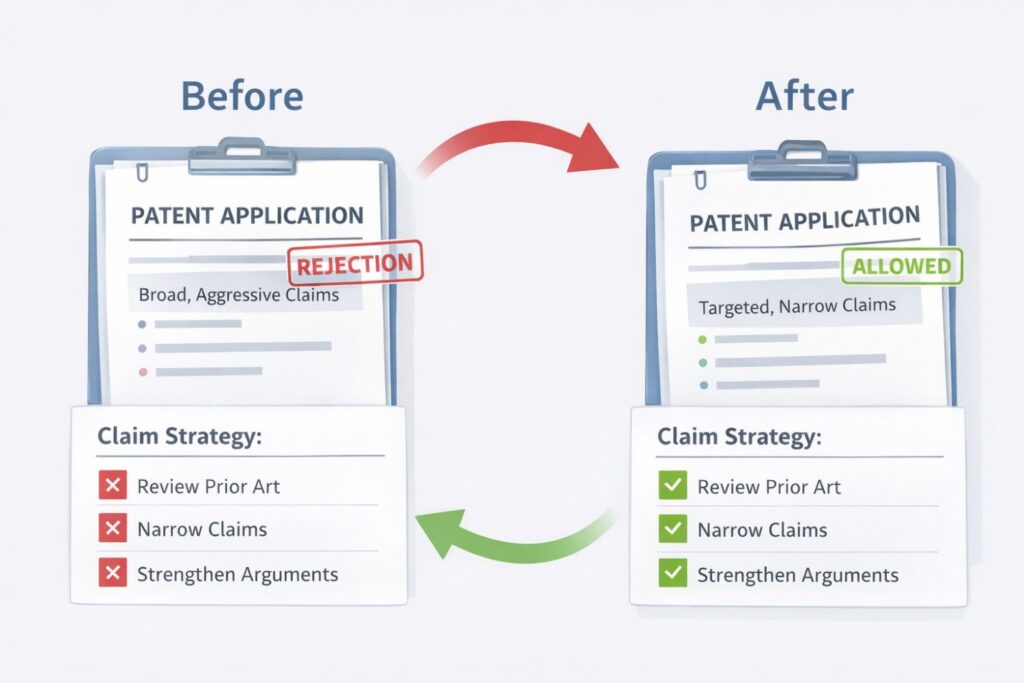
Or they chase breadth endlessly and delay issuance beyond practical value.
Adjusting claim strategy means being honest about what you need now versus what you need later.
Align Claim Scope With Future Product Direction
Your product today is not your product in two years.
When adjusting strategy, think forward. Where will your system evolve? What features are on the roadmap? What integrations are likely?
Examiner analytics may suggest that certain claim styles are more likely to survive. But do not let that push you into protecting only current implementations.
Instead, draft with flexibility in mind. Protect core concepts in a way that covers natural expansion. Include variations in your specification so future claims have support.
If you fail to think ahead, prosecution may lock you into protecting a version of your product that you outgrow.
Strategic adjustment means drafting for both current traction and future scale.
Use Interviews as Strategic Tools, Not Casual Conversations
When analytics shows that examiner interviews increase allowance probability, plan them carefully.
Do not treat them as informal chats. Enter with a clear goal. Present focused claim language. Highlight specific technical distinctions.
If analytics shows interviews rarely shift outcomes, adjust your effort accordingly. Focus more energy on written arguments and structured amendments.
The point is not to avoid communication. It is to match your effort with expected return.
Time is finite. Use it where it moves the needle.
Reevaluate After Each Office Action
Adjustment is not a one-time event. After each office action, pause and reassess.
Compare the examiner’s reasoning with historical patterns. Are they following their usual approach? Are they unusually rigid? Are they open to certain distinctions?
Then ask whether your current strategy still aligns with business value.
If your amendments are drifting too narrow, consider shifting broader protection into a continuation. If resistance is stronger than expected, evaluate whether a claim reframing would be more effective than incremental edits.
The key is active oversight.
Low-value prosecution thrives on autopilot.
High-value strategy requires deliberate checkpoints.
Protect Optionality Through Continuations
One of the most underused tools in startup patent strategy is the continuation.
When used properly, continuations allow you to adapt claim scope over time without losing your original filing date.
If examiner analytics predicts that broader claims will face resistance now but market conditions may change later, preserve those broader attempts in a continuation.
This protects optionality.
It also allows you to adjust to competitor behavior. If a rival launches a similar product, you can tailor continuation claims to target their design.
Without this flexibility, you are locked into whatever claim scope survives the initial prosecution.
Adjustment is not only about surviving the present examiner. It is about building long-term strategic depth.
Connect Every Decision to Business Outcomes
The biggest strategic shift you can make is simple.
Stop treating prosecution decisions as purely legal steps. Tie each decision to a measurable business outcome.
Will this amendment strengthen enforcement? Will it support valuation in your next funding round? Will it block a specific competitor feature?
If the answer is unclear, reconsider.
Examiner analytics gives you visibility into likely paths. But strategy comes from connecting that visibility to your company’s goals.
At PowerPatent, this is exactly how we guide founders. Smart analytics surfaces examiner behavior patterns. Experienced attorneys translate those patterns into clear strategic options.
You stay informed. You stay in control. And your patent plan supports your growth, not slows it down.
If you want to see how to build patents that match your roadmap and avoid costly detours, explore how it works here: https://powerpatent.com/how-it-works
In the next section, we will look at how to turn examiner data into real leverage and build a smarter patent plan from day one.
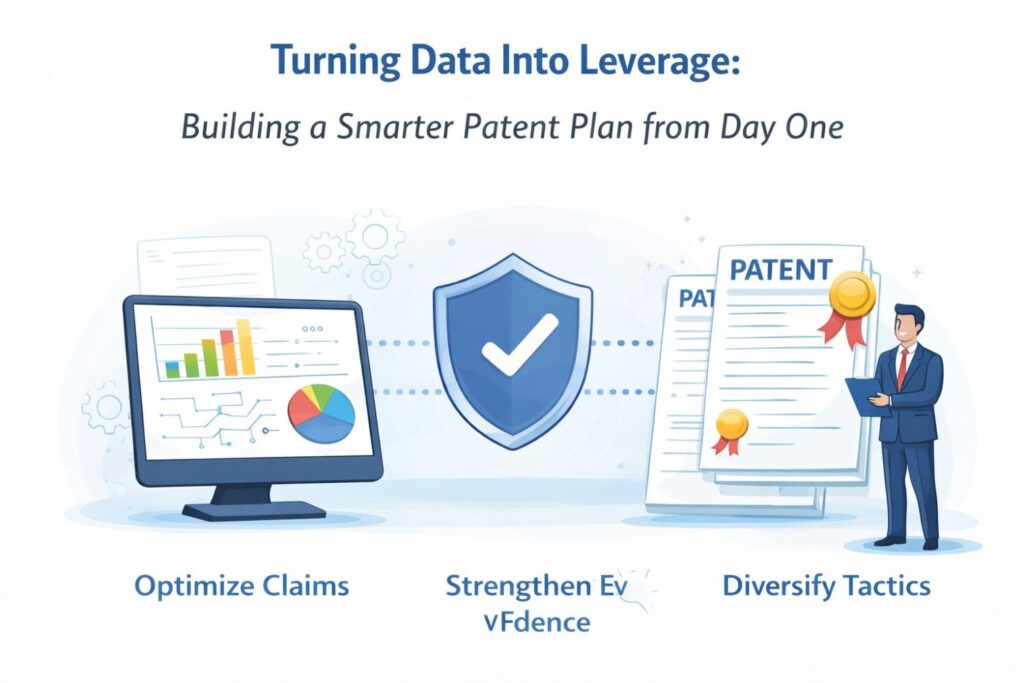
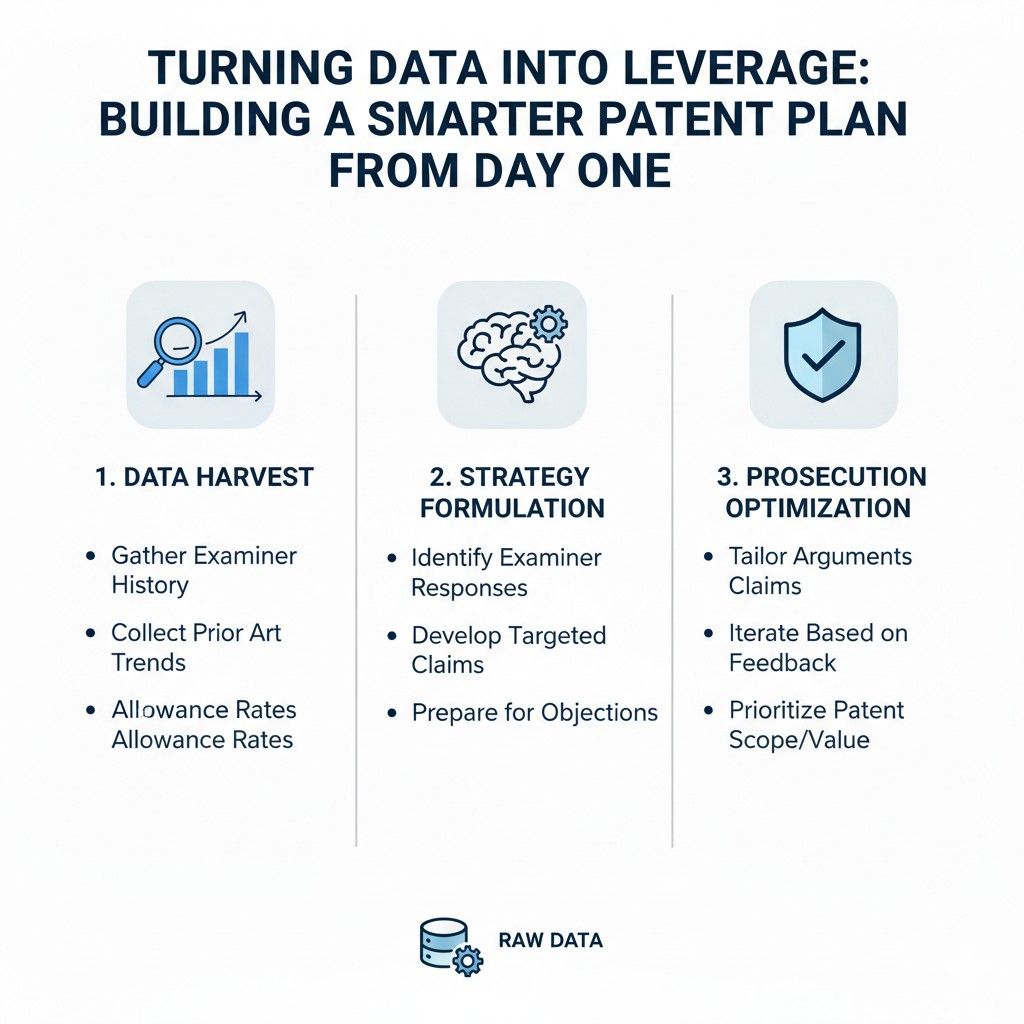
Turning Data Into Leverage: Building a Smarter Patent Plan from Day One
Data is only powerful if you use it before decisions are locked in.
Most founders see examiner analytics after the first rejection. By then, the application is filed. The claim language is fixed. The tone of the case is already set.
Real leverage comes from using examiner data at the very beginning. Before filing. Before assignment. Before you invest years into a single path.
This section is about building a patent system around foresight, not cleanup.
Start Before You File, Not After You’re Rejected
The strongest move you can make is simple. Study the art unit before drafting is final.
When you analyze how examiners in your likely classification behave, you gain early signals. You see average allowance rates. You see how often eligibility rejections appear.
You see whether claims in that space tend to be heavily amended before allowance.
This early signal should shape how you draft your application.
If you see that claims in your art unit often get narrowed to system-level details, you make sure your specification fully supports multiple system configurations.
If you see repeated obviousness rejections based on common reference combinations, you clearly distinguish your invention from those combinations up front.
This is not defensive drafting. It is strategic positioning.
When your application anticipates known pressure points, prosecution becomes smoother. You are not scrambling to add support that was never written.
Leverage begins with preparation.
Use Assignment Data to Set Expectations Immediately
Once your case is assigned to a specific examiner, the data becomes even more precise.
At that point, you should not simply wait for the first action. You should immediately review that examiner’s past behavior.
How many office actions do their cases average? How often do they allow after interviews? Do they frequently maintain final rejections?
This information should shape your internal timeline.
If the examiner typically issues multiple non-final rejections before movement, plan resources accordingly. If they allow more quickly after structured interviews, prepare to engage early.
Founders often treat assignment as a passive event. It should be a trigger for strategic review.
The moment you know who is handling your case, you gain insight into the likely road ahead.
Model the Prosecution Path Like a Product Roadmap
You would never build a product without mapping milestones. Patent prosecution deserves the same treatment.
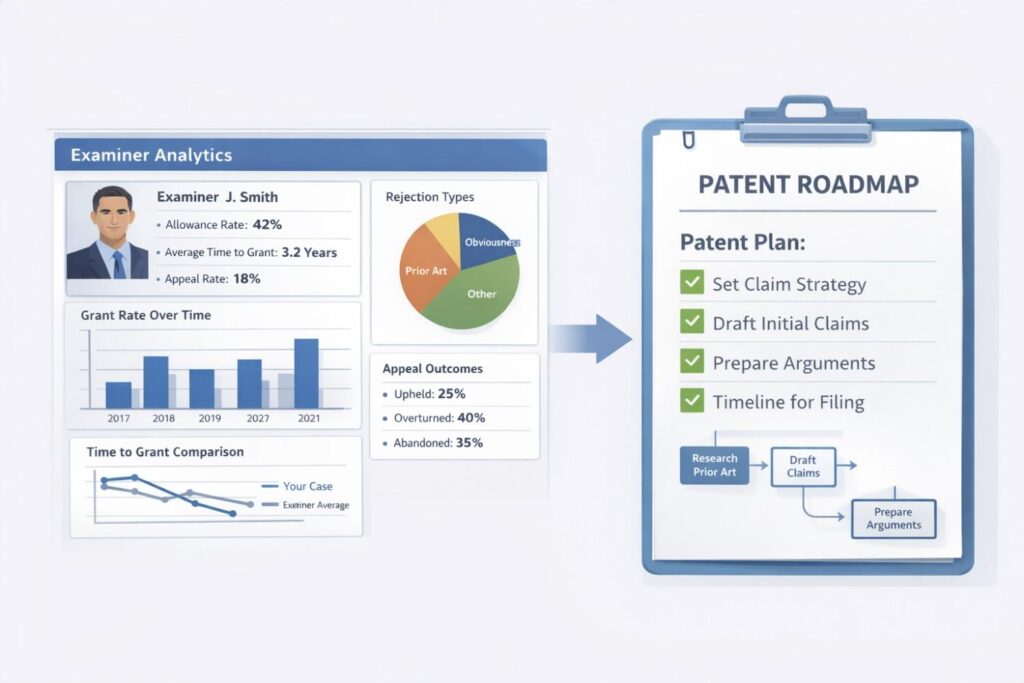
Using examiner analytics, you can estimate likely stages. First non-final rejection. Possible final rejection. Interview window. Potential allowance timing.
When you model this path, you reduce surprise.
More importantly, you align patent events with business goals. If fundraising is planned in twelve months, you may prioritize claim adjustments that improve the chance of allowance within that window.
If acquisition discussions are possible in two years, you may focus on strengthening broader coverage for due diligence review.
Data turns prosecution into a forecastable process.
Forecasts create control.
Align Filing Strategy With Competitive Risk
Examiner data should not exist in isolation. It should connect directly to your competitive landscape.
If your space is crowded and competitors are filing aggressively, you may need faster issuance to establish early leverage. In that case, analytics can help you identify where speed is realistic and where it is not.
If your space is emerging and technical standards are still forming, broader continuation strategies may matter more than quick narrow grants.
The key is matching examiner tendencies with market conditions.
For example, if analytics shows that broad claims in your art unit face consistent narrowing, but your competitive threat is immediate, you might secure a narrower enforceable patent first.
Then pursue broader claims through continuations once you have market traction.
This layered timing approach protects you both now and later.
Without data, these decisions feel like guesses.
With data, they become calculated choices.
Turn Interviews Into Strategic Negotiations
Examiner analytics often reveals how examiners respond to interviews.
If you see that allowance frequently follows structured discussions, treat interviews like negotiations, not casual calls.
Prepare clear claim language in advance. Present specific amendments. Tie arguments to measurable technical improvements. Avoid vague debates.
When data shows that interviews rarely move the needle, shift focus. Use written responses with precise amendments instead of relying on conversation to solve core disagreements.
The point is not to avoid human interaction. It is to use it where it statistically works.
Time invested should correlate with likely return.
Use Continuations as Dynamic Strategy Tools
Continuation practice becomes far more powerful when driven by data.
If examiner behavior suggests that broader claims will face sustained resistance, file a continuation early. Preserve broader scope while allowing the current case to move toward issuance.
If competitor behavior changes mid-prosecution, use continuation filings to adapt claims toward emerging threats.
This dynamic use of continuations turns your patent family into a living asset.
It also reduces risk. Instead of relying on a single claim set, you build layers of protection that evolve with your company.
Data informs where resistance will occur. Strategy determines how you respond.
Measure Patent Value the Same Way You Measure Product Impact
Your product team tracks performance metrics. Growth rate. Conversion. Retention.
Your patent strategy should track value metrics too.
How broad are your independent claims compared to competitors? How closely do they map to your revenue-driving features? How resistant is your examiner historically to similar language?
Examiner analytics helps quantify part of this picture. When you combine that with business insight, you can evaluate whether continuing prosecution creates positive return.
If projected scope is weak and resistance is high, redirect effort. File stronger applications that better capture differentiation. If projected scope is meaningful and allowance probability is solid, double down.
This mindset prevents sunk-cost traps.
You are not chasing allowance for its own sake. You are investing in enforceable advantage.
Build a Repeatable Internal System
The most advanced startups do not treat patents as isolated projects. They build repeatable systems.
Each new invention disclosure should be reviewed through both business value and examiner data lenses. Likely art unit. Historical allowance behavior. Expected timeline.
This structured approach improves decision quality over time.
Instead of relying on instinct, you build institutional knowledge.
Over multiple filings, patterns become clearer. You learn which claim styles perform better in your space. You refine drafting habits. You allocate budget more efficiently.
Data compounds.
And compounding advantage is exactly what startups seek in every other area of growth.
Combine Smart Software With Real Human Judgment
Data alone is not enough. Numbers require interpretation.
Allowance rates can mislead if viewed without context. Some examiners handle more complex cases. Some art units face evolving legal standards.
This is where combining analytics with experienced attorney oversight becomes critical.
Software surfaces patterns quickly. Attorneys translate those patterns into practical moves.
Together, they create clarity.
At PowerPatent, this combination is the core advantage. Smart systems reveal examiner behavior in plain terms. Real patent attorneys guide founders through strategic choices.
You stay informed. You avoid blind spots. And you make decisions that support your company’s future, not just the next office action.
If you want to build patents with foresight instead of frustration, and turn examiner analytics into real leverage from day one, you can see exactly how the process works here: https://powerpatent.com/how-it-works
This is how modern founders protect innovation without slowing down.
Wrapping It Up
Low-value prosecution is not bad luck. It is usually the result of limited visibility. When you cannot see examiner behavior, you react to each office action as if it were a surprise. You narrow claims step by step. You spend budget without clear return. You accept outcomes because you feel stuck.But when you use examiner analytics from the start, everything changes.