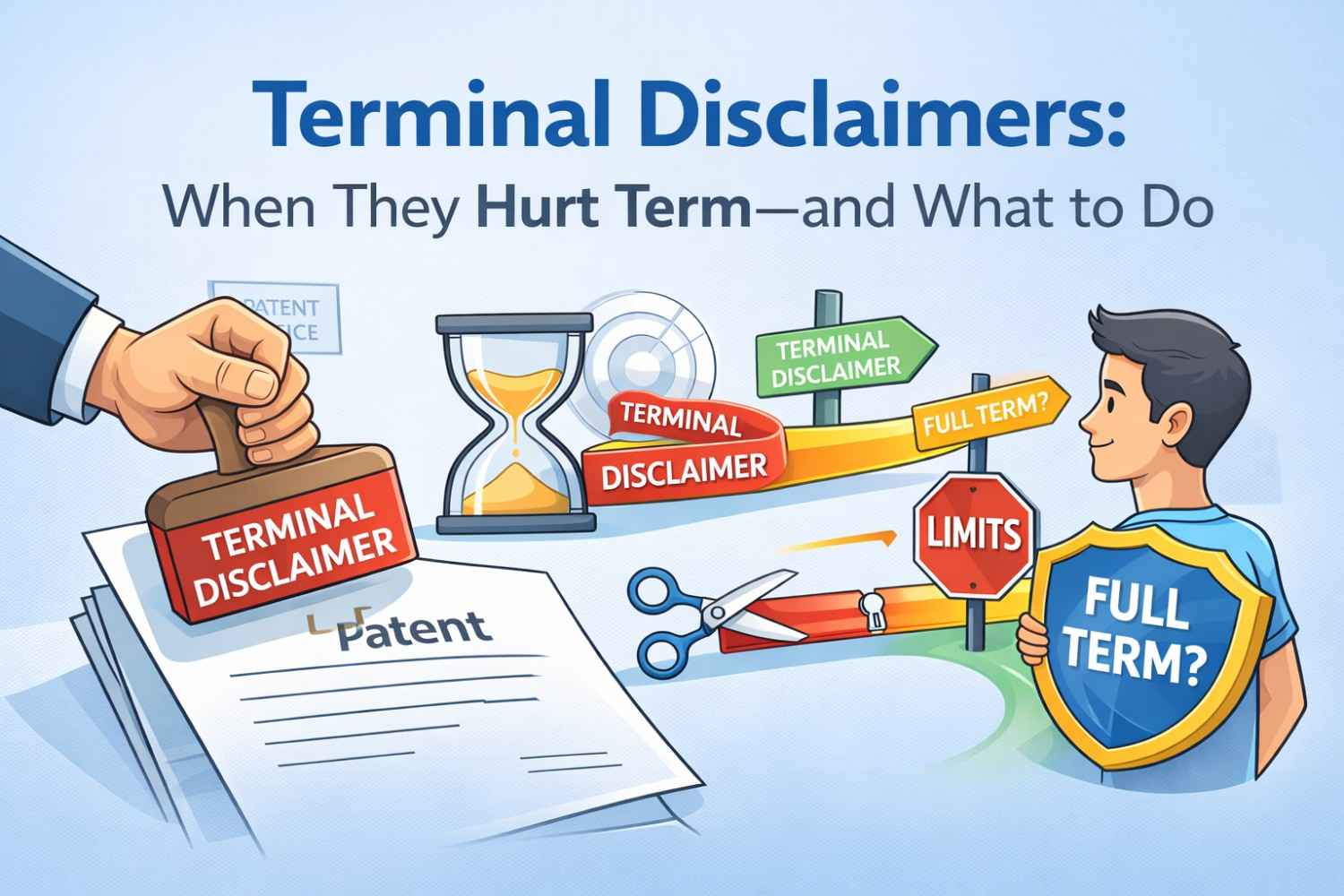
You worked hard to build your product. You moved fast. You filed patents to protect it. Then one small document quietly cut years off your patent term—and you did not even notice. That document is called a terminal disclaimer. It sounds harmless. It is not. In this article, we will break down what terminal disclaimers really do, when they can shrink the life of your patent, and what smart founders can do to avoid losing valuable years of protection.
What a Terminal Disclaimer Really Means (In Plain English)
Before you can protect your patent term, you have to understand what you are agreeing to. A terminal disclaimer is not just a small paper you file to make an examiner happy.
It is a legal promise. And like any promise tied to your business, it can shape your future in ways that are hard to undo. Let’s slow this down and unpack what it really means for you as a founder.
The Simple Promise You Are Making
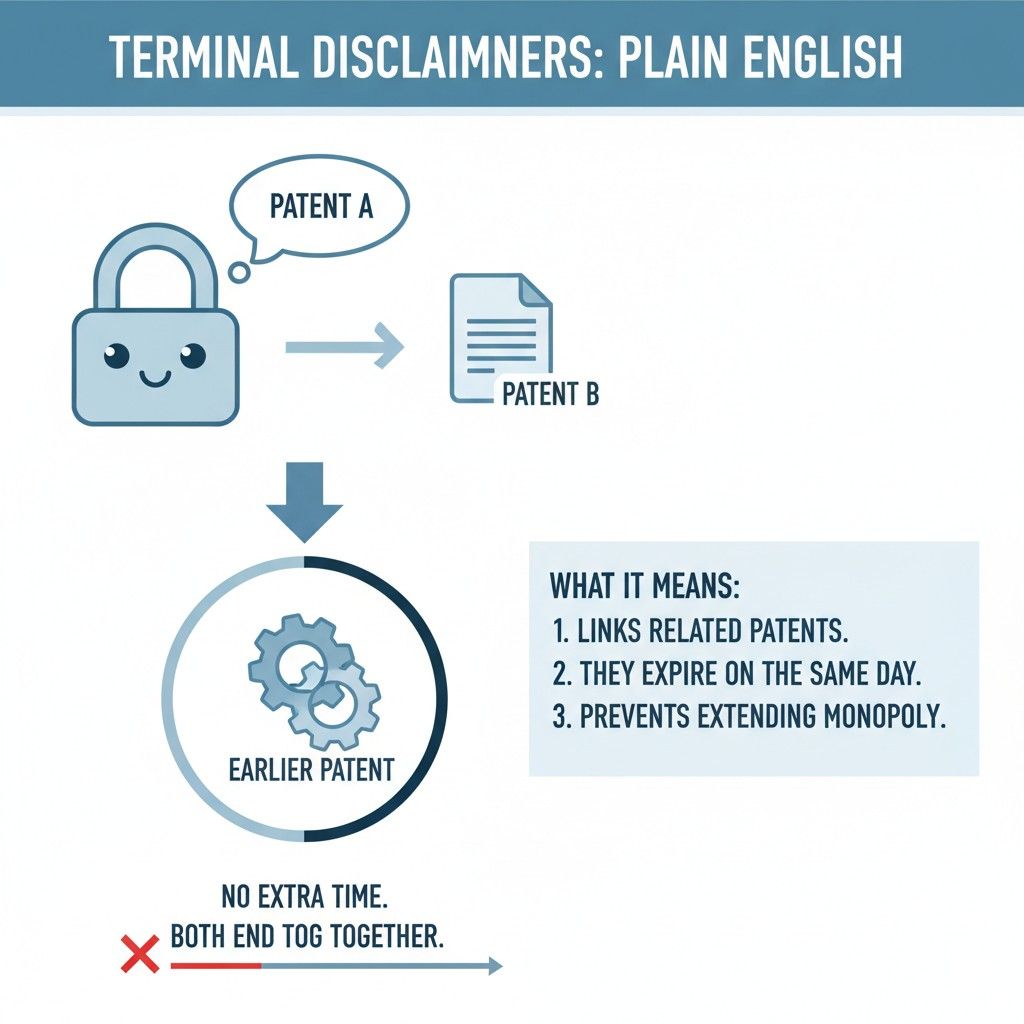
When you file a terminal disclaimer, you are telling the patent office: “If this patent is granted, I agree it will end at the same time as another related patent.” That is the heart of it.
You are giving up time.
Patents normally last about twenty years from the filing date. But if you have two applications that are seen as too similar, the patent office may say, “We will allow this one only if you promise it does not live longer than the earlier one.”
At first glance, this may feel harmless. You might think, “Fine. They can end together.” But that extra time could be the difference between controlling your market and watching competitors step in while you are still scaling.
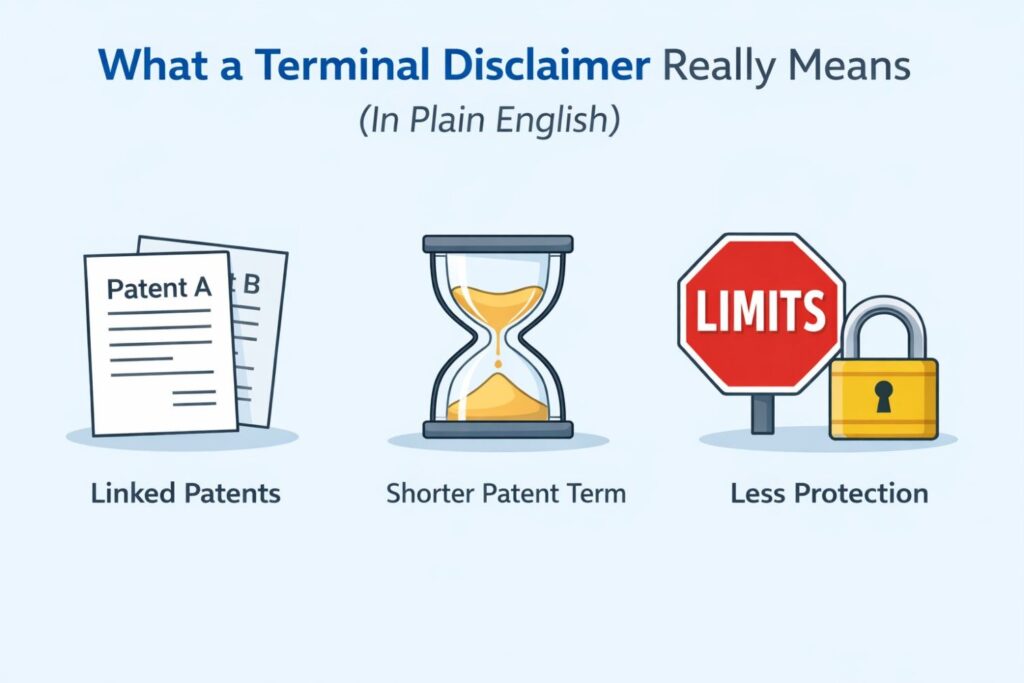
The moment you sign that disclaimer, you lock the expiration date to another patent. That choice cannot be reversed later. Even if the market changes. Even if that earlier patent becomes less useful. Even if you regret it.
This is why founders need to see terminal disclaimers as business decisions, not just legal steps.
Why the Patent Office Asks for It
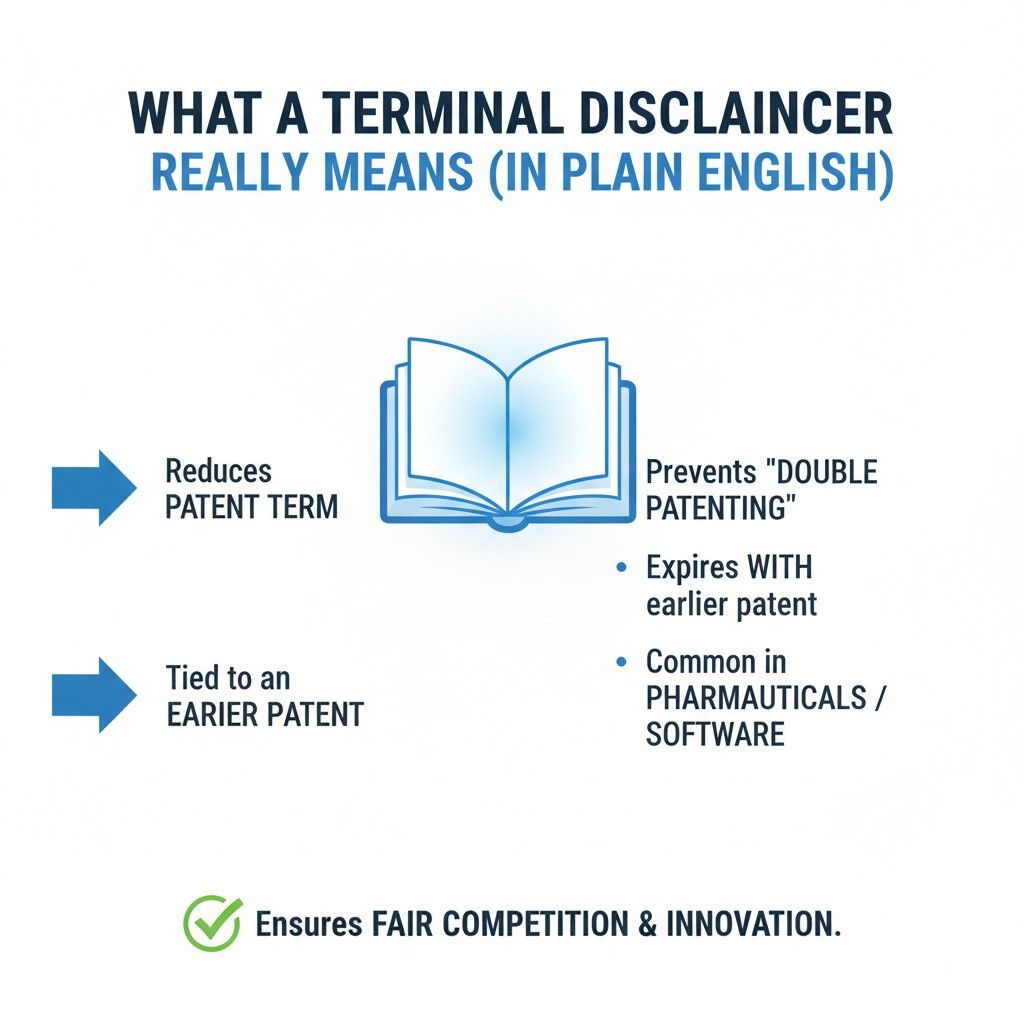
To understand strategy, you must understand motive. The patent office uses terminal disclaimers to prevent what they call “double patenting.”
In plain terms, they do not want someone getting two patents that cover nearly the same idea and stretching out protection unfairly.
If your second application looks too close to your first one, the examiner may say, “These inventions are not different enough. If we allow both, you cannot extend your monopoly.”
So they offer a trade: we allow the second patent, but only if you agree it expires with the first.
This feels like a win in the short term because it gets you allowance faster. But speed can hide cost. The real question is not “Can I get this allowed?” The real question is “What am I giving up in return?”
Founders who think long term treat this moment as a fork in the road.
How It Ties Patents Together
A terminal disclaimer does more than shorten term. It also links ownership.
When you file one, you are usually agreeing that both patents must stay under common ownership. That means they must be owned by the same entity for their full life.
Now think about your startup.
What if you spin out a product line?
What if you license one patent to a partner but keep the other?
What if you sell part of your IP during an acquisition?
A terminal disclaimer can limit flexibility. If the patents fall into different hands, enforcement may become difficult or even impossible.
This is where many early-stage companies get surprised. They sign the disclaimer to move prosecution forward.
Years later, during diligence, an investor asks about patent term and ownership chains. Suddenly that small document becomes a red flag.
Smart founders think about future deals when making today’s filing choices.
If you want a system that helps you see these risks before they happen, PowerPatent walks you through strategy upfront, not after the damage is done. You can see how that works here: https://powerpatent.com/how-it-works
The Hidden Cost of Lost Years
One year of patent term is not just a calendar issue. It is revenue.
If your product takes eight to ten years to reach peak adoption, those last few years of exclusivity are often the most valuable. By then, your brand is strong. Your distribution is stable. Competitors are watching closely.
Cutting off even two or three years can reduce licensing value, acquisition value, and negotiating power.
Imagine building a deep tech platform that takes years of R&D. You finally reach scale. Then your patent expires earlier than expected because of a decision made during prosecution.
Competitors enter faster. Pricing pressure increases. Your leverage drops.
All because of a document that felt procedural at the time.
This is why patent term is not a small detail. It is part of your financial model.
When It Seems Like the Easy Path
Examiners sometimes suggest terminal disclaimers as a fast fix. You are facing a rejection. The clock is ticking. You want allowance. The examiner says, “File a disclaimer and we can move forward.”
In that moment, it feels practical.
But founders should pause and ask a harder question: is there a way to argue for real distinction instead?
If your second application truly covers a different improvement, feature, or architecture, it may be worth pushing back. A strong technical argument can preserve independent term.
This is where having real attorney oversight matters. Not just someone checking boxes, but someone who understands your product roadmap and sees how claims map to long-term value.
At PowerPatent, filings are not rushed through with shortcuts that hurt later. The goal is strong protection that supports growth, not quick approvals that create silent risks.
You can explore the approach here: https://powerpatent.com/how-it-works
The Strategic View Founders Should Take
Think of your patent portfolio like layers of defense. Early patents may cover the core engine. Later filings may cover improvements, new use cases, or new markets.
If each layer expires at the same time because of terminal disclaimers, you lose the benefit of staggered protection.
But if each layer stands on its own, your protection extends further. You maintain leverage longer. You create optionality.
The right approach often starts before any disclaimer is even raised. It begins with claim drafting that clearly separates inventions. It involves filing strategies that consider continuation timing, priority chains, and future product paths.
This is not about gaming the system. It is about thoughtful planning.
When you treat patents as strategic assets instead of paperwork, decisions like terminal disclaimers are handled with care, not convenience.
What You Can Do Today
If you already have patents, review them. Check whether any terminal disclaimers were filed. Understand which patents are tied together and how their terms align.
If you are still in prosecution and facing a potential disclaimer, ask whether the claims can be adjusted to avoid it. Ask whether arguments can be made to show true distinction.
Most importantly, build a process where patent decisions align with business goals.
Your IP should support fundraising, partnerships, and exits. It should increase confidence, not create hidden traps.
Terminal disclaimers are not evil. Sometimes they are the right move. But they should always be chosen with eyes open.
When you combine smart software with experienced patent attorneys who think like founders, you reduce the chance of silent mistakes. That is exactly what PowerPatent was built to do.
How Terminal Disclaimers Quietly Cut Years Off Your Patent
This is where things get real. Most founders do not lose patent term in a dramatic way.
There is no loud warning. No flashing sign. The loss happens quietly, during prosecution, inside a document that looks routine. By the time the patent is granted, the clock has already been shortened.
If you care about long-term leverage, this section matters more than almost anything else in your patent strategy.
How Patent Term Normally Works
Before we look at what gets cut, we need to understand what you normally get.
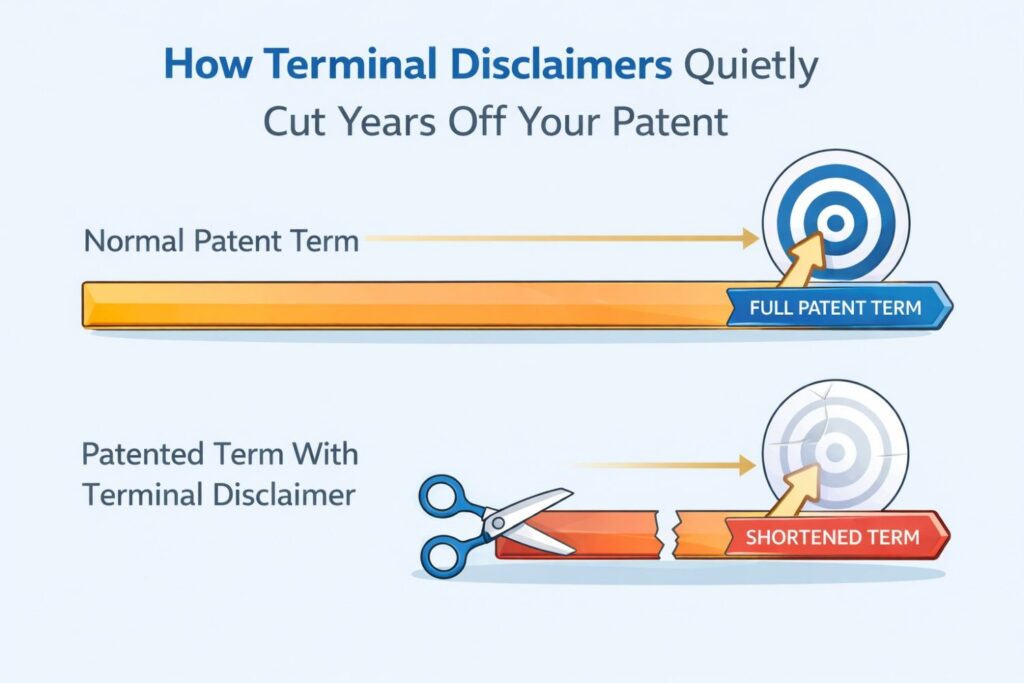
In simple terms, a U.S. patent lasts about twenty years from the earliest effective filing date. If you file a non-provisional patent application today, and it becomes a patent, the term usually runs twenty years from that filing date.
There are small adjustments that can add days or months if the patent office delays too long. There are also situations that can reduce term. But the baseline is clear. Twenty years from filing.
That clock starts ticking the moment you file.
Now here is where founders often get confused. If you file a second patent application later, you might assume it has its own twenty-year life. And technically, it does start its own clock based on its own filing date.
But if a terminal disclaimer enters the picture, that independent life can disappear.
The Moment the Clock Gets Tied
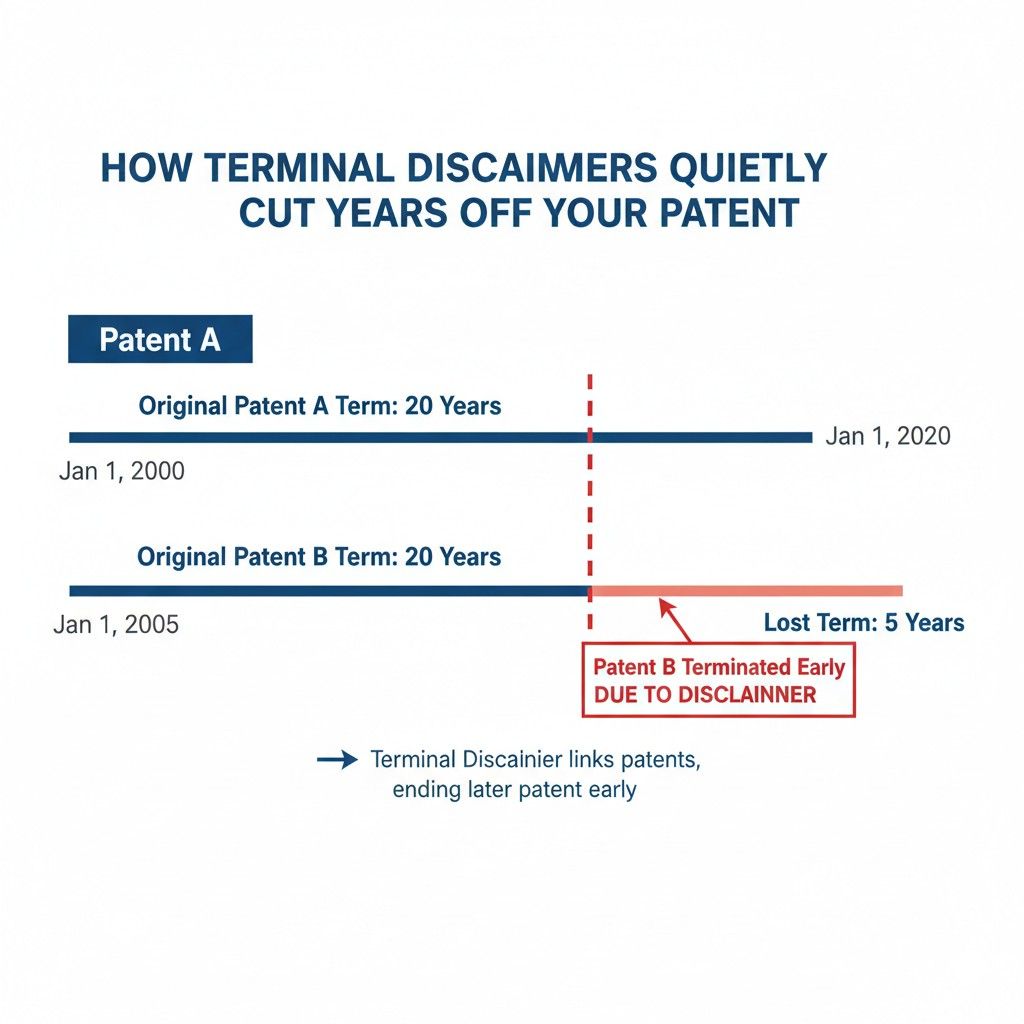
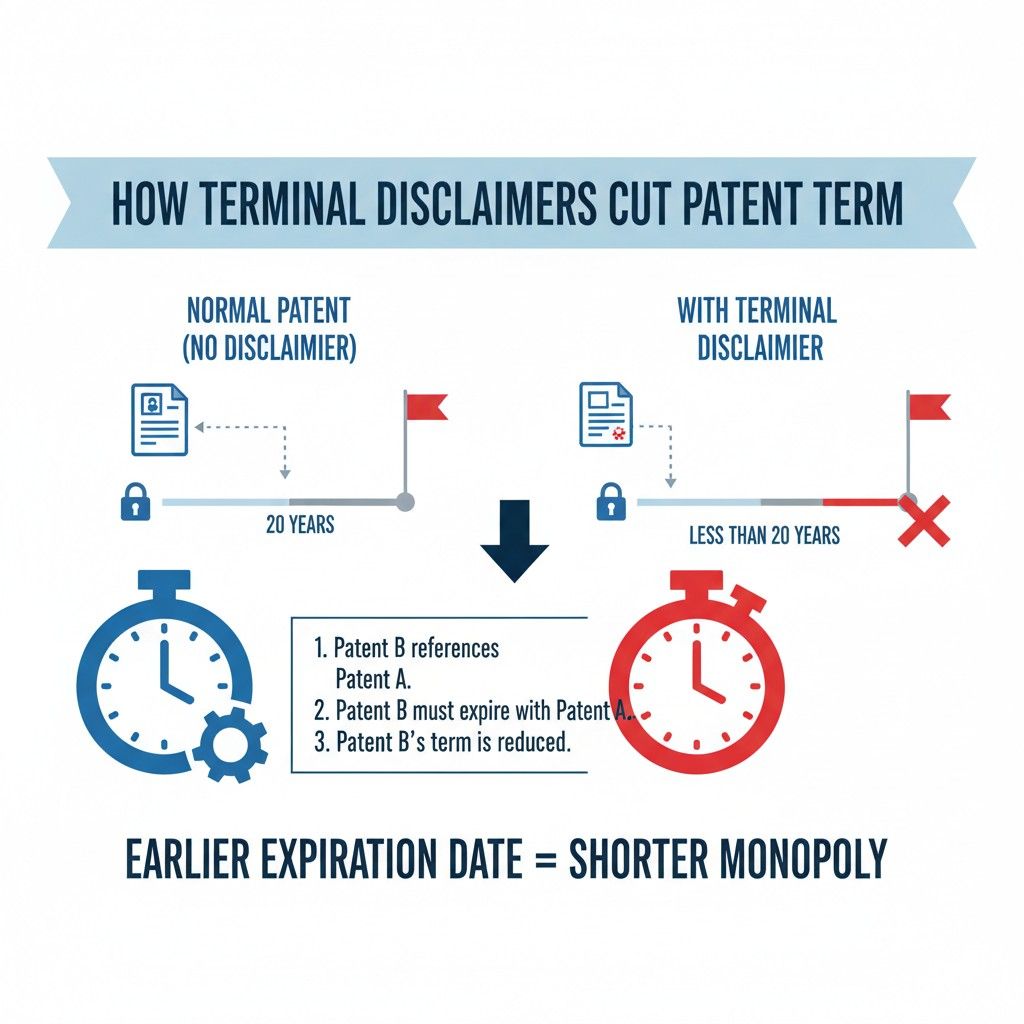
When you sign a terminal disclaimer, you are saying that the later patent will expire at the same time as the earlier one.
Let’s make this real.
Imagine you file your first patent in 2024. That patent will normally expire in 2044.
Two years later, in 2026, you file a second application that covers improvements or expanded features. On its own, that second patent would normally expire in 2046.
That is two extra years of protection.
But if the examiner says the second application is too close to the first and asks for a terminal disclaimer, and you agree, the second patent will now also expire in 2044.
You just lost two years.
Nothing dramatic happened. You still received the second patent. It still has claims. It still looks strong on paper.
But its life was shortened.
Multiply that across multiple continuation filings, and the effect compounds. Instead of a staggered set of patents that extend protection over time, everything collapses into one shared expiration date.
That is how term quietly disappears.
Why Continuations Make This Risk Bigger
Many startups use continuation applications to expand claim coverage over time. This is smart. As your product evolves, you want to adjust claims to match new features or market angles.
But continuations often share the same priority date as the original application. That means their twenty-year term runs from the same early filing date.
If you add a terminal disclaimer on top of that, you lock everything even tighter.
Founders sometimes think they are building a layered wall of protection. In reality, they may be building a single wall with one expiration date.
When investors review your portfolio, they will look at term. They will check how long meaningful protection lasts. If all patents expire within the same short window, your leverage shrinks faster than expected.
This is why filing strategy must connect to product roadmap. If major innovations happen later, they may deserve fresh filings with new priority dates. That creates new clocks.
The earlier you think this way, the more options you preserve.
If you want a system that helps align filing timing with business growth, PowerPatent is built for that exact need. You can see how it guides founders through smarter filings here: https://powerpatent.com/how-it-works
The Compounding Effect on Portfolio Value
Patent term is not just about one patent. It is about portfolio life.
Imagine you are building a core AI engine. Your first patent covers the main architecture. Over time, you develop optimization layers, new training methods, hardware integrations, and specific use cases.
If each of those is filed thoughtfully, with attention to timing and claim separation, your protection can stretch well into the future.
But if terminal disclaimers are used casually across these filings, everything may expire around the same year.
From a buyer’s perspective, that compresses value.
Acquirers look at remaining term because it signals how long they can control the technology. Licensees look at it because it affects royalty models. Even competitors watch expiration dates to plan entry.
When term is cut short, your negotiation power fades earlier.
This is why every disclaimer should be treated like a strategic trade, not a procedural step.
The Trap of Short-Term Thinking
Prosecution can be exhausting. Office actions arrive. Rejections pile up. Founders want resolution. Attorneys want to move cases forward.
In that environment, a terminal disclaimer can look like relief.
It can feel like, “Let’s just get this allowed and move on.”
The danger is that short-term relief can create long-term regret.
If you are in a fast-moving market, you might assume technology will change so quickly that long patent term does not matter. But deep tech often matures over years. Markets take time to educate. Enterprise sales cycles are slow.
By the time your technology becomes standard, those last years of exclusivity are often the most powerful.
Giving them up too early weakens your future position.
When the Loss Is Invisible Until Due Diligence
Many founders do not discover the real impact of terminal disclaimers until a financing round or acquisition process.
During diligence, investors review patent term and ownership links. They ask how long core patents will last. They examine whether patents are tied together in ways that limit flexibility.
If they see multiple patents expiring on the same early date because of terminal disclaimers, questions follow.
Why were disclaimers filed?
Could they have been avoided?
How much term was lost?
These questions can slow deals or reduce valuation.
It is far better to answer them confidently because you planned ahead.
With PowerPatent, founders get both smart drafting tools and real attorney guidance to avoid hidden term cuts before they happen. You are not left guessing years later. You can explore the approach here: https://powerpatent.com/how-it-works
Seeing Patent Term as a Business Asset
The biggest shift you can make is mental.
Do not see patent term as a legal detail. See it as runway.
Just like cash runway gives you time to grow, patent runway gives you time to control your market.
Every year of exclusivity is time where competitors must work around you, license from you, or stay out.
Terminal disclaimers directly affect that runway.
When you evaluate whether to accept one, ask yourself: how valuable could this technology be in year eighteen, nineteen, or twenty?
If the answer is “very valuable,” then losing even a year should feel serious.
This does not mean you should never file a disclaimer. Sometimes it is the right call. But the decision should be made with full awareness of what is being traded.
Your patents should grow with your company. They should support expansion, licensing, fundraising, and exit.
Protecting term is part of protecting your future.
Why Patent Offices Push for Them—and When You Should Push Back
If terminal disclaimers reduce your patent term, a fair question follows. Why does the patent office push for them so often?
The answer is not personal. It is structural. Examiners are trained to prevent what they see as unfair extension of patent rights. Their job is to stop applicants from getting multiple patents that cover the same idea in slightly different words.
But here is the key point. The examiner’s goal is not the same as your business goal.
Their focus is clean boundaries. Your focus is long-term leverage.
Understanding that difference is the first step toward handling terminal disclaimers the right way.
The Examiner’s Incentive
Examiners work under time pressure. They review thousands of applications. When they see two related filings from the same company that look close in scope, they are trained to raise a concern.
From their perspective, if two patents claim overlapping subject matter and expire at different times, that could look like an attempt to extend exclusivity beyond the intended period.
A terminal disclaimer is a quick fix.
It allows the examiner to grant the second patent without worrying that it creates unfair extra term. It keeps the system clean in their view.
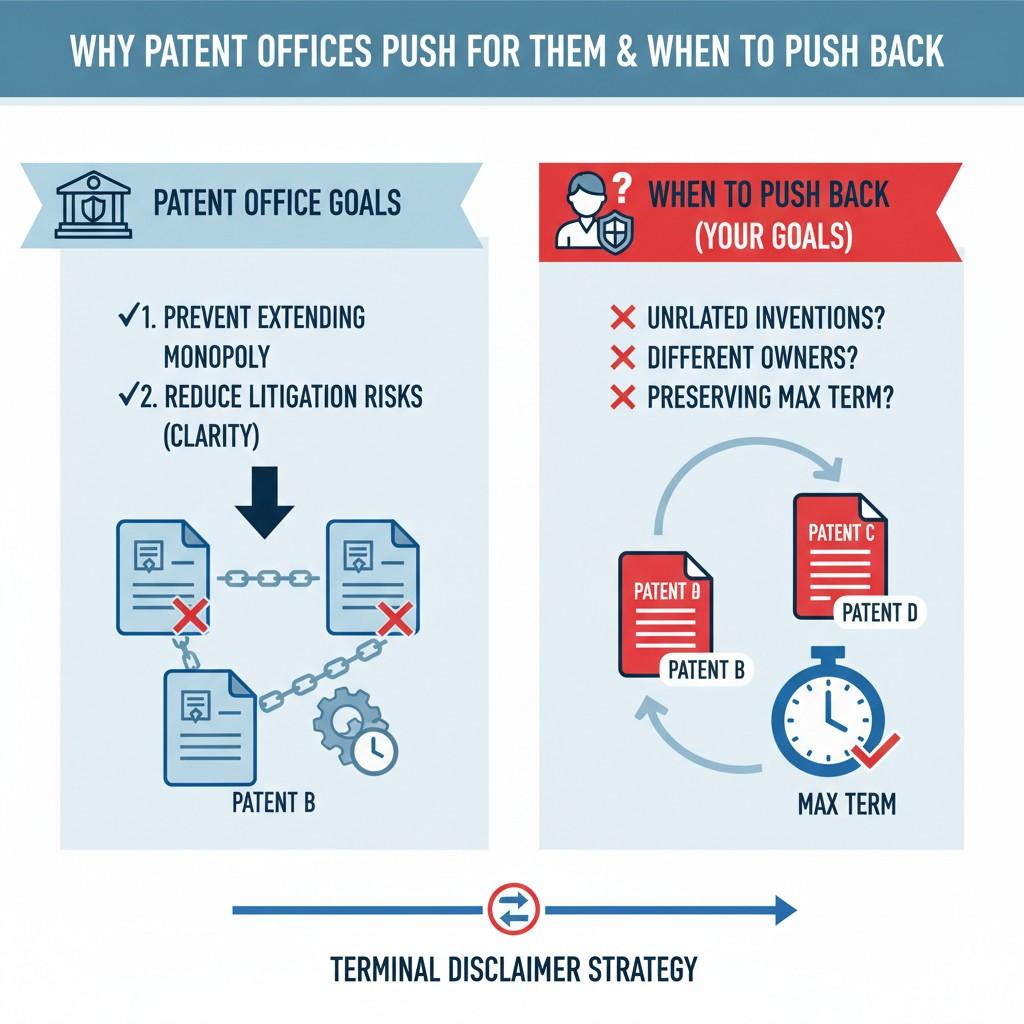
This is why terminal disclaimer requests often appear late in prosecution. Once claims narrow and start to resemble earlier claims, the issue surfaces.
But here is what many founders do not realize. A request for a terminal disclaimer is not always a final command. It is often a negotiation point.
When It Is Reasonable to Agree
There are situations where filing a terminal disclaimer makes sense.
If two applications truly claim almost the same invention and the later one is not adding meaningful new scope, preserving extra term may not be critical. In that case, accepting shared expiration can simplify prosecution and reduce cost.
If the second application mainly exists to adjust wording or fine-tune claims for enforcement, the practical difference in term may be small.
In those cases, the business impact may be limited.
The key is that the decision should be conscious.
You should understand exactly how much term is being given up and whether that term has real economic value.
If the answer is that the lost years are unlikely to matter, then agreeing can be efficient.
But many cases are not that simple.
When You Should Slow Down and Reconsider
If the later application covers a meaningful improvement, a new technical approach, or a feature that may drive revenue years after the core invention, you should pause before agreeing to a terminal disclaimer.
Improvements often outlive original versions.
Think about software platforms. The first version may establish the base. Later optimizations, data pipelines, or integration layers may become the real competitive edge.
If those later innovations are tied to the early filing date and forced to expire at the same time, you lose the chance to extend protection where it might matter most.
In these cases, pushing back can be smart.
Pushing back does not mean arguing emotionally. It means making clear technical distinctions in the claims and in written responses. It means showing that the later invention is not just a rewording, but a separate advancement.
This requires thoughtful drafting from the start.
At PowerPatent, the process is designed so claims are built around real technical differences tied to your product roadmap. That makes it easier to defend separation when the issue arises. You can see how that works here: https://powerpatent.com/how-it-works
The Power of Claim Architecture
One of the most effective ways to avoid unwanted terminal disclaimers is to design claim architecture early.
Claim architecture means thinking carefully about how different inventions are framed.
If you file one application that broadly covers a system, and a second that focuses on a specific algorithm improvement, the claims should reflect clear boundaries. The improvement should not read like a slightly narrower version of the first claim.
It should stand on its own technical ground.
This is not about clever wording. It is about real technical separation.
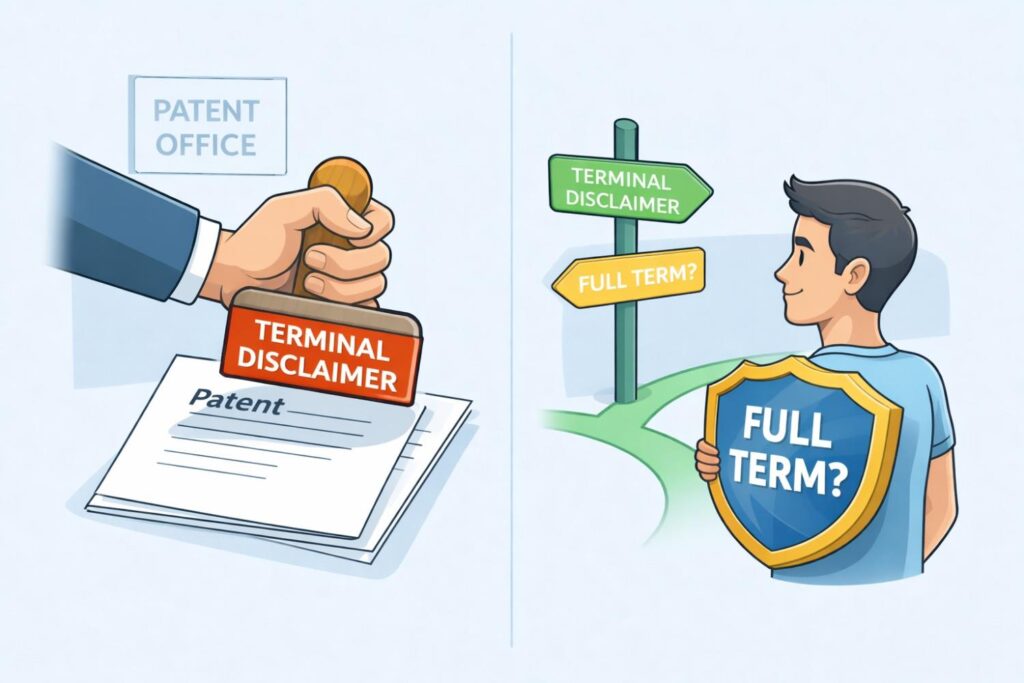
When applications are drafted without this strategy, they often overlap more than necessary. That overlap invites double patenting rejections and pushes you toward terminal disclaimers.
Strong initial drafting reduces the chance that you are forced into that corner later.
The Role of Timing
Timing also plays a major role.
If you develop a significant new invention years after the original filing, it may deserve a fresh application with its own priority date instead of being folded into a continuation tied to the old clock.
Filing everything under the original umbrella may feel organized, but it can compress term.
Founders sometimes default to continuations because they feel safe and connected. But new priority dates can create new patent life.
The decision depends on how related the new invention truly is and how important long-term term is for that feature.
These are strategic choices that should be made with a view toward your growth plan.
If your technology will take a decade to mature, filing in a way that preserves later expiration dates can be a powerful advantage.
Avoiding the Fear-Based Decision
Many terminal disclaimers are filed because of fear.
Fear of delay.
Fear of rejection.
Fear of added cost.
Examiners may suggest that without a disclaimer, allowance will be difficult. That can create pressure.
But a thoughtful response can often address the concern without sacrificing term. Sometimes small claim adjustments can create enough distinction. Sometimes a well-reasoned argument can overcome the rejection.
The key is having guidance from attorneys who are willing to think strategically, not just clear files quickly.
At PowerPatent, filings are reviewed by real patent attorneys who understand startup realities. The goal is not to drag prosecution out, but to balance speed with strength. You do not want approval at any cost. You want protection that holds up over time.
If you want to build patents that support your company five, ten, or fifteen years down the road, it starts with smart early decisions. You can explore the full process here: https://powerpatent.com/how-it-works
Treating Each Disclaimer as a Business Deal
A helpful way to think about terminal disclaimers is to treat each one like a business deal.
You are trading something of value, patent term, in exchange for something else, usually faster allowance.
Before making that trade, ask what the term is worth.
If your technology has a short shelf life, maybe the trade is fair. If your technology is foundational and may define a category, the trade could be expensive.
When you frame the decision this way, it becomes clear that terminal disclaimers should never be automatic.
They should be evaluated with the same care you would apply to giving up equity or signing a long-term contract.
Your patents are part of your company’s core assets. Decisions that affect their lifespan deserve attention at the founder level, not just inside legal correspondence.
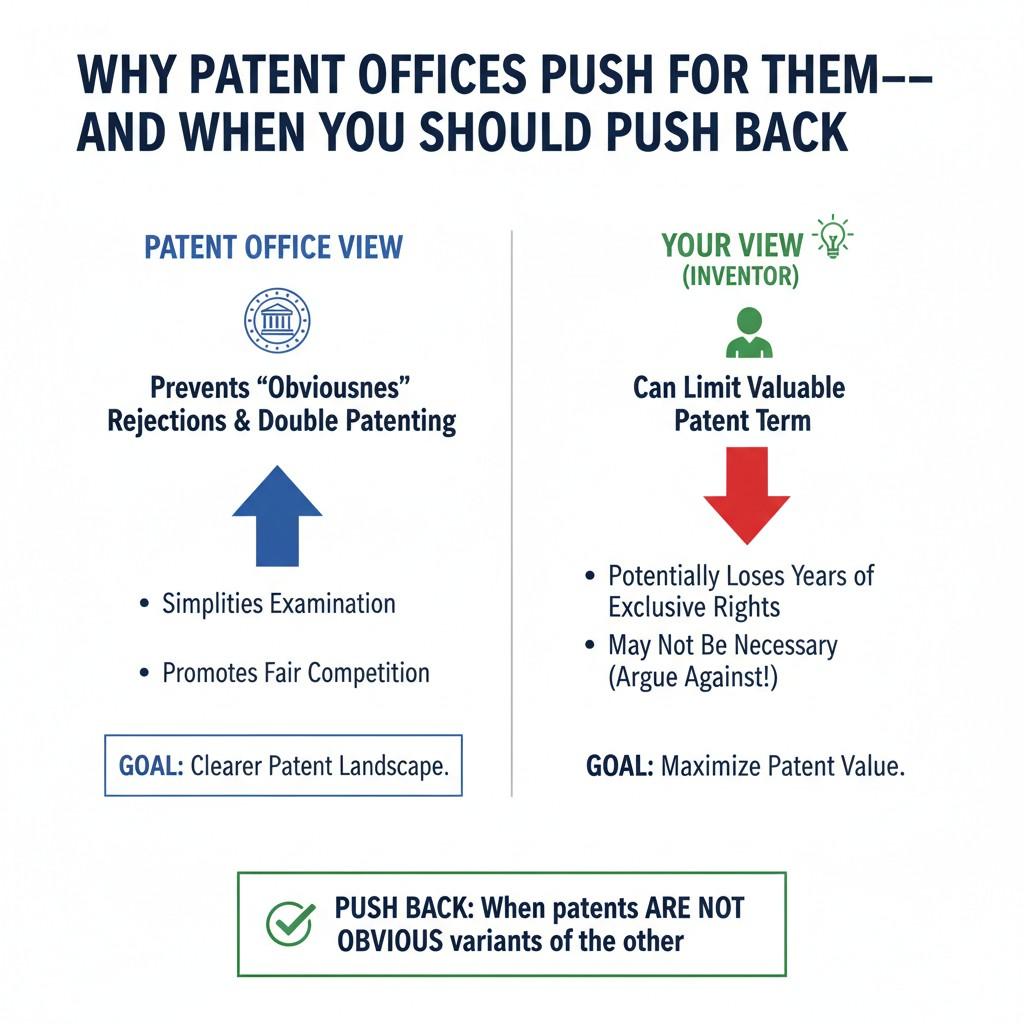
When you approach terminal disclaimers with strategy instead of habit, you protect more than just a filing. You protect future leverage.
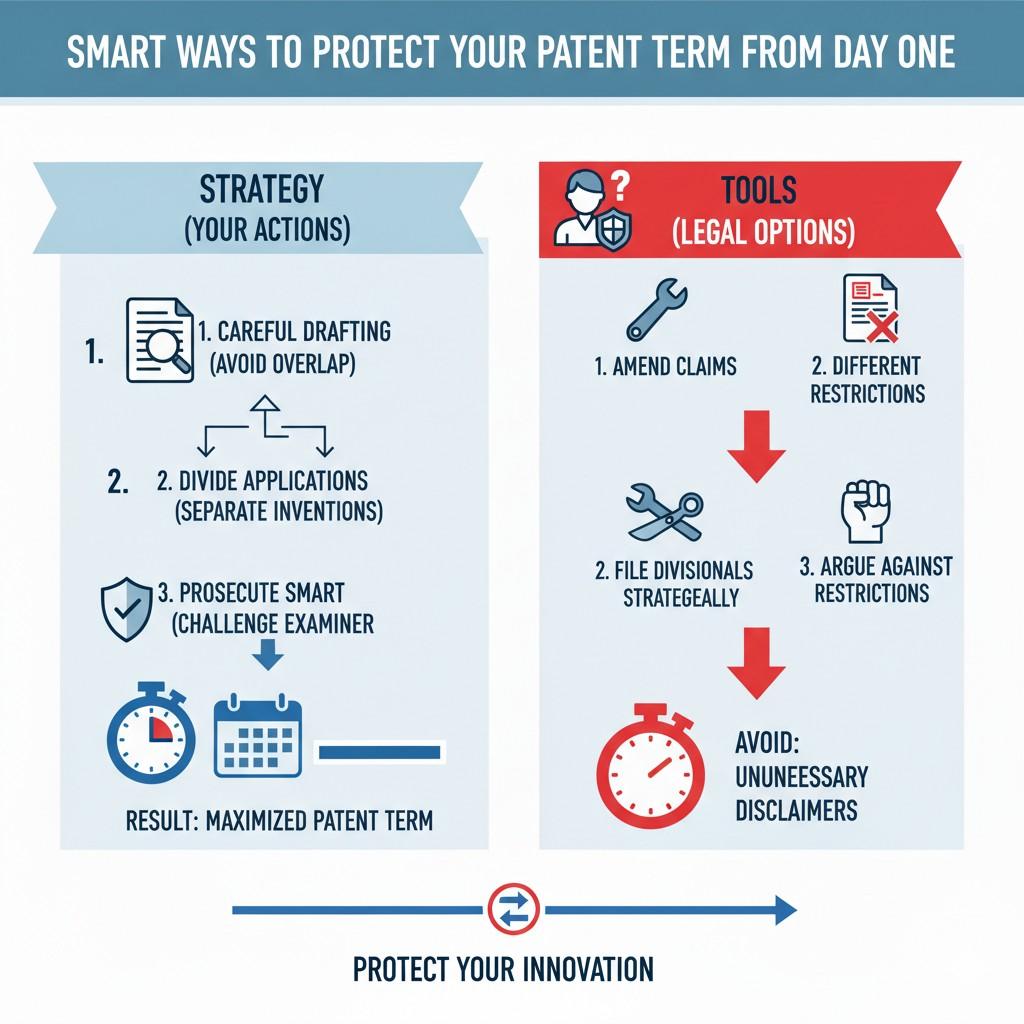
Smart Ways to Protect Your Patent Term From Day One
If you wait until a terminal disclaimer is on the table, your options are already narrower.
The smartest move is to think about patent term before you file your first application. Patent life is not something you fix at the end. It is something you design at the beginning.
Founders who treat patents as long-term business tools, not just legal shields, build portfolios that age well. They keep flexibility. They keep leverage. They avoid painful surprises during fundraising or acquisition.
This section is about playing offense instead of defense.
Start With a Roadmap, Not Just an Invention
Most patent filings begin with a single idea. That is natural. You built something new. You want to protect it.
But strong portfolios are not built around a single snapshot in time. They are built around a roadmap.
Before filing, step back and ask where your technology will be in three years. Five years. Ten years.
Will you add new models? New data flows? Hardware layers? Enterprise features? APIs? Integrations?
When you think in terms of a roadmap, you can separate inventions more cleanly. Your first application can focus on the core architecture. Later filings can focus on real improvements that deserve their own space and potentially their own clock.
This separation makes it easier to argue that later inventions are distinct. That reduces the risk of being forced into terminal disclaimers that tie everything together.

At PowerPatent, this roadmap thinking is built into the process. Instead of asking only what exists today, the system helps you map what is coming next so filings support long-term growth. You can see how it works here: https://powerpatent.com/how-it-works
Draft With Clear Technical Boundaries
A common mistake is drafting broad claims that swallow too much ground without clear internal structure.
When later applications are filed, they often look like smaller versions of the first one. That overlap invites double patenting concerns.
A smarter approach is to build strong but structured claims from the start. The core invention should be defined clearly. Improvements should be framed as separate technical advances, not just variations.
For example, if your first patent covers a distributed training system, and later you invent a specific memory optimization method, that method should be described and claimed as a distinct improvement with its own technical contribution.
The more clearly you draw those lines in the written description, the easier it becomes to defend separation later.
This is not about being narrow. It is about being thoughtful.
Well-drafted applications create space for future filings without stepping on themselves.
Be Intentional With Continuations
Continuations are powerful tools. They let you adjust claims over time as markets evolve. They keep options open.
But they also share the original priority date, which means they share the same basic expiration timeline.
If you rely too heavily on continuations for new inventions that arise years later, you compress your overall patent life.
Instead, consider whether a new invention truly depends on the earlier filing date. If it does not, filing a fresh non-provisional application with a new priority date may be the better move.
This creates a new twenty-year term for that specific advancement.
The decision is strategic. It depends on how much the new invention relies on earlier disclosures and how valuable long-term protection will be.
Founders should not default to one path. They should weigh term impact as part of the decision.
Monitor Examiner Signals Early
When an examiner first raises concerns about overlapping claims, that is the moment to slow down.
Do not wait until the only path to allowance appears to be a terminal disclaimer.
If you see a non-statutory double patenting rejection early, treat it as a signal that claim boundaries may need refinement.
Sometimes small shifts in language can highlight real differences. Sometimes adding technical detail clarifies that the later invention solves a different problem in a different way.
Addressing these issues early often gives you more room to maneuver.
The longer you wait, the more the file history narrows your options.
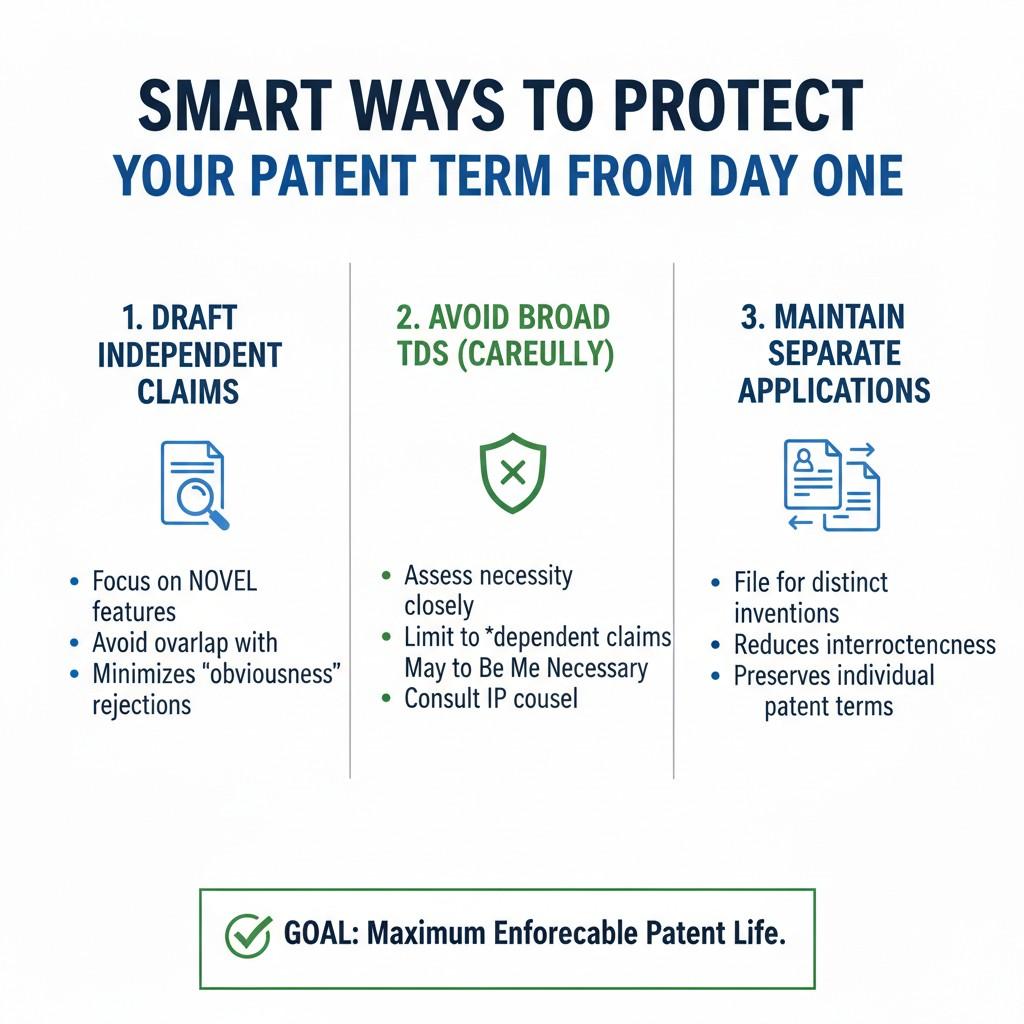
Having attorney oversight that tracks these signals carefully can make a major difference. With PowerPatent, you get both software efficiency and real attorney review to catch these issues before they harden into constraints.
You are not left reacting at the last minute. Learn more here: https://powerpatent.com/how-it-works
Align Patent Strategy With Exit Strategy
Patent term should match your business horizon.
If you plan to build and exit within five years, term beyond that may feel less urgent. But most acquirers look at long-term defensibility. They want protection that extends well past the transaction date.
If you plan to build a long-term independent company, term becomes even more critical. You may still be scaling when your earliest patents approach expiration.
Aligning patent strategy with exit plans forces better decisions about disclaimers.
Ask yourself how valuable your core technology will be in year fifteen or twenty. If the answer is that it could still anchor your business, preserving every year matters.
When patents are structured with that future in mind, they become assets that support valuation instead of limiting it.
Build With Transparency and Control
One of the biggest risks with terminal disclaimers is that founders often do not realize they were filed until much later.
That lack of visibility creates frustration and limits corrective action.
You should always know whether a disclaimer has been filed, how it affects expiration dates, and which patents are tied together.
A modern patent system should give you clear insight into these connections.
PowerPatent was built for founders who want control. The platform shows how filings connect, how timelines align, and where risks may arise. Combined with attorney guidance, that transparency helps you make informed decisions instead of reactive ones.
When you can see the structure of your portfolio clearly, you are far less likely to give away term without understanding the trade.
Think Long, Move Fast
Speed matters for startups. You cannot let patent work slow down product development.
But speed without strategy creates hidden costs.
The goal is not to drag out prosecution or fight every examiner suggestion. The goal is to move fast with clarity.
When you file with a long-term view, draft with separation in mind, and evaluate terminal disclaimers as business trades, you protect both speed and strength.
Your patent portfolio should grow with your company. It should extend your leverage, not shorten it.
Terminal disclaimers are powerful tools. Used carefully, they can resolve real issues. Used casually, they can shrink the life of your most valuable assets.
From day one, treat patent term as something worth guarding.
If you are building deep tech and want protection that matches your ambition, take a closer look at how PowerPatent combines smart software with real attorney oversight to help you file stronger patents without hidden traps. Start here: https://powerpatent.com/how-it-works
Wrapping It Up
Terminal disclaimers are easy to overlook. They show up as small documents inside a long prosecution process. They often feel like a quick way to move forward. But they are not small. They can shorten your patent life. They can tie your patents together. They can limit flexibility during licensing, fundraising, and exit. And most of the time, founders do not realize the full impact until much later. Here is the core truth. Patent term equals leverage.