Keeping your patents alive should feel clear and in your control. But when renewal time comes around, most founders see a wave of fees, deadlines, and country choices that all feel urgent and expensive at the same time. It’s hard to know which patents are worth keeping, which ones to let go, and how to make sure you’re not wasting money on claims that don’t even support your real product anymore. That’s why smart teams look at renewal KPIs that show what’s actually working and what’s not. Three simple numbers—cost per active claim, country ROI, and coverage gaps—help you protect the parts of your invention that matter most without overspending or losing ground to competitors.
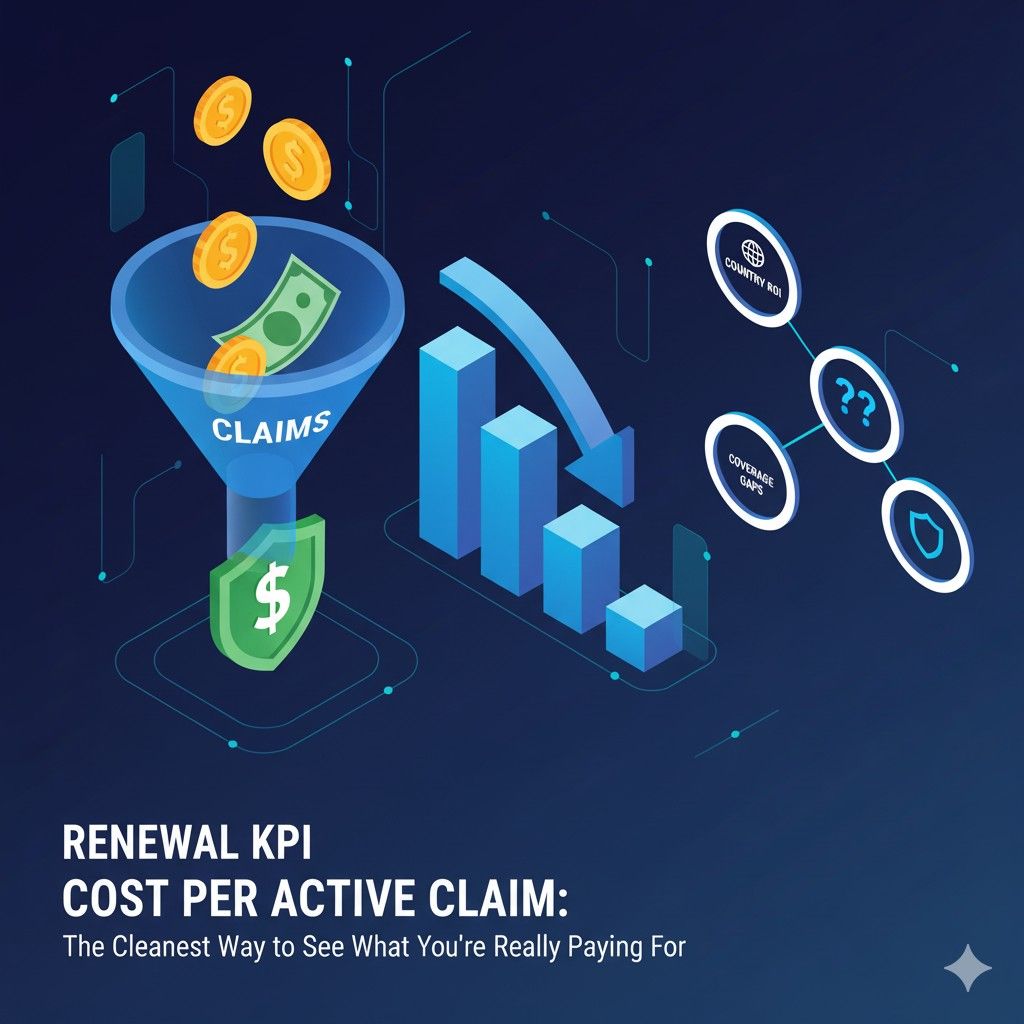
Cost per Active Claim: The Cleanest Way to See What You’re Really Paying For
Understanding the true cost of your patents starts with seeing how much you spend on each claim that still matters to your business.
Many companies look at renewal fees as one big number, but that never shows the real picture. A patent can look expensive at first glance, but when you divide the renewal cost by the number of active claims that still protect your current product or core technology, everything becomes clearer.
This small shift gives founders and engineering leaders a simple way to judge value without needing a legal background. It helps you see which patents are pulling their weight and which ones may quietly drain your budget.
Why active claims matter more than total claims
Most patents carry claims that no longer match what the company ships today. Startups pivot. Code gets rewritten. Hardware changes fast.
Claims that once felt important might now cover features that were removed long ago. When you look at cost per active claim, you cut out the noise and focus only on the claims that still protect something real.
This keeps you from blindly renewing expensive patents with outdated coverage.

At the same time, it highlights the patents that still safeguard your edge and deserve continued investment because they guard your revenue, your roadmap, and your competitive wall.
How cost per active claim supports smarter budgeting
Every founder deals with tight budget windows, especially when renewal cycles stack up across multiple countries. Cost per active claim gives you a clean metric for quick decisions, even if your team is not deeply trained in IP.
Instead of debating in circles about which patents to keep, you can look at which ones offer maximum protection at a reasonable cost and which ones protect very little at a very high cost.
This approach saves money but also keeps your decision process calm, fast, and focused. You no longer rely on gut feelings or long legal memos. You rely on a number that speaks for itself.
Using claim relevance mapping to avoid renewal mistakes
The most helpful step any business can take is to map each patent claim to the real product elements it covers today. Many companies skip this because it feels tedious, but with the right system this work becomes simple and fast.
Once each claim is tied to a real feature, component, workflow, or algorithm, you can instantly see which claims are active and which ones are dead weight.
When renewal time arrives, you already know the value. This prevents rushed decisions driven by deadlines or fear, and it stops you from paying for coverage that does not actually guard your IP moat.
When to keep a high cost per active claim
Not every patent with a high cost per active claim should be dropped. Sometimes a single claim protects something so central that it deserves full support even when renewal fees rise.
For example, a single algorithm claim that shields your core AI model might look expensive on paper, but the real question is what happens if a competitor copies it.
If losing that claim would put your advantage at risk, the renewal remains worth it.

This is why the metric is not meant to replace judgment. It is meant to give you clearer judgment based on what truly matters to your company.
How PowerPatent simplifies active-claim tracking
Many teams struggle with tracking active claims because they use scattered spreadsheets or rely on old firm emails that never feel updated. PowerPatent solves this by giving founders a clean view of each patent, each claim, and each renewal cost in one simple dashboard.
You see the cost per active claim instantly and can make renewal choices with confidence instead of waiting days for an attorney to respond.

The system combines smart tools with real attorney review so you get clarity without losing legal safety. If you want to see how the platform works, you can visit https://powerpatent.com/how-it-works anytime.
Country ROI: How to Know Which Markets Deserve Renewal Dollars
Every patent family eventually reaches a point where renewals across different countries start to add up fast. The costs do not rise evenly, and the value of each country is never the same.
This is why country ROI becomes one of the most important KPIs for any business that wants to protect its technology without overspending. The idea behind country ROI is simple: understand what each country gives back to your business compared to what you pay to stay protected there.
When you see this clearly, you avoid wasting money on regions that no longer support your growth, and you double down on the markets that matter most.
How country ROI aligns protection with real business goals
Many startup teams treat international renewals as a routine task, renewing everything everywhere because that feels safe. But this usually leads to high costs and low returns.
When you look at country ROI, you shift from a defensive mindset to a strategic one. Instead of thinking, “We need to keep this patent alive because it exists,” you start asking, “Does this country still protect revenue, partners, or future expansion?” Companies grow unevenly across the world.
Some markets become core revenue drivers. Others turn into distractions. Country ROI helps you match your patent spend to your real growth path.
This way of thinking supports teams that are trying to scale while staying lean. You stop pouring money into markets where you have no sales, no partners, and no plans.

At the same time, you invest confidently in the countries that support your current roadmap. This leads to cleaner financial planning and stronger protection where it truly matters.
Understanding value signals inside each country
To calculate country ROI well, you need to look at a few simple signals inside each market. One signal is the potential for revenue. Countries where you have strong customer traction or clear expansion plans usually deserve renewal attention.
Another signal is competitor activity. If a competitor is strong in a certain country or enters that market before you, keeping protection there becomes even more important. A third signal is manufacturing and supply chain exposure.
If your product or parts of your product are manufactured in a specific country, having protection there prevents copycat production.

Each of these signals helps you see the real-world impact of a patent renewal. When you combine them with renewal cost data, you get a clean, simple picture of which markets are worth defending.
When a low-ROI country still deserves attention
There are moments when a country shows low ROI on paper but still deserves coverage. Sometimes a country has a slow market today but is important for long-term strategy.
You may also see early signs of growth from specific partners, investors, or customers located there. Another example is when the country plays a key role in your global enforcement strategy.
Some jurisdictions are strong entry points for blocking imports or exports of infringing goods. Even if sales are not strong there yet, the legal leverage is valuable.
This is why country ROI should guide your decisions, not dictate them. You take the number into account, but you always balance it with context from your leadership, sales team, and product vision.
How to prevent emotional renewal decisions
Founders often renew patents in certain countries because they feel attached to the idea of being “global.” But a global patent footprint only matters when it supports global business.
Country ROI helps remove emotion from the decision by breaking everything into clear value versus cost.
When a country looks expensive and gives little back, you no longer fear letting it go. You can make the call with confidence because the numbers support the decision.

This leads to a more balanced portfolio. You do not shrink your protection blindly, and you do not grow it without thought. You keep the footprint tight, smart, and aligned with where your business is actually moving.
Why renewal timing matters when measuring ROI
Renewal fees increase over time, and countries with low ROI often become harder to justify as fees enter higher stages. The earlier you track this KPI, the easier it becomes to shape a long-term renewal path.
You can plan ahead instead of being caught off guard by a sudden jump in fees. Good timing lets you prepare budget cycles and align IP strategy with product and market milestones.
If a market becomes valuable two years from now, you plan your renewals around that. If a market is shrinking, you can reduce spend before fees spike.
This timing control also gives your leadership team confidence because decisions are made proactively, not reactively.
How PowerPatent helps teams see country ROI instantly
Without the right tools, tracking country ROI becomes messy because renewal fees vary by year, by country, and by patent family. Many founders rely on scattered spreadsheets or delayed updates from outside firms.
PowerPatent solves this by giving you a live view of renewal fees, country value inputs, and portfolio strength across all markets.
You can see country ROI in seconds instead of hours. Real attorneys check the data behind the scenes, and the software keeps everything clear and simple.

This saves time, removes stress, and allows teams to make renewal decisions based on clean numbers instead of guesswork. If you want to see how this works in practice, you can visit https://powerpatent.com/how-it-works to explore the platform.
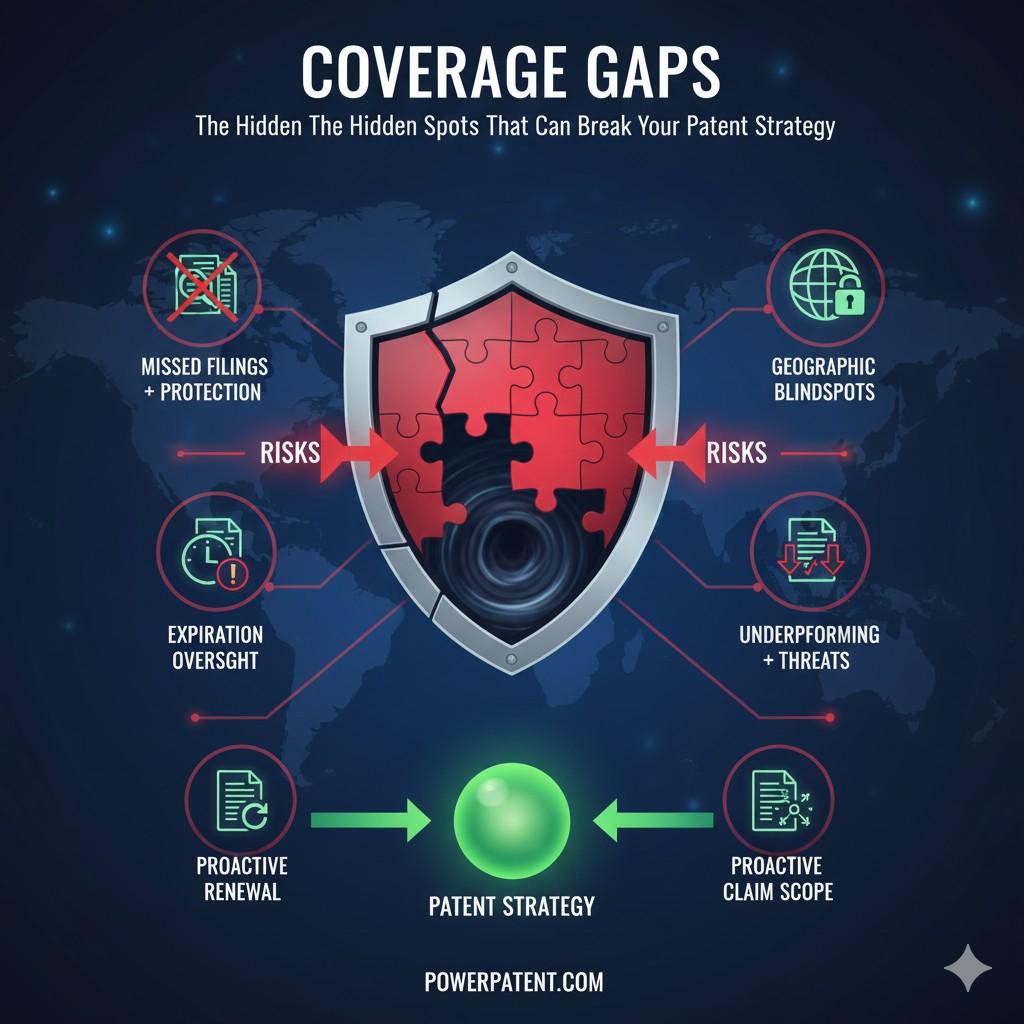
Coverage Gaps: The Hidden Weak Spots That Can Break Your Patent Strategy
Every fast-moving company reaches a point where the product has evolved so quickly that the original patents no longer match every important part of the technology.
These mismatches turn into coverage gaps, and they often stay invisible until it is too late.
A coverage gap is any place where your product, workflow, algorithm, hardware design, or system behavior is not protected by a clear, enforceable claim.
It is one of the most common—and most costly—problems in renewal strategy because teams usually renew everything they already have instead of checking what they are missing.
When you track this KPI early, you protect your freedom to build, launch, and scale without giving competitors open space to replicate your best ideas.
Why coverage gaps appear even in strong portfolios
Coverage gaps are not a sign of poor planning. They appear naturally as your product evolves. Most teams build faster than they file, and new features often grow out of earlier work but with enough changes that the old claims no longer fit.
A claim written three years ago for a narrow algorithm may not fully cover the expanded model you use today. A claim about a prototype device may not match the production design.
A claim about a workflow may not protect the new automated version. These shifts happen in every growing company.

The challenge is that many teams assume old patents automatically protect new versions. But patents do not expand with your product. They stay frozen in time.
When you see coverage gaps clearly, you stop relying on assumptions and start making choices that protect the product you are actually selling, not the one you built years ago.
How renewal decisions uncover hidden risk
Coverage gaps matter most at renewal time because this is when you decide which patents to keep and which to let go. But if you do not understand your gaps, you may drop a patent that anchors protection for a core part of your system.
You might also renew a patent that no longer protects anything meaningful. A clear view of gaps helps you make sharper decisions. If a patent covers a piece of technology that is still central, keeping it alive buys you time to file new applications that fill the missing areas.
If the patent no longer connects to your current product, the gap shows you that it can be safely abandoned.
Instead of renewing everything blindly, you shape your portfolio around the actual state of your technology. This saves money and strengthens your IP moat at the same time.
Why gaps become expensive when ignored
When a competitor sees an unprotected area, they take advantage of it. They may copy a feature, build a similar workflow, or create a parallel version of your system that avoids your active claims.
If the gap is big enough, they might even build a cheaper product with the same core value. Once they establish themselves, closing that gap becomes harder and more expensive. Filing new patents later in the game may still help, but it will never be as strong as filing before the competitor enters.
This is why smart companies treat coverage gaps as an early-warning signal. Seeing a gap today gives you time to reinforce protection before anyone steps into that space.
How to connect claims to real product behavior
The best way to spot gaps is to map claims to what your product actually does today.
This does not require deep legal training. You can break the product down into features, flows, and core technical elements, then ask a simple question for each: do we have a claim that covers this part?
If the answer is no, that is the gap. This process prevents the common mistake of thinking that broad claims automatically protect everything in your system.
Once the mapping is done, renewal choices become clear. You can see which patents anchor your protection and which leave you exposed. You can also see where new filings would add the most value.
When a coverage gap creates an opportunity
A gap is not always a threat. Sometimes it signals a chance to file new protection in areas that represent your next phase of growth.
If your roadmap shows that a new part of the system will become central, and the gap reveals weak coverage there, this becomes the perfect time to file.
Early filings in these areas help you stay ahead of competitors, and they give investors confidence because you can show that your IP stack aligns with your future direction.
This is why tracking gaps is not about fear. It is about planning. It helps you build an IP portfolio that follows the same path as your technology and your market, not one that lags behind.
How coverage gaps influence country renewals
Coverage gaps also shape how you think about country-level decisions. If a certain country is expensive to keep but holds patents that cover your strongest features, it may still deserve renewal.
If another country holds patents with weak coverage or outdated claims, you can drop them with less risk. This keeps your international footprint tight and efficient. It also ensures that you are not paying for empty protection in markets that no longer matter.
When you combine country ROI with coverage gap analysis, you get one of the cleanest views of your real global protection. Every renewal starts to feel like a clear, confident decision instead of a guess.
How PowerPatent makes gap detection simple
Most founders never check for gaps because the process feels hard and time-consuming. PowerPatent solves this by giving you a clean view of which claims cover which parts of your product.
The system shows you where your protection is strong, where it is thin, and where competitors could step in. It saves hours of manual work and gives you a clear roadmap for renewals and future filings.
Real attorneys check the strategy behind the scenes, and the software surfaces the insights in simple, founder-friendly language.
How gaps affect investment and due diligence
Coverage gaps often become visible during fundraising, and investors notice them quickly. When a VC or strategic partner looks at your patents, they want to see a strong shield around your core technology.
If they spot gaps, especially around the parts of your product that drive revenue or user adoption, they worry about how easily a competitor could copy you.
This does not mean they expect perfect coverage, but they do expect clarity. When you understand your gaps and can explain your plan to fill them, you appear more prepared, more focused, and more in control.
This builds trust and helps you move through diligence faster, with fewer questions and less friction.
How gaps influence freedom to operate
A gap is not just a missing piece of protection. It can also create uncertainty about whether your team can keep building safely. When a feature is not covered by your own claims, it becomes easier for a competitor to claim similar ground or challenge your ownership.
This is where freedom to operate becomes important. If you know your gaps, you can steer development away from risky areas or file new claims before your competitors do.
This keeps your team moving without slowing down innovation or forcing last-minute product changes.
Why gaps matter more in fast-moving industries
Some sectors move so fast that a short delay in filing can create long-term risks. In fields like AI, robotics, biotech tools, and advanced hardware, competitors often run experiments in parallel.
When an industry evolves quickly, coverage gaps grow wider because the technology changes faster than your early claims. This is why tracking gaps becomes a core part of staying ahead.

You cannot rely on old filings to protect next-generation work. You need a clear, living view of which areas are safe and which ones need new filings now, not later.
How identifying gaps supports long-term IP planning
Coverage gaps reveal more than missing protection. They also show where your technology is heading. When you map claims to your product and see the uncovered areas, patterns begin to appear.
These patterns show you which parts of the system keep expanding, which ones become stable, and which ones are turning into new technical pillars. This clarity helps you plan your next patents.
You are not filing reactively or randomly. You file in areas that reflect your real direction, which makes your IP stronger and more aligned with your strategy.
How PowerPatent strengthens gap-driven portfolio shaping
Seeing coverage gaps is helpful on its own, but the real power comes when those insights shape your entire portfolio. PowerPatent gives you a simple way to connect gaps to renewals, new filings, and country-level decisions without drowning in complex documents.
The platform shows where your protection is solid and where it needs work. It helps you decide which patents to keep alive, which ones no longer serve you, and where new filings will add the most value.
With real attorneys guiding the strategy behind the scenes, you get the safety of expert review combined with the clarity of clean, simple software.

This makes your portfolio stronger and your renewal decisions smarter.
You protect what matters, avoid wasting money, and move forward with more confidence. If you want to see how the system works, you can explore https://powerpatent.com/how-it-works any time.
Wrapping It Up
Every growing company eventually hits the moment when patent renewals start to feel heavy. Fees rise, deadlines converge, and different countries demand different decisions. It becomes easy to react instead of plan. But when you understand the three core renewal KPIs—cost per active claim, country ROI, and coverage gaps—you gain a simple and steady way to stay in control. Each KPI gives you a different lens. One shows the true value of claims you still rely on. One shows which countries still deserve your investment. One shows the weak spots that need reinforcement before competitors step in. Together, they form a clean picture of your entire portfolio so you can take action with confidence instead of guesswork.