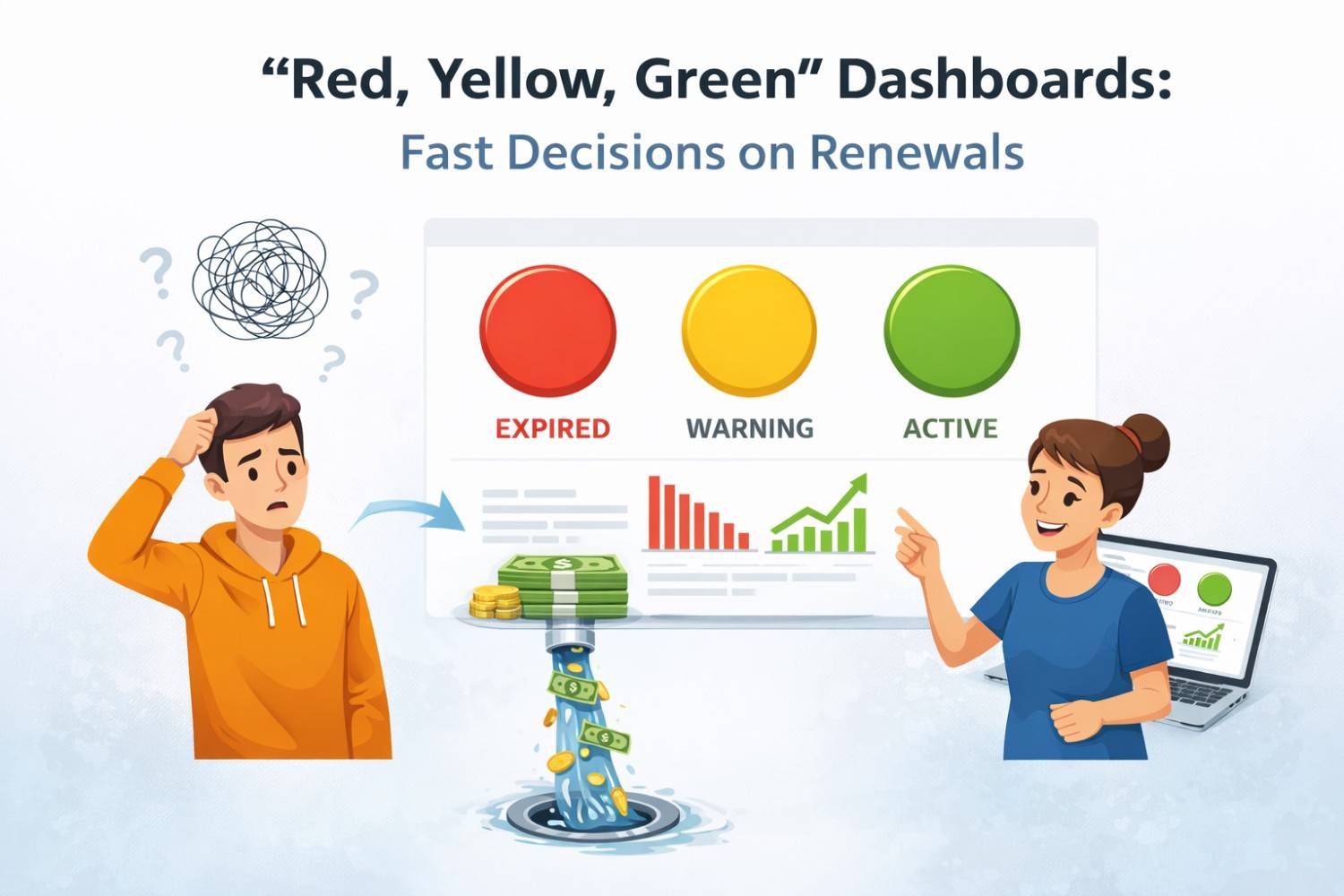
Patents do not just sit on a shelf. They cost money every year. And every year, you have to decide: do we keep this one, or let it go? For most startups, that choice feels slow, messy, and unclear. You open a spreadsheet. You look at dates. You ask your lawyer. Weeks pass. Money goes out the door. What if that decision could take five minutes instead of five meetings? That is where a simple “Red, Yellow, Green” dashboard changes everything. It turns patent renewals from a guessing game into a fast, calm, confident move.
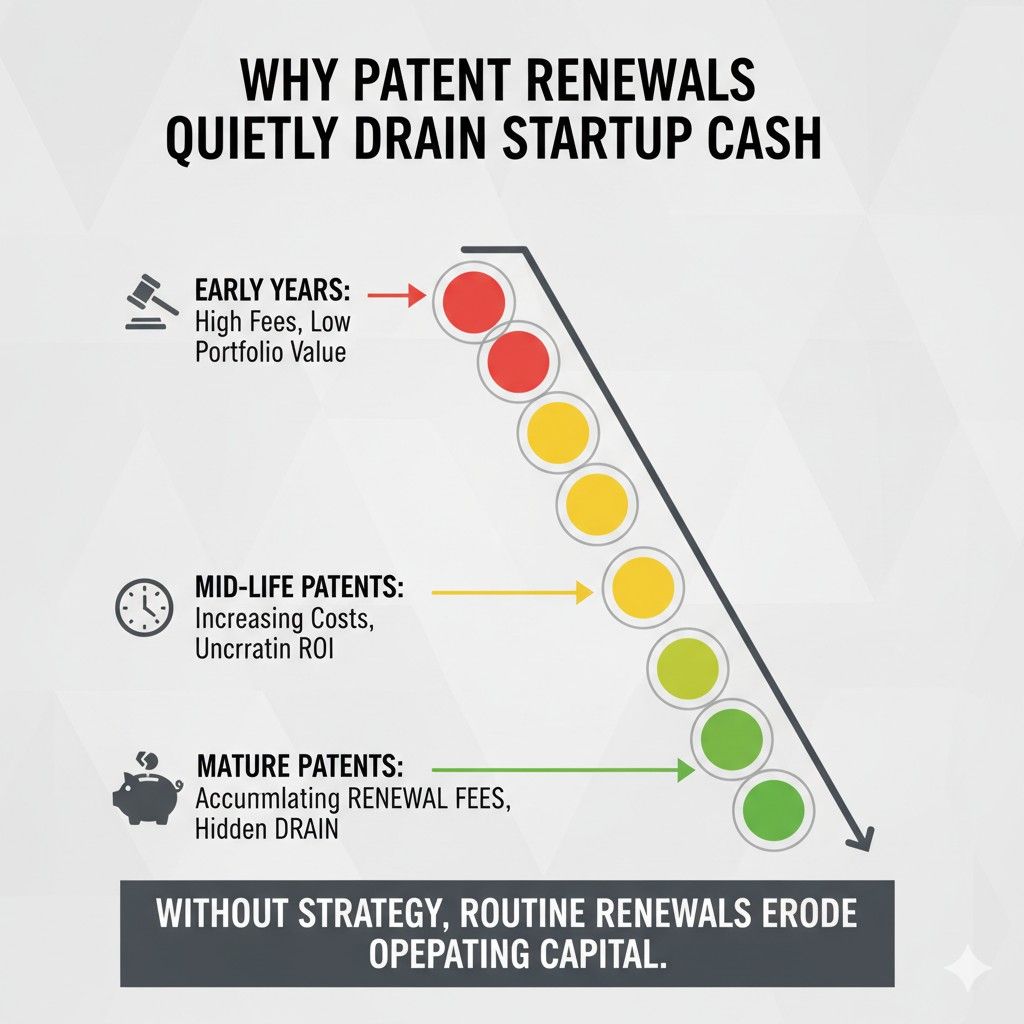
Why Patent Renewals Quietly Drain Startup Cash
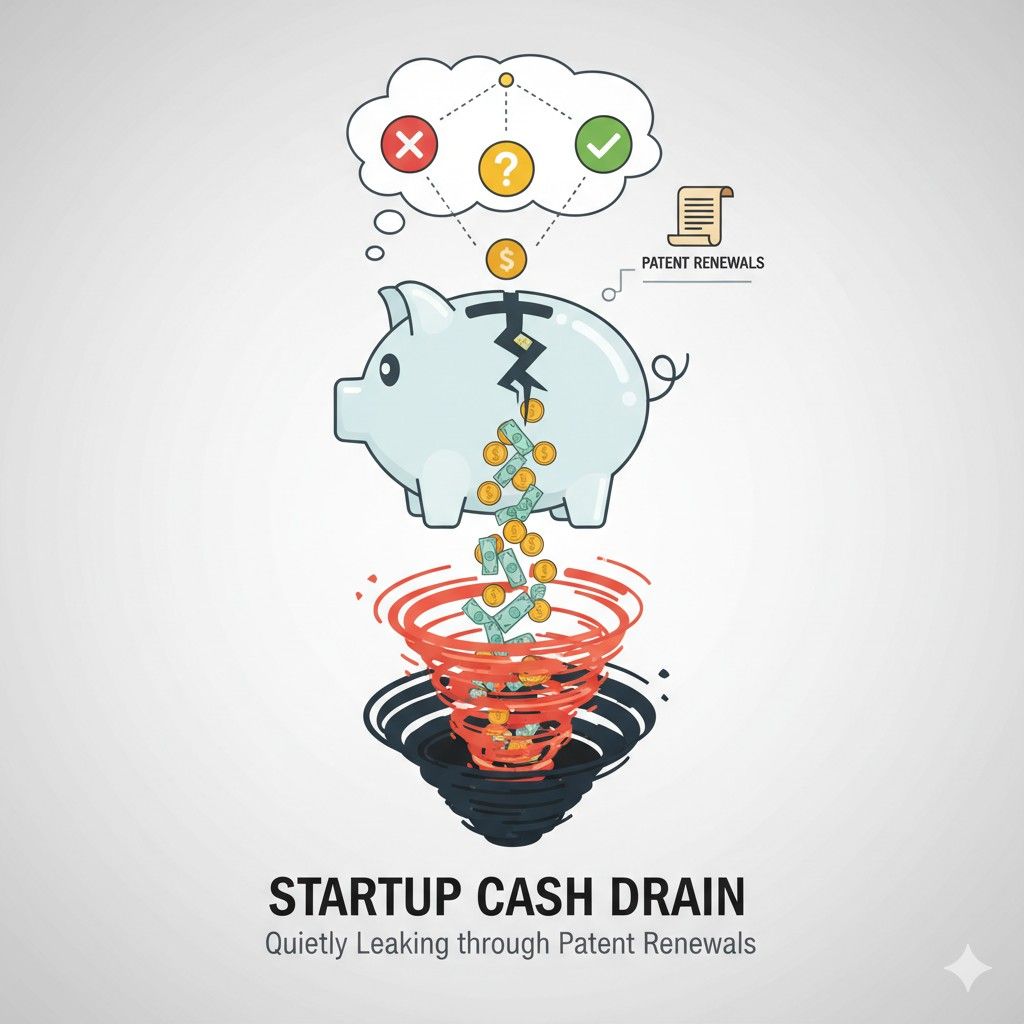
Every startup watches payroll. Every founder tracks runway. You know what your cloud bill is. You know what you spend on ads. But patent renewals often hide in the background.
They feel small at first. Then they stack up. Then they become a silent leak in your budget.
Renewals are not one-time payments. They repeat. They grow. And they show up whether or not the patent is helping your business today.
If you do not manage them with intention, they slowly eat into capital that could be used to hire, build, or launch.
Let’s look at why this happens and how to stop it.
Renewals Feel Small Until They Multiply
At first, a renewal fee does not look scary. It might be a few hundred or a few thousand dollars. For a single patent, that seems fine. You think, “We worked hard for this. Of course we’ll keep it.”
The problem starts when your portfolio grows. One patent becomes five. Five become twelve. If you file in other countries, the cost multiplies even faster. Each patent has its own clock.
Each country has its own rules. Each deadline brings another bill.
Over time, you are not paying for one patent. You are paying for a system that no one is actively reviewing.
This is where startups lose control. The cost does not explode all at once. It creeps up slowly. By the time someone notices, tens of thousands of dollars may already be committed for the year.
A smart move is to treat renewals like product features. If a feature is not being used, you question it. If a patent is not tied to revenue, product direction, or real defense value, it deserves the same scrutiny.
Before each renewal window, ask a simple question: if we did not already own this patent, would we spend money today to file it again? If the answer is no, that is a signal. Not an emotional signal. A business one.
The Emotional Trap of “We Already Paid for It”
Founders are builders. You invested time, energy, and money to get that patent granted. It feels wrong to let it go. It feels like wasting past effort.
But renewals are about the future, not the past.
The money you spent years ago is gone. The only real question is whether this patent will protect or support your company moving forward.
If it does not block competitors, support fundraising, protect core tech, or create leverage, keeping it just because you “already paid for it” is not strategy. It is attachment.
This is where many teams freeze. No one wants to be the person who says, “Let’s drop it.” So the default becomes: renew everything.
That default is expensive.
A better approach is to separate identity from assets. Your company is not your patent count. Investors do not fund you because you have the most patents. They care about defensible advantage. That is different.
When you review renewals, do it with clear criteria tied to your current roadmap. If the patent does not support where you are going in the next three to five years, it should be questioned. Not emotionally. Logically.
International Filings Multiply the Drain
Global protection sounds impressive. And sometimes it is necessary. But each country comes with its own renewal fees, deadlines, and administrative work.
Many startups file broadly early on because they want to “keep options open.” Later, they pivot. They narrow their market. They realize they will never sell in certain regions.
But the renewals continue.
This is one of the biggest hidden drains. You may be paying to maintain rights in countries that no longer match your strategy.
Before renewing internationally, align each country with a real business case. Are you selling there? Manufacturing there? Blocking a known competitor there? Planning expansion there in the near future?
If the answer is unclear, do not assume the safest move is to keep paying. The safest move is the one aligned with your real growth plan.
A disciplined company maps patents to markets. If the market is gone, the patent protection in that market should be reviewed.
Deadlines Create Panic Spending
Patent renewals come with strict deadlines. Miss them and you risk losing rights. Because of this, many teams renew out of fear. The reminder email comes in.
There are only weeks left. No one has done a review. The safest move feels like paying.
This cycle repeats year after year.
Panic spending is not strategic spending.
The fix is simple but powerful. Review patents months before renewal deadlines. Not days. Build a calendar that flags upcoming renewals at least six months in advance. That gives you time to ask real questions.
Is this patent still tied to our core product? Does it protect something we still use? Has the tech changed? Have we replaced it with something better?

When you review early, you regain control. When you review late, you pay by default.
A “Red, Yellow, Green” dashboard works best when it is not rushed. If a patent is marked red months ahead of renewal, the decision feels calm. If it is marked red two days before the deadline, the pressure may override logic.
No Clear Owner Means No Clear Decision
In many startups, no one truly owns patent renewals. Legal may track deadlines. Finance may process payments. Founders may not even see the full picture.
When ownership is unclear, renewals become routine transactions instead of strategic decisions.
Assigning one accountable person changes everything. This does not mean they decide alone. It means they lead the review process. They gather input from product, engineering, and leadership. They connect patents to roadmap and revenue.
Without that connection, renewals happen in isolation.
A simple but strong tactic is to review patents alongside quarterly planning. When you discuss product focus, market expansion, and competitor threats, include IP in the same conversation.
This keeps renewals tied to strategy instead of admin.
When IP is treated as part of growth planning, not just legal maintenance, waste drops quickly.
Patents That No Longer Match the Product
Startups evolve fast. The product you described in your first patent application may look very different from what you ship today.
If your technology stack has changed, your architecture has shifted, or your core feature set has moved, some early patents may no longer protect your real value.
Yet they keep renewing.
This is one of the quietest drains because the patent still “looks” relevant on paper. But if it covers a feature you sunset last year, its real-world value is low.
During renewal review, compare each patent claim to your current product. Not the pitch deck from two years ago. Not the roadmap you once had. The live product customers use now.
If there is weak alignment, question it.
This does not mean drop every early patent. Some still provide broad protection. But many do not. And paying for protection on technology you no longer use does not strengthen your moat.
The Illusion of Portfolio Size
There is a belief that more patents equal stronger defense. That is not always true.
A focused set of strong, relevant patents is more powerful than a large set of outdated ones.
Renewals become dangerous when they are driven by optics instead of impact. If you renew just to say you have “20 active patents,” you may be spending money for a vanity metric.
Investors and acquirers look deeper. They examine quality, scope, and alignment with revenue. A lean portfolio tied to real products signals discipline.
An oversized portfolio with scattered coverage can signal poor focus.
Before renewing, ask how each patent supports leverage. Can it block a competitor? Can it strengthen negotiation? Can it increase valuation in a due diligence review?
If the answer is weak, the renewal fee may be better invested in filing a new patent that covers your latest innovation instead.
Budgeting Without Visibility
Many startups do not forecast renewal costs properly. They see invoices as they come. They react.
A smarter move is to project renewal costs three to five years out. Even a simple model can show how fees rise over time. This makes the long-term burden visible.
When founders see the cumulative cost, decisions become clearer. It is easier to justify dropping low-value patents when you understand how much they will cost over the next decade.
Visibility creates discipline.
A renewal dashboard tied to projected spend helps leadership see not just this year’s fee, but the lifetime cost of keeping each patent alive.
Strategy Beats Habit
The biggest reason renewals drain cash is habit. Once a patent enters the system, it tends to stay there. No one wants to challenge it. So it continues.
But strong companies do not run on habit. They run on intention.
Every renewal should answer one simple business question: does this patent help us win?
If yes, renew with confidence. If no, redirect the capital to something that does.
When you shift from automatic renewals to strategic renewals, you free up cash without weakening your position. In many cases, you strengthen it because you focus only on what truly matters.
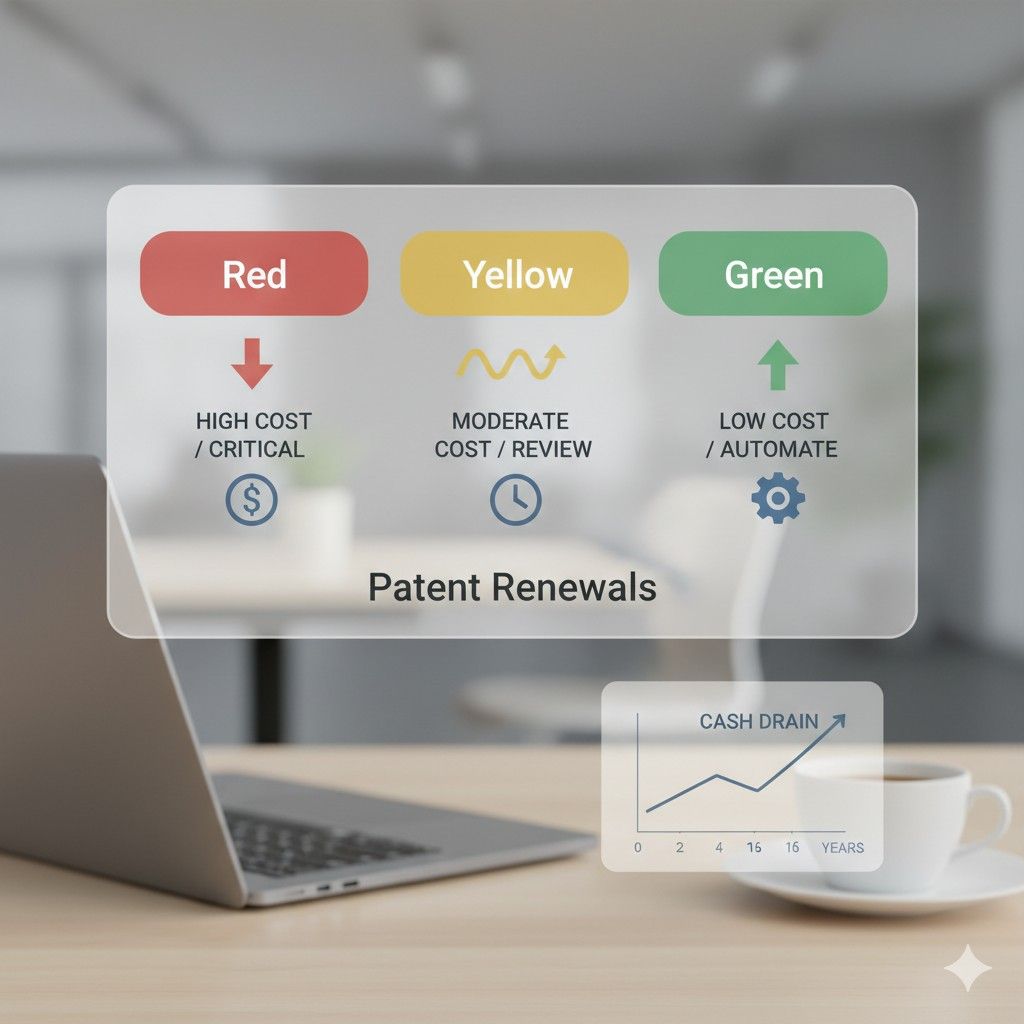
This is where a clear visual system, like a “Red, Yellow, Green” dashboard, becomes powerful. It forces a decision. It removes gray areas. It replaces habit with clarity.
And clarity protects both your innovation and your runway.
How “Red, Yellow, Green” Dashboards Turn Confusion Into Clarity
When renewal season hits, most teams open a spreadsheet and feel overwhelmed. Dates, countries, numbers, long patent titles. It feels technical. It feels legal. It feels slow.
But renewal decisions are not legal decisions first. They are business decisions.
A “Red, Yellow, Green” dashboard changes the frame. Instead of staring at rows of data, you see simple signals. Stop. Review. Keep going. That shift alone saves time, money, and stress.
Let’s break down how this works in practice.
From Spreadsheets to Signals
Spreadsheets show information. Dashboards show meaning.
A renewal spreadsheet might tell you a patent expires in eight months and costs a certain amount to renew. That is useful, but it does not answer the key question: should we keep it?
A color dashboard forces a decision. Each patent is assigned a status based on its current business value.
Green means this patent clearly protects core technology or supports revenue. Red means it no longer aligns with strategy and likely should not be renewed. Yellow means it needs discussion.
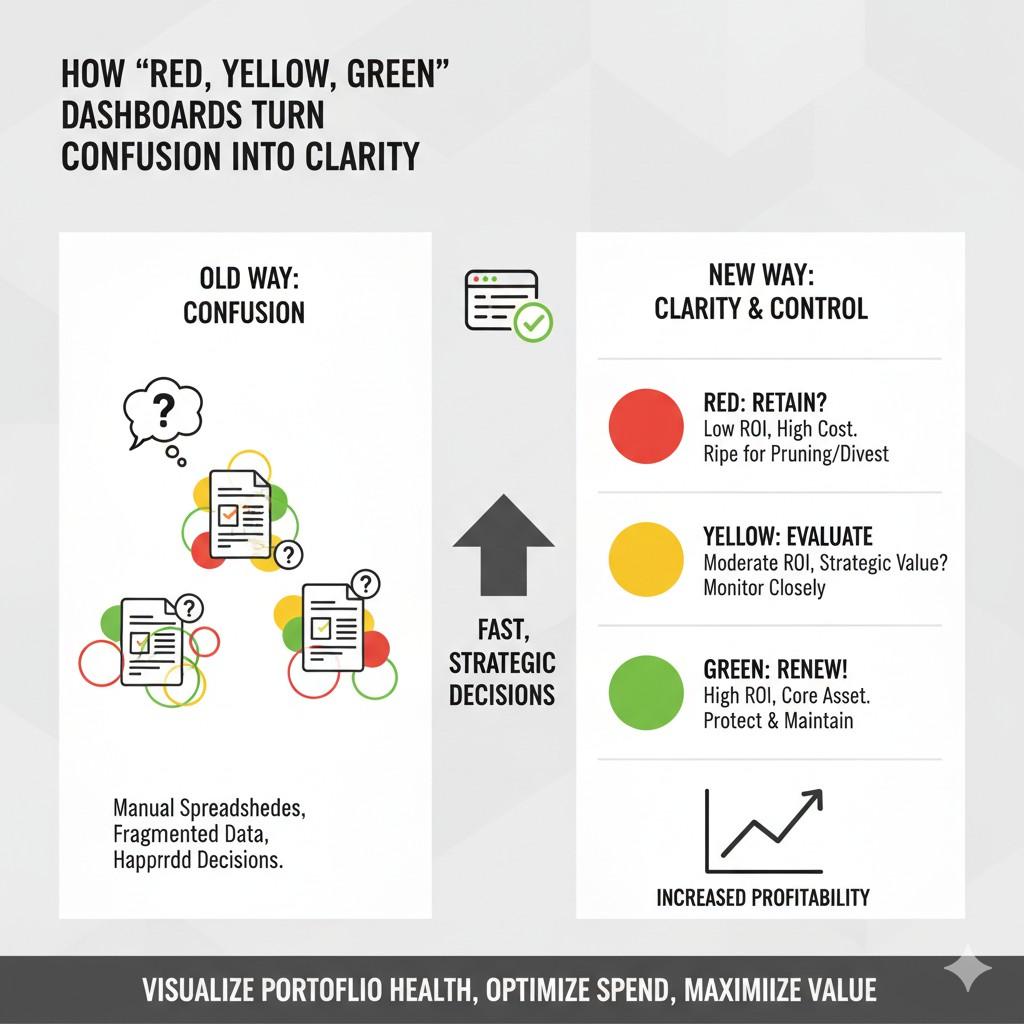
This simple visual shift turns renewal review from a passive activity into an active choice.
Instead of asking, “What is due this quarter?” you ask, “Which assets are still driving value?”
Clarity Reduces Emotional Bias
When a founder sees a long list of patents, it is easy to feel proud. That pride can cloud judgment.
A color-coded dashboard strips away that emotion. You are not looking at impressive titles. You are looking at signals.
If something is red, it demands a reason to stay. If it is green, it should be easy to explain why.
The dashboard does not make the decision for you. It creates a framework where weak assets cannot hide behind complexity.
That clarity is powerful during leadership meetings. Instead of debating abstract legal language, the team can discuss impact. Does this patent help our current product? Does it block a real competitor? Does it matter for fundraising?
The conversation becomes strategic, not technical.
Making “Green” Mean Something Real
A green label should not be given lightly. If everything is green, the dashboard loses its value.
To make green meaningful, tie it to measurable business drivers.
For example, a patent may be green if it covers a feature used by paying customers today. It may be green if it protects a core algorithm that differentiates your product.
It may be green if it directly supports expansion into a market you are actively entering.
The key is proof. If a patent is green, someone on the team should be able to explain in plain language why it matters now.
This creates discipline. Patents earn their status.
Over time, this habit improves how you file new patents as well. Teams start thinking ahead. They file around real strategy, not vague ideas.
Yellow as a Strategic Pause
Yellow is not indecision. It is a signal for review.
Some patents sit in gray areas. Maybe they protect technology you might reuse. Maybe they cover a feature that could return in a future release. Maybe they are relevant in a market you have not fully explored.
Yellow means: pause and evaluate before spending more.
The key to using yellow well is setting a review timeline. Do not let yellow assets drift for years. Tie them to a specific checkpoint. For example, review again before the next renewal window or after a product milestone.
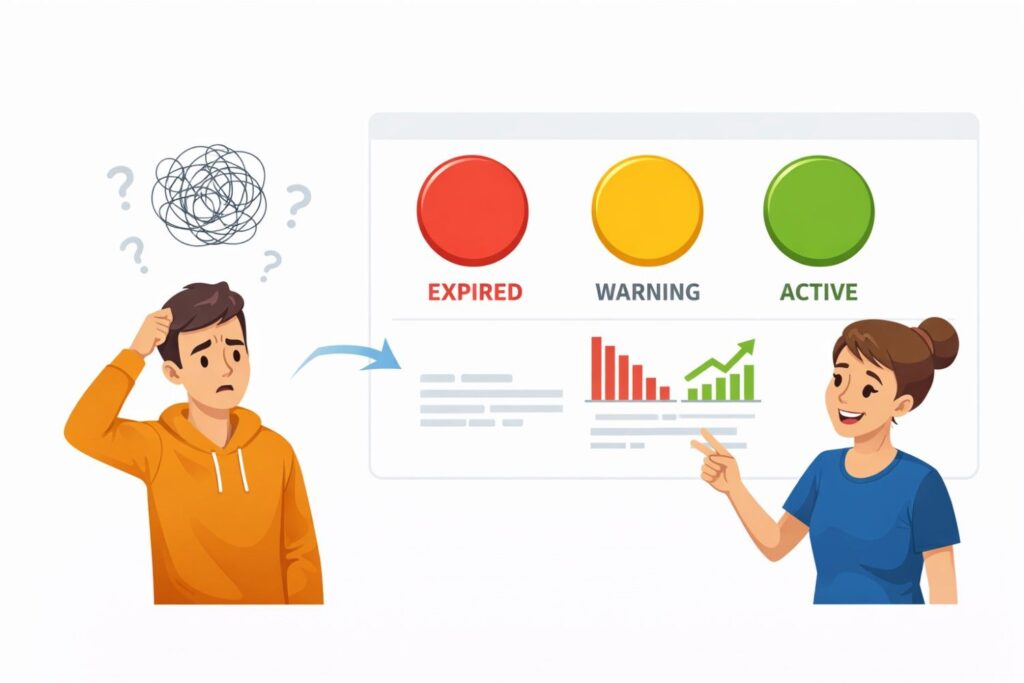
This prevents yellow from becoming automatic green.
Yellow is where the most strategic conversations happen. It forces alignment between engineering vision and business reality.
Red as a Sign of Discipline, Not Failure
Marking a patent red can feel uncomfortable. But red is not a mistake. It is a sign that your company has evolved.
Startups pivot. Products improve. Markets shift. A patent that made sense three years ago may not serve you today.
Red simply means you are choosing focus.
When teams begin marking some patents red each year, something interesting happens. They become more thoughtful about new filings. They stop filing broadly “just in case” and start filing with purpose.
Red builds discipline into the system.
And that discipline protects runway.
Building the Dashboard Without Complexity
You do not need complex software to start. A simple internal system can work at first.
List each patent. Include basic data like title, jurisdiction, next renewal date, and projected cost over the next few years. Then add one column: status.
Assign red, yellow, or green based on a structured discussion with product and leadership.
The power is not in the tool. It is in the shared understanding.
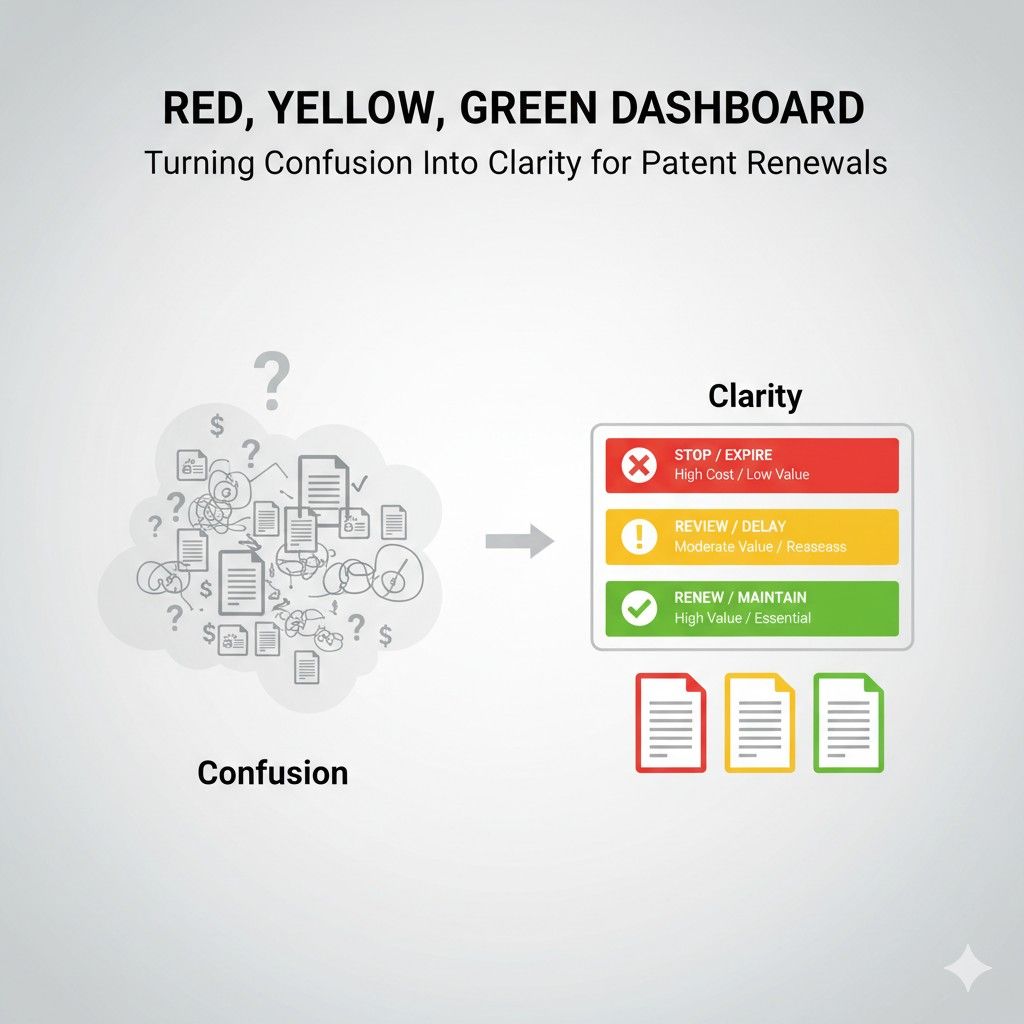
Over time, you can layer in more insight. You can track which patents support which product lines. You can connect them to revenue streams. You can link them to competitive threats.
But even a basic color system creates momentum.
What matters most is that review becomes regular, not reactive.
Timing the Review for Maximum Impact
A dashboard only works if it is used before deadlines create pressure.
The best time to update statuses is during strategic planning cycles. When you are already reviewing roadmap and budget, include IP.
Look ahead at renewals for the next 12 to 24 months. Do not wait until invoices arrive.
When review happens early, red decisions feel calm. You are not racing against the clock. You are making a thoughtful choice.
This also allows you to redirect saved capital intentionally. Instead of renewals consuming funds by default, you can allocate money toward new filings that protect your latest breakthroughs.
Renewal review becomes a lever, not a burden.
Turning the Dashboard Into a Leadership Tool
The real power of a red, yellow, green system is not cost control. It is alignment.
When founders, engineers, and legal advisors all see the same simple dashboard, conversations become clear. Everyone understands which patents are core and which are optional.
This shared visibility reduces confusion. It prevents surprises during fundraising or due diligence. It builds confidence that your portfolio is intentional.
Investors appreciate clarity. When you can explain why each active patent is green, you signal strong management.
That confidence can matter just as much as the patent itself.
Where PowerPatent Fits In
Managing renewals manually can still feel heavy. Tracking deadlines, projecting costs, and aligning with attorneys takes effort.
This is where combining smart software with real attorney oversight changes the game.
With PowerPatent, your portfolio is organized in one place. You can see upcoming renewals clearly.
You can connect patents to products. You can get input from experienced patent attorneys who understand both the legal side and the startup side.
Instead of reacting to emails from different firms across different countries, you have a clear system.
And when you build your own red, yellow, green dashboard on top of that organized foundation, decisions become fast and grounded.
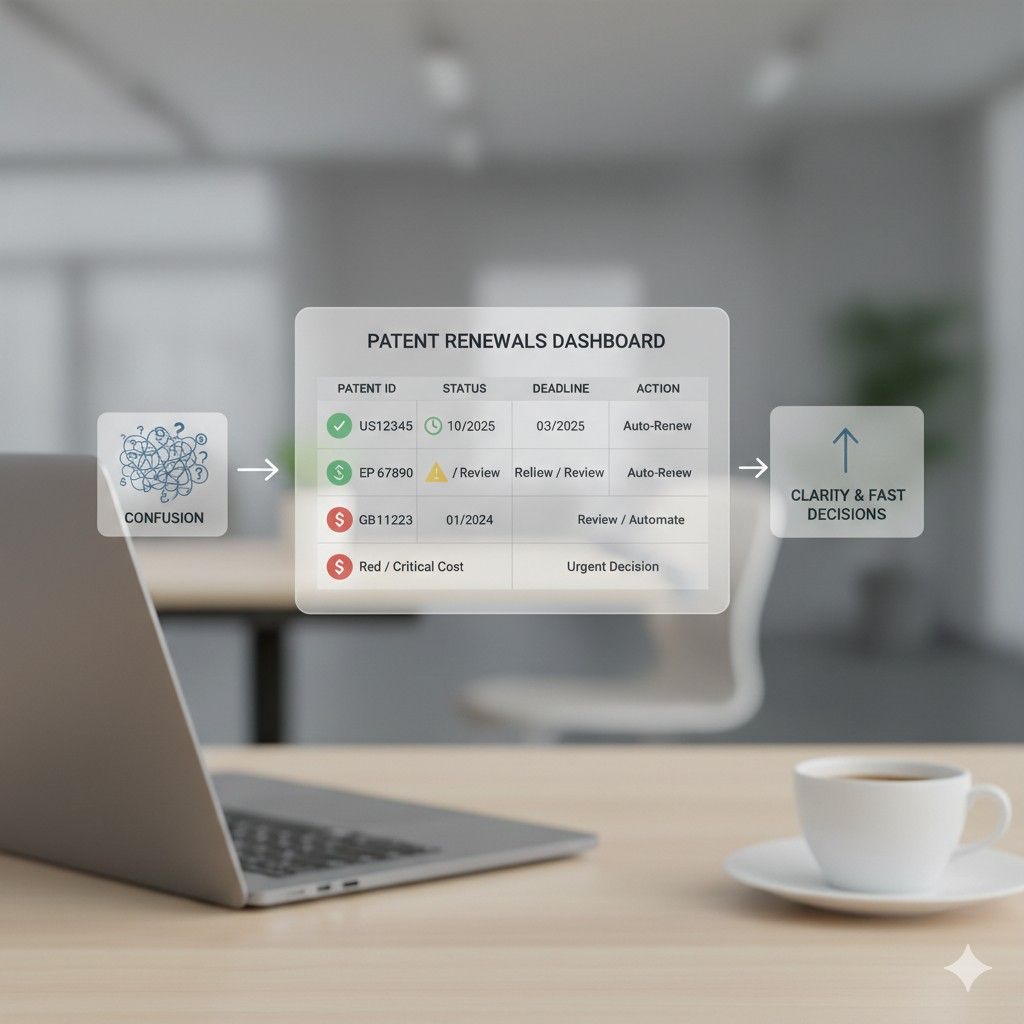
If you want to see how a modern platform can simplify this entire process, take a few minutes to explore how it works at https://powerpatent.com/how-it-works.
Renewals should never feel like a guessing game.
They should feel like a choice you control.
Building a Renewal System That Protects What Matters Most
A dashboard is powerful. But a dashboard alone is not a system.
If you want fast, confident renewal decisions year after year, you need a simple structure behind the colors. You need a rhythm. You need ownership. You need clean data. And you need the right support so you are not guessing.
The goal is not to manage renewals. The goal is to protect the parts of your business that truly matter, while freeing cash from the parts that no longer do.
Let’s build that system step by step.
Start With a Clear Map of Your Portfolio
Before you can make strong renewal decisions, you need visibility. Many startups do not actually have a clean, simple view of all their patents across all countries.
There may be filings handled by different law firms. Some may sit in old email threads. Some may be tracked by finance. Some may live in a shared folder that no one has opened in months.
This fragmentation creates risk. It also slows decision-making.
The first move is to consolidate everything into one clear view. Every active patent. Every pending application. Every country. Every upcoming renewal date. Every projected cost.
When everything is visible in one place, you reduce surprises. You also remove fear. Decisions are easier when you are not worried about hidden deadlines.
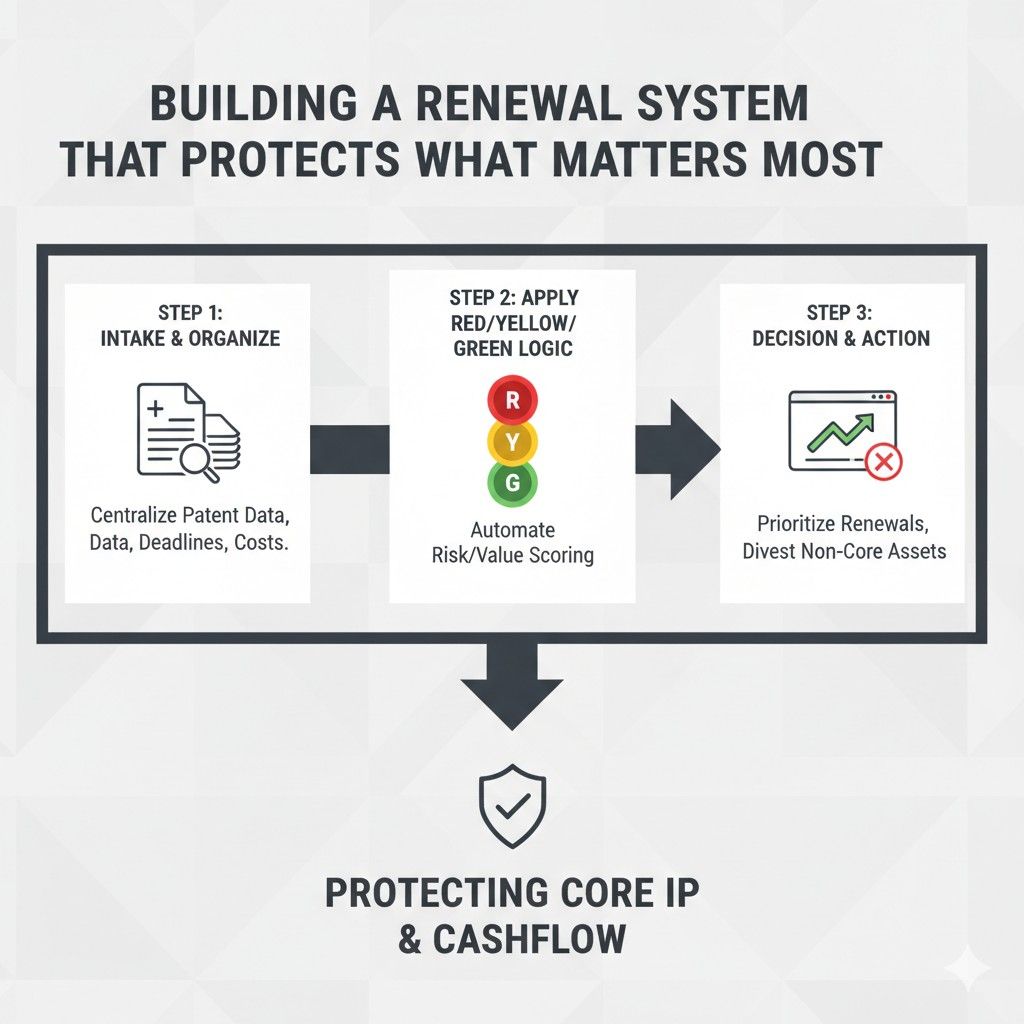
This is one of the reasons modern tools matter. When your entire portfolio lives inside one structured platform, you stop chasing information and start making decisions.
PowerPatent was built for exactly this. It brings your filings, timelines, and attorney guidance into one clean system so founders are not left guessing. You can see how that works here: https://powerpatent.com/how-it-works.
Clarity is the foundation of discipline.
Tie Every Patent to a Business Purpose
A renewal system breaks when patents exist in isolation.
Every active patent should be connected to something real inside your company. A product feature. A core model. A hardware component. A licensing plan. A defensive wall against a known competitor.
If a patent cannot be tied to a current or near-term business goal, that is a signal.
This does not mean every patent must generate revenue today. Some protect future expansion. Some block risk. But each one should have a clear reason for being alive.
During renewal review, ask the product team to explain in simple language what the patent covers and how it connects to the roadmap. If the explanation feels vague or outdated, that is important information.
When patents are mapped to business goals, renewals become obvious. The ones that matter stand out. The ones that do not quietly fall away.
Forecast Costs Before They Hit
Many startups treat renewal fees as random expenses. They are not random. They are predictable.
A strong renewal system projects costs years ahead. Not just the next payment, but the next five or even ten years.
When you look at the full future cost of maintaining a patent, your thinking changes. A few thousand dollars this year may turn into a large total over time.
This long view helps you decide whether the protection is worth the lifetime investment.
Forecasting also protects your runway. You can build renewal costs into financial planning instead of reacting to invoices.
Inside a structured platform like PowerPatent, you can see upcoming deadlines and understand the timing clearly. That visibility makes forecasting far easier than digging through scattered emails.
When finance and product leaders see renewal costs early, better decisions follow.
Create a Review Rhythm, Not a Reaction
A renewal system works best when it runs on a schedule.
Instead of reviewing patents only when deadlines approach, set fixed review windows. For example, once a year, conduct a full portfolio review. Then, each quarter, look at renewals coming up in the next twelve months.
This creates a calm decision cycle.
You are not scrambling. You are not rushing. You are evaluating with space to think.
In each review, update the red, yellow, green status. Discuss changes in product direction. Note any patents that may need deeper legal input.

Over time, this rhythm becomes normal. IP becomes part of strategic planning, not an afterthought.
This shift alone can save significant capital while strengthening protection.
Involve the Right People, but Keep It Focused
Too many voices can slow decisions. Too few can create blind spots.
A strong renewal system usually includes one accountable leader, often a founder or senior product executive, along with input from engineering and patent counsel.
Engineering understands what is truly core. Leadership understands where the company is going. Patent attorneys understand the scope and strength of protection.
When these perspectives meet in a structured review, decisions are grounded.
With PowerPatent, you are not left alone to interpret legal language. Real patent attorneys review your portfolio alongside smart software tools.
That mix ensures you are not dropping something critical by mistake and not keeping something weak out of fear.
This balance of software speed and human oversight is what modern startups need.
You can see how this combination works in practice here: https://powerpatent.com/how-it-works.
Replace Fear With Data
Many founders renew patents because they fear losing protection.
Fear is natural. But fear-based decisions are expensive.
A strong system replaces fear with evidence. When you know exactly what a patent covers, how broad it is, and how it connects to your product, you can decide calmly.
If a patent is narrow and no longer aligned with your tech stack, letting it expire may have little impact. If it covers your core engine, renewing is an easy choice.
The key is understanding, not guessing.
Modern platforms help translate complex patent documents into structured insights. Instead of reading dense legal text, you can see summaries and relationships clearly.
When you understand what you own, fear drops.
And when fear drops, strategy improves.
Use Saved Capital to Strengthen Your Moat
Here is something powerful: dropping low-value patents does not weaken your IP position if you reinvest wisely.
The capital saved from unnecessary renewals can fund new filings around your latest innovations.
It can strengthen protection in markets where you are actively growing. It can support continuation filings that broaden your strongest claims.
In other words, you trade stale protection for fresh leverage.
This shift turns renewals from a defensive cost into an offensive strategy.
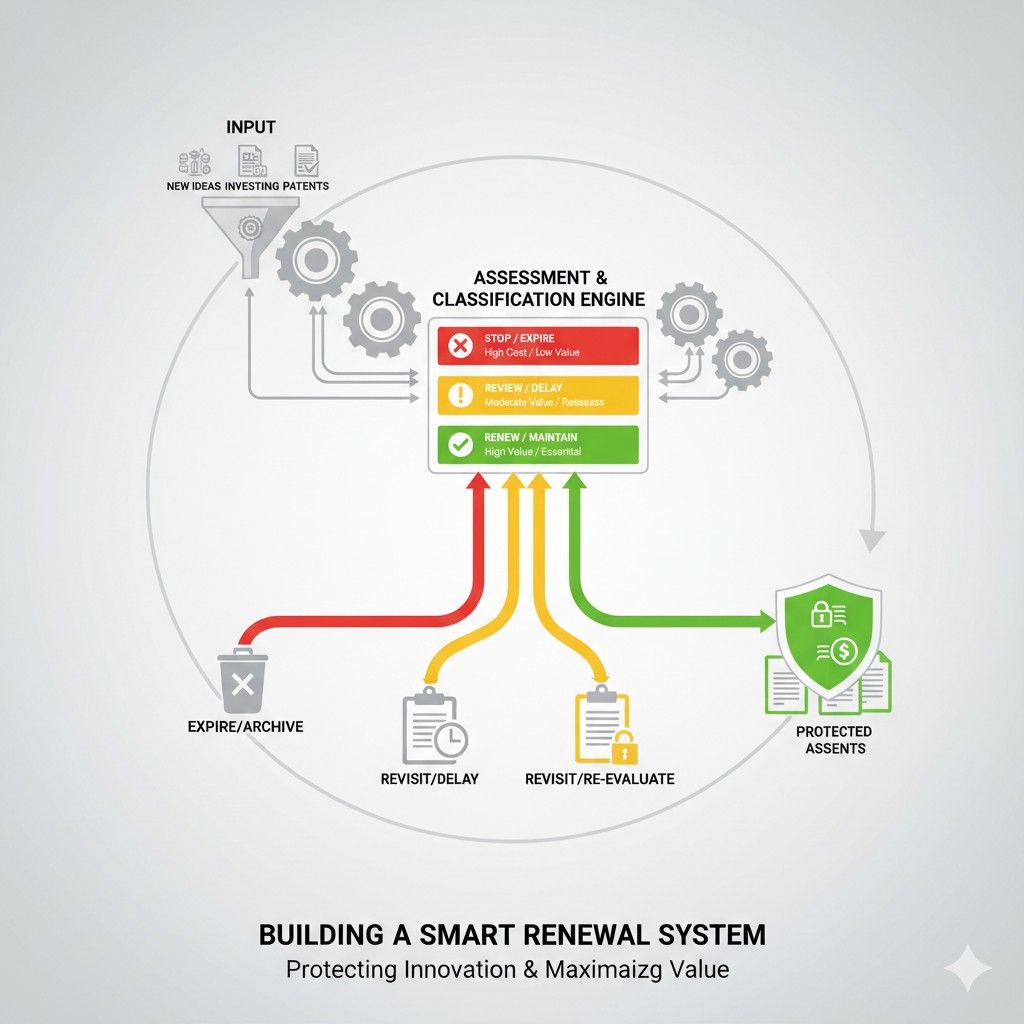
Instead of paying to preserve the past, you invest in protecting the future.
That is how high-performing startups treat IP.
Prepare for Fundraising and Exit Early
A clean, disciplined renewal system also pays off during due diligence.
Investors and acquirers look at your portfolio closely. They examine which patents are active, which markets are covered, and how well protection aligns with revenue.
If your portfolio is bloated with irrelevant patents, it raises questions. If it is lean and clearly mapped to your core technology, it builds confidence.
When you can explain why each active patent is green, your story becomes stronger.
And when you show that you regularly review and prune your portfolio, you signal strong management.
PowerPatent was built to support exactly this level of clarity. By combining structured software with real attorney oversight, it helps you maintain a portfolio that stands up to scrutiny.
If you are building for long-term value, this matters more than you think.
Make Renewal Decisions Fast and Final
The final piece of a strong system is decisiveness.
Once a patent is clearly red after review, close the loop. Do not reopen the debate each year. Document the reasoning. Move on.
This creates momentum and reduces mental clutter.
A focused portfolio is easier to manage. It is easier to explain. It is easier to defend.
And most importantly, it aligns with where your company is actually going.
Renewals should not be a source of stress. They should be simple checkpoints in a disciplined strategy.

When you combine a clear red, yellow, green dashboard with clean data, regular review cycles, and real attorney support, decisions that once took weeks can take minutes.
If you are ready to bring this level of clarity to your patents, explore how PowerPatent helps founders file smarter and manage their portfolios with confidence at https://powerpatent.com/how-it-works.
Wrapping It Up
Patent renewals should never feel like a yearly tax you pay without thinking. They should feel like a clear business choice. When you step back, the real issue is not the fee itself. It is the lack of structure around the decision. Without a system, renewals become automatic. Automatic spending slowly drains runway. Automatic decisions create clutter. Automatic habits weaken focus. A simple red, yellow, green dashboard breaks that pattern.