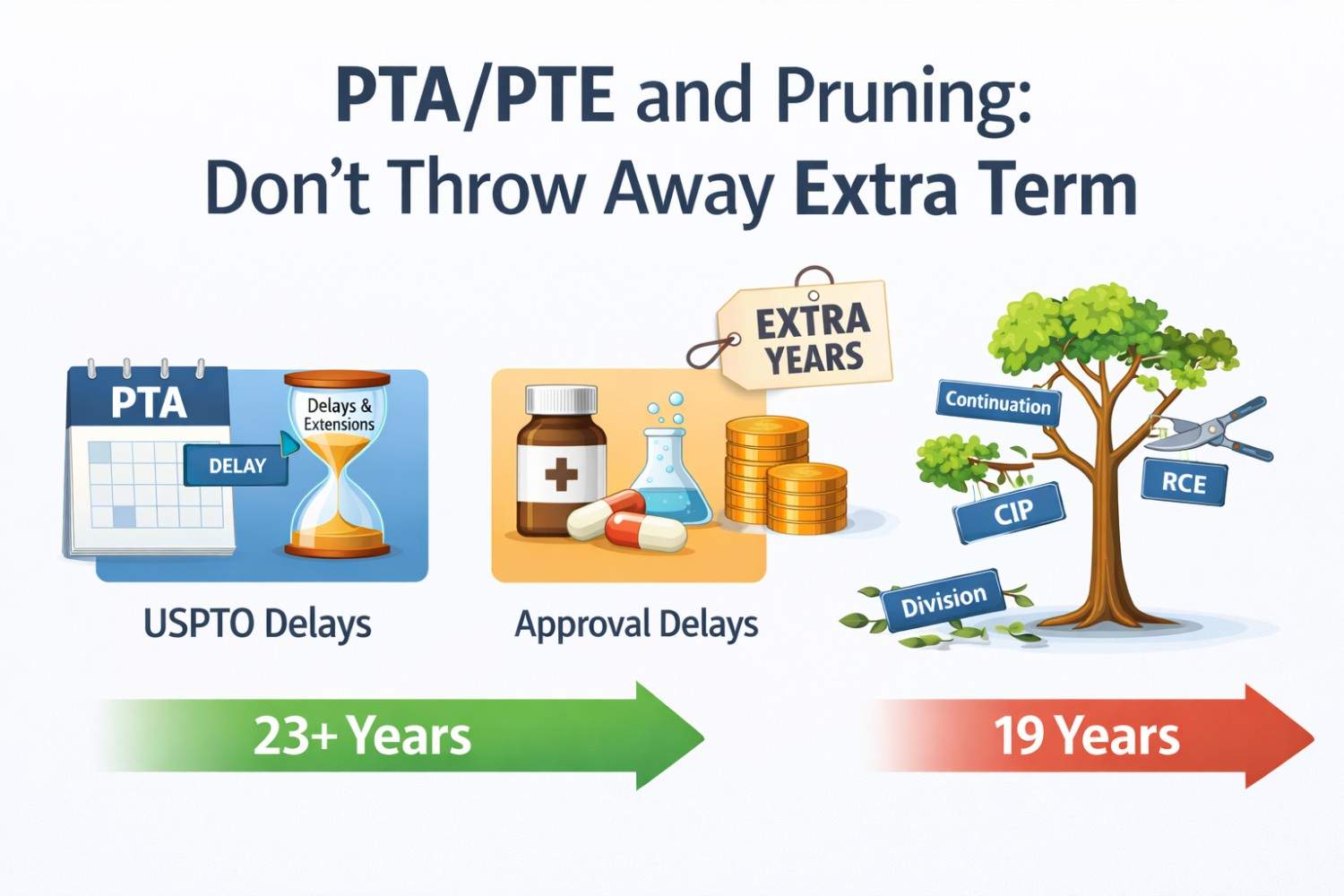
Most founders think a patent lasts 20 years. That’s it. Fixed. Done. But that is not always true. In many cases, you may be entitled to extra time. Real, valuable time. Time that can block competitors, protect your product, and increase your company’s value. And yet, many startups accidentally give that time away. Sometimes without even knowing it. Let’s fix that. Before we go deeper into PTA, PTE, and how “pruning” can quietly cut off your extra term, do you want me to continue?
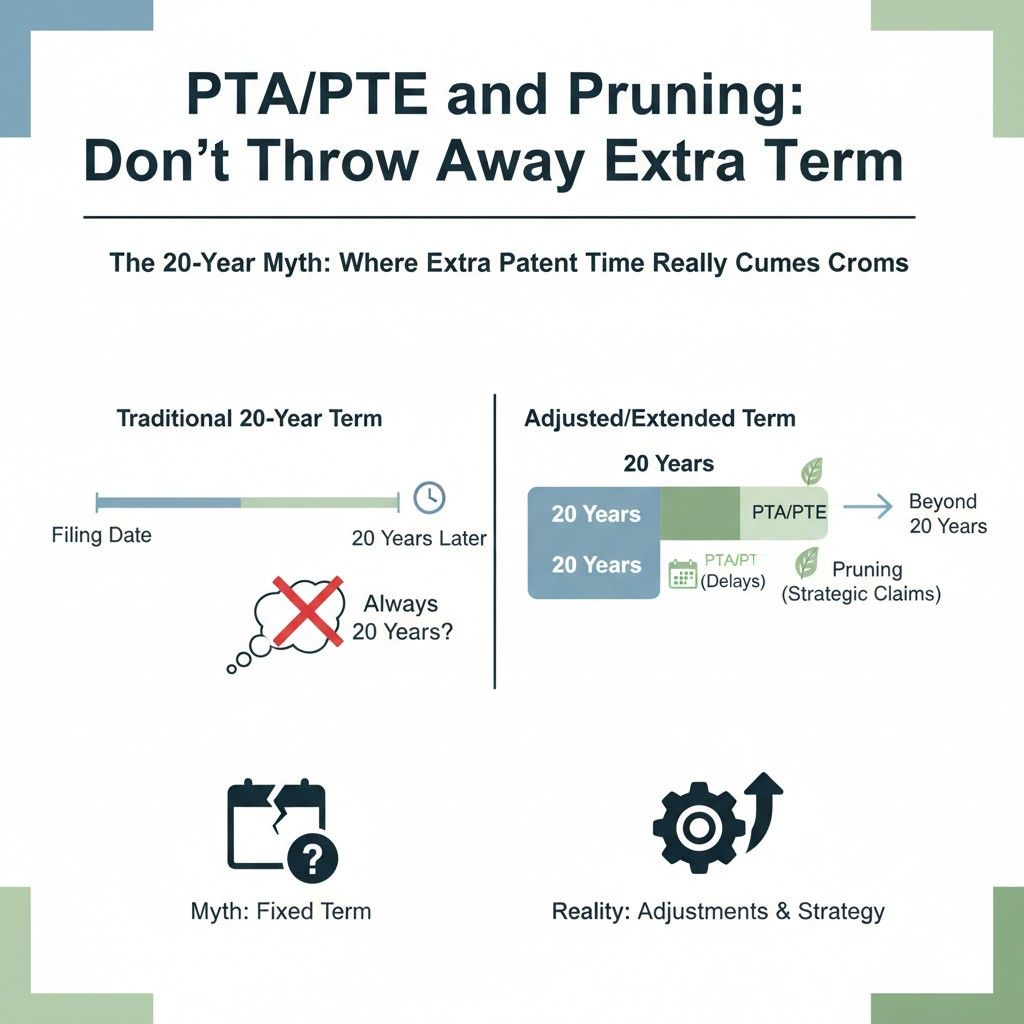
The 20-Year Myth: Where Extra Patent Time Really Comes From
Most founders believe a patent gives you 20 years of protection. Clean. Simple. Automatic. But that belief can quietly cost you millions.
The truth is this: 20 years is only the starting point. The real story depends on what happens during examination, how long the government takes, how your application is handled, and what strategic choices you make along the way.
Extra term is not magic. It is math. And if you do not pay attention, you can lose it.
If you are building deep tech, AI models, hardware systems, biotech platforms, or complex software, time is leverage.
Extra months — or years — of patent term can mean blocking a giant competitor during your most important revenue window. It can increase your valuation before acquisition. It can protect your moat while you scale.
This section will show you where that extra time comes from and how to think about it like a founder, not like a lawyer.
Why 20 Years Is Just the Baseline
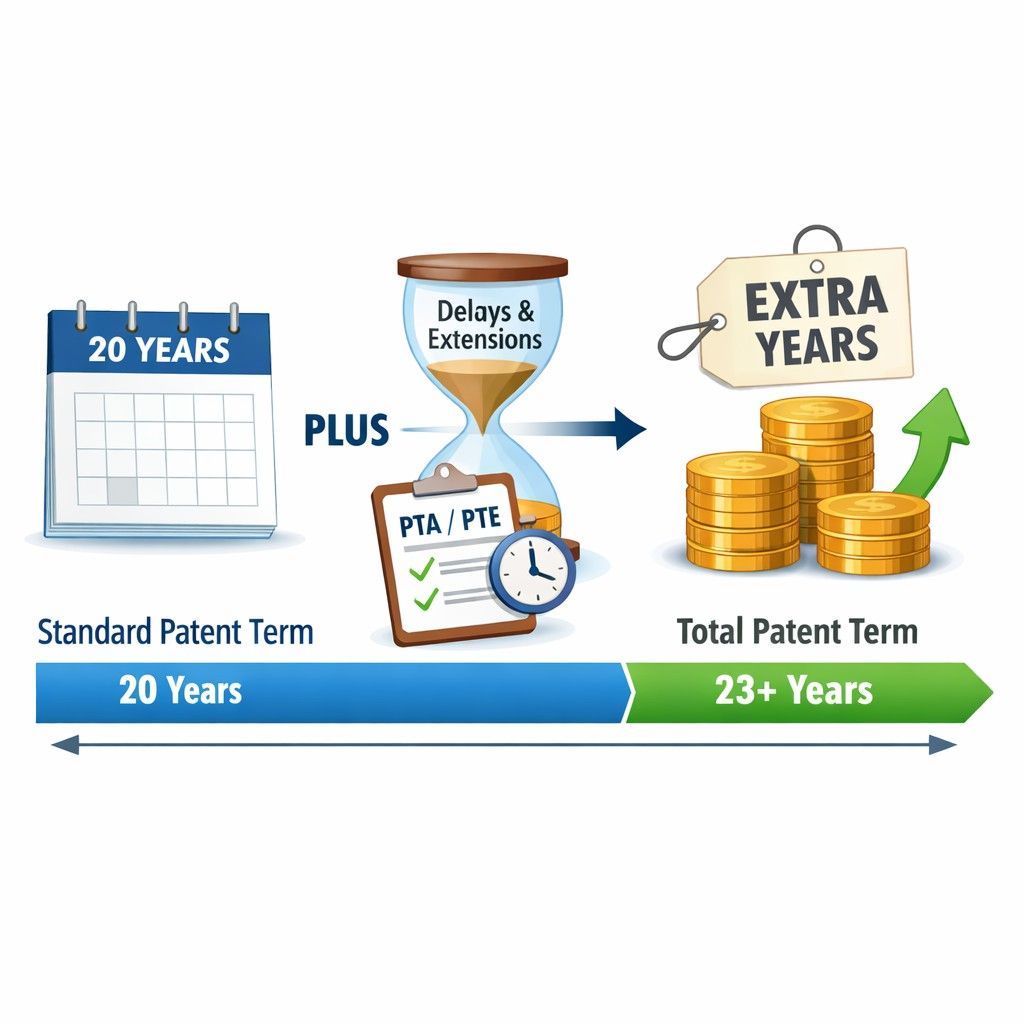
When people say “a patent lasts 20 years,” they are talking about 20 years from the earliest filing date. That is the rule on paper. But patents rarely move in a straight line.
The patent office has deadlines. If they miss those deadlines, you may earn extra days. If they take too long overall, you may earn even more days. Those extra days stack up. This is called Patent Term Adjustment, or PTA.
On top of that, in certain industries like pharma or biotech, if you lose years waiting for product approval, you may qualify for Patent Term Extension, or PTE. That can add even more time beyond the base 20 years.
So the real term of your patent is not just about when you filed. It is about what happened during the process.
As a founder, this should change how you view prosecution. It is not just about “getting it allowed.” It is about protecting your timeline.
Government Delay Can Become Your Extra Time
PTA exists because the government agreed that if they delay your application unfairly, you should not pay the price.
There are different types of delay. If the patent office takes too long to issue the first review. If they take too long after you respond. If they let the application sit for years without a final decision. All of that can add time to your patent term.
But here is what most startups do not realize.
You can also lose PTA if you cause delay.
If you take too long to respond. If you file certain amendments late. If you change strategy without understanding the timing impact. Small moves can subtract days.
The math is mechanical. It does not care about your funding round or product launch. It only counts days.
This means that prosecution strategy is not just about legal arguments. It is about time control.
If your attorney is not tracking PTA during prosecution, you are flying blind.
At PowerPatent, we believe founders should see this clearly. When you understand how the timeline works, you make smarter decisions about when to push, when to amend, and when to appeal.
Not All Delays Are Bad
This may sound strange, but sometimes a slower process can work in your favor.
If the patent office drags its feet, you might earn more PTA. In some cases, patents issue with years of added time.
That extra term can land at the back end of your protection window — often when your product is mature and revenue is strong.
Imagine this scenario.
You file early while building your tech. It takes several years to get allowed. During that time, the market grows.
You refine your product. Competitors show up. When your patent finally issues, you not only have a granted asset, but you may also have additional term that stretches further into the future than you expected.
That is not luck. That is understanding the system.
But this only works if you protect that extra time.
How Founders Accidentally Lose Earned Term
Extra term is earned. But it is fragile.
If you file a continuation and reset your filing date carelessly, you may shift your expiration. If you abandon a case too early, you may kill term that could have matured later.
If you combine claims from different timelines without thinking through priority dates, you may shorten your protection window.
This is where the 20-year myth becomes dangerous. Founders think, “It all ends at 20 years anyway.” So they make pruning decisions inside their patent family without understanding the time impact.
Patent families are like trees. Each branch has its own filing date, its own path, and its own potential term. When you prune a branch, you may be cutting off more than just claims. You may be cutting off time.
Before you drop a continuation or narrow claims to speed allowance, you should ask one question.
What happens to the back-end term?
If your team cannot answer that clearly, you are guessing.
The Hidden Value of Late-Stage Protection
Early-stage founders focus on getting the patent granted fast. That makes sense. Investors like issued patents.
But late-stage protection can be even more powerful.
If your product hits strong adoption in year eight or ten, competitors will study your patents closely. If you still have many years left — especially extra years — your leverage increases.
Acquirers look at remaining term. It affects deal value. A patent with 17 years left is very different from one with 8 years left.
So instead of thinking only about “how fast can we get this issued,” you should also think about “how long will this protect us when we are big.”
That mindset shift changes everything.
PTA Is Not Automatic Value
Just because PTA is calculated does not mean it is correct.
Errors happen. The patent office calculates adjustment at issuance. If the math is wrong and no one checks it, you lose days forever.
Many startups never review the PTA calculation. They accept whatever number appears on the patent grant.
That is risky.
A simple audit can reveal missed days. In some cases, significant time is recovered through correction.
If your patent covers core technology, even a few extra months can matter. If your company exits, that time could influence negotiations.
Founders should ask their team: have we reviewed PTA calculations on our issued patents?
If the answer is no, that is an easy fix.
Filing Strategy Shapes Your True Expiration
Your earliest filing date usually controls expiration. But you choose that date.
If you rush to file before your invention is ready and then rely heavily on that early priority date, your clock starts earlier. That may make sense for competitive reasons, but you should understand the trade-off.
Sometimes it is smart to file a strong provisional, then follow up with improvements that have their own timelines. Sometimes you want staggered protection that extends your coverage.
The key is intentional design.
Your patent portfolio should mirror your product roadmap. Core architecture. Version upgrades. New use cases. Hardware improvements. Each can have its own timing strategy.
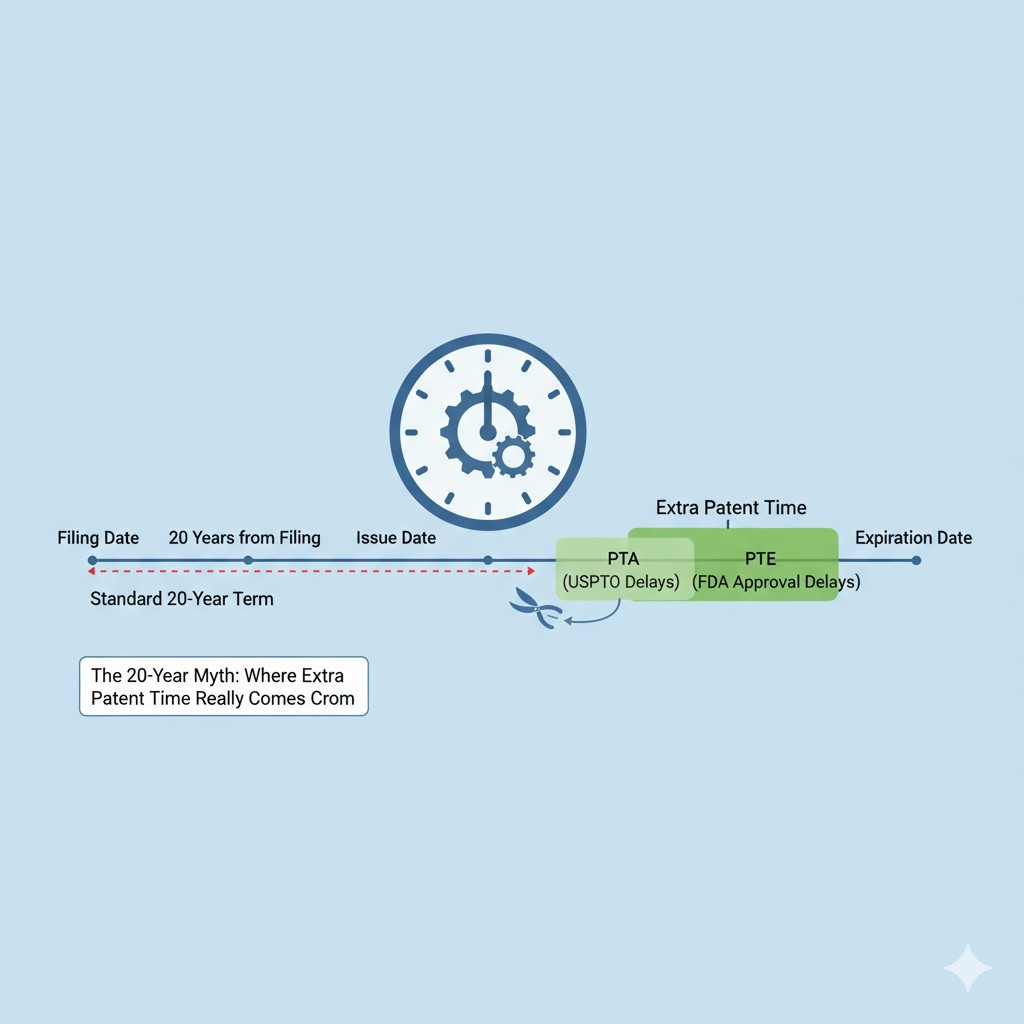
When done right, you are not just filing patents. You are designing layers of term that protect different waves of your technology.
That is strategic IP.
The Approval Delay Window in Regulated Industries
If you operate in biotech, medical devices, or other regulated fields, PTE becomes critical.
Product approval can take years. During that time, you cannot sell. Without extension, you might lose much of your effective patent life before revenue even starts.
PTE exists to fix that problem.
But it is not automatic and it is not unlimited. There are caps. There are deadlines. There are strict rules.
If your team misses the filing window for extension, you lose the chance forever.
This is why coordination between regulatory and patent strategy matters.
Your IP counsel should know your approval timeline. Your regulatory team should know your patent expiration projections. These two tracks cannot operate in isolation.
When aligned, you preserve the commercial window that matters most.
Extra Term as a Valuation Lever
Investors do not just care that you have patents. They care how strong they are and how long they last.
Imagine presenting your portfolio in a Series B round.
Instead of saying, “We have two patents,” you say, “We have two issued patents with confirmed term extending beyond 2042, including government delay adjustments.”
That is different. That shows control.
Buyers and investors look at risk. Long remaining term reduces risk. It increases exclusivity. It increases the runway for return.
So when you think about PTA and PTE, do not think like a lawyer calculating days. Think like a founder protecting enterprise value.
Build With the End in Mind
Your patent clock starts earlier than you think. It often starts when you are still experimenting.
That is why early decisions matter so much.
Before filing, think about how this invention fits into your five-year and ten-year roadmap. Consider whether this is a foundational platform or a short-lived feature. Decide how much term will matter when your company is mature.
If this is core technology that defines your moat, protecting every possible day of term should be a priority.
That does not mean slowing down. It means being intentional.
At PowerPatent, we combine smart software with real patent attorneys who understand both timelines and startup speed. We help founders see the full picture, not just the filing step.
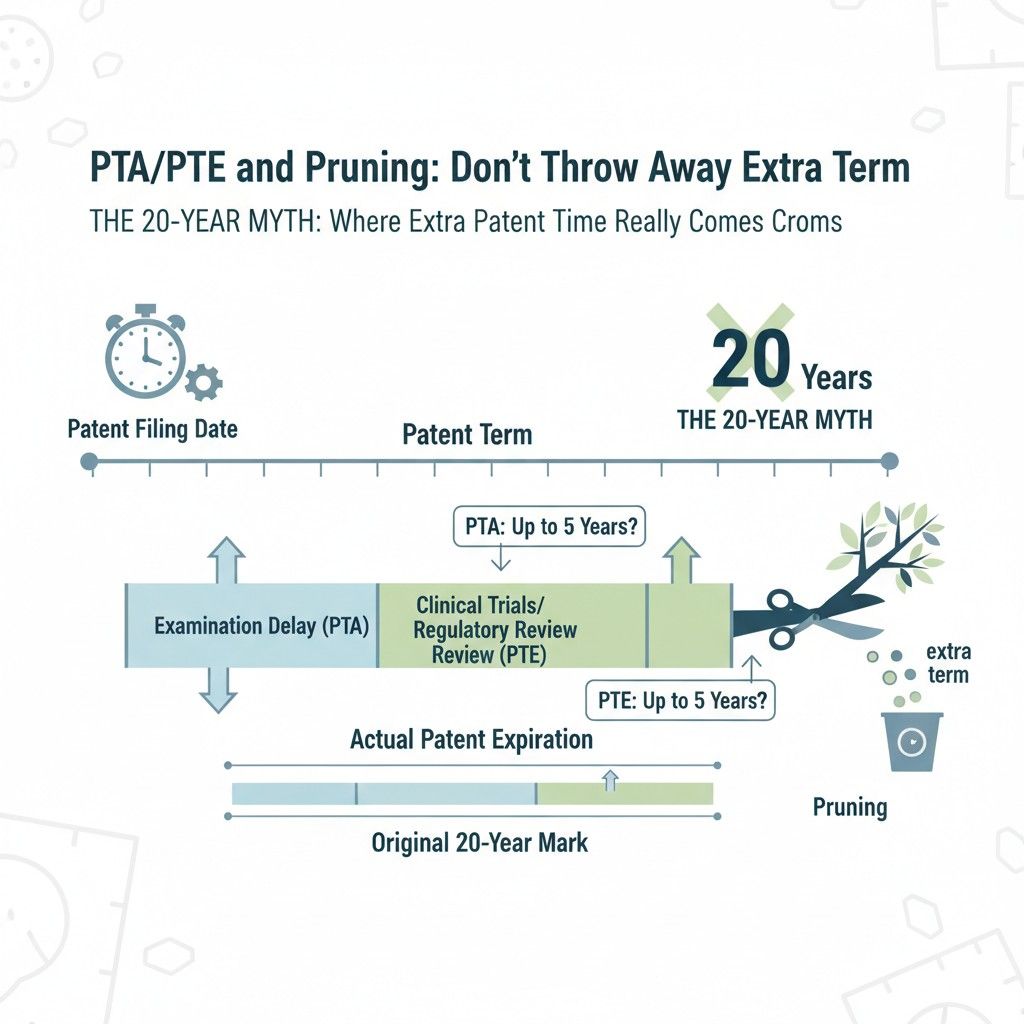
Because throwing away extra term is silent. You will not feel it today. You will feel it years from now when a competitor launches and you realize your protection ends sooner than it should.
That is avoidable.
And it starts with understanding that 20 years is only the beginning.
PTA vs. PTE: What They Are and Why They Matter to Your Startup
Most founders hear these terms once and tune out. PTA. PTE. They sound technical. Easy to ignore.
That is a mistake.
These two concepts can change how long your patent protects you. Not by a few days. Sometimes by years. And those years can land exactly when your company is scaling, raising a major round, or preparing for exit.
You do not need to memorize rules. But you do need to understand the difference, how they work, and how to protect them.
Let’s break this down clearly and connect it to real startup decisions.
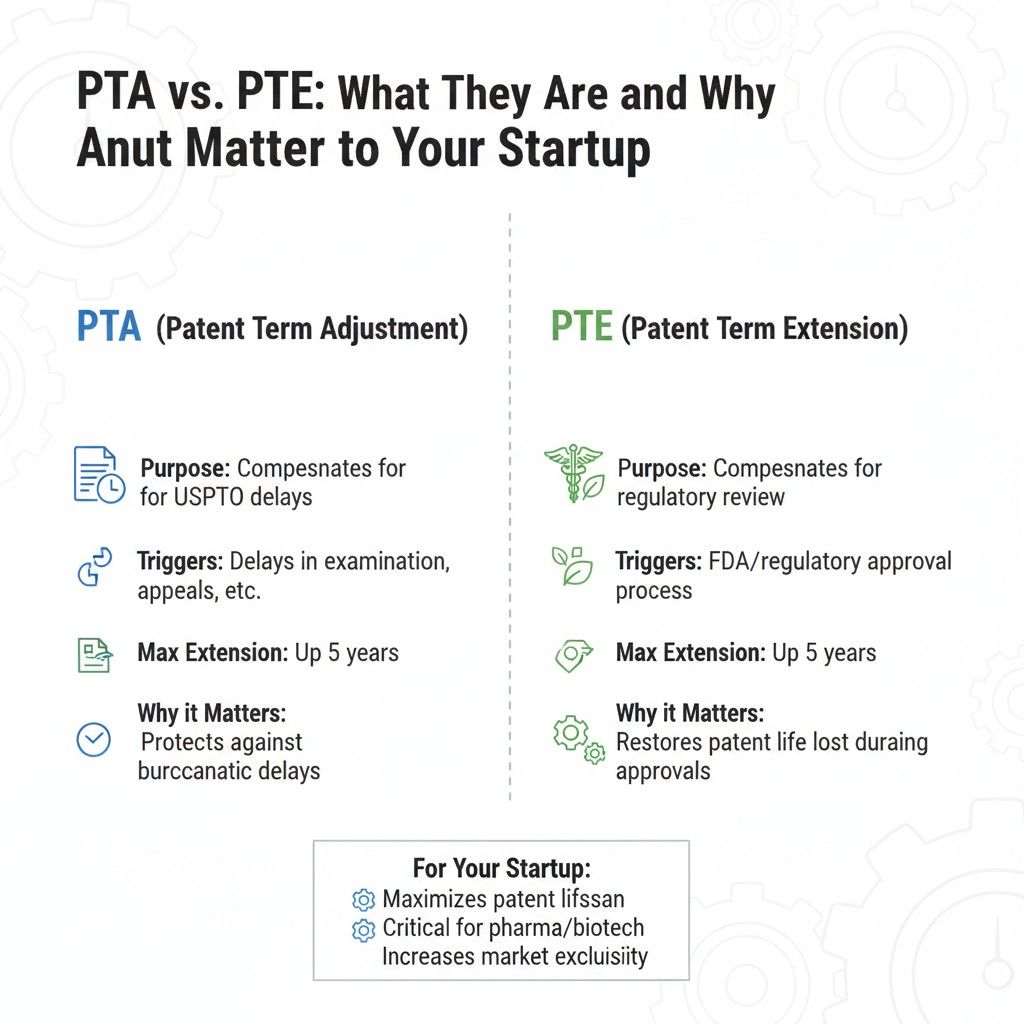
PTA Is About Patent Office Delay
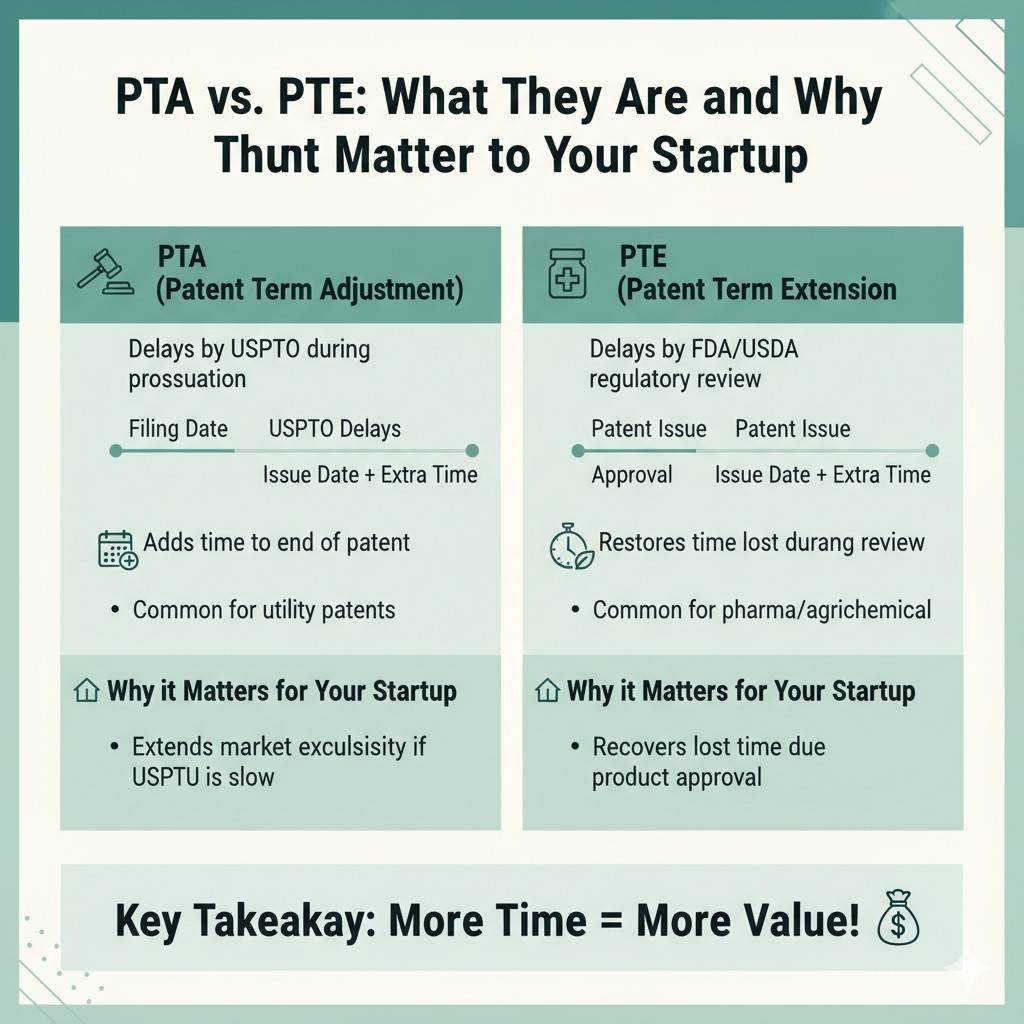
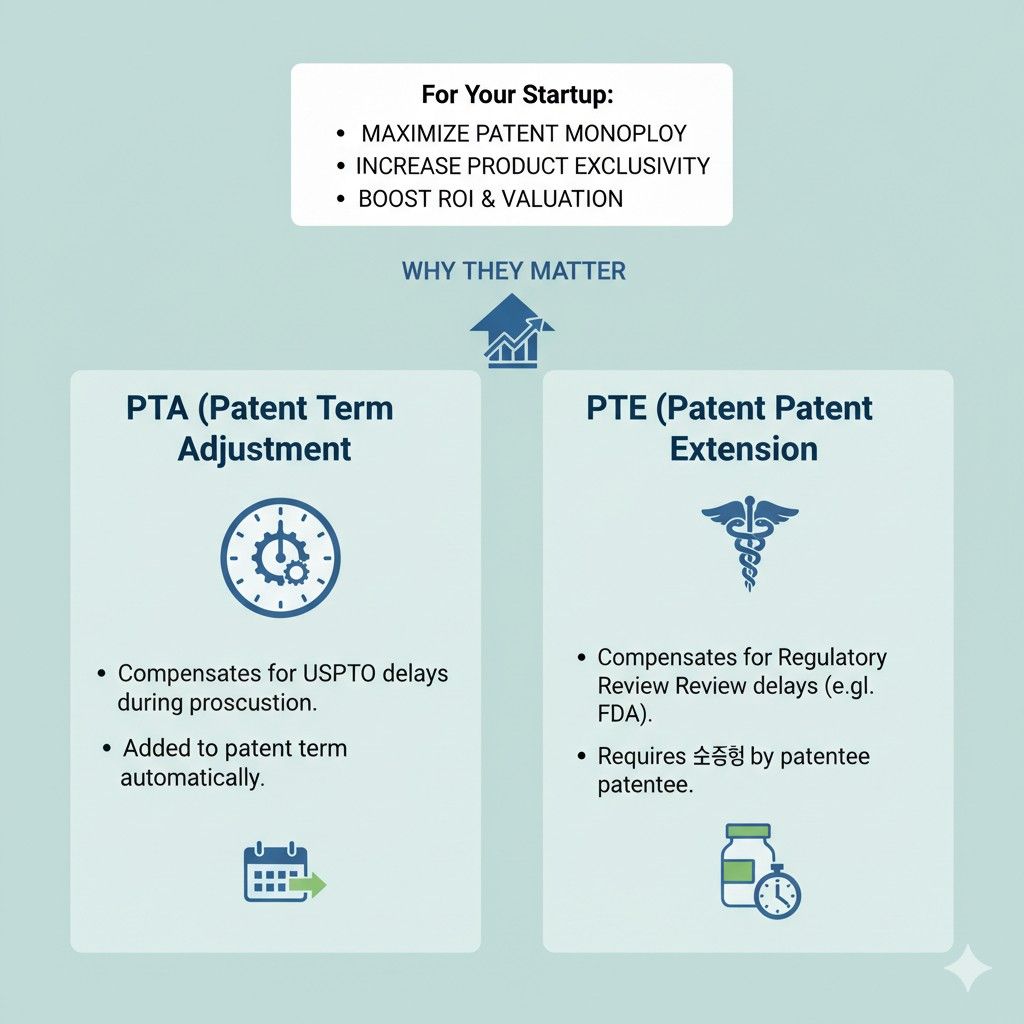
PTA stands for Patent Term Adjustment. It exists because the government promised to examine patent applications within certain time limits. When they fail to meet those limits, they owe you time back.
That extra time is added to the end of your patent term.
It is not a gift. It is compensation.
But here is what makes PTA powerful for startups. It applies to almost all technologies. Software. AI. Hardware. Robotics. Climate tech. Deep learning systems. Infrastructure tools. If the patent office is slow, you can gain term.
In busy technology areas, delays are common. Some applications take many years to reach allowance. During that time, PTA can accumulate.
If your application sits waiting for a first review longer than allowed, days start adding up. If the office takes too long after you respond, more days add up. If they exceed certain overall limits, even more time can be added.
This means that even in fast-moving industries, extra term is very real.
PTA Can Grow Quietly in the Background
The most interesting part about PTA is that it builds while you are focused on building your company.
You are shipping product. Hiring engineers. Closing customers. Meanwhile, your application is moving through examination. The clock is running. If the government moves slowly, your patent term grows on the back end.
But here is the catch.
You can shrink it.
If you miss response deadlines. If you file amendments late. If you request extensions of time. If you create avoidable delays. Those days subtract from your adjustment.
This is why prosecution discipline matters.
Speed is not only about getting allowance quickly. It is also about protecting the extra time you may already be earning.
Founders should ask one simple question during prosecution: are we preserving our adjustment days?
If that question is never asked, you are not managing the asset fully.
PTE Is Different and Much Narrower
PTE stands for Patent Term Extension. It applies mainly to products that require government approval before sale, such as drugs and certain medical devices.
If you spend years in clinical trials or regulatory review, you are burning patent life without revenue. PTE allows you to recover some of that lost commercial window.
This is not about patent office delay. It is about product approval delay.
That distinction matters.
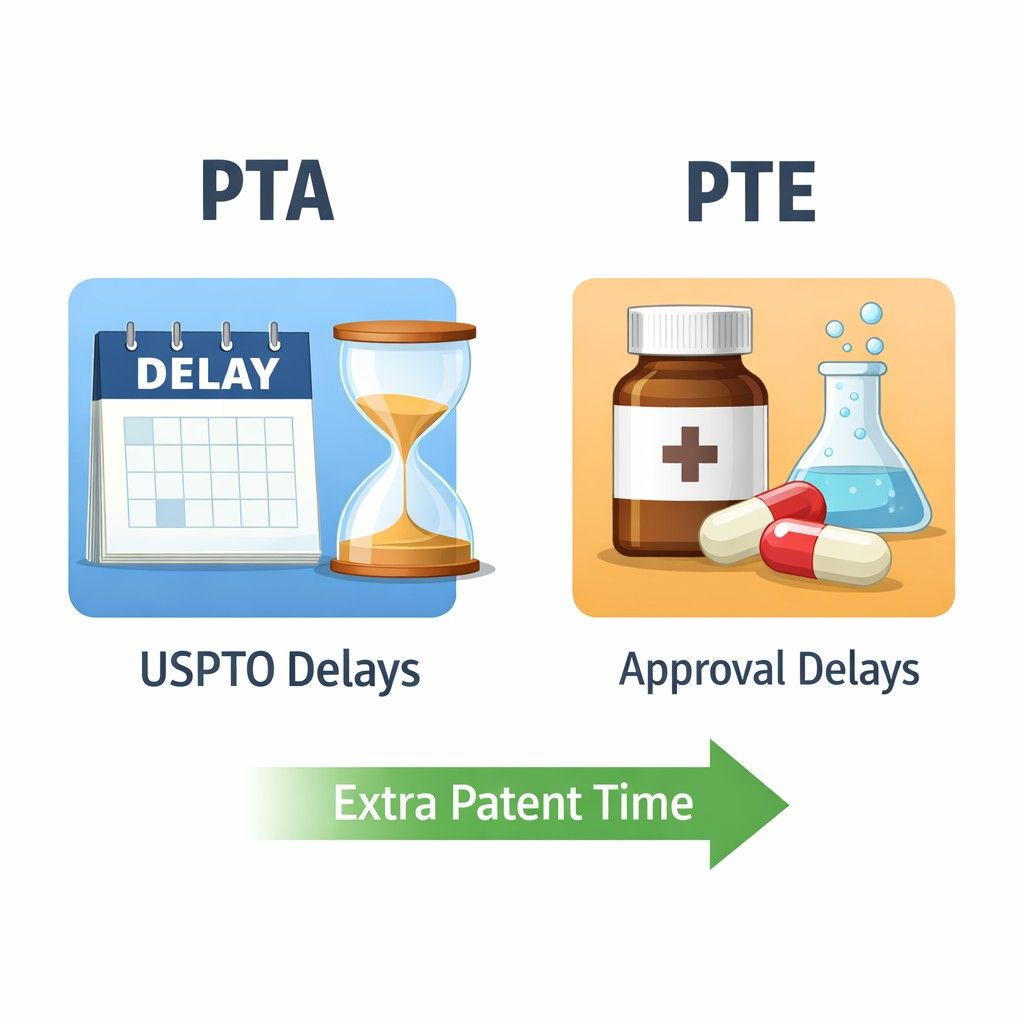
PTA is tied to examination timing. PTE is tied to regulatory timing.
They are calculated differently. They have different limits. And they require careful coordination.
For biotech and life sciences startups, this can be the difference between a viable product and a shortened revenue window.
Why Software Founders Should Still Care
You might think PTE does not apply to you if you are building AI or SaaS. That is often true. But PTA absolutely does.
And here is the deeper point.
Even if you are not in a regulated space, understanding PTE teaches you something important about patent strategy. Timing controls value.
The more years of exclusivity you have during your product’s peak revenue period, the stronger your leverage.
For a software founder, that means thinking carefully about filing timing, continuation strategy, and how your claims align with product evolution.
For a biotech founder, it means aligning regulatory milestones with patent deadlines.
Different industries. Same principle. Protect the commercial window.
PTA and PTE Do Not Work the Same Way
One common mistake is assuming all extra term is treated equally. It is not.
PTA is added automatically at issuance, but it can be challenged or corrected. It can be reduced for applicant delay. It attaches to that specific patent.
PTE requires a formal request. There are strict filing windows after product approval. There are limits on how much can be added. There are caps on total term.
If your team confuses these or treats them casually, you risk losing valuable time.
A startup operating in a regulated space should map out approval timelines early and compare them against projected patent expiration. Waiting until approval is near can create pressure and mistakes.
A startup in software should track examination progress and adjustment calculations, especially for core patents.
Different mechanics. Same strategic importance.
Extra Term Is Strongest at the End
Here is something founders often miss.
The extra term you gain through PTA or PTE is added to the back end of your patent life. That means it protects you later, not earlier.
Later is often when your company is strongest.
Early on, your patent is pending. Competitors may not pay attention. But when you scale, when revenue grows, when your product becomes standard, that is when patents matter most.
Having protection that extends deeper into that mature phase increases your defensive power.
It also improves negotiation strength. Whether you are licensing, partnering, or preparing for acquisition, longer remaining term is attractive.
This is why losing adjustment days is not a small issue. It directly affects future leverage.
The Interaction With Continuations
Many startups file continuation applications to pursue broader or different claim sets. This is smart. It allows you to adapt claims as your product and market evolve.
But continuation strategy interacts with patent term.
Each continuation has its own examination path. Each can earn its own PTA. But they usually share the same earliest priority date, which anchors the base expiration.
This means that if you prune the wrong branch, abandon a case too soon, or fail to monitor adjustment in each application, you may shorten protection unintentionally.
Continuation strategy should not only ask, “Do these claims help us?” It should also ask, “How does this affect our timeline?”
At PowerPatent, we encourage founders to view their patent family as a timeline map. Not just a stack of documents, but a coordinated system where term, claims, and product roadmap align.
Auditing Your Portfolio for Hidden Value
If your startup already has filed or issued patents, you may have untapped term value sitting quietly.
Have you reviewed the PTA on each issued patent? Has anyone double-checked the calculation? Are you tracking how much term remains on each core asset? Do you know whether any regulatory extension might apply?
These questions are rarely asked in early-stage companies. But they should be.
An audit does not need to be complex. It starts with visibility. Understand filing dates. Understand issue dates. Understand any adjustments granted. Compare expiration timelines against your product roadmap.
If your core patent expires earlier than your expected market peak, you may need additional filings to layer protection.
If you have strong PTA extending beyond what you assumed, that is a strategic advantage worth highlighting to investors.
IP is not just a legal box to check. It is a time-based asset.
Protecting Term Requires Intentional Execution
The main takeaway is simple.
Extra patent term is real. It can be significant. But it is not automatic value unless you protect it intentionally.
That means responding on time. Avoiding unnecessary extensions. Monitoring adjustment calculations. Coordinating regulatory and patent timelines. Designing continuation strategy with term in mind.
It also means working with a team that understands startup speed and long-term protection at the same time.
At PowerPatent, we combine smart software tools with real patent attorneys who focus on strategy, not just paperwork. We help founders see the timeline impact of each decision, so you do not wake up years later realizing you lost protection you could have kept.
Because extra term is not a bonus. It is part of your moat.
And throwing it away is optional.
Pruning Your Patent Family: The Silent Way Founders Lose Valuable Term
Most founders have heard the advice: trim what you do not need. Focus. Cut costs. Be lean.
That mindset works well for product development.
It can quietly destroy patent value.
In the patent world, pruning means narrowing claims, abandoning applications, or deciding not to continue certain filings in a patent family. Sometimes pruning is smart. Sometimes it is necessary.
But if you do it without understanding term impact, you can cut away years of protection without realizing it.
This is where PTA, PTE, and filing strategy collide.
Let’s walk through how this happens and how to avoid it.
A Patent Family Is a Living Timeline
Your patent filings are not single events. They are branches of a larger tree.
You might start with a provisional. Then a non-provisional. Then one or more continuations. Maybe even a continuation-in-part. Each branch has its own prosecution path. Each can issue at a different time. Each can earn a different amount of adjustment.
But many of them share the same earliest filing date.
That shared priority date controls the baseline expiration. The adjustments earned during examination push the end date forward.
If you look at your family as a group of static documents, you miss the real picture.
You should see a timeline stretching into the future, with different patents landing at different issue dates and carrying different adjustment amounts.
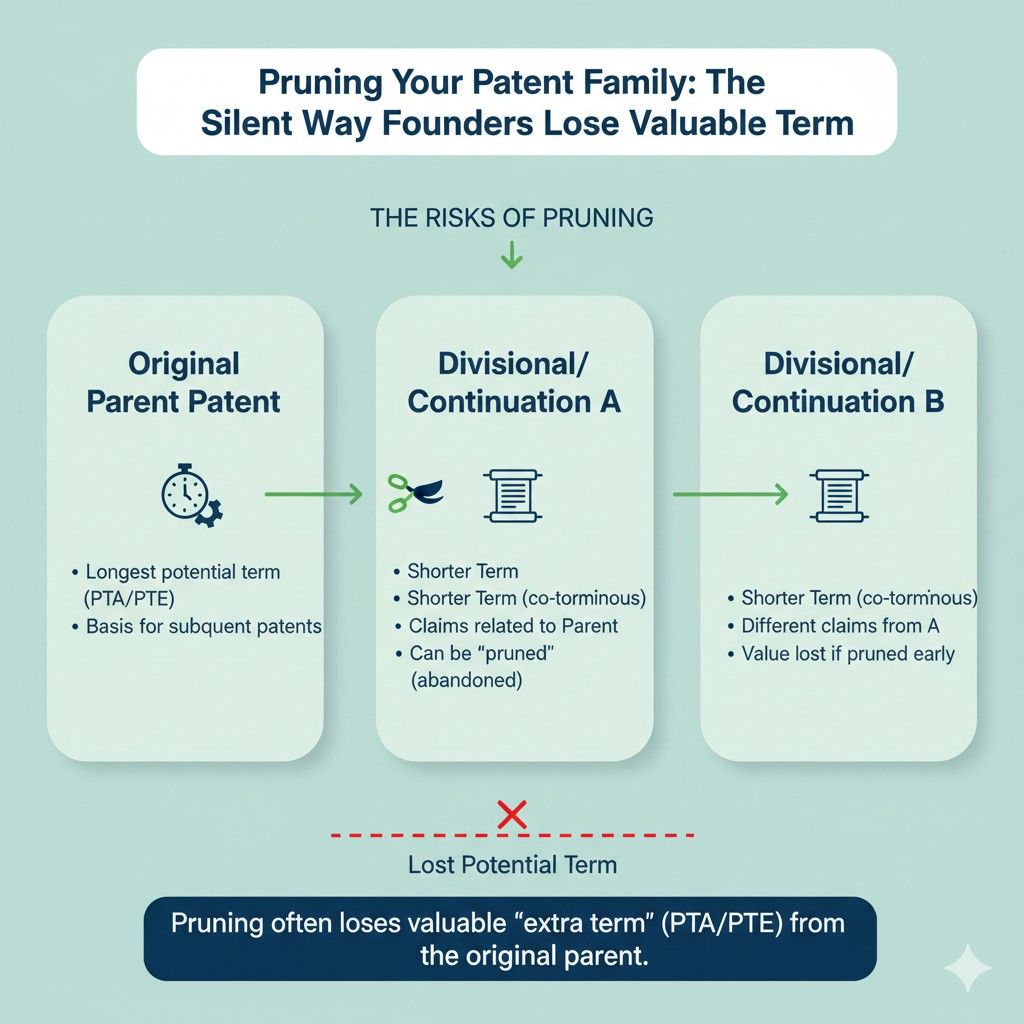
When you prune a branch, you are not just removing claims. You may be removing a later-issued patent that would have carried meaningful extra term.
That matters more than most founders think.
The Pressure to Cut Costs
Startups operate under budget pressure. Patent prosecution costs money. Continuations cost money. Maintenance fees add up.
So at some point, the question comes up.
Do we really need this continuation?
That is a fair question. But it should not be answered based only on short-term cost.
If a continuation is still pending, it might be accumulating PTA while you wait for examination. If it issues later, it may extend protection further into your growth stage.
Abandoning it early might save legal fees today but reduce leverage years from now.
The decision should weigh the future commercial window, not just current burn rate.
Before pruning, ask: if this issues in three years with additional adjustment, how valuable would that back-end protection be when we are scaling?
That shift in framing often changes the answer.
Narrowing Claims Can Shorten Your Leverage
Sometimes founders push to narrow claims just to get an allowance quickly. The logic feels sound. An issued patent looks better than a pending one.
But rushing to narrow can limit future flexibility.
If you accept very tight claims to speed up issuance, you may win the patent but lose strategic coverage. You might also reduce the ability to file stronger continuations later.
Worse, if you abandon broader claim paths entirely, you may eliminate opportunities for later-issued patents that would have carried their own PTA.
Fast is good. Smart is better.
Allowance timing should be aligned with product readiness and market maturity. If your product is still evolving, keeping broader paths alive can preserve options.
A pending continuation is not dead weight. It is optionality.
Optionality combined with time is power.
The Hidden Cost of Early Abandonment
Many startups abandon applications when initial examination looks difficult. They see rejections and assume the case is weak.
But rejections are normal. They are part of the process.
If you abandon too early, you lose more than that specific claim set. You lose any PTA that would have been earned if the case continued.
You also lose the ability to adapt claims based on how competitors enter the market.
Some of the most valuable patents issue years after filing, shaped by real-world developments.
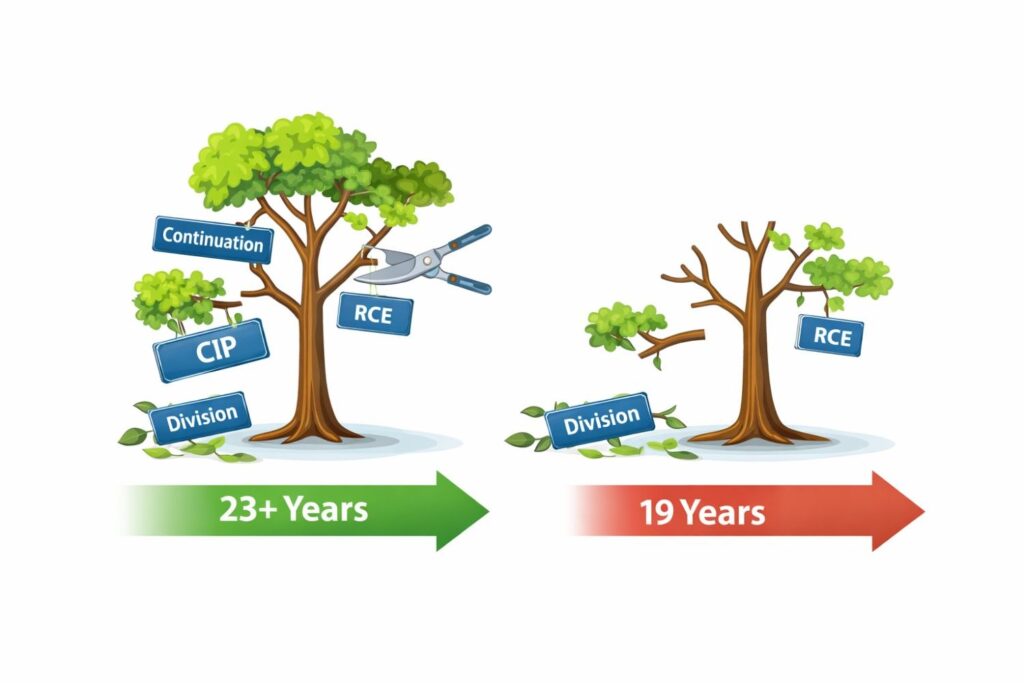
Pruning too early can freeze your strategy in the past.
Instead of asking, “Is this hard right now?” ask, “Could this be powerful later?”
That future view is how strong portfolios are built.
Continuations as Strategic Time Anchors
A continuation allows you to pursue new claims based on the same original disclosure. It keeps the family alive.
Founders often think of continuations only as a way to try again after a rejection. That is too narrow.
A continuation can be filed even after allowance, before the parent issues. It can preserve the ability to pursue broader claims. It can be timed strategically.
If you allow every case to issue without filing follow-on applications, your family closes. Your ability to shape claims based on future competitor behavior disappears.
You also limit your chance to capture additional PTA in later-issued patents.
Think of continuations as anchors in time. They allow your patent family to mature alongside your company.
Pruning all continuations may make your portfolio look tidy, but it can also shorten its lifespan in practical terms.
Product Roadmap Should Guide Pruning
Your patent strategy should mirror your product roadmap.
If your core platform will evolve over several versions, maintaining pending applications aligned with those versions can extend protection into each phase.
If you know a major feature launch is planned two years out, maintaining a continuation that could issue around that time may increase leverage.
Pruning decisions should not happen in isolation from product planning.
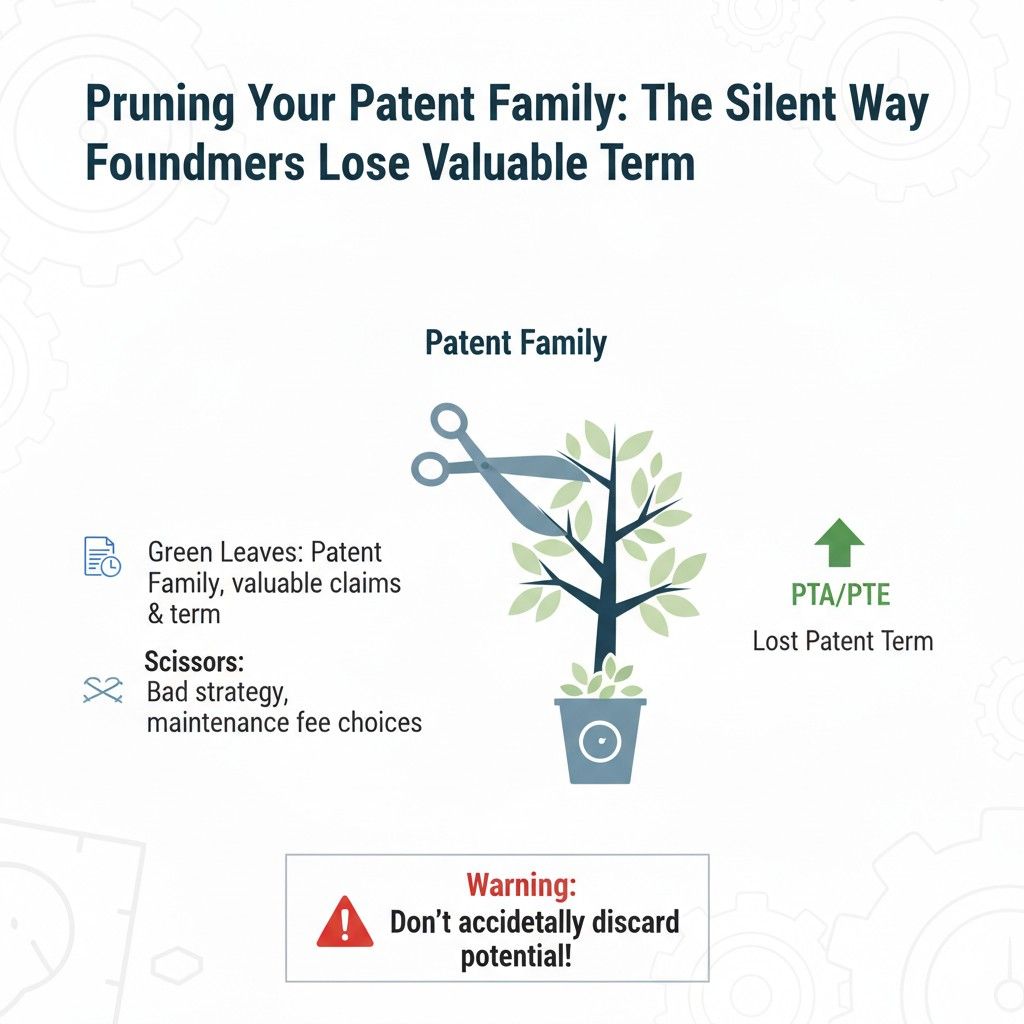
When IP and engineering teams operate separately, pruning often becomes reactive. When they coordinate, pruning becomes strategic.
At PowerPatent, we encourage founders to review their patent family at least once a year in light of product direction. Not just to count filings, but to align term with business milestones.
That conversation alone can prevent accidental term loss.
Investor Optics and Term Awareness
Investors look beyond patent count. Sophisticated investors ask about remaining term.
If you pruned aggressively early on and now have only patents nearing expiration, that weakens your position.
On the other hand, if you can show layered protection with staggered issue dates and meaningful adjustment, it signals foresight.
When you present your IP, you should know not just what you have, but how long it lasts.
If you do not know the expiration timeline of your key patents, that is a warning sign.
Term awareness is part of portfolio maturity.
Pruning Should Be Surgical, Not Emotional
Sometimes pruning is absolutely the right move. Some branches do not align with the business anymore. Some inventions lose relevance. Some prosecution paths are no longer worth pursuing.
The key is to prune with precision.
Look at the projected expiration of each application. Look at potential PTA. Consider how the claims could evolve. Evaluate alignment with future product plans.
Then decide.
Do not prune because a rejection feels frustrating. Do not prune only to reduce short-term spend. Do not prune without understanding the time impact.
Surgical pruning strengthens the tree. Random cutting weakens it.
Term Is a Strategic Asset, Not an Afterthought
Many founders treat patent term as a fixed fact. It is not.
Term is dynamic. It is shaped by filing timing, prosecution strategy, government delay, regulatory delay, and family management.
Pruning decisions directly affect that dynamic.
If your patent portfolio is meant to protect the heart of your technology, then every year of term matters.
At PowerPatent, we build portfolios with the long game in mind. Our software helps founders see the full picture, and our attorneys guide decisions with both speed and future leverage in view.
Because losing extra term rarely feels dramatic in the moment.
It feels invisible.
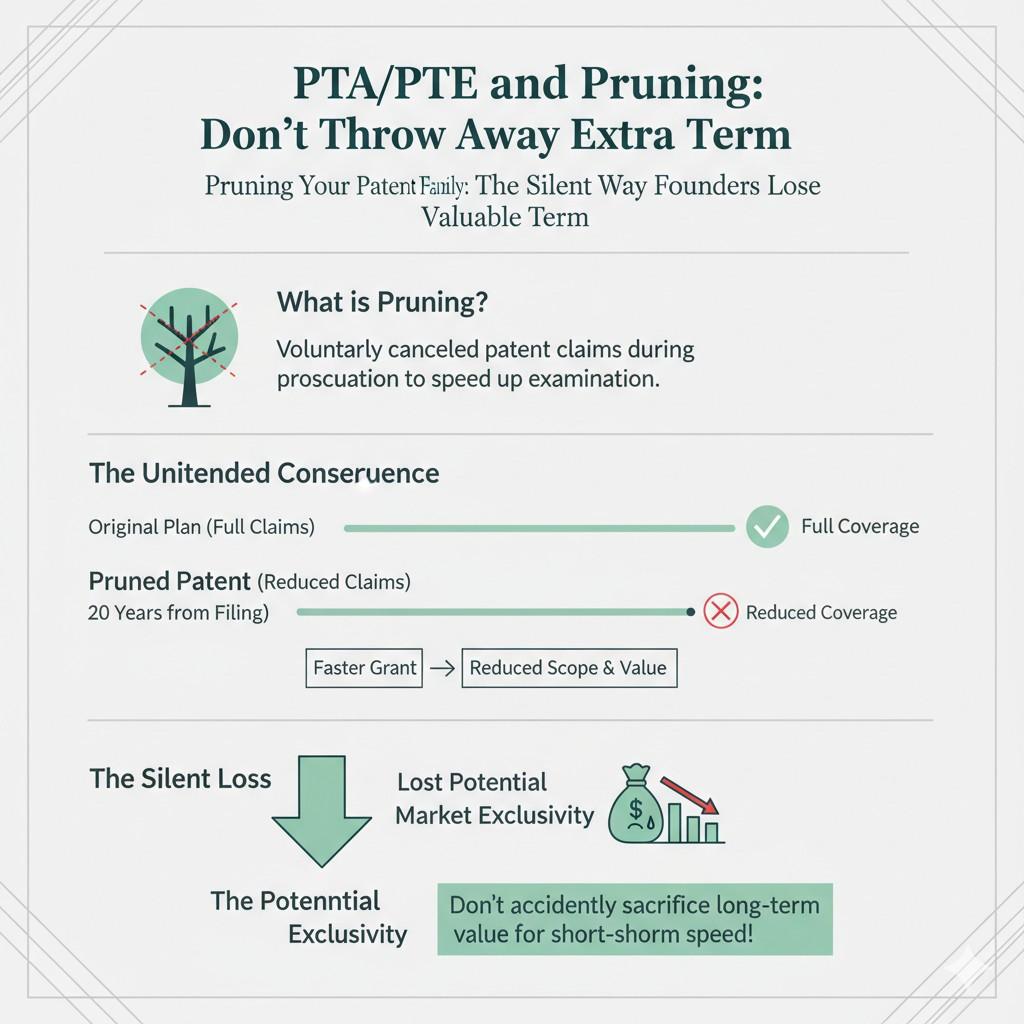
Until one day you realize your protection ends earlier than it should.
And by then, it is too late to get those years back.
Wrapping It Up
Most startups do not lose patent term because of one big mistake. They lose it in small, quiet ways. They assume 20 years is fixed. They rush allowance without thinking about long-term leverage. They abandon continuations to cut short-term cost. They never check adjustment calculations. They let regulatory and patent timelines drift apart. None of these decisions feel dramatic at the time.