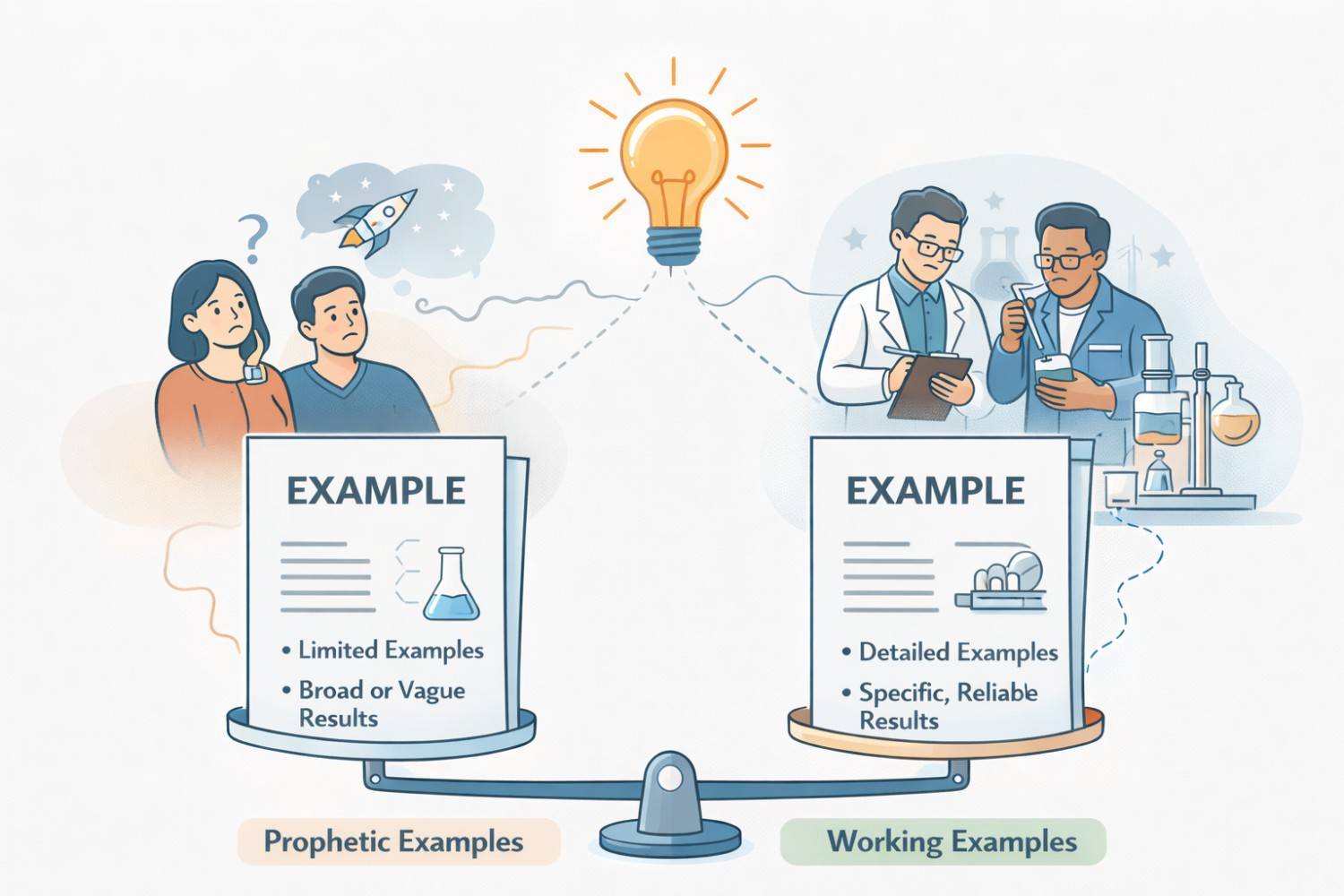
Most patent failures do not come from weak ideas. They come from weak explanations. Founders often describe what might work instead of showing what does work. That gap is the difference between prophetic examples and working examples. Enablement depends on whether your patent teaches something real or just sounds smart. Many patents fail because they promise results without proving the system. Closing this gap early is how you get a patent that truly protects your company.
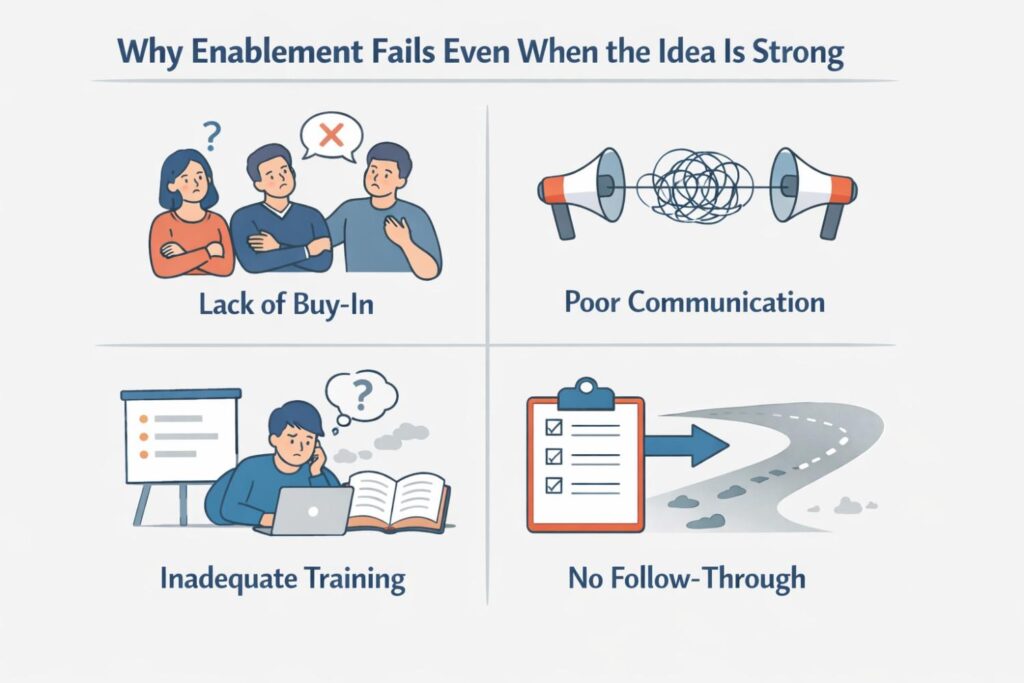
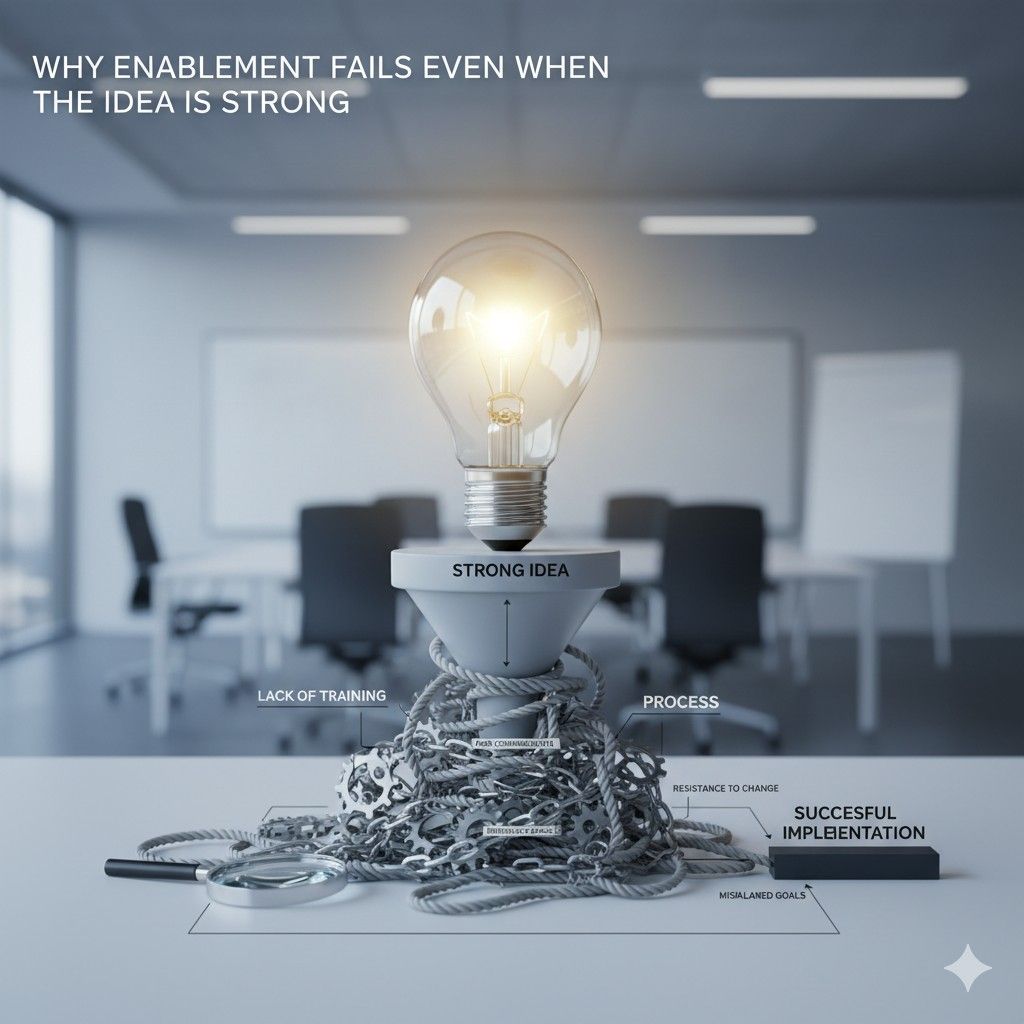
Why Enablement Fails Even When the Idea Is Strong
Strong ideas fail enablement tests far more often than weak ones. This surprises many founders. They assume that technical depth alone will carry the patent.
In reality, enablement is not impressed by intelligence. It responds to evidence.
When a patent fails enablement, it is usually because the invention was real but the explanation never fully crossed the gap from builder to reader.
The Curse of Being Too Close to the Problem
Founders and engineers live inside their systems. They understand the logic intuitively. They know which parts matter and which parts can be abstracted away. Unfortunately, enablement punishes intuition.
When you are too close to the problem, you unconsciously compress explanations. You skip steps because they feel obvious. You assume shared understanding.
The patent ends up reading like notes written for yourself instead of instructions written for someone else.
A useful business practice is to separate invention from explanation. After building, step away.
Then come back and explain the system as if you did not design it. This distance exposes missing steps and unclear logic before the patent ever gets filed.
When Speed Becomes the Enemy of Clarity
Startups move fast for good reasons. Shipping matters. Momentum matters. But speed often causes enablement shortcuts.
Patents drafted in a rush tend to summarize instead of explain. They describe the system at a high level and trust that details can be inferred. Unfortunately, enablement does not reward inference. It demands disclosure.
The solution is not to slow down product work. It is to capture explanations while building is happening anyway.
When engineers are already thinking through implementation details, that is the moment to document them. Waiting until after launch often results in vague descriptions that no longer reflect how the system actually works.
Confusing Novelty With Enablement
Novelty gets attention. Enablement keeps protection alive. Many patents lean heavily into what is new while neglecting how the new thing actually functions.
A patent can be novel and still fail enablement. If the reader cannot reproduce the invention without undue effort, novelty does not save it. Courts do not care how clever the idea was if the teaching was incomplete.

For businesses, this means balancing excitement with explanation. Every new element should be paired with a clear description of how it fits into the system. Novelty should sit on top of a well-explained foundation, not replace it.
Abstract Language Hides Risk
Abstract language feels safe. It avoids committing to specifics that might change. But abstraction is one of the fastest ways to weaken enablement.
When patents rely heavily on general terms without grounding them in concrete behavior, they invite doubt.
Examiners question whether the inventor truly possessed the invention. Opposing counsel later argues that the patent never taught anything usable.
A strong practice is to anchor abstract concepts to real operations. If the system performs analysis, explain what inputs are used and how outputs are produced.
If decisions are made automatically, explain the logic path. Abstract ideas should always point back to something tangible.
The Problem With “Obvious to Implement”
Many patents quietly rely on the phrase “known techniques” or similar language to skip explanations. This is risky. What feels obvious today may not be obvious to a court years later, especially as technology shifts.
Enablement is evaluated at the time of filing, but interpretation happens later. When explanations are thin, later readers may not share the same assumptions.
Businesses should resist the urge to rely on “standard” or “well-known” shortcuts unless they truly are foundational. If a step matters to making the system work, it deserves explanation even if it feels routine.
Enablement Breaks When Ownership Is Unclear
Another hidden failure point is unclear ownership of the solution. Sometimes a patent describes a result but does not clearly show that the inventor actually achieved it. This often happens when ideas are sketched before full implementation.
Enablement requires possession. The patent should make it clear that the inventor built or at least fully understood the working solution at the time of filing.
A practical safeguard is to ensure that at least one example in the patent reflects a version of the system that actually ran, executed, or was tested. This grounds the invention in reality and strengthens its defensibility.
The Business Cost of Enablement Failure
Enablement failure is not just a legal problem. It is a business risk. Weak enablement can surface during due diligence, fundraising, partnerships, or acquisition talks. Sophisticated buyers look past claim language and into the substance.
When a patent lacks real teaching, its value drops. It becomes harder to enforce. Easier to challenge. Less useful as leverage.
Founders who understand this treat enablement as an asset, not a formality. They view clear explanation as part of building enterprise value, not just satisfying a requirement.
Building Enablement Into Company Culture
The strongest IP portfolios come from teams that treat explanation as part of engineering. Design docs, architecture reviews, and internal notes are all raw material for strong enablement.
When teams regularly explain how and why systems work, patents become a natural extension of that process. Enablement stops being a scramble at filing time and becomes a byproduct of good engineering discipline.
How PowerPatent Supports Real Enablement
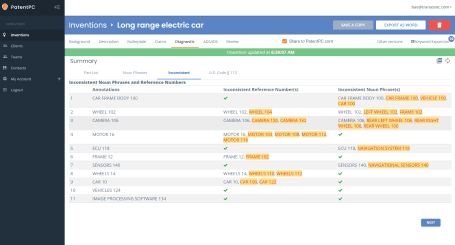
PowerPatent is built around this reality. It helps founders capture working systems as they exist, not as abstract ideas remembered later.
The platform guides users to explain mechanisms, decisions, and outcomes in plain language, while real patent attorneys ensure the explanations meet legal standards.

This approach reduces enablement risk without slowing down execution. It aligns patent strength with how modern teams actually build.
The Hidden Difference Between Promises and Proof in Patents
Many patents sound impressive at first glance. They talk about results. They describe benefits. They paint a clear picture of what the invention is supposed to achieve.
But when those patents are examined closely, the strength does not come from the promise of the result.
It comes from the proof of how the result is reached. This difference is subtle, but it decides whether a patent survives scrutiny or quietly collapses when tested.
Promises are easy to write. Proof takes work. And that work is exactly what enablement demands.
Why Promises Feel Natural to Founders
Founders are trained to think in outcomes. You build something to solve a problem.
You measure success by improvement. Faster processing. Lower cost. Better accuracy. When you describe your invention, your instinct is to lead with those wins.
That instinct is useful in sales and fundraising. It is dangerous in patents.
A promise focuses on what the system achieves. Proof focuses on how the system operates. When patents lean too heavily on outcomes, they skip the operational detail that enablement depends on.
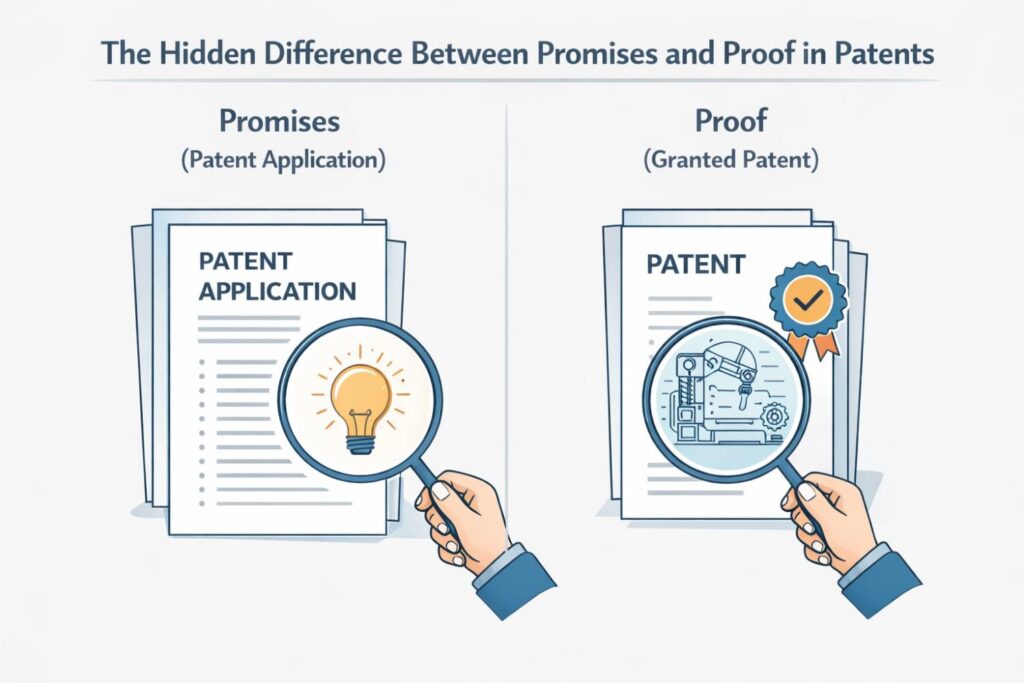
The shift founders must make is small but critical. Instead of asking “what does this do,” the patent must answer “what happens, step by step, when this runs.”
How Promises Hide Missing Understanding
Promises can hide gaps in understanding, even from the inventor. A system might appear to work, but the exact reason it works may not be fully clear. In product development, this can be acceptable. In patents, it is risky.
Enablement assumes that the inventor possessed the invention at the time of filing.
Possession means understanding. When a patent only promises results, it leaves room for doubt about whether the inventor truly understood the mechanism.
Proof removes that doubt. It shows not just that the system worked, but that the inventor knew why it worked.
The Danger of Outcome-Driven Language
Language centered on outcomes often avoids specifics.
The patent says the system improves efficiency without explaining which steps were removed. It says accuracy increases without explaining what errors were reduced. It says decisions are optimized without explaining how choices are evaluated.
This language sounds confident, but it does not teach.

Enablement requires that the reader can follow the logic of the system. Outcome-driven language forces the reader to imagine that logic themselves. That is where patents fail.
A useful internal check is to ask whether the patent explains causes, not just effects. If effects dominate, proof is missing.
Proof Anchors the Patent in Time
Promises exist in the future. Proof exists in the past. This difference matters because patents are judged years after they are filed.
When a patent is reviewed long after filing, the only thing that matters is what the inventor actually knew at that time. Promises blur that line. Proof defines it.
A proof-based patent captures a snapshot of real understanding. Even if the technology evolves, the disclosure remains grounded in a concrete moment. That grounding makes it harder to argue that the patent was speculative.
How Proof Shapes Examiner Behavior
Patent examiners read thousands of applications. They quickly learn to distinguish between confidence and substance. When they see proof, they slow down. They engage. They trust.
When they see promises stacked on promises, they become skeptical. They question whether the disclosure supports the claims. They interpret language narrowly. They issue rejections that are difficult to overcome.
This is not about bias. It is about workload. Proof reduces ambiguity. Promises create it.
Founders who want smoother prosecution should understand that proof is not just a legal requirement. It is a communication tool.
The Silent Narrowing of Claims
One of the most costly effects of promise-heavy patents is silent narrowing. Even if claims are allowed, they may be interpreted much more narrowly than expected.
When the description lacks proof, courts later limit claims to the few things that were actually explained. Broad language without support becomes meaningless.
Proof expands effective scope. It gives claims something to attach to. It allows reasonable interpretation instead of strict limitation.
This directly affects enforcement strength. A narrow patent rarely deters competitors. A well-supported one often does.
Why Proof Does Not Kill Flexibility
Many founders avoid proof because they fear locking themselves in. They worry that describing one working system will limit future versions.
This fear misunderstands how patents work.
Proof does not define the ceiling. It defines the floor. It shows one way the invention works, then allows claims to reach beyond that example as long as the variations make sense.
Without a floor, there is nothing to build on. Flexibility without foundation is not breadth. It is fragility.
Proof as a Business Asset, Not a Burden
Proof strengthens more than legal position. It strengthens business perception.
During due diligence, investors and acquirers read patents to assess execution risk. Proof signals that the company can build what it claims. Promises raise questions about maturity.
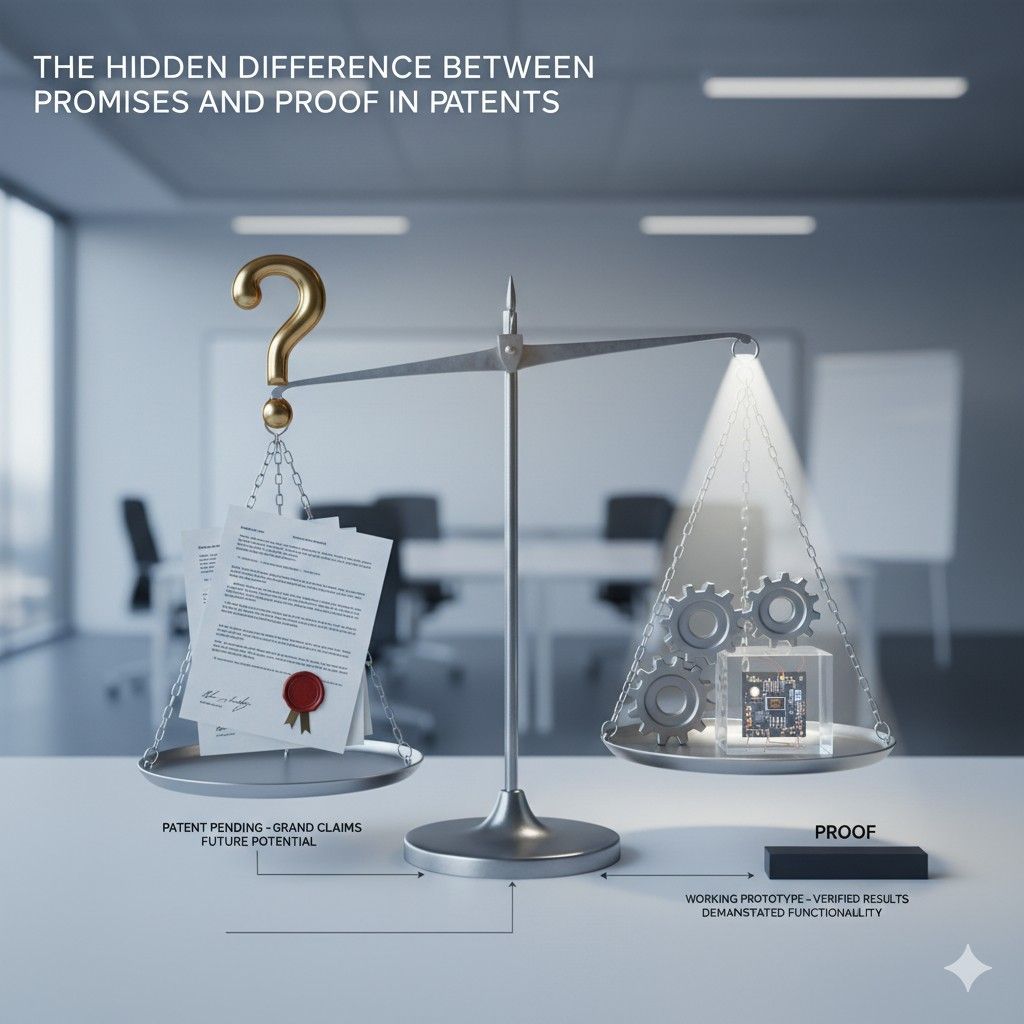
Proof also supports partnerships. When another company evaluates your technology, clear explanations build confidence. Vague outcomes invite skepticism.
In this way, proof increases enterprise value. It turns patents from paperwork into assets.
How Teams Accidentally Strip Out Proof
Proof often disappears late in the drafting process. Early notes may be detailed. Drafts get refined. Language gets generalized. Specifics are removed to sound more professional.
This is where many patents lose their strength.
Businesses should protect proof during editing. Simplification should clarify, not erase. If a detail explains how the system works, it likely matters.
A good rule is that polishing should never remove causality. If a sentence explains why something happens, keep it.
Shifting the Company Mindset Around Patents
The strongest patent portfolios come from companies that treat patents as technical documents, not marketing assets. They reward clarity over polish. They value explanation over ambition.
This mindset shift starts with leadership. When founders emphasize proof internally, patent quality improves naturally. Engineers feel comfortable explaining details instead of hiding them.
Over time, this creates a culture where enablement is built into how the company documents its work.
How PowerPatent Helps Founders Capture Proof
PowerPatent is designed to pull proof out of real systems without adding friction.
Instead of asking founders to imagine future versions, it asks them to explain what already runs. What inputs exist. What outputs are produced. What decisions are made.
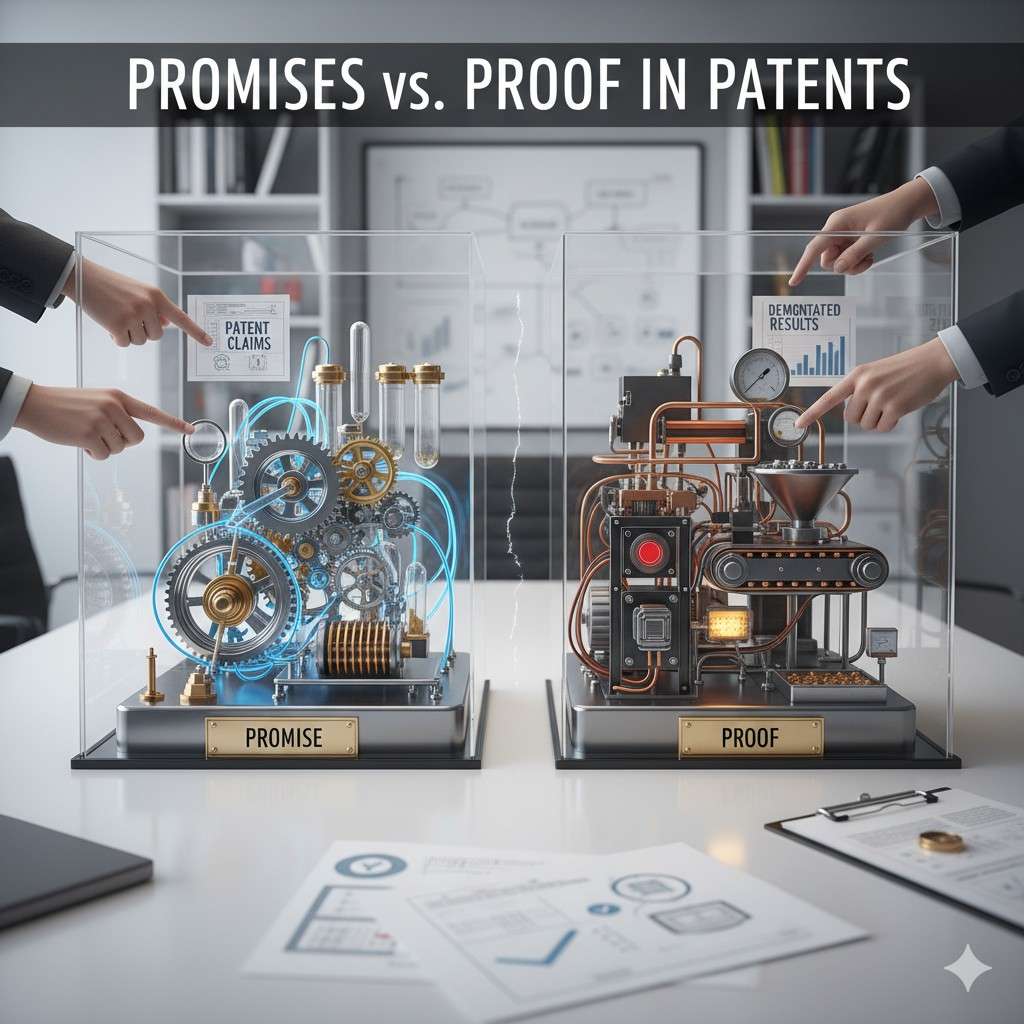
Real patent attorneys then shape that proof into disclosures that meet enablement standards while still supporting broad claims. This ensures that patents are grounded in execution, not aspiration.
How Example Quality Determines Patent Strength
Example quality quietly determines whether a patent is durable or fragile. Long before claims are challenged, enforced, or licensed, examples shape how the entire patent is understood.
They influence trust, scope, and credibility in ways most founders never see until it is too late.
This section goes deeper into why example quality matters so much, how weak examples quietly erode value, and what strong companies do differently.
Examples Are Where Belief Is Formed
When someone reads a patent, belief is not created by claims. It is created by examples. Examples answer the unspoken question every reader has: did this actually work, or is this just well-written language.
A high-quality example creates confidence without trying to. It walks the reader through behavior in a way that feels natural and complete. The reader stops doubting and starts following.
Low-quality examples do the opposite. They trigger suspicion. The reader begins looking for holes, even if the claims sound impressive.
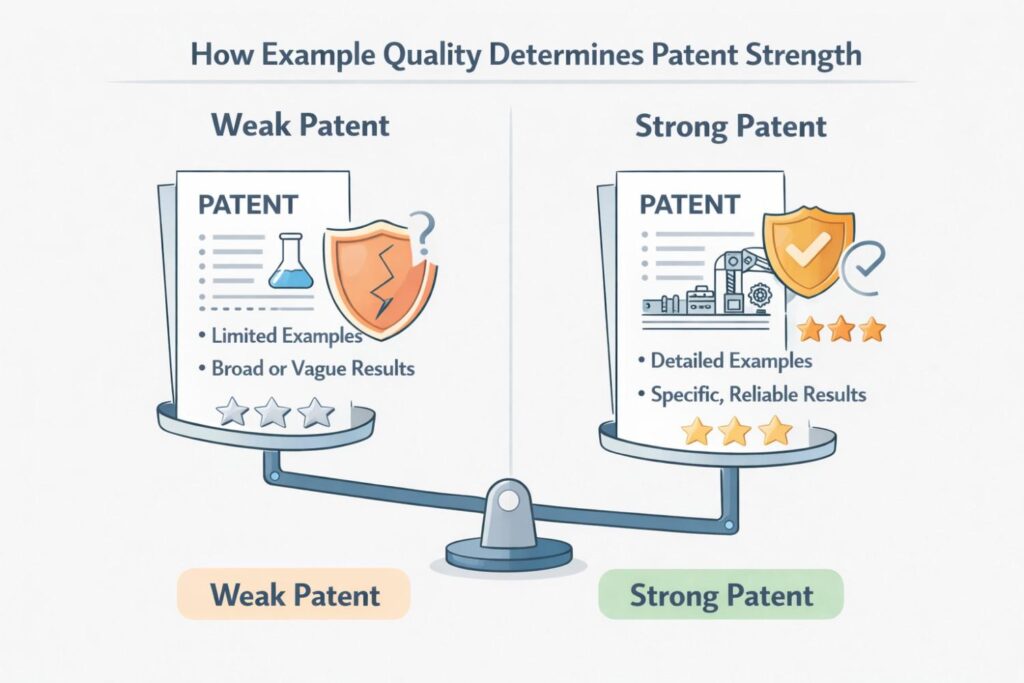
This emotional shift matters. Enablement is not only technical. It is interpretive. Belief changes how generously or narrowly the patent is read.
How Examples Define the Meaning of Words
Patent words do not exist in isolation. Their meaning is shaped by context. Examples provide that context.
When a patent uses terms like processor, module, model, or engine, the example shows what those words actually mean in practice. Without that grounding, terms become vague placeholders.
Courts rely heavily on examples to interpret claim language. If the example is thin, the meaning of the claim narrows. If the example is rich, the claim gains depth.
This means example quality directly affects how much protection you really have, regardless of how broad the claim language looks.
The Difference Between Surface Detail and Structural Detail
Not all detail improves example quality. Surface detail talks about what the system does at a high level. Structural detail explains how it does it.
Surface detail sounds polished but teaches little. Structural detail teaches without being complicated. It explains relationships, sequences, and dependencies.
Strong examples focus on structure. They show how components interact, how information moves, and how decisions are made. This kind of detail supports enablement without overwhelming the reader.
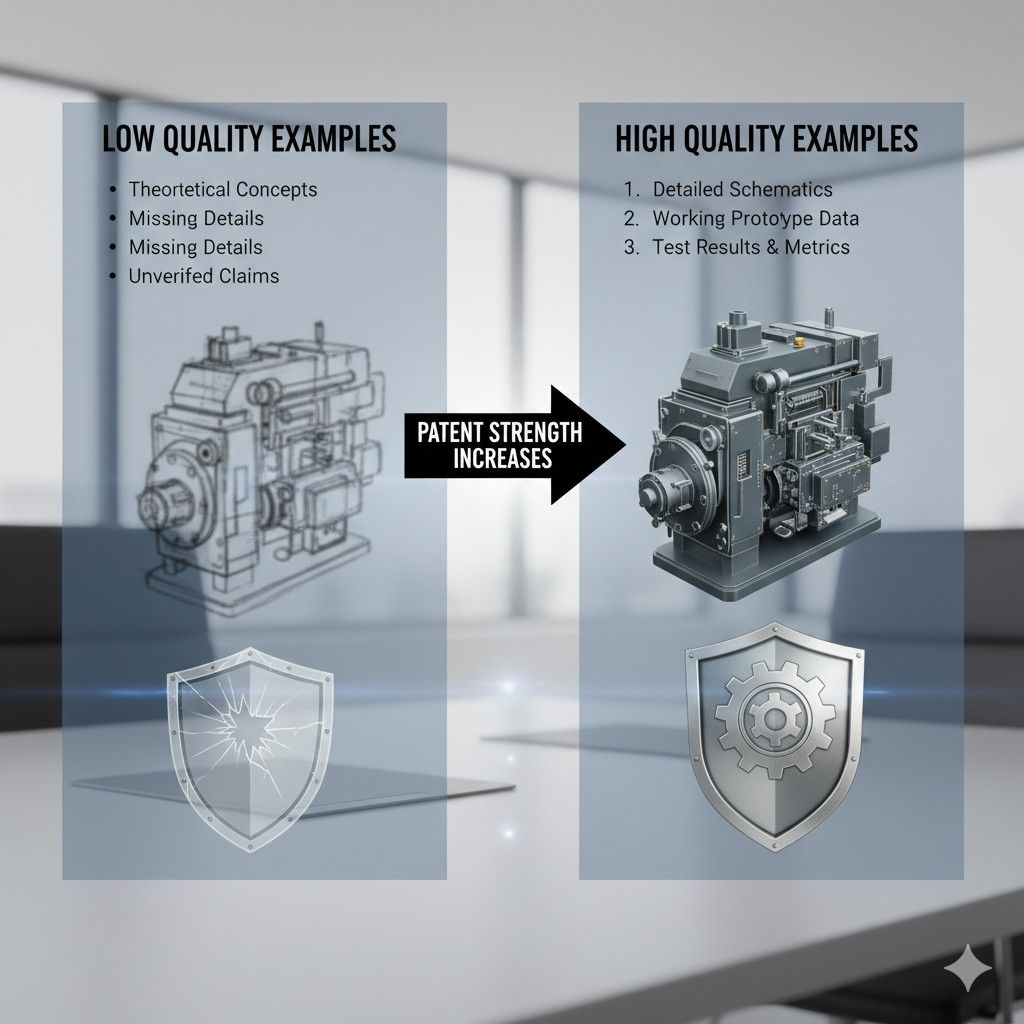
Weak examples often include many words but little structure. They describe behavior without explaining cause.
Why Examples Reveal Possession Better Than Claims
Possession is a core requirement of patent law. It asks whether the inventor truly had the invention at the time of filing.
Claims assert possession. Examples demonstrate it.
An example that explains why certain steps were chosen, how problems were handled, and what constraints existed shows real ownership of the solution. It reflects lived experience.
This is especially important when patents are challenged. Judges and juries look to examples to decide whether the inventor was guessing or knew what they were doing.
Example Quality and Technical Credibility
Technical readers can sense weak examples quickly. Engineers reading patents look for coherence. They want to see logic that matches how systems are actually built.
When examples gloss over hard parts or skip key transitions, technical readers disengage. This matters because many patent disputes involve expert witnesses who are deeply technical.
High-quality examples withstand expert scrutiny. They align with real-world engineering practice. They do not rely on magic steps or unexplained leaps.
This technical credibility becomes a shield during enforcement.
How Example Quality Influences Claim Breadth Without Saying So
Patents rarely say how broad they truly are. Example quality decides that behind the scenes.
When an example clearly explains which parts of the system are essential and which are flexible, the patent can credibly cover variations. The reader understands the invention’s core.
When an example fails to explain this, every variation becomes questionable. Scope shrinks, not because the claims say so, but because the support is missing.
This is why two patents with identical claims can have very different strength. One earned its scope through example quality. The other did not.
The Compounding Effect of Multiple Strong Examples
One strong example is powerful. Multiple strong examples compound that power.
When a patent includes several examples that approach the invention from different angles, it reinforces understanding. It shows that the inventor explored the solution space, not just one narrow path.
This does not mean adding volume. It means adding perspective. Different inputs. Different configurations. Different use cases, all grounded in real behavior.

Each additional high-quality example reduces ambiguity and increases resilience.
How Weak Examples Invite Design-Arounds
Competitors read patents looking for edges. Weak examples make that easy.
When examples are vague, competitors can convince themselves they are outside the patent’s scope. They design around language instead of substance.
Strong examples make design-arounds harder. They clarify the invention’s essence. Competitors must work harder to avoid infringement.
This deterrent effect is one of the most overlooked benefits of example quality.
Examples as Evidence During Disputes
In disputes, examples become evidence. They are pointed to, quoted, and dissected.
If an example clearly explains how a system works, it supports infringement arguments. If it is vague, it undermines them.
This is why example quality affects not just validity, but enforceability. A patent that cannot be confidently explained to a judge or jury loses leverage quickly.
Why Founders Often Undervalue Examples
Founders often see examples as filler. They focus on claims because claims feel official.
This is a mistake driven by unfamiliarity. In reality, examples do most of the heavy lifting. They make claims believable.
Once founders understand this, their approach changes. They invest time in explaining real behavior instead of polishing abstract language.
This shift alone dramatically improves patent strength.
Building a Habit of Strong Example Capture
Strong examples rarely come from memory. They come from documentation created during development.
When teams document how systems behave as they build them, they naturally produce high-quality examples. When they wait, details fade and examples weaken.
Businesses that value IP build example capture into their workflows. They treat explanation as part of engineering, not an afterthought.
How PowerPatent Helps Founders Get Examples Right
PowerPatent is built to elevate example quality by starting with what actually exists. The platform encourages founders to explain real system behavior, real data paths, and real decisions.
Instead of abstract prompts, it asks concrete questions that surface structure. Real patent attorneys then shape those explanations into strong disclosures that support broad claims.
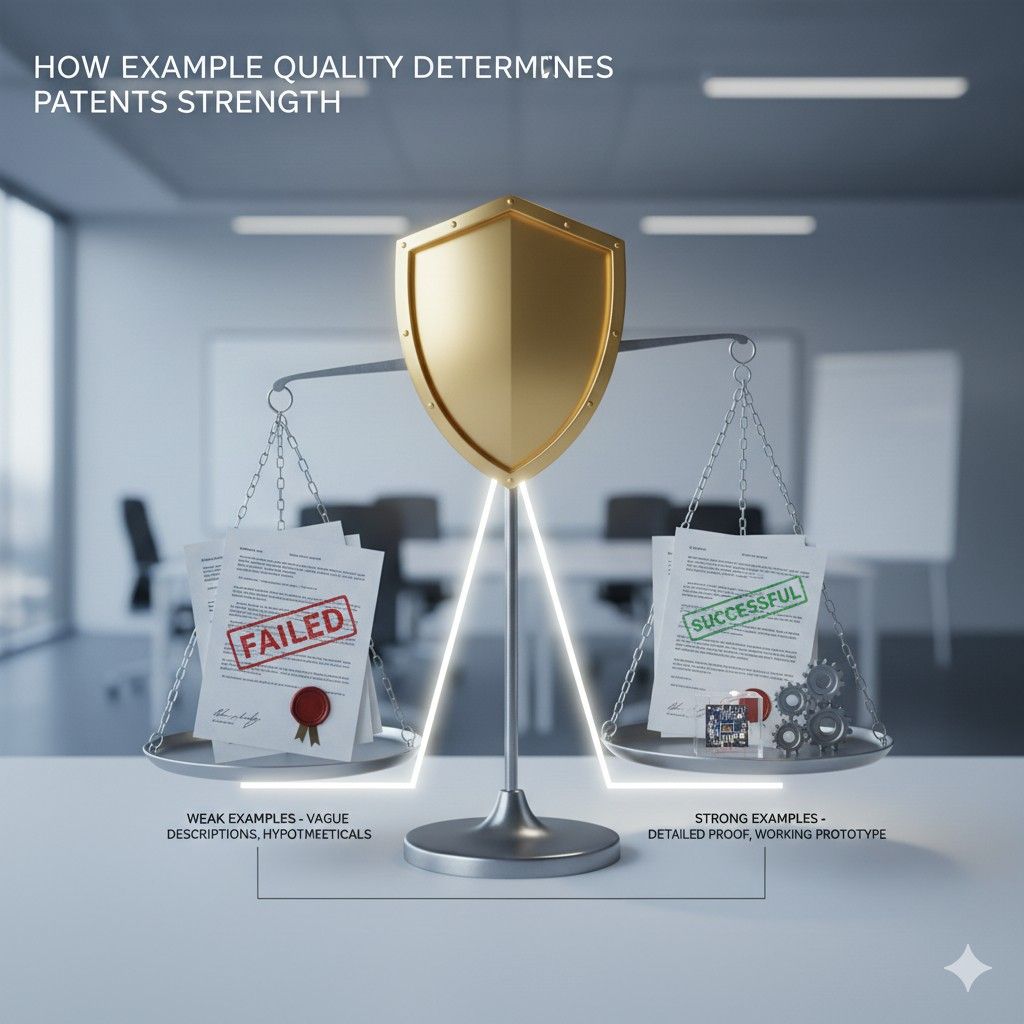
This process ensures that example quality strengthens enablement, scope, and enforceability at the same time.
Wrapping It Up
Enablement is not a mystery, and it is not a technical trap. It is a reflection of how clearly you explain what you actually built. Throughout this article, one pattern keeps showing up. Patents fail when they lean on hope, prediction, or polished language instead of real execution. They succeed when they are grounded in working examples, clear mechanisms, and honest explanation. Prophetic examples feel safe, but they weaken trust. Promises sound impressive, but they age poorly. Weak examples invite doubt, narrowing, and challenge. None of these failures come from bad inventions. They come from skipping the hard but necessary work of teaching.